Glyphosate: What Indigenous communities have suspected for years about the dangers of the herbicide

Source: The Conversation – Canada – By Charles Z. Levkoe, Canada Research Chair in Equitable and Sustainable Food Systems, Lakehead University

There have been renewed questions around the safety of the herbicide glyphosate in light of the recent retraction of an influential peer-reviewed research article. Originally published in 2000 in the academic journal Regulatory Toxicology and Pharmacology, the article claimed that glyphosate posed no risk to human health.

Glyphosate is widely used in forestry, agriculture and land-use management. Commercially sold under brands such as Roundup, it’s the most widely used herbicide in Canada.

In the journal’s retraction notice, the (co)editor-in-chief wrote: “Concerns were raised regarding the authorship of this paper, validity of the research findings in the context of misrepresentation of the contributions by the authors and the study sponsor and potential conflicts of interest of the authors.”

These potential conflicts raise questions about the study’s authorship and results, and renew concerns about the safety of glyphosate. According to Health Canada, consuming foods treated with glyphosate does “not result in any human health concern to any segment of the population.” This aligns with findings from other governments, including the United States, New Zealand and Australia.

Scientific research is an essential part of protecting the health and well-being of people and the planet, but it only tells part of the story. And despite some conclusions that glyphosate poses no risk, there have long been concerns regarding its impacts on the environment and human health, particularly from Indigenous communities.

Our ongoing research, in partnership with the Animbiigoo Zaagi’igan Anishinaabek (AZA) First Nation in northwestern Ontario, about the impact of glyphosate being sprayed on their traditional territory demonstrates that policymakers and researchers need to learn from the experiences of people living and working on the land.

Concerns over glyphosate

Our research focuses on glyphosate’s impacts on AZA’s relationships with the land along with the forestry companies and provincial government that use and regulate the herbicide on their territory. Through our work with 14 First Nations that are part of the Understanding Our Food Systems project, several communities expressed great concern about environmental contaminants on their territories.

Members of the AZA have been particularly distressed about the impacts of glyphosate on their traditional food systems, the land and watershed, and the community’s health for several years. People who live and work on the land have noticed many changes and called for research and action to address these concerns.

In 2015, the International Agency for Research on Cancer classified glyphosate as “probably carcinogenic to humans” based on “limited” evidence it causes cancer in people and “sufficient” evidence it causes cancer in animals.

This has been of particular concern for many Indigenous communities in terms of the impact of glyphosate being sprayed on the berries, animals, medicines and fish that make up their traditional food systems.

While several health-related issues have been connected to glyphosate use, such as destruction of cells, inflammation that can damage healthy tissue and weakening of the immune system’s ability to defend the body against infections and disease, there is no clear consensus on what level is considered safe.

Working closely with AZA, our team of researchers from Lakehead University and the Thunder Bay District Health Unit conducted a series of sharing circles and interviews with Elders, Knowledge Keepers, hunters, gatherers and youth to learn from their observations and experiences.

The ultimate goal of our ongoing research is to better understand the community’s experiences and perspectives of glyphosate to ensure they retain access to traditionally hunted, harvested and grown foods and to protect the environments they depend on.

Listening to Indigenous people

AZA members pointed to ways that traditional knowledge could be used to better understand the impacts of environmental contamination. Those who participated in the conversations shared experiences of finding fewer animals and plants in areas sprayed with glyphosate, making access to traditional foods difficult.

Many participants said animals were more diseased and that harvested and hunted foods did not taste, smell or look the same as they did previously. Disruptions to the cycles of the land and the loss of species impact the community’s food security as well as its self-determination and ability to transfer knowledge to future generations.

Western science tends to dominate policymaking and regulation. However, Indigenous knowledge has a lot to contribute to research and decision-making. Two-eyed seeing, described by Mi’kmaw Elder Albert Marshall, is a way to integrate Indigenous and western ways of knowing, foster deeper understanding and create more holistic, balanced approaches for the benefit of all.


Read more:
How Two-Eyed Seeing, ‘Etuaptmumk,’ is changing outdoor play in early childhood education


This demands that policymakers take seriously the concerns voiced by Indigenous people around environmental contamination. It also requires more transparent communication, accessible information and testing of waterways, animals and the land.

Listening to Indigenous people and learning from their observations and experiences is essential to protect the lands and waters where they hunt, harvest, and grow foods and medicines, and to ensure the health and well-being of all human and non-human kin.

This article was co-authored by Dorothy Rody from the Animbigoo Zaagi’igan Anishnaabek First Nation, Kim McGibbon, a public health nutritionist at the Thunder Bay District Health Unit, and Liz Lovell, a former master’s student in health sciences at Lakehead University.

The Conversation

Charles Z. Levkoe receives funding from the Social Sciences and Humanities Research Council of Canada, Indigenous Services Canada and the Thunder Bay District Health Unit.

ref. Glyphosate: What Indigenous communities have suspected for years about the dangers of the herbicide – https://theconversation.com/glyphosate-what-indigenous-communities-have-suspected-for-years-about-the-dangers-of-the-herbicide-274389
Social studies as ‘neutral?’ That’s a myth, and pressures teachers to avoid contentious issues

Source: The Conversation – Canada – By Kevin Lopuck, PhD Candidate, Faculty of Education, University of Manitoba

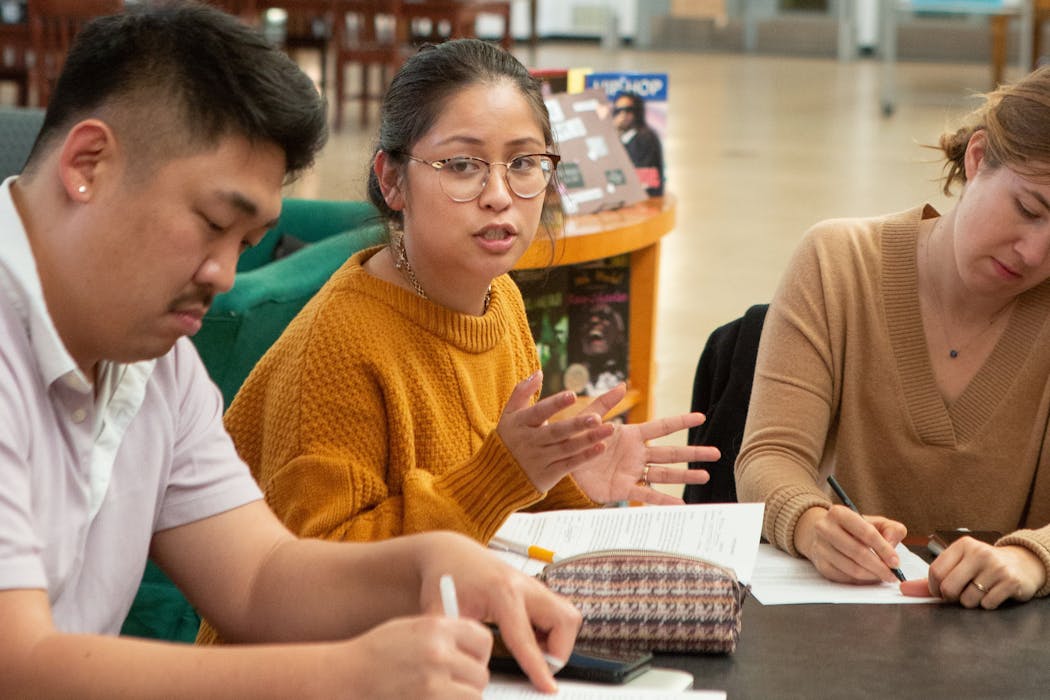
Social studies teachers face the distinct task of guiding students through pressing global issues and contentious dialogue.

(Allison Shelley/EDUimages), CC BY-NC

With a world literally and figuratively burning around them, high school social studies teachers are charged with engaging students in sensitive topics.

Social studies curricula today, for example, is concerned with themes like residential schools and racism. It’s also important to understand that beyond following explicit pre-set curricula, student-centred education calls for teachers to attend to students’ experiences in the social world.

This means making space for students’ observations or questions about current events like the ICE raids in Minnesota and inquiring into how unfolding events fit into larger social and historical patterns or themes. These conversations are a legitimate and everyday part of many social studies classrooms.

Social studies education demands sustained engagement with difficult knowledge and a heightened sense of obligation to both students and society, even as neoliberal and neoconservative pressures call for a stance of neutrality, which is neither possible nor desirable.

The weight of difficult knowledge

While teaching is widely recognized as stressful and teachers struggle with burnout, the relationship between that stress and specific subject curriculum is under-explored.

Social studies teachers are often required to dwell in the dark places of what Deborah Britzman, who researches the history of psychoanalysis and education, calls difficult knowledge. This pertains to traumatic histories that expose human vulnerability or violence — knowledge that is too much to bear or “make sense” of.

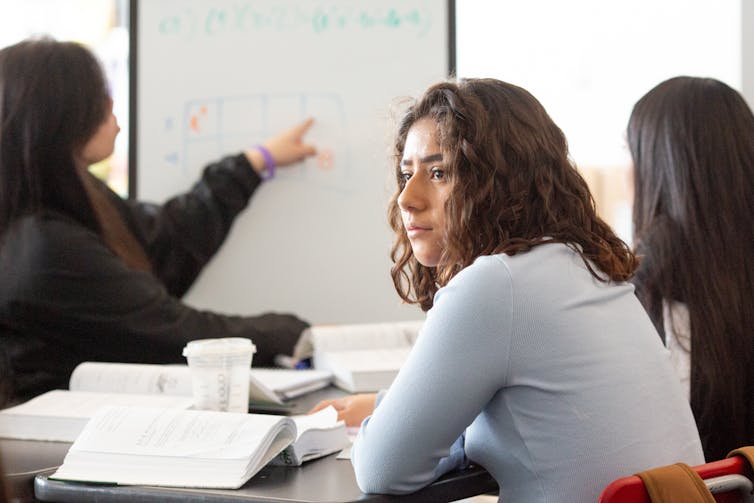
A student with a pensive look on their face.
In social studies classrooms, people are dwelling with difficult knowledge.
(Allison Shelley/EDUimages), CC BY-NC

While teacher stress, burnout and demoralization are well-studied, the weight I’m thinking about in my doctoral research and as a social studies teacher comes from social studies’ teachers’ sense of obligation to their students in this moment, to their discipline and to democracy — and the way carrying this weight exacts an emotional toll.

In this way, teaching social studies differs from other subjects. While all teachers are burdened by increasing demands, overburdened systems and rising public attacks from the “parental rights” movement, social studies teachers face the distinct additional task of guiding students through difficult knowledge, pressing global issues and contentious dialogue.

Pressures outside the classrooms

For example, immediately following the Hamas attacks in Israel on Oct. 7, 2023, and Israel’s subsequent military assault on Gaza, students in my rural Manitoba high school social studies class approached me with the expectation that I could help them understand what was happening.

In that moment, I became acutely aware not only of the obligation I felt to help my students, but also of the simultaneous contexts and pressures shaping how I might respond. I knew how deeply divisive this issue was in the public sphere, and consequently how any discussion that included Palestinians, Israeli state violence or historical context could be interpreted as taking sides beyond the classroom.


Read more:
Flawed notions of objectivity are hampering Canadian newsrooms when it comes to Gaza


It would have been simpler to just not engage with the topic. Yet, as a social studies teacher, I carried what I experienced as an emotionally weighty obligation to my students, the curriculum and to act in a way that reflected a broader moral responsibility. This led me to seek to understand, in my current doctoral research, how other high school teachers in Manitoba were experiencing their work.

My early findings from focus groups and qualitative interviews with approximately 20 Manitoba social studies teachers suggest these teachers experience a significant emotional toll linked to their sense of obligation to students and to the betterment of humanity.

Throughout this early research, Israel/Gaza has frequently been named as a flashpoint in classrooms, with many teachers expressing hesitation about engaging with the topic due to fears of backlash from parents, administrators or the broader community. In this sense, the weight of teaching difficult knowledge is not only personal, but collective and structural.

A ‘neutral space’ isn’t possible

A factor shaping pressures teachers perceive in how they guide and support difficult discussions is a dominant misinformed belief that the classroom is, or should be, a “neutral space” — an expectation that is neither possible nor desirable.


Read more:
How to curb anti-Black racism in Canadian schools


Teaching is inherently political insofar as it explicitly or implicitly validates or excludes certain perspectives and voices. The social studies classroom is never a neutral space.

What is taught — what some researchers call the explicit curriculum — is the result of political decision-making by curriculum developers appointed by politicians. What is left out (what some have called “null” curriculum) is equally political.

Myth of neutrality

Even the expectation of neutrality is political: choosing not to take a stance is itself a decision with ethical and political consequences. Teachers’ classroom choices, their responses to students, the framing of discussions, the arrangement of the classroom and even the ways they present themselves are all laden with values.


Read more:
Education for reconciliation requires us to ‘know where we are’


Expecting teachers to remain neutral ignores this reality and creates a false tension between “being impartial” and fulfilling professional and ethical obligations. Allowing a student’s derogatory or historically false comment to pass unchallenged, for example, is a political choice.

The myth of neutrality pressures teachers to self-censor and avoid contentious issues, contributing to emotional and professional strain.

Engagement with contentious issues required

Contemporary curricula increasingly emphasize global competencies, with critical thinking as a central goal.

Because the classroom is inherently political, teachers must make choices about how to engage. One approach, described by education scholar Thomas E. Kelly as “committed impartiality,” encourages teachers to share their own beliefs while welcoming all opinions and fostering dialogue.

This framework helps teachers respond thoughtfully when students express ideas carelessly or provocatively, guiding classroom discussion in ways that promote critical thinking.


Read more:
4 ways to empower students to spark social change


Whichever approach is taken, classroom interactions take place within the “lived curriculum,” — how students experience what happens in a class.

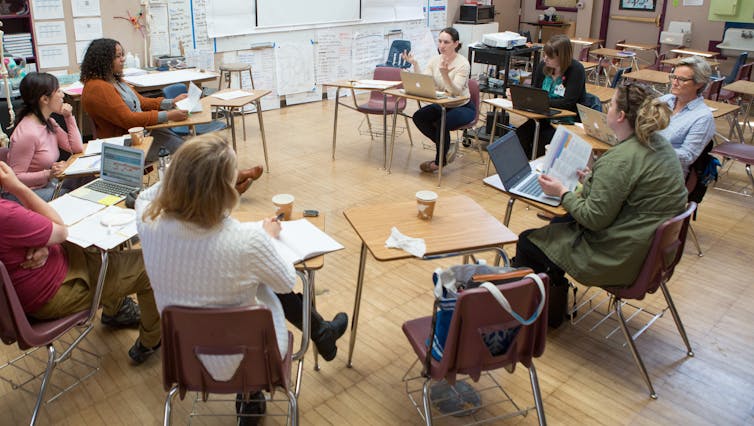
Teachers seen in a circle in discussion.
Expecting teachers to remain neutral creates a false tension between ‘being impartial’ and fulfiling obligations.
(Allison Shelley/EDUimages), CC BY-NC

Sharing weight, creating hope

If teachers feel unable to address the deaths of more than 70,000 people in Gaza or to critically look at the American government’s excessive use of force that has resulted in the deaths of civilians or to recognize the impact of human-caused climate change, what does this say about our collective ability to confront urgent crises and foster informed, empathetic democratic citizens?

By creating space for social studies teachers to share how they experience their work, feelings can be acknowledged and named. This can be part of offering teachers tools to practise self-inquiry to help inform responsible and sustainable classroom practise.

Like teachers’ work with students, these conversations may be messy, emotional and deeply human, and they may even make us want to retreat into isolation. But we are better when we can recognize and name the weight, lean into the collective and remain in the work together.

As I begin to analyze my research with social studies teachers, I am struck by a sense of hope in the ways they continue to engage in difficult conversations. What stands out is not denial of the darkness, but a persistent commitment to hope through teaching that encourages students to act, respond and participate in shaping a more just world.

The Conversation

Kevin Lopuck is affiliated with the Social Studies Educators Network of Canada.

ref. Social studies as ‘neutral?’ That’s a myth, and pressures teachers to avoid contentious issues – https://theconversation.com/social-studies-as-neutral-thats-a-myth-and-pressures-teachers-to-avoid-contentious-issues-269175

The backlash to Bad Bunny’s halftime show reveals how MAGA defines who belongs in America

Source: The Conversation – Canada – By Gavin Furrey, PhD Student, Political Science, L’Université d’Ottawa/University of Ottawa

Benito Ocasio, better known as his stage name Bad Bunny, has challenged English dominance in music over the past few years. The streaming era has allowed the Puerto Rican artist to bypass traditional gatekeepers and he recently became Spotify’s most streamed artist globally for the fourth time in his career.

He also made history at the 2026 Grammy Awards, becoming the first artist to win album of the year for a record sung entirely in Spanish, DeBÍ TiRAR MáS FOToS.

Yet his selection to perform at this year’s Super Bowl halftime show has sparked controversy and backlash from President Donald Trump’s administration and its supporters in the United States.

The U.S. has a long history of excluding Latinos from its sense of national identity. In this current era of MAGA politics, Bad Bunny is exposing the many ways the American conservative right has narrowed its ideas about who truly “belongs” in America.

Borders around — and within — the U.S.

Borders have been central to MAGA politics, most clearly demonstrated by Trump’s hardline stance on immigration. So too has the subject of who can count themselves as part of “the people” — not simply who we agree with, but who is seen as deserving protection and belonging.

In MAGA’s political logic, citizenship status is only one factor of this. Race, language, sexual orientation, gender identity and political leanings have all emerged as markers of belonging or exclusion.

Conservative commentator Tomi Lahren’s insistence that Bad Bunny is “not an American artist,” U.S. Secretary of Homeland Security Kristi Noem’s threats to have ICE present at the halftime show and one Fox News host’s description of Ocasio as a “cross-dresser who doesn’t speak English” all reveal the importance of ethno-nationalist and populist border-making for the American right.

In this regard, history is repeating itself. In 1936, the U.S. forcibly removed up to two million people of Mexican descent from the country — up to 60 per cent of whom were American citizens. More recently, between January and October 2025, approximately 170 American citizens were detained by ICE, including young children and pregnant women.

Partly as a result of the Mexican-American war (1846-48), Latinos — and Mexicans in particular — were racialized in the U.S. in ways that positioned them not as internal “others,” but as “aliens” imagined to be external to the nation.

This logic resurfaced in Arizona’s ethnic studies ban, which targeted a Mexican-American studies program in Tucson between 2010 and 2016. Beyond territorial boundaries, this policy drew boundaries around the national story the country tells about itself.

Puerto Rico and second-class citizenship

Puerto Rico’s political status is another manifestation of Latino alienation in the U.S. As an unincorporated territory, Puerto Ricans have no voting representation in congress and cannot vote for president.

Puerto Ricans are arguably treated as second-class citizens in the U.S.. In 2017, nearly 3,000 Puerto Ricans died waiting for assistance after Hurricane Maria struck. In contrast, the number of direct and indirect deaths for hurricanes that struck Florida and Texas weeks earlier was 84 and 94 respectively.

Bad Bunny has been vocal about this neglect. He has regularly stood up for Puerto Rico, including cancelling his European tour in 2019 to protest the Puerto Rican governor’s sexist and homophobic comments.

He also excluded the dates on the continental U.S. during his most recent tour to avoid drawing ICE attention to his fans, and also spoke out against ICE at the recent Grammys, saying “ICE out.”

Despite not identifying as queer himself, Bad Bunny has also been a consistent ally of the LGBTQ+ community. In 2020, he wore a skirt on The Tonight Show Starring Jimmy Fallon to bring attention to the killing of a transgender woman in Puerto Rico.

Following the ICE slayings of Renee Good and Alex Pretti, demanding that authorities be held accountable appears to have joined the list of MAGA’s targetable offences. Bad Bunny’s embrace of people different from him may be yet another point of friction for the cult of national purity that the MAGA movement advocates for.

The dog-whistle of ‘family-friendly’

Turning Point USA is hosting an alternative “All American” Super Bowl halftime show “celebrating faith, family and freedom” — a description that reinforces right-wing ideas of nationhood and acts as a dog whistle for racial, sexual, linguistic and national purity.

One could argue the Turning Point show isn’t about race or exclusion, but it’s a difficult argument to sustain given the pattern of recent backlash.

Since 2019, Jay-Z’s company Roc Nation has collaborated with the NFL to rebuild the league’s image after its conflict with Colin Kaepernick, who was effectively pushed out of the league after kneeling during the national anthem to protest police violence and racial injustice.

The partnership has increased visibility for genres associated with resistance and resilience, including hip hop, rap and now reggaeton.

A more inclusive, somewhat diplomatic, selection process has pushed the halftime show into the realm of cultural relevancy, allowing the NFL to reach new communities. In America’s polarized climate, however, what counts as relevant is up for debate.

In 2020, complaints sent to the Federal Communications Commission about Shakira and Jennifer Lopez’s Super Bowl halftime show described it as “inappropriate.”

In 2022, complaints about Kendrick Lamar’s show revolved around alleged “anti-American” themes, inappropriate lyrics, an all-Black dance crew and moments when Lamar grabbed his crotch.

Concerns of “family friendly” content are evoked. Yet, they stand close to discourses of anti-Americanism and concerns about a lack of white representation. Turning Point USA doesn’t need to explicitly evoke race or language to signal it.

A political stage — whether we admit it or not

Many argue the NFL halftime show has become politicized. But in reality, it’s always been an inherently political event.

Who gets to be seen on a broadcast with hundreds of millions of viewers, who is considered a conventional choice and who is deemed provocative all involve questions about who really belongs — and who doesn’t.

The Super Bowl halftime show is just one manifestation of a larger conversation happening in the U.S. about the validity of a variety of expressions of the American experience.

The MAGA movement may have won the White House, but in terms of America’s cultural values and tastes, its borders aren’t stopping millions of Americans from getting excited about the show.

The Conversation

Gavin Furrey does not work for, consult, own shares in or receive funding from any company or organisation that would benefit from this article, and has disclosed no relevant affiliations beyond their academic appointment.

ref. The backlash to Bad Bunny’s halftime show reveals how MAGA defines who belongs in America – https://theconversation.com/the-backlash-to-bad-bunnys-halftime-show-reveals-how-maga-defines-who-belongs-in-america-274815

Does the exodus to UpScrolled signify the end of TikTok?

Source: The Conversation – Canada – By Jaigris Hodson, Associate Professor of Interdisciplinary Studies, Royal Roads University

Soon after American investors took control of TikTok’s U.S. operations, users started complaining that content on certain topics was being suppressed. (Unsplash/Appshunter.io)

Until recently, you might have never heard of the TikTok competitor UpScrolled. But as of Jan. 29, the app reached No. 1 one in Apple’s app store as disgruntled TikTok users in the United States rushed to sign up.

The exodus to UpScrolled comes after a group of American investors, including Oracle founder Larry Ellison, acquired a majority stake in TikTok’s U.S. operations on Jan. 22, a day before the deadline set by President Donald Trump for the app’s U.S operations to be separated from Chinese parent company ByteDance.

Trump and other American officials have long pushed for acquiring TikTok’s U.S. operations, citing concerns over China accessing the data of U.S. citizens. However, soon after the acquisition, TikTok users started complaining of shadow banning, a disputed tactic whereby people suggest social media sites will allow you to post, but will not allow anyone else to see what you post.

The acquisition comes amid civil unrest in the U.S. as Immigration and Customs Enforcement officers (ICE) conduct raids in cities like Minneapolis that have resulted in multiple deaths and hospitalizations. Concerned users have been uploading video documenting ICE’s actions, but began to notice their videos were not garnering any attention on TikTok, or sometimes, not uploading at all following the acquisition.


Read more:
Blaming ‘wine moms’ for ICE protest violence is another baseless, misogynist myth


Users posting about other topics such as Palestine have also expressed concerns about censorship. Palestinian journalist Bisan Owda’s account was banned shortly after the acquisition. It was restored following an outcry from users.

TikTok says anyone experiencing a disruption over the last couple of weeks has not been shadow banned; it was result of technical problems following a polar vortex and associated weather-related issues. But this statement from U.S. TikTok came after one million downloads of UpScrolled and reports of concerned users deleting TikTok.

Controlling the algorithm

It may indeed be a coincidence that people had trouble uploading videos critical of ICE at a time of changing ownership, but the whole incident had users talking.

As part of the acquisition, TikTok has been programmed with a new U.S.-specific content moderation algorithm that influences what people do and don’t see. Like with every other social network, the algorithm is considered proprietary information, meaning no academic nor policymaker can independently audit it.

Trump has expressed interest in controlling social media algorithms, so it’s no wonder people are connecting the outage with possible censorship. Looking at Reddit posts about the TikTok sale reveals how upset some users are.

It’s well known that China engages in censorship on the Chinese version of TikTok, Douyin. In fact, this practice was commented on by France’s President Emmanuel Macron, who stated that children on TikTok in China receive more educational content than children in France do.

Knowing this, it’s not surprising that American users would connect the dots and suggest that any TikTok outage would be a result of government censorship.

The truth is, there’s no way to know for sure whether censorship did occur in the first week of the takeover, or whether it’s still occurring in less obvious ways now. Regardless of whether direct government interference is an issue, the algorithm still filters content in ways that often lead to misinformation spreading among a global user base.

Is time up for TikTok?

Does the rush of users from TikTok to apps like UpScrolled spell hard times ahead for TikTok U.S.? We’ve been here before, and the apps that take a temporary hit usually bounce back. After Elon Musk took over Twitter and rebranded it X in 2022, many users, including high-profile celebrities and corporations, left the platform. However, engagement is still strong among people who identify as right wing and MAGA.

Every couple of years, it seems, news outlets publish articles about reasons to leave Facebook. But Facebook and X are still going strong. The fact that these sites survive the exodus of both high-profile and regular users is likely due to network effects.

Social media platforms become more valuable the more people are on them. Not only do they become more interesting when there are more people posting content, but people also want to be on platforms where their friends, family and favourite celebrities already are.

Network effects mean that unless UpScrolled continues its explosive growth, people are unlikely to continue to choose it over the more established TikTok. At best, we might see a Twitter/X effect, which is where TikTok will host more pro-U.S. government content creators and those people who want to follow them, and UpScrolled will host more critical content creators and their followers. This is basically what happened when many left-leaning users moved to BlueSky as an alternative to X.

Because each social network engages in or facilitates different types of content filtering, each provides a different kind of echo chamber that people self-select into or out of.

These echo chambers are a problem because they reinforce beliefs, even ones grounded in mis- and disinformation, and in turn create deeper more polarized divisions between people that are hard to escape from. Since young people report getting most of their news from social media sites, people concerned about algorithms have more than just government censorship to worry about.

The Conversation

Jaigris Hodson receives funding from the Social Sciences and Humanities Research Council of Canada (SSHRC)

ref. Does the exodus to UpScrolled signify the end of TikTok? – https://theconversation.com/does-the-exodus-to-upscrolled-signify-the-end-of-tiktok-274813

How to ensure affordable, safe and culturally grounded housing for Indigenous older adults

Source: The Conversation – Canada – By Hai Luo, Associate Professor, Faculty of Social Work, University of Manitoba

A good home, or Minosin Kikiwa in Cree, is the foundation of dignity in later life, according to the Indigenous seniors who spoke to us. Yet “every year the rent goes sky-high and it’s tough to be homeless,” an anonymous participant said.

As members of the Indigenous Seniors Research Committee, we came together in the fall of 2022 with the goal of examining the housing and care needs of older Indigenous adults in Winnipeg. In 2023-24, we spoke with 48 Indigenous older adults between the ages of 55 and 83 and nine knowledge keepers. What we found out, and compiled in our report Minosin Kikiwa – “A Good Home”: Indigenous Older Adults in Winnipeg, is critical to share.

It turns out that many Indigenous Elders are struggling to find affordable and safe homes to age with dignity after decades of contributing to their families and communities. The evidence we’ve collected suggests a housing crisis that is not only economic but also cultural.

Affordability at the breaking point

A little more than half of the older Indigenous participants rented their housing, and 21 per cent were precariously housed or homeless. Many relied on social or income assistance they found lacking.

One participant who used a walker described having to keep working to afford the $1,050 monthly rent for a one-bedroom apartment. Another senior told us:

“[You] can’t move because [you] can’t afford it. You can’t afford it. You can’t even get a stinking room at the hotel [per month]. They’re charging over $650 for a bedbug-infested party room and people breaking in.”

Others described paying most of their fixed income for apartments with poor or unsafe conditions. One participant recalled living in a rooming house where individuals with questionable unsafe behaviours were allowed to move in. “My ex-landlady didn’t care who was in there…she was not maintaining the place.”

As committee co-chair Joanne Mason put it: “Getting a place to rent is impossible, and the ones that are for rent are dilapidated and often not well-kept at very high prices.”

Colonial legacies on housing

Indigenous older adults’ housing challenges cannot be separated from Canada’s history. Child welfare removals, residential schools and racism disrupted education, employment and the transfer of intergenerational wealth. As a result, many Indigenous older adults entered later life with mortgages or debts, and without personal savings.

As committee member Kathy Mallet explained: “The colonial system gave us (Indigenous Peoples) that legacy, and so now we’re paying for it.”

Cumulative poverty and other disadvantages compound this problem. As one participant shared, “You don’t raise four children and be wealthy when you retire.” Other low-income Indigenous participants told us they had no choice but to keep working in paid employment into their later years. Seventy-three per cent of our participants reported they either have “some difficulty” or “great difficulty” making ends meet.

These were no golden years of retirement.

Home is more than family

Housing is more than physical buildings, it is also about community and wellness.

Minosin Kikiwa for Indigenous older adults is defined as a safe, affordable and accessible space that fosters a holistic balance of physical, spiritual, mental and emotional well-being through deep connections to family, kin, community and culture.

Homes are places where one connects with family, passes on culture and finds rest. Yet restrictive housing policies frequently undermine this. One participant shared that overnight guests were forbidden in their building. “Visitors have to be out of the building by 10:30…that’s not a home.”

As Lucille Bruce, co-chair of the Indigenous Seniors Research Committee, explained: “They want to be within their communities where families can visit and where services are delivered in culturally relevant ways by Indigenous agencies.”

Intergenerational connections are disrupted when grandchildren and other family members are prevented from staying with renters due to these culturally insensitive policies, which worsens the isolation and cultural deprivation experienced by many.

When policy fails community

Winnipeg has one of the largest populations of urban Indigenous Peoples in Canada with 12.4 per cent of Winnipegers (90,990) identifying as Indigenous in 2021. The housing and later-life struggles of Indigenous older adults in the city reflect those faced by Indigenous older adults in urban settings across Canada.

Statistics Canada found that the life expectancy of an Indigenous person is about 7.8 years shorter than that of non-Indigenous Canadians. Other researchers have linked precarious housing to poor health, food insecurity and social isolation, all of which increase mortality.

Governments need to be accountable to Indigenous older adults. Public funds currently flow into dilapidated spaces and rooming houses that function as de facto “nursing homes” for low-income Indigenous older adults. As one participant stated, shelters and transitional housing too often become places “where our people come to die.”

Researchers note that government programs framed as reconciliation often amount to tokenistic gestures, with a lack of meaningful Indigenous leadership. Policy frameworks have failed to address deep-rooted challenges such as generational poverty, inadequate financial support that does not adjust for inflation, and the lack of safe, affordable and culturally representative housing options for urban Indigenous seniors.

Institutional systems, including the historical trauma of residential schools and restrictive modern housing policies (for example, prohibiting overnight guests), continue to displace Indigenous seniors from their families and communities, creating significant barriers to accessing necessary resources.

Moving toward dignity and justice

We believe that housing policy must prioritize Indigenous leadership in design, construction, ownership and governance. Housing programs should also be connected with stable and publicly funded supports for health, income and community well-being, shifting away from short-term or symbolic solutions toward lasting and transformative change.

In light of Minosin Kikiwa, we call for governments and housing providers to help ensure affordability while centring Indigenous values and leadership. Affordability should extend beyond just subsidies to building and sustaining safe, accessible and culturally relevant housing.

Housing for Indigenous older adults must transcend basic shelter to become a sanctuary of dignity and cultural sovereignty, a place where ceremonies, traditional foods and the passing of sacred knowledge are protected, not prohibited. This is no longer merely a policy suggestion, it is a fundamental requirement of reconciliation to ensure that aging in community is a right, not a privilege, for Indigenous seniors.

The Conversation

Hai Luo receives funding from the Manitoba Research Alliance’s Partnership Grant (SSHRC) – Community-Driven Solutions to Poverty: Challenges and Possibilities and the Winnipeg Friendship Centre. She is affiliated with Indigenous Seniors Research Committee of Winnipeg and Centre on Aging, University of Manitoba.

Laura Funk has received past funding for research, from the Social Sciences and Humanities Research Council of Canada and similar agencies. She is affiliated with the University of Manitoba and is a board member of the community-based Manitoba Seniors Equity Action Coalition.

Malcolm Disbrowe received funding from the Social Sciences and Humanities Research Council. He is affiliated with the College of Community and Global Health at the University of Manitoba and First Nations Health and Social Secretariat of Manitoba.

ref. How to ensure affordable, safe and culturally grounded housing for Indigenous older adults – https://theconversation.com/how-to-ensure-affordable-safe-and-culturally-grounded-housing-for-indigenous-older-adults-265949

Increasing math scores: Why Ontario needs early numeracy screening

Source: The Conversation – Canada – By Michael Slipenkyj, Postdoctoral Fellow, Math Lab, Department of Cognitive Science, Carleton University

Ontario’s 2024-25 Education Quality and Accountability Office (EQAO) standardized test results were recently released, and almost half (49 per cent) of Grade 6 students in English-language schools didn’t meet the provincial standard in mathematics.

These unsatisfactory results should not come as a surprise, and they cannot be attributed to lost time during COVID-19.

Ontario students have been struggling in math for many years. For instance, in 2018-19 and 2015-16, respectively, 52 per cent and 50 per cent of Grade 6 students failed to meet the provincial standard. What can be done to change this situation?

Setting stronger foundations in early math

We know from research in mathematical cognition that children’s early number knowledge (for example, at four-and-a-half years old) predicts their mathematical achievement later in school.


Read more:
New research shows quality early childhood education reduces need for later special ed


Because later learned skills build on earlier ones, kids who fall behind early may never catch up. Just as children need to get comfortable putting their face in the water before they can learn the front crawl, they need to become proficient with counting before they can learn addition and subtraction.

The best ways to support math learning are to:

  1. Provide lessons with clear skill progressions;

  2. Conduct regular assessments so teachers know what their students are learning; and

  3. Ensure that students get plenty of targeted practice on skills they have not yet mastered.

We should equip our students with solid foundational numeracy skills in the early years and check that they are on track before the first EQAO tests in Grade 3.

Roots of the problem, solutions

Clearly, policy initiatives like the $60 million “renewed math strategy”, making new teachers pass a math test and the “back to the basics” math curriculum, have done little to improve low math achievement.

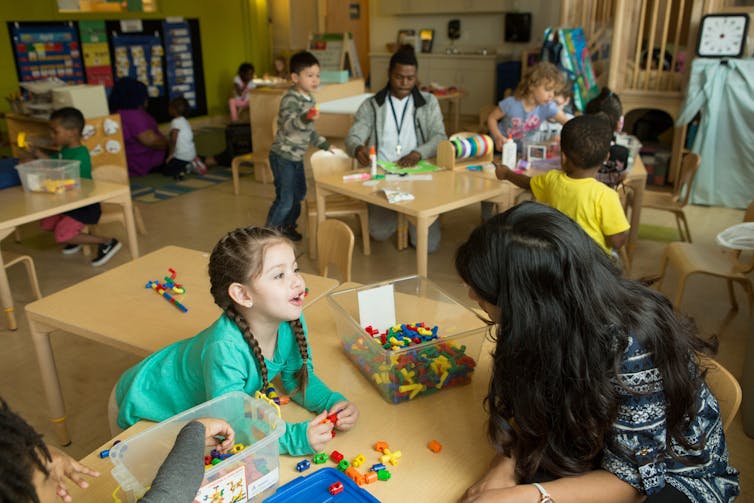
Young children with educators seen in a classroom at tables doing various activities with building blocks and other materials.
The skills that children learn later are scaffolded upon earlier learning.
(Allison Shelley/The Verbatim Agency for EDUimages), CC BY-NC

After the 2024-25 results were announced, the Elementary Teachers’ Federation of Ontario released a statement calling for EQAO funding to be redirected to classrooms, saying “EQAO assessments shift accountability from the government’s chronic underfunding of public education to educators.”

The province agrees that math scores are too low. In the aftermath of the results release, Ontario Education Minister Paul Calandra held a news conference to say the results weren’t “good enough.” He announced the formation of a two-person advisory committee to review the situation and provide “practical recommendations that we can put into action.”

Early universal numeracy screening

As researchers studying mathematical cognition and learning, we have an evidence-based recommendation to help improve children’s math scores: schools should use universal screening to identify and track students’ numeracy learning much earlier than Grade 3 (when the first EQAO tests are given).

Screeners that assess foundational numeracy skills and other forms of assessment are critical for evaluating gaps in students’ numerical knowledge and providing them with targeted supports before they start to fall behind.

Instead of waiting for provincial results at the end of Grade 3 to identify struggling learners, we need to equip students with necessary skills and knowledge earlier.

Measuring foundational skills is critical for mathematics because more advanced skills like geometry, algebra, calculus require students to have fluent access to foundational knowledge. For example, fluent division skills support converting fractions to decimals (for instance, one quarter equals 0.25).

A page showing children's colouring covering various squares coloured to express different fractions.
More complex skills like fractions are assessed in later grades.
(Jimmie Quick/Flickr), CC BY

Extensive store of knowledge needed

Children who lack foundational skills will continue to struggle across grades as the expectations become more advanced. Research has found that kindergarteners with lower counting skills are more likely to under-perform in math in Grade 7. These basic skills have also been linked to other metrics of academic success.

For example, children with strong foundational numerical skills are more likely to take advanced math classes in high school or pursue post-secondary education. Importantly, students who acquire foundational skills also develop more confidence in their mathematics abilities and are less likely to develop math anxiety.

By Grade 6, students need to have acquired a rich and extensive store of knowledge for learning the more complex math required in later grades.

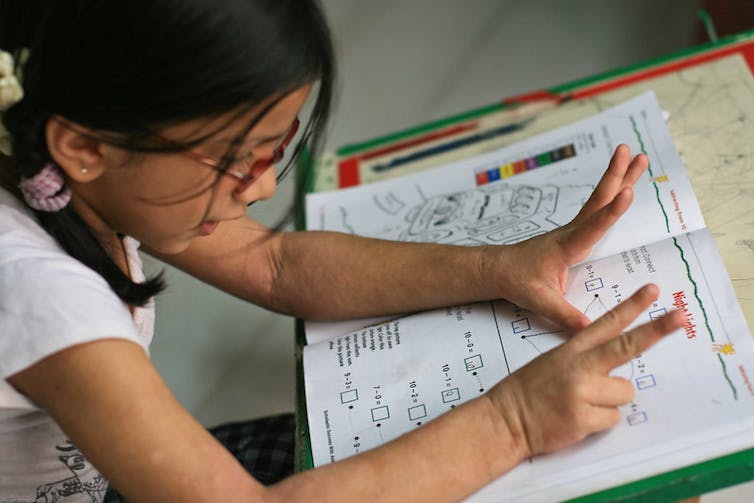
A child at a desk looking happy doing work.
Students who acquire foundational skills develop more confidence in their math abilities.
(Bindaas Madhavi/Flickr), CC BY-NC

The right to calculate

Human rights commissions have called for changes in education to ensure the “right to read” is protected for all students, including those with reading disabilities. We believe all students also have a right to high-quality math instruction — the right to calculate.

In efforts to connect math researchers and educators, we established the Assessment and Instruction for Mathematics (AIM) Collective. The AIM Collective is a community of researchers and educators, from universities and school districts across the country, committed to improving early math education in Canada.

Universal screening is one of the topics that AIM members have discussed in depth, because teachers often have mixed reactions to policies on screening.

However, educators we’ve partnered with have found that early math screening is a helpful teaching tool that helps educators target instruction to support children’s math learning.

Reaching full potential in math

Alberta now mandates universal numeracy screening. The Math Lab at Carleton University, where we are engaged in research, was involved in constructing grade-specific numeracy screeners for students in kindergarten to Grade 3 now in use in Alberta as well as other provinces.

Universal literacy screening is already mandated for students in Ontario from senior kindergarten to Grade 2. Initiating early universal numeracy screening is one step towards ensuring Ontario students reach their full potential in math.

Critically, screening must be accompanied by targeted support. Helping students reach their full math potential will contribute to a thriving Ontario.

As such, we call on the government to invest more in numeracy screening and earlier educational supports for struggling students.

The Conversation

Michael Slipenkyj is partly supported by a Mitacs internship with Vretta Inc., a Canadian educational technology company.

Heather P. Douglas has developed an early numeracy screener that is being used in four provinces in Canada. She collaborates with Vretta Inc., an educational technology company on a project to develop a digital version of the early numeracy screener. The project is funded by a Micas Accelerate grant.

Jo-Anne LeFevre has developed an early numeracy screener that is being used in four provinces in Canada. She collaborates with Vretta Inc., an educational technology company on a project to develop a digital version of the early numeracy screener, funded a Mitacs Accelerate grant.

Rebecca Merkley collaborates with Vretta Inc., a Canadian educational technology company. The project is funded by a Mitacs Accelerate grant titled: “A Research-Driven Approach to Assessment in Early Math Education”.

ref. Increasing math scores: Why Ontario needs early numeracy screening – https://theconversation.com/increasing-math-scores-why-ontario-needs-early-numeracy-screening-273339

Hey Trump: Here’s how Canada punched above its military weight in Afghanistan — from someone with a front-row seat

Source: The Conversation – Canada – By Eugene Lang, Interim Director, School of Policy Studies, Queen’s University, Ontario

“We’ve never needed them. We have never really asked anything of them. You know, they’ll say they sent some troops to Afghanistan, or this or that. And they did — they stayed a little back, a little off the front lines.” So said United States President Donald Trump recently, referring to America’s NATO allies, including Canada.

The comments have provoked outrage. British Prime Minister Keir Starmer called them “frankly appalling,” especially the insinuation that soldiers from other NATO states avoided the front lines in Afghanistan, leaving the most dangerous heavy lifting to American forces.

Anyone moderately familiar with NATO’s involvement in Afghanistan knows Trump’s insult is rubbish — especially when it comes to Canada.

The Canadian Armed Forces were deployed in some of the most dangerous regions and complex situations in Afghanistan for more than a decade, paying a heavy price in casualties — the heaviest since the Korean War in the early 1950s, when Canada also supported the American-led war effort and more than 500 Canadians died doing so.

What is less commented upon is Trump’s claim: “We’ve never needed them. We have never really asked anything of them.” This, too, is rubbish as far as Canada is concerned.

A front-row seat to Rumsfeld’s request

Twenty-three years ago, in fact, the U.S. asked Canada for something substantive and specific in Afghanistan. And Canada delivered substantively.

The ask came from U.S. President George W. Bush’s secretary of defense, the late Donald Rumsfeld, in January 2003. Famous for being sharp and precise with language, Rumsfeld invited Canada’s defence minister at the time, the late John McCallum, to the Pentagon to make a request.

I was in the room that day, and I heard the ask from Rumsfeld’s own lips (I later wrote about this historic meeting in The Unexpected War: Canada in Kandahar in 2007 and again in 2025 in Chretien and the World: Canadian Foreign Policy from 1993-2003.

Rumsfeld asked Canada to lead the International Security Assistance Force (ISAF), a multi-national stabilization mission then confined to Kabul, the war-torn capital city of Afghanistan. Rumsfeld’s request was an extremely significant one for Canada to digest. It meant providing the largest contingent of troops — about 2,200 — as well as a brigade headquarters and command of the operation.

Rumsfeld emphasized how critical the leadership of that mission was from his perspective, and how in his view Canada was better suited to take on the role than any other American ally. Gen. Richard Meyers, chairman of the U.S. Joint Chiefs of Staff at the time, was also present at the meeting and reinforced Rumsfeld’s point that ISAF was key to the Kabul region and Canada was the preferred nation to lead it.

American forces, the defense secretary argued, needed Canada to stabilize Kabul, which was awash in war lords and militia and had no real functioning government at that point.

American forces, meantime, would be otherwise engaged in the invasion of Iraq (which began a few weeks later) and holding the line in southern Afghanistan, where U.S. troops were concentrated.

The Canadian military was needed to hold Kabul together and pave the way for scheduled Afghan elections in 2004, Rumsfeld said. Kabul was an extremely important and vulnerable flank in the American war effort, and Rumsfeld needed Canada to cover that flank.

Canada answered the call

The U.S. needed Canada. The American military needed the Canadian Armed Forces. So Rumsfeld asked Canada for help. Following that meeting, McCallum returned to Ottawa and dutifully presented Rumsfeld’s ask to then Foreign Minister Bill Graham, Prime Minister Jean Chretien, Canada’s military leadership and ultimately the federal cabinet.

It was not an easy ask for Canada to fulfil in terms of military capability, capacity and risk. Canada had never done anything like this before. It was, therefore, not an easy decision to make for the government of Canada and for the Canadian military to deliver.

But Canada answered the call from its closest ally, giving the U.S. exactly what it asked for and what it needed from Canada. And for the next couple of years, more than 2,000 Canadian Armed Forces soldiers were deployed into the dangers and instability of Kabul in what was known as Operation Athena Phase 1 Kabul, where they acquitted themselves exceptionally well — as Rumsfeld predicted they would. Three Canadian soldiers gave their lives during this phase from 2003 to 2005.

Trump needs to be briefed on Canada’s military heroism before he opens his mouth again on this file. And Americans should understand that in the case of Afghanistan, they needed Canada’s help, their government asked Canada for help — and Canada delivered.

The Conversation

Eugene Lang is affiliated with Canadian Association of Defence and Security Industries

ref. Hey Trump: Here’s how Canada punched above its military weight in Afghanistan — from someone with a front-row seat – https://theconversation.com/hey-trump-heres-how-canada-punched-above-its-military-weight-in-afghanistan-from-someone-with-a-front-row-seat-274901

Hey Trump: Here’s how Canada has long punched above its military weight — from someone with a front-row seat

Source: The Conversation – Canada – By Eugene Lang, Interim Director, School of Policy Studies, Queen’s University, Ontario

“We’ve never needed them. We have never really asked anything of them. You know, they’ll say they sent some troops to Afghanistan, or this or that. And they did — they stayed a little back, a little off the front lines.” So said United States President Donald Trump recently, referring to America’s NATO allies, including Canada.

The comments have provoked outrage. British Prime Minister Keir Starmer called them “frankly appalling,” especially the insinuation that soldiers from other NATO states avoided the front lines in Afghanistan, leaving the most dangerous heavy lifting to American forces.

Anyone moderately familiar with NATO’s involvement in Afghanistan knows Trump’s insult is rubbish — especially when it comes to Canada.

The Canadian Armed Forces were deployed in some of the most dangerous regions and complex situations in Afghanistan for more than a decade, paying a heavy price in casualties — the heaviest since the Korean War in the early 1950s, when Canada also supported the American-led war effort and more than 500 Canadians died doing so.

What is less commented upon is Trump’s claim: “We’ve never needed them. We have never really asked anything of them.” This, too, is rubbish as far as Canada is concerned.

A front-row seat to Rumsfeld’s request

Twenty-three years ago, in fact, the U.S. asked Canada for something substantive and specific in Afghanistan. And Canada delivered substantively.

The ask came from U.S. President George W. Bush’s secretary of defense, the late Donald Rumsfeld, in January 2003. Famous for being sharp and precise with language, Rumsfeld invited Canada’s defence minister at the time, the late John McCallum, to the Pentagon to make a request.

I was in the room that day, and I heard the ask from Rumsfeld’s own lips (I later wrote about this historic meeting in The Unexpected War: Canada in Kandahar in 2007 and again in 2025 in Chretien and the World: Canadian Foreign Policy from 1993-2003.

Rumsfeld asked Canada to lead the International Security Assistance Force (ISAF), a multi-national stabilization mission then confined to Kabul, the war-torn capital city of Afghanistan. Rumsfeld’s request was an extremely significant one for Canada to digest. It meant providing the largest contingent of troops — about 2,200 — as well as a brigade headquarters and command of the operation.

Rumsfeld emphasized how critical the leadership of that mission was from his perspective, and how in his view Canada was better suited to take on the role than any other American ally. Gen. Richard Meyers, chairman of the U.S. Joint Chiefs of Staff at the time, was also present at the meeting and reinforced Rumsfeld’s point that ISAF was key to the Kabul region and Canada was the preferred nation to lead it.

American forces, the defense secretary argued, needed Canada to stabilize Kabul, which was awash in war lords and militia and had no real functioning government at that point.

American forces, meantime, would be otherwise engaged in the invasion of Iraq (which began a few weeks later) and holding the line in southern Afghanistan, where U.S. troops were concentrated.

The Canadian military was needed to hold Kabul together and pave the way for scheduled Afghan elections in 2004, Rumsfeld said. Kabul was an extremely important and vulnerable flank in the American war effort, and Rumsfeld needed Canada to cover that flank.

Canada answered the call

The U.S. needed Canada. The American military needed the Canadian Armed Forces. So Rumsfeld asked Canada for help. Following that meeting, McCallum returned to Ottawa and dutifully presented Rumsfeld’s ask to then Foreign Minister Bill Graham, Prime Minister Jean Chretien, Canada’s military leadership and ultimately the federal cabinet.

It was not an easy ask for Canada to fulfil in terms of military capability, capacity and risk. Canada had never done anything like this before. It was, therefore, not an easy decision to make for the government of Canada and for the Canadian military to deliver.

But Canada answered the call from its closest ally, giving the U.S. exactly what it asked for and what it needed from Canada. And for the next couple of years, more than 2,000 Canadian Armed Forces soldiers were deployed into the dangers and instability of Kabul in what was known as Operation Athena Phase 1 Kabul, where they acquitted themselves exceptionally well — as Rumsfeld predicted they would. Three Canadian soldiers gave their lives during this phase from 2003 to 2005.

Trump needs to be briefed on Canada’s military heroism before he opens his mouth again on this file. And Americans should understand that in the case of Afghanistan, they needed Canada’s help, their government asked Canada for help — and Canada delivered.

The Conversation

Eugene Lang is affiliated with Canadian Association of Defence and Security Industries

ref. Hey Trump: Here’s how Canada has long punched above its military weight — from someone with a front-row seat – https://theconversation.com/hey-trump-heres-how-canada-has-long-punched-above-its-military-weight-from-someone-with-a-front-row-seat-274901

The mental edge that separates elite athletes from the rest

Source: The Conversation – Canada – By Mallory Terry, Postdoctoral Fellow, Faculty of Science, McMaster University

Elite sport often looks like a test of speed, strength and technical skill. Yet some of the most decisive moments in high-level competition unfold too quickly to be explained by physical ability alone.

Consider Canadian hockey superstar Connor McDavid’s overtime goal at the 4 Nations Face-Off against the United States last February. The puck was on his stick for only a fraction of a second, the other team’s defenders were closing in and he still somehow found the one opening no one else saw.

As professional hockey players return to the ice at the Milan-Cortina Olympics, Canadians can expect more moments like this. Increasingly, research suggests these moments are better understood not as just physical feats, but also as cognitive ones.

A growing body of research suggests a group of abilities known as perceptual-cognitive skills are key differentiators. This is the mental capacity to turn a blur of sights, sounds and movements into split-second decisions.

These skills allow elite athletes to scan a chaotic scene, pick out the right cues and act before anyone else sees the opportunity. In short, they don’t just move faster, but they also see smarter.

Connor McDavid Wins 4 Nations Face-Off For Canada In Overtime (Sportsnet)

How athletes manage visual chaos

One way researchers study these abilities is through a task known as multiple-object tracking, which involves keeping tabs on a handful of moving dots on a screen while ignoring the rest. Multiple-object tracking is a core method I use in my own research on visual attention and visual-motor co-ordination.

Multiple-object tracking taxes attention, working memory and the ability to suppress distractions. These are the same cognitive processes athletes rely on to read plays and anticipate movement in real time.

Unsurprisingly, elite athletes reliably outperform non-athletes on this task. After all, reading plays, tracking players and anticipating movement all depend on managing visual chaos.

There is, however, an important caveat. Excelling at multiple-object tracking will not suddenly enable someone to anticipate a play like McDavid or burst past a defender like Marie-Philip Poulin, captain of the Canadian women’s hockey team. Mastering one narrow skill doesn’t always transfer to real-world performance. Researchers often describe this limitation as the “curse of specificity.”

This limitation raises a deeper question about where athletes’ mental edge actually comes from. Are people with exceptional perceptual-cognitive abilities drawn to fast-paced sports, or do years of experience sharpen it over time?

Evidence suggests the answer is likely both.

Born with it or trained over time?

Elite athletes, radar operators and even action video game players — all groups that routinely track dynamic, rapidly changing scenes — consistently outperform novices on perceptual-cognitive tasks.

At the same time, they also tend to learn these tasks faster, pointing to the potential role of experience in refining these abilities.

What seems to distinguish elite performers is not necessarily that they take in more information, but that they extract the most relevant information faster. This efficiency may ease their mental load, allowing them to make smarter, faster decisions under pressure.

My research at McMaster University seeks to solve this puzzle by understanding the perceptual-cognitive skills that are key differentiators in sport, and how to best enhance them.

This uncertainty around how to best improve perceptual-cognitive skills is also why we should be cautious about so-called “brain training” programs that promise to boost focus, awareness or reaction time.

The marketing is often compelling, but the evidence for broad, real-world benefits is far less clear. The value of perceptual-cognitive training hasn’t been disproven, but it hasn’t been tested rigorously enough in real athletic settings to provide compelling evidence. To date, though, tasks that include a perceptual element such as multiple-object tracking show the most promise.

Training perceptual-cognitive skills

Researchers and practitioners still lack clear answers about the best ways to train perceptual-cognitive skills, or how to ensure that gains in one context carry over to another. This doesn’t mean cognitive training is futile, but it does mean we need to be precise and evidence-driven about how we approach it.

Research does, however, point to several factors that increase the likelihood of real-world transfer.

Training is more effective when it combines high cognitive and motor demands, requiring rapid decisions under physical pressure, rather than isolated mental drills. Exposure to diverse stimuli matters as well, as it results in a brain that can adapt, not just repeat. Finally, training environments that closely resemble the game itself are more likely to produce skills that persist beyond the training session.

The challenge now is translating these insights from the laboratory into practical training environments. Before investing heavily in new perceptual-cognitive training tools, coaches and athletes need to understand what’s genuinely effective and what’s just a high-tech placebo.

For now, this means treating perceptual-cognitive training as a complement to sport-specific training, not as a substitute. Insights will also come from closer collaborations between researchers, athletes and coaches.

There is however, support for incorporating perceptual-cognitive tasks as an assessment of “game sense” to inform scouting decisions.

The real secret to seeing the game differently, then, is not just bigger muscles or faster reflexes. It’s a sharper mind, and understanding how it works could change how we think about performance, both on and off the ice.

The Conversation

Mallory Terry does not work for, consult, own shares in or receive funding from any company or organisation that would benefit from this article, and has disclosed no relevant affiliations beyond their academic appointment.

ref. The mental edge that separates elite athletes from the rest – https://theconversation.com/the-mental-edge-that-separates-elite-athletes-from-the-rest-273758

Why Canada must step up to protect children in a period of global turmoil

Source: The Conversation – Canada – By Catherine Baillie Abidi, Associate Professor, Child & Youth Study, Mount Saint Vincent University

Over half a billion children are now living in conflict zones, according to a 2025 Save the Children report, and the world is turning its back on them.

At a time of unprecedented global insecurity, funding and resources to care for, protect and engage with children affected by armed violence continue to decline.

The Donald Trump administration’s recent announcement of unprecedented American cuts to funding for international organizations — including reductions to the United Nations Offices of the Special Representatives of the Secretary-General for Children in Armed Conflict and on Violence Against Children — further undermines an already fragile system.

Cuts like these can have a devastating effect on some of the world’s most vulnerable populations, undermining important work to identify and prevent violations against children, and to assist children in rebuilding their lives in the aftermath of violence. Canada cannot sit on the sidelines.

Preventing violence against children

Violence against children is a global crisis. Without a seismic shift in how states take action to prevent such violence, the costs will continue to impact people around the world.

As a global community, we have a collective responsibility to build communities where children are not only safe and thriving, but where their capacity and agency as future peace-builders, leaders and decision-makers in their families, schools and communities are built upon and nurtured in wartime and post-conflict societies. These are core responsibilities that the global community is failing at miserably.

As many as 520 million war-affected children deserve better.

Canada has a long history of serving as a champion of children’s rights in armed conflict. Canadians have led global initiatives, including leading the first International Conference on War-affected Children, championing the Ottawa Treaty to ban landmines and developing the Vancouver Principles on Peacekeeping and Preventing the Recruitment and Use of Child Soldiers .

Canada is also the founder and chair of the Group of Friends of Children and Armed Conflict, an informal but vital UN network focused on child protection.

Now more than ever — amid American economic and political disengagement from core child protection priorities — there is both an opportunity and an imperative for Canada to demonstrate active leadership in the promotion of children’s rights and enhanced safety for children impacted by the devastation of armed conflict.

Complacency threatens to perpetuate generational impacts of violence.

Global leadership required

The Canadian government must once again stand up and provide global leadership on children and armed conflict by bolstering strategic alliances and funding efforts to protect and engage children impacted by armed conflict.

As a community of Canadian scholars dedicated to studying children, organized violence and armed conflict, we are deeply concerned about the growing vulnerability of children worldwide.

We see an opportunity for Canada to reclaim its role as a global leader in advancing and protecting children’s rights, especially in a time of political upheaval and heightened global insecurity. Canada can reassert itself and live up to its global reputation as a force for good in the world. It can stand on the global stage and draw attention to a crisis with generational impacts.

Children need protection from the effects of war, but they also need to be seen as active agents of peace who understand their needs and can help secure better futures.

Investments of attention and funding today can make significant differences in the emotional and social development of children who are navigating post-conflict life.


Read more:
The lasting scars of war: How conflict shapes children’s lives long after the fighting ends


Canada must take the lead

These investments are critical to the social structures of peaceful communities. Canadian leadership is well-positioned to take on this role, not only because of the country’s history and reputation, but because Canadian scholars are at the forefront, are organized around this issue and can be leveraged for maximum impact.

Prime Minister Mark Carney’s recent celebrated speech at the World Economic Forum’s annual conference at Davos signalled a possible and important shift in alliances, priorities and global moral leadership for Canada.

Canadian foreign policy can build upon this. Making the vulnerability of children affected by armed conflict and the capacity of children to be agents of peace a key foreign policy issue would positively affect the lives of millions of children globally. It would also signal to the world that Canada is ready to take on the significant global human rights challenges it once did.


The following scholars, members of The Canadian Community of Practice on Children and Organized Violence & Armed Conflict, contributed to this article: Maham Afzaal, PhD Student, Queens University; Dr. Marshall Beier, McMaster University; Sophie Greco, PhD Candidate, Wilfrid Laurier University; Ethan Kelloway, Honours Student, Mount Saint Vincent University; Dr. Marion Laurence, Dalhousie University; Dr. Kate Swanson, Dalhousie University; Orinari Wokoma, MA student, Mount Saint Vincent University.

The Conversation

Catherine Baillie Abidi receives funding from Social Science and Humanities Research Council of Canada.

Izabela Steflja receives funding from the Social Sciences and Humanities Research Council of Canada.

Kirsten J. Fisher receives funding from the Social Sciences and Humanities Research Council of Canada.

Myriam Denov receives funding from the Social Science and Humanities Research Council of Canada, and the Canada Research Chair Program.

ref. Why Canada must step up to protect children in a period of global turmoil – https://theconversation.com/why-canada-must-step-up-to-protect-children-in-a-period-of-global-turmoil-274398