When it comes to homelessness, what we call ‘compassion fatigue’ is something else entirely

Source: The Conversation – Canada – By Timothy Martin, Postdoctoral fellow, Faculty of Education, Simon Fraser University

The 20th-century French philosopher Simone Weil once said that compassion was an impossibility. She said it is “a more astounding miracle than walking on water.” The word she used for meeting the needs of the sufferer is not love or charity, but justice. Today, there is plenty of research that points to a decline in compassion.

Dealing with suffering, however, is part of the human experience, and as the American feminist philosopher Martha Nussbaum argued compassion is “an essential bridge to justice.”

As an education researcher who examines activist efforts to educate the public, I think what we’re witnessing is not so-called “compassion fatigue” but the loss of a sense of a shared world.

When it comes to how housed citizens respond to their unhoused neighbours, I have noticed an increasing trend of describing this strained relationship as compassion fatigue. Compassion is a specific word, with a specific history, and I argue it’s the wrong word here.

The concept of compassion in ancient Greece was synonymous with pity. In those days, pity was tied to one’s capacity to expose oneself to suffering — to suffer with.

Turning away from one another

The rising narcissism in contemporary society is fuelled in part by our online lives, where algorithms insulate us from those who don’t think the same way. German philosopher Hannah Arendt warned of this phenomenon when she wrote about our “human condition” of introducing ourselves into public, appearing alongside those we did not choose, but with whom we share the world.

Judith Butler, an American queer philosopher, called this necessary experience of strained cohabitation “up againstness.” This concept of the world, or the public realm, could help us find the term we are looking for.

Compassion fatigue, applied to the housing crisis, consistently centres the experience of those with housing. In this rendering, compassion would assume that these neighbours have reached out to their unhoused neighbours due to the obvious suffering of life without adequate shelter.

Nussbaum, inspired by Aristotle, offered three parameters that we might use to determine whether someone is acting out of compassion. First, compassion understands the seriousness of the suffering; it is not trivial, nor is it made up. Second, compassion does not assume the sufferer is culpable; the person is not at fault for their situation.

The third parameter is what Nussbaum calls “similar possibilities.” To put it plainly, this is the belief that it could be you.

Meanwhile, countless city councillors, media outlets and even Ontario’s premier assert that unhoused citizens merely need to try harder.

Citizens are not only “tired” of seeing homelessness, they are actively suing organizations working on the front lines of this crisis. In the case of cities like Barrie, local government has tried to find ways to criminalize helping unhoused neighbours. This does not speak of compassion, it speaks of a pervasive world fatigue. If we refuse to exercise compassion, this is not compassion fatigue; it is atrophy.

What justice demands of us

Arendt emphasized the importance of a solidarity “aroused by suffering.” A love of the world — Amor Mundi — was essential to maintaining spaces and democratic systems shared with others. While she rejected the “sentiment” of compassion guiding political action, perhaps the educational experience of compassion can inform what we deem to be political in the first place.

What most see as homelessness is only a sliver of an iceberg, caused by systemic violence over several decades.

David Madden and Peter Marcuse observe:

“Modern homelessness is a family phenomenon. Families comprise nearly 80 per cent of the population in the New York City shelter system. In the past year in New York alone, 42,000 children were unhoused for at least one night.”

Similarly shocking statistics apply in Canada. Dozens of organizations and countless front-line workers operate in conditions equated with disaster relief efforts. Is the suffering of children trivial? Are they culpable? Could this be me?

A recent front-page story in The Globe and Mail offered an analysis of Ontario municipalities. The article acknowledges the soaring costs of groceries and housing costs have led to a 25 per cent increase in homelessness in Ontario over the last two years.

Despite this, and like so much media coverage lately, the piece veers toward a narrative about “lawlessness,” “vandalism” and “addiction.” The educational force of compassion can help return us to the basic questions of affordability, before we condemn those living at the tip of this swelling iceberg.

I offer here what Nussbaum calls “a just city in words” — they are simply words, an exhortation toward justice but, to complete her phrasing, “without a just city in words…we never will get a just city in reality…”

If Simone Weil was right, then perhaps we are waiting for a miracle.

The Conversation

Timothy Martin receives funding from the Social Sciences and Humanities Research Council of Canada.

ref. When it comes to homelessness, what we call ‘compassion fatigue’ is something else entirely – https://theconversation.com/when-it-comes-to-homelessness-what-we-call-compassion-fatigue-is-something-else-entirely-272799

The Hubble tension: How magnetic fields could help solve one of the universe’s biggest mysteries

Source: The Conversation – Canada – By Levon Pogosian, Professor of Physics, Simon Fraser University

An image taken by the Hubble Space Telescope in July 2025 of Abell 209, a massive spacetime-warping cluster of galaxies located 2.8 billion light-years away in the constellation Cetus. (NASA)

It’s well established that the universe is expanding, but there’s serious disagreement among scientists over how fast it’s happening.

Two of our best ways of measuring the cosmic expansion rate, the Hubble constant, give answers that are stubbornly at odds. This presents a major problem in modern cosmology known as the Hubble tension.

However, we wondered if an idea originally proposed to solve another cosmic mystery — the origin of cosmic magnetic fields — could help us unlock the mystery of the Hubble tension.

Our recently published research explores whether extremely weak magnetic fields left over from the earliest moments after the Big Bang might help us unpack the Hubble tension, while offering a glimpse into physics at energies far beyond anything achievable on Earth.


Read more:
The universe may be lopsided – new research


The Hubble constant and tension

Astronomers use the Hubble constant as a measure of how fast the universe is expanding. It is named after the American astronomer Edwin Hubble who first discovered that the universe is expanding.

An explainer on the Hubble constant and Hubble tension. (University of Chicago)

There are two conceptually different approaches to measuring the Hubble constant. One is indirect, based on predictions of our cosmological model tuned to match the patterns in the cosmic microwave background, the faint afterglow of the Big Bang.

Telescopes such as the Planck Space Telescope have measured tiny fluctuations in this ancient light, predicting a Hubble constant of about 67 kilometres per second per megaparsec (km/s/Mpc). A parsec is a unit of distance used in astronomy equal to about 3.26 light years, or 30.9 trillion kilometres. A megaparsec is one million parsecs.

The second method is more direct, similar to the one used by Hubble in the 1920s when he first demonstrated that the universe is expanding.

It measures how fast distant galaxies are moving away from our home galaxy, the Milky Way, by observing the brightness of supernovae explosions in these far away galaxies.

Type Ia supernovae are known to be “standard candles” because we know that their luminosity is the same wherever they are. That means we can judge the distance to them from how dim they appear to us.


Read more:
How fast is the Universe really expanding? Multiple views of an exploding star raise new questions


To determine their intrinsic brightness, astronomers use other standard candles, such as Cepheid stars, in the galaxies nearby. These observations, which use the Hubble and James Webb space telescopes, give a higher value of around 73 km/s/Mpc.

This difference between the two measurements is called the Hubble tension. The difference between 67 and 73 may seem small, but it is statistically highly significant. If both methods are correct, then our standard model of cosmology must be missing something important.

An explainer on how astronomers measure cosmic distances. (NASA)

Where did cosmic magnetic fields come from?

Magnetic fields are everywhere in the universe. Planets and stars generate their own fields, but gaps in our understanding emerge when we attempt to explain the much larger scale magnetic fields threading galaxies and clusters, and possibly even cosmic voids.

One long-studied possibility is that magnetism first arose in the very early universe, long before the first stars or galaxies formed. These so-called primordial magnetic fields have been studied for decades, and searching for their imprints in the cosmic microwave background and other data offers a way to probe the early universe and the extreme energies that would have generated these fields.

In 2011, two of us (Karsten and Tom) pointed out that primordial magnetic fields would influence recombination — when electrons and protons first combined to form neutral hydrogen — and the universe turned from opaque to transparent. The first light able to travel freely from that moment on is what we now observe as the cosmic microwave background.

If present, primordial magnetic fields would speed up recombination by pushing and pulling on charged particles, making matter slightly clumpy. Where particles are more crowded, they are more likely to meet and form hydrogen.

Shifting the moment when the universe becomes transparent changes the size of the observed patterns in the cosmic microwave background. This effectively alters the cosmic ruler used to measure distances and, in turn, the value of the Hubble constant inferred from the model, helping to ease the Hubble tension. Two of us (Karsten and Levon) demonstrated this effect in 2020 using a simplified model of recombination.

A breakthrough: What we found

an image of a spheroid made up of green, blue and red areas
A map created by NASA’s Wilkinson Microwave Anisotropy Probe of the microwave radiation released approximately 375,000 years after the birth of the universe.
(NASA/WMAP Science Team)

In our new paper, we used the first full three-dimensional simulations of the primordial plasma with magnetic fields embedded in it, tracking how hydrogen forms.

We used the hydrogen formation history found through these simulations to compute predictions for how cosmic microwave background should appear if there were primordial magnetic fields, and tested these predictions against observations of the background.

The cosmic microwave background is extraordinarily sensitive to changes in recombination. If primordial magnetic fields altered it in a way that disagreed with observations, the idea could be ruled out. Instead, the data showed that our proposal remains viable.

Across multiple combinations of datasets, we find a consistent, mild preference for primordial magnetic fields, ranging from about 1.5 to three standard deviations. This is not yet a discovery, but a meaningful hint that they exist.

Equally important, the field strengths favoured by the data, about five to 10 pico-Gauss today, are close to what would be needed for galaxy and cluster magnetic fields to originate from primordial seeds alone. A pico-Gauss is a unit used to measure the strength of magnetic fields.

Aside from helping ease the Hubble tension, if primordial magnetic fields are confirmed, they would open a new window into how the universe was when it was only split seconds old, perhaps offering a glimpse into important events such as the Big Bang itself.

Our results show that the proposal survives the most detailed test available today and provides clear targets for future observations. Over the next several years, we will learn whether tiny magnetic fields from the dawn of time helped shape the universe we see today and whether they hold the key to resolving the Hubble tension.

The Conversation

Levon Pogosian receives funding from the Natural Sciences and Engineering Research Council of Canada. The work described in this article was enabled in part by support provided by the BC DRI Group and the Digital Research Alliance of Canada.

Karsten Jedamzik receives funding from the French National Centre for Scientific Research. The work described in this article was in part supported by the Agence Nationale de la Recherche.

Tom Abel receives funding from the U.S. Department of Energy under Contract No. DE-AC02-76SF00515.

ref. The Hubble tension: How magnetic fields could help solve one of the universe’s biggest mysteries – https://theconversation.com/the-hubble-tension-how-magnetic-fields-could-help-solve-one-of-the-universes-biggest-mysteries-274003

What ‘If I had Legs I’d Kick You’ tells us about mothering and thankless sacrifice

Source: The Conversation – Canada – By Billie Anderson, Lecturer, Disability Studies, King’s University College, Western University

Rose Byrne plays a mother overwhelmed with caring for her ailing young daughter in ‘If I Had Legs I’d Kick You.’ (VVS Films/A24)

Care work structures much of everyday life, yet it often remains invisible. It’s folded into assumptions about love, responsibility and familial duty rather than recognized as labour.

Nowhere is this more apparent than in caregiving, particularly when it’s performed by mothers. They’re routinely expected to absorb care work quietly, competently and without visible cost, even when that work unfolds under conditions of chronic illness, disability or grief.

Film and television often reinforce this expectation by presenting caregiving as a moral achievement rather than a social obligation. These representations frame maternal endurance as proof of love, virtue and emotional strength.

In recent cinema, motherhood shaped by loss or threat has emerged as a central narrative concern, from Hamnet to The Testament of Ann Lee to Sinners. Each film, in its own way, pushing back against the longstanding cultural fantasy of motherhood as a site of moral purity, endurance and heroism.

Rather than asking audiences to admire maternal sacrifice, these films linger on grief, struggle and ambivalence, exposing how expectations of care and emotional stability are unevenly distributed and disproportionately borne by women.

The trailer for ‘If I Had Legs, I’d Kick You.’ (A24)

Care as a source of grief and harm

Mary Bronstein’s 2025 film, If I Had Legs I’d Kick You belongs to this broader turn, but it pushes the critique further by stripping caregiving of even the residual comforts that often remain.

The film follows Linda (Rose Byrne, nominated for Best Actress at this year’s Academy Awards) as she navigates the daily, grinding reality of caring for her young child as serious illness reshapes every aspect of their lives, from medical appointments and disrupted routines to the emotional toll of uncertainty and constant vigilance.

The film refuses to frame care as redemptive, and instead shows how care, when imagined as an unlimited personal resource, becomes a source of depletion, grief and harm. Linda’s life revolves around her child’s needs — schedules dictated by medical systems, emotional energy consumed by anticipation and fear and moments of solitude repeatedly interrupted by responsibility — without any suggestion it’s a temporary, chosen or ultimately meaningful situation.

If I Had Legs I’d Kick You is not a story about maternal devotion. It’s a movie about how illness and disability are folded into private family life and how mothers are positioned as the shock absorbers of systems unwilling to provide adequate structural support.

Even when doctors, therapists, institutions and procedures surround her, the film makes clear that the emotional and logistical labour of care ultimately collapses back onto Linda herself.

As in real life, it’s left to the mother to internalize and dismantle shame, to make every consequential decision in the absence of adequate support and then to absorb judgment for each of those decisions. Mothers are asked to account morally for outcomes shaped by systems they cannot control.

‘Privatization of care’

Within disability studies and feminist ethics, care has long been understood as a social and political arrangement shaped by power, gender and access to resources.

Political theorist Joan Tronto argues that care is systematically devalued when it’s treated as private, feminized and morally natural — something women are presumed to provide instinctively — rather than as labour that must be collectively organized, supported and fairly distributed across society.

If I Had Legs I’d Kick You makes this devaluation visible in the way care is repeatedly pushed out of institutions and back onto Linda. In several scenes set within medical environments, professionals deliver information, outline procedures or ask Linda to make decisions, only to disappear once those moments conclude. This leaves her alone to manage the emotional aftermath, the logistical follow-through and the fear those decisions produce.

A man with red hair and glasses looks pained as a woman lies on a couch speaking.
Conan O’Brien plays Byrne’s vaguely irritated therapist in the film.
(VVS Films)

The systems of care remain present only as brief interventions, while the ongoing labour — monitoring her child’s symptoms, anticipating emergencies, soothing anxiety, reorganizing daily life — is treated as a natural extension of motherhood rather than as work that might require sustained support.

These scenes embody what Tronto describes as the privatization of care: institutions retain authority and expertise, but responsibility is quietly transferred to the individual caregiver, who is expected to absorb the costs without complaint.

Philosopher Eva Kittay extends this critique by focusing on dependency and the economic structures that rely on care while refusing to sustain those who perform it.

Kittay emphasizes that modern social and economic systems depend on vast amounts of unpaid or underpaid care work — much of it performed by women — while offering little material, emotional or social support in return.

Managing alone

In scenes where Linda juggles medical co-ordination alongside the ordinary and extraordinary demands of daily life, the film makes visible how care consumes every register of her attention.

She fields calls from doctors while continuing her own work as a therapist, absorbs the emotional crises of her patients even as she is barely holding herself together and navigates the instability of temporary housing after her roof collapses, forcing the family into a hotel.

A woman walks in the dark holding bottles of wine.
Byrne’s character is forced to relocate to a motel with her ailing child after the roof of her apartment caves in.
(VVS Films)

Her husband is frequently away for work, leaving her to manage both the logistical and emotional labour of care alone, while the film also insists on the banal realities of parenting: her child is sick but her child is also simply a child, needing comfort, discipline, patience and play.

In one moment she is trying to get her own child to eat enough to remove her feeding tube; in another she is unexpectedly left responsible for a stranger’s baby, her capacity for care assumed and exploited without question. Care here is an uninterrupted state of readiness, a demand that stretches across professional, domestic and emotional life without pause.

Popular culture frequently relies on the figure of the “good” mother: selfless, patient and endlessly resilient. Disability narratives often reinforce this ideal by positioning caregiving as proof of moral worth.

Flipping the narrative

By declining to transform suffering into inspiration, If I Had Legs I’d Kick You challenges the expectation that caregiving should make someone better, stronger or more fulfilled. Care here does not ennoble; it depletes. Crucially, this depletion is not framed as personal failure, but as the predictable outcome of systems that rely on mothers to absorb care work without adequate social, economic or emotional support.

Many films use disability as a narrative device, positioning it as a challenge that generates growth or moral clarity in others.

If I Had Legs I’d Kick You, by contrast, represents a decisive step toward undoing this familiar storytelling structure. The child’s illness does not exist to transform the mother or to provide emotional payoff for the audience. Disability is neither a lesson nor a catalyst; it is part of the family’s reality, shaping daily life in ways that are mundane, exhausting and deeply consequential.


Read more:
Women caregivers need more support to manage their responsibilities and well-being


By resisting sentimentality and refusing easy resolution — and by centring a protagonist who is allowed to be abrasive, overwhelmed, selfish and at times difficult to like — If I Had Legs I’d Kick You offers a rare and necessary portrayal of caregiving under conditions of illness and disability.

The film does not promise healing or redemption. It insists on honesty about grief that lingers, care that depletes and the impossible expectations placed on those who are expected to hold everything together.

The Conversation

Billie Anderson does not work for, consult, own shares in or receive funding from any company or organisation that would benefit from this article, and has disclosed no relevant affiliations beyond their academic appointment.

ref. What ‘If I had Legs I’d Kick You’ tells us about mothering and thankless sacrifice – https://theconversation.com/what-if-i-had-legs-id-kick-you-tells-us-about-mothering-and-thankless-sacrifice-274074

Canada is losing track of its wild salmon — just when we need that knowledge most

Source: The Conversation – Canada – By Michael Price, Adjunct professor, Department of Biology, Simon Fraser University

Every year, Pacific salmon return from the ocean to the rivers and streams where they were born. These migrations nourish ecosystems, sustain Indigenous cultures and support fisheries that people across Western Canada rely on. Yet something essential has quietly eroded: Canada’s efforts to count wild salmon.

That loss of basic information matters. It becomes especially important at a time when major industrial decisions affecting salmon watersheds are being made more quickly, and with less ecological information than in the past.

Twenty years ago, Canada adopted its Wild Salmon Policy (WSP), a landmark commitment to conserve the genetic and geographic diversity of wild Pacific salmon. At its core was a simple promise: to regularly assess the health of distinct salmon populations so declines could be detected early, and recovery action taken when needed.

Our recent analysis of publicly reported monitoring data shows that this foundation is weakening. Since the WSP was introduced, the number of spawning populations counted each year has declined by roughly one-third, driven largely by the loss of high-quality surveys.

We now lack sufficient publicly available data on nearly half of Canada’s Pacific salmon populations to assess whether they are healthy or at risk. Among those that can be assessed in British Columbia, around 70 per cent are in decline.


Read more:
Habitat loss and over-exploitation are leading to a decline in salmon populations


Why monitoring matters

Counting salmon isn’t bureaucratic box-checking. Salmon are foundational to coastal ecosystems and communities, and spawner counts are one of the simplest and most reliable ways to assess population health.

These data inform researchers and fisheries managers whether populations are stable, declining or recovering, and they underpin difficult decisions: when fisheries must be closed to prevent further harm, or when sustainable openings can support food security and livelihoods.

Without consistent monitoring, managers are forced to make decisions with limited evidence. Warning signs can be missed, and fisheries or habitat degradation may continue while populations quietly decline.

And the timing couldn’t be worse. The erosion of monitoring is occurring just as pressures on salmon are intensifying.

Climate change is warming rivers, altering ocean food webs, increasing the frequency of floods and droughts and reshaping freshwater habitats across Western Canada. In a changing environment, monitoring is the only way to distinguish natural variability from sustained declines.

At the same time, Canada is moving to accelerate industrial development. Recent federal legislation allows faster approval of projects deemed to be in the “national interest.” This push for speed is occurring while federal capacity to monitor salmon ecosystems weakens.

While expediency may be appealing, it carries real environmental risks unless matched by corresponding investment in mitigation and monitoring. When development accelerates while monitoring declines, decisions are increasingly made without a clear picture of what is being put at risk — or how impacts will be detected and addressed once projects are under way.

Data collection needed

The decline in monitoring is not simply the result of shrinking budgets or unavoidable austerity. Over the past two decades, federal investments in other salmon-related programs — such as enhancement and aquaculture development — have consistently exceeded investments in policy targeting salmon conservation.

In 2021, the federal government committed a historic $647 million to salmon conservation through the Pacific Salmon Strategy Initiative. Yet the systematic rebuilding of monitoring programs — the basic data collection needed to assess population health — was not made a central funding priority.

The challenge is likely to intensify. Recent federal budgets have committed to significant cuts to Fisheries and Oceans Canada, the department responsible for fisheries oversight and environmental monitoring. This would likely further constrain the capacity to rebuild monitoring programs.

In plain terms, Canada has not invested in the collection of information needed to know whether conservation efforts are actually working — or where action is most urgently required.

What rebuilding monitoring would look like

Reversing the decline in salmon monitoring is achievable, and relatively inexpensive compared to the costs of recovery once populations collapse.

First, the monitoring infrastructure and systems that allow governments and communities to track salmon populations must be treated as essential public infrastructure.

Second, coverage matters as much as precision. Monitoring more populations consistently, even with imperfect counts, often provides better insight than highly precise estimates at a few sites. Data gaps are far more damaging than moderate uncertainty.

Third, Indigenous-led and community-based monitoring offers a powerful opportunity to rebuild capacity. Many Indigenous nations have deep knowledge of salmon systems and strong stewardship responsibilities. Supporting monitoring partnerships, while respecting Indigenous data governance, can expand coverage, strengthen legitimacy and provide economic opportunities in local communities.


Read more:
Learning from Indigenous knowledge holders on the state and future of wild Pacific salmon


Finally, if governments choose to fast-track major projects, they must strengthen, not weaken, baseline ecological monitoring in affected watersheds. Speed should not come at the expense of understanding.

Canada has a clear framework for conserving wild salmon in the Wild Salmon Policy, but its effectiveness is undermined by low investment in basic monitoring. Without consistent and representative data, it becomes impossible to know what populations are in trouble, whether conservation efforts are working or where action is most urgently needed.

In effect, we are increasingly managing salmon in the dark — with stark consequences for ecosystems, fisheries and communities. Rebuilding broad, representative, monitoring programs is a foundational step that Canada can take to safeguard wild salmon in a time of rapid environmental and industrial change.

If we stop counting salmon, we should not be surprised when they disappear — quietly.

The Conversation

Michael Price is affiliated with SkeenaWild Conservation Trust as the Director of Science, and Adjunct Professor in the Department of Biology at Simon Fraser University.

Jonathan Moore is the principal investigator of the Salmon Watersheds Lab.

ref. Canada is losing track of its wild salmon — just when we need that knowledge most – https://theconversation.com/canada-is-losing-track-of-its-wild-salmon-just-when-we-need-that-knowledge-most-273746

When Valentine’s Day forces a relationship reckoning

Source: The Conversation – Canada – By Emily Impett, Professor of Psychology, University of Toronto

For people who have been quietly struggling with doubts about their relationship, the weeks leading up to Valentine’s Day can feel fraught. As Feb. 14 approaches, questions that were once easy to sidestep often become harder to ignore.

In a study that tracked romantic couples over a year, relationships were about 2.5 times more likely to end during the two weeks surrounding Valentine’s Day than during the fall or spring. When researchers accounted for relationship length, prior relationship history and gender, the odds of a breakup during this window were more than five times higher.

At first glance, this timing may seem strange. Why would couples break up just before a holiday devoted to love, connection and commitment?

Other findings from this study reveal that the increase in breakups appeared only among couples who were already struggling, not among those who were stable or getting stronger.

A psychological turning point

These findings suggest that Valentine’s Day functions less like a wrecking ball and more like a spotlight.

For couples who have been struggling for months, Valentine’s Day can bring those feelings into sharper focus, forcing people to confront questions they may have been postponing: Are we happy? Are we moving forward? Is this relationship something I want to celebrate?

Psychologists refer to moments like Valentine’s Day as temporal landmarks: points that divide time into a psychological before and after. They prompt people to take stock of their lives and make decisions they have been postponing. Romantic relationships are no exception.

Rather than creating doubt, these dates tend to accelerate decisions that were already unfolding, turning private uncertainty into a sense that change is overdue.

The pressure to perform

Not all temporal landmarks carry the same emotional weight, however. Valentine’s Day is an unusually ritualized and commercialized landmark. Consumer research shows that the holiday tends to evoke polarized reactions — people are far more likely to either love or loathe Valentine’s Day than to feel neutral about it.

In the weeks leading up to the holiday, advertising, store displays and social media amplify expectations about what counts as love: gifts, effort, public displays and visible commitment. Taking part in the ritual signals commitment and investment in a shared future; opting out can invite questions or disappointment.

In this sense, Valentine’s Day does not just invite reflection — it demands a performance.

This helps explain why breakups often happen before Valentine’s Day rather than after. Ending a relationship afterward can feel deceptive, especially if gifts were exchanged or plans were made. Many people would rather leave than perform romance they no longer feel, or accept gestures that imply a level of commitment they are unsure they can sustain.

That timing reflects a broader tendency to delay difficult decisions around holidays. Ending a relationship is emotionally uncomfortable at the best of times, and research shows people sometimes delay breakups to spare their partner pain. Holidays can intensify that hesitation.

In a nationally representative survey, 22 per cent of American adults said they ended relationships before Valentine’s Day because they did not want their partner to buy them gifts or spend money when they already knew the relationship was ending.

Uncertainty becomes impossible to ignore

The sense of being torn — wanting to avoid hurting a partner while also feeling unable to keep pretending — reflects a state psychologists call ambivalence.

Ambivalence is not indifference; it is the uncomfortable experience of holding competing motivations and emotions at the same time. Many people feel ambivalent long before a relationship ends, even in relationships that look stable from the outside. Research shows that this kind of internal conflict predicts lower satisfaction and greater instability over time.

Valentine’s Day intensifies ambivalence because it transforms private uncertainty into public signalling. Participating in the holiday sends a message that a relationship is intact and future-oriented. Dinner reservations, office flower deliveries and social media posts all carry symbolic weight.

Social comparison can add fuel to the fire. Valentine’s Day makes other people’s relationships unusually visible, often in idealized form. Couples appear everywhere — online and offline — celebrating love with carefully curated gestures. Decades of relationship research show that commitment is shaped not only by how satisfying a relationship is, but by how it compares to expectations and perceived alternatives.

When Valentine’s Day raises the bar for what love is supposed to look like, a relationship already marked by ambivalence can suddenly feel inadequate by contrast.

Not everyone experiences this pressure in the same way. Research shows that people who are uncomfortable with emotional closeness or public displays of romance often find Valentine’s Day especially stressful, which can amplify dissatisfaction and make withdrawal more likely.

Valentine’s Day rarely ends relationships on its own, of course. But it can make months of uncertainty suddenly very real, turning private doubts into decisions that feel urgent and unavoidable.

The Conversation

Emily Impett receives funding from the Social Sciences and Humanities Research Council of Canada.

ref. When Valentine’s Day forces a relationship reckoning – https://theconversation.com/when-valentines-day-forces-a-relationship-reckoning-274898

Northern housing must be built as an integrated ecosystem — by the North, for the North

Source: The Conversation – Canada – By Shelagh McCartney, Professor, Urban and Regional Planning, Toronto Metropolitan University

The recently launched Build Canada Homes (BCH) initiative marks the federal government’s most ambitious effort to build affordable homes since the Second World War.

The $13 billion initiative promises a building surge to emulate Canada’s post-war national housing program by doubling the national output of housing.


Read more:
Canada is a suburban nation because of post-Second World War government policy


This effort to aggressively stimulate growth in Canadian affordable housing construction includes the creation of the BCH new national agency working as a developer, rapid construction on public land, innovative modular construction methods and partnerships with private capital to push the pace.

For many Canadians, this may seem like a decisive response to the country’s housing crisis while also promoting Canadian sovereignty during tumultuous relations with the United States and other geopolitical developments.

But for the North, the parallels between the role of housing policy now and in the post-war era should give us pause. The building boom following the Second World War established many of the chronic housing, health and economic challenges northerners face today.

Lessons from the post-war era

Amid Cold War tensions and fears of Soviet encroachment following the Second World War, Canada and the United States moved to militarize and secure the Arctic.

Both countries established weather stations, the Distant Early Warning Line, airbases and other strategic infrastructure to assert sovereignty over the region. This geopolitical anxiety also fuelled Canadian efforts to create or expand permanent northern settlements.

These efforts imposed fixed communities on Indigenous peoples who previously moved seasonally through vast territories in patterns shaped by ecological knowledge and deep relationships with the land. This was often pursued through forced or incentivized relocations, reshaping Indigenous mobility and ways of life.

This push to secure the North was accompanied by a rapid expansion of federal housing initiatives in the 1950s and ‘60s to meet national housing strategies. Southern-style houses were imported into the North, detached from northern cultures, landscapes and climates, and administered through colonial governance structures.

Construction of these homes relied on southern labour and materials, leaving communities with buildings but not the authority, tools or training needed to construct or maintain them. Rather than recognize and learn from the approaches to housing construction and sustainability that northern, Indigenous peoples had been practising for generations, the government sought to impose control and authority through northern housing.

This era laid the groundwork for the housing precarity that northerners continue to feel today. Yet BCH uses the same language and approach — framing housing issues as a crisis, advocating rapid deployment, standardized technologies, reliance on southern supply chains and a short-term time frame. This undermines northerners’ abilities to self-determine and direct their own sustainable housing systems.

A different approach required

The North of 2026 is not the North of 1950. Climate change is accelerating permafrost thaw, reshaping ecosystems and exposing structural vulnerabilities in buildings and infrastructure caused by southern construction methods.

Dependence on imported materials and southern labour is even more unsustainable. Simultaneously, Indigenous Peoples across the North have developed community-led housing strategies, design innovations and governance models that offer powerful alternatives.

A Northern Housing Ecosystem (NHE) approach re-imagines northern housing not as a one-off construction campaign but as an interconnected system involving governance, economy, design, training, maintenance and social well-being.

It aligns with Indigenous-led housing innovations already underway — from the work of the K’asho Got’ine Housing Society and Yellowknives Dene First Nation, to regional training and design initiatives across the North.

The NHE asserts that housing is tied to health, education, economic development, energy use and cultural vitality. Housing cannot be governed within silos; it must be part of a living system.

To support northern housing autonomy and sustainability, BCH must adopt principles rooted in this ecosystem approach.

Principles include promotion of a northern housing economy where housing is collective infrastructure that focuses on community well-being and a sense of home for all northerners, prioritized over a market-based logic.

This fosters housing autonomy via northern and Indigenous control over governance, design, construction, repair and maintenance — the opposite of the dependency system of the post-war era.


Read more:
Housing is health: Coronavirus highlights the dangers of the housing crisis in Canada’s North


A sustainable northern housing future

The foundational question should no longer be: How many houses can we deliver quickly? Instead, it must be: How can we build a sustainable northern housing future?

This requires structural change in housing delivery. Short-term federal funding cycles and crisis-framing create pressure to spend and build quickly. That results in prioritizing communities with more administrative capacity, risks reinforcing inequities and rushes decisions that compromise sustainability.

Without concrete efforts to right the wrongs of the past, BCH will reproduce a housing system that never adequately or sustainably served the North. While BCH represents a major federal investment, the North needs more than housing units. It needs autonomy, climate-appropriate design, skilled local labour and local business development.

A sustainable northern housing future is possible, but only if programs like BCH evolve from a fast unit-counting exercise into an ecosystem-based strategy rooted in Indigenous leadership and northern expertise. That way a northern housing system can be built that will sustain communities for generations — by the North, with the North and for the North.


Mylène Riva, Associate Professor, Department of Geography, McGill University, Canada Research Chair in Housing, Community and Health and Rebecca Schiff, professor at the University of Lethbridge, co-authored this piece.

The Conversation

Shelagh McCartney receives funding from the Social Sciences and Humanities Research Council of Canada and the Canada Mortgage and Housing Corporation.

Aimee Pugsley receives funding from the Canada Mortgage and Housing Corporation and the Social Sciences and Humanities Research Council of Canada.

Julia Christensen receives funding from the Canada Mortgage and Housing Corporation and the Social Sciences and Humanities Research Council of Canada.

ref. Northern housing must be built as an integrated ecosystem — by the North, for the North – https://theconversation.com/northern-housing-must-be-built-as-an-integrated-ecosystem-by-the-north-for-the-north-273789

Imagining alternative Canadian cultural policy through BIPOC artists’ experiences

Source: The Conversation – Canada – By Taiwo Afolabi, Full Professor/CRC in Socially Engaged Theatre; Director, C-SET, University of Regina

We need arts and cultural policy that embeds foundational principles of care, accountability and attention to reciprocal and equitable relationships. (Peqsels/RDNE Stock project)

The culture and creative sector is experiencing unprecedented strain during a period defined by intense polarization and precarity, growing economic and environmental concerns, deepening social inequities and urgent calls for justice.

During the pandemic and amid powerful global movements for racial and social justice, longstanding inequities in the arts sector were brought into sharper focus — as was artists’ continued commitment to imagining alternative futures.

But the frameworks guiding Canadian arts and culture policy are increasingly insufficient to sustain our society.

Future of Canadian cultural policy

The future of Canadian cultural policy — shaping how artists and creative practitioners engage in their work, with each other and society at large — cannot solely be premised on the economic argument for the cultural and creative sector, as was assumed by the 2017 Creative Canada Policy Framework.

Assuming the primacy of economic returns and market performance in cultural production undermines the value of non-commodified, non-economic contributions of culture.

Nor can the future of Canadian cultural policy rest on nation-building narratives of the post-Second World War era.

As playwright and director Yvette Nolan and cultural strategist Sarah Garton Stanley discussed in a 2023 session with the Centre for Socially Engaged Theatre, such narratives marginalize Indigenous Peoples and other cultural identities and perpetuate a settler-colonial vision of cultural citizenship.

Yvette Nolan and Sarah Garton Stanley discuss the imprint of the 1951 Massey Report, concerned with arts and culture, on Canada’s creative sectors.

In addition to asking how culture can serve economic interests or reinforce a cohesive national brand, we must also ask: how can cultural policy nurture trust, belonging and long-term relationality across communities, identities and experiences?

This was our concern in research we conducted between 2022 and 2024 with 18 self-employed Black, Indigenous and People of Colour (BIPOC) artists and cultural entrepreneurs across Western Canada. Collaborators in this research were playwright Yvette Nolan, as well as art historian Luba Kozak and academic researcher Fonon Nunghe.

Conversations with artists

We explored the question: In what ways might the social value-creation strategies of self-employed BIPOC artists who engage in socially transformative practices shape a more equitable Canadian cultural policy?

Through individual and group conversations, we heard how artists are leveraging their creative practices, entrepreneurial skills and leadership to generate social value in their communities.

We also heard how they are countering discrimination, fostering belonging and advancing justice through culturally grounded, socially engaged art.

We conducted this research during a pivotal period in the wake of the COVID-19 pandemic and amid powerful global movements for racial and social justice. The reflections gathered are rooted in the social, political and cultural dynamics of that time, yet they remain relevant in today’s shifting landscape.

Issues such as systemic exclusion, under-representation and the need to support BIPOC leadership in the arts continue to demand urgent attention.

Erosion of EDI

Globally, the erosion of equity-based initiatives, especially in the wake of the 2024 U.S. presidential election, has raised alarm.

The backlash against diversity, equity and inclusion (DEI) efforts across sectors, including the arts, signals a broader populist shift that threatens the fragile gains made in justice-centred work. Canadian cultural institutions are not immune to this trend.


Read more:
We need meaningful, not less, EDI and climate action in turbulent times


Organizations that foreground equity and representation increasingly find themselves under scrutiny, pressured to defend their legitimacy and impact.

Cultural policy is needed that protects equity-driven practices and embeds care, accountability and relationality as foundational principles, especially in times of political volatility.

What does this look like on the ground? Here are three insights that emerged in our conversations with artists:

1. Authentic safe spaces and responsiveness: Artists emphasized that the concept of safety must go beyond institutional declarations of “safe spaces” or symbolic gestures. True safety for BIPOC artists requires culturally responsive policies that acknowledge the emotional, spiritual and cultural dimensions of artistic practice.

This might look different for different artists and communities. Many institutions, while professing inclusivity, continue to restrict practices revealing a limited understanding of cultural protocols. Artists shared that safety must be rooted in the ability to engage in arts production and express themselves authentically, without institutional gatekeeping or pressure to conform to Western norms. This calls for a systemic rethinking of safety that centres cultural sovereignty and the right to self-determined artistic expression.

A group of Black and racialized co-workers of varying genders having a meeting.
BIPOC artists are often exptected to take on dual roles of creating their own work while also educating institutions about cultural practices and histories.
(Gender Spectrum Collection), CC BY

2. Tokenism and decolonization: Many participants described being invited into institutional spaces as symbols rather than equal collaborators. This dynamic reduces cultural presence to a token, where inclusion is more about optics than genuine engagement. BIPOC artists are often expected to take on dual roles, creating their own work while also educating institutions about cultural practices and histories.

This expectation is not only unsustainable but emotionally exhausting, eroding trust over time. As one artist explained, they are there to tell stories, not to “do the work” of decolonization for institutions. Promises of change are frequently postponed, using excuses such as budget limitations or declining audiences, which can feel dismissive and discourage long-term engagement. These experiences underscore the need to move beyond performative inclusion and toward real power-sharing in decision-making, leadership and representation.

3. Relational accountability and community-based practices: True decolonial work requires relational accountability and the commitment to building respectful, sustained relationships rooted in reciprocity. This cannot be achieved through a checklist-style inclusion efforts or standard contracts. Many artists noted the lack of cultural and relational competency within institutions and highlighted the importance of nurturing trust through shared experiences, dialogue and time.


Read more:
How theatre on the Prairies can imagine an equitable and inclusive future


Community-based artistic practice often blurs the boundaries between personal and professional life, which institutions typically fail to recognize. Care responsibilities, emotional labour and deep ties to community are integral to the creative process for many artists, especially those working in post-COVID contexts.

However, hierarchical institutions that prioritize production and efficiency often undervalue relationships. One participant reflected on feeling torn between her commitment to her urban Indigenous community and institutional pressures focused on outputs. This tension highlights the urgent need for institutional models that respect and integrate relational and community-based approaches to art processes.

Reimagining how institutions define success

What’s needed for the new era in Canada’s arts landscape is a fundamental reimagining of how cultural institutions define success and responsibility. This shift calls for cultural policy that upholds the diverse realities of those who live, create and contribute across these lands and is grounded in their experiences.

Cultural policies must explicitly encourage and require institutions to prioritize care, trust and ethical leadership in their daily practices, instead of focusing solely on outputs and compliance. Policies should centre community and accountability to relationships as core to institutional purpose.

By embedding these values into funding criteria, accountability measures, success indicators and governance frameworks, cultural policy can compel institutions to move beyond short-term, project-based transactional models.

If we are to cultivate a truly inclusive cultural landscape, we must build equity not only in visibility and representation but also in the relationships, processes and structures that sustain cultural life.

Only by embracing this approach can cultural institutions foster trust, belonging and resilience, helping to heal and connect communities across this land.

The Conversation

The researchers/authors received funding from the Social Sciences and Humanities Council (SSHRC) (Insight Development Grant) for this research.

ref. Imagining alternative Canadian cultural policy through BIPOC artists’ experiences – https://theconversation.com/imagining-alternative-canadian-cultural-policy-through-bipoc-artists-experiences-273159

What to do if someone’s choking: Evidence says begin with back blows

Source: The Conversation – Canada – By Cody Dunne, Emergency Medicine Physician and PhD Candidate, University of Calgary

Eating is a social event. Whether it’s a night out with friends or an evening at home enjoying family dinner, conversation goes well with food. But what if, in the middle of laughter and big bites, someone suddenly began to choke? Would you know what to do?

Choking is a life-threatening emergency that requires immediate recognition and action to prevent rapid loss of consciousness, respiratory arrest and death. The actions of bystanders are often a major factor in the outcome of a choking incident. If the airway obstruction is not cleared before paramedics arrive, the risk of death is 42 per cent higher than if bystanders successfully remove it.

While choking can happen to anyone at any time, certain people are at higher risk, including people with neurological conditions that affect swallowing or chewing (such as dementia, stroke or Parkinson’s disease), people intoxicated by alcohol, drugs or medications or young children with small objects.

Despite choking being an emergency, until recently there has been limited high-quality evidence to guide bystanders on the most effective way to help. Techniques like abdominal thrusts (formerly known as the Heimlich maneuver), back blows and chest compressions or thrusts have existed since the mid-1900s but, until recently, recommendations were largely based on case reports rather than rigorous scientific data. This evidence gap is dangerous.

Bystander response is the primary driver of a choking person’s outcome, so ensuring people know the safest and most effective way to care for a choking person can save lives.

Back blows outperform abdominal thrusts and chest thrusts

Our research team — a collaboration of Canadian researchers, physicians and paramedics — investigated a large cohort of choking patients in the province of Alberta and looked at the effectiveness and safety of different choking techniques.

We found that back blows cleared the obstruction in 72 per cent of cases, superior to both abdominal thrusts (59 per cent) and chest thrusts (27 per cent). Survival to hospital discharge was also highest among those who initially received back blows (97.8 per cent) even after accounting for other important factors such as the patient’s age, sex and the type of obstruction.

Further, back blows caused no injuries, unlike abdominal thrusts and chest thrusts, which resulted in injury to the lungs, heart, liver, and ribs.

New American Heart Association guidelines

For the first time since 2010, the American Heart Association (AHA) updated its guidelines on how people should care for someone who is choking. Due to the AHA closely collaborating with the Heart and Stroke Foundation of Canada, these changes will impact first aid training across North America.

In the updated guidelines, our Canadian study was cited to inform this critical change, and was the only study directly comparing different choking techniques.

Previously, abdominal thrusts were recommended largely because they were reported more often in case descriptions, despite a known risk of serious injury. The updated guidelines now reflect the best available evidence.

So, how should you respond when you see a choking person?

If an adult or child can still cough, cry or speak clearly, then they are still able to clear the obstruction themselves. Get them to lean forward while encouraging them to cough forcefully.

If the person goes quiet, cannot speak or cry, or can only weakly cough, you want to start with five strong back blows first. With the person bent forward at their hips, deliver firm glancing blows between their shoulder blades using the heel of your hand up to five times.

If the obstruction does not clear, switch to abdominal thrusts. Continue alternating five back blows and five abdominal thrusts until the obstruction is cleared or the person becomes unconscious. Our study, along with others, showed that between 11 per cent and 49 per cent of choking persons will need more than one technique to successfully clear the obstruction.

Special circumstances to consider

Call 9-1-1 early. Get a bystander to call while you do back blows or place your phone on speaker if you are by yourself.

For children, kneel to their height to deliver back blows and abdominal thrusts effectively.

For infants who cannot stand, you can hold them in your arms. If the infant is still crying or coughing loudly, hold them with their head down supported by your arms. Then, if the obstruction doesn’t clear and they become quiet, you should begin with back blows followed by chest compressions, alternating until the obstruction clears.

If the person becomes unresponsive, assist them to the ground and start CPR with chest compressions. Each time you attempt to give rescue breaths, look for the object by opening the mouth and remove the object only if clearly visible.

Suction-based device

Recently, suction-based devices, such as LifeVac©, have been marketed as an alternative when other choking treatments fail, gaining attention on social media platforms like Facebook and TikTok. These devices create negative pressure in the upper airway to suction out an obstruction, in contrast to traditional techniques like back blows and abdominal thrusts that generate pressure from below.

Our research team has documented a considerable number of successful cases using these devices, with few injuries associated. Two trials in mannequins also found LifeVac© to be more effective at relieving simulation airway obstructions compared to abdominal thrusts.

While this early data is promising, major resuscitation organizations, like the AHA, have yet to make a conclusive recommendation on these devices yet – concerned that a bystander obtaining and using these devices may delay other lifesaving techniques. Still, this is an exciting field of research and larger, comparative studies will hopefully be conducted soon.

Time to get trained

People who know how to respond to choking emergencies can save a life in highly time-sensitive situations. Over the past two decades, simplified public CPR training has played a significant role in dramatically reducing deaths from cardiac arrest. Choking response has not benefited from similar public education campaigns.

Given immediate bystander response is the best chance the choking person has for survival, prioritization of mass public training in simple, evidence-based techniques such as back blows, may significantly improve choking survival.

The Conversation

Cody Dunne receives funding from the Canadian Institutes of Health Research (Grant # 202410MFE-531150-95777) and the Canadian Association of Emergency Physicians’ Junior Investigator Grant.

Andrew McRae receives funding from the Canadian Institutes of Health Research and Roche Diagnostics Canada.

Khara Sauro receives funding from the Canadian Cancer Society and CIHR.

ref. What to do if someone’s choking: Evidence says begin with back blows – https://theconversation.com/what-to-do-if-someones-choking-evidence-says-begin-with-back-blows-273903

ICE pullback in Minneapolis shows the limits of Donald Trump’s scare tactics

Source: The Conversation – Canada – By Eli Lawrence Sopow, Adjunct Faculty, Adler University

Thanks to United States President Donald Trump, 2026 is shaping up to be an age of angst as groups and countries retreat turtle-like into protective economic and cultural shells. We’re trusting very few and are suspicious of many. As is generally the result of such tactics, the perpetrator is creating an environment of divide and conquer.

The global and local anxiety being created by Trump are illustrated by the Edelman Trust Barometer Global Report. It reveals the results of a 2025 survey of 33,000 respondents in 28 countries.

The results show that trust in institutions of all description, and our “shared reality,” has created a “crisis of grievance.” This in turn has produced a “heightened insularity, a reluctance to trust anyone who’s different from you.”

But Trump’s draconian anti-immigration agenda — enforced through masked, violent and unaccountable Immigration and Customs Enforcement (ICE) agents — appears to be fuelling active and successful citizen collaboration.

In the aftermath of the slayings in Minneapolis of two civilians, Renee Good and Alex Pretti, and the mass protests that ensued, Trump’s border czar has announced he’s withdrawing 700 ICE agents from the city. Trump himself has also indicated his administration is backing down from its hardline tactics.

The simmering state of protest violence

A disturbing finding in the Edelman survey is that 40 per cent of respondents approve of one or more hostile actions to bring about change. This includes “attacking people online, intentionally spreading disinformation, threatening of committing violence, damaging public or private property.”

This willingness to take hostile action is the highest I have seen in my 45 years of research into public order and protest. It is far higher than numbers found in the 2017-22 World Values Survey of 102 countries that asked five questions about political action.

In that survey, only 35 per cent globally said they “might” get involved in a peaceful protest, while 46 per cent “would never.” In Canada, 48 per cent said they would get involved in a peaceful protest; 29 per cent would never. In the U.S., 55 per cent of respondents reported they “might” and 34 per cent wouldn’t.

The Edelman report states that “as fears rise, trust goes local.” This means that as change becomes a bigger feature in our lives, the circle of trust shrinks. Organizational psychologists like Canada’s Jason Walker note that this turn of the emotional screw can create paranoia, emotional stress and workplace/homelife violence.

One way to gauge rising fear and public anger is through Google Trends. Throughout January 2026, more people worldwide than at any point in the past five years — including during the darkest months of the COVID-19 pandemic — searched on the phrases “I fear change” and “I am angry.”

The U.S. led all countries on Google Trends, registering a score of 100 — the maximum value on the platform’s index, which indicates the highest relative search interest among all locations measured. The only other country matching this level of fear of change search was the Philippines, which is going through its own political and social turmoil.

In Cincinnati, Ohio, searches on “I am angry” were hitting close to 90 on the index following Good’s slaying in Minneapolis on Jan. 7. Ohio is where the National Guard shot and killed four unarmed students and wounded nine others who were protesting the Vietnam War in 1970.

Fear, distrust growing

Surveys and web searches expose a world of growing protective isolationism; it’s a lot more difficult to bring a collective, trusted resistance together.

Canadian Prime Minister Mark Carney recently warned that “a world of fortresses will be poorer, more fragile and less sustainable.” But in extolling the virtues of collectivism and mutual trust, Carney underplayed the fact that, unfortunately, fear and protectionism are often more powerful than trust.

Decades of public order research by myself and colleagues, as well as extensive academic research about public order and protest, has revealed a predicable pattern.

As I found in my book The Age of Outrage, when people are afraid, their fear can turn to boiling anger. That anger then becomes an emotional catalyst for action, either collectively or singularly, passively or violently, to fix things.

In fact, fear, anger and a demand for action can instill the collectivism and mutual trust missing in the Edelman survey. That could be what’s currently happening with the anti-Trump and anti-ICE protests throughout the U.S.

The challenge is that large public protests are a very delicate, potentially volatile formula for change. Collective protests require drama and a saturation of news and social media coverage to raise awareness and support. But protest support can quickly evaporate if the public sees acts of violence and destruction by even a minority of demonstrators (one TV news shot of a burning building or smashed storefront window will usually do the trick).

Trump was betting on fear

Amid the anti-ICE protests, Trump was betting that fear and chaos would prevail. He and his operatives continually seeded the public consciousness with language like “domestic terrorists,” “weaponized her vehicle” and “paid agitators” to describe the victims of ICE agents and other anti-ICE protesters. So far, Trump’s propaganda campaign is failing.

Trump didn’t count on the many peaceful anti-ICE protests and viral videos of the slayings of Good and Pretti that revealed the administration’s lies about their deaths. The over-zealousness of masked ICE agents has resulted in an uncomfortable drop of public support for the president.


Read more:
Anti-ICE protesters are following same nonviolent playbook used by people in war zones across the world to fight threats to their communities


Trump’s penchant for sowing fear is now in danger. If the “ICE Out” protests and strikes continue in their generally peaceful way, public fear, anger and a demand for public safety won’t be directed at demonstrators but at violent federal ICE officers.

How can protesters continue to build public support? My decades of research point to a consistent pattern among successful movements: a C.O.R.E. profile. Protesters remain committed, communicative, organized, resourceful and experienced — and above all else, non-violent.

What’s happening in the U.S. right now illustrates that public law-and-order initiatives are a double-edged sword. Just as over-zealous and violent protesters can quickly sour public opinion for their cause, so can the over-reaction of law enforcement and other authorities to peaceful protests — a lesson Trump is currently learning the hard way.

The Conversation

Eli Lawrence Sopow does not work for, consult, own shares in or receive funding from any company or organisation that would benefit from this article, and has disclosed no relevant affiliations beyond their academic appointment.

ref. ICE pullback in Minneapolis shows the limits of Donald Trump’s scare tactics – https://theconversation.com/ice-pullback-in-minneapolis-shows-the-limits-of-donald-trumps-scare-tactics-274933

As the climate changes, what does the future hold for the Winter Olympic and Paralympic Games?

Source: The Conversation – Canada – By Daniel Scott, Professor and Strategic Director for Climate Change Education in Environment, University of Waterloo

The 25th Winter Olympic Games are upon us, with Italy set to host the Games for the fourth time. The schedule at the 2026 Milano Cortina Winter Olympics is set to look similar to previous iterations of the event: a mix of snow and ice sports held on what is meant to be mountainous, wintry terrain.

Except the snowy cold winter that comes to mind when you picture the Olympic Games may not be tenable for much longer. Climate change is reshaping winter sport worldwide. In the Northern Hemisphere, the winter season has shortened over the last 50 years, with low elevation regions warming at twice the rate of global warming, leading to widespread declines in snowpack.

Snow sport athletes are experiencing these changes firsthand. In recent years, several International Ski and Snowboard Federation World Cup events have been cancelled due to poor snow and unsafe conditions.

In 2023, nearly 300 concerned athletes sent a letter to the federation demanding more action on climate change and a “geographically reasonable” race schedule aligned with evolving weather realities.

A 2021 survey of 339 professional and Olympic winter athletes and coaches from 20 countries found 90 per cent were concerned about how climate change will affect the future of winter sports.

For the Winter Olympic and Paralympic Games, climate change could fundamentally impact where the Games can be held in the future. In 2022, the International Olympic Committee delayed the selection of the 2030 host city so that it could obtain a clearer understanding of the climate risk of potential future host locations.

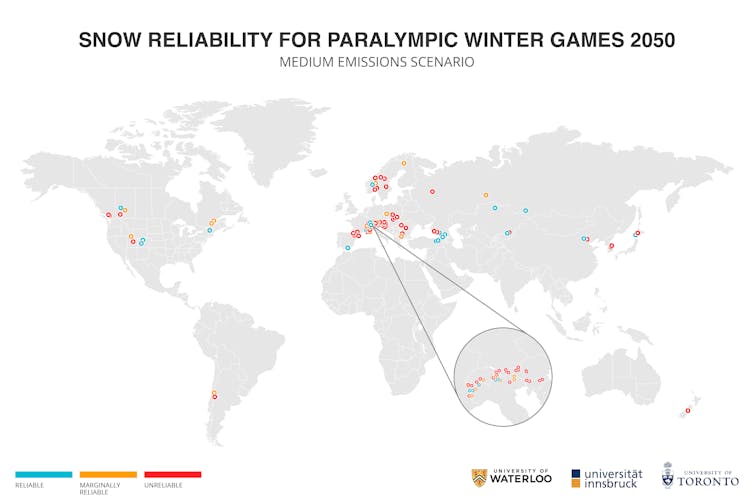
Our 2024 study of 93 potential host locations — those with the necessary infrastructure in place to host such a spectacle — found that even with advanced snowmaking, a significant number would no longer have reliable snow in future. By the 2050s, the pool of potential Olympic hosts halved, and worryingly, few (17 to 31) had viable conditions to host the Paralympics.

Olympic and Paralympic peril

a map of the world highlighting potential sites for the games
A map highlighting the potential climate reliability of Winter Olympics host sites in the by 2050s.
(Author provided)

Our recent study explores a wide range of strategies to mitigate the risks posed by climate change to the Winter Olympics and Paralympics. Each strategy requires careful evaluation by Olympic and Paralympic committees, host cities and sport federations. Many involve trade-offs that can impact the ability of communities to host the games, the athlete and spectator experience, and potentially, the sustainability of the Games.

For example, the location of snow sports venues further away from the main host city where the indoor events are held could enhance climate reliability. However, that would increase travel times and emissions, as well as reduce the ability of spectators to see some competitions.

At this year’s Milano Cortina Games, venues are dispersed between sites across northern Italy. That will make it more challenging for athletes and fans to mingle, a setback to team unity and spirit. Several more athletes than usual won’t be able to attend the opening or closing ceremonies because they’ll be competing several hundred kilometres away.

Changing the schedule

Given that the Paralympics are held after the Olympics, they are especially at risk due to climate change. The “one bid, one city” agreement, which requires a host city to stage both Games at the same venues, may need to be reconsidered.

This agreement has elevated para sport to new levels of visibility and excellence. However, our research suggests that it cannot survive climate change, and losing the Paralympics would be a devastating setback for winter sport.

The solution? Adjust the schedule so the the Paralympics can be held earlier.

a map of the world highlighting potential sites for the games
A map highlighting the potential climate reliability of Winter Paralympics host sites in the by 2050s.
(Author provided)

Our analysis revealed that holding the Winter Olympics and Paralympics three weeks earlier in the year has tremendous potential to increase the number of climate reliable hosts.

Moving the Olympics so the Games begin in late January or the first week of February, and the Paralympics in late February or the first week of March, nearly doubled the number of climate-reliable host locations for the Paralympics. That would help safeguard the “one bid, one city” arrangement through the mid-century and into the late century, if the Paris Climate Agreement’s goals are achieved.

Other options that ensure snow reliability include having the two events overlap, alternating the years the Games are hosted or putting the events in two separate locations in the same year. But each of these introduces political and logistics challenges.

What about snowmaking?

The increased reliance on snow-making has drawn criticism, particularly after the 2022 Beijing Games used nearly 100 per cent machine-made snow. Snow-making has been used at every Winter Olympics since 1980 in Lake Placid, and will be increasingly integral in the future.

Our analysis found that without snow-making, the snow sports program of the Winter Games as we currently know it is simply not possible. In the absence of snow-making, the number of climate-reliable potential hosts for the Olympic Games declines to four or less by 2050.

There are important sustainability concerns that must be addressed when it comes to snow-making, like how to reduce the energy and water demands of the practice and how to reduce the impacts on local biodiversity. Snow-makers are putting effort into improving the technology to reduce negative environmental impact, but more work is needed to make the practice more efficient.


Read more:
What Olympic athletes see that viewers don’t: Machine-made snow makes ski racing faster and riskier – and it’s everywhere


While it has its drawbacks, without snow-making, the Games would increasingly become unfair and unsafe for athletes. Events and competitions would need to be cancelled, and eventually, it would become impossible to include snow sports in the Winter Games.

While no outdoor sport will escape the consequences of accelerating climate change, snow sports are the canary in the coal mine. The global sports community must work together to advocate for strong climate action to achieve the goals of the Paris Climate Agreement, protect the safety of future Olympians and Paralympians and preserve the cultural heritage of this global celebration of sport for generations to come.

The Conversation

Madeleine Orr receives funding from the Social Science and Humanities Research Council of Canada.

Daniel Scott and Robert Steiger do not work for, consult, own shares in or receive funding from any company or organisation that would benefit from this article, and have disclosed no relevant affiliations beyond their academic appointment.

ref. As the climate changes, what does the future hold for the Winter Olympic and Paralympic Games? – https://theconversation.com/as-the-climate-changes-what-does-the-future-hold-for-the-winter-olympic-and-paralympic-games-274921