Le Liban face au conflit israélo-iranien

Source: – By Lina Kennouche, Chercheuse associée au CREAT, Université de Lorraine

Parallèlement aux opérations en Iran et à Gaza, Israël poursuit une guerre de basse intensité au Liban, dans l’objectif d’obtenir un désarmement complet du Hezbollah. Mais l’attaque sur l’Iran, surtout maintenant que Washington s’y est ouvertement associé, pourrait avoir des effets majeurs sur toute la région, où des alignements anciens pourraient rapidement évoluer…


Depuis plusieurs mois, parallèlement à la poursuite à Gaza d’une guerre sans limite qui transgresse toutes les normes juridiques et morales, Israël intensifie sa projection de puissance sur plusieurs théâtres.

Justifiant son expansionnisme territorial par l’argument sécuritaire, Israël a étendu dès décembre 2024 son occupation du plateau du Golan, renforcé son emprise sur cinq sites stratégiques au Sud-Liban en menant des frappes de drones et d’artillerie, et conduit depuis le 13 juin une attaque préventive contre l’Iran qui a entraîné un conflit ouvert dans lequel les États-Unis viennent de s’impliquer militairement.

Ce contexte chaotique a un impact majeur sur tous les pays de la région, à commencer par le Liban, dont la stabilisation est désormais directement tributaire de l’issue de la confrontation Israël-Iran.

Le désarmement du Hezbollah au cœur des débats

En dépit de la signature d’un cessez-le feu avec le Hezbollah le 27 novembre 2024, Israël a continué, dans les mois suivants, à recourir à la force contre les positions – supposées – du mouvement chiite libanais soutenu par l’Iran, dans une stratégie déclarée de destruction de son potentiel militaire qui a causé la mort de 160 civils libanais.

Bien que sa guerre contre le Hezbollah de 2024 ait permis à Tel-Aviv de modifier l’équilibre militaire en sa faveur, il n’est pas parvenu à détruire totalement les capacités de ce groupe armé – qui sont très difficiles à évaluer –, ni même à le paralyser de façon durable. Le Hezbollah demeure un acteur politique important avec lequel les plus hautes autorités de l’État libanais cherchent à négocier.

La guerre de basse intensité conduite par Israël au Liban tout au long de 2025 s’est accompagnée d’une stratégie de pression émanant de l’administration Trump afin d’enjoindre au gouvernement libanais de démanteler rapidement les infrastructures du Hezbollah.

L’ex-envoyée spéciale adjointe des États-Unis pour le Moyen-Orient, Morgan Ortagus, a demandé à plusieurs reprises aux responsables politiques libanais d’accélérer le désarmement du Hezbollah, et cela non seulement au sud du fleuve Litani, mais partout au Liban – demande réitérée le 20 mai 2025 lors du Forum économique de Doha : >

« Les États-Unis appellent au désarmement complet du Hezbollah. Pas seulement au sud du Litani, mais dans l’ensemble du pays. »

Les termes du cessez-le feu du 27 novembre dernier ne comprennent aucune clause explicite de désarmement, mais exigent un retrait des armes lourdes du Hezbollah à environ 25 km au nord de la frontière, donc au-delà du Litani, et le déploiement des « forces militaires et de sécurité officielles » du Liban, seules autorisées à porter des armes. Mais la question du désarmement prévue par la résolution 1559 de l’ONU adoptée en 2004 a repris de la vigueur vingt ans plus tard dans le contexte de l’après-guerre.

L’intensification des pressions sur cette question du désarmement n’a toutefois pas d’incidence sur la détermination du Hezbollah. Celui-ci, tout en ayant accepté le démantèlement de la majorité de ses infrastructures dans le sud du Liban (une partie des armes a été retirée par le Hezbollah au moment du cessez-le-feu et d’autres caches d’armes ont été remises à l’armée libanaise, qui a également découvert quelques tunnels), reste intransigeant sur la question d’un désarmement complet en l’absence d’un retrait israélien total et de garanties face aux violations répétées de la souveraineté du Liban qui, actuellement, ne dispose d’aucun outil de dissuasion conventionnelle crédible à même de répondre à la menace.

Or force est de constater qu’il n’existe pas de consensus solide au sein de l’élite politique libanaise sur la question du désarmement du Hezbollah et les tensions qu’elle suscite sont loin d’être résorbées.

Les principaux partis opposés au Hezbollah, à l’exemple des Forces libanaises de Samir Geagea, lequel défend une politique de sécurité résolument pro-américaine, ont appelé au désarmement total du groupe et exhorté le gouvernement de Nawaf Salam formé en février 2025 à adopter une position « claire et franche » sur cette question ; ce discours contraste avec celui d’autres personnalités telles que le ministre de la culture, Ghassan Salamé ou le président libanais Joseph Aoun.

Salamé a publiquement dénoncé les pressions extérieures sur ce dossier, rappelant au passage qu’« aucun pays ne peut imposer un choix au Liban ». De son côté, Aoun, tout en se disant déterminé à garantir le monopole de l’État sur les armes, a cependant clairement exprimé son attachement à un « dialogue non conflictuel », indiquant qu’il ne se précipiterait pas « pour désarmer le Hezbollah dans des circonstances défavorables, alors que l’armée israélienne continue de lancer des frappes aériennes meurtrières sur le pays, en violation du cessez-le-feu conclu en novembre ».

Si le désarmement du Hezbollah est présenté par les États-Unis et les acteurs politiques libanais les plus fermement pro-américains comme la condition sine qua non d’un retour à la stabilité et d’un soutien économique des puissances occidentales, la poursuite des frappes au Liban et le déclenchement des attaques israéliennes puis états-uniennes contre l’Iran affaiblissent aujourd’hui les positions de ceux, au Liban, qui militent pour le retrait de toutes les armes du groupe.

L’impact des velléités de « regime change » d’Israël

Bien que les États-Unis et Israël présentent la finalité de leur action militaire en Iran comme la destruction de tous les sites nucléaires de la République islamique – tout en sachant qu’ils ne seront pas en mesure de détruire le savoir-faire et l’expertise de l’Iran en la matière – en réalité, l’objectif est plus large : il s’agit de mettre en place des conditions favorables à un renversement du régime en place à Téhéran.

Les succès tactiques ont accru les ambitions d’Israël qui poursuit désormais des objectifs démesurés : un regime change qui serait le prélude au renversement de l’équilibre des forces régional et à la consolidation de l’hégémonie israélienne au Moyen-Orient. Ces objectifs sont activement soutenus par les États-Unis, pour lesquels le qualitative military edge – la « supériorité militaire qualitative » – d’Israël constitue la clé de voûte de toute leur stratégie au Moyen-Orient et qui s’impliquent désormais directement dans les actions contre l’Iran.

Benyamin Nétanyahou et plusieurs anciens et actuels responsables israéliens de la sécurité n’ont cessé d’affirmer qu’après la guerre du Liban de l’automne dernier et l’effondrement du régime Assad en Syrie, Israël était en mesure de remodeler la région conformément à ses intérêts. Dans son dernier article, « Why Israel Had to Act », paru le 21 juin dans le New York Times, le général à la retraite Amos Yadlin, qui a dirigé le renseignement israélien de 2006 à 2010, se montre optimiste :

« Israël et les États-Unis ont la perspective d’une rare ouverture stratégique. Ce qui a été pendant des années une approche réactive au Moyen-Orient peut maintenant se transformer en une vision proactive : une vision qui freine les ambitions et les efforts malveillants de l’Iran, stabilise Gaza et jette les bases d’un nouvel ordre au Moyen-Orient fondé sur la sécurité, l’intégration et les relations pacifiques. »

La sécurité serait assurée par la concrétisation du projet hégémonique poursuivi depuis la guerre à Gaza : destruction de la bande et expulsion de la population, renforcement de l’emprise sur la Syrie par le recours à la force, frappes contre l’Iran et intensification des pressions sur le Liban afin d’obtenir un désarmement total du Hezbollah

Les tenants du projet de remodelage du Moyen-Orient pour garantir l’hégémonie régionale d’Israël comme Amos Yadlin estiment, de manière générale, qu’il faut maintenir une pression militaire sur le Liban pour en finir définitivement avec le Hezbollah, qui restera perçu comme une menace tant qu’il ne sera pas totalement désarmé et neutralisé.

Un réalignement des puissances régionales ?

Mais cette analyse néglige un point fondamental : l’évolution de la posture des alliés régionaux des États-Unis, y compris des rivaux de longue date de l’Iran, qui refusent de souscrire à la vision de Washington, lequel soutient le projet de remodelage du Moyen-Orient et voient d’un mauvais œil les velléités hégémoniques israéliennes. Les positions officielles de pays comme le Pakistan, la Turquie, les États du Golfe et l’Égypte, qui ont clairement condamné l’agression israélienne et états-unienne contre l’Iran, ne sont pas anecdotiques.

Ainsi, en 2019, l’Arabie saoudite réclamait que la communauté internationale prenne des « mesures de dissuasion » à l’encontre de l’Iran afin de punir ce dernier pour ses infractions à l’Accord de Vienne sur son programme nucléaire ; ces derniers jours, elle a dénoncé l’attaque israélienne puis les frappes de Washington, et a déclaré qu’elle apporterait aux pèlerins iraniens bloqués sur son sol le soutien nécessaire jusqu’à ce qu’ils puissent regagner leur pays en toute sécurité. Si l’Iran est vaincu, Israël pourrait chercher à asseoir encore davantage son hégémonie régionale en exigeant de la part de Riyad toujours plus d’avantages économiques substantiels et de concessions politiques.

Vali Nasr, professeur d’affaires internationales à l’université Johns Hopkins, a souligné dans un article paru le 10 juin dernier dans Foreign Affairs intitulé « The New Balance of Power in the Middle East », l’importance des implications du changement d’attitude des pays pivots de la région au regard des velléités hégémoniques israéliennes qui esquisse donc une nouvelle cartographie politique régionale.

La nouvelle posture des alliés régionaux de Washington peut annoncer d’autres évolutions, comme le rejet de l’intensification des pressions de l’administration Trump sur le Liban afin qu’il procède au plus vite au désarmement du Hezbollah. Plus la confrontation avec Israël se durcit, plus ces pays sont exaspérés par l’attitude belliqueuse de Tel-Aviv, et plus ils pourraient évoluer vers une position moins hostile à l’encontre du Hezbollah.

Toutefois un tel scénario reste dépendant du dénouement du conflit entre Israël et l’Iran. Si l’Iran tient bon, cela va renforcer sa positon et celle de son allié libanais, et potentiellement, inciter les États de la région à converger ponctuellement avec Téhéran pour contenir des ambitions hégémoniques israéliennes.

L’Iran a averti que les frappes américaines sur trois sites nucléaires iraniens le 21 juin entraîneront « des conséquences durables » et rappelé qu’il « se réserve toutes les options » pour y répondre. La posture maximaliste de Washington et l’augmentation des coûts qu’impliquerait la soumission de l’Iran aux exigences de Donald Trump semblent pour l’instant renforcer la détermination de Téhéran à ne pas céder…

The Conversation

Lina Kennouche ne travaille pas, ne conseille pas, ne possède pas de parts, ne reçoit pas de fonds d’une organisation qui pourrait tirer profit de cet article, et n’a déclaré aucune autre affiliation que son organisme de recherche.

ref. Le Liban face au conflit israélo-iranien – https://theconversation.com/le-liban-face-au-conflit-israelo-iranien-259518

Reconstruire l’État post-conflit : pourquoi la paix passe par une gouvernance sur mesure

Source: – By Mohamad Fadl Harake, Docteur en Sciences de Gestion, Chercheur en Management Public Post-conflit, Université de Poitiers

La reconstruction d’un État après un conflit armé est un sujet central des recherches en relations internationales. L’équilibre entre justice, stabilité et développement est difficile à atteindre, surtout lorsque les divisions communautaires sont profondes : derrière les institutions, c’est la légitimité de l’État et la prévention du retour à la violence qui sont en jeu.


Reconstruire un pays après une guerre, ce n’est pas seulement rebâtir des routes ou des écoles. C’est aussi, et surtout, reconstruire l’État lui-même. Car sans institutions perçues comme légitimes et sans services publics accessibles, la paix peut demeurer fragile.

Comment redonner confiance aux citoyens dans un État souvent perçu comme corrompu ou inefficace ? Faut-il tout reconstruire d’en haut, ou partir des réalités locales ? Derrière ces questions se cache un enjeu fondamental : éviter que, faute de gouvernance adaptée, la violence revienne.

Rétablir la légitimité : un enjeu politique central

Dans les pays sortant d’un conflit, les institutions publiques souffrent d’un déficit de légitimité : elles sont perçues comme corrompues ou inefficaces. Restaurer cette confiance est essentiel.

Au Liban, l’accord de Taëf (1989) a instauré un partage confessionnel du pouvoir, stabilisant le pays mais enracinant un clientélisme communautaire. En Bosnie, l’accord de Dayton (1995) a figé la division ethnique, freinant l’unité nationale.

Dans ces contextes, les citoyens restent attachés à leur groupe plutôt qu’à l’État. Certaines approches hybrides, comme au Rwanda, qui combinent institutions traditionnelles et normes internationales, ont été perçues comme plus efficaces pour renforcer la légitimité dans certaines circonstances. L’enjeu est d’équilibrer inclusion politique et renouveau des élites pour crédibiliser les institutions.

Des fonctionnaires pour la paix

Dans les situations post-conflit, la fonction publique est souvent affaiblie : archives perdues, agents démotivés ou disparus. Reconstituer une administration compétente est essentiel mais politiquement sensible. Pour garantir la paix, les dirigeants tendent à distribuer des postes aux anciens adversaires – comme au Liberia ou en Afghanistan, où des chefs de guerre ont été intégrés à l’État. Cela peut stabiliser à court terme, mais risque de générer une inflation des effectifs et du clientélisme, et de freiner la professionnalisation.

Des décisions politiques, comme la « débaasification » mise en œuvre en Irak après 2003, ont exclu des milliers de fonctionnaires, affaiblissant l’appareil d’État. À l’inverse, certains pays comme le Rwanda ont réintroduit la méritocratie à travers des programmes de formation.

La Banque mondiale insiste sur l’importance d’un équilibre : accepter des compromis initiaux, mais aussi poser les bases d’un service public fondé sur la compétence. Une stratégie trop rigide s’avère souvent inefficace ; en revanche, un pragmatisme adapté au contexte peut favoriser une amélioration progressive.

Reprendre les services publics essentiels

L’accès à des services essentiels – santé, éducation, justice – est l’un des marqueurs les plus visibles d’un retour à la paix. Dans l’urgence post-conflit, ces fonctions sont souvent assurées par des ONG. Mais si cette substitution dure trop longtemps, elle peut affaiblir le rôle de l’État, comme cela a été observé au Liberia, où 77 % des soins étaient encore assurés par des ONG plusieurs années après la guerre.

Le défi consiste à articuler aide humanitaire immédiate et renforcement des capacités publiques. La justice joue ici un rôle clé : un système judiciaire perçu comme crédible, comme au Rwanda, peut favoriser la paix.

À l’inverse, les blocages judiciaires, comme en Irak, minent l’autorité publique. La reconstruction de l’État passe donc par la reprise en main progressive de ces services par des institutions locales légitimes et capables, condition indispensable à la confiance citoyenne.

Pouvoir local : une paix de proximité ?

La décentralisation vise à rapprocher l’administration des citoyens et à apaiser les tensions héritées de la guerre. Elle peut favoriser le dialogue, comme au Rwanda, où participation locale et inclusion des femmes sont encouragées malgré un pouvoir central fort. En Somalie, le fédéralisme cherche à contenir les rivalités claniques. Mais, mal conçue, la décentralisation peut fragiliser l’État, comme en Bosnie (blocages institutionnels) ou en Irak (tensions entre Bagdad et Erbil, capitale du Kurdistan irakien).

À Chypre, l’absence de compromis durable illustre les limites possibles de certains arrangements territoriaux, qui risquent de figer les divisions. L’enjeu est donc d’adapter le degré d’autonomie au contexte, pour éviter de reproduire localement les abus du pouvoir central.

Efficacité technocratique vs réconciliation sociale : un dilemme permanent

Dans les contextes post-conflit, la consolidation de l’État repose souvent sur une paix négociée, où les anciens adversaires se partagent le pouvoir pour éviter un retour à la violence. Ce type de paix stabilise à court terme, mais peut figer des compromis inefficaces à long terme. Faut-il d’abord rétablir une administration performante, quitte à exclure certains groupes ? Ou privilégier la réconciliation politique, au risque d’une gouvernance faible ?

Ce dilemme est présent dans de nombreuses politiques publiques post-conflit. La Bosnie et le Liban ont choisi l’inclusion, mais restent bloqués par des équilibres figés.

Le Rwanda a misé sur la performance administrative, bien que cette stratégie ait été critiquée pour son caractère autoritaire. Une transition réussie commence souvent par des compromis politiques, tout en posant les bases d’une professionnalisation progressive. Le management public post-conflit doit être pragmatique, évolutif et contextuel pour transformer une paix négociée en paix durable.

Des bailleurs internationaux à la paix libérale : vers des institutions hybrides et une gouvernance adaptée

Après un conflit, la reconstruction de l’État dépend fortement des bailleurs internationaux, qui financent infrastructures, réformes et gouvernance. Depuis les années 1990, ils promeuvent une « paix libérale », fondée sur la démocratie électorale, l’économie de marché et l’État de droit, conformément au Consensus de Washington.

Appliqué au Kosovo, en Irak ou en Bosnie, ce modèle n’a pas toujours permis une stabilisation durable et a été critiqué, dans certains cas, pour avoir accentué les divisions existantes. Face à ces limites, une approche plus contextuelle émerge.

Des exemples comme ceux du Somaliland ou le Rwanda montrent l’efficacité de solutions hybrides, mêlant institutions locales et normes internationales.


À lire aussi :
Le Somaliland, la démocratie africaine aux 30 ans d’isolement


Les bailleurs reconnaissent aujourd’hui l’importance de l’appropriation du processus de paix par les acteurs locaux. Le soutien des partenaires extérieurs reste essentiel, mais la paix ne peut être imposée : elle doit se construire de l’intérieur, avec humilité, en s’ancrant dans les réalités sociales, politiques et culturelles du pays concerné.

La reconstruction invisible : un État légitime au service d’une paix durable

Reconstruire un État après un conflit, ce n’est pas cocher des cases ni suivre un modèle prêt-à-emploi. C’est réparer un lien fragile entre l’État et ses citoyens, et cela passe par des gestes concrets : une école qui ouvre, un hôpital qui soigne, une mairie qui écoute.

La paix ne se signe pas seulement sur un papier ; elle se construit, jour après jour, dans la manière dont un État répond (ou non) aux besoins de sa population. Pour qu’une paix soit durable, elle doit être ressentie au quotidien par la population, au-delà des seules déclarations politiques.

The Conversation

Mohamad Fadl Harake ne travaille pas, ne conseille pas, ne possède pas de parts, ne reçoit pas de fonds d’une organisation qui pourrait tirer profit de cet article, et n’a déclaré aucune autre affiliation que son organisme de recherche.

ref. Reconstruire l’État post-conflit : pourquoi la paix passe par une gouvernance sur mesure – https://theconversation.com/reconstruire-letat-post-conflit-pourquoi-la-paix-passe-par-une-gouvernance-sur-mesure-259180

Fun with fossils: South African kids learn a whole lot more about human evolution from museum workshops

Source: The Conversation – Africa (2) – By Shaw Badenhorst, Associate Professor in Zooarchaeology, University of the Witwatersrand

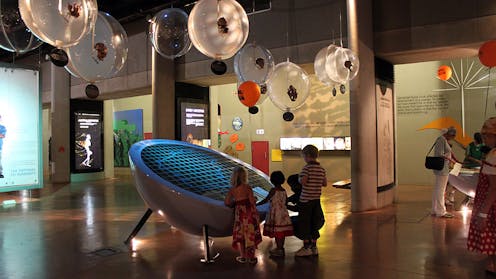
‘Find the fossil sites’ interactive display, Maropeng exhibition, Cradle of Humankind. flowcomm, CC BY

South Africa has one of the world’s richest fossil records of hominins (humans and their fossil ancestors). But many misconceptions still exist regarding human evolution, and school textbooks contain inaccuracies.

South Africans still have some of the lowest rates of acceptance of human evolution, mostly due to conflicting religious views. Religion and the non-acceptance of evolution hinders the understanding of evolution by teachers and learners.

It doesn’t help that school subjects (evolution being one of them) are often taught in unengaging ways, rather than interactive methods.

Many studies have shown that collaborations between schools and informal science learning centres, such as natural history museums, can have a positive effect on school learners. Inquiry-based activities at museums have been shown to help learners gain knowledge and meaning about the past. Museum visits foster “thinking skills” through guided conversation and questions asked by educators and learners. New information is gained through reasoning, inference and deduction, which enhance learning.


Read more:
Evolution revolution: how a Cape Town museum exhibit is rewriting the story of humankind


In 2018, a team of researchers from the University of the Witwatersrand launched workshops on human evolution for grade 12 learners (in the final year of secondary school) in South Africa’s Gauteng province. The aim was to stimulate interest in the palaeosciences and improve learner performance. We worked with learners from 13 schools in the area. The workshops were conducted at the museum of the university’s Evolutionary Studies Institute.

From tests before and after the workshops, we found that they improved the learners’ understanding and acceptance of concepts related to evolution. More teacher training and school visits to museums and exhibitions could build on this success.

Workshops on human evolution

Our human evolution workshops were conducted with well-resourced and historically disadvantaged schools attending. The grade 12 learners, aged 17 and 18 years, visited the fossil preparatory laboratory, searched for clues in the museum while answering a worksheet, and did activities on human evolution using inquiry-based approaches.


Read more:
What it’s like curating ancient fossils: a palaeontologist shares her story


These activities included measuring and describing skulls of apes and hominins, comparing hip bones to see whether the creature was able to walk upright on two legs, investigating stone tools, and drawing a phylogenetic tree (a diagram showing how species are descended from each other). Due to financial constraints, some of the workshops were held at the schools themselves.

The 687 learners wrote a test before and after the workshop to test their knowledge of hominin evolution. Their scores increased from an average of 39% to 61%.

The location of the workshops (either at the museum or at the school) did not affect the scores, suggesting that workshops can be scaled to reduce costs. Feedback from interviews indicated that learners regarded the workshops as beneficial, enabling them to learn new facts and gain a deeper understanding of human evolution. Teachers echoed the same view.

One learner said:

It was pretty enjoyable, and informative and interesting. Especially the part when we asked questions and we actually got answered. It helped us to understand the knowledge more.

Another said:

It is always better to physically see things as compared to seeing a picture of it, it is easier to understand it this way.

A teacher commented that learners

could literally see exactly what is happening and it is not just talk, they can touch it and they can take part in the experiment, which is not something they are exposed to at school.

It was apparent that learners understood human evolution better after the workshops. In the preliminary exam paper of Gauteng province, learners who attended the workshops scored nearly double (average 41%) the score of schools that did not attend (average 21%). While the scores are still low, and there is still much room for improvement, the results suggest that a short, hands-on workshop can make a major difference to learners.

The workshop also increased the acceptance of evolution from 41% to 51%. (It was not the purpose of the workshops to increase acceptance, but rather to improve understanding of the topic.)

Why the workshops worked

In our view, the workshops were successful because they used inquiry-based learning, learners working in groups using problem solving and physical handling of fossil casts. This enabled active participation in the learning process.


Read more:
It’s time to celebrate Africa’s forgotten fossil hunters


With this approach, learners took ownership of the learning process and it developed their curiosity, interest and a desire to learn. The guidance of a subject expert during the workshops enhanced the quality of the workshops and the learning experience. It’s clear that visits to places like natural history museums created connections which helped with understanding concepts such as human evolution in the classroom, and developing an enjoyment of learning.

What’s next

We recommend that teachers receive training in human evolution and how to teach this topic. Common misconceptions of teachers can be identified through surveys, and intervention training must be planned around these misconceptions. The Gauteng Department of Education has a free professional development programme offering training to teachers (not publicly available), which can be used for this purpose.


Read more:
Species without boundaries: a new way to map our origins


Various institutions in Gauteng offer exhibitions on human evolution and fossils, including the University of the Witwatersrand, the Ditsong National Museum of Natural History, Maropeng Cradle of Humankind, Sterkfontein Caves and the Sci-Bono Discovery Centre. The provincial education department must promote school visits to these places. Human evolution can be one of the most rewarding topics for learners, especially in a country where the fossil record is right on the doorstep.

It’s vital for grade 12 learners in South Africa to have a solid understanding of human evolution – it fosters critical thinking about science, identity and our shared African origins. This knowledge not only deepens their appreciation of the continent’s fossil heritage, but also counters misinformation with evidence-based insight.


This article was prepared with Grizelda van Wyk and in memory of Ian J. McKay.

The Conversation

Shaw Badenhorst works for the University of the Witwatersrand. He receives funding from GENUS, the National Research Foundation and the Palaeontological Scientific Trust.

ref. Fun with fossils: South African kids learn a whole lot more about human evolution from museum workshops – https://theconversation.com/fun-with-fossils-south-african-kids-learn-a-whole-lot-more-about-human-evolution-from-museum-workshops-259319

Somalia at 65: what’s needed to address its dismal social development indicators

Source: The Conversation – Africa – By Ali A. Abdi, Professor, University of British Columbia

Somalia ranks among the lowest scoring countries in the United Nations Human Development Index. The index of 195 countries is a summary measure of average achievement in key dimensions of human development: a long and healthy life, years of schooling, and access to a decent standard of living. Ali A. Abdi, a scholar of social development education, examines Somalia’s failure to advance social development programmes.

What is socio-economic development and how does Somalia stack up?

Somalia is celebrating its 65th year of independence. This was marked officially on 1 July 2025.

Despite the pomp and circumstance, though, the country’s social development indicators are dismal.

Social development generally means visible improvements in the quality of life. People’s well-being is based on aspects of national progress like:

  • universally available good quality education and adequate healthcare

  • employment opportunities that generate liveable incomes and upward socioeconomic mobility

  • governance structures that protect people’s rights to security.

Somalia has failed to meet these human development targets.

Its low score in the UN index can be understood by looking at the statistics relating to education and health. In any society these act as foundational blocks for social development. But in Somalia:

  • children can expect to get an average of 1.72 years of education (the continental African average is 7.7 years)

  • there are 0.23 doctors per 10,000 people, and many doctors serve in fee-based private clinics which are out of reach for ordinary citizens in a country with US$600 GDP per capita income

  • the capital city, Mogadishu, with a population of 2.8 million, has only two fully public hospitals and they lack specialist services; patients who require specialist care must go to private hospitals

  • the youth unemployment rate is just below 70%.

With these social development liabilities, it’s no wonder that the country is the biggest per capita producer of both global refugees and internally displaced persons.

How did Somalia come to this?

The Somali state collapsed as a cohesive national entity in 1991. The military government that had been in power since 1969 was overthrown by armed opposition forces. The country slowly fragmented into quasi-self-governing regions. Transitional national governments have come and gone.

The current federal political structure came into being in August 2012. The Federal Republic of Somalia comprised five founding member states (there are now six).

The depressed social development situation is not the only obstacle facing Somalia. Other complexities include:

A governance system built on cronyism and political loyalty: Somalia’s national political leadership entrenched cronyism. In fairness, the same selectively applies to sub-national, federal member states leadership. This corrupt system has found traction in a country where professionals, young graduates and traditional leaders lack legitimate sources of income. This undermines good governance while creating discord within and among the federal government and federal member states.

Discord at national level and between national and sub-national leaders: The most recent example of this revolves around the national leadership’s 2024 attempt to change the interim constitution. The unilaterally proposed one-person-one-vote proposal runs counter to the 2012 framework through which the current federal system was created. This has fuelled yet another national controversy with less than a year to the next presidential election.

Externally constructed political and economic interventions: Somalia receives significant international aid to address political and developmental challenges. But the strings attached include the management of these funds by external entities. These donor priorities can be detached from immediate social development needs. And aid creates and sustains dependency and entrenches poverty.

What should the government prioritise and why?

The political class always says fighting terrorism is the top policy priority. This thinking, while viable for the current situation, ignores the potential to minimise terrorism by putting the basic needs of the public first, and especially the youth.

Somali leaders are duty-bound to shift focus. A good place to start is the basis of social development: security, education and healthcare. It falls upon them to marshal the country’s resources and capacities to improve the well-being of its citizens.

The national leadership also needs to restructure its relationship with federal member states. Distribution of development resources (including foreign aid) must be fair, not based on political alliances.

Somalia also needs to reform the government’s policy on public appointments. People must get jobs based on their educational background, professional experience, incorruptible character and institutional accountability.

The country has impressive natural resources. There’s huge untapped potential for fisheries and agriculture, which is the country’s economic backbone. The country also has untapped minerals and hydrocarbons wealth.

The above observations are not to say that the federal government should lose sight of the fight against the terrorist organisations. But the welfare of people, including job creation for young people, must be equally prioritised. That will surely advance much needed social development while also reducing the appeal of terrorism among the youth.

The Conversation

Ali A. Abdi does not work for, consult, own shares in or receive funding from any company or organisation that would benefit from this article, and has disclosed no relevant affiliations beyond their academic appointment.

ref. Somalia at 65: what’s needed to address its dismal social development indicators – https://theconversation.com/somalia-at-65-whats-needed-to-address-its-dismal-social-development-indicators-258307

Ruth First and activist research: the legacy of a South African freedom fighter

Source: The Conversation – Africa – By Saleem Badat, Research Professor, UFS History Department, University of the Free State

Ruth First, born 100 years ago, was a South African freedom fighter, journalist and scholar who worked against the racist system of apartheid during white minority rule. She was assassinated by apartheid forces in her office at the Eduardo Mondlane University in Mozambique in 1982.

Her ideas, work and legacy live on. Sociologists Saleem Badat and Vasu Reddy have edited a new book called Research and Activism: Ruth First & Activist Research. We asked them about her and their project.


Who was Ruth First?

Heloise Ruth First was born on 4 May 1925 in Johannesburg to Jewish parents who had migrated from eastern Europe to South Africa in the early 1900s. Her parents were founder members of the South African Communist Party.

She joined the Young Communist League and the Federation of Progressive Students and graduated from the University of the Witwatersrand in 1946 with a Bachelor of Arts degree.

At 21, First joined the left-wing South African newspaper The Guardian. When it was banned, the New Age took its place until it too was banned in 1962. She served as the newspaper’s Johannesburg editor for 17 years.

In 1963, First was arrested at the University of the Witwatersrand library and held in solitary confinement for 117 days, during which time she was ruthlessly interrogated. The following year she and her three children left South Africa for England on an exit permit, where they joined her partner, the activist and politician Joe Slovo. She would not set foot again in South Africa. Continuing with her activist research in England, she taught at Durham University and then joined Eduardo Mondlane University until hear death.

The mid-1940s to early 1960s were tumultuous years in South Africa. With the rise of formal apartheid in 1948, racial segregation was intensified.

First’s intrepid and penetrating journalistic research exposed her to the brutality of labour exploitation and control on the mines and the farms. It reinforced her understanding of South Africa in Marxist terms.

She wrote:

Silence in the face of injustice is complicity.

For her:

The will to fight is born out of the desire for freedom.

She was confident that:

The power of the people is greater than the power of any government.

First believed that ignorance is “the enemy of progress and justice” and that knowledge and education are “key to empowering individuals and challenging oppressive systems”. These words ring true in today’s global events driven by right-wing authoritarianism, US imperialism and acts of genocide.

On learning of her death, former South African President Nelson Mandela recalled:

I was in prison when Ruth First was assassinated, felt almost alone. Lost a sister in arms  … It is no consolation to know that she lives beyond her grave.

What is activist research and how is it applied in the book?

As authors, we revisit Ruth First’s life, work and ideas and its relevance for the current context. We focus especially on the nature of her scholarship and how she navigated the tensions between her activism and her research – whether journalistic or for her books on South West Africa (today’s Namibia), Libya or western investment in apartheid. Other of her acclaimed books included The Barrel of a Gun: Political Power in Africa and the Coup d’etat and, during her Mozambican sojourn, Black Gold: The Mozambican Miner, Proletarian and Peasant.

In the process we invite renewed critical reflection about her life and work. Inspired by First’s contributions, the book considers how universities and scholars engage with institutions and social movements beyond the university.

For example, in the book a research group from Durham University in the UK considers how to balance objectivity (showing no bias) with more politically participatory research methods and how objectivity can be enhanced despite the difficulties faced by activist research.

Other scholars reflect on the work of the assassinated South African anti-apartheid activist scholar and lecturer Rick Turner; on climate change; and on the complexities of undertaking activist research in Marikana with a women’s organisation, Sikhala Sonke. Marikana was the site where South African police opened fire on and killed 34 striking mineworkers in 2012.

There is examination of a research partnership between University of Cape Town activist scholars and some Khoi-San communities, reflection on the challenges of legal practice and education, and critical analysis of the decolonisation challenges of the KwaZulu-Natal Society of the Arts.

How do you frame activist research in your book?

The book shows that there is a difference between engaged research, critical research and activist research.

Engaged research tries to connect knowledge produced by academics with institutions, movements and experts outside the university to collaboratively address issues and promote cooperation.

Critical research uses radical critical theory to critique oppression and injustice, to show the gap between what exists today and more just ways of living. However, it does not necessarily connect with political and social movements.

First’s research was not only engaged, but also critical in orientation and activist in nature. As activist research it challenged oppression and inequality.

It both critiqued the status quo in South Africa and elsewhere and tried to change it. It was linked with movements and connected to political activism that was anti-colonial, anti-imperialist, and committed to socialism.


Read more:
Lessons learnt from taking sides as a sociologist in unjust times


First’s activist research did not confine itself to the academic arena but engaged with larger, wider and more diverse publics. It used this experience to critique dominant and often limited thinking at universities and promoted other ways of producing knowledge. The expertise developed was used to improve scholarship in various ways.

What do you want readers to take away?

There is much talk about the “engaged university” and engaged research. However, only certain connections and engagements seem to be valued.

Prior to democracy in 1994, South African researchers connected with social movements for change. Now this is seldom the case. Universities and scholars largely engage with those with money – the state, business, elites and donors.


Read more:
Regina Twala was a towering intellectual and activist in Eswatini – but she was erased from history


This raises questions about the roles of researchers in South Africa, whose interests are prioritised and the place of critical and activist research in the engaged university.

How should Ruth First be remembered?

We must honour her for her intellectual and practical activism. What matters is not just her knowledge archive, but also her example as both an outstanding interpreter of the world and an activist scholar committed to changing society in the interests of the downtrodden, marginalised and voiceless.

First was a critical and independent thinker who refused to accept anything as settled and beyond questioning. But that intellect was committed to loyalty to the national liberation movement of which she was an invaluable cadre.


The views expressed in this piece do not reflect or represent the position of the university to which Badat and Reddy are affiliated.

The Conversation

Saleem Badat receives funding from the National Institute for Humanities and Social Sciences and the Andrew W Mellon Foundation. He is a board member of the International Consortium for Critical Theory Programs and Alameda.

Vasu Reddy currently receives no external funding. He serves on the board of the Human Sciences Research Council Press

Andrew W Mellon Foundation Grant

Board member of the HSRC Press Board

ref. Ruth First and activist research: the legacy of a South African freedom fighter – https://theconversation.com/ruth-first-and-activist-research-the-legacy-of-a-south-african-freedom-fighter-257687

Eco labels in South Africa don’t do the job: how to help customers make informed choices

Source: The Conversation – Africa – By Miemie Struwig, Professor, Department of Business Management, Nelson Mandela University

South Africans want to shop more sustainably, according to research published in the journal Sustainable Development. But most can’t tell which products are environmentally friendly.

Some food manufacturers have introduced eco labels – a certification symbol placed on product packaging. This indicates the product meets specific environmental standards set by a third party organisation.

These labels are meant to signal to consumers that a product has been produced in a way that limits harm to the environment. But our recent study with 108 South African consumers showed low recognition of eco labels, widespread confusion, and a need for clearer guidance.

The results show that most South African shoppers are unfamiliar with these labels or unable to differentiate between real and fictional ones.

In the European Union eco labels like the EU Energy Label are easily understood and highly visible. They are also usually supported by government awareness campaigns. Other examples of labelling systems that work well include those of Germany and Japan.

These countries show that long term institutional support, mandatory labelling in key sectors, and consistent public messaging can greatly improve eco label recognition.

We concluded from our research that South Africa lacks that national visibility and public education, leaving even motivated consumers unsure of what labels to trust. Based on our findings we recommend steps businesses, government and nonprofits can take to ensure that eco labels are clear, visible and understood.

Eco labelling at its best

The EU Energy Label is used on appliances such as fridges, washing machines and light bulbs to indicate their energy efficiency on a scale from A (most efficient) to G (least efficient).

In countries like Germany and Japan, eco labels are government backed as well as being integrated into school curricula, public service announcements and shopping platforms.

Germany’s Blue Angel label, which states “protects the environment”, has been in use since the 1970s. It appears on over 12,000 products and services, including paper goods, cleaning products, paints and electronics, that meet strict environmental criteria. It is supported by ongoing public education campaigns.

In Japan the the Eco Mark appears on products with minimal environmental impact. It appears on items like stationery, detergents, packaging and appliances. Many retailers display explanations next to these products to help consumers understand the label.

South Africans struggle to identify eco labels

We conducted a structured online survey of 108 South African consumers. Participants were asked about their environmental awareness and their ability to recognise both real and fictional eco labels across ten images. According to the global directory of eco labels and environmental certification schemes, there are around 50 eco labels in South Africa.

The EU Energy Label was the most recognised (87%).

The Afrisco Certified Organic label, which is a legitimate South African label, was the least recognised, identified by just 22% of respondents.

Fictional labels were mistakenly identified as real by many participants, revealing widespread confusion.

Only 3 out of 10 labels were recognised by at least half the participants, suggesting a general lack of eco label awareness. These include the Energy Star Eco label; the EU Energy label and the Forest Stewardship council label.

Age and employment status were significantly related to environmental awareness. Older and employed individuals showed higher levels of awareness.

These findings suggest that consumers are not opposed to eco labels, they simply lack the knowledge and confidence to use them effectively.

Eco labels have the potential to build brand trust, drive green purchasing behaviour, and support national sustainability goals. But they only work if consumers recognise and trust them.

In South Africa, inconsistent use, small label size, and a lack of consumer education are holding eco labels back from achieving their purpose.

What businesses can do

Based on our findings, we recommend the following:

  • Use recognised and credible labels: Third-party certified labels are more trustworthy and reliable.

  • Improve label visibility: The most recognised label in our study was the EU Energy Label and was also the most prominent. Small, cluttered logos go unnoticed.

  • Educate your market: Explain what eco labels mean through packaging, marketing, and digital platforms.

  • Partner with government and NGOs: Awareness campaigns at national and community levels can help standardise eco label understanding.

  • Tailor communication efforts: Awareness efforts should consider age and employment demographics, as these affect levels of environmental engagement.

The way forward

South Africans are willing to support environmentally responsible products, but they need help identifying them.

Businesses, government and nonprofits all have a role to play in making eco labels clearer, more visible, and more trustworthy.

Eco labels must become more than symbols. They should be tools for transparency and trust, and a gateway to more sustainable shopping.

The Conversation

The authors do not work for, consult, own shares in or receive funding from any company or organisation that would benefit from this article, and have disclosed no relevant affiliations beyond their academic appointment.

ref. Eco labels in South Africa don’t do the job: how to help customers make informed choices – https://theconversation.com/eco-labels-in-south-africa-dont-do-the-job-how-to-help-customers-make-informed-choices-258081

Uganda’s ride-hailing motorbike service promised safety – but drivers are under pressure to speed

Source: The Conversation – Africa – By Rich Mallett, Research Associate and Independent Researcher, ODI Global

Motorcycle-taxis are one of the fastest and most convenient ways to get around Uganda’s congested capital, Kampala. But they are also the most dangerous. Though they account for one-third of public transport trips taking place within the city, police reports suggest motorcycles were involved in 80% of all road-crash deaths registered in Kampala in 2023.

Promising to solve the safety problem while also improving the livelihoods of moto-taxi workers, digital ride-hail platforms emerged a decade ago on the city’s streets. It is no coincidence that Uganda’s ride-hailing pioneer and long-time market leader goes by the name of SafeBoda.

Conceived in 2014 as a “market-based approach to road safety”, the idea is to give riders a financial incentive to drive safely by making digital moto-taxi work pay better. SafeBoda claimed at the time that motorcyclists who signed up with it would increase their incomes by up to 50% relative to the traditional mode of operation, in which riders park at strategic locations called “stages” and wait for passengers.

In the years since, the efforts of SafeBoda and its ride-hail competitors to bring safety to the sector have largely been deemed a success. One study carried out in 2017 found that digital riders were more likely to wear a helmet and less likely to drive towards oncoming traffic. Early press coverage was particularly glowing, while recent academic studies continue to cite the Kampala case as evidence that ride-hailing platforms may hold the key to making African moto-taxi sectors a safer place to work and travel.


Read more:
Ride-hailing in Lagos: algorithmic impacts and driver resistance


Is it all as clear-cut as this? In a new paper based on PhD research, I suggest not. Because at its core the ride-hail model – in which riders are classified as independent contractors who do poorly paid “gig work” rather than as wage-earning employees – undermines its own safety ambitions.

Speed traps

In my study of Kampala’s vast moto-taxi industry – estimated to employ hundreds of thousands of people – I draw on 112 in-depth interviews and a survey of 370 moto-taxi riders to examine how livelihoods and working conditions have been affected by the arrival of the platforms.

To date, there has been only limited critical engagement with how this change has played out over the past decade. I wanted to get beneath the big corporate claims and alluring platform promises to understand how riders themselves had experienced the digital “transformation” of their industry, several years after it first began.


Read more:
Kenya’s ride-hailing drivers say their jobs offer dignity despite the challenges


One of the things I found was that, from a safety perspective, the ride-hail model represents a paradox. We can think of it as a kind of “speed trap”.

On one hand, ride-hail platforms try to moderate moto-taxi speeds and behaviours through managerial techniques. They make helmet use compulsory. They put riders through road safety training before letting them out onto the streets. And they enforce a professional “code of conduct” for riders.

In some cases, companies also deploy “field agents” to major road intersections around the city. Their task is to monitor the behaviour of riders in company uniform and, should they be spotted breaking the rules, discipline them.

On the other hand, however, the underlying economic structure of digital ride-hailing pulls transport workers in the opposite direction by systematically depressing trip fares and rewarding speed.

Under the “gig economy” model used by Uganda’s ride-hail platforms, the livelihood promise hangs not in the offer of a guaranteed wage but in the possibility of higher earnings. Crucially, it is a promise that only materialises if riders are able to reach and maintain a faster, harder work-rate throughout the day – completing enough jobs that pay “little money”, as one rider put it, to make the gig-work deal come good. Or, as summed up by another interviewee:

We are like stakeholders, I can say that. No basic salary, just commission. So it depends on your speed.

We already know from existing research that the gig economy places new pressures on transport workers to drive fast and take risky decisions. This is especially the case for workers on low, unsteady pay and without formal safety nets.

And yet, it is precisely these factors that routinely lead to road traffic accidents. Extensive research from across east Africa has shown that motorcycle crashes are strongly associated with financial pressure and the practices that lead directly from this, such as speeding, working long hours and performing high-risk manoeuvres. All are driven by the need to break even each day in a hyper-competitive informal labour market, with riders compelled to go fast by the raw economics of their work.

Deepening the pressure

Ride-hail platforms may not be the reason these circumstances exist in the first place. But the point is that they do not mark a departure from them.

If anything, my research suggests they may be making things worse. According to the survey data, riders working through the apps make on average 12% higher gross earnings each week relative to their analogue counterparts. This is because the online world gets them more jobs.

But to stay connected to that world they must shoulder higher operating costs, for: mobile data (to remain logged on); fuel (to perform more trips); the use of helmets and uniforms (which remain company property); and commissions extracted by the platform companies (as much as 15%-20% per trip).

As soon as these extras are factored in, the difference completely disappears. The digital rider works faster and harder – but for no extra reward.

Rethinking approaches to safety reform

Ride-hail platforms were welcomed onto the streets of Kampala as an exciting new solution to unsafe transport, boldly driven by technological innovation and “market-based” thinking.


Read more:
Uganda’s speedy motorbike taxis will slow down for cash – if incentives are cleverly designed


But it is important to remember that these are private enterprises with a clear bottom line: to one day turn a profit. As recent reports and my own thesis show, efforts to reach that point often alienate and ultimately repel the workers on whom these platforms depend – and whose livelihoods and safety standards they claim to be transforming.

A recent investment evaluation by one of SafeBoda’s first funders perhaps puts it best: it is time to reframe ride-hailing as a “risky vehicle” for safety reform in African cities, rather than a clear road to success.

The Conversation

Rich received funding for this research from the UK’s Economic and Social Research Council (ESRC).

ref. Uganda’s ride-hailing motorbike service promised safety – but drivers are under pressure to speed – https://theconversation.com/ugandas-ride-hailing-motorbike-service-promised-safety-but-drivers-are-under-pressure-to-speed-259310

Ghana and India: Narendra Modi’s visit rekindles historical ties

Source: The Conversation – Africa (2) – By Pius Siakwah, Senior Research Fellow, Institute of African Studies, University of Ghana

Narendra Modi’s trip to Ghana in July 2025, part of a five-nation visit, is the first by an Indian prime minister in over 30 years. The two countries’ relationship goes back more than half a century to when India helped the newly independent Ghana set up its intelligence agencies. Ghana is also home to several large Indian-owned manufacturing and trading companies. International relations scholar Pius Siakwah unpacks the context of the visit.

What is the background to Ghana and India’s relationship?

It can be traced to links between Kwame Nkrumah, Ghana’s first president, and his Indian counterpart, Prime Minister Jawaharlal Nehru, in 1957. It is not surprising that the Indian High Commission is located near the seat of the Ghana government, Jubilee House.

Nkrumah and Nehru were co-founders of the Non-Aligned Movement, a group of states not formally aligned with major power blocs during the cold war. Its principles focused on respect for sovereignty, neutrality, non-interference, and peaceful dispute resolution. It was also a strong voice against the neo-colonial ambitions of some of the large powers.

The movement emerged in the wave of decolonisation after the second world war. It held its first conference in 1961 under the leadership of Josip Bros Tito (Yugoslavia), Gamal Abdel Nasser (Egypt) and Sukarno (Indonesia) as well as Nehru and Nkrumah.

The relationship between Ghana and India seemingly went into decline after the overthrow of Nkrumah in 1966, coinciding with the decline of Indian presence in global geopolitics.

In 2002, President John Kufuor re-energised India-Ghana relations. This led to the Indian government’s financial support in the construction of Ghana’s seat of government in 2008.

Though the concept of the Non-Aligned Movement has faded this century, its principles have crystallised into south-south cooperation. This is the exchange of knowledge, skills, resources and technologies among regions in the developing world.

South-south cooperation has fuelled India-Ghana relations. Modi’s diplomatic efforts since 2014 have sought to relaunch India’s presence in Africa.

In recent times, India has engaged Africa through the India–Africa Forum Summit. The first summit was held in 2008 in New Delhi with 14 countries from Africa. The largest one was held in 2015, while the fourth was postponed in 2020 due to COVID-19. The summit has led to 50,000 scholarships, a focus on renewable energy through the International Solar Alliance and an expansion of the Pan-African e-Network to bridge healthcare and educational gaps. Development projects are financed through India’s EXIM Bank.

India is now one of Ghana’s major trading partners, importing primary products like minerals, while exporting manufactured products such as pharmaceuticals, transport and agricultural machinery. The Ghana-India Trade Advisory Chamber was established in 2018 for socio-economic exchange.

Modi’s visit supports the strengthening of economic and defence ties.

The bilateral trade between India and Ghana moved from US$1 billion in 2011-12 to US$4.5 billion in 2018-19. It then dipped to US$2.2 billion in 2020-21 due to COVID. By 2023, bilateral trade amounted to around US$3.3 billion, making India the third-largest export and import partner behind China and Switzerland.

Indian companies have invested in over 700 projects in Ghana. These include B5 Plus, a leading iron and steel manufacturer, and Melcom, Ghana’s largest supermarket chain.

India is also one of the leading sources of foreign direct investment to Ghana. Indian companies had invested over US$2 billion in Ghana by 2021, according to the Ghana Investment Promotion Center.

What are the key areas of interest?

The key areas of collaboration are economic, particularly:

  • energy

  • infrastructure (for example, construction of the Tema to Mpakadan railway line)

  • defence

  • technology

  • pharmaceuticals

  • agriculture (agro-processing, mechanisation and irrigation systems)

  • industrial (light manufacturing).

What’s the bigger picture?

Modi’s visit is part of a broader visit to strengthen bilateral ties and a follow-up to the Brics Summit, July 2025 in Brazil. Thus, whereas South Africa is often seen as the gateway to Africa, Ghana is becoming the opening to west Africa.

Modi’s visit can be viewed in several ways.

First, India as a neo-colonialist. Some commentators see India’s presence as just a continuation of exploitative relations. This manifests in financial and agricultural exploitation and land grabbing.

Second, India as smart influencer. This is where the country adopts a low profile but benefits from soft power, linguistic, cultural and historical advantages, and good relationships at various societal and governmental levels.

Third, India as a perennial underdog. India has less funds, underdeveloped communications, limited diplomatic capacity, little soft power advantage, and an underwhelming media presence compared to China. China is able to project its power in Africa through project financing and loans, visible diplomatic presence with visits and media coverage in Ghana. Some of the coverage of Chinese activities in Ghana is negative – illegal mining (galamsey) is an example. India benefits from limited negative media presence but its contributions in areas of pharmaceuticals and infrastructure don’t get attention.

Modi will want his visit to build on ideas of south-south cooperation, soft power and smart operating. He’ll want to refute notions that India is a perennial underdog or a neo-colonialist in a new scramble for Africa.

In 2025, Ghana has to navigate a complex geopolitical space.

The Conversation

Pius Siakwah does not work for, consult, own shares in or receive funding from any company or organisation that would benefit from this article, and has disclosed no relevant affiliations beyond their academic appointment.

ref. Ghana and India: Narendra Modi’s visit rekindles historical ties – https://theconversation.com/ghana-and-india-narendra-modis-visit-rekindles-historical-ties-260281

How far is your closest hospital or clinic? Public health researchers explain why Africa needs up-to-date health facility databases

Source: The Conversation – Africa (2) – By Peter M Macharia, Senior postdoctoral research fellow, Institute of Tropical Medicine Antwerp

The lack of reliable information about health facilities across sub-Saharan Africa became very clear during the COVID-19 pandemic. Amid a surge in emergency care needs, information was lacking about the location of facilities, bed capacity and oxygen availability, and even where to find medical specialists. This data could have enabled precise assessments of hospital surge capacity and geographic access to critical care. Peter Macharia and Emelda Okiro, whose research focuses on public health and equity of health service access in low resource settings, share the findings of their recent study, co-authored with colleagues.

What are open health facility databases?

A health facility is a service delivery point where healthcare services are provided. The facilities can range from small clinics and doctor’s offices to large teaching and referral hospitals.

A health facility database is a list of all health facilities in a country or geographic area, such as a district. A typical database should assign each health facility a unique code, name, size, type (from primary to tertiary), ownership (public or private), operational status (working or closed), location and subnational unit (county or district). It should also record services (emergency obstetric care, for example), capacity (number of beds, for example), infrastructure (electricity availability, for example), contact information (address and email), and when this information was last updated.

The ideal method of compiling this list is to conduct a census, as Kenya did in 2023. But this takes resources. Some countries have compiled lists from existing incomplete ones. Senegal did this and so did Kenya in 2003 and 2008.

This list should be open to stakeholders, including government agencies, development partners and researchers. Health facility lists must be shared through a governance framework that balances data sharing with protections for data subjects and creators. In some countries, such as Kenya and Malawi, these listings are accessible through web portals without additional permission. In others, such facility lists do not exist or require extra permission.

Why are they useful to have?

Facility listings can serve the needs of individuals and communities. They also serve sub-national, national and continental health objectives.

At the individual level, a facility list offers a choice of alternatives to health seekers. At the community level, the data can guide decisions like where to place community health workers, as seen in Mali and Sierra Leone.

Health lists are useful when distributing commodities such as bed nets and allocating resources based on the health needs of the areas they serve. They help in planning for vaccination campaigns by creating detailed immunisation microplans.

By taking account of the disease burden, social dynamics and environmental factors, health services can be tailored to specific needs.

Detailed maps of healthcare resources enable quicker emergency responses by pinpointing facilities equipped for specific crises. Disease surveillance systems depend on continuously collecting data from healthcare facilities.

At the continental level, lists are crucial for a coordinated health system response during pandemics and outbreaks. They can facilitate cross-border planning, pandemic preparedness and collaboration.

During the COVID-19 pandemic, these lists informed where to put additional resources such as makeshift hospitals or transport programmes for adults over  60 years of age.

The lists are used to identify vulnerable populations at risk of emerging pathogens and populations that can benefit from new health facilities.

They are important when it comes to making emergency obstetric and newborn care accessible.

What goes wrong if you don’t have them?

Many problems arise if we don’t know where health facilities are or what they offer. Healthcare planning becomes inefficient. This can result in duplicate facility lists and the misallocation of resources, which leads to waste and inequities.

We can’t identify populations that lack services. Emergency responses weaken due to uncertainty about where best to move patients with specific conditions.

Resources are wasted when there are duplicate facility lists. For example, between 2010 and 2016, six government departments partnered with development organisations, resulting in ten lists of health facilities in Nigeria.

In Tanzania, over 10 different health facility lists existed in 2009. Maintained by donors and government agencies, the function-specific lists didn’t work together to share information easily and accurately. This prompted the need for a national master facility list.

What needs to happen to build one?

A comprehensive list of health facilities can be compiled through mapping exercises or from existing lists. The health ministry should take responsibility for setting up, developing and updating this list.

Partnerships are crucial for developing facility lists. Stakeholders include donors, implementing and humanitarian partners, technical advisors and research institutions. Many of these have their own project-based lists, which should integrate into a centralised facility list managed by the ministry. The health ministry must foster a transparent environment, encouraging citizens and stakeholders to contribute to enhancing health facility data.

Political and financial commitment from governments is essential. Creating and maintaining a proper list requires significant investment. Expertise and resources are necessary to keep it updated.

A commitment to open data is a necessary step. Open access to these lists makes them more complete, reliable and useful.

The Conversation

Peter Macharia is funded by Fonds voor Wetenschappelijk Onderzoek- Belgium (FWO, number 1201925N) for his Senior Postdoctoral Fellowship.

Emelda Okiro receives funding for her research from the Wellcome Trust through a Wellcome Trust Senior Fellowship (#224272).

ref. How far is your closest hospital or clinic? Public health researchers explain why Africa needs up-to-date health facility databases – https://theconversation.com/how-far-is-your-closest-hospital-or-clinic-public-health-researchers-explain-why-africa-needs-up-to-date-health-facility-databases-259190

The first fossil thrips in Africa: this tiny insect pest met its end in a volcanic lake 90 million years ago

Source: The Conversation – Africa (2) – By Sandiso Mnguni, Honorary Research Associate, University of the Witwatersrand

The fossil thrips discovered in the Orapa Diamond Mine. Dr Sandiso Mnguni, CC BY-NC-ND

Thrips are tiny insects – their sizes range between 0.5mm and 15mm in length and many are shorter than 5mm. But the damage they cause to crops is anything but small. A 2021 research paper found that in Indonesia “the damage to red chilli plants caused by thrips infestation ranges now from 20% to 80%”. In India, various thrips infestations in the late 2010s and early 2020s “damaged 40%-85% of chilli pepper crops in Karnataka, Andhra Pradesh and Telangana”.

In Africa, a number of thrips species feed on sugarcane and have been known to damage nearly 30% of the crop in a single hectare of a farm. High rates of destruction have been recorded in Tanzania and Uganda on onion and tomato crops.

Now it’s emerged that thrips are hardly new to the African continent and the southern hemisphere more broadly. South Africa’s first and only Black palaeoentomologist, Sandiso Mnguni, who studies fossil insects, recently described a fossil thrips from Orapa Diamond Mine in Botswana that’s more than 90 million years old. He discussed his unique fossil find with The Conversation Africa.

What are thrips and how do they cause damage?

Thrips, also known as thunderflies, thunderbugs or thunderblights, are small, slender and fragile insects. They can be identified by their typically narrow, strap-like, fringed and feathery wings. Over time, they have also evolved distinctive asymmetrical rasping-sucking mouthparts consisting of a labrum, labium, maxillary stylets and left mandible. Most species use these to feed primarily on fungi. Some feed on plants and eat the tender parts of certain crops like sugarcane, tomatoes, pepper, onions, avocado, legumes and citrus fruits, focusing on the buds, flowers and young leaves.

This, along with their habit of accidentally distributing fungal spores while feeding or hunting, makes them destructive crop pests. They tend to feed as a group in large numbers, causing distinctive silver or bronze scarring on the surfaces of stems or leaves.

However, not all thrips are harmful. A small fraction of the 6,500 species that have already been described so far are pollinators of flowering plants; and a handful are predators or natural enemies of moths and other smaller animals such as mites.

A green leaf dotted with small black bugs in held in a person's hand
Larva, pupa and adult Weeping fig thrips (Gynaikothrips uzeli)
fcafotodigital

Tell us about the fossil thrips you’ve discovered

This is the first time that a fossil thrips has been recorded anywhere in Africa – or the entire southern hemisphere.

The Orapa Diamond Mine in Botswana is one of the most important fossil deposits on the continent. It’s about 90 million years old, dating back to the Cretaceous period.


Read more:
Fossil beetles found in a Botswana diamond mine help us to reconstruct the distant past


The deposit is situated 960 metres above sea level in the Kalahari Desert, about 250km due west of Francistown in Botswana, and 824km away from Johannesburg in South Africa. It was first discovered in 1967 and started producing carat diamonds in 1971.

Roughly 90 million years go, steam and gas caused a double eruption of diamondiferous kimberlites. These are vertical, deep-source volcanic pipes that form when magma rapidly rises from the Earth’s mantle, carrying diamonds and other minerals up to the surface. They create a distinctive rock formation that gets studied by geologists. This explosive volcanic eruption formed a deep crater lake at the centre of the mine.

Mining excavations during the 1980s and earlier uncovered and exposed fine-grained sedimentary rocks containing well preserved fossil plants and insects. These have already been studied by many researchers in the past. At the time, geology and palaeontology researchers from what was then the Bernard Price Institute, which has since been renamed the Evolutionary Studies Institute, at the University of the Witwatersrand in Johannesburg, were invited to collect the fossil material.

Although some of the material has been studied in the past, the fossil thrips hadn’t yet been put under the microscope. And that’s just what we did. By using its body characteristics and comparing it to living thrips, we can say for sure that it’s a thrips. But we didn’t give it a formal scientific name because it doesn’t have enough characteristics to classify it at the species level and describe it either as a new species or one that still exists today.

We think that the thrips either flew into the palaeolake that was formed by the volcanic eruption or was transported there through grass from a bird’s nest.

Why is this useful to know?

This discovery sheds light on the biodiversity and biogeography of thrips and many other groups of insects during a time when we know flowering plants that heavily relied on insect pollination were rapidly diversifying. This plant-insect reciprocal interaction goes back to the Devonian period, a time when there was a large super-continent called Gondwana. That’s when the first land plants evolved and dominated the Earth, and inadvertently led to many groups of insects, including thrips, diversifying to keep up with drastic changes in their preferred plant diets and habitats due to the dramatic environmental and climatic changes.


Read more:
Fossil insects help to reconstruct the past: how I ended up studying them (and you can too)


The fossil find also contributes to a more accurate documentation of life on Earth during the Cretaceous and helps scientists in reconstructing the past environment and climate in Botswana.

Hopefully there are more fossil insects waiting to be discovered in Botswana and elsewhere in Africa, to keep improving our picture of this long-ago world, and preserve the heritage of our continent.

The Conversation

Sandiso Mnguni receives funding from the GENUS: DSTI-NRF Centre of Excellence in Palaeosciences (Grant 86073). He is affiliated with the Agricultural Research Council Plant Health and Protection (ARC-PHP) and the Sophumelela Youth Development Programme (SYDP).

ref. The first fossil thrips in Africa: this tiny insect pest met its end in a volcanic lake 90 million years ago – https://theconversation.com/the-first-fossil-thrips-in-africa-this-tiny-insect-pest-met-its-end-in-a-volcanic-lake-90-million-years-ago-249077