Should lynx and wolves be reintroduced to Britain and Ireland? Young people have mixed feelings

Source: The Conversation – UK – By Jonny Hanson, Environmental Social Scientist, Queen’s University Belfast

Bjorn H Stuedal/Shutterstock

There are many things people have love-hate relationships with in Britain and Ireland, from Brussels sprouts to cricket or sea swimming. Another item can now be added to this list: the reintroduction of lynx and wolves to the countryside.

Lynx and wolf reintroductions are ecologically feasible in parts of Great Britain and may be in parts of Ireland in the future. Such reintroductions may provide significant ecological benefits, especially through influencing deer numbers and behaviour.

However, no governments in either of the two islands or nations has yet approved any proposals to reintroduce the animals. And ultimately, it is human nature much more than nature that will shape the feasibility and viability of such proposals. That’s why it’s vital to understand how people think and feel about the idea.

As part of my ongoing research on the subject, I asked over 4,000 ten to 11-year-olds and over 1,000 16-year-olds in Northern Ireland about their attitudes to lynx, wolves and their potential return to the UK and the Republic of Ireland.

For political and ecological reasons, Northern Ireland appears the least likely part of either nation to see these happen in the future. But its unique geopolitical status means its population can provide insights into what British and Irish people think.

My research highlights the complexity of feeling among young people on this subject in four key ways.

man in bllue coat looks through binoculars
In his research, author Jonny Hanson searches for social solutions to carnivore coexistence.
Marty Stalker, CC BY-NC-ND

First, perspectives may vary. The strongest single result from the five main survey responses to proposed reintroductions was the “neither agree nor disagree” category across both species and age groups. This was chosen by approximately a fifth to a quarter of young people: 21% and 26% for lynx among children and teenagers, and 22% and 24% respectively for wolves.

This uncertainty is summarised by Freddie, a 16-year-old from rural County Antrim: “As a young farmer who keeps sheep and other livestock, I’d be pretty worried about bringing lynx and wolves back.”

Second, Little Red Riding Hood still has a lot to answer for, as there was less support for the return of wolves compared to lynx. In my survey, just under one-third (32%) of ten to 11-year-olds and just over one third (35%) of 16-year-olds “agreed” or “strongly agreed” with the idea of lynx reintroductions to parts of the UK and Republic of Ireland.

That figure was lower for wolf reintroductions, with 30% of ten to 11-year-olds and 31% of 16-year-olds supporting the idea.

young lynx in woods walking towards camera
Young people’s perspectives about the reintroduction of lynx vary.
Miroslav Srb/Shutterstock

These levels were notably lower than the range of 36-52% support among surveys of British adults that I outline in my recent book, and considerably lower than the 72% support for lynx reintroductions in a study from northern England and southern Scotland published earlier this year. As Clara, an 11-year-old from Belfast, said: “I would definitely encourage the reintroduction of lynx … with regards to wolves I am uncertain.”


Read more:
Farmers told me what they really think about reintroducing lynx and wolves to Britain and Ireland


Third, for many teenagers “lynx” is primarily known as a brand of deodorant. Despite the illegal release of four lynx into the Scottish Highlands in January of this year, there is still less awareness of the species than of wolves.

This was reflected in the survey results among both ten to 11- and 16-year-olds, with many more choosing “I don’t know” for lynx (29% and 25% respectively) than for wolves (19% and 17% respectively). Freddie continued: “I don’t actually know a lot about how these animals hunt, so I am not sure how much danger they would really be.”

Fourth, knowledge is not enough. Among the 16-year-olds, those who knew what nature restoration or, especially, rewilding were, were much more supportive of lynx and wolf reintroductions.

But among the ten to 11-year-olds, beliefs that lynx and wolves were “beautiful”, “good” or “scary” also linked to attitudes to their possible return. When it comes to coexisting with these species, as similar research from Germany has shown, feelings matter as well as facts.

Young people, like people of all ages, have complex attitudes about the return of these complex creatures because of our complex relationship with them. On any love-hate issue, and especially with something as socially complex as lynx and wolf reintroductions, treading carefully is a wise course of action. As Freddie wisely summed it up: “Overall, I’d need more information before I could make a proper judgement.”


Don’t have time to read about climate change as much as you’d like?

Get a weekly roundup in your inbox instead. Every Wednesday, The Conversation’s environment editor writes Imagine, a short email that goes a little deeper into just one climate issue. Join the 47,000+ readers who’ve subscribed so far.


The Conversation

Jonny Hanson has received research funding in the past from the Economic and Social Research Council, the University of Cambridge, the Snow Leopard Conservancy, the Co-op Foundation and the Nuffield Farming Scholarships Trust. He is an affiliate of the Snow Leopard Conservancy.

– ref. Should lynx and wolves be reintroduced to Britain and Ireland? Young people have mixed feelings – https://theconversation.com/should-lynx-and-wolves-be-reintroduced-to-britain-and-ireland-young-people-have-mixed-feelings-269139

AFM-Téléthon : comment les patients et leurs proches ont révolutionné la recherche médicale

Source: The Conversation – in French – By Marie-Georges Fayn, Chercheuse associée, Université de Tours

Le Téléthon 2025 se tiendra les 5 et 6 décembre 2025. Née grâce à la détermination de parents d’enfants atteints de myopathie, l’association a su transformer l’épreuve de la maladie en une force génératrice d’entraide, de progrès scientifique et d’innovation sociale. Retour sur les raisons de ce succès, à la lumière des théories de l’empowerment.


Lorsqu’est créée, en 1958, l’Association française pour la myopathie (AFM), scientifiques et médecins n’ont que très peu de connaissances sur la maladie. Soutenue par une poignée de parents de patients, sa fondatrice Yolaine de Kepper, elle-même mère de quatre enfants atteints de myopathie de Duchenne, n’accepte pas la fatalité.

Elle décide de créer une structure pour faire connaître (et reconnaître) cette maladie, avec l’ambition de parvenir un jour à guérir les malades, dont la majorité mourait avant d’atteindre l’âge adulte. Les statuts initialement enregistrés au Journal officiel précisaient alors que l’objet de l’AFM était « [le] recensement des myopathes en France et en Belgique, [l’]obtention pour les malades atteints de myopathie des avantages du régime “longue durée” ; [la] création d’un centre spécialisé social et médical ».

Un peu moins de soixante-dix ans plus tard, devenue Association française contre les myopathies puis AFM-Téléthon, cette structure est une actrice incontournable de la recherche biomédicale, dont l’influence et l’expertise s’étendent bien au-delà de son périmètre initial.

L’analyse croisée des rapports institutionnels de l’association ainsi que de publications scientifiques ou issues de la société civile permet de mieux comprendre comment ce succès s’est construit, grâce à l’empowerment collectif.

De la révolte des familles à la naissance d’un mouvement

Sur son site Internet,l’AFM-Téléthon revendique un réseau de 68 délégations s’appuyant sur plus de 850 bénévoles afin d’accompagner quotidiennement les malades et leurs proches.

Le refus de la fatalité, la solidarité, la quête de solutions sont les valeurs fondatrices de ce collectif. En devenant membres de l’AFM, les parents sortent de leur isolement, s’entraident et mutualisent leurs expériences. Au fil du temps les réunions informelles se sont structurées ; l’association dispose aujourd’hui d’importants moyens d’accueil et d’information : groupes de paroles, lignes d’écoute, forums…

Le rapprochement de familles confrontées aux mêmes maux a permis de faire émerger une prise de conscience, une identité partagée, des liens de solidarité, un savoir et un pouvoir collectifs offrant une illustration concrète de l’empowerment communautaire. Ce terme d’empowerment est difficile à traduire en français, car il n’existe pas réellement d’équivalent capable de restituer à la fois sa dimension individuelle et sa dynamique collective, évolutive et transformative (même si des essais ont été tentés, tels qu’« empouvoirement », « pouvoir d’agir » ou « encapacitation », notamment).

Quand les patients deviennent partenaires de la recherche

Au début des années 1980, l’AFM réalise qu’aider ne suffit pas : il faut chercher à guérir. En 1981, elle crée son premier conseil scientifique, posant les bases d’une alliance entre familles, chercheurs et médecins. En 1982, sous la présidence de Bernard Barataud, elle adopte une devise ambitieuse, « Refuser, résister, guérir ».

Mais pour atteindre cet objectif, l’association a besoin d’argent, de beaucoup d’argent. En 1987, inspirée par le Jerry Lewis Show, l’AFM lance le Téléthon avec France 2. Un marathon de trente heures d’émission en direct qui mobilisent tout un pays : 180 millions de francs (soit l’équivalent de 27 millions d’euros) sont collectés dès la première édition. C’est un tournant historique – la société civile devient co-actrice de la recherche médicale.

L’association investit dans des laboratoires et des instituts (voir tableau plus bas) et les découvertes scientifiques majeures s’enchaînent :

Dans son rapport annuel et financier 2024, l’association revendique plus de 40 essais cliniques en cours ou en préparation pour 33 maladies différentes (muscle, peau, cœur, vision, foie…).

Ce contexte a permis à Laurence Tiennot-Herment, présidente de l’AFM, de déclarer lors du Téléthon 2024 :

« Aujourd’hui, nous avons des résultats concrets. C’est une révolution médicale collective. »

L’accompagnement au plus près des familles

Parallèlement au progrès scientifique, l’association poursuit sa mobilisation en faveur du soutien aux malades dans leur vie quotidienne en concevant un maillage au plus près des familles. L’AFM-Téléthon se prévaut de 120 référents parcours de santé qui interviennent non seulement à domicile, mais aussi à l’école et en entreprise, afin d’accompagner chaque étape du parcours de vie : diagnostic, scolarisation, emploi, démarches administratives.

Vecteurs d’empowerment individuel, ces professionnels favorisent l’expression des besoins, la prise d’autonomie et la construction de projets de vie adaptés à chaque situation. Leur accompagnement sur mesure aide les personnes à faire valoir leurs droits, à renforcer leur capacité d’agir et à devenir acteurs de leur parcours.

Ces dispositifs placent les personnes concernées au cœur des décisions qui les affectent. Des groupes d’intérêt par pathologie sont aussi constitués (Myopathies de Duchenne et de Becker, Amyotrophies spinales, Myasthénie, Dystrophie myotonique de Steinert, Dystrophie facio-scapulo-humérale, Maladies neuromusculaires non diagnostiquées, Myopathies inflammatoires, Myopathies des ceintures). Ils réunissent des personnes ayant développé une expertise approfondie de leur maladie. Ensemble, ils mobilisent leur intelligence collective pour co-produire des connaissances et développer les filières de santé ainsi que la recherche.

Mobilisant son énergie et ses ressources autour de deux stratégies complémentaires, l’AFM-Téléthon inscrit donc ses actions dans un empowerment collaboratif d’envergure : un axe scientifique, associant les familles à la production de connaissances fondamentales et au développement de programmes expérimentaux, et un axe social, fondé sur l’accompagnent à l’autonomie avec la co-conception de services (ouverture d’une ligne téléphonique « accueil familles » – 0 800 35 36 37 – accessible 7 jours sur 7 et 24 heures sur 24, création de lieux de répit) et de dispositifs de soutien en proximité (visites à domicile par les référents de parcours santé cités précédemment, cellule d’aide psychologique durant la pandémie).

De la science à la société

L’AFM-Téléthon porte une vision ambitieuse et volontariste de la santé. Ses plaidoyers inspirent les plans nationaux sur les maladies rares et promeuvent une recherche simplifiée, mieux financée et tournée vers l’innovation.

Ainsi, le programme de dépistage néonatal comprend désormais celui de l’amyotrophie spinale infantile (SMA) chez les nouveau-nés. Il s’agit d’une extension nationale du projet Depisma porté par l’AFM-Téléthon (le projet Depisma, projet-pilote de dépistage génétique à la naissance a été déployé par l’AFM-Téléthon dans les régions Nouvelle-Aquitaine et Grand-Est ; lancé en janvier 2023, il a permis de dépister la maladie sur quatre bébés et de la traiter).

Mais son influence dépasse largement le champ sanitaire : ses trente heures d’antenne et les milliers d’événements organisés dans plus de 15 000 communes ne sont pas seulement des temps de collecte : ils constituent un levier de transformation sociale. En offrant une tribune aux malades et à leurs proches, l’association a rendu visibles celles et ceux que la société tenait à distance.

L’association s’inscrit dans une tradition d’action axée sur la solidarité, l’accompagnement des familles et le soutien à la recherche, écartant toute prise de position partisane. Cette orientation stratégique lui permet de concentrer ses ressources sur son obligation de résultat (sauver la vie des enfants).

Par ailleurs, elle met son expertise scientifique et organisationnelle au service d’autres associations, notamment pour le développement de biomarqueurs, la structuration des filières ou la réponse à des appels d’offres. L’exemple de l’AFM-Téléthon illustre la manière dont un acteur majeur peut contribuer à renforcer un empowerment collectif, sans nécessairement investir le registre politique au sens strict comme ont choisi de le faire d’autres mouvements.


L’empowerment des patients. La révolution douce en santé, Presses de l’EHESP, octobre 2025.
DR

Pour approfondir :

The Conversation

Marie-Georges Fayn ne travaille pas, ne conseille pas, ne possède pas de parts, ne reçoit pas de fonds d’une organisation qui pourrait tirer profit de cet article, et n’a déclaré aucune autre affiliation que son organisme de recherche.

– ref. AFM-Téléthon : comment les patients et leurs proches ont révolutionné la recherche médicale – https://theconversation.com/afm-telethon-comment-les-patients-et-leurs-proches-ont-revolutionne-la-recherche-medicale-268463

Kim Kardashian’s brain scan shows ‘low activity’ – a brain expert has questions

Source: Radio New Zealand

Discussing Kim Kardashian’s recent brain scan, her doctor pointed out “holes” that he said were related to “low activity”.

While this sounds incredibly sad and concerning, doctors and scientists have doubts about the technology used and its growing commercialisation.

I study brain health, including imaging the brain to look for early signs of disease. Here’s what I think about this technology, whether it can really find holes in our brains, and if should we be getting these scans to check our own.

Representation of the human brain.

There is no medical need for healthy people to have SPECT and MRI scans, says academic Sarah Hallewell.

Unsplash / Robina Weermeijer

– Published by EveningReport.nz and AsiaPacificReport.nz, see: MIL OSI in partnership with Radio New Zealand

Pops Mohamed mixed old and new to reinvent South African music

Source: The Conversation – Africa – By Gwen Ansell, Associate of the Gordon Institute for Business Science, University of Pretoria

Ismail Mohamed-Jan – better known by South African jazz fans as Pops Mohamed – has passed away at the age of 75. His life in music represented a struggle against narrow, oppressive definitions – of race, instrumental appropriateness and musical genre.

A few days before his death, a remastered version of his 2006 album Kalamazoo, Vol. 5 (A Dedication to Sipho Gumede) had been released on digital platforms ahead of an official launch.

Mohamed was born on 10 December 1949 in the working-class gold-mining town of Benoni in South Africa. By his mid-teens, the Group Areas Act – which divided urban areas into racially segregated zones during apartheid – had forced his family to move to Reiger Park (then called Stertonville).

The suburb was allocated to residents of mixed heritage: Mohamed’s father had Indian and Portuguese ancestry; his mother, Xhosa and Khoisan forebears.

Influences

Significantly for his musical development, Reiger Park was a stone’s throw from the Black residential area of Vosloorus and the remnants of the historic informal settlement of Kalamazoo, where people of all racial classifications had lived side by side. He told me in a radio interview about travelling in the area with his father:

I used to witness migrant workers from the East Rand Property Mines coming with traditional instruments to the shebeens (taverns) and playing their mbiras (thumb pianos) and their mouth bows … and at the same time you’d have jazz musicians playing Count Basie stuff on an old out-of-tune piano … and these traditional guys would be joining in, jamming on their instruments.

At home, Mohamed’s family played music from LM Radio – which defied apartheid by broadcasting from Mozambique – and Springbok Radio – the first commercial station in South Africa, owned by the state (“I got attracted to Cliff Richard and the Shadows”).

As he became more interested in music, but still at high school, he’d take trips to central Johannesburg, to Dorkay House and the Bantu Men’s Social Centre, both famous as cultural centres for Black artists and thinkers. There he found his first guitar teacher, whose name he remembered as Gilbert Strauss. He heard legends like saxophonist Kippie Moeketsi rehearsing.

His first teenage band was Les Valiants (The Valiants). And by the early 1970s he was with The Dynamics, influenced by the assertive Soweto Soul sound of groups such as The Cannibals and The Beaters (later Harari).

Partly to pay school fees and partly out of a sense of adventure, those teenage bands sometimes played in white clubs, enduring the bureaucracy of special permits and sometimes playing behind a curtain while white men mimed out front. Apartheid laws prohibited venues from allowing racial mixing.

Something musically very interesting, he suggested, was emerging at that time from “how we copied the Americans and couldn’t get it quite right”. He was teaching himself to play a Yamaha keyboard with a ‘disco’ pre-set, falling in love with the sounds of Timmy Thomas and Marvin Gaye. “But then I was also influenced by Kippie Moeketsi and those melodies”.

Challenging boundaries

Introduced by As-Shams label founder Rashid Vally to reedman Basil Manenberg Coetzee, and together with an old Dorkay House friend, bassist Sipho Gumede, that eclectic mix went down on record as the first album by the band Black Disco, which produced the popular hit Dark Clouds.

Mohamed wasn’t yet confident to call himself a jazzman, but:

Sipho and Basil told me: just play what your heart is telling you. They were my mentors.

The success of Dark Clouds led to a second album, this time with drummer Peter Morake, called Black Discovery/Night Express – until the officious white minority apartheid censors blue-pencilled the first two words.

And after that the Black Disco band, with shifting personnel, was very much in demand at more upmarket clubs in the coloured townships.

Already the music was challenging boundaries:

We were bridging between a Jo’burg and a Cape Town feel – but still keeping the funk alive … But it was always very important for us not to stay inside the classification.

He explained:

The regime divided us – people classified coloured (mixed race) had identity documents; Black people had the dompas (pass book). We didn’t accept that separation. Black Disco was our way of saying: we are with you.

With work precarious and earnings uncertain, Mohamed played across genres and in multiple bands. Playing pop covers with his band Children’s Society did not satisfy him, but it provided some income. And he scored an even more substantial hit with them in 1975 with the original song I’m A Married Man.

It had been Black Disco that established the politics of his music. And in the shadow of the anti-apartheid 1976 Soweto uprising, with drummer Monty Weber, he established the project Movement in the City – a name he said was code for fighting the system.

Traditional sounds

He began exploring traditional instruments too, fearing that this heritage would be taken away.

So he mastered various mouth-bows and whistles, berimbau, didgeridoo, a range of percussion and the Senegambian kora, a stringed instrument with a long neck. On the kora, his style was unique, combining West African motifs, South African idioms and his personal, plaintive, tuneful melodies. It became his favourite instrument, “telling me more about what’s happening in myself … about who I am”.

Mohamed had a prolific and diverse recording career from that time on, producing more than 20 albums. Five of them, titled Kalamazoo, revisited Khoisan and African jazz tunes. He established a close relationship with individual Indigenous Khoisan musicians, healers and their communities, taking frequent trips to visit and play music with them in the Kalahari Desert.

With former Earth Wind and Fire trumpeter Bruce Cassidy he recorded the duo set Timeless. He also toured Europe with the London Sound Collective and voice artist Zena Edwards. Sampling, he said to me, was “a nice way of educating young people about traditional sounds”.

He established a partnership with steelpan player and multi-instrumentalist Dave Reynolds: “We’re both committed to a South African musical identity,” Reynolds says, “and we both play instruments that we weren’t born to – Trinidadian pans and Senegambian kora – but were rather called to.”

Mohamed’s final video.

In late 2021, Mohamed was hospitalised, and his convalescence left him struggling to work for a period. He continued working. His most recent release, Kalamazoo 5, used digital remastering to extend the sound palette of earlier work.

It showed how, never content to stay within anybody else’s boxes, he held on to his mission of “taking the old and mixing it with the new. We’re not destroying the music: we’re giving it a way to live on.” Through his recordings, it will.

The Conversation

Gwen Ansell does not work for, consult, own shares in or receive funding from any company or organisation that would benefit from this article, and has disclosed no relevant affiliations beyond their academic appointment.

– ref. Pops Mohamed mixed old and new to reinvent South African music – https://theconversation.com/pops-mohamed-mixed-old-and-new-to-reinvent-south-african-music-175710

Impossible translations: why we struggle to translate words when we don’t experience the concept

Source: The Conversation – Global Perspectives – By Mark W. Post, Senior Lecturer in Linguistics, University of Sydney

Wietse Jongsma/Unsplash

If you are fluent in any language other than English, you have probably noticed that some things are impossible to translate exactly.

A Japanese designer marvelling at an object’s shibui (a sort of simple yet timelessly elegant beauty) may feel stymied by English’s lack of a precisely equivalent term.

Danish hygge refers to such a unique flavour of coziness that entire books seem to have been needed to explain it.

Portuguese speakers may struggle to convey their saudade, a mixture of yearning, wistfulness and melancholy. Speakers of Welsh will have an even harder time translating their hiraeth, which can carry a further sense of longing after one’s specifically Celtic culture and traditions.

Imprisoned by language

The words of different languages can divide and package their speakers’ thoughts and experiences differently, and provide support for the theory of “linguistic relativity”.

Also known as the Sapir-Whorf hypothesis, this theory derives in part from the American linguist Edward Sapir’s 1929 claim that languages function to “index” their speakers’ “network of cultural patterns”: if Danish speakers experience hygge, then they should have a word to talk about it; if English speakers don’t, then we won’t.

The Welsh mountainside
Welsh hiraeth can imply a longing after specifically Celtic culture and traditions.
Mitchell Orr/Unsplash

Yet Sapir also went a step further, claiming language users “do not live in the objective world alone […] but are very much at the mercy” of their languages.

This stronger theory of “linguistic determinism” implies English speakers may be imprisoned by our language. In this, we actually cannot experience hygge – or at least, not in the same way that a Danish person might. The missing word implies a missing concept: an empty gap in our world of experience.

Competing theories

Few theories have proven as controversial. Sapir’s student Benjamin Lee Whorf famously claimed in 1940 that the Hopi language’s lack of verb tenses (past, present, future) indicated its speakers have a different “psychic experience” of time and the universe than Western physicists.

This was countered by a later study devoting nearly 400 pages to the language of time in Hopi, which included concepts such as “today”, “January” and – yes – discussions of actions happening in the present, past and future.

Even heard of “50 Inuit words for snow?” Whorf again.

Although the number he actually claimed was closer to seven, this was later said to be both too many and too few. (It depends on how you define a “word”.)

Four Inuit children.
Do in the Inuit really have 50 words for snow?
UC Berkeley, Department of Geography


Read more:
Do Inuit languages really have many words for snow? The most interesting finds from our study of 616 languages


More recently, the anthropological linguist Dan Everett claimed the Amazonian Pirahã language lacks “recursion”, or the capacity to put one sentence inside another (“{I trust {you’ll come {to realise that {my theory is better.}}}}”).

If true, this would suggest that Pirahã differs in the exact property that Noam Chomsky has argued to be the principal defining property of any human language.

Once again, Everett’s claims have been argued both to go too far and not far enough. The cycle would appear to be endless, such that two excellent recent books on the topic have adopted almost diametrically opposite perspectives – even down to the opposite wording of their titles!

Language as a comfortable house

There is truth in both perspectives.

At least some aspects of human languages must be identical or nearly so, since they are all used by members of the same human species, with the same sorts of bodies, brains and patterns of communication.

Yet recent increases in understanding of the world’s Indigenous languages have taught us two important additional lessons. First, there is far more diversity among the world’s languages than previously believed. Second, differences are often related to the patterns of culture and environment in which languages are traditionally spoken.

A scenic view of mountains with huts
In many Himalayan languages, expressions reflect the mountainous surroundings.
Mark Post

For example, in many Himalayan languages, an expression like “that house” comes in three flavours: “that-house-upward”, “that-house-downward” and “that-house-on-the-same-level” – a reflection of the mountainous area these speakers live in.

When their speakers migrate to lower-elevation regions, the system may shift from “upward/downward” to “upriver/downriver”. If there is no large enough river present then the distinction may disappear.

In Indigenous Aslian languages of peninsular Malaysia, there are large vocabularies referring to finely-distinguished natural odours. This is an index of the richly diverse foraging environment of their speakers.

Studies of small, tightly-knit communities like the Milang of northeastern India have revealed how languages can require speakers to mark their information source: whether a statement is the general knowledge of one’s social group, or is arrived at through a different type of source – such as hearsay, or deduction from evidence.

Speakers of languages with such “evidentiality” systems can learn to speak languages – like English – without them. Yet native language habits turn out to be hard to break. One recent study showed speakers of some languages with evidentiality add words like “reportedly” or “seemingly” into their statements more often than native English speakers.

Human languages may not be a prison their speakers cannot escape from. They may be more like comfortable houses one finds it difficult to leave. Although a word from another language can always be borrowed, its unique cultural meanings may always remain just a little bit out of reach.

The Conversation

Mark W. Post does not work for, consult, own shares in or receive funding from any company or organisation that would benefit from this article, and has disclosed no relevant affiliations beyond their academic appointment.

– ref. Impossible translations: why we struggle to translate words when we don’t experience the concept – https://theconversation.com/impossible-translations-why-we-struggle-to-translate-words-when-we-dont-experience-the-concept-267521

Fairness for whom? The impact of Alberta’s trans-exclusionary sports law

Source: The Conversation – Canada – By Gio Dolcecore, Assistant Professor, Social Work, Mount Royal University

Alberta’s Fairness and Safety in Sport Act promises protection. We believe that it discriminates and decides who gets to belong in sport.

The act, which received royal assent in December 2024 and came into effect on Sept. 1, 2025, requires organizations like school divisions, post-secondary institutions and provincial sport bodies to create and implement policies for athlete eligibility, including limiting eligibility for female-only divisions to people assigned female at birth.

While framed by the province’s United Conservative Party government as a measure to protect competition and ensure athletes “are able to participate in the sports they love fairly, safely, and meaningfully,” the act bans transgender girls aged 12 years and older from participating in competitive sports for women.

As there is no consistent or conclusive scientific evidence to show that transgender athletes have an inherent advantage, the act appears to be part of an organized anti-trans backlash occurring across the country, and a broader targeting of transgender and gender-nonconforming athletes internationally.

Far from just a local or niche issue, the implementation of this act exposes inconsistencies in sport policy and raises urgent questions about how anti-trans politics are shaping access to sport.

The impact on youth

The Fairness and Safety in Sport Act empowers just about anyone to file a complaint related to an organizations’ eligibility determinations. Incidents like one in British Columbia in 2023 —
a man attending a girls’ track and field meet demanded that a nine-year-old cisgender girl with a pixie cut prove she was not a boy through documentation — demonstrate the impact of this type of gender policing.

The consequences fall on transgender and gender non-conforming youth. For them, being banned from participation brings not only the loss of athletic opportunities, but also heightened experiences of exclusion and stigma.

Teammates and coaches must also navigate fractured team dynamics and a school-based athletic culture that risks becoming less about belonging and more about surveillance. The policy undermines the very developmental and educational values that sport is meant to cultivate.

It also places heavy and often invisible demands on the people who support these children. Parents and caregivers are left to shoulder the emotional work of helping their children process the psychological repercussions of exclusion in ways that surpass the normal responsibilities of parenting.

Research consistently shows that parents of transgender and gender-diverse children face significantly elevated levels of stress compared to parents of non-transgender children. This is largely due to the chronic strain of stigma, discrimination and navigating hostile environments along with the emotional labour of advocating within schools, health care and peer groups.

The impact on society

The act also has implications for varsity athletics and broader sporting cultures at post-secondary institutions.

Universities across the province have been forced to create new internal policies and procedures to align with the act, which place incoming and existing athletes participating in women’s varsity sport under increased scrutiny.

An inconsistency emerges when Alberta athletes step onto fields, rinks and courts outside the province.

Since the national institution for post-secondary sport in Canada (U Sport) still allows transgender athletes to compete according to their gender identity, Alberta now risks excluding its own youth while requiring them to compete under different eligibility standards when facing athletes from other provinces.

In addition, implementing this act will eventually create financial strain for organizations. Administering exclusionary rules requires new systems of eligibility verification, monitoring and appeals — an administrative burden that smaller leagues in particular are ill-equipped to manage.

A 2024 statement by the Alberta 2SLGBTQI+ Chamber of Commerce even urged the government to reject this trans-exclusionary legislation on the basis that it would also reduce Alberta’s market share of tourism and 2SLGBTQI+ travel revenue.

Resistance is necessary

Public response so far to the Fairness and Safety in Sport Act has been mixed.

Since it’s provincial law, school districts and universities have complied, creating internal policies and processes to fulfil the requirements of the act even while its trans-exclusionary nature runs counter to many of their values and commitments to equity, diversity and inclusion.

Some, however, have taken action. One University of Lethbridge faculty member, for example, resigned from the Board of Governors after it was forced to accept the new act.

Egale Canada, a national 2SLGBTQI organization — which, along with Calgary-based non-profit support organization Skipping Stone — has launched legal action against the Alberta government, challenging the constitutionality of the province’s anti-trans laws, and released a statement condemning the Fairness and Safety in Sport Act.

On Nov. 17, the Alberta government tabled legislation that seeks to invoke the notwithstanding clause of the Charter of Rights and Freedoms to insulate its laws from legal challenges. Using the clause would prevent courts from striking down laws for being unconstitutional, and in this context specifically, overrides the Charter rights of gender-diverse people.

This action has spurred widespread condemnation, including from the Canadian Civil Liberties Association and the Alberta Medical Association. Albertans are also making their views heard through MLA recall petitions and public protests.

The human toll of the Fairness and Safety in Sport Act must be recognized and challenged. When people refuse to accept exclusion and the overriding of basic human rights in sport, it can become a space for play, belonging and personal growth.

The Conversation

The authors do not work for, consult, own shares in or receive funding from any company or organisation that would benefit from this article, and have disclosed no relevant affiliations beyond their academic appointment.

– ref. Fairness for whom? The impact of Alberta’s trans-exclusionary sports law – https://theconversation.com/fairness-for-whom-the-impact-of-albertas-trans-exclusionary-sports-law-265565

Shots fired outside Sydney shopping centre, police swarm area

Source: Radio New Zealand

Images from the scene on Steer Road show officers setting up an exclusion area, with particular focus on a gym at the centre.

Images from the scene on Steer Road show officers setting up an exclusion area, with particular focus on a gym at the centre. Photo: ABC News

Police are on scene in Gregory Hills after a shooting outside a shopping centre.

Images from the scene on Steer Road show officers setting up an exclusion area, with particular focus on World Gym.

NSW police said in a statement officers were called to the area about 8:35am (Sydney time) after reports of shots fired.

“Officers attached to Camden Police Area Command attended and found a number of shots had been fired towards a man outside the gym,” the statement said.

“The man is believed to have left the scene immediately.”

There were no reports of injuries, police said.

More to come…

-ABC

– Published by EveningReport.nz and AsiaPacificReport.nz, see: MIL OSI in partnership with Radio New Zealand

Pete Hegseth could be investigated for illegal orders by 5 different bodies – but none are likely to lead to charges

Source: The Conversation – USA – By Joshua Kastenberg, Professor of Law, University of New Mexico

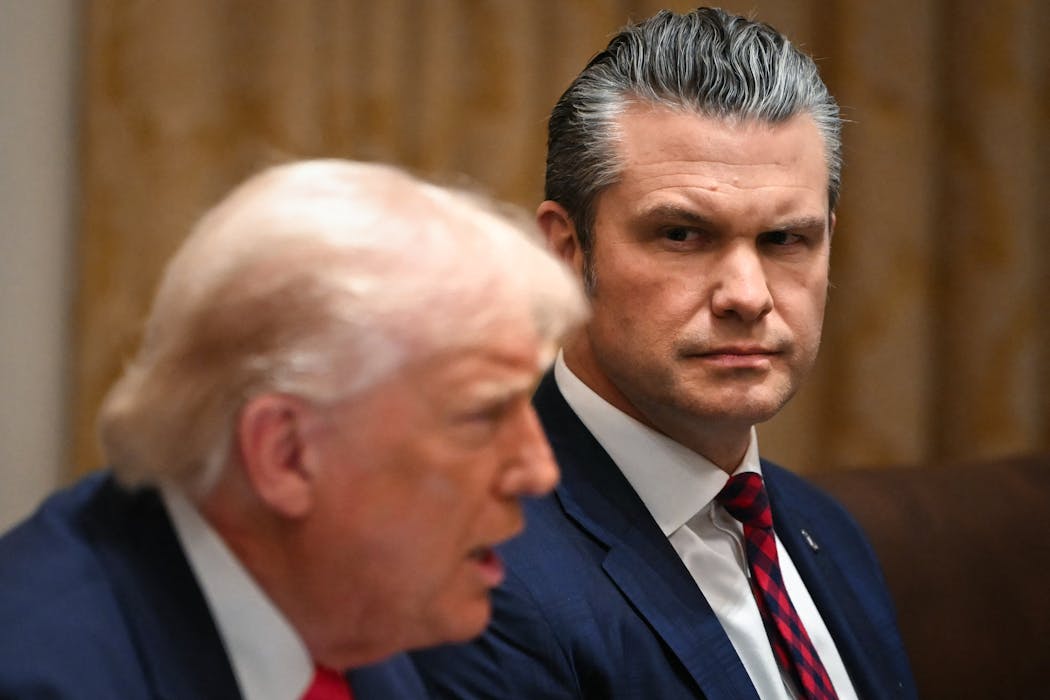
Defense Secretary Pete Hegseth attends a cabinet meeting with President Donald Trump at the White House in Washington, DC on December 2, 2025. Carolyn Van Houten/The Washington Post via Getty Images

News reports about a U.S. military attack on a boat in the Caribbean allegedly carrying drugs have raised critical questions about the military campaign against drug smugglers being carried out by the Trump administration in that region.

Among them: whether Secretary of Defense Pete Hegseth or others face criminal liability for any of the attacks. Those attacks killed people alleged to have been involved in illegal narcotics trafficking.

Congressional investigations have begun into allegations that a Sept. 2, 2025, follow-up attack on two survivors of an earlier attack was illegal and ordered by Hegseth. Some legal scholars have cited violations of international and United States criminal law that could come into play.

But as a military law scholar who spent 20 years as a lawyer and judge in the U.S. Air Force, I know that there aren’t enough facts known yet to determine who is responsible for what. There are five investigative mechanisms that could be used to determine the facts and whether there is criminal liability on the part of both senior civilian officials and military members involved in the now extensively reported second strike on the suspected drug boat that resulted in the deaths of civilians.

There are two caveats to this analysis. The first is that the Constitution says a person is to be presumed innocent before being proved guilty. The second is that the story from the White House and the Pentagon has changed over time.

A man in a dark blue military uniform walks among a number of men in suits.
Navy Adm. Frank Bradley, center, arrives for a closed-door classified meeting with lawmakers on Capitol Hill on Dec. 4, 2025.
Andrew Harnik/Getty Images

Congressional committees investigate

The first investigative mechanism is the Congress itself.

The House of Representatives and the Senate each have an armed services committee and a foreign relations or foreign affairs committee. In theory, any of these committees can place people under oath and have them testify, as well as issue subpoenas to obtain information.

This concept isn’t new.

Multiple committees examined the country’s lack of preparedness preceding the Japanese attack on Pearl Harbor and other military installations in 1941.

Almost every month during the Vietnam War, one or more of these committees investigated military matters, including one of the most notorious war crimes in U.S. history. In 1968, Army Lt. William Laws Calley commanded a platoon of soldiers who murdered close to 500 villagers in My Lai, including children and the elderly, none of whom posed a threat and none of whom were lawful targets.

But congressional investigations can be highly political. Even during the My Lai investigation, at least one member of the House, Mendel Rivers, a South Carolina Democrat who was at that time chairman of the Committee on Armed Services, attempted to shield officers in the chain of command. There is little reason to believe that a current investigation, conducted by a dramatically polarized Congress, will be free of partisan politics.

Attorney general investigates

A second means of investigating is for the U.S. attorney general to preliminarily conclude that crimes have been committed and to convene a grand jury to investigate. A federal grand jury is a constitutional body consisting of ordinary adult citizens. Its operations are governed by the Federal Rules of Criminal Procedure, and its role is to investigate whether there is probable cause to determine that a person has violated the criminal laws.

A federal statute prohibits murder. As far back as 1820, if not before, federal grand juries have investigated the crime of “murder on the high seas.”

No member of the president’s administration is immune from the criminal laws of the country, with the exception of the president himself when he has acted in the capacity of president or commander in chief. The Supreme Court in 2024 determined that the president is mostly immune from prosecution under criminal law.

But I believe this type of investigation is unlikely. That’s because members of the administration have argued that their actions were legal and that the men killed in the second strike were continuing in their mission and posed a threat.

Moreover, the attorney general is supposed to act in an independent capacity from the White House. But Trump’s attorney general, Pam Bondi, has demonstrated her loyalty to the president and his agenda in many instances.

Another consideration is that federal agency heads who rely on their attorneys in good faith are presumed to be immune from the law. This may be why Hegseth has stated that lawyers had advised the mission’s commanders.

Congress and the AG work a case

It is possible that during a congressional investigation one or more witnesses will be accused of lying under oath or accused of contempt.

Congress has the authority to hold individuals in contempt and fine and sentence them, but this is rare. Usually, Congress forwards the claim to the attorney general. Contempt of Congress is a federal misdemeanor offense, meaning a person cannot be sentenced to more than a year. Again, I believe it is unlikely that the attorney general would pursue a contempt charge in a federal court from these events.

Inspector general investigates

The Department of Defense’s inspector general can investigate allegations of wrongdoing in the department, and this includes the secretary. In the past, inspectors general have discovered criminal activity, written a publicly releasable report, and then a senior official was prosecuted.

In 2003, the Department of Defense investigated Darleen Druyun, a senior contracting official, for wrongly steering multimillion-dollar contracts to Boeing. The investigative report resulted in criminal charges from the Justice Department, and Druyun was found guilty in a criminal trial. Boeing officials also left the company, and the company was fined.

The military can investigate its civilian members but cannot prosecute them. The Uniform Code of Military Justice does not apply to civilians. That includes the president and secretary of defense, even though they are at the pinnacle of the chain of command.

International courts investigate

Finally, an investigation could be mounted through international law as enforced by courts outside of the United States.

Superpowers such as the United States and Russia often get a free pass from international law enforcement. In 1986, the International Court of Justice – a body partly created by the United States – ruled that the United States under the Reagan administration violated Nicaragua’s sovereignty during its civil war.

The Reagan administration’s response was that because other nations had disregarded the court, so too would the United States. No American official was ever held to account for the mining of Nicaragua’s main port or for the arming of rebels that led to the deaths of Nicaraguans.

It’s not clear which, if any, of these mechanisms will be used to hold accountable those who ordered and carried out the September 2025 operation in the Caribbean that killed two survivors of an earlier attack. What is clear is that the methods exist to find the facts – and make judgments based on them.

The Conversation

Joshua Kastenberg does not work for, consult, own shares in or receive funding from any company or organization that would benefit from this article, and has disclosed no relevant affiliations beyond their academic appointment.

– ref. Pete Hegseth could be investigated for illegal orders by 5 different bodies – but none are likely to lead to charges – https://theconversation.com/pete-hegseth-could-be-investigated-for-illegal-orders-by-5-different-bodies-but-none-are-likely-to-lead-to-charges-271284

Appeals court lets Donald Trump keep National Guard troops in DC for now

Source: Radio New Zealand

By Devan Cole, CNN

National Guard members patrol in Washington, DC, on November 27.

National Guard members on patrol in Washington Photo: Alex Wroblewski/Bloomberg/Getty Images via CNN Newsource

National Guard troops deployed to Washington, DC, can remain there for now, after a federal appeals court on Thursday temporarily froze a judge’s ruling that would have soon required them to leave the city’s streets.

The DC Circuit Court of Appeals said it was keeping the lower-court decision on hold for now to give it time to consider whether to pause the ruling indefinitely.

Implementation of the decision, issued on November 20 by US District Judge Jia Cobb, was already delayed by Cobb for 21 days to allow for appeals. Under the new ruling from the DC Circuit, Cobb’s directive for President Donald Trump and the Defense Department to remove the troops from the District will be on hold “pending further order of this court.”

The appeals court noted in its unsigned order that the decision was intended to give the court more time to consider whether to issue a more lasting pause on Cobb’s order and “should not be construed in any way as a ruling on the merits” of the request for a longer pause.

The presence of several thousand National Guardsmen in DC – both from the city and from Republican-led states – has come under renewed scrutiny in recent days following a shooting of two troops last week that left one guard member dead and another in critical condition.

Just after the shooting, lawyers for the administration asked the DC Circuit to freeze Cobb’s ruling, but made no mention of the attack in court papers.

But on Tuesday, DC Attorney General Brian Schwalb’s office seized on the “horrific attack” as it urged the DC Circuit to reject the Trump administration’s request, arguing that allowing the troops to remain in the city any longer “requires the diversion of scarce police resources, and exposes both the public and Guard members to substantial public safety risks.”

They pointed to the fact that DC police officers have had to coordinate with and escort guardsmen in the city to minimize threats, a task they say has “redoubled” following last week’s attack.

The legal wrangling over troops in the nation’s capital is playing out as a series of separate cases over Trump’s deployment of troops in other Democratic-led cities and states around the US continues. Those cases have entangled all levels of the federal judiciary, with the Supreme Court currently considering an emergency appeal in a challenge to Trump’s deployment of National Guard troops to Chicago.

– CNN

– Published by EveningReport.nz and AsiaPacificReport.nz, see: MIL OSI in partnership with Radio New Zealand

Racism allegations could derail right-wing populist Nigel Farage’s bid to become Britain’s next PM

Source: Radio New Zealand

By Christian Edwards, CNN

Reform UK leader Nigel Farage, pictured in London in October, has been accused of deeply offensive, racist and antisemitic behavior throughout his teenage years at school.

Reform UK leader Nigel Farage, pictured in London in October, has been accused of deeply offensive, racist and antisemitic behavior throughout his teenage years at school. Photo: Jack Taylor/Getty Images via CNN Newsource

Andrew Field recalls how his school in south London used to hand out a little blue book listing all the students enrolled that year. He says one boy used to go through the book to count how many children had the common English surname Smith, and how many had the Indian surname Patel.

“When there were more Patels than Smiths… he made a public ceremony of burning that school roll in protest,” Field told CNN.

That former student – remembered by Field as a “pompous, isolated loner” who enjoyed “strutting about” in school uniform – grew up to become arguably the most influential politician in Britain this century: right-wing populist Nigel Farage.

After leaving a career trading commodities in London’s financial district, Farage became a long-serving Member of the European Parliament before campaigning successfully for Britain’s exit from the European Union. But today’s 61-year-old Farage, now leader of the anti-immigrant Reform UK party, has set his sights on something bigger: If an election were held tomorrow, most polls suggest that he would stand a good chance of becoming the country’s next prime minister.

Field is among some 20 of Farage’s contemporaries at the elite Dulwich College who have recently and publicly accused him of deeply offensive, racist and antisemitic behavior throughout his teenage years in the 1970s and 1980s. Farage has denied the allegations, first reported on the record and at this scale by the Guardian newspaper last month.

But as more former students make fresh accusations, the scandal is threatening to stick to the typically Teflon-coated Farage. Analysts say the allegations pose the biggest challenge yet to Reform’s bid to convince Britain that it is not just a protest-vote party, but one responsible enough to govern a multi-ethnic nation of around 70 million people.

Field, a doctor with Britain’s National Health Service, is not convinced. Farage’s “burning the scroll” ritual is one of several alleged racist instances he recalls. He said he often saw Farage giving Nazi salutes and goose-stepping, adding, “those were really common sights.” A nine-year-old boy – the only Black child in his year – was “recurrently picked on” by the much older Farage, Field claimed, “who would go to him and say, ‘Africa is that way. Why don’t you f**k off there?'”

One incident sticks in Field’s mind. When he was made a prefect – a senior student trusted to enforce school rules and act as a role model to others – he said that Farage, already a prefect, took it on himself to show Field how to make use of his new powers.

“He guided me to lower school, where the younger children played, and he put an Indian child in detention completely at random. There was no reason whatsoever for him doing that,” Field said. “I was deeply shocked by that.”

Unlike Field, who was two years younger than Farage, Peter Ettedgui, now an award-winning film director, was in the same class as him from the ages of 13 to 14. He said they sat in alphabetical order, meaning the future politician was never far away.

Nigel Farage attended the elite Dulwich College in south London in the 1970s and 1980s.

Nigel Farage attended the elite Dulwich College in south London in the 1970s and 1980s. Photo: Dan Kitwood/Getty Images via CNN Newsource

“As soon as he found out I was Jewish – that was it,” Ettedgui told CNN. “He would say, ‘Hitler was right,’ in a sneering, contemptuous way. In other words, ‘You shouldn’t be here.'” Farage would also say “gas them,” Ettedgui said, sometimes adding a long hiss to emulate the sound of a gas chamber.

Farage has previously denied the allegations from Field, Ettedgui, and others first reported in the Guardian. In a statement to CNN, Farage said: “I can categorically say that the stories being told about me from 50 years ago are not true.” Richard Tice, Reform’s deputy leader, told the BBC on Thursday that the allegations are “made-up twaddle” and accused Ettedgui of lying, without providing evidence.

Claims of this kind were first made about Farage more than a decade ago. In 2013, the journalist Michael Crick reportedly uncovered a letter from an English teacher at Dulwich College, where annual fees today can reach around $85,000, opposing a decision in 1981 to make the 17-year-old Farage a prefect, on the grounds of his “publicly professed racist and neo-fascist views.”

At the time, Farage admitted saying “some ridiculous things… not necessarily racist things – it depends how you define it.” In response to the latest allegations, the usually forthright and forceful Farage was at first uncharacteristically evasive, offering a cocktail of heavily caveated denials.

“Have I ever tried to take it out on any individual on the basis of where they’re from? No,” Farage said last month in a broadcast interview in response to the new claims. Asked what his comments meant, he told ITV he had never abused anyone “with intent,” nor “directly really tried to go and hurt anybody.” He said the claims related to a period “49 years ago,” when he had “just entered” his teens. In the later statement, Farage categorically denied the allegations against him.

If some thought Farage was being evasive, many of his contemporaries say he is simply lying. Field said Farage’s racism was at its “most florid” when he was aged 17 and 18 and had been made a prefect – not just when he was in his early teens. “It’s when he had a little bit of power, and he was picking on much younger children,” Field said.

Ettedgui also said Farage’s claim never to have targeted anyone “directly” is untrue. “The abuse was directed and deeply personal. And it was venomous, which why I always remembered it,” he said. “Whenever I hear the guy speak today, my blood turns cold.”

It is unclear whether these allegations will dent Farage’s hopes to enter Downing Street after the next election, which is not due until 2029. Sunder Katwala, director of British Future, a think tank in London that researches integration, immigration and race, noted that Farage has routinely been able to win around 15% of the vote – some 4 million people – in general and European elections, first when he led the UK Independence Party (UKIP), and then for the Brexit Party, which became Reform UK in 2021.

Peter Ettedgui, pictured at the 68th BFI London Film Festival in 2024, said Nigel Farage would make antisemitic comments when they were at school together.

Peter Ettedgui, pictured at the 68th BFI London Film Festival in 2024, said Nigel Farage would make antisemitic comments when they were at school together. Photo: Jeff Spicer/Getty Images via CNN Newsource

While his hardcore supporters might not be put off by claims that Farage was allegedly a teenage bully who used racist slurs at school, turning Reform from a “15% party” to a “30% party” – one that could potentially win a general election – means attracting a different, moderate kind of voter, Katwala said.

That task could be even more difficult against a concerted campaign of tactical voting, he said, if an “Anyone But Reform” coalition mobilizes to try to keep Farage from power. Although UK Prime Minister Keir Starmer’s Labour party won a landslide election last year with just over a third of the vote, that victory was made possible by the “indifference” of most voters to a Labour victory, Katwala noted.

“There’s more danger for them than they’d realized,” he said of Reform. “If it’s not unthinkable that Farage can win, if a third of the public think trying him as prime minister is a dice worth rolling, I think the majority of people need to be indifferent to letting people roll the dice in that way.”

Reform is not there yet, he added. Although Farage has tried to “detoxify” Reform’s reputation, the latest polling from YouGov in September found that a plurality of white British voters sees Reform as a racist party with racist policies, by about 46% to 36% seeing the party as generally not racist. Meanwhile, just 13% of ethnic minority voters have a favorable opinion of Farage, while eight in 10 see him negatively, according to YouGov.

Farage, center, celebrates after being elected the member of parliament for Clacton in eastern England, on July 5, 2024.

Farage, center, celebrates after being elected the member of parliament for Clacton in eastern England, on July 5, 2024. Photo: Henry Nicholls/AFP/Getty Images via CNN Newsource

Farage, however, could benefit from the political distance he has maintained from what lies further to his right. He has refused to ally with Tommy Robinson, an extreme anti-Islam activist championed by X owner Elon Musk. While much of the online right in Britain is debating whether Black and Asian people are “really” British, and whether foreign-born politicians should be allowed in parliament, Farage has long welcomed people from ethnic minorities into his party and proudly spotlighted them. “In a way, he’s on the mainstream side of those arguments,” Katwala said.

But Farage’s former schoolmates say the public should be just as concerned by his denials as by the allegations themselves. “On the one hand, it’s actually almost funny that he’s trying to deny something that has been so widely corroborated,” said Ettedgui. “But on the other hand, it’s deeply upsetting because this man could be the prime minister of the UK.”

Some former Dulwich College pupils have told British media outlets that they do not recognize the allegations of racism levelled against Farage. Some of Farage’s allies have accused his former classmates of a “political” attempt to smear him. But the accusers say they were approached independently of each other, with Ettedgui saying he finally came forward because he wanted voters to do their “due diligence” before they vote in the next general election, due by 2029.

“We’re all saying exactly the same thing,” Ettedgui said of the accusers. “Certainly, for me, it boils down to something intensely personal: I don’t want my school bully to become my prime minister.”

– CNN

– Published by EveningReport.nz and AsiaPacificReport.nz, see: MIL OSI in partnership with Radio New Zealand