Las palabras que aparecen en la carretera para indicar el próximo desvío no siempre se reconocen igual de rápido. José Luis Tapia.
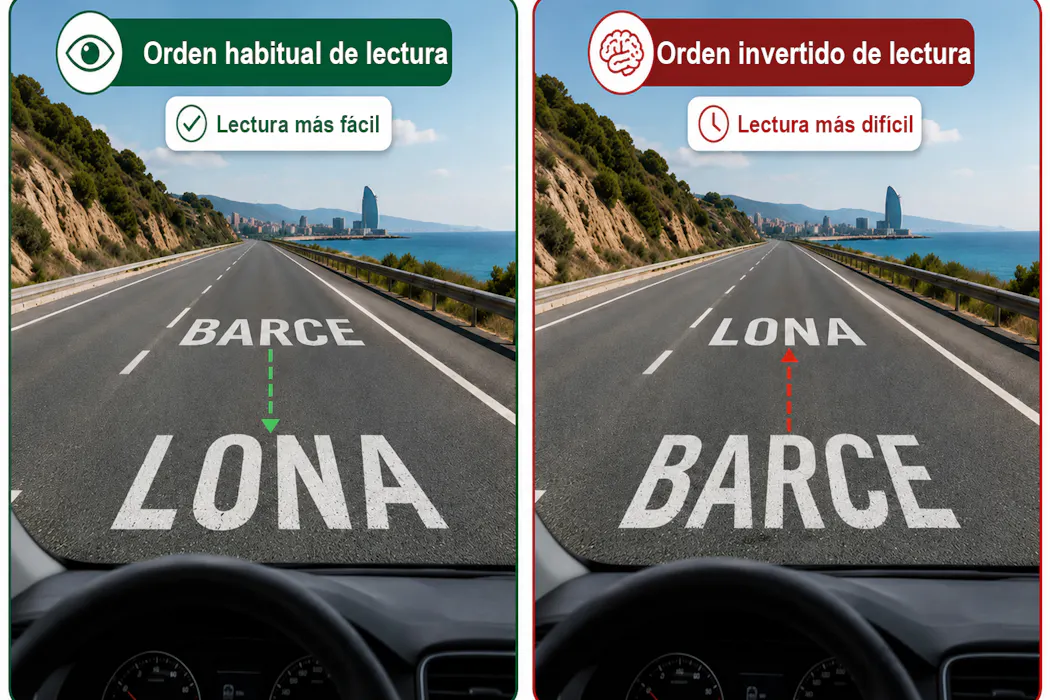
Imagine que circula por una autovía que no conoce. El navegador anuncia una salida, el tráfico ocupa los carriles contiguos y sobre el asfalto aparece un destino partido en dos líneas: LONA arriba y BARCE abajo. Durante una fracción de segundo, aquello no parece tener sentido. Después, su cerebro recompone el nombre: BARCELONA.
Las letras no estaban escritas al revés, pero sus fragmentos sí aparecían en un orden poco habitual. El inicio de la palabra estaba más cerca del vehículo y el segmento final, más lejos. Puede parecer un detalle sin importancia. Sin embargo, al volante, leer una simple palabra compite con vigilar el tráfico, mantener la trayectoria y decidir por dónde continuar. Nuestro estudio muestra que ese pequeño cambio en la disposición de una palabra hace que tardemos más en reconocerla.
Leer en movimiento
Cuando un nombre largo no cabe en la anchura del carril, puede dividirse en dos líneas. Eso obliga a elegir entre dos lógicas. La primera respeta la lectura de arriba abajo: BARCE se pinta en la línea superior, más lejos, y LONA en la inferior, más cerca. La segunda sigue el avance del vehículo y coloca el inicio en la línea que el vehículo alcanzará primero. En ese caso, BARCE queda abajo y LONA arriba.
Las dos opciones pueden parecer razonables. Nuestro cerebro, sin embargo, no las procesa igual. Y las normas tampoco resuelven siempre el dilema de la misma manera. La norma española 8.2-IC indica que la primera mitad debe situarse más lejos cuando los renglones están próximos, aunque permite invertirlos cuando la separación es muy grande. En otros países, las recomendaciones para mensajes de varias líneas siguen criterios distintos o no contemplan expresamente qué hacer con una única palabra partida. Por eso, es muy probable ver ambas disposiciones en los carriles e, incluso, en la misma ciudad o en la misma carretera.
Para comprobar si esa decisión gráfica afecta al reconocimiento de palabras, realizamos dos experimentos con 96 participantes. Les mostramos nombres largos de municipios españoles y palabras inventadas, todos divididos en dos líneas. Solo debían pulsar una tecla cuando reconocieran una población real.
En el primer experimento, los nombres aparecían sobre una textura de asfalto sin otros elementos. En el segundo, los integramos en una escena de carretera con perspectiva, carriles y otros elementos visuales. En ambos casos, presentamos cada nombre con el inicio arriba y más lejos, o con el inicio abajo y más cerca. La tarea era sencilla: queríamos medir el tiempo necesario para reconocer un destino a partir de sus fragmentos.
De milisegundos a metros
El resultado fue claro. Cuando los fragmentos conservaban el orden habitual de lectura, es decir, de arriba a abajo, los participantes reconocían los destinos con mayor rapidez y cometían ligeramente menos errores. La ventaja fue de 164 milisegundos con fondo neutro y de 211 milisegundos en la escena de carretera. En ambos experimentos apareció, por tanto, la misma pauta: respetar el orden habitual de lectura facilitó el reconocimiento.
Doscientos once milisegundos apenas se perciben al leer en una pantalla, pero en movimiento adquieren otra dimensión. Durante ese tiempo, un vehículo que circula a 100 kilómetros por hora recorre casi seis metros; a 120, algo más de siete. Esto no significa que ese retraso cause más accidentes, pero esta comparación permite visualizar la distancia que recorre el vehículo en ese intervalo.
¿Por qué se tarda más en leer en un formato que en el otro? Una explicación plausible es que años de lectura han acostumbrado a nuestro sistema visual a integrar las líneas de arriba hacia abajo, de modo que ese orden se procesa de forma más automática. Cuando los fragmentos rompen esa regularidad, podemos necesitar reordenarlos mentalmente antes de reconocer el conjunto.
Carreteras que se leen mejor
Nuestro experimento analizó el reconocimiento de palabras, no la conducción, que es una tarea más compleja. Los participantes no controlaban un vehículo, no elegían carril ni preparaban una maniobra. El siguiente paso será estudiar estas disposiciones en simuladores o en realidad virtual, donde puedan medirse la mirada, la elección de carril, los movimientos del volante y el frenado, también de noche, con lluvia o con tráfico intenso.
Mientras llegan esas pruebas, los resultados apuntan a una recomendación sencilla: si es necesario dividir en dos líneas el nombre de un destino, conviene mantener el inicio en la línea superior y más lejana, y el final en la inferior y más cercana. Es una decisión de bajo coste porque no requiere nuevos materiales ni tecnología, solo aplicar un criterio coherente.
En definitiva, las marcas viales son un lenguaje con el que la carretera se comunica con nosotros al conducir. Su diseño no debería depender únicamente de una convención heredada, sino también de la manera en que funciona la lectura humana. Porque, al conducir, cuando cada segundo cuenta y la rapidez con que reconocemos un destino importa.
Jose Luis Tapia Iglesias recibe fondos del Ministerio de Ciencia, Innovación y Universidades.
Francisco Rocabado, Ismael Gutiérrez Cordero, Javier García-Orza y Manuel Perea no reciben salarios, ni ejercen labores de consultoría, ni poseen acciones, ni reciben financiación de ninguna compañía u organización que pueda obtener beneficio de este artículo, y han declarado carecer de vínculos relevantes más allá del puesto académico citado.
Source: The Conversation – (in Spanish) – By Sylvie Pérez Lima, Psicopedagoga. Psicóloga COPC 29739. Profesora Estudios de Psicología y Educación, UOC – Universitat Oberta de Catalunya
Leer mucho suele considerarse una señal de una buena “competencia lectora”. Si un niño o adolescente lee varios libros al mes, parece lógico pensar que lee con facilidad y comprende bien aquello que lee. Al fin y al cabo, ¿cómo podría alguien leer tanto sin tener una buena comprensión?
Pero damos por supuesto algo que no es tan evidente. Podemos encontrarnos con niños y jóvenes que leen con frecuencia o disfrutan de los libros y que, sin embargo, tienen dificultades cuando se enfrentan a determinadas tareas de comprensión: identificar la idea principal de un texto, relacionar información que aparece en diferentes partes, hacer una inferencia o valorar críticamente aquello que han leído.
La pregunta, por tanto, no es si leer es importante (lo es), sino si leer mucho y comprender bien son la misma cosa.
Aquí aparece una paradoja que merece la pena explorar: podemos encontrar jóvenes que leen con frecuencia y, al mismo tiempo, presentan dificultades en tareas de comprensión lectora. Esto no significa que exista necesariamente una relación causal entre ambas cuestiones. Significa que el hábito lector y la competencia lectora no son exactamente lo mismo.
Qué se lee, y qué se comprende
¿Qué queremos decir exactamente cuando decimos que una persona comprende lo que lee?
Cuando hablamos de lectura tendemos a utilizar una única palabra para referirnos a actividades muy diferentes. No leemos de la misma manera una novela, las instrucciones de un experimento, un artículo científico, un texto argumentativo o dos noticias que ofrecen explicaciones diferentes sobre un mismo acontecimiento. Todas estas actividades implican leer, pero no exigen exactamente los mismos procesos.
Un lector puede seguir con fluidez una historia, recordar a sus personajes y disfrutar de ella y, sin embargo, encontrar dificultades cuando tiene que explicar qué idea sostiene un texto argumentativo, relacionar información que aparece en párrafos diferentes o deducir algo que el autor no ha dicho explícitamente.
Esto ayuda a entender una cuestión que a menudo queda escondida cuando hablamos de “buenos lectores”: la cantidad de lectura no nos dice por sí sola qué procesos de comprensión es capaz de realizar una persona.
Por eso, ante un niño o una adolescente que lee muchos libros, quizá la pregunta no debería ser únicamente “¿Cuánto lee?”, sino también “¿Qué es capaz de hacer con aquello que lee?”.
Relación entre ‘cantidad’ y ‘calidad’ de la lectura
Si leer mucho puede ser compatible con tener dificultades en determinadas tareas de comprensión, ¿qué sabemos sobre la relación entre el hábito lector y la competencia lectora?
Comprender un texto no consiste únicamente en entender las palabras que aparecen en él. También implica construir un significado, relacionar información y hacer inferencias. Además, utilizamos nuestros conocimientos previos para interpretar aquello que leemos.
Por eso, dos personas pueden leer el mismo texto y comprenderlo de manera diferente. No solo interviene lo que está escrito. También importan el lector, el texto y la tarea que se plantea. La dificultad, el propósito de la lectura o los conocimientos previos pueden cambiar lo que somos capaces de comprender.
Por ejemplo: cuando leemos muchas novelas, la experiencia previa (cuantas más hayamos leído más sucederá esto) nos ha enseñado a anticipar determinados giros de guión o de diálogos, y cuando son inesperados, lo son en comparación a lo que hemos leído previamente. Cuanto más experiencia lectora acumulamos sobre determinado estilo de escritura, menos esfuerzo cognitivo supone descifrarlo, más predecible será la tarea para nosotros, y menos esfuerzo de comprensión estaremos haciendo. De ahí la necesidad de leer textos variados.
Competencia lectora vs capacidad de comprensión
La investigación científica apunta a una relación positiva entre la exposición a la lectura y diferentes habilidades lectoras. Los autores plantean una posible relación circular: quienes tienen mejores habilidades lectoras tienden a leer más. A su vez, la lectura puede contribuir a desarrollarlas.
Así se observa también en estudios a lo largo del tiempo. En los primeros cursos, un menor nivel de comprensión y fluidez se asocia con una menor lectura voluntaria. En cursos posteriores, una mayor frecuencia de lectura, especialmente de libros, se asocia con una mejor comprensión.
Esto sugiere que leer y comprender pueden influirse mutuamente, y que la relación cambia durante el desarrollo. Pero también indica que no podemos reducir la competencia lectora al número de libros leídos.
Entonces, si leer más no garantiza por sí solo comprender mejor, ¿qué hace que una persona aprenda a comprender lo que lee?
Enseñanza explícita
Lo mismo que aprendemos la mecánica de la lectura en la escuela (que las letras representan sonidos y significados, que juntas hacen sílabas y palabras y frases), la comprensión lectora también requiere una enseñanza explícita. No basta con aumentar la exposición a los textos. También es necesario aprender a utilizar estrategias para construir y comprobar su significado.
La enseñanza explícita puede incluir estrategias como anticipar el contenido, activar conocimientos previos, formular preguntas o realizar inferencias. También puede enseñar a identificar ideas principales, resumir y comprobar la propia comprensión. Pero no consiste simplemente en proporcionar una lista de estrategias. El docente debe mostrar cómo y cuándo utilizarlas y acompañar progresivamente al alumnado hacia un uso autónomo.
Que un niño o un adolescente lea mucho es una buena noticia. La lectura frecuente ofrece oportunidades para ampliar conocimientos, descubrir palabras nuevas y encontrarse con formas diferentes de explicar el mundo.
Pero esas oportunidades no garantizan por sí solas que la comprensión se desarrolle en toda su complejidad. A comprender también se aprende y requiere una enseñanza que acompañe ese proceso.
Por eso, fomentar el hábito lector y enseñar a comprender deberían ir de la mano. No se trata de elegir entre conseguir que lean más o enseñarles estrategias de comprensión. Se trata de que puedan hacer ambas cosas.
Quizá debamos mirar un poco más allá del número de libros leídos. Preguntarnos qué textos leen, para qué los leen y qué hacen con aquello que encuentran en ellos. Porque leer también significa poder hacerse preguntas, relacionar ideas, construir una interpretación propia y cambiar de opinión cuando el texto nos aporta algo nuevo.
Sylvie Pérez Lima no recibe salario, ni ejerce labores de consultoría, ni posee acciones, ni recibe financiación de ninguna compañía u organización que pueda obtener beneficio de este artículo, y ha declarado carecer de vínculos relevantes más allá del cargo académico citado.
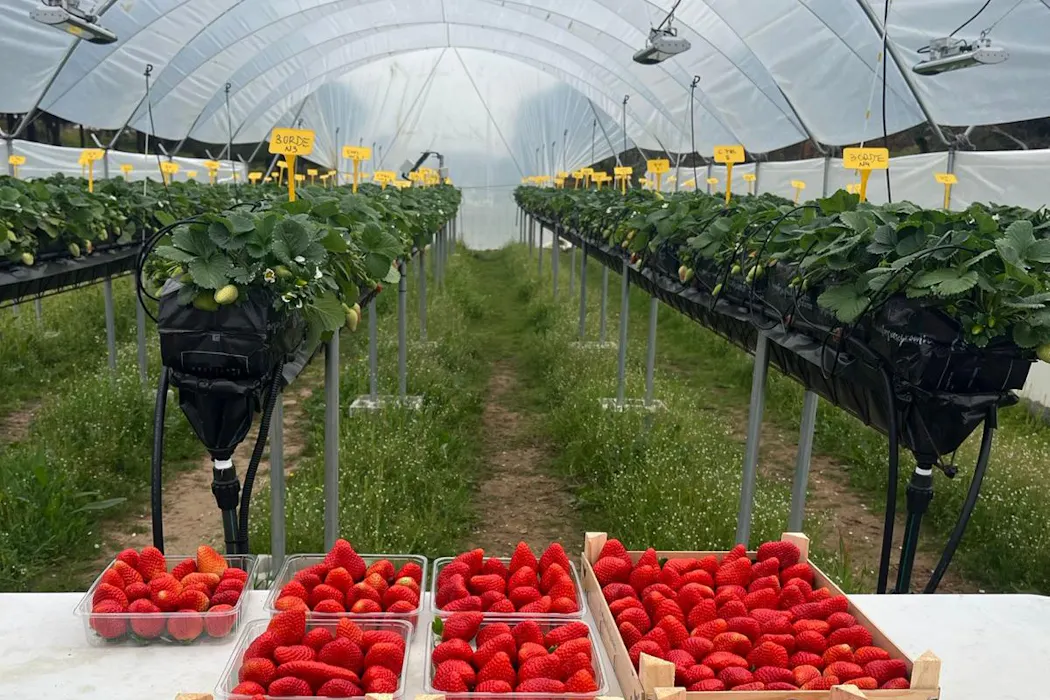
Cultivo de fresa en invernadero experimental con lámparas de luz UV. Beatriz Ramos, Universidad San Pablo CEU
Cuando pensamos en aumentar la producción agrícola, solemos imaginar fertilizantes, riego o nuevas variedades vegetales. Sin embargo, una herramienta mucho menos conocida está despertando un enorme interés entre los investigadores de todo el mundo: la luz ultravioleta (UV). Utilizada de forma controlada y en dosis muy bajas, esta radiación puede estimular el crecimiento de las plantas, mejorar la calidad de los frutos y aumentar su resistencia frente a enfermedades. Todo ello sin añadir productos químicos al cultivo.
Aunque la radiación ultravioleta suele asociarse a efectos negativos, como las quemaduras solares en la piel, las plantas llevan millones de años conviviendo con ella. De hecho, han desarrollado mecanismos sofisticados para percibirla y responder a su presencia.
La clave está en la dosis: mientras una exposición excesiva provoca daños celulares, pequeñas cantidades actúan como una señal que activa mecanismos de defensa y adaptación. Este fenómeno se conoce como hormesis, es decir, una respuesta beneficiosa ante un estrés leve.
Cómo perciben las plantas la luz UV
Las plantas disponen de receptores capaces de detectar determinadas longitudes de onda de la radiación ultravioleta. Cuando reciben una dosis moderada de UV, interpretan la señal como una posible amenaza ambiental y comienzan a prepararse para futuros episodios de estrés. Lo hacen produciendo compuestos antioxidantes, modificando su metabolismo e incluso activando genes relacionados con la defensa frente a patógenos.
Como consecuencia, las plantas incrementan la síntesis de sustancias protectoras como flavonoides, antocianinas y otros compuestos fenólicos. Estos metabolitos no solo ayudan a la planta a soportar mejor condiciones adversas, sino que además poseen interés nutricional para el consumidor, ya que muchos de ellos actúan como antioxidantes.
Efectos positivos demostrados en numerosos cultivos
Nuestros estudios en tomates ofrecen resultados especialmente llamativos. Con estas investigaciones hemos demostrado que breves exposiciones semanales a radiación UV-B y UV-C antes de la floración aumentan el crecimiento de las plantas, adelantan la aparición de flores y reducen la incidencia de enfermedades bacterianas. Además, los frutos obtenidos presentan mayores concentraciones de licopeno, carotenoides y compuestos fenólicos, mejorando su valor nutricional.
Sin embargo, el potencial de esta tecnología va mucho más allá del tomate.
También se han descrito efectos positivos en pepinos, albahacas y arroz, entre otras especies hortícolas. En ellas, dosis moderadas de radiación favorecen la acumulación de metabolitos beneficiosos y fortalecen la tolerancia frente a diferentes tipos de estrés ambiental.
¿Puede competir con los fertilizantes?
La luz UV no reemplaza completamente a los fertilizantes, ya que estos aportan nutrientes esenciales como nitrógeno, fósforo o potasio. Sin embargo, sí puede convertirse en una herramienta complementaria capaz de reducir parcialmente la dependencia de insumos químicos.
La diferencia fundamental es que los fertilizantes aportan recursos externos a la planta, mientras que la radiación UV estimula mecanismos internos que mejoran la eficiencia fisiológica. En otras palabras, la planta aprovecha mejor sus propios recursos.
Esta estrategia presenta varias ventajas:
No deja residuos químicos en el cultivo.
Reduce el impacto ambiental asociado a la fabricación y uso de fertilizantes.
Puede aumentar simultáneamente la productividad y la resistencia frente a enfermedades.
Mejora la calidad nutricional de los alimentos.
Disminuye la necesidad de algunos tratamientos fitosanitarios.
Todo ello resulta especialmente relevante si se considera que la producción y utilización de fertilizantes sintéticos genera una parte importante de las emisiones de gases de efecto invernadero asociadas a la agricultura.
La tecnología es relativamente sencilla. Se utilizan lámparas LED capaces de emitir radiación UV-B o UV-C de manera controlada, con exposiciones muy breves y espaciadas.
En nuestros estudios realizados con tomates, por ejemplo, los mejores resultados se obtuvieron mediante irradiaciones de apenas tres minutos una vez por semana durante la fase previa a la floración. Exposiciones más largas no mejoraban los resultados e incluso podían provocar efectos negativos.
Este aspecto es crucial: la eficacia depende de emplear dosis cuidadosamente ajustadas. La misma radiación que estimula el metabolismo vegetal en bajas cantidades puede convertirse en un factor dañino cuando se aplica en exceso.
Normalmente los tratamientos se realizan durante la noche, cuando no existe interferencia con la radiación solar y resulta más sencillo controlar la exposición.
¿Es viable a gran escala?
La respuesta es cada vez más positiva. La aparición de sistemas LED específicos para agricultura está reduciendo los costes energéticos y permitiendo una aplicación precisa de la radiación UV. Además, los invernaderos modernos ya incorporan un elevado nivel de automatización, lo que facilita integrar estas lámparas en los programas de manejo habituales.
Los cultivos protegidos en invernadero, como los de tomates, pimientos, pepinos, fresas o lechugas, son candidatos para adoptar esta tecnología. Ya se ha probado también en cultivos a cielo abierto mediante aplicaciones con tractores portadores de las lámparas. Con estos sistemas resulta sencillo controlar los pulsos de radiación.
Aún quedan desafíos por resolver. No todas las especies responden igual y cada cultivo requiere determinar la dosis, frecuencia y momento de aplicación más adecuados. También es necesario evaluar los costes económicos frente a los beneficios obtenidos en condiciones reales de producción.
Una nueva herramienta para la agricultura sostenible
Durante décadas, la agricultura ha dependido principalmente de fertilizantes y productos fitosanitarios para incrementar la producción. La luz ultravioleta plantea un enfoque diferente: estimular las capacidades naturales de la planta para que crezca mejor, produzca más y se defienda por sí misma.
Los resultados obtenidos hasta ahora muestran que pequeñas dosis de radiación UV pueden aumentar la floración, mejorar el rendimiento, reforzar la resistencia frente a patógenos y enriquecer el contenido de antioxidantes en los frutos. Más que una sustituta de los fertilizantes, esta tecnología emerge como una herramienta complementaria que podría ayudar a producir más alimentos con menos insumos y menor impacto ambiental. En un contexto de cambio climático y creciente demanda alimentaria, esa combinación resulta especialmente prometedora.
Los resultados obtenidos son fruto de una colaboración entre el grupo de investigación “Biotecnología de la Interacción Planta-Microbioma (https://www.biotecnologia-vegetal-microbioma-ceu.es/) de la Universidad San Pablo CEU y RZERO Infection Prevention and Control S.L.U (https://rzeroprevention.com/), que ha combinado el rigor científico con la innovación empresarial para generar conocimiento de alto valor e impacto aplicado.
Los resultados obtenidos son fruto de una colaboración entrevel grupo de investigación “Biotecnología de la Interacción Planta-Microbioma (https://www.biotecnologia-vegetal-microbioma-ceu.es/) de la Universidad San Pablo CEU y RZERO Infection Prevention and Control S.L.U (https://rzeroprevention.com/) que ha combinado el rigor científico con la innovación empresarial para generar conocimiento de alto valor e impacto aplicado.
Cada tarde, millones de personas regresan a casa después de trabajar. Algunas llegan con energía para salir a pasear, hacer deporte o jugar con sus hijos. Otras, sólo desean tumbarse en el sofá y que nadie les hable.
¿Qué ha ocurrido durante esas ocho horas?
La explicación habitual suele ser sencilla: “Ha sido un día duro”. Pero la ciencia lleva tiempo sugiriendo que ocurre algo más profundo.
Las empresas no solo producen bienes y servicios. También generan experiencias. Y esas experiencias influyen en cómo pensamos, cómo nos relacionamos, cómo afrontamos los problemas y cómo responde nuestro organismo ante todo ello.
Mucho más que un sueldo
Al principio existía una creencia generalizada de que el compromiso de un empleado dependía principalmente del salario.
La psicología organizacional ha demostrado que, una vez cubiertas las necesidades económicas básicas, otros factores adquieren una importancia decisiva: sentirse respetado, disponer de autonomía, confiar en los compañeros, recibir reconocimiento y percibir que el propio trabajo tiene sentido.
Por eso dos personas con el mismo sueldo pueden vivir experiencias laborales completamente distintas. Una termina la jornada satisfecha y la otra cuenta los minutos para marcharse.
La diferencia muchas veces no está en el trabajo que realizan, sino en la organización para la que trabajan.
Las empresas también nos transforma
Ninguna organización deja a sus profesionales exactamente igual que cuando llegaron. Después de meses o años compartiendo una misma cultura, las personas cambian. Algunas ganan confianza para expresar sus ideas, asumen nuevos retos y desarrollan relaciones de colaboración que potencian su crecimiento. Otras, por el contrario, dejan de participar en las reuniones, evitan asumir riesgos y acaban limitándose a cumplir lo imprescindible. La experiencia laboral contribuye a moldear su identidad profesional.
Muchas veces es el contexto el que marca la diferencia.
Las investigaciones en el área de psicología organizacional muestran que la forma en que una organización lidera, reconoce el trabajo, gestiona los errores o resuelve los conflictos influye directamente sobre la motivación, el compromiso, el aprendizaje y el bienestar de quienes la integran.
La cultura organizativa no es un concepto abstracto: se manifiesta cada día en miles de pequeñas interacciones que terminan moldeando la experiencia de trabajar en un lugar.
La huella invisible, y no tanto, de las organizaciones
Cuando hablamos del impacto de una empresa solemos fijarnos en indicadores como la rentabilidad, la productividad, la innovación o la cuota de mercado. Todos ellos son esenciales para conocer la salud de una organización.
Sin embargo, existe otro conjunto de indicadores que también habla de su desempeño y que no ocupa el mismo lugar en los informes de gestión.
La investigación ha estudiado por separado fenómenos como el compromiso (engagement), el desgaste profesional (burnout), la seguridad psicológica, la identificación organizacional o el bienestar laboral. Todos ellos responden, en realidad a una misma pregunta: ¿qué efecto produce una organización en las personas que trabajan en ella?
La respuesta deja una huella que, en ocasiones, resulta muy visible. Cuestiones como el absentismo, la rotación no deseada, las bajas por motivos de salud mental, el burnout o la dificultad para atraer y fidelizar talento constituyen, en realidad, una radiografía bastante precisa del tipo de organización que una empresa ha construido.
A veces la diferencia tiene nombre propio
Existe, además, un matiz que suele pasar desapercibido. Cuando preguntamos a alguien por qué disfruta de su trabajo o por qué decidió permanecer en una empresa, la respuesta no siempre hace referencia a la organización. Muchas veces tiene nombre y apellidos.
Aunque solemos hablar de las organizaciones como si fueran entidades abstractas, la experiencia laboral muchas veces se construye a través de personas concretas. Hay personas que consiguen que la experiencia laboral sea mejor para quienes trabajan a su alrededor. Un responsable que inspira confianza, una compañera que siempre ayuda o un mentor que acompaña en los momentos difíciles pueden hacer que un empleado se sienta vinculado a su trabajo, incluso cuando no desarrolla un fuerte compromiso con la organización conjunta.
Lo que ocurre en nuestro cerebro cuando vamos a trabajar
En las organizaciones se producen experiencias que aumentan o disminuyen la probabilidad de que se activen determinados sistemas biológicos, relacionados con el estrés, la motivación, la cooperación o la recompensa. En otras palabras, el cerebro responde menos al organigrama de la empresa que a la forma en que vivimos nuestro día a día dentro de ella.
Cuando predominan la confianza, el apoyo mutuo y el reconocimiento, resulta más fácil colaborar, aprender y comprometerse con los objetivos comunes. Por el contrario, cuando el miedo, la incertidumbre o el control excesivo forman parte de la rutina, el organismo permanece en un estado de alerta que termina afectando al bienestar, la creatividad y la capacidad para tomar buenas decisiones.
No es casualidad que las organizaciones más innovadoras del mundo dediquen grandes esfuerzos a construir culturas donde las personas se sienten seguras para preguntar, discrepar o reconocer un error. La profesora Amy Edmondson, de la Harvard Business School, denominó a este fenómeno seguridad psicológica y demostró que constituye uno de los mejores predictores del aprendizaje colectivo y del rendimiento de los equipos.
Del mismo modo, las investigaciones del neuroeconomista Paul Zak muestran que la confianza no es únicamente un valor ético, sino también un activo organizativo capaz de mejorar la cooperación, el compromiso y los resultados.
Una nueva forma de medir en las empresas
Es posible que haya llegado el momento de incorporar una nueva pregunta cuando evaluamos una organización. Una pregunta que no esté relacionada con cuánto factura, cuánto crece o cuánto innova nuestra organización, sino qué tipo de personas ayuda a construir.
Quizá la verdadera medida del éxito de una organización no sea únicamente lo que consigue, sino lo que deja. Porque todas las empresas producen resultados. Las mejores, además, producen personas que salen de ellas siendo mejores de lo que entraron.
Las personas firmantes no son asalariadas, ni consultoras, ni poseen acciones, ni reciben financiación de ninguna compañía u organización que pueda obtener beneficio de este artículo, y han declarado carecer de vínculos relevantes más allá del cargo académico citado anteriormente.
Source: The Conversation – (in Spanish) – By Carlos Aguilera-Serrano, Profesor Asociado, Departamento de Enfermería y Podología. Facultad de Ciencias de la Salud., Universidad de Málaga
Durante años, la atención en salud mental se centró en los síntomas. Pero ese enfoque resulta insuficiente: la ansiedad que no se expresa, la soledad que no se nombra, el cansancio emocional que se normaliza… ¿Quién cuida todo eso?
La enfermería especializada en salud mental es la respuesta a un fenómeno creciente: el sufrimiento psicoemocional ligado a la vida contemporánea. Por eso, su desempeño ha evolucionado hacia un modelo más integrador que aborda también el descanso, la alimentación, las relaciones personales o el sentido de vida, entre otros.
Este cambio permite acompañar procesos, no solo tratar problemas.
Su trabajo incluye valorar de forma integral, educar en salud, coordinar y liderar equipos y acompañar a lo largo del tiempo, así como defender los derechos de las personas y las familias en contextos donde a menudo se ven vulnerados. Con este fin, se desarrollan programas educativos, intervenciones grupales y apoyo comunitario. Además, la enfermería de salud mental incorpora atención a distancia y estrategias para mejorar la resiliencia.
En España, la especialidad requiere una formación específica de posgrado, con una duración de dos años. Durante este periodo, las futuras especialistas combinan formación teórica y práctica en distintos dispositivos asistenciales, como unidades de hospitalización, centros comunitarios, hospitales de día, programas de rehabilitación y atención a la infancia y la adolescencia.
Y aunque la especialidad fue regulada oficialmente en 1998 y su programa formativo actual se aprobó en 2011, sigue siendo una de las áreas menos conocidas de la profesión fuera del ámbito sociosanitario.
La importancia de la psicoterapia
La psicoterapia enfermera es una de las principales competencias de estas profesionales. Incluye intervenciones estructuradas basadas en la relación terapéutica, junto a la evaluación clínica y la planificación de cuidados.
Un ejemplo puede ayudar a entenderlo. Pensemos en una persona que vive con ansiedad tras una enfermedad grave. La psicoenfermera le ayudará a identificar qué situaciones aumentan su malestar y a trabajar hábitos como el sueño, la actividad física y las relaciones sociales. El objetivo es que recupere bienestar y autonomía en su vida diaria.
Aunque esta competencia comparte herramientas con otras formas de psicoterapia, se distingue por su mirada integral. No solo atiende el malestar emocional: también tiene en cuenta la salud física, la medicación, los hábitos cotidianos y el entorno familiar y social.
Es una visión especialmente útil en individuos con enfermedades crónicas o problemas complejos y en situaciones de vulnerabilidad social, como la de una persona mayor que vive sola, tiene pocos apoyos y comienza a aislarse tras la pérdida de un ser querido. El cuidado se adapta a la realidad de cada individuo y a los cambios que se producen con el tiempo.
Además, las psicoenfermeras suelen acompañar a las personas durante largos periodos. Esa continuidad favorece la confianza y permite ajustar las intervenciones cuando las necesidades cambian.
Potencial infrautilizado
Según los datos oficiales del Registro Estatal de Profesionales Sanitarios del Ministerio de Sanidad, hay 2 063 enfermeras especialistas en salud mental inscritas en España. Esta cifra no es representativa de la situación real, ya que no recoge necesariamente a la totalidad de profesionales en activo. Así, de acuerdo con diversas fuentes, el número de psicoenfermeras podría situarse entre 6 500 y 9 000. Sin embargo, muchas no ocupan plazas específicas de la especialidad y, en algunas comunidades autónomas, esos puestos siguen sin estar plenamente implantados, lo que apunta a una infrautilización de las competencias especializadas.
La situación es distinta en algunos países de nuestro entorno, como Reino Unido. Allí, las enfermeras de salud mental cuentan con mayor presencia en los servicios comunitarios y con un reconocimiento más amplio de funciones avanzadas, incluidas las intervenciones psicoterapéuticas.
Retos claros, oportunidades reales
Hoy, la enfermería especializada en salud mental sigue afrontando desafíos importantes: falta de recursos, fragmentación del sistema, reconocimiento insuficiente de sus capacidades o la persistencia del estigma, ya que muchas personas continúan asociando ese tipo de problemas a estereotipos negativos. Esto puede retrasar la búsqueda de ayuda y reducir el reconocimiento social de los cuidados que proporcionan las psicoenfermeras.
Paradójicamente, la evidencia indica que la enfermería de salud mental es una de las profesiones con mayor capacidad de adaptación y amplitud de roles dentro del sistema sanitario.
En definitiva, el desarrollo de competencias avanzadas –como la citada psicoterapia enfermera–, la integración en la comunidad y el enfoque basado en derechos humanos no solo mejoran la atención a los pacientes: también pueden transformar el modelo sanitario.
Carlos Aguilera-Serrano no recibe salario, ni ejerce labores de consultoría, ni posee acciones, ni recibe financiación de ninguna compañía u organización que pueda obtener beneficio de este artículo, y ha declarado carecer de vínculos relevantes más allá del cargo académico citado.
Hay ciudades que nacen lentamente y otras que son el resultado de una decisión (geo)política. Gdynia pertenece a estas últimas. En apenas unas décadas pasó de ser una pequeña aldea pesquera del Báltico a convertirse en el principal símbolo de la Polonia renacida. Un siglo después, la UNESCO ha inscrito su Centro Modernista en la Lista del Patrimonio Mundial.
Calle Świętojańska en Gdynia, la primera calle de la ciudad, aparte de las que conducían al mar, que se empedró y se acondicionó de acuerdo con el nuevo plan urbanístico de la época. National Library of Poland
La inscripción responde al criterio IV, reservado a bienes que constituyen ejemplos sobresalientes de una etapa significativa de la historia humana. En Gdynia se ha reconocido un conjunto urbano modernista excepcionalmente conservado, concebido como un todo en el que planificación, la arquitectura y el puerto forman un sistema inseparable. Pocas ciudades ilustran con tanta claridad cómo el urbanismo y la arquitectura fueron utilizados para construir la identidad y la economía de un Estado recién recuperado.
De aldea pesquera a símbolo de la Segunda República
Hasta comienzos del siglo XX, Gdynia era una pequeña aldea pesquera mayoritariamente de etnia casubia. Todo cambió tras la recuperación de la independencia de Polonia en 1918, después de 123 años de particiones. El principal puerto de la región, Gdansk, quedó constituido como Ciudad Libre bajo la protección de la Sociedad de Naciones. Habitada en un 95 % por población alemana, mantuvo una actitud crecientemente hostil hacia el nuevo Estado polaco.
Aunque el Tratado de Versalles garantizaba a Polonia el libre uso del puerto, estas obligaciones fueron incumpliéndose progresivamente y las tensiones desembocaron en la guerra aduanera germano-polaca iniciada en 1925. Para un Estado recién renacido, disponer de un puerto propio dejó de ser una aspiración económica para convertirse en una cuestión de supervivencia. La respuesta fue construir uno nuevo.
En 1922 el ingeniero Tadeusz Wenda eligió el emplazamiento y dirigió las primeras obras, mientras que Eugeniusz Kwiatkowski, ministro de Industria y Comercio y después viceprimer ministro, convirtió Gdynia en uno de los grandes proyectos nacionales de la Segunda República de Polonia. Convencido de que la independencia política exigía independencia económica, impulsó el desarrollo simultáneo del puerto y de la villa.
A la izquierda, obra en construcción del futuro puerto, probablemente a principios de 1921. A la derecha, el lujoso transatlántico de la marina mercante polaca MS Piłsudski en la terminal transatlántica de Gdynia. En la actualidad, la terminal es el Museo de la Emigración. Gdynia Moje Miasto-Henryk Poddębski /Wikimedia Commons
El urbanismo modernista respondía tanto a criterios funcionales como simbólicos. Edificios de líneas depuradas, fachadas blancas y formas inspiradas en los transatlánticos proyectaban la imagen de una Polonia moderna, abierta al comercio y orientada hacia el mar. Navigare necesse est (“Navegar es necesario”) decía el decreto por el cual Gdynia fue declarada ciudad en 1926.
El crecimiento fue extraordinario. En dos décadas la población pasó de unos 1 200 habitantes a más de 120 000 y el puerto alcanzó en 1938 un tráfico superior a nueve millones de toneladas, superando a Gdansk y reduciendo decisivamente la dependencia polaca de otros puertos bálticos y alemanes. Gdynia se convirtió en la principal puerta marítima del país y en uno de los ejemplos más notables de planificación urbana y económica de la Europa del siglo XX.
Guerra, reconstrucción y una ciudad que siguió mirando al mar
La Segunda Guerra Mundial interrumpió este desarrollo. Tras la invasión alemana de 1939, la ciudad fue anexionada al Tercer Reich con el nombre de Gotenhafen. Decenas de miles de polacos fueron expulsados y el puerto se transformó en una importante base de la Kriegsmarine (la Armada naval nazi). Pese a los daños sufridos, el conjunto modernista sobrevivió en gran medida, lo que explica su excelente estado de conservación.
Después de 1945, Gdynia recuperó rápidamente su papel como uno de los principales puertos de Polonia. Durante el periodo socialista se desarrollaron la industria naval, electrónica y de telecomunicaciones. Empresas como RADMOR, especializada en radiocomunicaciones marítimas y militares, simbolizan esa continuidad tecnológica. La firma de marroquinería Batycki ofrecía, a través de sus elegantes bolsos, una ilusión de lujo y sofisticación en medio de la gris realidad cotidiana de la Polonia comunista.
Una ciudad vinculada a la lucha por la libertad
La historia de Gdynia no puede entenderse solo a través de su puerto y su arquitectura. También ocupa un lugar destacado en la memoria de la oposición al régimen comunista. No es casualidad que fuera en las ciudades industriales del Báltico donde se produjera uno de los episodios decisivos de la historia contemporánea de Polonia. Al ordenar al ejército abrir fuego contra los trabajadores en diciembre de 1970, el régimen comunista socavó la principal fuente de su legitimidad: gobernar en nombre de la clase obrera.
Uno de los episodios más emblemáticos de esa época fue el traslado del cuerpo de un joven trabajador abatido por los disparos sobre una puerta arrancada de un edificio. Aunque después se supo que se llamaba Zbigniew Godlewski, la canción “Ballada o Janku Wiśniewskim” lo inmortalizó como Janek Wiśniewski. Interpretada por Krystyna Janda en la escena final de El hombre de hierro (1981), de Andrzej Wajda, la balada se convirtió en un símbolo de las protestas obreras y del posterior movimiento Solidaridad. Sus últimos versos –“El mundo se enteró, pero no dijo nada”– evocan el sentimiento de abandono que acompañó aquellos acontecimientos.
Quizá la reciente inscripción de Gdynia en la Lista del Patrimonio Mundial contribuya también a que esta parte de la historia de Polonia sea hoy mejor conocida fuera de sus fronteras.
Un patrimonio del siglo XX
La inscripción del Centro Modernista de Gdynia trasciende el reconocimiento de un excelente conjunto de arquitectura funcionalista. Reconoce una ciudad que concentra algunas de las grandes experiencias europeas del siglo XX: la reconstrucción de un Estado independiente, la fe en la planificación, la ocupación, la industrialización, la resistencia al autoritarismo y la capacidad de reinventarse sin perder su identidad marítima.
Gdynia demuestra que el patrimonio mundial no protege solo los vestigios del pasado remoto. También conserva los lugares donde tomó forma la historia contemporánea y cuyos valores siguen ayudándonos a comprender el mundo en el que vivimos.
¿Quiere recibir más artículos como este?Suscríbase a Suplemento Cultural y reciba la actualidad cultural y una selección de los mejores artículos de historia, literatura, cine, arte o música, seleccionados por nuestra editora de Arte + Humanidades Claudia Lorenzo.
Durante sus estudios en Ciencias Empresariales, en el año 2006 la autora realizó prácticas extracurriculares y no remuneradas en la empresa Radmor S.A. Gracias a ellas, pudo conocer tanto la ciudad de Gdynia, como su industria.
A menudo planteamos el cuidado de la salud como una sucesión de decisiones correctas: desayunar bien, caminar, usar menos el móvil, comprar mejor y acostarnos a una hora razonable. El problema es que decidir bien exige atención y energía.
Pero ¿y si el objetivo no fuera vigilar nuestra conducta sino conseguir que algunas acciones beneficiosas aparezcan casi solas? Igual que nos lavamos los dientes sin plantearnos si merece la pena o tener siquiera que recordarlo, otras conductas saludables pueden interiorizarse hasta formar parte de nuestra rutina.
La salud también se construye en automático
Un hábito no es simplemente una actividad frecuente, sino una asociación aprendida. Ante una señal (una hora, un lugar, un objeto o una acción anterior) surge el impulso de responder de determinada manera. Por eso desbloqueamos el móvil sin recordar para qué lo hemos cogido o abrimos el armario de los aperitivos al entrar en la cocina.
Actuar de forma automática no es un defecto, puesto que nos permite realizar tareas sin analizarlas desde el principio. Lo perjudicial no es tener el “piloto automático” sino haber entrenado uno que nos lleva hacia conductas poco saludables.
Cambiar ese automatismo no significa borrarlo como si elimináramos un archivo. La respuesta antigua puede reaparecer ante el cansancio o el estrés. La estrategia consiste en practicar otra respuesta ante la misma señal y facilitar su repetición hasta convertirla en la opción habitual. Podemos favorecer el cambio si actuamos sobre las señales, las recompensas y haciendo una respuesta más fácil que otra.
La decisión importante se toma antes
Imaginemos el comienzo del día. Si el móvil duerme sobre la mesilla, apagar la alarma puede llevarnos directamente a abrir una red social. Si se carga fuera del dormitorio y utilizamos un despertador, la mañana empieza por otro camino. No demostramos más voluntad al despertarnos: habíamos preparado el escenario la noche anterior.
En la cocina ocurre algo parecido. Dejar la fruta lavada y visible o guardar algunos productos fuera de la vista no obliga a elegir una opción, pero modifica cuál aparece primero. La disponibilidad y proximidad de los alimentos influyen en lo que seleccionamos y consumimos.
Ese entrenamiento continúa en el supermercado. Llevar una lista y dejar de comprar aquello que solemos comer por aburrimiento evita tomar malas decisiones luego en casa, al abrir la despensa. La conducta saludable empieza antes del momento en que creemos estar eligiendo.
Utilizar una rutina para construir otra
Las rutinas pueden servir como anclajes. En lugar de proponernos movernos más podemos caminar después de comer o levantarnos al terminar una reunión. Una acción sirve de señal para la siguiente.
También ayudan los planes “si-entonces”: “Si termino de comer, caminaré diez minutos” o “si empiezo a trabajar, activaré el modo no molestar del móvil”. Así, un propósito abstracto se convierte en una respuesta preparada para una situación concreta. Las investigaciones indican que estos planes pueden ayudarnos a comer mejor y movernos más.
Conviene empezar con una conducta pequeña y repetible. Preparar la ropa deportiva no equivale a hacer ejercicio, pero puede facilitar que lo iniciemos. Leer unas páginas no garantiza un sueño perfecto, pero ofrece una alternativa a seguir mirando el móvil.
Invertir la comodidad
El entorno está lleno de pequeños obstáculos y facilidades. La fruta preparada, las zapatillas junto a la puerta y el modo “no molestar” reducen los pasos necesarios para actuar de forma saludable. Retirar una aplicación de la pantalla principal, cerrar la sesión y dejar el teléfono en otra habitación añade una pausa a la conducta que queremos reducir.
No se trata de llenar la vida de prohibiciones, sino de invertir la comodidad. Que lo beneficioso quede cerca, preparado y visible. Que lo perjudicial deje de ser la respuesta inmediata. Así la voluntad no necesita librar la misma batalla cada día.
Repetir, pero sin contar hasta 21
La repetición en un contexto estable permite que una conducta se vuelva automática, pero no existe una duración universal. Un estudio de 2009 situó la mediana en 66 días (la mitad de los participantes necesitó menos tiempo y la otra mitad, más) y comprobó además que saltarse la conducta una vez no echaba por tierra el proceso.
Más que contar días o perseguir una cadena sin fallos importa recuperar la asociación entre la señal y la nueva respuesta y continuar practicándola.
No todos podemos diseñar el mismo entorno
Horarios laborales, ingresos, vivienda, cuidados familiares, oferta alimentaria o características del barrio determinan qué conductas resultan posibles. Estos determinantes sociales de la salud limitan el margen de elección. Rediseñar la rutina personal no sustituye la responsabilidad de instituciones, empresas y administraciones de crear entornos saludables.
Dentro del margen disponible podemos hacernos una pregunta: ¿qué acción realiza hoy mi entorno por mí y cuál me gustaría que facilitara mañana? La mejor rutina saludable no es la que nos obliga a pensar continuamente en cuidarnos, sino la que, después de diseñarla y practicarla, empieza a cuidarnos casi sin pensar.
Alberto Bermejo Cantarero no recibe salario, ni ejerce labores de consultoría, ni posee acciones, ni recibe financiación de ninguna compañía u organización que pueda obtener beneficio de este artículo, y ha declarado carecer de vínculos relevantes más allá del cargo académico citado.
Source: The Conversation – in French – By Samuel Leduc-Frenette, Doctorant en sciences de la Terre, Institut national de la recherche scientifique (INRS)
Qu’est-ce qui explique la si grande popularité du télétravail auprès des employés ? Une étude qualitative a fouillé la question.
Le 6 juillet 2026, la présence minimale obligatoire de quatre jours au bureau des fonctionnaires fédéraux canadiens admissibles au travail hybride est entrée en vigueur. Pour comprendre la grogne entourant cette annonce, il est nécessaire d’aborder les avantages et les désavantages perçus du télétravail par ceux qui le pratiquent.
Les syndicats fourbissent d’ores et déjà leurs armes : ils reprochent au gouvernement fédéral un retour précipité dans des lieux exigus, et ce, alors que les négociations entourant les conditions de travail n’ont toujours pas abouti. Rappelons que leurs membres étaient astreints à une présence minimale de trois jours depuis le 9 septembre 2024.
Doctorant en sciences de la Terre à l’Institut national de la recherche scientifique (INRS), je mène actuellement un projet de recherche sur l’empreinte carbone du télétravail. Avec une collègue à la maîtrise, Najoua El Abbadi, j’ai été amené à réaliser des entrevues semi-dirigées avec 21 membres de la communauté de l’établissement au sujet notamment de leurs comportements de déplacements et de consommation de biens en contexte de travail à distance.
Dans ce texte, je me penche sur une première tranche de données issues de ces entrevues. Cette analyse qualitative portera sur les avantages et désavantages perçus du télétravail, avec un accent particulier sur les apports moins médiatisés de ce régime de travail. Une partie des personnes répondantes ayant requis l’anonymat, je me limiterai à mentionner que ces dernières (20 sur 21) résident dans les régions de Montréal et de Québec, autour de l’un des quatre centres de l’INRS. Affiliées à une institution universitaire, elles sont donc soit étudiantes, soit travailleuses (recherche et enseignement, administration, services techniques, etc.).
Flexibilité tous azimuts
Les principaux thèmes qui ressortent de nos entrevues ne sont pas nouveaux. Dans une étude quantitative publiée en 2025, le CIRANO brosse le portrait des perceptions, positives et négatives, suivant l’application de la politique-cadre en matière de télétravail du gouvernement du Québec. On y apprend ainsi que 62 % des personnes répondantes se jugent plus efficaces en télétravail qu’au bureau. De même, 68 % voient en cette pratique une amélioration de l’équilibre travail-famille ou travail-vie personnelle.
Nos données révèlent la même chose. Les gens sont plus concentrés à la maison parce que, comme le souligne un des répondants, « il n’y a pas de collègues qui passent dire bonjour ou discuter de la vie en général ». En conséquence, ils sont plus efficaces et plus productifs par rapport à certaines tâches requérant un maximum de présence d’esprit. Une personne a même mentionné qu’elle est « mieux installée à la maison qu’au bureau au point de vue des équipements et de l’ergonomie du poste de travail », ce qui contribue à ce sentiment de mieux travailler.
Un meilleur équilibre travail-famille est aussi mis de l’avant. « Je vais porter ma fille à l’école le matin à pied », donne en exemple un autre répondant. Dans une autre portion de notre projet de recherche, nous avons constaté que les employeurs, dans leurs politiques organisationnelles de télétravail, vantent cette flexibilité, mais que celle-ci ne doit pas profiter aux personnes au détriment de leur productivité.
Cette flexibilité, qui englobe plusieurs choses, va au-delà de la stricte conciliation travail-famille. En tête de liste se trouve la diminution du transport, qui a la cote auprès de la moitié des cas interviewés. Le temps ainsi récupéré permet de commencer le travail plus tôt ou de s’avancer dans des obligations personnelles et domestiques. « L’été, je passe la tondeuse. L’hiver, je peux déneiger la voiture », nous a-t-on confié. Ou encore : « C’est sûr qu’on peut partir une recette ou partir une brassée ou ramasser le courrier ou tout ça. » La nourriture n’est manifestement pas à négliger, alors que quatre personnes chérissent le fait de ne pas avoir à se faire de lunch et de pouvoir diversifier leurs options de repas pour dîner.
Enfin, la flexibilité facilite aussi les activités extérieures de proximité pendant les heures ouvrables. Dans notre échantillon, trois types d’activités ressortent. Premièrement, les courses, comme aller au supermarché sur l’heure du dîner. Deuxièmement, les loisirs, comme pratiquer un sport. Et troisièmement, prendre des rendez-vous personnels, comme le proverbial rendez-vous médical, et ce, sans formellement demander un congé à l’employeur. Dans tous ces cas, la flexibilité du télétravail autorise la personne à étaler différemment ses heures de travail afin de rendre possible cette activité extérieure.
Le revers de la médaille
Dans le rapport du CIRANO, la « socialisation avec les collègues », avec un taux de réponse de 80 %, est l’un des deux principaux avantages du travail du bureau. En contrepartie, « l’isolement social », à 44 %, est un problème qui peut survenir à cause du télétravail. Conformément à ces résultats, le délitement des interactions sociales est le principal inconvénient rapporté dans notre étude.
Le sentiment général est illustré par ce propos : « Des fois, on croise quelqu’un dans une journée, ça nous permet de régler une petite affaire sur le bord de la porte. Mais au lieu de ça, si on ne se croise pas, bien on va être obligé de s’écrire un courriel, puis là, tu sais, on se comprend moins bien par courriel […]. Tout devient comme un peu plus formel, plus complexe. »
Déjà des milliers d’abonnés à l’infolettre de La Conversation. Et vous ? Abonnez-vous gratuitement à notre infolettre pour mieux comprendre les grands enjeux contemporains.
En conséquence, l’information circule moins bien. La santé mentale peut aussi en souffrir, alors que la frontière entre la vie privée et la vie professionnelle devient poreuse, si elle ne disparaît pas tout simplement. Les sources de distraction, comme la présence d’autrui à la maison ou la présence visuelle des tâches domestiques qui resteront encore à faire après le travail, nuisent à la concentration.
Certaines personnes répondantes admettent elles-mêmes, ironiquement, que tous ces inconvénients (le manque d’interactions, l’isolement ou les diverses distractions) peuvent finir par nuire à l’efficacité du travail, objectif pourtant cardinal pour l’employeur.
Samuel Leduc-Frenette a reçu des financements de l’Institut national de la recherche scientifique (INRS), du Partenariat Climat Montréal (PCM), de Mitacs (Mitacs Accélération) et de Loto-Québec.
Les feux de forêt n’endommagent pas que les arbres. Les flammes impactent aussi le sol, la vie qu’il abrite tout comme le stock de carbone qu’il détient.
L’ampleur des impacts varie selon les températures atteintes et de la capacité de récupération du sol.
Le feu a également tendance à diminuer le stock de carbone des sols.
Impossible d’être passé à côté : cet été 2026, une surface inédite de la forêt française a brûlé. Mais derrière les images spectaculaires de paysages calcinés, une autre histoire moins documentée se joue sous nos pieds. Au-delà de la végétation brûlée, le feu transforme en profondeur le sol et la vie qu’il abrite.
Surface brûlée en France. Données consultées le 21 août 2026. Copernicus, Fourni par l’auteur
Il impacte également un patrimoine invisible : les réserves de carbone du sol, que le grand public a souvent tendance à sous-estimer. Pourtant, les sols forestiers français stockent bien souvent plus de carbone que la partie aérienne de la forêt.
Pour comprendre ces bouleversements, commençons par voir ce qu’il se passe dans le sol après un incendie.
Comment le feu impacte-t-il le sol ?
Contrairement à l’image que l’on peut avoir d’un incendie qui consumerait tout sur son passage, la chaleur pénètre généralement assez peu dans le sol. En raison de sa faible conductivité thermique, ses effets directs restent le plus souvent limités aux premiers centimètres sous la surface. Or, c’est précisément dans cette fine couche que se concentre la majorité des racines, des microorganismes et de la matière organique qui assurent la fertilité, le stockage du carbone et le fonctionnement du sol.
Une fois les flammes éteintes, le sol garde ainsi la mémoire de l’incendie, avec des conséquences qui peuvent durer des années, voire des décennies, pour la régénération des écosystèmes et pour le climat.
Des transformations de la composition chimique
Cet impact est d’abord lié à la composition chimique du sol qui va changer sous l’effet de la chaleur.
La combustion de la végétation et de l’amas de feuilles et débris végétaux morts sur le sol de la forêt (la litière forestière) laisse à la surface du sol des cendres riches en éléments minéraux, notamment en calcium, magnésium et potassium. Ces nutriments cruciaux, notamment pour la structure cellulaire, la photosynthèse et la régulation hydrique des plantes, vont dès lors être plus disponibles. À l’inverse, certains nutriments indispensables à la croissance des plantes, notamment l’azote et le soufre, peuvent être perdus par volatilisation dès 200 °C.
Les cendres, généralement alcalines, peuvent également augmenter temporairement le pH du sol.
En altérant la matière organique qui contribue à maintenir les particules du sol assemblées, l’incendie peut également fragiliser sa structure et modifier sa porosité. L’eau s’infiltre alors plus difficilement, ce qui accroît le risque de ruissellement et d’érosion.
Des variations en fonction de la température
Ces effets peuvent parfois être amplifiés par certains phénomènes. Avec la chaleur, des composés organiques issus de la végétation qui brûle peuvent se volatiliser, puis migrer dans le sol avant de se condenser sur des particules plus froides. Ils créent alors une couche hydrophobe qui repousse l’eau. Cela peut alors avoir des conséquences négatives sur la capacité de rétention de l’eau par le sol, et, en conséquence, pour le développement des végétaux.
Cette répulsion à l’eau apparaît surtout dans certaines gammes de température, entre environ 200 °C et 280 °C, tandis qu’à des températures plus élevées, les composés organiques à l’origine de cet effet peuvent à leur tour être détruits.
Des différences entre sol sableux et sol argileux
Outre la température, d’autres paramètres peuvent également modifier grandement les effets d’un incendie sur le sol : intensité, durée, quantité et nature du combustible mais aussi les propriétés du sol.
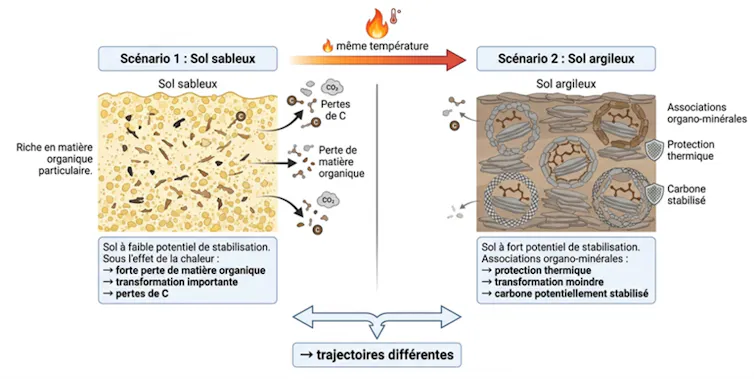
Dans un sol sableux, comme en forêt de Fontainebleau (Seine-et-Marne), par exemple, il aura une réduction plus importante de la matière organique du sol comparé à un sol argileux, comme certains sols du département de l’Aude. Cela est dû au fait que dans les sols sableux, la matière organique du sol est principalement présente sous forme de débris végétaux peu protégés, contrairement à un sol argileux où la matière organique est plus susceptible d’être présente en association avec les particules d’argiles. Cette association entre la matière organique du sol et les particules d’argiles est tellement forte qu’elle fonctionne comme une protection.
Ces sols argileux sont donc, eux, capables de stabiliser une part importante de la matière organique au contact des minéraux. Ils offrent ainsi une meilleure protection du carbone que les sols sableux.
Illustration de l’effet du feu sur un sol sableux (enrichi en matière organique particulaire) et un sol argileux (enrichi en matière organique associée aux minéraux, et donc plus stable). Dans la figure, l’élément carbone est représenté par la lettre C. Fourni par l’auteur
Une vie souterraine bouleversée
Les effets du feu sur les sols forestiers ne s’arrêtent pas là, car le feu ne transforme pas seulement la chimie et la structure du sol : il bouleverse également les organismes qui y vivent. Un sol abrite une communauté extrêmement diversifiée de bactéries, de champignons et d’animaux qui participent notamment à la décomposition de la matière organique et aux cycles du carbone et des nutriments. La chaleur peut provoquer très rapidement la mortalité directe d’une partie de ces organismes.
En modifiant le pH, la disponibilité des nutriments, la matière organique ou encore les propriétés physiques du sol, le feu transforme aussi dans la durée les conditions de vie et les ressources disponibles pour les organismes. Cette perturbation se traduit alors par une diminution de l’activité des champignons et microorganismes qui, par l’intermédiaire de leurs enzymes, décomposent la matière organique et rendent disponibles des nutriments précieux à la fertilité de la forêt tout entière.
Le fonctionnement biologique du sol peut ainsi rester perturbé bien après que les cendres ont disparu, avec des temps de récupération pouvant atteindre plusieurs années, voire plusieurs décennies selon la sévérité du feu et les caractéristiques de l’écosystème.
Tout le carbone part-il en fumée ?
Regardons maintenant ce qu’il se passe au niveau du stock de carbone des sols.
On pourrait penser qu’un incendie transforme une majorité du carbone du sol en CO2 qui partira dans l’atmosphère. La réalité est plus complexe. Une partie des substances carbonée de la matière organique du sol est, effectivement, consommée par les flammes. Mais une autre partie du carbone des sols n’est pas détruite : elle est transformée.
Pour comprendre cette transformation, il faut distinguer plusieurs formes de carbone présentes dans la matière organique du sol. Les formes dites « O-alkyles » correspondent principalement aux glucides, comme ceux de la cellulose et de l’hémicellulose des végétaux. Elles constituent une source d’énergie facilement accessible pour les microorganismes.
Les formes alkyles regroupent des molécules plus riches en chaînes carbonées, comme les cires ou certains lipides des plantes. Enfin, le carbone aromatique est constitué de molécules organisées en cycles carbonés, généralement plus résistantes à la décomposition biologique.
Sous l’effet de la chaleur, les formes O-alkyles et alkyles diminuent progressivement, tandis que la proportion de carbone aromatique augmente. À mesure que la température s’élève, certaines fonctions chimiques disparaissent à leur tour et les molécules se condensent, laissant un résidu de plus en plus riche en structures aromatiques : le carbone pyrogénique. Le charbon de bois en est la forme la plus visible, mais des composés similaires se forment également dans le sol après un incendie.
Du végétal au carbone pyrogénique : comment le feu transforme la matière organique. adapté de Knicker et coll., (2007), Fourni par l’auteur
Le feu produit donc une nouvelle forme de matière organique, structurellement plus fermée et chimiquement différente de celle qui existait avant l’incendie. Ce carbone peut alors interagir avec les minéraux du sol et persister plus longtemps que la matière organique dont il est issu. On pourrait donc penser que les incendies favorisent le stockage d’une forme de carbone plus stable dans les sols. La réalité est toutefois plus nuancée.
Des scénarios différents en fonction de l’intensité
Ce résultat surprenant est dû au fait que le feu consomme une partie de la matière organique, mais il génère aussi de résidus riches en carbone, comme le carbone pyrogénique, qui peuvent, dans certains systèmes, contrebalancer les pertes.
Cependant, une synthèse scientifique récente regroupant 471 études et plus de 5 000 observations à travers le monde montre que le feu tend globalement à diminuer les stocks de carbone du sol, avec des effets particulièrement marqués lorsque les incendies sont sévères ou répétés.
Après le feu, le sol continue d’évoluer
Lorsque les flammes s’éteignent, le sol n’est pas figé dans son nouvel état. Même si les sols gardent la mémoire des incendies, la végétation recommence à pousser, les microorganismes recolonisent progressivement le milieu et les cendres peuvent fournir temporairement des éléments nutritifs aux plantes. Commence alors une phase de récupération dont la vitesse et l’ampleur dépendent à la fois de la sévérité de l’incendie, des propriétés du sol et des caractéristiques de l’écosystème.
Dans certains écosystèmes, comme les savanes, les formations méditerranéennes ou les forêts sèches, le feu fait partie du fonctionnement naturel et peut contribuer au recyclage des nutriments ou au maintien de certaines espèces. Ces milieux ont évolué avec des incendies réguliers, généralement de faible intensité, qui favorise la libération de nutriments de la végétation morte et l’ouverture des espaces favorables à la germination ou à la repousse de nouvelles espèces. Certaines espèces méditerranéennes, comme le pin d’Alep ou plusieurs cistes, profitent même du passage du feu pour se régénérer. La chaleur intense des flammes fait fondre la résine qui maintenait leurs cônes fermés, libérant des milliers de graines sur un sol enrichi par les cendres.
Le problème survient lorsque le régime des feux se modifie. Un feu modéré suivi d’une recolonisation rapide n’a pas les mêmes conséquences à long terme que des incendies sévères ou répétés, qui peuvent survenir avant que le sol et la végétation aient eu le temps de récupérer. Les perturbations peuvent alors s’accumuler, entraînant des pertes de carbone et, plus largement, une altération durable du fonctionnement du sol.
Une intervention se justifie surtout lorsque le feu a rendu le sol particulièrement vulnérable à l’érosion, aux coulées de boue ou au transfert de sédiments vers les cours d’eau et les infrastructures. Dans ces secteurs, couvrir le sol avec de la paille, des copeaux de bois ou d’autres matériaux peut protéger sa surface de l’impact des gouttes de pluie et limiter le ruissellement et l’érosion.
À l’inverse, certaines interventions menées rapidement après l’incendie peuvent aggraver les dommages. Le passage d’engins lourds, notamment lors de l’exploitation des arbres brûlés, peut compacter un sol déjà fragilisé, dégrader sa structure et accroître l’érosion.
À l’heure du changement climatique, avec des incendies plus fréquents et plus intenses, une question cruciale demeure cependant : jusqu’où les sols peuvent-ils absorber ces perturbations sans voir leur fonctionnement durablement altéré ? Pour y répondre, l’étude des mécanismes favorisant ou limitant cette résilience demeure plus que jamais cruciale.
Cet article a bénéficié de l’appui de Quentin Bordier, rédacteur scientifique. Nous le remercions pour son aide dans la vulgarisation de cette réflexion.
Les auteurs ne travaillent pas, ne conseillent pas, ne possèdent pas de parts, ne reçoivent pas de fonds d’une organisation qui pourrait tirer profit de cet article, et n’ont déclaré aucune autre affiliation que leur organisme de recherche.
En cette rentrée 2026, un nouveau programme scolaire entre en vigueur en maternelle.
Depuis 1977, c’est la huitième fois que les objectifs de cette école sont réécrits : que penser de cette inflation de textes officiels ?
Au-delà de ce qu’on apprend à l’école maternelle, ne faut-il pas s’interroger sur le projet politique qu’elle porte ?
Le 7 mai 2026, un nouveau programme d’enseignement de l’école maternelle a été publié au Bulletin officiel. C’est le huitième texte de ce type et le plus copieux qui soit sorti depuis 1977. Organisé autour d’objectifs d’apprentissage déclinés par âge, il s’inscrit dans une longue série de réécritures qui se succèdent à une cadence croissante depuis près d’un demi-siècle.
Or, entre 1921 et 1977, l’école maternelle s’est profondément transformée sans qu’aucun programme ne soit réécrit. D’autres acteurs et actrices ont alors joué un rôle décisif pour façonner ses normes : une association professionnelle, des inspectrices, des éditeurs. Comment comprendre le passage d’un âge où l’institution évoluait depuis ses forces vives à un autre où les programmes prennent une place centrale ?
Retracer cette histoire, c’est comprendre comment changent les façons de scolariser les jeunes enfants et comment se reconfigurent les inégalités sociales auxquelles l’école maternelle prétend répondre.
Un modèle scolaire qui se stabilise dans les années 1920
Quand on pense à l’école maternelle, on visualise aussitôt de petites tables, du matériel à manipuler, des activités de groupe… C’est à la fin du XIXᵉ siècle que s’est construit ce modèle pédagogique, qui s’est stabilisé dans les années 1920.
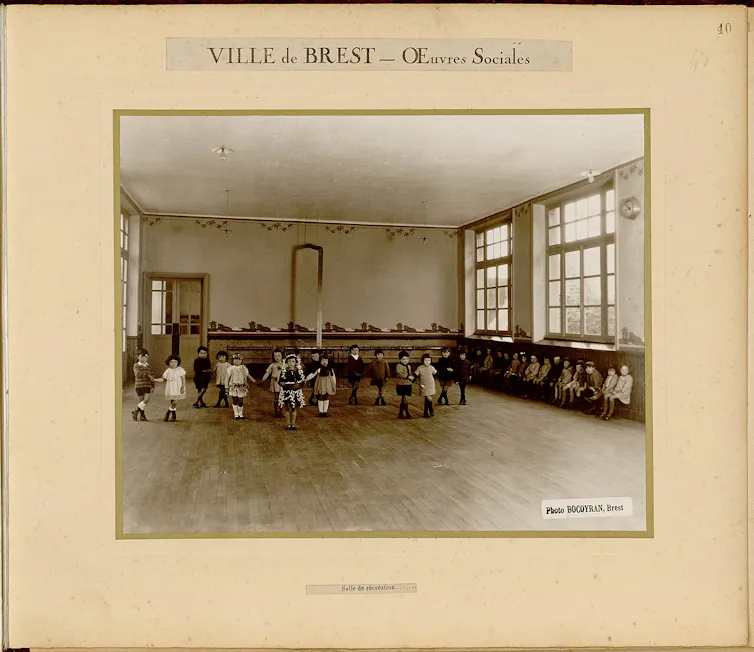
Des enfants dansent dans une salle de récréation, dans une école de Brest (Finistère), dans les années 1920. Alphonse Bocoyran, via Wikimédia
Ces normes sont portées par les inspectrices, souvent des femmes d’origines modestes en forte ascension sociale grâce aux filières d’élite de l’ordre primaire féminin (écoles normales, École normale supérieure de Fontenay). Leur vision de l’enfant s’inspire des modes d’éducation valorisés dans les milieux bourgeois.
Dès l’entre-deux-guerres, l’école maternelle se construit autour d’une tension durable : accueillir les enfants du peuple au nom d’un enfant pensé comme universel, mais selon une conception fondée sur des conceptions pédagogiques bourgeoises.
Un embourgeoisement de l’institution
Entre 1945 et les années 1970, c’est l’âge d’or de la maternelle. Aucun nouveau programme n’est publié et, pourtant, elle se transforme profondément. Le nombre d’écoles maternelles passe de 3 870 en 1948 à 18 486 en 1978 tandis que les effectifs par classe diminuent de 43 élèves en 1960 à 30 en 1980.
La préscolarisation se généralise jusqu’à atteindre la totalité des enfants de trois ans à six ans en 1994-1995. Cette expansion repose sur un investissement conjoint de l’État et des communes, finançant constructions, équipements et recrutements. Le modèle pédagogique promu depuis les années 1920 trouve alors les conditions de son déploiement.
Mais cet âge d’or est de même celui d’un embourgeoisement de l’institution. Historiquement destinée aux enfants des classes populaires, l’école maternelle attire désormais les classes moyennes et supérieures. Le profil social des enseignantes se modifie : contrairement à leurs prédécesseures souvent célibataires, elles sont nombreuses à contracter des mariages dans des milieux sociaux supérieurs et à fonder une famille.
À partir des années 1970, l’école maternelle entre dans l’âge de l’intégration scolaire. La massification de l’enseignement secondaire et la généralisation du collège unique font émerger une préoccupation centrale : l’échec scolaire. L’école maternelle se voit assigner une mission nouvelle, inscrite dans la loi Haby de 1975 : prévenir les difficultés scolaires.
Cette réorientation s’accompagne d’une perte progressive d’autonomie. Les inspections maternelles sont fondues dans l’inspection primaire, le monopole féminin pour y enseigner disparaît. L’espace professionnel féminin autonome s’efface, même si le travail de la classe reste aujourd’hui très majoritairement féminin. La loi Jospin de 1989 rattache plus étroitement la maternelle à l’élémentaire en rapprochant la grande section du CP. Les programmes se succèdent à un rythme soutenu : 1977, 1986, 1995, 2002, 2008, 2015, 2021 puis 2026.
Dans ce nouveau cadre, le langage devient l’objet privilégié de l’intervention pédagogique. À partir des années 1970 se constitue un champ d’expertise sur la littératie précoce. Linguistes, psychologues et spécialistes de l’écrit élaborent des normes qui circulent par la recherche, la formation et l’édition pédagogique. À partir de 2002, le langage occupe la première place dans les programmes, tandis que les mathématiques s’affirment plus récemment comme seconde discipline prioritaire.
À mesure que se multiplient supports écrits, évaluations et activités préparatoires aux apprentissages scolaires, les agents territoriaux spécialisés des écoles maternelles (Atsem) entrent en classe pour seconder des enseignantes dont le travail s’intensifie. Leur rôle pédagogique est progressivement reconnu, sans véritable revalorisation statutaire ou salariale.
La rentrée des classes en maternelle en 2005 (Archive INA).
De fait, la promesse de prévenir l’échec scolaire repose sur des normes pédagogiques socialement distinctives : on attend de l’enfant qu’il réfléchisse sur le langage, entre dans l’écrit par la littérature et l’échange verbal, apprenne de manière autonome avant même de maîtriser les techniques de l’écrit. Ce sont davantage les dispositions et les idéaux éducatifs des classes moyennes et supérieures que ceux des classes populaires. Les inégalités ne disparaissent donc pas : elles changent de forme.
La pression des évaluations
Depuis les années 1990, l’école maternelle est de plus en plus gouvernée par ses résultats. Les évaluations nationales et internationales, peu favorables à l’école française, nourrissent une succession de réformes qui renforcent les prescriptions.
Le programme de 2026 s’inscrit dans cette logique : plus long et plus détaillé que les précédents, il prolonge un demi-siècle d’inflation programmatique.
Finalement, la question est peut-être moins de savoir comment l’école maternelle doit éduquer les enfants et ce qu’elle doit enseigner que de comprendre quel projet politique elle porte, au service de quels groupes sociaux, quelles conceptions de l’enfance elle érige en normes, avec quels effets sociaux et à quel coût pour le travail de celles et ceux qui la font vivre au quotidien.
Fabienne Montmasson Michel ne travaille pas, ne conseille pas, ne possède pas de parts, ne reçoit pas de fonds d’une organisation qui pourrait tirer profit de cet article, et n’a déclaré aucune autre affiliation que son organisme de recherche.

















.jpg)

