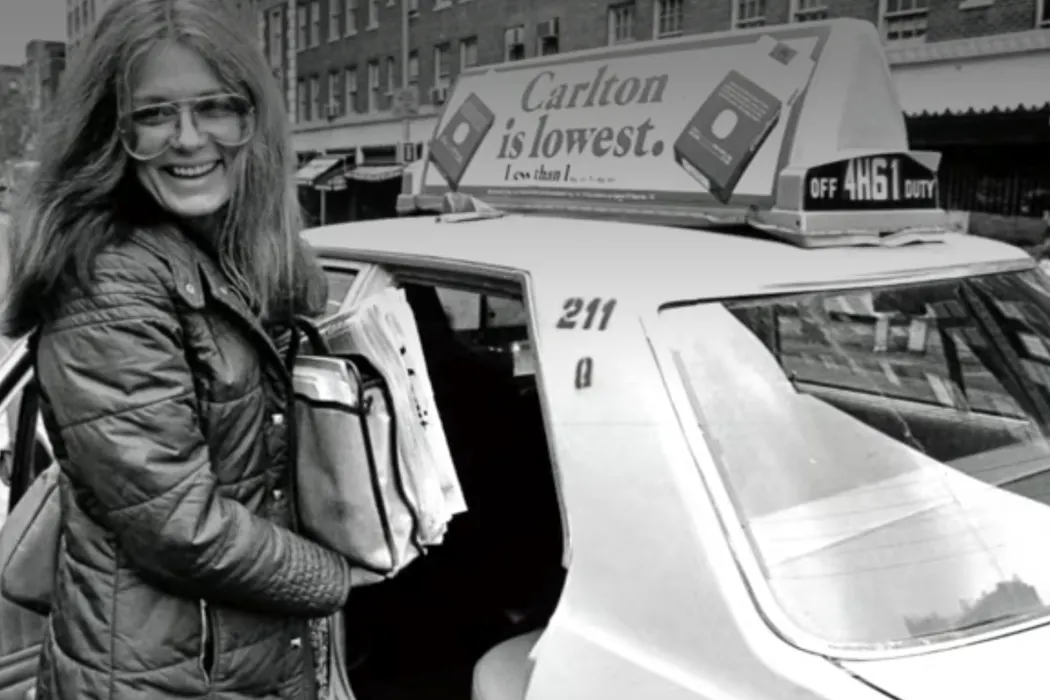
Les trajets en taxi permettaient à Gloria Steinem d’accéder, le temps d’un trajet, à des univers sociaux souvent invisibles.apture d’écran/Youtube
Icône américaine de la deuxième vague féministe, Gloria Steinem, décédée le 2 septembre 2026 à l’âge de 92 ans, est l’autrice de My Life on the Road (2015). Entre autobiographie, récit de voyage et manifeste politique, ses Mémoires révèlent comment une « vie en mouvement » a contribué à faire émerger un mouvement social.
Sa philosophie nomade, ou on-the-road state of mind comme elle la nomme, repose sur une disposition d’esprit ouverte au monde, à l’imprévu et aux rencontres. Le voyage devient alors un espace d’écoute et de lien. Là où Jack Kerouac célèbre, dans son On the Road (1957), une quête essentiellement individuelle de liberté, Steinem fait de la route un lieu d’échanges et de construction collective.
Fille d’un antiquaire peu conventionnel qui sillonne la Floride ou la Californie chaque hiver, la jeune Gloria passe une partie de son enfance dans une caravane familiale. Cette existence nomade, qu’elle décrit avec une certaine tendresse, la tient pourtant régulièrement éloignée de l’école. Elle apprend à lire grâce aux panneaux de signalisation routière.
D’autres chapitres décrivent son expérience fondatrice d’activisme social dans sa jeunesse parmi les femmes en Inde où elle a vécu pendant deux ans et où elle se déplaçait avec d’autres activistes de village en village, « une communauté mobile » comme elle la décrit. Cette forme de militantisme itinérant, inaugurée à cette époque, ne la quittera plus.
Prendre le pouls du pays
Tout au long de l’ouvrage, Steinem relate ses voyages en tant que journaliste engagée, par exemple ses voyages sur la route avec des militantes politiques cofondatrices de Ms. Magazine, son voyage à Huston pour la Conférence nationale des femmes de 1977, événement historique, ou encore ses nombreux déplacements entre campus universitaires, et communautés amérindiennes à travers les États-Unis.
Un chapitre intitulé « Pourquoi je ne conduis pas » est consacré aux chauffeurs de taxi rencontrés au fil de ses voyages. Steinem affectionne particulièrement ces conversations improvisées. Elles lui permettent certes de prendre le pouls du pays, mais surtout d’accéder, le temps d’un trajet, à des univers sociaux souvent invisibles. Chaque rencontre révèle ainsi l’un de ces « mondes sur roues » (worlds on wheels).
L’intérêt de cette autobiographie de Steinem tient principalement à sa lecture genrée du récit de voyage. Longtemps dominé par des figures masculines, ce genre littéraire a fait de la route un espace privilégié de liberté et d’aventure pour les hommes.
L’imaginaire du voyage s’est beaucoup construit autour de l’expérience de l’homme blanc mobile, où les femmes restent souvent cantonnées à l’espace privé, à l’image de Pénélope attendant le retour d’Ulysse. Aujourd’hui, des chercheurs et chercheuses féministes interrogent cette tradition en explorant la possibilité de réinventer le road narrative à partir d’expériences autres. La fin tragique de Thelma et Louise (1991) dont le scénario est signé Callie Khouri rappelle toutefois combien l’accès des femmes au « road trip au féminin » demeure problématique face aux représentations culturelles largement façonnées par des schémas patriarcaux.
Cultiver l’empathie
À travers un regard féministe, Steinem invite à repenser le langage du voyage et les stéréotypes qui l’accompagnent. Elle rappelle, par exemple, qu’une « aventurière » ne bénéficie pas des mêmes connotations positives qu’un « aventurier ».
Elle déconstruit également l’idée du foyer comme refuge naturel des femmes. Des violences domestiques aux États-Unis aux meurtres liés à la dot en Inde, elle souligne que les dangers auxquels les femmes sont confrontées proviennent souvent de leur entourage. Pour elles, la maison peut s’avérer plus dangereuse que la route.
Steinem nous invite à voir la route comme un espace de mobilisation autant que de déplacement. Dans My Life on the Road, elle inscrit son militantisme itinérant dans l’héritage des abolitionnistes et des suffragettes, qui parcouraient le pays pour porter leurs revendications. Cette filiation lui permet de rappeler une conviction centrale : aucun mouvement social ne peut reposer uniquement sur les médias ou les technologies de communication. La rencontre directe demeure au cœur de l’action collective :
« Alors et maintenant, nous prenons la route pour tenir des réunions communautaires où les auditeurs peuvent parler, les orateurs peuvent écouter, les faits peuvent être débattus, et l’empathie peut créer la confiance et la compréhension. »
Selon Steinem, l’empathie, celle qu’on cultive en voyageant, est l’émotion humaine la plus radicale et la plus puissante. Elle nous rappelle aussi que le « mouvement » et « se mouvoir » vibrent ensemble. Aspirer à un changement collectif suppose de mettre son corps en mouvement et de prendre activement la parole.
Son récit dessine un chemin vers la révolution, tout en faisant du cheminement lui-même une pratique révolutionnaire, un pas après l’autre. Ce livre offre dès lors un portrait fascinant du roadscape de Steinem, de sa vie sur la route et des rencontres qui ont nourri sa conviction qu’un monde meilleur est possible. Au cœur de cette trajectoire se trouve un « moi » itinérant mis au service d’un « nous » révolutionnaire.
Catherine Morgan-Proux ne travaille pas, ne conseille pas, ne possède pas de parts, ne reçoit pas de fonds d’une organisation qui pourrait tirer profit de cet article, et n’a déclaré aucune autre affiliation que son organisme de recherche.
Cadrée chaque rentrée par des listes, la recherche des fournitures scolaires peut virer au casse-tête.
Dans un langage neutre, la liste de fournitures se présente comme un service rendu tout en fixant un carcan.
Relire Quintilien, pédagogue romain du Ier de notre ère, et Roland Barthes aide à en questionner les rapports de pouvoir et les enjeux économiques sous-jacents.
Chaque année, avec la rentrée scolaire, un petit rectangle de papier circule dans les familles : la liste de fournitures. Elle arrive de l’école, imprimée sur une feuille A4 souvent photocopiée à la va-vite, parfois envoyée par mail, de plus en plus scannée et partagée sur les groupes WhatsApp de parents d’élèves.
Elle énumère, par exemple : deux cahiers 24×32, un paquet de crayons de couleur, une calculatrice – parfois avec une marque précise, alors même que le ministère de l’éducation nationale publie chaque année une liste-modèle censée cadrer ce type de demandes et en limiter le nombre. Cette liste-modèle existe bel et bien (elle est consultable sur le site du ministère de l’éducation nationale), mais rien n’oblige les enseignants à s’y tenir : la liste qui parvient réellement aux familles peut s’en écarter librement.
Personne ne questionne cet ensemble. C’est « la » liste. Elle a toujours existé, elle existera toujours. Et c’est là que commence le mythe.
Effacer les marques de la prescription
Ce que Barthes appelait la fonction du mythe, c’est exactement ce tour de passe-passe : transformer une histoire – une décision d’enseignant, une habitude d’établissement, parfois une entente locale avec telle papeterie – en un fait de nature.
La liste de fournitures ne se présente jamais comme un choix. Elle se présente comme ce qui est nécessaire. Le verbe employé est révélateur : on ne dit pas « l’école recommande », on dit « il faut prendre » ou, plus simplement, la liste elle-même parle à l’impératif nu, sans sujet :
« 1 cahier de brouillon.
1 boîte de mouchoirs.
1 ardoise Velleda. »
Le signifiant grammatical de la prescription a disparu, mais l’ordre, lui, demeure entier. C’est un langage qui se fait passer pour une simple énumération, un inventaire neutre, quand il est en réalité un ordre.
Derrière le service rendu, un carcan ?
Il y a près de deux mille ans, le rhéteur et pédagogue romain Quintilien décrivait déjà, sans le savoir, ce même geste, celui de la prescription qui se présente comme une aide. Dans son Institution oratoire, il explique comment faire apprendre l’écriture aux tout-petits :
« Je n’exclus pas non plus ce moyen bien connu, pour aiguiser l’envie d’apprendre chez le tout-petit, de lui offrir à jouer des lettres façonnées en ivoire, ou tout autre objet, pourvu qu’on en trouve, dont cet âge-là se réjouisse davantage, qu’il soit agréable de toucher, de regarder, de nommer. Mais dès qu’il commencera à suivre le tracé des lettres, il ne sera pas inutile de les faire graver le mieux possible sur une tablette, pour que le stylet se laisse guider comme par des sillons. Ainsi, l’enfant ne s’égarera pas comme sur la cire, car il sera contenu de chaque côté par des bords sans pouvoir s’écarter de ce qui est prescrit et, en suivant plus vite et plus souvent des empreintes bien fixées, il affermira ses doigts sans avoir besoin qu’on pose sa main sur la sienne pour la guider. » (Traduction de l’auteur)
Ce passage est un petit chef-d’œuvre involontaire de mythologie pédagogique. La tablette gravée n’est jamais présentée comme une contrainte, elle est un jeu, un objet « agréable à toucher, à regarder, à nommer ». Et pourtant, sa fonction technique est très exactement celle d’un carcan : elle contient de chaque côté par des bords, elle empêche l’enfant de s’écarter de ce qui est prescrit.
Quintilien dit lui-même, avec une franchise presque désarmante, que le sillon dispense de la main qui guide, l’objet a intériorisé la contrainte à la place du maître.
C’est le geste exact de la liste de fournitures : un texte qui canalise entièrement le comportement, mais qui se présente sous les traits du service rendu, de l’aide à l’apprentissage, du simple outil.
La liste comme rituel de classement social
Mais le mythe ne s’arrête pas à l’objet, il travaille aussi sur les familles elles-mêmes. La liste de fournitures, en énumérant avec précision ce qui est requis, produit un butoir invisible : elle sépare silencieusement celles et ceux pour qui cette liste est une formalité de celles et ceux pour qui elle est un mur.
Le baromètre annuel du panier moyen, d’environ 180 euros cette rentrée, en sixième, n’est jamais mentionné sur la liste elle-même. La liste ne dit jamais son prix. C’est précisément cette omission qui fait tout le travail idéologique : en se présentant comme un simple inventaire pédagogique, elle efface la question économique qu’elle pose pourtant à chaque famille qui la lit.
« Fournitures scolaires : initiatives et revendications pour la gratuité » (INA Actu, 2021).
Le geste barthésien consiste précisément à retourner l’objet pour voir sa doublure. Ce que la liste de fournitures ne dit jamais, c’est qu’elle est un texte de pouvoir, pas un texte d’information – même dans ses détails les plus anodins, comme le format d’un cahier, l’arbitrage entre cahiers et classeurs fait par l’enseignant sans jamais être justifiés, et pourtant transmis comme des évidences.
Elle prescrit sans jamais se donner comme prescriptive. Et comme la tablette gravée de Quintilien, elle y parvient précisément parce que son support, une feuille A4, un peu grise, glissée dans le cahier de liaison, a toute l’apparence de la neutralité la plus plate, du service rendu, de l’aide à l’apprentissage. C’est un texte qui n’a l’air de rien. C’est exactement pour cela qu’il faut le lire.
Benjamin Demassieux ne travaille pas, ne conseille pas, ne possède pas de parts, ne reçoit pas de fonds d’une organisation qui pourrait tirer profit de cet article, et n’a déclaré aucune autre affiliation que son organisme de recherche.
El partido de extrema derecha Alternativa para Alemania (AfD) ha causado conmoción en toda Alemania –y en el mundo entero– al arrasar a la oposición en unas elecciones regionales celebradas este fin de semana. Pero ¿será realmente capaz este partido de gobernar?
En unas elecciones que registraron una participación récord, la AfD obtuvo más del 44 % de los votos en el estado oriental de Sajonia-Anhalt. Esto supone más del doble del resultado en las elecciones regionales de 2021.
Sin embargo, como es habitual en la política alemana, la AfD no ha alcanzado la mayoría absoluta y necesitaría formar una coalición con otro partido para gobernar, aunque por un margen muy estrecho.
Tradicionalmente, los principales partidos políticos alemanes, tanto de izquierda como de derecha, se han comprometido a mantener un “cortafuegos” o “cordón sanitario” entre la AfD y el Gobierno. Esto significa que ninguno de ellos formaría una coalición con el partido de extrema derecha.
No obstante, el resultado ha amenazado con dar un vuelco a la política alemana, que desde la Segunda Guerra Mundial había logrado impedir que un partido de extrema derecha volviera al poder.
La AfD ha obtenido más votos que cualquier otro partido en Sajonia-Anhalt en más de diez años. Se trata de la misma formación que el organismo gubernamental encargado de salvaguardar la democracia alemana ha calificado oficialmente de partido de extrema derecha debido a sus “numerosas declaraciones antimusulmanas, racistas y antisemitas”.
La preocupación ahora es qué presagia esta elección regional para futuros éxitos de la ultraderecha.
¿Por qué le ha ido tan bien a la AfD?
Los analistas políticos llevan mucho tiempo tratando de presentar a la AfD como un fenómeno de Alemania Oriental (y siguen haciéndolo). Pero esto es solo una parte de la historia.
En las últimas elecciones federales de 2025, la AfD fue el segundo partido más votado en muchas circunscripciones alemanas. Y en casi todas las encuestas nacionales de este año, se ha situado en cabeza como la formación política más popular del país.
Incluso una coalición de los partidos históricamente más fuertes de Alemania –la Unión Demócrata Cristiana (CDU), el Partido Socialdemócrata (SPD) y los Verdes– tendría dificultades, según las encuestas actuales, para formar un Gobierno federal en la actualidad.
Es revelador que este giro hacia la extrema derecha en Sajonia-Anhalt se haya producido a expensas de la CDU, que lidera el actual Gobierno federal alemán bajo el mandato del canciller Friedrich Merz. Como dejó claro una encuesta a pie de urna realizada tras las elecciones, el 88 % de los votantes del estado consideraba que, si el Gobierno de Merz hubiera aplicado mejores políticas, la AfD no tendría tanta fuerza en el estado.
Por su parte, Merz ha cometido el error de intentar llevar a un partido de centro-derecha que gozaba de gran popularidad bajo el liderazgo de Angela Merkel mucho más hacia la derecha, en un intento por ganarse a los votantes descontentos. Sin embargo, en lugar de apaciguar a los votantes desilusionados de la AfD, Merz simplemente ha incorporado los argumentos de la extrema derecha a la corriente principal, lo que ha llevado a algunos votantes conservadores a apoyar a la AfD.
A pesar de la clara postura antimigratoria de la AfD, estas elecciones no fueron meramente un referéndum sobre la inmigración, como algunos querrían presentarlas.
De hecho, solo el 16 % de los votantes en las encuestas a pie de urna afirmó que era su principal preocupación. La economía y la educación ocupaban los primeros puestos en la lista, y a la inmigración le seguían de cerca la falta de infraestructuras y servicios básicos y la falta de oportunidades laborales.
Los votantes de Sajonia-Anhalt sentían que su calidad de vida se estaba deteriorando y culpaban no solo a los migrantes, sino también a los políticos del establishment y a aquellos a quienes denominan colectivamente die Bonzen —los “peces gordos” que se han enriquecido durante la crisis del coste de la vida—.
¿Es posible una coalición?
El único partido que podría formar una coalición con la AfD sería el partido minoritario Alianza Sahra Wagenknecht (BSW). El BSW es una formación fundada por un antiguo miembro de Die Linke (La Izquierda), aparentemente un partido socialista democrático.
Sin embargo, desde que abandonaron La Izquierda, los integrantes del BSW han relegado casi por completo sus anteriores convicciones socialistas democráticas y se han vuelto cada vez más nacionalistas.
De hecho, se han desplazado tanto hacia la derecha que, tras las elecciones de Sajonia-Anhalt, el BSW planteó inmediatamente la posibilidad de una coalición con la AfD, haciendo hincapié en sus
“puntos en común”.
Por su parte, la AfD se mantiene firme en su negativa a aceptar cualquier gobierno de coalición. En su lugar, amenaza con obligar al estado de Sajonia-Anhalt a convocar nuevas elecciones en un intento por conseguir una mayoría absoluta.
Esto no es del todo descabellado, ahora que el partido está a un paso de lograrlo: bastaría con que un partido menor, como el BSW, quedara por debajo del umbral electoral del 5 % necesario para obtener un escaño en el Parlamento regional para que la AfD consiguiera la mayoría absoluta.
¿Un resultado exclusivamente alemán?
Aunque las oscuras sombras del pasado nazi siguen marcando la percepción exterior del comportamiento de los votantes en Alemania, su giro hacia la derecha no se produce en el vacío. La desilusión con la democracia liberal está creciendo en otros lugares de Europa y más allá.
En Italia, la ya de por sí derechista primera ministra, Giorgia Meloni, se encuentra actualmente bajo la presión de partidos aún más extremistas. Reform UK, contrario a la inmigración, sigue obteniendo buenos resultados en las encuestas en el Reino Unido. Y la eterna amenaza para la democracia liberal en Francia, Marine Le Pen, es la favorita para las elecciones presidenciales del año que viene.
Las condiciones que han permitido el auge de la AfD en Alemania no son, por tanto, en absoluto únicas. Se está produciendo a escala mundial una erosión más profunda de las normas democráticas que está permitiendo que las formas más extremas de nacionalismo ultraderechista se conviertan en opciones elegibles.
Queda por ver qué podría significar esto para cuestiones de importancia mundial como la unidad de la Unión Europea, la guerra en Ucrania y el futuro de la OTAN en Europa.
Matt Fitzpatrick recibe financiación del Australian Research Council.
Plutôt que de croître, croître et encore croître, certains entreprises choisissent de ne pas grandir. Et c’est un signe de maturité !Andrydi/Shutterstock (no reuse)
La course effrénée à la croissance ne convainc pas tous les entrepreneurs. Les sceptiques ? Les micro-entreprises, cœur du tissu économique français. Une étude met en lumière les raisons qui poussent certaines entreprises à ne pas croître.
Dans l’imaginaire économique, une entreprise qui ne grandit pas est une entreprise qui dépérit. Les politiques publiques comme les discours d’experts présentent la croissance comme un impératif.
Dans une étude auprès de 13 micro-entreprises, issues de secteurs variés – artisanat, production, services ou numérique –, observées pendant douze ans, nous explorons une réalité contre-intuitive : ne pas croître peut devenir une stratégie pleinement assumée.
Les entreprises étudiées partagent un trait commun : après avoir augmenté leurs effectifs, elles ont délibérément choisi de revenir à une taille proche de leur situation initiale. Non par contrainte, ni à la suite d’un accident de parcours, mais par détermination stratégique. Le plus étonnant ? Cette décision s’est accompagnée d’une amélioration de leurs marges, de leur efficacité et surtout de leur bien-être au travail.
À rebours des scénarios habituels, ces entrepreneurs ne cherchent ni à conquérir des parts de marché ni à empiler les recrutements. Ils cherchent autre chose : la maîtrise de leur cœur de métier, la qualité de la relation avec leurs clients et la possibilité de continuer à exercer un métier qui fait sens.
Par exemple, un dirigeant d’atelier bois interrogé a développé son entreprise avant de faire machine arrière. En cherchant de nouveaux clients, il s’est éloigné du sens de son projet. Il choisit alors de revenir à une taille plus maîtrisée :
« En quittant l’atelier pour développer la clientèle, je me perdais. L’entreprise n’était plus ce que je voulais qu’elle soit. Désormais, nous refusons les projets qui ne correspondent pas à notre logique. »
La croissance leur apparaît moins comme un horizon désirable que comme une menace, celle de diluer leur savoir-faire et de s’enliser dans des responsabilités managériales devenues écrasantes. Préserver une taille réduite devient synonyme de rester fidèle à son projet entrepreneurial.
La spirale de l’innovation discrète
Contrairement à l’idée reçue selon laquelle seules les entreprises en expansion innovent, les micro-entreprises observées innovent… en se recentrant sur leur cœur de métier pour mieux en extraire le potentiel. Cette innovation discrète fonctionne en mouvement de spirale.
Par exemple, un ferronnier interviewé modernise son atelier avec des outils de pointe. Loin de standardiser son activité, ces investissements lui permettent de revisiter des techniques traditionnelles sans chercher à augmenter ses effectifs :
« Je perfectionne des techniques traditionnelles en les combinant avec de nouvelles technologies. Grâce à ces outils, nous avons revisité nos anciennes techniques et encore progressé. »
Leur développement ne procède pas par rupture, mais par un processus itératif qui les conduit à explorer leurs domaines d’excellence. Un ferronnier revisite les techniques anciennes grâce aux outils numériques ; un menuisier redéfinit sa pratique en mêlant matériaux traditionnels et procédés contemporains ; une artisane de cosmétiques biologiques élabore des formules inédites en s’appuyant sur des collaborations locales.
Ce travail d’approfondissement confère à ces entreprises un bénéfice inattendu : plus elles se recentrent sur un noyau étroit d’excellence, plus elles deviennent inimitables et donc essentielles.
Vivre « l’entreprendre »
L’autre pilier de leur stratégie est relationnel. Lorsqu’un projet dépasse leur périmètre, ils le mènent avec des partenaires de proximité plutôt que d’embaucher. Et lorsqu’une activité s’éloigne de leur cœur de métier, ils la confient à des pairs.
Cette logique de réseau n’est pas une tactique défensive, mais une philosophie d’équilibre. Elle répond aux demandes sans démultiplier les charges fixes de préserver la qualité et d’absorber les aléas économiques grâce à l’immersion dans un écosystème de compétences complémentaires. Dans cette géographie relationnelle, l’entreprise reste petite, mais son influence territoriale, voire stratégique, s’étend.
Un parqueteur choisit de ne plus tout faire lui-même. Quand l’activité déborde ou s’éloigne de son cœur de métier, il la confie à des collègues de confiance. La coopération devient un levier pour stabiliser l’entreprise sans recruter :
« Je ne veux plus courir après l’argent… Il est important que les collègues se transmettent du travail les uns aux autres. Je fais ce que je sais faire, et je partage le reste. »
Les dirigeantes et dirigeants interrogés racontent avec une grande transparence les raisons qui les ont conduits à cette approche : ne pas s’obstiner à la recherche de contrats, mais se donner le temps de travailler consciencieusement et de vivre « l’entreprendre ».
Du cœur de métier comme ancrage stratégique
Si ces micro-entreprises parviennent à se développer sans grandir, c’est qu’elles s’appuient sur un élément central : leur cœur de métier, qui n’est pas une simple catégorie technique, mais un espace d’identité. Il est façonné par la sensibilité du dirigeant, ses valeurs, ses rencontres, son histoire personnelle, mais surtout ses compétences distinctives.
Notre étude révèle que le cœur de métier n’est pas fixe. Il se construit, se précise, se renforce au fil des années. Il agit comme une boussole qui oriente les choix d’innovation, les collaborations possibles et les refus assumés. Ce cœur de métier protège l’entreprise contre les tentations de diversification hasardeuse et lui donne la profondeur qui compense l’absence de croissance en taille.
En réalité, la croissance se déplace de l’horizontale (plus large) vers la verticale (plus profonde).
Sortir de l’obsession de la taille
Les résultats de cette recherche posent une question bouleversante : Faut-il continuer à structurer notre politique économique sur la seule logique du « toujours plus » ? Si l’essentiel du tissu entrepreneurial ne souhaite pas croître, à quoi sert de lui proposer un accompagnement systématiquement orienté vers l’expansion, l’export ou le recrutement ?
Peut-être conviendrait-il plutôt :
de soutenir l’innovation de précision, celle qui renforce le savoir-faire expertal ;
de dynamiser les réseaux territoriaux qui permettent aux petites entreprises de coopérer plutôt que de grossir ;
d’accompagner les entrepreneurs non par « silo » (numérique, qualité, export…), mais selon la cohérence globale de leur trajectoire ;
de reconnaître que la performance peut s’exprimer autrement que par la taille.
Et si ne pas grandir traduisait une forme de progrès ?
La stratégie de no-growth n’a rien à voir avec la stagnation ou la résignation. Elle relève au contraire d’une démarche exigeante : raffiner, choisir, renoncer, s’entourer, innover sans se disperser. Ces entreprises ne veulent pas croître, car elles veulent mieux faire. Elles refusent de devenir plus grandes pour devenir plus fortes.
À l’heure où l’économie française cherche de nouveaux moteurs, les micro-entreprises rappellent une vérité essentielle : la valeur ne se mesure pas seulement en effectifs, mais aussi en excellence, en maîtrise et en sens.
Et si l’avenir de l’entrepreneuriat résidait justement dans cette audace tranquille, celle de croître autrement ?
Les auteurs ne travaillent pas, ne conseillent pas, ne possèdent pas de parts, ne reçoivent pas de fonds d’une organisation qui pourrait tirer profit de cet article, et n’ont déclaré aucune autre affiliation que leur organisme de recherche.
À l’opposé du burn out, le bore-out résulte d’un manque d’activité, de stimulation ou de sens au travail. Pourtant, ses effets psychologiques peuvent être tout aussi importants. Une étude qualitative permet d’analyser les manifestations du bore-out, ses causes organisationnelles et l’invisibilisation persistante de l’ennui au travail.
Alors que le burn out occupe désormais une place centrale dans les débats sur la santé mentale au travail, une autre forme de souffrance reste largement invisibilisée : le bore-out syndrom.
Moins spectaculaire que l’épuisement professionnel, il renvoie à une réalité profonde : celle d’un ennui chronique, d’un sentiment d’inutilité et d’une perte de sens dans le travail. Selon la chercheuse Ruth Maria Stock, le bore-out syndrom réduit l’innovation, diminue l’engagement et augmente le désengagement psychologique.
Longtemps considéré comme un simple inconfort ou comme un « privilège » comparé à la surcharge de travail, le bore-out – reconnu par le gouvernement français – apparaît comme un véritable risque psychosocial.
Les témoignages recueillis auprès de salariés de différents secteurs d’activités dans le cadre d’une étude qualitative menée par Charlotte Almeras pour sa thèse professionnelle en 2024 montrent que cet ennui n’est ni marginal ni anodin.
De quoi parle-t-on ?
Le bore-outdésigne une forme d’épuisement psychologique liée non à l’excès de travail, mais à son insuffisance, à sa monotonie ou à sa perte de sens. Les premiers travaux sur le sujet définissent le phénomène autour de trois dimensions principales : l’ennui, le manque de défis et le désintérêt professionnel.
Ruth Maria Stock le décrit comme « un état psychologique négatif de faible stimulation professionnelle » caractérisé par une crise de sens, une crise de croissance et l’ennui au travail.
Contrairement aux idées reçues, l’ennui au travail n’est pas nécessairement synonyme de confort. Plusieurs salariés interrogés évoquent au contraire un profond malaise. Une secrétaire du secteur automobile explique vivre :
« Un mal-être […] Quand je vais au travail, c’est pour effectuer une tâche, être rémunéré pour effectuer une mission. »
Une ancienne infirmière devenue conseillère funéraire décrit un sentiment d’inutilité :
« Je me sens inutile, j’ai l’impression de perdre mon temps et je me dis que je serais mieux chez moi qu’au travail à attendre. »
Ces témoignages rejoignent les analyses montrant que le travail ne constitue pas seulement une source de revenus, mais également un espace de reconnaissance sociale et d’utilité symbolique. Lorsque ces dimensions disparaissent, l’ennui peut progressivement devenir une véritable souffrance psychique.
Bore-out et burn out
Le burn out et le bore-out semblent, à première vue, opposés. Le premier résulte d’une surcharge de travail ; le second d’un manque d’activité ou de stimulation. Pourtant, leurs conséquences psychologiques présentent de nombreuses similitudes.
Dans les deux cas, les salariés évoquent une fatigue émotionnelle, une perte de motivation, de l’anxiété et, parfois, des symptômes dépressifs. Plusieurs personnes interrogées associent directement l’ennui professionnel à une détérioration de la santé mentale. Un contrôleur de gestion estime que le bore-out :
« Génère de l’anxiété, la journée étant très longue, la personne y va à reculons avec la boule au ventre en se demandant ce qu’elle va faire. »
Ces résultats rejoignent des travaux de recherche. Ces derniers montrent que le manque de stimulation professionnelle peut produire des effets comparables à ceux du surinvestissement professionnel, notamment en matière d’épuisement émotionnel et de désengagement.
Un autre point commun entre burn out et bore-out réside dans la culpabilité ressentie par les salariés. Là où le burn out peut conduire à culpabiliser de ne plus réussir à « tenir », le bore-out conduit souvent à culpabiliser… de ne pas avoir assez à faire. Un salarié explique :
« De la culpabilité, je dirais, parce que j’ai l’impression de pas faire ce que je devrais faire ou d’oublier quelque chose. »
Cette culpabilité contribue largement à invisibiliser le phénomène. Beaucoup de salariés hésitent à parler de leur ennui, par peur d’être perçus comme paresseux, démotivés ou privilégiés. Un chef de secteur dans la grande distribution affirme :
« Non, je n’oserais pas en parler. Je pense que mon supérieur le prendrait très mal et j’aurais honte face à mes collègues. »
Le bore-out apparaît comme une souffrance silencieuse : difficile à exprimer dans des organisations où la surcharge de travail demeure souvent valorisée.
Les manifestations du bore-out
Nos entretiens soulignent que le bore-out prend des formes variées dans les organisations. Les manifestations observées sont souvent discrètes : déambulation sur Internet, multiplication des pauses, discussions prolongées avec les collègues ou encore sentiment de vide durant certaines plages horaires.
Une assistante chef de produit reconnaît :
« Oui, parfois je flâne sur mon téléphone, sur les réseaux sociaux, je fais mes courses en ligne. »
Ces comportements sont souvent interprétés comme un manque d’implication individuelle. Pourtant, nos entretiens montrent qu’ils trouvent fréquemment leur origine dans des causes organisationnelles.
Causes organisationnelles
Le premier facteur évoqué : la sous-charge de travail. Plusieurs salariés décrivent une activité irrégulière, marquée par des pics suivis de longues périodes creuses. Une salariée parle d’un travail « par épisodes » tandis qu’un autre évoque « des semaines très chargées et d’autres très calmes ».
Le management apparaît comme un élément central. Une salariée estime que l’ennui vient principalement « du manager, et de la charge de travail qu’il confie ».
Ces résultats rejoignent les analyses des chercheurs Christian Bourion et Stéphane Trébucq. Ils appuient la thèse que le bore-out est étroitement lié aux modes d’organisation du travail et à la manière dont les entreprises absorbent l’inactivité professionnelle.
Plusieurs témoignages soulignent les transformations contemporaines du travail. Une commerciale critique notamment des horaires fixes parfois déconnectés de l’activité réelle : « Nous sommes encore trop sur un modèle de travail avec des horaires fixes. »
Plusieurs facteurs organisationnels récurrents sont identifiés : la sous-charge de travail, les tâches répétitives, le management inadéquat, l’absence de reconnaissance ou encore l’inadéquation entre les compétences du salarié et les missions confiées.
Le bore-out reste fréquemment associé aux métiers administratifs et tertiaires, marqués par des tâches répétitives, une forte bureaucratisation ou des périodes récurrentes de faible activité.
Un décalage entre compétence et poste
Au-delà des causes organisationnelles, certains profils semblent plus vulnérables au bore-out en raison d’un décalage entre leurs compétences, leurs attentes et le contenu réel de leur travail.
Les salariés surqualifiés apparaissent particulièrement exposés. Lorsque les compétences d’un individu dépassent les exigences du poste, un sentiment de sous-utilisation peut favoriser ennui, perte de sens et désengagement. Les profils à haut potentiel intellectuel ou à forte recherche de stimulation cognitive peuvent également souffrir davantage des situations de sous-stimulation et de répétitivité des tâches.
Les jeunes diplômés constituent aussi une population à risque lorsque leurs attentes professionnelles se heurtent à des tâches routinières ou peu responsabilisantes.
Nos entretiens reflètent une réalité plus nuancée. Le bore-out touche également des salariés qui ne se considèrent pas surqualifiés, mais qui expriment un fort besoin d’utilité ou de stimulation professionnelle. Un assistant-gestionnaire de copropriétés explique :
« Comme j’allais assez vite, je demandais plus de choses pour ne pas m’ennuyer et apprendre plus. »
Le bore-out ne renvoie pas uniquement à un « problème individuel ». Il interroge plus largement la capacité des organisations à distribuer le travail, reconnaître les compétences et à donner du sens à l’activité quotidienne.
L’ennui est un enjeu organisationnel
L’un des enseignements majeurs de ces entretiens ? L’ennui au travail reste socialement difficile à reconnaître. Dans de nombreuses organisations, manquer de travail demeure moins légitime que d’en avoir trop. Les conséquences peuvent être pourtant importantes, tant pour les salariés que pour les entreprises avec, à la clé, désengagement, absentéisme, perte de sens, anxiété ou baisse de performances.
Reconnaître le bore-out suppose de dépasser une vision uniquement quantitative du travail. Il ne s’agit pas seulement de « donner du travail » aux salariés, mais aussi de leur permettre de se sentir utiles, stimulés et reconnus dans leur activité.
À l’heure où les transformations du travail – télétravail, automatisation, fragmentation des tâches ou intensification des procédures – redéfinissent les rapports au temps et à l’activité, le bore-out pourrait bien devenir l’un des grands angles morts des risques psychosociaux contemporains.
Catherine Pourquier ne travaille pas, ne conseille pas, ne possède pas de parts, ne reçoit pas de fonds d’une organisation qui pourrait tirer profit de cet article, et n’a déclaré aucune autre affiliation que son organisme de recherche.
Source: The Conversation – in French – By Peter Lambertz, Research associate, Centre d’anthropologie culturelle, Université Libre de Bruxelles (ULB)
Les transports routiers en République démocratique du Congo ont fait l’objet d’une attention particulière de la part des chercheurs. Certaines études se sont penchées sur le paysage urbain. D’autres ont étudié les transports dans le contexte du conflit armé qui sévit dans l’est du pays, où la présence des barrages routiers constitue une caractéristique marquante.
Les voies d’eau du bassin du Congo, dont 25 000 km sont classés comme navigables, ont fait l’objet d’études portant sur le régime fiscal des grands convois de pousseurs et de barges. L’échelle intermédiaire du transport fluvial fonctionnant avec les baleinières en bois a toutefois été jusqu’à présent moins étudiée. Et ce, malgré la dépendance écrasante de villes telles que Kinshasa, Mbandaka et Kisangani à l’égard de ces petites embarcations.
Une part importante du trafic sur ces voies navigables est aujourd’hui assurée par des navires de transport en bois appelés « baleinières ». Mesurant entre 20 et 40 mètres de long, ces embarcations artisanales, développées localement, relient les villes en pleine expansion aux communautés agricoles de l’arrière-pays de la forêt tropicale, situées le long de rives fertiles et éloignées.
Les baleinières sont au cœur de mes recherches, qui se concentrent principalement sur la ville de Kisangani, dans la province du Tshopo, en République démocratique du Congo. Je m’intéresse à leur émergence, à leur transformation, aux matériaux utilisés et à l’usage socio-technique de ces embarcations artisanales, de leur système de propulsion et de leurs équipages. J’ai également porté mon attention sur le caractère systémique de leur infrastructure artisanale et sur son recours aux savoirs environnementaux traditionnels.
Réinvention d’un système de transport
Les baleinières en bois remontent au début des années 1960. Mais depuis les années 1990, elles jouent un rôle crucial dans la réinvention d’un système de transport à travers le bassin du Congo. Ces bateaux en bois assurent la sécurité alimentaire des villes riveraines d’Afrique centrale. C’est notamment le cas de Kinshasa, la troisième plus grande ville du continent. Elles relient également la capitale nationale à de nombreuses provinces du pays.
En raison d’un manque de statistiques et de recherches limitées à ce jour, des chiffres fiables ne sont disponibles que pour Kisangani, une ville de deux millions d’habitants située à l’amont du fleuve Congo navigable. Ici, environ 80 baleinières différentes arrivent chaque mois dans les ports secondaires privés de la ville, souvent à un rythme (bi-)hebdomadaire, et chacune transportant en moyenne 150 tonnes de marchandises et environ 150 passagers.
Kinshasa, ville de 17 millions d’habitants, accueillerait, selon les estimations, plusieurs centaines de baleinières chaque mois.
On manque encore d’études approfondies sur les facteurs socio-techniques complexes qui sous-tendent ces accidents, ainsi que sur la manière dont des centaines de personnes font face aux pertes humaines et économiques chaque année. Parmi les facteurs clés figurent les faiblesses structurelles des navires, le manque de formation professionnelle du personnel navigant et l’insuffisance des mesures de sécurité dans un contexte d’urgence économique.
Fruit d’une innovation locale et frugale, ces navires ont été développés par nécessité. Cela explique leur prix abordable, leur efficacité sans compromis et leur capacité à fonctionner sans infrastructures telles que des ports fortifiés, des grues et des quais, dans un environnement en constante évolution.
Les bateaux en bois du Congo incarnent les réalités et les paradoxes de la vie congolaise d’aujourd’hui. Une ingéniosité technique et économique née de la pratique et du savoir-faire des populations riveraines, sans bureau d’études ni appui public, assure l’approvisionnement alimentaire de millions de personnes, mais ne bénéficie d’aucune protection face à un capitalisme dérégulé qui dresse les individus les uns contre les autres. Ce capitalisme use les corps des hommes comme les coques des bateaux. Armateurs, équipages et commerçants transportés cherchent à s’en prémunir en ne se fiant qu’à eux-mêmes et à quelques liens personnels de confiance.
Origines, matériaux et propulsion
Les embarcations de la période coloniale qui ont donné leur nom aux baleinières étaient des navires de neuf mètres, sans pont ni moteur, rivetés à partir d’acier belge préfabriqué et remorqués derrière des bateaux à vapeur pour transporter des matériaux de construction. Aujourd’hui, seul leur nom subsiste. Les prototypes de baleinières en bois ont été construits au début des années 1960 par André « Bibeyi » (Lingala: barge), un artisan congolais qui a su allier les techniques de menuiserie coloniales au savoir-faire traditionnel local.
Bibeyi a fabriqué la charpente à partir de bois durs locaux. La coque, quant à elle, était en bois tendre de tola, le bois de prédilection pour les pirogues qu’il a imperméabilisée avec du bitume, des feuilles de n’kasa ya kwanga et des bandes de tôle d’aluminium recyclée. Dans les années 1980 et 1990, les collègues de Bibeyi et leurs descendants ont ouvert des chantiers navals sur presque toutes les principales voies navigables.
En 2007, des constructeurs de bateaux du lac Kivu, dans l’est de la RDC, ont introduit la tradition de construction navale de l’océan Indien dans la province de la Tshopo. La coexistence de ces deux styles de construction et de calfeutrage sur le cours supérieur navigable du Congo a stimulé la créativité des jeunes constructeurs congolais.
Vers 2010, les baleinières ont été encore améliorées grâce à la conversion de moteurs diesel bon marché de fabrication chinoise en un nouveau système de propulsion. Les mécaniciens locaux ont rapidement modifié le système de refroidissement et ont commencé à ajouter davantage de moteurs, ce qui a permis aux bateaux de gagner en taille.
Vidéo : le transport fluvial sur le fleuve Congo.
Au-delà du coût et de la simplicité des pièces de rechange, l’avantage de ce nouveau système de propulsion est de permettre la réparation d’un moteur défectueux pendant que les autres continuent de fonctionner. Il n’y avait donc plus de véritables pannes. Ce qui n’était au départ qu’une solution de fortune pour des déplacements occasionnels s’est progressivement transformé en un système de transport régulier et fiable.
Les baleinières constituent en effet l’une des très rares technologies développées localement et exportées depuis la RD Congo. Les constructeurs navals congolais ont ouvert des chantiers navals mobiles dans les pays voisins : la République du Congo (Congo-Brazzaville), la République centrafricaine et le Cameroun.
Les baleinières sont des microcosmes flottants de la vie actuelle en RD Congo. Elles représentent, en somme, ce que l’anthropologue français Marcel Mauss (1966) appelait un fait social total : leur constitution matérielle intègre différentes couches de l’histoire de la RD Congo, tandis que leur fonctionnement révèle les dimensions géographiques, économiques, politiques, infrastructurelles et culturelles du pays.
Favoriser une économie de survie
Partout en République démocratique du Congo, des décennies de croissance démographique et la désintégration des liaisons à longue distance ont transformé le système colonial centralisé — qui convergeait autrefois vers Kinshasa — en une mosaïque d’îlots territoriaux déconnectés. Les baleinières se sont développées pour répondre aux besoins de transport à moyenne distance.
Ces embarcations acheminent des denrées alimentaires (riz, manioc, huile de palme, volaille, chenilles, alcools locaux, bétail, viande de brousse, poisson) vers les villes. Elles ramènent dans les villages des produits manufacturés (tôles de toiture, meubles, motos, matelas, médicaments, moustiquaires, téléphones, tongs, vêtements).
Elles transportent également les commerçants eux-mêmes, car l’économie qu’elles desservent permet aux petits commerçants de gagner modestement leur vie avec peu ou pas de capital de départ. Elles offrent un aperçu de la réalité économique de la plupart des Congolais, qui vivent au jour le jour dans une économie populaire de survie.
Comme la maigre marge bénéficiaire d’une transaction peut trop facilement être perdue si on la confie à quelqu’un d’autre, on se déplace avec ses marchandises. Les responsables qui pointent la navigation nocturne comme cause principale des accidents oublient souvent que, si l’on ne pouvait pas voyager de nuit, seule la moitié des trajets commerciaux pourrait être effectuée, ce qui laisserait peu de chances aux commerçants locaux de joindre les deux bouts.
Infrastructure artisanale
Le secret du système réside dans la manière dont il relève les défis infrastructurels du transport fluvial. Au premier rang de ces défis figure le chargement et le déchargement dans des conditions de niveau d’eau en constante évolution, sans ports fortifiés, sans grues ni autres équipements similaires. La fonctionnalité d’une baleinière repose sur l’intégration habile des forces techniques, musculaires et naturelles, grâce à une solidarité cinétique et à des techniques de corps acquises.
L’une de ces infrastructures artisanales est le « kotindika » : lorsque le bateau chargé s’enlise sur le lit de la rivière, des porteurs s’avancent dans l’eau et le poussent vers des eaux plus profondes. Comme les matelots d’un bateau font toujours office de porteurs, une baleinière équipée de deux pirogues servant de passerelles mobiles dispose en fait de son propre port, pouvant charger ou décharger où bon lui semble.
Ce système est plus inclusif que les infrastructures de transport « rigides » : des centaines de porteurs, de matelots et leurs familles en dépendent. Il est également moins coûteux et plus adaptable.
Les marchés fluviaux locaux apparaissent et disparaissent au gré des lieux d’escale changeants, au rythme du cycle de production annuel de la forêt tropicale et du pouvoir d’achat fluctuant des commerçants itinérants.
Cependant, soumis aux contraintes du rythme hebdomadaire dicté par leurs passagers, rares sont les membres d’équipage qui peuvent consacrer du temps ou de l’argent à la formation, à l’entretien ou se reposer. Les baleinières constituent ainsi une solution, mais à double tranchant.
Quelques initiatives de développement ont tenté de remédier au problème des accidents en réglementant la conception et la construction des bateaux conformément aux normes étrangères. Leur impact a été limité car trop souvent ces initiatives ne tiennent pas compte des réalités opérationnelles locales. Il s’agit d’un phénomène connu sous le nom de « revanche des contextes ».
Cependant, le phénomène des baleinières a pris une telle ampleur, et le besoin de transport est devenu si pressant, qu’il n’est plus possible de laisser le système livré à lui-même. Toute initiative future devra s’ancrer dans les communautés locales qui le font fonctionner et s’appuyer sur leurs manières d’agir, de communiquer et de s’organiser telles qu’elles existent déjà.
Peter Lambertz a bénéficié d’un financement de la Fondation Gerda Henkel (subvention n° AZ 37_F_18) et du programme de recherche et d’innovation « Horizon 2020 » de l’Union européenne (subvention Marie-Curie n° 846498). Ses travaux de recherche sont également soutenus par l’initiative Mobeka d’anthropologie appliquée à Kisangani (www.mobeka.org)
Source: The Conversation – (in Spanish) – By Marina Lozano Ruiz, Profesora del grado de antropología, Universitat Rovira i Virgili; Institut Català de Paleoecologia Humana i Evolució Social (IPHES)
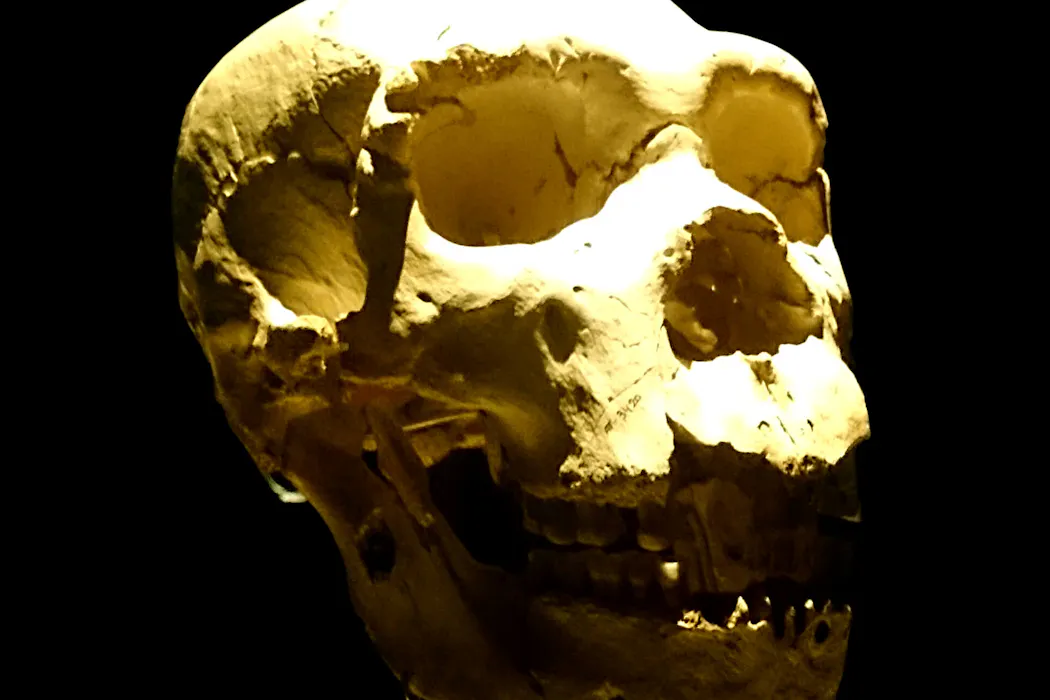
Miguelón, el Cráneo 5. Es uno de los fósiles humanos más emblemáticos de Atapuerca. El descubrimiento de numerosos restos en la Sima de los Huesos convirtió el yacimiento en una referencia internacional.UtaUtaNapishtim/Wikimedia commons, CC BY-SA
Los yacimientos de la sierra de Atapuerca (Burgos) son muy conocidos tanto a nivel nacional como internacional. Pero ¿a qué se debe esta fama?
Durante mucho tiempo, la evolución humana se imaginó como una historia lineal, protagonizada por unas pocas especies que se sucedían unas a otras. Atapuerca ha ayudado a desmontar esa idea: nuestra evolución es una historia mucho más diversa, compleja y cambiante de lo que imaginamos durante décadas. Los hallazgos realizados allí han demostrado que Europa fue poblada mucho antes de lo que se creía, y que su historia estuvo marcada por una diversidad de grupos humanos. También han revelado además una especie hasta entonces desconocida, Homo antecessor, y evidencias de canibalismo entre las más antiguas conocidas.
En la Sima de los Huesos, más de 7 000 fósiles pertenecientes al menos a 29 individuos han convertido el yacimiento en una referencia mundial para estudiar a los antepasados de los neandertales. La UNESCO declaró Atapuerca Patrimonio Mundial en 2000, al considerar que alberga una de las evidencias más tempranas y abundantes de la presencia humana en Europa.
En esta pequeña sierra burgalesa se han encontrado restos humanos de cinco especies de homininos, miles de fragmentos de fauna y otras tantas herramientas líticas. En un solo lugar hemos podido reconstruir cómo era la vida en Europa durante la Prehistoria, desde hace más de un millón de años hasta hace unos 4 000 años.
Los hallazgos más antiguos
Los hallazgos en el nivel TD4 de la Gran Dolina y la Sima del Elefante, con una antigüedad de entre 1 y 1,3 millones de años, representan una de las evidencias más tempranas del poblamiento de Europa. Aunque sin duda, lo más espectacular de estos yacimientos son los restos humanos de Sima del Elefante: una mandíbula del nivel TE7 y un fragmento facial del nivel TE9, asignados a Homo affinis erectus
Mandíbula humana hallada en el nivel TE9 de la Sima del Elefante. Con más de un millón de años, fue una de las evidencias que adelantó considerablemente la presencia humana conocida en Europa occidental. Wikimedia commons, CC BY-SA
Nivel TD6 de Gran Dolina donde aparecen los restos de Homo antecessor Marina Lozano Ruiz, CC BY-NC
Los restos de Homo antecessor aparecen muy fragmentados, lo que dificulta establecer el número de individuos representados. Sin embargo, el recuento más actual establece la presencia de unos 12 o 15 individuos. Todos ellos, niños y adultos, fueron víctimas de canibalismo, algo que sabemos gracias a las marcas de corte, golpes y mordeduras que muestran sus huesos. Es la evidencia más antigua documentada de esa conducta.
Su posición exacta en el árbol evolutivo humano sigue siendo objeto de debate. Durante años se propuso que podía ser un antepasado común de neandertales y Homo sapiens, pero actualmente existe bastante más cautela: su relación con otras poblaciones humanas antiguas continúa investigándose.
El descubrimiento de Homo antecessor en Atapuerca fue una de las primeras señales de que la historia humana en Europa era mucho más antigua y compleja de lo que se había supuesto: hace unos 800 000 años, grupos con un rostro sorprendentemente moderno ya habitaban la península ibérica.
Otro yacimiento que ha proporcionado hallazgos sensacionales es la Sima de los Huesos. Aquí se han recuperado los restos de 29 individuos pre-neandertales que vivieron hace unos 400 000 años. Su nivel de conservación es asombroso y se han podido reconstruir hasta 17 cráneos bastante completos. En total, se han recuperado más de 7 600 huesos y dientes de esos individuos, lo que representa más del 90 % del registro mundial de la cronología en la que se inscriben.
La fama e importancia de los yacimientos de la sierra de Atapuerca está más que justificada por todos estos hallazgos. El trabajo de investigación, publicación y difusión de los resultados de los numerosos investigadores e investigadoras que trabajamos allí lo ha hecho posible. A pesar de que los restos encontrados hasta el momento han permitido conocer muchos aspectos de la vida de nuestros antepasados, todavía quedan muchas preguntas por responder y esperamos que esos yacimientos nos sigan sorprendiendo.
Marina Lozano Ruiz recibe fondos de Ministerio de Ciencia, Innovación y Universidades_ PID2024-156477NB-C31.
La vuelta al cole coincide este año en España con la entrada en vigor de nuevas reglas estatales sobre alimentación escolar. Pero entre lo que establece una norma y lo que ocurre cada día en una cocina escolar hay una distancia considerable.
Pese a estas cifras, el comedor ocupa un lugar secundario en el debate educativo. Se habla de menús, becas o contratos, pero menos de cubrir bajas, tramitar pedidos, reparar equipos, adaptar dietas o atender reclamaciones. Estas tareas pueden recaer sobre equipos directivos y docentes y suelen hacerse visibles cuando algo falla.
El Real Decreto 315/2025 exige menús saludables y sostenibles, supervisión nutricional, alimentos frescos y de temporada, reducción de residuos y adaptación a necesidades específicas. El reto es convertir estas reglas en rutinas viables en centros muy diferentes.
Las comunidades autónomas organizan el servicio y cada escuela asume un grado distinto de responsabilidad. En nuestro proyecto de investigación en marcha detectamos un problema central: no basta con fijar requisitos. Los centros necesitan apoyo institucional, recursos y capacidad para resolver incidencias. Además, esas necesidades cambian según la forma de gestionar el comedor.
Distintos modelos, distintas necesidades
Para observar cómo se traduce esta diversidad en la práctica, en el marco de un proyecto de investigación todavía en curso elaboramos un censo de los 244 centros con comedor de Tenerife, obtuvimos 133 respuestas válidas a una encuesta y entrevistamos a profesionales de 14 escuelas. Participaron centros públicos, concertados y privados, rurales y urbanos.
Comparamos cocina propia, comida preparada fuera y transportada, y cocina situada en el colegio pero gestionada por una empresa. El 72 % de los equipos directivos calificó el esfuerzo como alto o muy alto y el 80 % consideró insuficiente el apoyo institucional. El patrón fue parecido entre centros de distinta titularidad y entre escuelas rurales y urbanas.
No encontramos un modelo ganador. Cocinar en el centro exige más trabajo, pero proporciona mayor control. El cáterin descarga algunas tareas, pero aumenta la dependencia del proveedor y no elimina la responsabilidad escolar.
En los centros con cocina propia, el 91 % señaló un esfuerzo alto o muy alto. En estos casos, la escuela participa en sustituciones, compras, averías, pagos y cumplimiento de las normas.
Una docente recién llegada, por ejemplo, se convirtió en la encargada realizar los pedidos del comedor. Una directora, desbordada por la rotación del personal y las tareas administrativas, lo resumió así: tenían “un comedor con un colegio, en vez de un colegio con un comedor”.
A cambio, estos centros describieron mayor capacidad para adaptar el servicio y resolver imprevistos. Solo el 5 % manifestó insatisfacción, frente al 14 % de los que recibían comida transportada.
Externalizar reduce tareas, pero no la responsabilidad
Con el cáterin transportado, el esfuerzo alto descendió al 59 %. La producción, las compras y parte de la gestión del personal pasan a la empresa. En España, el 80 % de los comedores está gestionado por empresas de restauración.
Sin embargo, el centro continúa comprobando entregas, supervisando la calidad, atendiendo a las familias y reclamando soluciones. En algunos centros, el número de raciones era cerrado y el alumnado no podía repetir. Una cocina propia podía preparar algo adicional si un niño llegaba con hambre, una flexibilidad importante para el alumnado vulnerable.
No comparamos la calidad nutricional, sino la organización y la respuesta ante imprevistos. En escuelas pequeñas o rurales también puede resultar difícil encontrar una empresa de cátering dispuesta a prestar el servicio.
Las entrevistas muestran obstáculos concretos. Un centro no hacía determinados pedidos porque carecía de despensa y el reparto era semanal. En otro, podían solicitar diez kilos de calabaza y recibir cinco. Algunas entregas llegaban hacia las once, demasiado tarde para preparar el almuerzo.
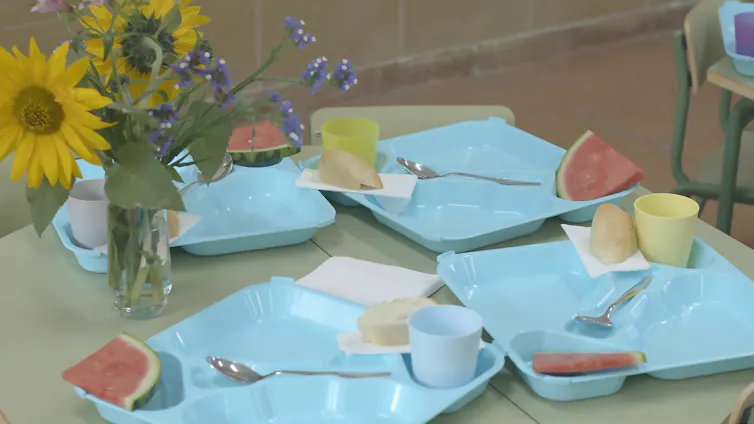
Mesa preparada antes del servicio en uno de los comedores escolares estudiados en Tenerife. María Abenia / Proyecto de investigación sobre comedores escolares
Vemos así como el compromiso con la alimentación sostenible no se puede llevar a la práctica sin que se cumplan unas condiciones mínimas: capacidad de almacenamiento, entregas previsibles, personal suficiente y coordinación.
En primer lugar, hay que reconocer el comedor como infraestructura educativa. En la práctica, esto supondría incluir personal, sustituciones, mantenimiento y tiempo de coordinación en la planificación y los presupuestos ordinarios del sistema.
En segundo lugar, el apoyo institucional debe adaptarse al modelo. Las cocinas propias necesitan personal estable, sustituciones rápidas, equipamiento y asesoramiento. Los centros con cáterin necesitan contratos claros, indicadores de calidad y procedimientos ágiles para reclamar.
En tercer lugar, es necesario alinear responsabilidad, capacidad de decisión y recursos. Si una escuela debe garantizar el servicio, necesita vías rápidas para cubrir una baja, reparar un equipo, realizar una compra urgente o exigir una solución al proveedor. Esta autonomía debe estar respaldada por recursos y protocolos claros.
Por último, hay que evaluar la aplicación de la norma, no solo su cumplimiento formal. Además de los menús, deberían medirse retrasos, productos que no llegan, averías, rotación laboral, suficiencia de las raciones, horas de gestión y tiempo de resolución de las incidencias. Un menú puede incluir alimentos frescos y de temporada sobre el papel, pero no servirse como estaba previsto si parte del pedido llega tarde o el centro no puede almacenarlo.
Las reglas no se aplicarán desde el Boletín Oficial del Estado, sino en cocinas, despachos y comedores concretos. Cualquier modelo puede fallar si depende del trabajo invisible de docentes y equipos directivos. La diferencia no está solo entre cocinar dentro o contratar fuera, sino en disponer de apoyo, recursos y capacidad para tomar decisiones.
Eva Parga Dans recibe financiación de Fundación CajaCanarias y Fundación Bancaria “la Caixa” a través del proyecto “La desigualdad social a través de los comedores escolares: comprendiendo y mitigando el impacto en la infancia y adolescencia en las Islas Canarias” (ADESCAN, referencia 2024POB01). Las entidades financiadoras no participaron en el diseño del estudio, la recogida o el análisis de los datos, su interpretación ni la preparación de este artículo.
Source: The Conversation – (in Spanish) – By Pere Simón, Profesor Titular de Derecho Constitucional, UNIR – Universidad Internacional de La Rioja ; Universitat de Girona
Un niño pone una cara graciosa. Alguien le hace una fotografía con el móvil, recorta el fondo y crea un sticker para WhatsApp. Primero circula entre cuatro amigos. Después llega al grupo de clase y termina almacenado en decenas, centenas o miles de teléfonos. Personas que ni siquiera conocen al protagonista utilizan su cara para expresar ternura, sorpresa, enfado o, simplemente, para sacarnos una sonrisa.
La escena resulta cada vez más habitual. Y plantea una pregunta que pocas veces nos hacemos antes de pulsar “enviar”: ¿podemos convertir la imagen de otra persona en una broma y difundirla sin su consentimiento?
La respuesta jurídica es bastante menos divertida que el sticker.
Por eso, hacer una fotografía, guardarla, modificarla, recortarla para fabricar un sticker y, posteriormente, compartirla son operaciones que constituyen un tratamiento de datos personales. Que la imagen se transforme no hace desaparecer esta protección. De hecho, una persona puede seguir siendo identificable por su rostro, gestos, vestimenta, entorno o porque quienes reciben el archivo saben de quién se trata.
Un caso real entre menores
La cuestión ha dejado de ser teórica y ha causado lesiones del derecho a la propia imagen y el derecho a la intimidad en situaciones comunes que se producen en cualquier grupo de adolescentes, tal y como ha analizado la Agencia Española de Protección de Datos (AEPD). En un caso reciente, un menor fotografió a otro durante una clase. La imagen acabó difundiéndose por WhatsApp y después se creó con ella un meme o sticker compartido en distintos grupos. El menor afectado había pedido expresamente que borraran su fotografía.
La respuesta de la AEPD fue especialmente significativa. Por un lado, considera infracción grave utilizar el rostro de un menor para crear un emoticono sin la autorización de sus padres. Por ello, determinó que se trataba de un tratamiento de datos personales sin consentimiento ni base jurídica legítima. Sin embargo, finalmente archivó el procedimiento, teniendo en cuenta que el responsable también era menor de 14 años cuando ocurrieron los hechos.
Eso sí, en paralelo, este organismo elevó a definitiva la medida que había adoptado provisionalmente: ordenó retirar de WhatsApp la fotografía y el sticker y exigió, además, que se evitara, en la medida en que lo permitiera el estado de la tecnología, que el mismo usuario u otros pudieran volver a subir copias o réplicas exactas.
Si el responsable hubiera sido mayor de 14 años, podría haber sido sancionado administrativamente, incluso con una multa económica cuya cuantía dependerá de la gravedad y circunstancias del caso. Además, en caso de ser un menor –entre 14 y 18 años– sus padres o tutores responderían solidariamente del pago de esa multa.
¿Está prohibido enviar cualquier foto por WhatsApp?
La normativa de protección de datos contiene la denominada excepción doméstica, que permite el tratamiento de datos realizado por personas en actividades particulares o domésticas.
Eso significa que el intercambio privado de fotografías entre familiares o amigos normalmente queda fuera del régimen general de protección de datos. Aun así, enviarlas por WhatsApp no equivale automáticamente a “puedo hacer lo que quiera con la imagen”.
Cuanto más se amplía el círculo de difusión, menor relación existe entre quienes reciben la imagen y la persona fotografiada, especialmente cuando el contenido salta a redes sociales, alcanza una difusión indeterminada o se viraliza. Entonces, es más difícil justificar que sea una actividad estrictamente doméstica.
La protección es todavía más intensa cuando hablamos de menores. Nuestro ordenamiento obliga a preservar su interés superior, su intimidad y su imagen frente a actuaciones realizadas en redes sociales, aplicaciones de mensajería y otros servicios digitales.
Por lo tanto, una broma puede tener consecuencias jurídicas distintas según las circunstancias: quién crea el sticker, de dónde obtiene la fotografía, quién aparece, qué edad tiene, a cuántas personas se envía, si se publica en abierto y si el contenido resulta vejatorio o humillante, o forma parte de una situación de acoso.
Tampoco basta con decir que ya estaba disponible en internet. Que una fotografía haya sido publicada en una red social no significa que pueda reutilizarse para cualquier finalidad. Subir una imagen a un perfil no equivale a consentir su transformación en meme, su circulación en grupos de mensajería o su uso humorístico o sexual por parte de desconocidos.
Cuando dejamos de ver a la persona
El fenómeno de los stickers en las plataformas de mensajería instantánea plantea un problema previo al jurídico. La digitalización facilita una peculiar cosificación de la identidad, puesto que una fotografía se separa de su contexto, se recorta y se transforma en objeto comunicativo. Quien la recibe puede desconocer quién es esa persona, cómo se obtuvo la imagen o si dio permiso para su utilización.
El protagonista deja de ser, a ojos de quienes comparten el archivo, un niño, un compañero de clase o simplemente alguien con derecho a decidir sobre su imagen. Se convierte en una “pegatina” graciosa.
Ahí reside una de las paradojas de nuestra comunicación digital. La tecnología hace extraordinariamente sencillo copiar, modificar y reenviar la imagen de una persona, pero esa facilidad técnica no elimina sus derechos. El gesto dura apenas un segundo; la circulación de la imagen puede durar años.
Pere Simón no recibe salario, ni ejerce labores de consultoría, ni posee acciones, ni recibe financiación de ninguna compañía u organización que pueda obtener beneficio de este artículo, y ha declarado carecer de vínculos relevantes más allá del cargo académico citado.
Source: The Conversation – (in Spanish) – By Antonio Figueras Huerta, Profesor de investigación del Consejo Superior de Investigaciones Científicas, Instituto de Investigaciones Marinas (IIM-CSIC)
En todo 2025, los pescadores del suroeste de Inglaterra vivieron el mayor boom de pulpo en los últimos 75 años. Mientras, un año antes, las lonjas gallegas tocaban mínimos históricos. En Galicia, las capturas de pulpo de 2024 fueron las más bajas en 25 años, apenas 1 180 toneladas en lonja, y la facturación se desplomó respecto a los buenos años de la década anterior.
¿Qué relación guardan los dos hechos? Son dos titulares simultáneos, opuestos y perfectos para un relato sencillo: el pulpo se escapa de Galicia. Huye de un Atlántico gallego que se calienta y encuentra refugio en aguas británicas que le resultan acogedoras. Es una historia limpia, intuitiva y… falsa.
Por qué la migración no cuadra
El pulpo común (Octopus vulgaris) es un animal de fondo, de vida corta (uno o dos años) y sedentario en su fase adulta. No protagoniza migraciones oceánicas de largo recorrido. La conexión entre poblaciones distantes no la hacen los adultos nadando, sino las larvas, que pasan semanas o meses a la deriva en el plancton antes de asentarse.
Cuando el equipo de la Marine Biological Association, la Universidad de Plymouth y el Plymouth Marine Laboratory reconstruyeron el origen del fenómeno británico, encontraron dos cosas mucho más cercanas. La primera: el pulpo común se está reproduciendo en las propias aguas británicas, con ejemplares juveniles que aparecen en las nasas. La segunda: los modelos de corrientes y las medidas de salinidad apuntan a un aporte de larvas desde las islas del Canal y el norte de Francia, en particular, tras un gran episodio en la isla de Guernsey impulsado por vientos persistentes del este, en 2024.
Lo que sí comparten los dos mares
Que no haya migración no significa que no haya conexión. Un mismo fenómeno climático produce efectos opuestos en dos biomas –ecosistemas característicos de una zona biogeográfica– locales distintos. El elemento común es la temperatura.
El boom británico no es un hecho aislado: es apenas el cuarto gran episodio de este tipo en 125 años (los anteriores fueron en 1899-1900, 1932-33 y 1950-51). Y todos coincidieron en inviernos y aguas anormalmente cálidas.
Lo que ha cambiado no es que el calor favorezca al pulpo, sino que ese calor ha dejado de ser excepcional. El canal de la Mancha ha registrado veranos clasificables como olas de calor marinas. Y, en un mar más templado, las larvas sobreviven al invierno, los adultos crían y una reproducción explosiva convierte una ventana favorable en una avalancha.
En Galicia, el mismo Atlántico que se calienta juega otra partida. Aquí el pulpo no se marcha, pero tampoco cría, o los juveniles mueren. Y la temperatura no es la única palanca. Los científicos del Instituto de Investigaciones Marinas de Vigo insisten en un factor que rara vez llega a los titulares: el afloramiento, ese ascenso de aguas profundas, frías y ricas en nutrientes que sostiene la productividad de las rías. Cuando el afloramiento y la salinidad se desajustan, el ciclo reproductivo del pulpo se resiente, porque es una especie muy sensible a las condiciones del agua.
Los mares europeos se reordenan
Conviene desconfiar de las correlaciones demasiado bonitas. Si el declive gallego y el auge británico fueran las dos caras de la misma moneda, deberían moverse en espejo año tras año. No lo hacen: en 2025, mientras el Reino Unido registraba su récord, Galicia empezaba a hablar de recuperación.
La lección para entender lo que ocurre en el Atlántico nororiental no es “el pulpo emigra al norte”, sino algo menos vistoso y más inquietante: el mismo cambio climático que perjudica a una especie en un extremo del mapa puede hacerla prosperar en otro.
No sabemos si el episodio británico será un pico pasajero, como los tres anteriores, o el primer capítulo de una presencia estable. Tampoco sabemos si Galicia volverá a sus buenas campañas de pulpo o si su declive es estructural. Lo que la evidencia sí deja claro es que los mares europeos se están reordenando ante nuestros ojos, especie por especie. La próxima sorpresa vendrá, como esta, disfrazada de coincidencia.
Antonio Figueras Huerta no recibe salario, ni ejerce labores de consultoría, ni posee acciones, ni recibe financiación de ninguna compañía u organización que pueda obtener beneficio de este artículo, y ha declarado carecer de vínculos relevantes más allá del cargo académico citado.














.jpg)
