Welcome to the ‘Homogenocene’: how humans are making the world’s wildlife dangerously samey

Source: The Conversation – UK – By Mark Williams, Professor of Palaeobiology, University of Leicester

Pigeons are well-suited to urban living, and are outcompeting distinctive local species around the world. Wirestock Creators / shutterstock

The age of humans is increasingly an age of sameness. Across the planet, distinctive plants and animals are disappearing, replaced by species that are lucky enough to thrive alongside humans and travel with us easily. Some scientists have a word for this reshuffling of life: the Homogenocene.

Evidence for it is found in the world’s museums. Storerooms are full of animals that no longer walk among us, pickled in spirit-filled jars: coiled snakes, bloated fish, frogs, birds. Each extinct species marks the removal of a particular evolutionary path from a particular place – and these absences are increasingly being filled by the same hardy, adaptable species, again and again.

One such absence is embodied by a small bird kept in a glass jar in London’s Natural History Museum: the Fijian Bar-winged rail, not seen in the wild since the 1970s. It seems to be sleeping, its eyes closed, its wings tucked in along its back, its beak resting against the glass.

A flightless bird, it was particularly vulnerable to predators introduced by humans, including mongooses brought to Fiji in the 1800s. Its disappearance was part of a broad pattern in which island species are vanishing and a narrower set of globally successful animals thrive in their place.

It’s a phenomenon that was called the Homogenocene even before a similar term growing in popularity, the Anthropocene, was coined in 2000. If the Anthropocene describes a planet transformed by humans, the Homogenocene is one ecological consequence: fewer places with their own distinctive life.

It goes well beyond charismatic birds and mammals. Freshwater fish, for instance, are becoming more “samey”, as the natural barriers that once kept populations separate – waterfalls, river catchments, temperature limits – are effectively blurred or erased by human activity. Think of common carp deliberately stocked in lakes for anglers, or catfish released from home aquariums that now thrive in rivers thousands of miles from their native habitat.

Meanwhile, many thousands of mollusc species have disappeared over the past 500 years, with snails living on islands also severely affected: many are simply eaten by non-native predatory snails. Some invasive snails have become highly successful and widely distributed, such as the giant African snail that is now found from the Hawaiian Islands to the Americas, or South American golden apple snails rampant through east and south-east Asia since their introduction in the 1980s.

Homogeneity is just one facet of the changes wrought on the Earth’s tapestry of life by humans, a process that started in the last ice age when hunting was likely key to the disappearance of the mammoth, giant sloth and other large mammals. It continued over around 11,700 years of the recent Holocene epoch – the period following the last ice age – as forests were felled and savannahs cleared for agriculture and the growth of farms and cities.

Over the past seven decades changes to life on Earth have intensified dramatically. This is the focus of a major new volume published by the Royal Society of London: The Biosphere in the Anthropocene.

The Anthropocene has reached the ocean

Life in the oceans was relatively little changed between the last ice age and recent history, even as humans increasingly affected life on land. No longer: a feature of the Anthropocene is the rapid extension of human impacts through the oceans.

This is partly due to simple over-exploitation, as human technology post-second world war enabled more efficient and deeper trawling, and fish stocks became seriously depleted.

lionfish on coral reef
Lionfish from the Pacific have been introduced in the Caribbean, where they’re hoovering up native fish who don’t recognise them as predators.
Drew McArthur / shutterstock

Partly this is also due to the increasing effects of fossil-fuelled heat and oxygen depletion spreading through the oceans. Most visibly, this is now devastating coral reefs.

Out of sight, many animals are being displaced northwards and southwards out of the tropics to escape the heat; these conditions are also affecting spawning in fish, creating “bottlenecks” where life cycle development is limited by increasing heat or a lack of oxygen. The effects are reaching through into the deep oceans, where proposals for deep sea mining of minerals threaten to damage marine life that is barely known to science.

And as on land and in rivers, these changes are not just reducing life in the oceans – they’re redistributing species and blurring long-standing biological boundaries.

Local biodiversity, global sameness

Not all the changes to life made by humans are calamitous. In some places, incoming non-native species have blended seamlessly into existing environments to actually enhance local biodiversity.

In other contexts, both historical and contemporary, humans have been decisive in fostering wildlife, increasing the diversity of animals and plants in ecosystems by cutting or burning back the dominant vegetation and thereby allowing a greater range of animals and plants to flourish.

In our near-future world there are opportunities to support wildlife, for instance by changing patterns of agriculture to use less land to grow more food. With such freeing-up of space for nature, coupled with changes to farming and fishing that actively protect biodiversity, there is still a chance that we can avoid the worst predictions of a future biodiversity crash.

But this is by no means certain. Avoiding yet more rows of pickled corpses in museum jars will require a concerted effort to protect nature, one that must aim to help future generations of humans live in a biodiverse world.

The Conversation

The authors do not work for, consult, own shares in or receive funding from any company or organisation that would benefit from this article, and have disclosed no relevant affiliations beyond their academic appointment.

ref. Welcome to the ‘Homogenocene’: how humans are making the world’s wildlife dangerously samey – https://theconversation.com/welcome-to-the-homogenocene-how-humans-are-making-the-worlds-wildlife-dangerously-samey-274092

Did a tsunami hit the Bristol Channel four centuries ago? Revisiting the great flood of 1607

Source: The Conversation – UK – By Simon Haslett, Pro Vice-Chancellor and Professor of Physical Geography, Bath Spa University; Swansea University

People living on the low-lying shores of the Bristol Channel and Severn estuary began their day like any other on January 30 1607. The weather was calm. The sky was bright.

Then, suddenly, the sea rose without warning. Water came racing inland, tearing across fields and villages, sweeping away the homes, livestock and people in its path.

By the end of the day, thousands of acres were underwater. As many as 2,000 people may have died. It was, quite possibly, the deadliest sudden natural disaster to hit Britain in 500 years.

More than four centuries later, the flood of 1607 still raises a troubling question. What, exactly, caused it?

Most early explanations blamed an exceptional storm. But when my colleague and I began examining the historical evidence more closely in 2002, we became less certain that this was the full picture. For one, eyewitness accounts tell a more unsettling story.

The flood struck on January 30 1607 – or January 20 1606, according to the old Julian calendar, which was still in use at that time. The flood affected coastal communities across south Wales, Somerset, Gloucestershire and Devon, inundating some areas several miles inland. People at the time were no strangers to storms or high tides – but this was different.

Churches were inundated. Entire villages vanished. Vast stretches of farmland were ruined by saltwater, leaving communities facing hunger as well as grief. Memorial plaques in local churches and parish documents still mark the scale of the catastrophe.

Much of what we know about how the event unfolded comes from chapbooks, which were cheaply printed pamphlets sold in the early 17th century. These accounts describe not just the damage, but the terrifying speed and character of the water itself.

One such pamphlet, God’s Warning to His People of England, describes a calm morning suddenly interrupted by what witnesses saw approaching from the sea:

Upon Tuesday 20 January 1606 there happened such an overflowing of waters … the like never in the memory of man hath been seen or heard of. For about nine of the morning, many of the inhabitants of these countreys … perceive afar off huge and mighty hilles of water tombling over one another, in such sort as if the greatest mountains in the world had overwhelmed the lowe villages or marshy grounds.

Our interest in the event arose from reading that account. It gives a specific time for the inundation – around nine in the morning – and emphasises the fair weather and sudden arrival of the floodwaters.

From a geographer’s perspective, this description is striking. Sudden onset, wave-like forms and an absence of storm conditions are not typical of storm surges. To us, the language was reminiscent of eyewitness accounts of tsunamis elsewhere in the world. This suggested a tsunami origin for the flood should be evaluated.

Until the early 2000s, few researchers seriously questioned the storm-surge explanation. But as we revisited the historical sources, we began to ask whether the physical landscape might also preserve clues to what happened in 1607. If an extreme marine inundation had struck the coast at that time, it may have left geological evidence behind.

In several locations around the estuary, we identified a suite of features with a chronological link to the early 17th century: the erosion of two spurs of land that previously jutted out into the estuary, the removal of almost all fringing salt marsh deposits, and the occurrence of sand layers in otherwise muddy deposits

These features point to a high-energy event. The question was what kind?

Testing the theory

To explore this further, we undertook a programme of fieldwork in 2004. We examined sand layers and noted signatures of tsunami impact such as coastal erosion, and analysed the movement of large boulders along the shoreline. Boulder transport is particularly useful, as it allows estimates of the wave heights needed to move them.

Some fieldwork was filmed for a BBC documentary broadcast in April 2005, which featured other colleagues too. It included an argument for a storm, but also another suggesting it isn’t fanciful to consider that an offshore earthquake provided the trigger.

Our results were published in 2007, coincidentally the 400th anniversary of the flood. In parallel, colleagues published a compelling model supporting a storm surge. The scientific debate, rather than being resolved, intensified.

An updating of wave heights based on boulder data using refined formula was published in 2021, suggesting a minimum tsunami wave height of 4.2 metres is required to explain the coastal features – whereas, according to the calculations, storm waves of over 16 metres would be required. This is perhaps unlikely within the relatively sheltered Severn estuary.

The low-lying coasts around the Bristol Channel remain vulnerable to flooding. Storm surges occur regularly, though usually with more limited effects. Climate change is now increasing the risk through rising sea levels and more intense weather systems.

Tsunamis, by contrast, are rare. A report by the UK government’s Department for Environment, Food & Rural Affairs found it unlikely that the 1607 flood may have been caused by one. However, it also noted that offshore southwest Britain is among the more credible locations for a future tsunami, triggered by seismic activity or submarine landslides.

This distinction matters. Storm surges can usually be forecast. Tsunamis may arrive with little or no warning.


Read more:
From Noah’s flood to Shakespeare’s storms, what literature reveals about our changing relationship with the weather


Scholarly and public interest in the flood has not waned. In November 2024, a Channel 5 documentary brought together several strands of recent research, concluding that the jury is still out on the flood’s cause.

That uncertainty should not be seen as a failure. Evaluating competing explanations is essential when trying to understand extreme events in the past – especially when those events have implications for present-day risk.

Whether the flood of 1607 was driven by storm winds, unusual tides or waves generated far offshore, its lesson is clear. Coastal societies ignore rare disasters at their peril.

The sea has come in before. And it will do so again.

The Conversation

Simon Haslett does not work for, consult, own shares in or receive funding from any company or organisation that would benefit from this article, and has disclosed no relevant affiliations beyond their academic appointment.

ref. Did a tsunami hit the Bristol Channel four centuries ago? Revisiting the great flood of 1607 – https://theconversation.com/did-a-tsunami-hit-the-bristol-channel-four-centuries-ago-revisiting-the-great-flood-of-1607-274135

Why it would be a big mistake for the US to go to war with Iran

Source: The Conversation – UK – By Bamo Nouri, Honorary Research Fellow, Department of International Politics, City St George’s, University of London

Reports of a growing US naval presence in the Gulf have prompted speculation that the US could be preparing for another Middle East war, this time with Iran.

The US president, Donald Trump, has warned of “serious consequences” if Iran does not comply with his demands to permanently halt uranium enrichment, curb its ballistic missile program and end support for regional proxy groups.

Yet, despite the familiar language of escalation, much of what is unfolding appears closer to brinkmanship than preparation for war.

The US president’s own political history offers an important starting point for understanding why this is. Trump’s electoral appeal, both in 2016 and again in 2024, has rested heavily on a promise to end America’s “forever wars” and to avoid costly overseas interventions.

And Iran represents the very definition of such a war. Any all-out conflict with Tehran would almost certainly be long and drag in other countries in the region.

It would also be hard to achieve a decisive victory. For a president whose political brand is built on restraint abroad and disruption at home, a war with Iran would contradict the central logic of his foreign policy narrative.

Meanwhile Iran’s strategic posture is rooted in decades of preparing for precisely this scenario. Since the 1979 revolution, Tehran’s military doctrine and foreign policy have been shaped by survival in the face of potential external attack.

Rather than building a conventional force able to defeat the US in open combat, Iran has invested in asymmetric capabilities: ballistic and cruise missiles, the use of regional proxies, cyber operations and anti-access strategies (including missiles, air defences, naval mines, fast attack craft, drones and electronic warfare capabilities). Anyone who attacks Iran would face prolonged and escalating costs.

This is why comparisons to Iraq in 2003 are misleading. Iran is larger, more populous, more internally cohesive and far more militarily prepared for a sustained confrontation.

An attack on Iranian territory would not represent the opening phase of regime collapse but the final layer of a defensive strategy that anticipates exactly such a scenario. Tehran would be prepared to absorb damage and is capable of inflicting it across multiple theatres – including in Iraq, the Gulf, Yemen and beyond.

With an annual defence budget approaching US$900 billion (£650 billion), there is no question that the US has the capacity to initiate a conflict with Iran. But the challenge for the US lies not in starting a war, but in sustaining one.

The wars in Iraq and Afghanistan offer a cautionary precedent. Together, they are estimated to have cost the US between US$6 and and US$8 trillion when long-term veterans’ care, interest payments and reconstruction are included.

These conflicts stretched over decades, repeatedly exceeded initial cost projections and contributed to ballooning public debt. A war with Iran – larger, more capable and more regionally embedded – would almost certainly follow a similar, if not more expensive, trajectory.

The opportunity cost of the conflicts in Iraq and Afghanistan were potentially greater, absorbing vast financial and political capital at a moment when the global balance of power was beginning to shift.

As the US focused on counterinsurgency and stabilisation operations, other powers, notably China and India, were investing heavily in infrastructure, technology and long-term economic growth.

That dynamic is even more pronounced today. The international system is entering a far more intense phase of multipolar rivalry, characterised not only by military competition but by races in artificial intelligence, advanced manufacturing and strategic technologies.

Sustained military engagement in the Middle East would risk locking the US into resource-draining distractions just as competition with China accelerates and emerging powers seek greater influence.

Iran’s geographic position compounds this risk. Sitting astride key global energy routes, Tehran has the ability to disrupt shipping through the Strait of Hormuz.

Even limited disruption would drive oil prices sharply higher, feeding inflation globally. For the US, this would translate into higher consumer prices and reduced economic resilience at precisely the moment when strategic focus and economic stability are most needed.

There is also a danger that military pressure would backfire politically. Despite significant domestic dissatisfaction, the Iranian regime has repeatedly demonstrated its ability to mobilise nationalist sentiment in response to external threats. Military action could strengthen internal cohesion, reinforce the regime’s narrative of resistance and marginalise opposition movements.

Previous US and Israeli strikes on Iranian infrastructure have not produced decisive strategic outcomes. Despite losses of facilities and senior personnel, Iran’s broader military posture and regional influence have proved adaptable.

Rhetoric and restraint

Trump has repeatedly signalled his desire to be recognised as a peacemaker. He has framed his Middle East approach as deterrence without entanglement, citing the Abraham Accords and the absence of large-scale wars during his presidency. This sits uneasily alongside the prospect of war with Iran, particularly the week after the US president launched his “Board of Peace”.

The Abraham Accords depend on regional stability, economic cooperation and investment. A war with Iran would jeopardise all of these. Despite their own rivalry with Tehran, Gulf states such as Saudi Arabia, the UAE and Qatar have prioritised regional de-escalation.

Recent experience in Iraq and Syria shows why. The collapse of central authority created power vacuums quickly filled by terrorist groups, exporting instability rather than peace.

Some argue that Iran’s internal unrest presents a strategic opportunity for external pressure. While the Islamic Republic faces genuine domestic challenges, including economic hardship and social discontent, this should not be confused with imminent collapse. The regime retains powerful security institutions and loyal constituencies, particularly when framed as defending national sovereignty.

Taken together, these factors suggest that current US military movements and rhetoric are better understood as coercive signalling rather than preparation for invasion.

This is not 2003, and Iran is neither Iraq nor Venezuela. A war would not be swift, cheap or decisive. The greatest danger lies not in a deliberate decision to invade, but in miscalculation. Heightened rhetoric and military proximity can increase the risk of accidents and unintended escalation.

Avoiding that outcome will require restraint, diplomacy and a clear recognition that some wars – however loudly threatened – are simply too costly to fight.

The Conversation

Bamo Nouri does not work for, consult, own shares in or receive funding from any company or organisation that would benefit from this article, and has disclosed no relevant affiliations beyond their academic appointment.

ref. Why it would be a big mistake for the US to go to war with Iran – https://theconversation.com/why-it-would-be-a-big-mistake-for-the-us-to-go-to-war-with-iran-274592

People who survive cancers are less likely to develop Alzheimer’s – this might be why

Source: The Conversation – UK – By Justin Stebbing, Professor of Biomedical Sciences, Anglia Ruskin University

Dragon Images/Shutterstock.com

Cancer and Alzheimer’s disease are two of the most feared diagnoses in medicine, but they rarely strike the same person. For years, epidemiologists have noticed that people with cancer seem less likely to develop Alzheimer’s, and those with Alzheimer’s are less likely to get cancer, but nobody could explain why.

A new study in mice suggests a surprising possibility: certain cancers may actually send a protective signal to the brain that helps clear away the toxic protein clumps linked to Alzheimer’s disease.

Alzheimer’s is characterised by sticky deposits of a protein called amyloid beta that build up between nerve cells in the brain. These clumps, or plaques, interfere with communication between nerve cells and trigger inflammation and damage that slowly erodes memory and thinking.

In the new study, scientists implanted human lung, prostate and colon tumours under the skin of mice bred to develop Alzheimer‑like amyloid plaques. Left alone, these animals reliably develop dense clumps of amyloid beta in their brains as they age, mirroring a key feature of the human disease.

But when the mice carried tumours, their brains stopped accumulating the usual plaques. In some experiments, the animals’ memory also improved compared with Alzheimer‑model mice without tumours, suggesting that the change was not just visible under the microscope.

The team traced this effect to a protein called cystatin‑C that was being pumped out by the tumours into the bloodstream. The new study suggests that, at least in mice, cystatin‑C released by tumours can cross the blood–brain barrier – the usually tight border that shields the brain from many substances in the circulation.

Once inside the brain, cystatin‑C appears to latch on to small clusters of amyloid beta and mark them for destruction by the brain’s resident immune cells, called microglia. These cells act as the brain’s clean‑up crew, constantly patrolling for debris and misfolded proteins.

In Alzheimer’s, microglia seem to fall behind, allowing amyloid beta to accumulate and harden into plaques. In the tumour‑bearing mice, cystatin‑C activated a sensor on microglia known as Trem2, effectively switching them into a more aggressive, plaque‑clearing state.

Surprising trade-offs

At first glance, the idea that a cancer could “help” protect the brain from dementia sounds almost perverse. Yet biology often works through trade-offs, where a process that is harmful in one context can be beneficial in another.

In this case, the tumour’s secretion of cystatin‑C may be a side‑effect of its own biology that happens to have a useful consequence for the brain’s ability to handle misfolded proteins. It does not mean that having cancer is good, but it does reveal a pathway that scientists might be able to harness more safely.

The study slots into a growing body of research suggesting that the relationship between cancer and neurodegenerative diseases is more than a statistical quirk. Large population studies have reported that people with Alzheimer’s are significantly less likely to be diagnosed with cancer, and vice versa, even after accounting for age and other health factors.

An elderly lady and her carer, outside in a park.
People with Alzheimer’s are significantly less likely to get cancer, and vice versa.
Halfpoint/Shutterstock.com

This has led to the idea of a biological seesaw, where mechanisms that drive cells towards survival and growth, as in cancer, may push them away from the pathways that lead to brain degeneration. The cystatin‑C story adds a physical mechanism to that picture.

However, the research is in mice, not humans, and that distinction matters. Mouse models of Alzheimer’s capture some features of the disease, particularly amyloid plaques, but they do not fully reproduce the complexity of human dementia.

We also do not yet know whether human cancers in real patients produce enough cystatin‑C, or send it to the brain in the same way, to have meaningful effects on Alzheimer’s disease risk. Still, the discovery opens intriguing possibilities for future treatment strategies.

One idea is to develop drugs or therapies that mimic the beneficial actions of cystatin‑C without involving a tumour at all. That could mean engineered versions of the protein designed to bind amyloid beta more effectively, or molecules that activate the same pathway in microglia to boost their clean‑up capacity.

The research also highlights how interconnected diseases can be, even when they affect very different organs. A tumour growing in the lung or colon might seem far removed from the slow build up of protein deposits in the brain, yet molecules released by that tumour can travel through the bloodstream, cross protective barriers and change the behaviour of brain cells.

For people living with cancer or caring for someone with Alzheimer’s today, this work will not change treatment immediately. But the study does offer a more hopeful message: by studying even grim diseases like cancer in depth, scientists can stumble on unexpected insights that point towards new ways to keep the brain healthy in later life.

Perhaps the most striking lesson is that the body’s defences and failures are rarely simple. A protein that contributes to disease in one organ may be used as a clean‑up tool in another, and by understanding these tricks, researchers may be able to use them safely to help protect the ageing human brain.

The Conversation

Justin Stebbing does not work for, consult, own shares in or receive funding from any company or organisation that would benefit from this article, and has disclosed no relevant affiliations beyond their academic appointment.

ref. People who survive cancers are less likely to develop Alzheimer’s – this might be why – https://theconversation.com/people-who-survive-cancers-are-less-likely-to-develop-alzheimers-this-might-be-why-274304

Artemis II: The first human mission to the moon in 54 years launches soon — with a Canadian on board

Source: The Conversation – Canada – By Gordon Osinski, Professor in Earth and Planetary Science, Western University

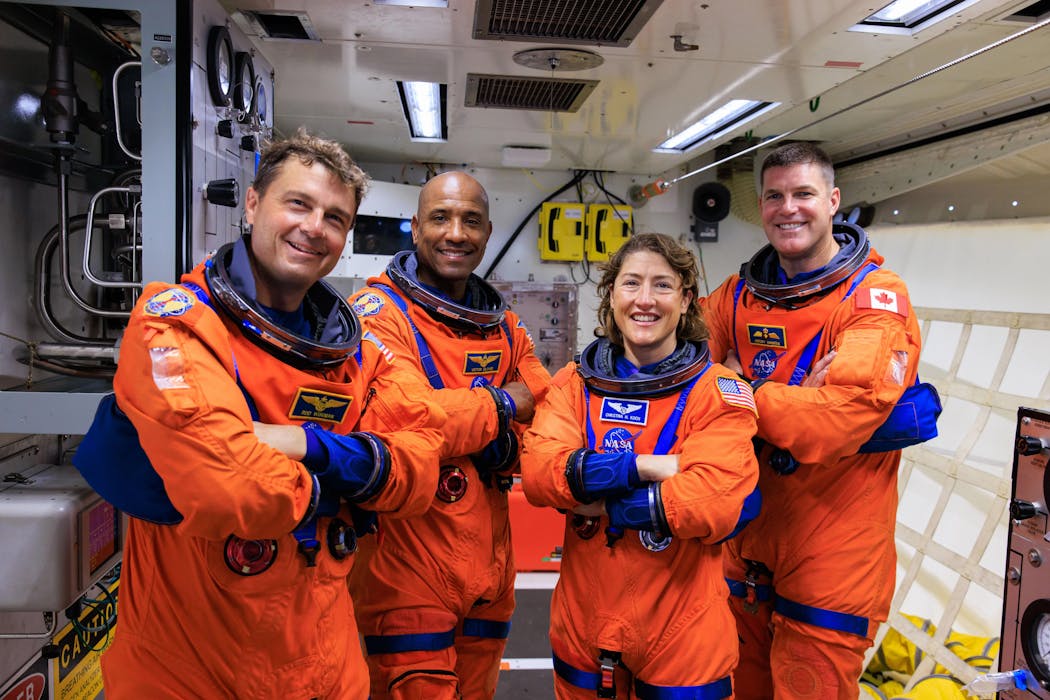
The crew of the new NASA moon rocket Artemis II at the Kennedy Space Center, including Jeremy Hansen of the Canadian Space Agency, on the far right. From left: Reid Wiseman, Victor Glover and Christina Koch. (NASA)

It’s been 54 years since the last Apollo mission, and since then, humans have not ventured beyond low-Earth orbit. But that’s all about to change with next week’s launch of the Artemis II mission from the Kennedy Space Center in Florida.

This is the first crewed flight of NASA’s Artemis program and the first time since 1972 that humans have ventured to the moon. Onboard is Canadian astronaut Jeremy Hansen, who will be the first non-American to fly to the moon and will make Canada only the second country in the world to send an astronaut into deep space.


Read more:
Canada’s space technology and innovations are a crucial contribution to the Artemis missions


I am a professor, an explorer and a planetary geologist. For the past 15 years, I have been helping to train Hansen and other astronauts in geology and planetary science. I am also a member of the Artemis III Science Team and the principal investigator for Canada’s first ever rover mission to the moon.

a rocket in a launcher at night
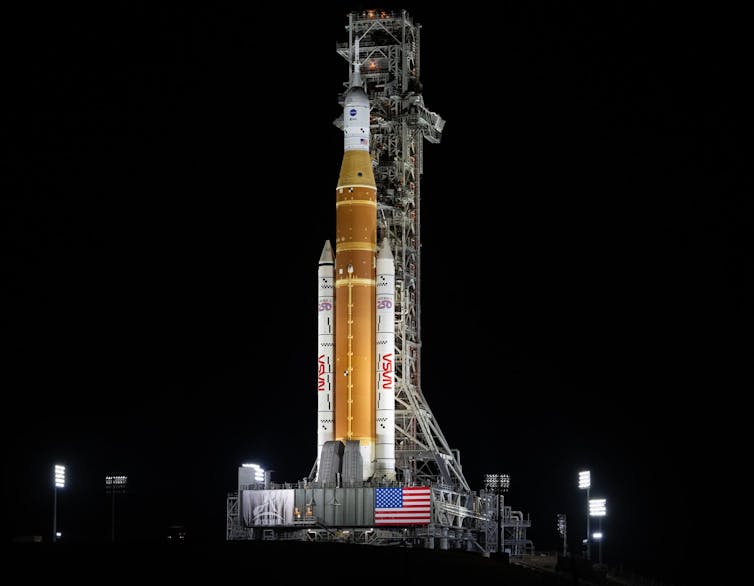
NASA’s Artemis II SLS rocket and Orion spacecraft secured to the mobile launcher at NASA’s Kennedy Space Center in Florida.
(NASA)

What will the mission achieve?

NASA’s Artemis program, launched in 2017, has the ambitious goal to return humans to the moon and to establish a lunar base in preparation for sending humans to Mars. The first mission, Artemis I, launched in late 2022. Following some delays, Artemis II is scheduled for launch as early as a week from now.

Onboard will be Hansen, along with his three American crew-mates.

This is an incredibly exciting mission. Artemis II is the first time humans have launched on NASA’s huge SLS (Space Launch System) rocket, and the first time humans have flown in the Orion spacecraft.

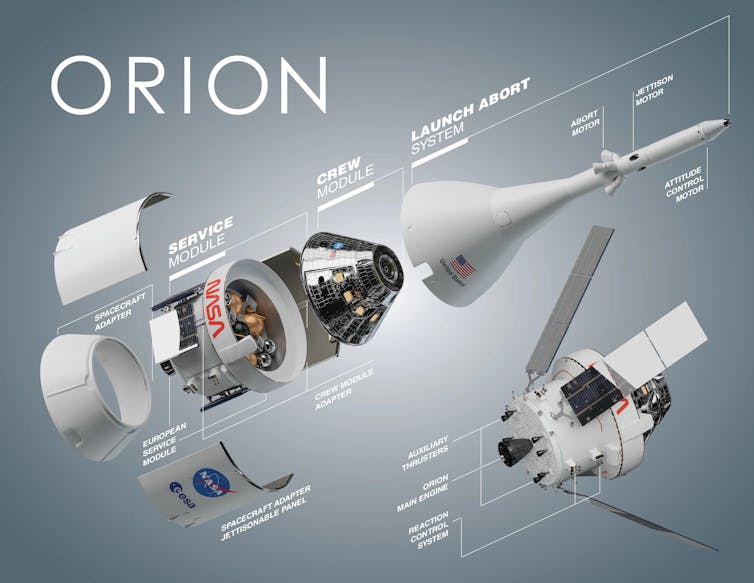
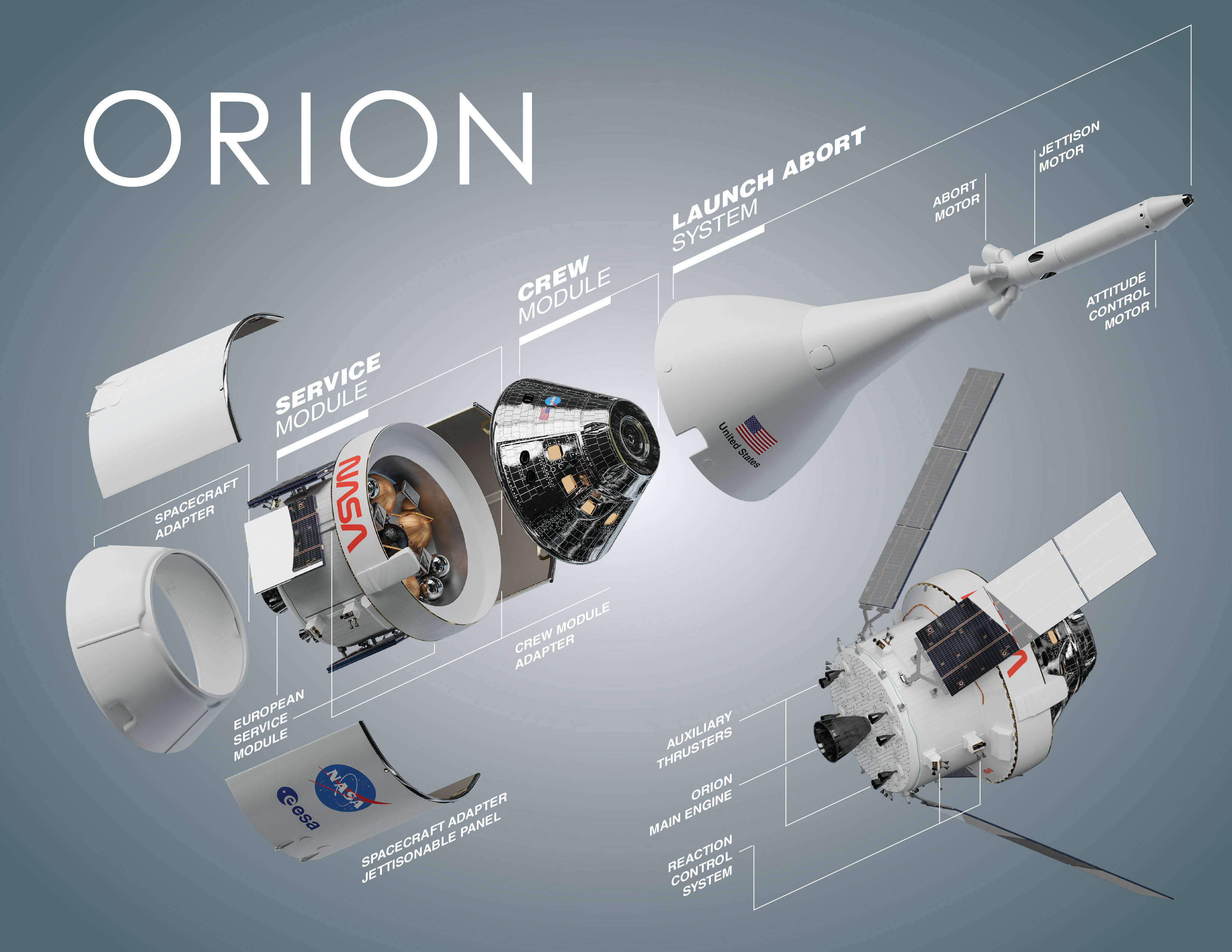
SLS is the most powerful rocket NASA has ever built, with the capability to send more than 27 metric tonnes of payload — equipment, instruments, scientific experiments and cargo — to the moon. The Orion spacecraft sits at the very top and is the crew’s ride to the moon. The Artemis II crew named their Orion capsule Integrity, a word they say embodies trust, respect, candour and humility.

an infographic illustrates a spacecraft
An infographic produced by NASA showing the different parts of the Orion spacecraft.
(NASA)

What will Artemis II crew do in space?

Following launch, the crew will carry out tests of Integrity’s essential life-support systems: the water dispenser, firefighting equipment, and, of course, the toilet. Did you know there was no toilet on the Apollo missions? Instead, the crews used “relief tubes.”

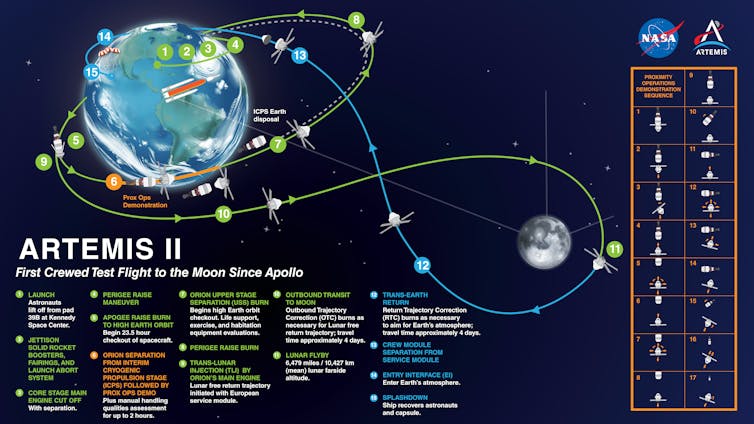
If everything looks good, the Artemis II will ignite what’s known as the Interim Cryogenic Propulsion Stage — part of the SLS rocket still connected to Integrity — to elevate the spacecraft’s orbit. If things are still looking good, the Orion spacecraft and its four human travellers will spend 24 hours in a high-Earth orbit up to 70,000 kilometres away from the planet.

For comparison, the International Space Station orbits the Earth at a mere 400 kilometres.

Following a series of tests and checks, the crew will conduct one of the most critical stages of the mission: the Trans-Lunar Injection, or TLI. This is the crucial moment that changes a spacecraft from orbiting the Earth — where the option to quickly return home remains — to sending it on its way to the moon and into deep space.

an infographic shows the trajectory of a spacecraft
The Artemis II mission’s 10-day ‘figure-eight’ trajectory.
(NASA)

Once the Integrity is on its way to the moon after TLI, there is no turning back — at least, not without going to the moon first. That’s because Artemis II — like the early Apollo missions — enters what’s called a “free-return trajectory” after the TLI. What this means is that even if Integrity’s engines fail completely, the moon’s gravity will naturally loop the spacecraft around it and aim it towards Earth.

After the three-day journey to the moon, the crew will carry out perhaps the most exciting stage of the mission: lunar fly-by. Integrity will loop around the far side of the moon, passing anywhere from 6,000 to 10,000 kilometres above its surface — much farther than any Apollo mission.

To quote Star Trek, at that most distant point, the Artemis II crew will have boldly gone where no (hu)man has gone before. This will be, quite literally, the farthest from Earth that any human being has ever travelled.

International effort to explore the moon

That a Canadian astronaut is part of the crew of Artemis II is a testament to the collaborative international nature of the Artemis program.

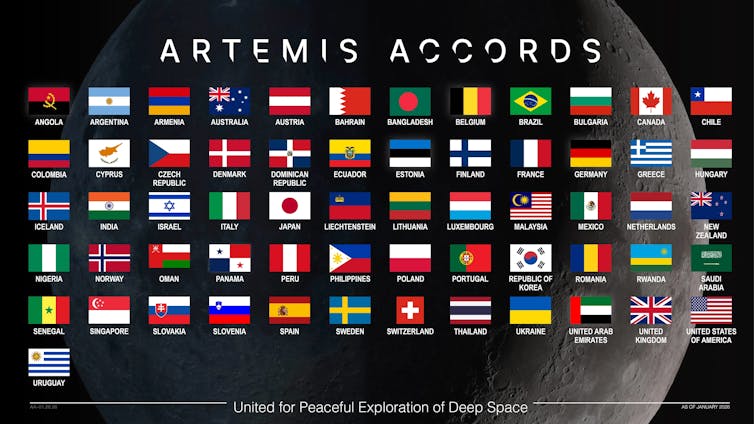
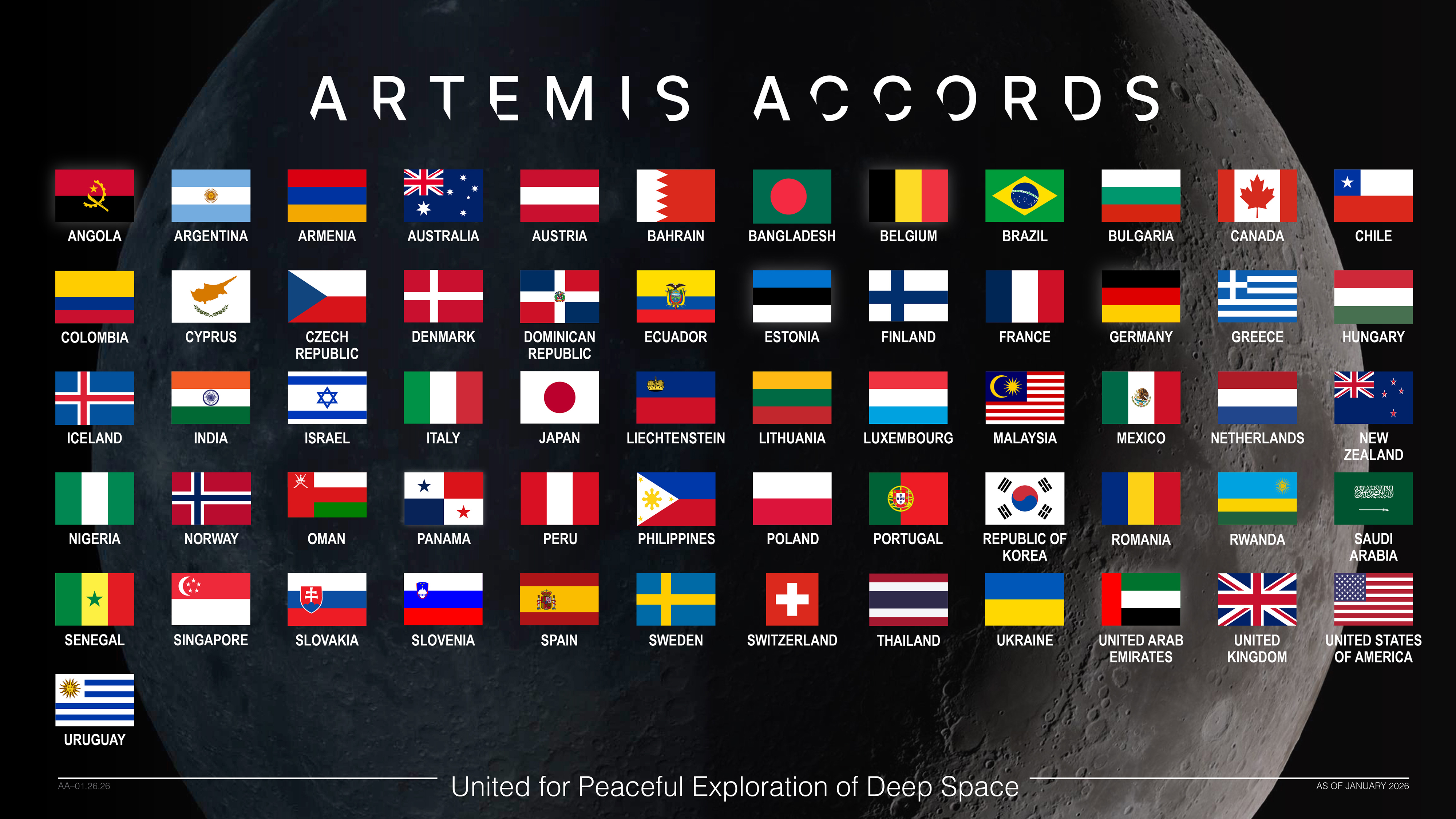
While NASA created the program and is the driving force, there are now 60 countries that have signed the Artemis Accords.

an infographic shows all the artemis accords signatories
On Jan. 26, 2026, Oman became the 61st nation to sign the Artemis Accords.
(NASA)

The foundation for the Artemis Accords is the recognition that international co-operation in space is intended not only to bolster space exploration but to enhance peaceful relationships among nations. This is particularly necessary now — perhaps more than any other time since the Cold War.

I truly hope that as Integrity returns from the moon’s far side, people around the world will pause — at least for a few moments — and be united in thinking of a better future. As American astronaut Bill Anders, who flew the first crewed Apollo mission to the moon, once said:

“We came all this way to explore the moon, and the most important thing is that we discovered the Earth.”

The Conversation

Gordon Osinski founded the company Interplanetary Exploration Odyssey Inc. He receives funding from the Natural Sciences and Engineering Research Council of Canada and the Canadian Space Agency.

ref. Artemis II: The first human mission to the moon in 54 years launches soon — with a Canadian on board – https://theconversation.com/artemis-ii-the-first-human-mission-to-the-moon-in-54-years-launches-soon-with-a-canadian-on-board-273881

Quand et comment décide-t-on qu’une espèce est éteinte ?

Source: The Conversation – France (in French) – By Violaine Nicolas Colin, Maitre de conférence en systématique et phylogéographie, Muséum national d’histoire naturelle (MNHN)

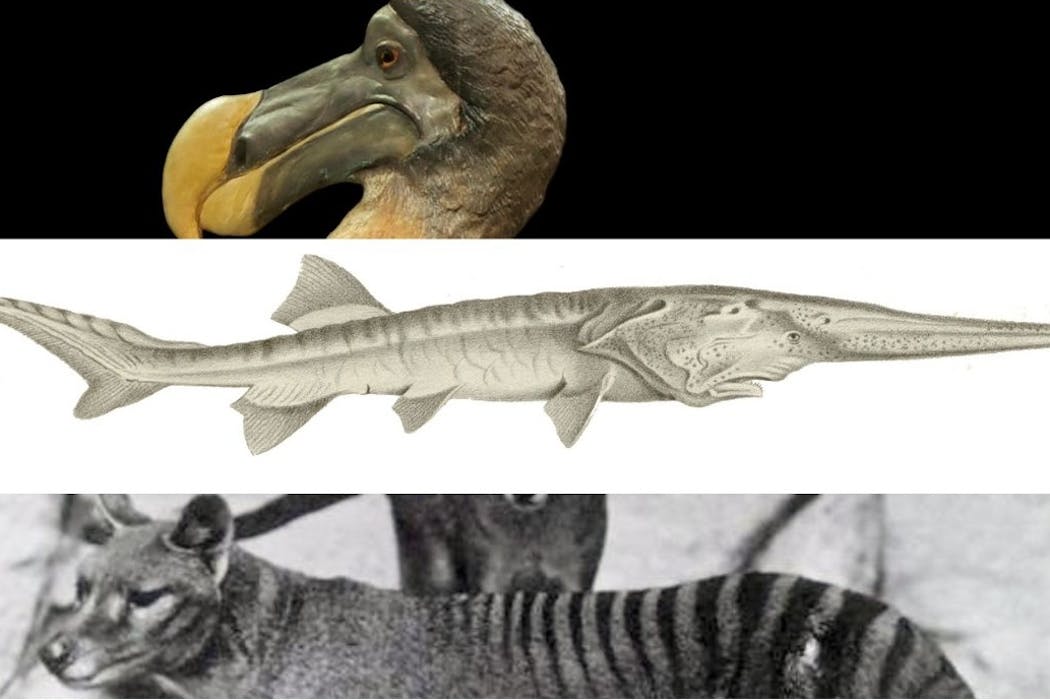
Modèle en cire et plâtre du dodo, dessin de l’espadon de Chine. Jebulon/Wikimédia/Nouvelles archives du Muséum d’histoire naturelle, Baker E., J. Keller., CC BY

Il est bien plus difficile de prouver une absence que de constater une présence. Il faut donc souvent des années, et un processus minutieux, pour qu’une espèce soit déclarée éteinte. Cela peut-être particulièrement difficile lorsqu’il s’agit d’espèces nocturnes, discrètes ou vivant dans des milieux reculés.


Déclarer une espèce « éteinte », ce n’est pas comme rayer un nom d’une liste. C’est un verdict lourd de sens, prononcé avec une extrême prudence. Car annoncer trop tôt une disparition peut condamner une espèce qui existe peut-être encore quelque part. Alors comment font les scientifiques en pratique ?

Comment les scientifiques tranchent-ils la question de l’extinction ?

Pour en arriver là, les biologistes doivent mener des recherches exhaustives, dans tous les habitats potentiels, aux bonnes périodes (saisons, cycles de reproduction), et sur une durée adaptée à la biologie de l’espèce.

Concrètement, plusieurs indices sont analysés ensemble :

  • l’absence prolongée d’observations fiables,

  • des campagnes de recherche répétées et infructueuses,

  • le temps écoulé depuis la dernière observation confirmée,

  • et l’état de l’habitat. Si celui-ci a été totalement détruit ou transformé au point d’être incompatible avec la survie de l’espèce, la conclusion devient plus solide.

Autrement dit, on ne déclare pas une espèce éteinte parce qu’on ne l’a pas vue depuis longtemps, mais parce qu’on a tout fait pour la retrouver, sans succès.

Qui décide officiellement de l’extinction ?

À l’échelle mondiale, c’est l’Union internationale pour la conservation de la nature (UICN) qui statue, depuis 1964, via sa célèbre « liste rouge », référence internationale en matière de biodiversité.

La liste rouge classe les espèces selon leur risque d’extinction, en plusieurs catégories allant de « préoccupation mineure » à « éteinte ». Elle est mise à jour régulièrement, accessible en ligne, et donne aujourd’hui le statut de 172 600 espèces.

Bien plus qu’une simple liste d’espèces et de leur statut, elle fournit aussi des informations sur l’aire de répartition, la taille des populations, l’habitat et l’écologie, l’utilisation et/ou le commerce, les menaces ainsi que les mesures de conservation qui aident à éclairer les décisions nécessaires en matière de préservation.

C’est donc un outil indispensable pour informer et stimuler l’action en faveur de la conservation de la biodiversité et des changements de politique. Le processus d’élaboration de la liste rouge implique le personnel de l’équipe d’évaluation et de connaissance de la biodiversité de l’UICN, les organisations partenaires, les scientifiques, les experts de la Commission de la sauvegarde des espèces de l’UICN, ainsi que les réseaux partenaires qui compilent les informations sur les espèces.

L’IUCN déclare une espèce comme « éteinte » quand il n’existe aucun doute raisonnable que le dernier individu a disparu. Des gouvernements ou agences nationales peuvent également déclarer une espèce éteinte localement, sur leur territoire.

Des extinctions bien réelles : quelques exemples récents

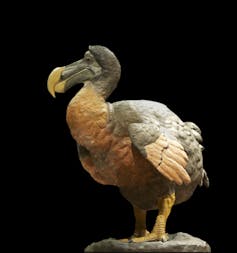
Modèle en cire et plâtre, réalisé par les taxidermistes du Muséum national d’histoire naturelle de Paris au milieu du XIXᵉ siècle
Raphus cucullatus. Espèce endémique de l’île Maurice, éteinte du fait de l’humain vers 1660. Modèle en cire et plâtre, réalisé par les taxidermistes du Muséum national d’histoire naturelle de Paris au milieu du XIXᵉ siècle.
Jebulon/Wikimedia, CC BY

Le dodo (Raphus cucullatus) reste l’icône des extinctions causées par l’humain : découvert à la fin du XVIᵉ siècle lors de l’arrivée des Européens sur l’île Maurice, il disparaît moins de cent ans plus tard, victime de la chasse et des espèces introduites.

Mais il est loin d’être un cas isolé, les extinctions récentes touchent tous les groupes du vivant. Si les espèces insulaires représentent une part disproportionnée des extinctions récentes (les îles, bien qu’elles ne couvrent que 5 % des terres émergées, abritent près de 40 % des espèces menacées), les espèces continentales sont également touchées.

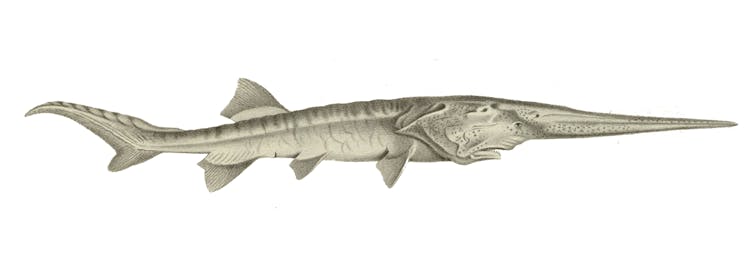
  • L’espadon de Chine (Psephurus gladius), une grande espèce de poisson d’eau douce (jusqu’à plusieurs mètres) qui vivait dans le fleuve Yangtsé, a été déclaré éteint en 2022. La surpêche, les barrages bloquant les migrations et la destruction de son habitat ont eu raison de cette espèce spectaculaire qui a été aperçue pour la dernière fois en 2003.
Psephurus gladius dessiné en 1868
Psephurus gladius dessiné en 1868.
Nouvelles archives du Muséum d’histoire naturelle, CC BY
Spécimen naturalisé au Centre de biodiversité Naturalis
Numenius tenuirostris, spécimen naturalisé au Centre de biodiversité Naturalis.
Wikimédia, CC BY
  • Le courlis à bec grêle (Numenius tenuirostris), un oiseau des zones humides, qui hibernait autour de la Méditerranée avant de rejoindre sa Sibérie natale au printemps, n’a plus été observé de manière certaine depuis 1995. Une étude publiée fin 2024 estime à 96 % la probabilité qu’il soit aujourd’hui éteint, victime de l’agriculture intensive et du drainage des marais.

  • La musaraigne de l’île Christmas (Crocidura trichura), discrète habitante de l’océan Indien, a été officiellement déclarée éteinte en 2025, après quarante ans sans observation malgré des recherches répétées. Les prédateurs introduits (rats, chats) et les perturbations de l’habitat sont les principaux suspects.

  • Deux escargots polynésiens (Partula dentifera et P. pearcekellyi) ont été officiellement déclarés éteints en 2024. La cause principale de leur disparition serait l’introduction d’un escargot prédateur invasif (Euglandina rosea), une tragédie silencieuse mais fréquente sur les îles.

  • Chez les plantes, Amaranthus brownii, une plante herbacée annuelle endémique d’une petite île hawaïenne, a été déclarée éteinte en 2018 après plus de trente-cinq ans sans observation malgré des recherches intensives. La destruction de son habitat et l’arrivée d’espèces invasives ont conduit à sa disparition, sans qu’aucune graine ni plant viable n’ait pu être conservé.

  • Depuis 2024, la liste rouge de l’IUCN comprend aussi des champignons. En mars 2025 la liste évaluait le statut de 1 300 espèces de champignons. Nous sommes loin des 155 000 espèces connues, mais les premières évaluations restent préoccupantes avec 411 espèces de champignons menacées d’extinction, soit près d’un tiers des espèces recensées.

Peut-on vraiment être sûr ? Entre erreurs, miracles et illusions

L’histoire de la biodiversité peut être pleine de rebondissements.

  • L’effet Lazare désigne la redécouverte d’espèces que l’on croyait éteintes. Ce terme fait référence au personnage biblique du Nouveau Testament ressuscité plusieurs jours après sa mort par Jésus. Ce terme est aussi employé en paléontologie pour désigner des groupes d’organismes qui semblent avoir disparu pendant des millions d’années dans le registre fossile avant de réapparaître comme par miracle.
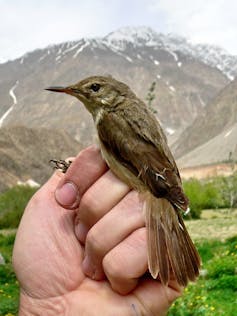
Rousserolle à grand bec au Tadjikistan
Rousserolle à grand bec au Tadjikistan.
Pavel Kvartalnov, CC BY

Selon le naturaliste, Brett Scheffers et ses collaborateurs au moins 351 espèces ont ainsi été « ressuscitées » en un peu plus d’un siècle, parfois après des décennies d’absence. La perruche nocturne (Pezoporus occidentalis) ou la rousserolle à grand bec (Acrocephalus orinus) en sont des exemples spectaculaires. Il est important de noter que la majorité de ces redécouvertes concerne des espèces si rares ou difficiles à trouver que leur seule occurrence confirmée provenait de leur description initiale. Ces espèces redécouvertes sont donc pour leur grande majorité toujours considérées comme gravement menacées et pourraient disparaître prochainement.

  • L’effet Roméo, au contraire, survient lorsqu’on renonce trop tôt à sauver une espèce en la croyant disparue.
Conuropsis carolinensis. Dessins d’Audubon.
Domaine public

Résultat : on cesse les efforts de conservation… alors qu’il restait peut-être une chance de la sauver. Ce nom fait référence au Roméo de Shakespeare qui renonce à vivre en croyant Juliette morte, alors qu’elle ne l’est pas encore. La conure de Caroline (Conuropsis carolinensis), un perroquet d’Amérique du Nord, pourrait en être un triste exemple. Présumée éteinte au début du XXᵉ siècle cette espèce a probablement survécu plus longtemps comme en atteste les nombreux témoignages locaux (incluant des détails sur son comportement) jusqu’aux années 1950, et peut-être même jusqu’aux années 1960.

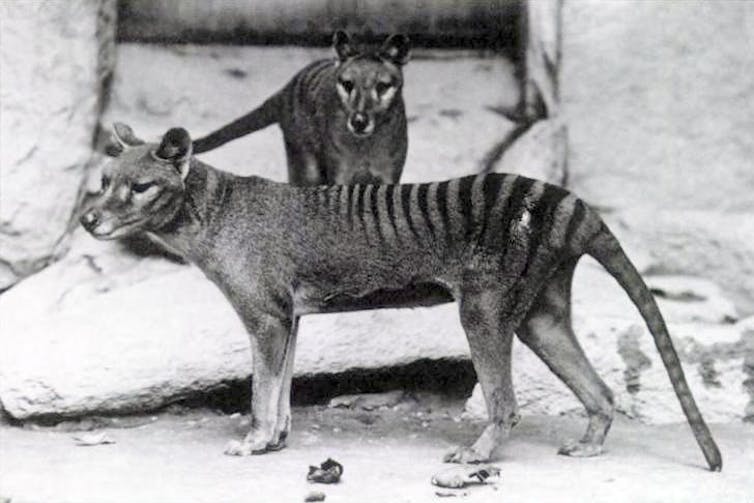
  • Enfin, l’effet thylacine (du nom du thylacine, plus connu sous le nom de « tigre de Tasmanie ») illustre l’excès inverse : l’espoir persistant qu’une espèce éteinte survit encore, malgré l’absence de preuves solides.
Une femelle thylacine et son juvénile au parc zoologique national de Washington en 1904
Une femelle thylacine et son juvénile au parc zoologique national de Washington en 1904.
Domaine

Le thylacine, dont le dernier animal (captif) est officiellement mort en 1936, continue de fait d’alimenter de nombreuses rumeurs et témoignages d’observations non vérifiables. Selon l’étude scientifique la plus complète à ce sujet le dernier animal sauvage entièrement documenté (avec des photographies) a été abattu en 1930, mais il n’y aurait aucune raison de douter de l’authenticité de deux carcasses signalées en 1933, ni de deux autres captures suivies de relâchers en 1935 et en 1937. Par la suite, sur une période de huit décennies, 26 morts et 16 captures supplémentaires ont été rapportées, mais sans être vérifiées, ainsi que 271 observations par des « experts » (anciens piégeurs, chasseurs, scientifiques ou responsables) et 698 signalements par le grand public. En 2005, le magazine australien d’information The Bulletin a offert une récompense de plus d’un million de dollars (soit plus 836 000 euros) à quiconque fournirait une preuve scientifique de l’existence du thylacine, en vain. Entre 2014 et 2020, 3 225 sites équipés de pièges photographiques en Tasmanie, totalisant plus de 315 000 nuits de surveillance, n’ont révélé aucune détection pouvant être attribuée à un thylacine.

Pourquoi est-ce si compliqué de mesurer les extinctions ?

Prouver une absence est bien plus compliqué que constater une présence. L’UICN préfère donc l’extrême prudence et ne classe une espèce « éteinte » que lorsqu’elle peut l’affirmer avec certitude. En effet, comme nous l’avons vu, officialiser une extinction est un acte lourd de conséquences car cela conduit à clôturer les éventuelles mesures de protection. Ainsi, le requin perdu (Carcharhinus obsoletus) est estimé comme « gravement menacé d’extinction – possiblement éteint » par la dernière publication de la liste rouge de l’UICN en 2020, alors qu’il n’a plus été vu dans ses eaux de la mer de Chine depuis 1934. La liste rouge ne déclarant éteintes que des espèces pour lesquelles il n’y a aucun doute, les extinctions enregistrées sont largement sous-estimées.

De plus, notre vision est biaisée : les vertébrés (en particulier les oiseaux et les mammifères) sont relativement bien suivis, mais l’immense majorité des espèces – insectes, invertébrés, champignons, microorganismes – restent très mal connues et leur taux d’extinction est sous-estimé. Beaucoup d’espèces sont discrètes, minuscules, nocturnes ou vivent dans des milieux difficiles d’accès. Pour la majorité d’entre elles, les données sont quasi inexistantes et elles peuvent disparaître sans que personne ne s’en aperçoive.

Pourquoi est-ce si important de savoir ?

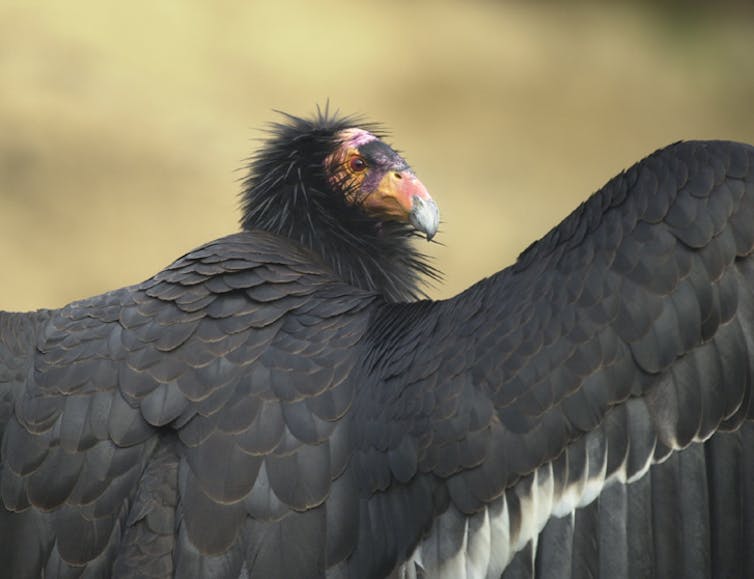
Savoir si une espèce a réellement disparu permet de choisir les bonnes stratégies de conservation. Beaucoup d’espèces peuvent encore être sauvées lorsque quelques individus subsistent. C’est par exemple le cas du condor de Californie (Gymnogyps californianus) pour lequel il restait seulement 22 individus à l’état sauvage dans les années 1980. Un programme de capture de ces spécimens, puis d’élevage en captivité et de réintroduction progressive a permis à la population sauvage de réaugmenter progressivement et d’atteindre 369 individus en 2024.

Un Condor de Californie
Avec son 1,40 mètre de longueur et ses 2,90 mètres d’envergure, le condor de Californie est un des plus grands oiseaux du monde.
United States Fish and Wildlife Service, CC BY

À l’inverse, un diagnostic erroné – trop optimiste ou trop pessimiste – peut détourner les efforts au mauvais moment.

L’extinction est un fait biologique, mais c’est aussi un défi méthodologique. Entre prudence scientifique, incertitudes du terrain et illusions collectives, établir la frontière entre « menacée » et « éteinte » reste l’un des exercices les plus sensibles de la conservation moderne.

The Conversation

Violaine Nicolas Colin a reçu des financements de l’ANR

ref. Quand et comment décide-t-on qu’une espèce est éteinte ? – https://theconversation.com/quand-et-comment-decide-t-on-quune-espece-est-eteinte-272516

Une ambition monumentale… Pourquoi Donald Trump veut-il créer à Washington une copie de l’Arc de triomphe ?

Source: The Conversation – in French – By Garritt C. Van Dyk, Senior Lecturer in History, University of Waikato

Copie assumée de l’Arc de triomphe parisien, l’« Independence Arch », déjà surnommé « Arc de Trump », s’inscrit dans une longue tradition monumentale, entre célébration du pouvoir, réécriture du passé et affirmation politique.


Donald Trump a pris le temps cette semaine, alors que l’actualité internationale et américaine était particulièrement chargée, de présenter trois nouvelles propositions architecturales pour son projet d’« Independence Arch » à Washington. Les trois rendus rappellent clairement l’Arc de triomphe de la place de l’Étoile à Paris, même si l’un d’eux se distingue par des ornements dorés, dans la lignée des choix décoratifs de Trump pour le Bureau ovale de la Maison-Blanche.

Commandée en vue du 250ᵉ anniversaire de la signature de la Déclaration d’indépendance des États-Unis, le 4 juillet, cet arc de triomphe s’inscrit dans une longue tradition de monuments célébrant les victoires militaires, des empereurs romains à Napoléon Bonaparte.

Ce projet de monument participe ainsi pleinement de la politique étrangère de Donald Trump et de l’ambition qu’affiche ce dernier de voir les États-Unis étendre leur contrôle sur l’« hémisphère occidental » – une orientation que le président a lui-même baptisée la « doctrine Donroe ».

Mais une question demeure, largement posée : alors que le projet copie l’Arc de triomphe, monument emblématique s’il en est, un hommage personnel est-il vraiment la manière la plus pertinente de marquer l’anniversaire de la rupture des États-Unis avec le pouvoir absolu et la monarchie britannique ?

L’« Arc de Trump »

Lorsque Donald Trump a présenté pour la première fois, en octobre 2025, des maquettes de l’arche envisagée, un journaliste lui a demandé à qui elle était destinée. Trump a répondu : « À moi. Ce sera magnifique. » Dans une déclaration faite en décembre, le président a affirmé que la nouvelle arche « sera comme celle de Paris, mais pour être honnête avec vous, elle la surpasse. Elle la surpasse à tous les niveaux ».

Une exception toutefois, a-t-il précisé :

« La seule chose qu’ils ont, c’est l’histoire […] Je dis toujours que c’est la seule chose avec laquelle on ne peut pas rivaliser, mais nous finirons par avoir cette histoire nous aussi. »

Le président est manifestement convaincu que son arche contribuera à forger cette histoire. « C’est la seule ville au monde d’une telle importance qui ne possède pas d’arc de triomphe », a-t-il déclaré à propos de Washington, DC.

Prévue à proximité du cimetière national d’Arlington et du Lincoln Memorial, l’implantation placerait la nouvelle structure en dialogue visuel avec plusieurs des monuments les plus emblématiques de la capitale fédérale.

Le projet s’inscrit par ailleurs dans une série d’initiatives destinées à laisser l’empreinte de Donald Trump sur le paysage bâti de Washington : les transformations apportées à la Maison-Blanche l’an dernier, avec notamment la minéralisation du célèbre Rose Garden, la décoration du Bureau ovale dans un style rococo doré, ou encore la démolition de l’East Wing pour permettre une extension de la salle de bal estimée à 400 millions de dollars (334,5 millions d’euros).

Surnommé l’« Arc de Trump », le projet est désormais la « priorité absolue » de Vince Haley, directeur du Conseil de politique intérieure de la Maison-Blanche.

Triomphe et architecture

L’Arc de triomphe de Paris, situé au sommet des Champs-Élysées, est une commande de Napoléon Bonaparte (1804-1814/1815) en 1806 pour honorer l’armée impériale française après sa victoire à la bataille d’Austerlitz (2 décembre 1805). Il ne sera achevé qu’en 1836, sous la Restauration et le règne de Louis-Philippe (1830-1848), dernier roi de France.

Les architectes du projet, Jean-François Chalgrin et Jean-Arnaud Raymond, se sont inspirés des arcs antiques, en prenant pour modèle principal l’arc de Titus à Rome (vers 85 de notre ère). Celui-ci fut érigé par l’empereur Domitien (51–96 de notre ère), tyran cruel et ostentatoire, populaire auprès du peuple mais en conflit permanent avec le Sénat, dont il avait restreint le pouvoir législatif. L’arc fut commandé par Domitien pour célébrer à la fois l’apothéose de son frère Titus et sa victoire militaire contre la rébellion en Judée.

Par ses références, l’arche proposée par Trump ne renvoie à aucun élément de conception spécifiquement américain. Son style néoclassique s’inscrit en revanche dans la continuité de monuments plus anciens, eux aussi inspirés de l’Antiquité.

Le Washington Monument, par exemple, adopte la forme d’un obélisque égyptien. Ce pilier à quatre faces, qui s’amincit en s’élevant et se termine par une pyramide, rend hommage au dieu solaire Rê. Mais il intégrait aussi un élément destiné à symboliser les avancées technologiques et l’esprit d’innovation américains : un pyramidion en aluminium. Lorsque l’obélisque a été achevé en 1884, l’aluminium était un matériau rare, le procédé permettant de le raffiner n’étant pas encore maîtrisé. Le sommet du monument constituait alors la plus grande pièce d’aluminium moulé au monde.

Un combat de valeurs

L’arc de triomphe voulu par Trump s’inscrit dans un débat de longue date sur les monuments publics et sur ce qu’ils disent des valeurs qu’une société choisit de mettre en avant.

Ainsi, pendant le mouvement Black Lives Matter, de nombreuses statues de figures historiques ont été retirées de l’espace public, car elles étaient perçues comme glorifiant le racisme et l’impérialisme. Donald Trump a depuis fait remettre en place au moins une statue confédérée renversée à cette période, et son ambition d’ériger un monument à sa propre personne ne saurait donc surprendre.

Sous le régime des lois Jim Crow (1877, abrogées en 1964), qui ont institutionnalisé la ségrégation raciale, puis durant le mouvement des droits civiques, le nombre de monuments consacrés aux soldats et aux généraux confédérés a connu une nette hausse.

De la même façon que le déboulonnage de ces statues relevait d’un geste politique, l’érection d’un nouveau mémorial destiné à promouvoir la lecture positive que Trump propose de l’histoire nationale en constitue un autre. Le projet s’intègre d’ailleurs dans la mission revendiquée par son administration de « restaurer la vérité et la raison dans l’histoire américaine ».

Reste une question plus immédiate : l’Independence Arch pourra-t-il seulement voir le jour d’ici au 4 juillet, jour de la fête nationale ? Un défi de taille, même pour ce président. Quant à son accueil, l’histoire tranchera.

The Conversation

Garritt C. Van Dyk a reçu des financements du Getty Research Institute.

ref. Une ambition monumentale… Pourquoi Donald Trump veut-il créer à Washington une copie de l’Arc de triomphe ? – https://theconversation.com/une-ambition-monumentale-pourquoi-donald-trump-veut-il-creer-a-washington-une-copie-de-larc-de-triomphe-274636

«Rendre la liberté académique plus solide…» Stéphanie Balme est l’invitée de notre émission « La grande conversation »

Source: The Conversation – France in French (3) – By Laurent Bainier, Directeur de la rédaction The Conversation France, The Conversation

Stéphanie Balme (Sciences Po), rédactrice d’un rapport sur la liberté académique pour France Universités, était l’invitée de l’émission de The Conversation et CanalChatGrandialogue vendredi 23 janvier 2026. TheConversation, CC BY

Elle a rédigé le rapport « Défendre et promouvoir la liberté académique », commandé par France Universités. Stéphanie Balme, directrice du Centre de recherches internationales de Sciences Po et experte de la diplomatie scientifique, était l’invitée vendredi 23 janvier de notre émission « La Grande Conversation », en partenariat avec CanalChat Grandialogue.

La liberté académique est aujourd’hui confrontée à des tensions inédites : pressions politiques, restrictions budgétaires, ingérences étrangères et remise en question des principes d’indépendance scientifique. Ces enjeux, qui touchent les chercheurs et les institutions en France comme à l’international, interrogent notre capacité à produire un savoir libre et critique.

Lors de cette émission, nous abordons avec Stéphanie Balme, rédactrice du rapport« Défendre et promouvoir la liberté académique », le rôle des institutions et des politiques publiques pour la protéger. Quelles mesures prendre pour assurer sa défense? Comment répondre aux critiques récurrentes d’une partie de l’opinion publique? Quelles leçons tirer de ce qui se passe sur les campus américains ? Une émission à retrouver sur notre chaîne YouTube.

L’émission Conversation avec Stéphanie Balme, le 23 janvier 2026.

The Conversation

ref. «Rendre la liberté académique plus solide…» Stéphanie Balme est l’invitée de notre émission « La grande conversation » – https://theconversation.com/rendre-la-liberte-academique-plus-solide-stephanie-balme-est-linvitee-de-notre-emission-la-grande-conversation-274638

Submarine mountains and long-distance waves stir the deepest parts of the ocean

Source: The Conversation – Global Perspectives – By Jessica Kolbusz, Research Fellow, School of Biological Sciences, The University of Western Australia

NOAA Office of Ocean Exploration and Research, 2019 Southeastern U.S. Deep-sea Exploration

When most of us look out at the ocean, we see a mostly flat blue surface stretching to the horizon. It’s easy to imagine the sea beneath as calm and largely static – a massive, still abyss far removed from everyday experience.

But the ocean is layered, dynamic and constantly moving, from the surface down to the deepest seafloor. While waves, tides and currents near the coast are familiar and accessible, far less is known about what happens several kilometres below, where the ocean meets the seafloor.

Our new research, published in the journal Ocean Science, shows water near the the seafloor is in constant motion, even in the abyssal plains of the Pacific Ocean. This has important consequences for climate, ecosystems and how we understand the ocean as an interconnected system.

Enter the abyss

The central and eastern Pacific Ocean include some of Earth’s largest abyssal regions (places where the sea is more than 3,000 metres deep). Here, most of the seafloor lies four to six kilometres below the surface. It is shaped by vast abyssal plains, fracture zones and seamounts.

It is cold and dark, and the water and ecosystems here are under immense pressure from the ocean above.

Just above the seafloor, no matter the depth, sits a region known as the bottom mixed layer. This part of the ocean is relatively uniform in temperature, salinity and density because it is stirred through contact with the seafloor.

Rather than a thin boundary, this layer can extend from tens to hundreds of metres above the seabed. It plays a crucial role in the movement of heat, nutrients and sediments between the pelagic ocean and the seabed, including the beginning of the slow return of water from the bottom of the ocean toward the surface as part of global ocean circulation.

Observations focused on the bottom mixed layer are rare, but this is beginning to change. Most ocean measurements focus on the upper few kilometres, and deep observations are scarce, expensive and often decades apart.

In the Pacific especially, scientists have long known that cold Antarctic waters flow northward, along topographic features such as the Tonga-Kermadec Ridge and the Izu-Ogasawara and Japan Trenches.

But the finer details of how these waters interact with seafloor features in ways that intermittently stir and reshape the bottom layer of the ocean has remained largely unknown.

A bright pink, soft coral attached to a grey seafloor mount.
Deep sea ecosystems are under immense pressure from the ocean above.
NOAA Photo Library

Investigating the abyss

To investigate the Pacific abyssal ocean, my colleagues and I combined new surface-to-seafloor measurements collected during a trans-Pacific expedition with high-quality repeat data about the physical features of the ocean gathered over the past two decades.

These observations allowed us to examine temperature and pressure all the way down to the seafloor over a wide range of latitudes and longitudes.

We then compared multiple scientific methods for identifying the bottom mixed layer and used machine learning techniques to understand what factors best explain the variations in its thickness.

Rather than being a uniform layer, we found the bottom mixed layer in the abyssal Pacific varies dramatically. In some regions it was less than 100m thick; in others it exceeded 700m.

This variability is not random; it’s controlled by the seafloor depth and the interactions between waves generated by surface tides and rough landscapes on the seabed.

In other words, the deepest ocean is not quietly stagnant as is often imagined. It is continually stirred by remote forces, shaped by seafloor features, and dynamically connected to the rest of the ocean above.

Just as coastal waters are shaped by waves, currents and sediment movement, the abyssal ocean is shaped by its own set of drivers. However, it is operating over larger distances and longer timescales.

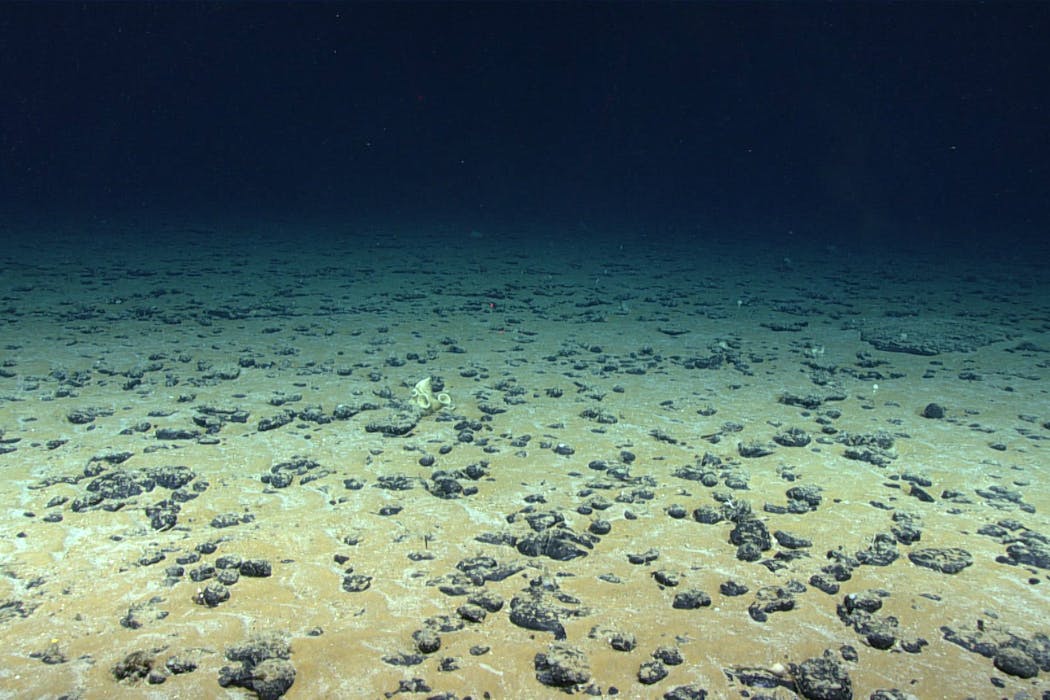
Underwater mounts on the seafloor covered in gold minerals.
Topographic features of the seafloor intermittently stir and reshape the bottom layer of the ocean.
NOAA Photo Library

Connected to the rest of the world

This matters for several reasons.

First, the bottom mixed layer influences how heat is stored and redistributed in the ocean, affecting long-term climate change. Some ocean and climate models still simplify seabed mixing, which can lead to errors in how future climate is projected.

Second, it plays a role in transporting sediment and seabed ecosystems. As interest grows in deep-sea mining and other activities on the high seas, understanding how the seafloor environment changes, and importantly how seafloor disturbances might spread, becomes increasingly important.

Our results highlight how little of the deep ocean we actually observe.

Large areas of the abyssal Pacific remain effectively unsampled, even as international agreements such as the new UN High Seas Treaty seek to manage and protect these regions.

The deep ocean is not a silent, static place. It is active, connected to the oceans above and changing. If we want to make informed decisions about the future of the high seas, we need to understand what’s happening at the very bottom in space and time.

The Conversation

Jessica Kolbusz receives funding from the marine research organisation Inkfish LLC. The funder was not involved in the study design, collection, analysis, interpretation of data, the writing of this article, or the decision to submit it for publication.

ref. Submarine mountains and long-distance waves stir the deepest parts of the ocean – https://theconversation.com/submarine-mountains-and-long-distance-waves-stir-the-deepest-parts-of-the-ocean-274124

What the ‘mother of all deals’ between India and the EU means for global trade

Source: The Conversation – Global Perspectives – By Peter Draper, Professor, and Executive Director: Institute for International Trade, and Director of the Jean Monnet Centre of Trade and Environment, Adelaide University

The “mother of all deals”: that’s how European Commission President Ursula von der Leyen described the new free trade agreement between the European Union and India, announced on Tuesday after about two decades of negotiations.

The deal will affect a combined population of 2 billion people across economies representing about a quarter of global GDP.

Speaking in New Delhi, von der Leyen characterised the agreement as a “tale of two giants” who “choose partnership, in a true win-win fashion”.

So, what have both sides agreed to – and why does it matter so much for global trade?

What has been agreed

Under this agreement, tariffs on 96.6% of EU goods exported to India will be eliminated or reduced. This will reportedly mean savings of approximately €4 billion (about A$6.8 billion) annually in customs duties on European products.

The automotive sector is the big winner. European carmakers – including Volkswagen, BMW, Mercedes-Benz and Renault – will see tariffs on their vehicles gradually reduced from the current punitive rate of 110% to as little as 10%.

The reduced tariffs will apply to an annual quota of 250,000 vehicles, which is six times larger than the quota the UK received in its deal with India.

To protect India’s domestic manufacturers, European cars priced below €15,000 (A$25,500) will face higher tariffs, while electric vehicles get a five-year grace period.

India will almost entirely eliminate tariffs on machinery (which previously faced rates up to 44%), chemicals (22%) and pharmaceuticals (11%).

Wine is particularly notable – tariffs are being slashed from 150% to between 20–30% for medium and premium varieties. Spirits face cuts from 150% to 40%.

In return, the EU is also opening up its market. It will reduce tariffs on 99.5% of goods imported from India. EU tariffs on Indian marine products (such as shrimp), leather goods, textiles, handicrafts, gems and jewellery, plastics and toys will be eliminated.

These are labour-intensive sectors where India has genuine competitive advantage. Indian exporters in marine products, textiles and gems have faced tough conditions in recent years, partly due to US tariff pressures. That makes this EU access particularly valuable.

What’s been left out

This deal, while ambitious by India standards, has limits. It explicitly excludes deeper policy harmonisation on several fronts. Perhaps most significantly, the deal doesn’t include comprehensive provisions on labour rights, environmental standards or climate commitments.

While there are references to carbon border adjustment mechanisms (by which the EU imposes its domestic carbon price on imports into their common market), these likely fall short of enforceable environmental standards increasingly common in EU deals.

And the deal keeps protections for sensitive sectors in Europe: the EU maintains tariffs on beef, chicken, dairy, rice and sugar. Consumers in Delhi might enjoy cheaper European cars, while Europe’s farmers are protected from competition.

An auction takes place at a busy seafood market.
India’s seafood exporters stand to benefit from the deal.
Elke Scholiers/Getty

Why now?

Three forces converged to make this deal happen. First, a growing need to diversify from traditional partners amid economic uncertainty.

Second, the Donald Trump factor. Both the EU and India currently face significant US tariffs: India faces a 50% tariff on goods, while the EU faces headline tariffs of 15% (and recently avoided more in Trump’s threats over Greenland). This deal provides an alternative market for both sides.

And third, there’s what economists call “trade diversion” – notably, when Chinese products are diverted to other markets after the US closes its doors to them.

Both the EU and India want to avoid becoming dumping grounds for products that would normally go to the American market.

A dealmaking spree

The EU has been on something of a dealmaking spree recently. Earlier this month, it signed an agreement with Mercosur, a South American trade bloc.

That deal, however, has hit complications. On January 21, the European Parliament voted to refer it to the EU Court of Justice for legal review, which could delay ratification.

This creates a cautionary tale for the India deal. The legal uncertainty around Mercosur shows how well-intentioned trade deals can face obstacles.

The EU also finalised negotiations with Indonesia in September; EU–Indonesia trade was valued at €27 billion in 2024 (about A$46 billion).

For India, this deal with the EU is considerably bigger than recent agreements with New Zealand, Oman and the UK. It positions India as a diversified trading nation pursuing multiple partnerships.

However, the EU–India trade deal should be understood not as a purely commercial breakthrough, but also as a strategic signal — aimed primarily at the US.

In effect, it communicates that even close allies will actively seek alternative economic partners when faced with the threat of economic coercion or politicised trade pressure.

This interpretation is reinforced by both the deal’s timing and how it was announced. The announcement came even though key details still need to be negotiated and there remains some distance to go before final ratification.

That suggests the immediate objective was to deliver a message: the EU has options, and it will use them.

What does this mean for Australia and India?

For Australians, this deal matters more than you might think. Australia already has the Australia-India Economic Cooperation and Trade Agreement, which came into force in late 2022.

Australia has eliminated tariffs on all Indian exports, while India has removed duties on 90% of Australian goods by value, rising from an original commitment of 85%.

This EU-India deal should provide impetus for Australia and India to finalise their more comprehensive Comprehensive Economic Cooperation Agreement, under negotiation since 2023.

The 11th round of negotiations took place in August, covering goods, services, digital trade, rules of origin, and – importantly – labour and environmental standards.

The EU deal suggests India is willing to engage seriously on tariff liberalisation. However, it remains to be seen whether that appetite will transfer to the newer issues increasingly central to global trade, notably those Australia is now trying to secure with Indian negotiators.

Chasing an Australia-EU deal

Australia should take heart from the EU’s success in building alternative trading relationships.

This should encourage negotiators still pursuing an EU–Australia free trade agreement, negotiations for which were renewed last June after collapsing in 2023.

These deals signal something important about the global trading system: countries are adapting to American protectionism not by becoming protectionist themselves, but by deepening partnerships with each other.

The world’s democracies are saying they want to trade, invest, and cooperate on rules-based terms.

The Conversation

Nathan Howard Gray receives funding from Department of Foreign Affairs and Trade.

Mandar Oak and Peter Draper do not work for, consult, own shares in or receive funding from any company or organisation that would benefit from this article, and have disclosed no relevant affiliations beyond their academic appointment.

ref. What the ‘mother of all deals’ between India and the EU means for global trade – https://theconversation.com/what-the-mother-of-all-deals-between-india-and-the-eu-means-for-global-trade-274515