Source: The Conversation – Canada – By Rassim Khelifa, Assistant Professor, Department of Biology; Canada Research Chair Tier 2 in Global Change Biology, Concordia University
Research shows people prefer their edible insects to look less like bugs and more like muffins.(Flickr/William Warby), CC BY
Lobster had one of the greatest reputation makeovers in food history.
Once treated as “food for the poor,” it is now served in expensive restaurants, dipped in butter and presented as a delicacy.
Insects may be next. More than two billion people already eat grasshoppers, caterpillars, ants, beetles and crickets — within varied food traditions across Africa, Asia and Latin America. They are valued for their taste, availability and nutritional content.
Or does it? Our survey of adult visitors at the Montréal Insectarium revealed that 44 per cent of participants were open to eating insects. And around 87 per cent preferred products where the insect component was not visible, such as baked goods made with insect flour.
And yet, in a culture where people will add protein powder to almost anything, one of the planet’s most efficient protein sources still makes many people squirm.
Fried insects are viewed as a nourishing food source in many parts of the world. (Unsplash/Max Tcvetkov)
Canadians are curious
In our recent study, published in Scientific Reports, we surveyed 252 adult visitors at the Montréal Insectarium to better understand how Canadians think about insect-based foods.
The results were more hopeful than a simple “yuck” story.
Overall, 44 per cent of participants expressed openness to eating insects. This included 18 per cent who had already eaten insects and would do so again, and 26 per cent who had not tried them but said they were willing to.
But curiosity is not the same as commitment. Only 27 per cent said they would include insects in their usual diet, and just 17 per cent said they would cook them at home. So, Canadians are not quite ready to replace chicken nuggets with cricket nuggets yet.
Disgust and fear
The clearest pattern in our study related to the visibility of the insects.
Participants were far more open to insect-based foods when the insects were hidden. About 87 per cent preferred products where the insect component was not visible, such as baked goods made with insect flour.
This shows that the barrier is not necessarily the ingredient itself. It is the image.
A muffin made with cricket flour still feels like a muffin. But a visible larva asks the eater to confront exactly what they are eating and for many people, that is where curiosity turns into disgust.
Disgust was the most common barrier in our study, reported by 70 per cent of participants. Others mentioned fear of insects, uncertainty about safety and health concerns.
These are not small obstacles. Food is emotional. We do not eat only with our stomachs. We eat with our memories, our cultural norms, our fears and our ideas of what belongs on a plate.
A familiar way to eat the unfamiliar
If insect-based foods become more common in Canada, this probably won’t start with whole fried beetles on restaurant menus. They may appear more quietly, inside foods we already understand: bread, muffins, pasta, protein bars, cookies, even pizzas.
People are more willing to try something unfamiliar when it arrives in a familiar form.
This does not mean disgust will disappear overnight. Food norms change slowly. Lobster did not become desirable because it became less strange looking. It became desirable because people learned to see it differently.
Our study suggests that most Canadians are not ready to fully embrace insects as everyday food, but they are not completely closed off either. Their openness depends on trust, safety, familiarity and, most of all, presentation.
The future of insect-based food will not be decided by protein content alone. It will be decided by whether insects can be accepted as safe and trustworthy “ingredients.”
It may begin with a simple cricket flour cookie. That may sound strange today, but so did lobster once.
Nadezhda Velchovska, undergraduate honours student in psychology with a minor in multidisciplinary studies in science at Concordia University, co-authored this article.
Rassim Khelifa receives funding from a NSERC CRC Tier 2 (CRC-2022-00134) and NSERC Discovery Grant (RGPIN-2024- 04564). He is a member of The Quebec Centre for Biodiversity Science and The Canadian Society for Ecology and Evolution.
Source: The Conversation – Canada – By Biz Nijdam, Assistant Professor, Department of Central, Eastern, and Northern European Studies, University of British Columbia
For those who spend their free time with 20-sided dice, or boast an impressive collection of meeple-themed jewelry, it’s undeniable that we’re living in a “golden age” of board games.(Pexels/Pavel Danilyuk)
For those of us who spend our free time with 20-sided dice, or boast an impressive collection of meeple-themed jewelry, it’s undeniable that we’re living in a “golden age” of board games. But with digital technologies on the rise, the success of tabletop games might come as a surprise to some.
The digital detox movement has further increased attention to tabletop games, but their capacity to support health, general well-being and community-building goes much deeper than putting down your smartphone.
Hobbies can bring joy, well-being, and focus to our busy lives, but so many of us don’t have one. If you’re ready to replace scrolling with stitching, or hustle with horticulture, The Hobby Starter Kit (a new series from Quarter Life) will help you get going.
Building meaningful connections
Board games can provide a basis to establish meaningful social connections that support our mental well-being. (Pexels/Pavel Danilyuk)
Research on the COVID-19 pandemic showed how playing board games decreased stress, isolation and anxiety. Research also demonstrates that playing board games helps develop socio-emotional growth, strengthens relationships and builds community.
At Kansas State University, the Bonding thru Board Games program uses tabletop gaming to support the development soft skills, such as self-control, positive self-concept, social and communication skills and executive function.
What’s changing, however, is the recognition that tabletop gaming also builds vital community. Andrea Robertson is the co-owner of Rain City Games in British Columbia. She has seen increased participation in store events over the last few years. Annual ticket sales increased from approximately 8,500 in 2024 to over 9,100 in 2025. She told me:
“We find that our store fills the role of a ‘third space’ for a lot of our customers. We hope our events help alleviate some of the rising loneliness and isolation among young people, offering a way to interact without the mediation of screens and algorithms.”
Plamondon is a Cree game consultant with strong community ties to Treaty 8 and Treaty 6 Territory. He told me that:
“Historically, the tabletop hobby has been unwelcoming, if not overtly hostile to many equity deserving groups, particularly LGBTQ2S+, women and BIPOC folks.”
He explained that poor representation, as well as socioeconomic and geographical factors, have excluded Indigenous folks from participating in tabletop gaming.
As a game consultant, Plamondon helps game developers ensure Indigenous Peoples are represented and part of the conversation when it comes to designing games that include Indigenous histories, communities, culture and storytelling traditions. He said:
“From a Cree perspective, the incorporation of Indigenous values into gaming spaces and game design is synonymous with building and protecting a community. So, when we opened Pe Metawe games, that was our primary focus: honouring Cree culture through creating a safe, welcoming and inclusive space for anyone who was willing to honour that ideal.”
From play to playtesting
Plamondon’s work reflects a new trend in the global gaming industry that emphasizes intentional and inclusive game design. It has led to the development of new kinds of gaming events. In addition to coming together to play games, gamers have started coming out in droves to help develop them.
The Vancouver Playtest Group (VPG) was established in 2018 to create a space for board game designers to gather and work on their prototypes. The group’s co-founders Mark Ellis and Noe Escobar see gaming groups as a great way to connect and meet new people. Escobar told me:
“Games teach us a lot about ourselves, through moments that are funny, or exciting, or frustrating. We share those feelings and go on a journey together. Pretty soon, you can find a whole new community of friends you might never have met otherwise.”
Academics have also begun to recognize the value of gaming’s capacity to build community. Beyond research on the value of playing games as a social enterprise, games studies as an academic field has turned to community as a model for intellectual inquiry.
At the University of British Columbia, our team recently launched the UBC Critical Play Lab and Fellows Program to develop a community of practice for games and game studies. Its mission is to innovate teaching, research and public engagement through games.
Our inaugural cohort of almost 30 scholars, students, and local game designers are collaborating on new research, knowledge mobilization and game design initiatives.
How to get started
If you’re looking to get into tabletop gaming, checking out in-person board game nights at a local venue is an excellent way to start. Search for local events online or pop by your local game shop for information on local board game or RPG groups. You can even try check out games at your local public library.
Game store staff are often experts in identifying the perfect new game for any player. Give them a sense of the kinds of games you’ve played or like, and they can provide you with a list of similar games or suggest accessible new games.
If you haven’t played a game in years, but want to try them out, here are my favourite starter games right now. Hues and Cues and Wavelength are easy party games with creative mechanics. Dominion and Ascension are great for getting started on deck-building games.
If you are a fan of Yahtzee and interested in adding a different kind of competition, Dice Throne is essentially magical combat with dice and endless character variations. And if you’re looking for a further twist on the classic dice game, but this time inspired by the Indigenous-futurist world of Coyote & Crow created by award-winning game designer and proud Cherokee citizen Kenna Alexander, check out Naasii.
My favourite “cozy” board game is Patchwork, which is easy to play while having a conversation. Another tile-laying game that is simple to learn and reflects the natural beauty of my home in the Pacific Northwest is Cascadia, and a great tile-grabbing game for the tiny humans in your life is Cobra Paw.
Ticket to Ride is always a crowd-pleaser among young and old alike with a wealth of geographies to choose from, and a new go-to game for my whole family is the two-player game Toy Battle, which is as much fun for adults as it is for the kids.
Elizabeth “Biz” Nijdam is Director of the UBC Critical Play Lab and receives funding from the University of British Columbia and the Social Sciences and Humanities Research Council of Canada.
The first half of 2026 has been a chaotic time for U.S. foreign policy: new tariffs, threats to annex Greenland, the capture of Venezuelan President Nicolás Maduro and the struggle for control of the Strait of Hormuz.
As a researcher focused on the values and rhetoric of American presidents, I study how presidents and their administrations communicate to the public about foreign policy. My primary aim is to understand the values systems and policy priorities that make up a president’s public persona.
I have found the second Trump administration exceptionally difficult to track and assess. Keeping up with Truth Social posts, press conferences and off-the-cuff Oval Office remarks from the president can feel like drinking from a fire hose.
Gone for now are the days when a U.S. president stepped to the lectern and delivered a speech direct from the teleprompter or released a carefully crafted statement that was understood to be official U.S. policy.
In its place is an unpredictable barrage of communication – ranging from traditionally worded executive orders in the mold of previous administrations to an expletive-laden Truth Social post on Easter morning in the midst of Operation Epic Fury, the Pentagon name for the war in Iran.
In either case – whether it’s Trump’s defenders or detractors – it is increasingly difficult to ascertain whether the language of the president signals actual policy positions from the White House.
If the words of the American president no longer function as reliable indicators of U.S. foreign policy, where can the public, U.S. allies and America’s adversaries look to better understand the administration’s geopolitical priorities?
One answer may be found by examining the words of key Cabinet members.
Vance redefines ‘Western’ values
At the 2025 Munich Security Conference, U.S. Vice President JD Vance shocked gathered leaders when he spoke about ‘the retreat of Europe from some of its most fundamental values.’
Trump’s second term has introduced a political paradox: because he is president, his words carry enormous weight. And yet, because of his hyperbolic and often erratic communication style, each statement also carries significant political uncertainty.
The rhetoric of Cabinet members increasingly serves as a bridge between Trump’s erratic communication style and actual policy.
Public statements delivered in 2025 by Vice President JD Vance, Secretary of State Marco Rubio and Defense Secretary Pete Hegseth offered, I believe, critical insight into the administration’s foreign policy vision and helped lay the groundwork for major policy actions in 2026.
In February 2025, Vance stood at a lectern at the Munich Security Conference to address a gathering of prominent European political and military leaders. Many analysts expected an aggressive speech from Vance criticizing Europe’s spending on defense in the context of shared American-European security concerns, such as NATO and the war in Ukraine.
Instead, Vance argued that Europe’s political elites had failed to defend “Western” values. Speaking over audible gasps from attendees, Vance declared: “What I worry about is the threat from within, the retreat of Europe from some of its most fundamental values, values shared with the United States of America.”
Using freedom of speech as a shared value, Vance argued that many left-leaning European governments – not authoritarian-led Russia or Hungary – posed the real threat to this cornerstone of Western society.
As the first major foreign policy speech delivered abroad by the second Trump administration, Vance’s remarks signaled a major shift in America’s approach to the trans-Atlantic alliance.
The speech suggested that, in the eyes of the administration, the “values-and-interests” framework that shaped the U.S.-European relationship post-World War II had weakened. In that phrase, “values” are understood as a country’s moral and cultural preferences and its “interests” as the factors that advance its security and prosperity.
Instead, Vance argued that liberal values alone would no longer guarantee cooperation, and the administration made clear it would not avoid public fights over ideological differences with European allies.
The speech also appeared to send a clear signal to right-leaning political leaders in Europe, including then-Hungarian Prime Minister Viktor Orbán, that their brand of “Western” values had become increasingly attractive to Washington.
It is not difficult to connect Vance’s Munich speech to the administration’s subsequent embrace of right-leaning political leaders and its pullback from postwar liberal foreign policy priorities, such as a commitment to international aid.
Rubio: Trade over humanitarian aid
One of the most tumultuous domestic periods of Trump 2.0 came during the DOGE process of massive budget cutting, which eliminated programs across the government.
One DOGE flash point was the fate of the U.S. Agency for International Development, or USAID, which since 1961 had been the American government’s primary organization delivering humanitarian aid globally.
That same day, Rubio published an article on the State Department’s Substack account titled Make Foreign Aid Great Again, arguing for a new approach that prioritized “trade over aid, opportunity over dependency, and investment over assistance.”
Like Vance in Munich, Rubio adopted an overtly aggressive tone in criticizing both USAID and America’s broader humanitarian aid model. Rubio argued that the “charity-based model failed.” Rubio’s rhetoric built on and complemented themes from Vance’s speech.
First, it reinforced the administration’s broader free-ride-is-over argument that prioritized quid pro quo relationships over established liberal values-based commitments. While Vance applied this logic to European allies in the context of “Western” values and military support, Rubio applied it to humanitarian aid projects and America’s relationships across the Global South.
Second, Rubio’s remarks made clear that a quid pro quo foreign policy rooted in what he deemed to be U.S. national interests would increasingly shape State Department decision-making – regardless of the humanitarian consequences from cuts to international aid programs or multilateral institutions such as the United Nations.
Hegseth rewrites US rules of war
In September 2025, Secretary of Defense Pete Hegseth stood in the Oval Office alongside Trump to discuss his department’s renaming to the “Department of War.” Hegseth asserted that the War Department would focus on “maximum lethality, not tepid legality; violent effect, not politically correct.”
Viewed alongside the administration’s actions in late 2025 and into 2026 – from attacks on nonmilitary vessels around Venezuela to the extraction of Maduro, to the scale of destructive force deployed against Iran – the “maximum lethality” statement may prove to be one of the most consequential rhetorical moments from a Trump Cabinet official.
Pete Hegseth declares that the newly named Department of War will focus on ‘maximum lethality, not tepid legality; violent effect, not politically correct.’
As Operation Epic Fury continues, Hegseth has defiantly reaffirmed the administration’s “maximum lethality” posture. At one point he declared that “we negotiate with bombs,” and at another briefing he called for “no quarter, no mercy for our enemies” – a practice that violates international law.
These remarks and others underscore the administration’s rejection of international law and diplomacy in favor of military force as the preferred tool of American foreign policy.
Beyond the noise
In 2025, Vance, Rubio and Hegseth articulated new visions of America’s role in the world. In their own ways, they deployed rhetoric that sought to reshape U.S. foreign policy by redefining Western values, embracing quid pro quo relationships and prioritizing military force as guiding principles of the Trump administration’s agenda.
Despite the daily frenetic social posts and statements from Trump, members of his Cabinet will surely continue to project their own moral and political visions of America throughout 2026 and beyond.
Kevin Maloney is affiliated with the Carnegie Council for Ethics in International Affairs.
Source: The Conversation – USA – By Farah N. Jan, Senior Lecturer in International Relations, University of Pennsylvania
German Chancellor Friedrich Merz, French President Emmanuel Macron, British Prime Minister Keir Starmer and Italian Prime Minister Giorgia Meloni arrive for a press conference at the Elysee Palace in Paris on April 17, 2026.Jeanne Accorsini/Pool/AFP via Getty Images
“We are a sovereign country that does not wish to take part in illegal wars,” Sánchez said. U.S. President Donald Trump responded by threatening a full trade embargo against Spain.
Weeks later, Italian Prime Minister Giorgia Meloni – Trump’s closest European ally and the only EU head of government invited to his second inauguration – broke publicly with Washington.
“When we don’t agree, we must say it,” she said. “And this time, we do not agree.” Rome then refused to let U.S. bombers refuel at a base in southern Italy.
These are not minor diplomatic frictions. As a scholar of alliance politics and nuclear security, I see something much larger than a tactical disagreement. The Iran war’s most consequential casualty may not be in Tehran. It may be American credibility as an ally, and with it, the trans-Atlantic alliance itself.
The Iraq comparison misleads
The initial U.S. and Israeli strikes on Iran were launched with virtually no advance consultation with European allies. The Trump administration treated NATO partners not as participants in strategic decision-making but as logistical infrastructure to be commandeered or punished for refusing assistance.
The reflex in Washington has been to read this as a rerun of 2003, when France and Germany opposed the Iraq War. In January 2003, Defense Secretary Donald Rumsfeld dismissed France and Germany as “old Europe” while courting the postcommunist “new Europe,” including Poland, the Czech Republic and Hungary.
On the surface, the parallel is tempting: a unilateral American war in the Middle East, European refusal to participate, trans-Atlantic recriminations.
Protesters against the Iran war carry placards in Rome on March 28, 2026, depicting U.S. President Donald Trump, Italy’s Prime Minister Giorgia Meloni and Israeli Prime Minister Benjamin Netanyahu. Tiziana Fabi/AFP via Getty Images
But the comparison conceals more than it reveals. In 2003, the United States wanted Europe in its coalition. The George W. Bush administration sought United Nations authorization, courted allies and treated European refusal as a problem to be managed.
The deeper difference is structural. In 2003, the trans-Atlantic alliance still rested on shared commitments to collective defense, open trade and an international, rules-based order.
Today, the Trump administration does not share the commitments that traditionally bound the United States to its European partners, whether on NATO, the Russia-Ukraine war, or the rules governing trade and migration.
The shared values that papered over the Iraq disagreement in 2003, and that allowed President Nicolas Sarkozy to reintegrate France into NATO’s command by 2009, are no longer there to do the work of repair.
The Iran war inverts the conditions of that lesson. In 1956, Europeans learned that they could not act independently of Washington. In 2026, they are learning that they cannot rely on Washington’s consent being available, and that the U.S. will act without them, against their stated interests and at their economic expense.
Secretary of State John Foster Dulles, left, and President Dwight Eisenhower discuss the nationalization of the Suez Canal by the Egyptian government in August 1956 at the White House. Abbie Rowe/PhotoQuest via Getty Images
The pattern is the same: Dependence on the U.S. is unsustainable, and autonomous capacity is no longer optional. What has changed is that Europe is now willing to use the financial, economic and military tools it has long possessed in ways it would not have considered before.
The strategic postures were debated for decades. The Iran war is making them operational.
This is not yet European strategic independence. Europe remains militarily reliant on U.S. air defense, satellite capacity and intelligence.
The closure of the Strait of Hormuz, for example, has forced an uncomfortable energy reckoning with American liquefied natural gas, Russian pipelines, Middle Eastern hydrocarbons and Chinese-dominated renewable supply chains. None of the available paths to energy security run through trusted partners.
France and Germany still disagree on nearly every detail of how integration should proceed. But the political condition for autonomy, a shared European belief that Washington can no longer be trusted to share strategic decision-making, has crystallized in a way that no previous crisis produced.
The post-1945 trans-Atlantic bargain traded U.S. security guarantees for European deference on global strategy. Iraq 2003 strained that bargain. Trump’s first term cracked it, and the Iran war has broken it.
What replaces it will not be a renewed partnership. It will be a parallel relationship between two powers with sometimes overlapping interests and, increasingly, separate strategic horizons.
In 1956, Europe learned how dependent it was on Washington. In 2026, it is learning that dependence is no longer sustainable.
Eleni Lomtatidze, a student in the International Relations Program at the University of Pennsylvania and at SciencesPo Paris, contributed to this story.
Farah N. Jan does not work for, consult, own shares in or receive funding from any company or organization that would benefit from this article, and has disclosed no relevant affiliations beyond their academic appointment.
The struggling footwear company Allbirds, which announced in April 2026 that it was rebranding into an AI company, may be one of the most recent notable examples of ‘AI washing.’Business Wire
Across corporate earnings calls, investor presentations and marketing pitches, “artificial intelligence” has become the buzzword of choice. Yet a troubling pattern lies under the hype. Many claims vastly overstate actual AI sophistication, misleading people about true capabilities, future outcomes and potential harms.
A case in point is the recent 600% share price surge of Allbirds, after the once-trendy sustainable footwear business issued a vague announcement in April 2026 that it would pivot to AI. In the coming months, the company plans to rename itself NewBird AI and give up its status as a public benefit corporation.
As a scholar who studies corporate sustainability, I see parallels between this “AI washing” phenomenon – when companies oversell the benefits of AI while glossing over the risks – and the greenwashing trend in the recent past, when companies claimed to commit to sustainability but didn’t enact fundamental change. Widespread deception was rampant, with businesses spending far more on green marketing than on actual sustainability improvements. And those efforts often backfired on both the companies and the communities they served. Even more worrisome: AI washing’s rapid rise and widespread adoption will likely eclipse the greenwashing trends.
How we got here
AI washing is thriving because companies and policymakers ignore four important principles. These shortfalls, in the past, also characterized greenwashing.
Making matters worse is that the U.S. currently relies on fragmented AI rules, with most being voluntary. The Trump administration has generally sided with Big Tech to push back efforts at state or federal regulation. At a global level, one of the few exceptions is the European Union AI Act, perhaps one of the most comprehensive frameworks, but its implementation won’t be fully phased in until 2027 or later.
The U.N. climate change summits, like this one in Brazil in 2025, have offered a global forum for policymakers and business leaders on climate and sustainability issues. AP Photo/Fernando Llano
When companies must report carbon emissions using the same methodology, for example, or disclose labor conditions using identical categories, investors can compare performance, identify laggards and allocate capital accordingly. This push made comparisons possible and deception harder, although it still wasn’t foolproof. For example, a 2023 United Nations Environment Programme report on the fast-fashion industry found that many companies continue to make “vague and inflated” sustainability claims.
Second, there are no comprehensive frameworks in the U.S. that require businesses to judge how AI affects them in a material way and publicly disclose those impacts. Examples of AI-driven material impacts include whether algorithmic bias shapes business outcomes, or whether decisions on how to use AI systems carry significance for shareholders and the public.
Instead, AI governance remains dominated by the narrow inner circle of companies that build the AI systems, while affected communities rarely have a say in determining which AI impacts are material enough to warrant public attention. For example, Big Tech companies like Google, Microsoft, Apple, NVIDIA and others adhere to their own AI governance guidelines, with relatively little public input.
The development of sustainability principles offers some examples of how to build these frameworks. The EU’s Corporate Sustainability Reporting Directive requires over 50,000 companies to formally evaluate which sustainability topics are material to their stakeholders, and then disclose that information. These efforts try to ensure that accountability is clear across entire supply chains.
A third problem is the general lack of third-party verification, making AI washing trivially easy. Effective disclosure means reporting all material impacts – not just cherry-picked successes.
In practice, AI audits can vary dramatically in rigor, scope and methodology. One auditor might conduct extensive testing across demographic groups, analyze decision-making and validate the quality of training data. Another might simply review documentation and accept company explanations at face value. Given the variety of AI auditing models out there, different auditors may use incompatible methodologies, making results impossible to compare. If companies adopted third-party accreditation systems to assess how they use AI, they would help ensure the accountability that self-reported claims cannot match.
By contrast, there was reasonable progress in this respect as companies adopted ESG principles. For example, institutions such as the Carbon Disclosure Project and Global Reporting Initiative have a network of partners that offer independent verification. These providers, certified under international standards, verify corporate sustainability data against rigorous criteria. That way, they provide the assurance that lets companies show the progress needed to unlock sustainable finance and mitigate legal risks. Third-party audits are far from perfect, but they offer a clear path for improvement.
The fourth principle is robust enforcement. Early ESG initiatives relied on reputational pressure and stakeholder goodwill – things that corporations routinely ignored when profits were at stake. When change came, it was because regulations established legal liability and financial penalties.
These consequences changed how corporations assess risk and continue to shape sustainability practices today. Volkswagen’s 2015 ‘Dieselgate’ scandal, for example, cost the company over US$30 billion in fines, settlements and criminal charges after U.S regulators found that the carmaker was cheating emissions tests. BP faced billions in penalties and liabilities for the 2010 Deepwater Horizon disaster, the biggest oil spill in the history of marine oil drilling operations.
The current enforcement gap in AI creates a predictable dynamic. The expected value of AI washing – like potential investment gains, competitive advantage, and market valuation increases – far exceeds the expected cost in terms of penalties and risk of detection. Until enforcement imposes consequences that exceed benefits, AI washing will persist as a rational business strategy rather than a risk to a business’s reputation.
Until businesses address these four principles, AI washing will continue. Without standards and audits, even well-intentioned companies can’t know if their work meets adequate rigor. Without assessments of material impact, some groups of consumers or shareholders will be hurt. And without liability, even thorough auditors won’t be able to identify whether a business’s claims about AI are truthful.
These principles, applied broadly, also help explain why greenwashing persists. For example, the lack of universal reporting standards continues to leave some gaps, with data-quality issues persisting even as reporting frameworks emerged. More fundamentally, political buy-in for ESG has diminished significantly, particularly in the U.S., where over 150 bills were introduced across multiple states by 2023 to disincentivize firms from adopting ESG. Major financial institutions – including JP Morgan, State Street, BlackRock and PIMCO – have retreated from their earlier climate commitments amid political pressure as well as antitrust concerns.
This trend shows that even well designed accountability measures require durable political support to succeed. After all, corporate sustainability took more than 25 years to develop from an initial framework to mandatory standards, and it still remains a work in progress. AI, by contrast, is advancing exponentially in terms of its reach and societal impact. There may not be 25 years to catch up – but at least there are lessons from the recent past.
Suvrat Dhanorkar does not work for, consult, own shares in or receive funding from any company or organization that would benefit from this article, and has disclosed no relevant affiliations beyond their academic appointment.
After fleeing Venice, Antonia Bembo lived near the newly constructed Porte Saint-Denis, a triumphal arch in Paris that’s depicted in this 19th-century painting by Jean Francois Lebelle.Heritage Art/Heritage Images via Getty Images
The Paris Opera has staged iconic works like “Don Carlos” and “Les Troyens,” along with celebrated ballets such as “Les Indes Galantes” and “The Rite of Spring.”
But you’d be forgiven for not having heard of Antonia Bembo, whose 1707 opera “Ercole Amante” – “Hercules in Love” – will be staged at Paris’ Opéra Bastille for the first time on May 28, 2026. Born around 1640, Bembo and her opera remained obscure for centuries, due to the vagaries of her music manuscripts and the historical neglect of women composers.
I have been studying Bembo since 1990. At the time, scholars knew nothing about her life; she had merely been a name on the title pages to her music manuscripts. Once I confirmed that she was not born into, but had married into, the patrician Bembo family, I was able to not only identify her, but also tell her story in my 2006 biography, “Desperate Measures: The Life and Music of Antonia Padoani Bembo.”
Until recently, interest in Bembo and her music had been relatively modest, her name one among many historical women composers. A European premiere devoted to her work marks a major step forward.
Escape from Venice
Bembo’s obscurity was partly of her own making.
Trained as a musician in Venice, she fled from an abusive husband and settled in Paris in 1677. There, she sang before Louis XIV, who provided the means for her to live in a women’s residential community near the newly constructed Porte Saint-Denis, a triumphal arch along the Boulevard de Bonne-Nouvelle.
She wrote music by hand and gifted it to the king to thank him for his generosity, producing numerous cantatas, arias, celebratory motets and dramatic works. Nevertheless, she must have lived in constant fear of being found in Paris by her husband: Only when he died in 1703 did she feel free to assemble her manuscripts into finished, presentable volumes.
The coat of arms that appears on the cover of the manuscript for Antonia Bembo’s ‘Ercole Amante.’ Courtesy of the Sibley Music Library, Eastman School of Music, University of Rochester, CC BY-SA
By the time of her death around 1720, she’d bound eight volumes of works. Four have lain in France’s National Library for centuries, two have been lost, and the two containing “Ercole Amante” were acquired at auction by the Music Department at the National Library in 1937. That same year, musicologist Yvonne Rokseth published an article in The Musical Quarterly in which she wrote about the contents of the opera, as well as the compositions in Bembo’s other volumes.
I was a graduate student at Duke University in search of a dissertation topic in 1990 when I came across Rokseth’s article. It was the first time I had heard Bembo’s name. I obtained the microfilms of Bembo’s music, and my adviser gave me the go-ahead to pursue a study of her life and works.
For months I searched for documents mentioning the composer at the Paris National Archives and came up empty-handed. During a short trip to Venice in 1991, I found a book of names of women who married into noble families. From its contents, I posited that she had been born Antonia Padoani and had married into the Bembo family. The following year, I had a breakthrough: I found an envelope of documents at the State Archives of Venice that revealed she had left most of her belongings at the Convent of San Bernardo in Murano. She’d also left her 14-year-old daughter, Diana, at the convent in order to protect her from her father.
With these hints, I was able to find more information about Bembo’s life in documents located at the Patriarchal Archive, the Correr Museum and the Marciana Library in Venice.
Over time, I was able to flesh out enough details from Bembo’s life and works to write my biography.
A life comes into focus
The only child of medical doctor and amateur poet Giacomo Padoani and his wife, Diana Paresco, Antonia Padoani received an education in music and grammar in Venice.
Giacomo Padoani arranged to have Francesco Cavalli, the foremost Venetian composer of the day, teach his daughter.
Famously, Cavalli had been called to Paris in 1660 to write an opera for the wedding of Louis XIV and the Spanish infanta, María Teresa. That opera, “Ercole Amante,” was based on a libretto, or script, by Francesco Buti.
Antonia Bembo lived in this home in Venice’s Santa Maria Nova neighborhood with her husband and three children. Courtesy Patricia Fortini Brown, CC BY-SA
Giacomo Padoani’s Venetian contemporary, poet Giulio Strozzi, also hired Cavalli to teach his daughter, Barbara. But whereas Barbara would go on to publish a series of her compositions, Antonia took a different path that likely disappointed her father. Instead of pursuing a career as a musician or a poet, she married Lorenzo Bembo. He gave her noble status and three children, but it came with a great deal of trouble.
In 1672, Antonia Bembo – then living in the back part of a house known as Cà Bembo in the neighborhood of Santa Maria Nova – sued for divorce, citing Lorenzo’s infidelity along with mental and physical abuse. The lawsuit was unsuccessful, so five years later, she slipped out of town to start her new life in Paris, leaving her husband and children behind.
In 1707, Bembo completed her composition of a new musical score for Buti’s opera libretto. Like Cavalli’s opera, it follows Hercules, who becomes obsessed with Iole, the daughter of a man he has killed. Iole happens to also be in a relationship with Hercules’ son, and Hercules’ pursuit ends up setting off a chain of rivalries among gods and mortals.
In some ways, Bembo improved upon Cavalli’s original opera. A story about an aging Hercules in the 1700s better coincided with Louis XIV’s life arc than when Cavalli had composed the opera for the 22-year-old king’s wedding. And whereas the French public had objected to the Italian language Cavalli used in his opera, Bembo’s union of Italian and French musical styles – reflecting what she had heard and learned in Venice and Paris – made it more accessible.
The time has come
So why is Bembo’s opera only reaching the stage in 2026?
First, her handwritten score was difficult to decipher. Unlike Barbara Strozzi’s scores, which were printed and published during her lifetime, Bembo’s manuscripts have presented challenges for performers. The Opéra de Paris created a performance score of “Ercole Amante” by employing an editorial team that corrected mistakes and rectified inconsistencies.
Second, women composers of early music operas – traditionally excluded from the operatic canon – have only recently started having their works staged. In 2023, for example, “Céphale et Procris,” an opera written by Bembo’s French contemporary Élisabeth-Claude Jacquet de La Guerre, along with Francesca Caccini’s “Alcina,” were performed at the Boston Early Music Festival.
With a star-studded cast and a large Baroque orchestra under the baton of Leonardo García-Alarcón, the staging of Bembo’s manuscript, which has lain dormant for centuries, is an occasion to rejoice.
Now, Bembo’s operatic masterpiece can claim its place alongside the legacy of her teacher, Francesco Cavalli. It also places her alongside Jean-Baptiste Lully, Marc-Antoine Charpentier and Michel-Richard de Lalande as one of Louis XIV’s “artisans of glory” – the group of artists, architects, composers and performers who helped construct the image of the “Sun King” as a divinely ordained monarch.
Claire Fontijn does not work for, consult, own shares in or receive funding from any company or organization that would benefit from this article, and has disclosed no relevant affiliations beyond their academic appointment.
The resignation of Marty Makary, commissioner of the U.S. Food and Drug Administration, on May 12, 2026, brought to the forefront a heated controversy over fruit-flavored nicotine vapes.
Beyond Washington, the public health community is also divided. Researchers are working to understand how flavored vapes affect public health, but the evidence is complicated.
The authorization of two fruit-flavored vapes marks a pivotal moment in U.S. e-cigarette regulation.
Former Food and Drug Administration Commissioner Marty Makary is said to have clashed with President Donald Trump over the FDA’s controversial approval of two flavored vapes. Brendan Smialowski/AFP via Getty Images
FDA’s role in regulating tobacco and nicotine
The Family Smoking Prevention and Tobacco Control Act, which was signed into law in 2009, gave the FDA the authority to regulate the manufacture, distribution and marketing of tobacco products. This includes nicotine alternatives such as e-cigarettes, vapes and oral nicotine pouches.
Tobacco and nicotine products, such as major cigarette brands, that were on the market before 2007 did not require FDA authorization, but new products, like vapes, do. To be authorized, new tobacco and nicotine products must meet the standard of being “appropriate for the protection of public health”. In other words, their benefits to the population as a whole must be judged to outweigh their risks.
The Center for Tobacco Products at the FDA is responsible for making these decisions and implementing regulations. Academic research centers, like ours, support the center in understanding how its policies might affect public health.
Vaping has a lower relative risk than smoking
Vaping nicotine is not risk-free, but research is clear that it is much less harmful than smoking. Vapes and e-cigarettes don’t contain tobacco leaf like cigarettes do, nor do they have the same toxic chemicals that are found in cigarettes. Smoking involves burning organic material, which releases cancer-causing pollutants; vaping does not.
Vapes can contain potentially harmful chemicals, but these are usually in much lower amounts than those found in cigarettes. Nicotine is an addictive chemical, but it does not on its own cause cancer. The FDA’s regulation and oversight of vapes is important for public safety. As of May 2026, the FDA has approved 45 vaping products that can be lawfully sold in the U.S.
On the other hand, the U.S. is flooded with illegal vapes, including colorful devices manufactured in China. It can be difficult to know what is in illegal vapes.
Because vaping is not risk-free but has a lower relative risk than smoking, it presents an increased risk for people who do not otherwise use tobacco or smoke, but a decreased risk for people who smoke.
Flavored vapes attract new users, especially youth
Flavored vapes can include menthol and mint, fruit and sweet flavors and concept flavors with names like “jazz,” “solar,” “fusion” and “unicorn puke.” Other flavored vapes are often packaged in bright and appealing colors, even if they do not include explicit flavor description words.
The recent FDA decision to approve two fruit- and sweet-flavored nicotine vapes, which have the color-coded names of “Sapphire” and “Gold,” is a potentially significant expansion of the FDA’s approach to authorizing e-cigarettes.
Research shows that flavored vapes attract new users, including young people who do not have a history of smoking tobacco. It also shows that experimenting with flavors increases the appeal of vapes among adolescents. Young people often think fruit-flavored vapes are less harmful than tobacco-flavored vapes.
Flavored vapes might help people quit smoking
Flavored vapes can attract youth, but they can also appeal to people who smoke. For people who smoke, switching to nicotine vapes can diminish their exposure to cancer-causing chemicals and potentially lower their likelihood of tobacco-related disease.
Researchers regularly assess the scientific evidence on whether e-cigarettes can help people stop smoking. Regularly updated evidence across more than a hundred studies continues to show that nicotine vapes can help people who use cigarettes to quit smoking.
However, researchers don’t yet know whether or how adding flavors to vapes might affect smoking and vaping. While fruity and sweet flavors can be appealing to people who smoke, tobacco and menthol flavors are sometimes more popular among older people who have a history of smoking tobacco.
As the recent clash between Trump and Makary shows, the debate over flavored vapes continues. Whatever the outcome, it remains important that decisions made about vapes are based on scientific evidence, and that the reasons behind policy decisions are communicated effectively to the public.
Claire L. Ma is a Postdoctoral Research Fellow at the Center for the Assessment of Tobacco Regulations, where she leads research dissemination efforts for the Policy Analysis and Dissemination Core. Her research is funded by the FDA and NIH through a Federal grant to the University of Michigan School of Public Health. Dr. Ma does not receive any funding from the tobacco or vaping industries.
Holly Jarman is the Co-Lead of the Policy and Dissemination Core for the Center for the Assessment of Tobacco Regulations (CAsToR) at the University of Michigan and receives funding from the NIH and FDA for that work. Jarman does not receive any funding from the tobacco or vaping industries.
Jamie Hartmann-Boyce receives funding from the NIH, FDA, Truth Initiative, Cancer Research UK and the Massachusetts Department of Health for research related to tobacco control. She does not receive any funding from tobacco or vaping industries.
This article includes examples of antisemitic hate speech.
The men accused of carrying out high-profile antisemitic attacks in the United States in recent years shared an important characteristic: They posted hate speech on their social media accounts beforehand.
Hate speech uses feelings, emotions and attitudes that seek to dehumanize individuals or groups. At times, animosity is clear. But it can also take a more hidden form, using code words or terms understood only by like-minded people. Coded hate speech can evade online content censors and recruit people who might balk at more clearly discriminatory speech.
There are an estimated 5.7 billion social media accounts worldwide. Even when hate speech is explicit, content moderators struggle with the volume and deciding how much to monitor users’ speech. There are also alternative – some argue extremist – sites that limit content moderation, including 4chan, BitChute, Gab, GETTR, Parler, Rumble and Truth Social.
We are a group of interdisciplinary researchers at American University who study the rhetorical strategies behind overt and coded hate speech on social media. Our Unmasking Antisemitism project uses artificial intelligence, qualitative analysis and survey experiments to develop studies and tools to detect both types of terms. This article discusses examples of antisemitic hate speech that are disturbing but illustrate types of terms and how to counter this dangerous influence.
Two types of hate speech
To understand the difference between direct and coded hate speech, consider shooter Robert Bowers’ language before the Tree of Life massacre. On Gab, he used older, virulently antisemitic slurs such as “kike,” a “highly offensive term used to insult and denigrate people of Jewish faith or ethnicity that is widely considered to be a form of hate speech,” according to the American Jewish Committee.
Other extremist terms are just as offensive but less obvious, such as “oven dodger,” which Bowers also used on Gab: a reference to how German Nazis systematically exterminated Jewsduring the Holocaust. Like overt phrases, coded terms often draw on older, well-researched antisemitic tropes, such as “Jews have too much power,” repacking them in new words and phrases.
They can also have double meanings, which makes hate speech harder to moderate. The original definition of “globalist” refers to a person who believes that policies should be planned with the whole world’s interest in mind rather than just one country. But globalist also has an antisemitic connotation.
As the American Jewish Committee “Translate Hate” glossary puts it, antisemites often use “globalist” to disparage Jews, promoting a conspiracy theory that “Jewish people do not have allegiance to their countries of origin, like the United States, but to some worldwide order – like a global economy or international political system – that will enhance their control over the world’s banks, governments and media.” This repackages long-standing Nazi and Soviet propaganda about Jews based on historical antisemitic tropes.
How terms develop
In the early days of social media, companies responded to criticism of the more hateful content on their platforms by using a combination of AI and human analysis to moderate content. The automated tools use natural language processing to analyze context, detect slurs and flag content. Human workers analyze more complex language, such as irony and slang.
But keeping up with the volume of posts is challenging, especially for more subtle hate speech. Our team’s goals are to identify coded antisemitic terms, understand how they develop, and create technology to track them.
The key is to understand that hate terms have a life cycle. Some take a path toward more public use, while others disappear.
New terms tend to emerge from a small set of people considered leaders or influencers in antisemitic circles online. In some cases, their communities adopt the term and normalize it; other times, it’s dropped from use.
In our initial pilot project we started with 46 antisemitic terms, both overt and coded, from the American Jewish Committee’s glossary. We entered the terms in Pyrra, now called Alert Media – a private software company that allows users to scrape posts from a collection of social media sites.
Researchers trained in definitions of antisemitism, historical antisemitic tropes and hate speech detection identified 24 additional terms. White supremacists use the symbol “1488,” for example, to identify each other. The first part, “14,” references the “14-word” slogan of white supremacist leader David Lane. The “88” stands for “Heil Hitler,” based on “h” being the eighth letter of the alphabet. Other coded terms are less well known, such as “DOTR” or “Day of the Rope,” a reference to the 1978 book “The Turner Diaries,” which was written under a pseudonym by neo-Nazi William Pierce.
To track which coded terms have spread to the general public, we scrutinized mainstream media content and ran survey experiments to see whether people recognized them. We also developed an AI software tool designed to automatically track how coded language evolves. The app is trained on data from Pyrra and learns to identify new antisemitic terms based on the context in which they appear.
First, the app identifies distinctive terms based on how frequently they appear in each post, versus how rare they are on the platform in general. To find out whether these terms have an antisemitic connotation, we encode their context, such as other words in the post, and calculate whether it is close to the context of already known antisemitic terminology. Some of the terms our app has identified are explicit, while others are coded.
This approach can also be applied to hate speech targeted at other groups, such as Latinos, LGBTQ+ people and women. We aim to create a tool kit that can be distributed to nonprofit groups, think tanks and policymakers considering legislative efforts to curb hate speech.
One academic discipline working independently is too siloed, and humans alone can’t handle the scale. But machines alone can’t understand sophisticated human language, slang or context.
History shows that at every moment of profound technological change in our communication systems, incidents targeting Jews or other minority groups go up dramatically. This era’s technical innovation is unprecedented – but unfortunately, hate speech now travels around the globe almost instantly. Technology may be part of the problem, but its immense power can be harnessed to create a solution.
We received internal funding for this project from American University as part of its Signature Research Initiative.
Source: The Conversation – France (in French) – By Sylvain Bessonneau, Ingénieur bâtiment sur l’observation de la Transition Ecologique du secteur, Ademe (Agence de la transition écologique)
L’Agence de la transition écologique, ou Ademe, a lancé en 2025 un observatoire de la transition écologique du bâtiment, dénommé BâtiZoom. Son rôle est d’agréger et de suivre dans le temps les données sur les différentes dimensions de l’impact environnemental du parc immobilier français : consommation d’énergie, émissions de gaz à effet de serre, production de déchets, qualité de l’air, artificialisation des sols… Les leviers permettant de réduire ces impacts, tels que la rénovation énergétique, le décarbonation, la sobriété, la circularité des matériaux, etc., sont également suivis.
L’Ademe a en outre publié, fin 2025, un baromètre portant spécifiquement sur l’année 2024, qui permet de faire un état des lieux. Quelles en sont les principales leçons ? Entretien avec Sylvain Bessonneau, responsable de l’observatoire BâtiZoom au sein du service bâtiment de l’Ademe.
The Conversation France : Quel poids le parc immobilier français pèse-t-il dans l’empreinte environnementale du pays ?
Sylvain Bessonneau : Le parc immobilier pris en compte par BâtiZoom englobe le parc résidentiel et le parc tertiaire, excluant ainsi les bâtiments agricoles et industriels. À l’échelle nationale, les parcs résidentiel et tertiaire couvrent une surface de 4 200 millions de mètres carrés, dont 77 % consacrés au logement. Ces deux parcs représentent 45 % de la consommation d’énergie française totale, répartis entre 30 % pour le résidentiel et 15 % pour le tertiaire.
On pense spontanément à l’énergie utilisée pour se chauffer en hiver ou au fonctionnement d’une climatisation en été, mais cet impact ne se limite pas à l’énergie consommée en phase d’exploitation. Les derniers chiffres de 2019 sur les émissions de gaz à effet de serre du secteur du bâtiment, sur l’ensemble de sa chaîne de valeur, montrent que l’usage des bâtiments est certes responsable d’environ 67 % des émissions totales, mais que la construction et la rénovation – par ailleurs sources de déchets et d’artificialisation des sols – pèsent pour les 33 % restants.
Émissions de GES sur l’ensemble de la chaîne de valeur du bâtiment en 2019. CSTB/Ademe
Dans ce contexte, la rénovation énergétique constitue un levier central. Toutefois, il convient d’agir sur d’autres leviers, par exemple en produisant des capacités de logement au travers de nouvelles initiatives, comme la lutte contre la sous-occupation des logements, la mutualisation des usages, etc.
L’ensemble du parc résidentiel compte, en effet, 10 % de résidences secondaires, 8 % de logements vacants et 56 % de bâtiments sous-occupés par rapport à leur surface. La mobilisation de ces leviers constitue une opportunité pour répondre aux besoins de logements et de locaux tertiaires tout en respectant les objectifs environnementaux.
Pourquoi y a-t-il urgence à faire baisser cet impact environnemental à l’avenir ?
S. B. : Les enjeux sont nombreux. En premier lieu, les émissions de gaz à effet de serre engendrées par les activités humaines, y compris par le secteur du bâtiment, conduisent à un changement climatique d’une ampleur inédite qui menace la pérennité de nos sociétés modernes. Pour limiter ce dérèglement, il est essentiel d’atteindre les objectifs de long terme de baisse des émissions, que le projet de troisième Stratégie nationale bas carbone, soumis à consultation du public fin 2025, a confirmés.
C’est, en outre, un enjeu d’adaptation : le changement climatique engendre déjà des risques croissants de sinistres sur les bâtiments, en lien avec des sécheresses, des vagues de chaleur et des inondations de plus en plus intenses et fréquentes.
En février 2026, les tempêtes Nils et Pedro ont provoqué en France des inondations majeures. Sur les biens matériels, les dégâts associés sont estimés à 1,2 milliard d’euros. Dans ce contexte, la présidente de France Assureurs a d’ailleurs appelé à « la mobilisation collective en matière de prévention des inondations afin que toutes les parties prenantes se préparent à affronter des évènements naturels à la fois plus fréquents et plus intenses du fait du dérèglement climatique ».
Il y a aussi une nécessité sociale à contenir la consommation d’énergie de notre parc immobilier : entre 2021 et 2024, le prix de l’énergie s’est envolé, avec une hausse pour les ménages de 45 % pour l’électricité et de 70 % pour le gaz. Cela a fait progresser la précarité énergétique, et rappelle l’urgence de donner aux Français les moyens de maîtriser leur facture énergétique.
Le dernier enjeu, enfin, est géopolitique. La baisse des consommations d’énergie et de matière ainsi que leur décarbonation permettraient de limiter notre dépendance aux pays producteurs d’énergies fossiles et de réduire notre vulnérabilité vis-à-vis des fluctuations des prix.
De quels leviers disposons-nous pour progresser, et de quelles réglementations pour les mobiliser ?
S. B. : La France dispose de quatre grands leviers pour atténuer l’empreinte de notre parc immobilier et s’est dotée, pour les mobiliser, d’un ensemble d’instruments réglementaires ambitieux, complets et complémentaires.
Le premier à activer est la sobriété, à la fois au niveau des usages – fondée sur l’adoption d’écogestes, susceptibles de réduire d’environ 10 % la consommation énergétique globale – ou au niveau de l’optimisation de l’occupation du parc existant, en mobilisant la part vacante et en réduisant la sous-occupation.
Le deuxième levier est l’efficacité énergétique, qui repose en partie sur la rénovation énergétique, aussi bien dans le résidentiel que dans le tertiaire. L’Ademe estime que, pour respecter nos objectifs climatiques, 80 à 90 % des logements devraient avoir un diagnostic de performance énergétique (DPE) A et B d’ici à 2050, ce qui implique un rythme d’environ un million de rénovations performantes par an. La stratégie nationale bas-carbone (SNBC) 3 en consultation propose un scénario alternatif davantage porté sur l’électrification de logements au moyen des pompes à chaleur.
Pour le tertiaire, la trajectoire de baisse de la consommation d’énergie s’appuie sur le dispositif Éco Énergie Tertiaire, réglementation qui fixe des objectifs de réduction de la consommation en 2030, en 2040 et en 2050 aux propriétaires et aux occupants.
Côté construction, la filière progresse et produit des bâtiments neufs plus performants énergétiquement et moins émetteurs de gaz à effet de serre. Ces évolutions sont notamment le fruit de l’application de la Réglementation environnementale RE2020, une réglementation ambitieuse sur le neuf dont les exigences sont progressives, ce qui conduit la filière à faire évoluer ses pratiques au fur et à mesure.
Le troisième levier porte sur la réduction des déchets. Il s’agit d’en diminuer la production et d’encourager le recyclage des matériaux et des produits du secteur, dans une logique d’économie circulaire. Celle-ci est encadrée par la responsabilité élargie du producteur (REP) « Produits et matériaux de construction du bâtiment », qui fixe des objectifs de collecte et de traitement des déchets du bâtiment.
Cette REP permet le financement des opérateurs pour la collecte, le tri et le traitement des déchets. Ce financement permet la reprise gratuite des déchets triés pour les entreprises de travaux, encourageant ainsi le tri à la source.
Quel rôle peut jouer l’électrification des usages ? Comment décarboner les consommations d’énergie des bâtiments ?
S. B. : La décarbonation de l’énergie constitue le quatrième levier essentiel. En 2025, d’après les données provisoires, 33 % de la consommation d’énergie du bâtiment provenait des énergies fossiles, essentiellement du gaz pour le chauffage. Le développement des réseaux de chaleur, alimentés majoritairement par des énergies renouvelables, est une des solutions à promouvoir.
En parallèle, l’électrification des usages, en parallèle avec l’installation d’équipements plus efficaces, est indispensable. Une récente campagne de mesures a notamment montré que les performances réelles des pompes à chaleur air/eau sont conformes aux attentes, avec un coefficient de performance proche de 3, ce qui signifie que pour 1 kilowattheure (kWh) d’électricité consommé, 3 kWh de chaleur sont produits.
Comment a évolué l’empreinte du parc immobilier ces cinq dernières années et comment analyser ces évolutions ?
S. B. : Le parc immobilier français a connu une baisse significative de sa consommation d’énergie entre 2021 et 2023, du fait notamment des mesures de sobriété prises durant cette période en réponse à la hausse des prix de l’énergie. Pour certains ménages, ces mesures de sobriété se sont traduites par des restrictions, avec pour conséquence une bascule dans la précarité énergétique.
En 2024, la consommation d’énergie a légèrement augmenté, caractérisant un coup d’arrêt dans la baisse amorcée les deux années précédentes. Cette hausse traduit une dynamique insuffisante vis-à-vis des objectifs de réduction nationaux. À ce stade, les éléments disponibles ne permettent pas encore d’identifier clairement les facteurs susceptibles d’expliquer ce ralentissement ni d’anticiper son inscription dans la durée. À titre d’hypothèse, il est toutefois possible que les économies d’énergie liées aux efforts de sobriété d’usage aient atteint un premier palier.
En 2025, les données provisoires indiquent une baisse des consommations qui compense la hausse observée en 2024.
Sur d’autres aspects, des progrès sont à noter : on a déjà évoqué l’amélioration de la performance énergétique et environnementale du neuf permise par la RE2020, mais également la structuration de la filière REP pour encourager la circularité en matière de déchets. Pour le verre et le plâtre, les bénéfices de la filière REP sont déjà visibles : elle a permis de déployer rapidement des filières de collecte séparée et de préparation des matières recyclées, ce qui a répondu à une forte demande de la part des producteurs de plaques de plâtre et de menuiseries vitrées.
Enfin, en matière de rénovation, le nombre de logements ayant bénéficié d’une rénovation d’ampleur aidée par l’Agence nationale de l’habitat (Anah) a connu une augmentation importante en 2024 et en 2025, il s’élève à 120 300 logements en 2025, soit une hausse de 68 % par rapport à 2023. Cette évolution positive montre que, avec ce dispositif ambitieux et incitatif, la demande des ménages est au rendez-vous et que l’augmentation attendue des rénovations peut être enclenchée.
Propos recueillis par Nolwenn Jaumouillé.
Sylvain Bessonneau ne travaille pas, ne conseille pas, ne possède pas de parts, ne reçoit pas de fonds d’une organisation qui pourrait tirer profit de cet article, et n’a déclaré aucune autre affiliation que son organisme de recherche.
Si les jeux d’argent sont aujourd’hui à portée de clic, les points de vente traditionnels, dans les commerces de proximité, restent des vitrines stratégiques pour les opérateurs. Ce sont aussi des espaces de rencontre importants pour les joueurs eux-mêmes. Car le fait de jouer ne s’arrête pas au pari ou au jeu à gratter mais s’inscrit dans des lieux et une sociabilité générale. Explications.
Le Loto a 50 ans ! Commercialisé pour la première fois en mai 1976 par la Loterie nationale (aujourd’hui FDJ United), le Loto amorce à l’époque le début du renouveau pour les jeux de loterie en France.
Un demi-siècle plus tard, à l’heure de la numérisation croissante des pratiques dans la société, 27 % du produit brut mondial des jeux et 18,5 % de celui réalisé en France se font en ligne. Il est aujourd’hui possible de jouer en quelques secondes, depuis son téléphone, sans contrainte particulière de lieu ni de temporalité.
Dans ce contexte, comment expliquer la persistance des points de vente physiques dans l’organisation du marché des jeux d’argent en France ? Pourquoi est-ce qu’à l’heure du numérique FDJ United continue de disposer du premier réseau commercial de France, avec près de 29 000 commerces partenaires ?
Un levier de visibilité publicitaire
Le réseau physique de la Française des jeux (FDJ) a tout d’abord un poids économique considérable dans les résultats du groupe, puisque, en 2025, 93 % du produit brut des jeux réalisé en France (calcul à partir des données présentées dans les documents financiers de FDJ United), transite encore par ces points de vente. Malgré un réseau moins dense (environ 14 000 points de vente), le constat est similaire pour l’opérateur de paris hippique, le Pari mutuel urbain (PMU).
Mais ce poids économique ne peut être compris indépendamment des stratégies d’implantation mises en œuvre par les opérateurs et des choix de la puissance publique. En effet, dans un marché aussi régulé que le marché des jeux d’argent, ceux-ci « ne sont censés exister que là où ils sont expressément admis ».
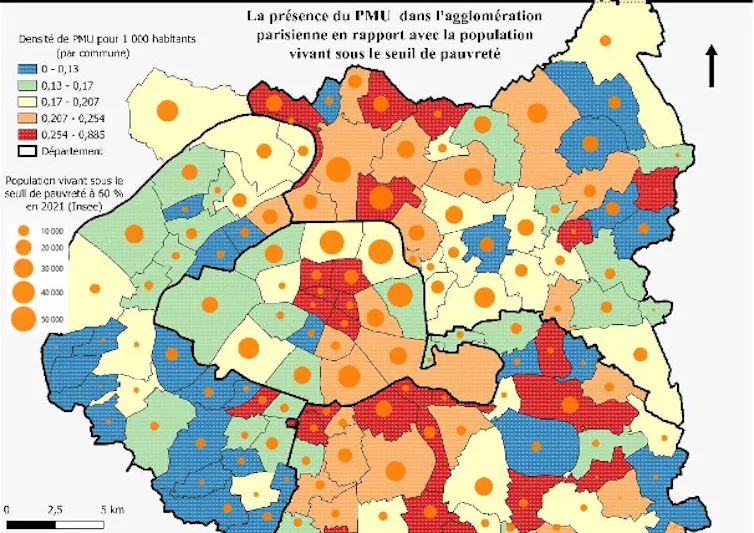
La fabrique et le maintien d’un réseau de points de vente ne résultent ainsi pas d’une simple logique de diffusion commerciale uniforme : il est construit de manière ciblée, en fonction des quartiers souvent populaires et défavorisés (Figure 1), des flux de population et des espaces de forte fréquentation.
Figure 1 : La présence du PMU dans l’agglomération parisienne en rapport avec la population vivant sous le seuil de pauvreté. Nicolas Brun, 2022, Fourni par l’auteur
Dans cette perspective, le choix des emplacements n’est jamais sans conséquences. Il s’agit d’une véritable politique de l’offre, qui vise à maximiser les occasions de contact entre les publics ciblés et les espaces de vente des produits de jeu.
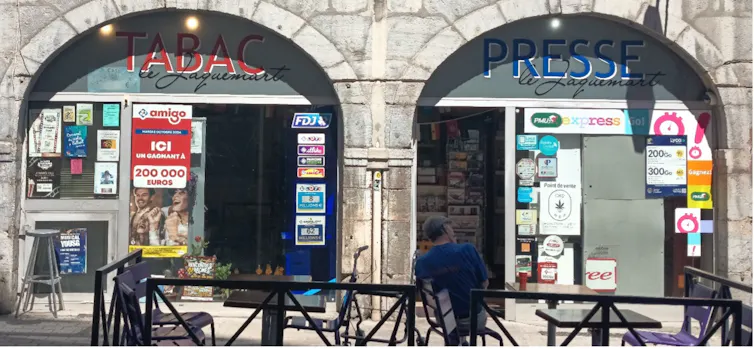
Image 1 : Tabac-Presse affichant fièrement « ICI, un gagnant à 200 000 euros ». Nicolas Brun, Besançon (Doubs), 8 mai 2026, Fourni par l’auteur
Les points de vente constituent également des vitrines et des rappels de ce qu’il est possible de gagner en jouant (Image 1). Implantés principalement dans des commerces de proximité (bars-PMU, tabacs-presse), les opérateurs de jeux cherchent à être proches des gens et de leurs habitudes. En parallèle, la visibilité du jeu est de plus en plus marquée dans les rues et transports en commun à travers les campagnes publicitaires (Image 2).
Image 2 : De gauche à droite, publicité Winamax à Paris, publicité Unibet à Aubervilliers (Seine-Saint-Denis), publicité Parions Sport en ligne à Stains (Seine-Saint-Denis). Publicité Betclic projetée simultanément sur deux écrans à la gare de Toulouse-Matabiau (Haute-Garonne). Nicolas Brun, 2025, Fourni par l’auteur
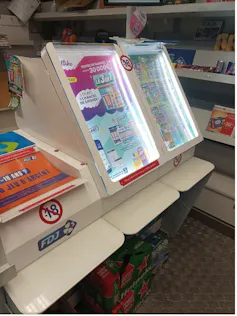
De plus, la pluriactivité des espaces de jeu en France favorise la venue d’une clientèle variée, qui se retrouve alors fortement sollicitée par des messages et des incitations à jouer. Voir le montant de la prochaine cagnotte et des gains réalisés dans ce point de vente, passer devant le présentoir des jeux à gratter (Image 3), devoir ajouter une grille de Loto pour pouvoir payer ses cigarettes avec la carte bancaire sont autant de situations qui facilitent le jeu et incitent à la consommation.
Jouer comme support de sociabilité
Pour essayer de comprendre la place des points de vente dans la pratique du jeu, il faut toutefois dépasser la lecture réductrice qui consisterait à penser que l’on ne joue que dans l’attente très hypothétique de gagner le « gros lot ».
Certes, l’espoir d’un gain financier reste le moteur principal des joueurs. L’imaginaire du jackpot, savamment entretenu par les « Big Gambling », permet de rêver à une vie meilleure. Mais, cette promesse qui n’est qu’exceptionnellement satisfaite ne peut suffire à elle seule à expliquer la persistance des pratiques, en particulier dans les lieux physiques.
Image 3 : Présentoir des jeux à gratter de la FDJ dans un point de vente. Nicolas Brun, Aubervilliers (Seine-Saint-Denis), 20 mai 2022, Fourni par l’auteur
De nombreux travaux en sciences humaines et sociales nous montrent également que les espaces de jeu sont aussi des espaces de sociabilité dans lesquels des communautés se forment et se retrouvent (turfistes, amis, collègues…). Bien sûr, ceci est particulièrement vrai pour les aficionados du PMU qui, dans sa pratique, favorise le maintien à l’intérieur des espaces de jeu. Mais cela ne signifie pas que les adeptes des loteries, paris sportifs ou jeux à gratter échappent à cette socialisation au sein des points de vente.
On joue en allant acheter ses cigarettes, son journal, en prenant une pause café, ou encore, en sortant du travail. Le jeu n’est pas forcément central, mais il s’intègre à des pratiques quotidiennes qui impliquent des micro-interactions. Les commerces savent articuler habilement ces routines.
Une matérialité qui compte
On ne joue pas seulement à un jeu : on joue quelque part… et (pour l’instant) ce quelque part est encore généralement un point de vente de la FDJ ou du PMU. L’expérience du jeu est consubstantielle au lieu où elle se déroule.
L’ambiance du commerce, les affiches, les écrans, les discussions ou les habitudes de fréquentation participent pleinement à la pratique. L’espace intérieur des points de vente constitue ainsi un dispositif de mise en jeu, entendu ici comme un ensemble d’agencements matériels, spatiaux et sociaux participant à orienter les comportements et les pratiques. Dans ces espaces, rien n’est laissé au hasard, de la localisation du présentoir de tickets à gratter, toujours placé de façon à être visible depuis l’entrée du commerce, aux micro-espaces structurés autour de chaque expérience en fonction de ses jeux de prédilection (Figure 2).
Figure 2 : Représentation simplifiée de l’organisation interne d’un bar-PMU/FDJ à Aubervilliers (Seine-Saint-Denis). Nicolas Brun, 2023, Fourni par l’auteur
Cette matérialité du lieu et du jeu compte. Elle introduit ainsi une forme de décalage. Dans ces espaces du quotidien, la pratique du jeu ouvre une parenthèse, le temps du jeu suspend brièvement le cours ordinaire des choses. L’espace mental du jeu, concept avancé par Winnicot, « contribue à bâtir une temporalité » propre au jeu et à ses pratiques dans des lieux spécifiques produits pour cela. En ce sens, les espaces de jeu fonctionnent bien souvent comme des hétérotopies : des espaces à part au sein du quotidien, où les temporalités ordinaires se trouvent momentanément suspendues et où se construit une forme d’illusion collective, celle d’être, face au hasard, toutes et tous égaux dans la possibilité d’une réussite.
Cette suspension du temps est d’ailleurs explicitement mobilisée dans les stratégies de communication des opérateurs eux-mêmes. Dans une récente campagne publicitaire de FDJ United pour sa marque, Parions Sport en point de vente, l’opérateur de jeu met en scène Éric Cantona dans le rôle d’un commerçant. Dans un de ces clips publicitaires, l’ancien joueur de foot et comédien recherche le contact physique avec un parieur en lui serrant la main pendant de longues secondes, qui sont comme suspendues hors du temps. Cette séquence insiste moins sur le résultat du pari que sur l’intensité du moment vécu dans le lieu de jeu lui-même. L’espace socialisé du jeu apparaît ici comme un lieu qui modifie brièvement le rapport ordinaire au temps.
Quand l’espace fait jouer
Les points de vente ne constituent pas de simples relais de distribution de tickets à gratter ou de grilles de Loto. Ils contribuent à organiser les conditions mêmes de la pratique, en inscrivant le jeu dans des lieux connus et parfois fantasmés, à l’intérieur de routines et de sociabilités ordinaires, qui favorisent la pérennité de l’espoir d’un gain important.
Par ailleurs, leur inscription dans l’espace urbain ne relève pas d’une logique neutre de proximité. En effet, il s’agit bien d’une stratégie orchestrée par les opérateurs de jeux, fondée sur le ciblage d’une partie de la population, la captation des flux d’individus et la multiplication des sollicitations aux jeux (pression publicitaire, visibilité dans la rue…). Les points de vente fonctionnent ainsi comme des supports d’exposition permanente du jeu.
L’implantation des espaces de jeu dans des commerces fréquentés pour de multiples raisons, où se superposent consommation (d’alcool), sociabilités et circulations, favorise également la pratique du jeu et en banalise les usages.
C’est cette production organisée de la visibilité et de l’accessibilité du jeu qui permet de comprendre la persistance des points de vente dans un secteur pourtant de plus en plus numérisé.
Nicolas Brun a reçu des financements du Groupement d’intérêt scientifique Jeu et Sociétés.