Source: The Conversation – France in French (2) – By Thomas Similowski, Professeur de pneumologie, directeur de l’unité de recherche UMRS1158 (Neurophysiologie Respiratoire Expérimentale et Clinique), spécialiste des interactions entre système respiratoire, système nerveux, et société, Sorbonne Université
Les œuvres d’art et les robots peuvent aussi respirer !UMRS 1158, Fourni par l’auteur
La respiration n’a pas comme unique fonction de nous apporter de l’oxygène et d’éliminer du dioxyde de carbone. Loin de là. Elle sert aussi à communiquer de multiples manières. Avec les autres, explicitement et implicitement ; avec soi-même ; et même avec des robots ou des œuvres d’art. Cette faculté est propre à la respiration : on ne communique avec son cœur ou ses tripes qu’au figuré.
Parmi les fonctions vitales, la respiration possède deux grandes particularités. La première est que nous pouvons en prendre temporairement le contrôle. Comment est-ce possible ? Parce que l’automatisme respiratoire ne vient pas des poumons eux-mêmes, comme c’est le cas pour les automatismes du cœur et de l’intestin, mais d’ailleurs : du système nerveux central. Pour respirer, il faut contracter des muscles « squelettiques » (qui font bouger des os), dont le plus connu est le diaphragme, la coupole musculaire qui sépare thorax et abdomen. Ces muscles respiratoires sont commandés par des neurones de la moelle épinière. Notre cortex cérébral y a accès pour en faire ce que nous voulons, en court-circuitant temporairement les structures automatiques qui assurent le rythme respiratoire (des oscillateurs neuronaux du tronc cérébral). Ce phénomène n’existe pour aucune autre fonction vitale.
Pour parler (ou chanter, ou siffler, ou jouer d’un instrument à vent), il faut pouvoir arrêter la respiration automatique, prendre une grande inspiration pour une voix forte ou une phrase longue, segmenter son souffle pour moduler sa prosodie. Une fois dit, cela paraît évident. Mais aviez-vous vraiment conscience que sans contrôle de la respiration, c’est le silence ?
Respirer, c’est communiquer
Deuxième particularité de la respiration : elle se voit et elle s’entend. Nous pouvons communiquer impatience, lassitude, colère, fatigue, soulagement, surprise, ou peur par des soupirs expressifs. Mais il y a plus subtil.
La respiration est branchée sur notre état physiologique (le sommeil ou l’effort), notre santé, nos émotions. Tous ces sentiments caricaturés explicitement par les soupirs appuyés, la respiration les traduit implicitement par des modifications de son amplitude et de sa fréquence, et des sons de notre « soufflet ».
Respiration lente, régulière et profonde de l’apaisé qui somnole. Respiration superficielle, rapide, monotone de la crise d’anxiété. Respiration saccadée, irrégulière de la joie et de l’excitation. Que nous en ayons conscience ou pas (plus souvent « pas », d’ailleurs), nous envoyons aux autres un flux continu d’information sur nous-mêmes par le simple fait de respirer. C’est d’ailleurs une source d’alliance : la synchronisation respiratoire, implicite ou explicite, peut créer un lien, favoriser la coopération. Nous avons même chacun notre signature motrice respiratoire : en effet, la façon dont notre poitrine se gonfle et se dégonfle nous est propre, comme l’est notre démarche.
Par ailleurs, notre cerveau est bombardé en permanence de milliers de messages qui proviennent de notre appareil respiratoire. Il se sert de ces messages comme d’un échafaudage pour coordonner des aires cérébrales impliquées dans de multiples fonctions cognitives : mémoriser ou décider, par exemple. Des recherches ont montré que nous enregistrons mieux une image si elle nous est présentée pendant l’inspiration que pendant l’expiration.
Ainsi, par la respiration, nous communiquons avec nous-mêmes. Et nous pouvons agir sur notre cerveau, en particulier l’apaiser, en changeant notre façon de respirer, une propriété largement mise à profit par la plupart des approches psychocorporelles.
Faire respirer les robots
Mais revenons à cette respiration qui se voit et qui s’entend, qui renseigne sur vous, qui dit en fait « Regarde, écoute, je suis vivant », et ce, dès notre tout premier cri, jusqu’à notre dernier souffle.
Pour savoir si quelque chose est vivant, les enfants utilisent trois indices : ça bouge ; ça respire ; ça grandit (mais celui-ci demande du temps). Donc pour savoir tout de suite si c’est vivant, même si cela ne bouge pas : est-ce que cela respire ?
Au laboratoire de physiopathologie respiratoire de l’unité de recherche UMRS 1158 Inserm-Sorbonne Université, et en collaboration avec l’Institut des systèmes intelligents et de robotique de Sorbonne Université, nous avons mobilisé ce concept pour l’appliquer à une problématique très spécifique, celle des interactions humains-robots.
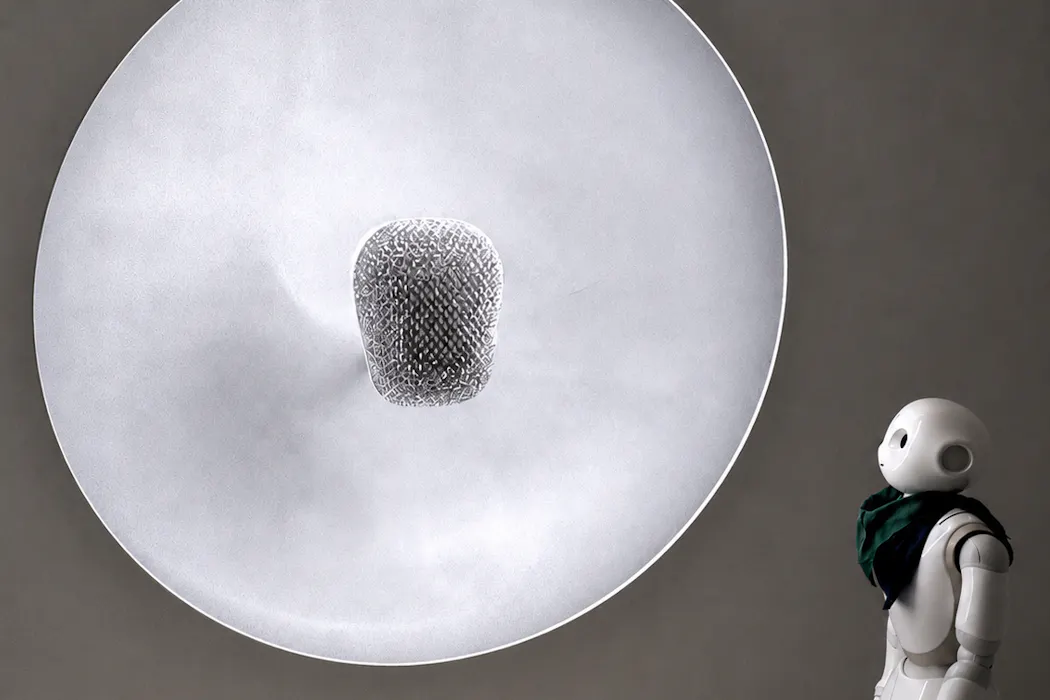
Le robot Pepper animé pour donner le sentiment d’une respiration.
Est-ce qu’un robot qui « respire » est plus « engageant » qu’un robot « normal » ? Ceci avait déjà été observé par d’autres chercheurs qui avaient animé un bras mécanique de mouvements cadencés ressemblant à une respiration. Les humains, qui travaillaient avec le robot sur une chaîne de coproduction humains-machines, avaient trouvé le « bras respirant » plus « vivant », plus « humain », plus « intelligent », plus « aimable » et plus « rassurant », selon un outil d’évaluation très utilisé en robotique (le questionnaire « Godspeed »). Mais notre question s’adressait davantage à ces robots humanoïdes qui seront peut-être nos compagnons, nos interlocuteurs de demain. Faire respirer un robot déjà très attractif par sa morphologie, est-ce mieux ? Ou au contraire, est-ce dérangeant ?
Pour tester cela, nous avons programmé deux robots « Pepper » (un petit humanoïde bourré de capteurs qui ressemble à un enfant d’une dizaine d’années) pour qu’ils puissent converser avec des humains. Nous en avons animé un de petits bruits et mouvements aléatoires que l’on injecte souvent dans le comportement des robots pour les rendre plus « vivants ». Nous avons animé l’autre d’un mouvement associant redressement du torse et rotation des épaules (comme ce qui se passe lorsque nous inspirons) ainsi que d’un discret souffle. Le résultat a été probant. Alors que la plupart des participants ne réalisaient pas consciemment que l’un des deux robots respirait, ils trouvaient celui-ci « plus vivant » et « plus intelligent ».
Surtout, l’interaction changeait : les participants passaient davantage de temps à regarder la tête et le visage du robot (« temps de regard ») et l’échange durait plus longtemps. Statistiquement, deux facteurs seulement étaient significativement associés au temps de regard : la respiration du robot d’une part et le niveau de sollicitude empathique de son interlocuteur de l’autre.
Un humain s’implique plus dans une interaction avec un robot si le robot « respire ». Donc, la respiration est un vecteur de communication même avec le « non-vivant ». Une piste si l’on souhaite humaniser toujours plus robots, intelligences artificielles et autres agents virtuels ?
Quand l’art respire
Réespiration. Samuel Bianchini
C’est selon ce principe d’animéité respiratoire que notre unité de recherche s’est intégrée à une équipe multidisciplinaire, réunie par Samuel Bianchini, artiste et enseignant-chercheur à l’École nationale supérieure des arts décoratifs, équipe dont les efforts ont convergé vers la création d’une œuvre d’art respirante.
Réespiration combine création artistique, robotique souple, ingénierie mécanique, intelligence artificielle, physiologie, design textile, design sonore, et bien d’autres choses encore, en une entité qui respire comme un humain (grâce à l’entraînement d’un algorithme spécialisé et qui peut synchroniser son rythme respiratoire à celui de son spectateur, voire l’influencer. Les réactions du public et les premières données de recherche montrent qu’en présence de Réespiration, les corps se détendent, les cerveaux s’apaisent. Ils vagabondent même, en chemin vers un état modifié de conscience.
Les robots respirants en général, et Réespiration en particulier, auront-ils des applications médicales ? Apaiseront-ils l’anxiété, aideront-ils à soulager la souffrance des patients atteints de maladies respiratoires chroniques ? C’est la prochaine question…
L’UMRS 1158 et le projet Réespiration sont soutenus par la Fondation du Souffle, www.lesouffle.org
Source: The Conversation – France in French (2) – By David Stroebel, Ingénieur de recherche hors classe CNRS dans l’équipe Récepteurs du glutamate et synapses excitatrices, Institut de biologie, École normale supérieure (ENS) – PSL
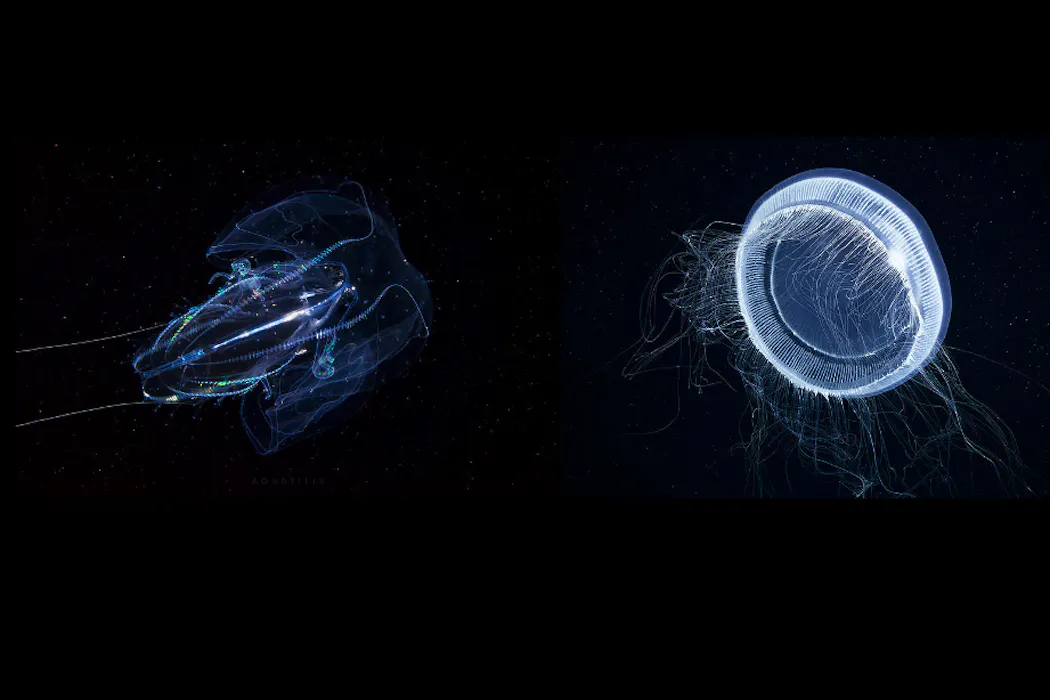
Un cténophore (*Leucothea multicornis*, à gauche) et une méduse, ou cnidaire (*Aequorea sp.*, à droite), se ressemblent beaucoup mais n’ont pas – du tout ! – le même type de système nerveux.Alexander Semenov/Flickr, CC BY-NC-SA
Dans les livres de biologie, on apprend que le système nerveux se compose de neurones connectés par des synapses, indispensables à nos capacités de cognition. Jusqu’à très récemment, les synapses étaient un élément incontournable de tous les systèmes nerveux connus. Mais voilà que des chercheurs ont observé un système différent, sans synapses, chez d’intrigants animaux marins, les cténophores. Cette avancée suscite les débats chez les scientifiques.
Aux prémices de la neurobiologie moderne, au début du XXᵉ siècle, une rivalité d’anthologie opposa Camillo Golgi, médecin italien, pionnier et figure tutélaire de la microscopie cellulaire, et l’Espagnol Santiago Ramón y Cajal, génie de la neuroanatomie. L’Italien avançait que le système nerveux formait un réseau unique et continu : un syncytium. L’Espagnol y voyait plutôt un réseau discontinu, fait de cellules indépendantes se contactant par des synapses.
Les co-lauréats du prix Nobel de physiologie ou médecine en 1906 ont deux visions bien différentes du système nerveux des êtres vivants : Santiago Ramón y Cajal, à gauche, penchait pour un réseau avec des synapses qui connectent les neurones entre eux, tandis que Camillo Golgi (à droite) avait imaginé un système nerveux continu, le « syncytium ». Wikimédia, CC BY
Cent vingt ans après l’attribution du même prix Nobel de physiologie aux deux scientifiques, le succès de Cajal apparaît total : les synapses constituent une pièce maîtresse de notre compréhension actuelle du fonctionnement du système nerveux. De fait, ces structures submicrométriques innombrables dans le cerveau (près d’un demi-million de milliards de synapses chez l’humain) forment le support des capacités de computation, d’apprentissage et de mémorisation.
Mais si, envers et contre l’histoire de la neurobiologie moderne, Golgi avait pu aussi avoir raison ? Et si le système nerveux d’un organisme pouvait également fonctionner en syncytium ?
C’est précisément ce que des chercheurs ont découvert en 2023, en imageant un cténophore par tomographie électronique. Les cténophores sont des créatures marines translucides, familières de presque tous les environnements marins, qui se distinguent par de délicates ondulations irisées à leur surface. Certains cténophores peuvent sembler, à première vue, être de proches cousins des méduses. Cependant, l’étude publiée en 2023, dans la revue Science, révèle que la partie centrale du réseau neural de cténophore est continu, un cas sans équivalent dans le monde vivant.
Le syncytium neural de Golgi se trouvait en fait… dans les mers.
Un système synaptique shématique, à gauche, contenant des neurones distincts – de couleurs différentes – qui se connectent au niveau de synapses, correspondant ici à des petits renflements sphériques. Les lignes colorées représentent les axones d’autres neurones voisins. À droite, un système syncytial, sous forme de réseau continu sans synapses, schématisé d’après les images de microscopie électronique de tissu neural sub-épithélial de cténophore. David Stroebel, Fourni par l’auteur
Les cténophores n’en sont pas à leur première originalité
Pourquoi une telle querelle entre spécialistes ? Parce que l’ancestralité des cténophores chez les animaux (Métazoaires) complexifie le scénario d’émergence du système nerveux.
En effet, les classifications du vivant considéraient jusque-là que notre ancêtre commun, Eumétazaoire, a acquis un système nerveux après la séparation du groupe des éponges, qui, elles, seraient demeurées dépourvues de système nerveux. Le repositionnement des cténophores dans l’arbre du vivant bouscule complètement ce scénario : il impliquerait l’émergence multiple et séparée de systèmes nerveux potentiellement différents, couplée ou non à la disparition du système nerveux chez certaines espèces (par exemple, chez les éponges).
L’état actuel des recherches ne permet d’exclure aucun des deux scénarios. Le scénario initial a pour lui une grande simplicité (on parle de scénario « parcimonieux »), permettant aisément d’envisager un assemblage progressif de la complexité du système nerveux. Le scénario nouvellement remanié est porté par l’évolution exceptionnelle des données de séquençage de génome et des outils d’analyse bio-informatique. Ce nouveau scénario a le bénéfice et l’attrait de la nouveauté. Mais, pour convaincre, il lui reste encore à élaborer un mécanisme évolutif convaincant de formation du système nerveux.
C’est là qu’intervient la découverte de la singularité du système nerveux des cténophores, appuyant l’originalité biologique de ces discrets organismes marins parmi les animaux (Métazoaires). Si, à ce stade, elle ne permet pas formellement de trancher entre les deux théories, cette découverte offre un aperçu des possibilités insoupçonnées d’organisation du système nerveux dans le vivant. Par là même, elle ouvre les chemins des possibles évolutifs, ceux qui faisaient défaut aux scénarios complexes de co-émergence de systèmes nerveux.
Les cténophores déterrent le débat entre Golgi et Cajal
Mais revenons à l’autre débat, celui d’il y a plus de cent ans, entre Cajal et Golgi – ou, désormais transposé à la biologie marine, la distinction d’organisation neurobiologique entre cténophores et cnidaires. Que peut bien apporter une organisation neurale en syncytium par rapport à celle bien connue basée sur des synapses (et vice versa) ?
Pour l’instant, on ne sait encore presque rien du fonctionnement de ce syncytium neural des cténophores, seulement qu’il connecte les cellules excitables sensorielles et motrices de l’animal. En attendant les résultats de futures investigations, nous en sommes aujourd’hui juste réduits à spéculer sur ce qu’un tel réseau pourrait procurer : une économie d’énergie ? Un gain de rapidité de réponse ?
Le rôle des synapses, des méduses aux humains
Dans les organismes neuraux, les synapses constituent la base des capacités d’encodage complexe du signal au sein du réseau. L’importance de leur capacité d’adaptation (appelée aussi plasticité) et l’étendue de leur diversité constituent des champs d’investigation actifs de la neurobiologie actuelle. Plusieurs décennies de recherche intensive nous ont appris que, selon leur type et leur environnement cellulaire, les synapses modulent la force, la dynamique et même la nature des signaux transmis au neurone qu’elle contacte.
Ces propriétés sont vraisemblablement à l’origine des possibilités d’expansion et de complexification des réseaux neuronaux des organismes à synapses, comme chez nous autres Vertébrés. In fine, ce sont cette expansion et cette complexification qui ont permis de supporter le développement de comportements et d’apprentissages élaborés, jusqu’aux prouesses des transmissions culturelles humaines.
Embrasser la complexité du vivant
Alors, système à syncytium ou à synapses ?
Si juger (neurobiologiquement) de l’efficacité relative d’organisations si différentes n’a guère de sens, un regard sur les chiffres de population des espèces concernées révèle une profonde asymétrie. Seule une centaine d’espèces de cténophores est référencée alors qu’il existerait plus d’un million d’espèces d’animaux neuraux. Le succès évolutif des organismes à synapses – à la fois en termes de diversité que de biotopes occupés – est aussi incontestable que la postérité de Cajal.
Pourtant, après 600 millions d’années marquées par plusieurs extinctions massives, les cténophores continuent de cohabiter avec les autres espèces peuplant nos océans. La sélection naturelle n’a pas tranché entre système à syncytium et à synapses.
Et les cténophores, tels des clins d’yeux facétieux aux modèles de Golgi, persistent à tourner en dérision nos schémas simplistes, du fonctionnement neural au scénario de nos origines.
David Stroebel est un agent du CNRS, France. Il a reçu des financements de l’ANR (Agence Nationale pour la Recherche, France) ainsi que de la FRM (Fondation pour la recherche médicale).
La recherche de vie ailleurs que sur Terre n’est pas de la science-fiction, mais un domaine très sérieux de recherche : l’exobiologie. Découvrez les techniques qui pourraient permettre, un jour, une rencontre du troisième type.
Sommes-nous seuls dans l’Univers ? Pendant longtemps, cette question relevait surtout de la philosophie. Chacun pouvait avoir son intuition. Kant disait même qu’il parierait toute sa fortune sur l’existence d’une vie ailleurs dans l’Univers. Il ne prenait pourtant pas un très grand risque : à son époque, il était impossible de tester cette hypothèse.
Aujourd’hui, la situation a profondément changé. Grâce aux progrès de l’astronomie, de la biologie, de la chimie et de la géologie, la recherche de la vie extraterrestre est devenue une véritable discipline scientifique : l’exobiologie. Des milliers de chercheurs tentent désormais de répondre expérimentalement à une question qui semblait encore hors de portée il y a quelques décennies.
Plusieurs approches sont explorées. L’idée est d’apprendre ce que l’on peut du cas terrestre avant d’extrapoler à d’autres mondes. Ainsi, certaines équipes cherchent à comprendre comment la vie est apparue sur Terre afin d’identifier les ingrédients indispensables à son émergence. D’autres étudient son évolution vers des organismes plus complexes.
Les astronomes, eux, s’intéressent à une autre question : si la vie existe ailleurs, comment pourrions-nous la détecter ?
Deux grandes stratégies se dessinent. La première consiste à rechercher des biosignatures, c’est-à-dire des traces laissées par des organismes vivants. La seconde vise les technosignatures, des indices qui pourraient révéler l’existence d’une civilisation suffisamment avancée pour développer une technologie détectable.
Chercher la vie dans le système solaire
La façon de rechercher la vie dépend avant tout de la distance. Dans notre système solaire, nous pouvons envoyer des sondes pour analyser directement des roches, des glaces ou des océans cachés sous la surface. Autour d’autres étoiles, en revanche, nous sommes condamnés à observer les planètes à distance et à interpréter la faible lumière qui nous parvient.
Mars reste l’une des cibles les plus étudiées. Le rover Perseverance ne cherche pas à photographier d’éventuels organismes vivants, mais à identifier des biosignatures fossiles : des traces chimiques ou géologiques qui indiqueraient qu’une vie microbienne a existé lorsque Mars possédait des lacs et des rivières il y a plusieurs milliards d’années. Les échantillons qu’il collecte devraient être rapportés sur Terre dans les prochaines décennies – sûrement avec beaucoup de retard à cause de coupes budgétaires sévères de l’administration Trump – afin d’être analysés avec les instruments les plus performants.
D’autres mondes suscitent également beaucoup d’espoir. Les lunes glacées Europe, autour de Jupiter, et Encelade, autour de Saturne, abritent un océan d’eau liquide sous leur croûte de glace. Encelade projette même dans l’espace des panaches d’eau provenant de son océan, offrant une occasion unique d’en analyser directement la composition. Les missions Europa Clipper et Juice, actuellement en route, permettront de mieux comprendre si ces océans réunissent les conditions favorables à l’apparition de la vie.
Au-delà du système solaire, cette approche directe devient impossible. Les astronomes doivent alors rechercher les traces que la vie pourrait laisser dans l’atmosphère ou à la surface des exoplanètes.
Les biosignatures : rechercher les empreintes laissées par la vie
Sur Terre, les êtres vivants modifient profondément leur environnement. Certaines bactéries produisent de l’oxygène, d’autres du méthane. Les plantes absorbent certaines longueurs d’onde de la lumière pour réaliser la photosynthèse. Toutes ces activités laissent des signatures qui pourraient, en principe, être détectées à des dizaines d’années-lumière.
On pourrait croire qu’il suffit de détecter de l’oxygène dans l’atmosphère d’une exoplanète pour conclure à la présence de vie. Malheureusement, la nature sait produire de l’oxygène sans intervention biologique. Il existe de nombreux mécanismes dits abiotiques capables d’imiter certaines signatures du vivant.
On recherche donc des indices plus subtils : des déséquilibres chimiques. Sur Terre, par exemple, l’oxygène et le méthane coexistent alors qu’ils devraient rapidement réagir entre eux pour former du dioxyde de carbone. S’ils restent présents simultanément, c’est parce que les organismes vivants les renouvellent en permanence. Une telle combinaison constitue une biosignature beaucoup plus convaincante qu’une seule molécule prise isolément.
L’actualité récente illustre parfaitement cette difficulté. En 2025, des observations réalisées avec le télescope spatial James-Webb sur l’exoplanète K2-18 b ont révélé la présence possible de molécules comme le sulfure de diméthyle (DMS), un composé qui, sur Terre, est principalement produit par le phytoplancton marin. L’annonce a suscité un immense enthousiasme, mais aussi de nombreuses réserves : les données restent limitées et les conclusions ont sans doute été tirées un peu trop rapidement. De plus, il est possible que ces molécules puissent être produites par des processus non biologiques. Cette étude rappelle qu’aucune molécule, à elle seule, ne peut aujourd’hui être considérée comme une preuve de l’existence de la vie. Il faudra réunir plusieurs indices indépendants et convergents avant de pouvoir revendiquer une détection crédible.
Une autre approche consiste à observer directement la lumière réfléchie par une planète. Sur Terre, les végétaux absorbent fortement la lumière rouge pour alimenter la photosynthèse, puis réfléchissent très efficacement le proche infrarouge. Cette transition brutale, appelée le « bord rouge » de la végétation (vegetation red edge), est visible lorsqu’on observe notre planète depuis l’espace. Si une biosphère extraterrestre exploitait elle aussi l’énergie de son étoile grâce à un processus analogue, elle pourrait laisser une signature similaire, même si ses organismes étaient très différents des plantes terrestres.
Aucune de ces observations ne suffira, à elle seule, à démontrer l’existence de la vie. Les astronomes devront croiser plusieurs indices : la composition de l’atmosphère, la présence éventuelle d’eau liquide, la nature rocheuse de la planète, son champ magnétique ou encore les propriétés de son étoile. Comme dans une enquête policière, c’est l’accumulation de preuves indépendantes qui permettra de construire un scénario crédible.
Les technosignatures : rechercher des civilisations plutôt que des microbes
On pourrait penser que les astronomes devraient concentrer tous leurs efforts sur la recherche de vie microbienne, probablement beaucoup plus abondante que les civilisations technologiques. Pourtant, les deux approches sont complémentaires.
Les biosignatures sont sans doute plus fréquentes, mais souvent ambiguës. Les technosignatures, elles, seraient probablement beaucoup plus rares, mais aussi beaucoup plus difficiles à expliquer autrement. Si nous recevions un signal radio contenant les décimales du nombre π ou une suite de nombres premiers, le doute serait permis bien moins longtemps.
Depuis les années 1960, les recherches regroupées sous le nom de SETI (Search for Extraterrestrial Intelligence) scrutent le ciel à la recherche de signaux radio artificiels. L’idée est qu’une civilisation pourrait chercher à communiquer avec d’autres ou laisser s’échapper involontairement des émissions, comme nos propres transmissions radio et télévisées fuient dans l’espace depuis près d’un siècle.
À ce jour, aucune détection n’a été confirmée. Le célèbre « signal Wow ! », enregistré en 1977 par un radiotélescope de l’Ohio State University, est une émission radio de 72 secondes très intense et de bande étroite provenant de la constellation du Sagittaire. Son caractère inhabituel a suscité de nombreuses spéculations, mais son origine demeure inconnue. Surtout, l’absence de toute nouvelle détection similaire empêche d’y voir une preuve convaincante d’une civilisation extraterrestre.
Aujourd’hui, des chercheurs explorent un éventail beaucoup plus large de technosignatures. Une planète couverte d’éclairages artificiels pourrait produire une émission lumineuse inhabituelle. Une civilisation très avancée pourrait construire d’immenses infrastructures destinées à exploiter l’énergie de son étoile, comme les sphères de Dyson, un hypothétique immense ensemble de satellites collecteurs répartis autour de l’étoile pour en récupérer une grande partie de l’énergie. Il est également envisageable de rechercher des polluants industriels impossibles à produire naturellement, des faisceaux laser utilisés pour communiquer, voire des constellations de satellites semblables au réseau Starlink.
Une quête qui ne fait que commencer
Le télescope spatial James-Webb inaugure une nouvelle ère en permettant de sonder les atmosphères d’exoplanètes avec une précision jamais atteinte. Mais les instruments actuels restent encore limités.
La prochaine révolution viendra probablement de l’Extremely Large Telescope (ELT), actuellement en construction au Chili. Avec son miroir de 39 mètres de diamètre, il pourra analyser en détail l’atmosphère de petites planètes rocheuses situées autour d’étoiles proches. Les futurs observatoires spatiaux iront encore plus loin. Ensemble, ils permettront de tester des biosignatures toujours plus subtiles et d’éliminer progressivement les explications alternatives.
La découverte d’une vie extraterrestre ne prendra probablement pas la forme d’une photographie spectaculaire ou d’un unique signal mystérieux. Elle résultera plutôt d’une accumulation patiente d’indices, confrontés pendant des années à toutes les explications possibles.
Pour la première fois de l’histoire, la question « Sommes-nous seuls dans l’Univers ? » n’appartient plus seulement à la philosophie. Elle est devenue une question scientifique. Et les prochaines décennies pourraient enfin nous apporter les premiers éléments de réponse.
Pour en savoir plus sur cette quête de la vie extraterrestre, vous pouvez consulter le livre de Quentin Kral, Les Astronomes à la recherche de la vie extraterrestre, aux éditions Ellipses, 2025.
Quentin Kral est l’auteur de l’ouvrage : « Les astronomes à la recherche de la vie extraterrestre » aux éditions ellipses.
Source: The Conversation – (in Spanish) – By Óscar del Barco Novillo, Profesor Ayudante Doctor. Departamento de Física (área de Astronomía y Astrofísica), Universidad de Murcia
Recreación artística de nuestra galaxia, la Vía Láctea, observada desde la parte superior o en visión perpendicular al disco galáctico. La imagen muestra la estructura de galaxia en espiral con cuatro brazos principales. NASA/JPL-Caltech/R. Hurt (SSC/Caltech., CC BY
Al estar inmersos en el plano galáctico, no disponemos de la perspectiva necesaria o vista de pájaro para conocer su aspecto preciso, así como tampoco es fácil determinar con exactitud su tamaño. Afortunadamente, con los datos disponibles de la misión europea Gaia y observando otras galaxias parecidas a la nuestra, podemos concretar con bastante detalle su forma y estimar de forma eficaz su tamaño.
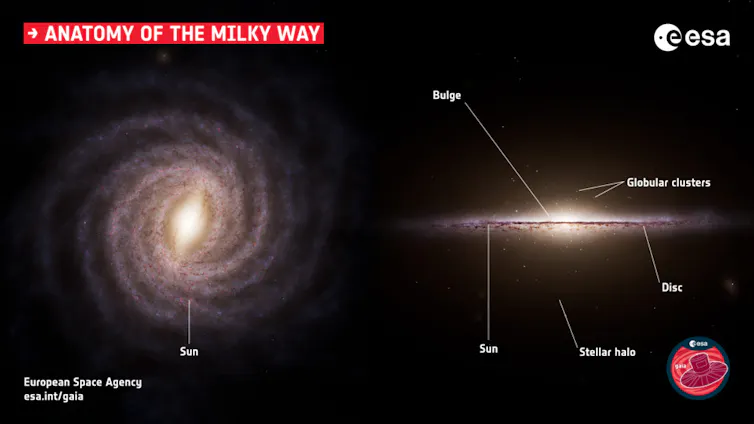
La Vía Láctea observada desde dos perspectivas distintas. Desde la parte superior o vista de pájaro (imagen izquierda) se aprecian con detalle el bulbo central y el disco galáctico, que contiene los brazos característicos de una galaxia en espiral. Obsérvese la ubicación del sistema solar en un brazo secundario (brazo de Orión) a las afueras de nuestra galaxia. En una perspectiva de canto o perfil (imagen derecha), se pone de manifiesto el escaso grosor del disco, en comparación con la longitud total del mismo. ESA., CC BY
El disco tiene un diámetro aproximado de unos 100 mil años luz y es muy delgado, con tan solo 1000 años luz de grosor. No es totalmente plano, sino que posee una forma ligeramente curvada. Nuestro sistema solar está ubicado en uno de los brazos exteriores del disco, a unos 26 mil años luz del agujero negro supermasivo Sagitario A*.
Posiblemente, la característica más bella de este tipo de galaxias sea la existencia de brazos espirales en su disco.
Estas estructuras son zonas de gran concentración de gas y materia estelar con tonos más azulados que el resto del disco. Esto indica que las estrellas que los componen son extremadamente masivas y muy jóvenes, por lo que están quemando su gran reserva de combustible nuclear a un ritmo acelerado. Como consecuencia, los brazos espirales están asociados a regiones activas donde se están formando continuamente estrellas.
En particular, la Vía Láctea consta de dos brazos principales (Escudo-Centauro y Perseo) y dos brazos secundarios prominentes (Norma y Sagitario). Además, nos encontramos con el brazo de Orión, un ramal secundario ubicado entre los brazos de Sagitario y Perseo, donde está ubicado nuestro sistema solar.
Ahora, con los resultados de esta novedosa investigación, las distancias entre los brazos más externos y el centro galáctico han cambiado de forma significativa. ¿Cómo es esto posible?
Los ecos de tres intensas explosiones extragalácticas
Los ecos de rayos X tienen estructura de anillo y sus diámetros, observados por el telescopio espacial Chandra, permiten determinar la distancia a la Tierra. Así, los anillos de mayor tamaño corresponden a nubes de polvo más cercanas a nosotros.
Concretamente, los investigadores analizaron tres fuentes de esta potente radiación, denominadas GRB 031203, GRB 160623A y la más reciente, GRB 221009A (el nombre de cada estallido indica el año, mes y día de observación, en este orden).
Un tamaño mayor del que ya conocíamos
Al analizar estos tres estallidos de rayos gamma, los investigadores calcularon las distancias a tres brazos espirales de la Vía Láctea –en orden de distancia creciente desde el centro galáctico: el brazo de Perseo, el brazo exterior y el brazo exterior de Escudo-Centauro–.
En la dirección de uno de los GRBs, los astrónomos descubrieron que tanto el brazo Exterior como el brazo Exterior de Escudo-Centauro se encuentran aproximadamente un 10 % más lejos de lo que se pensaba hasta ahora.
Recreación artística de la Vía Láctea donde se detallan los cambios en las distancias entre los brazos más externos de nuestra galaxia (imagen izquierda, las dimensiones de la Vía Láctea con los datos empleados hasta la fecha; imagen derecha, las nuevas dimensiones a partir del nuevo estudio). NASA/CXC/A. Hobart., CC BY
Esta forma de calcular distancias se basa en la geometría, mientras que la mayoría de los demás métodos dependen de suposiciones sobre cómo rota la Vía Láctea, con alto grado de incertidumbre en las regiones exteriores.
Inconvenientes y un futuro prometedor
Sin embargo, aunque esta original técnica mejoró significativamente la precisión en la medida del tamaño de nuestra galaxia, no podrá utilizarse de forma sistemática para obtener futuras mediciones. El problema radica en que los estallidos de rayos gamma intensos visibles a través del plano galáctico son muy poco frecuentes. Y sin ellos, no es posible el estudio de los ecos de rayos X.
Aún así, el conocimiento sobre la Vía Láctea seguirá creciendo durante los próximos años.
No solo serán fundamentales los datos cada vez más detallados del observatorio Gaia, sino también la futura aportación de NewAthena, el observatorio de rayos X de nueva generación de la ESA, que permitirá a los científicos explorar ecos de rayos X mucho más tenues en las regiones periféricas de nuestra galaxia.
Óscar del Barco Novillo no recibe salario, ni ejerce labores de consultoría, ni posee acciones, ni recibe financiación de ninguna compañía u organización que pueda obtener beneficio de este artículo, y ha declarado carecer de vínculos relevantes más allá del cargo académico citado.
Source: The Conversation – (in Spanish) – By Juan Ramón Liébana Ortiz, Profesor Titular de Derecho Procesal, Facultad de Derecho, UNIR – Universidad Internacional de La Rioja
El futbolista estadounidense Folarin Balogun fue expulsado por tarjeta roja directa durante la eliminatoria de dieciseisavos contra Bosnia-Herzegovina del Mundial 2026. La expulsión fue efectiva después de que el árbitro, avisado por el VAR, considerase una acción imprudente el pisotón del delantero estadounidense al bosnio Tarik Muharemovic.
La polémica estalló cuando la FIFA levantó la tarjeta roja a Balogun, permitiéndole disputar el siguiente encuentro de octavos de final con su selección. Y arreció cuando el Presidente Trump confirmó en una conferencia de prensa en el Despacho Oval que había llamado a Gianni Infantino, presidente de la FIFA, para pedirle la revisión de la sanción.
Por su parte, el Presidente de la FIFA, que también reconoció dicha conversación, ha defendido la autonomía de los órganos judiciales de la FIFA, “pues su independencia es esencial para la credibilidad e integridad del fútbol”.
Cabe preguntarse: ¿está arbitrando la Casa Blanca el mundial de fútbol? La respuesta es no. Desde la perspectiva de la justicia deportiva, el procedimiento cumple la normativa de la FIFA. Esta prevé la posibilidad de levantar una sanción tan grave como una tarjeta roja cuando así se estime oportuno. Es más, existen algunos ejemplos cercanos en el tiempo y otros idénticos a este. Cuestión distinta es si resulta estético y qué impacto pueda llegar a tener en la competición.
¿Se ha aplicado correctamente la normativa FIFA?
De acuerdo con el artículo 7.1 del Reglamento de la Copa Mundial de la FIFA 26, las infracciones disciplinarias se tratarán según estipule el Código Disciplinario de la FIFA vigente. Por su parte, el artículo 27 del Código Disciplinario de la FIFA, en vigor desde 2023, habilita a los órganos judiciales “a suspender total o parcialmente la aplicación de una medida disciplinaria”, sometiendo “al sancionado a un periodo de prueba, con una duración de entre uno y cuatro años”. Además, el artículo 25.1 del Código establece que los órganos judiciales “determinan el tipo y la extensión de las medidas disciplinarias que proceda imponer”.
¿Cómo funciona la justicia en el Mundial de Futbol?
En el “indulto a Balogun” lo que ha ocurrido es que la Comisión Disciplinaria de la FIFA, en función de los elementos objetivos y subjetivos de la infracción, ha considerado oportuna la suspensión de la sanción de un partido. La ejecución queda así pospuesta “a prueba” durante un año.
Por esta razón, el futbolista estadounidense pudo disputar el partido que enfrentó a su selección contra Bélgica correspondiente a la ronda de octavos de final, donde fue eliminada.
El recurso contra la decisión de levantar la tarjeta roja a Folarin Balogun y, por tanto, de permitirle disputar el encuentro contra Bélgica, tan sólo podría haberse combatido, una vez agotadas todas las vías de recurso de la FIFA, solicitando un arbitraje ante el Tribunal de Arbitraje Deportivo (TAS) conforme al Código de Arbitraje en Materia Deportiva del TAS
El Tribunal de Arbitraje Deportivo ha establecido una cámara ad hoc que estará vigente del 11 de junio al 19 de julio de 2026, y que garantiza la resolución rápida e independiente de los recursos contra las decisiones de la FIFA relacionadas con el torneo. Dicha instancia ofrece procedimientos de arbitraje acelerados para los casos susceptibles de apelación ante el TAS. Esta fórmula viene funcionando con éxito en todas las citas olímpicas desde los Juegos Olímpicos de Atlanta 1996.
Existen muchos otros casos similares en la historia del los mundiales de fútbol.
Cristiano Ronaldo fue expulsado, tras propinarle un codazo al irlandés O’Shea, en el encuentro de fase de grupos del Mundial 2026, que enfrentó a Portugal con Irlanda el 13 de noviembre de 2025. El artículo 14.1.i) del Código Disciplinario de la FIFA establece que, en casos de agresión (codazos, puñetazos, patadas o mordiscos, escupir o golpear a un adversario), la sanción mínima debe ser de tres partidos.
Sin embargo, la Comisión de Disciplina de la FIFA, aunque mantuvo el partido de suspensión ya cumplido, dejó en suspenso los otros dos partidos reglamentarios de sanción en función del comportamiento del luso, teniendo en cuenta que Cristiano Ronaldo no tenía antecedentes disciplinarios en sus 225 apariciones internacionales previas. Con ello se permitió que la estrella de la selección lusa pudiera participar en todos los partidos de la fase final de la Copa Mundial de la FIFA 2026, hasta que finalmente su selección perdió en octavos de final contra la de España.
Pero la historia del fútbol ha visto muchos más casos de jugadores sancionados con tarjeta roja que terminaron disputando el Mundial. El defensa francés Laurent Koscielny y el croata Mario Mandžukić en 2014, el centrocampista neerlandés Phillip Cocu en 2006, el japonés Makoto Hasebe en 2010 y Mané Garrincha en 1962 recibieron un trato similar.
El caso de Mané Garrincha, la gran estrella de Brasil en ese mundial tras la lesión de Pelé, es paradigmático. Ante una patada por detrás a un futbolista chileno, el juez de línea avisó al árbitro del partido, que expulsó al extremo brasileño en la semifinal de la Copa del Mundo de Chile 1962.
La participación en la final del Mundial del mejor jugador brasileño se convirtió en una cuestión de Estado. Hasta el presidente de Brasil, Joao Goulart, envió un telegrama al de la FIFA, el británico Stanley Rous, para pedir el indulto de un jugador ejemplar.
Aunque no se pudo aplicar la normativa actualmente vigente (no es que no existiera un Código de Disciplinario, es que ni siquiera existían las tarjetas rojas o amarillas, que se implementaron en el Mundial de México 1970), Mané Garrincha no fue suspendido puesto que el juez de línea no se presentó a ratificar su versión ante el Comité Disciplinario de la FIFA. Garrincha jugó la final de 1962 que Brasil ganó 3-1 a Checoslovaquia.
Juan Ramón Liébana Ortiz no recibe salario, ni ejerce labores de consultoría, ni posee acciones, ni recibe financiación de ninguna compañía u organización que pueda obtener beneficio de este artículo, y ha declarado carecer de vínculos relevantes más allá del cargo académico citado.
Source: The Conversation – (in Spanish) – By Francisco José Callado Muñoz, Profesor Titular de Universidad. Departamento de Economía Financiera y Contabilidad, Universidad de Alicante
Es un hecho que las cifras crecen: en 2025, el gasto en defensa a nivel global fue de casi 3 billones de dólares en 2025, un aumento del 2,9 % con respecto a 2024.
La UE se rearma
En la UE, el plan ReArmar Europa / Preparación 2030, lanzado en marzo de 2025, busca movilizar cerca de 800 000 millones de euros en los próximos cuatro años para fortalecer la seguridad europea.
Todos estos factores han incrementado el interés por el funcionamiento y los resultados del sector en los países europeos.
Vender una imagen
En un estudio reciente hemos analizado la gestión de resultados (contabilidad creativa, maquillaje contable o earnings management) en empresas de defensa españolas entre 2011 y 2020. Nuestra intención era determinar si dichas empresas buscan proyectar, a través de sus informes financieros, una imagen determinada tanto al Estado español (su principal cliente) como a los inversores y la sociedad.
La gestión de resultados engloba prácticas contables y decisiones cuyo objetivo es presentar una cifra de resultados distinta de la real, ya sea con fines estratégicos o informativos. Estas prácticas no implican desviarse de la normativa ni incurrir en fraude, pues la normativa contable permite cierta discrecionalidad de la que las empresas pueden valerse para dirigir sus resultados.
Cuando las empresas utilizan estos ajustes, la calidad de la información financiera puede verse disminuida, lo que puede dificultar su interpretación correcta por parte de las partes interesadas (opinión pública, prestamistas, inversores, clientes).
Al diferenciar entre proveedores de defensa actuales, proveedores potenciales y empresas no relacionadas con la defensa, demostramos que la gestión de resultados contables aparece en años con ventas en el sector de la defensa.
Contratación en defensa y gestión de resultados
En concreto, Nuestro análisis muestra que las empresas que dependen fuertemente de los contratos de defensa emplean estrategias diferentes según su situación particular.
De un lado, las compañías con restricciones financieras –por ejemplo, con poca liquidez o un endeudamiento elevado– tienden a ajustar sus resultados al alza para proyectar una imagen de solvencia. Esto es relevante porque, según la legislación española, las empresas pueden ser excluidas de las licitaciones públicas si están en riesgo de insolvencia o quiebra. Al intentar parecer más rentables y estables de lo que realmente son, estas compañías buscan mejorar la percepción del Estado sobre su solidez financiera para asegurarse contratos futuros.
Por otro lado, las empresas más rentables suelen gestionar sus resultados a la baja para parecer menos exitosas. Así, reducen estratégicamente sus beneficios contables para disminuir su visibilidad y evitar costes políticos: el escrutinio de los medios de comunicación y los grupos de presión antimilitaristas, o que el Estado exija condiciones económicas más estrictas en contratos posteriores a estas empresas.
Empresas que no venden al Estado
Aplicar el mismo análisis en compañías que nunca han obtenido contratos en el sector de la defensa muestra que estas últimas gestionan menos sus resultados. Esto sugiere que las empresas hacen gestión de resultados, sobre todo, cuando facturan a la Administración pública.
En los países desarrollados, tener al Estado como cliente implica un menor riesgo, pues la posibilidad de impago es mínima y los contratos suelen ser duraderos. Por ello, las empresas buscan mantener estas relaciones para mejorar su rentabilidad y acceder a financiación en mejores condiciones.
Sin embargo, nuestro resultado contrasta con los de investigaciones similares realizadas en Estados Unidos, donde los contratos gubernamentales mejoran la calidad de la información financiera. No obstante, hay que tener en cuenta que los trabajos sobre gestión del resultado y contratación pública centrados en EE. UU. analizan contratos públicos de adquisición en distintos sectores y no solo en el de la defensa.
¿Por qué esa diferencia?
Dos razones pueden explicar estas diferencias:
Las particularidades del sector de la defensa, que se caracteriza por la complejidad de sus productos. Además, en el caso de las empresas españolas, el ministerio es su principal, y en algunos casos único, cliente. Esto incrementa los incentivos para que actúen estratégicamente y ajusten sus resultados para conseguir o mantener un contrato.
La distinta capacidad de supervisión institucional. En este sentido, las agencias gubernamentales estadounidenses parecieran contar con una mayor capacidad de monitorización que el ministerio de Defensa español. Aunque en los últimos años ha intentado mejorar sus mecanismos de control, no parece que los planes de racionalización y centralización de la gestión hayan sido suficiente para evitar el incentivo de las empresas contratistas a incurrir en prácticas de gestión del resultado. Esto puede deberse a factores como las limitaciones de personal público o la gran cantidad de nuevos programas de defensa nacionales y europeos.
Mejorar la transparencia
Desde una perspectiva de política económica, el estudio subraya la necesidad de reforzar los sistemas de supervisión gubernamental para garantizar la transparencia y mejorar la calidad de la información financiera. Un marco de control más sólido reduciría los incentivos de las empresas a gestionar estratégicamente sus resultados cuando perciben que su supervivencia, su reputación o su relación con el Estado pueden verse afectadas. Esto redundaría en un mayor control de las inversiones y en un uso más eficiente del presupuesto público.
En un contexto de un fuerte aumento del gasto de defensa y de ambiciosos planes europeos, el desarrollo y la consolidación de estos sistemas de control resultan aún más relevantes. Además, una mejora de los mecanismos de supervisión podría contribuir a reducir el riesgo de escrutinio y, con ello, los incentivos de las empresas a gestionar los resultados para disminuir su visibilidad o su exposición pública.
Esto podría favorecer no solo una mayor transparencia, sino también una relación más fluida entre el sector, el Estado y la opinión pública. Todo ello es especialmente importante en una industria estratégica para la seguridad nacional, el desarrollo económico y la innovación tecnológica.
Francisco José Callado Muñoz recibe fondos de Ministerio de Ciencia, Innovación y Universidades (MICIU) (proyecto PID2022-138003NB-I00/ MICIU / AEI / 10.13039/501100011033/FEDER, UE)
José Yagüe Guirao recibe fondos de la Agencia Nacional de Investigación (proyectos PID2023-148790NB-I00 y PID2021-125317NB-I00) y de la Fundación Cajamurcia.
Juan Pedro Sánchez Ballesta recibe fondos de la Agencia Nacional de Investigación (proyecto PID2023-148790NB-I00).
Natalia Utrero González no recibe salario, ni ejerce labores de consultoría, ni posee acciones, ni recibe financiación de ninguna compañía u organización que pueda obtener beneficio de este artículo, y ha declarado carecer de vínculos relevantes más allá del cargo académico citado.
Marga Sánchez Romero es catedrática de prehistoria y vicerrectora de Extensión Universitaria, Patrimonio y Relaciones Institucionales de la Universidad de Granada.
Para la investigadora, la tesis de que los seres humanos somos violentos por naturaleza —la violencia inherente— no es más que una “metanarrativa”: un sesgo probélico que los medios de comunicación alimentan desde el siglo XIX y la academia contribuyó a popularizar.
“Nos exhiben la guerra como un videojuego”, afirma la experta ante los vídeos de ataques con drones que acumulan millones de visitas en internet.
Frente a la espectacularización de la masacre, Sánchez Romero reivindica el dato:“Las poblaciones pacíficas e igualitarias ganan por goleada abrumadora en la historia de la humanidad. Asumimos la idea de que la guerra es un motor de la historia, se blanquea desde quienes vencen porque se consiguen objetivos, aunque si hablamos de violencia deberíamos entender que una de las principales causas del sufrimiento humano es la lenta y silenciosa implantación de la desigualdad social, una forma de violencia estructural que hoy seguimos replicando y aceptando”.
Guerra. La historia de la humanidad la contamos de guerra en guerra. ¿De verdad no es algo innato?
Así es, los libros de historia se escriben de guerra en guerra, como si no hubiera otra cosa. Hay que empezar preguntándonos a qué llamamos guerra; ya no solo porque el uso histórico de lo que significa en cada periodo es francamente diferente, sino porque las definiciones pareciera que igualan a los grupos o naciones contrincantes. Pero, ¿se le puede llamar guerra a lo que pasa en Irán o a lo que sigue sufriendo Palestina? Hemos globalizado demasiado el término. Yo no sé si lo que ocurre en Palestina es una guerra o, más bien, una confrontación asimétrica de unos que pueden y que pretenden aniquilar a otros que, simplemente, no tienen capacidad de defenderse.
Cuando hablamos de relaciones humanas, deberíamos hablar de conflicto. El conflicto sí es inherente a nuestra especie: tú tienes unos intereses, yo tengo otros y chocamos. Ese conflicto se puede resolver de forma violenta, pacífica o a través de una violencia que no es física, sino estructural. La guerra es solo una estrategia entre otras para solventar un elemento, pero no es un rasgo innato, ni desde luego la única alternativa.
¿La mayor parte de los conflictos de la historia se han resuelto por vías ajenas a la guerra?
Sí, rotundamente. Ojo, esto no significa que sean soluciones perfectas. Resolver un conflicto de forma pacífica puede ser complejísimo: a veces funciona la diplomacia que usa el diálogo y la negociación, y otras veces simplemente alguien termina cediendo. Una parte acepta ciertas condiciones abusivas porque sabe que está en una posición de debilidad, lo cual sigue siendo violencia estructural. Pero la historia demuestra que ha habido infinidad de conflictos resueltos por la vía pacífica o con niveles de violencia física ínfimos.
¿No arrastramos guerras desde el origen de los tiempos?
Las guerras comienzan cuando aparece la desigualdad y existe competencia por los recursos. Durante mucho tiempo se ha situado este momento en Europa en la Edad del Bronce, cuando empiezan a aparecer evidencias arqueológicas relacionadas con prácticas violentas: las primeras armas y estructuras defensivas y la aparición de guerreros. Pero también aquí tenemos que acabar con mitos. ¿Cuándo surgen los ejércitos reales? Hay sociedades de las que se ha hablado muy alegremente como “sociedades Estado”, con ejércitos permanentes, y no lo son.
¿Como las de El Argar?
Las sociedades argáricas (Edad del Bronce en el sudeste de la península ibérica, entre el 2200 y el 1550 a e c) se han categorizado muchas veces como sociedades Estado entre otras razones porque parecía que tenían un cuerpo de guerreros. Sin embargo, analizas la cultura material y los datos no cuadran. Se han excavado miles de sepulturas en El Argar y solo tenemos 76 alabardas y 14 espadas en 700 años de historia. ¿Se puede considerar eso un cuerpo militar institucionalizado? Yo creo que no. Y además, solo en unos pocos casos se han documentado muescas o roturas compatibles con su utilización en enfrentamientos. Tampoco vemos las huellas de esa violencia en huesos humanos encontrados en las sepulturas. En este caso, las armas son objetos de representación, símbolos de estatus. Lo que había allí era violencia estructural.
¿Al hablar de violencia estructural está hablando de clases sociales?
Es el ejercicio de la desigualdad por parte de los que ostentan el poder frente a los que no. Las clases sociales son una forma de violencia estructural que perpetuamos hasta la actualidad. Vivimos en un mundo donde las desigualdades se manifiestan en la diferencia en los derechos y en el acceso a los recursos. Esta violencia no es física, y en muchas ocasiones sustituye a la agresión directa para evitar la extinción mutua.
En arqueología, una de las pruebas de la violencia estructural son los ajuares funerarios. Ver que alguien se entierra con una diadema de oro y otra persona lo hace con el cuerpo completamente desgastado por la artrosis y el trabajo duro, sin ningún tipo de ofrenda, es violencia estructural.
El establecimiento de clases sociales es una manera de solucionar el conflicto sin violencia física: “no te mato (porque además necesito tu fuerza de trabajo o tus habilidades para seguir manteniendo mi posición), pero no tienes los mismos derechos que yo”.
Cuando eres capaz de controlar el discurso de la desigualdad, algo que pasa mucho ahora, es porque en muchas ocasiones quienes se encuentran en posiciones más vulnerables han asimilado esa subordinación, han entendido que la desigualdad es la buena solución.
Las armas monopolizan la atención. En los museos y en los medios, encontrar una espada antigua parece el mayor trofeo arqueológico.
Porque la historia y la arqueología que heredamos del siglo XIX se construyeron erigiendo a la guerra como el único motor del cambio histórico. Hemos sublimado la guerra y blanqueado la violencia porque nos sirve para justificar objetivos geopolíticos, también actuales. Además, las armas tienen una ventaja museográfica: son atractivas y perfectamente identificables. En un museo te exponen quince espadas porque resultan espectaculares, pero a lo mejor te ocultan miles de vasijas cerámicas que explicarían muchísimo mejor la vida cotidiana de esa sociedad. Verás una punta de flecha y sabrás lo que es; al lado verás una piedra tosca etiquetada como “raedera” y pasarás de largo, sin saber que era un útil fundamental para preparar las pieles de animales y fabricar útiles, por ejemplo, para combatir el frío. Priorizamos lo bélico sobre lo cotidiano.
Si encuentras un enterramiento del Paleolítico de hace 15 000 años con diez individuos que muestran traumatismos craneales o cortes, eso será portada en todo el mundo. En cambio, una necrópolis con 500 personas donde ninguna presente pruebas de violencia física, jamás será noticia. Elevamos la excepción a la norma.
Incluso fenómenos como el canibalismo se han interpretado de forma sesgada. ¿Es siempre una forma de violencia física? No lo podemos asegurar; podría ser un ritual de reconocimiento o una forma de asumir a los ancestros, una cuestión gastronómica o de supervivencia y también, sí, una estrategia violenta. En Atapuerca se explica que no contamos con todas las evidencias necesarias para vincularlo con un contexto conductual específico, y es razonable: como científica quiero tener pruebas arqueológicas fehacientes antes de crear metanarrativas que normalmente coincidirán con prejuicios actuales de nuestra sociedad.
En su libro Lo que el cuerpo nos cuenta (Ed. Destino) narra dos episodios extremadamente violentos, uno en la Cueva del Trocs (Pirineo oscense) y otra en La Hoya (Laguardia, Álava).
Por supuesto que hay episodios violentos indiscutibles en la prehistoria, en la Cueva del Trocs, en el Neolítico (con restos de personas ejecutadas con flechas hace unos 7 300 años) o los yacimientos de la Edad del Hierro en el norte de España como La La Hoya, un poblado de la Edad del Hierro que llegó a acoger en algún momento hasta a 1 500 personas. Se han encontrado restos de 9 personas con amputaciones brutales. Yo no niego la violencia, sería absurdo hacerlo, pero la clave está en el porcentaje: la excepción no hace la norma.
En los años 90 hubo un boom de publicaciones académicas sobre la guerra en la prehistoria. ¿A qué respondió esa tendencia?
Tras la Segunda Guerra Mundial, Europa vivió un periodo de paz idílica y las guerras se veían como algo exótico y lejano. Pero en los 90 estalló la guerra de los Balcanes, en pleno corazón europeo. Fue un conflicto cruento, televisado y doloroso. Ante el trauma de ver que la barbarie regresaba a casa, la reacción colectiva fue exculpatoria: “Es que somos violentos por naturaleza”. Se acudió a la prehistoria a buscar esos signos para justificar que no es culpa nuestra, que estamos programados así desde los orígenes y que tenemos que aceptarlo.
Pero eso es científicamente falso. Si comparamos cuantitativamente el número de fosas con heridas de lucha cuerpo a cuerpo frente a la inmensa cantidad de personas enterradas sin ningún tipo de violencia física, esta última gana por una goleada abrumadora. Que no haya marcas de guerra no significa que fuesen sociedades idílicas, sino que resolvían sus tensiones mediante mecanismos estructurales o de negociación.
En ese largo periodo que es el Paleolítico, ¿las poblaciones eran realmente igualitarias?
Sí, lo eran. Hay que entender que la diferencia no es lo mismo que la desigualdad. Se podía tener mayor habilidad para cazar, pintar o curar, pero eso no creaba sociedades jerárquicas ni coercitivas. La desigualdad comenzó más tarde, cuando la acumulación y el control de los recursos empezaron a generar competencia y exclusión.
Otra idea firmemente asentada es que la guerra es un asunto exclusivamente masculino. ¿Qué dice la arqueología de género al respecto?
Se ha negado sistemáticamente la presencia de las mujeres en la guerra, y es una falacia histórica. No solo sostuvieron la economía en la retaguardia, sino que estuvieron en primera línea de combate.
Un buen ejemplos son los enterramientos (kurganes) de hace unos 2500 años en el territorio de la actual Ucrania, donde se han encontrado tumbas de adolescentes de unos 13 años enterradas con todo el pertrecho militar y con traumatismos óseos que demuestran que murieron combatiendo. Al analizar las sepulturas de guerreros de esa zona ¡hasta el 20 % son mujeres! No es un caso aislado, es un porcentaje altísimo. Lo que ocurre es que en las narraciones épicas hay mucha propaganda. Así, nadie que gane una batalla dice que derrotó a 17 personas: dirá que derrotó a 1 500.
La guerra real no es la épica del combate, sino las poblaciones refugiadas, desplazadas, gentes despojadas de todo. Tras la victoria romana en la batalla de Baecula, a principios del año 208 a. e. c. la realidad no fue el triunfo glorioso de los generales, sino cientos de civiles huyendo desterrados de sus casas.
Llevando esto al presente: hoy los telediarios nos muestran ataques de drones masivos que casi parecen fuegos artificiales, pero se evita enseñar la crudeza de los cadáveres. ¿Nos hace esto percibir la guerra casi como un videojuego?
Totalmente, nos muestran la guerra como un videojuego. Romantizamos la guerra porque nos la muestran limpia. Censurar las imágenes de los cadáveres en televisión no se hace por respeto a los muertos; se hace para protegernos a nosotros, para evitar que suframos un desasosiego tremendo en la comodidad de nuestro sofá mientras cenamos. Si hay una guerra, deberíamos ver toda su crudeza, porque a los que ya están muertos les da igual si los miras o no; ellos lo que querían era seguir vivos. Ver la realidad nos obligaría a asumir las consecuencias de un conflicto. Al ocultarlo, protegemos nuestro propio bienestar psicológico y convertimos la tragedia humana en una feria tecnológica.
Lo que más me cabrea es que, para justificar el uso de la guerra hoy en día por puros intereses económicos, volvamos a mirar a la prehistoria para repetir falsamente: “No se preocupen, la violencia es inherente a la especie humana”. Y eso es mentira.
La pasta, el pan, los cereales y la cerveza podrían albergar cantidades peligrosas de micotoxinas de hongos, si no fuera por los controles de calidad en el mercado de la alimentación.Kikofotografia/Pixabay
Si se va a hacer unos macarrones y resulta que le ha salido moho al queso que iba a usar, seguramente piense en cambiar de receta. Haría bien. Algunos mohos pueden producir micotoxinas. Pero ¿y si estas sustancias nocivas para la salud estuvieran en los macarrones?
Las micotoxinas son comunes en cereales y otros alimentos, como los frutos secos, especias y café. Pueden originarse mientras crece la planta y durante su almacenamiento, si hay humedad y calor. Por suerte, los controles sanitarios a los que se someten estos cultivos antes de llegar a nuestra mesa nos protegen de este problema, marcando límites máximos de micotoxinas en los alimentos.
Un enemigo invisible
El daño puede ser doble. Hay hongos, como algunas especies de Fusarium, que, además de hacer enfermar a las plantas, reduciendo su producción, pueden contaminarlas con diferentes tipos de micotoxinas que se ingieren con su consumo posterior.
Por desgracia, no podemos detectarlas por el aspecto ni el olor o sabor del alimento. Se necesitan análisis químicos muy sofisticados. Además, muchas son muy resistentes y no desaparecen al cocinar.
En total, se conocen más de 300 micotoxinas, aunque las más peligrosas pueden acotarse a doce. Sus efectos tóxicos son muy variados.
Algunas, como el desoxinivalenol, pueden causar daños gastrointestinales muy graves y alterar el sistema inmunológico. Otras, pueden inducir cáncer, como las aflatoxinas. Otro ejemplo son los alcaloides del ergot o cornezuelo del centeno, que pueden ser alucinógenos y causar gangrena.
¿Cómo evitamos estas peligrosas sustancias?
Dada su importancia, la prevención de la contaminación por micotoxinas ha sido ampliamente estudiada y regulada. Empieza mucho antes de que el alimento llegue al consumidor: en el cultivo, el almacenamiento y la transformación industrial.
En España, la legislación europea establece límites máximos seguros: si alguna toxina sobrepasa ese límite, el alimento no puede venderse.
Como prevención, es importante controlar la salud de los cultivos, con prácticas como labrar el suelo, usar semillas certificadas y emplear adecuadamente los fitosanitarios, productos químicos usados para proteger los cultivos de plagas y enfermedades.
Infografía sobre la contaminación por micotoxinas en cereales y las principales medidas de protección: buenas prácticas agrícolas, control de temperatura y humedad durante el almacenamiento, muestreo y análisis, y regulación alimentaria. Natalia Martínez Reyes, CC BY-SA
Estos se emplean de forma habitual en sistemas agrícolas intensivos con condiciones climáticas favorables para los hongos, para reducir pérdidas de cosecha y proteger la cadena alimentaria.
En términos de salud pública, esta función es muy relevante. Si los hongos no pueden infectar la planta, no producirán micotoxinas.
Uno de estos métodos es el empleo de agentes de control biológico: consiste en usar a los enemigos naturales de los organismos perjudiciales a nuestro favor.
Una batalla microscópica
Un gran ejemplo es el uso de Trichoderma, un hongo con un característico color verde que puede mejorar la salud de las plantas y frenar a los productores de micotoxinas.
Puede parecer paradójico que un hongo nos ayude a controlar a otro, pero esa idea resume muy bien uno de los principios más fascinantes de la ecología microbiana: en la naturaleza, los microorganismos compiten, se inhiben y se equilibran entre sí.
Microbioma del suelo, un equilibrio beneficioso
En el suelo y sobre la planta, conviven bacterias, hongos beneficiosos y hongos patógenos. Algunos hongos y bacterias se entremezclan con las células de las raíces de las plantas en una relación simbiótica, beneficiosa para ambos. Otros atacan a las plantas y también pueden atacarse entre sí.
Estos microorganismos ocupan espacio y consumen nutrientes, pero pueden producir sustancias que les dan ventaja frente a los demás, como ocurre con los antibióticos y los compuestos antifúngicos que usamos en medicina.
En este escenario, el campo no es una simple fábrica donde entran semillas, fertilizante y agua y sale un producto. Se trata de un ecosistema complejo del que cada día aprendemos más.
Hay que comprender el microbioma del suelo y de la planta. Es decir, la comunidad de microorganismos que interactúa con los cultivos en cada momento. Un suelo vivo y diverso puede ofrecer más resistencia frente a la invasión de hongos problemáticos.
En este escenario, el control biológico es prometedor, pero no sustituye a las demás medidas. Requiere investigación, selección de cepas eficaces, evaluación de su seguridad, adaptación a cada cultivo y a cada región. Es una herramienta más dentro de la gestión integrada de los cultivos.
Por eso, la discusión sobre los pesticidas no debería plantearse en términos de todo o nada. La clave es combinar las herramientas que tenemos para garantizar alimentos seguros y minimizar el impacto ambiental. Se debe reducir la dependencia de los fitosanitarios de síntesis cuando existan alternativas eficaces, sin olvidar que la protección del alimento es prioritaria.
Como apuntábamos al principio del artículo, la buena noticia es que las micotoxinas en los macarrones no son un problema que tengamos que resolver solos en nuestra casa. Para eso existen controles, legislación y mucha investigación detrás de cada cereal que llega al supermercado.
La mala noticia es que el queso con moho de la nevera sigue siendo cosa de cada uno.
Natalia Martínez Reyes ha recibido fondos de la Junta de Castilla y León y el Fondo Social Europeo para realizar investigaciones sobre el uso de agentes de biocontrol en cultivos, y del Ministerio de Ciencia e Innovación y la Agencia Estatal de Investigación para investigar sobre el uso de bacterias para degradar micotoxinas.
Rosa Elena Cardoza Silva recibe fondos de Ministerio de Ciencia e Innovación. Miembro del equipo investigador del Proyecto “Aislamiento de cepas bacterianas capaces de de-epoxidar trichotecenos a partir de cultivos de judía y lúpulo colonizados por cepas de Trichoderma productora de estas micotoxinas”, TRICHODETOX. 2022-2025
This work was supported in a part of the Spanish I + D + i Grant PID2021-123874O-I00, financed by the MCIN/AEI/https:// doi.org/https://doi.org/10.13039/501100011033, for Santiago Gutiérrez, Natalia Martínez and Rosa E. Cardoza
Aunque la causa de la enfermedad de Alzheimer aún se ignora, existen varios factores de riesgo conocidos. Uno de ellos es tener niveles elevados de colesterol LDL (el llamado “colesterol malo”) durante la mediana edad, un factor modificable que se ha asociado a mayores posibilidades de desarrollar una demencia.
Las estatinas constituyen uno de los tratamientos más prescritos en todo el mundo para reducir el colesterol-LDL, y lo consiguen bloqueando la enzima responsable de su síntesis en el hígado (HMG-CoA reductasa). Numerosos ensayos clínicos han evidenciado que estos fármacos reducen de forma significativa el riesgo de infarto de miocardio, ictus y muerte de origen cardiovascular, tanto en personas con enfermedad cardiovascular previa como en aquellas con un riesgo elevado de desarrollarla.
Sin embargo, cuando trasladamos la cuestión al cerebro, la respuesta deja de ser tan sencilla. El metabolismo del colesterol cerebral es muy diferente al del resto del organismo, lo que ha generado un intenso debate sobre si este medicamento puede influir, de forma beneficiosa o perjudicial, en dolencias neurodegenerativas como el alzhéimer.
El imprescindible papel del colesterol en el cerebro
El cerebro representa solo el 2 % del peso de nuestro cuerpo, pero contiene la cuarta parte del colesterol total del organismo. La mayor parte se sintetiza localmente en el propio sistema nervioso y está protegido por la llamada barrera hematoencefálica. Ese lípido es esencial para la formación y mantenimiento de las membranas neuronales, la sinapsis (el punto de conexión que permite que las neuronas se comuniquen entre sí), la mielinización de los axones (la capa protectora que protege la prolongación de las neuronas) y, en general, para el desarrollo y funcionamiento normal del sistema nervioso. Sin el colesterol, el cerebro no podría funcionar correctamente.
Por eso, la relación entre colesterol sanguíneo, salud cerebral y deterioro cognitivo es mucho más compleja de lo que solemos pensar. Como apuntábamos más arriba, diversos estudios indican que niveles elevados durante la mediana edad están asociados con mayores posibilidades de padecer demencia décadas después. De hecho, la Comisión Lancet sobre prevención de la demencia incorporó recientemente el colesterol LDL elevado como uno de los 14 factores de riesgo modificables sobre los que merece la pena actuar. Según esta comisión de expertos, el 45 % de los casos de demencia podrían evitarse o retrasarse si se controlaran esos condicionantes.
Teniendo todo esto en cuenta, nuestro equipo de investigación se preguntó: ¿qué ocurriría si inhibimos la síntesis de colesterol en el cerebro?
Lo que observamos en miles de pacientes
Con el objetivo de explorar la cuestión analizamos datos de más de 47 000 pacientes mayores con factores de riesgo cardiovascular. Nuestros resultados sugieren que las estatinas hidrofílicas (aquellas que por su naturaleza no pueden atravesar la barrera hematoencefálica y llegar al cerebro) podrían asociarse con una menor utilización de medicamentos para el alzhéimer que las estatinas lipofílicas (que sí atraviesan dicha barrera), lo cual sugiere que las primeras podrían tener un efecto protector.
Asimismo, observamos diferencias entre los diferentes principios activos concretos: la rosuvastatina (estatina hidrofílicas de potencia alta) y pitavastatina (estatina lipofílica de potencia baja) mostraron asociaciones más favorables en comparación con atorvastatina (estatina lipofílica de alta potencia).
Modalidades de estatinas.
¿Qué significan estos resultados?
Es importante subrayar que nuestros hallazgos no demuestran que una estatina prevenga el alzhéimer ni que otra lo favorezca. Los estudios observacionales permiten detectar asociaciones, pero no establecer relaciones de causa y efecto. Además, las personas que reciben distintos tratamientos pueden diferir en edad, factores de riesgo cardiovascular, comorbilidades o gravedad de la enfermedad.
Por ello, estos resultados deben interpretarse como una nueva hipótesis de investigación. Aunque mantener el colesterol LDL dentro de los niveles recomendados sigue siendo fundamental, nuestro trabajo sugiere que las características farmacológicas de las estatinas, especialmente su capacidad para atravesar la barrera hematoencefálica, podrían influir en la salud cerebral.
El objetivo no es solo proteger el corazón, sino hacerlo sin comprometer los mecanismos que permiten mantener un cerebro sano durante el envejecimiento.
Lucrecia Moreno Royo no recibe salario, ni ejerce labores de consultoría, ni posee acciones, ni recibe financiación de ninguna compañía u organización que pueda obtener beneficio de este artículo, y ha declarado carecer de vínculos relevantes más allá del cargo académico citado.
Source: The Conversation – (in Spanish) – By Cláudia Maria Costa Dias, Docente e Investigadora. Prof. en el Grado de Educación Infantil y Máster en Psicopedagogía de la Universidad Internacional de la Rioja., UNIR – Universidad Internacional de La Rioja
En ninguna maleta debería faltar un libro, en las infantiles y adolescentes tampoco. Aquí algunas recomendaciones de ocho expertos, para todas las edades y gustos, para llevarse de viaje o evadirse del calor.
Ofrece recursos simbólicos para nombrar y comprender una emoción que, a los 5, 6 años, resulta especialmente difícil de gestionar: la ira. El libro recurre a la metáfora del volcán que entra en erupción para representar de forma visual y muy intuitiva lo que sucede en el cuerpo y en la mente cuando el enfado crece sin control, lo que permite a los niños identificar esa sensación interna –el calor, la presión, el deseo de explotar– con una imagen concreta y fácil de recordar. Contar con metáforas claras ayuda a poner nombre a los sentimientos y, con ello, a la regulación emocional. Entendemos que sentir rabia o enfado es normal y legítimo, pero que existen formas de gestionar esa energía sin que termine dañando la relación con los demás.
Andy Griffiths y Terry Denton. Traducción de Rita da Costa García. Penguin Radom House
Ideal como puente entre la lectura autónoma y la lectura compartida en familia. Se trata del primer volumen de una serie de trece títulos, estructurada en capítulos breves que se corresponden con cada uno de los pisos de la casa-árbol protagonista. Esta arquitectura narrativa, sencilla pero ingeniosa, permite que el lector vaya avanzando “piso a piso”, lo que ofrece pequeñas metas de lectura muy adecuadas para niños que empiezan a ganar confianza con los textos extensos.
Aunque algunas guías de lectura sitúan la edad recomendada a partir de los 10 años, la experiencia indica que puede introducirse ya a los 7 u 8 años si se acompaña desde el entorno familiar, lo que convierte al libro en una herramienta idónea para la lectura compartida entre adultos y niños.
Estimula de forma muy directa la curiosidad, la imaginación y la creatividad. Situaciones disparatadas y humorísticas invitan al niño a interpretar, anticipar y dar sentido a lo que ocurre, favoreciendo así la comprensión lectora. Los propios autores son personajes dentro de la historia lo que genera un efecto de cercanía y complicidad.
Aunque su extensión y su densidad textual puedan suponer un reto mayor que el de otros álbumes ilustrados más breves, precisamente ese desafío es parte de su valor pedagógico: enseña a los niños a sostener la atención durante relatos más largos, a tolerar cierta incertidumbre narrativa y a disfrutar del proceso de “subir” de capítulo en capítulo, ganando autonomía lectora progresivamente. Leer juntos estas páginas permite conversar sobre el humor, las situaciones absurdas y los pequeños conflictos que surgen entre los personajes, convirtiendo la lectura en un espacio de vínculo afectivo además de un ejercicio de desarrollo lingüístico y cognitivo.
Un conjunto de relatos que ayudan a partir de los 7 años a construir una imagen sana y segura de sí mismos en una etapa en la que empiezan a compararse con los demás y a ser más sensibles a la mirada externa. El libro aborda de manera directa y accesible los temas de la autoestima y la identidad, cuestiones que a esta edad cobran especial relevancia porque coinciden con el momento en que los niños comienzan a definirse fuera del núcleo familiar, en la escuela y en el grupo de iguales, y en el que las primeras inseguridades sobre el propio cuerpo, las capacidades o la forma de ser pueden empezar a aparecer.
A los 7-9 años, los niños están desarrollando su capacidad de pensamiento crítico y de autorreflexión, por lo que una historia que pone el foco en “ir con uno mismo” –es decir, en sostenerse desde la propia identidad y no desde la validación externa– les proporciona un marco de referencia valioso para enfrentar situaciones cotidianas como la presión de grupo, la comparación o el miedo al rechazo.
Julia Donaldson. Ilustrador/a Axel Scheffler. Traductor Roberto Vivero Rodríguez. Bruño
Pensados para el pequeño lector acompañado desde los 3 o 4 años y para la lectura autónoma a partir de los 6 o 7, los libros del tándem Julia Donaldson y Axel Scheffler, autores del afamado libro El Gruffalo, son indispensables en cualquier lista de obras de literatura infantil. En el caso de El Hombre Palo, nos encontramos con un personaje (un pequeño palo humanizado) que se pierde en el bosque e inicia un viaje en el que animales, niños y adultos lo encuentran y lo utilizan en sus juegos o quehaceres diarios, mientras que él defiende una y otra vez que él es el Hombre Palo y solo desea volver a su hogar.
Mediante la identificación con el pequeño hombre palo, los más pequeños aprenden modelos de actuación y contexto que les permiten entender temas tan complejos como el miedo a la separación y la soledad, la construcción de una identidad propia, el abuso de autoridad y, sobre todo, la familia como el lugar en el que se puede ser uno mismo.
Como puede apreciarse, la obra, al igual que la mayoría de las realizadas por esta pareja de escritora e ilustrador, desafía el prejuicio de que la literatura infantil no aborda temáticas complejas. Por otro lado, la riqueza visual del libro y la muy pensada relación complementaria entre imagen y palabra al construir la historia refuerzan los procesos de inmersión lectora y de construcción del mundo ficcional del texto, lo que estimula el aprendizaje y los procesos cognitivos en este nivel inicial.
Recomendado por Sara Molpeceres Arnaiz, profesora de Teoría de la Literatura y Literatura Comparada
“Todo el mundo sabe que, cuando el Príncipe Azul despertó a la Bella Durmiente, tras un sueño de cien años, se casó con ella en la capilla del castillo y, llevando consigo a la mayor parte de sus sirvientes, la condujo, montada a la grupa de su caballo, hacia su reino. Pero, ignoro por qué razón, casi nadie sabe lo que sucedió después. Pues bien, éste es el verdadero final de aquella historia”.
Así comienza El verdadero final de La Bella Durmiente, obra en la que Ana María Matute, escritora de cuya muerte el pasado 25 de junio se cumplieron doce años, narra qué sucedió con el personaje de la Bella Durmiente, y con su príncipe salvador, después de su matrimonio. No es, sin embargo, una continuación ficticia, sino una recreación de una segunda parte verdaderamente existente de la historia, que se encuentra en las versiones de Giambattista Basile y Charles Perrault, pero que los hermanos Grimm, así como luego Disney en su versión cinematográfica de 1959, eliminaron, condenándola en cierto modo al olvido.
Es una obra valiosísima para lectores jóvenes, no solo por su evidente calidad literaria, sino también porque desplaza la atención hacia lo que suele quedar oculto, aquella otra historia que acontece después del supuesto final feliz. Esta decisión hace que el texto siga siendo hoy actual, porque conecta con una idea muy contemporánea, y es que detrás de las apariencias hay contradicciones, “zonas oscuras” que también forman parte de crecer.
Matute muestra que releer no es repetir, sino mirar de nuevo y, por ello, este cuento sigue siendo una muy buena puerta de entrada a la literatura, para disfrutarla y también para reflexionar y aprender con ella.
Recomendado por Claudio Moyano, Didáctica de la Lengua y la Literatura
Astrid Lindgren. Ilustraciones de Katsuya Kondo. Traducción de Ulla Ljungström y Esther Rubio. Editorial Kókinos
Astrid Lindgren fue una escritora valiente y extremadamente respetuosa con la infancia, se tomaba muy en serio a los niños y niñas que leerían sus obras y les hablaba con honestidad y sin ñoñerías injustificadas ni moralinas. Uno de sus personajes más conocidos, Pippi Långstrump, ha hecho las delicias de varias generaciones, ya sea en formato libro o en formato audiovisual.
Toda la obra de Lindgren es un disfrute asegurado. Pero en este caso, por ampliar la mirada más allá de Pippi, recomiendo dos obras recientemente reeditadas por Kókinos: Ronia. La hija del bandolero y Los hermanos Corazón de León. Ambas están protagonizadas por niños que tienen vidas muy fuera de lo común, llenas de aventuras y fantasía, en las que deben afrontar dificultades y peligros que no son ya tan comunes entre las páginas que ofrecemos al público infantil. En estas obras hay espacio para el miedo y el desengaño, pero también para el amor, la ternura y el cuidado.
Astrid Lindgren. Ilustraciones de Noemí Villamuza. Traducción de Kókinos. Editorial Kókinos
Ronia ofrece una ventana a una naturaleza cargada de magia, al despertar adolescente con todos sus miedos y dudas, al descubrimiento autónomo de los propios límites y la propia identidad. Los hermanos Corazón de León nos brindan una bellísima representación del amor fraternal, del cuidado entre amigos y vecinos, de la fuerza que tiene la comunidad en tiempos oscuros y de los límites que somos capaces de superar cuando nuestras inseguridades no nos dejan inmóviles.
El mundo de Astrid Lindgren es un excelente destino para estos días de verano si el lector busca aventura, emoción y disfrute, aderezados con un toque de optimismo.
Roald Dahl. Traducción de Pedro Barbadillo Gómez. Ilustraciones de Quentin Blake. Alfaguara
Matilda, de Roald Dahl, cumplirá pronto 40 años. Pero está aún lejos de quedar marginada en el rincón de los “clásicos”. No acabará como lectura que se aprende de memoria sin abrir sus páginas; no se lo merece. Matilda es mucho más que un libro “de paso” por la infancia, o un recuerdo nostálgico de la generación milenial. Ahí continúa, leyéndose en colegios e institutos de todo el mundo. Muchos la recomendarán, y con razón, por su corazón “metaliterario”: un libro que trata sobre libros, sobre los clásicos que definen nuestra cultura, y una defensa firme de la lectura como súperpoder.
Pero, como toda buena literatura que no se queda en su argumento, Matilda guarda mucho más. Conecta a adultos, adolescentes y niños en torno a una pequeña cría que nos demuestra que la literatura consiste, sobre todo, en la aventura de vivir. Matilda lee (mucho), y luego piensa, y razona, y opina. Construye su experiencia de la realidad, y por tanto su identidad, sobre lo que los libros le enseñan. Y esa es una fuente infinita de relecturas. Más allá de sus trepidantes y sorprendentes aventuras contra adultos tiranos, nos enseña que la literatura no es comprender un texto, sino imaginar qué hacer con él. Y en sus páginas, abiertas a todo el mundo, seguiremos leyendo, pensando, opinando y descubriendo, con Matilda, que los libros pueden transformar nuestra realidad.
Si fuese adolescente y nunca hubiera leído poesía desearía que los primeros versos que llegasen a mí fueran los de Paula: sencillos, perspicaces, comestibles. En una pulsión por subvertir el canon curricular y sus constricciones, el presente parece un buen punto de partida. No obstante, el presente no nace del vacío, sino que emana de una tradición a la que debería ser accesible aproximarse. En este caso, la autora lo consigue regalándonos destellos de ideas de místicas como Hildegarda de Bingen o Teresa de Jesús, o conceptos tan valiosos como los claros del bosque de María Zambrano. Quizá sea esta una manera más amable de ofrecer a las personas jóvenes el trabajo de pensadoras como ellas, con las que tenemos una deuda cultural inmensa.
A través de la historia de la juglarilla, en una especie de poemario de formación, se despliegan ante nuestros ojos las potencias de lo natural: el río, las bellotas, las piedras o los animales que habitan el paisaje.
La voz poética cristaliza una ternura fractal, interdependiente hacia todos ellos. Aprende la soledad sin su cervatillo, señala la importancia de nombrar las cosas, experimenta las alegrías de la amistad, se pregunta por la escritura y por el impacto que tiene aquello que creamos. Reflexiona con franqueza y miedo sobre las expectativas, la vergüenza, la frustración y la autoexigencia. Aun así, más allá del desasosiego, un puñado de palabras luminosas, un consuelo, casi un antídoto. El alivio de los amores que nos permiten descansar de nosotras mismas: “Me senté con mis criaturas silenciosas en el patio de la casa. Las únicas que nunca me pidieron nada. Ninguna canción, ningún parlamento brillante … Ellas nunca me exigieron ningún deslumbramiento. Me permitían estar callada. Callada y quieta en el patio de la casa”.
El Premio Gran Angular 2026 es una historia dura y oscura. Se centra en un tema que preocupa a los adolescentes o que forma parte de algunas de sus conversaciones: el dinero fácil, la necesidad de copiar las “vidas” de las redes sociales, la falsa confianza del yo puedo con eso…
La forma de narrarlo, la manera de dar protagonismo a cada una de las voces o de diferenciar los puntos de vista de personajes tan diferentes, nos lleva a subrayar diferentes frases que muestran maneras de ver el mundo.
Es un libro para leer conjuntamente, en familia o en un club de lectura de la biblioteca escolar o pública. Porque es un libro valiente y sin complejos que merece unas hora de nuestro tiempo y de nuestras conversaciones.
La saga La guerra de las brujas está formada por tres libros: El clan de la Loba, El desierto de hielo y La Maldición de Odi, a los que en 2023 se sumó la precuela La loba gris. La historia de Deméter.
Carranza ha construido un mundo mágico más allá de la ficción que crea la industria del entretenimiento. Un universo de calidad que, a lo largo de cuatro libros, narra la historia de mujeres con poderes, ligadas a la cultura mediterránea y atlántica. Un mundo propio que ha llegado a más de 30 lenguas y ha merecido diferentes premios.
La loba gris cuenta los inicios de los clanes de las brujas Omar, que han vivido ocultas de las brujas Odish, y se centra en la historia de Deméter, la abuela de Anaíd. El siguiente libro de la saga, El clan de la Loba, ya se centra en la elegida, Anaíd, que ha pasado su infancia resguardada en un pueblo del Pirineo, ignorando los secretos de las mujeres de su familia pero que deberá asumir su destino para salvar a su clan.
Más allá de los mundos mágicos de las sagas más globales, La Guerra de las brujas construye un mundo fantástico desde nuestras raíces, actualizando la figura de las brujas, rompiendo moldes y ofreciendo una aventura que demuestra como desde lo local se llega a todos los públicos.
Recomendados por Gemma Lluch, catedrática de Literatura Catalana
Esta novela gráfica nos transporta al mundo rural de la España del último siglo, desde los años treinta hasta una actualidad marcada por la despoblación y el abandono progresivo de muchos pueblos. A través de la vida de Emilio, el libro recorre una forma de habitar la tierra que ha ido cambiando con el tiempo, entre la dureza del campo, la memoria familiar, la emigración hacia la ciudad y la desaparición lenta de una comunidad.
Emilio, el último habitante de un pequeño pueblo turolense, vive casi al margen de todo. A su alrededor, las casas empiezan a desaparecer y solo él parece advertirlo. Esa premisa, cercana por momentos a lo fantástico, permite vislumbrar el concepto de la España vaciada sin necesidad de convertir la historia en un documental. Al final, llega a transmitir una sensación de pérdida ligada a los lugares, a las rutinas y a la relación con el mundo.
Su formato de cómic permite que esa desaparición del lugar en el tiempo pueda vivenciarse no solamente en el texto, sino principalmente en la imagen. Los espacios vacíos, los interiores de las casas, los caminos y los silencios tienen tanto peso como lo que se dice. Barbecho abre una conversación sobre qué significa marcharse, qué significa quedarse y qué ocurre cuando un territorio deja de estar habitado, pero no del todo recordado.
Publicado originalmente en 1983, fue durante años una obra menos accesible dentro de la trayectoria del creador de Studio Ghibli. Es un relato ilustrado que puede leerse como una pieza muy especial dentro de su universo creativo. Quien haya disfrutado con El viaje de Chihiro, La princesa Mononoke o cualquiera de sus grandes relatos cinematográficos reconocerá aquí algunas de sus preocupaciones habituales, como la aventura, la naturaleza, la supervivencia y la relación entre el individuo y la comunidad.
Shuna es el joven heredero de una tierra pobre, donde la cosecha apenas permite sobrevivir. Cuando oye hablar de unas semillas doradas que podrían devolver la abundancia a su pueblo, emprende un viaje hacia un lugar del que nadie regresa. A partir de ahí, el libro despliega un mundo duro y hermoso, con pueblos sometidos, comercio de esclavos, criaturas extrañas y paisajes que parecen venir de una mitología propia. Con Miyazaki, lo importante no es solo llegar al final del viaje sino todo lo que ocurre durante el camino, porque ahí se ponen a prueba el miedo, el cuidado, la responsabilidad y la manera de mirar el mundo.
Ellen Duthie y Anna Juan Cantavella. Ilustraciones de Andrea Antinori. Wonder Ponder
La muerte sigue siendo un tema tabú en nuestra sociedad, especialmente cuando hablamos de edades tempranas y de jóvenes. Se evita, se intenta delegar en otras personas o se suaviza tanto que a veces acaba siendo más difícil preguntar por ella. ¿Así es la muerte? parte de 38 preguntas reales formuladas por niños y niñas de entre 5 y 15 años. Su estructura, cercana a una conversación abierta, permite encontrar cuestiones como “¿Yo me moriré?”, “¿Adónde vamos cuando morimos?”, “Si se muere alguien a quien quieres, ¿cuánto tiempo estás triste?” o “¿Por qué se dice descanse en paz, y no descanse divertido?”.
Gracias a estas cuestiones, el libro permite acercarse a la muerte desde la curiosidad, la lógica cotidiana, el humor y la observación de lo que ocurre alrededor. En sus páginas aparecen asuntos muy concretos, como el cuerpo, el pensamiento, las creencias, el duelo, el recuerdo o el cuidado de quienes se quedan. También aparece la muerte como finitud, como conciencia de que la vida tiene un límite y de que los vínculos, los recuerdos y el tiempo compartido importan precisamente por eso. Las ilustraciones de Andrea Antinori no rebajan el tema, pero sí lo vuelven más accesible y permiten tratarlo con respeto, distancia y naturalidad.
Recomendados por Kevin Baldrich, Didáctica de la Lengua y la Literatura
Las personas firmantes no son asalariadas, ni consultoras, ni poseen acciones, ni reciben financiación de ninguna compañía u organización que pueda obtener beneficio de este artículo, y han declarado carecer de vínculos relevantes más allá del cargo académico citado anteriormente.