Israel’s recognition of Somaliland is about political alliances, not legal principles

Source: The Conversation – Africa (2) – By Alemayehu Weldemariam, Ph.D. Fellow, Center for Constitutional Democracy, Indiana University

Israel’s decision to recognise Somaliland as an independent nation has been described as historic by Somaliland’s president, Abdirahman Mohamed Abdullahi. He framed the December 2025 declaration as the first decisive breach in the wall of diplomatic isolation that has surrounded Somaliland for more than three decades.

Somaliland has operated as a fully functional de facto state with defined territory, population and government since declaring independence from Somalia in 1991. But it lacks international recognition. This would allow it full participation in the global community, such as membership in the United Nations, as well as boosting its economic opportunities.

I am a scholar of peace and conflict resolution, constitutional design and constitutional law, with a regional focus on the Horn of Africa. My work includes examining regional peace and security.

Based on this deep knowledge of the region, I would argue that Tel Aviv’s decision is indeed consequential. But not because it resolves anything.

Its significance lies in the fact that it has elevated a question of legal status into a strategic contest unfolding within the world’s most volatile geopolitical corridor.

Over the last decade the Red Sea – which links the Mediterranean to the Indian Ocean – has become the frontline of a new multipolar order. The region has been transformed into a dense arena of overlapping crises. These include state collapses in Sudan, Yemen and Somalia, and Ethiopia’s destabilising quest for maritime access. There is also the intensification of Gulf rivalry and great power competition, which includes China’s consolidation of a coastal arc of influence.

The Red Sea region now hosts the highest concentration of foreign military bases on earth. It also sits astride critical global trade routes.


Read more:
Ethiopia’s deal with Somaliland upends regional dynamics, risking strife across the Horn of Africa


Against this backdrop, Israel’s recognition unsettles an already fragile equilibrium. While the decision alters the board, it doesn’t end the game. It increases Somaliland’s strategic value while increasing its geopolitical toxicity in a region already under strain.

The African Union and the fear of precedent

The African Union viewed the Somaliland question as a dangerous exception that must not be entertained. Its position rests on a single overriding fear: that recognition would weaken the postcolonial settlement built on inherited borders.

Somaliland’s claim is that it merely reasserts the boundaries of the former British protectorate. But the AU’s doctrine is rigid by design. It does not distinguish between border revisionism and constitutional secession within colonial lines. For the AU, the precedent is intolerable.

If African politics were governed by doctrine alone, the matter would end there. But it doesn’t.

For Ethiopia, the Somaliland question is inseparable from the Red Sea itself. Landlocked, populous and strategically exposed, Ethiopia treats maritime access as a condition of state survival. Recognising Somaliland would not automatically grant Ethiopia access to the sea. But it would fundamentally change the bargaining structure through which such access could be secured. Recognition would convert what is currently an informal, reversible commercial arrangement into a sovereignty-linked exchange.

With nearly all its trade flowing through Djibouti at enormous cost, Addis Ababa’s anxiety is real – and destabilising.

Here the wider Red Sea crisis intrudes directly. Ethiopia’s quest for access unfolds amid collapsing neighbours, proliferating militias, drone warfare supplied by Gulf states and external powers, and an increasingly militarised coastline.

It is not yet clear which direction Ethiopia has decided to take in its relations with Somaliland. Last year, prime minister Abiy Ahmed quietly retreated from the memorandum of understanding signed in 2024 with Somaliland. This was after it became clear that the move would provoke severe African Union repercussions.


Read more:
Somaliland-Ethiopia port deal: international opposition flags complex Red Sea politics


For the present, therefore, any meaningful external support for Somaliland recognition comes only from Israel and the United Arab Emirates (UAE).

What is emerging in the region is an increasingly polarised alignment. On one side are Egypt, the Sudanese Armed Forces, Turkey, Qatar, Saudi Arabia, Eritrea, Djibouti and Somalia. On the other are the UAE, the Rapid Support Forces in Sudan, Libya, Somaliland, Israel – and Ethiopia, despite its efforts to conceal the extent of its involvement.

Some states continue to hedge. South Sudan, Uganda and Kenya have sought to avoid choosing sides.

Israel, the United Arab Emirates and Saudi Arabia

In Israel’s recognition announcement, the country’s prime minister, Benjamin Netanyahu, explicitly situated Somaliland within the logic of the Abraham Accords. Signed in 2020, the accords are a set of US-brokered agreements that normalised relations between Israel and several Arab states. They link diplomatic recognition to security cooperation, economic integration and regional realignment.

By invoking the accords, Netanyahu is seeking to pull Somaliland into the gravitational field of the Gulf. And, above all, to signal the influence of the United Arab Emirates. The UAE’s imprint in the Horn of Africa in recent years is evident in ports, bases, logistics corridors, and paramilitary finance across the region.

Israel’s recognition of Somaliland, therefore, is a strategic move that aligns it with the UAE’s economic and security architecture in the Red Sea. It is not that Israel has suddenly developed an interest in Somaliland’s legal merits, nor that it is simply acting at the UAE’s behest. Rather, recognition makes sense because Israel is choosing to embed itself within an Emirati-centred political economy of the Red Sea.

Saudi Arabia, on the other hand, condemned Israel’s decision on the grounds that it entrenched unilateral secession and violates international law. In doing so, it aligned itself with the African Union’s position while asserting independent leadership in the Red Sea arena.

China

Beijing’s resistance to Somaliland’s recognition is not about Africa alone. It is about precedent in a maritime corridor central to China’s global strategy to develop an unbroken arc of influence from the Horn to the Suez. It already has a military base in Djibouti and is expanding naval diplomacy along the African coast.

Recognition of Somaliland by major powers would validate a dangerous idea from Beijing’s perspective: that durable quasi-states can eventually overcome diplomatic isolation through persistence.

The outcome is ambiguity, but not necessarily failure

Seen whole, the Somaliland question is not a recognition cascade but a coordination failure unfolding in the world’s most dangerous maritime corridor. Multiple enforcers – the African Union, China, Saudi Arabia and others in the Middle East – raise the cost of recognition. Multiple bargainers – Ethiopia above all – demand compensation commensurate with those costs.

As a consequence, recognition has developed into a scarce and risky currency, spent only when the return justifies the danger.

History suggests that unresolved questions of sovereignty rarely disappear. They linger, reshaped by power and circumstance, until either violence settles them or institutions adapt. In the Red Sea today, institutions lag behind reality. What emerges is not resolution, but managed contradiction.

This may disappoint advocates of clarity. It should not surprise students of history. International order has never been sustained by justice alone. It endures through arrangements that most actors find tolerable and none find ideal. In the Red Sea – now the frontline of a new global order – ambiguity is not failure. It is the price paid for avoiding something worse.

In the absence of a power willing to bear the full costs of finality, ambiguity will persist – not as a failure of will, but as the international system’s preferred substitute for resolution.

The Conversation

Alemayehu Weldemariam does not work for, consult, own shares in or receive funding from any company or organisation that would benefit from this article, and has disclosed no relevant affiliations beyond their academic appointment.

ref. Israel’s recognition of Somaliland is about political alliances, not legal principles – https://theconversation.com/israels-recognition-of-somaliland-is-about-political-alliances-not-legal-principles-273488

Exit madame Irma dans sa roulotte, place aux tarologues en ligne

Source: The Conversation – France (in French) – By Elisabeth Eglem, Maitre de Conférences en Sciences de Gestion , Université de Perpignan Via Domitia

Depuis la fin du XX<sup>e</sup>&nbsp;siècle, la pratique du tarot tend à se tourner vers le développement personnel. StayGoldDesignCo/Shutterstock

En 2026, les tarologues sont devenus influenceurs à l’ère du tout-numérique. Ces nouveaux entrepreneurs doivent maîtriser la communication numérique et les attentes de leurs clients en termes de développement personnel. Témoignage de la stratégie de plusieurs tarologues sur le réseau social Instagram.


D’après un sondage Ifop de 2022, 29 % des Français déclarent croire à la cartomancie. Les chiffres financiers l’attestent. Le marché des cartes de tarot est en pleine expansion, estimé à 515 millions d’euros en 2024 et à un milliard d’euros d’ici 2033.

De nombreuses personnes consultent un tarologue davantage pour mieux gérer leurs émotions et développer leurs capacités à réaliser des objectifs personnels et professionnels que pour connaître leur avenir. Ces objectifs s’inscrivent dans une logique de développement personnel, comme le montre ce compte Instagram.

Notre étude cherche à comprendre la stratégie de marketing digital des tarologues et leur rapport au marché du développement personnel. Elle est issue de l’observation régulière de dix comptes Instagram de tarologues sur une période de six mois, complétée par cinq entretiens.

Perspective divinatoire et développement personnel

À partir des années 1960, la pratique du tarot se tourne vers la connaissance de soi via la projection d’émotions sur les cartes.

Alors, l’utilisation du tarot dans une perspective divinatoire a-t-elle totalement disparu ? À étudier les réseaux sociaux des tarologues, ces derniers continuent à proposer leurs services de divination, cette façon de prédire l’avenir par l’interprétation de certains phénomènes sur demande. Les contenus en lien avec la magie et l’ésotérisme sont toujours légion.

En 2024, notre étude montre que le langage des tarologues s’inscrit dans la recherche de bien-être émotionnel et de l’amélioration de l’estime de soi. Cela ne doit rien au hasard. Le réseau social Instagram est caractérisé par un vocabulaire tourné vers l’action, l’expression de valeurs individuelles et les compétences émotionnelles : « focus », « énergies », « travail sur soi », « être aligné », « fluide », « transformation », « changement », etc.

Le tarot apparaît comme un outil permettant d’identifier des points de résistance et de se (re)mettre en mouvement.

« Le tarot dit quelque chose, mais c’est à la personne de continuer sa vie et de prendre ses décisions, elle doit agir, sinon il se ne passera rien », souligne Emily, tarologue.

La notion de « libre arbitre », souvent mentionnée, met en valeur la responsabilité du client qui doit être prêt à faire des efforts pour obtenir des résultats : « Le tarot te donne une longueur d’avance pour prendre la direction qui te convient », explique Will. Et d’après Leena : « Il y a un côté mindset, tu as tiré une carte qui t’invite à voir ta journée sous un jour positif, comme ça même si tu ne te sens pas super bien le matin, ça va te motiver à passer une bonne journée malgré tout. »

Recherche de visibilité

L’insertion des tarologues dans le monde numérique passe par le suivi des usages des réseaux sociaux et la compréhension de leur fonctionnement. L’influence de l’algorithme qui, par ses changements réguliers, modifie les règles du jeu. Sandrine, tarologue interviewée dans notre étude, constate que « l’algorithme ne met en valeur que les reels ».

Les grandes tendances impactent la façon de catégoriser les services proposés par le tarologue via la formulation de la bio, le choix des photos ou la manière de monter les vidéos. D’après la psychologue Listhiane Pereira Ribeiro et l’anthropologue Candice Vidal e Souza, les pratiques de tirage de cartes sont influencées par les codes de l’entrepreneuriat numérique.

Leena, tarologue, adapte ses choix de publication aux différents formats : « Je vais créer plus de proximité en stories et plus d’information dans les posts. »

Les outils proposés – stories, reels, emojis, recours à des plateformes telles que Canva – permettent d’adapter les publications aux habitudes du public tout en essayant de retenir son attention. Will, tarologue, explique que « quelque chose de long n’a en général pas d’impact ».

Les stories à la une sont utilisées pour publier des contenus stratégiques qui doivent rester permanents : l’histoire du tarologue, les prestations proposées, les tarifs, les témoignages, etc. Inversement, les stories classiques sont utilisées pour lancer des événements promotionnels. Exemple : « Jusqu’à ce soir 22 heures, deux questions pour 10 euros », ou « Pour vous, qui est le Bateleur ? »

Le Magicien – ou le Bateleur dans le tarot de Marseille – traduit le passage de l’idée à la réalité.
Emzzi/Shutterstock

Le Bateleur, parfois appelé le Magicien, est la première carte du tarot de Marseille. Elle représente un jeune homme debout devant une table recouverte de différents objets, dont la symbolique oriente vers tous les potentiels et vers les nouveaux départs.

La difficulté reste de capter un public à la fois peu disponible et soumis à des offres similaires concurrentes. Au-delà de l’utilisation adaptée des formats existants, la clé réside dans l’authenticité perçue de la personne du tarologue et de ce qu’il propose.

« Il y a une sorte d’uniformité sur Instagram. Tous les dimanches soir, tu as l’énergie de la semaine, les “guidances” de la semaine… Il faut essayer de sortir de ça », explique Will.

L’utilisation des outils contribue à rendre ludique le rapport aux cartes, à travers leur mise en scène sur le réseau. Les cartes elles-mêmes par leur esthétique qui varie suivant le style du jeu (gothique, antique, tarot de Marseille traditionnel, humoristique, etc.) contribuent à la communication visuelle. Elles peuvent être mises en valeur par la couleur du fond, certains objets apparents sur la photo, etc. Certains tarologues adoptent une vision relativement humoristique du tarot, permettant de le dédramatiser.

The Conversation

J’ai interviewé des tarologues dans le cadre de la recherche ayant donné lieu à un article dont ma proposition pour The Conversation est issue. Certaines citations des ces entretiens apparaissent dans le texte.

ref. Exit madame Irma dans sa roulotte, place aux tarologues en ligne – https://theconversation.com/exit-madame-irma-dans-sa-roulotte-place-aux-tarologues-en-ligne-272125

Face à l’IA, les médias ne pourront pas faire l’économie d’une profonde remise en question de leur mode de fonctionnement

Source: The Conversation – in French – By Henri Isaac, Maître de conférences en sciences de gestion, Université Paris Dauphine – PSL

L’intelligence artificielle remet profondément en cause la raison d’être des médias et leur modèle d’affaires. Leur survie pourrait passer par une rapide réflexion sur ce qui fait leur cœur de métier, à l’image de la politique suivie par le New York Times. Au risque de sombrer dans des offres très low cost ou de devenir des fournisseurs des géants de l’IA.


Trois ans après l’irruption de ChatGPT, les médias cherchent comment se positionner vis-à-vis de l’intelligence artificielle (IA) générative. Avec les précédentes vagues de numérisation (Web, plateformes sociales), les entreprises de médias ont dû faire face à une baisse d’audience ou à des problèmes de distribution de leurs contenus. L’arrivée de l’IA pose une question beaucoup plus existentielle à ces entreprises : celle de la pérennité à très court terme de leur modèle d’affaires, soit la façon dont l’entreprise opère et crée de la valeur pour ses parties prenantes.

Déstabilisés, les médias abordent cette nouvelle phase dans une position affaiblie. Faiblesse économique avec des pertes massives d’audiences, qui se traduisent pour certains par une chute des recettes publicitaires et d’abonnés. WPP, la principale agence mondiale de publicité, prévoit que les recettes publicitaires sur les plateformes (Instagram, TikTok, YouTube, etc.) de contenus générés par les utilisateurs dépassent en 2025 les recettes des médias historiques. Seuls 11 % des Français sont abonnés à un média en ligne en 2025.

La valeur du journalisme discutée

À cela s’ajoute un affaiblissement du rôle institutionnel des médias historiques. La confiance dans les médias connaît une érosion continue, particulièrement marquée en France. Seuls 29 % des Français ont confiance dans les médias contre 38 % en 2015, ce qui place la France au 41e rang mondial de l’indice de confiance analysé par le Reuters Institute dans son digital report].

Outre la fatigue informationnelle, une partie importante de la population manifeste une volonté d’évitement des médias historiques. Plus ces personnes consomment de contenus sur les plateformes sociales, plus elles remettent en question les règles et normes du journalisme.


À lire aussi :
Quand les IA cadrent l’information et façonnent notre vision du monde


Un risque de disparition pure et simple

Dans cette situation difficile, les enjeux de l’IA peuvent apparaître différents pour la radio, la télévision et la presse. Clonage de voix, génération automatisée de vidéo, avatar (présentateur), génération automatique d’articles, chaque famille de médias doit relever ses propres défis. Mais la transformation des médias historiques en plateformes multimédias produisant des contenus dans des formats toujours plus nombreux (vidéo, podcast, article vocalisé, transcription de vidéo, sous-titrage) leur forge un destin commun face à l’IA.

Si, pour l’heure, les médias ont pour la plupart évité de repenser leur modèle d’affaires dans la phase de numérisation précédente, le déploiement des infrastructures cognitives, l’arrivée des moteurs de réponses (answer engine) remplaçant les moteurs de recherche (search engine), leur impose de le repenser entièrement sous peine de disparation.

Choisir un modèle low cost

Comme de nombreux marchés, les médias font face à l’irruption d’un modèle low cost que l’IA générative rend de plus en plus possible en compressant les coûts de plusieurs maillons de la chaîne de valeur. Génération de titres, édition d’articles, production d’images et de vidéos, doublage, traduction multilingue, sous-titrage, indexation automatisée, le champ d’applications de l’IA générative est très large et offre de substantielles sources de réduction de coûts. Dans ce modèle low cost, l’IA est déployée sur les processus internes, sur les fonctions de production de l’information (back-office) sans être utilisée directement dans la relation directe avec l’audience.

Dans le contexte de fragilité financière de bien des médias, succomber à une promesse d’une baisse des coûts est très tentant. Sous pression, les médias ont d’ores et déjà réduit une partie de leurs coûts de production en s’appuyant sur de larges systèmes de sous-traitances. Aller plus loin, au risque de dégrader la qualité des contenus rapprocheraient dangereusement les médias des producteurs de fermes de contenus produits par l’IA. Ces acteurs, qui se multiplient, contribuent à dégrader la qualité de l’espace informationnel, phénomène qualifié d’« _AI slop* » ».

Vendre des licences

Par ailleurs, les usages croissants des outils conversationnels fondés sur l’IA, comme ChatGPT, devraient conduire à modifier profondément la construction des audiences numériques. Le modèle actuel repose très largement sur les flux générés par les grandes plateformes, à commencer par Google. Le passage d’un moteur de recherches (search engine Google) à un moteur de réponses (answer engine, ChatGPT) pourrait réduire fortement le trafic vers les sites des médias, les utilisateurs se contentant de la réponse des outils d’IA. La captation par les producteurs d’IA d’une part substantielle des recettes de médias historiques les affaiblirait à nouveau.

Dans ce monde nouveau du « zéro clic », les acteurs de l’IA réintermédient la relation entre les médias et les audiences. Cette position pourrait les amener à développer une offre publicitaire qui produirait une nouvelle baisse des recettes des médias. Dans un tel environnement, les médias se trouveraient dans la position de fournisseur des acteurs de l’IA. Les médias peuvent proposer des données d’entraînement des modèles d’IA grâce à leurs archives indexées et des données fraîches dont les modèles d’IA sont dépourvus par définition.

L’enjeu pour les entreprises du secteur est alors de négocier au mieux la valeur des contenus fournis. Mais le rapport de force n’est pas forcément en faveur des médias et risque de conduire à des accords de licence peu rémunérateurs, l’information étant vue comme une commodité – une matière première – par les acteurs de l’IA.

Certifier et labelliser l’information

Afin d’augmenter la valeur de ces contenus, les médias pourraient les certifier comme provenant d’un média labellisé JTI (Journalism Trust Initiative) (1), si tant est que traçabilité et certification soient valorisées par les utilisateurs, justifiant une rémunération supérieure. Compte tenu de la faible confiance accordée aux médias, on peut douter de leur capacité à imposer un tel modèle de valeur aux producteurs d’IA.

Dans ce modèle business-to-business-to-consumer (B2B2C) de producteur certifié, dans lequel les médias produiraient des contenus en marque blanche, la valeur de leur marque risque de s’éroder. Ce modèle n’est donc guère souhaitable à long terme. En effet, il est hautement probable qu’il se combine au modèle low cost afin de maintenir des coûts de production d’autant plus faibles que les producteurs d’IA chercheront à obtenir des prix plus bas. Détenant la relation avec le consommateur final, ils pourront aisément mettre en concurrence les différents médias.

Un nouveau modèle ?

Être un des fournisseurs des producteurs d’IA ne pouvant suffire à garantir la pérennité des médias à long terme, repenser la proposition de valeur des médias est donc essentiel. Si le cœur de celle-ci doit rester la fourniture d’une information fiable et/ou d’une expérience de divertissement riche et unique, les médias cherchent depuis plusieurs années à enrichir cette proposition de valeur par des diversifications d’activités, qui n’ont pas abouti pour le moment à des offres distinctes à même d’assurer le développement et la pérennité des médias.

Le développement des agents d’IA crée de nouvelles expériences pour les utilisateurs. Davantage conversationnelles, elles nécessitent d’adapter l’offre proposée. Autrement dit, les médias devront franchir le pas de l’utilisation de l’IA dans l’interaction avec les audiences.

Cette véritable mutation devrait être l’occasion de repenser l’offre en termes de services. La transformation numérique est la généralisation d’une tendance plus vaste de transformation des produits en services, dont les médias se sont tenus éloignés jusqu’à aujourd’hui. Ce mouvement déplace le cœur de la création de valeur de l’échange vers l’usage. La valeur n’est plus tant dans la transaction et le transfert vers le client d’un produit (le journal, le film, l’article, etc.) que dans l’usage que le client en fera. Dans l’espace numérique, cet usage peut être approché, géré, développé grâce aux données produites par les dispositifs qui soutiennent ses services.

Le « New York Times », exemplaire ?

Le cas du New York Times illustre bien cette logique servicielle. Après avoir acquis plusieurs acteurs (WireCutter, 2016, The Athletic, Wordle 2022), le New York Times a cessé de promouvoir l’offre dite « news-only » dans ses campagnes marketing et pousse systématiquement l’accès via l’offre groupée News + Games + Cooking + Wirecutter + The Athletic + Audio.

En 2025, la refonte de l’application mobile fait de l’offre groupée la porte d’entrée unique d’un ensemble Read-Play-Swipe où l’on accède indifféremment aux articles, aux rubriques jeux, cuisine et audio. Chaque verticale proposée est conçue autour d’usages concrets : s’informer, se détendre, préparer à manger, choisir un produit, suivre son club, remplir un temps mort.

Cette offre multiservice repose sur plusieurs tâches de la vie quotidienne. La logique n’est plus seulement « le journal du jour », mais une disponibilité permanente de services d’actualités : push personnalisés, dossiers, explications pédagogiques (explainers, chronologies), alertes thématiques. L’abonné à l’offre groupée est en relation quasi permanente avec la marque via des usages variés tout au long de la journée, ce qui augmente son engagement et facilite la rétention des clients.

Dans cette logique de servicisation, le New York Times vend de moins en moins un produit (un PDF, un numéro) et de plus en plus un flux continu d’aides pour comprendre le monde, accessible partout, synchronisé entre web, app et audio. Les jeux servent de porte d’entrée vers l’offre groupée. Les nouveaux abonnés arrivant par ce canal sont ensuite orientés vers les autres services. Les jeux fonctionnent comme un service de fidélisation. Quand l’actualité est déprimante, ils offrent un usage positif et stable, qui protège la relation d’abonnement. On est typiquement dans une logique de valeur d’usage. Le consommateur ne paie pas pour « avoir des grilles de mots croisés ou de sudoku », mais pour un moment quotidien de détente intellectuelle, ritualisé.

Nouveaux liens avec le client

NYT Cooking fonctionne comme une application de service culinaire, pour répondre quotidiennement à la question « Qu’est-ce qu’on mange ce soir ? » Là encore, la valeur n’est plus seulement informative (lire des recettes). Elle est aussi pratique en proposant des outils d’aides à la planification des repas, la gestion du temps, l’inspiration. Surtout, le service s’intègre dans la routine familiale. Le New York Times a même signé un partenariat avec le service de livraison de courses Instacart pour les abonnés du service NYT Cooking.

France Culture, 2025.

Wirecutter est, quant à lui, un service d’aide à la décision (choisir un aspirateur, un smartphone, un matelas), une sorte de « conseiller personnel » plutôt qu’une rubrique consommation classique. Pour le New York Times, c’est une source de revenus diversifiés (affiliation) et un moyen de couvrir une autre dimension de la vie quotidienne, complémentaire de l’information et du divertissement.

The Athletic est un service de suivi sportif, organisé par club, ligue, compétition, avec analyses et podcasts qui captent des abonnés dont le besoin est davantage de « suivre [s]on équipe/[s]on sport » que l’actualité générale. C’est un service pour passionnés. Désormais, le quotidien offre un ensemble de contenus, notifications, podcasts, analyses autour d’une communauté de fans.

Un actif insuffisamment inexploité : les archives

Ce cas de servicisation d’un média se décline pour d’autres, comme la presse locale. Des services centrés sur la ville, le territoire, sont envisageables y compris le suivi fin de la démocratie locale grâce aux données ouvertes.

La presse magazine peut dans la logique de Wirecutter du New York Times bâtir des services de coaching sur de nombreux sujets dont elle a l’expertise nécessaire. Cette logique servicielle permet aux médias d’être un moteur de réponses (answer engine) et de rivaliser grâce à leurs expertises avec des services d’IA.

Dans cette perspective, les actifs accumulés (archives) retrouvent de la valeur. Articulés avec les compétences journalistiques, elles constituent la base d’un avantage concurrentiel face aux IA conversationnels en fournissant des réponses fiables, documentées et articulées. Il n’en demeure pas moins que cette transformation profonde du modèle de média est une source de tensions au sein des médias et appelle à un véritable aggiornamento culturel.

Ne pas répéter les erreurs du passé nécessite de dépasser des logiques de stratégies individuelles qui ne garantissent pas la pérennité à long terme. À cet égard, les tentatives d’actions collectives, comme la mutualisation des inventaires publicitaires, la création d’un identifiant unique pour les médias à des fins publicitaires, les négociations avec les grandes plateformes numériques, montrent bien que les médias n’ont pas réussi jusqu’ici à se coaliser de façon efficace face aux enjeux communs.

La situation appelle à l’abandon de telles postures tant l’avenir apparaît sombre. Il est urgent de dépasser les antagonismes pour bâtir un espace numérique informationnel et faire émerger de nouveaux modèles d’affaires pérennes.


(1) The Conversation France est labellisé JTI depuis 2025 (ndlr).

The Conversation

Henri Isaac est membre du Think tank Renaissance Numérique.

ref. Face à l’IA, les médias ne pourront pas faire l’économie d’une profonde remise en question de leur mode de fonctionnement – https://theconversation.com/face-a-lia-les-medias-ne-pourront-pas-faire-leconomie-dune-profonde-remise-en-question-de-leur-mode-de-fonctionnement-271536

Canada at war with Russia? Why the debate has shifted from ‘if’ to ‘when’

Source: The Conversation – Canada – By Brian McQuinn, Co-Director of the Centre for Artificial Intelligence, Data, and Conflict and Associate Professor, International Studies, University of Regina

In the fog-softened half light of the morning of Oct. 14, 2023, security cameras along Finland’s eastern border with Russia captured dozens of figures crossing the frontier.

After being detained, migrants told Finnish authorities they had been lured to Russia and later bused to Finland’s border by people they described as Russian border guards. By November, the number of crossings had risen to 500, prompting the Finnish government to close its border with Russia.

Weaponizing migration is just one tactic Russia is using in its expanding hybrid war — a form of conflict that seeks to undermine societies through chaos, coercion and disinformation without formally declaring war.

Over the past year, we’ve spent considerable time in the region and have been struck by a shift: leaders no longer talk about whether there will be war in the Baltics, but how to prepare for it.

This was echoed recently in a speech by NATO Secretary General Mark Rutte at the Munich Security Conference:

“I fear that too many are quietly complacent, and too many don’t feel the urgency…We must all accept that we must act to defend our way of life, now. Russia has become even more brazen, reckless, and ruthless towards NATO, and towards Ukraine.”

More than irritants

In 2024, more than 600 weather balloons and 200 drones were flown into Lithuania’s airspace from Belarus, Russia’s ally, forcing repeated temporary closures of Lithuania’s two major airports and causing millions of dollars in disruption.

In another incident two months ago, Russian fighter jets violated Estonian airspace, triggering an immediate NATO response.

Often dismissed as irritants, these actions represent an escalating challenge to the sovereignty of Lithuania, Finland, Latvia and Estonia — all NATO members. But these tactics are also co-ordinated with information warfare targeting Western European and Canadian societies.


Read more:
What NATO could learn from Ukraine as it navigates Russian threats to European security


The goal is to fracture societies from within by amplifying existing social divisions to erode trust in our governments and in one another. These campaigns are also designed to encourage Canadians to question alliances with the European Union and NATO while strengthening pro-Russian political parties.

This undermines Europe’s defences and shifts political power toward Russia. This strategy has shown results, with pro-Russian parties elected this year in Georgia and the Czech Republic.

Disinformation campaigns

Russian disinformation has long sought to deny Ukraine’s right to exist as a sovereign state. In preparation for war with Europe, Russia is increasingly questioning the independence and legitimacy of Latvia, Lithuania and Estonia.

But it doesn’t stop there. Last November, Russia’s Ministry of Foreign Affairs claimed that Russia had “granted” the Netherlands its independence. Framed as historical commentary, the statement was a deliberate act of rhetorical provocation, echoing the Kremlin’s broader effort to portray democratic states as failing and their sovereignty as conditional and revocable.

Perhaps most crucially, Russia’s economy and society are being restructured to wage war. This shift cannot be easily undone, meaning that even the end of Vladimir Putin’s rule would not necessarily mean the end of Russia’s policy of expansion by war.

Canada on the front line

The war in Ukraine and the attacks on NATO partners might seem distant, but Canada is on the front lines. As part of NATO’s enhanced Forward Presence in Latvia, Canada has more than 2,000 troops deployed under Operation Reassurance.

If Baltic leaders are right, and it’s only a matter time until there’s an open war with Russia, Canadians will be on the front lines from the beginning.

Canada’s NATO commitments also mean that an attack on any of these countries will be treated as an attack on Canada.

Historically, Canada and Europe have relied on American military guarantees, but it seems highly unlikely U.S. President Donald Trump would come to the aid of Latvia and declare war on Putin. Canada and its European allies are likely on their own.

Baltic leaders are demonstrating that preparedness is not provocation but the surest path to deterrence and reassurance. We asked Estonian Prime Minister Kristen Michal what this means in practice.

He told us:

“Estonia is prepared for different threats. We know that the pressure from Russia goes beyond the military. It also includes vandalism, sabotage, airspace violations, balloons threatening aviation, cyberattacks and ongoing information campaigns — not only against Estonia, but against all allies, no matter how near or distant, including Canada.

“That’s why our approach is broad. As a NATO ally, we invest in shared defence and deterrence — five per cent of GDP starting next year. We also focus on building a strong economy and attracting investment, like the Canadian Neo Performance Materials plant in eastern Estonia. We protect our information space and work to make sure our society is resilient and ready to deal with any kind of crisis — whether it comes from aggressor states, from nature or from climate change. We are not afraid; we are prepared.”

A worker wearing a mask handles magnets.
A worker handles magnets during pre-assembly at the Neo Performance Materials plant in Estonia in 2025.
(Neo Performance Materials, Inc.)

Preparing for war

Baltic societies offer Canada a clear blueprint for countering Russian coercion, preparing for crisis and building resilience without surrendering democratic values.

We believe that the urgency declared by the NATO secretary general needs to be better understood in Canada, so it can, like its Baltic allies, prepare the Canadian economy, society and military for what is looking increasingly like an inevitability: war with Russia.

The Conversation

Brian McQuinn is the co-Director of the Centre for Artificial Intelligence, Data, and Conflict. The centre has received funding from SSHRC, CIFAR, DND, and Facebook (now Meta).

Marcus Kolga is the founder of DisinfoWatch and a Senior Fellow at the Raoul Wallenberg Centre for Human Rights, Macdonald-Laurier Institute and the CDA Institute.

ref. Canada at war with Russia? Why the debate has shifted from ‘if’ to ‘when’ – https://theconversation.com/canada-at-war-with-russia-why-the-debate-has-shifted-from-if-to-when-272326

Reports of ‘AI psychosis’ are emerging — here’s what a psychiatric clinician has to say

Source: The Conversation – Canada – By Alexandre Hudon, Medical psychiatrist, clinician-researcher and clinical assistant professor in the department of psychiatry and addictology, Université de Montréal

Artificial intelligence is increasingly woven into everyday life, from chatbots that offer companionship to algorithms that shape what we see online. But as generative AI (genAI) becomes more conversational, immersive and emotionally responsive, clinicians are beginning to ask a difficult question: can genAI exacerbate or even trigger psychosis in vulnerable people?

Large language models and chatbots are widely accessible, and often framed as supportive, empathic or even therapeutic. For most users, these systems are helpful or, at worst, benign.

But as of late, a number of media reports have described people experiencing psychotic symptoms in which ChatGPT features prominently.

For a small but significant group — people with psychotic disorders or those at high risk — their interactions with genAI may be far more complicated and dangerous, which raises urgent questions for clinicians.

How AI becomes part of delusional belief systems

“AI psychosis” is not a formal psychiatric diagnosis. Rather, it’s an emerging shorthand used by clinicians and researchers to describe psychotic symptoms that are shaped, intensified or structured around interactions with AI systems.

Psychosis involves a loss of contact with shared reality. Hallucinations, delusions and disorganized thinking are core features. The delusions of psychosis often draw on cultural material — religion, technology or political power structures — to make sense of internal experiences.

Historically, delusions have referenced several things, such as God, radio waves or government surveillance. Today, AI provides a new narrative scaffold.

Some patients report beliefs that genAI is sentient, communicating secret truths, controlling their thoughts or collaborating with them on a special mission. These themes are consistent with longstanding patterns in psychosis, but AI adds interactivity and reinforcement that previous technologies did not.

The risk of validation without reality checks

Psychosis is strongly associated with aberrant salience, which is the tendency to assign excessive meaning to neutral events. Conversational AI systems, by design, generate responsive, coherent and context-aware language. For someone experiencing emerging psychosis, this can feel uncannily validating.

Research on psychosis shows that confirmation and personalization can intensify delusional belief systems. GenAI is optimized to continue conversations, reflect user language and adapt to perceived intent.

While this is harmless for most users, it can unintentionally reinforce distorted interpretations in people with impaired reality testing — the process of telling the difference between internal thoughts and imagination and objective, external reality.

There is also evidence that social isolation and loneliness increase psychosis risk. GenAI companions may reduce loneliness in the short term, but they can also displace human relationships.

This is particularly the case for individuals already withdrawing from social contact. This dynamic has parallels with earlier concerns about excessive internet use and mental health, but the conversational depth of modern genAI is qualitatively different.

What research tells us, and what remains unclear

At present, there is no evidence that AI causes psychosis outright.

Psychotic disorders are multi-factorial, and can involve genetic vulnerability, neuro-developmental factors, trauma and substance use. However, there is some clinical concern that AI may act as a precipitating or maintaining factor in susceptible individuals.

Case reports and qualitative studies on digital media and psychosis show that technological themes often become embedded in delusions, particularly during first-episode psychosis.

Research on social media algorithms has already demonstrated how automated systems can amplify extreme beliefs through reinforcement loops. AI chat systems may pose similar risks if guardrails are insufficient.

It’s important to note that most AI developers do not design systems with severe mental illness in mind. Safety mechanisms tend to focus on self-harm or violence, not psychosis. This leaves a gap between mental health knowledge and AI deployment.

The ethical questions and clinical implications

From a mental health perspective, the challenge is not to demonize AI, but to recognize differential vulnerability.

Just as certain medications or substances are riskier for people with psychotic disorders, certain forms of AI interaction may require caution.

Clinicians are beginning to encounter AI-related content in delusions, but few clinical guidelines address how to assess or manage this. Should therapists ask about genAI use the same way they ask about substance use? Should AI systems detect and de-escalate psychotic ideation rather than engaging it?

There are also ethical questions for developers. If an AI system appears empathic and authoritative, does it carry a duty of care? And who is responsible when a system unintentionally reinforces a delusion?

Bridging AI design and mental health care

AI is not going away. The task now is to integrate mental health expertise into AI design, develop clinical literacy around AI-related experiences and ensure that vulnerable users are not unintentionally harmed.

This will require collaboration between clinicians, researchers, ethicists and technologists. It will also require resisting hype (both utopian and dystopian) in favour of evidence-based discussion.

As AI becomes more human-like, the question that follows is how can we protect those most vulnerable to its influence?

Psychosis has always adapted to the cultural tools of its time. AI is simply the newest mirror with which the mind tries to make sense of itself. Our responsibility as a society is to ensure that this mirror does not distort reality for those least able to correct it.

The Conversation

Alexandre Hudon does not work for, consult, own shares in or receive funding from any company or organisation that would benefit from this article, and has disclosed no relevant affiliations beyond their academic appointment.

ref. Reports of ‘AI psychosis’ are emerging — here’s what a psychiatric clinician has to say – https://theconversation.com/reports-of-ai-psychosis-are-emerging-heres-what-a-psychiatric-clinician-has-to-say-273091

Iran protests: Trump stalls on US intervention leaving an uncertain future for a bitterly divided nation – expert Q&A

Source: The Conversation – UK – By Scott Lucas, Professor of International Politics, Clinton Institute, University College Dublin

A US intervention in Iran appeared imminent this week. US and UK troops were pulled out of several bases around the Middle East, US military assets had been moved into position and the US president, Donald Trump, had reassured protesters on the streets of Iran that “help is on its way”.

But then the US president told reporters on the afternoon of January 14 that he had received information from “very good sources” that “the killing has stopped” and that planned executions of protesters would not now proceed.

So where does this leave the protest movement in Iran? In two and a half weeks of protests across the country, more than 2,500 people are reported to have been killed and more than 18,000 people arrested. The theocratic regime which has ruled the country since the 1979 revolution has been shaken to its core, but – like on several occasions in the past 25 years – appears to have survived yet another nationwide wave of protest and dissent from a population that overwhelmingly rejects its oppressive governance.

We speak to Scott Lucas, an expert in Middle East politics at University College Dublin, who addresses several key issues.

Do you think a US intervention in Iran is now off the cards?

I hate to make this a story about Donald Trump. It should focus on the important people – the Iranians who are risking their lives to pursue rights and reforms – but here goes.

The logical approach for any US administration considering intervening in a situation like this is to consider both the situation inside Iran as well as the regional dynamics. But the US president does not act logically. He’s a mess of contradictions, wanting to be a bully and a “president of peace” at the same time.

So he blusters for days that he will unleash the US military on Iran’s regime. But he’s also seduced by signals from Tehran that it is willing to enter negotiations with him.

On Wednesday, Trump officials let European and Israeli counterparts know that US strikes are imminent. But Iran’s leaders send another signal: we have stopped killing protesters and we will not execute them. So Trump goes back into his “maybe they will speak to me as the president of peace” mode. So the strikes have been suspended.

Avoiding what could have been a disastrous confrontation between the US and Iran is a relief for the region – and the wider world. But the Iranians risking their lives on the streets will feel abandoned and discouraged.

There have been several waves of protest this century. Are things any different this time?

I think of these nationwide protests, going back more than 25 years, as waves hitting the Iranian shore. There was a first wave in 1999, which began in the universities, for political and social freedoms. Ten years later, there was a far larger wave – the largest since the 1979 Islamic Revolution – after the regime manipulated the 2009 presidential election.

In 2019, the protests were over economic conditions, particularly the prices of petrol, food and essential goods. It was only three years until the next wave, the 2022 marches which lasted for months for “women, life, freedom”.

On each occasion, through the combination of deadly force, detentions, cut-off communication and decapitation of the opposition’s leadership, the regime has quelled the public displays. But both the discontent and the desire for freedoms are below the surface, waiting to propel another wave.

That in December 2025 came the catalyst of the collapsing currency, which fed an inflation threatening both households and vendors. However, the wider aspirations of many Iranians soon expanded this into a renewed challenge to the regime’s legitimacy.

Ali Khamenei is already reportedly planning his retirement. How does the Islamic Republic adapt if it wants to survive?

Personally, I don’t think the supreme leader will quit until he is too ill to carry on. So while less prominent on a daily basis, he is still head of the regime for the foreseeable future.

The other question is even easier to answer because the regime has given its response. It does not adapt: it refers to the same political playbook which it has used since the first big wave of student protests in 1999. Intimidate the opposition and the protesters. Detain them. Abuse them. Force them to “confess”. Kill them if necessary. Restrict communications.

And then call out your supporters to the streets. Use state media and your spokespeople – one of them, the main unofficial English-language talking head, is a former colleague from the University of Birmingham, Seyed Mohammad Marandi – to insist that genuine Iranians back the regime and that the protesters are puppets of the US and Israel.

Israel and the Arab states advised Trump against a US intervention. Why?

While Israel, Saudi Arabia, the UAE and the other Gulf States benefit from a weakened Iranian regime, they do not want one which collapses without an obvious successor.

Paradoxically, they also know that US military intervention could strengthen the Iranian leadership. Since 1999, the regime has relied on portrayal of its opponents as American and Israeli agents. An American attack strengthens that narrative.

But the fundamental calculation is likely that a US assault will result in instability throughout the region. Iran might retaliate against American positions or those of the Gulf States. It could threaten the Strait of Hormuz, through which about 20% of seaborne LNG (liquefied natural gas) and 25% of oil passes. While its allies in the Middle East have been weakened, from Hezbollah to the Houthis, there still could be consequences in Lebanon, Yemen, and other countries.

Could Reza Pahlavi unify the country or provide an interim solution?

I’m sceptical about parachuting the late Shah’s son into Iran as its “leader”, whether on the throne or another seat of power. He left the country at age 18 in 1979. Since then, having declared himself Shah and leader of a government-in-exile, he has forged ties with monarchist groups, but has been rejected by others in the opposition.

Some Iranian diaspora groups and their overseas supporters are fervent proponents of Pahlavi, and some inside Iran no doubt would favour him as an option. But from talking to my personal contacts, and all the evidence you see reported in the media, and in surveys such as the one published in The Conversation on January 12, most Iranians are not looking for a return to the monarchy.

People also know from the experience of neighbouring Iraq in 2003, that imposing a leader from outside may not work out well. The US-supervised administration under Ahmad Chalabi, who – like Pahlavi – had spent more than 40 years outside the country, soon collapsed. Iraq went through an insurgency and civil war in which hundreds of thousands were killed.

That raises a wider, more important issue in which Pahlavi should be set aside. For all the scale and potential of the protests, the opposition does not have the organisation for its political, social and economic ambitions. The regime has seen to that with its decapitation strategy, imprisoning prominent activists from all spheres of Iranian society. How can protesters and the opposition be supported in developing that organisation?

The regime has imprisoned a number of popular democracy figures – could any of them be a credible leader?

I don’t think of this in terms of a “leader” but in terms of the organisation to which I just referred.

Long-time political prisoners include politicians such as Mostafa Tajzadeh, the former interior minister who has been behind bars for most of the past 16 years. Then there are human rights activists such as Nobel peace laureate Narges Mohammadi and Majid Tavakoli. There are also lawyers such as Nasrin Sotoudeh, as well as unionists, students and journalists.

Mir Hossein Mousavi was prime minister between 1981 and 1989 (when the regime abolished the role) and the man who reportedly led the first round of the 2009 presidential election, before the regime’s intervention. Mousavi has been under strict house arrest with his wife the artist, academic and activist Zahra Rahnavard, since February 2011.

Mousavi’s release would be important symbolically. Freedom for others would be a practical boost to the opposition: they could provide the makings of an organised movement which could engage the regime for the changes needed for political, economic and social space.

That is why, rather than headlining Donald Trump’s bluster about military action, I wish people would focus on releasing these prisoners as well as opening up communications within Iran, and between Iran and the outside world.

The Conversation

Scott Lucas does not work for, consult, own shares in or receive funding from any company or organisation that would benefit from this article, and has disclosed no relevant affiliations beyond their academic appointment.

ref. Iran protests: Trump stalls on US intervention leaving an uncertain future for a bitterly divided nation – expert Q&A – https://theconversation.com/iran-protests-trump-stalls-on-us-intervention-leaving-an-uncertain-future-for-a-bitterly-divided-nation-expert-qanda-273501

How AI-generated sexual images cause real harm, even though we know they are ‘fake’

Source: The Conversation – UK – By Alex Fisher, Society for Applied Philosophy Postdoctoral Fellow, University of Leeds

CandyRetriever/Shutterstock

Many women have experienced severe distress as Grok, the AI chatbot on social media site X, removed clothing from their images to show them in bikinis, in sexual positions or covered in blood and bruises. Grok, like other AI tools, has also reportedly been used to generate child sexual abuse material.

In response, the UK government has announced it will bring forward the implementation of a law, passed in June 2025, banning the creation of non-consensual AI-generated intimate images. Following bans in Malaysia and Indonesia, Grok has now been updated to no longer create sexualised images of real people in places where it is illegal, which will include the UK.


Read more:
What can technology do to stop AI-generated sexualised images?


X’s owner, Elon Musk, has claimed the UK government wants “any excuse for censorship”. The media regulator, Ofcom, is also conducting an investigation into whether X’s activities broke UK law.

Some X users have minimised the harm these “undressed” and “nudified” images cause, describing them as “fake”, “fictional”, “very realistic art at most” and “no more real than a Tom & Jerry cartoon”.

You might think that AI-generated and edited images only cause harm through deception – fake images mislead us about real events. But how can images that everyone knows aren’t real cause harm?

The sexualised content of undressed images is not real, even if they are based on genuine photos. But these images are highly realistic. This, along with the misogyny motivating their creation, is sufficient to cause significant psychological distress to victims.

How ‘undressed’ images harm

MP Jess Asato and other victims report an uncanny feeling at seeing undressed images of themselves: “While of course I know it’s AI, viscerally inside it’s very, very realistic and so it’s really difficult to see pictures of me like that,” Asato told the BBC.

Research in philosophy and psychology can help explain this experience. Think about looking down from a tall building. You know you are completely safe, but might still feel terrified of the drop. Or you watch a horror film, then feel on edge all night. Here, your emotions are “recalcitrant”: you feel strong emotions that clash with what you believe to be true.

Seeing oneself digitally undressed generates powerful recalcitrant emotions. People strongly identify with their digital appearance. And a “nudifed” image really looks like the subject’s body, given it is based on a real picture of them.

So, while knowing these images are fake, their realism manipulates the victim’s emotions. They can feel alienated, dehumanised, humiliated and violated – as if they were real intimate images shared. This effect may worsen as AI-generated videos provide ever more realistic sexual content of users.

Research shows that the nonconsensual sharing of nude or sexual images is “associated with significant psychological consequences, often comparable to those experienced by victims of sexual violence”.

Besides the psychological impact of undressed images, users also feel horrified at the very real motivations behind them. Someone felt entitled to sexualise your photo, directing Grok to strip away clothing and reduce you to a body without consent. Publicly bombarding women with these images exerts control over how they present themselves online.

Sexual deepfake videos and undressed images – whether of celebrities, politicians or members of the public – target women for humiliation. The misogynistic mindset behind these images is real and familiar, even if their content is not.


Read more:
Taylor Swift deepfakes: new technologies have long been weaponised against women. The solution involves us all


Virtual harms

The distress caused by “undressed” images resembles another prevalent form of digital misogyny: the assault and harassment of women in virtual worlds. Many women in online virtual reality environments report their avatars being assaulted by other users – a common issue in video games that is worsened as virtual reality (VR) headsets present an immersive experience of being assaulted.

Whistleblowers have claimed Meta has suppressed the lack of child safety on its VR platform, with girls as young as nine frequently harassed and propositioned by adult men. Meta denies these allegations. A company spokesperson told the Washington Post that Meta’s VR platform has safety features to protect young people, including default settings that allow teen users to communicate only with people they know.

Metaverse: Why it’s already unsafe for women | CNN.

Virtual assault is also often dismissed as “not real”, even though it can cause similar trauma to physical assault. The realistic appearance of virtual reality, strong identification with one’s avatar and the misogynistic motivations behind virtual assault enable it to cause serious psychological harm, even though there is no physical contact.

These cases show how misogyny has evolved with technology. Users can now create and participate in realistic representations of harm: undressed images, deepfake videos, virtual assault and the abuse of chatbots and sex dolls based on real people.

These forms of media cause significant distress, but are slow to be regulated as they don’t physically harm victims. Banning social media like X isn’t the solution. We need proactive regulation that anticipates and prohibits these digital harms, rather than enacting laws only once the damage is done.

Victims undressed by Grok or assaulted in virtual worlds are not being “too sensitive”. It is a mistake to dismiss the real psychological impact of this media just because the images themselves are fake.

The Conversation

Alex Fisher has received research funding from The Society for Applied Philosophy, the Leverhulme Trust, the Aristotelian Society, and the Royal Institute of Philosophy.

ref. How AI-generated sexual images cause real harm, even though we know they are ‘fake’ – https://theconversation.com/how-ai-generated-sexual-images-cause-real-harm-even-though-we-know-they-are-fake-273427

Wormholes may not exist – we’ve found they reveal something deeper about time and the universe

Source: The Conversation – UK – By Enrique Gaztanaga, Professor of Astrophysics at Institute of Cosmology and Gravitation, University of Portsmouth

remotevfx.com/Shutterstock

Wormholes are often imagined as tunnels through space or time — shortcuts across the universe. But this image rests on a misunderstanding of work by physicists Albert Einstein and Nathan Rosen.

In 1935, while studying the behaviour of particles in regions of extreme gravity, Einstein and Rosen introduced what they called a “bridge”: a mathematical link between two perfectly symmetrical copies of spacetime. It was not intended as a passage for travel, but as a way to maintain consistency between gravity and quantum physics. Only later did Einstein–Rosen bridges become associated with wormholes, despite having little to do with the original idea.

But in new research, my colleagues and I show that the original Einstein–Rosen bridge points to something far stranger — and more fundamental — than a wormhole.

The puzzle Einstein and Rosen were addressing was never about space travel, but about how quantum fields behave in curved spacetime. Interpreted this way, the Einstein–Rosen bridge acts as a mirror in spacetime: a connection between two microscopic arrows of time.

Quantum mechanics governs nature at the smallest scales such as particles, while Einstein’s theory of general relativity applies to gravity and spacetime. Reconciling the two remains one of physics’ deepest challenges. And excitingly, our reinterpretation may offer a path to doing this.

A misunderstood legacy

The “wormhole” interpretation emerged decades after Einstein and Rosen’s work, when physicists speculated about crossing from one side of spacetime to the other, most notably in the late-1980s research.

But those same analyses also made clear how speculative the idea was: within general relativity, such a journey is forbidden. The bridge pinches off faster than light could traverse it, rendering it non-traversable. Einstein–Rosen bridges are therefore unstable and unobservable — mathematical structures, not portals.

Nevertheless, the wormhole metaphor flourished in popular culture and speculative theoretical physics. The idea that black holes might connect distant regions of the cosmos — or even act as time machines — inspired countless papers, books and films.

Yet there is no observational evidence for macroscopic wormholes, nor any compelling theoretical reason to expect them within Einstein’s theory. While speculative extensions of physics — such as exotic forms of matter or modifications of general relativity — have been proposed to support such structures, they remain untested and highly conjectural.

Two arrows of time

Our recent work revisits the Einstein–Rosen bridge puzzle using a modern quantum interpretation of time, building on ideas developed by Sravan Kumar and João Marto.

Most fundamental laws of physics do not distinguish between past and future, or between left and right. If time or space is reversed in their equations, the laws remain valid. Taking these symmetries seriously leads to a different interpretation of the Einstein–Rosen bridge.

Rather than a tunnel through space, it can be understood as two complementary components of a quantum state. In one, time flows forward; in the other, it flows backward from its mirror-reflected position.

This symmetry is not a philosophical preference. Once infinities are excluded, quantum evolution must remain complete and reversible at the microscopic level — even in the presence of gravity.

The “bridge” expresses the fact that both time components are needed to describe a complete physical system. In ordinary situations, physicists ignore the time-reversed component by choosing a single arrow of time.

But near black holes, or in expanding and collapsing universes, both directions must be included for a consistent quantum description. It is here that Einstein–Rosen bridges naturally arise.

Solving the information paradox

At the microscopic level, the bridge allows information to pass across what appears to us as an event horizon – a point of no return. Information does not vanish; it continues evolving, but along the opposite, mirror temporal direction.

This framework offers a natural resolution to the famous black hole information paradox. In 1974, Stephen Hawking showed that black holes radiate heat and can eventually evaporate, apparently erasing all information about what fell into them — contradicting the quantum principle that evolution must preserve information.

The paradox arises only if we insist on describing horizons using a single, one-sided arrow of time extrapolated to infinity — an assumption quantum mechanics itself does not require.

If the full quantum description includes both time directions, nothing is truly lost. Information leaves our time direction and re-emerges along the reversed one. Completeness and causality are preserved, without invoking exotic new physics.

These ideas are difficult to grasp because we are macroscopic beings who experience only one direction of time. On everyday scales, disorder — or entropy — tends to increase. A highly ordered state naturally evolves into a disordered one, never the reverse. This gives us an arrow of time.

But quantum mechanics allows more subtle behaviour. Intriguingly, evidence for this hidden structure may already exist. The cosmic microwave background — the afterglow of the Big Bang — shows a small but persistent asymmetry: a preference for one spatial orientation over its mirror image.

This anomaly has puzzled cosmologists for two decades. Standard models assign it extremely low probability — unless mirror quantum components are included.

Echoes of a prior universe?

This picture connects naturally to a deeper possibility. What we call the “Big Bang” may not have been the absolute beginning, but a bounce — a quantum transition between two time-reversed phases of cosmic evolution.

Space explosion.
Was the big bang really the beginning?
Triff/Shutterstock

In such a scenario, black holes could act as bridges not just between time directions, but between different cosmological epochs. Our universe might be the interior of a black hole formed in another, parent cosmos. This could have formed as a closed region of spacetime collapsed, bounced back and began expanding as the universe we observe today.

If this picture is correct, it also offers a way for observations to decide. Relics from the pre-bounce phase — such as smaller black holes — could survive the transition and reappear in our expanding universe. Some of the unseen matter we attribute to dark matter could, in fact, be made of such relics.

In this view, the Big Bang evolved from conditions in a preceding contraction. Wormholes aren’t necessary: the bridge is temporal, not spatial — and the Big Bang becomes a gateway, not a beginning.

This reinterpretation of Einstein–Rosen bridges offers no shortcuts across galaxies, no time travel and no science-fiction wormholes or hyperspace. What it offers is far deeper. It offers a consistent quantum picture of gravity in which spacetime embodies a balance between opposite directions of time — and where our universe may have had a history before the Big Bang.

It does not overthrow Einstein’s relativity or quantum physics — it completes them. The next revolution in physics may not take us faster than light — but it could reveal that time, deep down in the microscopic world and in a bouncing universe, flows both ways.

The Conversation

Enrique Gaztanaga receives funding from the Spanish Plan Nacional (PGC2018-102021-B-100) and Maria de Maeztu (CEX2020-001058-M) grants. Enrique Gaztanaga is also a Professor at the Institute of Space Sciences (CSIC/IEEC) in Barcelona and publishes a science blog called DarkCosmos.com.

ref. Wormholes may not exist – we’ve found they reveal something deeper about time and the universe – https://theconversation.com/wormholes-may-not-exist-weve-found-they-reveal-something-deeper-about-time-and-the-universe-272832

One uprising, two stories: how each side is trying frame the uprising in Iran

Source: The Conversation – Global Perspectives – By Ali Mamouri, Research Fellow, Middle East Studies, Deakin University

Since the outbreak of the current wave of protests in Iran, two sharply competing narratives have emerged to explain what is unfolding in the streets.

For the ruling establishment, the unrest is portrayed as a foreign-engineered plot. They argue it is an externally-driven attempt to destabilise the state through manipulation, infiltration, and psychological operations.

For the opposition, the same events are framed as a nationwide uprising rooted in long-standing grievances. They argue the protests signal a rupture between society and the political system.

How the “story” of a conflict is told is a key component in warfare. The Iran protest are offering two very different stories.

Narrative crafting as psychological warfare

In the digital age, psychological warfare has moved beyond conventional propaganda into the realm of what academics Ihsan Yilmaz and Shahram Akbarzadeh calls Strategic Digital Information Operations (SDIOs).

Psychological operations function as central instruments of power, designed not only to suppress dissent but reshape how individuals perceive reality, legitimacy, and political possibility. Their objective is cognitive and emotional:

  • to induce fear, uncertainty, and helplessness
  • to discredit opponents
  • to construct a sense of inevitability around a certain political scenario.

These techniques are employed not only by states, but increasingly by non-state actors as well.

Social media platforms have become the primary theatres of this psychological struggle. Hashtags, memes, manipulated images, and coordinated commenting – often amplified by automated accounts – are used to frame events, assign blame, and shape emotional responses at scale.

Crucially, audiences are not passive recipients of these narratives. Individuals sympathetic to a particular framing actively reproduce, reinforce, and police it within digital echo chambers. In this way, confirmation bias flourishes and alternative interpretations are dismissed or attacked.

Because of this, narrative control is not a secondary dimension of conflict but a central battleground. How an uprising is framed can shape its trajectory. It can determine whether it remains peaceful or turns violent, and whether domestic repression or foreign intervention comes to be seen as justified or inevitable.

The Iranian regime’s narrative

The Iranian regime has consistently framed the current uprising as a foreign-engineered plot, orchestrated by Israel, the United States and allied intelligence services. In this narrative, the protests are not an expression of domestic grievance but a continuation of Israel’s recent confrontation with Iran. This, it argues, is part of a broader campaign to overthrow the regime and turn the country into chaos.

Two weeks after the protests began, the state organised large pro-regime demonstrations. Shortly afterward, supreme leader Ayatollah Ali Khamenei declared these rallies had “thwarted the plan of foreign enemies that was meant to be carried out by domestic mercenaries”.

The message was clear: dissent was not only illegitimate but treasonous. Those participating in it were portrayed as instruments of external powers rather than citizens with political demands.

Demonising dissent serves a dual purpose. It is not only a method of silencing opposition, but also a tool for engineering perception and shaping emotional responses.

By portraying protesters as foreign agents, the regime seeks to manufacture compliance, discourage wavering supporters, and project an image of widespread popularity. The objective is not simply to punish critics, but to signal that public dissent will carry heavy costs.

To reinforce this narrative, pro-regime social media accounts have circulated content that blends ideological framing with selective factual material. Analyses arguing that events in Iran follow a familiar “regime change playbook” – have been widely shared, as have Israeli statements suggesting intelligence operations inside Iran. Cherry-picking expert commentary or isolated data points to justify repression is a common feature of this approach.

The timing and amplification of such content are also significant. Social media networks are deployed via “algorithmic manipulation” to make the regime’s framing go viral and marginalise counter views.

As this digital campaign unfolds, it is reinforced by more traditional forms of control. Internet restrictions and shutdowns limit access to alternative sources of information. This allows state media to dominate communications and thwart challenges to the official narrative.

In this environment, the regime’s story functions not merely as propaganda, but as a strategic instrument. It aims to redefine the uprising, delegitimise dissent, and preserving authority by controlling how events are understood.

The opposition narrative

Though the opposition is divided, but two main groups have appeared active in framing the opposition narrative: those who support an Iranian monarchy, and dissenting armed group Mojahedin-e-Khalq (MEK). Despite their differences, the two have contributed to the same story.

They have crafted a persuasive narrative, framing the uprising as a moral emergency requiring external intervention, particularly by the United States and Israel. This narrative does not represent all opposition voices, but it has gained visibility through social media, exile media outlets, and activist networks. Its core objective is to bring international attention to the conflict and put the case for, then bring about, regime change in Iran.

One central technique has been the legitimisation and encouragement of violence. Calls for armed protest and direct confrontation with security forces mark a clear shift away from demand-based, civilian mobilisation toward a violent uprising.

A high number of state forces casualties – reportedly more than 114 by January 11 – is an example of the effectiveness of this technique. This escalation is often justified as necessary to “keep the movement alive” and generate a level of bloodshed that would compel international intervention.

According to external conflict-monitoring assessments, clashes between armed protesters and state forces have in fact resulted in significant casualties on both sides.

A second technique involves the strategic inflation of casualty figures. Opposition platforms have claimed the death toll to be far higher than figures cited by independent estimates.

Such exaggeration serves a clear psychological and political purpose. It is intended to shock and sway international opinion, frame the situation as genocidal or exceptional, and increase pressure on foreign governments to act militarily.

A third element has been the use of intimidation and rhetorical coercion. In some high-profile media appearances, opposition figures have openly threatened pro-regime commentators, warning of retribution once power changes hands.

This language serves multiple functions. It seeks to silence alternative viewpoints, project confidence and inevitability, and present the situation as one of good versus evil. At the same time, such rhetoric risks alienating undecided audiences and reinforcing regime claims the uprising will lead to chaos or revenge politics.

These practices reveal how parts of the opposition have also embraced narrative warfare as a strategic tool. This narrative is used to amplify violence, inflate harm, and suppress competing interpretations. It aims to redefine the uprising not merely as a domestic revolt, but as a humanitarian and security crisis that demands foreign intervention.

In doing so, it mirrors the regime’s own effort to weaponise storytelling in a conflict where perception is as consequential as power.

In different ways, both narratives ultimately sideline the protesters themselves. They reduce a diverse, grassroots movement into an instrument of power struggle, either to legitimise repression at home or justify intervention from abroad.

The Conversation

Ali Mamouri does not work for, consult, own shares in or receive funding from any company or organisation that would benefit from this article, and has disclosed no relevant affiliations beyond their academic appointment.

ref. One uprising, two stories: how each side is trying frame the uprising in Iran – https://theconversation.com/one-uprising-two-stories-how-each-side-is-trying-frame-the-uprising-in-iran-273573

How is China viewing US actions in Venezuela – an affront, an opportunity or a blueprint?

Source: The Conversation – Global Perspectives – By Kerry E. Ratigan, Associate Professor of Political Science, Amherst College

China’s public response to the U.S. capture of Nicolás Maduro played out in a fairly predictable way, with condemnation of a “brazen” act of force against a sovereign nation and accusation of Washington acting like a “world judge.”

But behind closed doors, Beijing’s leaders are likely weighing the more nuanced implications of the raid: How will it affect China policy in Latin America? Can Beijing use the incident to burnish its image as an alternative global power? And what does the United States’ apparent disregard of international laws mean should China wish to make similar assertive moves in its own backyard?

As a scholar focusing on China’s global presence, I believe that these questions fit into a wider dilemma that President Xi Jinping faces in balancing two core Chinese tenets: the country’s long-standing commitment to noninterference in the domestic politics of other countries and its desire to strengthen strategic alliances and increase its presence in countries that, like Venezuela, provide it with crucial resources.

China’s LatAm ambitions

In recent years, China has become a more active and assertive player in international relations. And nowhere is this more true than in Latin America, where it has established deeper ties with countries like Venezuela.

China and Latin American countries have a mutually beneficial economic relationship. China needs natural resources, such as copper and lithium, that are abundant in Latin America, while China has been a ready source of infrastructure development.

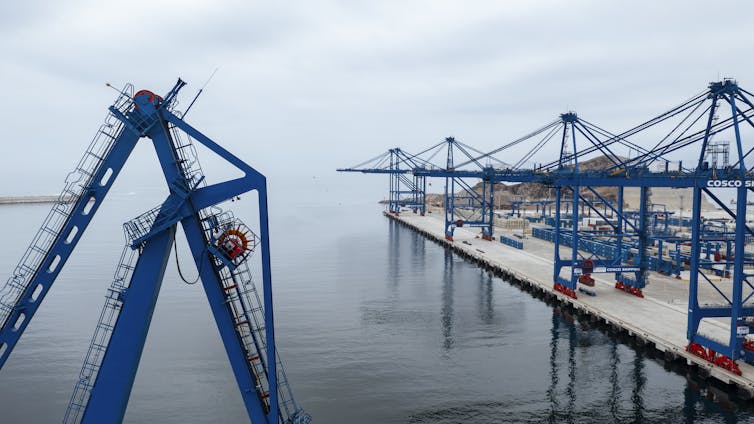
For example, China has a strong presence in Peruvian mining, and the Chinese state-owned enterprise COSCO recently opened the high-tech Port of Chancay in Peru.

A row of cranes are seen at a dock.
The Port of Chancay is 60% owned by the Chinese state-owned company COSCO Shipping Ports.
Hidalgo Calatayud Espinoza/picture alliance via Getty Images

And Chinese companies have been instrumental in upgrading public transportation to electric and hybrid systems across the region, such as the new metro line in Bogotá, Colombia.

China has become the second-largest trading partner across Latin America, behind the United States. For South America, it is the largest.

China’s relationship with Venezuela, as with other Latin American countries, took shape in the early 2000s. By 2013, China had lent Venezuela more energy finance than anywhere else in the world.

Even as mismanagement of Venezuela’s state-owned oil company and the country’s increasing slide into autocracy became apparent, China doubled down on lending. Throughout this process, China become the recipient of the vast majority of Venezuelan oil.

Accordingly, ties to the now-ousted Maduro remained strong to the end. Indeed, the last public act of Maduro before being snatched away from his bedroom by U.S. Delta Force commandos was reportedly a post on social media about his country’s strong bond with China.

But other than rhetoric and condemnations at the United Nations and elsewhere, Beijing can do little to directly counter the U.S. action.

Most likely, China will continue to condemn such policies, while quickly building up ties with Maduro’s successor and negotiating with Washington. China’s foreign ministry was at pains to stress commitment to Venezuela “no matter how the political situation may evolve,” following a Jan. 9 meeting between Beijing’s ambassador to Venezuela and Maduro’s successor, Delcy Rodriguez.

A woman in a green dress claps her hands while being surrounded by other people
Delcy Rodriguez met with the Chinese ambassador to Venezuela within days of being sworn in as acting Venezuelan president.
Jesus Vargas/Getty Images

More than anything, China will likely seek continued economic engagement with Venezuela. In 2024, Venezuela exported 642,000 barrels of oil per day to China — about three-quarters of the country’s production.

How the U.S. will now address Venezuelan oil — and by extension China’s ties to it — is not yet clear. President Donald Trump has pushed to redirect Venezuelan oil exports away from China and to the U.S, but he might not want to further escalate U.S.-China tensions.“

Broader than Venezuela

Even if Trump were to deprive China of Venezuelan oil, it is unlikely to change the trajectory of Beijing’s Latin America policy. After all, Venezuelan oil still only makes up 4% to 5% of China’s imported crude.

Indeed, China’s Latin America policy has not been discriminatory with regard to the political leanings of nations, even if Venezuela were to change course. China has well-established economic relations with almost every country in Latin America. For example, Argentina’s MAGA-aligned leader Javier Milei has courted China while in office and confirmed no intention to break ties now.

Nonetheless, Beijing is mindful of Trump’s reassertion of an aggressive Monroe Doctrine approach to the United States’ southern neighbors.

Unlike its own assertive military actions in its near waters, China has not meaningfully engaged in overt military or political influence in Latin America nations, in line with its noninterference stance.

And aside from China’s limited military support to allied nations through arms sales and joint-training exercises, some observers have been quick to note that China’s inaction following the U.S. attack on Venezuela exposes the hollowness of any security arrangement with Beijing.

Some may caution that Chinese projects like the Port of Chancay in Peru could be used for military purposes, or that Chinese control of utilities like electricity, as in Peru and Chile, presents a security threat to the host country and possibly to U.S. interests.

But for all of the Trump administration’s talk about how a country like China wants to intervene in Latin America, it is not Beijing that has suddenly renewed active military interventions in Latin America. And when push comes to shove, China likely has no wish to be involved militarily in Latin American affairs.

Men in army fatigues sit behind two flags.
China’s Air Force personnel take part in the International Army Games 2017 alongside teams from Iran, Kazakhstan, Morocco, Russia, South Africa and Venezuela.
AFP via Getty Images

China as an alternative global power

If anything, U.S. intervention of the kind seen in Venezuela risks pushing Latin America further into China’s orbit.

The Maduro operation has been met with staunch criticism from countries including Brazil, Chile, Colombia and Mexico. It plays into a growing sense of disillusionment with the U.S.-dominated global order.

And here, China might see an opportunity.

In recent decades, China has gone from a being a “rule taker” to a “rule maker” in international politics, meaning that Beijing increasingly sees geopolitics as the U.S once did: something ripe for remaking in its own image.

In addition to assuming leadership roles in major U.N. agencies, China under Xi has increasingly positioned itself as a leader of the Global South. It has developed international organizations that seem to offer an alternative to the institutions tied to the existing U.S.-led global order.

For example, Beijing created the Asian Infrastructure Investment Bank as an alternative lender to the World Bank and the International Monetary Fund. China also offers development finance through the New Development Bank and its two “policy banks” — the China Development Bank and the Export-Import Bank of China.

In international governance, China has emphasized multilateralism and dialogue as the basis for new global initiatives, pledging adherence to the principles of the U.N. charter and respecting sovereignty.

Skeptics may claim this as window dressing for strategic global ambitions. But if the intention is for China to remold international governance under its guidance, then the actions of the current U.S. administration pave the way for Beijing to promote its vision.

Under Trump, the U.S. has undermined global governance bodies, pulling out of a series of bodies and commitments, including the Paris climate accord, the World Health Organization and the U.N. Human Rights Council.

The Chinese government’s condemnations of the U.S. actions in Venezuela have highlighted the impact it had on certain international norms, notably law. But it has left it to sympathetic voices outside government to make the logical next jump.

Writing for the state-run China Global Television Network, Renmin University Professor Wang Yiwei argued that the international system suffers from American imperialism and that the “only nation capable of dismantling these three pillars [of imperialism, colonialism and hegemony] is undoubtedly China.” The article was published in Chinese and English on CGTN — a clear nod that it is intended for both a domestic and international audience.

Carving up the world?

While China has been quick to condemn the U.S. intervention in Venezuela, some observers have speculated that it could provide China a blueprint for potential action in Taiwan.

Regardless of China’s intentions toward Taiwan, Washington’s apparent pushing of a “spheres of influence” doctrine won’t automatically find unfavorable ears in Beijing.

At some level, China may actually accept U.S. dominance in Latin America — even as it protests such action — should this advance a longtime goal for Beijing in having its own “Monroe Doctrine” in its near waters.

The Conversation

Kerry E. Ratigan receives funding from the Wilson Center and the Chiang Ching-kuo Foundation for International Scholarly Exchange.

ref. How is China viewing US actions in Venezuela – an affront, an opportunity or a blueprint? – https://theconversation.com/how-is-china-viewing-us-actions-in-venezuela-an-affront-an-opportunity-or-a-blueprint-273076