How can Europe fight back against incursions by drone aircraft?

Source: The Conversation – UK – By Matthew Powell, Teaching Fellow in Strategic and Air Power Studies, University of Portsmouth

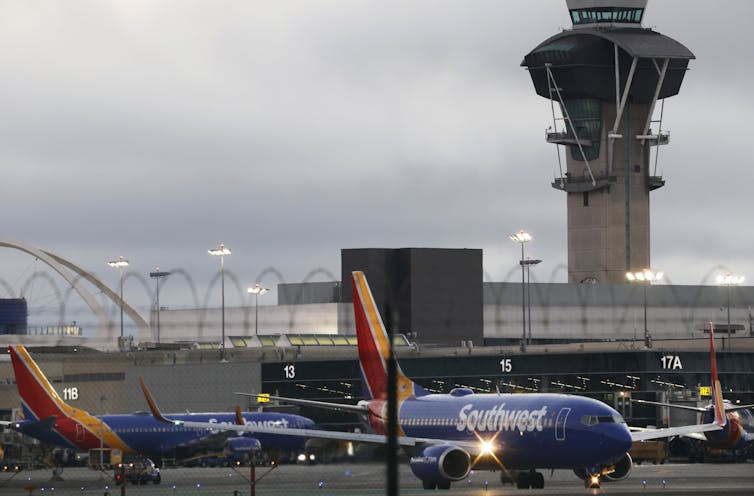
An increasing number of drones have been spotted around Denmark’s airports in recent weeks. The most recent incidents around Aalborg and Billund airport caused considerable disruption followed as scheduled flights were prevented from landing or taking off.

These incidents follow several others, including at Copenhagen Airport. This is similar to the disruption that was experienced around London Gatwick airport in 2023, again causing widespread disruption.

In addition to drones being spotted around civilian airports, there have also been sightings around military airbases where the Danish F-16 and F-35 combat aircraft are based.

A civilian drone flights have been banned for a week in advance of a European Union summit in Copenhagen on October 1.

Given the widespread disruption that has been caused, questions are now being raised about what can be done to either suppress or destroy drones and prevent future attacks. There is also a risk to civilian aircraft from mid-air collisions with the drones and the potential for civilian deaths and injuries.


Read more:
Zelensky says a destructive drone arms race looms – but dystopia isn’t inevitable


The Danish government has claimed that these most recent drone flights have been conducted by someone trying to spread fear among the Danish population. There have also been claims that they are part of wider Russian hybrid operations, which aims to disrupt Danish defence.

Suspicions of increased Russian activity has been fostered by an increasing number of incursions by drones into several other nations’ airspace This is something that has been strenuously denied by the Kremlin.

Lasers, bullets and missiles

Ukrainian forces have used fishing nets to try to catch Russian drones deployed against their positions. Some drones have even been engineered to fire nets in a bid to snag other drones.

Another way of reducing or removing this relatively new threat is to directly shoot down the drones that are around the airspace of airports and airbases. This could potentially be done with combat aircraft, but also with high-powered lasers. But this is not as straightforward as it sounds.

One of the biggest challenges in taking this action is that it usually requires new legislation to be passed by national parliaments. Even with emergency legislation this can take time, meaning that it is not the immediate response to the threat that is clearly necessary. Similar legislation to that being considered by the Danish parliament was passed in the UK in 2018.

But once legislation has been passed the challenges do not end. Given the relatively small size of the drones causing the disruption, they can often be very difficult to target through traditional military means. Even if drones can be targeted, an additional risk is then posed – when a drone is shot out of the sky, there is little control over its trajectory as it falls to earth.

Once destroyed, it could easily land on airport infrastructure, on civilian property or in a worst-case scenario on people, causing injury or death.

Decisions whether to target drones causing this disruption must therefore be taken after a great deal of thought and consideration,. But other methods are available and new technologies are being developed that may provide more effective solutions in the future.

Jamming technology

Instead of using so-called kinetic methods to physically destroy drones that are posing this problem, the use of jamming technology could be used to disrupt the communications link between the drone and the operator. As with kinetic attack, this response poses the challenge of what happens to the drone itself once the signal has been jammed and it falls out of the sky.

There are, however, several advantages to this approach. The first and most important advantage is that jamming can work for relatively long distances. This, disincentivises further attacks as, in theory at least, any drone being flown cannot get within sufficient range to cause the level of disruption that has been seen in Denmark.

In addition to this, the lack of physical destruction from kinetic engagement means that, in theory at least, the drone can be recovered and information about its operation and whether it is a civilian or military asset can be discovered.

But using jamming technology to prevent drones from flying around civilian airports and military airbases has its own drawbacks. Jamming technology, as it is currently exists, cannot be targeted against individual aircraft. This means that any other aircraft within the vicinity of the airport or airbase where jamming technology is being used is also vulnerable to disruption. Due to this, closure of airspace would still be required to remove the threat of the drone, but this should be for a vastly reduced amount of time than is currently required.

There are, however, potential future technologies that might be incorporated into the defence of civilian airports and military airspaces. One such technology is currently being developed by the Royal Navy and has been named DragonFire. This uses the power of a long-range laser to physically destroy a drone in the sky from distances of up to three miles.

A further technology that is being developed by the British army, is jamming technology that can be directed on to targets with greater precision than is currently available outside of the British military.

These new technologies will take time to be widely used in civilian applications. So the sort of disruption we’ve been seeing lately will probably continue in the near future.

The Conversation

Matthew Powell does not work for, consult, own shares in or receive funding from any company or organisation that would benefit from this article, and has disclosed no relevant affiliations beyond their academic appointment.

ref. How can Europe fight back against incursions by drone aircraft? – https://theconversation.com/how-can-europe-fight-back-against-incursions-by-drone-aircraft-266256

Port Talbot, one year on: steelworks closure shows why public is losing trust in net zero

Source: The Conversation – UK – By Nicholas Beuret, Lecturer in Management and Ecological Sustainability, University of Essex

The rolling mills are still working, but the furnaces are long cold. Of the 4,000 people previously employed at the steel mill in Port Talbot, Wales, only half still work there. Despite union protests and local rallies, one year ago on September 30 2024, the plant’s last coal-burning blast furnace was shut down.

This ended more than a century of steelmaking in the UK’s biggest plant – one of the largest in Europe. The owner, Tata Steel, blamed high energy prices and competition from cheaper Chinese steel, claiming ongoing losses of around £1 million a day. It warned the plant would close entirely unless the UK government stepped in to help replace its ageing furnaces with lower-emissions electric arc furnaces.

Steel manufacture contributes around 7% of global climate emissions, and Port Talbot alone accounted for 1.5% of the UK total. Faced with the choice between the closure of the mill and supporting its transition to greener production, the government committed £500 million to this transition.

Tata Steel then announced 2,800 job losses – around one in ten jobs in the town of 35,000. Up to 9,500 more could be lost in the supply chain and broader sector.

This is not how successive governments have sold the transition to a net zero economy. Both Labour and the Conservatives promised net zero would create skilled, well-paid work that would not only make up for losses elsewhere, but generate economic growth and lower bills.

Some data suggests they were right: the UK’s net zero sector is growing far faster than the rest of the economy at 10% per year, and already supports close to 700,000 jobs.

However, polling shows only about one in five voters think the energy transition will create jobs in their area, while only one in three think the transition will have a positive impact on jobs anywhere in the UK.

So why does no one believe the politicians? And where are the jobs?

A series of betrayals

Partly this is about geography. Old centres of industry like Port Talbot are struggling to retain jobs, while net zero businesses tend to be far more dispersed nationally, with many in London and the south-east. As the transition progresses, industrial towns will feel even more abandoned.

The jobs themselves are also different. Many new net zero jobs are in installation, waste processing and other services, often for small businesses and with worse working conditions than those that predominate in heavy industry.

Even within heavy industry, low-carbon technologies tend to mean fewer jobs, as greener versions generally employ fewer workers. Electric furnaces need less labour than coal-burning furnaces, for instance. Facilities tend to be more automated, and supply chains are shorter.

And where there could be a pipeline from fossil fuel jobs to renewable industries, as in Scotland, most workers say there is far too little support from government and industry for them to make this change.

Political fallout

Reform has been quick to seize on the closure of Port Talbot, with its leader Nigel Farage declaring he’d open the furnaces again, despite this being physically impossible.

Reform more generally has declared net zero to be an expensive farce, one that costs jobs and drives up energy bills. Across a swathe of local councils where Reform has overall control, it has promised to cancelled net zero policies and renewable energy projects.

Though critics suggest Reform’s promises threaten billions in investment and upwards of 1 million jobs, the party’s claims are finding a welcome home among workers in industry, with unions warning that their members are increasingly drawn to Reform as they desert Labour.

The steel industry isn’t the only one undergoing job losses. From oil and gas facilities to fertiliser and car plants, heavy industry is shedding jobs under pressure from high energy costs, competition, and the need to reduce greenhouse gas emissions. As the transition continues, these losses are likely to mount.

The household budget myth

It is not just the “jobs gap” that generates the sense of betrayal among workers. Since the 2008 financial crisis, the myth that the UK government’s finances work in the same way as a household budget, thus justifying one of the most dramatic programs of government austerity seen among the world’s wealthier countries, has become a well-established common-sense framework.

And this mindset associated with austerity has also come to haunt the UK’s net zero transition.

Surveys repeatedly list local decline as among the main reasons why people are turning away from the major parties and towards Reform. And when the UK government hands hundreds of millions to companies like Nissan or Tata Steel, only for them to cut hundreds of jobs, this feeds a sense that money is flowing to corporations, not communities.

Reform has capitalised on this by contrasting supposed subsidies for solar farms with the closure of vital services in those same towns and regions. When combined with the steady flow of commentaries in the right-wing media declaring net zero a burden on the taxpayer and a waste of scarce government resources, the narrative that net zero is a “con”, taking money and jobs from the British public to give to big business, seems more credible.

The bitter irony here is that not only do most people in the UK, including most Reform supporters, still back taking action on climate change, but that climate change will hit deprived areas hardest. Yet without visible local benefits, warnings about future risks won’t cut through.

One year on from the Port Talbot closure, I believe it’s vital that the net zero transition comes to mean something more than broken promises and betrayed communities. Reform’s anti-net zero rhetoric is no panacea. Yet without a program to ensure a just transition, we risk this becoming hostage to such reactions – a transition to nowhere that anyone wants to go.

The Conversation

Nicholas Beuret does not work for, consult, own shares in or receive funding from any company or organisation that would benefit from this article, and has disclosed no relevant affiliations beyond their academic appointment.

ref. Port Talbot, one year on: steelworks closure shows why public is losing trust in net zero – https://theconversation.com/port-talbot-one-year-on-steelworks-closure-shows-why-public-is-losing-trust-in-net-zero-265906

The eye in the sky: what Denmark’s drone sightings tell us about power and fear down the years

Source: The Conversation – UK – By Kathrin Maurer, Professor , Department of Cultural and Linguistic Studies, University of Southern Denmark

All-seeing ‘eye in the sky’: drones make us uneasy because we don’t know who is controlling them. Piotr Piatrouski/Shutterstock

Red and blue lights blink in the Danish sky. Is it a plane, a satellite, or a drone hovering overhead? Over the past few weeks, more and more Danes have been scanning the skies for mysterious flying objects, caught between curiosity and unease as sightings across the country spark fresh concern.

Drones have been sighted over airports and military bases all over Denmark. Air traffic has been delayed, politicians have gathered for crisis meetings, and Nato has been called on to act.

We speak about drones in our coffee breaks, exchanging newly acquired expert knowledge about flight heights and battery power. We talk to our children about “hybrid warfare”. And many of us walk around with a strange and eerie feeling that something in the sky is watching us.

Although Russia’s role in the recent drone incidents remains unconfirmed, the sightings come against a backdrop of escalating tensions between the two countries, and just after Copenhagen announced it would acquire long-range precision weapons, drawing sharp threats from Moscow. Indeed, analysts have suggested the drone flyovers may form part of a wider Russian strategy to sow fear, test Nato’s defences, and erode Danish support for Ukraine.


Read more:
Zelensky says a destructive drone arms race looms – but dystopia isn’t inevitable


That monstrous stare

As a professor of culture and technology, my research focuses on surveillance, drones and how we talk about war. In this sense, surveillance from above is a tale as old as time. Think of that godly “eye in the sky”, mentioned by the Old Egyptians and in the Bible. That celestial all-seeing entity with superhuman powers to decide whether you should live or die, much like the drone itself.

This connection is not only highlighted in popular culture, such as in the title of the 2015 film Eye in the Sky about military drone strikes, but also by the military industry itself.

There is, for example, a US military drone, Gorgon Stare, named after a monstrous figure from Greek mythology, most famously represented by the three sisters Stheno, Euryale and Medusa. The latter is known for turning anyone who looks at her into stone. The Gorgon Stare is equipped with many cameras and armed with Hellfire missiles.

Trailer for 2015 film, Eye in the Sky.

But it’s not only the assumed drone’s power of hypervision that gives us the creeps. It’s also precisely its opposite feature: its invisibility. Although we might see some dots and shadows in the sky, the drone pilot stays invisible. Who steers this Unmanned Aerial Vehicle (UAV)? Who controls it – or does it even control itself? It is deeply rooted in our human instincts that when we feel observed by an invisible force, we feel alarm and our nervous system enters defence mode.

In this context, another Greek myth comes to mind: Gyges. The Greek philosopher Plato wrote about the shepherd Gyges, who discovered a magical ring that could make him invisible. Armed with this new power, Gyges became king and ruler over the country. Drones operate in a similar way to Gyges’s strategy, as their pilots also remain hidden in the shadows.

Threatening sky

Humans tend to thrive on eye contact. But drones are not about seeing each other. When it comes to fighting, there is no duel anymore. Drones do not announce themselves. They disregard international treaties, break laws of war, and fly under the radar.

The drone flyovers in Denmark expose our vulnerabilities and erode the sanctity of our airspace. Many have been left wondering if we are prepared for this new type of warfare. Nevertheless, within all this hype about drones, we have to remember that aerial reconnaissance has been around for centuries. Think of kites, hot air balloons and spy planes.

A military command centre showing a man operating drones.
Who is controlling the drone in the sky above you?
Gorodenkoff/Shutterstock

It’s also important to point out that new technologies frequently spark public unease. The first cars were met with great anxiety and fear. Electricity was seen as something supernatural. These examples do not aim to normalise the high levels of drone activity we’ve seen over Denmark, or the feelings of fear and uncertainty these aerial vehicles have induced.

But by looking at how new technologies have been viewed historically, it opens up space for critical and nuanced dialogue about their societal implications and how we navigate their presence in our everyday lives.

The history of surveillance from above shows us that human unease with aerial reconnaissance is nothing new. But in today’s climate of geopolitical tension, drones are more than symbols of technological change – they are markers of the fragile balance between visibility, power, and trust. And right now, that balance feels more precarious than ever.


This article was commissioned with Videnskab.dk as part of a partnership between it and The Conversation.

The Conversation

Kathrin Maurer receives funding from DFF research grant project 2 “Drone Imaginaries and Communities” 2019-2022

ref. The eye in the sky: what Denmark’s drone sightings tell us about power and fear down the years – https://theconversation.com/the-eye-in-the-sky-what-denmarks-drone-sightings-tell-us-about-power-and-fear-down-the-years-266296

The ancestors of ostriches and emus were long-distance fliers – here’s how we worked this out

Source: The Conversation – UK – By Klara Widrig, Postdoctoral research fellow, Smithsonian Institution

Oleksii Synelnykov/Shutterstock

Aside from being a delight to watch, flight in birds is regarded by many cultures as a symbol of freedom, and a source of inspiration for humans to build our own flying machines. This makes those birds that have given up flight for a land-based way of life seem all the more intriguing.

In our new study of a 56 million-year-old fossil bird, my colleagues and I show that the distant ancestors of ostriches and other large flightless birds once flew great distances.

Many flightless birds belong to Palaeognathae, a taxonomic group containing ostriches, rheas, emus, cassowaries and kiwi, as well as the tinamous of Central and South America.

Unlike their large flightless relatives, tinamous can fly – but not very far. Spending most of their lives on the ground, they tend to fly only if startled by a predator. If you have ever been on a walk and startled a grouse or pheasant, this type of flight, known scientifically as burst flight, will be familiar to you.

Close up of bird with colourful head and neck
Cassowaries are related to ostriches.
Nikolay Hristakiev/Shutterstock

Because they are flightless (or can’t fly far), the fact that palaeognaths are found on many different continents – South America, Africa, Australia and New Zealand – has been difficult for scientists to explain.

When the theory of plate tectonics became widely accepted in the 1960s, an answer seemed within reach. All of the continents were once united as the supercontinent Pangea, which slowly broke apart during the time of the dinosaurs, starting to split around 200 million years ago. Scientists wondered whether different populations of flightless palaeognaths could have just drifted apart from each other along with the continents they lived on.

However, this once-popular theory has since been discredited for two reasons. One is that the flying tinamous are genetically closer to some flightless palaeognaths than they are to others. This means that ostriches, rheas, emus, cassowaries and kiwi did not share a flightless common ancestor. Instead, in a remarkable case of parallel evolution, they all became flightless separately from each other.

The second reason is that genetic research shows palaeognath lineages started to separate many millions of years after Pangea broke up – far too late for the continental drift theory to be true.

This means palaeognaths had to have made it to South America, Africa,
Australia and New Zealand under their own power. Only able to fly in short bursts, a tinamou doesn’t stand a chance of flying across an ocean – but what about palaeognaths from the distant past? Could the ancestors of today’s palaeognaths have made these long journeys?

Small brown bird walking in grassland.
Tinamous can only fly in short bursts.
Foto 4440/Shutterstock

The collections of the Smithsonian National Museum of Natural History in Washington DC include an almost perfectly preserved sternum, or breastbone, belonging to an ancient palaeognath called Lithornis promiscuus that lived 56 million years ago. It was a fairly large bird, about the size of a grey heron.

Other researchers had determined that the sternum is a key piece of the skeleton for determining the flight style of a bird, so this fossil was our best chance to determine what this ancient bird was capable of.

Using a technique called geometric morphometrics, we compared the shape of the Lithornis sternum to those of over 150 living bird species. Our results show that Lithornis was not a burst flier like today’s tinamous. Instead, its sternum is most similar in shape to birds that fly huge distances, such as egrets and herons. This means means that, unlike their living relatives, Lithornis and other ancient palaeognaths would have been capable world travellers, able to establish new populations on different continents.

Why did these birds become flightless over and over again?

No matter how beautiful or inspiring we think flying is, it is also hard. If a bird species finds itself in a situation where it can get all of its food on the ground and doesn’t need to fly to escape predators, it will probably evolve towards being flightless.

Ostrich running across plain.
This bird wasn’t always stuck on the ground.
Paula French/Shutterstock

Nowadays, these conditions are only met on islands, with the dodo being perhaps the most famous example. The dodo was a flightless bird that roamed Mauritius until it became extinct in the 1600s.

Dodos had no natural predators until humans arrived in the late 1500s (bringing with them other animals including rats). This meant dodos had not evolved a fear response, and there are records of them happily approaching humans.

Back when Lithornis and its relatives were alive, the world was very different. Just a few million years before, the dinosaurs had gone extinct. With no major predators around, birds were safe on the ground on continents as well as islands. And with a specialised bill tip organ as well as a keen sense of smell, Lithornis was well suited for probing for food in the soil, so it had no need to fly up into the trees to feed.

Therefore, ancient palaeognaths were set on a course towards flightlessness or low flight capacity wherever they went around the world. New mammalian predators evolved slowly, over millions of years, giving these flightless birds plenty of time to evolve new ways to escape and defend themselves.

After these long-distance flying ancestors went extinct, we were left with a puzzling distribution of these birds that could only be explained by the fossil record.

The Conversation

Klara Widrig received funding from the Gates Cambridge Trust.

ref. The ancestors of ostriches and emus were long-distance fliers – here’s how we worked this out – https://theconversation.com/the-ancestors-of-ostriches-and-emus-were-long-distance-fliers-heres-how-we-worked-this-out-266081

A second runway at Gatwick airport could improve efficiency and bring down fares – an economist’s view

Source: The Conversation – UK – By Marwan Izzeldin, Senior Lecturer in Economics, Lancaster University

Steve Travelguide/Shutterstock

The £2.2 billion plan for a second runway at London’s Gatwick airport has divided opinion over environmental concerns and its ability to kickstart the economic growth the UK so badly needs. Critics have said that the economic benefits are overstated and the environmental harms unavoidable.

These concerns – including from leading economists – are an important part of the debate. But they don’t tell the whole story. Looking at Gatwick’s northern runway proposal in particular, the evidence suggests that expansion can improve safety, reduce waste and deliver real benefits to travellers and the local community. As long as it is managed responsibly, of course.

Gatwick is Europe’s busiest single-runway airport, handling more than 43 million passengers a year and around 260,000 aircraft movements on just one operational runway.

This creates bottlenecks – during peak hours, aircraft go into “holding stacks” (vertical formations of planes that circle until it’s their turn to land). A typical Boeing 737 burns 2.5 to three tonnes of jet fuel per hour, so just 15 minutes of unnecessary holding adds nearly a tonne of CO₂ emissions into the atmosphere.

With an average of 3.24 minutes lost per flight into Gatwick in holding stacks and to other inefficiencies, the waste is significant, both environmentally and economically. Economists call this a “congestion externality”. That is, costs imposed on society with no corresponding benefit. Adding runway capacity directly reduces these inefficiencies.

Critics argue that more flights automatically mean more emissions. Yet the data show that efficiency matters too. Absorbing delays at cruise altitude rather than in low-level holding stacks has been shown to cut waste significantly.

At Gatwick, an arrival management scheme introduced in 2019 was expected to save more than 26,000 minutes of holding per year. If realised, this would translate into around 1,200 tonnes of fuel and 3,800 tonnes of CO₂ avoided annually.

Pairing those measures with the northern runway – which reduces stacking – compounds the savings. In welfare terms, this is a clear case of lowering emissions intensity per movement (a more useful measure than a company’s overall emissions). It should ensure that growth is not just about more traffic but also cleaner, more efficient traffic.

The case for consumers

There are also important consumer benefits. Gatwick competes heavily in the leisure and short-haul market, where families are most sensitive to price. By expanding to two runways, airlines will be able to schedule more services at peak times, bringing down fares.

Research shows that a scarcity of slots adds a premium to air fares. At Europe’s busiest airports – which include Gatwick – it’s estimated that by 2035 congestion will add €10.42 (£9.10) on average to each ticket.

Expansion also supports local and national economies. Gatwick forecasts that the northern runway project could create 14,000 jobs and contribute nearly £1 billion a year to the regional economy.

These jobs span construction, airport operations, tourism and supply chains, directly benefiting communities in the south-east of England. It’s what economists call a distributional gain – the benefits are spread broadly through employment and regional growth, rather than to a narrow group.

Of course, the costs – noise, air quality and climate – cannot be ignored and will have to be managed. Expansion plans retain the strict 11pm-6am night flight quota, implement quieter continuous descent operations (a technique that allows planes to descend more smoothly, creating less noise), and aim to encourage more travellers to arrive at the airport by rail.

Around 44% of Gatwick passengers already arrive by train, and it has more direct train connections than any other European airport.

woman wearing a red t-shirt reading gatwick neighbour from hell.
Gatwick expansion plans are likely to come up against strong opposition from locals.
Dinendra Haria/Shutterstock

With timetable integration and new fare types, Gatwick aims to push the percentage of passengers arriving and leaving by rail well above 50%. This would cut road traffic emissions. It is an attempt to ensure that those who generate environmental costs (airlines and airports) also bear responsibility for reducing them.

The real test is not whether Gatwick grows, but how it grows. With verifiable baselines – such as average stack minutes per arrival, go-around rates (where pilots abandon a landing attempt and circle back), and CO₂ per movement – expansion can be monitored and airport bosses held to account.

If the promised gains are delivered, the net effect could include safer skies, lower emissions intensity, cheaper fares, more jobs and stronger regional growth. Welfare economics teaches us that policy should maximise the wellbeing of the many, not preserve the convenience of a few. By that measure, Gatwick’s northern runway expansion could well be a welfare-enhancing choice.

The Conversation

Marwan Izzeldin does not work for, consult, own shares in or receive funding from any company or organisation that would benefit from this article, and has disclosed no relevant affiliations beyond their academic appointment.

ref. A second runway at Gatwick airport could improve efficiency and bring down fares – an economist’s view – https://theconversation.com/a-second-runway-at-gatwick-airport-could-improve-efficiency-and-bring-down-fares-an-economists-view-265995

Serbia’s Aleksandar Vučić clings to power – but protests highlight the danger of stubborn leadership

Source: The Conversation – Global Perspectives – By Keith Brown, Professor of Politics and Global Studies, Arizona State University

In Serbia, there is a word for a form of stubbornness that sees someone act out of spite or defiance rather than yield to the will of others: “inat.”

It’s something Serbian President Aleksandar Vučić is showing remarkable levels of right now.

For almost a year, anti-government protests have roiled the Balkan nation. They intensified over summer 2025, culminating in angry clashes between students and police in August and September.

But Vučić has stood firm in the face of growing calls for his resignation. In fact, as scholars of politics and history in Southeast Europe, we have watched Vučić take Serbia even further down an authoritarian path. In so doing, he is drawing from the well-worn playbook of autocratic leaders past and present – not least his former boss Slobodan Milošević and Vladimir Putin, the Russian leader Vučić openly admires.

Yet, while Vučić can draw on support from Putin and fellow authoritarians overseas, he is losing legitimacy at home. Opposing him is a new generation of civic activists who have won the Serbian public’s backing by reclaiming “inat” as force for positive change.

Unmoved by a movement

The immediate trigger for the ongoing unrest came in November 2024 with the deadly collapse of a train station canopy in Novi Sad, a city in northern Serbia.

Renovated with funding from China’s Belt and Road Initiative, the canopy was one of many projects touted by Vučić’s government as evidence of its success in attracting foreign investment. The accident’s 16 deaths, however, served to sharpen questions about corruption, failures of oversight and government accountability.

Student protests gathered momentum through winter and into spring. One demonstration, on March 15, saw more than 300,000 people turn out in Belgrade. Activists have also employed civil disobedience tactics, like staging pop-up roadblocks in Serbian cities, to maintain pressure on the government.

But Vučić has remained obdurate. On Sept. 1, while large crowds gathered in Belgrade and other Serbian cities, Vučić joined Putin and other leaders critical of Western-style democracy at a large military parade in Beijing.

Then on Sept. 20, Vučić staged his own show of strength, with soldiers and tanks taking part in a military parade in Belgrade as Russian-bought MiG-29 fighter planes flew overhead.

Two men in suits enter a room
Russian President Vladimir Putin and Serbian President Aleksandar Vučić hold a bilateral meeting on Sept. 2, 2025, in Beijing.
Getty Images

From reform to repression

Vučić’s reaction to the protests and his cozying up to leaders of Russia and China reveal how the Serbian leader’s politics have changed.

He was once perceived as a pro-European reformer. Indeed, Vučić and his Serbian Progressive Party campaigned on a pro-European Union platform in the 2012 election that brought them to power.

First serving as deputy prime minister before becoming prime minister in 2014, Vučić won plaudits for seeking to resolve long-standing tensions over Kosovo’s status as a sovereign country. At that time, it was Vučić who led his country’s negotiations with the EU over a normalization of relations between Serbia and its former province.

Vučić also showed willingness to improve Serbia’s ties with neighboring Bosnia-Herzegovina. Whereas many Serbian citizens still felt primary affinity for the Serb-dominated Republika Srpska, whose armed forces committed genocide at Srebrenica in 1995, Vučić risked domestic censure when, in 2015, he labeled that massacre of Bosniak men and boys by Serbian paramilitaries a “monstrous crime.” Vučić also showed up at Srebrenica to pay his respects to the victims, despite local hostility.

Those diplomatic gestures, along with his success in attracting foreign investment, won Vučić international praise as an effective reformer. Serbian voters, likewise, acknowledged the economic stability and the country’s improved reputation.

Backtracking on record

Those assessments started to change in earnest, however, after Vučić secured election as president in 2017. Critics say that he has leveraged his position to amass power and influence, mimicking methods familiar to those living under authoritarian-leaning governments in Hungary and Russia.

Meanwhile, the U.K.’s Brexit vote in 2016, the election of Donald Trump in 2016 and then the global disruption of the COVID-19 pandemic all changed the dynamics of the international community, reducing outside pressure that had advanced democratic norms.

What followed in Serbia was backsliding on democracy. Serbia’s once-vibrant media now operates as government cheerleader. Independent journalism outlets have faced harassment, censorship and lawsuits as part of a state-sponsored campaign of censorship.

Meanwhile, on the diplomatic front, Vučić changed his tune on Kosovo. He now pledges to protect the interests of the breakaway province’s Serbs and portrays Kosovo’s Albanian leader, Albin Kurti, as the obstacle to any normalization deal.

On Bosnia-Herzegovina, Vučić has also backtracked, expressing support for long-time Bosnian Serb leader Milorad Dodik – who has been barred from office by the country’s constitutional court, but defies that ruling.

To Serbian audiences, Vučiċ accuses the EU of duplicity and anti-Serbian prejudice. Meanwhile, he smears the student-led movement as a Western-led “color revolution” aimed at politically motivated regime change. Critics are “fascists” and “foreign mercenaries.”

Europe gets wise to Vučiċ

In all this, Vučiċ has drawn on Kremlin talking points and an authoritarian playbook to distract attention away from his government’s practices. He and his allies cast the current protests not as a movement built on grassroots mobilization, but as the result of meddling by foreign agents.

In taking this authoritarian turn, Vučić invites critics to see parallels with Milošević, under whom the current president served in the 1990s as minister of information. Milošević, who died while on trial for war crimes, did much to inflame Serbian nationalism in the early 1990s and presided over the bloody wars in Croatia, Bosnia-Herzegovina and Kosovo. After Milošević’s ouster in the Bulldozer Revolution of 2000, Vučić spent a decade in opposition before returning to government in 2012.

And while European diplomats were for many years eager to court Vučić, even tolerating hedging tactics that saw Serbia expand ties with Russia and China, that changed amid the president’s response to months of protest.

In March, European Commission President Ursula von der Leyen noted on the social platform X that Serbia “needs to deliver on EU reforms, in particular to take decisive steps towards media freedom, the fight against corruption and the electoral reform.”

Marta Kos, European Commissioner for Enlargement, delivered blunter assessment six months later, noting in a European Parliament debate the “wave of violence and continuous use of force against protesters in Serbia.”

Such criticism has seen Vučić turn increasingly to China, Russia and also to the Trump administration, with Donald Trump Jr.’s visit to Serbia in March as emblematic of the warming ties between Washington and Belgrade.

The ‘inat’ of the Serbian people

Vučić has spent over a decade directing a political spectacle in which he presents himself as the one force capable of saving Serbia. And for the better part of the past year, he has attempted to paper over the cracks in his rule through a strategy of imposing increasingly authoritarian measures at home while seeking support from like-minded regimes abroad.

But the fact that this ploy has not extinguished the still ongoing anti-government protests suggests it may be a failing tactic.

And like Milošević in the late 1990s, Vučić seems to have underestimated the force of “inat” of the Serbian people. The Bulldozer Revolution that ousted Milošević was comprised of Serbs from a wide range of backgrounds, all determined to bring down an unpopular autocrat who put his own political survival above the needs of citizens.

They did so through grassroots mobilization and shared recognition that the true obstacle to prosperity was not foreign conspiracy, but Milošević himself. For all his individual stubbornness and spite, Milošević could not match the resilience and determination of Serbia’s citizens.

That same energy appears to be in the streets of Belgrade now, sustained by a new generation of citizens standing firm against the tactic of a different autocratic leader.

The Conversation

Keith Brown receives funding from the Finland Fulbright Foundation, and directs a Center that until recently has received funds from the US Department of State Title VIII program, the US Department of Education Title VI program, and the US Embassy in Yerevan, Armenia.

Hanna Begić does not work for, consult, own shares in or receive funding from any company or organization that would benefit from this article, and has disclosed no relevant affiliations beyond their academic appointment.

ref. Serbia’s Aleksandar Vučić clings to power – but protests highlight the danger of stubborn leadership – https://theconversation.com/serbias-aleksandar-vucic-clings-to-power-but-protests-highlight-the-danger-of-stubborn-leadership-245878

Why This Is Spinal Tap remains the funniest rock satire ever made

Source: The Conversation – Global Perspectives – By Adam Daniel, Associate Lecturer in Communication, Western Sydney University

Embassy Pictures Corporation/Getty Images

With Spinal Tap II: The End Continues hitting cinemas, now is the perfect moment to revisit its precursor, one of most influential and hilarious comedy films ever made, 1984’s This Is Spinal Tap.

Directed by Rob Reiner and co-written by Reiner and the stars of the film, Christopher Guest (as Nigel Tufnel), Michael McKean (David St. Hubbins) and Harry Shearer (Derek Smalls), the mockumentary film follows a fictional British heavy metal band on a disastrous tour of the United States.

As audiences dwindle, equipment fails and egos clash, the band’s decline satirises rock’n’roll excess and the absurdities of the music industry.

Widely acknowledged as a cult classic, the film codified the “straight-faced” style of mockumentary that became central to modern comedies such as The Office and Modern Family.

Its dry and absurdist tone, handheld camerawork, faux interview format and largely improvised dialogue were inspirational for many contemporary comedy creators, including Ben Stiller, Mike Schur and Ricky Gervais. It also established a tone and style Guest would return to throughout his filmmaking career, in movies such as Waiting For Guffman (1996), Best In Show (2000) and A Mighty Wind (2003).

The band which could exist

Beyond pure nostalgia and the legacy of the mockumentary style, This Is Spinal Tap remains a cult favourite because of the clever and farcical way it skewers and satirises rock excess.

As Roger Ebert stated, although the band does not exist,

the best thing about this film is that it could. The music, the staging, the special effects, the backstage feuding and the pseudo-profound philosophizing are right out of a hundred other rock groups and a dozen other documentaries about rock.

In the early 1980s, MTV was on the rise. Rock tour documentaries from bands like Led Zeppelin, Black Sabbath and The Band established new conventions of “rock reality” in films such as The Song Remains The Same (1976), Black and Blue (1980) and The Last Waltz (1978). The culture of excess surrounding some of these artists provided fertile ground for parody.

Ego clashes, overblown stage shows and catastrophic tours were commonplace. Spinal Tap’s deadpan mockumentary style was both a timely satire, and an authentic cultural commentary.

The brilliance of the film goes beyond its ribald satire. Of vital importance is the skilful musicianship of the cast. Even if they are a joke, Spinal Tap can play. The great rock riffs sustain the silliness of the lyrics in songs like Sex Farm and Big Bottom.

In addition, Guest and McKean slyly navigate a bromance at the heart of the film between their characters, Nigel and David.

When David’s girlfriend, Jeanine (June Chadwick) arrives to join the tour, things really go off the rails, leading to an acrimonious breakup between the bandmates.

Their reunion at the film’s conclusion reveals that the film is truly a love story between two vain yet endearing buffoons.

Going to 11

Moments such as Nigel boasting about his amplifier going “to 11”, Derek’s airport security incident, the band getting lost on the way to the stage, and the 18-inch (instead of 18-foot) Stonehenge stage prop have become iconic. But there are so many great gags on the periphery, layered through the largely improvised dialogue.

A personal favourite occurs during an early band interview. Reflecting on a series of strange deaths that have afflicted Spinal Tap’s drummers throughout the years, and acknowledging that their first drummer died in “a bizarre gardening accident”, Tufnel states “the authorities said best leave it unsolved really”.

There are also subtle visual jokes embedded through the film: the sudden emergence of cold sores for each band member in the early stages of the tour (at roughly the same time the band’s groupies enter the frame); the band being second billed behind an Amusement Park Puppet Show as the tour falls apart; Nigel needing to quickly tune the violin he’s using to augment an overblown guitar solo.

Online lists such as Cracked’s “50 funniest moments in This Is Spinal Tap” demonstrate the sheer volume of funny moments.

Modern audiences would no doubt recognise the film’s style being mimicked in contemporary works such as The Office, Parks and Recreation, Summer Heights High and What We Do in the Shadows.

Its influence has been directly acknowledged in the lead-up to the release of the sequel by creators who owe a debt to its clever format.

Spinal Tap II: The End Continues reunites Tufnel, St. Hubbins and Smalls, now estranged, 41 years after the original film.

They are reluctantly coming back together for one final concert they are legally bound to perform. Documentarian Marty Di Bergi (Reiner) returns to showcase their legacy, modern mishaps and the realities of being an ageing rocker.

It is an apt sequel in a world where legacy bands and artists such as The Rolling Stones, Springsteen and McCartney are still performing in their 70s and 80s.

The sequel is not just a reunion gig. It is a reminder of why the original remains one of the sharpest and most influential comedies ever made – and one well worth a revisit.

The Conversation

Adam Daniel does not work for, consult, own shares in or receive funding from any company or organisation that would benefit from this article, and has disclosed no relevant affiliations beyond their academic appointment.

ref. Why This Is Spinal Tap remains the funniest rock satire ever made – https://theconversation.com/why-this-is-spinal-tap-remains-the-funniest-rock-satire-ever-made-264591

Pet guardians are increasingly worried about the mental health of their dogs and cats

Source: The Conversation – Canada – By Renata Roma, Researcher Associate – Pawsitive Connections Lab, University of Saskatchewan

The human-animal bond is evolving, and there is a need to further explore people’s concerns towards their pets (Unsplash/Manuel Meza)

When it comes to caring for pets, some people worry most about physical health, while others are more concerned about financing potential health problems. But what stands out in a recent survey is that many pet guardians are especially focused on their pets’ emotional well-being, with separation anxiety at the top of the list.

The survey involved 600 pet guardians in the United States. Its results align with recent research highlighting shifts in the ways pets are perceived.

As a researcher who specializes in understanding the impact of the human-animal bond on people’s mental health, I am particularly interested in what these findings reveal about how people’s relationships with their pets shape both human well-being and animals’ welfare.

Paying closer attention to pet guardians’ concerns can help us examine how people’s and pets’ well-being are intertwined. It may also inspire policies more sensitive to the realities of pet guardians, supporting both animals and people.

A woman with two fluffy cats
In recent years, some studies have highlighted pet guardians’ growing concerns about pets’ mental health.
(Unsplash/Tran Mau Tri Tam)

The impact of the COVID-19 pandemic

In recent years, some studies have highlighted pet guardians’ growing concerns about pets’ mental health. For example, in one study with almost 45,000 pet guardians, 99 per cent of them described moderate or severe behavioural problems in their dogs, with attachment issues or separation anxiety as the most prevalent issue.

Another study suggests that COVID-19 lockdowns were detrimental to the mental health of some pets, particularly for those who already had symptoms of separation anxiety. During the pandemic, most people spent more time with their dogs, which might have strengthened the bond in some respects, but it also reduced pets’ privacy and safe spaces, which are essential for their emotional regulation.

Many people also decreased dog walks, and in homes with only one pet, these animals no longer had opportunities to socialize with other pets. Also, when pet guardians returned to their regular routines once lockdowns were lifted, the change was a trigger for some pets, and not only for dogs with a history of anxiety-related problems. When animals started to stay home alone again, some had difficulties coping with separation.

Another survey suggests that anxiety has increased significantly in dogs and cats since the pandemic, including fears of strangers, anxiety related to other pets and separation anxiety.

Taken together, these findings highlight the significant impact of the pandemic on pets’ behavioural issues, showing that these changes might have affected pets more than people realized.

Interconnections between people’s and pets’ mental health

While these problems in pets are indeed relevant, it is worth examining why they matter so profoundly for pet guardians, as these concerns may reveal something about the evolving role of the human-animal bond.

A man outdoors hugging a golden retriever
Concerns about pets’ mental wellness may reveal something about the evolving role of the human-animal bond.
(Unsplash/Eric Ward)

There is evidence that people’s vulnerability to emotional stress may have increased in recent years along with increased rates of anxiety, depression and a sense of loneliness.

Looking further, the stigma around mental health issues is decreasing, and people are gradually becoming less uneasy about acknowledging and talking about their emotional struggles.

Poorer mental health in guardians may be associated with more behavioural issues in pets. It is possible that a greater sensitization to mental health issues, combined with a stronger perception of pets as family members and a broader trend toward their humanization, is impacting pet guardians’ concerns about their pets.

Additionally, some studies have shown an association between elevated anxiety in pet guardians and increased fears and anxiety-related behaviours in pets. In this context, these findings might reflect broader changes in how pets are perceived, while also mirroring society’s increasing attention to mental health issues and the interplay between human and pet behaviours.

People’s concerns with pet’s behavioural and emotional problems may also reflect their synchrony with companion animals at a different level. More specifically, the fact that these anxiety-related problems are taken seriously by pet guardians, shows a growing acknowledgement of pets’ emotional needs.

At the same time, many people are willing to seek specialized help, including training, hotels and pet boarding services, which are expanding markets.

Some people have even left their jobs for reasons related to their pets, and 60 per cent would consider doing the same if their job conflicted with their pet-care needs, which may reflect people’s growing motivation to ensure their pets’ well-being.

This finding is aligned with studies showing that the implementation of pet-friendly policies can enhance employees’ well-being and work engagement.

Broader implications for human and animal well-being

A black cat reaching a paw out towards the hand of a person out of frame.
some studies have shown an association between elevated anxiety in pet guardians and increased fears and anxiety-related behaviours in pets.
(Unsplash/Humberto Arellano)

The human-animal bond is evolving, and there is a need to further explore people’s concerns towards their pets. It is also essential to examine how these concerns may be connected with broader issues of pet guardians and their pets, such as attachment, daily routines and shared well-being.

As outlined in past studies, the relationship with pets may have ups and downs, and sometimes may be a source of stress, which in turn may have negative impacts on the quality of the relationship.

In this regard, chronic stress, along with feelings of insecurity in managing pets’ behavioural issues, may contribute to emotional overload and increased anxiety in pet guardians. Similarly, not responding adequately to pets’ needs can negatively affect their overall welfare.

A deeper understanding of the nature and impacts of pet guardians’ concerns may inform policies designed to support this population. Importantly, recognizing and addressing these concerns is, above all, a way of valuing the pets themselves and the significance of the bond people share with them.

This approach may also support people’s mental health, who may already be exposed to several stressors. In this sense, paying closer attention to pets’ needs may be an essential investment in human mental health and well-being.

The Conversation

Renata Roma does not work for, consult, own shares in or receive funding from any company or organisation that would benefit from this article, and has disclosed no relevant affiliations beyond their academic appointment.

ref. Pet guardians are increasingly worried about the mental health of their dogs and cats – https://theconversation.com/pet-guardians-are-increasingly-worried-about-the-mental-health-of-their-dogs-and-cats-265563

Le changement climatique est-il en décalage horaire ?

Source: The Conversation – in French – By Sarah Safieddine, Chargée de recherche CNRS (LATMOS/IPSL), Sorbonne Université

Le réchauffement climatique ne se mesure pas seulement en moyennes globales. Derrière les +1,5 °C ou +2 °C, souvent avancés comme indicateurs globaux, on retrouvera des réalités très différentes selon les lieux… et, surtout, selon les heures de la journée. Une récente étude montre comment l’usage généralisé du temps universel par les climatologues peut masquer ces différences en heures locales. Mieux les prendre en compte permettraient de mieux adapter nos villes, nos systèmes agricoles et nos politiques de santé publique.


Les chiffres du changement climatique sont bien connus : 1,5 °C de plus depuis l’ère préindustrielle, et +2 °C attendus d’ici 2050 si rien n’est fait. Il s’agit toutefois d’une augmentation moyenne des températures sur toute la surface du globe.

Derrière ces chiffres se cachent donc des réalités bien différentes, en fonction du lieu où on se situe sur Terre, mais également en fonction des moments de la journée. Non, il ne fera pas « chaud pareil » à midi qu’à minuit : les tendances de réchauffement, elles aussi, varient selon l’heure locale.

Dans une étude publiée récemment, nous avons ainsi montré que l’évolution des températures n’est pas uniforme tout au long de la journée. La hausse peut être plus marquée la nuit que l’après-midi, ou l’inverse, selon les régions du globe.

Et pourtant, les climatologues utilisent actuellement un repère unique pour comparer les données climatiques : le fuseau horaire UTC (temps universel coordonné). Pratique pour uniformiser les données climatiques, mais problématique pour comprendre les dynamiques locales. Ignorer l’heure locale peut fausser notre compréhension du changement climatique et limiter l’efficacité de nos politiques d’adaptation, par exemple lorsqu’il s’agit de limiter la surchauffe des villes en périodes de canicule.

D’abord, remettre les pendules à l’heure

Considérons, par exemple, un relevé à 12 heures UTC. Il correspondra à midi à Londres, mais à 21 heures à Tokyo, ou encore à 2 heures du matin à Los Angeles. En travaillant uniquement avec l’UTC, on mélange donc des observations réalisées de jour et de nuit, ce qui masque la variabilité diurne des températures – c’est-à-dire, les différences qui surviennent entre le jour et la nuit.

Si l’on ne considère que la terre ferme, en excluant les mers et les océans, la moyenne des températures globales proches du sol varie d’environ 14 °C à 16 °C. Mais si l’on convertit ces observations en heures locales autour du globe, il apparaît que cette variabilité diurne globale a beaucoup plus d’amplitude : de 11 °C à 6 heures du matin en moyenne à 19 °C vers 15 heures/16 heures.

Le cycle diurne de la température dépend fortement du référentiel temporel choisi. Exprimé en UTC, il reflète une moyenne globale déphasée par rapport aux conditions locales. Exprimé en heure locale, il révèle directement les variations quotidiennes vécues sur place.
Sarah Safieddine, Fourni par l’auteur

Pour cette étude, nous avons analysé plus de quarante ans de données (1981–2022) issues de la composante Terre (sans les mers et océans) de la réanalyse ERA5. C’est une base de données qui fusionne modèles et observations pour fournir, heure par heure, des estimations cohérentes de températures – et d’autres variables atmosphériques – depuis 1940, à l’échelle mondiale.

Et donc, au lieu de ramener systématiquement les données en UTC, nous les avons transposées en heures locales, en appliquant le principe des fuseaux horaires. Nous avons ainsi pu cartographier, heure par heure, l’évolution des températures terrestres proches de la surface (celle des bulletins météorologiques) à l’échelle mondiale. De quoi quantifier plus finement l’impact du changement climatique sur ces dernières au cours de la journée.


À lire aussi :
Pourquoi le record de températures en 2024 est une surprise pour les scientifiques


Pas uniforme, ni dans l’espace ni dans le temps

Nos résultats montrent que l’évolution de la température au cours des quarante dernières années n’est pas uniforme, ni dans l’espace ni dans le temps.

De manière générale, depuis 1981, les températures augmentent presque partout sur Terre, avec un réchauffement particulièrement marqué dans les régions arctiques. Mais, dans le détail, certaines zones géographiques, comme l’Inde, semblent moins affectées : le réchauffement y est beaucoup plus lent qu’ailleurs. Si on considère le créneau horaire de 15 heures en Inde, on y observe même un… refroidissement depuis 1981.

Réchauffement de la température globale depuis 1981 à 3 heures du matin (à gauche) et à 15 heures (à droite), heure locale. À l’œil nu, on ne voit pas beaucoup de différence, sauf en Inde.
Sarah Safieddine, Fourni par l’auteur

Une des raisons de ces hétérogénéités tient à l’augmentation locale de certaines sources de pollution, en particulier des particules fines. Celles-ci peuvent bloquer une partie du rayonnement solaire et refroidir la surface terrestre.

Pour représenter de façon plus perceptible les variations de température au cours de la journée dans les différentes régions du monde, nous avons soustrait les tendances climatiques observées à 3 heures de celles observées à 15 heures. De quoi mettre en évidence plus clairement la variabilité diurne du changement climatique dans le monde.

Carte des écarts de tendances de réchauffement entre l’après-midi (15 heures) et la nuit (3 heures), sur la période 1981–2020 (en °C). Les valeurs positives indiquent un réchauffement plus marqué à 15 heures qu’à 3 heures.
Sarah Safieddine, Fourni par l’auteur

Nos résultats montrent alors que, pour une région donnée, la variation de l’amplitude du réchauffement climatique peut atteindre jusqu’à un degré Celsius entre le matin et l’après-midi, avec des tendances parfois opposées (comme en Inde), selon l’heure considérée.

Pour mieux s’adapter, des prévisions à l’heure locale

Cette vision plus fine et « heure par heure » du réchauffement ouvre de nombreuses perspectives concrètes.

D’abord pour l’agriculture, où ce n’est pas la moyenne annuelle des températures qui compte, mais celle qui surviendra lors de moments critiques, tels que la germination, la floraison, la production de fruits, etc. Prévoir plus finement les pics horaires de température permettrait alors d’adapter les calendriers d’irrigation ou de semis.


À lire aussi :
Des printemps toujours plus précoces ? Comment les plantes déterminent leur date de floraison


En matière de santé publique également : on sait que les vagues de chaleur sont d’autant plus dangereuses que la température nocturne reste élevée, ce qui limite la bonne récupération de l’organisme. Une prévision plus fine de ces extrêmes nocturnes permettrait de mieux identifier les nuits et les villes à risque pour les personnes fragiles.

De même, cela aiderait également à mieux programmer les compétitions sportives en fonction des températures prévues à l’heure locale. En effet, des compétitions organisées aux heures les plus chaudes de la journée peuvent exposer athlètes et spectateurs à des risques accrus.


À lire aussi :
35 °C à Paris : les JO 2024 permettront-ils de mieux comprendre les dangers de la température humide ?


C’est également une donnée importante pour améliorer l’urbanisme de nos villes. Celles-ci connaissent déjà, en période de canicules, un effet d’îlot de chaleur marqué la nuit.

Une connaissance fine de l’évolution diurne et nocturne des température heure par heure est donc indispensable pour concevoir des espaces urbains plus résilients, et notamment des « refuges climatiques » pour les riverains.


À lire aussi :
Lors des canicules, notre cerveau ne s’aligne pas toujours avec le thermomètre et peut nous mettre en danger


Enfin, l’amélioration des modèles de prévision climatique pour réellement les replacer « à l’heure locale » permettrait de rendre les systèmes d’alerte plus pertinents pour les citoyens et pour les décideurs.

Le réchauffement climatique ne se résume pas à quelques degrés de plus. Il s’agit aussi de savoir quand, dans la journée, ces degrés supplémentaires s’ajoutent. En mettant l’accent sur l’heure locale, nous révélons une nouvelle dimension du changement climatique qui peut transformer nos stratégies d’adaptation.

The Conversation

Cathy Clerbaux a reçu des financements du Centre National d’Etudes Spatiales pour financer les travaux de recherche de son équipe.

Sarah Safieddine ne travaille pas, ne conseille pas, ne possède pas de parts, ne reçoit pas de fonds d’une organisation qui pourrait tirer profit de cet article, et n’a déclaré aucune autre affiliation que son organisme de recherche.

ref. Le changement climatique est-il en décalage horaire ? – https://theconversation.com/le-changement-climatique-est-il-en-decalage-horaire-265820

Africa’s borrowing costs are too high: the G20’s missed opportunity to reform rating agencies

Source: The Conversation – Africa – By Misheck Mutize, Post Doctoral Researcher, Graduate School of Business (GSB), University of Cape Town

One of the commitments the South African presidency of the G20 made in its policy priorities document at the beginning of 2025 was to push for fairer, more transparent sovereign credit ratings. And to address the high cost of capital caused by an illusive perception of high risk in developing economies.

South Africa proposed to establish a commission to look into the cost of capital. In particular, to investigate the issues that impair the ability of low- and middle-income countries to access sufficient, affordable and predictable flows of capital to finance their development.


Read more:
Rating agencies don’t treat the Global South fairly: changes South Africa should champion in G20 hot seat


For many in Africa, this was more than a bureaucratic statement. It represented the first real chance for countries in the global south to challenge the entrenched power of international credit rating agencies through the G20. Through the influence of their opinions, Moody’s, S&P Global Ratings and Fitch Ratings are at the centre of driving the high cost of borrowing in Africa.

But the window of opportunity for advances to be made on this are narrowing. The South African government and the country’s business community have not used the opportunity provided by the G20 presidency to press for reforms that could reduce Africa’s borrowing costs and strengthen its financial sovereignty.

Why credit ratings matter so much

Credit rating agencies are not neutral observers of financial markets. Their judgements directly shape investor sentiment, access to finance and the interest rates countries pay when issuing bonds.

For developing countries, especially in Africa, ratings determine whether a government spends its scarce resources on debt servicing or on development needs such as schools and hospitals.

The problem is not just the ratings themselves but the inaccuracy and subjectivity of how they are determined.

Developing economies have frequently complained about several rating challenges.

First, African countries are more likely to be given rating downgrades that aren’t supported by economic fundamentals than countries in other regions.

Second, subjective risk factors are applied by pessimistic rating analysts who are based outside the continent.


Read more:
Rating agencies and Africa: the absence of people on the ground contributes to bias against the continent – analyst


Third, developing economies are penalised on the basis of the speculative impact of external shocks such as global pandemics or climate-related disasters.

Lastly, there are significant variations in the weights allocated to risk factors in Africa compared to peer countries with relatively similar risk profiles in Asia and Latin America.

A missed leadership opportunity

The G20 remains the key global forum where both the major advanced economies and the most influential developing economies sit together. As chair, South Africa has the power to shape the agenda, shape working groups and drive communiqués that influence global discourse.

But so far, the proposed cost of capital commission has not been established. It is fair to assert that South Africa’s G20 presidency has not used this platform to redress the cost of capital issue. Its engagements on credit rating reform have been limited to reiterating talking points. There’s no evidence of structured proposals dedicated to the issue.

This inaction is surprising given that South Africa itself is no stranger to the sharp end of credit rating decisions. In the past eight years, a series of downgrades by the international rating agencies pushed the country’s debt deep into “junk” status. These decisions have raised borrowing costs and dented investor confidence. Pretoria therefore has both experience and legitimacy to lead a reform conversation on sovereign ratings.

In addition, South Africa’s corporate and financial sector – its banks, insurers and institutional investors – have remained largely on the sidelines.

Platforms such as the Cost of Capital Summit, convened by the Business (B20) working group, Standard Bank, Africa Practice and the African Peer Review Mechanism, were useful. But South Africa’s business community has failed to seize its country’s G20 presidency as a lever to press for reforms that would benefit not only domestic firms but also African partners.

Lower sovereign borrowing costs in host countries, for example, would directly reduce macroeconomic risks for South African corporates operating across the continent and expand their investment opportunities.

What could have been done

Three concrete steps could bring the issue of credit rating reform back onto the agenda.

  • Mainstream credit ratings in the G20 technical task force agenda. Its Communique should clearly reflect that ratings are the gatekeepers of capital by determining borrowing costs, shaping investor sentiments and ultimately determining how much fiscal room governments will have to finance development.

  • Recognise and champion the Africa Credit Rating Agency (AfCRA) as one of the mechanisms to address cost of capital in Africa. The African Union has already endorsed the establishment of a continental agency to complement global credit rating agencies. South Africa should use the G20 platform to raise the initiative’s profile, attract technical support and encourage global investors to consider its assessments.


Read more:
Africa’s new credit rating agency could change the rules of the game. Here’s how


The cost of inaction

According to UNCTAD, developing countries pay interest rates up to three percentage points higher than peers with similar fundamentals, amounting to billions of dollars annually in excess costs.

This “hidden tax” on development has direct human consequences. Fewer resources for infrastructure, climate adaptation, health systems and education. For Africa, where financing needs are immense, more accurate credit ratings could unlock vital fiscal space.

South Africa cannot afford to let its G20 presidency drift into symbolism. The promise of “fairer, more transparent” sovereign credit ratings must be translated into action, through task forces, communiqués and alliances that advance reform.

Pretoria also needs its business sector to step up. This is not only a moral imperative. It’s also an economic one.

Lower risk premium and fairer access to capital will expand opportunities across the continent, including for South African investors. The world is watching. If South Africa fails to lead, it will confirm suspicions that rhetoric about reforming the global financial architecture is little more than lip service. If it seizes the moment, however, it could leave a legacy far greater than its own domestic struggles. The beginning of a fairer, more accountable system of sovereign credit ratings for the global south.

The Conversation

Misheck Mutize does not work for, consult, own shares in or receive funding from any company or organisation that would benefit from this article, and has disclosed no relevant affiliations beyond their academic appointment.

ref. Africa’s borrowing costs are too high: the G20’s missed opportunity to reform rating agencies – https://theconversation.com/africas-borrowing-costs-are-too-high-the-g20s-missed-opportunity-to-reform-rating-agencies-265766