Why many of Hungary’s religious groups will be celebrating Viktor Orbán’s election loss

Source: The Conversation – UK – By Marc Roscoe Loustau, Affiliated Fellow at the Institute for Advanced Study, Central European University

Hungary’s long-serving leader, Viktor Orbán, was dismissed on April 12 by an electorate fed up with his authoritarian rule. Péter Magyar led his Tisza party to a landslide victory, securing a two-thirds majority in parliament. This is enough for Tisza to elect members of Hungary’s highest court and even amend the constitution.

Magyar has vowed to change the constitution as one of his first steps in office in a drive to restore democratic standards. Religious minority groups in Hungary, including several that have been treated harshly by Orbán, are likely to be among the main beneficiaries of this change.

Before Orbán came to power, the Hungarian constitution guaranteed the right to choose or change religion and the freedom to express such beliefs. However, Hungary’s religious landscape underwent significant change over Orbán’s 16 years in power.

In June 2011, not long after winning a landslide two-thirds majority in parliament, MPs from Orbán’s Fidesz party passed a law that reduced the number of recognised religious groups in Hungary from 44 to 14.

The main beneficiaries were a group of Christian churches: the Catholic Church, Reformed Church, Lutheran Church, Unitarian Church, Baptist Union and various Orthodox communities. These churches received special commendations as so-called “historical churches” that had played formative roles in Hungarian society.

The main losers from the new law included the Hungarian Evangelical Fellowship (MET), which is led by prominent anti-Orbán critic Gábor Iványi, as well as Buddhist groups and the Hungarian Islamic Community, the oldest Muslim group in the country.

The impetus for the 2011 law came from Orbán’s coalition partner, the Christian National Democratic Party, whose support largely came from the “historical churches” that benefited from the new law. The 14 groups singled out on the official recognition list received various tangible benefits. They were given access to public funding for social services, and people could donate a proportion of their income tax directly to these groups.

Hungary’s constitutional court rejected the new religion law in December 2011, primarily because the parliament approved the law through a highly irregular process. Parliament then drew up nearly identical legislation in response. After more back and forth, Orbán changed the constitution itself in 2013. This change gave parliament explicit and final authority to determine which religious groups to recognise.

Explicit political considerations were injected into the government’s procedure for recognising religious groups. Religious communities had to apply and show they would “cooperate with the state” by providing social services, such as running homeless shelters, schools and eldercare facilities.

These applications were assessed by the Hungarian parliament – and religious groups had to receive a two-thirds majority vote to receive official recognition.

The politicisation of religious life raised immediate objections. Several groups that had been “de-registered”, such as Iványi’s MET, complained of discrimination. They filed lawsuits that went all the way to the European Court of Human Rights.

In a 2014 decision, the European Court of Human Rights ruled that Hungary’s religion law was in breach of multiple articles of the European Convention. This included Article 11, which protects the freedoms of religion and association. The judgment included an order to establish a new process for registering religious groups and a requirement to provide financial restitution to the complainants.

But in a statement released following the verdict, Hungary’s Ministry of Human Resources said the Hungarian government had no obligation to adhere to the court’s rulings. The court’s decision, the statement continued, was evidence of a conspiracy by unnamed “international interest groups”. The restrictive religious legal framework remained largely in place despite the ruling.

This confrontation was one of the first instances of the Orbán government coming into clear conflict with the EU. And the government’s antagonistic response set the tone for the next decade of rancour that has imposed serious damage on Hungary’s relationship with the EU.

Indeed, relations had sunk so low by 2026 that the Danish government called for the suspension of Hungary’s EU voting rights and EU legal experts began drawing up scenarios for recreating a new union without Hungary and Orbán.

Depoliticising religion

The damages for Hungarian religious groups affected by the law have been financial and spiritual. Some groups eventually received financial compensation. But others were forced to register with the government as secular “civil associations” in order to receive government funding. Some refused to change their registration for reasons of religious conscience and effectively ceased to operate entirely.

Now that Orbán’s reign is over, the focus should be on changing the constitution. First and foremost, the process for registering religious groups should be depoliticised. Parliament should have no role and instead the decisions should be turned over to an independent body of experts whose appointments are not dependent on parliament.

But action also needs to be taken by the leadership of Hungary’s Christian churches that enjoyed the privileges of official recognition throughout Orbán’s rule. In large part, these groups did not speak up on behalf of other religious groups as they suffered discrimination at the hands of an antagonistic state.

Magyar has promised to put a revised constitution up for a popular referendum. If the constitution does include substantial and clear provisions for the depoliticisation of religion governance, the church institutions that benefited from Orbán’s rule should use their public moral authority to encourage Hungarians to vote yes.

This would go a long way to demonstrating a commitment to equal treatment for all of Hungary’s religious groups.

The Conversation

Marc Roscoe Loustau does not work for, consult, own shares in or receive funding from any company or organisation that would benefit from this article, and has disclosed no relevant affiliations beyond their academic appointment.

ref. Why many of Hungary’s religious groups will be celebrating Viktor Orbán’s election loss – https://theconversation.com/why-many-of-hungarys-religious-groups-will-be-celebrating-viktor-orbans-election-loss-280478


Why the future of marijuana legalization remains hazy despite high public support

Source: The Conversation – USA – By William Garriott, Professor of Law, Politics and Society, Drake University

Cannabis plants are seen at Harborside Oakland Dispensary on Aug. 11, 2025, in Oakland, Calif. Justin Sullivan/Getty Images

Thousands of Americans will soon gather to celebrate April 20 – or “4/20” – the most important day of the year for cannabis enthusiasts.

But this year, a cloud of uncertainty will hang over these celebrations. After years of success, the movement to legalize recreational and medical cannabis has stalled.

It’s a moment unlike any that I have seen in the 12 years that I’ve been researching cannabis legalization as part of my broader interest in U.S. drug policy.

Not so long ago, the movement had so much momentum that nationwide cannabis legalization felt virtually inevitable. That momentum is now gone.

The strategy to legalize cannabis through ballot initiatives is no longer working. The coalition of supporters that made this strategy work has frayed, and new research is raising concerns about the health impact of regular cannabis use. All of this constitutes the most significant challenge to the movement since it went mainstream in the 21st century.

Years of success

As a social movement, cannabis legalization has been extremely successful. Since 2012, 24 states and Washington have legalized recreational cannabis use. Forty-nine states and Washington have legalized medical cannabis use, though programs vary from state to state.

While cannabis remains illegal at the federal level, changes have happened there, too.

The 2018 Farm Bill, for instance, legalized hemp, a non-psychoactive derivative of the cannabis plant used to make textiles, rope and other consumer goods. While it wasn’t lawmakers’ intent, entrepreneurs figured out how to make products from hemp that contain enough of the chemical compound tetrahydrocannabinol, or THC, to be psychoactive. This fueled growth of the hemp market, which in 2023 was valued at US$1.63 billion.

Additionally, the Biden administration in 2024 began the process of rescheduling cannabis under the Controlled Substances Act. It’s a course that has continued under the second Trump administration.

The scheduling system classifies substances based on accepted medical use and potential for abuse. Federal rescheduling would not legalize cannabis, but it would move it from the most restrictive Schedule I – which includes substances like heroin and LSD – to Schedule III, with substances like anabolic steroids, ketamine and codeine. It would recognize cannabis as having medical use.

A man in a cannabis store attends to a customer.
A budtender helps customers purchase marijuana at California Street Cannabis Company on Aug. 11, 2025, in San Francisco.
Justin Sullivan/Getty Images

Challenges emerge

With rescheduling still underway, it may seem odd to say that the legalization movement has stalled. But a closer look reveals significant challenges.

The biggest challenge can be found at the ballot box. The 2024 election was the legalization movement’s worst showing in years.

All three recreational legalization ballot measures failed. Only Nebraska’s medical legalization measures passed, but it has yet to be fully implemented due to ongoing political and legal challenges.

Then there’s the 2025 tax and spending package approved by Congress. When its new provisions go into effect later this year, they will dramatically alter the hemp market.

Many hemp products currently on shelves, like THC-infused beverages and gummies, will become illegal. Many businesses currently selling these products will be forced to close.

Some of this is already happening, as states like Tennessee and Iowa rush to pass restrictions on hemp products.

For instance, the dispensary closest to my university in Iowa has just closed. Once a growing business that employed 30 people, it was forced to shut down after new state laws significantly limited what they could sell. This crackdown on the hemp market is particularly significant in states like Iowa that have no legal market for recreational marijuana use and only a limited medical marijuana market.

No single reason for current slump

Several factors are driving these changes.

One is politics. While the vast majority of Americans support marijuana legalization, the approval is much higher among Democrats and independents than it is among Republicans.

Of the 26 states where recreational marijuana has not been legalized, 20 of them have state governments that are under total Republican control. Another four have Republican-controlled legislatures. Pennsylvania’s legislature is split between Republicans and Democrats. Only Hawaii has a Democrat-controlled state government that has not legalized recreational cannabis.

A man sitting at a desk is surrounded by people wearing white medical coats.
President Donald Trump speaks in the Oval Office on Dec. 18, 2025, before signing an executive order easing restrictions on marijuana.
Brendan Smialowski/AFP via Getty Images

Then there is the health issue. A growing body of evidence is raising concerns about the negative impact of regular cannabis use that includes the risk of cannabis addiction, psychosis, anxiety and depression.

Researchers are also questioning cannabis’ efficacy as medicine. Several recent reviews have concluded that there is insufficient scientific evidence to support the therapeutic use of cannabis for most of the conditions for which it is consumed, such as insomnia and acute pain. A review of cannabis’s use for treating mental health conditions came to a similar conclusion.

Citing such evidence, The New York Times editorial board recently recanted some of its earlier support for legalization. The newspaper wrote, “The unfortunate truth is that the loosening of marijuana policies … has led to worse outcomes than many Americans expected,” adding, “It is time to acknowledge reality and change course.”

The coalition of supporters frays

Still another issue is conflict within the legalization movement itself, particularly between the business and activist wings.

The tension between these groups is long-standing, with activists often accusing members of industry of being more focused on money than justice. And as the cannabis industry has grown, these tensions have become more acute.

In 2022, for example, the pro-cannabis organization True Social Equity in Cannabis sued three Illinois cannabis companies for engaging in coordinated anticompetitive practices and violating federal antitrust laws. In court documents, they called the three companies the “Chicago cartel,” before voluntarily dismissing the case.

Florida Gov. Ron DeSantis used a similar strategy in 2024 in his successful campaign against the legalization of marijuana for recreational use in the state. He consistently criticized “corporate cannabis,” a catchall phrase often used by critics to describe the large cannabis companies that increasingly dominate state markets. He warned voters that the law would create a “weed cartel.”

Prominent cannabis activists like former Massachusetts regulator Shaleen Title have also called out corporate cannabis in their accounts of what’s wrong with the legalization movement.

In many ways, these challenges are the result of the movement’s earlier success. Making marijuana legal has meant more people trying it, more people studying it and more people making money from it.

The insights from the past 12 years could help inform whatever comes next. The fact that public support for legalization remains high suggests that a return to the days of blanket prohibition is unlikely.

Still, as the history of cannabis law and policy has shown, there are no guarantees.

The Conversation

William Garriott’s work has been supported by the Wenner-Gren Foundation for Anthropological Research.

ref. Why the future of marijuana legalization remains hazy despite high public support – https://theconversation.com/why-the-future-of-marijuana-legalization-remains-hazy-despite-high-public-support-279960

The IMF enjoys preferred creditor status: why it shouldn’t be the judge when it comes to other lenders

Source: The Conversation – Africa – By Misheck Mutize, Post Doctoral Researcher, Graduate School of Business (GSB), University of Cape Town

The International Monetary Fund (IMF) should not be an arbiter of discussions about which other multilateral financial institutions should qualify for preferred creditor status. This is because the IMF is a direct beneficiary of the creditor hierarchy policy.

A preferred creditor status gives multilateral development institutions priority for the repayment of their loans should a borrower run into financial difficulties. This means preferred creditors have no non-performing loans on their balance sheets. This preserves their low-cost funding channels. Non-preferred creditors have high risk exposure and borrowing costs.

The events leading to Fitch Ratings’ downgrade in January 2026 of the African Export-Import Bank (Afreximbank) and the rating agency’s subsequent withdrawal of the bank’s ratings illustrate this IMF conflict.

Fitch acted on a statement by the IMF declaring that Afreximbank was not treated as a preferred creditor in the finalisation of Ghana’s debt restructuring.

The effect of the IMF’s statement was to throw into doubt Afreximbank’s preferred creditor status, which it qualifies for by convention and through its member shareholders.

The IMF’s interpretation was that the agreement between Ghana and Afreximbank was consistent with the comparability of treatment under the official creditors’ committee framework. Official creditors are governments, government agencies, or international organisations such as the IMF and the World Bank. Comparability of treatment is the principle that debtor countries must restructure all external debt on broadly equivalent terms. This is aimed at ensuring fairness and equal sharing of losses when a country defaults.

The official creditors committee was formed in terms of the G20 Common Framework for Debt Treatments. The framework was created by the G20 to enable low-income countries that have hit financial trouble to restructure their debts, working with creditors.

Based on my work on rating agencies and African countries, I argue that the IMF’s statement on Afreximbank should not have been treated as a fact. In addition, no attempt was made to verify the specific terms with Ghana or Afreximbank. Fitch admitted in its rating report that it did not have details of the loan terms.

And based on the same agreement between Ghana and Afreximbank, GCR, a subsidiary of Moody’s, took a different view, affirming Afreximbank’s globally comparable ratings. Most importantly, GCR revised the bank’s rating from “rating watch evolving” to stable, arguing that Afreximbank’s preferred creditor status was strong.

Despite the differences in interpretation of the agreement between Afreximbank and Ghana, the IMF statement triggered a chain reaction. Fitch Ratings first downgraded the bank’s rating and later completely withdrew its rating of the bank.

But beyond the technical jargon of debt restructuring lies a deeper, more troubling reality. The IMF is not a neutral arbiter on any discussions relating to preferred creditor status. It is itself a direct beneficiary of the very creditor hierarchy it is pushing to maintain as policy.

Ghana and Afreximbank agreement

In December 2025, Afreximbank and Ghana announced that they had reached an agreement on a US$750 million facility.

The details of the agreement were not disclosed. But both Ghana and Afreximbank said they were happy with it.

Afreximbank’s preferred creditor status is not just a matter of convention. It is granted to the bank by its member shareholders.

If Ghana had treated Afreximbank’s loan facility as commercial, it would have bundled it together with other commercial lenders in the restructuring. Eurobond holders, for example, took a nominal 37% reduction in the value of what they had lent Ghana.

The ‘baby multilateral’ prejudice

The Ghana-Afreximbank case is one example of how conflicted the Bretton Woods institutions – the IMF and the World Bank Group – are when they are engaging on matters of global financing. This conflict of interest is at the heart of key challenges bedevilling global financial governance.

The IMF, together with the Paris Club (an informal group of official creditors), has long treated African multilateral financial institutions such as Afreximbank as second-class entities.

Their associate economists have dismissively referred to African multilateral financial institutions as complicating debt restructuring by claiming to be preferred creditors. Analysts also prejudicially referenced African multilateral banks as “baby multilaterals” relative to the size of IMF and the World Bank.

They have strongly resisted any suggestion that African multilaterals should be accorded status equal to the World Bank or the IMF, or even that they should be allowed to use the term “multilateral” development banks.

But the opposite could be true. Small multilaterals need the preferred creditor status more than Bretton Woods institutions. This is because the status is a strategic advantage.

Concessional lending argument is flawed

The IMF’s justification for why African multilateral banks should be denied preferred creditor status often sounds reasonable on the surface. It suggests that this status should be reserved for institutions that lend on highly concessional terms, with long maturities and low interest rates.

By this logic, African multilaterals do not quality for the same protection because they lend at slightly higher interest rates relative to bigger institutions such as the World Bank and the IMF. But this argument is fundamentally flawed for two reasons.

First, preferred creditor status is not a reward for concessionality, it is a functional necessity for any multilateral lender that must recycle funds across multiple countries. The function of a multilateral development bank is to take wholesale risk so that its members do not have to. Size and concessionality – more favourable terms compared to commercial lenders – are not the criteria. Credibility and a developmental role are.

Second, if the IMF genuinely wanted African multilaterals to grow and lend at more concessional rates, it would have supported their access to resources. For example, through its quota system, the IMF constrained the 2021 reallocation of unused Special Drawing Rights that had been proposed for rechannelling to African multilateral financial institutions.

The Special Drawing Right is not a currency and derives its value based on a basket of currencies comprising the US dollar, the euro, the Chinese renminbi, the Japanese yen, and the British pound sterling.

Of the US$650 billion in available Special Drawing Rights, it imposed a limit of just US$15 billion for allocation across all multilateral development banks. The African Development Bank was the only African multilateral financial institution that accessed the Special Drawing Rights fund.

The argument was technical. But the effect was political – keep African institutions small and dependent, and then point to their small size as a reason to deny them equal status. That is not neutrality but gatekeeping.

What needs to change

The IMF demands that African multilaterals prove their creditworthiness without preferred creditor status, while the IMF itself would likely see its own credit rating downgraded if it were treated as a common creditor. The IMF enjoys preferred creditor status not because it is the largest or most concessional, but because the system has been designed to protect it. It can thus not credibly adjudicate on whether others deserve it.

This needs to change in the following ways.

First, the global financial architecture must confront legitimate issues affecting developing countries and their institutions with neutrality. Creditors should establish clear, transparent and consistent criteria for preferred creditor status that apply equally to all multilateral lenders across the globe.

Second, rating agencies must stop treating IMF statements as presumptively correct, especially when the IMF has a direct stake in the outcome.

Lastly, African governments and their multilateral banks must collectively challenge the “baby multilateral” narrative, not by begging for recognition but by building alternative mechanisms.

If this does not change, the global financial architecture will remain a a two-tier system with the World Bank, IMF and their associates at the top and African-led institutions holding the bottom.

The Conversation

Misheck Mutize is affiliated with the African Union – African Peer Review Mechanism as a Lead Expert on credit ratings

ref. The IMF enjoys preferred creditor status: why it shouldn’t be the judge when it comes to other lenders – https://theconversation.com/the-imf-enjoys-preferred-creditor-status-why-it-shouldnt-be-the-judge-when-it-comes-to-other-lenders-280509

About half of young Americans can’t name a single Holocaust site, repeating a pattern of ignorance seen in postwar Germany

Source: The Conversation – USA (2) – By Daniela R. P. Weiner, Teaching Assistant Professor of the First Year Experience and Humanities, Stevens Institute of Technology

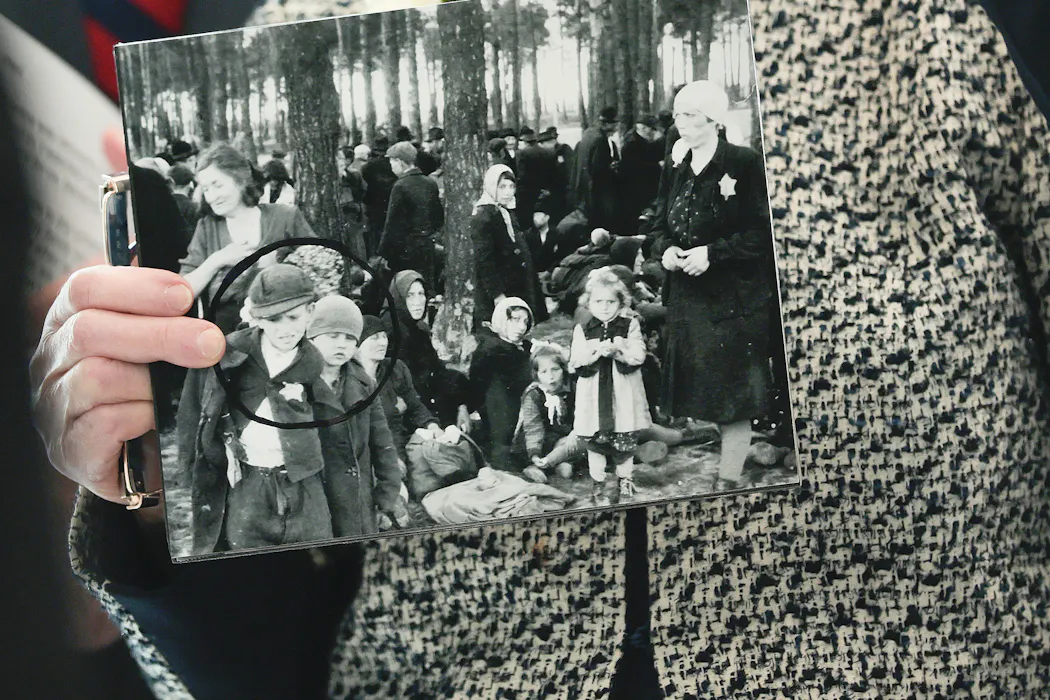
Irene Fogel Weiss holds a photograph of her mother and brothers, who were killed during the Holocaust, during a ceremony at the U.S. Capitol on April 14, 2026, in Washington. Heather Diehl/Getty Images

In 2025, 48% of Americans ages 18-29 could not name a single concentration or death camp, according to a survey by the nonprofit Conference on Jewish Material Claims Against Germany, which works to secure compensation and restitution for Holocaust survivors.

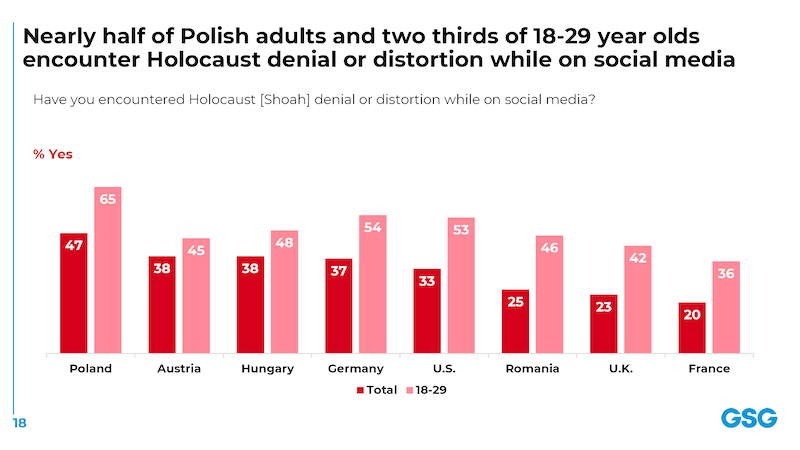
Another 53% of surveyed Americans said that they had encountered Holocaust “denial or distortion while on social media.”

Given their ages, approximately 70% of living Holocaust survivors will likely die by 2035. As they do, more and more people will never hear firsthand experiences about the atrocities Nazis perpetuated during the genocide of European Jews.

My research shows that Holocaust education and awareness, though, doesn’t always follow a linear path.

A large brick tower is seen in front of another tower and barbed wire fence.
The grounds of the Auschwitz concentration camp in Oswiecim, Poland, in April 2026.
Klaudia Radecka/NurPhoto via Getty Images

Teaching a dark chapter

In my 2024 book, “Teaching a Dark Chapter: History Books and the Holocaust in Italy and the Germanys”, I study how Holocaust education evolved in East Germany, West Germany and Italy from the 1940s through the 1980s. In particular, I focus on the content of history textbooks that schools used for middle school students.

I also explore how two antisemitic incidents, one in 1959-60 and then another in 1977, revealed West German students’ lack of Holocaust knowledge.

Both times, international and domestic West German news outlets expressed alarm about students’ ignorance.

These antisemitic incidents also led to a series of educational reforms, in which educational leaders affirmed the need for Holocaust education and specified how educators should teach about the Holocaust.

The ‘swastika epidemic’

All of the synagogues in Cologne, Germany, were either destroyed or badly damaged during the Nazi pogroms of 1938, sometimes called Kristallnacht, or the “Night of the Broken Glass.”

The prominent, historic Roonstrasse synagogue was among the badly damaged Jewish houses of worship and was one of the few synagogues in West Germany to be rebuilt following World War II. In September 1959, West German Chancellor Konrad Adenauer attended a high-profile ceremony when the synagogue’s reconstruction was complete.

But then on Christmas Day of that year, Roonstrasse was defaced with antisemitic graffiti.

Two 25-year-old men were arrested for the vandalism. They testified during their 1960 trial that they never learned about Nazism in school. At the time, West Germany had vague guidelines on how to teach students about the Nazis and the Holocaust.

Historian James Loeffler has challenged whether these arrested men were actually responsible for the vandalism. He argues that the Soviet KGB actually drew the swastikas in order to discredit West Germany.

Regardless, following the Roonstrasse defacement, a wave of additional antisemitic vandalism spread throughout West Germany and other places, including the United States. The press called this trend the “swastika epidemic.”

Many people attributed the rise in antisemitic activity to a lack of education about the Nazi period. They questioned what West German students were learning about their country’s recent past.

New guidelines on how to teach Nazism

The swastika epidemic wasn’t happening in isolation.

In April 1959, the TV documentary “Blick auf unsere Jugend,” meaning “Focus on Our Youth”, focused on a class of West German high school students. Very few of them knew how many Jews were killed by the Nazis.

The negative media coverage coincided with representatives of German and international Jewish organizations meeting with the West German federal president, Theodor Heuss, regarding the antisemitic vandalism and the failures of the West German education system to teach about Nazism.

A committee of West German state cultural representatives called the Kultusministerkonferenz, or KMK, began issuing new guidelines in 1960 and again in 1962 about how to teach about Nazism in schools.

The West German federal states were instructed to examine how Nazism and what we now know as the Holocaust – the term was not used at the time – was depicted in school textbooks. Feedback was then provided to the textbook publishers.

How books were revised

I analyzed many versions of the same middle school history textbook called “Kletts geschichtliches Unterrichtswerk Ausgabe B,” which translates into “Klett’s Historical Instructional Materials Version B.”

Between 1959 and 1960, the textbook authors completely revised a subsection on “Terror and Crimes,” which examined how the Nazis murdered disabled people, as well as how the Nazis persecuted and murdered Jews.

The subsection tripled in size between the 1959 and 1960 textbook editions. The new version also included important new information, such as that the Nazis murdered an estimated 6 million Jews.

Previous editions had used generalizations like “many million,” without providing actual numbers.

A second controversy

Seventeen years later, in 1977, a West German teacher named Dieter Bossmann published a widely publicized study that offered more detail on the widespread ignorance among West German students, at every level.

Some students admitted to knowing almost nothing about Hitler. Some said relatively positive things about Hitler. One student thought that the Nazis had killed tens of thousands of Jews. Another thought that 16 million Jews had been killed.

The West German news magazine Der Spiegel observed at the time that the issue was perhaps not so much what students were learning, but rather how they were being taught. Although West German textbooks had been revised in the 1960s, somehow there was a disconnect between the textbook page and students’ understanding.

The KMK issued a new resolution in April 1978 that called for new curricular material for schools.

After this, more West German teachers began to prioritize an active teaching model. They encouraged students to analyze primary sources and participate in experiential learning activities, such as visiting concentration camp memorials and conducting local history research.

A man with short white hair, a black jacket and backpack and kippah on his head stands in front of a brick wall that says 4 block.
An Auschwitz camp building in the Auschwitz Museum, the former Nazi concentration camp in Poland, is seen during an educational event marking Yom HaShoah, or Holocaust Memorial Day, on April 14, 2026.
Dominika Zarzycka/SOPA Images/LightRocket via Getty Images

Remembering history

Holocaust education in West Germany was not perfect after 1978 – or any time since.

For example, Deutsche Welle, Germany’s public news broadcaster, quoted a Berlin history teacher saying in 2023 that among his students, “Adolf Hitler is known by most; the term National Socialism too. Some of them also know about the Holocaust, but knowledge is selective and it contains many blank spots.”

An estimated 18% of German adults incorrectly said in 2025 that 2 million or fewer Jews were killed during the Holocaust.

My particular focus on textbooks and curricular guidelines, though, demonstrates that sometimes, knowledge gaps lead to leaps forward.

Today, in part because of these developments, it’s mandatory to teach about the Holocaust in all federal states in Germany.

In the U.S., Holocaust education requirements are determined at the state level, and not all states provide Holocaust education guidance or mandates. If the West German case shows anything, I think, it is that guidance on teaching history should be continuously updated and reiterated.

The Conversation

Daniela R. P. Weiner has received funding from the Jack, Joseph and Morton Mandel Center for Advanced Holocaust Studies at the United States Holocaust Memorial Museum, the German-American Fulbright Commission, the German Historical Institute, Washington, DC, the Leibniz Institute for Educational Media | Georg Eckert Institute, the Carolina Center for Jewish Studies, the Stanford Graduate School of Education, and the Department of History at the University of North Carolina at Chapel Hill. She is also affiliated with the Association for Jewish Studies.

ref. About half of young Americans can’t name a single Holocaust site, repeating a pattern of ignorance seen in postwar Germany – https://theconversation.com/about-half-of-young-americans-cant-name-a-single-holocaust-site-repeating-a-pattern-of-ignorance-seen-in-postwar-germany-278507

Legal aid for asylum seekers is hard to come by – it’s no wonder criminal advisers are taking advantage

Source: The Conversation – UK – By Raawiyah Rifath, Lecturer in Law, University of Exeter

Treerat Wongvorapat/Shutterstock

The Home Office is investigating after a BBC report found evidence of a “sham industry” of immigration advisers helping people fabricate asylum claims.

The advisers and lawyers allegedly promised quick routes to refugee status – sometimes for fees of thousands of pounds – by helping asylum seekers present themselves in ways they believed the Home Office would accept. These included false claims based on sexual orientation, atheism, political activism and domestic abuse allegations.

These revelations, while concerning, should not be treated as proof of a widespread problem with asylum seekers. Instead, they show how easily people in precarious legal situations can be exploited when access to trustworthy legal advice has been allowed to erode. While some may knowingly go along with such practices, many others may be exploited by unregulated advisers selling a “quick fix” to a complex system.

In England and Wales, immigration advisers are regulated by the Immigration Advice Authority. They must pass competence exams and can only advise at the level for which they are authorised. Government guidance establishes that they must be regulated and are restricted by their qualification levels. Many of the advisers and lawyers identified in the BBC report are unregulated or operating without a licence. In the UK, providing immigration services without proper authorisation is a criminal offence.
Registered immigration advisers found to prepare fraudulent cases can lose their credentials, while solicitors who act dishonestly can face disciplinary sanctions including strike off.

People seeking asylum navigate one of the most complex areas of law, often not in their first language. At the same time, they are living in temporary accommodation and dealing with uncertainty. It may be difficult for them to distinguish between reputable solicitors, informal community brokers, regulated advisers, overstretched charities and opportunists.

Like many others in England and Wales, asylum seekers have been affected by years of legal aid shortages. This has created gaps that are being filled by exploitative advisers. “Insider knowledge” presented as certainty and speed can be easily sold to people who are unable to access reliable advice.

Legal aid is a state-funded scheme providing legal advice and representation for people who do not have the means to pay for it themselves. This is often the only route to getting regulated legal help at all in asylum matters, but the system has been weakened over many years. Large parts of civil legal aid were cut back after the introduction of the Legal Aid, Sentencing and Punishment of Offenders Act in 2012, and what remains available is financially unviable for providers because fees have failed to keep pace with costs. As a result, there are fewer firms and longer waits for the lawyers who remain.

Between 2022-23, 63% of the population of England and Wales did not have access to an immigration and asylum legal aid provider in their area. And 51% of asylum applicants in England and Wales (37,450 people) were unable to find a legal aid lawyer.


Read more:
The legal aid sector is collapsing and millions more may soon be without access to justice – new data


Home Office policies house many asylum seekers in locations where legal aid provision is already absent. Access to regulated advisers is far from guaranteed.

The state has left too much room for under-resourced forms of assistance to become normal. As a result, third sector organisations have stepped in to fill gaps in legal support and basic welfare. This often involves the provision of legal support and information about the asylum process.

Most people seeking asylum do not understand what sort of detail the Home Office will expect, how interviews work, what documents they need to present or what counts as corroboration. They rely on legal representatives where they can find them. Considering the lack of affordable and competent advice, opportunistic actors find it easy to step in.

Why unregulated advice finds a market

These issues are worsened by the way asylum decision-making works. Research with asylum seekers about their experiences has found that immigration officials approach asylum interviews with suspicion. Decision-makers may have an idea of what makes someone’s story plausible and recognisable, which is not always reflective of people’s complex lives. For example, people seeking asylum because they are apostates – people who have left religion in a theocracy – have reported being asked to name humanist philosophers – something many would not be able to do regardless of their beliefs.

Home Office caseworkers make life-changing decisions in a system that has long been criticised for inconsistency and disbelief.

Concerns have been raised about the quality of asylum decisions made amid efforts to speed up the process and reduce the backlog of applications. Reports that caseworkers have been offered bonuses for faster decisions also cast doubt on the quality of decision-making. It is not hard to see why people may be drawn towards anyone claiming they know how to make a case “work”.

Long waits also make people more vulnerable to exploitation. Most of our research participants have spent years in limbo, waiting for application decisions. Many would be tempted by promises of a supposedly safer and faster route through the system.

The real concern is not just that some people may be coached on their story, but the fact that the system makes this coaching lucrative. This market of “insider knowledge” can only thrive in a context where regulated legal aid has collapsed, where the success of the asylum claim depends on knowing how to present oneself in a particular manner, and where delays, precarity and uncertainty are part of claimants’ everyday lives.

We welcome any well-investigated scrutiny of rogue advisers. But the legal aid crisis, the uneven geography of advice provision, the culture of disbelief among asylum officials and the assessment process itself are also worthy of examination.

An investigation that does not consider that wider context will only shift public attention to supposedly suspect claimants, instead of to the system that has left them vulnerable to exploitation in the first place.

The Conversation

Raawiyah Rifath has received funding from the Wellcome Centre for Cultures and Environments of Health.

Diego Garcia Rodriguez serves as a trustee of the LGBTIQ+ asylum charity Time To Be Out (https://www.timetobeout.org.uk).

Nicole Hoellerer does not work for, consult, own shares in or receive funding from any company or organisation that would benefit from this article, and has disclosed no relevant affiliations beyond their academic appointment.

ref. Legal aid for asylum seekers is hard to come by – it’s no wonder criminal advisers are taking advantage – https://theconversation.com/legal-aid-for-asylum-seekers-is-hard-to-come-by-its-no-wonder-criminal-advisers-are-taking-advantage-280839

80 million people globally claim Irish ancestry – why the release of 1926 Irish census records is so momentous

Source: The Conversation – UK – By Ciara Breathnach, Professor of Irish Gender History, University College Cork

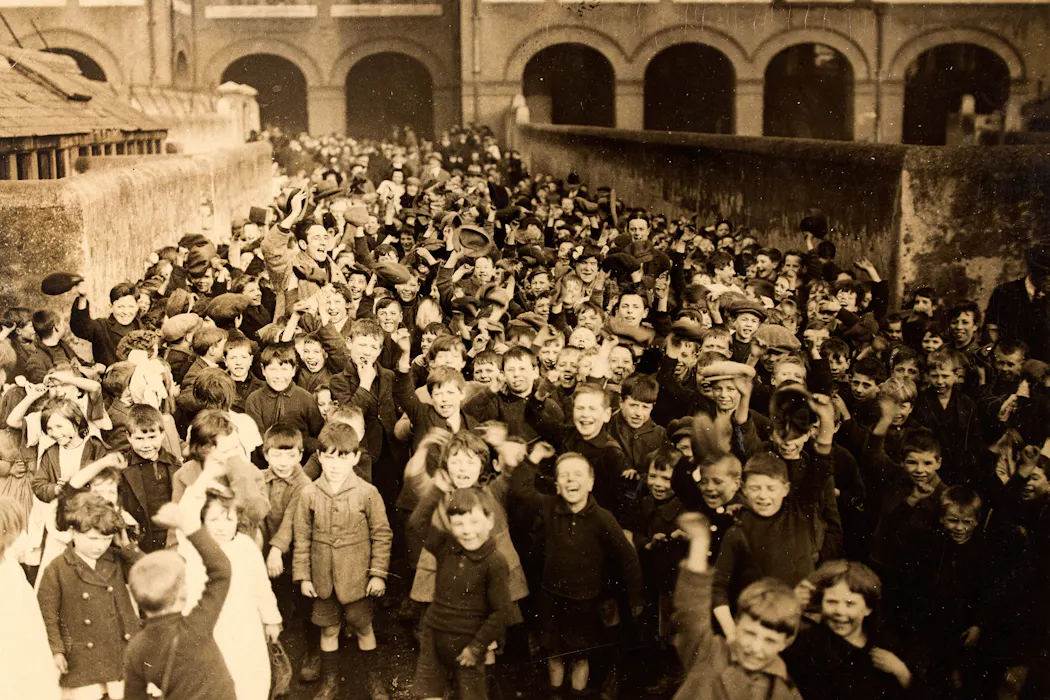
A children’s party in Dublin in the 1920s. National Library of Ireland on The Commons @ Flickr Commons, CC BY

One hundred years after it was conducted, the first full census of independent Ireland is being released for free online. These nearly 3 million records will be of great significance to Ireland’s population, and a global diaspora of some 80 million claiming Irish ancestry.

As well as providing insight into socioeconomic circumstances following the establishment of Saorstát Éireann (the Irish Free State) in 1922, the 1926 census holds several keys to unravelling Ireland’s complicated past.

For many, this public release will help reconcile the enormous loss caused by the destruction of the Public Record Office of Ireland at the outset of the Irish civil war. An explosion laid waste to over 700 years of Irish historical records, including some of the 19th-century censuses.

In Ireland, public access to historical census returns is legally restricted for 100 years. Almost 16 years since the online release of the 1901 and 1911 household census returns, the demand for more genealogical records is palpable.

So, please be patient with the system (and the wonderful people behind it) as it will be busy. Excitement about previous census releases has crashed websites.

What the census could reveal

The 1926 census has some novel aspects compared with those conducted under British administration from 1821 to 1911. Although the Irish language was part of a bilingual question since 1851, the 1926 census offered the first opportunity to complete the form as Gaeilge (in Irish).

This census emphasised the “family” as the unit of inquiry, as opposed to the “household”, which was more inclusive of non-relatives cohabiting. As with past censuses, the name, age, sex, marital status/orphanhood, birthplace, language, religion and occupation of each person was documented in terms of their relationship to an appointed head of household.

A census provides the statistical underpinning to plan for future population needs. In the 1920s, the world was reeling from excess young adult mortality – a combination of the first world war and the global influenza pandemic. Ireland was no exception.

Aggregate reports from the 1926 census convey concerns about the declining population, delayed age at marriage and marital fertility.

Perhaps reflecting the remit of the responsible Department of Industry and Commerce (Statistics Branch), the 1926 census sought more precise information than previous censuses about employment and employers. The reports show that of 1,223,014 “gainfully employed” people over the age of 12, 53% were engaged in agriculture.

But regional variations were marked. In Dublin City, heartland of the pejoratively termed “beer and biscuits” economy, that figure was as low as 0.9%. In counties like Galway, agricultural dependency was as high as 75%.

Only 6% of the population was categorised as “unemployed”, most of which was temporary. Some jobs had residential components and, of those, the 14,145 “professed clergymen and nuns” outnumbered the 13,869 non-commissioned members of the recently reduced Óglaigh na hÉireann (Irish army).

The records released on April 18 tell us even more about the men, women and children behind these statistics, what their domestic lives were like, and the parts they played in Saorstát Eireann.

Mysteries of history

Like many, I approach the release with questions about my own family, such as where my grandparents were at the time.

My first search will be for deceased loved ones like my darling uncle Eamon. He will be among the infants recorded in 1926, who went on to contribute to the Bailiúchán na Scol or Schools’ Collection – a compilation of folklore compiled by Irish schoolchildren in the 1930s. Something was definitely in my eye when I found him in there a few years ago.

There are also several wider socioeconomic, cultural and political aspects to this census that I will explore.

I am interested in teasing out the relationship between the populace and the newly-formed An Gárda Síochána, the unarmed police force established in 1926 who acted as census takers. For example, did they encourage participation, or instil a reticence to engage, among those who opposed the Irish Free State government?

Related to this is whether Dublin’s sex work district, Monto, endured the moral panic that swept across Europe following the Great War. My work with Rachel Murphy on the 1911 census found several young women as sole occupants of tenement rooms, which would normally be inhabited by entire families. Will similar patterns emerge when we examine the streets of Monto in 1926?

It will be possible to investigate the ages of older cohorts alongside court records. This may challenge the well-worn jokes about those who allegedly aged more than ten years between the 1901 and 1911 censuses, in order to qualify for the old-age pension.

For scholars of migration, birthplace will be a critical data point, to trace Northern Irish Catholics seeking refuge from sectarian conflict.

Sadly, the equivalent 1926 Northern Irish returns were lost through suspected improper housing and archival neglect. This inhibits future research on the 106,456 decrease in the Protestant population from the 1911 census. Some of this reflected the departure of British Crown forces, but the majority were those fleeing the Irish Free State for political and safety reasons.

Tips for your census search

Household census returns are an excellent source of information about past family and kinship networks. But it is best to manage expectations and think creatively around naming conventions, derivatives and spelling variations. Ditto for place names – but there is a useful historical mapping tool that could help. Bear in mind also that several streets were renamed after 1922.

As a general rule, the upper echelons of Irish society are easier to find in official records than lower socioeconomic groups. My work shows how census returns are often the only official record of ordinary lives.

To protect the privacy of residents in hospitals, asylums, prisons, county homes (erstwhile workhouses) and other carceral institutions on census night, only their initials were recorded. This makes patients and inmates tricky to find, but a rough idea of age and location will prove helpful.

For the more well-documented Irish, the 1926 census offers a conduit to the delights of other freely available online collections, like the civil registration of births deaths and marriages on irishgenealogy.ie.

The Conversation

Ciara Breathnach receives funding from Research Ireland.

ref. 80 million people globally claim Irish ancestry – why the release of 1926 Irish census records is so momentous – https://theconversation.com/80-million-people-globally-claim-irish-ancestry-why-the-release-of-1926-irish-census-records-is-so-momentous-280746

Trump sidelined Congress’ authority over war on Iran – and lawmakers allowed it, extending a 75-year trend

Source: The Conversation – USA – By Sarah Burns, Associate Professor of Political Science, Rochester Institute of Technology; Institute for Humane Studies

Congress has not used its constitutionally granted power to influence the war in Iran. Bloomberg Creative via Getty Images

Lawmakers in the U.S. House of Representatives set April 21, 2026, as the date to hear from and question top Pentagon officials Adm. Brad Cooper, the head of U.S. Central Command, and Gen. Dagvin R.M. Anderson, head of U.S. Africa Command, about the war in Iran. But Republican legislators put off the hearing for a month, giving up – for now – the opportunity to exercise oversight of the war.

Adam Smith, the top Democratic member of the House Armed Services Committee, told The New York Times, “We are six weeks into this conflict. And we still haven’t gotten a public briefing from anyone in the administration about the war.”

President Donald Trump’s military campaign against the Iranian regime is currently in a ceasefire. Despite the low approval rating of the war, the president has not drawn the conflict to a close, and the result of the operation is so far unclear.

The postponed hearing was only one example of how Congress has been noticeably meek about the war, with most Republicans killing the many Democratic efforts to exercise constitutionally granted power over engaging in such military conflicts. For the fourth time, the Senate on April 16, 2026, rejected a war powers resolution.

As scholars who research war powers and have a book coming out about President Barack Obama’s decision-making about the Afghan war, we know that the reluctance of Congress to assert its power is, in fact, history repeating itself, as is the president’s unilateral action.

A man standing at a lectern flanked by flags, pointing into the audience of raised hands.
President Donald Trump and Defense Secretary Pete Hegseth conduct a news conference in the White House briefing room about the war in Iran on April 6, 2026.
Tom Williams/CQ-Roll Call, Inc via Getty Images

Historically meek Congress

Article 1 of the U.S. Constitution gives Congress the power to declare war, not the president. But most modern presidents and their legal counsel have asserted that Article 2 of the Constitution allows the president to use the military in certain situations without prior congressional approval – and have acted on that, sending troops into conflicts from Panama to Libya with no regard for Congress’ will.

Based on the 1973 War Powers Resolution – passed over President Richard Nixon’s veto – the president has an obligation to inform Congress about his actions within 48 hours of initiating military action and requires him to seek legislative authorization if the military operation will last over 60 days.

Since its passage, presidents have dutifully informed Congress within the 48-hour window when they unilaterally initiate military operations. Typically, they use the following language: “Pursuant to” their power as commander in chief and chief executive, they are initiating an operation.

Yet presidents since Nixon have never formally acknowledged the constitutionality of the War Powers Resolution. They have, however, mentioned it in their letters to Congress about their actions, and for the most part they have abided by its restrictions. So language is crucial and presidents tend to use the phrase “consistent with” the War Powers Resolution when they inform Congress about military operations.

The second Trump administration has broken with that standard. In Trump’s message to Congress about the Iran war, sent on March 2 2026, he did not acknowledge the War Powers Resolution or the Constitution, let alone pay lip service to either.

Instead, Trump has sidestepped the traditional use of the War Powers Resolution – and avoided the congressional oversight that comes with it – by relying on executive orders to convey his intent to use military power against the Iranian regime. That move, whether legal or not, has provided the president with a great deal of freedom to decide what the military can do, what tools they can use to do it and how long they can do it. His decision to send another carrier group and the addition of thousands of U.S. troops to the region is just the latest example.

Congress has proved incapable or unwilling to check this presidential unilateralism. Shortly after the start of the military campaign against Iran, Democratic Sen. Chris Murphy introduced war powers legislation to constrain Trump that failed to pass the Senate. In the House on March 5, members narrowly rejected a resolution to impede a broader or longer operation.

To a meaningful extent, we are watching history repeat itself: Over the past seven decades during times of war, members of Congress have not wanted to act, and presidents have not wanted to ask permission.

From alacrity to deference

Presidents Woodrow Wilson and Franklin D. Roosevelt made their case for war and obtained a formal declaration from Congress within three days in 1917 and within the same afternoon in 1941, respectively.

Since the start of the Korean War, however, members of Congress have demonstrated more deference and less assertiveness.

In Korea, President Truman did not get congressional authorization for the war.

Following North Korea’s invasion of the South in June 1950, Truman bypassed Congress, making his case for war to the United Nations Security Council. In July 1950, United Nations Security Council Resolution 84 “authorized the United States to establish and lead a unified command comprised of all military forces from UN member states, and authorized that command to operate under the UN flag.”

A soldier with a gun ordering soldiers on the ground to do something.
U.S. soldiers in 1951 order Chinese prisoners to the ground outside Seoul, South Korea, before U.S. and U.N. troops took the city.
AFP via Getty Images

Truman’s rhetoric about American combat operations on the Korean peninsula being part of a U.N. “police action” became increasingly tenuous, but he managed to avoid seeking congressional permission. In doing so, Truman created a precedent in which a congressional declaration of war was no longer necessary for the American military to carry out combat operations. Sen. Robert Taft, a Republican, opposed this lack of congressional deliberation, declaring that Truman’s actions represented a “usurpation” of the war powers authority.“ But Congress did nothing to stop the war as the tactical and strategic picture in Korea stalemated.

In Vietnam, in the aftermath of the 1964 Gulf of Tonkin incident – a purported attack by the North Vietnamese on American naval vessels that did not, in fact, occur – President Lyndon Johnson used the alleged crisis to push for congressional authorization for the escalation of force in Southeast Asia.

Johnson presented the Gulf of Tonkin Resolution to Congress, which quickly passed it. The resolution allowed Johnson to freely escalate American military involvement in Southeast Asia with a vague authorization to engage militarily as he saw fit, in contrast to the very clear declarations of war that came before it for previous wars.

Col. Harry G. Summers, who wrote an influential strategic analysis of the Vietnam War, points to the Gulf of Tonkin Resolution as evidence that the relevant actors – the executive, Congress and the military – failed to foresee the scale of the course of action they were embarking on.

The resolution significantly increased the president’s freedom of action – and freedom from oversight – and marked a major step toward the Americanization and escalation of the war in July 1965. Despite the deeply troubled engagement in South Vietnam and the passage of the War Powers Resolution, we still see presidents acting alone, without consulting members of Congress, let alone getting authorization.

Refusing responsibility

In Summers’ Vietnam postmortem, he relates a telling anecdote of a professor at West Point. The professor, an Army officer, remarked, “When people ask me why I went to Vietnam I say, ‘I thought you knew. You sent me,’” a comment indicative of “the civilian sector’s growing refusal to take responsibility for the kind of army it needs.”

In the case of Trump’s decision-making concerning hostilities with Iran, Americans will one day need answers to the questions: Why did the United States engage in this war with unclear political objectives? And why did Congress allow it to continue?

This story contains material from an article published on March 6, 2026.

The Conversation

The authors do not work for, consult, own shares in or receive funding from any company or organization that would benefit from this article, and have disclosed no relevant affiliations beyond their academic appointment.

ref. Trump sidelined Congress’ authority over war on Iran – and lawmakers allowed it, extending a 75-year trend – https://theconversation.com/trump-sidelined-congress-authority-over-war-on-iran-and-lawmakers-allowed-it-extending-a-75-year-trend-280671

Trump’s coercive tactics in Latin America evoke era of gunboat diplomacy – and the rise of anti-imperialism it helped spur

Source: The Conversation – Global Perspectives – By Tony Wood, Assistant Professor of History, Modern Latin America, University of Colorado Boulder

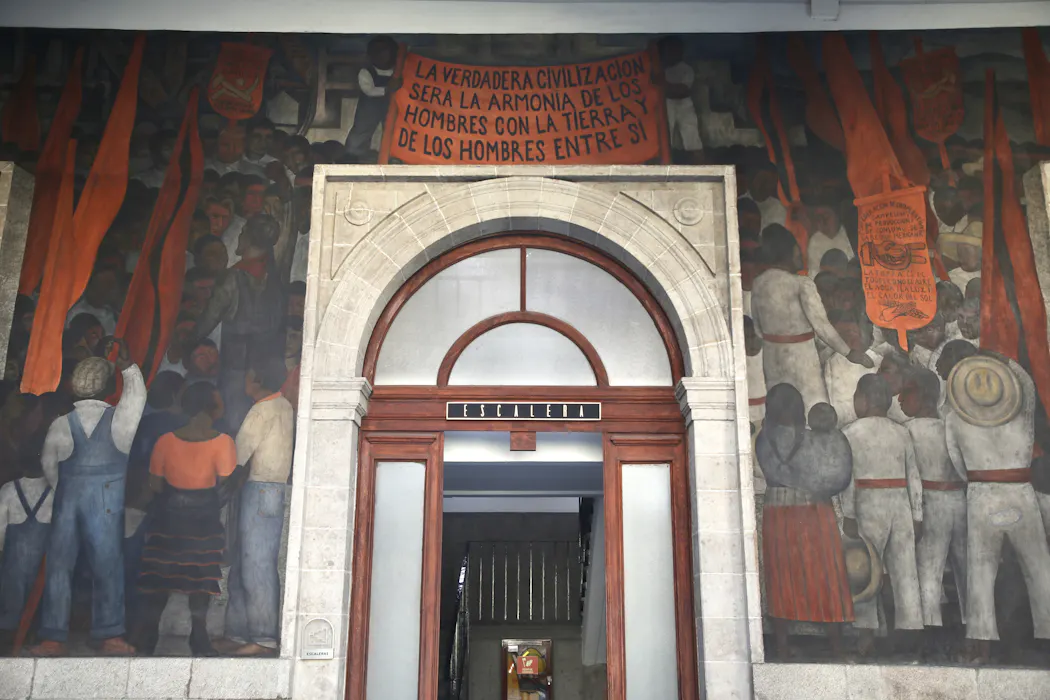
One of scores of murals Diego Rivera painted in the interwar period that sits above the Secretariat of Public Education in Mexico City, Mexico. Apolline Guillerot-Malick/SOPA Images/LightRocket via Getty Images

In Latin America, as in other parts of the world, the second Trump administration has adopted an increasingly aggressive policy.

From drone strikes on purported drug traffickers to increased tariffs on imports, and from the blockade on fuel shipments and threats of invasion in Cuba to the Jan. 3 military incursion into Venezuela, the U.S.’s more coercive approach to its hemispheric neighbors evokes an earlier period of U.S. foreign policy.

Many commentators have found echoes of the 1989 capture of Panamanian leader Manuel Noriega in the kidnapping of Venezuelan president Nicolás Maduro. Others highlighted the longer history of U.S. interventions in Latin America stretching back through the Cold War. That includes the Nixon administration’s support for the 1973 coup against Salvador Allende in Chile or the CIA-sponsored removal of Guatemala’s elected president, Jacobo Arbenz, in 1954.

Yet as a historian of early 20th-century Latin America, I believe the Trump administration’s approach to Latin America more closely resembles an older pattern of U.S. policy. Between 1900 and the mid-1930s, U.S. forces intervened in one Latin American country after another. This practice was often justified by the Roosevelt Corollary, President Theodore Roosevelt’s addition to the Monroe Doctrine. In cases of “chronic wrongdoing,” Roosevelt said in 1904, the U.S would find itself compelled to exercise an “international police power” in defense of U.S. interests.

But crucially, how Latin Americans responded to the U.S. exerting its dominance in the early 20th century may hold some lessons for the present day. One of the major side effects of the U.S.’s so-called gunboat diplomacy was an upsurge of resistance and anti-imperialist thinking in the region’s political life.

The roots of anti-imperialism

In the 30 years after Roosevelt asserted the U.S.’s right to intervene across the hemisphere, U.S. forces occupied Cuba three times – in 1906-09, 1912 and 1917-21. They also occupied Haiti from 1915 to 1934 and the Dominican Republic from 1916 to 1924. In Nicaragua, the U.S. deployed the Marines from 1912 to 1925 and then again from 1926 to 1933, waging a counterinsurgency in which it used aerial bombardment for the first time.

Across much of the region, then, this was a time when the U.S. was quick to resort to force, unburdened by any concerns for Latin American countries’ sovereignty.

Yet this era of external intervention also coincided with a period of remarkable political ferment, which I describe in my recently published book, “Radical Sovereignty.”

In one place after another, from Buenos Aires to Mexico City and from Havana to Lima, movements sprang up that put forward sharp critiques of U.S power. Many of them grew out of student organizations in the late 1910s, while others drew on the rising strength of labor unions and newly formed leftist political parties.

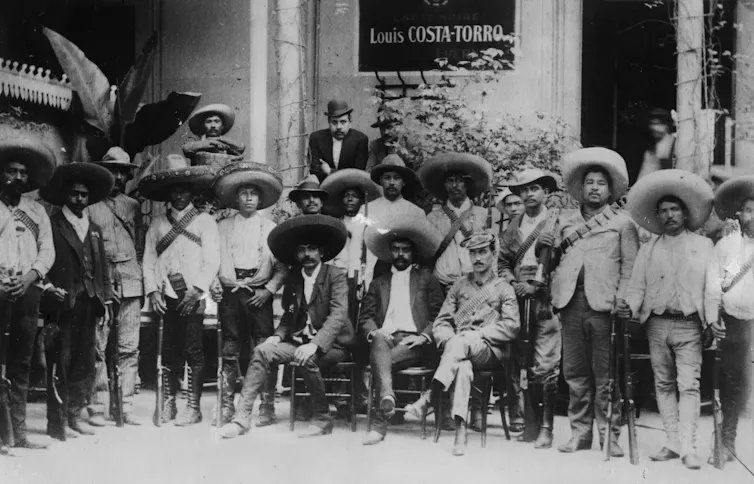
Emiliano Zapata, a primary leader of the Mexican Revolution, is shown with his fellow soldiers in an undated photo.
HUM Images/Universal Images Group via Getty Images

In 1923, rural workers in the Mexican state of Veracruz formed a Peasant League. From the outset, they saw local issues as closely interwoven with international ones, and they argued that there was a compelling reason for this. As the league put it, “Our internationalism is not the child of a crazed enthusiasm for empty phrases … but of the need to take preventive measures, to bolster ourselves against the enemy,” which they identified as “the imperialism of North America.”

Many of Latin America’s radical movements at this time were inspired by the recent example of the Mexican Revolution. The new Mexican Constitution of 1917 had nationalized the country’s land and natural resources, putting it on a collision course with U.S. companies and landowners.

Others still were energized by the global repercussions of the Russian Revolution. This, of course, included several brand-new communist parties across the region. But at the time, many others in Latin America saw the Bolsheviks as part of a global anti-colonial wave.

Mexico City as activist hub

My book explores the key role Mexico City played as a gathering point for these different political tendencies.

They included groups ranging from Mexican peasant leagues to the American Popular Revolutionary Alliance, an anti-imperialist movement formed by Peruvian exiles. Many of these organizations converged under the umbrella of the Anti-Imperialist League of the Americas. Founded in Mexico City in 1925, it soon had chapters in a dozen more countries across the region.

Between them, these movements brought into focus the novel features of U.S. power. As the Cuban student leader and communist Julio Antonio Mella saw it in 1925 – at a time when his native country was highly dependent on the U.S. but formally sovereign – the U.S. was distinct. Unlike European empires, it largely refrained from direct control of territories, though it had pressed the Cubans to include in their 1901 constitution a provision allowing it to intervene in the island at will.

In Mella’s view, the U.S. was clearly an empire, one that mainly exercised its dominance through commercial or financial pressures. For him, the dollar and Wall Street were as central to U.S. power as the halls of government in Washington, D.C.

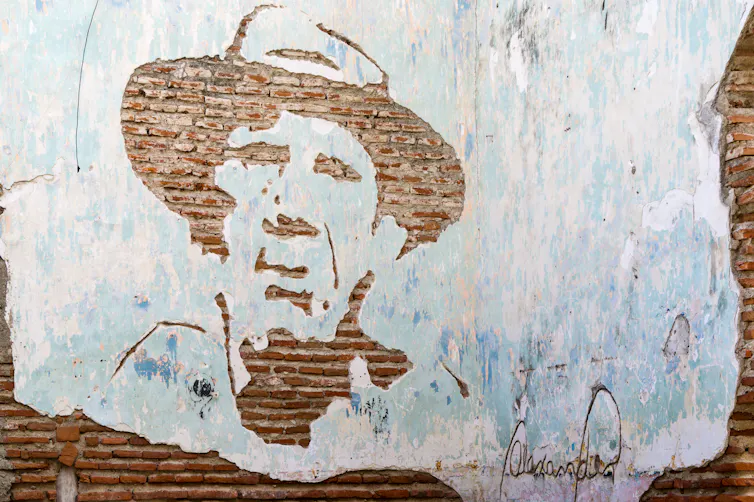
A portrait of a man chiseled from a brick wall.
A portrait of Julio Antonio Mella is seen chiseled from a brick wall in Camaguey, Cuba.
Roberto Machado Noa/LightRocket via Getty Images

For Ricardo Paredes, an Ecuadorean doctor who founded the country’s Socialist Party in 1926, a new term was required to capture Latin American countries’ contradictory position. Formally sovereign, they were not colonies as such. Yet they were economically and politically subordinated to Washington and Wall Street – “dependent countries,” as he phrased it in 1928.

For the Peruvian poet Magda Portal, a leading member of the anti-imperialist American Popular Revolutionary Alliance, U.S. dominance played out differently in different parts of Latin America.

In a series of lectures she gave in Puerto Rico and the Dominican Republic in 1929, Portal divided the region into zones. While countries such as Argentina or Brazil were mainly sites for U.S. investment, Mexico and the Caribbean were regularly subjected to U.S. military force. Or, as Portal put it, “Here imperialism wears no disguise.”

Portal concluded her lectures with a phrase that combined her analysis of U.S. dominance with a resonant appeal for unity: “We have a single and great enemy; let us form a single and great union.”

United states of resistance?

Yet while there was much Latin American anti-imperialist thinkers could agree on, there were also profound divergences between them. This included questions of strategy as well as issues of principle. What role should different classes play in their movement? How radical a transformation of society were they pushing for? And what kind of state should emerge from it?

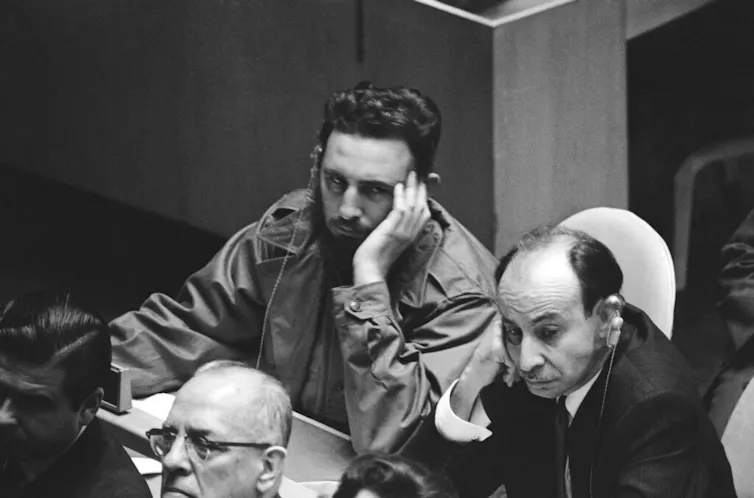
Two men listen to a speech in an old photograph.
Cuban Premier Fidel Castro and his foreign minister Raul Roa listen to U.S. President Dwight Eisenhower speak to the United Nations General Assembly on Sept. 22, 1960.
AP Photo

Over time, these differences turned into deep rifts that pitted revolutionaries against democratic reformists, internationalists against nationalists, and pro-Soviets against anti-communists. These disagreements played an important role in Latin American politics over the rest of the century.

While many of these rifts became especially prominent during the Cold War, they developed out of earlier divisions over how best to counter U.S. dominance.

The anti-imperialist upsurge of the 1920s and ’30s was formative for a generation of Latin American radicals. Several of those who entered political life during these years went on to play key roles in major events of the 20th century. Raúl Roa, for example, who served as foreign secretary for Cuba’s revolutionary government from 1959 to 1976, was first politicized in the island’s anti-imperialist movement of the 1920s.

The men and women whose political visions were formed in the interwar period carried those ideals forward into the Cold War era. In important ways, the 1920s and 1930s laid vital groundwork for later and better-known radical movements.

Past is, of course, not always prologue. It is impossible to predict what the long-term consequences of current U.S. policy in Latin America will be, especially given the rightward tilt that is currently unfolding across the region.

But looking at the region’s anti-imperialist traditions does point to one possible outcome: The U.S.’s newly aggressive stance will, sooner rather than later, fuel a resurgence of anti-imperialist sentiment as the organizing principle for a new generation of activists.

The Conversation

Tony Wood does not work for, consult, own shares in or receive funding from any company or organization that would benefit from this article, and has disclosed no relevant affiliations beyond their academic appointment.

ref. Trump’s coercive tactics in Latin America evoke era of gunboat diplomacy – and the rise of anti-imperialism it helped spur – https://theconversation.com/trumps-coercive-tactics-in-latin-america-evoke-era-of-gunboat-diplomacy-and-the-rise-of-anti-imperialism-it-helped-spur-279238

What if Texas’ destructive Tax Day storm had centered on inner Houston instead? It’s why cities should plan for the improbable

Source: The Conversation – USA (2) – By James R. Elliott, Professor of Sociology, Rice University

A couple battle floodwaters as they evacuate their Houston apartment complex on April 18, 2016. AP Photo/David J. Phillip

Ten years ago, the infamous Tax Day storm swamped the Houston area with off-the-charts rainfall. Nearly 2 feet of rain fell in less than 15 hours in parts of the region, starting on April 17, 2016. The rain flooded thousands of homes and exceeded a 10,000-year event at some gauges.

But the storm’s damage could have been much worse.

The brunt of the deluge hit Waller County, west of Houston, where the impact was largely on farms and ranches. Had the same volume of water fallen just a few miles to the east, over Houston’s dense urban core, the tragedy would have been far worse.

What made the Tax Day flood so devastating was its speed. It was a flash event that struck overnight, without warning.

People in an airboat going past buildings surrounded by water.
The strongest rains from the 2016 Tax Day flood hit less-populated areas west of Houston, but communities across the city flooded. An airboat rescued residents from a flooded neighborhood in Spring, Texas.
AP Photo/David J. Phillip

At Rice University’s Center for Coastal Futures and Adaptive Resilience, we used state-of-the-art hydrological modeling conducted by our colleagues at Rice’s Severe Storm Prediction, Education and Evacuation from Disasters Center to see what would happen if a similar storm struck more populated parts of the city today.

The results suggest that current flood planning strategies in Houston – and similar strategies used in communities across the U.S. – are dangerously narrow in how they consider what’s at risk. In today’s world of increasingly extreme downpours, preparing for flood disasters means preparing for more than just what’s probable – it means also preparing for extreme situations that are less likely but could be far more dangerous.

The perils of relying on probability

In the United States, flood risk is publicly defined by maps produced by the Federal Emergency Management Agency. These maps, suggesting which properties face flood risks, guide everything from emergency planning to decisions related to the National Flood Insurance Program.

However, FEMA’s risk maps are based on probabilistic modeling that typically stops at the 500-year flood risk level, meaning a property has 0.2% odds – a 1 in 500 chance – of being flooded in any given year. There is a mathematical reason for doing this: There are simply too few cases to reliably estimate probabilities below that threshold.

Consequently, “off the charts” events like the Tax Day flood are effectively ignored in official planning. Authorities often prefer to view them as unrealistic until more data is collected – a process that can take decades. Yet, parts of Houston suffered another 1,000-year event the following year when remnants of Hurricane Harvey stalled over the city in 2017, and Houston has seen other 500-year floods in recent years.

People carry their belongings in trashbags and adults have small children on their shoulders as they walk through waist-deep water.
Residents wade through floodwaters as they leave a Houston apartment complex on April 18, 2016, after an overnight downpour.
AP Photo/David J. Phillip

The Dutch, who are global leaders in flood science by necessity, since more than half their country is at risk of flooding, use a different approach. They take what they consider “worst credible floods” seriously. These are events that extend beyond standard probability models but are still considered by experts to be realistic, or credible, possibilities.

If the Tax Day storm hit today

To get a clearer picture of the Houston area’s credible risks, we simulated the impact of the Tax Day flood from rainfall alone if the storm had centered over two different watersheds in Houston’s Harris County.

The suburban risk: Clear Creek runs through a middle-class suburban area near NASA’s Johnson Space Center. Vast stretches of suburban concrete block its natural drainage, and thousands of homes have been built along its winding, sluggish tributaries.

Even moderate rainfall can quickly transform these waterways into destructive torrents that overflow into nearby townships, including Friendswood and League City.

Our simulations show that if the Tax Day storm had centered over the Clear Creek area, more than 13,500 properties with homes would have quickly flooded with at least 6 inches of water. Above 6 inches is the danger zone where roads become unsafe for most passenger vehicles. In a home, when drywall gets wet it begins to wick water upward, requiring tear-outs. Even in elevated homes, that much water can damage equipment and contaminate water systems. In some areas, our simulations indicate the water depths would have exceeded 3 feet within hours.

A map shows widespread flooding
In this simulation of flooding of the Houston area’s Clear Creek watershed, properties in orange would have flooded to 6 inches or more.
Center for Coastal Futures and Adaptive Resilience/Rice University

The financial “what if” is even more staggering. Our analysis of publicly available data indicates that 92% of homes in Clear Creek’s flood zone likely have no flood insurance, and 52% fall outside the 100-year flood plain in FEMA’s latest proposed maps. Even with FEMA’s latest map updates, most mortgage holders would not be required to carry flood insurance on homes in the area that would have flooded.

The equity gap: When we moved the storm over Hunting Bayou, a working-class area in inner Houston populated largely by residents of color, the results were even more severe. Here, flooding represents the legacy risk of midcentury urbanism, where a naturally shallow, sluggish stream was penned in by industrial warehouses and tightly packed residential streets long before modern drainage standards existed, restricting the waterway’s ability to expand and meander gracefully.

Because much of the area has flat, poorly draining soils, this watershed has become a bottleneck that can rapidly overflow during heavy rains. We found the Tax Day storm would have flooded more than half of all residential lots there with at least 6 inches of water, compared to 16% of residential lots in the Clear Creek area. And flood insurance in the Hunting Bayou area is nearly nonexistent.

A map shows widespread flooding
Had the Tax Day storm centered over Houston’s Hunting Bayou, this simulation shows that properties in orange would have flooded to 6 inches or more.
Center for Coastal Futures and Adaptive Resilience/Rice University

Both simulations, viewable through our interactive online tool at the Center for Coastal Resilience and Adaptive Futures, reveal a sobering reality: Devastation that local, state and federal government planning dismisses as improbable is, in fact, entirely possible.

When FEMA or state planners prioritize probabilistic mapping over “worst-case” modeling like we conducted, they treat historic deluges like the Tax Day flood as improbable anomalies rather than predictable consequences of a changing climate and rapid urban expansion. Moreover, unlike hurricanes, which typically arrive with several days’ notice, the sudden destructive force of “normal” storm systems like the Tax Day storm is discounted.

Learning from ‘worst cases’

The levels of destruction we simulated could easily occur in the coming years as global temperatures rise and storm intensity increases.

To prepare, U.S. emergency planners and flood authorities can look to three lessons from the Dutch planners’ possibilistic playbook.

Embrace flexible planning: Overly detailed plans can create a false sense of control and end up paying less attention to neighborhoods considered to be outside the flood plain. Simple and flexible plans that empower local officials to repurpose everyday assets in real time work best. That might include preemptively mobilizing high-water rescue vehicles into geographically vulnerable areas.

Map potential disruption, not just probability: Extending flood planning beyond who is in or out of the 100-year flood zone can also help identify where road networks and critical infrastructure are likely to fail during extreme events. This approach also helps identify infrastructure such as public parks that can double as temporary water retention basins.

Raise public risk perception: Residents can respond more effectively when local flood authorities share plans for “what if” scenarios with the public, along with guidance on how best to prepare.

The 10th anniversary of the Tax Day flood is a reminder of why it’s crucial to stop ignoring improbable events and start scientifically leveraging the possible to make all cities safer in an age of worsening climate change.

This article, originally published April 14, 2026, has been updated to include the Rice University SSPEED Center’s contribution to the research.

The Conversation

Dominic Boyer receives funding from the National Science Foundation and the John S. Guggenheim Foundation.

James R. Elliott and Yilei Yu do not work for, consult, own shares in or receive funding from any company or organization that would benefit from this article, and have disclosed no relevant affiliations beyond their academic appointment.

ref. What if Texas’ destructive Tax Day storm had centered on inner Houston instead? It’s why cities should plan for the improbable – https://theconversation.com/what-if-texas-destructive-tax-day-storm-had-centered-on-inner-houston-instead-its-why-cities-should-plan-for-the-improbable-279964

How Islamophobic rhetoric leaves an impact on the mental health of Muslim Americans

Source: The Conversation – USA (3) – By Anisah Bagasra, Associate Professor of Psychology, Kennesaw State University

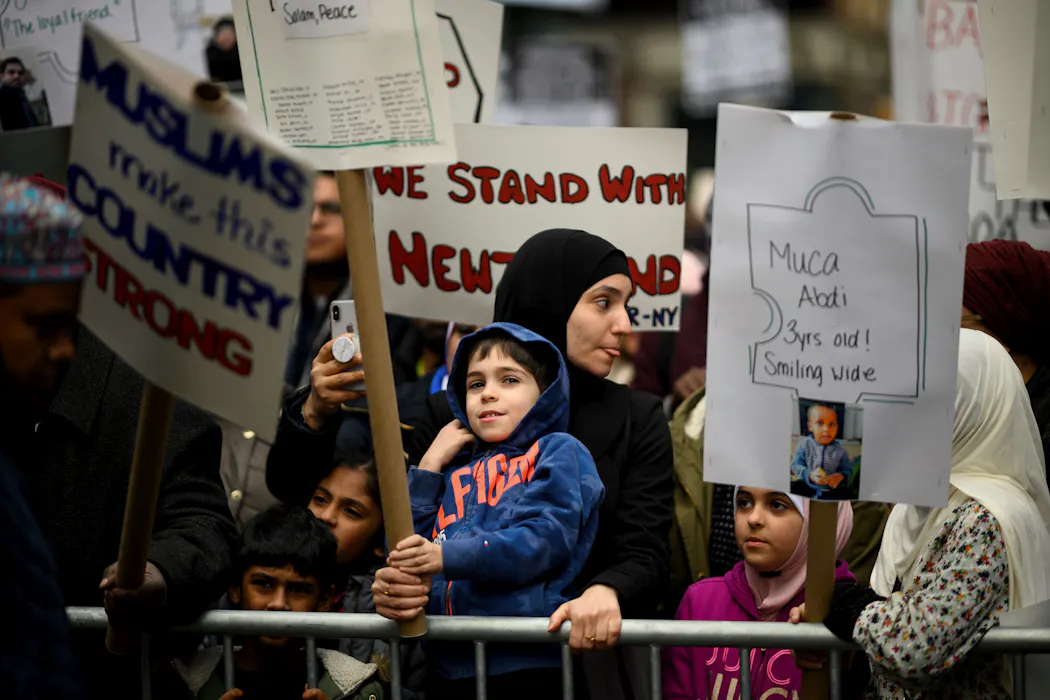
Demonstrators in New York City take part in a protest against growing Islamophobia in March 2019. Johannes Eisele/AFP via Getty Image

The war with Iran has led to a surge in anti-Muslim rhetoric – spilling into political discourse.

U.S. Rep. Randy Fine of Florida posted on X that “the choice between dogs and Muslims is not a difficult one,” and added in another post, “We need more Islamophobia, not less.” Similarly, U.S. Rep. Brandon Gill of Texas called for stopping the entry of “Muslims immigrating to America.”

A study by the Center for the Study of Organized Hate found that the average number of Islamophobic posts jumped from 2,000 to 6,000 each day on X alone in the first six days of the conflict.

I have studied the impact of Islamophobia on mental health over the past two decades, following soaring hate crimes in the wake of 9/11. Research consistently shows that negative portrayals of Muslims shape public attitudes toward Muslims and can lead to increased discrimination, hate crimes and psychological consequences.

Increase in Islamophobia

Islamophobia in the United States tends to surge during global conflicts, political campaigns and terrorist attacks. Human Rights First, an organization that works to promote human rights in the U.S. and abroad, documented surges in Islamophobia in 2015 following the Syrian refugee crisis, when a large number of people were displaced. That same year the 2015 attacks in Paris and shooting in San Bernardino, California, intensified public anxiety about terrorism, and a surge in crimes against Muslims followed.

Islamophobic rhetoric in the U.S. intensified during Donald Trump’s 2016 presidential campaign and continued into his presidency, often framing Muslims as a security threat. Burton Speakman, a scholar of digital media, and I found an increasing acceptance of such rhetoric among the political right in social media posts from 2016-19.

Social media posts and comments showed an increasing use of dehumanizing language toward Muslims. In a study I conducted in 2020, a majority of 830 Muslim Americans reported encountering the most Islamophobic content on Facebook, followed by Twitter and Instagram. This shift was also reflected in the language and coverage of Islam in right-wing media, which often portrayed Muslims as invaders wanting to impose Sharia law and as a drain on social welfare.

Mainstream media can also amplify negative depictions of Muslims by often discussing Islam within the context of terrorism and portraying Muslims more negatively than other racial, ethnic or religious minority groups.

Hate crimes tend to increase alongside Islamophobic rhetoric. During 2016, a period with high rates of Islamophobic rhetoric, there were 307 reported incidents – the highest recorded number immediately following 9/11. The numbers dropped the following year but were followed by an increase in 2024 with the start of the Israel-Hamas war; the number of reported anti-Muslim hate crimes was 288 that year.

A 2025 poll found that 63% of American Muslims reported experiencing religious discrimination, with many reporting at least one such incident every year since 2016.

Mental health of Muslim Americans

The cumulative effects of Islamophobia have an impact an American Muslims’ mental health and access to care.

A woman wearing a headscarf speaks with another woman reclining on a bed, who is also wearing a headscarf.
Higher rates of depression among Muslim Americans are associated with Islamophobia.
triloks/ E+ via Getty images

Numerous studies since 9/11 link the high rates of discrimination experienced by the Muslim American
community to higher rates of depression. Experiences of discrimination also lead some Muslim Americans to believe they are not viewed as being American.

Thirty-one percent of participants in my 2020 study described the impact of social media on their mental health: Many said they avoided displaying their Muslim identity in social media posts, supporting a Muslim political candidate on social media, or even sharing religious content or videos. Some just withdrew – 27% deactivated or deleted their social media accounts.

In addition, many Muslims report feeling discouraged from seeking both physical and psychological treatment from non-Muslim providers, leading Muslim Americans to significantly underutilize available services compared to other ethnic and religious minority groups.

A 2015 study found that nearly one-third of Muslim Americans report experiencing discrimination in health care settings, which has an impact on their trust in providers. The majority reported being treated rudely by providers, insensitivity regarding modesty requirements, or having their pain disregarded. One participant in that study said: “Going into a surgery, health care providers didn’t recognize the importance of me keeping my hijab on and wanting most of my body covered.”

In my 2023 study, a number of participants described personal experiences with mental health professionals who seemed not to see them as individuals beyond their religious affiliation. One participant described a provider as being “quick to attribute problems” to religion or culture. “I worry about them stereotyping and end up feeling as if I’m on the defense,” this participant said.

My most recent study, conducted in 2024, which is currently under review, asked 325 Muslim Americans who had used any psychological services about their health-seeking behavior: 56% said they were worried ; 57% were worried about being misunderstood.

Following Trump’s travel ban targeting several Muslim countries in 2017, a study conducted by researchers at the Yale School of Public Health found that many Muslim Americans skipped their primary care appointments; at the same time, their visits to the emergency room went up.

Addressing the challenges

In response, a number of initiatives have emerged at the local and national levels.

One approach involves increasing mental health literacy within Muslim communities and creating networks of mental health professionals working with Muslim clients.

For example, mental health professionals and community leaders are working to increase mental health literacy through in-person education and digitally. Muslim community members learn about symptoms of mental health disorders through training, such as Mental Health First Aid. Online directories of Muslim mental health providers have also been created.

Another approach involves training mental health professionals. A team at Stanford University has created a six-part training module that provides therapists with knowledge of religious norms and an opportunity to reflect on their own possible biases.

Finally, Muslim researchers and providers have begun to develop therapies and resources that integrate Muslim beliefs and spiritual approaches with treatment. These include psychotherapy that is inspired by the Quran, the teachings of the prophet and spiritual practices such as self-reflection, prayer and mindfulness.

Muslim Americans can often feel helpless in combating the hate they experience – more awareness and advocacy could reduce Islamophobia and address the mental health needs of an already vulnerable community.

The Conversation

Anisah Bagasra received funding from Meta’s Content Policy Research on Social Media Platforms research award in 2019 to study Islamophobic rhetoric and imagery on social media platforms.

ref. How Islamophobic rhetoric leaves an impact on the mental health of Muslim Americans – https://theconversation.com/how-islamophobic-rhetoric-leaves-an-impact-on-the-mental-health-of-muslim-americans-279046