Swarms of AI bots can sway people’s beliefs – threatening democracy

Source: The Conversation – USA – By Filippo Menczer, Professor of Informatics and Computer Science, Indiana University

Crowds of AI bots posing as humans can influence crowds of real people on social media. J Studios/DigitalVision via Getty Images

In mid-2023, around the time Elon Musk rebranded Twitter as X but before he discontinued free academic access to the platform’s data, my colleagues and I looked for signs of social bot accounts posting content generated by artificial intelligence. Social bots are AI software that produce content and interact with people on social media. We uncovered a network of over a thousand bots involved in crypto scams. We dubbed this the “fox8” botnet after one of the fake news websites it was designed to amplify.

We were able to identify these accounts because the coders were a bit sloppy: They did not catch occasional posts with self-revealing text generated by ChatGPT, such as when the AI model refused to comply with prompts that violated its terms. The most common self-revealing response was “I’m sorry, but I cannot comply with this request as it violates OpenAI’s Content Policy on generating harmful or inappropriate content. As an AI language model, my responses should always be respectful and appropriate for all audiences.”

We believe fox8 was only the tip of the iceberg because better coders can filter out self-revealing posts or use open-source AI models fine-tuned to remove ethical guardrails.

The fox8 bots created fake engagement with each other and with human accounts through realistic back-and-forth discussions and retweets. In this way, they tricked X’s recommendation algorithm into amplifying exposure to their posts and accumulated significant numbers of followers and influence.

Such a level of coordination among inauthentic online agents was unprecedented – AI models had been weaponized to give rise to a new generation of social agents, much more sophisticated than earlier social bots. Machine-learning tools to detect social bots, like our own Botometer, were unable to discriminate between these AI agents and human accounts in the wild. Even AI models trained to detect AI-generated content failed.

Bots in the era of generative AI

Fast-forward a few years: Today, people and organizations with malicious intent have access to more powerful AI language models – including open-source ones – while social media platforms have relaxed or eliminated moderation efforts. They even provide financial incentives for engaging content, irrespective of whether it’s real or AI-generated. This is a perfect storm for foreign and domestic influence operations targeting democratic elections. For example, an AI-controlled bot swarm could create the false impression of widespread, bipartisan opposition to a political candidate.

The current U.S. administration has dismantled federal programs that combat such hostile campaigns and defunded research efforts to study them. Researchers no longer have access to the platform data that would make it possible to detect and monitor these kinds of online manipulation.

I am part of an interdisciplinary team of computer science, AI, cybersecurity, psychology, social science, journalism and policy researchers who have sounded the alarm about the threat of malicious AI swarms. We believe that current AI technology allows organizations with malicious intent to deploy large numbers of autonomous, adaptive, coordinated agents to multiple social media platforms. These agents enable influence operations that are far more scalable, sophisticated and adaptive than simple scripted misinformation campaigns.

Rather than generating identical posts or obvious spam, AI agents can generate varied, credible content at a large scale. The swarms can send people messages tailored to their individual preferences and to the context of their online conversations. The swarms can tailor tone, style and content to respond dynamically to human interaction and platform signals such as numbers of likes or views.

Synthetic consensus

In a study my colleagues and I conducted last year, we used a social media model to simulate swarms of inauthentic social media accounts using different tactics to influence a target online community. One tactic was by far the most effective: infiltration. Once an online group is infiltrated, malicious AI swarms can create the illusion of broad public agreement around the narratives they are programmed to promote. This exploits a psychological phenomenon known as social proof: Humans are naturally inclined to believe something if they perceive that “everyone is saying it.”

A diagram showing clusters of gray and yellow dots with lines connecting many of them.
This diagram shows the influence network of an AI swarm on Twitter (now X) in 2023. The yellow dots represent a swarm of social bots controlled by an AI model. Gray dots represent legitimate accounts who follow the AI agents.
Filippo Menczer and Kai-Cheng Yang, CC BY-NC-ND

Such social media astroturf tactics have been around for many years, but malicious AI swarms can effectively create believable interactions with targeted human users at a large scale, and get those users to follow the inauthentic accounts. For example, agents can talk about the latest game to a sports fan and about current events to a news junkie. They can generate language that resonates with the interests and opinions of their targets.

Even if individual claims are debunked, the persistent chorus of independent-sounding voices can make radical ideas seem mainstream and amplify negative feelings toward “others.” Manufactured synthetic consensus is a very real threat to the public sphere, the mechanisms democratic societies use to form shared beliefs, make decisions and trust public discourse. If citizens cannot reliably distinguish between genuine public opinion and algorithmically generated simulation of unanimity, democratic decision-making could be severely compromised.

Mitigating the risks

Unfortunately, there is not a single fix. Regulation granting researchers access to platform data would be a first step. Understanding how swarms behave collectively would be essential to anticipate risks. Detecting coordinated behavior is a key challenge. Unlike simple copy-and-paste bots, malicious swarms produce varied output that resembles normal human interaction, making detection much more difficult.

In our lab, we design methods to detect patterns of coordinated behavior that deviate from normal human interaction. Even if agents look different from each other, their underlying objectives often reveal patterns in timing, network movement and narrative trajectory that are unlikely to occur naturally.

Social media platforms could use such methods. I believe that AI and social media platforms should also more aggressively adopt standards to apply watermarks to AI-generated content and recognize and label such content. Finally, restricting the monetization of inauthentic engagement would reduce the financial incentives for influence operations and other malicious groups to use synthetic consensus.

The threat is real

While these measures might mitigate the systemic risks of malicious AI swarms before they become entrenched in political and social systems worldwide, the current political landscape in the U.S. seems to be moving in the opposite direction. The Trump administration has aimed to reduce AI and social media regulation and is instead favoring rapid deployment of AI models over safety.

The threat of malicious AI swarms is no longer theoretical: Our evidence suggests these tactics are already being deployed. I believe that policymakers and technologists should increase the cost, risk and visibility of such manipulation.

The Conversation

Filippo Menczer receives funding from Knight Foundation, National Science Foundation, Swiss National Science Foundation, and Air Force Office of Scientific Research.

ref. Swarms of AI bots can sway people’s beliefs – threatening democracy – https://theconversation.com/swarms-of-ai-bots-can-sway-peoples-beliefs-threatening-democracy-274778
More than a feeling – thinking about love as a virtue can change how we respond to hate

Source: The Conversation – USA (3) – By Tucker J. Gregor, Doctoral Candidate in Religious Studies, University of Iowa

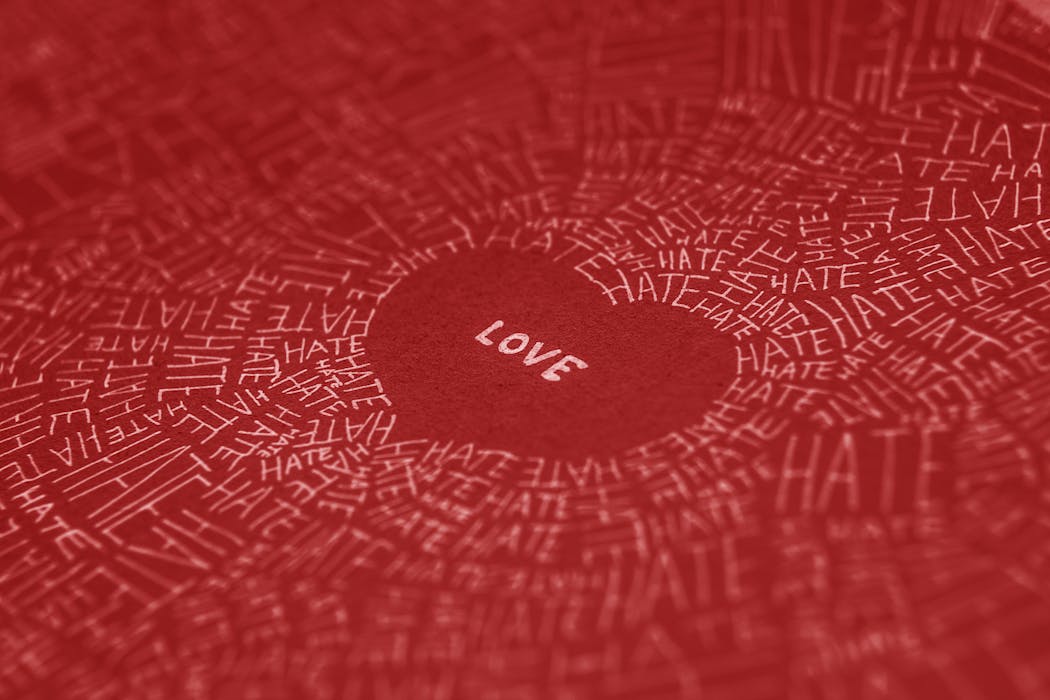
Seeing hate as a feeling tied to love, rather than being its opposite, might help us choose how to respond. Lusky/E+ via Getty Images

Love and hate seem like obvious opposites. Love, whether romantic or otherwise, involves a sense of warmth and affection for others. Hate involves feelings of disdain. Love builds up, whereas hate destroys.

However, this description of love and hate treats them as merely emotions. As a religious ethicist, I am interested in the role love plays in our moral lives: how and why it can help us live well together. How does our understanding of the love-hate relationship change if we imagine love not as an emotion but as a virtue?

The 13th-century theologian Thomas Aquinas is a foundational thinker in the history of Christian ethics. For Aquinas, hate is not the antithesis of love, or even opposed to it. In his most important work, the “Summa Theologiae,” he writes that hate responds to love. In other words, hate is a reaction to threats against what we love, or what we deeply value. We can better understand the experience of hate by getting clear on what it means to love.

Greek roots

Today, scientists know that feelings of love are related to biochemical processes that release chemicals in the brain, increasing pleasure and excitement. Beyond mere biology or even emotions, some philosophers and psychologists contend that love is also a practice.

Love can also refer to a virtue: a habit or settled disposition that increases the likelihood of people thinking, feeling and acting in ways that promote happiness and well-being. For example, the virtue of courage can help people endure and thrive in the midst of fear and uncertainty.

An Asian woman with white hair smiles as she puts cans of food into boxes at a food pantry, standing beside a younger Black woman.
Love is more than a feeling; it’s a virtue that helps promote others’ well-being.
FatCamera/iStock via Getty Images Plus

The concept of virtue is as old as philosophy itself. In the “Republic,” written in the fourth century B.C.E., Plato distinguishes between virtue in general and the individual virtues that he believes characterize well-being, such as wisdom, courage, moderation and justice.

Love is not among them. Instead, he associates love – for which he used the Greek word “eros” – with feelings of physical desire.

It was Aristotle, one of Plato’s students, who inched love closer toward virtue. In Aristotle’s “Nicomachaen Ethics,” he writes that virtue involves learning how to act and feel “at the right times, about the right things, toward the right people, for the right end, and in the right way.” The individual virtues are cultivated over time through repetition.

For an act to be virtuous, one must consciously and deliberately act for the sake of some moral value. For example, Aristotle states that a generous person does good by giving wealth to the right people. Someone who spends with the aim of receiving some benefit in return merely appears generous. The person’s character and the spirit in which they give matters.

The virtuous life isn’t easy – but true friends can help. Aristotle believed that relationships of mutual respect and concern can empower us to develop virtues. Unlike friendships that are situational or superficial, these deeper connections are characterized by “philia,” a kind of love. Friendships based in philia are virtuous: They involve mutual accountability and concern for each other, as if each person were an extension of oneself.

Aquinas’ take

The Christian moral tradition builds and elaborates on these Greek foundations. For Christian theologians and moral philosophers, love can refer to an emotion, an affection, a duty and, yes, a virtue.

Aquinas considers virtue to be a stable disposition of the will – our capacity to choose – that contributes to a well-lived life. Individual virtues are good habits that influence how we relate to ourselves and other people in our daily lives, including love.

A painting in muted colors of a balding man with a halo over his head, who is reading and wearing a cloak.
An early 16th-century painting of Thomas Aquinas by the Italian artist Fra Bartolomeo.
Wikimedia Commons, CC BY-SA

He also considers love to be a theological virtue – a gift of God’s grace that people can choose to embrace or reject. “Caritas,” or “charity” in Latin, is defined as friendship with God. Aquinas writes that it has a social benefit, too: Caritas inclines people toward treating their fellow humans with kindness, acting to advance others’ well-being.

The other types of love, eros and philia, are subjective. They respond to our perception of value in other people and things. Caritas creates value in other people, whether or not we are able to see it.

Love and hate

How can approaching love as a virtue – rather than an emotion, affection or biochemical reaction – help us understand feelings of hatred?

From Aquinas’ perspective, the feeling of hate is dependent on and conditioned by the people and things that we love, or that we consider good for ourselves and other people, whether that’s a sports team, a movie or an ideology.

Yet if we take love to be a virtue – a daily habit that we choose to guide our practices – then we can exercise a degree of control over how we respond to feelings of hatred.

Consider how much hate there is in politics, such as hatred of a particular policy, politician or belief – or hatred of injustice itself. But at root, perhaps that hate is a response to love; for example, love for one’s neighbors, one’s country or one’s ideals. Recognizing that possibility can help us respond with a loving choice, like peaceful protest, as a way to advocate for rights. By cultivating the virtue of love, people are more likely to engage in practices of care and empathy necessary for communities to thrive.

Distinguishing between feelings of love, practices of love and the virtue of love can empower us to respond to feelings of hatred. Becoming better lovers requires engaging with destructive emotions, rather than running from them.

The Conversation

Tucker J. Gregor does not work for, consult, own shares in or receive funding from any company or organization that would benefit from this article, and has disclosed no relevant affiliations beyond their academic appointment.

ref. More than a feeling – thinking about love as a virtue can change how we respond to hate – https://theconversation.com/more-than-a-feeling-thinking-about-love-as-a-virtue-can-change-how-we-respond-to-hate-272330

How business students learn to make ethical decisions by studying a soup kitchen in one of America’s toughest neighborhoods

Source: The Conversation – USA (3) – By Tim Swift, Professor of Management, St. Joseph’s University

Guests line up for a hot meal at St. Francis Inn on Kensington Avenue in North Philadelphia. Timothy Swift, CC BY-SA

For the past decade I have volunteered at St. Francis Inn, a soup kitchen in the Kensington neighborhood of Philadelphia.

Kensington, for those not from Philly, has long had a reputation for potent but affordable street drugs. Interstate 95 and the Market-Frankford elevated commuter train line provide easy access to the neighborhood for buyers and sellers, and abandoned buildings offer havens for drug use and other illicit activity.

St. Francis Inn Ministries, which was founded by two Franciscan friars in 1979, serves sit-down breakfast and dinner for thousands of people each year, many of whom suffer from poverty, homelessness and substance use disorder. It also runs Marie’s Closet, a charity that provides free used clothing and housewares.

These ministries are operated by a core team of nine full-time members, hundreds of volunteers from local high schools and colleges, and an ad hoc team of folks from many walks of life.

In the years I’ve been volunteering at St. Francis, significant changes have occurred in Kensington, including gentrification, soaring housing prices and increased police activity. Such changes can make it harder for people who suffer from poverty and homelessness to remain in the neighborhood.

Around 2018, the number of guests visiting St. Francis Inn was already dwindling noticeably. I heard volunteers speculate on whether St. Francis Inn should relocate further north in Philadelphia where there are more people in need. Others wondered whether St. Francis Inn should create a mobile unit that traveled to people in need wherever they may be.

As I listened, I realized that this was a business decision. As a professor of management at St. Joseph’s University in Philadelphia, I decided to present this decision to the students in my Management Honors Capstone Seminar. In January 2026 I published a business case study titled “Dealing with Change in Kensington, Philadelphia: The Case of Saint Francis Inn.”

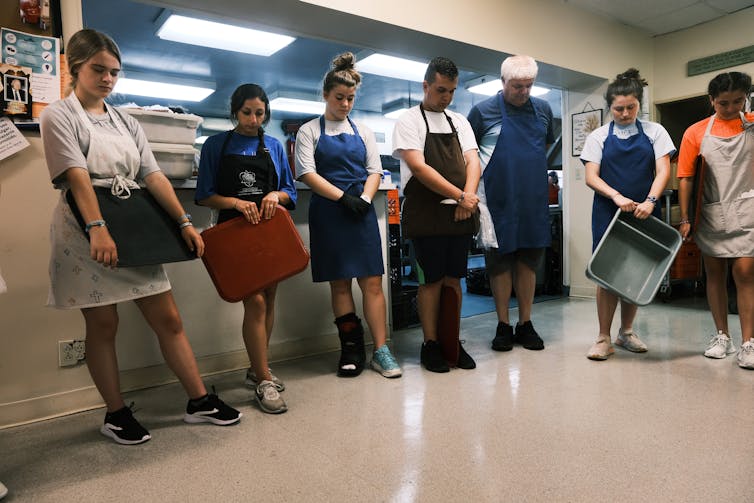
Seven people wearing aprons and holding stand with heads bowed
Volunteers at the St. Francis Inn pray together before serving a meal on July 19, 2021.
Spencer Platt/Getty Images

An interesting business case

The capstone seminar I teach is the second of two strategic management courses that honors business students take in their senior year. Using the Harvard case study method, students identify the critical issues embedded in a variety of cases and find the information needed to evaluate those issues using seminal theories in strategic management.

Students then propose a solution – a hypothesis they believe best addresses the situation. They test whether that solution works by building a plan of action – called a “proof” – that provides logic and evidence that their solution would work.

Part of what I believe makes this case study interesting is that it involves some of the most vulnerable people in Philadelphia. I felt it was important to give students the opportunity to consider important issues of social justice when applying their business decision-making skills.

Morally sound recommendations

Among other material, the course covers two different perspectives that students can use to make informed decisions and propose solutions for St. Francis Inn.

The first is the resource-based view. Using this framework, students identify the unique resources and capabilities that a firm – in this case, St. Francis Inn – has built over the years. Then they determine how to use those resources and capabilities best to carry out the firm’s mission.

St. Francis Inn’s mission is to live among and serve the poor, following the example of St. Francis of Assisi. The organization has built decades-long relationships with food companies – which share leftover meat, vegetables and other products with the inn – as well as with members of the community in Kensington. In addition, they have developed a network of hundreds of well-trained and motivated volunteer workers throughout Philadelphia and, indeed, the entire country.

The second framework that students are expected to use is “formal moral theory,” which provides a set of different theories for determining moral rules. It enables us to make ethical decisions that are structured, rational and logical.

For example, using “utilitarianism,” students quantify all of the costs and benefits of a decision and choose the option that provides the largest net benefit – or utility – to society. “Rights theory” requires students to make decisions that respect the intrinsic dignity of all persons. Students can use these theories to make morally sound recommendations on how St. Francis Inn can best serve the stakeholders in its community.

Perhaps the most obvious people affected by St. Francis Inn are the people living in the neighborhood who struggle with homelessness and substance use disorder and receive food and other assistance there. Other groups of concern include longtime neighbors who have homes nearby but still live in poverty, new residents moving into the neighborhood, local property developers who generally want to see fewer homeless people in the neighborhood, and city officials who are responsible for various government functions. These include police and emergency medical services, city council members and social services organizations.

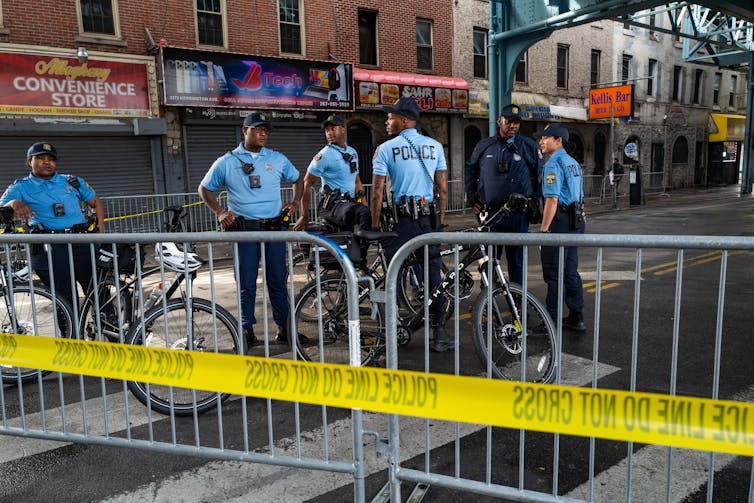
A group of uniformed police stand on an empty commercial street behind metal gate and yellow police tape
Police close down a section of Kensington Avenue to clear a homeless encampment on May 8, 2024.
Spencer Platt/Getty Images

Students must answer a two-dimensional question: Given what St. Francis Inn does best, how can it best address the needs of its most important stakeholders?

Since they are business majors, many quickly gravitate to logical business decisions that St. Francis Inn can make, such as continuing its operation where it is, relocating, or creating a mobile service. Without fail, there are students each semester who argue that regardless of what’s “best” for St. Francis Inn, the interests of the various people of concern in the neighborhood must be respected. To be honest, I enjoy watching them grapple with this problem with sincerity and care.

Here, students must balance an organization’s core competencies with the moral impact of its decisions, while prioritizing the rights and needs of diverse, nontraditional groups who have a stake in this decision. That’s a valuable skill for any future – or, for that matter, current – business executive.

Read more of our stories about Philadelphia and Pennsylvania, or sign up for our Philadelphia newsletter on Substack.

The Conversation

Tim Swift received funding from the Villanova University Center for Church Management to write this case study in 2022.

ref. How business students learn to make ethical decisions by studying a soup kitchen in one of America’s toughest neighborhoods – https://theconversation.com/how-business-students-learn-to-make-ethical-decisions-by-studying-a-soup-kitchen-in-one-of-americas-toughest-neighborhoods-274508

Deaths of 31 people in UK’s worst small boat disaster caused by government’s ‘systemic failure’ – the Cranston inquiry conclusions explained

Source: The Conversation – UK – By Travis Van Isacker, Senior Research Associate, School of Sociology, Politics and International Studies, University of Bristol

The deaths of at least 31 people in the Channel on November 24 2021 were “avoidable”, an independent inquiry has found. The final report of the Cranston inquiry highlights known problems at HM Coastguard that were not resolved, calling them a “significant, systemic failure on the part of government”, which led to this crossing becoming Britain’s deadliest small boat disaster.

The report points blame at the people smugglers who “provided an unsuitable craft and inadequate safety equipment” for the crossing, as well as the French navy for failing to respond to a mayday alert.

Most of its criticisms, however, were reserved for HM Coastguard’s flawed search and rescue operation and other systemic problems, despite failings attributable to individual officers.

These findings vindicate the accounts of the two survivors, rescued from the sea more than 12 hours after calling for help. It also vindicates family members of the deceased who first raised the coastguard’s failings immediately after the disaster. The bereaved families and survivors have held all along that the tragedy was “preventable”.

The incident

The night of November 23 to 24, a dinghy with at least 33 people on board began taking on water in the middle of the Channel. Some travellers tried to bail the freezing water out and keep the rubber tubes inflated. Others made desperate calls for help.

Neither French nor British coastguards took enough responsibility for coordinating an effective rescue. Transcripts revealed that travellers were at one point told by British call-handlers they must be in French waters and should call the French coastguard instead, after the time when formal responsibility for search and rescue had passed to the British coastguard. Teenager Mubin Rizghar Hussein, who was aboard the boat, was told that a rescue ship was on its way but that he needed to “be patient” and stop calling.

By the time the Border Force ship arrived to the sinking dinghy’s last known location, it had drifted away. Other small boats in the area were rescued instead and the distress calls stopped once the dinghy capsized.


Read more:
‘We were treated like animals’: the full story of Britain’s deadliest small boat disaster


Public inquiries are usually convened quickly after such disastrous incidents. But the fact that the British government initially refused to accept that the sinking occurred in UK waters delayed an accountability process.

Survivors and bereaved families fought hard for accountability, and the Cranston inquiry was ultimately commissioned in January 2024 by the Department for Transport.

Over four weeks of public hearings in March 2025, officers involved in the UK’s search and rescue response gave oral evidence. One survivor, Issa Mohamed Omar, and members of the grieving families also gave evidence. After three years, they were given the chance for their voices to be heard.

Systemic failures

The Maritime and Coastguard Agency asserted in its closing statement that “the real causes” of the shipwreck were factors outside HM Coastguard’s control. The inquiry rejected this, finding that a number of problems at the agency contributed to the deaths.

These included chronic staffing issues at Dover’s Maritime Rescue Coordination Centre, inadequate supervision and insufficient remote assistance for coastguard officers. The inquiry also pointed to the lack of training for call-handlers, who widely believed that travellers on small boats “exaggerated their level of distress”.

“Flawed decisions” by several coastguard staff involved in the search and rescue operations were also criticised in the report. In particular, this included not treating the information received from those onboard the sinking dinghy “at face value”. The inquiry found that short staffing at the Dover centre led to there being only one fully qualified staff member on duty the night of the incident, who was unable to take a break during the shift, and left “feeling overwhelmed and fatigued.”

Decisions made in that context ultimately led to the search being called off prematurely, meaning no one in the UK was searching for the people who were perishing in the cold waters of the Channel throughout the morning.

The inquiry finally highlighted the failure of the French response. When the coastguard at Dover broadcast a mayday relay for the sinking dinghy which mandated all ships to respond, the French warship Flamant — approximately 15 minutes away — ignored the request. Had the Flamant responded, “many more and possibly all lives would have been saved”, the report said.

There is an ongoing criminal investigation into the French warship and coastguard officers.

Deadlier crossings since

The inquiry’s investigation focused on offering “truth” for the families regarding what happened to their loved ones. Its recommendations therefore focused on improving search and rescue operations to prevent the likelihood of a similar incident occurring again, not to consider small boat crossings more generally.

The inquiry noted that “much has improved since November 2021”, but still people continue to die in the Channel. Despite increased surveillance, improved communications technology and more rescue ships, an unprecedented 82 people were reported to have died in 2024. At least 24 deaths were reported last year.

Monitoring organisations have pointed out that, beyond the inherent danger of small boat journeys, “stop the boats” policies have led to more overcrowding and chaotic launches of dinghies – with more deaths as a result. Specifically they highlight the £500 million agreement with France, introduced by the former Conservative government, which has paid for 500 more French police to patrol the coast. The assumption that preventing boats from leaving French shores will “save lives” is, however, a mistaken one.

Many of the deadly incidents since 2021 have occurred on the beaches and in the shallow waters just off the French coast as police try and stop dinghies from launching. What the then Labour home secretary, Yvette Cooper described in 2024 as heroic efforts to prevent crossings were recognised by France’s interior minister as also leading to an increase in deaths.

As constructive as the inquiry’s report is for improving search and rescue for small boats in the Channel, it has not grappled with this changed context. So long as the UK’s border controls in Europe exist, Channel deaths will continue, even if government agencies implement all the inquiry’s recommendations.

The Conversation

Travis Van Isacker receives funding from the Economic and Social Research Council (UK) (Grant Ref: ES/W002639/1).

ref. Deaths of 31 people in UK’s worst small boat disaster caused by government’s ‘systemic failure’ – the Cranston inquiry conclusions explained – https://theconversation.com/deaths-of-31-people-in-uks-worst-small-boat-disaster-caused-by-governments-systemic-failure-the-cranston-inquiry-conclusions-explained-274920

Why are safety concerns being raised inside Porton Down, Britain’s nerve centre of chemical and biological research?

Source: The Conversation – UK – By Thomas Keegan, Senior Lecturer in Epidemiology, Lancaster University

When the UK’s offensive chemical and biological weapons programmes were terminated in the 1950s, work at the high-security military research centre in Porton Down, Wiltshire switched to defensive strategies. These included developing chemicals for use in riot control and countermeasures to the evolving threat of chemical and biological weapons.

Before being tested on military personnel, potential riot control compounds had to go through an informal preliminary screening. According to a 2006 history of Porton Down published by the Ministry of Defence (MoD), this would sometimes involve laboratory staff “cautiously sniffing” new compounds in order to “eliminate the less promising ones”.

Today’s scientists working inside the Defence Science and Technology Laboratory (DSTL), which is headquartered at Porton Down, won’t be doing any sniff tests. But according to an anonymous whistleblower, Porton’s CEO, Paul Hollinshead, has warned that the laboratory needs to improve its health and safety record, or risk losing its operating licence.

The Guardian reported that an internal survey had raised widespread concerns about staff lacking the “resources to work safely”. The facility is now undergoing a major reorganisation, but a Porton spokesperson stressed to me that “any changes will protect and enhance its critical functions” – including working with government departments beyond the MoD.

Inside Porton Down. Video: ITV News.

A history of staff self-testing

My research with colleagues inside Porton Down found that between 1941 and 1989, staff took part in more than 1,300 tests of 78 different chemical and biological substances.

These included highly toxic nerve agents such as Tabun, and vomiting agents such as diphenylchlorarsine and sulphur mustard. In the later decades, staff self-testing focused on pre-emptive therapies for nerve agent attacks, using drugs such as Pralidoxime.

Other historical accounts suggest Porton scientists were given great latitude to develop experiments – and join in with them too. One long-term staff member, Mark Ainsworth, described testing a new piece of equipment in the wound ballistics laboratory. Working in it was “heroic”, he wrote in 1976, as the machine would “charge itself up to 300,000 volts, then discharge itself randomly, turning [the testers] into nervous wrecks”.

In an echo of the recent whistleblower complaints, Ainsworth also revealed that he “swore at the management for not being more generous with staff deployment”.


Read more:
Inside Porton Down: what I learned during three years at the UK’s most secretive chemical weapons laboratory


During the cold war era, Porton scientists developed troop protection including nuclear, biological and chemical (NBC) suits, respirators, and the triple-therapy “combo pen” for treating exposure to potentially deadly nerve agents.

These scientists would have been shocked to find products stemming from their research being used decades later, in March 2018, on civilian shoppers just a few miles down the road. Porton Down was a key part of the emergency response to a chemical weapons attack on UK soil when Novichok was used to try to kill former Russian intelligence officer Sergei Skripal and his daughter at their home in Salisbury.

Despite the aggressive toxicity of this nerve agent, neither died – partly thanks to Porton Down expertise that was shared with the emergency and health services involved in their care.

Three months later, however, another Salisbury resident, Dawn Sturgess, died after spraying herself with Novichok hidden in a discarded perfume bottle. Her partner Charlie Rowley was also exposed to the nerve agent, but survived.

Biosecurity risks

Insights into the secretive work carried out at Porton Down also come when its scientists’ work is published in academic literature. DSTL senior fellow Tim Atkins, for example, is among researchers leading the global response to Q fever and melioidosis – two potentially deadly bacterial diseases.

Porton also conducts research into the continuing response to COVID and other highly infectious pathogens such as Yersinia pestis (the bacterium that causes plague) and Ebola virus. The highest levels of biosecurity are therefore required to prevent outbreaks of disease against which the public would not be protected.

Porton Down research into Yersinia pestis, the bacterium which caused the great plague of 1665. Video: Channel 5/DTSL.

My experience of working inside Porton’s secure area between 2002 and 2008 was that entry to, and passage around, the site was strictly controlled. Machine gun-armed MoD police were stationed at the facility’s outer entry points and also guarded the secure inner area.

We were investigating risk of cancer and mortality in the approximately 20,000 service personnel who took part in tests at Porton Down between 1945 and 1989. While we found a small increased risk of mortality, it could not be attributed directly to Porton attendance. The last documented case of staff self-testing, in June 29 1984, involved 7-methoxy cycloheptatriene, a non-corrosive “irritant compound”.

One former senior staff member I spoke to recalled working at Porton as “stimulating” and “fun”, partly because of the freedom scientists were afforded to innovate. Such freedom may be a thing of the past – but the work inside this top-secret British laboratory remains as important to national security as ever.

According to the Porton Down spokesperson: “Our people remain the bedrock of DSTL, and their dedication has ensured that our performance this year is better than last … Through the largest reforms to defence in more than 50 years, we are strengthening our ability to anticipate and respond to evolving threats, including increasing our safety standard.”

The Conversation

Thomas Keegan has in the past worked on research into Porton Down with funding from the UK Medical Research Council..

ref. Why are safety concerns being raised inside Porton Down, Britain’s nerve centre of chemical and biological research? – https://theconversation.com/why-are-safety-concerns-being-raised-inside-porton-down-britains-nerve-centre-of-chemical-and-biological-research-274908

Why has the 20mph limit become such a political issue in the Welsh election?

Source: The Conversation – UK – By Michael Woods, Professor of Human Geography, Aberystwyth University

Nigel Farage has announced Reform UK’s first policy pledge of the Welsh election campaign in May: to scrap the default urban speed limit of 20mph introduced by the Labour Welsh government in 2023.

Like the Welsh Conservatives, who are also committed to reversing the legislation, Reform UK have identified frustration with the 20mph limit in Wales as a widespread and emotive issue that it hopes will help to propel the party to seat gains in the election. It is currently second in the polls, behind the centre-left Welsh nationalist party Plaid Cymru.

Reform said it will scrap the “blanket approach” to the speed limit, but would still have it around schools and hospitals. Welsh Labour have also said that some roads will return to 30mph under its plans.

Meanwhile, the Wales Green party leader Anthony Slaughter suggested that the party could push for extensions to 20mph coverage in local government, speaking to the BBC Radio 4 Today programme in January.

Polling by More in Common shows that the 20mph limit is the best known of the current Welsh government’s policies, with 90% of respondents confirming awareness, but also the second most unpopular. Some 55% of people polled considered that the change reflected negatively on Welsh Labour, compared with 21% who viewed it positively.

Yet, for others the 20mph limit is a flagship achievement. Lee Walters, the former transport minister who introduced the legislation, has admitted mistakes in the way it was introduced, but told BBC Wales: “The data and evidence shows that it will save lives, and in time it will settle down.”

The history of 20mph limits

The legislation reduced the default speed limit on so-called “restricted roads” in Wales (essentially roads in built-up areas) from 30mph to 20mph.

Part of the aim was to reduce the number of collisions and injuries from road collisions (as well as the cost to the National Health Service of treating these casualties), encouraging walking and cycling, and improving health and wellbeing.

As elsewhere in Britain, 20mph zones already existed in high-risk sites such as outside schools. Exceptions also applied to the 20mph default, with local authorities identifying roads where a 30mph limit would remain.

There’s a division of opinion over 20mph speed limits in Wales.

Overall, the 20mph limit currently applies to 37% of the road network in Wales. The policy featured in both the Labour and Plaid Cymru manifestos for the 2021 Senedd (Welsh parliament) election. It was also supported by the sole Liberal Democrat Senedd member, when introduced.

Conservative Senedd members voted against the legislation. The measure was controversial, with noisy opposition from sections of the public.

A petition to repeal the law attracted 469,571 signatures and new 20mph road signs were defaced in many parts of Wales.

There was widespread media coverage describing confusion over the speed limit and claiming negative effects on bus timetables, tourism and businesses.

A lack of consistent polling makes it difficult to track public opinion on the issue. Polls in October 2023 and July 2024 recorded 54% and 72% of Welsh voters opposed to the 20mph limit respectively, but no more recent poll has directly asked about the policy.

However, a softening of attitudes over time was identified by an analysis of posts on the social media platform X at implementation in September 2023 and six months later. Not only did comments become less negative towards the change, but the content also evolved. Right after implementation, tweets focused on politics, especially criticisms of Welsh government.

Six months later, discussion shifted toward everyday impact: improved safety around schools and residential streets, benefits for pedestrians and cyclists and urban mobility such as buses and traffic flow. Although political criticism remained, misinformation decreased and conversation became more grounded in lived experience, with safety, especially for children and communities, more prominent.

Psychologists refer to this movement as the Goodwin Curve: when behaviour people are anxious about doesn’t materialise, their attitudes soften and they become more accepting of policy change.

Early reports on the impact of the 20mph speed limit were anecdotal. More than two years after implementation, however, there is a growing body of objective evidence on its effects, especially around speed and collision data. The most recent figures show that average speeds for road traffic in Wales have fallen by 3.3 mph.

Relatedly, there has been a marked reduction in both collisions and casualties on roads where the speed limit changed from 30mph to 20mph. In 2024, the first full year after the change, collisions on 20mph and 30mph roads combined were down 23.5% compared with 2022, and casualties were down by 25.8%.

Evidence of environmental and social impacts is less conclusive. Early monitoring shows no material change in air quality (NO₂, PM₁₀ or PM₂.₅) in pilot areas up to April 2024, and analysis of CO₂ emissions is still ongoing. Impacts on walking and cycling also remain unclear, as post-implementation active travel data has not yet been reported.

Speed and the Senedd

So, why are speed limits back on the election agenda? Reform and the Conservatives both cite the cost of the policy, estimated at £32 million. Yet, as journalist Will Hayward points out, this spend has already happened and returning to 30mph would also be expensive.

The significance of 20mph to Reform and the Conservatives is about setting the tone of the election. It is an issue that speaks to the continuing scepticism of some of the Welsh electorate towards devolution.

What’s more, the issue encapsulates different visions for Welsh society. For the rightwing parties, opposition to the 20mph limit reflects a championing of individualism and “common sense” against the perceived intrusive paternalism of the left. As Farage told journalists in Newport: “It’s an example of government saying we know what is best for you, and you must comply with us.”

Reform UK has targeted car drivers as a potential voting base before. Reform-led councils in England have vowed to dismantle low-traffic neighbourhoods, for instance, even in areas that didn’t actually have them.

For some leftwing politicians, on the other hand, the 20mph speed limit is emblematic of a devolved Welsh government taking bold, pioneering action for health and environmental wellbeing. Reductions both in collisions and in motor insurance premiums could be presented as evidence of delivering benefits to Welsh people.

Labour and Plaid Cymru are unlikely to want the 20mph speed limit to be a major topic in the election, and would prefer to focus on issues around jobs, education, health care and public transport. Whether they can achieve a swing to those issues as the primary topic of discussion will be down to the public’s interest, and possibly media coverage.

The Conversation

Michael Woods receives funding from UKRI. He is a member of the Liberal Democrats.

Charles Musselwhite received funding from Health & Care Research Wales. Charles Musselwhite is currently Chair of the Transport Studies Research Group and a Vice Chair of the Transport and Health Science Group.

ref. Why has the 20mph limit become such a political issue in the Welsh election? – https://theconversation.com/why-has-the-20mph-limit-become-such-a-political-issue-in-the-welsh-election-275360

Valentine’s Day won’t fix your relationship – but attachment theory might explain it

Source: The Conversation – UK – By Martin Graff, Senior Lecturer in Psychology of Relationships, University of South Wales

As Valentine’s Day approaches, restaurant bookings fill up and couples exchange cards, flowers and carefully chosen gifts. For some, it’s a day of closeness and connection. For others, it can bring anxiety, disappointment or emotional distance.

These different reactions may feel deeply personal. But in terms of psychology, they may reflect something much deeper – how we learned to attach to other people in childhood.

Attachment theory offers a powerful way of understanding why romantic relationships unfold the way they do, and why partners can sometimes feel emotionally mismatched. Developed over decades of research, it suggests that our earliest experiences of care shape how safe, connected or vulnerable we feel in adult love.

Attachment theory was first proposed by the British psychiatrist John Bowlby, who argued that people are biologically wired to form close emotional bonds with their caregivers. These early attachments help infants feel protected and teach them what to expect from relationships.

Later, Canadian developmental psychologist Mary Ainsworth expanded this work through studies observing how infants responded to separation and reunion. She found that children develop different attachment patterns depending on how consistently their caregivers meet their emotional needs.

In simple terms, attachment theory suggests that early relationships create internal “templates” for connection. These influence whether we see others as trustworthy, how we cope with emotional stress and how comfortable we feel with closeness. These are patterns that often persist into adulthood.

Types of attachment

There are four attachment styles, which exist on a spectrum rather than as fixed categories.

People with a secure attachment style tend to feel comfortable with intimacy and independence. They usually trust their partners, communicate openly and can rely on others without fear of losing themselves.

Those with anxious attachment often crave closeness but worry about abandonment. They may seek reassurance, overthink interactions, or become preoccupied with their partner’s availability.

People with avoidant attachment place a high value on self-reliance and may feel uncomfortable with emotional dependence. They can struggle with intimacy and may withdraw when relationships become intense.

A smaller group show disorganised attachment. This is marked by conflicting desires for closeness and distance, often linked to early experiences of instability.

Most people don’t fit neatly into a single category.

How attachment shows up in adult relationships

Research suggests these attachment styles continue to shape how we relate to romantic partners. Securely attached people are more likely to describe their relationships as trusting, supportive and emotionally satisfying.

By contrast, anxious attachment is associated with fears of rejection and heightened emotional sensitivity, while avoidant attachment is linked to discomfort with closeness and difficulty relying on others. Some people oscillate between these responses, experiencing relationships as both comforting and painful.

These patterns help explain familiar dynamics, such as why one partner wants to resolve conflict immediately while the other needs space, and why some people fall in love quickly while others struggle to commit. Much of this happens unconsciously, driven by expectations formed long before adulthood.

Man and woman sitting on chair with hearts squiggles above heads
Attachment theory was first proposed by the British psychiatrist John Bowlby.
Master1305/Shutterstock

The question of whether or not attachment styles can change over time is a tricky one. They may not be fixed for life. But they may also be determined more by the social trends of the day, rather than genuine changes in attachment.

However, a 2019 study attempted to investigate whether attachment style changes across the lifespan. It found that while attachment style is generally constant, it may also be affected by our relationships and the challenges we face at different stages of our lives.

So, both anxious and avoidant attachment tend to be higher in adolescence and young adulthood, decreasing into middle and old age, at a time when we are more confident perhaps that relationships will sustain. The researchers also found that across the lifespan, being in a close relationship tended to correspond with low scores on avoidant and anxious attachment.


Read more:
Limerence: why some people experience intense infatuation that feels like love, and how it affects them


Valentine’s Day is designed to amplify romance. But how much of this is determined by attachment style? One study has shown that those who are less avoidant tend to report higher relationship satisfaction on Valentine’s Day, while feelings of closeness and dependence can strengthen relationships during moments like these.

For people with anxious or avoidant tendencies, however, the day can highlight emotional mismatches. For example, one partner seeks reassurance, while the other feels overwhelmed by expectations.

While attachment anxiety and avoidance are linked to lower relationship satisfaction, they are not life sentences. Attachment styles are learned, which means they can also be reshaped. Understanding attachment helps frame these moments not as personal failings, but as reflections of deeper emotional patterns shaped by upbringing and experience.

This Valentine’s Day, alongside cards and chocolates, there is another gift worth considering – curiosity about how you learned to love. Recognising your own attachment patterns, and those of your partner, can offer compassion, clarity and a pathway towards more secure relationships.

The Conversation

Martin Graff does not work for, consult, own shares in or receive funding from any company or organisation that would benefit from this article, and has disclosed no relevant affiliations beyond their academic appointment.

ref. Valentine’s Day won’t fix your relationship – but attachment theory might explain it – https://theconversation.com/valentines-day-wont-fix-your-relationship-but-attachment-theory-might-explain-it-275115

An existentialist philosopher on why we should not let fear dictate love

Source: The Conversation – UK – By Henry Somers-Hall, Professor of Philosophy, Royal Holloway, University of London

Let’s begin with a story from the beginnings of western philosophy that doesn’t sit well with existentialist thought.

In Plato’s Symposium, a character called Aristophanes gives an account of love. He tells us that human beings originally had doubled bodies, with two heads, four arms and four legs. As a punishment for threatening the gods, however, Zeus cut each of them in half.

Now, these half humans, with just one head and one pair of arms and legs, find themselves adrift in the world, searching for the other half of themselves that would make them whole.

This, for Aristophanes, is the origin of love – the desire to return to a lost unity and to become whole. Why this story appeals to us is that it captures our intuition that love is destiny, and that there is someone out there who will take away our feeling of incompleteness.

For the existentialist, however, this feeling of incompleteness points to a fundamental truth about being human. For them, we are this tension. We are thrown into the world we haven’t chosen, but we are still responsible for the sense we make of our lives. This is what the existentialists mean by the slogan: existence precedes essence – there’s no script of our lives.

We become who we are through what we do, in a world defined by contingency and transience. Aristophanes here gives us the comforting illusion that there is some essence or meaning to our lives given before we exist – that there is someone out there who will resolve the tensions of being human by making us whole, if only we can find them.

For the existentialist, stories like Aristophanes’ cover over irresolvable tensions with being human rather than solving them. Think about the idea of finding “the one”. For the existentialist, behind this project is really one of putting the script back into our lives. Love proves that our lives have meaning.

If the aim of love, then, is to resolve our own feelings of anxiety at being cast adrift in a world, then we’re unlikely to really connect with another person. Rather, what will be important about them will be the role they play in our life.

Think about our desire to be the centre of someone else’s world. For existentialist philosopher Jean-Paul Sartre, this is less about them than it is about the place they give us in their lives: their love for us becomes a proof that our own life has meaning. From here, we ask for what our lover cannot in good faith give us – the certainty that we will occupy that place: “you’ll always love me, won’t you?”

It sounds as if love is not so much a relationship, but a project we use to insulate ourselves from our own fears. It lets us believe the meaning of our lives comes from the outside while ensuring that we stay safely on the inside.

Stepping back from love itself, we can see another tension, however.

A more positive possibility for love

When we think of Sartre and Simone de Beauvoir, whose lifelong partnership combined romantic and intellectual commitment with a deep insistence on personal freedom, it’s difficult not to see a model of romantic love.

At the beginning of the second world war, Sartre wrote to de Beauvoir: “Never have I felt so forcefully that our lives have no meaning outside of our love, and that nothing changes that, neither separation, nor passions, nor the war. You said it was a victory for our morality, but it is just as much a victory for our love.”

There is here, then, a more positive possible account of love.

For Sartre, this possible positive love is not an attempt to resolve the tensions in what it is to be human. Rather, to love authentically is to love in full understanding of the tensions of time and freedom.

Love’s aim, on this account, is not to escape time, but to embrace it together. This means loving, in the moment, absolutely, while recognising that just as we can always disavow our past, this moment, in the future, will itself become another past that we may disavow.

Loving is, then, not using the ideal of love as a project to step out of time, to hide. Instead, it involves the recognition that being with another within time entails living with fragility and transience, and that what makes this love human is the possibility of change.

Rejecting love as an ideal, and the lover as a role to be played, allows us to see our lovers not simply as a foil for our own projects, but as another person, with all the complexity and singularity a human being contains. In this, we find ourselves outside of ourselves, exposed in a world where failure is always possible.

But with such exposure there is also the possibility of a genuine connection with another human being. As Søren Kierkegaard, the first existentialist, puts it, in love, we do not love the “other I”, but the “you”. Love, then, becomes the rejection of destiny for authenticity.


Looking for something good? Cut through the noise with a carefully curated selection of the latest releases, live events and exhibitions, straight to your inbox every fortnight, on Fridays. Sign up here.


The Conversation

Henry Somers-Hall does not work for, consult, own shares in or receive funding from any company or organisation that would benefit from this article, and has disclosed no relevant affiliations beyond their academic appointment.

ref. An existentialist philosopher on why we should not let fear dictate love – https://theconversation.com/an-existentialist-philosopher-on-why-we-should-not-let-fear-dictate-love-275455

Ten classic films that used rain to transform a scene

Source: The Conversation – UK – By Jane Steventon, Course Leader, BA (Hons) Screenwriting; Deputy Course Leader & Senior Lecturer, BA (Hons) Film Production, University of Portsmouth

Water covers over 70% of our planet, so it’s no wonder that it flows through our storytelling. Biblical rain offered divine judgement either in the form of a blessing and rewards, or retribution and vengeance. In Shakespeare’s Twelfth Night, Feste the fool issued the melancholic refrain: “For the rain it raineth every day.” It reminded the audience of the persistence of suffering in life.

Filmmakers worldwide have revered the visual beauty and the metaphorical value of rain on screen, letting it augment many a classic scene, sequence or speech. Technically, rain intensifies mise-en-scène (the overall visual presentation on screen, combining set design, lighting, props and more): it catches backlight and renders air itself visible, creating depth and shimmer.

And as our global weather patterns undergo changes, media researchers have suggested that engagement with cinematic weather conditions like rain can allow for an “ecological meta-narrative” that connects humans (both on and offscreen) with their environment.

Whether depicting solitude, decay, adversity or romantic destined love, rain in movies emotes as much as a character would. Here are ten key moments where rain took a starring role in film – just perfect for watching on a wet day.

1. Singin’ in the Rain (1952)

The famous scene from Singin’ in the Rain.

Few scenes invert bad weather more joyfully than Gene Kelly’s iconic number. After a night of salvaging their disastrous film project, The Duelling Cavalier, actor Don Lockwood (Gene Kelly) realises that he has fallen for the bubbly singer Kathy Selden (Debbie Reynolds). On his ebullient walk home, a legendary song and dance number turns the perceived bad weather on its head with the cheerful refrain: “Come on with the rain, I’ve a smile on my face.”

Kelly reportedly performed the sequence while running a fever, and the scene’s exuberance reframes rain not as obstacle but as liberation. The uplifting choreography sees Kelly splashing through puddles that reflect streetlights, making the urban space of the set design feel elastic and alive.

2. Seven Samurai (1954)

Rain heightens the brutal physical clashes in filmmaker Akira Kurasawa’s Seven Samurai. As the Samurai face their final battle, the rain (which has been used throughout to add mood and tone) is as cruel and violent as any of the antagonists, amplifying the pressure with its muddy, disorientating and visceral presence in the conflict.

Kurosawa was meticulous about weather effects, using wind, dust and rain to choreograph movement within the frame. The downpour turns the battlefield into sludge, erasing clear footing and underscoring the film’s meditation on chaos, class struggle and the cost of collective defence.

3. Breakfast at Tiffany’s (1961)

The downpour in Breakfast at Tiffany’s.

The final reunion scene of Breakfast at Tiffany’s raises the emotional stakes with its unrelenting rain. In a taxi to the airport, Holly Golightly, played by Audrey Hepburn, tries to run away and abandon her emotional commitments to struggling writer Paul Varjak (George Peppard) and the stray cat she’s adopted.

After an incensed Paul watches her throw the cat out into the rain, he exits, determined to rescue the soggy feline. As she tearfully joins him, her character arc is complete. The storm forces Holly quite literally to stop running, confronting the emotional commitments she has tried to evade.

4. Network (1976)

In Network, a New York rainstorm provides the ultimate backdrop for anchorman Howard Beal’s (Peter Finch) unhinged and rain-drenched live rant. The drumming of rain against studio windows suggests a world outside the sealed, commodified space of television as, in a renowned monologue, he berates the news channel’s manipulation and society’s disintegration with the famous line: “I’m as mad as hell, and I’m not going to take this any more.”

5. Point Break (1991)

Point Break’s final rain scene.

In Point Blank, rookie FBI agent Johnny Utah (Keanu Reeves) confronts Bodhi, a bank-robbing surfer played by Patrick Swayze, in the rain. The weather ultimately enables him to evade capture by allowing him to ride one last big wave; something both know he will never survive.

Here, rain acts as a redemptive force. Bodhi seeks exoneration through the only thing he respects – nature.

6. The Shawshank Redemption (1994)

In prison drama The Shawshank Redemption, Andy’s (Tim Robbins) Raquel-Welch cell poster hides a hidden escape shaft, years in the making while he endured time for a crime he didn’t commit.

Wading through a sewer tunnel he finally emerges to a torrential downpour, holding out his arms and facing the heavens in a symbolic act of cleansing, salvation and freedom. Rain here washes away not guilt, but injustice.

7. Four Weddings and a Funeral (1994)

The rain Carrie ‘doesn’t notice’ in Four Weddings.

Rain doesn’t always have to represent high drama. In the Richard Curtis-penned film Four Weddings and a Funeral, American Carrie’s (Andie MacDowall) famously cheesy line, “Is it still raining, I hadn’t noticed?” puts the seal on her romance with bumbling but charming British Charles (Hugh Grant) and secures the star-crossed lovers a future.

The actors were reportedly freezing during the rain rigged shoot. Rigs often rely on using cold water and multiple takes.

8. Magnolia (2000)

Magnolia’s frenzied collective experience of a thunderstorm of frogs will forever capture the imagination of the more surreally minded. In this scene, rain symbolises the universal chaos of life and binds disparate characters into a shared reckoning.

9. The Notebook (2004)

The rainy reunion of The Notebook.

The physical brutality of heavy rain underscores heartbreak, loss and forgiveness in decades-spanning The Notebook as Ryan Gosling and Rachel McAdams’ separated lovers Noah and Allie reunite after family has dictated their separation.

A sweepingly romantic scene in a sleeper hit turned cult favourite, the downpour legitimises emotional excess – tears indistinguishable from rain.

10. Blade Runner (1982)

The demand of three of the most challenging filming elements – smoke, night shoots and rain – had the crew of Ridley Scott’s futuristic dystopian Blade Runner christen the film “Blood Runner” as 50 nights of filming in constant artificial rain took a physical, mental and logistical toll.

Whether depicting disorder or harmony, life-enhancing joy or unprecedented destruction, rain remains a valuable visual medium and narrative tool for filmmakers.

What’s your favourite rain scene in cinematic history? Let us know in the comments below.


Looking for something good? Cut through the noise with a carefully curated selection of the latest releases, live events and exhibitions, straight to your inbox every fortnight, on Fridays. Sign up here.


The Conversation

Jane Steventon does not work for, consult, own shares in or receive funding from any company or organisation that would benefit from this article, and has disclosed no relevant affiliations beyond their academic appointment.

ref. Ten classic films that used rain to transform a scene – https://theconversation.com/ten-classic-films-that-used-rain-to-transform-a-scene-275705

Why brands can become emotional lifelines in times of crisis

Source: The Conversation – France – By Laetitia Mimoun, Associate Professor in Marketing at ESCP Business School, ESCP Business School

The rain hasn’t stopped for hours. Wind rattles the shelter’s windows as the storm outside swells, flooding the streets they used to call home. In a crowded gym, a family of four sit huddled together on makeshift beds pushed side by side each other. The parents wrap donated blankets around their shoulders; the teenagers lean against each other. Someone suggests a movie: something light, something old. They settle on a childhood favourite, a worn-out Pixar film, its colours flickering softly on the phone screen. Familiar voices, the opening music, the brand logo before the title… For a few minutes, it feels like the flood damage caused to their home no longer matters because they are together.

This is not just nostalgia. Research shows it is a form of collective coping. When the world feels unstable, why do we cling to familiar household brands and family rituals?

A study in everyday survival

In our recent research published in the International Journal of Research in Marketing, we explored how families use everyday brands and consumer rituals to restore a shared sense of identity after major life-changing disruptions.

Drawing on interviews and the diaries of 22 French families during the Covid-19 lockdowns, we found that major life disruptions, sudden collective shocks like pandemics, wars, or natural disasters, destabilise shared identities. When crisis strikes, family units don’t merely adapt their routines; they rebuild who they are together through consumption.

Brands act as scaffolding for reconstructing “who we are together”. Products, platforms, and rituals, from Netflix series to board games to family meals, become tools for resilience and belonging.

And this pattern extends well beyond Covid. In an era of growing environmental volatility, it matters more than ever. According to global risk reports, the number of natural disasters causing major economic losses is at record highs. As more and more communities around the world face upheaval, these small, mundane gestures of consumption are likely to become even more vital.

How we make sense when the world stops making sense

The study identifies three-way people use shared consumption to soothe anxiety and reclaim a sense of belonging.

1) Ritualised structuring: re-creating routine

When time feels suspended, people rebuild daily habits through familiar brands. This can involve watching the same show every night at eight to mark family time or deciding that Tuesday night is reserved for a sisterly chat over WhatsApp while watching a cooking show. Even a simple coffee in a beloved mug every morning can signal the start of “normal” life again.

These rituals restore predictability and reinforce family structure: who does what, when, and with whom?

2) Collective revalorising: rediscovering shared fun

Shared consumption becomes a new form of togetherness. Families dust off old board games like Monopoly and Cluedo. Parents can cook with kids using brands that “belong” to the household (e.g. Nutella pancakes, Lego projects). The activity is not about the brand itself; it is about reasserting family character traits: “We’re playful,” “We’re resilient,” “We do this together.”

3) Intergenerational romanticising: reviving lineage

Families can also turn to the past for comfort, rewatching classics from childhood, cooking passed down recipes, or creating family newsletters to share stories across generations. These rituals ease anxiety by reconnecting with lineage and continuity. A form of quiet resistance to the fear that the future is slipping away.

Together, these practices form a kind of psychological architecture: a way to impose meaning, order, and belonging amidst chaos.

What brands really mean in a crisis

Not all brands can play that role. The ones that endure crises often do so not because they shout louder, but because they embody stability, shared experience, and emotional legacy.

During an economic downturn or after a parent’s layoff, trusted retailers can become family anchors and symbols that life can still be rearranged. A brand like Ikea, for example, could help families adjust to smaller homes by buying back larger furniture and offering adaptable, modular pieces that transform rooms into communal areas. That kind of gesture does more than move products: it helps families reimagine togetherness and regain a sense of control.

In climate disasters, local brands can strengthen communities and become symbols of solidarity. After the 2025 Texas flash floods, Walmart offered free meals to affected families. Initiatives like that could go further, for example by creating spaces where families gather, connect, and rest. The value is not just in the food; it is in rebuilding collective morale.

Even in political upheaval, cultural and media brands provide continuity. National broadcasters, for instance, can help by reviving beloved classic films that families can watch together. A subtle act of collective reassurance, reminding people of their shared cultural heritage.

The insight is simple but powerful: during disruption, consumption is not escapism. It’s sense making.

Belonging as a Business Asset

If brands can become emotional lifelines, it is because consumption in moments of rupture is not mindless escapism. Sharing a meal, lighting the same candle, queuing up the same movie… these acts whisper, “We’re still ourselves.”

The brands that subsist are not the ones that dominate conversations, but those that quietly fit into our family coping mechanisms. Our research shows that brands become vectors of family history, creators of gathering occasions, and delineators of individual, relational, and collective times and activities. They are, in effect, identity technologies which act as everyday anchors for group belonging and continuity.

As societies face mounting major challenges, from climate anxiety to digital disconnection and geopolitical tension, the emotional dimension of the marketplace will matter more than ever. When the world falls apart, the brands we hold onto are not about consumption at all; they are about remembering who we are.


A weekly e-mail in English featuring expertise from scholars and researchers. It provides an introduction to the diversity of research coming out of the continent and considers some of the key issues facing European countries. Get the newsletter!


The Conversation

Les auteurs ne travaillent pas, ne conseillent pas, ne possèdent pas de parts, ne reçoivent pas de fonds d’une organisation qui pourrait tirer profit de cet article, et n’ont déclaré aucune autre affiliation que leur organisme de recherche.

ref. Why brands can become emotional lifelines in times of crisis – https://theconversation.com/why-brands-can-become-emotional-lifelines-in-times-of-crisis-270334