Stablecoins are gaining ground as digital currency in Africa: how to avoid risks

Source: The Conversation – Africa – By Iwa Salami, Professor of Law, University of East London

A notification popped up on my LinkedIn the other day. Africans were doing a traditional celebratory dance at the Africa Stablecoin summit in Johannesburg.

The picture gave me a sinking feeling.

Why? While stablecoins can advance financial inclusion in Africa, could this celebration mark the potential transfer of monetary sovereignty from African economies to the economy issuing the most coveted currency-denominated stablecoin?

Stablecoins are crypto-assets or digital currencies designed to maintain a stable value, typically by being pegged to a reference asset such as a national currency (like US dollars), a commodity (like gold) or a basket of assets.

The use of stablecoins in Africa is on the rise, particularly in Nigeria, South Africa and Kenya. This rise is driven by currency volatility, inflation and limited access to stable foreign currency through traditional banking. Those problems prompt some people to adopt US dollar-denominated stablecoins for saving, hedging and remittances.

Part of their appeal is that they can be moved across borders more quickly, cheaply and efficiently than conventional assets. In South Africa, a well developed regulatory and financial infrastructure has increased institutional confidence, expanding stablecoin use beyond retail into business payments, remittances and other business-to-business transactions.

Their stability is usually achieved through reserves, collateral, or algorithmic mechanisms that prevent large price swings.

My book, Financial Technology Law and Regulation in Africa, looked at their operation as a crypto-asset in African states. I raised concerns about their potential impact on emerging economies, including African countries, in 2019 and 2020. A recent International Monetary Fund paper has echoed these concerns.

The journey so far

Stablecoins emerged in 2014 to reduce the volatility of crypto-assets for crypto-holders who wanted to cash out of a high-value crypto-asset before it crashed. Crypto-asset values crash easily because they are highly speculative, sentiment-driven, and can be sold instantly at scale, allowing fear to trigger rapid sell-offs.

The most popular ones are US dollar-denominated USDT and USDC issued by private companies Tether and Circle, respectively. However, stablecoins were unregulated for about 10 to 11 years before the EU Markets in Crypto-assets (MiCA) regulation in 2024 and the US Genius Act in 2025. During this period, there were no disclosure requirements governing these crypto-assets.

As not all are subject to regulation, criticisms abound regarding the quality and opaque nature of the assets backing them and their robustness to withstand redemption runs or large cash redemption by holders of stablecoins.

These criticisms arise as it is often unclear exactly how liquid, safe, and transparent the assets backing stablecoins are, raising doubts about whether unregulated issuers could meet large, sudden redemption demands without stress. This matters because the stablecoin market is worth approximately US$300 billion, so a loss of confidence could trigger mass redemptions and cause disruption well beyond the crypto-asset sector.

Potential problems

The rise in the use of stablecoins poses a risk of dollarisation, as US dollar-denominated stablecoins account for 99% of the stablecoin market. Dollarisation is the excessive use of the dollar in local African economies. It could be a threat to African states’ monetary sovereignty and drive capital flight from African economies.

To avert this problem, African authorities and central banks would first need to be prepared to impose restrictions or limits on the amounts of these US dollar or foreign-denominated stablecoins that can circulate within their economies at any given time. This is to prevent the threat to monetary sovereignty.

Secondly, African economies should also be prepared to put in place sound policy frameworks through which they can build credibility for their currencies and, therefore, avoid the risk of dollarisation.

Thirdly, they can consider launching their own stablecoins. This can be in the form of a local currency stablecoin or a regional stablecoin. To prevent capital flight from the economies, these stablecoins can be backed by a commodity or a basket of commodities, from Africa’s wealth of natural resources and minerals such as precious stones, gold, diamonds, crude oil and cobalt. To have a global edge, a dollar value can be derived from these commodities.

Since the proposed African backed stablecoin would be a local currency with a US dollar value, it could be used to settle domestic, regional and global transactions without the need for US dollars, whose backing assets are held outside the country and in the US.

Fourthly, they could also consider issuing their own retail central bank digital currency, as this would have exactly the same effect as fiat but in digital form. It would have the same credibility status as fiat, which would need to be built to avoid the risk of dollarisation.

The risks

As US dollar-denominated stablecoins account for 99% of the stablecoins market, the rise of their use in Africa indicates stablecoins have heightened dollarisation.

Dollarisation already exists and is widespread across Africa. It ranges from partial and informal to deep and systemic, depending on country conditions, but stablecoins accelerate and reinforce it. Traditional dollarisation (people and firms informally using US dollars for savings and trade) remains constrained by physical cash, bank access and foreign exchange controls.

Stablecoins make dollar-denominated liquidity instantly accessible on a mobile phone, bypassing banks, foreign exchange restrictions and domestic currency infrastructure. They become “digital dollars”, circulating outside the supervisory perimeter of central banks.

The US Genius Act brings issuers under US regulatory oversight. It guarantees that US dollar-denominated stablecoins will be safe, liquid and institutionally backed, making them more attractive than many African domestic currencies, especially in inflationary environments.

Consequently, what was once an informal hedge becomes a formal, globally credible digital alternative to local currency, accelerating capital flight, weakening deposit creation, and undermining domestic monetary policy.

This has direct monetary sovereignty implications for countries such as Nigeria and Kenya. In Nigeria, persistent foreign exchange shortages and naira volatility have pushed households and small enterprises into Tether (USDT) and USD Coin (USDC) as working capital and savings instruments.

Post-Genius Act, these instruments will become more institutionally robust, increasing dependence on US-dollar-based payment and settlement systems located and governed outside the country’s financial system and reducing the Central Bank of Nigeria’s ability to influence liquidity, lending and inflation.

In Kenya, where digital finance is already deeply embedded through M-Pesa, US dollar-stablecoins offer a hedge against the shilling, bypassing local credit creation and weakening the Central Bank of Kenya’s monetary transmission mechanism.

In both cases, the US Genius Act effectively shifts monetary authority away from African central banks and towards US regulators and private issuers – not by design, but through market incentives. Stablecoins thus do not merely mirror existing dollarisation; they legalise it at scale, embedding it into Africa’s digital financial systems.

There is also the risk of capital flight from African economies to the jurisdictions where the denominated stablecoins are backed.

In summary, stablecoins can truly advance financial inclusion in Africa, but heavy reliance on foreign-denominated stablecoins risks deepening dollarisation and weakening monetary sovereignty.

Next steps

To deal with these risks, African economies need stronger policy frameworks to build currency credibility and reduce the risk of dollarisation. This means that the fiscal deficit must be contained – meaning that governments must not spend far more than they earn. Current account balances must be managed, and foreign exchange, bank and corporate sector balances must be closely monitored.

My take on this issue is that central banks should be at the forefront of these developments, and this could also involve issuing their own central bank-issued tokenised money or digital currencies. This can co-exist alongside stablecoins rather than allowing privately issued, foreign-denominated stablecoins to become the dominant digital currency in circulation in a state.

So, while the dance at the stablecoin summit was commendable, I am concerned that only one dimension, looking at the benefits of stablecoins to facilitate payments and financial inclusion, is being put forward.

Policymakers must clearly articulate the implications of foreign-denominated stablecoins and prepare appropriate responses.

The Conversation

Iwa Salami does not work for, consult, own shares in or receive funding from any company or organisation that would benefit from this article, and has disclosed no relevant affiliations beyond their academic appointment.

ref. Stablecoins are gaining ground as digital currency in Africa: how to avoid risks – https://theconversation.com/stablecoins-are-gaining-ground-as-digital-currency-in-africa-how-to-avoid-risks-271359

What is below Earth, since space is present in every direction?

Source: The Conversation – USA – By Jeff Moersch, Professor of Earth, Environmental, and Planetary Sciences, University of Tennessee

Our solar system is mostly arranged along one plane in space, as in this not-to-scale artist’s diagram. NASA/JPL, CC BY

Curious Kids is a series for children of all ages. If you have a question you’d like an expert to answer, send it to CuriousKidsUS@theconversation.com.


What is below Earth, since space is present in every direction? – Purvi, age 17, India


If you’ve seen illustrations or models of the solar system, maybe you noticed that all the planets orbit the Sun in more or less the same plane, traveling in the same direction.

But what is above and below that plane? And why are the planets’ orbits aligned like this, in a flat pancake, rather than each one traveling in a completely different plane?

I’m a planetary scientist who works with robotic spacecraft, such as rovers and orbiters. When my colleagues and I send them out to explore our solar system, it’s important for us to understand the 3D map of our space neighborhood.

Which way is ‘down’?

Earth’s gravity has a lot to do with what people think is up and what is down. Things fall down toward the ground, but that direction depends on where you are.

Imagine you’re standing somewhere in North America and point downward. If you extend a line from your fingertip all the way through the Earth, that line would point in the direction of “up” to someone on a boat in the southern Indian Ocean.

model of the solar system with Sun at the center and planets all revolving in the same plane
By convention, looking ‘down’ on the solar system you see the planets orbiting counterclockwise.
Andrzej Wojcicki/Science Photo Library via Getty Images

In the bigger picture, “down” could be defined as being below the plane of the solar system, which is known as the ecliptic. By convention, we say that above the plane is where the planets are seen to orbit counterclockwise around the Sun, and from below they are seen to orbit clockwise.

Even more flavors of ‘down’

Is there anything special about the direction of down relative to the ecliptic? To answer that, we need to zoom out even farther. Our solar system is centered on the Sun, which is just one of about 100 billion stars in our galaxy, the Milky Way.

Each of these stars, and their associated planets, are all orbiting around the center of the Milky Way, just like the planets orbit their stars, but on a much longer time scale. And just as the planets in our solar system are not in random orbits, stars in the Milky Way orbit the center of the galaxy close to a plane, which is called the galactic plane.

This plane is not oriented the same way as our solar system’s ecliptic. In fact, the angle between the two planes is about 60 degrees.

line of pinkish milky glow against dark background of space
A side view of galaxy NGC 4217 taken by the Hubble Space Telescope shows how all the stars and their planetary systems lie on one plane.
NASA Goddard, CC BY

Going another step back, the Milky Way is part of a cluster of galaxies known the the Local Group, and – you can see where this is going – these galaxies mostly fall within another plane, called the supergalactic plane. The supergalactic plane is almost perpendicular to the galactic plane, with an angle between the two planes of about 84.5 degrees.

How these bodies end up traveling paths that are close to the same plane has to do with how they formed in the first place.

Collapse of the solar nebula

The material that would ultimately compose the Sun and the planets of the solar system started out as a diffuse and very extensive cloud of gas and dust called the solar nebula. Every particle within the solar nebula had a tiny amount of mass. Because any mass exerts gravitational force, these particles were attracted to each other, though only very weakly.

The particles in the solar nebula started out moving very slowly. But over a long time, the mutual attraction these particles felt thanks to gravity caused the cloud to start to draw inward on itself, shrinking.

There would have also been some very slight overall rotation to the solar nebula, maybe thanks to the gravitational tug of a passing star. As the cloud collapsed, this rotation would have increased in speed, just like a spinning figure skater spins faster and faster as they draw their arms in toward their body.

Watch how the cloud’s particles collided and eventually clumped.

As the cloud continued shrinking, the individual particles grew closer to each other and had more and more interactions affecting their motion, both because of gravity and collisions between them. These interactions caused individual particles in orbits that were tilted far from the direction of the overall rotation of the cloud to reorient their orbits.

For example, if a particle coming down through the orbital plane slammed into a particle coming up through that plane, the interaction would tend to cancel out that vertical motion and reorient their orbits into the plane.

Eventually, what was once an amorphous cloud of particles collapsed into a disc shape. Then particles in similar orbits started clumping together, eventually forming the Sun and all the planets that orbit it today.

On much bigger scales, similar sorts of interactions are probably what ended up confining most of the stars that make up the Milky Way into the galactic plane, and most of the galaxies that make up the Local Group into the supergalactic plane.

The orientations of the ecliptic, galactic and supergalactic planes all go back to the initial random rotation direction of the clouds they formed from.

So what’s below the Earth?

So there’s not really anything special about the direction we define as “down” relative to the Earth, other than the fact that there’s not much orbiting the Sun in that direction.

If you go far enough in that direction, you’ll eventually find other stars with their own planetary systems orbiting in completely different orientations. And if you go even farther, you might encounter other galaxies with their own planes of rotation.

This question highlights one of my favorite aspects of astronomy: It puts everything in perspective. If you asked a hundred people on your street, “Which way is down?” every one of them would point in the same direction. But imagine you asked that question of people all over the Earth, or of intelligent life forms in other planetary systems or even other galaxies. They’d all point in different directions.


Hello, curious kids! Do you have a question you’d like an expert to answer? Ask an adult to send your question to CuriousKidsUS@theconversation.com. Please tell us your name, age and the city where you live.

And since curiosity has no age limit – adults, let us know what you’re wondering, too. We won’t be able to answer every question, but we will do our best.

The Conversation

Jeff Moersch receives funding from NASA an the U.S. National Science Foundation.

ref. What is below Earth, since space is present in every direction? – https://theconversation.com/what-is-below-earth-since-space-is-present-in-every-direction-245348

Trump lawsuits seek to muzzle media, posing serious threat to free press

Source: The Conversation – USA – By Kathy Kiely, Professor and Lee Hills Chair of Free Press Studies, University of Missouri-Columbia

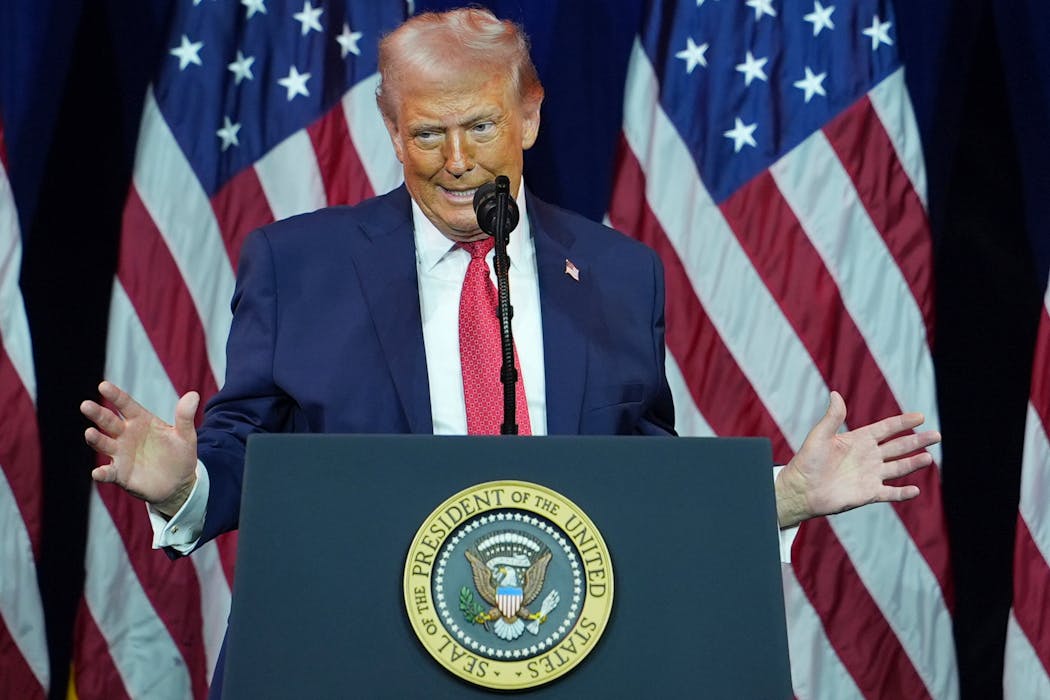
President Donald Trump, who has been involved in thousands of lawsuits, has made news outlets a particular target for litigation this year. AP Photo/Evan Vucci

In December 2025, President Donald Trump filed a US$10 billion lawsuit against the BBC in a federal court in Florida. It was only the latest in a long series of high-dollar legal challenges Trump has brought against prominent media organizations, including ABC, CBS, The New York Times and The Wall Street Journal, among others.

Trump has won some sizable settlements in cases legal scholars had dismissed as largely lacking in merit. But as media scholars, we believe prevailing in court is not necessarily his primary goal. Instead, Trump appears to use lawsuits as a strategic weapon designed to silence his enemies and critics – who sometimes seem to be one and the same in his eyes.

Trump has always been litigious. Over the course of his life, he has been involved in more than 4,000 lawsuits. Many of these involved Trump suing for defamation over perceived threats to his reputation. Relatively few, however, have been successful, if success is defined as prevailing in courts of law.

But using litigation as a tool for intimidation can produce other results that can count as victory. We are concerned that the president may be using the courts as a tool not to correct the record but to muzzle potential watchdogs and deprive the public of the facts they need to hold him accountable.

Winning major settlements

Trump claims the BBC attempted to interfere with the 2024 election by misrepresenting statements he’d made. As with Trump’s other defamation suits, the odds appear long against the president winning his case against the British broadcaster in court.

Just after Trump’s election in 2024, ABC, whose parent company is Disney, promised to make a $15 million contribution to the Trump presidential library to settle a defamation suit many experts said had dubious merit.

CBS and its parent company Paramount Global settled an arguably weaker defamation suit involving editing of a “60 Minutes” interview with Kamala Harris that Trump said was done “to make her look better.” Paramount contributed $16 million to Trump’s presidential library and his legal fees in order, the company said, to avoid the “uncertainty and distraction” of litigation. That same month, the Federal Communications Commission approved the $8 billion acquisition of Paramount by Skydance Media.

Those two defamation suits were filed while Trump was still a presidential candidate. Weeks after winning reelection, Trump sued The Des Moines Register for publishing a preelection poll that suggested he might lose the swing state of Iowa. Instead, he carried the state by 13 percentage points.

Kamala Harris greeting supporters during the 2024 campaign.
Paramount Global agreed to pay $16 million to settle a lawsuit Trump had filed complaining that a CBS News interview with Kamala Harris had been misleadingly edited.
AP Photo/Jacquelyn Martin

Trump could have just gloated over his victory, as President Harry Truman did when he famously posed holding the Chicago Tribune’s “Dewey Beats Truman” headline the day after his reelection. Instead, Trump went to court, accusing The Des Moines Register and its pollster, J. Ann Selzer, of violating Iowa’s consumer protection laws by fraudulently deceiving consumers and campaign donors.

Even if Trump loses this suit, he has inflicted expensive litigation costs on a news organization.

The considerable costs of defense

From the 1960s until the late 1990s, leading media outlets, rich from advertising dollars, could afford to hire lawyers to defend against governmental overreach and protect their role in the U.S.’s democratic order. Those fights led to Supreme Court decisions shielding media outlets from most libel complaints and government censorship prior to publication.

But the rise of the internet and then social media led to the collapse of the economic model supporting traditional news production. As audiences and advertisers have fled traditional media outlets, including newspapers and broadcasters, the money to hire lawyers to defend against expensive defamation suits or fight for access to government information is much harder to find.

If even media giants such as ABC and CBS are settling rather than fighting, what local news editor is going to assign a story that might trigger a presidential lawsuit? That’s why Trump’s suit against The Des Moines Register is such an ominous development.

Giving up without a fight

What’s disheartening about the media giants’ capitulation is that they are at risk of squandering the protections afforded by the Constitution and the courts.

In medieval England, criticizing the king or peers of the realm was a crime. But early in U.S. history, attempts to enforce seditious libel laws by the British government and later by President John Adams and the Federalist-controlled Congress generated public outcry and rebuke. This was based in part on the understanding that in a democracy the people must be free to criticize those who govern them, a principle enshrined in the First Amendment.

The Supreme Court ratified this understanding of press freedom in its 1964 decision New York Times v. Sullivan. In a resounding victory for free expression, the justices held that government officials cannot prevail in defamation cases unless there is clear and convincing proof that their critics knowingly or recklessly disregarded the truth. Careless errors are not enough.

President Trump pumps his fist in front of supporters.
Trump addressed supporters on Jan. 6, 2021, prior to their march to Capitol Hill. The question of whether he incited them to riot is at the heart of his lawsuit against the BBC.
AP Photo/Jacquelyn Martin

Under these protections, even Trump’s case against the BBC – where the network has admitted an ethical lapse – is not a certain winner, especially since the contested content didn’t air in Florida, where the lawsuit was filed.

Although Trump claims the BBC’s misleading edits implied that he directly incited protesters to storm the Capitol on Jan. 6, 2021, the network can argue in court that the inaccuracy is only technical, given that Trump truly did give a firebrand speech that was widely criticized as at least indirectly leading to the violence that followed . If the edited version of Trump’s speech is not appreciably more harmful to Trump’s reputation than his actual speech, Trump’s defamation claim would likely fail.

Trump is the first U.S. president to use the weight of his office to extract private settlements from news outlets tasked with holding him accountable. Ostensibly, these suits are to recover monetary damages for harm to his reputation, but they are part of a broader attack on what Trump perceives as hostile media coverage.

New limits from states

Some of Trump’s targets are fighting back.

One is the Pulitzer Prize Board, the defendant in yet another Trump defamation suit – in this case, over the awards the board gave for reporting on Russian interference in the 2016 presidential election.

In December 2025, the Pulitzer Prize Board asked the judge in the case to force the president to hand over tax and medical records to prove that he had suffered the financial and emotional harm he is claiming.

Another key development: Most states have enacted anti-SLAPP laws. SLAPP stands for “strategic lawsuits against public participation,” referring to cases filed to intimidate and discourage public criticism. Thirty-eight states, plus the District of Columbia, now have anti-SLAPP laws in place. It’s probably not a coincidence that Trump filed the latest iteration of his suit against The Des Moines Register on June 30, which happened to be one day before Iowa’s anti-SLAPP law took effect.

These state laws allow targets of SLAPPs to get early resolutions of meritless suits and can force people found to have filed such suits to pick up their targets’ legal bills.

Without such tools protecting First Amendment rights – and media organizations taking steps themselves to defend such rights – dissent might be characterized as a “deceptive trade practice,” and speech is no longer truly free.

The Conversation

Lyrissa Barnett Lidsky is affiliated with the Florida First Amendment Foundation.

Kathy Kiely does not work for, consult, own shares in or receive funding from any company or organization that would benefit from this article, and has disclosed no relevant affiliations beyond their academic appointment.

ref. Trump lawsuits seek to muzzle media, posing serious threat to free press – https://theconversation.com/trump-lawsuits-seek-to-muzzle-media-posing-serious-threat-to-free-press-272850

Venezuela’s oil industry has flailed under government control – Mexico and Brazil have had more success with nationalizing

Source: The Conversation – USA (2) – By Skip York, Nonresident Fellow in Energy and Global Oil, Baker Institute for Public Policy, Rice University

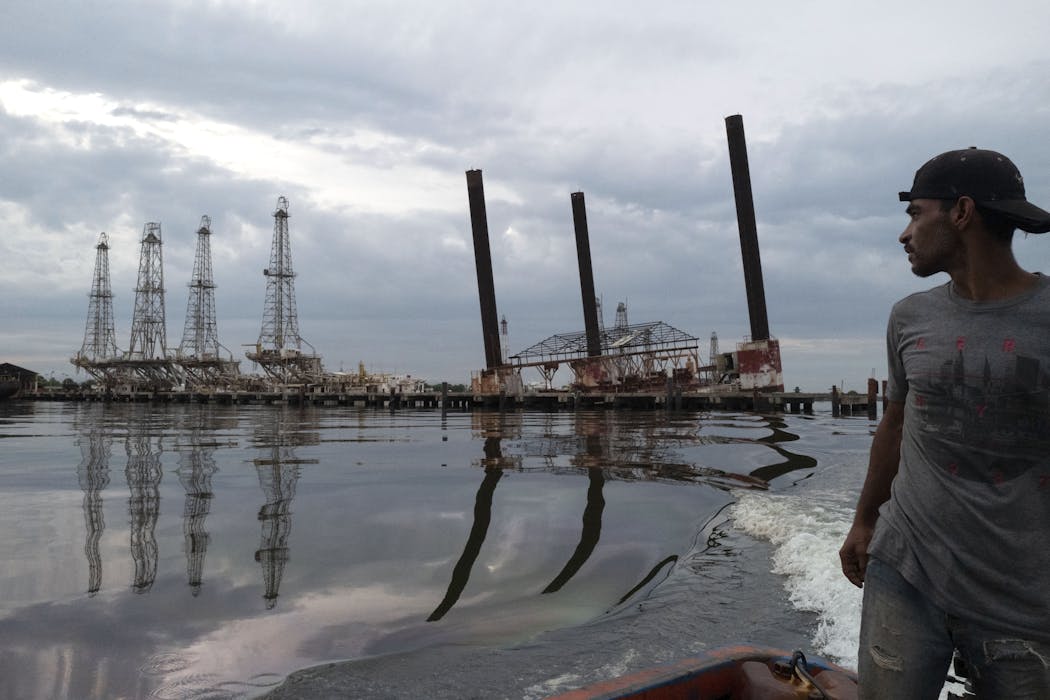
The Venezuelan state-run oil company is contending with aging infrastructure. Michael Robinson Chavez/The Washington Post via Getty Images

U.S. President Donald Trump has ignited a contentious debate over who has the right to control Venezuela’s vast oil reserves.

Speaking on Jan. 3, 2026, after the U.S. military seized Venezuelan President Nicolás Maduro, the U.S. president declared, “We built Venezuela’s oil industry, and now we’re going to take it back.”

By Jan. 6, Trump was saying that Venezuela would provide the U.S. with up to 50 million barrels of oil in the near future.

The next day, the U.S. seized two tankers bound from Venezuela for other markets – less than a month after it seized two others it said were transporting Venezuelan oil.

Long-term plans go much further. Trump envisions major U.S. oil companies, such as Chevron and ExxonMobil, to invest some US$100 billion into reviving Venezuela’s struggling industry, with the investing companies reimbursed through future production. So far, neither Venezuelan authorities nor U.S. oil companies have said whether they’re willing to do this.

As a scholar of global energy, I believe that Trump’s words and actions, including his consultations with oil executives before Maduro’s removal, signal a bold push to reassert American dominance in a country with vast oil reserves.

A motorcycle passes in front of an oil-themed mural.
A motorcycle passes in front of an oil-themed mural in Caracas, Venezuela, on May 9, 2022.
Javier Campos/NurPhoto via Getty Images

Trump’s rationale

Trump’s “Venezuela took our oil, we’re taking it back” rationale apparently references the South American nation’s initial nationalization of its oil industry in 1976, plus a wave of expropriations in 2007 under Venezuelan President Hugo Chávez.

U.S. oil companies played a big role in launching and sustaining Venezuela’s oil boom, starting in the 1910s. Companies such as Standard Oil, a predecessor of ExxonMobil, and Gulf Oil, which eventually became part of Chevron, invested heavily in exploration, drilling and infrastructure, transforming Venezuela into a major global supplier.

Contracts from that era often blurred lines between reserve ownership and production rights. Venezuela legally retained subsoil ownership but granted or sold broad concessions to foreign operators, such as Royal Dutch-Shell. That effectively gave control of reserves and production to the oil companies, but not forever.

This ambiguity likely has played a role in Trump alleging outright theft through nationalization, a claim that holds little grounding in the historical precedent of how Venezuela and other nations have managed ownership of their natural reserves.

Oil nationalization

When a country nationalizes its oil industry, control is transferred from private, often foreign-owned, companies to the government.

Nationalization can involve the outright expropriation of facilities and reserves – with or without compensation – or the renegotiation of oil production contracts. Alternatively, a government may get a bigger stake in the joint ventures it already has with foreign oil companies.

While privately owned oil companies primarily are accountable to their shareholders and focus mainly on maximizing profits, most government-run oil companies have other priorities too. These might include pumping revenue into safety net programs, domestic energy security, the development of other industries and military spending.

Sometimes those other goals take so much money out of the oil company’s orbit that they interfere with operational efficiency and reinvestment, slowing growth or even reducing production capacity. That’s what happened in Venezuela, where oil production has fallen sharply since 2002.

But other Latin American countries have also nationalized their oil industries with better results.

Mexico’s experience

In Mexico, President Lázaro Cárdenas’ 1938 expropriation of foreign oil assets – primarily from U.S. and British companies – was the region’s first such assertion of economic independence.

Amid labor disputes and perceived exploitation, 17 privately owned companies were nationalized, creating Petróleos Mexicanos as Mexico’s government-run oil monopoly. Mexicans celebrate the formation of this company, known as Pemex, every year on March 18 as a symbol of national sovereignty.

Despite initial boycotts and diplomatic strain, Mexico eventually compensated the foreign companies that lost their property. But it isolated its oil sector from international capital and technology for decades.

Due to the depletion of Pemex’s largest oilfields, chronic underinvestment, a failure to adopt new technologies and unwise policy choices, production, which peaked at 3.8 million barrels a day in 2004, began to decline. Mexico responded in 2013 and 2014 with reforms that opened the oil, gas and power generation industries to private capital.

By 2018, political backlash around a perceived loss of sovereignty and uneven benefits led to a policy reversal. Oil output continues to shrink; it now stands at 1.8 million barrels per day.

Mexico’s experience underscores how oil nationalization can foster self-reliance while hindering production.

A crowd in Mexico gathers for a speech below a large bust of a man.
Mexican President Andres Manuel Lopez Obrador, left, delivers a speech on the 86th anniversary of the nationalization of oil on March 18, 2024.
Rodrigo Oropeza/AFP via Getty Images

Brazil’s approach

Brazil also nationalized its oil industry in 1953, when President Getúlio Vargas established Petróleo Brasileiro S.A. as a state-owned company.

From the start, Petrobras had a monopoly over all Brazilian oil exploration and production. The government expanded the company’s scope when it nationalized all privately owned refineries by 1964.

Brazil’s oil nationalization was part of the country’s broader effort to develop its own industrial capacity and reduce its dependence on foreign oil.

Petrobras has changed significantly since its founding, especially after President Fernando Henrique Cardoso signed an oil deregulation law in 1997. It’s now a state-controlled company, in which investors may buy and sell shares. The government has forged many partnerships with private oil companies, drawing foreign investment.

This strategy succeeded. Production has quadrupled from 0.8 million barrels per day in 1997 to 3.4 million in 2024.

Shell, Total Energies, Equinor, ExxonMobil and other foreign oil companies have provided capital, technology and execution capacity, particularly with deep-water drilling.

A man walks past the headquarters of  a Petrobras building.
A man walks past the headquarters of Petrobras in Rio de Janeiro in 2022.
Fabio Teixeira/Anadolu Agency via Getty Images

Venezuela’s nationalization

Venezuela’s oil nationalization, by contrast, shifted from cooperation with foreign oil companies to confrontation with them.

President Carlos Andrés Pérez first nationalized Venezuela’s oil industry in 1976, creating Petróleos de Venezuela, S.A. Foreign companies received compensation of about 25% for losing their assets. Many transitioned into service providers or formed joint ventures with the new company, PDVSA.

Venezuela made its oil sector more open to foreign capital in the 1990s. It aimed at the time to boost output and develop the Orinoco Belt in eastern Venezuela, which has some of the world’s biggest oil reserves.

This policy contributed to Venezuelan production reaching a historical peak of more than 3 million barrels per day in 2002.

Chávez changes everything

Hugo Chávez, elected president of Venezuela in 1998, reversed course.

In 2003, after a strike briefly but severely slashed national output, Chávez consolidated control over the oil industry. He purged PDVSA of his critics, replacing managers who had expertise with his political allies, and fired over 18,000 employees.

Venezuela expropriated operating assets, converted contracts held by private companies into PDVSA-controlled joint ventures and made sharp and unpredictable increases in the taxes and royalties foreign oil companies had to pay.

Foreign oil companies suffered from chronic payment delays, along with restrictive foreign exchange rules and new laws that weakened contract enforcement and made it harder for companies to use arbitration to resolve disputes.

In 2007, Chávez forced foreign oil companies partnering with PDVSA to renegotiate their agreements, leading to the partial nationalization of their stakes in those ventures.

Several foreign oil companies, including ConocoPhillips and ExxonMobil, rejected the new terms of engagement and left Venezuela.

Their legal disputes with Venezuela over billions of dollars in joint venture assets and severed revenue-sharing agreements have never been resolved.

Man holds a detailed map with the PDVSA logo.
Venezuelan President Hugo Chavez shows on a map the location of new oil wells operating in the country in 2004.
HO/AFP via Getty Images

Chevron, however, stayed put.

The Houston-headquartered company, which has had a presence in Venezuela since 1924, now plays the largest role of any foreign oil company in the country. It produces 240,000 barrels per day, about 25% of Venezuela’s total output.

The government also reclassified vast oil deposits as “proven” at a time when global oil prices were very high, rendering their exploration and production more economically viable. That change tripled this self-reported and never-verified estimate of Venezuela’s proven oil reserves to approximately 300 billion barrels.

Conditions get worse under Maduro

Venezuelan oil output further declined while Maduro served as president, falling to 665,000 barrels per day in 2021. Since then, production has recovered somewhat, rebounding to about 1.1 million barrels per day by late 2025 – about one-third of its historic high.

This overall decline is due to mismanagement, corruption and more than a decade of U.S. sanctions. Infrastructure decay – leaking pipelines, outdated refineries held together by makeshift repairs – has exacerbated this crisis.

Many hurdles are in the way of the industry’s recovery, including ongoing and potentially future legal disputes, geopolitical risks and the need for massive investments. Returning Venezuela’s oil production to its peak of 3 million barrels per day could cost more than $180 billion.

People spend time on a beach with an oil tanker nearby.
The national oil industry is hard to ignore in Venezuela.
Jesus Vargas/picture alliance via Getty Images

Better example

As Brazil’s experience suggests, governmental control over oil production and sales is not inherently bad for a country’s economic welfare.

Norway is an even stronger example. That oil-rich Nordic country has evaded what some scholars call the “resource curse” by treating the oil that its nationally owned company, now called Equinor, has produced as a source of lasting wealth for the Norwegian people.

Revenue from the Norwegian government’s 67% stake in Equinor has accumulated in a sovereign wealth fund worth more than $2 trillion and helped Norway diversify its economy.

As the Venezuelan government regroups following Maduro’s removal, there’s much it can learn from other countries that have managed to maintain more stability alongside state-controlled oil production.

The Conversation

Did prior consulting work for PdVSA in 2002-2003

ref. Venezuela’s oil industry has flailed under government control – Mexico and Brazil have had more success with nationalizing – https://theconversation.com/venezuelas-oil-industry-has-flailed-under-government-control-mexico-and-brazil-have-had-more-success-with-nationalizing-272785

Financial case for college remains strong, but universities need to add creative thinking to their curriculum

Source: The Conversation – USA (2) – By Caroline Levander, Vice President Global Strategy & Carlson Professor in the Humanities, Rice University

Unemployment rates are lower among people who have a college degree, compared to those with a high school degree. Wong Yu Liang/iStock Images/Getty Images

A college degree was once seen as the golden ticket to landing a well-paying job. But many people are increasingly questioning the value of a four-year degree amid the rising cost of college.

Almost two-thirds of registered voters said in an October 2025 NBC News poll that a four-year college degree isn’t worth the cost – marking an increase from 40% of registered voters who said that college wasn’t worth the cost in June 2013.

Caroline Field Levander, the vice president for global strategy and an English professor at Rice University, argues in her December 2025 book “Invent Ed” that people have lost sight of two factors that made universities great to begin with: invention and creativity.

Amy Lieberman, education editor at The Conversation U.S., spoke with Levander to break down the benefits of going to college and university – and how schools can better demonstrate their enduring value.

How can we measure the value of a college degree?

College graduates earn substantially more than people who do not have a college degree.

The average high school graduate over a 40-year career earns US$1.6 million, according to 2021 findings by the Georgetown University Center on Education and Workforce. The average college graduate, over this same 40-year time frame, earns $2.8 million. That $1.2 million difference amounts to around $30,000 more salary per year.

People who earn a degree more advanced than a bachelor’s, on average, earn $4 million over 30 years, making the lifetime earning difference $2.4 million between these graduates and people with just a high school diploma.

College graduates are also better protected against job loss, and they weather job disruption cycles better than high school graduates.

The unemployment rate for people with a high school degree was 4.2% in 2024, according to the U.S. Bureau of Labor Statistics. By contrast, 2.5% of people with a bachelor’s degree and 2.2% of people with a master’s degree were unemployed in 2024.

Do any of these benefits extend beyond individual students?

In addition to the substantial financial benefits college graduates experience, colleges and universities are major employers in their communities – and not just professors and administrators. Higher education institutions employ every trade and kind of worker, from construction workers to police, to name a few.

Universities are crucial to developing and strengthening the U.S. economy in other ways. The discoveries that faculty and researchers make in laboratories lead to new products, businesses and ideas that drive the U.S. economy and support the country’s financial health.

Researchers at the University of Texas Southwestern did important work in helping to discover statins, while scientists at the University of Pennsylvania developed the mRNA vaccine. The list of inventions that started at universities goes on and on.

Some people are questioning the value of a degree. What role can universities play in reassuring them of their relevance?

Discovery and invention have traditionally been the focus of many graduate programs and faculty research, while undergraduate college educations tend to focus on ensuring that students are able to successfully enter the workforce after graduation.

Undergraduate students need to gain competency in a field in order to contribute to society and advance knowledge.

But I believe universities need to teach something else that is equally valuable: They also need to build creative capacity and an inventive mindset into undergraduate education, as a fundamental return on the investment in education.

Employers report that creativity is the top job skill needed today. The IBM Institute for Business Value, for example, concluded in 2023 that creativity is the must-have skill for employee success in the era of generative AI.

The Harvard Business Review reports that employers are developing short courses aimed to build creative capability in their workers.

A woman with dark hair looks down with various small images around her.
Creativity and innovation are both likely to become increasingly important for young people entering the workplace, especially as AI continues to grow.
Andriy Onufriyenko/iStock/Getty Images

What can faculty and students easily do to encourage creativity and innovation?

Professors can build what I call a “growth mindset” in the classroom by focusing on success over time, rather than the quick correct answer. Faculty members can ask themselves as they go into every class, “Am I encouraging a growth mindset or a fixed mindset in these students?” And they can use that answer to guide how they are teaching.

Students could also consider committing to trying new courses in areas where they haven’t already been successful. They could approach their college experience with the idea that grades aren’t the only marker of success. And I think they could benefit from developing thoughtful ways to describe their journey to future employers. Simple practices like keeping a creativity notebook where they record the newest ideas they have, among many others that I describe in my new book, will help.

And university leaders need to open the aperture of how we define our own success and our university’s success so that it includes creative capability building as part of the undergraduate curriculum.

The Conversation

Caroline Levander does not work for, consult, own shares in or receive funding from any company or organization that would benefit from this article, and has disclosed no relevant affiliations beyond their academic appointment.

ref. Financial case for college remains strong, but universities need to add creative thinking to their curriculum – https://theconversation.com/financial-case-for-college-remains-strong-but-universities-need-to-add-creative-thinking-to-their-curriculum-269463

Eating less ultraprocessed food supports healthier aging, new research shows

Source: The Conversation – USA (3) – By Moul Dey, Professor of Nutrition Science, South Dakota State University

Studies have linked ultraprocessed foods to poor health outcomes, but such foods make up about half the calories of a typical American diet. Kobus Louw/E+ via Getty Images

Older adults can dramatically reduce the amount of ultraprocessed foods they eat while keeping a familiar, balanced diet – and this shift leads to improvements across several key markers related to how the body regulates appetite and metabolism. That’s the main finding of a new study my colleagues and I published in the journal Clinical Nutrition.

Ultraprocessed foods are made using industrial techniques and ingredients that aren’t typically used in home cooking. They often contain additives such as emulsifiers, flavorings, colors and preservatives. Common examples include packaged snacks, ready-to-eat meals and some processed meats. Studies have linked diets high in ultraprocessed foods to poorer health outcomes.

My team and I enrolled Americans ages 65 and older in our study, many of whom were overweight or had metabolic risk factors such as insulin resistance or high cholesterol. Participants followed two diets low in ultraprocessed foods for eight weeks each. One included lean red meat (pork); the other was vegetarian with milk and eggs. For two weeks in between, participants returned to their usual diets.

A total of 43 people began the dietary intervention, and 36 completed the full study.

In both diets, ultraprocessed foods made up less than 15% of the total calories – a significant reduction from the typical American diet, where more than 50% of total calories comes from ultraprocessed foods. The diets were designed to be realistic for everyday eating, and participants were not instructed to restrict calories, lose weight or change their physical activity.

Older couple shopping in a supermarket
Maintaining metabolic health promotes healthy aging.
Giselleflissak/E+ via Getty Images

We prepared, portioned and provided all meals and snacks for the study. Both diets emphasized minimally processed ingredients and aligned with the 2020-2025 Dietary Guidelines for Americans, the U.S. government’s nutrient-based recommendations for healthy eating, while providing similar calories and amounts of key nutrients.

The 2025-2030 Dietary Guidelines for Americans, released on Jan. 7, 2026, explicitly recommend eating less ultraprocessed food, but the previous versions of the guidelines did not specifically address food processing. Our feeding study design allowed us, for the first time, to examine the health effects of reducing ultraprocessed foods while keeping nutrient levels consistent with recommended targets.

We compared how participants fared while eating their habitual diets with how they responded to the two diets that were low in ultraprocessed foods. During the periods when participants ate fewer ultraprocessed foods, they naturally consumed fewer calories and lost weight, including total and abdominal body fat. Beyond weight loss, they also showed meaningful improvements in insulin sensitivity, healthier cholesterol levels, fewer signs of inflammation and favorable changes in hormones that help regulate appetite and metabolism.

These improvements were similar whether participants followed the meat-based or the vegetarian diet.

Why it matters

Ultraprocessed foods make up more than half the calories consumed by most U.S. adults. Although these foods are convenient and widely available, studies that track people’s diets over time increasingly link them with obesity and age-related chronic diseases such as Type 2 diabetes and heart disease. With older adults making up a growing share of the global population, strategies that preserve metabolic health could support healthy aging.

Most previous feeding studies testing how ultraprocessed foods affect people’s health haven’t reflected real-world eating, especially among Americans. For example, some studies have compared diets made up almost entirely of ultraprocessed foods with diets that contain little to none at all.

Our study aimed to more closely approximate people’s experience while still closely tracking the foods they consumed. It is the first to show that for older adults a realistic reduction in ultraprocessed foods, outside the lab, has measurable health benefits beyond just losing weight. For older adults especially, maintaining metabolic health helps preserve mobility, independence and quality of life.

What’s still unknown

Our study was small, reflecting the complexity of studies in which researchers tightly control what participants eat. It was not designed to show whether the metabolic improvements we observed can prevent or delay diseases such as diabetes or heart disease over time. Larger, longer studies will be needed to answer that.

On the practical side, it’s still unclear whether people can cut back on ultraprocessed foods in their daily lives without structured support, and what strategies would make it easier to do so. It’s also not fully understood which aspects of processing – for example, additives, emulsifiers or extrusion – matter more for health.

Answering these questions could help manufacturers produce foods that are healthier but still convenient – and make it easier for people to choose healthier food options.

The Research Brief is a short take on interesting academic work.

The Conversation

Moul Dey receives funding from the National Pork Board, the U.S. Department of Agriculture, and the National Institute of Food and Agriculture (Hatch project).

ref. Eating less ultraprocessed food supports healthier aging, new research shows – https://theconversation.com/eating-less-ultraprocessed-food-supports-healthier-aging-new-research-shows-271986

What is Christian Reconstructionism − and why it matters in US politics

Source: The Conversation – USA (3) – By Art Jipson, Associate Professor of Sociology, University of Dayton

Elements of Christian reconstructionist thought appear in parts of the Christian homeschooling movement. Forest Trail Academy, CC BY-NC

Christian Reconstructionism is a theological and political movement within conservative Protestantism that argues society should be governed by biblical principles, including the application of biblical law to both personal and public life.

Taking shape in the late 1950s, Christian Reconstructionism developed into a more organized movement during the 1960s and 1970s.

It was born from the ideas of theologian R. J. Rushdoony, an influential Armenian-American Calvinist philosopher, theologian and author. In his 1973 book, “The Institutes of Biblical Law,” Rushdoony argued that Old Testament laws should still apply to modern society. He supported the death penalty not only for murder but also for offenses listed in the text such as adultery, blasphemy, homosexuality, witchcraft and idolatry.

As a scholar of political and religious extremism, I am familiar with this movement. Its following has been typically very small – never more than a few thousand committed adherents at its peak. But since the 1980s, its ideas have spread far beyond its limited numbers through books, churches and broader conservative Christian networks.

The movement helped knit together a network of theologians, activists and political thinkers who shared a belief that Christians are called to “take dominion” over society and exercise authority over civil society, law and culture.

These ideas continue to resonate across many areas of American religious and political life.

Origins of Christian Reconstructionism

Rushdoony’s ideas were born from a radical interpretation of Reformed Christianity – a branch of Protestant Christianity that follows the teachings of John Calvin and other reformers. It emphasizes God’s authority, the Bible as the ultimate guide and salvation through God’s grace rather than human effort.

Rushdoony’s ideas led him to found The Chalcedon Foundation in 1965, a think tank and publishing house promoting Christian Reconstructionism. It served as the movement’s main hub, producing books, position papers, articles and educational materials on applying biblical law to modern society.

It helped train Greg Bahnsen, an Orthodox Presbyterian theologian, and Gary North, a Christian reconstructionist writer and historian, both of whom went on to take key leadership roles in the movement.

At the heart of reconstructionism lies the conviction that politics, economics, education and culture are all arenas where divine authority should reign. Secular democracy, they argued, was inherently unstable, a system built on human opinion rather than divine truth.

These ideas were, and remain, deeply controversial. Many theologians, including conservatives within the Reformed tradition, rejected Rushdoony’s argument that ancient Israel’s civil laws should apply in modern states.

Christian dominionism and different networks

Nonetheless, reconstructionist ideas grew as people who more broadly believed in dominionism began to align with it. Dominionism is a broader ideology advocating Christian influence over culture and politics without requiring literal enforcement of biblical law.

Dominionism did not begin as a single, unified movement. Rather, it emerged in overlapping strands during the same period that Christian Reconstructionism was developing.

Between the 1960s and 1980s, Christian Reconstructionism helped turn dominionist beliefs into an explicit political project by grounding them in theology and outlining how biblical law should govern society. Religion historian Michael J. McVicar explains that Rushdoony’s work advocated applied biblical law as both a theological and political alternative to secular governance. This helped in influencing the trajectory of the Christian right.

At the same time, parallel streams – especially within charismatic and Pentecostal circles – advanced similar claims about Christian authority over society using different theological language.

The broad network of those who believe in Christian dominionism includes several approaches: Rushdoony’s reconstructionism, which provides the theological foundation, and charismatic kingdom theology.

Charismatic kingdom theology, which emerged in Pentecostal and charismatic circles, teaches that believers – empowered by the Holy Spirit – should shape politics, culture and society before Christ’s return.

Unlike reconstructionism, it emphasizes prophecy and spiritual authority rather than formal biblical law; it seeks influence over institutions such as government, education and culture.

What unites them is the idea that Christian faith should be the basis of the nation’s moral and political order.

Taken together, I argue that these strands have reinforced one another, creating a larger movement of thinkers and activists than any single approach could achieve alone.

From reconstructionism to the New Apostolic Reformation

Christian reconstructionist and dominionist ideas gained wider popularity through C. Peter Wagner, a leading charismatic theologian who helped shape the New Apostolic Reformation, or NAR, by adapting elements of Christian Reconstructionism. NAR is a charismatic movement that builds on dominionist ideas by emphasizing the use of spiritual gifts and apostolic leadership to shape society.

Wagner emphasized spiritual warfare, prophecy and modern apostles taking control of seven key areas – family, church, government, education, media, business and the arts – to reshape society under biblical authority. This is known as the “Seven Mountains Mandate.”

Both revisionist and dominionist movements share the belief that Christians should lead cultural institutions.

Wagner’s dominion theology, however, adapts Christian Reconstructionism to a charismatic context, transforming the goal of a Christian society into a spiritually driven movement aimed at influencing culture and governments worldwide.

Doug Wilson and homeschooling

Another key bridge between reconstructionism and contemporary dominionist thought is Doug Wilson, a pastor and author in Moscow, Idaho.

Though Wilson distances himself from some of reconstructionism’s harsher edges, he draws heavily from Rushdoony’s intellectual framework. Wilson’s influence can be seen in publications such as “Reforming Marriage,” where he argues for applying biblical principles to law, education and family life.

A grey-haired man in a blue suit speaks into a microphone while gesturing with his finger.
Doug Wilson, a pastor and author in Idaho, Moscow.
Liesbeth Powers/Moscow-Pullman Daily News, CC BY

He has promoted Christian schools, traditional family roles and living out a “Christian worldview” in everyday life, bringing reconstructionist ideas into new areas of society.

Through his writings, teaching and leadership within the Communion of Reformed Evangelical Churches – the CREC – network, Wilson encourages a vision of society shaped by Christian values, connecting reconstructionist thought to contemporary cultural engagement.

Wilson’s publishing house, Canon Press, and his classical school movement have brought these ideas into thousands of Christian homes and classrooms across the U.S. His local congregation – the Christ Church in Moscow, Idaho – numbers around 1,300.

The Christian homeschooling movement offers parents a curriculum steeped in reformed theology and resistance to secular education.

Enduring influence

Some critics warn that the fusion of dominionist and reconstructionist theology with political action can weaken pluralism and democratic norms by pressuring laws and policies to reflect a single religious worldview. They argue that even moderated forms of these visions challenge the separation of church and state. They risk undermining the rights of religious minorities, nonreligious citizens and others who do not share the movement’s beliefs.

Supporters frame their mission as the renewal of a moral society, one in which divine authority provides the foundation for human flourishing.

Today, Christian Reconstructionism operates through small but influential networks of churches, Christian homeschool associations and media outlets. Its reach extends far beyond its original movement.

Even among those unfamiliar with Rushdoony, the political and theological patterns he helped shape remain visible in modern evangelical activism and the ongoing debates over religion’s place in American public life.

The Conversation

Art Jipson does not work for, consult, own shares in or receive funding from any company or organization that would benefit from this article, and has disclosed no relevant affiliations beyond their academic appointment.

ref. What is Christian Reconstructionism − and why it matters in US politics – https://theconversation.com/what-is-christian-reconstructionism-and-why-it-matters-in-us-politics-266915

Why the mad artistic genius trope doesn’t stand up to scientific scrutiny

Source: The Conversation – UK – By Daisy Fancourt, Associate Professor Psychobiology and Epidemiology, UCL

Vincent van Gogh sliced off his ear with a knife during a psychotic episode. Ballet dancer Vaslav Nijinsky developed schizophrenia and spent the last 30 years of his life in hospital. Virginia Woolf lived with bipolar disorder, eventually taking her own life as she felt another deep depression beginning.

Many famous creative artists have lived with severe mental illness. Catherine Zeta-Jones, Mariah Carey, Demi Lovato, Jean-Claude Van Damme and Mel Gibson have all reported diagnoses of bipolar disorder. Yayoi Kusama, Sylvia Plath, Kurt Cobain and Syd Barrett spoke about experiences of psychosis. Speculation abounds about whether Amy Winehouse, Marilyn Monroe and Ernest Hemingway lived with borderline personality disorder.

The concept of the “mad creative genius” harks back to antiquity. Artists in the Renaissance and Romantic periods would sometimes assume eccentric personalities to distinguish themselves as extraordinary individuals who had made Faustian bargains for their talents.

Edvard Munch, the Norwegian painter, described his “sufferings” as “part of myself and my art … their destruction would destroy my art.” Poet Edith Sitwell, who experienced depression, reportedly used to lie in an open coffin to inspire her poetry.

In 1995, a study of 1,005 biographies written between 1960 and 1990 even proposed that people in the creative professions had a higher rate of severe psychopathology than the general population.

So how does this square with the fact that artistic expression is beneficial for our mental health? As I explain in my new book Art Cure: The Science of How the Arts Transform Our Health, there is a wealth of scientific evidence on these benefits.

However, the reality for professional artists can be a bit different. While they tend to report enhanced overall wellbeing, the life of an artist can be psychologically challenging. They have to endure everything from precarious careers to professional competition.

Additionally, fame brings stress, challenging lifestyles, an increased risk of substance abuse, and an inevitable but unhealthy focus on oneself. In a 1997 study, scientists analysed the number of first-personal pronouns – I, me, my, mine and myself – in songs by Cobain and Cole Porter (who himself had bouts of severe depression). As their fame increased, both saw a statistically significant increase in their use of these pronouns.

Linking artistry and severe mental illness

But what about artists who developed mental illness before becoming famous, or even before becoming artists? Genetics research has uncovered some shared genes that may underlie severe mental illness and creativity.

A variation in the gene NRG1 is associated with both increased risk of psychosis and higher scores on questionnaires that measure people’s creative thinking. Variations in dopamine-receptor genes have been linked with both psychosis and various creative processes like novelty seeking and decreased inhibitions. It’s a mixed bag of findings, however – not all studies show such links.

Beyond genetics, there are also some personality traits that can be common both to mental illness and creativity, including openness to experience, novelty-seeking and sensitivity. It’s possible to see how such research could provide a lens for viewing artists like Van Gogh, Nijinsky and Woolf.

Yet creativity and mental health difficulties can act against one another. For instance, Woolf described her depressive episodes of bipolar disorder as a well: “Down there, I can’t write or read.” So while some people with severe mental illnesses may make art, not everyone can all the time.

What’s more, when we look for signs of a link between severe mental illness and creative pursuits at a population level, the evidence isn’t clear-cut. In 2013, a Swedish study tracked over 40 years of data from 1.2 million people in national patient registers, including medical records of diagnoses, mental health treatments and cause of death.

The researchers found that people with schizophrenia, schizoaffective disorder, anxiety disorders and unipolar depression were actually less likely than the average person to be in creative professions. The only slight exception was bipolar disorder, where people had around 8% higher odds of being in a creative profession.

But this study also found something arguably more intriguing: the parents and siblings of people with schizophrenia, schizoaffective disorder and bipolar disorder were more likely to be in creative professions. It’s not hard to think of examples amongst famous artists: James Joyce’s daughter and David Bowie’s half-brother both had schizophrenia. Why might this pattern exist?

People who are genetically susceptible to severe mental illness but don’t develop the full conditions may instead have milder versions. Minor hypomania, for instance, involves elevated moods but not with the intensity of bipolar disorder. Schizotypy involves divergent thinking and heightened emotion without the severity of schizophrenia.

These conditions have been associated with creative processes like reduced inhibitions, defocused attention and neural hyperconnectivity (the ability to make cross-sensory associations like hearing colours or tasting musical notes).

Perhaps the siblings and parents of people with mental illness tend to be more likely to have such conditions, and this explains why they choose creative professions. Having said that, not all creative people work in a creative profession – for many, creative hobbies are their outlet away from work.

Essentially, the science suggests there may be some shared processes between severe mental illness and creative processes like the arts. But it’s not the clear linkage that anecdotes might lead us to believe. The myth of the “mad creative genius” is overly simplistic. It also risks perpetuating stigma rather than understanding, so it’s perhaps better put to bed.

It seems more productive to focus on the value that creative engagement can bring to support our mental health. Whether people have a mental illness or are just dealing with day-to-day moods and emotions, there are more studies emerging every week that are building our understanding of the tangible, meaningful benefits the arts can have. This research is revealing how artists, clinicians and communities can work together to build safe, accessible, inclusive opportunities to enjoy the arts.


This article features references to books that have been included for editorial reasons, and contains links to bookshop.org. If you click on one of the links and go on to buy something from bookshop.org, The Conversation UK may earn a commission.

The Conversation

Daisy Fancourt receives funding from Wellcome, UK Research and Innovation, the Prudence Trust, and Bloomberg Philanthropies.

ref. Why the mad artistic genius trope doesn’t stand up to scientific scrutiny – https://theconversation.com/why-the-mad-artistic-genius-trope-doesnt-stand-up-to-scientific-scrutiny-272841

What Cubans want – and what they are bracing for, following Trump’s threats

Source: The Conversation – UK – By Anna Grimaldi, Lecturer in Politics and International Relations, University of Leeds

The Cuban capital of Havana, where we are currently on a research trip, woke to an unfamiliar silence on January 5. As we drove through the city, no music drifted from open windows and shops and restaurants were shuttered. The streets were almost deserted.

It was the first day of national mourning for the 32 Cuban soldiers killed during the US operation to capture Venezuelan leader Nicolás Maduro in Caracas two days earlier. For 48 hours, Cubans observed a duelo (period of grief), honouring what some describe as the “heroes who resisted the aggressors”.

Apart from the eerie quiet, little else in Havana has changed. Street vendors still try to lure tourists with half‑price cigars and last‑minute excursions. The general hospital’s neon lights flicker under the strain of power cuts. And the once‑grand, now crumbling, facades of buildings in central Havana remain coated in a thick film of dust, while passers-by dodge the occasional falling piece of concrete.

A crumbling building in Havana, Cuba.
Cuba’s streets and infrastructure are crumbling due to decades of economic hardship.
Anna Grimaldi

The US government says Cuban officials should be scared of becoming their next target. At a news conference on January 3, secretary of state Marco Rubio said: “If I lived in Havana and I was in the government, I’d be concerned.” President Donald Trump has since urged Cuba to “make a deal” with his government or face consequences.

But no one seems particularly troubled by the possibility that the US attack on Caracas might be repeated here. “They have always underestimated us,” says Antonio, our taxi driver, as he steers through the empty streets. He speaks with the matter‑of‑fact pride common among Cubans, quick to recall the fiasco of the failed Bay of Pigs US invasion in 1961. “It won’t happen here, Cubans are different.”

He points to Venezuela’s history of political betrayals, from the conspiracies against independence leader Simon Bolívar in the early 19th century to the attempted coup against former president Hugo Chávez in 2002 and now the removal of Maduro, apparently betrayed by someone close to him. Antonio insists Cubans remain loyal to their ideals of revolution and sovereignty: “The US can try to strangle us with sanctions, but they won’t break us.”

While much of the world reacts with alarm to Trump’s escalating threats against Mexico, Colombia, Iran and even Greenland, Cubans have barely flinched. Hostility from the US is nothing new, and there is general confidence in the country’s longstanding preparation for any potential escalation with what they see as an old adversary. “We’ve been getting ready for this war for more than 65 years,” one resident remarked.

A mural depicting Che Guevara next to a Cuba flag in Havana.
A mural depicting Che Guevara, a major figure of Cuba’s 1959 revolution, in Havana.
Anna Grimaldi

Trump insists that, when Cuba finally collapses, a better future awaits it – an argument that has been amplified by mainstream international media. But this strikes many Cubans as detached from their lived reality. We spoke to Alejandro, a 20‑year‑old law student, who dismissed this idea as wishful thinking: “They’re wrong if they think they know what’s best for us.”

Cuba is living through one of its most difficult periods since the 1990s. Power cuts, water shortages, scarce foreign currency, falling tourism and rising prices shape daily life for most people.

Sanctions imposed after the socialist revolution in 1959 – and later tightened under Trump following a brief thaw under the presidency of Barack Obama – have intensified these hardships. However, there is little sign that Cubans are waiting for Trump’s help.

Cuba’s stoic resilience

Many western analysts say the halt in Venezuelan oil imports will be devastating for Cuba, arguing that the island has no real alternatives. Cubans seem to think otherwise. “We’ll get oil from the Middle East, from Mexico – we don’t rely on Venezuela as much as they say,” says Yadira, a housekeeper.

Still, the reality is more nuanced. While Mexico has now overtaken Venezuela as Cuba’s main oil supplier, providing nearly half of the island’s crude oil in 2025, it also has to deal with increasing pressures from Washington to align with US foreign policy goals in the region. These pressures forced the Mexican president, Claudia Sheinbaum, to clarify on January 7 that, while oil exports to Cuba are continuing, they will not increase.

Losing Venezuelan imports alone may not cause Cuba to collapse, but the impact will be serious and uneven. Cities, which depend heavily on fuel-intensive transport and electricity, will suffer most. And as past crises show, distribution can break down even when food is available.

“During COVID, all I could get hold of in Havana was mangoes and spring onions,” says Sophie, a British expat. Cuba’s vulnerability lies less in total isolation and more in the fragility of its internal systems – especially those that keep urban life functioning.

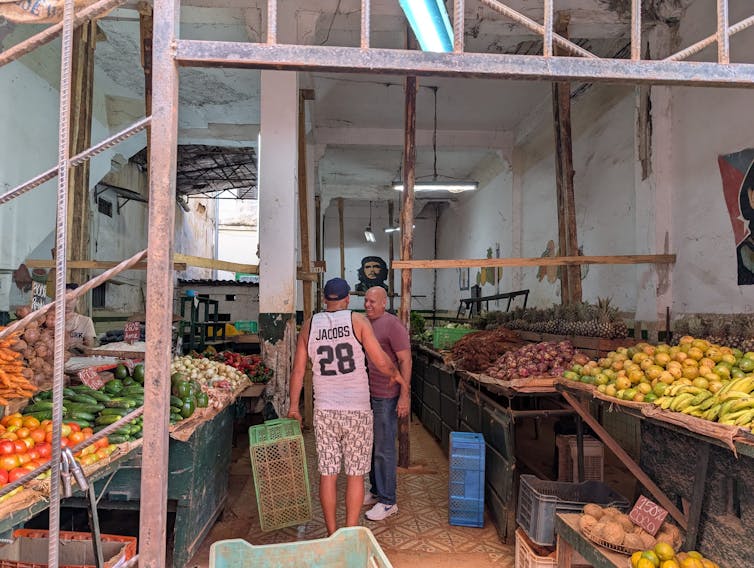
Two men greeting each other in a grocery store in Havana, Cuba.
Two men greet each other in a grocery store in Havana, Cuba.
Anna Grimaldi

Beneath the surface of stoic resilience, subtle cracks are beginning to show. Albeit timidly, some Cubans point to internal governance failures.

“If I told you what I really think, I’d be arrested,” says a tour guide who told us he would prefer to remain anonymous. A trained engineer, he never managed to achieve the prosperity promised by the government’s provision of free education for all Cubans.

Like many young people, his children emigrated to Spain and, for him, Cuba’s current situation feels increasingly unsustainable. “Nothing works,” he says. “There are no medicines, no supplies, and the repression is getting worse.”

So, while Trump may not be the answer many seek, his threats underscore a broader truth for Cubans: change must come one way or another. Foreign rule is far from a solution to Cuba’s problems, yet some see it as one of the few paths left when no other way forward seems possible.

Cubans do not expect an invasion, but they do expect their lives to grow harder. They are not calling for regime change imposed from outside, but what they seem to want is the chance to build a future at home.

As the situation in Venezuela unfolds, Cubans will watch closely – not because they expect the same to happen on their island, but because they know that events elsewhere in the region have a way of washing up on their shores.

The Conversation

The authors do not work for, consult, own shares in or receive funding from any company or organisation that would benefit from this article, and have disclosed no relevant affiliations beyond their academic appointment.

ref. What Cubans want – and what they are bracing for, following Trump’s threats – https://theconversation.com/what-cubans-want-and-what-they-are-bracing-for-following-trumps-threats-272857

The economics of climate risk ignores the value of natural habitats

Source: The Conversation – UK – By Narmin Nahidi, Assistant Professor in Finance, University of Exeter

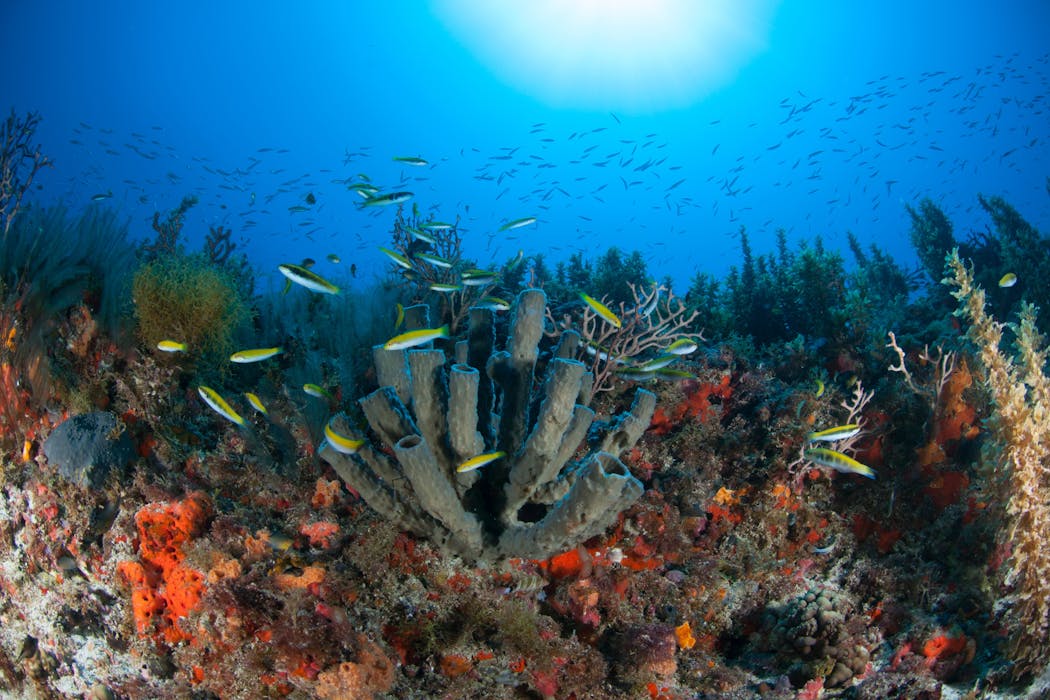
Coral reefs in Quintana Roo, Mexico. Connect Images – Curated/Shutterstock

When Hurricane Delta hit Mexico’s Caribbean coast in 2020, insurance payouts were released within days – not to rebuild hotels or roads, but to repair coral reefs.

In the Mexican state of Quintana Roo, reefs are insured and restoration is taken care of by a local trust. After storms, payouts fund rapid restoration so reefs can keep doing their job: breaking up waves so they don’t erode the shore, reducing flooding, protecting tourism jobs and lowering insurance losses.

Nature is treated as part of the economic infrastructure. This idea is spreading, as it directly affects costs, risks and financial stability.

Until recently, sustainable or “green” finance has focused almost entirely on carbon emissions, net zero targets and climate-related investments. But these climate-only measures miss something basic. The economy doesn’t just depend on temperature; it depends on living systems.

In my field of sustainable finance and financial stability, research shows that when ecosystems fail, the costs show up in rising food prices, insurance bills and public finances. The health of the planet affects everyday costs.


Read more:
The UK’s food system is built on keeping prices low – but this year’s droughts show up its failings


Take food. Around three-quarters of our leading food crops benefit at least partly from animal pollination, including by bees. When pollinator numbers fall, harvests shrink. That pushes up food prices, drives inflation and squeezes household budgets.

Or consider flooding. Wetlands, forests and mangroves absorb water and slow storms. When they’re destroyed, floods cause more damage. Insurers pay out more, premiums rise or cover disappears. Governments often step in, using public money to deal with the fallout.

These aren’t niche environmental problems, they are economic shocks. In many parts of finance, climate risk is now being modelled. But nature loss is only starting to be treated in the same way.

From carbon to nature

In finance, the term “greenium” refers to the lower borrowing costs enjoyed by companies or governments seen as safer environmental bets. When the idea first emerged in the late 2010s, it was almost entirely about carbon emissions. But that’s starting to change.

Investors are beginning to recognise that destroying forests, reefs or soils increases future losses. Where risk rises, returns have to rise too. Where ecosystems are protected, financing becomes cheaper.


Read more:
Your essential guide to climate finance


Change is already happening in three key areas: government debt, insurance schemes and regulation.

In 2021, for example, Belize refinanced part of its national debt in a deal linked to ocean protection. In return for protecting marine habitats, the country received debt relief. For investors, this wasn’t charity: healthy oceans support tourism, fisheries and long-term growth – all of which matter for a country’s ability to repay its debts.

The reef insurance scheme in Mexico isn’t alone any more. Similar ideas are being explored for mangroves and wetlands, especially in storm-prone regions such as the Caribbean and parts of southeast Asia. These ecosystems reduce damage before disasters happen. For insurers, that means fewer claims. For households and businesses, it can mean lower premiums and better access to cover.

shot from underwater of mangroves trees
Mangroves help absorb wave power and protect coastlines from extreme weather.
Nattapon Ponbumrungwong/Shutterstock

Regulators are paying attention too. Central banks and financial supervisors are increasingly asking how nature loss makes other risks worse. A degraded ecosystem can turn a heatwave into a food crisis, or a storm into a fiscal emergency. From this perspective, biodiversity loss isn’t an ethical issue – it’s a risk amplifier.

Research highlights that focusing only on climate misses important economic channels. Carbon metrics tell us about long-term warming, but say much less about near-term shocks.

Ecosystem damage often hits faster than long-term climate consequences, through crop failures, floods and disaster costs – and these shocks don’t stay local. They affect inflation, strain government budgets and ripple through financial markets. When nature is degraded, the economy becomes more fragile.

If ecosystems fail, food costs more. Insurance becomes harder to afford, and governments spend more on responding to disasters. These costs are shared across society.

Seeing nature as part of the economic system isn’t radical, it’s realistic. The sooner finance reflects that reality in everyday financial decisions, the more resilient our ecosystems and economies will be.


Don’t have time to read about climate change as much as you’d like?

Get a weekly roundup in your inbox instead. Every Wednesday, The Conversation’s environment editor writes Imagine, a short email that goes a little deeper into just one climate issue. Join the 47,000+ readers who’ve subscribed so far.


The Conversation

Narmin Nahidi does not work for, consult, own shares in or receive funding from any company or organisation that would benefit from this article, and has disclosed no relevant affiliations beyond their academic appointment.

ref. The economics of climate risk ignores the value of natural habitats – https://theconversation.com/the-economics-of-climate-risk-ignores-the-value-of-natural-habitats-272769