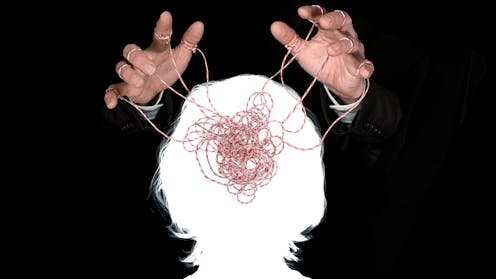
Why people embrace conspiracy theories: it’s about community, not gullibility

Source: The Conversation – UK – By Robin Canniford, Professor of Markets, Business, and Society, University of Bath

TSViPhoto/Shutterstock

Psychologists have long considered how a tendency towards irrational thinking or particular personality traits might predict peoples’ interest in conspiracies. Yet these individual factors do not explain the group processes through which conspiracy theorists are extending their influence and impact.

Over five years, we sought out and got to know people on the cusp of becoming conspiracy theorists. And the results of our new study show that a sense of community activism is attracting people to these ideas.

Indeed, contrary to the stereotype of isolated keyboard warriors who have gone down the rabbit hole, conspiracy theorists are becoming organised, recruiting supporters, picketing vaccination centres and vandalising telecommunication and traffic infrastructures.

Our research examined the growing interest in conspiracy theories and how associated activism emerges. Immersive research with conspiracy theorists is rare. But revealing our status as researchers actually allowed us to build relationships with people, who shared insights into what motivates their involvement.

In particular, we spoke to people about conspiracy theories concerning 5G technology, COVID-19, 15-minute cities and low-traffic neighbourhoods. We also took part in online discussions and travelled the UK to sit in on public meetings and conferences. Ultimately, our insights revealed how people tend to follow a pathway from initial interest, to community engagement and potentially activism.

Awakenings

Belief in conspiracy theories is often initiated by traumatic life events. Job losses or the death of a loved one can trigger anger and suspicion towards public services, authority figures, and experts. This is especially so if people feel that the tragic or destructive events that affected them could have been averted. And these emotions can motivate a search for answers.

When conspiracy theories claim to explain painful personal circumstances or wider fears over COVID-19, or climate change, people can experience “awakenings”. These are moments of insight during which people come to believe that the causes of their problems lie with secretive groups which control society.

One person we spoke to described conspiracy theories as enabling him to “access the way the world really works… as if a light was switched on in my head and I could see things clearly”.

People rarely experience their awakening in isolation. In online group chats, people discover others with similar problems. In public meetings, beliefs in various theories are boosted by interactions where people discuss their suspicions over who is to blame for particular issues. In the process, these groups feed off their common emotions, building an atmosphere of energy and excitement.

The loss of traditional meeting places such as pubs and high streets, along with high levels of loneliness, may be driving people to look for new forms of connection and meaning.

QAnon protesters stand holding posters
Conspiracy theories can make people feel like they are part of something.
Mircea Moira/Shutterstock

The people we spoke to expressed surprise at the social connections they had found through these communities. As one participant put it, “there’s a lot of support out there for people who are doing their own research… there is always someone wanting to hear more, building on the work of others, giving each other support. There’s a real buzz in this community.”

Do your own research

Conspiracy theories don’t merely offer alternative explanations for events, they are resources for communities that provide identity, purpose and belonging. These benefits may explain why it is so difficult to talk people out of their beliefs in conspiracy theories.

Indeed, when conspiracy communities generate common interpretations and shared emotions, conspiracy theories can resonate powerfully, making them seem more real than they are.

This effect is compounded by the way which conspiracy theories invite believers to build on ideas by “doing their own research”. The internet serves as a vast database where conspiracy theorists can discover articles, documents and scientific reports to support their claims.

And despite the questionable quality of many such sources, contributing to conspiracy theories can provide a boost to people’s self esteem, making them feel like experts and heroic detectives. A key aspect of these communities is how they empower members to contribute.

Yet, beyond generating more theories, conspiracy communities are becoming organised networks for protest and activism. Given that conspiracy theories raise suspicion and anger over peoples’ problems, and point the blame at particular targets, we found that believers can feel compelled to take part in protests.

For example, some claim that the urban planning concept of 15-minute cities is part of secretive government scheme to limit citizens’ movement. Protesters against these and other efforts to improve urban environments are uniting under slogans such as “stop the tyranny”.

Who benefits?

Activism based on conspiracy theories can come with serious risks. Many of those involved lose contact with family and friends. Increasingly, conspiracy activists are being charged with crimes. In 2024, an anti-vaccine conspiracy theorist was sentenced to prison for five years for encouraging violence against chief medical officer for England, Chris Witty.

Moreover, when conspiracy theorists take action without tested evidence, they may misidentify targets. This can result in harm to innocent people and can undermine the very institutions needed to solve crimes.

To be sure, instances of conspiracy and foul play by powerful figures and organisations do happen. You have to wonder how much energy then, is wasted fighting imaginary enemies while actual wrongdoing is overlooked.

Perhaps the real winners here are the conspiracy entrepreneurs – people who capitalise on conspiracy theories by creating content that heightens peoples’ suspicions about problematic events. In the process, these people build attention and fame, while peddling products and services from books, merchandise and coaching, to vitamin pills and gadgets.

The Conversation

The authors do not work for, consult, own shares in or receive funding from any company or organisation that would benefit from this article, and have disclosed no relevant affiliations beyond their academic appointment.

ref. Why people embrace conspiracy theories: it’s about community, not gullibility – https://theconversation.com/why-people-embrace-conspiracy-theories-its-about-community-not-gullibility-262276

Sleep apnoea and the unlikely role of conch shells

Source: The Conversation – UK – By Jo-Anne Johnson, Head of Undergraduate Medicine, Anglia Ruskin University

AJP/Shutterstock.com

Could blowing a conch shell help treat sleep apnoea? As a doctor working in sleep medicine, this unexpected news story certainly grabbed my attention. My first reaction was scepticism – sleep specialists don’t typically prescribe natural objects found on beaches as medical therapy. But perhaps I was too hasty to dismiss the idea.

For those unfamiliar with them, a conch shell is the spiral home of a large sea snail that, when hollowed out, can be blown like a trumpet. This practice isn’t new – cultures worldwide have used conch shells for thousands of years in rituals, ceremonies and communication. What’s novel is the suggestion that it might help with a serious medical condition affecting millions.

We all know someone who snores, but not all snoring is harmless. If your partner notices you sometimes stop breathing during the night, that’s cause for concern. You may have obstructive sleep apnoea, a condition where throat muscles relax excessively during sleep, causing the airway to narrow or close completely. These breathing interruptions – called apnoeas – can happen dozens or even hundreds of times per night.

The consequences extend far beyond disturbing your partner’s sleep. Each pause in breathing jolts your brain out of deeper sleep stages, leaving you exhausted the next day. This isn’t merely inconvenient – drowsy drivers cause thousands of accidents annually. The repeated drops in oxygen also strain your heart, increasing risks of high blood pressure and heart disease if left untreated.

Standard treatments focus on keeping airways open during sleep. The gold standard is Cpap (continuous positive airway pressure), where a mask delivers steady airflow that acts like an internal splint. We also use oral devices that gently shift the jaw forward, surgical removal of enlarged tonsils or adenoids, and even newer techniques involving tiny electrical impulses to stimulate airway muscles.

Lifestyle changes matter, too. Weight loss reduces fatty tissue around the neck that can compress airways, while cutting alcohol and stopping smoking helps maintain firmer airway muscles – both substances make throat tissues floppier and worsen symptoms.

Muscles matter for sleep

So where does the conch shell fit? When you blow through any narrow opening, you’re essentially training your upper airway muscles to stay open and firm. This concept, called airway muscle training, has legitimate scientific backing. Studies show that exercises targeting the tongue, soft palate and facial muscles can improve mild to moderate sleep apnoea symptoms.

Research has even examined whether playing the didgeridoo – another wind instrument requiring sustained airway control – might benefit sleep apnoea patients. The results were promising, though limited by patient compliance. The challenge with any exercise-based treatment is maintaining daily practice long-term.

A shirtless man blows a didgeridoo.
This could help too, but might annoy your neighbours more.
Lies Ouwerkerk/Shutterstock.com

This is where the conch shell idea becomes more intriguing. For carefully selected patients with milder symptoms, it could offer an engaging, culturally rich alternative to conventional airway exercises. It’s certainly more accessible than learning the didgeridoo – and probably easier to explain to concerned neighbours.

However, let’s be clear: conch shell therapy won’t revolutionise sleep apnoea treatment. Anyone with suspected sleep apnoea needs proper medical evaluation and evidence-based treatment. Cpap therapy remains the most effective option for moderate to severe cases. But as part of a comprehensive approach – alongside weight management, lifestyle changes and conventional treatments – prescribed conch shell exercises might one day earn a place in our therapeutic toolkit.

So sleep medicine, typically obsessed with high-tech solutions, might benefit from embracing something as ancient and simple as blowing into a seashell. Of course, being sleep specialists, we’d inevitably need to give it a suitably technical name – “conchological respiratory muscle rehabilitation” has a nice ring to it, don’t you think?

The Conversation

Jo-Anne Johnson does not work for, consult, own shares in or receive funding from any company or organisation that would benefit from this article, and has disclosed no relevant affiliations beyond their academic appointment.

ref. Sleep apnoea and the unlikely role of conch shells – https://theconversation.com/sleep-apnoea-and-the-unlikely-role-of-conch-shells-263458

No end to the violence as Israel launches its assault on Gaza City

Source: The Conversation – UK – By Julie M. Norman, Senior Associate Fellow on the Middle East at RUSI; Associate Professor in Politics & International Relations, UCL

In Gaza City, Palestinians are fleeing a renewed Israeli [assault] to take control over the area, following days of air strikes that have killed dozens. Just days earlier in Cairo, Hamas officials announced their acceptance of a ceasefire proposal following negotiations with Qatari and Egyptian mediators – a deal now probably derailed by the assault. And across Israel, hundreds of thousands of Israelis demonstrated against Benjamin Netanyahu’s handling of the war, demanding an end to fighting and the return of hostages.

It may be tempting to view Hamas’s announcement, combined with the protests, as potential turning points. But for many in the region, and with Israel beginning a new ground offensive in Gaza, this week’s headlines look all-too familiar.

Gaza City has been pummelled repeatedly throughout the 22-month war. Hamas has initially responded positively to various ceasefire proposals over the past year that have then broken down in negotiations. And Israelis turned out for massive protests nearly a year ago against the government’s failure to reach a ceasefire-for-hostages deal. Weekly protests have continued since in both Tel Aviv and Jerusalem, to no avail.

Indeed, after spending the past month in the region, I find it hard to envisage an end to the violence any time soon. As one Israeli reservist told me: “Last year at this time, I didn’t imagine there could possibly be another year of war. Now, it’s hard to imagine there not still being a war in another year from now.” So where do things go from here?

Even before Israel’s renewed offensive, a ceasefire deal looked highly unlikely. This is despite the fact that the proposal accepted by Hamas is reportedly “98% similar” to the US-backed phased plan from July. This called for a 60-day truce, which would see about half of the hostages released while the two sides negotiate a lasting ceasefire. Hamas has also reportedly eased its demands regarding two of the major sticking points from the summer’s negotiations, namely the number of Palestinian prisoners serving life sentences to be released as part of the deal (reduced from from 200 to 150), and the size of an Israeli buffer zone along the Gaza border (increased from 800 metres to one kilometre).

But the Israeli government has said it is no longer interested in a partial or phased deal, only a comprehensive agreement that would see all the hostages freed. While Netanyahu has not formally ruled out the current offer, various members of his governing coalition have already rejected it.

Israel and Hamas remain far apart regarding what “ending the war” actually means. Hamas has long maintained that an end to the war means the withdrawal of Israeli troops from Gaza and a guarantee that any truce be permanent. Meanwhile, Israel’s security cabinet has approved a five-point plan for ending the war that, along with the return of the hostages, includes disarming Hamas, demilitarising Gaza, and taking security control of the Strip, as well as establishing “an alternative civil administration that is neither Hamas nor the Palestinian Authority”.

Aside from the hostage release, all of these points present major challenges, especially disarming Hamas and “security control”. Given Hamas’s depleted state, some argue that Hamas might be willing to decommission weapons as part of a negotiated disarmament, demobilisation and reintegration process, similar to the IRA in Northern Ireland or the Farc in Colombia. But this would require disarmament happening in the context of a broader long-term political agreement.

This was part of the logic behind a July declaration endorsed by all Arab League states, calling on Hamas to disarm to open up a pathway for a Palestinian state. But, given that the Netanyahu government has rejected any negotiations towards a two-state solution, Hamas’s leadership in Gaza is not likely to disarm if it is seen purely as surrendering.

Israel’s intention to maintain “security control” in Gaza arguably represents an even greater impasse to reaching a ceasefire. This is not a new position. Netanyahu articulated a plan for security control in February 2024, and has spoken openly of reoccupying Gaza since May 2025.

The government has also discussed plans to annex parts of Gaza, and continues to explore options for “resettling” Gazans to third countries – a move that would amount to forcible transfer under international law. And as the military moves forward this week with plans to retake Gaza City, all signs are pointing to a long-term or permanent Israeli presence inside Gaza.

Israeli opposition, Hamas division

These moves are happening on the backdrop of growing public wariness in Israel, where polls show more than 70% of Israelis supporting a negotiated end to the war to free the hostages. Furthermore, many view the plans to retake Gaza City as both endangering the remaining hostages in the short term and creating new security problems for Israel in the long term, as well as keeping thousands of reservists deployed.

In addition to this past week’s protests, a group of more than 600 Israeli security and intelligence officials wrote a letter earlier this month stating that Hamas no longer poses a strategic threat to Israel, and calling for an end to the war. Notably, the letter was sent to the US president, Donald Trump, whom most officials I spoke with agreed is the only person with the leverage to nudge Netanyahu towards a ceasefire.

Identifying external leverage for Hamas is equally difficult. There have long been internal rifts within Hamas, especially between the so-called pragmatists and ideologues. These internal divisions have multiplied over the course of the war as the group struggles to maintain a coherent vision amid the Israeli assassinations of most of its leadership and the weakening of its regional backers, Iran and Hezbollah.

As such, even when Qatari and Egyptian mediators manage to extract concessions from Hamas negotiators, they are often rebuffed by leaders and operatives in Gaza, where the group views mere survival as a form of victory. Indeed, even though Hamas’s military capabilities have been largely depleted, they maintain the capacity to sustain a long campaign of guerrilla warfare.

As both Netanyahu and Hamas prolong the war for their own survival, they appear to be locked in a mutually destructive cycle. But it’s Gaza’s civilians and the Israeli hostages who continue to bear the consequences.

The Conversation

Julie M. Norman does not work for, consult, own shares in or receive funding from any company or organisation that would benefit from this article, and has disclosed no relevant affiliations beyond their academic appointment.

ref. No end to the violence as Israel launches its assault on Gaza City – https://theconversation.com/no-end-to-the-violence-as-israel-launches-its-assault-on-gaza-city-263463

How the racist study of skulls gripped Victorian Britain’s scientists

Source: The Conversation – UK – By Elise Smith, Associate Professor in the History of Medicine, University of Warwick

Illustration of a skull, viewed from the left side, showing the principal craniometric points. From Gerrish’s Text-book of Anatomy (1902) Frederick Henry Gerrish (1845-1920), Public domain, via Wikimedia Commons

The recent publication of the University of Edinburgh’s Review of Race and History has drawn attention to its “skull room”: a collection of 1,500 human craniums procured for study in the 19th century.

Craniometry, the study of skull measurements, was widely taught in medical schools across Britain, Europe, and the United States in the 19th and early 20th centuries.

Today, the harmful and racist foundations of craniometry have been discredited. It’s long been proven that the size and shape of the head have no bearing on mental and behavioural traits in either individuals or groups.

In the 19th and early 20th century, however, thousands of skulls were amassed to enable research and instruction in scientific racism. Edinburgh’s skull room is by no means unique.

Unlike phrenology, a popular theory which linked personality traits to bumps on the head, craniometry enjoyed widespread scientific support in the 19th century because it revolved around data collection and statistics.

Craniometrists measured skulls and averaged the results for different population groups. This data was used to classify people into races based on the size and shape of the head. Craniometrical evidence was used to explain why some peoples were supposedly more civilised and evolved than others.

The vast accumulation of data drawn from skulls appealed to Victorian scientists who believed in the objectivity of numbers. It equally helped to validate racial prejudice by suggesting that differences among peoples were innate and biologically determined.

Medical history

The study of skulls was central to the development of 19th-century anthropology. But before anthropology was taught at British universities, markers of supposed racial difference were studied by anatomists skilled in identifying minute differences in skeletons. The study of skulls entered the university curriculum through medical schools, and particularly through anatomy departments.

For example, when Alexander Macalister was appointed as professor of anatomy at Cambridge in 1884, some of his first lectures were on “The Race Types of the Human Skull.”

Macalister’s annual report for 1892 in the Cambridge University Reporter describes how he had increased Cambridge’s cranial holdings from 55 to 1,402 specimens. In 1899, he reported the donation of more than 1,000 ancient Egyptian craniums from the archaeologist Flinders Petrie. Much of Macalister’s skull collection remains housed in the university’s Duckworth Laboratory, which was established in 1945.

As the prestige of craniometrical research increased, institutions had to compete for cranial collections as they went on the market. Statistical accuracy depended on vast series of craniums being measured to produce representative “types”. This created an increased demand for human remains.

In 1880, the Royal College of Surgeons purchased 1,539 skulls from the private collection of Joseph Barnard Davis. This was added to their existing cache of 1,018 craniums to create Britain’s largest craniological collection. This collection was largely destroyed in 1941 when the college building was bombed during world war two. The remaining skulls are no longer held by the Royal College of Surgeons.

Oxford’s University Museum of Natural History included rows of crania in their anatomical displays in the 19th century, as did the University of Manchester’s medical school (the medical school is no longer on the same site). This investment in skulls ensured that racial researchers had enough material to study and use in their teaching.

Catalogues kept by universities in the 19th and early 20th centuries reveal not only the size of their skull collections, but also the origin of individual specimens.

Historical trauma

Some medical schools, such as Edinburgh’s, repurposed skulls procured by phrenological societies earlier in the century to enhance their holdings. Others, including Oxford’s, made use of skulls unearthed by archaeologists to conduct racial research into the country’s past. This research attempted to trace the movements of Celts, Normans, Saxons, and Scandinavians across the British Isles.

Yet because craniologists wanted to capture the full extent of racial variation, skulls from abroad were especially prized. Medical graduates of British universities posted to the colonies sent foreign bones to their old professors.

In research for my forthcoming book on skull collections, I’ve found that Cambridge’s cranial register includes a skull sent from a former student stationed in India. He had plucked it from a cremation site in Bombay despite the outrage of gathered mourners. Brazen grave-robbing and colonial violence were central to the international network that furnished British universities’ skull rooms.

The racist ideology that spurred the collection of skulls 150 years ago has been completely discredited. However, some anthropologists believe these bones may still shed light on human origins, relations and migrations.

Yet ethical factors now equally shape institutional policies towards human remains. The Pitt Rivers Museum in Oxford took its infamous “shrunken heads” off display in 2020.

Increasingly, universities and museums have confronted the historic injustices and inter-generational trauma perpetuated by their retention of human remains. Since the 1970s, Indigenous groups from around the world have launched campaigns to repatriate their ancestors’ bones. Research institutions have become increasingly responsive to these requests.

In London, the Museum of the Royal College of Surgeons no longer displays the skeleton of Charles Byrne, the so-called “Irish Giant”. Byrne had explicitly denied consent for his remains to be dissected and mounted before he died in 1783.

The skulls in British universities are a testament to a vast theft of human remains from almost every territory on earth. Yet they have the potential to become powerful symbols of reconciliation if their discriminatory histories are acknowledged, and remedied through their return.

A spokesperson for the Duckworth Laboratory, University of Cambridge, said:

“We, like many institutions in the UK, are dealing with the legacies and past unethical practice in assembling the collections in our care. The Duckworth Collection and the Department of Archaeology are dedicated to fostering an open dialogue and building robust relationships with traditional communities and other stakeholders. This commitment is seen as an integral part of a continuous, reciprocal exchange of knowledge, perspectives, and cultural values. The aim is not only to address past inequities but also to enrich contemporary academic and cultural understanding through a respectful and equal partnership. In this vein, the Duckworth Collection is actively expanding its work with archival documentation and improving our records and database. In essence, the Duckworth Laboratory’s approach to repatriation and community engagement is marked by a commitment to openness, inclusivity, and a recognition of the need for an ongoing dialogue.”

The Conversation

Elise Smith does not work for, consult, own shares in or receive funding from any company or organisation that would benefit from this article, and has disclosed no relevant affiliations beyond their academic appointment.

ref. How the racist study of skulls gripped Victorian Britain’s scientists – https://theconversation.com/how-the-racist-study-of-skulls-gripped-victorian-britains-scientists-262280

Why empty supermarket shelves make you uneasy – even if you don’t want the missing items

Source: The Conversation – UK – By Dominik Piehlmaier, Associate Professor in Marketing, Department of Strategy and Marketing, University of Sussex

Kauka Jarvi/Shutterstock

Have you ever spotted an empty supermarket shelf and felt a sudden pang of discomfort, even though you weren’t looking for that item? You’re not alone. Shocks such as COVID and cyberattacks on retailers have made empty shelves a common sight in many countries. These moments often come with media coverage of panicked shoppers and long queues.

But what happens when those shelves are empty while shopping during normal times and when you weren’t even planning to buy what’s missing?

My recent study, undertaken with my colleague Ursula Dávila Gamiño, found that empty shelves can trigger anxiety in shoppers, regardless of whether they intended to buy the missing product.

We explored how consumers react emotionally to “stockouts” (when products are unavailable or shelves are bare). The findings reveal that just the sight of empty shelves can stir up feelings of anxiety.

Our research found that shoppers’ brains may still interpret the empty space as a warning sign. It appears to be a kind of emotional conditioning: after seeing empty shelves during stressful times, consumers start to associate them with anxiety.

So even for people just browsing or picking up a few essentials, the sight of a stockout can make them feel uneasy.

One of our most striking findings is that the anxiety is not tied to the specific product. Shoppers might feel stressed when they see an empty shelf of canned soup, even if they were looking for bread. The emotional response is triggered by the visual cue itself, not the item.

Previous research has shown that media coverage alone can create a sense of urgency and fear of missing out, even when consumers aren’t directly affected by stockouts.

This means that shoppers are reacting to the idea of scarcity, not the actual inconvenience. It’s a subtle but powerful shift in how we experience retail spaces.

Different countries, different reactions

Our study also compared shopper responses in two countries – the UK and Mexico. Interestingly, UK shoppers were more likely to feel anxious when they saw empty shelves, while Mexicans were less affected.

We measured their anxiety using a method known as the state anxiety inventory by asking them to describe their current feelings either in English or Spanish towards randomly allocated images of fully stocked or empty shelves. The list of feelings covered “at ease”, “frightened”, “comfortable”, “nervous”, “worried” and “pleasant”.

We found the difference came down to their experiences. In Mexico, there was widespread reporting on severe supply chain disruptions when the country was hit hard by the 2009 swine flu outbreak.

However, over the 16 years since the outbreak occurred, the association between this traumatic event and empty supermarket shelves has weakened. This appears to have made Mexicans less likely to interpret stockouts as a sign of danger even though there were also supply chain problems during the height of the COVID pandemic.

British shoppers saw a roughly 11% increase relative to their average anxiety levels when exposed to images of empty shelves. In contrast, Mexican consumers had no detectable reaction when they were shown these photos.

mexican newspaper headline in red font detailing 236 cases of swine flu
The 2009 swine flu outbreak was an anxious time for Mexicans that ultimately led to product shortages.
Frontpage/Shutterstock

In contrast, UK shoppers, who have more recently experienced sudden and dramatic shortages as a novel phenomenon during Brexit and COVID, have a stronger emotional reaction. For them, an empty shelf might not be just a gap in inventory. It could be a reminder of the uncertainty they experienced just a few years ago – official figures show that average anxiety levels in the UK jumped rapidly over the first part of 2020.

Our environment affects us, even in subtle ways. Supermarkets are not just places to buy food, they are commercially driven spaces that influence how we feel. The layout, lighting and even the state of the shelves can shape our mood and determine if and how much we buy.

Rather than using signs to explain the shortages, one practical solution to help shoppers avoid feelings of anxiety could be for supermarkets to cover empty shelves with images of fully stocked ones.

This visual trick might help reduce anxiety and create a more pleasant shopping atmosphere. While it may sound like a small change, it could make a big difference for shoppers who are sensitive to signs of scarcity.

There is a growing body of research into how everyday experiences affect our mental and emotional wellbeing. Even routine activities such as grocery shopping can have psychological impacts, and small changes in our environment can influence how we feel.

So the next time you’re in the supermarket and the sight of an empty shelf makes your heart sink, remember it’s not just about the missing products. It’s about how your brain has learned to respond.

The Conversation

Dominik Piehlmaier does not work for, consult, own shares in or receive funding from any company or organisation that would benefit from this article, and has disclosed no relevant affiliations beyond their academic appointment.

ref. Why empty supermarket shelves make you uneasy – even if you don’t want the missing items – https://theconversation.com/why-empty-supermarket-shelves-make-you-uneasy-even-if-you-dont-want-the-missing-items-262285

GCSE results are out – but is the system worth it?

Source: The Conversation – UK – By Hannah Wilkinson, Lecturer in Educational Psychology, University of Manchester

Drazen Zigic/Shutterstock

Many students rejoice when they find out their GCSE results. In 2025, 21.9% of grades awarded are at grade seven (previously A) or above. But others will be holding a piece of paper – or looking at a screen – that tells them they have failed to reach expected standards. This year, 32.6% of awarded grades were below the pass grade of four.

It is important to consider the potential impact of this failure, and examine whether these exams are effectively serving young people.

GCSEs were originally conceived as a criterion-referenced assessment. This means that that students’ performance would be measured against a fixed set of criteria, with the intention of being accessible and fair for all candidates. There would be no limit on, for instance, how many students could get a top grade.

However, the reality incorporates elements of a norm-referenced approach, whereby grades are standardised.

This means that grade boundaries are adjusted so that overall results generally align with the proportion of grades awarded at each level for a predetermined standard. This is applied to ensure consistency across years: to eliminate issues if exams are judged to be particularly “easy” or “difficult” in a given year. However, this process means that there will always be a percentage of students who fail because their performance is not judged to hit the grade four threshold for a pass mark.

Outside of the years when marking and results were affected by the COVID-19 pandemic, on average, fewer than 70% of students reached the level required for a grade four pass mark, meaning that at least 30% of students always fail.

The expectation of failure can have negative consequences for students. In response to consistent failure, students can become helpless, seeing themselves as having less control over their future outcomes and attributing their failure to a lack of ability. Students who feel helpless are less likely to persist when they fail. Even in the face of success, helpless students are more likely to view this as a one off.

What’s more, a series of education reforms over the past four decades has turned GCSE education into an extremely competitive system.

Focus on academics

GCSEs were initially introduced in 1988 under the Education Reform Act. This was followed by the introduction of performance league tables in 1992, requiring schools to publish the number of students achieving five or more passes at GCSE. These reforms intended to transform schools into a competitive marketplace, with the aim of improving schools and student outcomes.

This change was followed by further reforms in 2015, which saw coursework and modular exams replaced with exams at the end of two years of study.

In a bid to focus schools on providing an academic curriculum, schools now also have to publish the number of students taking up the English baccalaureate: a set of subjects taken at GCSE which must include English language and literature, maths, the sciences, geography or history and a language. They must also publish their students’ average performance across these five subjects.

This means that students may be encouraged to study and take exams in subjects that don’t suit them and that they don’t enjoy.

The pressure on schools to perform well in these league tables can lead to them engaging in practices often referred to as “gaming the system”. These range from the more obvious (such as spending increased time on core subjects and exam preparation) to the downright dubious, such as lower test scorers being removed from taking exams in order to inflate average test scores.

Exams and wellbeing

There are also growing concerns around the impact of exams on students’ wellbeing. A recent survey by charity Young Minds found that 63% of 15 to 18-year-olds said they struggled to cope in the lead up to and during GCSE and A-level exams. The survey found that 74% of 15 to 18-year-olds think exams should be reformed to improve mental health. Childline, the counselling service for young people, have also raised concerns regarding the increase in calls relating to exams and revision stress.

Teenagers in exam hall
Exam stress can affect wellbeing.
Juice Flair/Shutterstock

The purpose of education

This high-pressure environment can also have a suffocating effect on curiosity in learning. In one memorable lesson during my research observing teachers and pupils in the GCSE classroom, I observed a student asking the teacher the first name of a historical figure he was discussing. “You won’t get any more marks for knowing their first name,” the teacher responded.

This example highlights the focus in classrooms on knowledge acquisition for the purpose of passing exams. This approach leaves little time for in-depth understandingor the development of higher-order cognitive skills, such as problem solving and critical thinking. Both employers and universities note that current exam system does not prepare young people for life beyond school. They have called for more focus on other skills such as independent and creative thinking and greater ability to collaborate.

What do students want?

In a research study with GCSE students, the teenagers in the study felt that a return to previous assessment methods would be beneficial: such as a number of smaller modular-based exams over the course of study, or a combination of coursework and exams, to spread the risk if something doesn’t go to plan.

The students also noted that the current system places heavy emphasis on remembering quotes, equations and formulae. A move towards open-book exams would mean moving away from rote learning and allowing a greater focus upon skills such as understanding and application, which are more relevant and useful for life beyond the classroom.

The potential negative influence of current exam processes on the mental health of young people and the lack of real-world skills this approach promotes calls into question the need for a further reform to GCSEs – as well as the need for greater consideration of young people’s voices in assessment policy.


If you are upset, disappointed, or worried about your future, you can talk with a Childline counsellor.

The Conversation

Hannah Wilkinson does not work for, consult, own shares in or receive funding from any company or organisation that would benefit from this article, and has disclosed no relevant affiliations beyond their academic appointment.

ref. GCSE results are out – but is the system worth it? – https://theconversation.com/gcse-results-are-out-but-is-the-system-worth-it-261888

Israel’s plan for massive new West Bank settlement would make a Palestinian state impossible

Source: The Conversation – UK – By Leonie Fleischmann, Senior Lecturer in International Politics, City St George’s, University of London

The Israeli government has approved a plan for construction of a massive new settlement bloc in the controversial E1 area in the occupied West Bank.

In reviving a project first proposed in 1994, which will comprise about 3,500 new dwellings in a line across the West Bank, finance minister Bezalel Smotrich laid bare the intentions of his government. He declared that “approval of construction plans in E1 buries the idea of a Palestinian state, and continues the many steps we are taking on the ground as part of the de facto sovereignty plan”.

E1 (“East 1”) refers to 12 square kilometres of unsettled land east of Jerusalem. It sits inside the boundaries of the third most populous Israeli settlement in the West Bank, Ma’ale Adumim.

In 1975, Israel expropriated 30 sq km of land on which seven Palestinian villages had once stood. Here they built Ma’ale Adumim, one of three Israeli settlement blocs that form an “outer ring” around the Israeli-defined municipal boundaries of Jerusalem.

Israeli authorities refer to these blocs as “facts on the ground”. They were initiated in the West Bank by the Israeli government after the 1967 War to ensure that Israeli population centres were protected from potential attacks.

Today, almost 40,000 Israelis live in Ma’ale Adumim – largely secular Israelis and diaspora Jews who have moved to Israel. Far from the makeshift Israeli outposts that are scattered across the rural West Bank, Ma’ale Adumim was designated a city by Israel in 2015. It is considered by the majority of Israeli Jews to be a permanently protected settlement bloc, which will be retained through land swaps in any final agreement with Palestinians.

The E1 development plan would involve a significant expansion of the existing settlement. All settlement building in East Jerusalem and the West Bank is deemed illegal under international law, but the E1 plans are particularly controversial.

At the heart of the controversy is the viability of a Palestinian state. Israeli construction in E1 would cut the West Bank into two separate parts, rendering it impossible to establish a contiguous Palestinian state with East Jerusalem as its capital.

In addition, according to an objection lodged by the Israeli pressure group Peace Now, Israeli construction in E1 would negatively affect the economic development of a future Palestinian state.

Its objection argues the E1 area is essential for expansion of an urban metropolis necessary for economic growth, and is the only land in East Jerusalem suitable for further development in the Palestinian part of the city. It states that E1 should therefore be left for Palestinian rather than Israeli development.

Political threat

The plan to develop E1 was first proposed in 1994 by Israel’s then-prime minister, Yitzhak Rabin, to make sure Ma’ale Adumim was part of a “united Jerusalem”. This was subsequently reaffirmed by Shimon Peres during his prime ministership in 1996, as part of proposed territorial swaps in the framework of a permanent peace agreement.

In 2005, those plans were frozen after the US administration under George W. Bush told Israel that settlement in E1 would “contravene American policy”.

Map of the West Bank.
The proposed E1 development, linking up with the settlement of Ma’ale Adumim, would make a Palestinian state based on contiguous land in the West Bank impossible.
Honest Reporting, CC BY-SA

The plan was reignited by Israel’s current prime minister, Benjamin Netanyahu, in 2012, in retaliation for the United Nations’ extension of non-member status to Palestine. But it was then put on hold for eight years due to international pressure.

In 2020, a week ahead of the third national elections held in Israel in a single year, Netanyahu pledged to revive the E1 project, with the hope of securing votes and to court the ultra-nationalist parties into a potential coalition. In 2022, Netanyahu renewed the E1 construction plans, weeks before then-US president Joe Biden was due to visit Israel.

Opposition and support

Each time the plans have been proposed, the decision to advance construction has been met with both internal and international condemnation. On June 9 2023, the planning hearing was “indefinitely” postponed following a call between Netanyahu and Biden’s secretary of state, Antony Blinken.

In response to the most recent announcement to reinstate the plans, the European Union put out a statement expressing concern. It urged Israel “to desist from taking this decision forward, noting its far-reaching implications and the need to consider action to protect the viability of the two-state solution”.

However, Donald Trump now appears to be breaking with the position of previous US administrations. It was recently reported in the Jerusalem Post that the Trump administration supports the reactivation of the development plans. A spokesperson for the US State Department said “a stable West Bank keeps Israel secure and is in line with this administration’s goal to achieve peace in the region”.

Israel’s latest attempt to initiate construction in E1 shows that, while the plans have consistently been delayed, they have never been abandoned. The question is why did Smotrich, with the apparent approval of Netanyahu, make this announcement now?

The answer is most likely that, with the international focus firmly on the continued assault on Gaza, the Israeli government believes it has the breathing space to press ahead with its commitment to building settlements across the West Bank.

Alongside the proposed Israeli takeover of Gaza City, the promise by Smotrich that 2025 would be Israel’s “Year of Sovereignty” – and with it the end of a future Palestinian state – appears to be coming ever closer.

The Conversation

Leonie Fleischmann does not work for, consult, own shares in or receive funding from any company or organisation that would benefit from this article, and has disclosed no relevant affiliations beyond their academic appointment.

ref. Israel’s plan for massive new West Bank settlement would make a Palestinian state impossible – https://theconversation.com/israels-plan-for-massive-new-west-bank-settlement-would-make-a-palestinian-state-impossible-263451

Why bad arguments sound convincing: 10 tricks of logic that underpin vaccine myths

Source: The Conversation – Global Perspectives – By Hassan Vally, Associate Professor, Epidemiology, Deakin University

The biggest lie those who create and spread misinformation perpetrate is that they want you to think for yourself. They warn their target audience not to be “sheep” and not to let themselves be told what to believe by “mainstream” voices, the “deep state” or other bogey men.

But in a classic case of misdirection, at the same time they warn you about this, they deploy a range of manipulative tricks to ensure you don’t actually think clearly or independently.

One of these tactics is to seduce you into subscribing to “logical fallacies”. These are flawed patterns of reasoning that sound convincing but lead to false or misleading conclusions.

Logical fallacies are like optical illusions of thought: convincing on the surface, but ultimately an apparition. Like a magician who tries to convince you he really has pulled a rabbit from a hat, getting you to fall for logical fallacies is a sleight of hand that aims to trick you into believing something is true that isn’t.

But when you know how a magic trick works, it no longer fools you. If you recognise the most common logical fallacies and understand how they work, they very quickly lose their power. Once you can see behind the curtain, the illusion fades, and you begin to understand things as they really are.

Here are ten of the most common ones you need to be on the lookout for when it comes to vaccine misinformation.

1. Appeal to nature fallacy

Typical claim:

Vaccines are unnatural, so they must be bad.

Fallacy: Assumes that natural is always better or safer, which is not logically or scientifically valid. Plenty of natural substances are very harmful or deadly, and plenty of man-made products, including many medicines, are life-saving.

2. Slippery slope fallacy

Typical claim:

If we allow vaccine mandates, next we’ll lose all medical freedom.

Fallacy: Assumes a minor or reasonable action will inevitably spiral into something more extreme and implausible. This is one of the easiest logical fallacies to spot and relies on stretching logic to its breaking point in order to provoke fear. Politicians particularly like this tactic.

3. Ad hominem fallacy

Typical claim:

You can’t trust that doctor, he’s obese and doesn’t know how to look after himself.

Fallacy: Attacks the person instead of engaging with their argument or evidence. This is usually the go-to strategy when one either has no evidence to back up what they are saying or doesn’t have any capacity to engage with the evidence.

4. False dichotomy fallacy

Typical claim:

You either trust vaccines blindly or you’re a free thinker.

Fallacy: Ignores the nuanced middle ground and oversimplifies the choices. Often this is a version of the “you’re either with us or against us” ploy. It frames the debate so that one option is clearly unreasonable, creating the false impression that the right choice is obvious.

5. Straw man fallacy

Typical claim:

Pro-vaccine people think vaccines are perfect and have no risks.

Fallacy: This may be the most relied upon tactic by those spreading vaccine misinformation. It relies on misrepresenting the evidence to make it easier to attack. It often involves a number of different tactics such as distorting, cherry picking or oversimplifying the evidence. RFK Jr is a big fan of this tactic.

6. Post hoc fallacy (false cause)

Typical claim:

My child got sick after a vaccine, so the vaccine caused it.

Fallacy: Confuses correlation with causation without considering other explanations. Just because two events occur at about the same time doesn’t mean one caused the other. The false belief that the MMR vaccine causes autism stems from a single fraudulent study that wrongly inferred causation from a mere correlation.


Read more:
If ‘correlation doesn’t imply causation’, how do scientists figure out why things happen?


7. Bandwagon fallacy (appeal to popularity)

Typical claim:

Millions of people are questioning vaccines so there must be something wrong.

Fallacy: Assumes that a widespread belief is equivalent to truth. This is also called the “illusory truth effect” and it’s one of the main reasons misinformation has such an influence on social media. When people find themselves in echo chambers where they are led to believe a view is commonly held, even when it is obviously untrue, they are more likely to believe it. Humans are wired up to follow the herd.

8. Anecdotal fallacy

Typical claim:

I know someone who got vaccinated and still got sick so vaccines can’t work.

Fallacy: Uses personal stories instead of statistical or scientific evidence. This is equivalent to the reference to the grandmother who smoked a pack of cigarettes a day and lived to be 100 years old. It’s often the go-to strategy when there is no evidence to support a claim. Apart from the fact these anecdotes are usually not verifiable, anecdotes are no substitute for rigorous scientific evidence.

9. Perfectionist fallacy

Typical claim:

Vaccines aren’t 100% safe and effective, so they are useless.

Fallacy: Rejects a good solution (vaccines) because it is not perfect. No medical intervention is 100% risk-free. Even something universally used like aspirin can have side effects, and so an extension of this logic is that every single therapeutic intervention is useless because it is not perfect, which is absurd.

10. Base rate fallacy

Typical claim:

More vaccinated people are getting sick, so vaccines don’t work.

Fallacy: In a highly vaccinated population, most people will be vaccinated and inevitably some vaccinated people will still get sick. While the absolute numbers of vaccinated people who get sick will outnumber those who did not get vaccinated and got sick, this is misleading as the proportion will be much smaller due to the sheer numbers of vaccinated individuals in the population.

In a nutshell

We live in a time where bad-faith actors are easily able to spread deliberate misinformation. Therefore, we all need to educate ourselves in the tactics and tricks used by these con artists, so we’re not fooled.

Being able to recognise how logical fallacies are used to make misleading arguments seem persuasive is one of the things we can do to protect ourselves. The good news is, once you understand the most commonly used logical fallacies, it’s harder be to fooled.

The Conversation

Hassan Vally does not work for, consult, own shares in or receive funding from any company or organisation that would benefit from this article, and has disclosed no relevant affiliations beyond their academic appointment.

ref. Why bad arguments sound convincing: 10 tricks of logic that underpin vaccine myths – https://theconversation.com/why-bad-arguments-sound-convincing-10-tricks-of-logic-that-underpin-vaccine-myths-261778

How can Western countries back up Palestine recognition with action? Here are 4 ways to pressure Israel

Source: The Conversation – Global Perspectives – By Amin Saikal, Emeritus Professor of Middle Eastern Studies, Australian National University; Vice Chancellor’s Strategic Fellow, Victoria University; Adjunct Professor of Social Sciences, The University of Western Australia

Italian Defence Minister Guido Crosetto said recently the Israeli cabinet has “lost its reason and humanity” in Gaza, reflecting a widespread view around the world.

Israeli Prime Minister Benjamin Netanyahu’s staunch defiance over the Gaza war has led many Western states to recognise the state of Palestine in recent weeks. More could come before the UN General Assembly meeting in September, too.

These Western leaders have used strong words to push for a two-state solution to the Israeli-Palestinian conflict. As Australian Foreign Minister Penny Wong said when Australia pledged to recognise Palestine:

There is a risk there will be no Palestine left to recognise if the international community don’t move to create that pathway to a two-state solution.

Recognition of a Palestinian state sends a strong message of the world’s revulsion to the Netanyahu government’s actions in Gaza. However, it is unlikely to make much of a difference on the ground without Israel and the United States agreeing to move forward on a two-state solution.

So, how can Western states give teeth to their recent pledges to recognise a Palestinian state? What kind of pressure would actually work?

1. Suspend trade deals and arms exports

Israel is by no means self-sufficient. It is very much dependent on the US for its defence capability and economic and financial wellbeing, as well as military supplies coming directly and indirectly from other Western countries.

Germany has now taken the lead in this respect by suspending military exports to Israel over its decision to expand the war. Slovenia also banned all weapons trade with Israel this month.

Other Western nations should be more transparent about the exports of specific parts to a global supply chain that Israel can access, such as those for F-35 jets, and be willing to block these.

In addition, Spanish Prime Minister Pedro Sanchez has advocated for the European Union to suspend its trade deal with Israel for breaching an article “on respect for human rights and democratic principles”.

Suspending the deal in full would require unanimous agreement among all 27 EU members. A partial suspension is possible, however, if just 15 EU members agree.


Read more:
EU sanctions against Israel: here’s what’s on the table


2. A strong US stand on a two-state solution

Western states could also put pressure on US President Donald Trump to persuade Israel that its future peace and prosperity depends on a two-state solution.

The US has long supported a two-state solution as a core policy. However, the US ambassador to Israel, Mike Huckabee, recently suggested this might be changing. Trump has not endorsed a two-state solution nor a new US position on it.

Given Netanyahu’s long-held opposition to a two-state solution, this might be a tough sell. However, Trump could be compelled to take a firm stand on the issue, given American public opinion is gradually shifting against Israel.

This is also reflected in assertions by some key MAGA supporters, such as the strategist Steve Bannon, Congresswoman Margorie Taylor Greene and media personality Tucker Carlson, as well as some far-right podcasters. They have questioned America’s support of Israel and, in some cases, called for an end to American aid to the country.

Trump is a transactional leader and could be amenable to pressure from his base and outside allies.

3. Push for an oil embargo

An oil embargo on Israel and its supporters is another means of pressure.

Earlier this year, Israel granted exploration licenses for natural gas deposits off its coast to a consortium of oil companies, including British Petroleum (BP) and Azerbaijan’s SOCAR.

Israel imports nearly three-quarters of its crude oil from three countries: Azerbaijan, Kazakhstan and Gabon. It relies on this crude oil and refined petroleum to fuel its fighter jets, tanks and bulldozers.

Gabon is a member of the Organisation of the Petroleum Exporting Countries (OPEC); Azerbaijan and Kazakhstan are part of an expanded group called OPEC+.

Where do Israel’s oil imports come from?

The Organisation of Arab Petroleum Exporting Countries (part of OPEC) implemented such an embargo against the United States and other countries in 1973 in retaliation for supporting Israel in the 1973 Arab-Israeli War and its seizure of Egyptian and Syrian land afterwards. Israel itself was cut off, too.

It proved effective. The embargo prompted Henry Kissinger, then-national security advisor in the Nixon administration, to engage in “shuttle diplomacy” between Israel, Egypt and Syria. This led to force disengagement agreements in early 1974, and the lifting of the oil embargo.

It also contributed to the diplomatic path that eventually resulted in the Camp David Accords between Israel and Egypt, with US President Jimmy Carter’s mediation, in 1978.

Under the accords, Israel withdrew from the Sinai Peninsula in return for a peace treaty with Egypt. A framework for Palestinian autonomy and self-government was also agreed to. However, subsequent talks on the path forward broke down for a number of reasons – among them Israel’s refusal to make concessions on key issues – much to Carter’s fury.

Israel also refused to withdraw from Syria’s Golan Heights, which it later annexed.

4. Move to suspend Israel from the UN

A final option is the threat of suspending Israel from the United Nations. This has been advocated by the UN special rapporteur on human rights in the Palestinian territories, Francisca Albanese, and Malaysian Prime Minister Anwar Ibrahim.

Suspending a member from the UN is not easy. It requires the consent of the General Assembly, as well as the recommendation of the Security Council, which counts Israel’s steadfast ally, the US, as a member.

Nonetheless, the forthcoming UN General Assembly meeting in September would be a suitable time to heighten this threat. The assembly’s resolutions are not binding, but it is still a tool for the international community to apply pressure.

In the 1970s, for example, the General Assembly moved to suspend South Africa’s membership over its apartheid system of government. Although the Security Council blocked South Africa’s expulsion, it remained suspended in the General Assembly until 1994.

These measures are now needed to maximise the pressure on Netanyahu’s leadership to relent on a two-state solution. Whether Western countries have the political will to go beyond mere recognition and implement them is another question.

The Conversation

Amin Saikal does not work for, consult, own shares in or receive funding from any company or organisation that would benefit from this article, and has disclosed no relevant affiliations beyond their academic appointment.

ref. How can Western countries back up Palestine recognition with action? Here are 4 ways to pressure Israel – https://theconversation.com/how-can-western-countries-back-up-palestine-recognition-with-action-here-are-4-ways-to-pressure-israel-263273

‘I hadn’t gone out there to save anybody’: a deep dive into the manosphere fails to address its harms

Source: The Conversation – Global Perspectives – By Simon Copland, Honorary Fellow in Sociology, Australian National University

Eric McLean/Unsplash

New, extreme, and often bizarre social movements and communities are popping up around the world. As each one arises, journalists and academics are pumping out books that do “deep dives” into these communities.

In liberal sociologist Arlie Hochschild’s Strangers in Their Own Land, published in 2016, she looks at the Tea Party voters who who would become Donald Trump’s MAGA base. And in her 2021 book, QAnon and On, Australian journalist Van Badham investigated the QAnon conspiracy theory.

Such books can give us real insight into why these communities grow and develop – in turn, helping us address both extremism, and its impact on the broader community. Yet, such deep dives can be risky. At times, they turn into journalistic sideshows that simply give these communities more (unneeded) attention.

In his third book, Lost Boys, Guardian journalist James Bloodworth adds to this catalogue. As I did in my own, research-based recent book, he conducts a “deep dive” into the manosphere: a loose network of blogs, forums and social media channels dedicated to “men’s rights”, anti-feminism and extreme misogyny.


Review: Lost Boys: A Personal Journey Through the Manosphere – James Bloodworth (Atlantic)


He attends a manosphere conference. He participates in seduction workshops: events where manosphere leaders teach men how to pick up women, often involving going onto the street or into bars, where men “practice” on women in real life. And he interviews manosphere leaders, seeking to understand this community.

He asks:

Why are so many men susceptible to the sinister beliefs these groups promote? What does the emergence of these communities say about Western society? And what can we do about it?

While the book asks these big, important questions, it struggles to actually answer any of them. Bloodworth doesn’t really formulate a clear argument about the manosphere, and it is unclear what his stance is in relation to the community.

Instead, his meandering book unfortunately tells us more about how not to do these types of investigations than about the manosphere itself.

Behind the scenes of the manosphere

James Bloodworth.
Atlantic Books

Lost Boys begins promisingly. Bloodworth takes us back to being a 23-year-old, awkward, young straight man, when he spent thousands of dollars to take a seduction course. He reassures us he didn’t believe a lot of the manosphere stuff – but, like many other men, just wanted more confidence in picking up women.

His course ended up on a night out in the West End of London, where he nervously avoided trying to use the techniques he’d been taught, until his instructor encouraged him, using slogans like “your organ is a spear”. Despite his anxiety, Bloodworth eventually began approaching women in a bar, feeling deflated after he was pushed by his instructor, but was flatly rejected.

I hoped this was going to take us somewhere exciting and different. Accounts from men who have been sucked into these communities in the past are few and far between – particularly from someone who can then turn their experience into a major book. A genuine reflection on how Bloodworth ended up in this place at that time – and how we could take those lessons to other men – could be very interesting.

Unfortunately, that moment is left behind after the opening chapters. The rest of the book lacks this personal touch. Instead, we get a meandering and broad description of the manosphere that jumps from major player to major player.

He details the rise of Canadian psychologist Jordan Peterson and his campaigns against political correctness and examines the violent attack of manosphere adherent Lyndon McLeod, who murdered five people in Colorado in 2021. He concludes by documenting the accusations against notorious self-proclaimed misogynist and manosphere influencer Andrew Tate.

Yet, these descriptions add little to our knowledge. Bloodworth tells us who these figures are, what they believe and how they become famous, but not much more.

He interviews some of these figures, such as former pickup artist Anthony “Dream” Johnson – the so-called “president of the manosphere”, who organised the annual 21 Convention manosphere conference. Even these interviews, which are briefly described, offer very little.

They yield no actual new information about these men, how they operate, or what is going on behind the scenes.

Major sins

This isn’t the major sin of the book, however. This comes about halfway through, when Bloodworth travels to the United States. He starts with a trip to Florida, where he attends multiple talks at the 21 Convention, the so-called “Woodstock of the manosphere” (last organised in 2023, though cancelled that year). The 21 Convention included talks from manosphere leaders about the evils of feminism and how men can become masculine again, as well as tips for seduction and how to live.

This moment, I am sure, was full of trepidation and fear: conference participants would have been unlikely to welcome an undercover journalist seeking to document their ideas. But Bloodworth reports on it almost as if he is going to a science show: he details the content of each talk he attends, then moves on. Again, it lacks a personal touch, and there’s not even much reflection of what this content actually means.

Things get worse when he travels to Las Vegas to participate in a “Men of Action” course, hosted by dating and performance coach Michael Sartain. The course promises men to “learn how to meet incredible women, make high status friends, and attend exclusive venues”.

Some academics, such as feminist media and culture studies scholar Rachel O’Neill, who embedded herself in seduction communities in London for her PhD, have taken this approach, to great effect. O’Neill uses her research to fully investigate the underlying economy of this community, exposing it for the business fraud it is.

Bloodworth, however, goes even further than O’Neill: he doesn’t just attend the course, but also takes up a role in coaching the young men. While he is a little unclear in the book about how he managed to get this role and what he was doing, in a later interview with GQ Magazine, he explained.

I was invited to do it by one of the people who was working for [Sartain]. I’d take a group of men to the club – the big nightclubs in Vegas, like Omnia, Encore, XS – supervise them and make sure they weren’t being weird.

He also explains that he never hid who he was; organisers knew he was a journalist.

As a coach, Bloodworth explains how he took men to clubs and provided them tips on how to approach women. (He does say, at times, he tries to guide students in a “certain direction”, less sexist than their official teachings).

In doing so, he provides some interesting titbits, including a section where students complain about how “shallow and disingenuous” the techniques are. In another moment, he overhears sexist commentary repeating classic ideas from within the manosphere. One man says “women nowadays only want attention from the most valuable men in the world”.

‘I hadn’t gone out there to save anybody’

Despite some of these minor insights, however, I found this extremely problematic. As Bloodworth himself explains, the techniques used in these courses are based on extremely sexist stereotypes, and often involve coercion and manipulation. “The problem with courses like this one is that men are essentially being taught to view women as prettifying props: ornamentation for their high-status content,” he writes.

These courses are also terrible for the men themselves. They teach unrealistic ideas about what it is to be a man, and terrible notions of how they should engage with women.

Despite acknowledging all this, Bloodworth still helps to lead a course. This could have been worth it if he explored some of these ethical qualms – or if he managed to gain some valuable new insight. But he doesn’t.

At the end of his trip to Vegas, for example, Bloodworth offers little actual analysis. He concludes:

It was time for me to leave Vegas. I hadn’t gone out there to save anybody; but I didn’t want to participate (inadvertently or otherwise) in making anybody worse either. I was exhausted by the merry-go-round of electric pastel clubs, narcoleptic bedtimes and pay-as-you-go sincerity. They could keep their Lambos, ripped jeans, velvet ropes, red-carpet events, bikini competitions, Playboy playmates, high-status social networks, Facetuned deltoids and Dan Bilzerian. I just wanted to get home and have a nice cup of tea, even if it wouldn’t generate a lot of heat on the “gram”.

This just leaves more questions. How did he feel giving men dodgy advice on how to improve their lives? Did he have ethical qualms about participating in an inherently sexist industry?

Bloodworth doesn’t even attempt to answer any of these questions.

How not to do it

This was the major problem with Lost Boys. For me, the book is a perfect guide on how not to engage in deep dives on extreme communities. For a book seeking to understand the manosphere, it seems to lack any purpose, let alone a point of view. It feels like the project of a journalist who gets a thrill out of “going undercover” and reporting his heroics.

This may be OK for other topics, but when it comes to the manosphere, it is not good enough. This community is creating real violence: primarily for women, the victims of the sexism emanating from it, but also for the men who get sucked into the space. To embed yourself within these spaces without any seeming attempt to do something about this harm may be a thrill for the journalist, but in the end it just adds to the pain these communities cause.

Here, I cannot help but compare Lost Boys to Jamie Tahsin and Matt Shea’s 2024 book on Andrew Tate, Clown World, described as “part Gonzo journalism, part masculinity rabbit hole”.

For a short period, Tahsin and Shea become close to Tate, even participating in one of his infamous War Room programs. But they are unflinchingly critical of him and his cronies. They used their opportunity not just to challenge him, but also to do real investigations into his dodgy dealings. In particular, they uncovered the first criminal allegations against Tate – and their journalism played a role in him facing criminal charges in the UK.

Unlike Bloodworth, Tahsin and Shea took a position. They used their journalism and writing to expose the fault lines in these communities, producing real-life outcomes.

Time for a sideshow is over

While promising in its scope, therefore, Bloodworth’s book fails. While he asks the question of why so many men are attracted to the manosphere, he seems unable to even try to answer it. And in writing it, he fell into into common journalistic traps we need to be avoiding while studying these communities.

He treats the manosphere as a sideshow to be gawked at, even when acknowledging the real harm it can do. He spends too much time simply describing rather than analysing, which just ends up giving them more attention. And he offers nothing substantive that can help us deal with the community.

And the worst sin of all: Bloodworth centres himself. The book’s subtitle, “a personal journey through the manosphere” makes clear from the outset that this is its central premise. But in practice, it makes the book seem like it’s more about trying to have an adventure in an extreme community than trying to make a real impact.

When it comes to the manosphere and the far-right, the time for a journalistic sideshow is over. These spaces have been described enough, and its leaders have been interviewed to death. At this critical global period, we must be clear about why we are researching these communities – and how our work can help reduce their harm. Lost Boys does not do this.

The Conversation

Simon Copland does not work for, consult, own shares in or receive funding from any company or organisation that would benefit from this article, and has disclosed no relevant affiliations beyond their academic appointment.

ref. ‘I hadn’t gone out there to save anybody’: a deep dive into the manosphere fails to address its harms – https://theconversation.com/i-hadnt-gone-out-there-to-save-anybody-a-deep-dive-into-the-manosphere-fails-to-address-its-harms-261468