The European Union excluded Greenland from public consultations on the EU seal product ban. Why?

Source: The Conversation – Canada – By Danita Catherine Burke, Senior Research Fellow, Center for War Studies, University of Southern Denmark

In 2024, the European Union held public consultations to review the fitness of the EU’s seal product ban regulations. The results of these public consultations are available now and reveal zero public feedback from people in Kalaallit Nunaat, or Greenland.

The lack of input from the Kalaallit/Greenlandic public is strange given the importance of seals and sealing to Kalaallit Nunaat. So why is the EU proceeding without them?

In 2009, the EU banned the import of seal products. The
ban was revised in 2015 after a World Trade Organization ruling to permit two exceptions: certified Indigenous/Inuit pelts from subsistence hunting and personal-use items brought into the EU by people from their travels.

The EU based its ban on “public moral concerns.” The ban came about after decades of anti-sealing activism. The EU was heavily influenced by the International Fund for Animal Welfare (IFAW); arguably the leading anti-sealing advocacy group.

Is the ban ‘fit for purpose?’

In 2020, the Kalaallit government called for the EU to help combat the stigma against seal products. It wants the EU to do more to educate the European public on what the Indigenous exception means and why it exists; for example, to make clear that Greenlanders don’t hunt baby seals.

This call, however, has had little impact, though the EU claims the “rights of Indigenous peoples are a thematic priority under the European Initiative for Democracy and Human Rights.”

The European Commission launched a public consultation process on the fitness of its seal trade regulations in 2024 that ran from May 15 to August 7, 2024.

The purpose of the fitness check was to “assess if the rules in place remain fit for purpose,” focusing on their socio-economic impact and the impact on seal populations.

Negative feedback

The consultation process resulted in 14,146 public comments, most of them from France (82.74 per cent), Belgium (4.4 per cent) and the Netherlands (3.52 per cent).

A lot of the comments were negative, and included remarks in this vein:

Against this barbarism, unnecessary cruelty … these ‘killers’ [show so much] indifference, are clearly psychologically suspicious.”

Some questioned the validity of the exemptions for seal product imports, with one writing:

“These exceptions to the marketing of seal products within the EU are dangerous and can lead to abuses.”

There was a lot of feedback from IFAW and Sea Shepherd supporters; both organizations are prominent anti-sealing advocates.

Though negative comments dominated the feedback, support was also expressed by Indigenous and coastal peoples and organizations from Arctic states.

Most notably, the consultations indicated no contributions from Kalaallit Nunaat. This is odd, considering the emphasis of the EU process on ostensibly learning more about the socio-economic impact of the ban on communities most affected.

Feedback from Kalaallit hunters

In interviews with Kalaallit hunters in July 2025, my co-author Erik Kielsen and I found seal hunters were unaware of the consultation process.

As part of ongoing research project entitled Seals, Stigma and Survival funded by the Nordic Council in Greenland’s Nordic Arctic Programme, we spoke with Ole Jørgen Davidsen of Narsaq and Thor Eugenius of Nanotalik.

Davidsen and Eugenius are the community leaders for the hunting and fishing association KNAPK (the Fishermen and Hunters Association in Greenland) in Kalaallit Nunaat.

Both men were surprised the EU had conducted and concluded public consultations without hearing from Kalaallit hunters. They only learned about the EU review and consultations when talking to us.

Eugenius said: “I hadn’t heard that. I also don’t even know if the KNAPK has heard about it.”

Davidsen echoed his colleague’s surprise:

“This is the first time I’m hearing about it. From you. It would have been very important for the EU to have us have a say in these processes, and I would have had something to say, to include, if I had known it was happening but I’m just hearing about it now.”

The EU ostensibly wanted its review to provide information on the socio-economic impacts of its sealing regulations on those most affected. Kalaallit Nunaat has been significantly impacted by the ban. Kalaallit hunters have endured loss of income, restrictions on their marine ecosystem management and socio-cultural consequences from the anti-seal hunt stigma.

So the EU’s assertion that it wanted to hear from those impacted is suspect.

What’s next?

The EU report on its seal trade ban is still pending.

The people of Kalaallit Nunaat, however, have been devastated by the fallout of the ban. It is unclear why the EU appears to be proceeding with its review without public input from Kalaallit Nunaat, given the impact the ban has had on their communities and economy.

The EU has time to address its research gap, given its report is not yet published. It should immediately solicit Kalaallit public input. In doing so, the EU would signal that it takes its legislative review seriously and it would show a commitment to its stated prioritization of Indigenous human rights and democracy.


Erik Kielsen, Founder of Kielsen Coordination in Kalaallit Nunaat, co-authored this article.

The Conversation

Danita Catherine Burke does not work for, consult, own shares in or receive funding from any company or organisation that would benefit from this article, and has disclosed no relevant affiliations beyond their academic appointment.

ref. The European Union excluded Greenland from public consultations on the EU seal product ban. Why? – https://theconversation.com/the-european-union-excluded-greenland-from-public-consultations-on-the-eu-seal-product-ban-why-263387


Young people in coastal towns are getting left behind – here’s what could help

Source: The Conversation – UK – By Sam Whewall, Research Fellow, Centre for Global Youth, UCL Institute of Education, UCL

JJ pixs/Shutterstock

When you think of the English seaside, what probably springs to mind are childhood summer holidays, donkey rides on the beach and scenic clifftop walks. The reality for young people growing up on the coast tells a different story.

Today, some of England’s most deprived communities are coastal. Recent research suggests economic stagnation, climate change, housing, and transport connectivity are among the core challenges facing coastal areas. In 2021, Chris Whitty – England’s chief medical officer – published a report drawing attention to the poor health and low life expectancy of those in many coastal areas.

Unemployment is also high in some coastal towns. And a recent study found that young adults on the English coast are three times more likely to have an undiagnosed mental health condition than those inland.

Young people are often an afterthought in these reports, but in our ongoing research on young people’s experiences of growing up on the coast, we have learned that scarce leisure opportunities and crippled youth services are key challenges facing coastal youth.

We spoke with 50 professionals from around the coastline about the range of issues facing 15- to 20-year-olds on the coast, and their suggestions for what can be done to address them.

Young people are bored

It was pointed out by many of those we spoke to that, when the season ends and tourists go home, there’s next to nothing to do in their towns. In some areas, from October through April, cafes close, theme park rides grind to a halt and work opportunities dry up. Worse still, many towns have virtually no indoor spaces where young people can spend time.

Deserted beach and tower
The beachfront in Blackpool, UK, in March 2025.
Pajor Pawel/Shutterstock

Like the rest of the country, youth services in these towns have been decimated by cuts. As our recent report points out, services that remain are overstretched and rely on patchwork, competitive, short-term funding.

As many we spoke to suggested, because of this lack of resources, young people are, at best, bored. As a youth practitioner from Great Yarmouth put it: “You get a lot of young people congregating at the pier, just standing around looking for something to do.”

Even the beach is not necessarily an appealing space to spend time – especially in winter. We heard reports of beaches that are considered unsafe or strewn with litter. In some towns, including Bridlington and Paignton, some young people have never visited their local beach. Unsurprisingly, many we spoke to were concerned that young people in their towns would leave when they were old enough and simply not return.

At worst, young people are engaging in high-risk activities and entering unsafe environments. The lack of leisure activities means anti-social behaviour – including vandalism and violence – is widespread in some towns. And over half of those we spoke to raised concerns about the prevalence and risks posed to local youth by county lines activity. This is the supply and dealing of drugs between large cities and smaller centres, often involving vulnerable young people, and is a particular problem in coastal areas.

Shoring up support

Despite widespread funding constraints, efforts are being made across statutory and voluntary services to support young people. What coastal towns need, though, is sustained, ring-fenced support for long-term projects. Our professionals made two key suggestions for improving the lives of the young people they work with.

The first is to invest in safe spaces and leisure activities that are available outside of the short summer season. This could include skate parks, music venues and sports facilities. The intention is not just to keep young people out of trouble, but to provide spaces where they can socialise and enjoy themselves, and opportunities to build a sense of pride in where they live.

The second suggestion is to invest in and rebuild youth services. The youth workers we spoke with are working hard to fill gaps left by public service cuts, but without the resources they need to do so.

Funding is desperately needed to support, train and retain quality youth workers and other professionals, to create facilities and programmes embedded in local communities that respond to local need. They also call for improved youth mental health services to address limited availability and long waiting lists, a problem disproportionately affecting coastal areas.

There are reasons for hope. Cross-party support for a UK government minister for coastal communities has grown, and the All-Party Parliamentary Group for Coastal Communities relaunched earlier this year, with young people at the heart of their agenda. Meanwhile, however, those working on the ground in coastal communities require fast action – during the process of writing our report, one of the youth centres we worked with closed down due to lack of funding.

The cost of doing nothing – for coastal towns and the young people who live there – are severe. Young people’s mental health is at risk, particularly in the most deprived coastal communities, driven in part by economic and social challenges and geographic isolation.

Failing to invest in the young people who live in these towns year-round risks a continued cycle of deprivation, poor health and wellbeing, and outward migration.

The Conversation

Sam Whewall is the Postdoctoral Research Fellow for the Coastal Youth Life Chances project, which receives funding from the UKRI Economic and Social Research Council, Grant/Award Number: ES/X001202/1

Avril Keating is Project Leader for the Coastal Youth Life Chances project and receives funding from UKRI-Economic and Social Research Council, Grant/Award Number: ES/X001202/1

Emily Clark is a Research Assisant for the Coastal Youth Life Chances project, which is funded by UKRI-Economic and Social Research Council, Grant/Award Number: ES/X001202/1

ref. Young people in coastal towns are getting left behind – here’s what could help – https://theconversation.com/young-people-in-coastal-towns-are-getting-left-behind-heres-what-could-help-262771

From sulphur to selenium, calcium to copper, here’s what your body’s made of – and why it matters

Source: The Conversation – UK – By Dan Baumgardt, Senior Lecturer, School of Psychology and Neuroscience, University of Bristol

Cagkan Sayin/Shutterstock

In my youth, I spent an unreasonable amount of time questioning why A-level chemistry was a prerequisite for medical school. Why was it as essential as biology? Why did I need to learn about electrons and entropy? The penny finally dropped when my rather brilliant teachers turned my attention towards the periodic table.

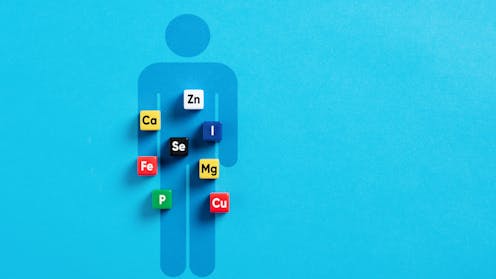
Every single atom in our bodies can be found in the periodic table – from chlorine to chromium, magnesium to manganese. In fact, just six elements make up about 98.5% of our body mass: 65% oxygen, 18% carbon, 10% hydrogen, 3% nitrogen, 1.5% calcium, and just over 1% phosphorus. The remaining 1.5% is made up of trace elements – potassium, sulphur, iron, zinc, copper, and many others – all of which play crucial roles in keeping us alive.

It might be more accurate to describe ourselves as oxygen-based life forms, rather than carbon-based.

The final 1% consists of trace elements. Though they’re present in smaller amounts, they’re no less essential. Many of them come from our diet, which is why we’re advised to balance our meals with sufficient vitamins and minerals.

But what exactly should we be eating to fulfil these requirements – and can you have too much of a good thing?

Calcium

Crucial for healthy bones and teeth, calcium is abundant in dairy products, nuts and leafy greens. It also plays a vital role in nerve and muscle function. When the body is deficient in calcium, numbness, muscle twitching and even seizures may ensue. Dietary supplementation with calcium or vitamin D, which aids calcium absorption, becomes necessary.

However, too much calcium can be just as harmful. In people with cancer, tuberculosis or an overactive parathyroid gland, levels can rise too high, causing kidney stones, depression and abnormal heart rhythms.

Dangers of high calcium levels, The Doctors.

Phosphorus

Phosphorus – the same element used in the striking surface of matchboxes – is fundamental to life. It’s a key component of DNA, the blueprint of our being, and of adenosine triphosphate (ATP), the molecule that stores and delivers energy in cells.

Most of us get more than enough phosphorus through our diet – in meat, fish, dairy, grains and nuts. It’s also added as phosphate to many processed foods and fizzy drinks.

Magnesium

From the same periodic group as calcium, magnesium plays a role in muscle and nerve function, and contributes to bone health. You’ll find it in plant-based foods like beans and grains.

Magnesium supplements are widely available, but most people don’t need them. Some people are at a greater risk of magnesium deficiency, including those with chronic alcoholism or malabsorption disorders.

While toxicity from dietary sources is rare, excessive magnesium from supplements can lead to diarrhoea, nausea and, in severe cases, cardiac complications.

Sodium, potassium and chloride

Sodium and potassium share a role in electrical activity within neurons and muscle cells, including those in the heart. Sodium also regulates fluid balance within the body.

The body maintains these minerals within a tight range to ensure optimal function. Too much sodium or potassium can be extremely dangerous. In fact, the traditional lethal injection protocol in the US involved an intravenous dose of potassium to stop the heart.

High potassium (hyperkalemia) – symptoms and causes | National Kidney Foundation.

Deficiencies of sodium and potassium can cause multiple symptoms, including muscle weakness, confusion and other neurological symptoms.

Dietary sources of potassium include bananas and potatoes. For sodium and chloride (the latter also being involved in fluid regulation and stomach acid production), the most familiar source is table salt. We do need some, but no more than 6g a day. High salt intake is linked to high blood pressure and cardiovascular disease.

Sulphur

The smell of sulphur (or more precisely, sulphur-containing compounds) will be familiar to anyone who remembers the acrid odour of school chemistry labs: think rotten eggs, overcooked cabbage and bad breath. Unsurprisingly, cabbage, garlic and onions are rich in sulphur.

Sulphur is found in certain amino acids (protein building blocks) and is essential for growth and development. A diet with lean protein and vegetables usually provides everything you need.

Trace minerals

So far, we’ve looked at macrominerals, those needed in larger quantities. But the trace minerals, needed in smaller amounts, are no less vital.

Take iron, crucial for the production of red blood cells, which carry oxygen throughout the body. Iron deficiency (common in children, menstruating women and people with restrictive diets) can cause anaemia, plus symptoms like fatigue, dizziness and shortness of breath. Iron is plentiful in red meat, legumes and green vegetables.

Other essential trace elements include zinc, which supports immune function, wound healing and cell growth and iodine, needed for the production of thyroid hormones, which both regulate metabolism. Selenium, rich in Brazil nuts, acts as an antioxidant and supports reproductive and thyroid health, while fluoride helps strengthen tooth enamel and prevent decay.

You’ll also find manganese, chromium and copper in the body, all playing key physiological roles. Manganese supports bone development and helps the body metabolise amino acids and carbohydrates. Chromium is involved in glucose regulation through enhancing insulin action. Copper has many varied roles, including iron metabolism, and the maintenance of healthy connective and nervous tissue.

You might even find trace amounts of arsenic, lead or gold in the body – and not just in dental work. These elements are not beneficial. They are toxic rather than therapeutic. Lead can accumulate in bones and organs, interfering with nervous system function. Arsenic, depending on the form, can be carcinogenic and disrupt cellular respiration – the process cells use to convert oxygen and nutrients into energy – essentially poisoning the cell’s energy supply.

So, the periodic table is not just a baffling grid of letters and numbers. It’s a map of you, and the body’s delicate balance between minerals that can be both essential in the right doses, and dangerous in the wrong amounts.

The Conversation

Dan Baumgardt does not work for, consult, own shares in or receive funding from any company or organisation that would benefit from this article, and has disclosed no relevant affiliations beyond their academic appointment.

ref. From sulphur to selenium, calcium to copper, here’s what your body’s made of – and why it matters – https://theconversation.com/from-sulphur-to-selenium-calcium-to-copper-heres-what-your-bodys-made-of-and-why-it-matters-262772

Was the ‘double tap’ attack on Gaza’s Nasser hospital a war crime? Here’s what the laws of war say

Source: The Conversation – UK – By James Sweeney, Professor, Lancaster Law School, Lancaster University

There has been widespread international outrage at Israel’s attack on Nasser hospital in Khan Younis, northern Gaza, on August 25. The attack took the form of a “double tap” strike. The first attack killed at least one person, then – as medics, journalists and other responders rushed to the scene – a second attack on the same location killed another 20 people. This included five journalists and several medical staff treating people injured in the first attack.

Israel’s prime minister, Benjamin Netanyahu, has called the incident a “tragic mishap”. But whether or not the attacks on the hospital were intentionally directed, the double tap tactic almost certainly falls under those acts of war prohibited by the law of armed conflict and could constitute a war crime on that basis alone.

Whether or not charges specifically relating to the attacks on Nasser Hospital are ever brought, it’s an opportunity to examine how international law operates in situations like this.

Who is fighting who, and why it matters

That the hostilities in Gaza constitute, in international law, an “armed conflict” is beyond doubt. That means that there are grounds for the application of the law of armed conflict (LOAC) – or as it is also known, international humanitarian law.

If we see today’s conflict as being between Israel and Hamas, then it would be a non-international conflict because it would not be between two or more states. But if it is between Israel and Palestine then, whether or not Israel recognises Palestine as a valid state, it would be international. In May 2024, International Criminal Court (ICC) prosecutor Karim Khan caused some controversy when he said that it was both, running in parallel.

This issue is important because the rules covering international and non-international armed conflict are not the same. The rules on international armed conflict are older and more detailed. This also means that there are separate lists of international and non-international war crimes in the Rome Statute, the treaty that established the ICC. But the LOAC rules relevant to a double-tap attack are similar enough in both types of conflict that we can postpone coming to a conclusion on this until such as time as war crime charges are actually brought.

Law of armed conflict

The first essential feature of LOAC is that it is all based on the idea that the means (weapons) and methods (tactics) used in an armed conflict are “not unlimited”. That is why some weapons are banned – chemical weapons, for example. When it comes to tactics it is, for example, unlawful to order to “take no prisoners”.

There are other even more fundamental rules on methods that govern the conduct of hostilities.

The main rules on hostilities are often said to be humanity, necessity, distinction and proportionality. Humanity is about not inflicting unnecessary suffering. Necessity requires that in applying the other rules a commander should be able to do what they need to “win”, but no more than that. Distinction requires that only lawful objectives should be targeted for attack. Proportionality requires that when a lawful objective is attacked, the expected “collateral damage” should not be excessive to the expected military advantage of the attack.

It’s important to note that a judgement on proportionality must be made before a military action is launched and during an attack “constant care” should be taken that the situation really is what the military commander thought it was when they ordered the attack. That rule is meant to minimise accidents.

Double-tap attacks

Distinction and proportionality are the key principles for looking at a “double-tap attack” such as the one on August 25. First, applying the rule on distinction, there are only very limited circumstances in which a hospital could ever be a lawful target. Hospitals are marked out for special protection under the Geneva Conventions. The same goes for journalists, who are protected alongside all other civilians, as long as they do not become engaged in fighting.

Further to this, it would be reasonable to expect that after a lethal attack medics would attend the site, and journalists might want to cover it. Launching the second attack could therefore be said to be either intentionally directed against the medics and journalists or, at the very least, uncaring as to whether both lawful and unlawful targets might be killed. That is known as an “indiscriminate” attack. So it also violates the rule on distinction. It is also difficult to see how the second attack could have been accidental.

And even if it were argued that the hospital was a lawful target, for example due to being used by Hamas fighters to stage attacks on the Israeli forces, the collateral damage was almost certainly going to be vast. So, for that reason, it would violate the rule on proportionality.

Israel is a state party to the Geneva Conventions of 1949, which require that “grave breaches” of their rules are investigated and prosecuted. Alternatively, and whether or not the conflict is found to be international or non-international, the Rome Statute provides a solid basis for the above violations of LOAC to be prosecuted as war crimes at the International Criminal Court.

The Conversation

James Sweeney does not work for, consult, own shares in or receive funding from any company or organisation that would benefit from this article, and has disclosed no relevant affiliations beyond their academic appointment.

ref. Was the ‘double tap’ attack on Gaza’s Nasser hospital a war crime? Here’s what the laws of war say – https://theconversation.com/was-the-double-tap-attack-on-gazas-nasser-hospital-a-war-crime-heres-what-the-laws-of-war-say-263955

Himalayan flash floods: climate change worsens them, but poor planning makes them deadly

Source: The Conversation – UK – By Manudeo Singh, Newton International Fellow at the Department of Geography and Earth Science, Aberystwyth University

On August 5, a cloudburst near the Kheer Ganga river triggered a flash flood that tore through Dharali, a village in the Indian Himalayas. Within minutes, the river swelled with water, mud and debris, sweeping away homes, roads and lives.

Every monsoon season, the Himalayas see similar tragedies – flash floods caused by cloudbursts or glacial lake outbursts. The first explanation we often hear is climate change. Extreme rainfall and melting glaciers are part of our warming world, but that is only half the story. The other half lies in where and how we build.

A cloudburst is an extreme, sudden downpour – often more than 100mm of rain in just an hour, falling over a small area. It’s like the sky suddenly emptying a huge bucket of water over the mountainside.

A glacial lake outburst flood happens when a lake formed by melting glaciers bursts through its natural dam of ice or loose rock, releasing a sudden torrent downstream.

Both cloudbursts and glacial lake outbursts send huge volumes of water rushing down steep valleys. On their way, they pick up mud, rocks and trees, turning into debris-laden flash floods that sweep away whatever lies in their path.

These are natural events in higher mountainous regions, such as the Himalayas. They cannot be stopped. What makes them disasters is when towns, hotels and roads are built directly where these floods predictably flow.

Where we build matters

To understand why the damage is so severe, we need to look at the land itself. Geomorphology is the study of how Earth’s surface is shaped. It shows us how rivers, slopes and valleys have been formed and modified over time by floods, landslides and debris flows.

In the Himalayas, many safe-looking places are anything but. Take the alluvial fan, which is a cone-shaped pile of sand, gravel and silt that forms where a steep stream slows and drops the debris it carries. Over time, repeated floods build up this fan. It looks flat and inviting – perfect for a settlement, hotel, or car park – but when the next flash flood happens, the water and debris flow straight back down, burying whatever is built there.

This is not theory but history repeating itself. Dharali, which is built around the ancient Kalp Kedar Hindu temple, has faced flash floods before. Records show the temple has been buried multiple times, most recently in 2013. This also highlights our short memory span.

Climate change and poor planning

Rising temperatures can lead to more intense and erratic rainfall, and this does raise the likelihood of cloudbursts and glacial lake outbursts. But focusing only on climate change makes disasters sound unavoidable.

In reality, much of the destruction is preventable. Poor planning and reckless construction have put people in harm’s way. Roads, hotels, even entire towns, are expanding into zones geomorphology tells us are flood prone.

When disaster follows, we blame the climate. But the harder truth is that our own decisions magnify the risks.

Ignoring geomorphology has serious consequences. For governments, it means billions spent on disaster relief and rebuilding after every monsoon. For developers, it means investments washed away in a single night. For tourists, it means the risk of being caught in floods during what should be a holiday. And for mountain communities, it means living in constant danger.

What is needed is geomorphic literacy. Planners, policymakers, developers and citizens need to read the land and respect its signals. The land itself tells us where floods have happened before, and where they will happen again. Listening to it can save lives.

Flash floods due to cloudbursts and glacial lake outbursts are a natural part of the Himalayan monsoon. They cannot be prevented, and climate change may make them more frequent. But the devastation they cause is not inevitable – it is shaped by where and how we build.

Geomorphology is nature’s diary, showing where water and debris have flowed for centuries. Learning to read it can keep people safe.

The Dharali disaster is a painful reminder that the real danger is not only in the sky, but in our failure to understand and respect the land beneath our feet. Unless we take that lesson seriously and build geomorphic awareness into planning, policy making and public understanding, tragedies like Dharali will keep happening, year after year.

The Conversation

Manudeo Singh does not work for, consult, own shares in or receive funding from any company or organisation that would benefit from this article, and has disclosed no relevant affiliations beyond their academic appointment.

ref. Himalayan flash floods: climate change worsens them, but poor planning makes them deadly – https://theconversation.com/himalayan-flash-floods-climate-change-worsens-them-but-poor-planning-makes-them-deadly-263561

Supporting religious diversity on campus is a surprising consensus among faculty across the red-blue divide

Source: The Conversation – USA – By Matthew J. Mayhew, Professor of Higher Education, The Ohio State University

University faculty are the most important people influencing student learning, development, persistence and degree attainment. Maskot/Getty Images

Universities, often perceived as bastions of progressive thought, are increasingly reflecting the broader political polarization gripping the nation.

Faculty members represent a university’s core identity and mission. They express the values of the institution in numerous ways, including teaching, mentoring, advising and researching.

In my research into the impact of college on student development and learning, I – and others – have found that faculty are the most important people influencing student learning, development, persistence and degree attainment.

However, no systematic efforts have ever been undertaken to find out how faculty’s work is influenced by their understanding of university life and religion – until now.

The Templeton Religion Trust, a charity focused on improving societal well-being through understanding individual well-being, funded a recent national survey my team and I administered to 1,000 faculty members. The survey asked faculty about their perceptions of university life, including free speech and diversity, equity and inclusion initiatives, often shortened to simply DEI.

The survey results reveal a striking divergence in perspectives on the often divisive issues of free speech and DEI among faculty. Those differences showed up particularly along the red state and blue state divide.

Yet, amid these deep disagreements, a surprising point of bipartisan consensus emerges: faculty members’ belief in the importance of religious, spiritual and secular inclusion in diversity efforts.

A student wears a graduation cap with a verse from Koran written on it.
Faculty agreed on the importance of religious, spiritual and secular inclusion in diversity efforts. Here, a student graduating from Columbia University in New York on May 21, 2025, wears a graduation cap with a verse from the Quran written on it.
Jeenah Moon/POOL/AFP via Getty Images, CC BY

State political leaning is key

Survey responses represented national trends across various factors, including region, institutional control, institutional type and academic discipline.

In part of the analysis, we uncovered that the political leanings of a state – how a state voted in the presidential election of 2024 – play a significant role in what faculty perceive about free speech and DEI programming.

Even more compelling, significant differences reported by faculty from red versus blue states showed up consistently across gender, race, religion, academic discipline, faculty rank and whether the faculty member was employed at a private or public institution.

In other words, political leanings of a state were strongly associated with faculty perceptions regardless of these other factors.

Measuring the right to free speech

We asked faculty four questions related to their First Amendment rights, which we presented as: “The First Amendment protects freedom of speech, freedom of religion, freedom of the press, freedom of assembly, and freedom to petition.”

Working closely with experts in legal epidemiology, we asked faculty the extent to which they agreed with the following statements: a) the First Amendment is relevant to my job as a faculty member; b) the First Amendment is relevant to my research engagement; c) my institution provides me with my constitutionally mandated First Amendment rights; and d) I am aware of my rights and responsibilities as they relate to the First Amendment of the U.S. Constitution.

While awareness of First Amendment rights appears consistent across the board, a notable difference arises in faculty members’ perception of institutional protection of those rights.

Faculty in blue states are significantly more likely than those in red states to report that their institutions uphold their constitutionally mandated First Amendment rights. This implies a potential disconnect in how freedoms are experienced and protected, depending on the political leanings of the state where an institution is located.

Measuring attitudes about DEI

The divide deepens when it comes to DEI, defined in the survey as “campus diversity programs” in some instances and “diversity, equity, and inclusion” in others.

When compared with faculty in blue states, those in red states are far more inclined to view DEI efforts as “overreach,” agreeing with the statements that “diversity programs generally do more harm than good on college and university campuses” and “the promotion of diversity, equity, and inclusion on college and university campuses has gone too far.”

Conversely, blue state faculty largely disagree with these assertions. When compared with faculty in red states, those in blue states were more likely to agree that “campus diversity programs support student success,” demonstrating a stark ideological chasm on the value and impact of DEI.

This partisan disagreement extends to the very concept of banning DEI programs.

Red state faculty show moderate support for banning DEI, suggesting a belief that current efforts to curtail campus diversity initiatives are, according to survey response options, “well justified.”

Blue state faculty overwhelmingly support the continuation of these programs. They gave strong endorsement to the idea that “colleges and universities should continue to offer identity-specific organizations and programming.”

This schism reflects the ongoing national debate about the role and scope of DEI in higher education. Faculty perspectives mirror the political sentiments of their respective regions.

Amid this significant polarization, a crucial area of common ground emerges: what we call religious, spiritual and secular inclusion.

That’s the idea that DEI efforts should include programming and activities designed to help students from all religious, spiritual and secular backgrounds belong and succeed.

Religious, secular and spiritual diversity

Despite their sharp disagreements on other aspects of DEI, both red state and blue state faculty overwhelmingly agree that “colleges and universities should provide support for students of all religious, secular, and spiritual identities and backgrounds.”

And both groups similarly reject the notion that “campuses should not concern themselves with religious, secular and spiritual diversity.”

The findings from this survey highlight the complex landscape of faculty opinion in higher education. While significant difficulties remain in reconciling differing views on free speech and DEI, the shared commitment to religious, spiritual and secular inclusion offers a potential path to agreement.

By focusing on areas of consensus, institutions can begin to foster more inclusive environments to serve the needs of all students, regardless of their background or beliefs. Understanding these nuanced perspectives is the first step toward building more cohesive, pluralistic and intellectually vibrant academic communities across the nation’s varied political terrain.

The Conversation

Matthew J. Mayhew receives funding from the Templeton Religions Trust, the Arthur Vining Davis Foundations, the Pew Charitable Trusts, the Educational Credit Management Corporation (ECMC) Foundation, the National Science Foundation, the Alfred P. Sloan Foundation, the Merrifield Family Trust, the Andrew W. Mellon Foundation, the Fetzer Institute, the Ewing Marion Kauffman Foundation, the Merrifield Family Trust, and the United States Department of Education.

ref. Supporting religious diversity on campus is a surprising consensus among faculty across the red-blue divide – https://theconversation.com/supporting-religious-diversity-on-campus-is-a-surprising-consensus-among-faculty-across-the-red-blue-divide-262589

We drilled deep under the sea to learn more about mega-earthquakes and tsunamis

Source: The Conversation – Canada – By Morgane Brunet, Postdoctoral researcher, Marine geoscience, Université du Québec à Rimouski (UQAR)

The Japanese drilling vessel Chikyu (Japan Agency for Marine-Earth Science and Technology)

Far beneath the waves, down in the depths of the Japan Trench — seven kilometres below sea level — lie hidden clues about some of the most powerful earthquakes and tsunamis on Earth.

From September to December 2024, Expedition 405 of the International Ocean Discovery Program (IODP) embarked on a four-month long mission to offshore Japan. Aboard the Chikyu — the world’s largest scientific drilling ship — 60 scientists teamed up with experienced drillers to uncover deep-sea sediment cores from beneath the sea floor.

The scientists included sedimentologists like myself, alongside geochemists, micropaleontologists, structural geologists, geophysicists and paleomagnetists. We drilled into a fault zone where only one prior expedition had drilled directly before. IODP Expedition 405 — also called Tracking Tsunamigenic Slip Across the Japan Trench (JTRACK) — is only the second deep-drilling mission to access this area.

This time, we reached and sampled the décollement, or the basal detachment, of the fault that ruptured during the devastating 2011 Tōhoku mega-earthquake. We collected cores that will help scientists better understand how such powerful earthquakes are triggered.

Expedition 405 of the International Ocean Discovery Program embarked onboard the Chikyu for a four-month long mission offshore Japan.

An unexpected slip

On March 11, 2011, the Tōhoku mega-earthquake struck off the northeast coast of Japan, triggering a catastrophic tsunami. At magnitude 9.1, it was the most powerful earthquake ever recorded and the deadliest natural disaster in Japan’s modern history.

More than 18,000 people died. The earthquake severely damaged the Fukushima nuclear plant; there was an estimated US$235 billion in damages. Scientists were surprised not by the scale of the earthquake, but by the location of the largest plate slip that had triggered it: not deep underground, but just beneath the sea floor, at the shallowest part of the plate boundary.

The rupture took place along the Japan Trench, where the Pacific Plate dives beneath the Okhotsk Plate. Until then, this shallow section of subduction zones was thought to slip slowly and quietly.

But during the Tōhoku event, more than 50 metres of slip occurred on a fault that ruptured the sea floor, displacing huge amounts of water and generating the devastating tsunami.

Drilling into the fault

During the IODP 405 expedition, we set out to understand the conditions that make such tsunamis possible.

The Japan Trench provides a natural laboratory to investigate the fundamental processes of tsunamigenic earthquakes that trigger massive tsunamis.

For that reason, we drilled deep into the plate boundary fault, the exact zone that ruptured during the 2011 earthquake. This meant drilling more than 800 metres beneath the seafloor and into the fault itself to recover samples of rocks and sediments.

We also installed a long-term observatory to monitor temperature and fluid pressure at the earthquake’s source, hoping to detect subtle signals locked in the material that once unleashed one of the most powerful earthquakes in history.

Retrieving cores

On board the Chikyu, operations ran 24-7. Every three hours, a new core arrived on deck — a long, cylindrical archive of Earth’s memory. As sedimentologists, we got to work right away peering through the transparent liners with flashlights, scanning for traces of sand, volcanic ash or anything hinting at past geological events.

Each core told a chapter of a story written over millions of years. Layer by layer, they revealed a sequence of faulted, fractured or deformed sediments and rocks. Some contained smectite — a slippery clay mineral known to reduce friction along faults. These are precisely the kinds of materials that can allow tectonic plates to slip easily, even at shallow depths near the sea floor — exactly the kind of setting that could produce a tsunami-generating earthquake.

One of the most thrilling moments came when we hit layers of chert — a hard, glassy rock that marks the transition from deep-sea sediments to oceanic crust. We had reached the décollement zone, the very boundary where one tectonic plate dives beneath another.

a woman holding a tube filled with layers of different coloured sediment
A split core recovered from within the fault zone.
(M. Brunet), CC BY-NC-ND

In the lab, slicing open the cores revealed something else: beautifully banded colourful clays, tinted in rich shades of chocolate, vanilla and caramel — a natural palette created from geological processes deep within the Earth.

Each new core entered a tightly co-ordinated workflow: scanned by high-resolution, X-ray-computed tomography, tested for physical and chemical properties, then split in half. One half was carefully preserved in a permanent archive, while the other was examined and sampled thoroughly by scientists from various countries and disciplines.

My research focuses on the sedimentary signature of past earthquakes and tsunamis. On the Chikyu, I searched for deposits called homogenite-turbidite sequences. These form when a quake shakes the sea floor, triggering a submarine landslide (the turbidite), followed by a slow rain of fine particles stirred up by the tsunami (the homogenite). These sequences are geological time capsules, helping us estimate how often giant earthquakes have struck in the past.

Fault evolution

The Chikyu returned to the original site drilled soon after the 2011 earthquake. This gave us something rare in geoscience: an opportunity to observe how the fault has evolved over more than a decade. We installed a borehole observatory, deeper and more advanced than any before in this region.

Installing the observatory in the JTRACK research expedition.

Over the coming years, it will monitor temperature and fluid flow in real time, giving us a window into the living, breathing dynamics of a megathrust fault.

Using this data, scientists will simulate earthquake conditions using numerical models or experiments to test how these rocks respond under pressure. They will analyze the chemistry of the fluids trapped within the fault and use advanced logging tools to build a detailed picture of the fault’s internal architecture.

Others — like myself — will focus on the sedimentary record, deciphering past events to better understand the frequency of earthquakes and tsunamis.

From understanding to preparedness

The Japan Trench is not an isolated case. Subduction zones around the world, from Chile to Alaska to Indonesia, pose similar risks, often just offshore from densely populated regions. If shallow slip can happen there too, then our current models and preparedness strategies must evolve accordingly.

Our goal wasn’t just to understand why the 2011 Tōhoku earthquake happened, but to help prepare for the next one. By improving tsunami hazard assessments and deepening our understanding of mega-earthquake fault behaviour, we contribute to building global resilience.

IODP Expedition 405 marks a major milestone for earthquake and tsunami science. In the coming years, data from the new borehole observatory, along with lab experiments and sediment analyses, will offer unprecedented insights into how these faults evolve and how we can better anticipate and mitigate the impacts of future megathrust earthquakes.

The Conversation

Morgane Brunet receives funding from the European Commission through a Marie Curie Postdoctoral Global Fellowship.

ref. We drilled deep under the sea to learn more about mega-earthquakes and tsunamis – https://theconversation.com/we-drilled-deep-under-the-sea-to-learn-more-about-mega-earthquakes-and-tsunamis-252010

Canada is leading the U.K. and France in boycotting American goods due to Trump’s tariffs

Source: The Conversation – Canada – By Shelley Boulianne, Professor in Communication Studies, Mount Royal University

Since taking office, United States President Donald Trump has used tariffs to address perceived trade deficits with other countries. He claims that other countries have cheated and pillaged the U.S. via trade deficits.

In response, many political leaders have implemented retaliatory tariffs on American products, although Canadian Prime Minister Mark Carney recently lifted many of them in an apparent peace offering amid Canada-U.S. trade negotiations.

Citizens have also been engaged in these trade wars by avoiding the purchase of American products and services, as well as avoiding travel to the U.S.

From June 25 to July 8, 2025, Kantar, a global research and consulting company, conducted a survey through its online panels of 1,500 respondents in Canada, France and the United Kingdom, respectively.

Strict quotas were used to ensure the survey respondents would match the census profile of the adult population in each of the three countries.

Surveying consumers

As a social scientist who examines citizen engagement in civic and political life, I designed the survey questions. Respondents answered yes or no to:

Due to Trump’s recent tariffs, have you boycotted: a) American products, including grocery items; b) American services, such as Facebook, Amazon, or TV streaming services; and c) Travel to the United States.

The graph below outlines the results. Compared to the U.K. and France, Canadians were far more likely to report boycotting American products, services and travel.

Canadians, of course, have greater opportunities to boycott compared to other countries, given historically high levels of travel and international trade with the U.S. and Canada’s close proximity to the country. Statistics Canada reports that Canadian trips to the U.S. are down by 28.7 per cent from last year.

This case study of political consumerism reveals important distinctions compared to traditional boycotts.

Politically motivated boycotting is typically associated with those holding left-wing views.

In this case, both left-wing and right-wing people are participating in the boycott of American products. There are no ideological differences in participation in Canada and France. However, in the U.K., those on the right are more likely to boycott American products, services and travel than those on the left.

Existing research also shows well-educated people are more likely to boycott, particularly in Canada and France.

But in the Kantar survey, education did not impact participation in the boycott of American products, services and travel. All educational groups were motivated to participate.

Expressing discontent

Boycotting is a particularly attractive form of political behaviour in the case of international relations, because angry international citizens cannot simply contact Trump to express their discontent.

In fact, criticizing U.S. policies under Trump may result in being turned away at the American border by U.S. Customs and Border Protection.

Instead, consumers can express their discontent through the choices they make when grocery shopping, when making travel plans, and finally, in their choice to refrain from using American-owned social media like Facebook.

This situation is also unique because Trump actively encourages citizens to boycott companies with which he disagrees. Despite his own calls to boycott companies, Trump and American officials have called Canadians “nasty” for boycotting U.S. alcohol and travel in retaliation of American tariffs.

Follow the leader?

Now Canada has lifted most of the retaliatory tariffs, with Carney explaining that Canada has the “best deal with the United States right now.”

Canadians may choose to follow the direction of their prime minister or they may view this as an opportunity to take more responsibility and continue to use their purchasing choices to influence trade relations.

The responses may also differ across countries.

The U.K. says it has negotiated the lowest U.S. tariff rate so far and therefore, British citizens may choose to end their boycotting.

In contrast, political leaders in France continue to criticize the European Union’s recent trade agreement with the U.S. In this case, French citizens may follow suit and continue to use their purchasing power to influence trade relations.

The Conversation

Shelley Boulianne does not work for, consult, own shares in or receive funding from any company or organisation that would benefit from this article, and has disclosed no relevant affiliations beyond their academic appointment.

ref. Canada is leading the U.K. and France in boycotting American goods due to Trump’s tariffs – https://theconversation.com/canada-is-leading-the-u-k-and-france-in-boycotting-american-goods-due-to-trumps-tariffs-263395

South Africa’s service delivery crisis: why protesters are using more militant tactics

Source: The Conversation – Africa (2) – By Kenny Chiwarawara, Senior Lecturer, University of Johannesburg

Post-apartheid South Africa is characterised by frequent public protests. On average, between 2007 and 2013, there were over 11 protests daily. Research shows that protests almost doubled in the 20 years after 1997.

Service delivery protests – over basic services such as housing, electricity, refuse removal, water and sanitation – feature most prominently in these protests.

These protesters employ diverse tactics at different times: marching to government offices, barricading roads, destroying property and attacking unpopular individuals.

Often people ask why protesters resort to destroying public and private property and attacking people.

I have researched poor people’s struggles for housing and basic services in South Africa since 2012.

This article draws from a study involving 20 in-depth interviews and two focus group discussions in Gugulethu and the same number in Khayelitsha. These are low-income black townships in Cape Town.

The study investigated three inter-related questions: the reasons for protests, the tactics used by protesters, and the character and organisation of the protests. This article focuses on when, how and why different tactics are used in these protests.

It may be easy to blame protesters for barricading roads, vandalising property and attacking people. However, as my study shows, protesters often initially engage in peaceful and orderly marches. They resort to more radical tactics only when peaceful tactics fail to yield results.

Rather than placing the blame squarely on protesters, there is a need to consider the seriousness of their grievances (such as lack of water), and the failure by the authorities to respond speedily and adequately. Genuinely acknowledging and addressing the grievances discourages more militant protest tactics.

Findings

There is often a perception that communities have an appetite to engage in violent protests. But my research shows that this is not the case.

Aggrieved communities often engage in protests to push for the delivery of basic services.

Usually, poor communities first engage in rounds of orderly and peaceful means of engagement with government officials to alert them to their grievances.

These means of engagement – which are less reported by the media – include holding meetings with the officials responsible for addressing their challenges, and handing them written demands.

When all these means of engagement fail to yield fruit, communities resort to more dramatic means of engagement. These include barricading roads to pressure the government to meet their demands. Even when they turn to dramatic tactics, they first exhaust less dramatic ones.

As the scholar-activist Trevor Ngwane has rightly remarked,

When people start hitting the streets, they should have a banner saying: ‘All protocols observed’, because they’ve gone through all the channels … People feel that the only way to be heard, to get attention, is to burn tyres and engage in some of protest.

My research in Gugulethu and Khayelitsha found that a lack of response, or a poor or unsatisfactory response, led to more radical tactics.

For example, a pastor I interviewed explained the rationale for more radical protest tactics with a compelling metaphor. He explained that pain was necessary in order for someone to take action. He gave an example of a person with a sore arm, but who did nothing to address the source of the pain. He reasoned that if someone else pinched the sore arm, this would compel the patient to take necessary steps to ensure that the arm was healed.

In the same way, he explained that the government knew about the “sore arms”, or poor conditions that impoverished communities endured, but chose to ignore them.

To pressure the government to address their grievances, communities sometimes employ radical protest tactics (pinching). For communities enduring appalling service delivery, the momentary inconveniences ensuing from the “pinching” pale in comparison to the ignored service delivery challenges (sore arms).

My research, for example, highlights the precariousness of living in shacks, lacking a bathroom, toilet, running water and electricity.

It is these challenges that residents episodically protest against using primarily orderly means of engagement and sometimes more radical protest tactics to pressure (or pinch) the government to address the challenges.

What should be done?

Tactics such as the destruction of property and attacks on people that sometimes accompany protests should be discouraged. At the same time, it is important to condemn the circumstances that necessitate such radical tactics.

A more responsive government would try to make it unnecessary for people to turn to militant protests to air their grievances. The government should proactively address service delivery challenges and swiftly respond to the complaints raised by communities.

The Conversation

Kenny Chiwarawara does not work for, consult, own shares in or receive funding from any company or organisation that would benefit from this article, and has disclosed no relevant affiliations beyond their academic appointment.

ref. South Africa’s service delivery crisis: why protesters are using more militant tactics – https://theconversation.com/south-africas-service-delivery-crisis-why-protesters-are-using-more-militant-tactics-241045

Mother Vera: beautiful documentary film about a nun’s dilemma – reviewed by a priest

Source: The Conversation – UK – By Helen Hall, Professor, Nottingham Law School, Nottingham Trent University

Nuns loom large in the European imagination. They are often caricatured to the point of dehumanisation. Either as a grotesque comic creation, like the chocolate-obsessed sister in Father Ted (1995-1998), or a monstrous aberration, like the demon Valak from the Conjuring (2013-2025) films.

Either way, by rendering the nun unreal, and stripping her of personhood, these portrayals allow viewers to avoid confronting the uncomfortable questions that a flesh and blood nun raises. In contrast, nuns who are not safely contained in the realm of fiction, but live and breathe in our world, force us to consider whether the aspirations and desires that society expects women, and indeed human beings, to feel, are in fact cultural rather than innate.

If we take the dangerous step of acknowledging that nuns are no different from anybody else, we face the unsettling question of whether we too could reshape our experience of sexuality, fulfilment, interpersonal connection and community. Watching the new documentary film Mother Vera pushes viewers forcefully to take that step.

Following a conversation with a family member, Mother Vera, the protagonist nun of the film, is compelled to reclaim buried memories and face the events that led her to choose life in a convent. This leads her on a journey of renewal and transformation, with all of the losses and gains bound up with change. However, the visual storytelling weaves a complex tapestry of emotions and ideas as this unfolds.

Mother Vera is an immersive work of art and the beauty of the cinematography is almost hypnotic. Countryside, animals and people move across the screen and pull observers into a different time and place. On occasion it is so vivid that it is almost possible to catch the scent of the candles in a darkened church, or the smell of cattle in the yard.

Yet while it is highly evocative, Mother Vera is a demanding watch. The audience is permitted to enter into the life of the nun and her order, and given an infinitesimal, but powerful, taste of the silence and stillness of that domain.

Engaging with it is radically different from seeing a film propelled forward by constant dialogue, or framed in a way that leads viewers inexorably towards a prescribed moral conclusion or emotional response. Mother Vera not only gives those watching space to react and reflect individually, it almost compels them to do so.


Read more:
Nuns are a staple on the Hollywood screen – even as they disappear from real life. What’s behind our timeless obsession?


This is not to suggest that the film ever pretends naivety or neutrality – it is far too carefully constructed for that. It also plays with some very well-worn tropes in respect of nuns and indeed religion. The story arc centred on a slow burn of inner and outer liberation is a familiar one.

Equally, the central character is depicted in a way that sets her apart from the audience. The clothes that she wears and the physical setting through which she moves call to mind not just another era, but another period in history. There are moments when she seems almost medieval, as she is shown from a distance riding on horseback, long garments flowing, or when the camera pans to a close up of her face, framed by stark black cloth.

Playing with archetypes

At times, Mother Vera teeters on the verge of being overdone. It comes close to the cliché of presenting nuns as distinct from other members of society, and needing to shed something of their otherworldly nature if they are to reintegrate, or even authentically interact, with those outside of the cloister walls.

However, the sophistication of the film as a whole means that we are not expected to unquestioningly consume these cardboard cut-out ideas. Instead, we are invited to play with the archetypes on screen and interrogate the extent to which we really believe in them.

The trailer for Mother Vera.

These archetypes are complicated because they are not entirely without grounding in reality. Members of religious orders are indeed secluded and set apart from the wider population, and live their lives according to an alternative set of parameters. When entering an order, there are formal rites of passage, as a person moves from one context into another. The question of what it might mean to walk in the opposite direction, creating more personal symbolism, is a recurring theme.

Significantly, within the protagonist’s journey there are threads of continuity: most obviously, but not uniquely, her bond with horses. These points of continuity demonstrate that in some respects, both the distinct periods of an individual’s life, and the sacred and secular realms of society, are part of an integrated whole.

We are captivated by the crossroads at which this particular nun has found herself, because her dilemmas and decisions resonate with our own, regardless of belief, gender, language or other characteristics. Not only does Mother Vera vividly evoke its specific setting, in doing so, it lays bare universal struggles.

Mother Vera is beautifully constructed and manages to be both lavish and minimalist at the same time. The existential nature of the material that it explores, combined with its appeal to the senses, mean that it lingers in the mind long after the film has ended.


Looking for something good? Cut through the noise with a carefully curated selection of the latest releases, live events and exhibitions, straight to your inbox every fortnight, on Fridays. Sign up here.


The Conversation

Helen Hall is a priest in the Church of England

ref. Mother Vera: beautiful documentary film about a nun’s dilemma – reviewed by a priest – https://theconversation.com/mother-vera-beautiful-documentary-film-about-a-nuns-dilemma-reviewed-by-a-priest-263746