Martin Luther King Jr. was ahead of his time in pushing for universal basic income

Source: The Conversation – USA – By Tarah Williams, Assistant Professor of Political Science, Allegheny College

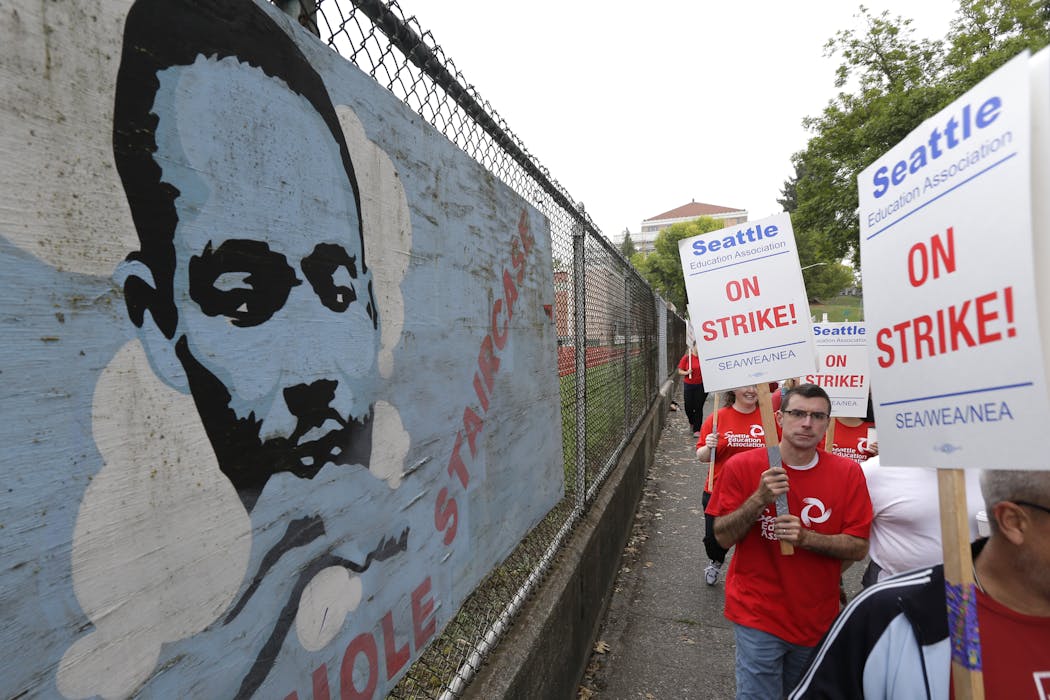
Martin Luther King Jr. became involved not just in fights over racial equality but also economic hardship. Ted S. Warren/AP

Each year on the holiday that bears his name, Martin Luther King Jr. is remembered for his immense contributions to the struggle for racial equality. What is less often remembered but equally important is that King saw the fight for racial equality as deeply intertwined with economic justice.

To address inequality – and out of growing concern for how automation might displace workers – King became an early advocate for universal basic income. Under universal basic income, the government provides direct cash payments to all citizens to help them afford life’s expenses.

In recent years, more than a dozen U.S. cities have run universal basic income programs, often smaller or pilot programs that have offered guaranteed basic incomes to select groups of needy residents. As political scientists, we have followed these experiments closely.

One of us recently co-authored a study which found that universal basic income is generally popular. In two out of three surveys analyzed, majorities of white Americans supported a universal basic income proposal. Support is particularly high among those with low incomes.

King’s intuition was that white people with lower incomes would support this type of policy because they could also benefit from it. In 1967, King argued, “It seems to me that the Civil Rights Movement must now begin to organize for the guaranteed annual income … which I believe will go a long, long way toward dealing with the Negro’s economic problem and the economic problem with many other poor people confronting our nation.”

But there is one notable group that does not support universal basic income: those with higher levels of racial resentment. Racial resentment is a scale that social scientists have used to describe and measure anti-Black prejudice since the 1980s.

Notably, in our research, whites with higher levels of racial resentment and higher incomes are especially inclined to oppose universal basic income. As King well knew, this segment of Americans can create powerful opposition.

Economic self-interest can trump resentment

At the same time, the results of the study also suggest that coalition building is possible, even among the racially resentful.

Economic status matters. Racially resentful whites with lower incomes tend to be supportive of universal basic income. In short, self-interest seems to trump racial resentment. This is consistent with King’s idea of how an economic coalition could be built and pave the way toward racial progress.

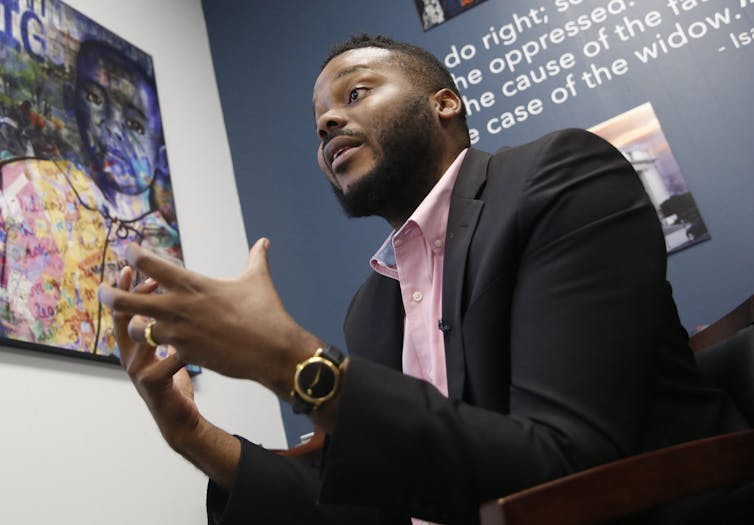
Michael Tubbs, the mayor of Stockton, Calif., gestures with his hands while making a point.
As mayor of Stockton, Calif., Michael Tubbs ran a pioneering program that provided a basic income to a limited number of residents.
Rich Pedroncelli/AP

Income is not the only thing that shapes attitudes, however. Some of the strongest supporters of universal basic income are those who have higher incomes but low levels of racial resentment. This suggests an opportunity to build coalitions across economic lines, something King believed was necessary. “The rich must not ignore the poor,” he argued in his Nobel Peace Prize lecture, “because both rich and poor are tied in a single garment of destiny.” Our data shows that this is possible.

This approach to coalition building is also suggested by our earlier research. Using American National Election Studies surveys from 2004-2016, we found that for white Americans, racial resentment predicted lower support for social welfare policies. But we also found that economic position mattered, too.

Economic need can unite white Americans in support of more generous welfare policies, including among some who are racially prejudiced. At a minimum, this suggests that racial resentment does not necessarily prevent white Americans from supporting policies that would also benefit Black Americans.

Building lasting coalitions

During his career as an activist in the 1950s and 1960s, King struggled with building long-term, multiracial coalitions. He understood that many forms of racial prejudice could undermine his work. He therefore sought strategies that could forge alliances across lines of difference. He helped build coalitions of poor and working-class Americans, including those who are white. He was not so naive as to think that shared economic progress would eliminate racial prejudice, but he saw it as a place to start.

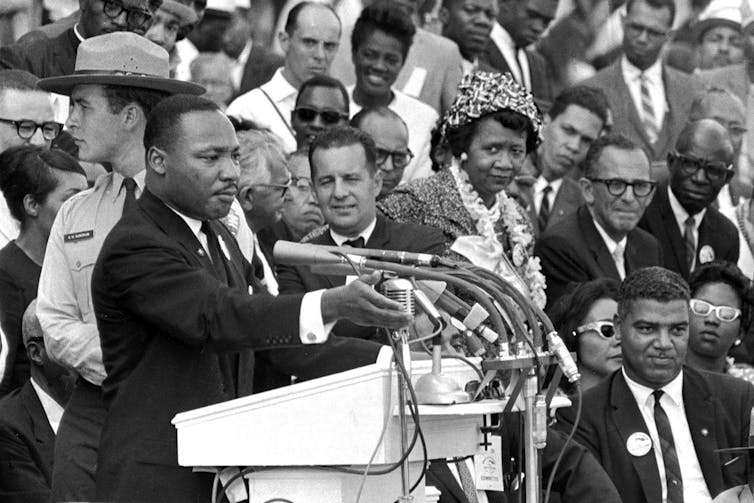
Martin Luther King Jr. speaks before a crowd at the 1963 March on Washington.
Martin Luther King Jr. believed Americans of different racial backgrounds could coalesce around shared economic interests.
AP

Currently, the nation faces an affordability crisis, and artificial intelligence poses new threats to jobs. These factors have increased calls for universal basic income.

Racial prejudice continues to fuel opposition to universal basic income, as well as other forms of social welfare. But our research suggests that this is not insurmountable.

As King knew, progress toward economic equality is not inevitable. But, as his legacy reminds us, progress does remain possible through organizing around shared interests.

The Conversation

The authors do not work for, consult, own shares in or receive funding from any company or organization that would benefit from this article, and have disclosed no relevant affiliations beyond their academic appointment.

ref. Martin Luther King Jr. was ahead of his time in pushing for universal basic income – https://theconversation.com/martin-luther-king-jr-was-ahead-of-his-time-in-pushing-for-universal-basic-income-272963

Slanguage: The trouble with idioms is that they can leave even fluent English speakers behind

Source: The Conversation – Canada – By Frank Boers, Professor of Applied Linguistics, Western University

Being a linguist — and someone who has tried to learn several languages (including English) in addition to my mother tongue (Flemish Dutch) — I have an annoying habit: instead of paying attention to what people are saying, I often get distracted by how they are saying it. The other day, this happened again in a meeting with colleagues.

I started writing down some of the expressions my colleagues were using to communicate their ideas that may be puzzling for users of English as a second or additional language.

In a span of about five minutes, I heard “it’s a no-brainer,” “to second something,” “being on the same page,” “to bring people up to speed,” “how you see fit,” “to table something” and “to have it out with someone.”

These are all expressions whose meanings do not follow straightforwardly from their lexical makeup — they’re called idioms by lexicologists.

Idioms are part of daily communication. But this anecdote also suggests that we take it for granted that such expressions are readily understood by members of the same community. However, when it comes to people who are new to said community, nothing could be further from the truth.


Learning a language is hard, but even native speakers get confused by pronunciation, connotations, definitions and etymology. The lexicon is constantly evolving, especially in the social media era, where new memes, catchphrases, slang, jargon and idioms are introduced at a rapid clip.
Slanguage, The Conversation Canada’s new series, dives into how language shapes the way we see the world and what it reveals about culture, power and belonging. Welcome to the wild and wonderful world of linguistics.


Idioms and the limits of language proficiency

Research conducted at the University of Birmingham several years ago revealed that international students for whom English is an additional language often misunderstand lecture content because they misinterpret their lecturers’ metaphorical phrases, including figurative idioms.

More recent research confirms that English idioms can remain elusive to second-language learners even if the expressions are intentionally embedded in transparent contexts.

One of my own recent studies, conducted with international students at Western University in Canada, also found that students incorrectly interpreted idioms and struggled to recall the actual meanings later on after being corrected.

This shows just how persistently confusing these expressions can be.

It’s worth mentioning that we’re talking about students who obtained high enough scores on standardized English proficiency tests to be admitted to English-medium universities. Knowledge of idioms appears to lag behind other facets of language.

When literal meanings get in the way

The challenge posed by idioms is not unique to English. All languages have large stocks of idioms, many of which second-language learners will find puzzling if the expressions do not have obvious counterparts in their mother tongue.

There are various obstacles to comprehending idioms, and recognizing these obstacles can help us empathize with those who are new to a community. For one thing, an idiom will inevitably be hard to understand if it includes a word that the learner does not know at all.

However, even if all the constituent words of an expression look familiar, the first meaning that comes to a learner’s mind can be misleading. For example, as a younger learner of English, I was convinced that the expression “to jump the gun” referred to an act of bravery because, to me, the phrase evoked an image of someone being held at gunpoint and who makes a sudden move to disarm an adversary.

I only realized that this idiom means “to act too soon” when I was told that the gun in this phrase does not allude to a firearm but to the pistol used to signal the start of a race.

I also used to think that to “follow suit” meant taking orders from someone in a position of authority because I thought “suit” alluded to business attire. Its actual meaning — “to do the same thing as someone else” — became clear only when I learned the other meaning of suit in card games such as bridge.

The idea that idioms prompt a literal interpretation may seem counter-intuitive to readers who have not learned a second language because we normally bypass such literal interpretations when we hear idioms in our first language. However, research suggests that second-language learners do tend to use literal meanings as they try to make sense of idioms.

Unfortunately, when language learners use a literal reading of an idiom to guess its figurative meaning, they are very often misled by ambiguous words. For example, they will almost inevitably misunderstand “limb” in the idiom “to go out on a limb” — meaning “to take a serious risk” — as a body part rather than a branch of a tree.

Recognizing the origin of an idiomatic expression can also be difficult because the domains of life from which certain idioms stem are not necessarily shared across cultures. For example, learners may struggle to understand English idioms derived from horse racing (“to win hands down”), golf (“par for the course”), rowing (“pull your weight”) and baseball (“cover your bases”), if these sports are uncommon in the communities in which they grew up.

A language’s stock of idioms provides a window into a community’s culture and history.

Same language, same idioms? Not exactly

Idiom repertoires vary across communities — whether defined regionally, demographically or otherwise — even when those communities share the same general language.

For example, if an Aussie were to criticize an anglophone Canadian for making a fuss by saying “you’re carrying on like a pork chop,” they may be lost in translation, even if there isn’t much of one. At least, linguistically that is.

Although people may have learned a handful of idioms in an English-language course taken in their home country, those particular idioms may not be the ones they will encounter later as international students or immigrants.

The moral is simple: be aware that expressions you consider perfectly transparent because you grew up with them may be puzzling to others. We need to have more empathy for people who are not yet familiar with the many hundreds of potentially confusing phrases that we use so spontaneously.

The Conversation

Frank Boers receives funding from the Social Science and Humanities Research Council of Canada.

ref. Slanguage: The trouble with idioms is that they can leave even fluent English speakers behind – https://theconversation.com/slanguage-the-trouble-with-idioms-is-that-they-can-leave-even-fluent-english-speakers-behind-271681

The Colombian border is one of the biggest obstacles to building a new Venezuela

Source: The Conversation – Canada – By Sally Sharif, Lecturer in Political Science, University of British Columbia

Since American forces captured Venezuelan President Nicolás Maduro, plunging the country into uncertainty, there have been hopes for a transition to democracy, the stabilization of its economy, a reduction in drug trafficking and conditions that might allow millions of Venezuelans abroad to return home.

But one factor will impede efforts at stabilizing the country: Venezuela’s hard-to-control border with Colombia, a shadow security zone that serves as a sanctuary and trafficking corridor for armed and dangerous organizations.

There are two main armed groups along the border:

  1. Leftist guerrillas in Colombia who have used Venezuelan territory to regroup, move supplies and evade counterinsurgency attacks.
  2. Leftist pro-government militias in Venezuela that have squashed dissent and exerted violence against civilians every time protests have erupted against Hugo Chávez and, later, Maduro.

Over time, these groups have often collaborated, turning a porous frontier into a shared operating space that any new Venezuelan government will have to dismantle.

The question, then, is whether any government — democratic or otherwise — can consolidate power in the presence of entities on both sides of an ungoverned international border with the most to lose from a change in the status quo.


Read more:
5 scenarios for a post-Maduro Venezuela — and what they could signal to the wider region


Venezuela: Shielding Colombian leftist rebels

I have been studying armed groups in Colombia for a decade. My research explains why about one-third of disarmed fighters of the guerrilla group the Revolutionary Armed Forces of Colombia (FARC) have picked up arms again since a historic peace agreement in 2016.

The breakup in the organizational structure of FARC is one of these reasons. The other reason is Venezuela’s support.

When a handful of disarmed FARC commanders released a video in August 2019 announcing their return to taking up arms, they were able to do so because Maduro’s government had an ideological and strategic stake in keeping them afloat: a shared leftist, anti-imperialist world view that treated Colombia’s Marxist guerrillas as political allies.

In fact, when I interview disarmed FARC combatants in Colombian provinces on the border for my research, they consistently describe Venezuela as a place where they could recuperate, treat injured fighters and regroup after Colombian military pressure, which was equipped and funded in part by the U.S. government.

In the border province of Norte de Santander, the FARC and another leftist guerrilla group, the National Liberation Army (ELN), collaborate to ship coca paste from the expansive coca fields of northeastern Colombia through alluvial paths and dirt roads to Lake Maracaibo in Venezuela. From there, speed boats take the cocaine to the U.S.

In one interview, I asked a former FARC commander to draw the trafficking route on a map. To my surprise, it zig-zagged across the international border between Colombia and Venezuela.

Any attempt to change the status quo in Venezuela will therefore be met with fierce resistance by Colombian armed groups who have for decades benefited from a porous border and a helping hand across it.

Armed militias mobilized by Chavez

Colombia has done its share of influencing Venezuela’s politics, in particular during the presidency of Álvaro Uribe from 2002 to 2010, when
Colombia was closely tied to the U.S. and was perceived by former president Chávez as a threat to his revolution.

After the failed April 2002 coup attempt against Chávez — when some members of the military and opposition briefly removed him from office before he returned within two days — the president responded by backing armed pro-government militias, known as colectivos, so they could help defend his rule.

For years, Maduro consistently armed and provided impunity to militias that run street-level checkpoints and show up fast across the country when the regime feels threatened.

In the days after Maduro’s recent capture, those groups were visibly deployed across the capital of Caracas, patrolling on motorbikes with rifles, stopping cars and demanding access to people’s phones — signalling that Chávez’s ideology still has muscle on the street, even if its top leader is now in an American jail cell.

Militias are one of the most destructive forces for a society. Once mobilized, they allow governments to avoid accountability for violence and repression. They are also difficult to get rid of. My research also shows that almost half of armed groups return to fighting after going through disarmament.

With armed violence in Colombia surging again and leftist armed groups entrenched along the frontier, any crackdown on Venezuelan colectivos risks pushing them across the border into Colombia, where allied guerrillas can shelter them until the pressure eases.

Sore spots for state-building

International borders are sore spots for countries attempting to consolidate power and transition to peace. The civil war in the Democratic Republic of the Congo has been raging for decades because of neighbouring Rwanda’s support for the rebels.

The World Bank ran into this reality in the Great Lakes region of Africa: it helped launch the Multi-Country Demobilization and Reintegration Program because efforts to demobilize fighters in one country didn’t work when armed groups and combatants were moving and operating across borders.

Similarly, the Colombia-Venezuela border has long fuelled cycles of violence in Colombia. It will now be the main sticking point in any Venezuelan efforts to reduce drug trafficking, consolidate power and transition to democracy and the rule of law.

The Conversation

Sally Sharif does not work for, consult, own shares in or receive funding from any company or organisation that would benefit from this article, and has disclosed no relevant affiliations beyond their academic appointment.

ref. The Colombian border is one of the biggest obstacles to building a new Venezuela – https://theconversation.com/the-colombian-border-is-one-of-the-biggest-obstacles-to-building-a-new-venezuela-272975

Slanguage: How ‘6-7’ makes sense even though it means nothing

Source: The Conversation – Canada – By Nicole Rosen, Professor and Canada Research Chair in Language Interactions, University of Manitoba

The expression “6-7” spread like wildfire last year, making its way outside the realm of usual adolescent slang and into the collective discourse, popping up at public sports events, in Halloween costumes and even in teachers’ lesson plans.

A couple of things are clear about the 6-7 phenomenon: kids love saying it and adults love hating it. But what does it actually mean? The answer — “It doesn’t mean anything” — appears to be the main complaint. But meaning nothing is kind of the whole point.

While it may not signify anything in the conventional sense of meaning, 6-7 expresses solidarity and belonging.

Users of the expression show that they’re part of the in-group as opposed to those who “just don’t get it.” They’re deploying something sociolinguists call “social meaning.”

Social meaning can be thought of as value-added information about the speaker and their attitude, their stance and how they want to portray themselves in the world. It’s an integral part to how we understand language, and the fact that this is being spread by young adolescents is no accident.


Learning a language is hard, but even native speakers get confused by pronunciation, connotations, definitions and etymology. The lexicon is constantly evolving, especially in the social media era, where new memes, catchphrases, slang, jargon and idioms are introduced at a rapid clip.
Slanguage, The Conversation Canada’s new series, dives into how language shapes the way we see the world and what it reveals about culture, power and belonging. Welcome to the wild and wonderful world of linguistics.


Not all meaning is about dictionary definitions

When people think about meaning, it’s normally semantic meaning. Six, for example, is a numerical concept that we understand to mean one more than five and one less than seven. It’s another way of saying half a dozen. It’s the age that most children enter Grade 1. Maybe it’s suppertime.

6-7, on the other hand, is void of any semantic meaning. It doesn’t even refer to quantity. Consider the difference between, “I’d like 6-7 crackers” versus simply yelling “6-7” and doing the viral hand gesture. The 6-7 in the first sentence means an amount of crackers, the 6-7 in the latter does not actually refer to an amount at all. But that doesn’t make it meaningless.

While 6-7 has no semantic meaning, it has a very definite social meaning. Social meaning involves how hearers interpret language not only on the basis of the meaning of the words, but on the basis of what kind of person is speaking and how they align themselves socially.

And the truth is that we rely on social meaning like this all the time, even if we don’t notice it.

Social meaning speaks volumes

Consider a person’s clothing and hairstyle, for example.

Wearing a Winnipeg Jets jersey and a mullet hairstyle signals to people in Canada things about you without you even opening your mouth: you’re a hockey enthusiast, invested in a team, and probably play or watch the game regularly. Then, to add to these visual cues, you can use a phrase such as “Fire that biscuit top shelf!” that lets people know not only that you want your player to “shoot the puck up high in the corner of the net,” (semantic meaning) but also that you’re positioning yourself as a hockey person who is knowledgeable on the matter (social meaning).

True synonyms are rare in languages. Even when there are two words that mean the same thing, they usually have different connotations, are used in different contexts or have different social meanings. Calling a “puck” a “biscuit” might be referring to the same object, but it certainly does not have the same overall meaning in discourse.

Usually, words have at least semantic meaning and sometimes also social meaning. 6-7 is interesting precisely because it has no semantic meaning, only social meaning, which is much more uncommon.

Slang, social development and growing up

The fact that an expression with only social meaning has been adopted primarily by adolescents is to be expected. Adolescence is a period of intense social development.

This age group is leaving childhood behind, and the teenage years have consistently been found to be a time of deep linguistic change when social meaning becomes paramount as they strive to stake their own place in the world. Adolescents are demarcating themselves both from younger children and from their parents.

This era results in what is often called the adolescent peak of 15 to 17, when the use of new slang and innovative items is most pronounced. That said, 6-7 is generally used by a younger group, more in the 11 to 14 age range — and even younger now, as it moves rapidly through the population.

It’s possible that we’re seeing the effects of children being online at a younger age, and that this intense social development is happening earlier.

In the end, the fact that 6-7 doesn’t mean anything is perfectly fine. It’s not simply “brain rot,” but rather the developmentally appropriate creation of a saying with social meaning for adolescents at a time when social dynamics are the most important aspect of their lives.

And if you really hate it, don’t worry, you don’t have to use it, and yes, it will pass. By now it’s so widespread that only the uncool (adults and younger kids) are using it anyway. It has already lost its cachet.

A new perplexing, yet socially meaningful, phrase or expression will soon take its place. In fact, it appears that 41 may be the new 6-7.

The Conversation

Nicole Rosen has received funding from The Social Sciences and Humanities Research Council of Canada and the Canada Research Chair program.

ref. Slanguage: How ‘6-7’ makes sense even though it means nothing – https://theconversation.com/slanguage-how-6-7-makes-sense-even-though-it-means-nothing-270006

The making and breaking of Uganda: an interview with scholar Mahmood Mamdani

Source: The Conversation – Africa (2) – By Mahmood Mamdani, Herbert Lehman Professor of Government, Department of Anthropology, Columbia University

In his latest book, Slow Poison: Idi Amin, Yoweri Museveni, and the Making of the Ugandan State, anthropologist Mahmood Mamdani explains the factors and characters – Idi Amin and Yoweri Museveni – that shaped post-independence Uganda.

As he explains to The Conversation Africa, there are striking differences between the two men.

Museveni has been in office for almost four decades. Amin lasted eight years. What explains Museveni’s endurance?

I try to explain in the book some of the most important reasons Museveni has lasted for more than four decades. I think these reasons are both internal and external.

The internal reason is that he has tried to perfect what the British introduced as “divide and rule”, which is to undermine the basis of a unified citizenship in the country. Not just as the British did, taking existing ethnic groups and politicising them into political structures we call tribes. But more than that, taking some sub-ethnic groups and turning them into tribes. So from fewer than 20 tribes, he has created more than 100. It’s an endless process.

And then there is the external. Unlike Amin, who was the sworn enemy of big powers in the west, Museveni is the sworn protégé and the sworn friend of the big powers in the west.

Some analysts seem to suggest that it’s only now, particularly after his son has started making sort of political pronouncements, that Ugandan politics is being militarised. But a theme that comes out clearly in your book is that under both Amin and Museveni, the army has always been a substitute for political organisation in Uganda.

I think that’s a correct reading of the book. Now, within that very broad comparison, there are some important differences in the route taken by Amin.

Amin was recruited as a child soldier by the British at the age of 14 or so. He was trained in what they call the arts of counter insurgency, which is really a polite term for state terrorism. He used to publicly demonstrate, particularly to African heads of state, for example, at their meeting in Morocco, how he could suffocate with a handkerchief.

And Amin went through some kind of a transformation in the first year after he had gained power.

He gained power through the direct assistance of the British and the Israelis. The Israelis, in particular, advised Amin that he could not just overthrow Uganda’s first post-independence president Milton Obote and think that that was the end of the story. He would have to deal with his cohorts, the people he had brought to key positions, and the reckoning would be around the corner.

So the only way he could avoid the reckoning was to annihilate them. And his first year in power was brutal. I mean, he killed hundreds of people in different army barracks. These were massacres. There’s no other word to describe it.

And then, after that, he went to Israel and to Britain with sort of a list of what he wanted. He thought he had gone forward for the Israelis and the British, and now it was time for them to do him a favour. And they were amused, and he was humiliated. He looked for an alternative, and that is how he, through the then Egyptian president Anwar Sadat, met Libyan leader Muammar Gaddafi, and that is how, through Gaddafi, he met Sudanese leader Gaafar Muhammad Nimeiry. Amin, along with Ethiopian emperor Haile Selassie, played a key role in the Addis Ababa agreement of 1972 which brought the first civil war in Sudan to an end.

After the second year of his coming to power, I don’t know of any massacres. He still killed opponents, but he did not generalise the killing to either family or friends or clans or just groups that the person was identified with or associated with. His killing was much more that of a dictator who uses violence to deal with his opposition.

It’s very different in Museveni’s case. Museveni came to power with the sense that violence is critical to politics, and especially critical to liberation politics. Museveni is an avid devotee of Frantz Fanon, particularly The Wretched of the Earth. And the key lesson he takes from Fanon is the essentiality of violence in any emancipatory politics.

And so I try to trace the path whereby Museveni begins by thinking of violence as central to dismantling an oppressive state and ends up with the notion that violence is central to building a state. He arrives at exactly the opposite conclusion. And this is long before his son comes into the picture.

There’s a whole chapter I have in the book on the first few decades after 1986 when Museveni comes to power in his operations in the north and in successive massacres and killings, claiming that what he was fighting in the north was a continuation of the war on terror, which had begun after the 11 September 2001 attacks in the US.

And these claims were just accepted at face value by the international community, which is the name we give to western powers.

So would you say the war on terror was a godsend for Museveni in helping him advance his agenda?

Definitely. Ever since the structural adjustment programme of the late 1980s, he understood that if he was going to stifle opposition at home, he would need support overseas, and this support would come to him if he claimed to be central to waging the war on terror.

Museveni was smart enough to realise that American foreign policy, American military involvement, had political limitations. And those limitations were: how many Americans could be killed? And when these killings took place in Somalia, the Black Hawk Down incident, Museveni offered his services.

He took his soldiers to Somalia. You remember that slogan, African solutions for African problems. Museveni offered that African solution in South Sudan, in Rwanda, in eastern Congo. The African solution was just a fancy name for Africans massacring Africans in the service of imperial powers. And that’s what happened at the end.

You recommend a federation as the most likely to succeed in post Museveni Uganda. Is there a political base for it at the moment? Or would something need to happen for the proposed federation to succeed?

Those of us who are militant nationalists and independents understood federation as a British project. We understood that it was the right wing, it was those who were interested in creating tribal fiefdoms, who used federation as a fig leaf to describe their agenda. We understood that this was their way of undercutting any attempt to build a strong nationalist state.

But since then, with a strong state having been built, we have understood the conditions have changed and the times have changed. Local organisation, local autonomy, has come to have a very different significance.

It is a way of resisting a development of autocracy in the centre and I think people are beginning to draw lessons from this.

Now, the thing is what kind of federation, because Museveni has also promoted something resembling a federation. But he has, as in Ethiopia, promoted what you can call an ethnic federalism. So in each single unit, he has divided the majority from the minority, the majority belonging to the ethnic group living in the country, and the minority having descended from other ethnic groups, even though living in the country, even though born in that place, still deprived of rights.

This is what’s happened in Ethiopia. If you look at Ethiopia, if you look at Sudan, you will see that the British politicised ethnic groups and turned them into tribes. And then after colonialism, what we have done is to militarise these tribes. So we have created tribal militias. That’s what they have done in Ethiopia. That’s the fighting between different tribal militias. That’s what they did in Sudan. They created tribal militias, starting in Darfur and then in other places. It is the state military which led the systems in creating these tribal militias. Then it is the tribal militias which have begun to swallow the state.

So this current civil war we have going on is between the state army and the tribal militias. It’s the same process you see in Uganda. We have not gone to the point of creating tribal militias, but we have been manufacturing tribe after tribe after tribe in order to fragment the country.

Some of these trends that you describe about Uganda can be found in most African countries. What are the lessons about the way forward for the rest of the African continent?

Broadly, we can see these trends in many African countries. The British model of colonialism became the general colonial model. Even the French, known for their assimilationist preferences, adopted indirect rule when they moved from assimilation to what they called association in the 1930s. And the Portuguese followed the French.

South Africans were the last ones in – they called it apartheid. But it was the same thing, the creation of homelands, the tribalisation of local differences. So that’s one trend in much of the thinking on the continent.

The alternative to that trend has been described as centralisation, so we’ve been moving between beefing up autocratic, centralised power and then opposing with fragmented, tribal powers.

I’m proposing a third way. I’m proposing a federation which is more ethnic. I’m proposing a federation which is more based on territory, more based on where you live. So it doesn’t matter where you’re from, but just the fact that you live there means that you have cast your lot with the rest of the people there in creating a common future.

And what matters in politics, more than where you came from, is the decision to make a common future. Migration is characteristic of human society. Human society has not come into being through homelands. So homeland is a colonial fiction.

The idea that Africans did not move, that they were tied to a particular piece of territory, is absurd, because Africans moved more than anybody else. We know that humanity began in Africa and spread to the rest of the world. So where is the homeland? You can have a homeland for this generation, for the previous few generations, but all African people have a story of migration. This is, I think, central.

So the way forward: one is a federation which consolidates democracy rather than eroding it.

The second way forward is to critically think through the whole neoliberal economic model and the empowering of elites, whether they are racial or ethnic or whatever.

I think we have to find a different economic model. But as you say, the book is not dedicated to looking for solutions. The book is dedicated to the proposition that we need to understand the problem before rushing to solutions.

And each country will have its own nuances. Different to Uganda.

The Conversation

Mahmood Mamdani does not work for, consult, own shares in or receive funding from any company or organisation that would benefit from this article, and has disclosed no relevant affiliations beyond their academic appointment.

ref. The making and breaking of Uganda: an interview with scholar Mahmood Mamdani – https://theconversation.com/the-making-and-breaking-of-uganda-an-interview-with-scholar-mahmood-mamdani-272181

Research institutions tout the value of scholarship that crosses disciplines – but academia pushes interdisciplinary researchers out

Source: The Conversation – USA – By Bruce Weinberg, Professor of Economics, The Ohio State University

Interdisciplinary researchers are trained to conduct work that crosses between fields. PixelsEffect/E+ via Getty Images

The most exciting landmark scientific achievements don’t happen without researchers sharing and collaborating with others outside their field. When people first landed on the Moon in 1969, Neil Armstrong’s first footsteps marked the realization of a century-long vision that integrated a variety of scientific fields. Landing on the Moon required expertise in electrical, mechanical, chemical and computer engineering, as well as astronomy and physics.

Similarly, the advances in genetics that have made the biotechnology revolution possible involved contributions from disciplines as far ranging as biology, mathematics and statistics, chemistry and computer science.

Today, some of the biggest challenges that scientists face are interdisciplinary in nature – from studying the effects of climate change to managing generative artificial intelligence.

Climate change isn’t only an environmental problem, just like the impact of AI isn’t solely technological. Scientists in a variety of disciplines can independently come up with ways to examine these issues, but as research has shown, the most effective approaches often integrate multiple fields.

Our own interdisciplinary team of researchers in economics and informatics – itself an interdisciplinary field focused on technology, information and people – explored the career hurdles that many interdisciplinary researchers face in a study published in July 2024. We studied how these challenges affect their careers and the production of interdisciplinary research.

Infrastructure and interdisciplinary work

Government and private funders alike have introduced programs to support interdisciplinary work. Universities foster interdisciplinary research through joint appointments, hiring multiple faculty at once, centers that span disciplines, and graduate programs that join different fields.

With these efforts, you might expect a high demand and exceptional career outcomes for interdisciplinary researchers. However, this does not appear to be the case. The American academic system is still very much dominated by disciplines and academic departments. A researcher whose work doesn’t fit neatly into a category can easily fall through the cracks.

The structure of distinct disciplines and departments is deeply embedded in universities. Many researchers have trouble finding a journal willing to publish interdisciplinary papers or a department willing to offer interdisciplinary classes. Students interested in this work have difficulty finding mentors.

Interdisciplinary researchers may have a harder time publishing their work.
Maggie Villiger, CC BY-ND

When interdisciplinary researchers apply for jobs, promotion and tenure, hiring committees made up of members of a single discipline may have difficulty evaluating their work. That issue can put these researchers at a disadvantage, compared to candidates with more traditional backgrounds.

Interdisciplinary centers, institutes and programs are often less permanent structures than departments. Sometimes they’re devised as solutions to fill in the cracks between the work done in different departments or to address real-world problems. These centers are a kind of borderlands – they can attract scientists, especially established ones, who want to identify and pivot toward new research problems. But they’re not generally designed to support scientists’ careers long term.

Career challenges

Our 2024 study focused on biomedical research, which can benefit from an interdisciplinary approach because of the complexity of biological processes and human behavior.

A venn diagram of three circles
Interdisciplinary researchers work at the nexus of multiple academic subfields.
MirageC/Moment via Getty Images

To start, we wanted to understand whether researchers with interdisciplinary training had longer careers publishing their research than those without. The results were stark.

Interdisciplinary researchers stopped publishing much earlier than researchers who stuck to a single discipline. The most interdisciplinary researchers – those whose work draws the most on other disciplines beyond their primary field – had the shortest careers. Half of the most interdisciplinary researchers – the top 1% in terms of the interdisciplinarity of their work as graduate students – stopped publishing within eight years of graduation. Moderately interdisciplinary and single-discipline researchers kept publishing for more than 20 years.

Many interdisciplinary researchers left academia early in their career, by the point when most scholars transition into faculty positions and start to get promoted or receive tenure.

Many researchers who leave do important work in industry and other sectors. However, the high attrition rate of these researchers in biomedicine means that few senior scientists remain in academia to conduct interdisciplinary research or train future interdisciplinary researchers.

Researchers who started out as interdisciplinary tended to become more focused on one discipline early in their careers, as if recognizing that disciplinary work is the smoothest route to success.

However, we also found that over the 40-year period our study examined, biomedical research became more interdisciplinary overall. Ironically, single-discipline researchers, whose interdisciplinary work tends to be lower quality, drove that growth, becoming more interdisciplinary as their careers progressed.

But our study found that these researchers usually didn’t have specialized training in interdisciplinary research. They may have become more interdisciplinary through collaborations with researchers in other fields.

So, even though the overall level of interdisciplinarity in the field increased, trained interdisciplinary researchers left academia, and the single-discipline researchers without the same training were the ones conducting much of the interdisciplinary work.

Consequences for research

Our findings indicate another striking trend: Researchers entering the research community tended to be less interdisciplinary than the ones already in it.

Studies have shown that early career researchers often do the most innovative work. But at this formative career stage, they do not lend their talents to interdisciplinary work as frequently.

While many people in the academic community say they want to see more interdisciplinary research, the new, more discipline-focused scholars joining the system aren’t conducting this work.

Our analysis suggests that finding ways for universities, departments and funders to support early career interdisciplinary researchers could keep these scholars from leaving and increase the output of interdisciplinary work.

Many difficult societal problems will require research that cuts across the lines of established disciplines to solve. Right now, academia rewards scholars who work within disciplinary boundaries and climb the departmental career ladder.

To remedy this issue, universities and funding agencies could create better incentives for collaboration and research that addresses critical problems regardless of the discipline. These changes could create space for interdisciplinary researchers to thrive and become mentors for future generations of scientists.

The Conversation

Bruce Weinberg receives funding from the National Science Foundation, the National Institutes of Health, the Ewing Marion Kauffman and Alfred P. Sloan Foundations, as well as the National Bureau of Economic Research.

Enrico Berkes received funding from the National Science Foundation and the National Institutes of Health while a postdoctoral researcher at The Ohio State University.

Monica Marion has received funding from the National Science Foundation.

Staša Milojević received funding from the National Science Foundation and the Air Force Office of Scientific Research.

ref. Research institutions tout the value of scholarship that crosses disciplines – but academia pushes interdisciplinary researchers out – https://theconversation.com/research-institutions-tout-the-value-of-scholarship-that-crosses-disciplines-but-academia-pushes-interdisciplinary-researchers-out-254034

Wars without clear purpose erode presidential legacies, and Trump risks political consequences with further military action in Venezuela

Source: The Conversation – USA – By Charles Walldorf, Professor of Politics and International Affairs, Wake Forest University

The body of U.S. Army Spc. Israel Candelaria Mejias is carried in a transfer case at Dover Air Force Base in Delaware after he was killed on April 5, 2009, near Baghdad. AFP Photo/Paul J. Richards via Getty Images

Despite public support in the U.S. for deposing Venezuelan leader Nicolás Maduro, President Donald Trump is unlikely to find that level of support for fighting an actual war in that country.

Even as Trump tries to work through Delcy Rodríguez, Maduro’s vice president and now the acting leader of the country, to manage Venezuela, there are echoes of President George W. Bush in Iraq with Trump saying that the United States will “run” Venezuela and “nurse it back to health” with Venezuelan oil wealth. None of that – which requires a lot of control by Washington and a major presence on the ground – can or will happen without a significant commitment of U.S. military forces, however, which Trump hasn’t ruled out.

“We’re not afraid of boots on the ground,” Trump said.

Yet U.S. citizens have been and remain deeply skeptical of military action in Venezuela. From Lyndon Johnson to George W. Bush, history shows that leaders often pay a high political price – and costs to their legacy, too – when wars they start or expand become unpopular.

As an expert on U.S. foreign policy and regime change wars, my research shows that every major U.S. war since 1900 – especially those that involved regime change – was buoyed at its outset by a big story with a grand purpose or objective. This helped galvanize national support to bear the costs of these wars.

During the Cold War, a story about the dangers of Soviet power to American democracy and the need to combat the spread of communism brought strong public support, at least initially, for wars in Korea and Vietnam, along with smaller operations in the Caribbean and Latin America.

In the 2000s and 2010s, the dominant narrative about preventing another Sept. 11 and quelling global terrorism generated strong initial public support for wars in Iraq – 70% in 2003 – and Afghanistan, 88% in 2001.

A big problem Trump now faces is that no similar story exists for Venezuela.

President Donald Trump said on Jan. 3, 2026, that the US is “not afraid of boots on the ground” in Venezuela.

What national interest?

The administration’s justifications for war cover a hodgepodge of reasons, such as stopping drugs that flow almost exclusively to Europe, not the U.S.; seizing oil fields that benefit U.S. corporations but not the wider public; and somehow curtailing China’s efforts to build roads and bridges in Latin America.

All these are unrelated to any story-driven sense of collective mission or purpose. Unlike Korea or Afghanistan at the start, Americans don’t know what war in Venezuela will bring them and whether it is worth the costs.

This lack of a holistic story or broad rationale shows up in the polls. In November, only 15% of Americans saw Venezuela as a national emergency. A plurality, 45%, opposed an overthrow of Maduro. After Maduro was removed in early January 2026, Americans’ opposition to force in Venezuela grew to 52%. No rally around the flag here.

Americans also worry about where things are heading in Venezuela, with 72% saying Trump has not clearly explained plans going forward. Few want the mantle of regime change, either. Nine in 10 say Venezuelans, not the United States, should choose their next government. And more than 60% oppose additional force against Venezuela or other Latin American countries.

Only 43% of Republicans want the United States to dominate the Western Hemisphere, indicating Trump’s foreign policy vision isn’t even popular in his own party.

Overall, these numbers stand in sharp contrast to past U.S. wars bolstered by big stories, where there was generally a deep, bipartisan consensus behind using force.

For the moment, 89% of Republicans support removing Maduro. But 87% of Democrats and 58% of independents are opposed.

Reflecting the national skepticism – and in a rebuke of Trump – the U.S. Senate advanced a measure to final vote requiring Trump to get congressional approval before taking further military action in Venezuela. Five Senate Republicans joined all Democratic senators in voting for the measure.

All told, the U.S. political system is flashing red when it comes to war in Venezuela.

Hubris can turn deadly

Research shows that U.S. regime change wars almost never go as planned. Yet, the hubris of U.S. leaders sometimes causes them to ignore this fact, which can result in deadly trouble. In Iraq, influential Vice President Dick Cheney told one interviewer, “We’ll be greeted as liberators.” We weren’t, and U.S. forces got bogged down in a bloody insurgency war.

Experts say the same trouble could come in Venezuela.

US soldiers sitting at a table with a tv behind them showing an image of Barack Obama.
U.S. Army soldiers watch a TV airing election coverage of Democratic presidential candidate Barack Obama at a base located along the Afghanistan-Pakistan border on Nov. 4, 2008.
David Furst/AFP via Getty Images

What might stop the United States from rolling into a deeper war that’s not in line with how the public views U.S. interests? My research shows that the answer lies with U.S. leaders taking steps to back away from owning what comes next in Venezuela.

This turns a lot on presidential rhetoric. When leaders make robust commitments to action, it often boxes them in politically later on to follow through, even if they don’t want to do so. Their words create what political scientists call “audience costs,” which are domestic political setbacks, or punishment, that leaders will face if they fail to follow through on what they promised to do.

Audience costs can even form in a case like Venezuela, because despite limited public support for force, the media along with proponents of war inside and outside government often pick up on a president’s words and produce a churning conversation. That conversation is visible now in the news cycle, with leading Republicans and other prominent voices calling for more robust action. It’s the “you broke it, you fix it” discussion.

This churn raises questions about the president’s credibility that sometimes makes leaders feel boxed in to act, even when public support is questionable.

As a presidential candidate in 2008, Barack Obama promised to devote greater attention and resources to the war in Afghanistan. When he got in office, Obama’s words came back to bite him. Political pressure generated by his campaign pledge made it almost impossible for Obama to avoid surging troops into Afghanistan at a much higher level than what he intended.

While presidents should always strive to keep the public informed of the direction policy is headed, research shows that leaders can avoid the trap of audience costs by remaining relatively vague and noncommittal, which the public now prefers, about future military actions.

On Venezuela, Trump has done some of this vague language work already by sidestepping specifics about when and if force will be used again, and by also downplaying talk of U.S.-led democracy promotion. If he stops talking about “running” Venezuela and adopts the more measured language used by advisers such as Secretary of State Marco Rubio, who says the goal is to “move (Venezuela) in a certain direction” but not run the country, Trump could take another step away from being boxed in to do more militarily.

Events on the ground in Venezuela might also factor into future U.S. policy. Obama would not have faced the political pressure for the surge that he did when coming to office if the Afghan war had been going in a more positive direction.

Venezuela is close to economic collapse, according to some experts, due to Caracas’ inability to reap the profits of selling oil abroad. If that happens, political chaos could follow and leave Trump, like Obama in Afghanistan, feeling lots of pressure to act militarily, especially if Trump is still saying he “runs” Venezuela.

Again, Americans don’t want that, which means taking steps, such as loosening the current oil embargo, to alleviate economic pain in Venezuela might make sense for Trump. Otherwise, if American troops are sent in by Trump and deaths mount, even a president deemed virtually untouchable by scandal and failure could find himself finally paying a political price for his decisions.

The Conversation

Charles Walldorf is affiliated with Defense Priorities.

ref. Wars without clear purpose erode presidential legacies, and Trump risks political consequences with further military action in Venezuela – https://theconversation.com/wars-without-clear-purpose-erode-presidential-legacies-and-trump-risks-political-consequences-with-further-military-action-in-venezuela-273199

Nearly half of Detroit seniors spend at least 30% of their income on housing costs − even as real estate values fall

Source: The Conversation – USA – By Amanda Nothaft, Director of Data and Analysis, Poverty Solutions at the University of Michigan, University of Michigan

The high costs of maintaining a home can put Detroit seniors at risk. Nick Hagen/The Washington Post via Getty Images

For Detroit homeowners over 65 who overwhelmingly live on fixed incomes, unexpected costs – increases in grocery prices, rising health care premiums or an emergency repair – heighten their risk of financial instability and can even lead to them falling into poverty.

I am a policy researcher at Poverty Solutions at the University of Michigan. Our initiative uses action-based research, an approach that seeks to understand real-world problems and inform policy changes that could make life work better for people with low incomes. The center recently examined data from the 2023 American Community Survey to explore how low-income seniors in Detroit are affected by declining housing values and high housing costs compared to seniors across Michigan.

Federal, state and local programs to help seniors with these costs are already strained. As the population of older adults in metro Detroit continues to grow, demand for support services, such as caregiving and healthy meal programs, will likely increase.

Housing cost burdens are more acute for Detroit seniors

The poverty rate of senior-headed households in Detroit is nearly twice as high as the rate statewide.

Detroit seniors, both owners and renters, are more likely to be housing cost-burdened than Michigan seniors overall, with 45% paying more than 30% of their income on housing costs compared to 31% of seniors statewide. This is partially driven by lower median incomes in the city compared to the state.

Even when we focus on the seniors who would be considered the most financially stable, those who own their homes free and clear, the proportion burdened by housing costs is twice as high as the state: 32% versus 16%.

Detroit seniors pay more for property taxes and utilities

Lower incomes aren’t the only thing driving the higher housing cost burden. Detroit seniors pay more for all homeownership costs, including utilities – not only as a proportion of home values and income, but also in terms of real costs.

Detroiters face higher rates for auto insurance, and they pay more for utilities, compared to others in the state, adding to a situation where many residents, especially seniors on fixed incomes, struggle to make ends meet.

While the cost of living in urban areas is often higher compared to suburban and rural places, my analysis found that comparative costs for insurance, water, electricity and gas are lower in cities such as Milwaukee and Pittsburgh, which points to systemic issues that might be unique to Detroit.

Insurance and property taxes are also higher for seniors in Detroit compared to seniors across the state, especially relative to median home values. Detroit seniors pay the same or slightly more for these essentials despite living in homes that are worth less, based on the analysis.

The median house value for senior property owners in Detroit is $65,000, compared to $170,000 for seniors in Michigan.

High property taxes and insurance rates drive costs

Detroit lost over half a million residents between 1980 and 2020, causing an oversupply of single-family housing stock and a steady drop in home prices.

As residents left and businesses followed, the property tax base eroded. To generate the same revenue as cities with a richer tax base, Detroit levies property taxes at relatively high rates. Detroiters face a property tax rate close to 3%, significantly higher than the national average of 1.38%.

The housing market in Detroit has seen such large declines in property values that a disconnect has emerged. The replacement cost of a home, which is the actual expense required to reconstruct the dwelling, is often substantially higher than its current market value. This makes the cost of homeowner’s insurance disproportionately expensive relative to the market value of a home in Detroit.

A property’s condition and the condition of neighboring properties also raises the cost of homeowner’s insurance because insurance premiums are primarily influenced by the risk associated with insuring a property. Poor property and neighborhood conditions limit the availability of homeowner’s insurance, driving those who want homeowner’s insurance to purchase costly policies from insurers of last resort, or companies that provide coverage to people who cannot obtain it through other means due to high insurance risks.

The high cost drives many Detroit residents to forgo homeowner’s insurance. According to my analysis, almost 35% of Detroit seniors do not insure their homes, putting their main financial asset at risk.

Big utility bills

Utility bills in Detroit are higher compared to those statewide for two reasons: higher use and higher rates. The housing stock in Detroit is significantly older, with 88% of Detroit seniors living in houses built before 1960, compared to 34% of seniors in the rest of the state. These older homes use more energy because they often lack modern insulation and have single-paned windows, outdated appliances, older plumbing fixtures and poor seals around windows and doors.

Detroiters and others in Michigan served by DTE Energy, a utility provider, pay gas and electricity rates that are higher than others in the state. Detroiters also pay more for utilities due to a 5% “utility users tax” added to their gas and electricity bills. This surcharge isn’t new. It stems from legislation originally passed in the 1970s, and the funds collected flow to the Public Lighting Authority, which is responsible for improving and maintaining street lights in the city, and to the Detroit Police Department.

In the wake of Detroit’s bankruptcy filing in 2013, the Detroit Water and Sewerage Department carried out widespread shut-offs. From 2014 to 2020, the shut-offs affected as many as 141,000 Detroit residents, mostly those with low incomes. The crisis garnered national and international attention.

The initial crisis has passed, yet the cost of water continues to increase across the entire state, with those in the metro Detroit area served by the Great Lakes Water Authority seeing substantially higher rate increases than the state overall to cover deferred maintenance and infrastructure costs.

Costs are compounded by social isolation

Costs stemming from isolation and disability exacerbate the financial strain Detroit seniors already face.

Several factors contribute to older adults living alone, including increased life expectancy for women as well as children and family members moving farther away from each other. Older adults living alone are also more likely to be poorer than older adults who are a part of a larger household.

This issue is more pronounced in Detroit, where 54.7% of seniors live alone compared to the 43.2% statewide average. Living alone increases the risk of social isolation, which is linked to poorer health outcomes. Detroit seniors also have higher rates of disability than other seniors in the state of Michigan, which can lead to higher health care costs, decreased mobility and increased social isolation.

Less funding could create more hardship

Historically the demand for support outstrips the available resources, with only a small proportion of eligible households receiving energy assistance. And now, programs that help vulnerable seniors with the costs of utilities are at risk of funding cuts.

Detroit Water and Sewerage Department’s Lifeline Plan, launched in 2022, ran out of state and federal money in October 2025.

Meanwhile, the entire staff that administers the federal Low Income Home Energy Assistance Program, known as LIHEAP, was cut in April 2025. While the program is funded in the continuing resolution passed on Nov. 12, 2025, it is zeroed out in the president’s fiscal year 2026 proposed budget.

Even before funding uncertainties emerged, Detroit seniors who own their homes faced institutional barriers accessing property tax relief, putting many at risk of tax foreclosure. Additionally, Detroiters struggle to keep up with home repair costs, heightened by the needs of older homes and because the home repair assistance system is fragmented and difficult to access.

Without these programs, Detroit seniors will be left without an essential lifeline.

The Conversation

Amanda Nothaft does not work for, consult, own shares in or receive funding from any company or organization that would benefit from this article, and has disclosed no relevant affiliations beyond their academic appointment.

ref. Nearly half of Detroit seniors spend at least 30% of their income on housing costs − even as real estate values fall – https://theconversation.com/nearly-half-of-detroit-seniors-spend-at-least-30-of-their-income-on-housing-costs-even-as-real-estate-values-fall-268075

Viruses aren’t all bad: In the ocean, some help fuel the food web – a new study shows how

Source: The Conversation – USA (2) – By Steven Wilhelm, Professor of Microbiology, University of Tennessee

A research ship sails in the Atlantic Ocean, where scientists are studying the roles of marine viruses. SW Wilhelm

Virus. The word evokes images of illness and fears of outbreaks. Yet, in the oceans, not all viruses are bad news.

Some play a helpful, even critical, role in sustaining marine life.

In a new study, we and an international team scientists examined the behavior of marine viruses in a large band of oxygen-rich water just under the surface of the Atlantic Ocean. What we discovered there – and its role in the food web – shows marine viruses in a new light.

Studying something so tiny

Viruses are incredibly small, typically no more than tens of nanometers in diameter, nearly a hundred times smaller than a bacterium and more than a thousand times smaller than the width of a strand of hair.

In fact, viruses are so small that they cannot be seen using conventional microscopes.

Four highly magnified images show a tiny round object, the virus. In two of the images, the tail is visible.
An electron microscope view shows examples of Prochlorococcus myoviruses. Images A and D show different viruses with their tails. In B and C, the tail is contracted. The black scale bar indicates a length of 100 nanometers.
MB Sullivan, et al., 2005, PLOS One, CC BY

Decades ago, scientists thought that marine viruses were neither abundant nor ecologically relevant, despite the clear relevance of viruses to humans, plants and animals.

Then, advances in the use of transmission electron microscopes in the late 1980s changed everything. Scientists were able to examine sea water at a very high magnification and saw tiny, circular objects containing DNA. These were viruses, and there were tens of millions of them per milliliter of water – tens of thousands of times greater than had been estimated in the past.

A theory for how viruses feed the marine world

Most marine viruses infect the cells of microorganisms – the bacteria and algae that serve as the base of the ocean food web and are responsible for about half the oxygen generated on the planet.

By the late 1990s, scientists realized that virus activity was likely shaping how carbon and nutrients cycled through ocean systems. We hypothesized, in what’s known as the viral shunt model, that the marine viruses break open the cells of microorganisms and release their carbon and nutrients into the water.

This process could increase the amount of nutrients reaching marine phytoplankton. Phytoplankton provide food for krill and fish, which in turn feed larger marine life across the oceans. That would mean viruses are essential to a food web that drives a vast global fisheries and aquaculture industry producing nearly 200 million metric tons of seafood.

Watching viruses in action

In the new study in the journal Nature Communications led by biologists Naomi Gilbert and Daniel Muratore, our international team demonstrated the viral shunt in action.

The team took samples from a meters-thick band of oxygen that spreads for hundreds of miles across the subtropical Atlantic Ocean. In this region, part of the Sargasso Sea, single-celled cyanobacteria known as Prochlorococcus dominate marine photosynthesis with nearly 50,000 to upwards of 100,000 cells in every milliliter of seawater. These Prochlorococcus can be infected by viruses.

What are Prochlorococcus? Science Magazine.

By sequencing community RNA – molecules that carry genetic instructions within cells – our team was able to look at what nearly all viruses and their hosts were trying to do at once.

We found that the rate of virus infection in this oxygen-rich band of the ocean is about four times higher than in other parts of the surrounding ocean, where cyanobacteria don’t reproduce as quickly. And we observed viruses causing massive infections in Prochlorococcus.

The viruses were attacking cells and spilling organic matter, which bacteria were taking up and using to fuel new growth. The bacteria respired away the carbon and released nitrogen as ammonium. And this nitrogen appears to have been stimulating photosynthesis and the growth of more Prochlorococcus cells, resulting in greater production that generated the ribbon of oxygen.

The viral infection was having an ecosystem-scale impact.

Scientists aboard a research vessel prepare a large device with many tubes for collecting samples once lowered into the ocean.
Scientists aboard a National Science Foundation research expedition in the open Atlantic in 2019 prepare equipment to collect water samples at different depths to analyze the activity of marine viruses.
SW Wilhelm

Understanding the microscopic world matters

Viruses can cause acute, chronic and catastrophic effects on human and animal health. But this new research, made possible by an open-ocean expedition supported by the National Science Foundation, adds to a growing range of studies that demonstrate that viruses are central players in how ecosystems function, including by playing a role in storing carbon in the deep oceans.

We are living on a changing planet. Monitoring and responding to changes in the environment require an understanding of the microbes and mechanisms that drive global processes.

This new study is a reminder of how important it is to explore the microscopic world further – including the life of viruses that shape the fate of microbes and how the Earth system works.

The Conversation

Steven Wilhelm’s work on this study was supported by The National Science Foundation, The National Institute of Environmental Health Science, the Simons Foundation and the Allen Family Philanthropies.

Joshua Weitz’s work on this study was supported by The National Science Foundation, the Simons Foundation, and the Blaise Pascal Chair of the Île-de-Paris Region.

ref. Viruses aren’t all bad: In the ocean, some help fuel the food web – a new study shows how – https://theconversation.com/viruses-arent-all-bad-in-the-ocean-some-help-fuel-the-food-web-a-new-study-shows-how-273088

Rural areas have darker skies but fewer resources for students interested in astronomy – telescopes in schools can help

Source: The Conversation – USA (2) – By Emma Marcucci, Executive Director of STARS, Smithsonian Astrophysical Observatory, Smithsonian Institution

Observing the night sky can get kids interested in astronomy and STEM careers. Jeremy Thomas/Unsplash

The night sky has long sparked wonder and curiosity. Early civilizations studied the stars and tracked celestial events, predicted eclipses and used their observations to construct calendars, develop maps and formulate religious rituals.

Scholars widely agree that astronomy is a gateway science – that it inspires a core human interest in science among people of all ages, from senior citizens to schoolchildren. Helping young people tap into their excitement about the night sky helps them build confidence and opens career pathways they may not have considered before.

Yet today the night sky is often hidden from view. Almost all Americans live under light-polluted skies, and only 1 in 5 people in North America can see the Milky Way. When people live in areas where the night sky is clearer, they tend to express a greater wonder about the universe. Altogether, this means communities with less light pollution have great potential to educate the next generation of scientists.

Rural communities have some of the darkest skies in the country, making them perfect for stargazing. Yet while students in rural areas are in the optimal physical environment to be inspired by the night sky, they are the most in need of science, technology, engineering and mathematics, or STEM, education resources to support their interests and build the confidence they need to pursue careers in science.

Stargazing, finding constellations and watching meteor showers as a kid inspired my own sense of awe around the vastness of space and possibilities in our universe. Now, I’m the executive director of the Smithsonian’s Scientists Taking Astronomy to Rural Schools, or STARS, a new program led by the Smithsonian Astrophysical Observatory, part of the Center for Astrophysics | Harvard & Smithsonian, that delivers telescopes and associated lesson plans to rural schools across the United States, free of charge. I’m working to share my excitement and wonder with students in rural areas.

The Sun, partially blocked by the Moon.
A solar eclipse, as viewed through a telescope.
STARS

Why hands-on STEM learning matters

Students need direct exposure to STEM careers and hands-on experiences that help them learn the skills they will need to pursue these careers on their own. Hands-on activities ground new knowledge in ways that lectures and reading often cannot. Experiential opportunities connect what may be distant or abstract concepts to clear, tangible, real-world skills. This experiential learning improves students’ understanding of astronomy content and increases their motivation to learn.

Telescopes are important tools for astronomy that scientists use all the time. When students use telescopes as part of their learning, they are experiencing real techniques that scientists use. Using a telescope brings the viewer closer to fantastic celestial objects – allowing them to see galaxies, nebulas, planets, the Moon and the Sun, with solar filter protection, more closely or in greater detail.

A full Moon, tinged orange from sunlight, during a lunar eclipse.
Telescopes help students view astronomical objects, like the Moon, up close.
STARS

There is nothing quite like seeing the soaring peaks and shadowed valleys of the Moon, or the distinct ring structure of Saturn, or endless other astronomical objects, through a telescope lens. This inspiration can motivate students to use their curiosity to explore the universe and see STEM careers as potential pathways.

Rural STEM education

The National Rural Education Association’s Why Rural Matters 2023 report estimates that there are 9.5 million students attending school in rural areas in the U.S., across more than 32,000 schools. This is more students than the student population of the 100 largest U.S. school districts combined.

While rural communities around the country all look different, they can face similar challenges: limited access to broadband internet, reduced state funding support and restricted geographical access to field trip opportunities, such as museums. Why Rural Matters found, on average, that 13.4% of rural households have a limited internet connection, and for some states this increases to 20%.

Each state distributes their education funding differently. The percentage allocated to rural schools varies from state to state, ranging from 5% to 50% of the total funding, which results in a wide range of money spent per student. Nonrural districts spend an average of US$500 more per student than rural districts. Looking state by state, however, this disparity climbs into the thousands of dollars.

Given their remote locations, rural areas host only 1 in 4 museums in the United States. Only 12% of children’s museums are in rural areas.

Educators may also consider STEM topics daunting. Many teachers do not feel adequately prepared or confident to introduce these topics to students. In other situations, there simply aren’t enough teachers to cover these topics. Shortages of STEM-focused teachers occur at some of the highest rates in rural districts, reducing rural students’ access to these subjects.

These reasons are why, through the STARS program, we give teachers access to a national community of practice that supports peer sharing and participation, alongside the telescope and science-aligned lesson plans. The lesson plans will be available online for anyone to use later this spring, whether or not they are part of the program.

STARS isn’t the only program connecting students with the night sky. Teachers, parents and students can also participate in national activities such as Observe the Moon Night and Globe at Night, and local activities, like their local amateur astronomy clubs.

A starry sky, silhouetted by trees.
Rural areas farther from cities tend to have darker skies, better for stargazing.
Ryan Hutton/Unsplash

Opportunities to observe the sky with telescopes lead to an improvement in learning outcomes and STEM identity, and rural schools are uniquely situated to introduce students to the night sky. With a little extra support, through community events and educational programs, these schools have the opportunity to inspire the next generation of scientists and engineers.

The Conversation

Emma Marcucci works for the Smithsonian Astrophysical Observatory, as Executive Director of the Smithsonian STARS program, which is supported through private gifts and donations.

ref. Rural areas have darker skies but fewer resources for students interested in astronomy – telescopes in schools can help – https://theconversation.com/rural-areas-have-darker-skies-but-fewer-resources-for-students-interested-in-astronomy-telescopes-in-schools-can-help-266848