Film festivals like TIFF set the tone for wider industry norms — here’s what we’re watching around AI

Source: The Conversation – Canada – By Lauren Knight, PhD Candidate, Faculty of Information, University of Toronto

This week, the Toronto International Film Festival (TIFF) is celebrating 50 years of films and programming.

Through its evolution, TIFF has become an industry staple for both artists and fans, and remains important as a “major launching pad for Hollywood.” It showcases a range of international and independent films to wider market success and connects filmmakers to distributors.

TIFF also plays an important international role by programming, launching and generating wider conversations — both at the festival and beyond via fan, industry, media and social media commentary — in response to emerging trends and technologies in the film industry.

By bringing together stakeholders and curating conversations, film festivals are also powerful cultural hubs that set the tone for the norms and practices of the industry. A major theme at the moment involves questions around AI.

Future of labour in film

In our work as researchers within the Creative Labour Critical Futures project at the University of Toronto, we are tracking and examining media responses to AI use across the film industry.

We’re also mapping emerging trends around policy, governance, worker organizing, creativity, discourses around venture-backed technology startups and acts of refusal when it comes to generative AI across the creative industries, in Canada and beyond.

Film festivals are trying different ways to address AI. One film festival founded and directed by American actor Justine Bateman promises no AI.

TIFF allows the use of AI-generated material in submissions but requires filmmakers to disclose how AI was used. The festival is providing a forum for AI-related conversations through a variety of panel discussions and events.

For example, on Sept. 8 at a “Visionaries” industry conference event, Andrea Scrosati of Fremantle, a major production and distribution company, spoke about Fremantle’s AI-focused Imaginae Studios.

He discussed unlocking new possibilities, noting that AI “tools will permit a new generation of talent to emerge, because they are taking away the barriers to entry.”

Yet the role of AI is a hot-button issue that all stakeholders — filmmakers, tech companies, distributors, creatives’ guilds and unions, policymakers and viewers — are struggling to negotiate.

This negotiation involves narrating and interpreting the meaning of AI in the film industry, which in turn establish new norms and practices.

The ‘ethical’ AI narrative

A key aspect of what’s being negotiated across culture industries is how the public, fans, media commentators and creative professionals understand responsible AI creation and how this intersects with legal issues around ownership, fairness issues around compensation and philosophical issues related to creativity and authenticity.

A notable participant at a TIFF industry event was the company Moonvalley, a Toronto-based AI research firm.

With the company Asteria Film Co., co-founded by American actor and writer Natasha Lyonne and entrepreneur Bryn Mooser, Moonvalley built a generative AI model called Marey, trained only, as the company notes, on “licensed, high-resolution footage.”

Asteria Film identifies itself as “an artist-led generative AI film and animation studio” which, alongside Moonvalley, “has built the first of its kind clean foundational AI model.” Some media reporting amplifies this discourse about it being “clean” and “ethical.”


Read more:
AI is bad for the environment, and the problem is bigger than energy consumption


Yet, there are questions around private companies, including Moonvalley, and public transparency and accountability in terms of how AI has been trained. A Vulture story that covered a visit to Asteria’s Los Angeles studio and interview with Mooser reports the company ultimately declined to provide details about where and how exactly the company paid for and acquired data for training, citing confidentiality.

Labour concerns

Amid conversations about the potential of AI, debates were amplified this year in labour disputes, union strikes and changes to major award regulations.

In July 2024, 2,500 voice-acting members of the SAG-AFTRA union began what would become a year-long strike against 10 video game companies, including Electronic Arts and Activision. The strike outlined 25 disputes, but the primary concern was the industry’s use of AI to “replicate” or “replace” human performers.

This debate began alongside the announcement of an AI Darth Vader non-playable character in Fortnite. Trained using the voice of James Earl Jones, with approval from Jones written into his estate, players could interact with Darth Vader during gameplay.

This integration has become controversial partly because the AI Darth Vader has been recorded swearing or using homophobic slurs in conversation with players.

SAG-AFTRA members reached an agreement on July 9, 2025, noting the addition of “consent and disclosure requirements for AI digital replica use” in union contracts.


Read more:
When does an actor stop, and AI begin? What The Brutalist and Emilia Pérez tell us about AI in Hollywood


Following debates about AI use in Oscar-nominated films, the Academy Awards has similarly amended qualification requirements to account for AI use and disclosure. The academy announced that “the use of generative AI will neither help, nor hinder, a film’s chances of nomination,” though it has stressed that voting members should consider the role of the human at the heart of the creative process.

As these controversies show, the role of AI in the film industry is far from decided. Instead, it is being continually negotiated by many stakeholders.

Festivals like TIFF not only provide a window into these debates, but also play an active role in shaping their direction.

The Conversation

Lauren Knight receives funding from Creative Labour and Critical Futures (CLCF) project.

Daphne Rena Idiz receives funding from the Creative Labour and Critical Futures (CLCF) project.

Rafael Grohmann receives funding from Creative Labour and Critical Futures (CLCF) project and SSHRC Connection Grant (Workers Governing Digital Technologies).

ref. Film festivals like TIFF set the tone for wider industry norms — here’s what we’re watching around AI – https://theconversation.com/film-festivals-like-tiff-set-the-tone-for-wider-industry-norms-heres-what-were-watching-around-ai-264225


When it comes to wars − from the Middle East to Ukraine − what we call them matters

Source: The Conversation – Global Perspectives – By Jeff Bachman, Associate Professor, Department of Peace, Human Rights & Cultural Relations, American University School of International Service

The ‘Vietnam War’ to some, the ‘American War’ to others. But why not the American-Vietnamese war? History/Universal Images Group via Getty Images

Is the conflict in Eastern Europe a “special military operation in Ukraine” or a “Russian invasion”? And when it comes to events in the Middle East, are we talking about the “Israeli-Palestinian conflict,” the “War on Gaza” or the “Israel-Hamas war”?

As scholars who study international security, we know that how people refer to a war matters. The name may, for example, signal the speaker’s perspective on who is responsible for the fighting and, therefore, to blame for the death and destruction that follows.

We explored this idea as part of a recent analysis of how scholars discussed the U.S. invasion of Iraq in 2003 compared with Russia’s invasion of Ukraine in 2022. The results of our research show that scholars used diametrically opposed language in describing and referring to the two wars. While the vast majority described the conflict between Iraq and the U.S. as the “Iraq war” – referencing just one of the participants – the most common ways of referring to the current conflict in Eastern Europe are variations of the “Russia-Ukraine War” – which includes both participants.

This sparked our interest into delving deeper into war-naming conventions. What we found is that the way wars are referred to in the U.S. – by politician, journalists and in public scholarship – tends to serve state interests and power rather than necessarily reflect the realities of conflicts.

War-naming conventions

There are a number of different ways in which wars are named, but they can be broadly grouped around place, participants or time.

In the first category, you have examples ranging from the “Vietnam War” to the “Falklands War.” Both examples, incidentally, highlight the fact that a war’s name may differ from place to place. The Vietnam War is the “American War” to the Vietnamese, and Argentinians talk of the “War of the Malvinas.”

In the second category are conflicts such as the “Spanish-American War,” the “Franco-Prussian War” and the “Sino-Japanese War” of 1894–1895. These are also subject to some variation, known in France and China as the “War of 1870” and the “Jiawu war,” respectively.

Wars are named after other conventions, too. They can be named after significant factors that make them stand out – examples include holidays in which the conflict took place in the case of the “Yom Kippur War” – or how long they last, such as the “Thirty Years’ War.”

At first look, naming wars after their location, participants, starting date or duration might appear to be an exercise in objective detachment. But examining why one naming convention is used over another can reveal a particular perspective or bias.

Historian Danny Keenan has demonstrated how decisions are made in naming wars that may imply culpability among the actors involved. He notes that what has come to be known as the “New Zealand Wars” was once referred to as “The Māori Wars.”

“It was generally acknowledged that Māori should not bear such responsibility” implied by the earlier name, writes Keenan.

The New Zealand/Māori Wars name change gets at a wider point that naming conflicts after one participant can be problematic, especially when there is a power imbalance.

Take the British naming of their colonial wars after the populations they were subjugating, such as the “Xhosa Wars” or the “Mahdist War.” Naming an interstate war based on the state in which the war is fought – while omitting the name of outside instigators – implies the culpability of that state.

A drawing shows a man in uniform on a horse spearing a man.
A depiction of fighting in the ‘Xhosa Wars.’
Hulton Archive/Getty Images

And more powerful actors, such as colonial powers, have historically been able to make their chosen name stick, obscuring their role in the violence.

When apparent objectivity belies bias

While naming wars after both participants seemingly avoids these biases, what becomes evident is that the order in which participants are listed matters. For example, the “Philippine-American War” – fought between 1899-1902 – may imply that the U.S. engaged in that conflict only in response to the actions of an antagonist, even though it was the U.S. that was seeking to deny the Philippines independence.

The results of our research into the U.S.’s and Russia’s respective invasions of Iraq and Ukraine demonstrate how different naming conventions are used politically.

“Iraq war,” we argue, suggests full culpability on Iraq for the war being fought on its territory, despite Iraq having not attacked the U.S. or its allies. It also entirely omits the U.S., even though it was the invading force.

Russia’s invasion of Ukraine, meanwhile, is referred to by public scholars and media in a variety of ways that emphasize Russia or President Vladimir Putin as an aggressive antagonist. Examples include Russia’s “murderous war on Ukraine”; “Vladimir Putin’s war on Ukraine”; and “Russian war against Ukraine.”

The New York Times and Foreign Policy Magazine include articles about the war under the topic heading “Russia-Ukraine War,” and The Washington Post and the magazine Foreign Affairs do so under “War in Ukraine.”

Although “War in Ukraine” employs the location naming convention, the other headlines and topic headings use the participants convention, leading with Russia as the antagonist. Noticeably absent is any reference to the “Ukraine War.”

What to call the Middle East conflict?

The naming of the current conflict in the Middle East presents its own issues.

The New York Times and Foreign Affairs, both of which we analyzed for our research, as well as other U.S.-based popular news media such as USA Today and Detroit Free Press, all headline their coverage of Gaza and Israel with the “Israel-Hamas War.”

Based on what research tells us regarding naming conventions, what might this tell us?

First, consider the placement of Israel first. This could identify Israel as the aggressor. However, the use of “Hamas” over “Gaza” is noteworthy. Hamas is recognized by the U.S. and most of the Western world as a terrorist organization. As such, placing Israel first actually can be understood as a legitimation of Israel’s violence.

Also, their is no mention of Palestine, Palestinians, Gaza or Gazans.

This is despite Israeli actions long superseding the targeting of Hamas. Israel’s plans now include the full occupation of, at least, large parts of Gaza and the potential displacement of Gaza’s people.

The move away from the use of “Palestinian” cannot, we argue, be assumed to be incidental. Since October 2023, mentions of the “Israeli-Palestinian” conflict have seemingly become rarer, despite the growing, and related, violence in the West Bank and Jerusalem.

Finally, the use of the term “war” in referring to the “Israeli-Hamas war” can itself be problematic as it indicates a certain level of symmetry.

In the current conflict in Gaza, that is not the case: Israel possesses a far superior and advanced military. And since the Hamas attack on Oct. 7, 2023, in which 1,200 Israelis were killed, those killed have nearly entirely been Palestinians – over 63,000 as of September 2025.

The difference in size and capability between Israel’s military and Hamas is such that using the term “war” is, we believe, misleading.

It may be more accurate to describe it as an “occupation” or “a noninternational armed conflict.” A growing number of international bodies are calling it a “genocide.”

Challenging war narratives

How media, scholars and politicians refer to specific wars says a lot about how they would like them to be perceived. It is not coincidence, we argue, that wars and violence perpetrated by the U.S. and its allies are typically named in ways that contribute to a beneficial narrative, while the opposite is true when those deemed U.S. enemies are involved.

Repetition of such names for war and violence can reinforce narratives that serve state interests – it makes sense, therefore, for state officials to propagate names that potentially misinform. When news media and experts do the same, however, it undermines society’s ability to substantially challenge dominant framings in times of war.

The Conversation

The authors do not work for, consult, own shares in or receive funding from any company or organization that would benefit from this article, and have disclosed no relevant affiliations beyond their academic appointment.

ref. When it comes to wars − from the Middle East to Ukraine − what we call them matters – https://theconversation.com/when-it-comes-to-wars-from-the-middle-east-to-ukraine-what-we-call-them-matters-263388

Israel’s attack in Doha underscores a stark reality for Gulf states looking for stability and growth: They remain hostage to events

Source: The Conversation – Global Perspectives – By David Mednicoff, Associate Professor of Middle Eastern Studies and Public Policy, UMass Amherst

Footage from an Israeli strike in Qatar on Sept. 9, 2025. Photo by Security Camera/Anadolu via Getty Images

The oil-rich states of Qatar, Saudi Arabia and the United Arab Emirates have a lot going for them: wealth, domestic stability and growing global influence. In recent months, these Gulf kingdoms also appear closer to something they have long sought: reliable U.S. support that has become stronger and more uncritical than ever, just as Iranian power in the region has significantly degraded.

In Donald Trump, the nonelected Gulf Arab monarchs have an ally in Washington who has largely shed previous American concerns for democracy and human rights. That the American president made his first scheduled international trip of his second term to Saudi Arabia, Qatar and the UAE only underscores their international clout.

Additionally, the popular overthrow of the Assad government in Syria and Israel’s war against Iran and its allies in Lebanon and Yemen have served to greatly weaken Tehran’s perceived threat to Gulf Arab interests.

Yet, as an expert on Middle Eastern politics, I believe Gulf Arab countries must still navigate a regional political tightrope. And as the Israeli targeting of senior Hamas leaders in Qatar on Sept. 9, 2025, shows, events by other Middle Eastern actors have a nasty habit of derailing Gulf leaders’ plans.

How these countries manage four particular uncertainties will have a significant effect on their hopes for stability and growth.

1. Managing a post-civil war Syria

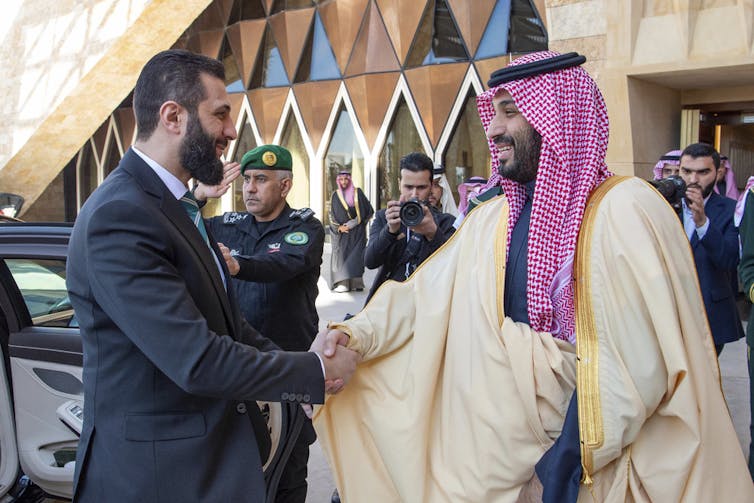
In Syria, years of civil war that had exacerbated splits among ethnic and religious groups finally ended in December 2024. Since then, Arab Gulf countries, which once opposed the Iranian-allied government of Bashar Assad, have been pivotal in supporting new Syrian President Ahmed al-Sharaa. They successfully lobbied the U.S. to drop sanctions.

In addition to sharing mutual regional interests with Sharaa, the leaders of Gulf Arab states want a Syrian state that is free from internal war and can absorb the millions of refugees that fled the conflict to other countries in the Middle East.

Two men shake hands.
Saudi Crown Prince Mohammed bin Salman greets Syria’s interim President Ahmed al-Sharaa in February 2025.
Saudi Ministry of Media via AP

Gulf states can support postwar Syria diplomatically and financially. However, they can’t wish away the legacy of long war and sectarian strife. Israeli attacks on Syrian soil since Assad’s fall, as well as recent outbreaks of fighting in the Sweida region of southern Syria, underscore the ongoing fragility of the Syrian government and concerns over its ability to contain violence and migration outside of its borders.

2. The challenge of regional politics

Syria illustrates a broader policy challenge for Gulf states. As their wealth, military strength and influence have grown, these countries have become dominant in the Arab world.

As a result, Qatar, Saudi Arabia and the UAE have invested billions of dollars in efforts to influence governments and groups across the world. This includes the mostly authoritarian governments in the Middle East and North Africa, such as Egypt’s.

But here, Gulf states are torn politically. If democratic systems form elsewhere in the Arab world, this could encourage Gulf citizens to push for elected government at home. Yet overly coercive Arab governments outside of the Gulf can be prone to popular unrest and even civil war.

Propping up unpopular regional governments risks backfiring on Gulf Arab leaders in one of two ways.

First, it can entice Gulf states into protracted and damaging wars, such as was the case with Saudi Arabia and the UAE’s failed military intervention in Yemen against the Houthis. Second, it can drive a wedge between Gulf states, as is seen with the current conflict in Sudan, in which the Saudis and Emiratis are backing rival factions.

3. Watching which way Iran will turn

Always looming behind complicated Middle Eastern politics is Iran, the historically powerful, populous, non-Arab country whose governing Shiite Islam ideology has been the chief antagonist to the Sunni-led Gulf Arab states since the Iranian Revolution in 1979.

Opposing Gulf Arab and American strategic interests, Iran has for years intervened aggressively in Middle Eastern politics by funding and encouraging militant Shiite groups in Iraq, Lebanon, Yemen and elsewhere.

An assertive Iran has been especially a thorn in the side of Saudi Arabia, which strives to be the dominant Muslim majority power in the region. Dealing with Iran has required careful balancing from Qatar and the UAE, which are more directly exposed to Tehran geographically and have maintained relatively stronger relations.

Given this, Gulf countries may silently welcome the decrease in Iran’s military power in the wake of Israel’s recent war against Iran and its allies, such as Hezbollah in Lebanon, while also fearing further Iranian-Israeli conflict.

At the same time, a less powerful Iran runs two types of new potential dangers for Gulf states. Should Iran become more unstable, the resulting turmoil could be felt across the region.

In addition, should Iran’s military, policy and economic turmoil lead to a new political system, it could disturb Gulf countries. Neither a Muslim majority democratic government nor a more hard-line nationalist variant in Iran would sit well with nearby Gulf monarchs.

Conversely, concerns that the Israeli and U.S. bombing of Iran may actually lead to increased Iranian determination to pursue a nuclear program also worry Gulf leaders.

4. Living with Israel’s military assertiveness

Israel, the unquestioned military power and sole nuclear weapons state in the region, has long posed particularly deep political dilemmas to Gulf Arab states. The current challenge is how to balance the immense global unpopularity of the Israeli government’s war in Gaza – including among Gulf Arab citizens – with common strategic interests the Gulf states hold with Israel.

Gulf Arab leaders face domestic and regional pressure to show solidarity for Palestinians and their aspirations for statehood.

Yet Gulf rulers also share strategic goals with Israel. Along with opposition to Iranian influence, Gulf states maintain strong military links to the U.S, like Israel. They also appreciate the economic and other security value of Israel’s high-tech products, including software used for espionage and cybersecurity.

This helps explain the UAE’s 2019 decision to join the short list of Arab states with full diplomatic relations with Israel. Hamas attacked Israel in 2023 in part to stop Saudi Arabia from following suit – something that might have further sidelined Palestinians’ bargaining power.

Indeed, moves toward open Saudi diplomatic recognition of Israel were stopped by Hamas’ attack and the global backlash that followed Israel’s ongoing devastation of Gaza.

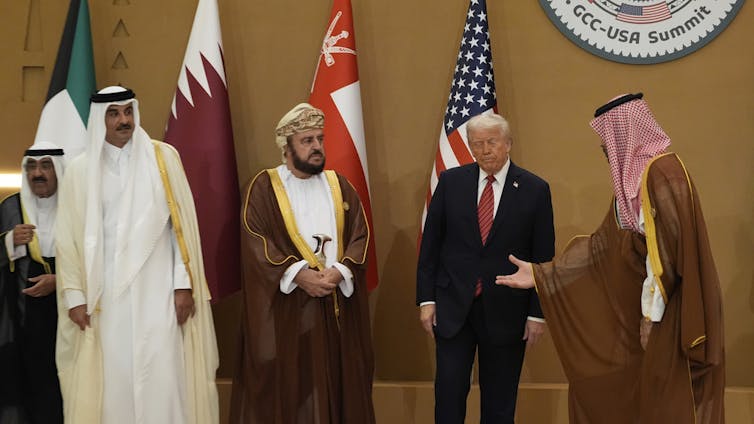
Four men stand in front of flags.
Saudi Crown Prince Mohammed bin Salman, right, welcomes President Donald Trump for the group photo with Gulf Cooperation Council leaders during the GCC Summit in Riyadh, Saudi Arabia, on May 14, 2025.
AP Photo/Alex Brandon

Gulf leaders may still believe that normalized ties with Israel would be good for the long-term economic prospects of the region. And Bahrain and the UAE – the two Gulf Arab states with diplomatic relations with Israel – have not backed away from their official relationship.

Yet expanding open relations with Israel further, and taking in other Gulf states, is unlikely without a real reversal in Israel’s policy toward Palestinians in both Gaza and the West Bank.

All this is more true in the immediate aftermath of Israel’s attack in Qatar – the first time Israel has launched a direct strike within a Gulf Arab state. That action, even if ostensibly directed at Hamas, is likely to exacerbate tensions not only with Qatar but place increasing stress on the calculus allied Gulf Arab countries make in their dealings with Israel.

Tricky way forward for Gulf Arab states

These challenges underscore an inescapable truth for Gulf leaders: They are hostage to events beyond their control.

Insulating them from that reality takes regional unity.

The Gulf Cooperation Council, nearly 45 years old, was established precisely for this purpose. While it remains the most successful regional organization in the Middle East, the GCC has not always prevented major rifts, such as in 2017 when a coalition of Arab states led by Saudi Arabia cut ties with and blockaded Qatar.

The conflict was resolved in 2021. Since then, the six members of the GCC have worked together more closely.

No doubt, rivalries and disagreements still exist. Yet Arab Gulf leaders have learned that cooperation is useful in the face of major challenges. This can be seen in the recent collaborative diplomatic approaches toward Syria and the U.S.

A second lesson comes from the broader Middle East. Key issues are often interdependent, particularly the status of Palestinians. Hamas’ attack on Israel, and the resulting destruction of much of Gaza, resurfaced the deep popularity across the region of addressing Palestinian needs and rights.

The monarchs of the Arab Gulf would like to maintain their unchallenged domestic political status while expanding their influence in the Middle East and beyond. However, even when Gulf leaders wish to be done with the region’s challenges, those challenges are not always done with them.

Isabella Ishanyan, a UMass Amherst undergraduate, provided research assistance for this article.

The Conversation

David Mednicoff held a research grant from the Qatar National Recent Fund from 2013-2016 which has no connection to anything discussed in this article.

ref. Israel’s attack in Doha underscores a stark reality for Gulf states looking for stability and growth: They remain hostage to events – https://theconversation.com/israels-attack-in-doha-underscores-a-stark-reality-for-gulf-states-looking-for-stability-and-growth-they-remain-hostage-to-events-261146

Middle East leaders condemn Israel’s attack on Qatar as Netanyahu ends all talk of Gaza ceasefire – expert Q&A

Source: The Conversation – Global Perspectives – By Scott Lucas, Professor of International Politics, Clinton Institute, University College Dublin

Israel launched an unprecedented airstrike on the Qatari capital of Doha on September 9, the first time it has directly attacked a Gulf state. The “precision strike”, as Israel has called it, targeted a building in which Hamas officials were reportedly discussing a peace proposal brokered by the US.

Al Jazeera has reported that it had been told by a Hamas official that none of its leadership weree killed in the strike.

The Qatari government said it “strongly condemns the cowardly Israeli attack”, which it described as “a blatant violation of international law”. Other Middle East states including Saudi Arabia condemned the Israeli strike, as did the secretary general of the United Nations, António Guterres, who said it was a “flagrant violation” of Qatari sovereignty.

It has also been reported that Israel’s prime minister, Benjamin Netanyahu, informed the White House of Israel’s intentions before carrying out the attack. An Israeli official told local media that the US president, Donald Trump, had given the strike the “green light” but this has not been confirmed.

A statement released by Netanyahu’s office appeared to suggest the strike was at least partly in retaliation for the killing of six Israeli civilians at a bus stop in Jerusalem, for which Hamas has claimed responsibility.

Scott Lucas, a Middle East expert at Dublin City University, spoke to Jonathan Este, The Conversation’s senior international affairs editor, shortly after the attack. He addressed several key questions.

What’s the thinking behind Israel’s strike on Qatar? Why now?

The Israeli government is going for the kill with Hamas. Having staked his political and legal future on the “absolute destruction” of the organisation, Netanyahu cannot agree to a settlement in which it retains any place in Gaza, let alone power.

So he and some of his ministers have not engaged in negotiations for a ceasefire since the start of March. At that point, they pulled out of any discussion of a phase two, resumed the military assault on Gaza, and cut off humanitarian aid. They have only turned it back on in dribs and drabs. Aid distribution has been sporadic and all too often deadly for the people who queue for food. And it’s not enough to prevent widespread famine in Gaza.

But the problem for Netanyahu and his allies is that others continued to push for a resolution – both inside Israel, where citizens are beginning to get sick of endless war, and among Israel’s international allies, who are sickened by the images emerging from the Strip and under pressure from their own populations.

On more than one occasion, Hamas agreed – or at least came close to agreeing – terms put to them by mediators. In August, the Palestinian organisation did so again. At that point, the Israel government had a choice: accept the settlement, get the hostages back and pull back on the plan for a long-term occupation of Gaza. Or try to push aside the settlement while blaming Hamas, then expand its military operations to take over Gaza City.

Netanyahu’s commanders, including the head of the Israel Defense Forces, Eyal Zamir, warned against the assault on Gaza City. Other advisers noted the risk of further international condemnation and the isolation of Israel.

But Netanyahu and hard-right ministers in his government have persisted, urging the prime minister to go for broke. Within minutes of the strike on Doha, finance minister Bezalel Smotrich was on social media praising the attack, writing: “Terrorists have no immunity and will never have immunity from Israel’s long arm anywhere in the world.”

So how to accomplish “absolute” victory? For Israeli hardliners, this means levelling parts of Gaza City while taking out Hamas’s leadership – both to break up the organisation and to ensure that there is no more talk of ceasefire, only capitulation.

What does this mean for the normalisation of relations between Israel and the Gulf States?

There is no normalisation. There probably was none before this attack. The Netanyahu government has decided on a course in Gaza that involves the mass killing of at least 65,000 people, most of them civilians, to displace up to 90% of the population of 2.2 million and to threaten all of them with starvation.

Not even the most cynical Arab government could risk the domestic backlash of continuing with “normalisation” in those circumstances.

So the Netanyahu government is not losing any possibilities with the brazen bombing in a sovereign Arab state. It is trying to set the terms for the future, perhaps a distant one: we’ll come back to normalisation from the position of imposing our will on Gaza, even if you might not have liked it.

Israel said the US president gave the attack the ‘green light’. Where does this leave Washington?

It leaves the Trump administration where it has always been: supporting Israeli actions that have led to the mass killing of people in Gaza. The US president was reportedly briefed on Israel’s intention to strike at Doha – a US ally – before the attack went ahead. Trump’s ally, the Republican speaker of the House of Representatives, Mike Johnson, is now talking about Israel having to contend with “enemies encamped around them and they’re trying to bring peace”.

Yes, Trump has pursued the chimera of a deal which would win him the Nobel peace prize. But when Israel effectively ended the deal at the start of March, the US president provided not only an excuse – Hamas was to blame – but also a rationale. Palestinians could be moved out of Gaza to allow Trump to create his “riviera of the Middle East” – a detailed prospectus for which was obtained and published last week by the Washington Post.

Each time the Netanyahu government has walked away from a peace proposal, Trump and his senior officials have provided them with cover. So, as the Israelis approach their long-term occupation, we are at the same point as we were in March – Trump officials talking about the removal of the civilians.

I doubt this attack will shake that position.

What does this tell us about negotiations over Gaza?

There are no negotiations over Gaza. There is a demand by the Netanyahu government for Hamas’s capitulation. If it does not capitulate, Hamas will be destroyed – no matter how many civilians pay the cost.

This is not just about the approach to Gaza. The Netanyahu government has now decided that its regional objectives will be pursued through “decapitation”.

It has not only tried to destroy the leadership of Hamas, with attacks in Gaza, Iran, Lebanon, Syria and now Qatar. It has killed most of the leadership of Lebanon’s Hezbollah. It laid waste to Iran’s political and military commanders in its 12-day war in June. On August 24, it assassinated Ahmed Ghaleb Nasser al-Rahawi, recognised by the Houthi people as their prime minister, and other senior Houthi officials in Yemen.

The deadly message of the Netanyahu government is clear: no one whom they consider an “enemy” is immune, wherever they are. Negotiations are peripheral, perhaps even irrelevant, to that commitment.

The Conversation

Scott Lucas does not work for, consult, own shares in or receive funding from any company or organisation that would benefit from this article, and has disclosed no relevant affiliations beyond their academic appointment.

ref. Middle East leaders condemn Israel’s attack on Qatar as Netanyahu ends all talk of Gaza ceasefire – expert Q&A – https://theconversation.com/middle-east-leaders-condemn-israels-attack-on-qatar-as-netanyahu-ends-all-talk-of-gaza-ceasefire-expert-qanda-264945

Why painting your home white could help you survive a heatwave

Source: The Conversation – UK – By Rosa Schiano-Phan, Reader in Architecture and Environmental Design, University of Westminster

At a seminar on building cooling strategies in the late 1990s, I vividly remember hearing that “in 30 years time, the climate of London will feel like Marseille’s today”. That warning stuck with me. Back then, it sounded both alarming – and oddly appealing.

Three decades on, it no longer feels theoretical. As a Londoner of Mediterranean origin, I’ve lived through the shift. When I co-wrote The Architecture of Natural Cooling, I drew not only on professional expertise but also on childhood memories of white walls, shady courtyards and shuttered windows. These ancient techniques – once suited to the Mediterranean – now hold lessons for modern Britain, where heatwaves are becoming the new normal.

One of the simplest and most effective ways to cool a building is to change its colour. White surfaces reflect sunlight rather than absorb it, and studies show that painting roofs white or adding some other type of reflective coating can reduce the internal temperatures by more than 1°C and sometimes more than 4°C. They can even lower the surrounding outdoor temperatures by up to 2°C.

That might not sound like much, but across a whole city it can make a real difference, helping to counter the urban heat island effect (where human-made surfaces absorb heat and mean a city is hotter than surrounding countryside) and keep homes more comfortable during the hottest hours of the day.

Seaside scene with white buildings
White roofs and thick walls in Tunisia.
BTWImages / shutterstock

The success of these strategies, however, comes with a caveat. The more low-energy “passive” strategies – shutters, white buildings, ventilation and so on – we adopt in combination the more likely they are to work effectively. A white roof, for example, is more effective if windows stay shut during the hottest hours, with shutters or external shades to keep the sun out.

If you close the windows, you will be better off with heavyweight walls and floors because the materials store coolness from the night air and release it through the day. That’s one reason Mediterranean homes often stay comfortable for longer even in extreme heat.

Night-time ventilation also plays a key role – at least if the air outside actually cools down after dark. In cities like London or Manchester with a strong urban heat island effect reflective roofs and avoiding the waste heat generated by air-conditioning units becomes even more crucial.

What about winter?

Some people may worry that a white roof might make their home colder in winter. But this is a very marginal problem, especially if the roof is well-insulated. How much you’ll need to heat your home is driven by the ability of your home’s outer shell to retain the heat that is already inside, rather than its ability to prevent heat coming from outside.

Rooftop view in winter
In winter, retaining heat is more important than absorbing sunlight.
Multishooter / shutterstock

In northern climates, winter sunlight is weak and often blocked by clouds. If, in a cold climate with sunny skies, you want to harness solar energy for warmth, it’s more effective to let sunlight in through double glazed windows than to rely on darker building materials.

A practical upgrade

Repainting your house white is not excessively expensive, at least compared to the big overall costs involved in heating and maintaining a home. Many homeowners, especially in suburban residential areas in the UK, already choose white finishes when refurbishing.

On flat or low-pitched roofs, reflective coatings can be applied at relatively low cost. For steeply pitched roofs, it is not possible to apply coats of paint as it would soon wear away and look terrible, requiring regular repainting. Tile roofs also need to “breathe” and let moisture out – paint could block this process, leading to damp problems. The best option is to replace dark shingles or slate tiles with more reflective clay tiles that reduce the roof’s surface temperature. This is a more time consuming and expensive option with costs, in the UK, starting from about £125 per square metre of roof.

The climate is changing and there’s no getting away from it. Yet sometimes the best solutions aren’t hi-tech or expensive. A coat of white paint, combined with a few other simple design strategies, could help keep Britain’s homes cooler, cheaper to run and better prepared for the climate changes and high energy prices expected in the decades ahead.


Don’t have time to read about climate change as much as you’d like?

Get a weekly roundup in your inbox instead. Every Wednesday, The Conversation’s environment editor writes Imagine, a short email that goes a little deeper into just one climate issue. Join the 45,000+ readers who’ve subscribed so far.

The Conversation

Rosa Schiano-Phan does not work for, consult, own shares in or receive funding from any company or organisation that would benefit from this article, and has disclosed no relevant affiliations beyond their academic appointment.

ref. Why painting your home white could help you survive a heatwave – https://theconversation.com/why-painting-your-home-white-could-help-you-survive-a-heatwave-264634

Political tensions and border anxiety pushed Canadians away from the U.S. this summer

Source: The Conversation – Canada – By Moira A. McDonald, Associate Professor, Director, School of Tourism and Hospitality Management, Royal Roads University

Global attitudes towards the United States as a tourism destination are plunging. Travel pressures, exchange rate shifts and increasing economic uncertainty have all damaged the reputation of the American travel sector.

Canadian travellers are increasingly turning to domestic destinations instead of heading south. In July, Canada recorded its seventh consecutive month of declining travel by Canadians to the U.S..

Political tensions appear to be playing a role in this shift.
U.S. President Donald Trump’s repeated remarks about wanting to annex Greenland and make Canada the “51st state” continue to strain relations between the U.S. and its allies.


Read more:
Allies or enemies? Trump’s threats against Canada and Greenland put NATO in a tough spot


For travellers, these tensions are one more deterrent for travelling to the U.S. About three-quarters of Canadians say Trump is “dangerous” and favourable views of the U.S. are at an all-time low.

Impact south of the border

This year, many Canadians reconsidered plans to visit the U.S. for business, leisure or school-related excursions, and some also boycotted American products.


Read more:
Canadian retailers are seeing a surge in domestic sales amid the ‘Buy Canadian’ movement


A spring 2025 prediction by Tourism Economics anticipated a 20 per cent drop in Canadian travellers to the U.S.. The U.S. Travel Association trade group warned that even a 10 per cent decrease would translate to two million fewer visits and US$2.1 billion in lost spending.

By the end of the summer, year-to-date Canadian visitation numbers to the U.S. had dropped about 25 per cent, confirming that U.S.-inbound travel continues to under-perform.

These choices also reflect anxiety over border-related issues. Measures such as selected detainment and asking Canadians to register with Homeland Security if they plan to stay in the U.S. for 30 days or more has raised concerns among those accustomed to a less intrusive cross-border experience, with some even describing the U.S. as a “hostile state.”


Read more:
Travelling to the U.S.? Here’s what you need to know about the risks and your rights


U.S. border cities feel the pinch

The consequences of declining travel are being felt most acutely in U.S. border cities that rely heavily on Canadian visitors. Canadians are no longer “flooding the streets of Seattle,” but instead are supporting their own tourism economy.

Cities such as Buffalo, N.Y., hoped to entice Canadians with welcoming billboards and special incentives over the summer. But according to Patrick Kaler, CEO of Visit Buffalo Niagara, it was clear their efforts were not working, and the customary wave of Canadian visitors never arrived.

The ripple effects extend well beyond traditional tourism destinations as well. One New York golf club reported losing US$400,000 in Canadian revenue, for instance.

It’s not just Canadian travellers, either. While Canada has seen an increasing number of European visitors, the U.S. recorded a 17 per cent decline in European arrivals this past spring, also likely due to the Trump administration’s policies and general actions.

Canadian tourism grows stronger

While U.S.-bound travel declines, domestic tourism in Canada is on the uptick. Tourism is the country’s second-largest service export, bringing $31 billion into the country last year, according to Destination Canada.

Unlike traditional exports, where goods are shipped out of the country, tourism brings the world’s travellers to Canada — and increasingly, keeps Canadians exploring at home.

Canadians took a total of 77.4 million trips within Canada in the first quarter of 2025. This shift has been a welcome trend to local tourism organizations and businesses that have been increasingly relying on the support of local travellers.

More Canadians are avoiding U.S. travel amid the ongoing trade war. (Global News)

But the increasing fear and uncertainty of American tariffs, policies and bilateral relationships are also causing unrest among Canadian tourism businesses.

The impact from Trump’s tariffs are felt particularly strongly by many Indigenous business owners who are now navigating inflationary pressures and workforce shortages.

Looking forward

The downturn in U.S.-bound travel could extend beyond the summer as travel trends continue to evolve. The statistics underscore the challenges that the U.S. tourism sector is facing and is likely to continue to face in to the future.

With World Tourism Day approaching on Sept. 27, travel and tourism professionals are encouraged to reflect on the industry’s development.

A central goal of World Tourism Day is to inspire “awareness among the international community of the importance of tourism and its social, cultural, political, and economic value.”

As tourism experts, we continue to promote Canadian generosity through professionals and travellers who keep kindness at the centre of their travel — an action that may be even more important than many realize.

Intentional travel and tourism can foster both peace and understanding. While the focus of World Tourism Day and the United Nations World Tourism Organization is to bring the world closer, this year Canadians worked to bring Canada itself closer together.

The Conversation

Moira A. McDonald is affiliated with Tourism and Travel Research Association Canada (TTRA).

Ann-Kathrin McLean is affiliated with Tourism and Travel Research Association Canada (TTRA).

ref. Political tensions and border anxiety pushed Canadians away from the U.S. this summer – https://theconversation.com/political-tensions-and-border-anxiety-pushed-canadians-away-from-the-u-s-this-summer-254780

Middle East holds its breath after Israel launches attack on Qatar: expert Q&A

Source: The Conversation – Global Perspectives – By Scott Lucas, Professor of International Politics, Clinton Institute, University College Dublin

Israel launched an unprecedented airstrike on the Qatari capital of Doha on September 9, the first time it has directly attacked a Gulf state. The “precision strike” as Israel has called it, targeted a building in which Hamas officials were reportedly discussing a peace proposal brokered by the US.

Al Jazeera has reported that it had been told by a Hamas official that none of its leadership had been killed in the strike.

The Qatari government said it “strongly condemns the cowardly Israeli attack”, which it described as “a blatant violation of international law”. Other Middle East states, including Saudi Arabia, condemned the Israeli strike, as did the secretary general of the United Nations, Antonio Guterres, who said it was a “flagrant violation” of Qatari sovereignty.

It has also been reported that Israel’s prime minister, Benjamin Netanyahu, informed the White House of Israel’s intentions before carrying out the attack. An Israeli official told local media that the US president, Donald Trump, had given the strike the “green light” but this has not been confirmed.

A statement released by Netanyahu’s office appeared to suggest that the strike had been at least party in retaliation for the killing of six Israeli civilians at a bus stop in Jerusalem, for which Hamas has claimed responsibility.

Scott Lucas, a Middle East expert at Dublin City University spoke to Jonathan Este, The Conversation’s senior international affairs editor shortly after the attack. He addressed several key questions.

What’s the thinking behind Israel’s strike on Qatar? Why now?

The Israeli government is going for the kill with Hamas. Having staked his political and legal future on the “absolute destruction” of the organisation, Netanyahu cannot agree to a settlement in which it retains any place in Gaza, let alone power.

So he and some of his ministers have not engaged in negotiations for a ceasefire since the start of March. At that point, they pulled out of any discussion of a phase two, resumed the military assault of Gaza, and cut off humanitarian aid. They have only turned it back on in dribs and drabs. But aid distribution has been sporadic and all too often deadly for the people who queue for food. And it’s not enough to prevent widespread famine in Gaza.

But the problem for Netanyahu and his allies is that others continued to push for a resolution: both inside Israel, where citizens are beginning to get sick of endless war and among Israel’s international allies, who are sickened by the images emerging from the Strip and under pressure from their own populations.

On more than one occasion, Hamas agreed – or at least came close to agreeing – terms put to them by mediators. In August, the Palestinian organisation did so again. At that point the Israel government had a choice: accept the settlement, get the hostages back and pull back on the plan for a long-term occupation of Gaza. Or try and push aside the settlement while blaming Hamas and expand military operations to take over Gaza City.

Netanyahu’s commanders, including the head of the Israel Defense Forces, Eyal Zamir, warned against the assault on Gaza City. Other advisers noted the risk of further international condemnation and isolation of Israel.

But Netanyahu and hard-right ministers in his government have persisted and urged the prime minister to go for broke. Within minutes of the strike on Doha, finance minister Bezalel Smotrich was on social media, praising the attack, writing: “Terrorists have no immunity and will never have immunity from Israel’s long arm anywhere in the world.”

So how to accomplish “absolute” victory? For Israeli hardliners it means levelling parts of Gaza City, while taking out Hamas’s leadership – both to break up the organisation and to ensure that there is no more talk of ceasefire, only capitulation.

What does this mean for the normalisation of relations between Israel and the Gulf States?

There is no normalisation. There probably was none before this attack. The Netanyahu government has decided on a course in Gaza that involves the mass killing of at least 65,000 people, most of them civilians, to displace up to 90% of the population of 2.2 million and to threaten all of them with starvation.

Not even the most cynical Arab government could risk the domestic backlash of continuing with “normalisation” in those circumstances.

So the Netanyahu government is not losing any possibilities with the brazen bombing in a sovereign Arab state. It is trying to set the terms for the future, perhaps a distant one: we’ll come back to normalisation from the position of imposing our will on Gaza, even if you might not have liked it.

Israel has said the US president gave the attack the ‘green light’. Where does this leave Washington?

It leaves the Trump administration where it has always been: supporting Israeli actions that has led to the mass killing of people in Gaza. The US president was reportedly briefed on Israel’s intention to strike at Doha – a US ally – before the attack went ahead. Trump’s ally, the Republican speaker of the House of Representatives, Mike Johnson, is now talking about Israel having to contend with “enemies encamped around them and they’re trying to bring peace”.

Yes, Donald Trump has pursued the chimera of a deal that would win him the Nobel Peace Prize. But when Israel effectively ended the deal at the start of March, Trump provided not only an excuse – Hamas is to blame – but also a rationale. Palestinians could be moved out of Gaza to allow Trump to create his “riviera of the Middle East” – a detailed prospectus for which was obtained and published last week by the Washington Post.

Each time that the Netanyahu government has walked away from a peace proposal, Trump and his senior officials have provided them with cover. So, as the Israelis approach their long-term occupation, we are at the same point as we were in March – Trump officials talking about the removal of the civilians.

I doubt that this attack will shake this position.

What does this tell us about negotiations over Gaza?

There are no negotiations over Gaza. There is a demand by the Netanyahu government for Hamas’s capitulation. If it does not capitulate, Hamas will be destroyed – no matter how many civilians pay the cost.

This is not just about the approach to Gaza. The Netanyahu government has now decided that its regional objectives will be pursued through “decapitation”.

It has not only tried to destroy the leadership of Hamas, with attacks in Gaza, Iran, Lebanon, Syria and now Qatar. It has killed most of the leadership of Lebanon’s Hezbollah. It laid waste to Iran’s political and military commanders in its 12-day war in June. On August 24, it assassinated Ahmed Ghaleb Nasser al-Rahawi, recognised by the Houthi people as their prime minister, and other senior Houthi officials in Yemen.

The deadly message of the Netanyahu government is clear: no one whom they consider an “enemy” is immune, wherever they are. Negotiations are peripheral, perhaps even irrelevant, to that commitment.

The Conversation

Scott Lucas does not work for, consult, own shares in or receive funding from any company or organisation that would benefit from this article, and has disclosed no relevant affiliations beyond their academic appointment.

ref. Middle East holds its breath after Israel launches attack on Qatar: expert Q&A – https://theconversation.com/middle-east-holds-its-breath-after-israel-launches-attack-on-qatar-expert-qanda-264945

New report ranks Philadelphia and Allentown among toughest cities in America for people with asthma

Source: The Conversation – USA (3) – By Ana Santos Rutschman, Professor of Law, Villanova University

The top 5 ‘asthma capitals’ in the U.S. are Detroit, Rochester, Allentown, Philadelphia and Cleveland, according to the Asthma and Allergy Foundation of America’s 2025 report. Terry Vine/DigitalVision Collection via Getty Images

Philadelphia has once again been named one of the “asthma capitals” of the U.S. – ranking No. 4 in a report released on Sept. 9, 2025, by the Asthma and Allergy Foundation of America. Allentown was ranked No. 3, Harrisburg No. 15 and Pittsburgh No. 44.

The AAFA, which is the largest patient group in the country for people with asthma and allergies, ranks cities based on “how challenging they are to live in” for people with asthma. The ranking combines data on asthma prevalence rates, visits to the ER and deaths related to asthma.

Compared with 2024 data, Allentown’s ranking has improved: It went from No. 1, a position now occupied by Detroit, to No. 3. Philadelphia is doing worse, one place higher than in 2024.

I am a health law professor and the director of the Health Innovation Lab at Villanova University, where I have researched ways to make asthma medication more affordable for patients.

Here are some steps that individuals, schools and state leaders in Pennsylvania can take to reduce asthma triggers and the cost of asthma medications in their families and communities.

The September asthma peak in Pennsylvania

The ranking was published at an especially challenging time of the year for many asthma patients.

September is known as the “asthma peak month.” The third week of September typically registers the highest number of asthma attacks, as well as asthma-related hospital and ER visits, nationwide.

Asthma triggers include fall pollen and mold levels, which start increasing in the late summer and stay high through early fall.

Also contributing to the September asthma peak is poor indoor air quality, especially in older or poorly maintained school buildings where children are exposed to concentrated amounts of allergens and irritants.

A report released in August 2025 found that Pennsylvania schools face a variety of asthma triggers, such as exposure to radon, mold and lead paint. Yet, less than 4% of schools in Pennsylvania have an indoor air quality plan. The problem is especially acute in cities like Philadelphia, where many school buildings are over 70 years old and in disrepair.

Solving a problem as complex and widespread as asthma may require taking creative steps. These include initiatives led by schools and students. For example, students in Australia led a successful initiative to improve air quality around their schools by having parents cut down on engine idling time.

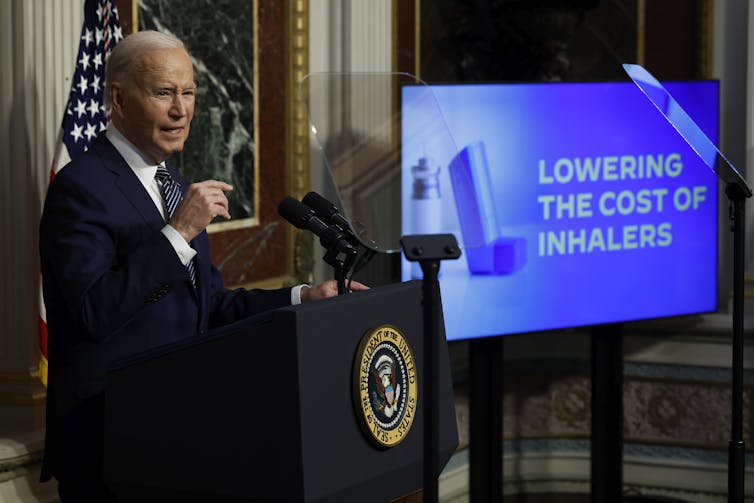
Former president Joe Biden speaks at podium alongside digital screen that says 'Lowering the cost of inhalers'
Speaking at the White House in 2024, former President Joe Biden credits Vermont senator Bernie Sanders with helping lower the cost of asthma inhalers from three of the four top companies to just $35 per month.
Chip Somodevilla via Getty Images

Affordable asthma medications

Asthma patients often need medication to manage their symptoms. Yet, over the past 15 years that medication has become increasingly unaffordable.

Last year, some pharmaceutical companies capped the price of their asthma inhalers at US$35 each.

But not all types of inhalers are covered. And other asthma medications, such as some drugs taken orally, remain unaffordable for many patients. Asthma drugs that are not subject to a price cap or other type of price control may cost patients thousands of dollars a year.

There are resources for asthma patients and parents of children with asthma that may help them save some money when filling their prescriptions. A good starting point is GoodRx, a free online platform that allows users to search and compare medication prices across pharmacies. The website currently lists 65 different types of asthma medication and their varying prices.

What Pennsylvania lawmakers can do

Since price caps don’t apply to all types of inhalers and asthma medication, states can pass legislation that imposes such caps, instead of relying solely on industry compliance. Before there was a federal Medicare price cap on insulin, several states took this route and implemented state caps.

Some states have now begun passing similar legislation for certain types of asthma medication. Minnesota, for instance, beginning Jan. 1, 2025, capped inhalers at $25, lower than the industry cap. Pennsylvania could follow suit and even consider asthma medication besides inhalers.

Pennsylvania can also address other facets of the asthma crisis. For instance, the state could offer funding or other incentives for schools to upgrade their ventilation systems or otherwise address poor indoor air quality.

Read more of our stories about Philadelphia.

The Conversation

Ana Santos Rutschman does not work for, consult, own shares in or receive funding from any company or organization that would benefit from this article, and has disclosed no relevant affiliations beyond their academic appointment.

ref. New report ranks Philadelphia and Allentown among toughest cities in America for people with asthma – https://theconversation.com/new-report-ranks-philadelphia-and-allentown-among-toughest-cities-in-america-for-people-with-asthma-264084

As pine martens are reintroduced to south-west England, a new study shows why local people need to be involved

Source: The Conversation – UK – By Roger Auster, Lecturer in Environmental Social Science, Centre for Resilience in Environment, Water and Waste, University of Exeter

Fifteen pine martens have been reintroduced to the south west of England as part of the Two Moors project. Terry Whittaker 2020Vision, CC BY-NC-ND

Fifteen pine martens were relocated from Scotland to Dartmoor, Devon, late last year in the first phase of a reintroduction to south-west England. This autumn, more of these domestic cat-sized mammals will be released into Exmoor as part of a long-term recovery strategy to restore pine marten populations.

Pine martens live primarily in woodland habitats, feeding on fruits, small mammals and birds. They were once found throughout Britain, until habitat loss from woodland clearance and increased predator control led to population collapse. It is thought pine martens lived in south-west England until the late 19th century.

In 2023, before plans for this release had been agreed, my colleague Kirsty Frith and I were commissioned by the Two Moors Pine Marten Project – a conglomeration of seven organisations, including the county’s environmental charity Devon Wildlife Trust and Dartmoor National Park Authority – to independently capture perspectives of local people and interest groups on the proposals. This “social feasibility” assessment used an approach similar to one used previously for a release in Wales to determine how a pine marten reintroduction would be received in this area.

Our new study, published in Human Dimensions of Wildlife, outlines how we used a technique called Q-methodology. This method identifies shared perspectives and enables a rich understanding of subjectivity.

For participants, this involves a sorting exercise with discussion, placing written statements into a configuration to illustrate their levels of agreement with each. Once completed, their sorting arrangements are statistically compared and interpreted to identify perspectives which participants associate with.

small brown pine marten climbs out of enclosure onto ground
A remote camera trap captures the moment that a pine marten takes its first step into the Devon countryside.
Devon Wildlife Trust, CC BY-NC-ND

Pining for martens?

Three main perspectives were identified. The anonymised participants included farmers, land managers, shooting representatives, conservationists and local residents.

Two of these perspectives supported pine martens and their reintroduction. Although similar, they exhibited some differences. The first viewpoint was more favourable to pine martens and reintroduction as a point of principle, with fewer reservations about introducing wild animals into the countryside. As one environmental farm advisor commented, “living around more nature and wildlife is a good thing”.

Although the second viewpoint still agreed strongly with reintroduction in this region, emphasis was on the motivation to restore the native population of pine martens and natural habitats. Some people expressed concerns about whether there might be negative effects on threatened native wildlife, for example, bats or dormice.

Participants wanted further evidence about the effects pine marten would have on habitats and more information about future plans for monitoring them and dealing with any issues. One participant, an environmental professional and public official, held this viewpoint and agreed with the reintroduction of pine martens “if it is done well and it is well planned”.

The third perspective was opposed to pine martens and their reintroduction. These participants were worried about introducing a predator like pine martens because they perceived them to be a threat to native wildlife, poultry and gamebirds.

They were also concerned about the availability of management support if there were negative effects from the reintroduction of pine martens. As one gamekeeper and conservationist viewed it, “they would add to the taking of wildlife when we have already lost more than 50%”.

What next?

Our new paper and previous research highlight two key challenges for any pine marten reintroduction project. By addressing those, the ability to coexist with pine martens can be improved.

close up face of brown pine marten
Pine martens are acrobatic hunters and people’s perceptions of them vary drastically.
Terry Whittaker 2020Vision, CC BY-NC-ND

People can have very different, polarised views. To minimise any conflict, reintroduction projects need to support inclusive dialogue around pine martens and how they can be monitored and managed. Unanimous support may be unlikely, but more collaborative relationships can be developed when people are involved in making plans for reintroduction.

It also really matters that people have contrasting understandings of predation. While supporters of reintroduction believed pine martens would contribute towards a functioning ecosystem, people who were less supportive were concerned that pine martens could kill threatened wildlife. Giving space for sensitive, nuanced conversations helps build trust and mutual understanding.

Our findings highlight the importance of assessing social feasibility before wildlife reintroductions take place. To ensure future success, that dynamic is just as crucial as ecological feasibility.


Imagine weekly climate newsletter

Don’t have time to read about climate change as much as you’d like?

Get a weekly roundup in your inbox instead. Every Wednesday, The Conversation’s environment editor writes Imagine, a short email that goes a little deeper into just one climate issue. Join the 35,000+ readers who’ve subscribed so far.


The Conversation

This research was commissioned by the Two Moors Pine Marten Project partnership. At the time of the research project, this included: Devon Wildlife Trust, National Trust, Woodland Trust, Exmoor National Park Authority, and Dartmoor National Park Authority.
Additional content contributed by Kirsty Frith.

ref. As pine martens are reintroduced to south-west England, a new study shows why local people need to be involved – https://theconversation.com/as-pine-martens-are-reintroduced-to-south-west-england-a-new-study-shows-why-local-people-need-to-be-involved-240559

How our minds trick us into thinking we are being greener than we really are

Source: The Conversation – UK – By John Everett Marsh, Reader in Cognitive Psychology, University of Lancashire

non c/Shutterstock

You’re in the supermarket. Imported beef mince, shrink-wrapped vegetables and cleaning spray are already in your basket. Then you toss in some organic apples and feel a flicker of moral relief. Surely that small green gesture lightens the load?

Not quite. Objectively, every extra product increases your carbon footprint. But psychology research reveals a curious illusion: when we add eco-friendly items, we often judge our shopping basket as having less impact on our carbon footprint than before.

This mental glitch is called the negative footprint illusion, and it matters for how we shop, how businesses market themselves and how governments design climate policies.

The illusion has been demonstrated across dozens of studies. In a typical experiment, people are asked to estimate the carbon footprint of 150 standard houses. Then they estimate the footprint of those same houses plus 50 eco-houses. Mathematically, the second total must be higher – there are simply more houses. Yet participants often judge the mixed set as lower.

In other words, adding a “good” item doesn’t just seem to cancel out a “bad” one. It creates a false impression that the total footprint has gone down, when in reality it has gone up. And the more “green” items you add, the stronger the illusion becomes.

What’s striking is how stubborn this bias is. It occurs among people with strong environmental values, people with scientific training and even among experts in energy systems. Education and numeracy don’t protect us. This isn’t a problem of knowledge, but of how the mind simplifies complex judgements.

Why does it happen?

The main culprit is averaging. Instead of adding up the total impact, we unconsciously average the mix. Toss in a few low-impact items and the “average impression” improves, even though the overall footprint goes up.

Our memory also plays tricks. If a sequence ends with an eco-friendly item, that last impression weighs heavily and colours the whole set. Likewise, when items are arranged irregularly, we find it harder to keep track of how many there are, so we default to averages rather than totals.

Psychologists have long shown that even when people are told about a bias, they often fall right back into it. Our latest experiments suggest the same applies to the so-called negative footprint illusion. That suggests it isn’t just sloppy reasoning but a deeper mental tendency: the mind simplifies.

The illusion may seem harmless in a lab, but it has real-world consequences when it comes to shopping, for example.

Businesses have also learned, consciously or not, to exploit this bias. A fast-food chain might showcase paper straws while still promoting beef-heavy menus. A hotel might advertise its towel-reuse policy while quietly expanding its energy-hungry facilities. These green cues create a halo that spills over to the whole brand.

Woman Choosing Bamboo Eco Friendly Biodegradable Toothbrush in Zero Waste Shop
One green products doesn’t cancel out other ones.
dmitriylo/Shutterstock, CC BY-SA

Even well-intentioned policy nudges can misfire. Offering more green-labelled choices is often assumed to drive better behaviour. But if those choices mask the real cost of consumption, they may backfire – encouraging people to consume more under the false impression of virtue.

Can it be fixed?

The good news is the illusion can be reduced. One promising approach is “summative priming”: nudging people to think in totals rather than averages. In experiments, participants who first completed simple “totalling” tasks were later more accurate in judging carbon footprints.

Research shows that when eco-friendly items appear at the end of a list, they distort overall impressions more strongly. Placing them earlier makes the illusion weaker. Likewise, when items are arranged in a regular, predictable structure, people find it easier to keep track of totals and are less prone to averaging errors.

These tweaks won’t eliminate cognitive bias entirely, but they show that design matters. Product labels, online platforms and policy communications can all be shaped to help people think in terms of totals rather than averages.

Climate change is driven by millions of everyday decisions: what we buy, what we eat, what we throw away. Understanding the psychological biases behind those decisions is essential.

The negative footprint illusion reminds us that even well-intentioned, environmentally conscious people can misjudge the true impact of their actions. Simply offering more green options isn’t enough. If those options distort our perceptions, they may slow genuine progress.

The challenge, then, is not only to provide information – carbon scores, eco-labels, green badges – but to present it in ways that match how people actually think. That means designing interventions that highlight totals, not averages, and that help consumers see the cumulative impact of their choices.

Climate change is a global problem, but it is fuelled by small misjudgments at the individual level. By recognising how our minds work, we can design smarter tools, better policies and more honest messages – and nudge ourselves towards the sustainable future we urgently need.


Don’t have time to read about climate change as much as you’d like?

Get a weekly roundup in your inbox instead. Every Wednesday, The Conversation’s environment editor writes Imagine, a short email that goes a little deeper into just one climate issue. Join the 45,000+ readers who’ve subscribed so far.


The Conversation

John Everett Marsh is a Reader in Cognitive Psychology at the University of Lancashire in the UK. He is also a Visiting Associate Professor at the Luleå University of Technology in Sweden and Bond University in Australia. He receives funding from Riksbankens Jubileumsfond.

Patrik Sörqvist receives funding from Stiftelsen Riksbankens Jubileumsfond and The Swedish Energy Agency.

ref. How our minds trick us into thinking we are being greener than we really are – https://theconversation.com/how-our-minds-trick-us-into-thinking-we-are-being-greener-than-we-really-are-263959