Broncos say their new stadium will be ‘privately financed,’ but ‘private’ often still means hundreds of millions in public resources

Source: The Conversation – USA (2) – By Geoffrey Propheter, Associate Professor, School of Public Affairs, University of Colorado Denver

In September 2025, the Denver Broncos announced their plan to build a new, privately financed stadium. Icon Sportswire/Getty Images

The Denver Broncos announced in early September 2025 their plan to build a privately financed football stadium. The proposal received a lot of attention and praise.

Across the five major sports leagues in the U.S. – the NBA, NHL, NFL, MLB and MLS – only 20% of facilities are privately owned.

I’ve studied the intersection of state and local public finance and pro sports for two decades. This experience has led me to approach claims of private financing with suspicion.

Private dollars are often masked as public dollars in these arrangements.

A Fox31 Denver news report aired in November 2025 about the Broncos’ plans for a new stadium.

Private vs public dollars

In theory, what counts as private or public dollars is uncontroversial. Dollars are public when government has a legal claim over them – otherwise, they are private.

The public versus private dollar distinction matters when accounting for who is contributing how much to a sports facility. When public dollars are allowed to count as private dollars, a project proposal looks more enticing than it is, in fact.

For instance, lawmakers regularly allow team owners to count public dollars as private dollars. The Sacramento City Council agreed to let the NBA’s Sacramento Kings count their property tax payments for the city-owned arena as private contributions to the overall cost of financing the arena. But property taxes are public dollars that in other instances go toward public services like schools and road repairs.
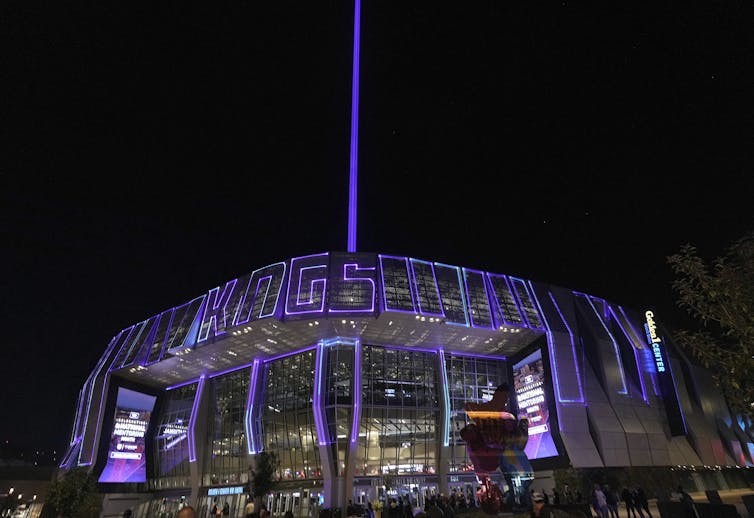
A building at night is lit up with purple lights that read
The Sacramento Kings stadium, the Golden 1 Center, counts property tax payments as a private contribution, even though property taxes are public dollars.
Thearon W. Henderson/Getty Images

Team owners building private facilities also typically receive public dollars through tax breaks, which is government spending in disguise. Property tax exemptions, sales and use tax exemptions on materials and machinery, and income tax credits are common forms of government givebacks to sports team owners.

I’ve estimated that property tax exemptions alone, among facilities in the five major leagues, have cost state and local governments US$20 billion cumulatively over the life of teams’ leases, 42% of which would have gone to K-12 education.

Rental payments spent on facilities are not private dollars

Many facilities and their infrastructure are funded through public debt secured in part by team rental payments. Lawmakers, media and consultants often view projects secured by rents as privately financed, in part or whole.

However, rental income in exchange for use or operation of public property should not be counted as private dollars.

Here’s a thought experiment. Suppose state lawmakers allocated the rent paid for use of campground sites in a state park to pay for new campground bathrooms. Are the bathrooms privately funded?

The flaw in concluding “yes” arises from a failure to appreciate that lawmakers, through policy, create legal claims over certain dollars. All dollars start as private dollars, but through the tax system, lawmakers transfer ownership of some dollars to the public.

It is the government landlord’s choice, a policy decision, to spend the rental income on the rented property, a choice available to them only if they own the rental income in the first place.

Yet lawmakers regularly allow teams, both professional and minor league, to count rental payments as private contributions. This accounting makes sports subsidies look less generous than they actually are.

Looking beyond construction

Facilities not only need to be constructed but also operated, maintained and eventually upgraded. Roads, sewer lines, overpasses, game-day security and emergency response and public policies to mitigate gentrification caused by a facility are all common taxpayer-funded touchpoints. In addition, facilities have preconstruction costs such as land acquisition, soil remediation and site preparation, as well as later costs such as demolition and remediation for the land’s next use.

Focusing on privately financed construction and ignoring all other aspects of a project’s development and operation is misleading, potentially contributing to lawmakers making inefficient and expensive policy decisions.
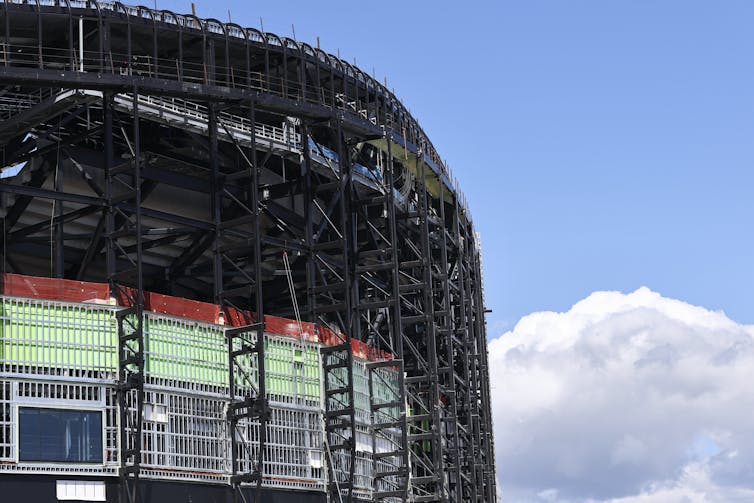
Outer wall of a stadium under construction.
The Buffalo Bills’ stadium.
Aaron M. Sprecher/Getty Images

By way of example, the Council of the District of Columbia approved a subsidy agreement last year with the NFL’s Commanders. The stadium would be financed, constructed and operated by the team owner, who would pay $1 in rent per year and remit no property taxes. In exchange for financing the stadium privately, the owner receives exclusive development rights to 20 acres of land adjacent to the stadium for the next 90 years.

The stadium is expected to cost the owner $2.5 billion, with the city contributing $1.3 billion for infrastructure.

But the city also gives up market rental income between $6 billion and $25 billion,depending on future land appreciation rates, that it could make on the 20 acres.

In other words, the rent discount alone means the city gives up revenue equal to multiple stadiums in exchange for the Commanders providing one. It is as if the council has a Lamborghini, traded it straight up for a Honda Civic, and then praised themselves for their negotiation acumen that resulted in a “free” Civic.

The Broncos’ proposed stadium

As of January 2026, Denver taxpayers know only that the Broncos stadium construction will be privately financed and that public dollars will be spent on some infrastructure.

Being enamored with such a proposal is similar to being offered a $1 billion yacht at a 75% discount. In my experience, there are two types of public officials: one will want to spend $250 million to save $750 million, while the other will ask whether $250 million for a yacht is an appropriate use of taxpayer resources given existing needs elsewhere.

My hope is that lawmakers better appreciate the many ways government participation in sports facility development, including privately financed ones, imposes serious risks and costs for current and future taxpayers. What is the expected total cost of the stadium project over its life? How much of the life cost would public resources cover? Could public resources generate greater benefits in an alternative use? How much will it cost to mitigate or compensate those affected by a project’s expected negative side effects, such as gentrification, congestion, pollution and crime?

Read more of our stories about Colorado.

The Conversation

Geoffrey Propheter does not work for, consult, own shares in or receive funding from any company or organization that would benefit from this article, and has disclosed no relevant affiliations beyond their academic appointment.

ref. Broncos say their new stadium will be ‘privately financed,’ but ‘private’ often still means hundreds of millions in public resources – https://theconversation.com/broncos-say-their-new-stadium-will-be-privately-financed-but-private-often-still-means-hundreds-of-millions-in-public-resources-270053

The ‘drug threat’ that justified the US ouster of Maduro won’t be fixed by his arrest

Source: The Conversation – USA – By Eduardo Gamarra, Professor of Politics and International Relations, Florida International University

This isn’t going to stop in the U.S. just because Venezuelan President Nicolás Maduro was arrested. Floris Leeuwenberg, Corbis Documentary/Getty Images

Donald Trump has flagged Venezuelan drug trafficking as a key reason for the U.S. military operation on Jan. 3, 2026, that captured President Nicolás Maduro and whisked him to New York to face federal drug charges.

Trump has described Maduro as “the kingpin of a vast criminal network responsible for trafficking colossal amounts of deadly and illicit drugs into the United States.”

In 2025, the administration presented the U.S. military buildup in the Caribbean and repeated strikes on alleged drug trafficking vessels off Venezuela’s coast as necessary to counter the flow of cocaine into the United States.

But as an international relations scholar focused on Latin America, I know that when assessed against hard data on cocaine production and transit, the U.S. pretense for military action against Venezuela falters.

Venezuela has never been a major cocaine producer. That distinction belongs overwhelmingly to Colombia, which accounts for the vast majority of coca cultivation and cocaine processing in the Western Hemisphere.

That means the arrest of Maduro and subsequent U.S. attempts to control Venezuela’s government are unlikely to stem the influx of cocaine into the U.S.

Justifying intervention

While Venezuela’s geography and governance gaps make it a transit country for Colombian products, most U.S. cocaine originates and flows through corridors north and west of Venezuela. This contradicts the claim that Caracas was the central hub of cocaine trafficking into the United States.

Moreover, the opioid overdose crisis in the U.S. today is overwhelmingly driven by synthetic drugs such as fentanyl, which have supply chains rooted in Mexico and Asia, not Venezuela.

So why did Washington elevate Venezuela’s role in narcotics?

A man in handcuffs being moved along by uniformed law enforcement agents.
Nicolás Maduro, in handcuffs, is escorted by federal agents en route to a federal courthouse in New York on Jan. 5, 2026.
XNY/Star Max/GC Images

The answer, I believe, lies less in illicit markets than in power. By conflating criminal networks with government authority, an act amplified through legal designations and indictments, the Trump administration could justify military intervention without explicit congressional authorization.

Once Maduro was removed, the substance beneath the rhetoric became clearer. The U.S. has not turned power over to an opposition democratic coalition. Instead, it facilitated the swearing-in of Vice President Delcy Rodríguez as interim president, a figure deeply tied to the existing regime and whose network includes people long accused by U.S. authorities of illegal activities.

The release of political prisoners by the interim government and U.S. moves to reopen Venezuela’s oil sector to American interests underscore that what unfolded was not purely a counternarcotics mission but a reconfiguration of governance in Caracas.

Pretext for military action

The role of the Cartel de los Soles – or Cartel of the Suns – in this narrative deserves particular scrutiny. Originally a label for alleged trafficking networks within Venezuela’s security forces, U.S. legal indictments and terrorist designations expanded that concept. That amplified the narrative that Maduro was at the head of a transnational criminal enterprise.

In fact, the Cartel de los Soles is not a structured cartel at all. Yet the narrative of Maduro as head of a narco-terrorist empire was politically and legally potent. It provided a pretext for military action, creating a justification that could be sold domestically and internationally as an effort to defend U.S. citizens from an external criminal threat.

But the U.S. attack in Venezuela was not, in substance, a counternarcotics mission. It was a strategic economic and geopolitical operation framed in the language of law enforcement.

Two days after the Venezuela attack, the Justice Department retreated from its November 2025 claim that Maduro was the head of Cartel de los Soles, underscoring that the link between drug enforcement and regime removal was more instrumental than evidentiary.

Rodríguez said just days after the U.S. attack, “Drug trafficking and human rights were the excuse; the real motive was oil.”

A man in a blue suit walking into a group of other men in suits in a high-ceilinged room.
President Donald Trump arrives at a White House meeting with oil and gas executives on Jan. 9, 2026, to discuss plans for investment in Venezuela after ousting its leader, Nicolás Maduro.
Alex Wong/Getty Images

No meaningful reduction

While the U.S. operation in Venezuela undoubtedly disrupted the trafficking networks that operated under Maduro’s umbrella, at least temporarily, the action cannot be convincingly framed as a drug supply intervention.

The reality of drug trafficking itself underscores this point.

Cocaine production and distribution networks are dynamic. When one route is disrupted, traffickers invariably find alternative pathways.

Routes that once used Venezuelan territory have likely rerouted rather than collapsed. This has historically characterized drug flow in Latin America in response to pressure from law enforcement.

Even if Venezuelan transit networks are briefly destabilized, there is no evidence that U.S. intervention will lead to a meaningful reduction in the volume of illegal drugs flowing into the United States. The most significant drivers of U.S. drug problems, including Mexico-based distribution systems and the surge of synthetic opioids, operate largely outside Venezuela.

The U.S. operation may benefit Venezuela politically by toppling a long-standing authoritarian figure. That opens the possibility of political change.

But if the lens through which policymakers view these events is drug policy, they are misreading both the evidence and the incentives. The action was centered on energy and strategic realignment, with counternarcotics rhetoric serving as a justification rather than a driver of the U.S. attack.

And while trafficking networks adapt and survive, these shifts will not reduce the flow of drugs into the United States, which has long been shaped by factors far beyond Venezuela’s borders.

The Conversation

Eduardo Gamarra does not work for, consult, own shares in or receive funding from any company or organization that would benefit from this article, and has disclosed no relevant affiliations beyond their academic appointment.

ref. The ‘drug threat’ that justified the US ouster of Maduro won’t be fixed by his arrest – https://theconversation.com/the-drug-threat-that-justified-the-us-ouster-of-maduro-wont-be-fixed-by-his-arrest-273139

South Florida’s Brightline has highlighted an old problem – every year for the past decade, 900 pedestrians were killed by trains

Source: The Conversation – USA – By Ian Savage, Professor of Economics, Northwestern University

High-speed passenger trains like Florida’s Brightline travel through dense neighborhoods, increasing the likelihood of accidents involving pedestrians. Brynn Anderson/Associated Press

In 2018, high-speed passenger trains branded as Brightline started running along the formerly freight-only Florida East Coast Railway. Initial service from Miami to West Palm Beach was extended to Orlando in 2023. Unfortunately, the southern end of the line is in the spotlight because of collisions with pedestrians and motor vehicles.

The safety concerns have received extensive coverage in the Miami Herald, Orlando Sentinel, The Atlantic and on local television and radio stations.

To South Floridians, the furor may be novel. But nationally the debate over how to prevent these incidents has been going on for decades.

Most of the risks of railroading fall on pedestrians and motorists. Over the past decade, an average of 900 pedestrians lost their lives each year in the U.S., and another 150 motor vehicle occupants died in collisions at highway-rail grade crossings.

I’m an economist who has studied transportation safety for 40 years. My research has analyzed why motor vehicle risks have fallen substantially, while there has been hardly any progress for pedestrians.

Reducing motor vehicle crashes

In 1966, 1,700 motor vehicle occupants died at railroad crossings. Nowadays, that number is typically less than 150. Over the same period, the number of vehicles on the road has tripled. By these measures, the risk has fallen by an amazing 97%.

What happened?

In part, the risk fell due to better vehicle technology and reduced drunken driving, which have improved overall highway safety.

The rest was due to actions taken starting in the early 1970s in reaction to the high number of deaths. Notably, the responsibility for deciding on safety features at crossings was taken away from the railroads and given to state and local highway authorities.

A design standards handbook and risk analysis tools were developed by the U.S. Department of Transportation. The analysis tools produce a priority listing of the riskiest crossings. The handbook describes the options that engineers can use to reduce risks, such as installing flashing warning lights and barriers across the road. It also suggests when to consider closing or consolidating dangerous crossings. Federal money supplemented spending by railroads and state and local governments to pay for these improvements.

A public information campaign educating drivers about the risks at crossings was established in Idaho in 1972 under the name Operation Lifesaver. By 1986, the program had spread to every state.

Railways closed many unprofitable lines after they were allowed to do so by the Staggers Rail Act of 1980. The reduced number of railroad miles and crossings also dropped the associated risk.

Stagnant risks to pedestrians

A similar analysis of pedestrian deaths is complicated. Pedestrian deaths occur all along the railroad and not just at crossings. Sadly, some deaths are intentional. Federal railroad officials had stopped requiring that suicides be reported in the mid-1950s and resumed doing so only in 2011.

In 1966, there were 730 nonintentional pedestrian deaths. Today, that number is roughly the same. It’s worth noting, however, that the U.S. population is 70% higher than it was in the 1960s, so the risk per person is lower.

Federal data from the past decade shows that about a quarter of the 900 annual pedestrian deaths were ruled by a coroner or medical examiner to be intentional. Coroners often lack sufficient evidence to definitively rule a suicide, so the actual proportion of pedestrians with suicidal intent is likely much higher. My own research in the Chicago area found that about half were confirmed or likely suicides.

Getting to the root cause

While the risk is down, the reduction is nowhere near as large as that of motor vehicles at crossings.

In the past decade the U.S. Department of Transportation has funded development of handbooks on the design of pedestrian crossings and interventions to mitigate risks at places away from crossings.

The latter handbook emphasizes that successful countermeasures need to be tailored to the reasons people are on the tracks in the first place. And, of course, there are many reasons.

Fencing may seem like an obvious countermeasure, but a fence does not prevent access at crossings and stations. Moreover, fences also tend to be destroyed where it is onerous to detour to a formal crossing rather than take a shortcut.

In fact, fencing can be counterproductive if it screens the railroad from public view and encourages nefarious activities, including theft, drug dealing and loitering.

Tackling intentional deaths has been challenging. Countermeasures have focused on signage providing information on mental health services and training rail workers to recognize people displaying symptoms of distress and then intervening or calling for help.

At times, tackling the root of the problem may involve land use and zoning at a local level. For example, a city might decide not to allow a convenience store to be located on the opposite side of the tracks from the population it serves. Or a city or school district might relocate transit or school bus stops to avoid the temptation to take a shortcut.

train tracks running through an intersection with multiple stoplights
This intersection with red traffic lights and railway crossings in Miami requires the traffic lights to coordinate with railway crossing gates.
LB Studios/Connect Images via Getty Images

Florida railroads

South Florida faces several challenges. The primary challenge is its flat land. No hills means there is no natural grade separation between the railroad and intersecting roads and footpaths.

Elevating the railroad would be expensive and would cut communities in two. The effects of such severance should not be underestimated. In fact, the trend in recent times has been to rejoin urban neighborhoods that were bisected by interstate highway construction in the 1960s.

Another challenge comes, ironically, from the original vision behind rail travel in Florida. Standard Oil magnate Henry Flagler developed and built the Florida East Coast Railway in hopes of spurring coastal development. These days, dense communities surround the line, with housing, schools, stores and restaurants scattered on both sides of the tracks.

Development also made it less safe for motor vehicles. Main roads, such as U.S. Route 1 and Dixie Highway, were built parallel to the tracks. Over time, as these roads have become wider and busier, the cross streets have a smaller distance between the railroad and the main road. The space for vehicles waiting to turn onto the main road is limited, and the lights and gates at the railroad crossing must be coordinated with the traffic signals on the main road. This is a major challenge to the state, county and municipal traffic engineers who have inherited these complicated intersections.

It is tempting to suggest that many of these crossings should be consolidated into fewer, well-designed crossings. But this could result in unintended consequences for pedestrians. When too few crossings are available, pedestrians are more likely to take unauthorized shortcuts. Any consolidation of road crossings must be accompanied by alternative ways for pedestrians to cross the tracks safely.

It is important to keep looking for solutions to pedestrian and vehicle safety issues so that South Florida communities can be safer while enjoying the benefits that rail offers, such as reducing the number of trucks on the roads and offering an alternative to passengers who wish to avoid flying or driving on congested Interstate 95.

If you are experiencing suicidal thoughts, you can contact the National Suicide Prevention Lifeline (988) or Crisis Text Line (text “HELLO” to 741741) for immediate support.

The Conversation

I was a volunteer member of the National Academies of Sciences, Engineering, and Medicine oversight committee as the 2022 “Strategies for Deterring Trespassing on Rail Transit and Commuter Rail Rights-of-Way” handbook was developed. As such we could comment on drafts but were not the authors of the report.

ref. South Florida’s Brightline has highlighted an old problem – every year for the past decade, 900 pedestrians were killed by trains – https://theconversation.com/south-floridas-brightline-has-highlighted-an-old-problem-every-year-for-the-past-decade-900-pedestrians-were-killed-by-trains-272229

US military has a long history in Greenland, from mining during WWII to a nuclear-powered Army base built into the ice

Source: The Conversation – USA (2) – By Paul Bierman, Professor of Natural Resources and Environmental Science, University of Vermont

Rusting fuel drums and vehicles remain at an abandoned U.S. World War II base in Greenland. Posnov/Moment via Getty Images

President Donald Trump’s insistence that the U.S. will acquire Greenland “whether they like it or not” is just the latest chapter in a co-dependent and often complicated relationship between America and the Arctic’s largest island – one that stretches back more than a century.

Americans have long pursued policies in Greenland that U.S. leaders considered strategic and economic imperatives. As I recounted in my 2024 book, “When the Ice is Gone,” about Greenland’s environmental, military and scientific history, some of these ideas were little more than engineering fantasies, while others reflected unfettered military bravado.

A person stands next to a sled and dog team looking at a large radar installation.
Inuit and their dog team stand in front of a U.S. military radar installation at Thule, Greenland, that scanned the skies for Soviet bombers and missiles during the Cold War. More than 100 native Inuit were removed from their land during base construction.
NF/SCANPIX/AFP via Getty Images

But today’s world isn’t the same as when the United States last had a significant presence in Greenland, decades ago during the Cold War.

Before charging headlong into this icy island again, the U.S. would be remiss not to learn from past failures and consider how Earth’s rapidly changing climate is fundamentally altering the region.

Early US plundering of Greenland’s metals

In 1909, Robert Peary, a U.S. Navy officer, announced that he had won the race to the North Pole – a spectacular claim debated fiercely at the time. Before that, Peary had spent years exploring Greenland by dogsled, often taking what he found.

In 1894, he convinced six Greenlanders to come with him to New York, reportedly promising them tools and weapons in return. Within a few months, all but two of the Inuit had died from diseases.

A man stands beside a very large rock almost as tall as he is
People moved the 34-ton Cape York meteorite fragment named Ahnighito from the Greenland coast to Robert Peary’s ship, which took it to New York in 1897.
Account Of The Discovery And Bringing Home Of The ‘Saviksue’ or Great Cape York Meteorites. New York 1898/Wikimedia Commons

Peary also took three huge fragments of the Cape York iron meteorite, known to Greenlanders as Saviksoah. It was a unique source of metal that Greenlandic Inuit had used for centuries to make tools. The largest piece of the meteorite, Ahnighito, weighed 34 tons. Today, it sits in the American Museum of Natural History, which reportedly paid Peary US$40,000 for the space rocks.

World War II: Strategic location and minerals

World War II put Greenland on the map strategically for the U.S. military. In spring 1941, Denmark’s ambassador signed a treaty giving the U.S. military access to Greenland to help protect the island from Nazi Germany and contribute to the war effort in Europe. That treaty remains in effect today.

New American bases in western and southern Greenland became crucial refueling stops for planes flying from America to Europe.

Hundreds of American soldiers were garrisoned at Ivittuut, a remote town on the southern Greenland coast where they protected the world’s largest cryolite mine. The rare mineral was used for smelting aluminum, critical for building airplanes during the war.

A view across the water to a small mining outpost.
The Ivittuut cryolite mine in southwestern Greenland, shown in 1940. U.S. troops guarded the mine, essential for aluminum production, during World War II.
U.S. Coast Guard via Wikimedia Commons

And because Greenland is upwind from Europe, weather data collected on the island proved essential for battlefield forecasts as officers planned their moves during World War II.

Both the Americans and Germans built weather stations on Greenland, starting what historians refer to as the weather war. There was little combat, though allied patrols routinely scoured the east coast of the island for Nazi encampments. The weather war ended in 1944 when the U.S. Coast Guard, and its East Greenland dogsled patrol, found the last of four German weather stations and captured their meteorologists.

Men holds their hands in the air in surrender while soldiers point guns at them.
American soldiers capture members of Germany’s Edelweiss II weather station in northeastern Greenland in 1944.
U.S. Coast Guard via Wikimedia Commons

Cold War: Fanciful engineering ideas vs the ice

The heyday of U.S. military engineering dreams in Greenland arrived during the Cold War in the 1950s.

To counter the risk of Soviet missiles and bombers coming over the Arctic, the U.S. military transported about 5,000 men, 280,000 tons of supplies, 500 trucks and 129 bulldozers, according to The New York Times, to a barren, northwest Greenland beach – 930 miles (1,500 kilometers) from the North Pole and 2,752 miles (4,430 kilometers) from Moscow.

There, in one top-secret summer, they built the sprawling American air base at Thule. It housed bombers, fighters, nuclear missiles and more than 10,000 soldiers. The whole operation was revealed to the world the following year, on a September 1952 cover of LIFE magazine and by the U.S. Army in its weekly television show, “The Big Picture.”

Trucks packed into a ship arrive with the ocean in the background.
A wave of U.S. military engineers lands on the shores of northwestern Greenland to build Thule Airbase in summer 1951.
Keystone-France/Gamma-Keystone via Getty Images

But in the realm of ideas born out of paranoia, Camp Century and Project Iceworm were the pinnacle.

The U.S. Army built Camp Century, a nuclear-powered base, inside the ice sheet by digging deep trenches and then covering them with snow. The base held 200 men in bunkrooms heated to 72 degrees Fahrenheit (22 Celsius). It was the center of U.S. Army research on snow and ice and became a reminder to the USSR that the American military could operate at will in the Arctic.

Military engineers building Camp Century wear parkas and stand in a tunnel wide enough to drive a truck through.
Metal arches placed over trenches cut into the snow-formed roofs at Camp Century. The arches were covered with snow and ice, removed, and reused. A similar idea had been planned for rail lines through the ice.
U.S. Army Corps of Engineers, 1960

The Army also imagined hundreds of miles of rail lines buried inside Greenland’s ice sheet. On Project Iceworm’s tracks, atomic-powered trains would move nuclear-tipped missiles in snow tunnels between hidden launch stations – a shell game covering an area about the size of Alabama.

In the end, Project Iceworm never got beyond a 1,300-foot (400-meter) tunnel the Army excavated at Camp Century. The soft snow and ice, constantly moving, buckled that track as the tunnel walls closed in. In the early 1960s, first the White House, and then NATO, rejected Project Iceworm.

Trucks are parked outside the partially buried Camp Century.
An aerial view shows Camp Century, which was powered by a small-scale portable nuclear reactor.
US Army

In 1966, the Army abandoned Camp Century, leaving hundreds of tons of waste inside the ice sheet. Today, the crushed and abandoned camp lies more than 100 feet (30 meters) below the ice sheet surface. But as the climate warms and the ice melts, that waste will resurface: millions of gallons of frozen sewage, asbestos-wrapped pipes, toxic lead paint and carcinogenic PCBs.

Who will clean up the mess and at what cost is an open question.

Greenland remains a tough place to turn a profit

In the past, the American focus in Greenland was on short-term gains with little regard for the future. Abandoned bases, scattered around the island today and in need of cleanup, are one example. Peary’s disregard of the lives of local Greenlanders is another.

History shows that many of the fanciful ideas for Greenland failed because they showed little consideration of the island’s isolation, harsh climate and dynamic ice sheet.

Large rusted construction trucks and some fuel drums.
World War II-vintage trucks abandoned at a U.S. airfield in east Greenland were still there decades later.
Posnov/Moment via Getty Images

Trump’s demands for American control of the island as a source of wealth and U.S. security are similarly shortsighted. In today’s rapidly warming climate, disregarding the dramatic effects of climate change in Greenland can doom projects to failure as Arctic temperatures climb.

Recent floods, fed by Greenland’s melting ice sheet, have swept away bridges that had stood for half a century. The permafrost that underlies the island is rapidly thawing and destabilizing infrastructure, including the critical radar installation and runway at Thule, renamed Pituffik Space Base in 2022. The island’s mountain sides are crashing into the sea as the ice holding them together melts.

The U.S. and Denmark have conducted geological surveys in Greenland and pinpointed deposits of critical minerals along the rocky, exposed coasts. However, most of the mining so far has been limited to cryolite and some small-scale extraction of lead, iron, copper and zinc. Today, only one small mine extracting the mineral anorthosite, which is useful for its aluminum and silica, is running.

It’s the ice that matters

The greatest value of Greenland for humanity is not its strategic location or potential mineral resources, but its ice.

A NASA animation of satellite data shows Greenland’s ice sheet mass losses between 2002 and 2023, measured in meters of water equivalent in the ice.

If human activities continue to heat the planet, melting Greenland’s ice sheet, sea level will rise until the ice is gone. Losing even part of the ice sheet, which holds enough water to raise global sea level 24 feet in all, would have disastrous effects for coastal cities and island nations around the world.

That’s big-time global insecurity. The most forward-looking strategy is to protect Greenland’s ice sheet rather than plundering a remote Arctic island while ramping up fossil fuel production and accelerating climate change around the world.

The Conversation

Paul Bierman receives funding from the US National Science Foundation.

ref. US military has a long history in Greenland, from mining during WWII to a nuclear-powered Army base built into the ice – https://theconversation.com/us-military-has-a-long-history-in-greenland-from-mining-during-wwii-to-a-nuclear-powered-army-base-built-into-the-ice-273355

Reddit and TikTok – with the help of AI – are reshaping how researchers understand substance use

Source: The Conversation – USA (3) – By Layla Bouzoubaa, Doctoral Student in Information Science, Drexel University

Only a small percentage of people with substance use disorder seek treatment, but millions of people discuss their experiences with drugs in online communities. vladans/iStock via Getty Images

When you think of tools for studying substance use and addiction, a social media site like Reddit, TikTok or YouTube probably isn’t the first thing that comes to mind. Yet the stories shared on social media platforms are offering unprecedented insights into the world of substance use.

In the past, researchers studying peoples’ experiences with addiction relied mostly on clinical observations and self-reported surveys. But only about 5% of people diagnosed with a substance use disorder seek formal treatment. They are only a small sliver of the population who have a substance use disorder – and until recently, there has been no straightforward way to capture the experiences of the other 95%.

Today, millions of people openly discuss their experiences with drugs online, creating a vast collection of raw narratives about drug use. As a doctoral student in information science with a background in public health, I use this material to better understand how people who use drugs describe their lives and make sense of their experiences, especially when it comes to stigma.

These online conversations are reshaping how researchers think about substance use, addiction and recovery. Advances in artificial intelligence are helping make sense of these conversations at a scale that wasn’t possible before.

The hidden population

The vast majority of people diagnosed with a substance use disorder address the issue informally – seeking support from their community, friends or family, self-medicating or doing nothing at all. But some choose to post about their drug use in dedicated online communities, such as group forums, often with a level of candor that would be difficult to capture in clinical interviews.

Their social media posts offer a window into real-time, unscripted conversations about substance use. For example, Reddit, which is comprised of topical communities called subreddits, contains over 150 interconnected communities dedicated to various aspects of substance use.

In 2024, my colleagues and I analyzed how participants in drug-related forums on Reddit connect and interact. We found that they focused on the chemistry and pharmacology of substances, support for drug users, recreational experiences such as festivals and book clubs, recovery help, and harm reduction strategies. We then selected a few of the most active communities to develop a system for categorizing different types of personal disclosures by labeling 500 Reddit posts.

Hands holding blank orange speech bubble on blue background.
People who post about their own drug use in public forums often use social media to support and look out for each other.
mucahiddin/iStock via Getty Images

Policymakers and public health experts have expressed concerns that social media encourages risky drug use. Our work did not assess that issue, but it did support the notion that platforms such as Reddit and TikTok often serve as a lifeline for people seeking just-in-time support when they need it most.

When we used machine learning to analyze an additional 1,000 posts, we found that most users in the forums we focused on were seeking practical safety information. Posters often posed questions such as how much of a substance is safe to take, what interactions to avoid and how to recognize signs of trouble.

We observed that these forums function as informal harm reduction spaces. People share not just experiences but warnings, safety protocols and genuine care for each other’s well-being. When community members are lost to overdose, the responses reveal deep grief and renewed commitments to keeping others safe. This is the everyday reality of how people navigate substance use outside medical settings – with far more nuance and mutual support than critics might expect.

We also explored TikTok, analyzing more than 350 videos from substance-related communities. Recovery advocacy content was the most common, depicted in 33.9% of the videos we analyzed. Just 6.5% of the videos showed active drug use. As on Reddit, we frequently saw people emphasizing safety and care.

Why AI is a game changer

Platforms like Reddit, TikTok and YouTube host millions of posts, videos and comments, many filled with slang, sarcasm, regional language or emotionally charged stories. Analyzing this content manually is time-consuming, inconsistent and virtually impossible to do at scale.

That’s where AI comes in. Traditional machine learning approaches often rely on fixed word lists or keyword matching, which can miss important contextual cues. In contrast, newer models – especially large language models like OpenAI’s GPT-5 – are capable of understanding nuance, tone and even the underlying intent of a message. This makes them especially useful for studying complex issues like drug use or stigma, where people often communicate through implication, coded language or emotional nuance rather than direct statements.

These models can identify patterns across thousands of posts and flag emerging trends. For example, researchers used them to detect shifts in how Canadians on X, the social media site formerly called Twitter, discussed cannabis as legalization approached – capturing shifts in public attitudes that traditional surveys might have missed.

In another study, researchers found that monitoring Reddit discussions can help predict opioid-related overdose rates. Official government data, like that from the Centers for Disease Control and Prevention, typically lags by at least six months. But adding near-real-time Reddit data to forecasting models significantly improved their ability to predict overdose deaths – potentially helping public health officials respond faster to emerging crises.

The role that stigma plays in substance use disorder is difficult to capture in traditional surveys and interviews.

Bringing stigma into focus

One of the most difficult aspects of substance use to study – and to address – is the stigma.

It’s deeply personal, often invisible and shaped by a person’s identity, relationships and environment. Researchers have long recognized that stigma, especially when internalized, can erode self-worth, worsen mental health and prevent people from seeking help. But it’s notoriously hard to capture using traditional research methods.

Most clinical studies rely on surveys or interviews conducted at regular intervals. While useful, these snapshots can miss how stigma unfolds in everyday life. Stigma scholars have emphasized that understanding its full impact requires paying attention to how people talk about themselves and their experiences over time.

On social media platforms, people often discuss stigma organically, in their own words and in the context of their lived experiences. They might describe being judged by a health care provider, express shame about their own substance use or reflect on how stigma shapes their relationships. Even when posts aren’t directly naming the experience as stigma, they still reveal how stigma is internalized, challenged or reinforced.

Using large language models, researchers can begin to track these patterns at scale, identifying linguistic signals like shame, guilt or expressions of hopelessness. In recent work, my colleagues and I showed that stigma expressed on Reddit aligns closely with long-standing stigma theory – suggesting that what people share on social media reflects recognizable stigma processes, not something fundamentally new or separate from what researchers have long studied.

That matters because stigma is one of the most significant barriers to treatment for people with substance use disorder. Understanding how people who use drugs talk about stigma, harm, recovery and survival, in their own words, can complement surveys and clinical studies and help inform better public health responses.

By taking these everyday expressions seriously, researchers, clinicians and policymakers can begin to respond to substance use as it is actually lived — messy, evolving and deeply human.

The Conversation

Layla Bouzoubaa does not work for, consult, own shares in or receive funding from any company or organization that would benefit from this article, and has disclosed no relevant affiliations beyond their academic appointment.

ref. Reddit and TikTok – with the help of AI – are reshaping how researchers understand substance use – https://theconversation.com/reddit-and-tiktok-with-the-help-of-ai-are-reshaping-how-researchers-understand-substance-use-241730

How cocaine traffickers launder cartel money

Source: The Conversation – France – By Pierre-Charles Pradier, Maître de conférences en Sciences économiques, LabEx RéFi, Université Paris 1 Panthéon-Sorbonne

On 4 May 2016, the European Central Bank (ECB) decided to stop issuing 500 euro notes. The number of these notes in circulation will fall from 614 million at the end of 2015 to just under 220 million by mid-2025. DerkachevArtem/Shutterstock

The cocaine market exploded between 2014 and 2023. Production in Colombia increased more than sevenfold to nearly 2,700 tonnes, according to the United Nations Office on Drugs and Crime (UNODC).

Behind the scenes, drug traffickers find equally illicit ways to pay their suppliers and foot soldiers, or to spend the proceeds of their criminal trade. Their solution? Money laundering. It is estimated that 25% of the funds collected is laundered.

Criminals generally launder money in three stages: firstly, they inject it into the financial system; secondly, they layer it with the aim of obscuring the origin of the funds, and finally, they integrate it into the financial system, a process aimed at legitimising the money. This typology does not take into account the fact that money laundering is sometimes partial, i.e. it stops at the first stage. Let us consider an example.

Take the money from cocaine originating from the main exporter of coca: Colombia. Some of it is laundered entirely on site, by reinjecting the cash into legitimate businesses – restaurants, hairdressers, etc. – while another part is used to pay for the goods. To do this, it has long been sufficient to provide cash – in banknotes – which is then laundered in Colombia.

Cash smuggling

In Europe, the cash is exchanged for €500 notes by accomplices working in banks and then entrusted to money mules. The latter take the plane with sums of between £200,000 and £500,000.

It is this link in the drug trafficking chain – bulk cash smuggling – that has allowed cryptocurrencies to emerge as a key cog in narco traffic.

To fully get one’s head around the use of cryptocurrencies in drug money laundering, one needs to understand how cash smuggling works. An article by Peter Reute and Melvin Soudijn (the former is a criminologist and the latter an intelligence officer with the Dutch police) has made it possible to accurately measure the costs of this operation. They accessed the accounting records of traffickers in six cases tried for offences that took place between 2003 and 2008. Between them, they accounted for €800 million transported between the Netherlands and Colombia.

The costs amounted to around 3% for changing small denominations into €500 notes, the same amount to pay the mule, and slightly less for their travel expenses. The heavy surveillance at Amsterdam-Schiphol Airport meant that they had to fly from elsewhere in Europe. Factoring in additional costs, the transport of funds to Colombia alone costs between 10% and 15%, or even up to 17% of the amounts moved.

In concrete terms:

  1. The cocaine leaves Colombia.

  2. It is sold by intermediaries in Europe.

  3. The money collected from this sale is turned into 500 euro notes, at the cost of a 3% fee.

  4. The €500 notes are entrusted to mules, at the cost of a 3% fee.

  5. The mules travel to Colombia, at the cost of 3% fee.

  6. The cash arrives in Colombia to pay for the drugs, then is laundered on the spot, again at a cost.

According to the authors, anti-money laundering regulations have succeeded in significantly increasing the costs of smuggling, particularly transport, but not the selling price, as we consider France’s booming cocaine market. Indeed, national consumption has increased ninefold since 2000. To circumvent these regulations, traffickers are relying on the 500-euro note.

End of the 500-euro note

In a twist on 4 May 2016, the European Central Bank (ECB) decided to stop issuing 500-euro notes. The number of these notes in circulation fell from 614 million at the end of 2015 to just under 220 million by mid-2025.

’It has been decided to permanently discontinue the production of the 500-euro note and to remove it from the “Europe” series, taking into account concerns that this denomination could facilitate illegal activities,’ the bank explained.

That same year, a new financial asset burst onto the scene: bitcoin.

Enter cryptocurrencies

As 500-euro notes grew scarcer from 2016, Bitcoin contributed to redrawing the map of cash trafficking.

Instead of an integrated chain where cash returns to the source of the drugs to pay for deliveries, we are witnessing a process of specialisation. On the one hand, drug traffickers exchange their cash for cryptocurrencies, which they use to pay for their supplies in Colombia. On the other, a money laundering network collects the banknotes and transports them along easier routes, such as those leading to Dubai (United Arab Emirates).

How do we know this? Thanks to, for example, Operation Destabilise by the UK’s National Crime Agency. The press release describes an international money laundering network controlled by Russians. They used an exchange platform that did not exercise its duty of care, Garantex, for cryptocurrency transactions, and Dubai, for cash transactions.

The money laundering network collected cash from drug traffickers and paid them in crypto tokens (particularly USDT-Tether), charging only 3% in fees. Compared to the 10% to 15% that transport cost in Colombia before the 500-euro note was phased out, this represents a saving of 70% to 80%.

Reporting

Cryptocurrencies – initially Bitcoin and now stablecoins such as USDT-Tether – have enabled drug traffickers to save on the cost of sending cash by choosing the safest routes. It is too early to know whether the significant increase in transatlantic drug trafficking, as reported in a recent investigation by the Financial Times, is linked to this technical innovation.

In concrete terms, the new method follows this new route between drug traffickers and money laundering networks:

  1. The cocaine leaves Colombia.

  2. It is sold by intermediaries in Europe.

  3. The money collected from this sale is exchanged for USDT-Tether cryptocurrencies, with a 3% fee.

  4. The USDT-Tether cryptocurrencies are sent to Colombia to pay for the drugs.

  5. For the money laundering network, the cash is entrusted to mules, who travel to Dubai, for a 1% fee.

  6. In Dubai, the cash is laundered for a 1% fee.

Legislation against crypto asset laundering

It’s reasonable to believe that the recent anti-money-laundering rules on crypto-asset service providers in countries that have signed the Crypto-Asset Reporting Framework will complicate matters for criminal organizations. We can also trust the latter will pinpoint the smallest loopholes and exploit them.

The invention of cryptocurrencies has set back the fight against organized crime by years, but the “coalition of the willing”, including Switzerland, the Bahamas, Malta and France, is finally getting organized.

In France, the fight against money laundering is being strengthened by a law “aimed at freeing France from the trap of drug trafficking”, passed in June 2025. A specialized national public prosecutor’s office has been created. A raft of measures is being put in place, from the administrative closure of front businesses (by prefects rather than mayors, who are too exposed) to the freezing of drug traffickers’ assets and initiatives against the mixing of crypto-assets.

But traffickers are adapting to avoid being caught, as we will see in a second article.

The Conversation

Pierre-Charles Pradier worked for the Directorate of Territorial Surveillance in the 1990s.

ref. How cocaine traffickers launder cartel money – https://theconversation.com/how-cocaine-traffickers-launder-cartel-money-270500

Could ChatGPT convince you to buy something? Threat of manipulation looms as AI companies gear up to sell ads

Source: The Conversation – USA – By Bruce Schneier, Adjunct Lecturer in Public Policy, Harvard Kennedy School

AI advertising could be hard to resist – or even recognize. showcake/iStock via Getty Images

Eighteen months ago, it was plausible that artificial intelligence might take a different path than social media. Back then, AI’s development hadn’t consolidated under a small number of big tech firms. Nor had it capitalized on consumer attention, surveilling users and delivering ads.

Unfortunately, the AI industry is now taking a page from the social media playbook and has set its sights on monetizing consumer attention. When OpenAI launched its ChatGPT Search feature in late 2024 and its browser, ChatGPT Atlas, in October 2025, it kicked off a race to capture online behavioral data to power advertising. It’s part of a yearslong turnabout by OpenAI, whose CEO Sam Altman once called the combination of ads and AI “unsettling” and now promises that ads can be deployed in AI apps while preserving trust. The rampant speculation among OpenAI users who believe they see paid placements in ChatGPT responses suggests they are not convinced.

In 2024, AI search company Perplexity started experimenting with ads in its offerings. A few months after that, Microsoft introduced ads to its Copilot AI. Google’s AI Mode for search now increasingly features ads, as does Amazon’s Rufus chatbot.

As a security expert and data scientist, we see these examples as harbingers of a future where AI companies profit from manipulating their users’ behavior for the benefit of their advertisers and investors. It’s also a reminder that time to steer the direction of AI development away from private exploitation and toward public benefit is quickly running out.

The functionality of ChatGPT Search and its Atlas browser is not really new. Meta, commercial AI competitor Perplexity and even ChatGPT itself have had similar AI search features for years, and both Google and Microsoft beat OpenAI to the punch by integrating AI with their browsers. But OpenAI’s business positioning signals a shift.

We believe the ChatGPT Search and Atlas announcements are worrisome because there is really only one way to make money on search: the advertising model pioneered ruthlessly by Google.

Advertising model

Ruled a monopolist in U.S. federal court, Google has earned more than US$1.6 trillion in advertising revenue since 2001. You may think of Google as a web search company, or a streaming video company (YouTube), or an email company (Gmail), or a mobile phone company (Android, Pixel), or maybe even an AI company (Gemini). But those products are ancillary to Google’s bottom line. The advertising segment typically accounts for 80% to 90% of its total revenue. Everything else is there to collect users’ data and direct users’ attention to its advertising revenue stream.

After two decades in this monopoly position, Google’s search product is much more tuned to the company’s needs than those of its users. When Google Search first arrived decades ago, it was revelatory in its ability to instantly find useful information across the still-nascent web. In 2025, its search result pages are dominated by low-quality and often AI-generated content, spam sites that exist solely to drive traffic to Amazon sales – a tactic known as affiliate marketing – and paid ad placements, which at times are indistinguishable from organic results.

Plenty of advertisers and observers seem to think AI-powered advertising is the future of the ad business.

Big Tech’s AI advertising plans are shaking up the industry.

Highly persuasive

Paid advertising in AI search, and AI models generally, could look very different from traditional web search. It has the potential to influence your thinking, spending patterns and even personal beliefs in much more subtle ways. Because AI can engage in active dialogue, addressing your specific questions, concerns and ideas rather than just filtering static content, its potential for influence is much greater. It’s like the difference between reading a textbook and having a conversation with its author.

Imagine you’re conversing with your AI agent about an upcoming vacation. Did it recommend a particular airline or hotel chain because they really are best for you, or does the company get a kickback for every mention? If you ask about a political issue, does the model bias its answer based on which political party has paid the company a fee, or based on the bias of the model’s corporate owners?

There is mounting evidence that AI models are at least as effective as people at persuading users to do things. A December 2023 meta-analysis of 121 randomized trials reported that AI models are as good as humans at shifting people’s perceptions, attitudes and behaviors. A more recent meta-analysis of eight studies similarly concluded there was “no significant overall difference in persuasive performance between (large language models) and humans.”

This influence may go well beyond shaping what products you buy or who you vote for. As with the field of search engine optimization, the incentive for humans to perform for AI models might shape the way people write and communicate with each other. How we express ourselves online is likely to be increasingly directed to win the attention of AIs and earn placement in the responses they return to users.

A different way forward

Much of this is discouraging, but there is much that can be done to change it.

First, it’s important to recognize that today’s AI is fundamentally untrustworthy, for the same reasons that search engines and social media platforms are.

The problem is not the technology itself; fast ways to find information and communicate with friends and family can be wonderful capabilities. The problem is the priorities of the corporations who own these platforms and for whose benefit they are operated. Recognize that you don’t have control over what data is fed to the AI, who it is shared with and how it is used. It’s important to keep that in mind when you connect devices and services to AI platforms, ask them questions, or consider buying or doing the things they suggest.

There is also a lot that people can demand of governments to restrain harmful corporate uses of AI. In the U.S., Congress could enshrine consumers’ rights to control their own personal data, as the EU already has. It could also create a data protection enforcement agency, as essentially every other developed nation has.

Governments worldwide could invest in Public AI – models built by public agencies offered universally for public benefit and transparently under public oversight. They could also restrict how corporations can collude to exploit people using AI, for example by barring advertisements for dangerous products such as cigarettes and requiring disclosure of paid endorsements.

Every technology company seeks to differentiate itself from competitors, particularly in an era when yesterday’s groundbreaking AI quickly becomes a commodity that will run on any kid’s phone. One differentiator is in building a trustworthy service. It remains to be seen whether companies such as OpenAI and Anthropic can sustain profitable businesses on the back of subscription AI services like the premium editions of ChatGPT, Plus and Pro, and Claude Pro. If they are going to continue convincing consumers and businesses to pay for these premium services, they will need to build trust.

That will require making real commitments to consumers on transparency, privacy, reliability and security that are followed through consistently and verifiably.

And while no one knows what the future business models for AI will be, we can be certain that consumers do not want to be exploited by AI, secretly or otherwise.

The Conversation

The authors do not work for, consult, own shares in or receive funding from any company or organization that would benefit from this article, and have disclosed no relevant affiliations beyond their academic appointment.

ref. Could ChatGPT convince you to buy something? Threat of manipulation looms as AI companies gear up to sell ads – https://theconversation.com/could-chatgpt-convince-you-to-buy-something-threat-of-manipulation-looms-as-ai-companies-gear-up-to-sell-ads-272859

From a new flagship space telescope to lunar exploration, global cooperation – and competition – will make 2026 an exciting year for space

Source: The Conversation – USA – By Grant Tremblay, Federal Astrophysicist and External Relations Lead at the Smithsonian Astrophysical Observatory, Smithsonian Institution

The U.S. is planning a crewed flight around the Moon in 2026. AP Photo

In 2026, astronauts will travel around the Moon for the first time since the Apollo era, powerful new space telescopes will prepare to survey billions of galaxies, and multiple nations will launch missions aimed at finding habitable worlds, water on the Moon and clues to how our solar system formed.

Together, these launches will mark a turning point in how humanity studies the universe – and how nations cooperate and compete beyond Earth. Coming from one of the world’s largest astrophysical research institutes, I can tell you, the anticipation across the global space science community is electric.

Mapping the cosmos at unprecedented scales

Several of the most ambitious missions slated for launch in 2026 share a common goal: to map the universe on the largest possible scales and reveal how planets, galaxies and the largest cosmic structures evolved over billions of years.

The centerpiece of this effort is NASA’s Nancy Grace Roman Space Telescope. Construction completed on the Roman telescope in December at NASA’s Goddard Space Flight Center, and if all goes well, it could launch as early as fall 2026.

What makes Roman more special than NASA’s other flagship space telescopes is not just what it will see, but how much of the sky it can see at once. Its 300-megapixel camera can capture regions of sky about 100 times larger than the Hubble Space Telescope’s field of view while maintaining comparable sharpness – like switching from studying individual tiles to surveying the entire mosaic at once.

During its five-year primary mission, Roman is expected to discover more than 100,000 distant exoplanets, map billions of galaxies strewn across cosmic time and help scientists probe dark matter and dark energy – the invisible scaffolding and mysterious forces that together account for 95% of the cosmos.

Roman also carries a coronagraph, a pathfinder instrument that can block out a star’s blinding light to directly photograph planets orbiting around it. The technology could pave the way for future missions, like NASA’s planned Habitable Worlds Observatory, capable of searching for signs of life on Earth-like worlds.

Two engineers in a clean room wearing protective suits looking at the mirror of the assembled Roman space telescope
NASA’s Nancy Grace Roman Space Telescope is now fully assembled following the integration of its two major segments on Nov. 25, 2025, at the agency’s Goddard Space Flight Center in Greenbelt, Md. The mission is slated to launch by May 2027, but the team is on track for launch as early as fall 2026.
NASA/Jolearra Tshiteya

Over in Europe, the European Space Agency’s PLATO mission, short for PLAnetary Transits and Oscillations of stars mission, is scheduled to launch in December 2026 aboard Europe’s new Ariane 6 rocket. PLATO will monitor about 200,000 stars using an array of 26 cameras, searching for small, rocky planets in their stars’ habitable zones, while also determining the stars’ ages.

For China, 2026 is expected to mark a milestone of a different kind: the launch of its first large flagship space telescope dedicated to astrophysics. The Xuntian space telescope, also known as the Chinese space station telescope, is currently expected to launch in late 2026. Xuntian will survey enormous regions of the sky with image quality comparable to Hubble’s, but with a field of view more than 300 times larger.

Like NASA’s Roman Space Telescope, Xuntian is designed to tackle some of modern cosmology’s biggest questions. It will hunt for dark matter and dark energy, survey billions of galaxies and trace how cosmic structure evolved over time. Uniquely, Xuntian will co-orbit with China’s Tiangong space station, allowing astronauts to service and upgrade it and, potentially, extending its life for decades.

An illustration of a space telescope, which looks like a metal cylinder with two solar panels attached to either side.
A recent rendering of China’s Xuntian space station telescope, which is on track to launch in late 2026.
China National Space Administration

Together with the new Vera C. Rubin Observatory on the ground, which will repeatedly scan the entire southern sky to capture how the universe changes over time, the Roman, PLATO and Xuntian space telescopes will study the cosmos not just as it is but as it evolves.

Global milestones in human spaceflight

While robotic observatories quietly expand our view of the cosmos, 2026 will also mark a major step forward for human spaceflight.

NASA’s Artemis II mission, now readying for launch as early as April 2026, will send four astronauts on a 10-day journey around the Moon and back. It will be the first time humans have traveled beyond low Earth orbit since Apollo 17 in December 1972.

Across the globe, India is preparing to reach a similarly historic milestone. Through its Gaganyaan program, the Indian Space Research Organisation is planning a series of uncrewed test flights in 2026 as it works toward sending astronauts to space. If that happens, India would become only the fourth nation to achieve human spaceflight on its own – a significant technological and symbolic achievement.

Meanwhile, China will continue regular crewed flights to its Tiangong space station in 2026, part of a broader effort to build the experience, infrastructure and technologies needed for its planned human missions to the Moon later in the decade.

In parallel, NASA is relying increasingly on commercial spacecraft to carry astronauts to and from the International Space Station, freeing the agency to focus its own human spaceflight efforts on deep-space missions beyond Earth.

Together, Artemis II, Gaganyaan and China’s ongoing crewed space station missions reflect a renewed global push toward human exploration beyond Earth orbit – one in which governments and commercial partners alike are laying the groundwork for longer missions and a sustained human presence in space.

The origin and geology of the Moon and Mars

Another set of 2026 missions focuses on a more grounded question: how rocky worlds – and the resources they contain – came to be.

Japan’s Martian Moons eXploration mission, slated to launch in late 2026, will travel to Mars, spend three years studying both of its small, potato-shaped moons – Phobos and Deimos – and collect a surface sample from Phobos to bring back to Earth by 2031.

Scientists still debate whether these moons originated as captured asteroids or debris from an ancient giant impact with Mars. Returning pristine material from Phobos could finally settle that question and reshape our understanding of how the inner solar system evolved.

China’s Chang’e 7 mission, expected to launch in mid-2026, will head to the Moon’s south pole, a region of intense scientific and strategic interest. The mission includes an orbiter, lander, rover and a small flying “hopper” designed to leap into permanently shadowed craters, where sunlight never reaches. These craters are thought to harbor water ice, a resource that could one day support astronauts or be converted into rocket fuel for deeper-space missions.

The Chinese and Japanese missions both highlight how planetary science and exploration are becoming increasingly intertwined, as understanding the geology of nearby worlds also informs future human activity.

It’s the Sun’s solar system, we’re just living in it

In 2025, powerful solar storms forced airlines to reroute and ground flights, disrupted radio communications and pushed vivid auroras far beyond their usual polar haunts – lighting up skies as far south as Florida. These events are reminders that space is not a distant abstraction: Activity on the Sun can have immediate consequences here on Earth.

Not all of 2026’s major missions look outward into deep space. Some are focused on understanding the dynamic space environment that surrounds our own planet.

In a notable example of international cooperation, the solar wind magnetosphere ionosphere link explorer, SMILE – a joint mission between the European Space Agency and the Chinese Academy of Sciences – is scheduled for launch in spring 2026.

SMILE will provide the first global images of how Earth’s magnetic field responds to the constant stream of charged particles flowing from the Sun. That interaction drives space weather, including solar storms that can disrupt satellites, navigation systems, power grids and communications.

Understanding those interactions is critical not only for protecting modern infrastructure on Earth but also for safeguarding astronauts and spacecraft operating beyond the planet’s protective magnetic shield.

At a time of growing geopolitical tension in space, the mission also stands out as a rare and consequential example of sustained scientific cooperation between Europe and China.

The global stakes

These missions unfold against a complex geopolitical backdrop. The United States and China are both racing to return humans to the Moon by the end of the decade.

Yet for all the competition, space science remains profoundly collaborative. Japan’s Martian Moons eXploration mission carries instruments from NASA, ESA and France. International teams share data, expertise and the sheer wonder of discovery. The universe, after all, belongs to no one nation.

Having spent my career studying the universe, I see 2026 as a year that reflects both the rivalries and the shared ambitions of space exploration today. Competition is real, but so is cooperation at a scale that would have been hard to imagine a generation ago. From the search for habitable worlds around distant stars to plans for returning humans to the Moon, the work is global – and the sky is shared by all.

The Conversation

Grant Tremblay receives funding from the National Aeronautics and Space Administration (NASA)

ref. From a new flagship space telescope to lunar exploration, global cooperation – and competition – will make 2026 an exciting year for space – https://theconversation.com/from-a-new-flagship-space-telescope-to-lunar-exploration-global-cooperation-and-competition-will-make-2026-an-exciting-year-for-space-272010

There’s an intensifying kind of threat to academic freedom – watchful students serving as informants

Source: The Conversation – USA (2) – By Austin Sarat, William Nelson Cromwell Professor of Jurisprudence and Political Science, Amherst College

Approximately 58% of faculty interviewed in a national survey in 2024 reported self-censoring. PM Images/iStock/Getty Images

Texas A&M University told philosophy professor Martin Peterson in early January 2026 that he could not teach some of Greek philosopher Plato’s writings that touch on “race and gender ideology.”

The university’s local chapter of the American Association of University Professors, an organization of professors and academics in the U.S., quickly denounced this requirement.

Peterson, in response to his university’s direction, replaced the Plato readings with material on free speech and academic freedom.

Silencing a professor from teaching a certain subject fits within what experts have long recognized as encroaching on academic freedom.

In another high-profile incident at Texas A&M in September 2025, a student filmed an exchange with an English literature professor, Melissa McCoul, who was talking about gender identity.

The student said that McCoul was violating President Donald Trump’s January 2025 executive order that recognized “women are biologically female, and men are biologically male.” As a result, the student told her professor, as seen in her video, “I’ve already been in touch with the president of A&M, and I have a meeting with him in person to show all of my documentation tomorrow.” Her video went viral.

This represents a growing threat to academic freedom: Students who act as informants and police their classes and professors for signs of political incorrectness.

A 2023 study found that 75% of college students feel free to report their professors if they say something objectionable. Self-identified liberal students were more likely than conservative students to report their professors to the administration.

As someone who teaches politically charged subjects, I am very much aware of the need to teach in inclusive ways and respect the diversity of student views. I have also written about how academic freedom is changing, given new external threats and political realities. I recognize that students will play an important role in determining the future of academic freedom.

A college campus is seen with broad sidewalks and tall, green trees.
Two high-profile incidents at Texas A&M University show different forms of threats to academic freedom.
Kailynn.Nelson/Wikimedia

Academic freedom is not the same as free speech

Academic freedom is a complex concept that is often confused with freedom of speech.

The American Association of University Professors offers one definition: Academic freedom is focused on ensuring that professors can say, teach, discuss and write about any issue within their field, without “interference from administrators, boards of trustees, political figures, donors, or other entities.”

As law professor Stanley Fish has argued, freedom of speech – meaning the right to express oneself without restrainthas no place in college classrooms.

As Fish notes, college classrooms are about the pursuit of truth.

In Fish’s view, this is true in both public and private colleges and universities, even though the Supreme Court has held that free speech applies in any public higher education institution.

I believe that Christopher Eisgruber, president of Princeton University, made a mistake when he said in November 2025, “Colleges get free speech right through millions of conversations … that take place in dorm rooms or dining hall tables or at public events or classrooms in colleges and universities across the U.S. every year.”

Dorms, dining halls, public events, yes. Classrooms, no.

As the American Association of University Professors’ preamble says, higher education institutions depend “upon the free search for truth and its free exposition.” It goes on to say, “Academic freedom is essential to these purposes and applies to both teaching and research.”

While that statement is not legally binding, it establishes a set of standards that are widely endorsed throughout higher education.

The September 2025 incident at Texas A&M is so worrisome because it suggests that faculty are being required to adhere to a political ideology, rather than allowed to pursue the truth as they see it.

Self-censorship on the rise

Despite most colleges and universities embracing academic freedom, a rising number of college professors are today censoring themselves in their classrooms.

Approximately 58% of faculty interviewed in a national survey in 2024 reported “regularly self-censoring in … conversations with students outside of class and in classroom conversations.”

In addition, a 2024 study done at Harvard University found that “Many Harvard faculty members and instructors … reported reluctance to discuss controversial subjects inside and outside the classroom.”

Such pervasive fear has a clear chilling effect in controlling what professors teach and say.

Meanwhile, a 2024 report from the American Enterprise, a conservative think tank, explains that faculty self-censorship “increases when faculty engage with students who could record and circulate words, in or out of context, to the world in a matter of seconds.”

Students’ rights to record classroom discussions

The legal landscape concerning the rights of students to record what happens in a college classroom is complex.

In some states, like Alabama and Maine, people can record someone without their consent, if they are directly part of the conversation being documented. In other states, like California and Massachusetts, all people part of the conversation need to consent to being recorded.

Many universities have their own rules regarding recording. Some limit it in classes, except as necessary to accommodate students with particular disabilities.

Harvard, for example, prohibits any member of a course from posting identifiable classroom statements on social media without people’s written consent.

Protecting academic freedom

The September Texas A&M controversy resulted in the university firing McCoul. Texas A&M President Mark A. Welsh III also stepped down from his position in September.

In November, a faculty committee then determined that the university did not have good reason to fire McCoul – though she has not been reinstated to her position.

I believe that colleges, universities and groups like the American Association for University Professors need to think about academic freedom differently than they did in 1940, when the association first adopted its academic freedom statement.

This will require colleges and universities to take steps to protect faculty from direct attempts by the government, or outside groups, to punish them for saying something that the government or others deem controversial.

But protecting faculty is also about establishing new norms to govern the classroom.

Adopting the think tank Chatham House’s rules, which say that people during meetings cannot attribute anything said to a specific speaker without their consent, is a possible path.

I have gone one step further. I now begin my classes by discussing my own classroom compact that covers academic freedom, academic integrity and the values that will inform and guide the work we will do.

Students are also required to pledge that they will not post anything about my class, or anything said in it, on social media with or without attribution. And I remind them that Massachusetts legally requires the consent of all people part of a conversation when it comes to recording.

Helping students understand the meaning and value of academic freedom and enlisting them to help protect it is not an easy task. However, the future of that value may depend on it.

The Conversation

Austin Sarat does not work for, consult, own shares in or receive funding from any company or organization that would benefit from this article, and has disclosed no relevant affiliations beyond their academic appointment.

ref. There’s an intensifying kind of threat to academic freedom – watchful students serving as informants – https://theconversation.com/theres-an-intensifying-kind-of-threat-to-academic-freedom-watchful-students-serving-as-informants-273182

Why people believe misinformation even when they’re told the facts

Source: The Conversation – UK – By Kelly Fincham, Programme director, BA Global Media, Lecturer media and communications, University of Galway

Alina Kolyuka/Shutterstock

When you spot false or misleading information online, or in a family group chat, how do you respond? For many people, their first impulse is to factcheck – reply with statistics, make a debunking post on social media or point people towards trustworthy sources.

Factchecking is seen as a go-to method for tackling the spread of false information. But it is notoriously difficult to correct misinformation.

Evidence shows readers trust journalists less when they debunk, rather than confirm, claims. Factchecking can also result in repeating the original lie to a whole new audience, amplifying its reach.

The work of media scholar Alice Marwick can help explain why factchecking often fails when used in isolation. Her research suggests that misinformation is not just a content problem, but an emotional and structural one.

She argues that it thrives through three mutually reinforcing pillars: the content of the message, the personal context of those sharing it, and the technological infrastructure that amplifies it.

1. The message

People find it cognitively easier to accept information than to reject it, which helps explain why misleading content spreads so readily.

Misinformation, whether in the form of a fake video or misleading headline, is problematic only when it finds a receptive audience willing to believe, endorse or share it. It does so by invoking what American sociologist Arlie Hochschild calls “deep stories”. These are emotionally resonant narratives that can explain people’s political beliefs.

The most influential misinformation or disinformation plays into existing beliefs, emotions and social identities, often reducing complex issues to familiar emotional narratives. For example, disinformation about migration might use tropes of “the dangerous outsider”, “the overwhelmed state” or “the undeserving newcomer”.

2. Personal context

When fabricated claims align with a person’s existing values, beliefs and ideologies, they can quickly harden into a kind of “knowledge”. This makes them difficult to debunk.

Marwick researched the spread of fake news during the 2016 US presidential election. One source described how her strongly conservative mother continued to share false stories about Hillary Clinton, even after she (the daughter) repeatedly debunked the claims.

The mother eventually said: “I don’t care if it’s false, I care that I hate Hillary Clinton, and I want everyone to know that!” This neatly encapsulates how sharing or posting misinformation can be an identity-signalling mechanism.

A woman angrily shouting at an ipad
What’s driving you to share that post?
Ekateryna Zubal/Shutterstock

People share false claims to signal in-group allegiance, a phenomenon researchers describe as “identity-based motivation”. The value of sharing lies not in providing accurate information, but in serving as social currency that reinforces group identity and cohesion.

The increase in the availability of AI-generated images will escalate the spread further. We know that people are willing to share images that they know are fake, when they believe they have an “emotional truth”. Visual content carries an inherent credibility and emotional force – “a picture is worth a thousand words” – that can override scepticism.

3. Technical structures

All of the above is supported by the technical structures of social media platforms, which are engineered to reward engagement. These platforms create revenue by capturing and selling users’ attention to advertisers. The longer and more intensively people engage with content, the more valuable that engagement becomes for advertisers and platform revenue.

Metrics such as time spent, likes, shares and comments are central to this business model. Recommendation algorithms are therefore explicitly optimised to maximise user engagement. Research shows that emotionally charged content – especially content that evokes anger, fear or outrage – generates significantly more engagement than neutral or positive content.

While misinformation clearly thrives in this environment, the sharing function of messaging and social media apps enables it to spread further. In 2020, the BBC reported that a single message sent to a WhatsApp group of 20 people could ultimately reach more than 3 million people, if each member shared it with another 20 people and the process was repeated five times.

By prioritising content likely to be shared and making sharing effortless, every like, comment or forward feeds the system. The platforms themselves act as a multiplier, enabling misinformation to spread faster, farther and more persistently than it could offline.


Read more:
The dynamics that polarise us on social media are about to get worse


Factchecking fails not because it is inherently flawed, but because it is often deployed as a short-term solution to the structural problem of misinformation.

Meaningfully addressing it therefore requires a response that addresses all three of these pillars. It must involve long-term changes to incentives and accountability for tech platforms and publishers. And it requires shifts in social norms and awareness of our own motivations for sharing information.

If we continue to treat misinformation as a simple contest between truth and lies, we will keep losing. Disinformation thrives not just on falsehoods, but on the social and structural conditions that make them meaningful to share.

The Conversation

Kelly Fincham does not work for, consult, own shares in or receive funding from any company or organisation that would benefit from this article, and has disclosed no relevant affiliations beyond their academic appointment.

ref. Why people believe misinformation even when they’re told the facts – https://theconversation.com/why-people-believe-misinformation-even-when-theyre-told-the-facts-271236