For birds, flocks promise safety – especially if you’re faster than your neighbor

Source: The Conversation – USA (2) – By Joan Strassmann, Professor of Biology, Washington University in St. Louis

Sanderlings run in groups as they hunt for food in the sand on Long Beach Island, N.J. Vicki Jauron, Babylon and Beyond Photography/Moment via Getty Images

As I walked along Bolivar Flats, just across from Galveston Island in Texas, I watched flocks of sanderlings forage along the frothy wavefront as it surged and retreated. Nearby, Caspian terns, American avocets, and black skimmers rested on the beach, each in its own group.

The birds rose simultaneously as I drew near, and then settled farther down the beach, clearly fearing me.

As an evolutionary biologist and author of the new book “The Social Lives of Birds,” I’m fascinated by how social behavior has evolved in birds. Why is it ever worth being with others that not only compete for food but may pass on diseases or even mate with your partner?

A tern with a bright orange beak carries a small fish as tiny tern chick eats parts of it. Another tern keeps a tiny tern chick warm.
A pair of Caspian terns, with other terns around them, feed their chicks on a beach.
US Environmental Protection Agency

Safety in numbers

The late Oxford University biologist William D. Hamilton discussed the advantages of flocking with his landmark 1971 paper “Geometry for the Selfish Herd.” He theorized that individuals in a flock stay because each benefits from the shelter of the group. At the time, a prevailing belief was that animals moved in groups for the benefit of the group, not the individual.

Groups provide some safety because they’re harder to attack, they’re more likely to provide warnings of approaching danger, and they have an ability to respond together if threatened.

But everyone in the group does not necessarily benefit equally.

A flock of seagulls takes off as a child runs down a beach into the group.
When a threat approaches, a bird in a flock is harder to target.
Ed Schipul via Wikimedia Commons, CC BY-SA

The best position is one that puts another bird between oneself and a predator, making your neighbor the more likely target. This keeps birds in a group close together as each tries for living shelter. It is a kind of movement you’ll also see in schools of fish or great herds of ungulates in Africa, like wildebeests.

The peril of being the lone bird

Shorebirds, similar to those I saw in Texas, might be the easiest to study, particularly where the predator can come from a forest that borders the shore.

One of the best-studied flocking shorebirds is the common redshank, Tringa tetanus, often seen feeding on mudflats and saltmarshes in Britain. Redshanks are sandpipers very closely related to the greater and lesser yellowlegs I see in Texas, but with red legs rather than yellow.

Two small birds on a rock with red legs that appear long for their small bodies.
Two noisy redshanks in the Shetland Islands.
Mike Pennington via Wikimedia, CC BY

The predator that redshanks have most reason to fear is the Eurasian sparrowhawk, which watches foraging redshanks from the trees bordering the saltmarsh. When a sparrowhawk picks its prey, it flies fast and hard toward a single predetermined target, grabbing the hapless redshank with its talons.

Evolutionary biologist Will Cresswell studied the redshank’s flocking behavior on the chilly Tyninghame Estuary and found that sparrowhawks were most successful in catching lone birds and those in smaller flocks.

A hawk carries a smaller bird in its talons as it flies.
Why shorebirds have reason to fear Eurasian sparrowhawks and look for safety in numbers.
Janne Passi via Wikimedia, CC BY-SA

The closer a bird was to a neighbor, the less likely it was to be targeted and caught. That reminds me of that old trope about how fast you have to run from a lion: just faster than your neighbor.

Large flocks have downsides, too

One downside to being in a large redshank flock is that these birds have to take more steps to get food because they have more competition.

With other flock members probing the sand, and the sand shrimp and other invertebrates fleeing this probing, the redshanks spend more time foraging when they are in larger flocks.

More than a dozen red birds flutter around a backyard bird feeder trying to get close enough to grab some seeds.
A flock of purple finches competes for space at a feeder. While flocks provide safety, they also mean more competition for food.
ImagePerson via Wikimedia Commons, CC BY

Canadian ornithologist Guy Beauchamp compared closely related species on islands where there were fewer predators with those on the mainland where predators were common. Flocks were smaller on islands, allowing the birds to forage with less competition.

Fantastic flying flocks

Flying in flocks can also help birds avoid predators.

Evolutionary biologist Daniel Sankey and his colleagues separated the behavior of predator and prey by using an artificial predator, the ingeniously engineered flying robot falcon. Its behavior could be mechanically controlled as it approached a flock of homing pigeons, all labeled with GPS tags that allowed precise measurements of how the birds’ positions changed.

The team compared pigeon flight with and without attacks by the robot falcon and found that when the pigeons noticed the robot falcon, they turned sharply away from it, following the direction their nearest neighbor was turning and did not cluster more tightly.

A murmuration of starlings in flight. National Geographic.

More spectacular but harder to study are the mesmerizing flocks of European starlings as they circle and swerve, avoiding predators before settling for the night. These flocks of thousands are called murmurations and are fantastic to watch, and likely frustrating for predators that would struggle to grab a single bird from the swirling scene.

Italian physicist Michele Ballerini figured out that this magnificent visual concert was the result of birds simply keeping track of six nearest neighbors, turning and moving when they did.

Beyond flocks: Roosts and supersociality

Birds are social in other ways, too.

Some sleep together in roosts, nest near each other in colonies, or show off together, carrying out mating dances in what is known as lekking to attract females. They may actively help each other in rearing the young, typically if they are related to the breeders, or anticipate inheriting the breeding position or territory.

Male sage grouse strut their stuff during lekking. National Geographic.

Take time to watch the behavior of the birds around you, and you’ll start to notice social behaviors everywhere, from the ducks in a city pond to the chickadees hunting for insects deep in winter. I hope you’ll watch them with more understanding of their social lives, and with a little bit more wonder.

The Conversation

I wrote a book, The Social Lives of Birds, and this piece might increase sales of this book since it is about the same topic and is cited. Not sure if this is a necessary disclosure or not.

ref. For birds, flocks promise safety – especially if you’re faster than your neighbor – https://theconversation.com/for-birds-flocks-promise-safety-especially-if-youre-faster-than-your-neighbor-264674

4 decades after the landmark book ‘Alone in a Crowd,’ women in the trades still battle bias – a professor-turned-welder reflects

Source: The Conversation – USA (2) – By Jo Mackiewicz, Professor of Rhetoric and Professional Communication, Iowa State University

A few years ago, while working as a professor and as a welder at a small repair and fabrication shop, I went looking for books about women in the skilled trades. In the few I found, one stood out in how it made way for tradeswomen’s voices: political scientist Jean Reith Schroedel’s 1985 classic “Alone in a Crowd: Women in the Trades Tell Their Stories.”

Her first book after earning her Ph.D., “Alone in a Crowd” drew on Schroedel’s own experience working blue-collar jobs. She interviewed 25 women – machinists, truck drivers, electricians and more – whose stories revealed the exhaustion, danger, harassment and pride that shaped their working lives.

In her introduction, Schroedel noted that American women’s work opportunities have expanded and contracted in step with their rights as citizens. During World War II, for example, women entered the industrial trades in large numbers, only to be forced out when the war ended. They began to find their way back to such work after the passage of the 1964 Civil Rights Act, which barred discrimination based on sex.

The women who entered skilled trades after 1964 made up just a small share of the workforce, and they faced a wide range of challenges, including sexual harassment. Schroedel’s interviewees talked at length about being harassed and threatened by co-workers and being retaliated against for reporting sexism, racism and bullying.

So what, if anything, has changed, and what’s stayed the same?

Women hold just 5% of jobs in the trades

For one thing, it’s still rare for women to work in the skilled trades. Around 95% of the trades workforce is male, according to the U.S. Department of Commerce. Discrimination remains a barrier to entry: A 2020 research review published by sociologist Donna Bridges and her colleagues found that sexual harassment, stereotyping, ostracization and surveillance kept women from entering and staying in construction trades.

According to a 2023 analysis of 25 studies by Kimberly Riddle and Karen Heaton, sexual harassment of tradeswomen becomes more likely when male workers view women as outsiders, when women have less seniority and when jobs are physically demanding. These issues were common in 1985, and they remain so today.

Heather, a Howe’s employee, working at the lathe in the machine shop. According to the U.S. Bureau of Labor Statistics, 4.8% of U.S. machinists are women.
Jo Mackiewicz

In addition to these meta-analyses – or studies of studies – new research has revealed other similarities between 1985 and now. In a study published in 2022, sociologist Elizabeth Wulff and her colleagues interviewed 15 tradeswomen and found that types of social and cultural capital, such as growing up in a family of tradespeople and being physically strong, led them to be more successful.

Meraiah Foley, a researcher who studies workplace gender equity, and her co-researchers focused on how tradeswomen experience gender harassment – harassment not sexual in nature but focused on gender characteristics. Studying women in aviation and automotive repair in 2019, they found women experience “jokes, jibes, and belittling comments” and bosses who allow such behavior. These behaviors reinforce the view that women are outsiders, making it harder for them to succeed.

Steps forward: Respect, research and cultural shifts

So, has anything improved for women in trades since 1985? While the research clearly shows that problems such as stereotyping, disrespect, scrutiny and harassment haven’t gone away, it would be wrong to say that nothing’s changed.

In Chapter 10 of my 2025 book “Learning Skilled Trades in the Workplace,” I discuss some of the challenges that I’ve encountered as a woman in a welding shop. But I also highlight the ways that my boss and my co-workers have respected my ideas and input, have encouraged me when I’ve made mistakes, have praised my successes, and have generously shared their knowledge.

It’s possible to see change in apprenticeship programs aimed at girls and women, scholarships for women studying trades, professional organizations to support tradeswomen, and, perhaps most important, growing numbers of women in apprenticeships and skilled-trades work. While the problems that tradeswomen encounter in 2025 haven’t changed in nature since 1985, it seems these problems are more readily acknowledged and less ubiquitous.

Also, the body of research on tradeswomen is growing, which can lead to new solutions to old problems. In 2021, for example, Bridges and her co-researchers looked to scholarship on resilience to understand how male-dominated industries might better support tradeswomen. They found that mentoring, role models and networking opportunities, as well as formal health and safety rules and policies such as flexible schedules, help tradeswomen thrive.

Similarly, while most research on women in skilled trades has historically focused on tradeswomen in the U.S., Australia, New Zealand and other Western countries, new scholarship is providing insight into the experiences of tradeswomen elsewhere.

For example, education researchers Joyceline Alla-Mensah and Simon McGrath published an article in March 2025 about barriers to Ghanaian women’s participation in skilled trades. Their interviews brought to light new findings – for example, the importance of land ownership to Ghanaian tradeswomen. Researchers are just now beginning to understand the experiences of women in trades all around the world.

Back in 1985, Schroedel wrote that she had three goals for “Alone in a Crowd”: to let women doing nontraditional work know that they’re not alone, to shed light on their work situations, and to tell the largely overlooked stories of working-class women.

While the outlook for tradeswomen is brighter than it was back in 1985, it would nevertheless be possible to begin a 2025 sequel to “Alone in a Crowd” with the same three goals. And that says something about how far the U.S. has yet to go.

The Conversation

I work for Howe’s Welding and Metal Fabrication.

ref. 4 decades after the landmark book ‘Alone in a Crowd,’ women in the trades still battle bias – a professor-turned-welder reflects – https://theconversation.com/4-decades-after-the-landmark-book-alone-in-a-crowd-women-in-the-trades-still-battle-bias-a-professor-turned-welder-reflects-262307

Pneumonia vaccines for adults are now recommended starting at age 50 – a geriatrician explains the change

Source: The Conversation – USA (3) – By Laurie Archbald-Pannone, Associate Professor of Medicine and Geriatrics, University of Virginia

A new version of the pneumonia vaccine that specifically targets strains that affect adults helped spur the updated recommendations. zoranm/E+ via Getty Images

Autumn brings a chill in the air – and the start of another season of respiratory illnesses, which can be especially hard for older adults.

Although vaccine recommendations have been in flux, the Centers for Disease Control and Prevention’s recommendations on respiratory vaccines for older adults remain robust.

As a geriatrician treating primarily patients age 65 and older, I’ve found that my patients are often unsure which of the various types of pneumonia vaccines is the best option for them.

Until recently, the CDC recommended that everyone age 65 and older get a pneumonia vaccine. A year ago, in October 2024, the CDC lowered the recommended age from 65 to 50 due to a growing recognition that pneumonia can cause serious illness in people ages 50-65 – especially people who have other conditions that make them particularly vulnerable.

Pneumonia basics

Pneumonia most commonly occurs when a bacterium called Streptococcus pneumoniae infects the lungs. The infection can spur an outsize immune response and damage cells.

The first vaccine for pneumonia was developed more than 100 years ago, at the request of the South African mining industry, which was losing a startling 5% to 10% of workers to the disease each year.

For decades the most widely used pneumonia vaccine for adults was the so-called 23-valent vaccine, or PPSV23, which was approved in 1983 and protected against 23 strains of pneumococcal bacteria. In 2014, the PCV13 vaccine, which protected against 13 types of these bacteria, became the first pneumonia vaccine to be routinely recommended for adults age 65 and older. This vaccine was made using a newer technology that is thought to be more effective.

Patient gets a vaccine from a doctor.
The pneumonia vaccine has been recommended for older adults since 2014.
fstop123/E+ via Getty Images

Since then, three other pneumonia vaccines for adults, also made using the newer technology, have been licensed and added to the list of those recommended for older adults. The most recent of these is PCV21, which was approved in 2024 and specifically targets strains that usually affect adults rather than children.

Which specific pneumonia vaccine you get will depend on your medical conditions and other health factors. Your health care provider will determine the most appropriate option, but you can learn more about pneumonia vaccines on the CDC’s website and bring specific questions to your next health care visit.

Why did the guidelines change?

As the population of older adults rises, research suggests that without intervention, the number of people hospitalized with pneumococcal pneumonia could nearly double by 2040. About 150,000 Americans are hospitalized with pneumococcal pneumonia each year.

Although the Advisory Committee on Immunization Practices, the independent body that advises the CDC on vaccines, had previously considered lowering the recommended age to receive the vaccine from 65 to 50, the approval of PCV21 provided a push. Because the rate of pneumococcal pneumonia was so high in this age group, they moved to adopt the recommendation.

The pneumonia vaccine boosts the immune system’s ability to fight off this bacterium and lowers the likelihood of getting pneumonia – and of getting seriously ill, getting hospitalized, being put on a breathing machine or dying from a pneumonia infection.

According to the CDC, the old vaccine, PPSV23, is 60% to 70% effective in preventing invasive pneumonia, the more serious version of the disease in which pneumococcal bacteria infect the major organs and the blood. Althoughtis new, its mechanism and the strains it covers suggest it is even more effective, especially for people living in nursing homes or other long-term care facilities.

Who should get the vaccine?

Older age is the clearest risk factor for getting sick from pneumonia. So, if you’re like me and you are planning for an upcoming 50th birthday – and have never gotten the pneumonia vaccine before – make sure to put “get the pneumonia vaccine” on your birthday list.

If you’re an adult under 50 years old with a high risk condition, such as chronic liver disease or diabetes, the CDC also recommends you get vaccinated for pneumonia.

And make sure to talk with your health care provider to see that you’re also up to date on all recommended vaccines, which could include shingles, flu, RSV and COVID-19.

The Conversation

Laurie Archbald-Pannone receives funding from USDA and Prime, Inc

ref. Pneumonia vaccines for adults are now recommended starting at age 50 – a geriatrician explains the change – https://theconversation.com/pneumonia-vaccines-for-adults-are-now-recommended-starting-at-age-50-a-geriatrician-explains-the-change-262009

Stones have been ‘overfished’ from the sea – here’s how Denmark’s rocky reefs are being restored

Source: The Conversation – UK – By Dominique Townsend, Visiting Researcher, School of Geography and Environmental Science, University of Southampton

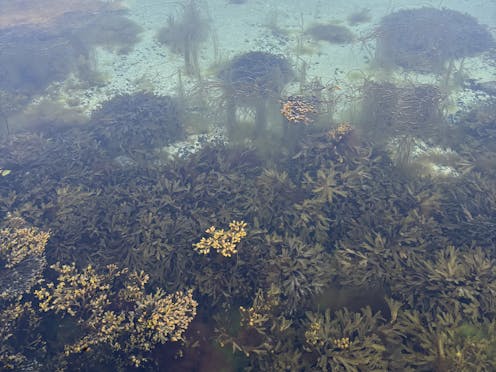
A seaweed garden: rocks provide vital surfaces for marine life to grow. Dominique Townsend, CC BY-NC-ND

At the end of the last ice age, billions of boulders and cobbles were left scattered over southern Scandinavia. Huge ice sheets had dragged the rocks from mountainous regions further north down to the Baltic Sea areas. When those ice sheets retreated and sea levels rose, these colossal boulders became rocky reefs, rich with marine life. These rocks formed part of a naturally resilient coast, proving a rugged structure for waves to break and reducing pressure on the seashore.

For centuries these reefs have been exploited as building materials. This practice of “stonefishing” occurred extensively across Denmark and was only banned in 2010 by which time the rocky shore had been depleted, leaving only smaller rocks on the seabed. Now that it’s illegal, Denmark is scrambling to recover marine life and prepare for rising sea levels by restoring these reefs.

In the century between 1900 and 2000, approximately 8.3 million cubic metres of rock covering an area of about 21 square miles were extracted from Danish shallow coastal waters for building purposes on land. Although this is a relatively small area, boulder reefs are biological hotspots, supporting hundreds of marine species. These rocky reefs act as a base for everything from oysters to seaweed to thrive, plus a safe haven for young fish.


Read more:
How Denmark’s oysters are transforming foodies into citizen scientists


Often divers would accompany boats during boulder extraction to help guide these giant claws around the stones.
Svend Christensen, CC BY-NC-ND

Now numerous projects are being carried out to bring the stones back to coastal areas. At least eight stone reef restoration projects are currently underway, with the earliest having begun even before stonefishing was prohibited. The first project happened in northern Denmark, conveniently close to Norway where a quarry provided the needed rocks. Since then, interest in restoring lost reefs has grown tremendously.

The restoration projects reveal that marine life returns when given the time, space and right conditions to do so. Seaweed forests recover, creating necessary structural complexity and associated species reenter the restored areas. Atlantic cod, once a culturally and economically important species in the region, are especially attracted to the restored reefs. One study showed cod numbers increased by 60-129 fold over the course of the five to six months after a rock reef was rebuilt.

cod fish in rocks
A cod resting within a restored rocky reef on Læsø Trindel in the Kattegat.
Karsten Dahl, CC BY-NC-ND

While working on a stone reef restoration project on the island of Als, in southern Denmark, one of us (Jon C. Svendsen) spotted an opportunity. With rising sea levels, weather getting more severe and being a low-lying country, Denmark is becoming increasingly concerned with coastal erosion. Rocky reefs can help dissipate wave energy, providing a form of protection and so it just made sense to combine the two.

Although Denmark is not as low lying as the nearby Netherlands, the coastline is 4,600 miles long. This makes it one of the longest coastlines in Europe, with around 40% of the population living within a couple of miles of the sea. As sea levels rise, larger waves will be able to reach the shore, leading to increased risk of flooding and erosion, especially on coasts with very small variation in tide levels such as Denmark.

Our stone barrier reef project tests the idea of combining both the protection of the coastline and enhance biodiversity along a section of coast on the island of Samsø. The boulder reef was constructed earlier this year, and extends about 100m long and 16m wide. Sitting roughly 1m below the sea surface, it resembles a medieval rock wall rising from the seabed and runs parallel to the shore.

An introduction to the stone barrier reef project in Samsø.

This reef design is expected to partially shelter the coastline from waves, causing large waves to break along its crest. This reduces the amount of energy available for coastal erosion and encourages the build up of sediment. It is hoped that within this newly created sheltered area, meadows of seagrass (a marine flowering plant) can colonise and flourish.

We’ll be monitoring the progress through an extensive monitoring programme, recording changes in species richness and the sea bed. By snorkelling, we can survey the changes in marine plant and animal life. Underwater cameras will be used to unobtrusively identify and count the number of species moving around the reef over the next three years. With evidence of how marine life recovers, we’ll explore whether these rocky reefs can jointly stabilise the coastline and improve biodiversity in the area.

rocks by coast, with machinery
Boulders are being used in the construction of the Samsø island rock reef as part of the BARREEF project.
Jon Christian Svendsen, CC BY-NC-ND

Globally the fundamental problem with coastal management is that we cannot see vast changes as they occur below the sea surface. Various initiatives across the UK are also trying to make amends for the large historic loss of marine habitats.

Oyster reefs are one such example. Following the collapse of the oyster industry in the 1980s, there are now more than a dozen restoration projects underway in a bid to restore populations of these ecologically and environmentally important species. By working with nature, not extracting from it, we finally stand a chance of building truly resilient coastlines.


Don’t have time to read about climate change as much as you’d like?

Get a weekly roundup in your inbox instead. Every Wednesday, The Conversation’s environment editor writes Imagine, a short email that goes a little deeper into just one climate issue. Join the 45,000+ readers who’ve subscribed so far.


The Conversation

Jon C. Svendsen receives funding from the Velux Foundation and Vattenfall to conduct the BARREEF project.
Research is further funded by A) the Danish Rod and Net Fish License Funds, Denmark, B) the Horizon Europe project MARHAB (grant no. 101135307) (Improving marine habitat status by considering ecosystem dynamics), and C) the BlueBioClimate project (Interreg, grant no. 2021TC16RFCB025).

Dominique Townsend does not work for, consult, own shares in or receive funding from any company or organisation that would benefit from this article, and has disclosed no relevant affiliations beyond their academic appointment.

ref. Stones have been ‘overfished’ from the sea – here’s how Denmark’s rocky reefs are being restored – https://theconversation.com/stones-have-been-overfished-from-the-sea-heres-how-denmarks-rocky-reefs-are-being-restored-263151

The latest Tory defector to Reform wrote David Cameron’s ‘hug a hoodie’ speech – here’s why that matter now

Source: The Conversation – UK – By Nicholas Dickinson, Lecturer in Politics, University of Exeter

Conservative party leader David Cameron gave a speech in 2007 on social justice which is remembered as the “hug a hoodie” moment. In it, he laid out the foundations of what would become the “big society” social programme and called for more compassion towards young people. The speech was written by his adviser Danny Kruger – the MP who has just defected to Nigel Farage’s Reform party.

Back then, Kruger, Philip Blond and Steve Hilton were seen as the key intellectual forces behind compassionate conservatism. But we now realise that the big society was really informed by a much darker vision of society than the hug a hoodie speech implied.

It was based on the belief that the country had been hollowed out by the moral vacuousness of governments (both left and right) since the 1960s. The picture the Conservatives painted even at the time was not one of optimism and progress but of crisis and decline.

This was exemplified by Kruger in particular. As he puts it in his essay On Fraternity, published the same year as Cameron’s speech: “Our culture is in the grip of this pernicious alliance, between … self-seeking individualism … and the bloated, all-aggrandising, all-powerful state … Between the two, society is being squeezed to death.” The political left is apportioned the majority of the blame for this state of affairs.

Blond was critical of every post-war government for creating a managerial welfare state which destroyed the old mutualism of the British working class while facilitating social permissiveness. This, he thought, had led to the commodification of sex and the creation of “empty pleasure-seeking drones” who looked to the state to solve problems. Today the right calls this being an NPC – a non-player character.

As a result of his links to Cameron, Blond became a feted public intellectual, founding a think-tank to promote his ideas. Kruger, meanwhile, pursued a career in the third sector before moving into politics. He became an MP in 2019 after a stint at the pro-Brexit Legatum institute.

Reading Cameron’s speech alongside Kruger’s essay today reveals not a coherent political philosophy but a carefully sanitised version of traditional conservatism designed for public consumption. What emerges is not genuine conservative compassion, but social conservativism dressed in progressive language.

The vanishing act

Kruger’s essay is replete with references to classic thinkers and concerns itself primarily with the abstract concept of fraternal bonds in society. Like Cameron, he defines British nationalism as primarily civic and not ethnic. Yet cultural change, including immigration’s effect on social cohesion, are rarely far from the surface.

He identifies “the presence of large communities with different national origins” as one of Britain’s three major challenges, contrasting today’s diversity with an allegedly more homogeneous past. This anxiety about rapid demographic change runs quietly throughout his analysis of social breakdown.

Cameron’s speech, by contrast, made these concerns disappear almost entirely. While discussing youth crime he avoids any suggestion that cultural diversity might complicate social cohesion. The “hoodie” instead becomes a deracinated symbol of alienated youth. Likewise, Cameron avoided golden age rhetoric by focusing entirely on the present and future.

Both texts struggle with a fundamental question: who gets to define the social values that supposedly bind communities together? Kruger writes extensively about “social authority” but rarely distinguishes benevolent community pressure from oppressive conformity except by implication. His requirement that “acts of public liberty” be “compatible with the interests and values of British society as a whole” sounds reasonable until you ask who determines that compatibility.

Cameron dodges this entirely by focusing on consensual values as well as, somewhat ironically, an appeal to expertise. But serious social problems often involve contested values around family structure, sexual morality, work ethic, and cultural integration. Compassionate conservatism had no mechanism for addressing these conflicts beyond hoping voluntary organisations would somehow resolve them.

This vagueness wasn’t accidental. It was essential to the compassionate conservative project. Specific policies force difficult choices between competing values. Better to speak in generalities about “love” and “relationships” while avoiding the hard questions about resources, priorities and trade-offs.

The collapse of compassionate conservatism

Understanding the collapse of compassionate conservatism requires recognising its primary function: electoral coalition-building. It allowed conservatives to appeal to socially liberal voters while maintaining traditional supporters. The problem is that this coalition was always unstable because it papered over genuine philosophical disagreements rather than resolving them.

Kruger’s defection represents the collapse of this synthesis. When migration pressures intensified, cultural conflicts sharpened, and mainstream conservative parties failed to address underlying tensions, the intellectual architects of compassionate conservatism abandoned the project for more explicitly populist alternatives.

Hilton abandoned British politics in the 2010s for Fox News, eventually siding with Trump and the MAGA movement. He is presently running for governor of California against progressive incumbent Gavin Newsom.

Blond still comments on British politics, using his X account in support of a variety of socially conservative positions on abortion, assisted dying, and trans rights. Today he believes the “most oppressed groups in the UK are white working-class males”, though he still interprets this as a progressive position.

Cameron’s speech worked as political rhetoric because it tells everyone what they want to hear – conservatives get individual responsibility and support for voluntary organisations, while progressives get structural understanding and emotional empathy. But when it comes to actual governance, these tensions become impossible to ignore.

Compassionate conservatism wasn’t a serious attempt to synthesise liberty and social justice. It was a marketing campaign that promised voters they could have conservative economics and progressive social policy simultaneously. The intellectual incoherence was a feature, not a bug. Politicians could avoid making difficult choices by pretending they didn’t exist.

The result was a politics of good intentions that consistently failed to deliver meaningful change, leaving both conservative and progressive goals unmet. Now that the electoral rewards of this approach have diminished, even its creators seem to have moved on to more authentic (or lucrative) expressions of their actual beliefs.

The Conversation

Nicholas Dickinson does not work for, consult, own shares in or receive funding from any company or organisation that would benefit from this article, and has disclosed no relevant affiliations beyond their academic appointment.

ref. The latest Tory defector to Reform wrote David Cameron’s ‘hug a hoodie’ speech – here’s why that matter now – https://theconversation.com/the-latest-tory-defector-to-reform-wrote-david-camerons-hug-a-hoodie-speech-heres-why-that-matter-now-265561

Curious kids: why do we dream?

Source: The Conversation – UK – By Anthony Bloxham, Lecturer in Psychology, Nottingham Trent University

Jorm Sangsorn/Shutterstock

Why do we dream? Vishnu, aged nine, Kerala

That’s a really interesting question, and people have been asking it for thousands of years. But it’s difficult to answer because dreams are difficult to study scientifically.

Think about it: how easy do you find it to remember your dreams every night? Not everyone can do this. If we can’t remember our dreams, we can’t study them.


Curious Kids is a series by The Conversation that gives children the chance to have their questions about the world answered by experts. If you have a question you’d like an expert to answer, send it to curiouskids@theconversation.com and make sure you include the asker’s first name, age and town or city. We won’t be able to answer every question, but we’ll do our very best.


Some ancient cultures like the Egyptians, the Greeks and the Romans believed that dreams were important messages from the gods. But even they could not agree about exactly where dreams come from, why they happen or what they might mean.

In the last 100 years, many scientists across the world have learned a lot about the science of dreaming. But even still, there is disagreement.

Some scientists think dreams have an important job, others do not. I’ll explain some of the most well-known ideas.

Around the year 1900, an Austrian psychologist (someone who studies how we think) called Sigmund Freud published an influential book called The Interpretation of Dreams. In it, Freud wrote about his experiences of talking to other people about their dreams (and his own dreams too).

He believed that dreams came from wishes or desires buried deep in the mind. He thought these wishes were usually transformed in some way to disguise them in the dream, as they could be quite scary or rude.

Freud would help people to work out what these hidden wishes and desires might be, so they could address them in waking life. He also wrote that dreams are a part of the process that helps keep us asleep, that dreams protect sleep from disturbances. And there is some evidence to support that idea.

Freud’s ideas had a great influence on thinking about dreams for many decades. But since Freud’s time, we have learned much more about how sleep works. And that has inspired new ideas about what dreams might (or might not) be doing.

In the 1970s, scientists like Allan Hobson started to reject Freud’s ideas about dreams, and suggested that perhaps dreams don’t do anything important. In Hobson’s view, dreams had no hidden meaning or function to them.

He thought they might just be random side-effects of chemical processes going on in the brain during sleep. It is one good explanation for why dreams often seem so strange. Hobson thought little bits and pieces of knowledge and imagination get activated and merge together meaninglessly.

But other scientists since then have noticed that not all dreams are strange. Many of them are in fact quite ordinary, and some have content that is important to the dreamer.

Perhaps you have dreamed about something that happened in your life recently, like a fun day out with your school friends or family, or maybe you dreamed you were in a film you watched the day before.

We often dream about things that had a significant effect on us in waking life, or are related to worries we carry with us. And this I think is the most important thing we need to realise: our dreams are connected with our waking lives.

Concept art of boy riding a paper cloud
Dreams don’t always make sense – at least at first.
Roman Samborskyi/Shutterstock

Some scientists now believe that dreaming about these things might help us to process them, or give us new ideas about what to do in our waking life. This is still difficult to test though. Whether or not this is what dreams are really doing by themselves, you have the choice to look at your dreams and decide what new ideas you can draw from them.

Another interesting idea is that dreams evolved long ago to help us survive threats. A lot of people seem to report dreaming about being chased by monsters or dangerous animals. Maybe you have too.

Some scientists see this as evidence for a threat simulation system that emerged back when we were living in caves and had to hunt for our food while trying not to be hunted ourselves.

If we survive a threatening encounter in a dream, that could better prepare us for surviving real threats when we are awake. The problem with this idea though is that it is too dangerous to test properly.

Even if someone dreams about fighting a tiger, for example, scientists cannot then lock people in a cage with a real tiger and see how well they survive!

That’s one of the exciting things about being a scientist. There are still lots of questions to answer and we’re learning new things all the time.

The Conversation

Anthony Bloxham does not work for, consult, own shares in or receive funding from any company or organisation that would benefit from this article, and has disclosed no relevant affiliations beyond their academic appointment.

ref. Curious kids: why do we dream? – https://theconversation.com/curious-kids-why-do-we-dream-264817

Does your child need more protein? The answer is probably not

Source: The Conversation – UK – By Sophia Komninou, Lecturer in Public Health Nutrition, Swansea University

Most kids won’t need extra protein added into their diet. Asada Nami/ Shutterstock

Protein is everywhere nowadays. From yogurt to breakfast cereal, bread to pasta or even chocolate bars, the obsession with making sure we get enough protein has seemingly taken over our diets.

This push for protein has even started to trickle down to children, with parents now worrying their kids aren’t getting enough of it. While protein is certainly an important nutrient for growing children, most will already get more than enough protein from their regular diet and won’t need fortified foods to “boost” their intake.

Adults usually need between 0.8g and 1.2g of protein per kilogram of bodyweight. But infants, toddlers and children all have high protein needs relative to their body size because of their very rapid growth – so this factor is much higher.

That might lead to parents to think they need to provide large amounts of protein to their child or worry that if their child isn’t getting enough it will stunt their development. But because children have a much lower body weight compared to adults, the amount they actually need is still significantly less than what the average adult needs daily.

For babies under a year old, recommended protein intake is between 12-15g of protein per day. They require such a high amount of protein in proportion to their body weight because of how fast they grow – doubling their birth weight in the first six months and tripling it by their first birthday. Their protein needs are usually covered by their normal breast milk or formula intake.

Up to three years of age, as their development gets less rapid, children need around 15g of protein a day. From age four to six, children need around 20g of protein per day as their body weight increases. From six to ten, they need around 28g of protein per day.

From then on, the recommendations differ between boys and girls as they reach puberty at slightly different rates. From the ages of nine to 13, boys and girls both need around 34g of protein per day. But from age 14-18, girls need approximately 46g of protein while boys need 52g.

Protein intake

Your child’s daily protein needs are probably already being adequately met through their usual diet. To illustrate how when it comes to actual food intake, a cup of milk (240ml) or half a cup of lentils or beans contains 8g of protein, an egg or one slice of cheese has around 6g of protein and 100g of Greek yoghurt or 40g of chicken contains 10g of protein.

There’s also protein in many foods that we don’t normally associate with protein. For instance, pasta has 5g of protein per 100g, rice around 3g per 100g and bread has around 2g per slice.

A boy uses a fork to eat a plate of spaghetti with red sauce.
Other foods, such as pasta, also contain some protein.
Aaaarianne/ Shutterstock

So, unless your child is an extremely picky eater, it’s unlikely you need to actively count their protein intake daily or find ways of sneaking extra protein in with fortified foods, protein powders or adding high-protein ingredients to recipes. Their diet alone should be sufficient.

What’s more, focusing too much on specific nutrients could create a stressful environment around mealtimes. This could affect a child’s relationship with food in the long term.

Focusing solely on protein consumption could also potentially lead to under consumption of other nutrients that offer different health benefits. For example, when focusing on high-protein diets for toddlers and children, the rest of their diet might end up lacking fruits and vegetables as they’re considered low protein. But fibre is essential for gut health, so this could lead to health problems such as constipation.

Fast-growing toddlers and children also need more that just protein for growth and development. They need a combination of many macro- and micronutrients – including carbohydrates and unsaturated fats, which are often found in foods that aren’t protein rich.

Protein increases feelings of fullness by slowing stomach emptying. This could reduce hunger and overall food intake – including intake of these other nutrients that are important for development. For more picky eaters that could lead to even more restricted diet.

Too much protein has also been shown to have a negative effect on the kidneys, liver and bone density in adults. However, the evidence is still not there yet for children on how much is too much. But what we do know is that high animal protein diets have been associated with excessive weight gain early in life so too much protein may best be avoided.

Protein is an essential part of your child’s diet, important for their growth and development. But most will get more than enough from the foods they normally eat and won’t need products such as protein shakes or protein supplements.

The Conversation

Sophia Komninou does not work for, consult, own shares in or receive funding from any company or organisation that would benefit from this article, and has disclosed no relevant affiliations beyond their academic appointment.

ref. Does your child need more protein? The answer is probably not – https://theconversation.com/does-your-child-need-more-protein-the-answer-is-probably-not-263744

If you’re a fan of Downton Abbey, this Grand Finale is a big letdown

Source: The Conversation – UK – By Laura O’Flanagan, PhD Candidate, School of English, Dublin City University

After 15 years on screen, Downton Abbey limps to its conclusion with The Grand Finale. Directed by Simon Curtis and billed as the ultimate farewell, it reunites the ensemble cast for one last bow.

Marketed as the crowning chapter of a much-loved, award-winning series that once defined Sunday night television in Britain and became a transatlantic hit, the film carries a weight of expectation.

What audiences have been given, however, is a perfunctory epilogue, as though everyone involved knew something had to be delivered but couldn’t quite summon the spark to make it worthwhile.

At the film’s centre lies the long-anticipated moment when Lord Grantham (Hugh Bonneville) prepares to hand the reins of Downton Abbey to Lady Mary (Michelle Dockery). This plot is further complicated by Mary’s divorce, a scandal rippling through society as she assumes leadership of the estate.

This culmination of a story where responsibility is passed on, continuity is assured and change is accepted ought to feel momentous, but it is bogged down by dozens of minor storylines, quickly raised and neatly resolved. The slack pacing and uneven tone reduce it to a carousel of passing titbits. The Grand Finale seems determined to include all of the characters at once, and in doing so, loses its way.

With such a sprawling cast, there is no room to dig deeply. Scenes are crowded with so many characters that the effect often resembles a curtain call – each actor stepping forward for a line or two, then retreating again. It keeps faces in circulation, but it does not serve the audience.

This lack of focus highlights how far the films have drifted from what once made Downton Abbey irresistible. The television series thrived on a delicate balance of upstairs-downstairs drama. Modest conflicts, such as who might inherit, who might marry and whether a servant’s job was secure, were magnified through sharp writing and careful pacing into something greater than the sum of their parts.

It was a series about character, rhythm and mood as much as Edwardian glamour. The series let tensions simmer, mysteries unfold and gave its ensemble cast space to shine without overwhelming the story. Enormously popular, Downton Abbey became woven into Sunday nights in the UK, the kind of viewing that people looked forward to.

After a long week, Sunday evening would come, curtains were drawn, tea was brewed, and Downton Abbey was on TV. The familiar grand Victorian house with its rituals upstairs and downstairs helped close out the weekend with something warm, elegant and comforting. For me, it was a balm earlier this year while I was waiting on medical results and caught in restless uncertainty.

In this limbo, I returned to Downton Abbey on TV. It was comforting and familiar, yet still compelling enough to hold my attention when little else could. Back in good health, however, The Grand Finale could barely hold my attention for the two-hour running time.

Still, there is some pleasure in seeing the actors again. Michelle Dockery settles effortlessly back into Mary, and her warm exchanges with Laura Carmichael’s Edith highlight the positive development of the sisters’ relationship. Joanne Froggatt has a gentle and kind presence as Anna, and there are glimmers of the magic of the series in the scenes with Daisy (Sophie McShera) and Mrs Patmore (Leslie Nicol).

Maggie Smith’s absence is deeply felt; without the dowager countess’s sharp wit and perfectly timed barbs, the film misses the comedy of her character and veers too far towards sweetness and politeness.

Downton Abbey: The Grand Finale should have been the story’s crowning achievement, a chapter that tied its themes together and gave long-time viewers reason to cherish the journey one last time. Instead, it is a poor imitation of past glories.

A series that once made the smallest stakes feel monumental ends with an instalment that is both thin and tedious. Lord Grantham, resorting to cliche, remarks: “So this is how the world ends, not with a bang but a whimper.”

The whimper of this finale plays out in orchestral swells, becoming glossy and hollow, with a sentimental montage at the end which resembles a John Lewis Christmas advert. On the other hand, if you have found yourself invested in Downton over the years, how can you not take this chance to wave off old friends and find out how it ends? Just don’t expect a bang.

The Conversation

Laura O’Flanagan does not work for, consult, own shares in or receive funding from any company or organisation that would benefit from this article, and has disclosed no relevant affiliations beyond their academic appointment.

ref. If you’re a fan of Downton Abbey, this Grand Finale is a big letdown – https://theconversation.com/if-youre-a-fan-of-downton-abbey-this-grand-finale-is-a-big-letdown-265434

Millennial pink, gen Z yellow, brat green… Tell me your favourite colours, and I’ll guess your generation

Source: The Conversation – France – By Sabine Ruaud, Professeur de marketing, EDHEC Business School

Although each generation seems to adopt a particular palette, it would be simplistic to view this as a biological or universal phenomenon. While colour is the visual effect produced by the spectral composition of light that is emitted, transmitted or reflected by objects, how we interpret it is above all a social and cultural construct, shaped by customs, ideologies and media influences.

As French historian Michel Pastoureau, points out, colours are not created by nature – nor solely by the eye or the brain – but by society, which assigns them different meanings depending on the era. They thus become a kind of indicator of the transformations of each decade.

In the chapter section titled La Couleur, marqueur créatif générationnel? (Colour: a generational creative marker?) recently published in Les Dessous de la creativité – gagner en confiance creative et relever les défis (The Secrets of Creativity: Gaining Creative Confidence and Overcoming Challenges), we explore how successive generations are defined by sets of values, beliefs and behaviours that also manifest visually – most notably through their own distinctive colours.

Segmenting by generation – boomers, X, Y, Z, Alpha – thus allows us to observe chromatic preferences that are not merely matters of individual taste, but reflections of a collective relationship to time, aspirations and dominant aesthetics.

Each generation has its own colour code

Baby boomers (born between the end of the second world war and the mid-1960s) and generation X (1965 to 1980) gravitated toward more traditional palettes, with a dominance of neutral and pastel tones. From the 1970s onwards, these were enriched by earthy hues drawn from nature – greens, browns and rust reds.

Generation Y, or millennials (1980 to mid-1990s), saw the rise of an iconic colour: millennial pink. More than just a hue, this soft pastel became emblematic in the 2010s – symbolising lightness, optimism and, above all, a challenge to traditional gender codes.

For generation Z (1995–2010), the first standout shade was a bold yellow, quickly dubbed gen Z yellow, which emerged around 2018 in deliberate contrast to their predecessors’ pink. Soon after, purple entered the mix – long associated with power, creativity and feminist struggles, and now reinterpreted as a symbol of inclusivity and self-expression. More recently, green has gained ground. On one hand, it has become a rallying colour for ecological concerns and in political discourse; on the other, it has been reinvented as the provocative, screen-bright brat green, popularised in 2024 by British singer Charli XCX.

Generation Alpha, still in its early years, moves between two poles: a pull toward natural, comforting tones, and early immersion in the saturated, artificial colours of the digital world.

Being rooted in one’s time

While these generational markers are compelling, they should not be taken as fixed. Colours are never static: they circulate, evolve, and reinvent themselves. They return in cycles, much like fashion, and take on new meanings along the way. This fluidity is what gives colour such power in communications. It anchors a brand in its era, while also leaving space for reinterpretation.

The latest trends for 2024–2025 make this clear. Alongside the neon green tied to Charli XCX’s album “Brat”, Pantone has named Mocha Mousse, a warm, indulgent brown that speaks to a collective yearning for comfort and stability, its 2025 Colour of the Year. The contrast between these two signals – one ironic and exuberant, the other quiet and reassuring – captures the spirit of our moment, poised between excess and a quest for balance.

The power of colour naming

Research in marketing also shows that a colour’s impact lies not just in the hue itself, but in how it is named.

The name given to a colour directly shapes consumer preference and purchase intention. An evocative, poetic or playful name generates far more engagement than a generic label. This phenomenon – still underexplored – reminds brands that language can shape perception just as strongly as colour does. But humour or quirkiness must be handled with care: too much can blur brand recall, making balance essential.

For companies, the challenge is twofold. First, to understand the generational codes that shape how colours are read and received, so they can speak in an instantly recognisable visual language. Second, to build a colour system that remains coherent and sustainable over time.

Talking about generational colours is therefore a useful decoding tool – provided we recognise its flexibility. For every generation, colour is more than an aesthetic choice: it is a carrier of meaning, a witness to its time, a source of emotion, and a shared language that binds individuals to the spirit of their age.


A weekly e-mail in English featuring expertise from scholars and researchers. It provides an introduction to the diversity of research coming out of the continent and considers some of the key issues facing European countries. Get the newsletter!


The Conversation

Les auteurs ne travaillent pas, ne conseillent pas, ne possèdent pas de parts, ne reçoivent pas de fonds d’une organisation qui pourrait tirer profit de cet article, et n’ont déclaré aucune autre affiliation que leur organisme de recherche.

ref. Millennial pink, gen Z yellow, brat green… Tell me your favourite colours, and I’ll guess your generation – https://theconversation.com/millennial-pink-gen-z-yellow-brat-green-tell-me-your-favourite-colours-and-ill-guess-your-generation-265326

Jimmy Kimmel’s cancellation is the latest sign we’re witnessing the end of US democracy

Source: The Conversation – Global Perspectives – By Emma Shortis, Adjunct Senior Fellow, School of Global, Urban and Social Studies, RMIT University

History’s path is never linear. But its turns can be very sharp.

It is rare to be able to identify the moment when we can say “this is the point at which everything changed”.

So have we reached the point where we can say the United States is in a constitutional crisis? Has American democracy failed? Has the US descended into authoritarianism?

If the answers to those questions weren’t clear already, they are now.

Yes. It is happening. Right now.

Not because of one incident, but a series of moments and choices, events within familiar historical structures, that are pushing the US over the edge.

The assassination of Charlie Kirk, and the choices made by the administration in its aftermath, is one such moment. It was immediately clear the Trump administration would use Kirk’s murder as a pretext for accelerating its authoritarian project, weaponising it to destroy opponents, both real and imagined.

In a video address from the Oval Office, Trump blamed the “radical left” and promised a crackdown on “organisations” that “contributed” to the crime. His vice president, JD Vance, hosted Kirk’s podcast, effectively making it a tool of state-sponsored media.

On that show, White House Deputy Chief of Staff Stephen Miller promised “we are going to use every resource we have at the Department of Justice, Homeland Security and throughout this government to identify, disrupt, dismantle and destroy these networks”.

In the MAGA-verse, terms such as “radical left”, “networks” and “organisations” are code for any form of opposition or dissent – including the Democratic Party and traditional media. It is worth noting here that “radical left” is now shifting to terms as broad as “left-leaning”, progressive or, even more subversive, liberal.

The Trump administration is promising to go after the fundraising architecture of its opposition, broadly defined. And it will. It is already using the agencies of the federal government – including the Federal Bureau of Investigation and the Internal Revenue Service – to threaten, punish and obliterate those who oppose it.

And the moments keep coming. On Wednesday, Chair of the Federal Communications Commission, Brendan Carr, appeared on another far-right podcast. Carr – a Project 2025 contributor – suggested that broadcasters running the Jimmy Kimmel Live! show were risking “the possibility of fines or licensed revocation from the FCC” due to Kimmel’s comments about Kirk’s death.

That night, ABC announced that Kimmel’s show would be suspended indefinitely.

Kimmel’s moment follows Stephen Colbert’s. It follows another moment earlier in the week, when Trump berated senior Australian Broadcasting Commission journalist John Lyons, aggressively telling him he was “hurting” Australia and that he would tell the Australian prime minster as much. The ABC has since been barred from Trump’s UK press conference, ostensibly for “logistical reasons”.

In the firehose of these moments, it can be difficult to see them in context. But they are all connected – part of a deliberate, carefully planned program to destroy anyone or anything that opposes or even questions Republican orthodoxy as defined by Trump.

The Kirk moment, the Kimmel moment, and all the rest, must be understood in that broader framework. This week, too, the Trump administration announced it was deploying the National Guard into Memphis, Tennessee. It will likely also send the National Guard into Chicago, as it has long been threatening. It has already despatched the National Guard into Los Angeles and Washington DC.

Trump and his cronies are openly musing about other “Democrat cities”. The point is to sow fear and suppress dissent. It is working.

This month, in the aftermath of a meeting with his Russian counterpart Vladimir Putin, Trump promised to end mail-in voting. The Trump-aligned Supreme Court is poised to gut a key provision of the Voting Rights Act intended to prevent racial discrimination. The mid-term elections are still over a year away.

Incredibly, we are only eight months into the second Trump administration. But the moments will keep coming, and the speed at which they arrive will likely accelerate.

Taken together, they paint a very grim picture for the future of US democracy, constrained though it already is. The widespread, coordinated suppression of dissent – and the extended chilling effect that suppression has – are ripping apart the fabric of American political life.

It is here. It is happening. History is being made before our eyes.

This is a monumental change. For the United States. For the world.

The Conversation

Emma Shortis is Director of International and Security Affairs at The Australia Institute, an independent think tank.

ref. Jimmy Kimmel’s cancellation is the latest sign we’re witnessing the end of US democracy – https://theconversation.com/jimmy-kimmels-cancellation-is-the-latest-sign-were-witnessing-the-end-of-us-democracy-265574