Government shutdown hasn’t left consumers glum about the economy – for now, at least

Source: The Conversation – USA (2) – By Joanne Hsu, Research Associate Professor at the Institute for Social Research, University of Michigan
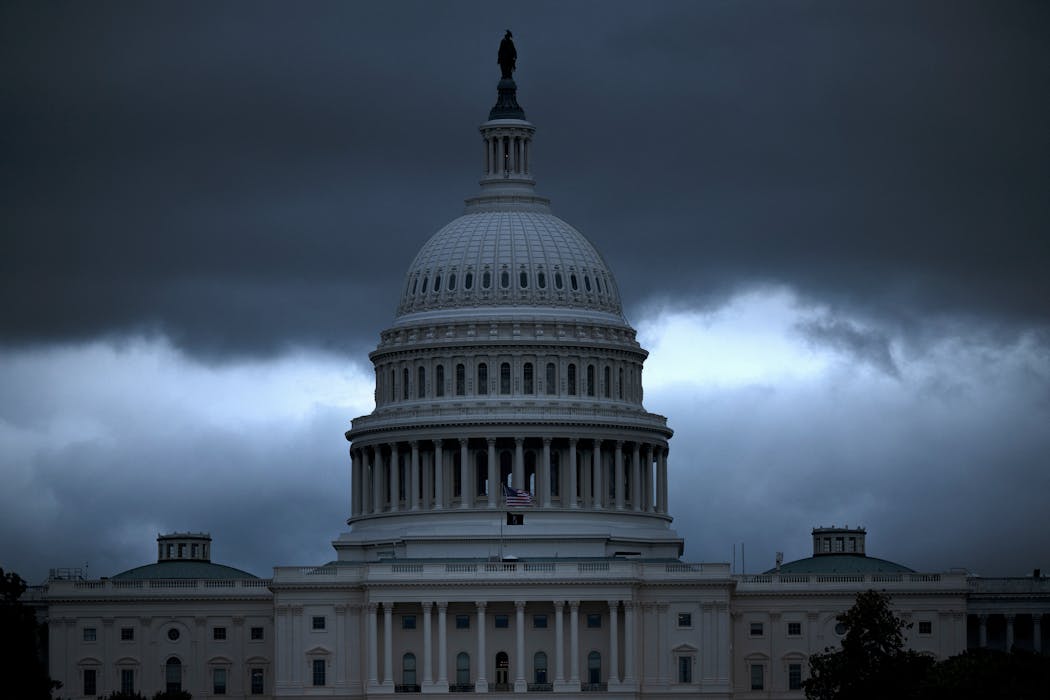
Economic clouds gathering? Perhaps not yet. Brendan Smialowski/AFP via Getty Images

The ongoing federal shutdown has resulted in a pause on regular government data releases, meaning economic data has been in short supply of late. That has left market-watchers and monetary policymakers somewhat in the dark over key indicators in the U.S. economy.

Fortunately, the University of Michigan’s Surveys of Consumers is unaffected by the impasse in Washington and released its preliminary monthly report on Oct. 10, 2025; the final read of the month will be released in two weeks.

The Conversation U.S. spoke with Joanne Hsu, the director of the Surveys of Consumers, on what the latest data shows about consumer sentiment – and whether the shutdown has left Americans feeling blue.

What is consumer sentiment?

Consumer sentiment is something that we at the University of Michigan have measured since 1946. It looks at American attitudes toward the current state of the economy and the future direction of the economy through questions on personal finances, business conditions and buying conditions for big-ticket items.

Over the decades, it has been closely followed by policymakers, business leaders, academic researchers and investors as a leading indicator of the overall state of the economy.

When sentiment is on the decline, consumers tend to pull back on spending – and that can lead to a slowdown in the economy. The opposite is also true: High or rising sentiment tends to lead to increased spending and a growing economy.

How is the survey compiled?

Every month, we interview a random sample of the U.S. population across the 48 contiguous states and the District of Columbia. Around 1,000 or so people take part in it every month, and we include a representative sample across ages, income, education level, demography and geography. People from across all walks of life are asked around 50 questions pertaining to the economy, personal finances, job prospects, inflation expectations and the like.

When you aggregate that all together, it gives a useful measure of the health of the U.S. economy.

What does the latest survey show?

The latest survey shows virtually no change in overall sentiment between September and October. Consumers are not feeling that optimistic at the moment, but generally no worse than they were last month.

Pocketbook issues – high prices of goods, inflation and possible weakening in the labor market – are suppressing sentiment. Views of consumers across the country converged earlier in the year when the Trump administration’s tariffs were announced. But since then, higher-wealth and higher-income consumers have reported improved consumer sentiment. It is for lower-income Americans – those not owning stock – that sentiment hasn’t lifted since April.

In October, we also saw a slight decline in inflation expectations, but it remains relatively high – midway between where they were around a year ago and the highs of around the time of the tariff announcements in April and May.

Has the government shutdown affected consumer sentiment?

The government shutdown was in place for around half the time of the latest survey period, which ran from Sept. 23-Oct. 6, 2025. And so far, we are not seeing evidence that it is impacting consumer sentiment one way or another.

And that is not super-surprising. It is not that people don’t care about the shutdown, just that it hasn’t affected how they see the economy and their personal finances yet.

History shows that federal shutdowns do move the needle a little. In 2019, around 10% of people spontaneously mentioned the then-shutdown in the January survey. We saw a decline in sentiment in that month, but it did improve again the following month.

Looking back, we tend to see stronger reaction to shutdowns when there is a debt ceiling crisis attached. In 2013, for example, there was a decline in consumer sentiment coinciding with concerns over the debt ceiling being breached. But it did quickly rebound when the government opened again.

Whether or not we see a decline in sentiment because of the current shutdown depends on how long it lasts – and how consumers believe it will impact pocketbook issues, namely prices and job prospects.

The Conversation

Joanne Hsu receives research funding from NIA, NIH, and various sponsors of the University of Michigan Surveys of Consumers.

ref. Government shutdown hasn’t left consumers glum about the economy – for now, at least – https://theconversation.com/government-shutdown-hasnt-left-consumers-glum-about-the-economy-for-now-at-least-267264

Nobel peace prize winner Maria Corina Machado: the Venezuelan opposition leader forced into hiding after taking on Maduro

Source: The Conversation – UK – By Pia Riggirozzi, Professor of Global Politics, University of Southampton

Across Latin America, democracy is coming under severe pressure. Authoritarian leaders across the continent have been entrenching political power through constitutional manipulation, militarised policing and the persecution of dissent.

In Venezuela, Nicaragua, El Salvador and Argentina, regimes are increasingly eroding democracy and mounting a backlash against human rights.

It is in this bleak regional landscape that the Nobel Committee’s decision to award the 2025 peace prize to María Corina Machado has landed. The award is a recognition of one woman’s defiance. But it is also an opportunity to ask what kind of democracy and what kind of peace the world should aspire to.

Machado has long been the face of Venezuela’s democratic opposition. Disqualified from public office, vilified by Nicolás Maduro’s regime and repeatedly threatened, she embodies the persistence of civic dissent.

The Nobel prize committee’s citation reads: “She is receiving the Nobel Peace Prize for her tireless work promoting democratic rights for the people of Venezuela, and for her struggle to achieve a just and peaceful transition from dictatorship to democracy.”

Yet that transition is a long way from being achieved and remains deeply uncertain. Venezuela has fallen victim to increasing political polarisation and is now suffering one of the worst displacement crises in the hemisphere, with 8 million people having left the country since 2014. And the threat of US interference is ever present.

The prize thus risks celebrating an aspiration more than an outcome. It represents a fragile hope in a region where democratic renewal is both urgent and unfinished.

A feminist reading of courage and contradiction

The award makes Machado the first Venezuelan to receive the Nobel peace prize, underscoring the international significance of her career and support for the Venezuelan democratic cause. There is no doubt that her courage is extraordinary.

Machado has refused exile, rejected violence and unified a fragmented opposition under conditions that would crush most political careers. She was forced to go into hiding last year shortly after alleging fraud in Nicolás Maduro’s reelection on July 28 2024.

For decades, women in Latin America have been at the forefront of resistance movements. From the Mothers of the Plaza de Mayo in Argentina to the Ni Una Menos protests in Buenos Aires, Santiago, Bogotá and Mexico City, women’s groups have focused on advancing human rights and social justice. Machado’s recognition inserts Venezuelan women’s political agency into that prominent tradition.

In a region where politics remains saturated by machismo and military archetypes, this is not trivial. The image of a woman – assertive, unapologetic, unbowed – being recognised as a symbol of peace and democratic resistance matters deeply.

Yet the discussion cannot stop there. Machado comes from a powerful business family. She was educated in exclusive schools in Venezuela and the US and shaped by early work in her family’s steel company – all of which may have informed and defined her political outlook.

Her position as an elite woman in a country whose crisis has hit the poor and working-class hardest highlights the need to broaden the conversation about what a just and inclusive democracy looks like.

Her economic agenda – market-oriented and pro-privatisation – raises questions about whether democratic renewal can balance economic reforms, social protection and grassroots priorities. It asks how best to address inequalities that underpin Venezuela’s crisis.

In recognising Machado, the Nobel committee has invited reflection not only on the courage of individual leaders but also on how democratic movements can more fully integrate issues of peace and social justice for all alongside the fight against authoritarianism.

The announcement of the 2025 Nobel peace prize.

Democracy, peace, and the displaced

The Nobel committee described Machado’s resistance as peaceful. In Venezuela the concept of peace is multifaceted. It encompasses not only the absence of violence but also the profound challenges of hunger, displacement and uncertainty that millions continue to face.

The mass displacement since 2014 has disproportionately affected women and girls. They often flee for gender-specific reasons such as the collapse of maternal healthcare and increased rates of gender-based violence. Many have been exposed to trafficking and sexual violence and have faced bureaucratic indifference.

They are the collateral damage of Venezuela’s authoritarian collapse. But they are also symptomatic of an international order that fails to protect women.

This situation underscores the necessity of broadening our understanding of peace to include the protection and rights of women – in this case, the many displaced Venezuelan women and girls.

It must demand a transition that not only restores electoral democracy but guarantees dignity for those who lost everything to repression and political, economic and humanitarian decay.

A mirror for the region

Machado’s Nobel prize is especially timely given that it has been awarded against a backdrop of democratic backsliding and even erosion across Latin America. Her experience highlights the way that the more democracy is undermined by a regime in power, the more difficult it becomes for an opposition to unseat that regime in elections – or assume office if it does win power.

Latin American democracies are losing institutional capacity to restrain the executive – while on the streets, popular protest is often forcibly repressed. Many opposition politicians and activists have no option but to flee or hide.

This has been Machado’s experience. But this Nobel prize sends a signal that global institutions are watching and highlights the deep concern for the future of democracy and the fragility of peace.

The Conversation

Pia Riggirozzi have received funding from ESRC for the project Redressing Gendered Health Inequalities of Displaced Women and Girls in Contexts of Protracted Crisis in Central and South America (ReGHID)

ref. Nobel peace prize winner Maria Corina Machado: the Venezuelan opposition leader forced into hiding after taking on Maduro – https://theconversation.com/nobel-peace-prize-winner-maria-corina-machado-the-venezuelan-opposition-leader-forced-into-hiding-after-taking-on-maduro-267245

Can friendship keep you young? Scientists say your social life might slow ageing

Source: The Conversation – UK – By James Goodwin, Visiting Professor in the Physiology of Ageing, Loughborough University

Monkey Business Images/Shutterstock.com

I recently heard Professor Luigi Ferrucci, an expert on ageing, speak at my local university’s medical school. One line really stuck with me: “The next great step in ageing science will be understanding how lifestyle factors slow down ageing.”

That, to me, is the ultimate goal. If we can slow the ageing process, we could delay or shorten the time we spend living with age-related illnesses. In other words, we might stay healthy for longer and only experience those diseases in the last few years of life, feeling younger and better overall.

As Ferrucci gave his talk, a new study was being published showing that one of the most surprising factors influencing ageing is our social life. It turns out that staying connected to others could slow how fast we age.

We’ve known for a while that people with strong social ties tend to live longer and enjoy better health. What’s been less clear is how our social connections affect our bodies on a biological level.

In this new American study of more than 2,000 adults, researchers looked at the strength and consistency of people’s social connections – things like family relationships, involvement in community or religious groups, emotional support and how active they were in their communities.

They devised a measure called “cumulative social advantage” (CSA) – essentially, how socially connected and supported someone is. This was a step forward because most earlier studies looked only at single factors like marriage or friendship.

The researchers then compared CSA to different measures of ageing. They looked at biological age (based on DNA changes, known as “epigenetic clocks”), levels of inflammation throughout the body, and how people’s stress-related hormones – such as cortisol and adrenaline – were behaving.

They found that people with stronger social connections tended to show slower biological ageing and lower inflammation. However, there wasn’t much of a link between social life and short-term stress responses, though the researchers suggested that this might simply be because those are harder to measure.

Altogether, the study adds to growing evidence that our social connections are closely tied to how we age. But perhaps we shouldn’t be too surprised. Humans have evolved over hundreds of thousands of years as social beings.

For our ancient ancestors, belonging to a group wasn’t just about company – it was key to survival. Working together kept us safer, helped us find food and supported our wellbeing. It makes sense, then, that our bodies have developed to thrive when we’re socially connected.

Rock painting of prehistoric people hunting together.
Social networks were important for survival on the African savanna.
Gas-photo/Shutterstock.com

Social advantage

The study also found that social advantage is linked with broader inequalities. People with higher levels of education, better income or belonging to certain ethnic groups often showed slower ageing and lower inflammation. This suggests that both our social and economic circumstances affect how we age.

There seem to be two ways to respond to this. First, we need social policies that reduce poverty and improve education and opportunity, because these factors clearly shape health and ageing. But second, we also have some individual control. Strengthening our own social lives – staying connected, supportive and involved – can also make a difference.

I remember being in Washington DC in 2014 for the 40th anniversary of the US National Institute on Aging, where Ferrucci now serves as chief scientific director. During the event, someone asked the head of social sciences: “What will be the most important research area for the next century?” Without hesitation, he replied: “Social science and genetics.”

At the time, no such research programme existed – but he was right. As this new study shows, bringing together these two fields is helping us understand not just how we age, but how we might age better.

The Conversation

James Goodwin does not work for, consult, own shares in or receive funding from any company or organisation that would benefit from this article, and has disclosed no relevant affiliations beyond their academic appointment.

ref. Can friendship keep you young? Scientists say your social life might slow ageing – https://theconversation.com/can-friendship-keep-you-young-scientists-say-your-social-life-might-slow-ageing-266313

How a 400,000-year-old elephant skeleton solved a tantalising puzzle of early human behaviour

Source: The Conversation – UK – By Gerrit Dusseldorp, Associate Professor of Stone Age Archaeology, Leiden University

One spring, after a long winter, an aged elephant lay dying at the bank of a small stream near the coast of what is now northern Italy. Soon after, some scavengers arrived to dine on this huge stockpile of food.

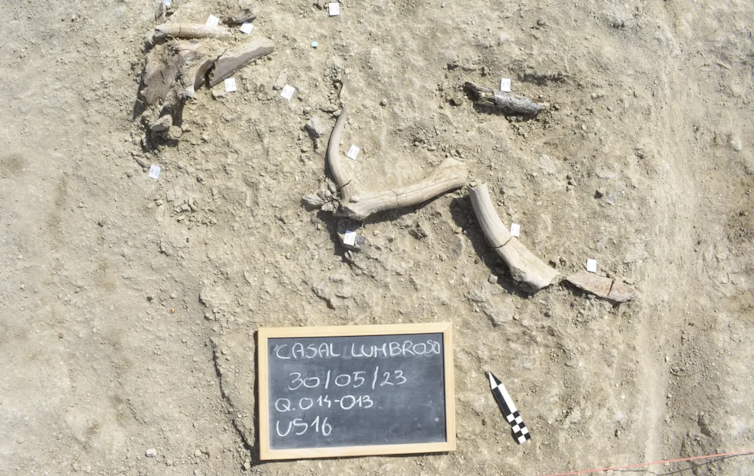
Over 400,000 years later, building activities at Casal Lumbroso on the outskirts of Rome have revealed one of the elephant’s tusks, prompting archaeological excavations to investigate the immediate surroundings.

A newly published study, led by Enza Spinapolice and Francesca Alhaique, not only provides an insight into the death of the elephant but also, perhaps more interestingly, the lives of the scavengers that fed on it.

These scavengers were no hyenas. They were a strange species of primate walking on two legs – early nomadic humans, living in Europe at a time long before people built houses or even lit fires, who briefly halted to profit from this unexpected windfall.

This discovery is a successful example of how archaeological heritage management can be integrated within development and building activities. Since 1992, a European-wide treaty makes it compulsory for EU nations to protect their archaeological heritage. But each country can decide for itself how to do so.

In my native Netherlands, the discovery of an animal fossil alone would not necessarily lead to excavations. A site like this might therefore easily be destroyed unseen.

But in the elephant’s case, the Roman archaeological superintendence went beyond the call of duty. They organised an ambitious research project which revealed – and solved – a tantalising puzzle of early human behaviour: what exactly did these nomadic scavengers do with the body of this animal?

Solving a 400,000-year-old jigsaw

Four hundred thousand years ago, humans in Europe were few in number but probably most common along the Mediterranean shores. Their fossils are extremely rare, but skulls from Sima de los Huesos (literally meaning “pit of bones”) in northern Spain and Swanscombe in England show that the people around this time were early Neanderthals.

Luckily for us, they left behind more than just their skeletons. We can also study their tools, which have been recovered across large parts of Europe – as far north as the south of England.

The river in which the Casal Lumbroso elephant died transported ash from a volcanic eruption that can be precisely dated to 404,000 years ago – so the elephant must have died after this. But the position of the sediments shows the ash deposits were from a warm period, dating to before 395,000 years ago. From that time, colder conditions started prevailing.

So, this puzzle for archaeologists was laid down in a very narrow (from an archaeological point of view) time slice.

In these warm periods, Italy was inhabited by a fascinating community of animals including wolves, lions, hyenas, hippos and rhinos. But straight-tusked elephants were the crowning glory. This species was much larger than an African elephant and was a true ecosystem engineer, opening up landscapes that would otherwise be densely forested, improving productivity for many other species.

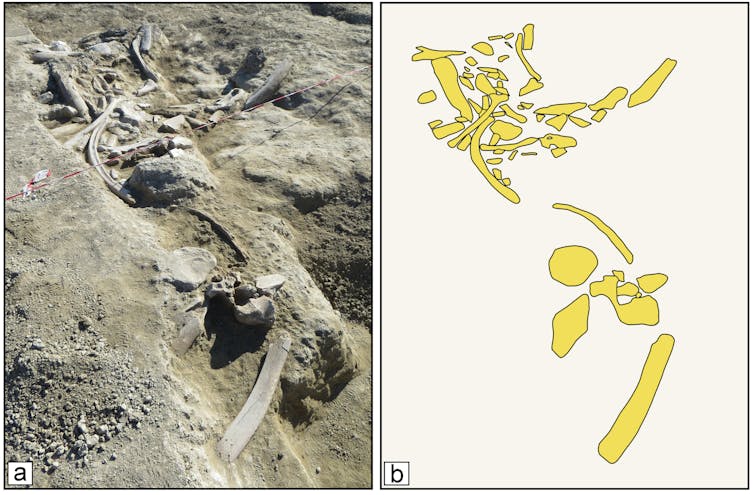
Elephant bones on site at Casal Lumbroso and a sketch of their outlines.
Elephant bones on the site at Casal Lumbroso, near Rome, and a sketch of their outlines.
Mecozzi et al., 2025, PLOS One, CC BY

This particular animal was in its late 40s – old for an elephant. It may have gotten stuck in the mud of the riverbank and died a natural death. We know this happened in other places too – for example, at Pogetti Vecchi in Tuscany, where seven elephants died in a hot spring and were later partially butchered. At Casal Lumbroso, we even know the season in which the elephant died: shed red deer and fallow deer antlers suggest it was spring.

Humans roaming the landscape in small groups would naturally be attracted to this mountain of meat. While the bones of the elephant do not show characteristic cut-marks produced by slicing and filleting, they do show hammer marks and were found next to several small flint tools.

We can see that the people hammered open some bones, perhaps for the fat marrow inside. But they also used the bones to make tools. This is uncommon behaviour which has only been documented at a few other sites.

In most cases, it seems the early Neanderthals preferred to make their tools from flint and, we suspect, other materials such as wood that are only rarely preserved for us to find. Creating bone tools is sometimes seen to be a technologically complex behaviour, indicating modern-like intellect.

I think the explanation is simpler: we rarely find them because they are more likely to decay than stone tools. Their use in at Casal Lumbroso may have been a case of “needs must”.

After all, beautiful though the ancient Italian environment may have been, for people depending on good stones for their tools, it had a severe shortcoming: flint was only available in very small pebbles.

These humans’ technology was nowhere near as sophisticated as the “classic” Neanderthals of later times who distilled birch tar, gave stone tools wooden handles and routinely lit fires – all of which we do not see this far back in time. This group was versatile enough to modify their technological repertoire to produce very small flint tools, but also to explore using other materials like elephant bone.

They adapted to the small flint pebbles using “bipolar technology” – a technique already in evidence at the first archaeological site, 3.3 million-year-old Lomekwi in Kenya. It consists of putting the stone you want to flake on a larger stone anvil, then hitting it at the top with another stone. This splits the pebbles into two pieces and from here, sharp flakes can be produced.

Elephant bones in the ground
The elephant bones at Casal Lumbroso.
Beniamino Mecozzi, CC BY

Some of the flint tool edges found at Casal Lumbroso were pristine enough to analyse for microscopic traces of their prehistoric use. They point to use on a rather soft material, which could mean the cutting of elephant meat – although this could be caused by other things as well.

These early Neanderthals also had more complex technical repertoires. They brought a hand axe to the site, made on (and from) a larger block of limestone – not the best material for tools as it is quite soft, but still suitable to make this larger tool type.

Possessing only imperfect stones – either too small or too soft – this group also grasped the potential of the huge elephant bones to fashion into tools. They broke up some bones and shaped them by flaking the bone with a hammerstone, in the same way they worked flint.

For perhaps only a few hours, the sounds of flint hitting the anvil, the cracks of breaking bone and the excited shouts of people flushed with a rich source of food would have filled the air. Then these early people would have moved on again, perhaps to find a suitable spot for the night.


Looking for something good? Cut through the noise with a carefully curated selection of the latest releases, live events and exhibitions, straight to your inbox every fortnight, on Fridays. Sign up here.


The Conversation

Gerrit Dusseldorp does not work for, consult, own shares in or receive funding from any company or organisation that would benefit from this article, and has disclosed no relevant affiliations beyond their academic appointment.

ref. How a 400,000-year-old elephant skeleton solved a tantalising puzzle of early human behaviour – https://theconversation.com/how-a-400-000-year-old-elephant-skeleton-solved-a-tantalising-puzzle-of-early-human-behaviour-267137

Donald Trump would have been an unsuitable choice for the 2025 Nobel peace prize – but he may be a more serious contender in 2026

Source: The Conversation – UK – By Stefan Wolff, Professor of International Security, University of Birmingham

And the winner is … not Donald Trump. That the US president didn’t get his much-coveted award is probably going to be the enduring memory of the 2025 Nobel peace prize.

This year’s recipient is María Corina Machado, leader of Venzuela’s opposition movement. The Norwegian Nobel committee awarded her the prize “for her tireless work promoting democratic rights for the people of Venezuela, and for her struggle to achieve a just and peaceful transition from dictatorship to democracy”.

Machado’s efforts are laudable and she deserves praise for her personal courage standing up to Venezuela’s strong-man ruler, Nicolás Maduro. What is less apparent is how her selection fits with the award criteria as specified in Alfred Nobel’s will.

Nobel wanted the recipient to be “the person who shall have done the most or the best work for fraternity between nations, the abolition or reduction of standing armies, and for the holding and promotion of peace congresses”. It’s open to debate whether Machado fits those criteria.

In fact, the entire process surrounding the 2025 Nobel peace prize has been highly unusual, in the way it has involved very public lobbying for a particular candidate. Trump himself has used every conceivable opportunity to push for the award – even his speech before the UN general assembly on September 23, when he reiterated an earlier claim to have “solved seven wars” that he made on August 19.

Those claims have been widely called into question, with good reason. Tenuous ceasefires are the closest that Trump got in some of the actual wars in which intervened.

This would not necessarily have ruled him out of the competition – the criteria do not require success and allow for effort to be rewarded. Yet even then, his chances for success were remote, given that nominations close on January 31, after which a shortlist is developed from late February and deliberations commence.

At that stage, the US president had arguably played a role in a temporary ceasefire in the war in Gaza – but most of his subsequent claims had yet to come to pass.

Nobel controversies

There have been controversial choices for the Nobel peace prize before: Henry Kissinger and Abiy Ahmed Ali, to name just two.

Kissinger won the prize in 1973 for ending the Vietnam war, together with Le Duc Tho, the principal Vietnamese negotiator who declined the prize. But while Kissinger negotiated the end of that war as US secretary of state, he was also notorious for his devastating bombing campaign against Cambodia from 1969 to 1973, among other things,.


Read more:
The Nobel peace prize has a record of being awarded to controversial nominees


Abiy was awarded the 2019 prize “for his efforts to achieve peace and international cooperation, and in particular for his decisive initiative to resolve the border conflict with neighbouring Eritrea”. But that did not stop him from fighting a vicious civil war against the Tigray People’s Liberation Front, which has cost the lives and livelihoods of hundreds of thousands of civilians.

Trump clearly looks a better candidate in comparison to Abiy and Kissinger. But now compare him with three other past US presidents who won the prize.

Theodore Roosevelt won in 1906 for mediating an end to the Russo-Japanese war. Woodrow Wilson won in 1919 for founding the League of Nations. And Jimmy Carter won in 2002 for decades of work promoting peaceful conflict resolution, democracy and human rights. Against these, Trump’s track record of success looks shakier.

Shaky track record

While he deserves some credit for his efforts and at least some temporary successes, Trump has no spotless track record as a peacemaker. His eight months in office since re-entering the White House in January 2025 are hardly an advertisement for criteria set out by Alfred Nobel.

Trump has threatened to annex Greenland and incorporate Canada as the 51st state of the US, joined Israel in bombing Iran during the so-called 12-day war, and carried out a deadly campaign of airstrikes against alleged Venezuelan drug traffickers.

This mixture of peacemaking and warmongering sets Trump apart from the fourth US president to win the prize, Barack Obama, who won in 2009 “for efforts to strengthen international diplomacy and cooperation between peoples”. This too was a controversial choice at the time as it was mostly aspirational, given Obama’s lack of track record as president in the early months of his administration.


Read more:
Nobel peace prize winner Maria Corina Machado: Venezuelan opposition leader forced into hiding after taking on Maduro


Perhaps the best outcome of the 2025 Nobel peace prize saga, and the fact Trump did not win, might be that the US president now doubles down on his peacemaking efforts. He has gone on the record as having ended seven wars, and now has another potential success with the Gaza ceasefire deal.

If he wants to remain in contention for the 2026 award, Trump can’t afford for his grandiose claims to be proved wrong. If he succeeds in preventing any of these conflicts from flaring up again, a service to peace will have been done – and it shouldn’t matter that it was done by Trump, or what his ultimate motivation was.

The Conversation

Stefan Wolff is a past recipient of grant funding from the Natural Environment Research Council of the UK, the United States Institute of Peace, the Economic and Social Research Council of the UK, the British Academy, the NATO Science for Peace Programme, the EU Framework Programmes 6 and 7 and Horizon 2020, as well as the EU’s Jean Monnet Programme. He is a Trustee and Honorary Treasurer of the Political Studies Association of the UK and a Senior Research Fellow at the Foreign Policy Centre in London.

ref. Donald Trump would have been an unsuitable choice for the 2025 Nobel peace prize – but he may be a more serious contender in 2026 – https://theconversation.com/donald-trump-would-have-been-an-unsuitable-choice-for-the-2025-nobel-peace-prize-but-he-may-be-a-more-serious-contender-in-2026-267067

Why some people turn off the lights, and others don’t

Source: The Conversation – UK – By Lorraine Whitmarsh, Professor of Environmental Psychology, University of Bath

Southworks/Shutterstock

Saving energy isn’t just about keeping bills down. A new analysis of 100 existing studies across 42 countries shows that people with positive attitudes to the environment, or who want what they do at home to make a difference to society, are more likely to save energy.

This finding is in line with leading psychological models of behaviour, which show there is often a relationship between what we feel and what we do.

But these models, and the evidence about who is more likely to turn off the lights and save energy, also show very clearly that there is often an “attitude-behaviour gap” – what we know we should do doesn’t always translate into action.

Anyone who has tried to lose weight or quit smoking will be very aware of this. Like health behaviour, environmental actions also suffer from this gap: while most people worry about climate change, far fewer take sufficient action.

This is because it is not only attitudes that predict behaviour, but the social, economic and physical context in which we act. In fact for many people, these factors exert a stronger influence on what we do than internal factors such as attitudes.

Cost and convenience matter

Cost, convenience and societal conventions are all strong influences on our actions. This helps to explain changes in how much homes are heated (due to central heating being more widespread), or use of hot water.

Many older people remember a weekly bath being the norm in their childhoods. Yet today, daily showers are more typical – partly because many more houses have showers now. Unsurprisingly, cost is also a driver of behaviour: more people will invest in energy-saving technology when energy prices are high than when they’re low.

Similarly, the new study shows that knowledge of environmental impact has a limited effect on energy-saving behaviour. For example, we have found that environmental awareness has little influence on whether people fly for work. In our 2020 study of academic travel, the people flying the most were climate change professors – who certainly knew that aviation is a contributor to climate change.

This gap between knowledge and action exists for the same reason as the attitude-behaviour gap: namely, our behaviour is influenced by wider factors than what we feel or know. A person whose job requires air travel is likely to fly for work even when they are aware of the environmental harm.

People are more likely to get heat pumps if their neighbours get them.

Neighbours are influential

The new study also finds that people save more energy if they think others expect them to – showing that social norms are a powerful influence on our behaviour.

Recent work similarly shows that social factors strongly shape people’s decision to buy a heat pump – one of the most effective energy-saving actions. Having a friend or neighbour with a heat pump means you hear about its benefits and how to buy it, and are more likely to believe it is a good idea than just hearing about it through secondhand sources (such as news reports).

At least as important, though, is making energy-saving actions cheap and convenient. So policies to reduce costs of energy technologies or insulation, and which ensure skilled installers are available, are critical. Saving energy is more often motivated by financial than environmental concerns – so price is a particularly powerful lever.

The new study also finds links between energy-saving and other green behaviour, such as recycling or using public transport. Research suggests that similar actions often relate. For instance, people who save energy are more likely to save water – often because these actions flow from a “green identity”: a sense of being an environmentally interested person.

But these links are not very strong, and become weaker across more diverse actions – for example, avoiding car use and saving energy at home – because the external factors that shape these choices are very different. So, living in a rural area might preclude reducing car use, while saving energy might be possible.

Ultimately, promoting energy-saving behaviour means creating the right conditions for people to act.

While information and motivation are crucial, meaningful and sustained change depends on making the greener option affordable, convenient – and just normal. If policies and environments support energy-saving choices, large-scale behaviour change (and progress towards climate and energy goals) becomes far more achievable.


Don’t have time to read about climate change as much as you’d like?

Get a weekly roundup in your inbox instead. Every Wednesday, The Conversation’s environment editor writes Imagine, a short email that goes a little deeper into just one climate issue. Join the 45,000+ readers who’ve subscribed so far.


The Conversation

Lorraine Whitmarsh receives funding from UKRI.

Sam Hampton receives funding from UKRI and the Askehave Climate Foundation.

ref. Why some people turn off the lights, and others don’t – https://theconversation.com/why-some-people-turn-off-the-lights-and-others-dont-266738

Hamas at a crossroads as the Gaza ceasefire deal comes into force

Source: The Conversation – UK – By Dale Pankhurst, PhD Candidate and Tutor in the School of History, Anthropology, Philosophy and Politics, Queen’s University Belfast

After two years of war, Israel and Hamas have agreed on the “first phase” of a US-backed peace plan for Gaza. The deal, if it holds, will involve the release of Israeli hostages and Palestinian prisoners, the withdrawal of Israeli troops from Gaza and the entry of aid into the enclave.

The president of the Palestinian Authority, Mahmoud Abbas, has welcomed the news. He has expressed hope that the deal acts as a “prelude to reaching a permanent political solution” between Israel and Palestine.

But what lies ahead for Hamas? A clause in the wider peace plan calls for the full dissolution of the group, both as a militant organisation and as a civil administration. It is difficult to see how Hamas leadership will negotiate their way through this without some form of disarmament or demobilisation.

The Israeli government, with backing from the US and other western countries such as the UK, has repeatedly said the full demobilisation of Hamas and its militant wing is the only possible outcome it will accept. This leads to a significant dilemma for Hamas.

Its entire reason for existence is to seek the destruction of the Israeli state through violence. There is no room for peaceful, democratic means in its objectives. So if the Hamas leadership are to pursue some form of demobilisation, they risk fracturing the organisation into dissenting armed factions that continue their militancy against Israel.


Read more:
Israel and Hamas agree ceasefire deal – what we know so far: expert Q&A


The Wall Street Journal reports that Hamas’s lead negotiator, Khalil al-Hayya, as well as other political officials living outside of Gaza, are ready to accept disarmament as part of a wider peace process. But analysts suggest other leaders and militants still based in Gaza may be less willing to compromise.

Hamas has remained remarkably resilient throughout the two years of war in Gaza. US figures from early 2025 showed that Hamas had added up to 15,000 new volunteers since the October 7 attacks in 2023, largely replacing those it had lost since the start of the conflict. Many of these recruits may be reluctant to surrender their weapons after losing family and property during the war.

At the same time, Hamas is not the only armed Palestinian group operating in Gaza. Although Hamas led the October 7 attacks against Israel, the attacking force contained militants from multiple armed groups.

These included Palestinian Islamic Jihad (PIJ), the Marxist-Leninist Popular Front for the Liberation of Palestine, the Al-Aqsa Martyrs Brigades, the Maoist Democratic Front for the Liberation of Palestine (DFLP) and the Palestinian Mujahideen Movement.

Some of these groups, including the PIJ, are thought to have joined Hamas in peace talks with Israel. Others are less willing to enter negotiations. The DFLP, for example, has said in a statement that it rejects any form of international mandate or guardianship in Gaza. This includes the future involvement of the former British prime minister, Sir Tony Blair, or an international security force.


Read more:
Gaza peace plan risks borrowing more from Tony Blair’s failures in the Middle East than his success in Northern Ireland


Beyond Gaza, Hamas has to consider its future in broader Palestinian politics. The armed group has ruled over Gaza since 2007. But its traditional opponent, Fatah, which Hamas expelled from the Gaza Strip in 2007 following a bloody feud, continues to wield significant political authority in the West Bank through its dominance of the Palestinian Authority.

Relations between Hamas and Fatah have been cordial in recent years. But Hamas may fear any demobilisation of its armed forces could shift the balance of power within Palestinian politics, enabling the Palestinian Authority to renew efforts for Gaza to rejoin the West Bank under a single, unified political authority.

Some form of disarmament is possible

Comparable case studies show that the disarmament and demobilisation of insurgent groups is possible, at least in part. In Northern Ireland, the Provisional Irish Republican Army (Pira) decommissioned a large portion of its weaponry in 2005 following protracted peace negotiations.

The Revolutionary Armed Forces of Colombia (Farc) also demobilised its armed units in 2017, a year after a historic peace settlement was reached between the Colombian state and the leftist rebels. Both organisations disarmed despite the presence of other armed groups, such as dissident republicans in Northern Ireland and the National Liberation Army in Colombia, that continued to wage violent campaigns.

Yet in Northern Ireland, the Pira never fully demobilised its volunteer base nor did it decommission all of its weapons. British security services and the Northern Irish police have found evidence that Pira members have been involved in several murders against internal opponents since the group decommissioned.

British intelligence also believes that the Pira’s militant structures and decision-making body, the army council, remain intact. They allege that these people now oversee the political strategy of Sinn Féin, an Irish republican political party.

While some insurgent groups disarm and demobilise, their legacy is slow to fade. Would Israel be willing to accept a similar disarmament, demobilisation and reintegration arrangement in Gaza as the British have done in Northern Ireland?

It is difficult to see the government of Israeli prime minister, Benjamin Netanyahu, which has continually reiterated that Hamas must be completely destroyed, doing so. Yet a different Israeli administration might.

It also remains to be seen whether Hamas could plausibly disarm a portion of its forces, such as its rocket units and armed assault groups, and allow others to be absorbed into a security force system governed by a body styled on the Palestinian Authority.

A monumental shift in strategic direction would be required for Hamas to reach this point. And the group is arguably more ideologically entrenched now as an Islamist Palestinian movement than the Pira was in the 1990s or the Farc in the 2010s.

Hamas is at a crossroads. It now faces either a period of negotiating for its future with little room to manoeuvre or further war with Israel if it refuses to dissolve. The challenge for mediators is to find a pathway that satisfies Israeli security demands and Hamas’s own quest for survival and transformation within Palestinian politics.

The Conversation

Dale Pankhurst does not work for, consult, own shares in or receive funding from any company or organisation that would benefit from this article, and has disclosed no relevant affiliations beyond their academic appointment.

ref. Hamas at a crossroads as the Gaza ceasefire deal comes into force – https://theconversation.com/hamas-at-a-crossroads-as-the-gaza-ceasefire-deal-comes-into-force-267145

Vitamin B3 supplement may reduce your risk of skin cancer

Source: The Conversation – UK – By Justin Stebbing, Professor of Biomedical Sciences, Anglia Ruskin University

BLACKWHITEPAILYN/Shutterstock.com

A major shift is unfolding in the field of skin cancer prevention, ignited by new research showing that an everyday vitamin supplement may prevent many cases of the world’s most frequently diagnosed cancer.

The supplement in question is nicotinamide, a form of vitamin B3.

Whereas previous studies hinted at a potential benefit, the latest research – spanning more than 33,000 US veterans – suggests that adding this simple vitamin pill to daily routines could dramatically lower skin cancer risk, especially for those who have already experienced their first case.

The scale, breadth and clarity of this evidence are driving calls to rethink how skin cancer is prevented.

Skin cancer is the world’s most common form of cancer. Non-melanoma types, including basal cell carcinoma and cutaneous squamous cell carcinoma, account for millions of new cases each year.

These cancers are linked to cumulative sun exposure, fair skin and ageing. Existing prevention strategies focus on avoiding ultraviolet (UV) rays and using sunscreen, but rates continue to climb, and patients diagnosed with one skin cancer typically face a stubborn cycle of recurrence.

Enter nicotinamide, a cheap, widely available supplement. Researchers observed that this form of vitamin B3 bolsters the skin’s natural repair systems after UV damage, reduces inflammation, and helps the immune system detect and clear abnormal cells.

In the new study, over 12,000 patients who began taking nicotinamide at 500mg twice daily for more than a month were compared to more than 21,000 who did not. Those taking nicotinamide saw a 14% lower risk of developing any new skin cancer. The protective effect was most profound when started promptly after a first diagnosed skin cancer, resulting in a 54% drop in the risk of additional cancers.

This benefit faded if supplementation started only after multiple recurrences, suggesting that timing matters. The effect was seen across both main skin cancer types but was particularly robust for squamous cell carcinoma, which can behave more aggressively and carries a greater risk of complications.

It’s important to underscore that, while hopeful, these findings do not suggest nicotinamide should replace sun avoidance or routine skin checks. Wearing hats, using sunscreen and seeking shade remain pillars of prevention.

Still, the simplicity, safety and low cost of nicotinamide mean that its incorporation as a daily “add-on” is an accessible step for most people, especially those with a track record of skin cancer. For dermatologists, this is an attractive profile compared to some prescription medicines used to prevent recurrence, which may be more expensive or have worse side-effects.

As a secondary prevention tool, it stands out as effective and practical. The timing of intervention appears paramount, with the greatest benefit gained when nicotinamide is offered straight away. In practice, this shifts the conversation, urging healthcare professionals and patients to view the first cancer as a red flag to act decisively.

Woman applying sunscreen to her shoulder.
Sunscreen is still one of the pillars of skin-cancer prevention.
verona studio/Shutterstock.com

Perspective is important

The findings emerge from an observational study using real-world data, meaning researchers looked at health records and drew statistical associations. Most participants were white males, so the broader relevance of these findings remains uncertain.

While this type of study cannot prove cause and effect as powerfully as a randomised trial, the results align with earlier, smaller trials that hinted at the same benefit. They reinforce the idea that a simple, non-pharmaceutical intervention could help in the battle against the world’s most common cancer, and at a fraction of the expense or risk of more intensive therapies.

This research does not settle every question. It remains to be seen how nicotinamide performs over very long periods and whether the benefit is as robust in more diverse populations. Additionally, people who have never had skin cancer were not the focus, so broader recommendations are likely to stay reserved for those with a prior history.

Still, for those confronting the anxiety of a first skin cancer diagnosis, the promise of a readily available, low-cost and well-tolerated supplement offers a new sense of control.

The Conversation

Justin Stebbing does not work for, consult, own shares in or receive funding from any company or organisation that would benefit from this article, and has disclosed no relevant affiliations beyond their academic appointment.

ref. Vitamin B3 supplement may reduce your risk of skin cancer – https://theconversation.com/vitamin-b3-supplement-may-reduce-your-risk-of-skin-cancer-266766

Nobel peace prize winner Maria Corina Machado: Venezuelan opposition leader forced into hiding after taking on Maduro

Source: The Conversation – UK – By Pia Riggirozzi, Professor of Global Politics, University of Southampton

Across Latin America, democracy is coming under severe pressure. Authoritarian leaders across the continent have been entrenching political power through constitutional manipulation, militarised policing and the persecution of dissent.

In Venezuela, Nicaragua, El Salvador and Argentina, regimes are increasingly eroding democracy and mounting a backlash against human rights.

It is in this bleak regional landscape that the Nobel Committee’s decision to award the 2025 peace prize to María Corina Machado has landed. The award is a recognition of one woman’s defiance. But it is also an opportunity to ask what kind of democracy and what kind of peace the world should aspire to.

Machado has long been the face of Venezuela’s democratic opposition. Disqualified from public office, vilified by Nicolás Maduro’s regime and repeatedly threatened, she embodies the persistence of civic dissent.

The Nobel prize committee’s citation reads: “She is receiving the Nobel Peace Prize for her tireless work promoting democratic rights for the people of Venezuela, and for her struggle to achieve a just and peaceful transition from dictatorship to democracy.”

Yet that transition is a long way from being achieved and remains deeply uncertain. Venezuela has fallen victim to increasing political polarisation and is now suffering one of the worst displacement crises in the hemisphere, with 8 million people having left the country since 2014. And the threat of US interference is ever present.

The prize thus risks celebrating an aspiration more than an outcome. It represents a fragile hope in a region where democratic renewal is both urgent and unfinished.

A feminist reading of courage and contradiction

The award makes Machado the first Venezuelan to receive the Nobel peace prize, underscoring the international significance of her career and support for the Venezuelan democratic cause. There is no doubt that her courage is extraordinary.

Machado has refused exile, rejected violence and unified a fragmented opposition under conditions that would crush most political careers. She was forced to go into hiding last year shortly after alleging fraud in Nicolás Maduro’s reelection on July 28 2024.

For decades, women in Latin America have been at the forefront of resistance movements. From the Mothers of the Plaza de Mayo in Argentina to the Ni Una Menos protests in Buenos Aires, Santiago, Bogotá and Mexico City, women’s groups have focused on advancing human rights and social justice. Machado’s recognition inserts Venezuelan women’s political agency into that prominent tradition.

In a region where politics remains saturated by machismo and military archetypes, this is not trivial. The image of a woman – assertive, unapologetic, unbowed – being recognised as a symbol of peace and democratic resistance matters deeply.

Yet the discussion cannot stop there. Machado comes from a powerful business family. She was educated in exclusive schools in Venezuela and the US and shaped by early work in her family’s steel company – all of which may have informed and defined her political outlook.

Her position as an elite woman in a country whose crisis has hit the poor and working-class hardest highlights the need to broaden the conversation about what a just and inclusive democracy looks like.

Her economic agenda – market-oriented and pro-privatisation – raises questions about whether democratic renewal can balance economic reforms, social protection and grassroots priorities. It asks how best to address inequalities that underpin Venezuela’s crisis.

In recognising Machado, the Nobel committee has invited reflection not only on the courage of individual leaders but also on how democratic movements can more fully integrate issues of peace and social justice for all alongside the fight against authoritarianism.

The announcement of the 2025 Nobel peace prize.

Democracy, peace, and the displaced

The Nobel committee described Machado’s resistance as peaceful. In Venezuela the concept of peace is multifaceted. It encompasses not only the absence of violence but also the profound challenges of hunger, displacement and uncertainty that millions continue to face.

The mass displacement since 2014 has disproportionately affected women and girls. They often flee for gender-specific reasons such as the collapse of maternal healthcare and increased rates of gender-based violence. Many have been exposed to trafficking and sexual violence and have faced bureaucratic indifference.

They are the collateral damage of Venezuela’s authoritarian collapse. But they are also symptomatic of an international order that fails to protect women.

This situation underscores the necessity of broadening our understanding of peace to include the protection and rights of women – in this case, the many displaced Venezuelan women and girls.

It must demand a transition that not only restores electoral democracy but guarantees dignity for those who lost everything to repression and political, economic and humanitarian decay.

A mirror for the region

Machado’s Nobel prize is especially timely given that it has been awarded against a backdrop of democratic backsliding and even erosion across Latin America. Her experience highlights the way that the more democracy is undermined by a regime in power, the more difficult it becomes for an opposition to unseat that regime in elections – or assume office if it does win power.

Latin American democracies are losing institutional capacity to restrain the executive – while on the streets, popular protest is often forcibly repressed. Many opposition politicians and activists have no option but to flee or hide.

This has been Machado’s experience. But this Nobel prize sends a signal that global institutions are watching and highlights the deep concern for the future of democracy and the fragility of peace.

The Conversation

Pia Riggirozzi have received funding from ESRC for the project Redressing Gendered Health Inequalities of Displaced Women and Girls in Contexts of Protracted Crisis in Central and South America (ReGHID)

ref. Nobel peace prize winner Maria Corina Machado: Venezuelan opposition leader forced into hiding after taking on Maduro – https://theconversation.com/nobel-peace-prize-winner-maria-corina-machado-venezuelan-opposition-leader-forced-into-hiding-after-taking-on-maduro-267245

Curious Kids: who invented art?

Source: The Conversation – UK – By Frances Fowle, Personal Chair of Nineteenth-Century Art, History of Art, University of Edinburgh

2xSamara.com/Shutterstock

Who invented art? – Grace, aged nine, Belfast, UK

Before we can answer this question, we need to think about another one: “what is art?” Art is something people make to share ideas or feelings. It can make others think or feel something too. Art can be many things including music, stories, paintings or drawings.

Cave paintings are often called the first art ever made. However, it’s possible the people who created the paintings thought of them as mysterious and powerful, quite different from art as we think of it today.

So who made them, why did they make them, and where can we find them? In a cave called Chauvet in southern France, archaeologists found drawings of animals such as woolly rhinos and mammoths that died out over 10,000 years ago. The people who made the drawings used black charcoal and red ochre – a colour made from crushed-up rocks that were chewed and spat into the artist’s hand, then pressed against the cave walls. Similar cave paintings have been found in Australia, India and Somaliland.


Curious Kids is a series by The Conversation that gives children the chance to have their questions about the world answered by experts. If you have a question you’d like an expert to answer, send it to curiouskids@theconversation.com and make sure you include the asker’s first name, age and town or city. We won’t be able to answer every question, but we’ll do our very best.


Some people think the cave paintings weren’t just for fun or decoration. They believe the drawings were supposed to be a kind of “magic”. By drawing animals like deer or bison, they argue, the person who made the picture (maybe a hunter) thought it would give them magical power over the animal they were hoping to catch.

Early thinking about art

A long time ago, a Greek thinker named Aristotle said that the point of art was to imitate the world around us. For him, art wasn’t just painting or drawing – it also included acting and even giving speeches. Because artists used their hands to make things, people thought of them like workers or craftspeople – similar to cooks, hairdressers, or blacksmiths.

In 13th- and 14th-century Europe, art was mostly connected to the church, and was made to help people feel closer to God. Artists were part of groups called guilds, based on the kind of work they did, and people saw them more as skilled workers than as creative individuals.

It wasn’t until the 15th and 16th centuries, known as the Renaissance in Europe, that artists began to see themselves as creators, not just craftsmen. A big change happened in 1436 when a man named Leon Battista Alberti wrote a famous book called On Painting, which claimed that art was just as important as poetry and science. His ideas had a huge effect in the city of Florence in Italy, where three very famous artists worked: Leonardo da Vinci, Michelangelo and Raphael.

A cave painting of a horned bull
A cave painting of a bull from the Lascaux Cave in France.
MisterStock/Shuttertstock

People started to think more about artists as special individuals, which was shown in another important book, Lives of the Artists, written by Giorgio Vasari in 1550.

Art began to be divided into two groups. The first was called the “fine arts”, which included painting, sculpture and drawing. These were seen as more important because they expressed big ideas and emotions. The second group was called the “decorative arts”, like glass-making, wood-carving and book decorations. These were thought to be less important because they were more about looking nice or being useful.

A urinal signed 'R.Mutt'.
Marcel Duchamp’s Fountain (1917).
Photographed by Alfred Stieglitz.

Changing how people think about art

In the late 19th century, people started to like the decorative arts more, because artists wanted to focus on handmade things instead of factory-made items. But painting was still seen as the most important kind of art. Then, in 1914, a French artist named Marcel Duchamp changed how people thought about art.

He started using everyday objects and turning them into art just by choosing them and signing them. He called these “readymades”. His most famous one was called Fountain – it was actually a type of toilet (a urinal) that he signed with a fake name, “R. Mutt”, and tried to put in an art show in New York in 1917. Duchamp said that picking an ordinary object and calling it art was enough to make it art, because the artist made the choice.

Duchamp helped change art by showing that it isn’t just about painting or making statues – it’s also about ideas.

Today, many artists use their work to talk about important issues and to make people think. In this way, they are no different from the artists of the past – such as the first cave dwellers who exerted power over their prey, or Duchamp, who challenged the very meaning of art.

And so the answer to the question “who invented art?” is quite simple. Humankind invented art – from the moment we were able to trace a pattern in the sand, or transfer a simple idea to the wall of a cave.

The Conversation

Frances Fowle does not work for, consult, own shares in or receive funding from any company or organisation that would benefit from this article, and has disclosed no relevant affiliations beyond their academic appointment.

ref. Curious Kids: who invented art? – https://theconversation.com/curious-kids-who-invented-art-266010