As Starbucks CEO Brian Niccol explained the decision in an earnings call, the pickup-only stores had a “transactional” feel, lacking “the warmth and human connection that defines our brand.”
While Niccol also touted the mobile-order options at its traditional coffee shops, I see Starbucks’ move as an attempt to return to its roots as a “third place” – a destination between home and work where people can gather and connect.
But this sort of pivot comes with trade-offs – and it creates interesting market opportunities for competitors. As a marketing professor and a coffee connoisseur, I’m offering this analysis to go with your morning cup of joe.
The two types of coffee shop patrons
In general, coffee shops attract two distinct customer segments. The first are what I call “stay-and-savor” customers – people who mostly use the site as a place to meet others or work. Their primary interest is in the space, not the mocha or muffins.
The second are “grab-and-go” customers – people who want a consistent product, delivered efficiently. They don’t linger at the store, so the place is less important to them than convenience, speed and product quality. Think of the morning rush at your local coffee joint.
Starbucks’ pickup-only stores, branded as Starbucks PICK UP, cater to grab-and-go customers. If you don’t live in a busy area, you might never have heard of the brand: There are fewer than 100 Starbucks PICK UPs, many in densely packed cities.
In contrast, there are about 17,000 sit-in Starbucks stores across the United States. That means its plan will affect just 0.5% of its locations. That’s not very much.
So why does this change have me a little, well, steamed up?
Back to the third place, whether you like it or not
The problem is that coffee shops aren’t like regular restaurants in terms of menu prices and customer spending. “Stay-and-savor” customers are costly to serve for coffee shops, and may generate insufficient revenue, making them less profitable. That could be bad for the bottom line.
The change could also have unintended consequences for workers and customers. For example, pickup-only stores allow employees to focus on food and beverage preparation, with less pressure to engage in small talk in the hopes of generating warmth and tips. Indeed, much academic research has shown that restaurant workers who serve customers report more emotional labor and stressand worse morale and well-being than those who don’t.
In contrast, Starbucks’ rivals, such as Dunkin’ and the Chinese new entrant Luckin Coffee, have embraced the grab-and-go customers. These rivals provide space for seating space, but they don’t elevate their positioning as if their baristas are serving warmth, connection and community.
Starbucks CEO Niccol has described the plan as a “sunsetting.” I’d watch out for Dunkin’ and Luckin Coffee, and of course, Starbucks’ financials in 2026, to determine whether the Starbucks sun sets or rises.
Vivek Astvansh does not work for, consult, own shares in or receive funding from any company or organization that would benefit from this article, and has disclosed no relevant affiliations beyond their academic appointment.
Most of us think we know something about Jane Austen. As I began research for Jane Austen’s Paper Trail – a new podcast from The Conversation marking 250 years since her birth – I certainly believed I did.
Perhaps, like me, you’ve read her novels or enjoyed one of the many screen adaptations. Maybe you’ve seen her portrait, painted by her sister Cassandra, hanging in the National Portrait Gallery – or gazing serenely from a £10 note. But the more I learned about Austen, the more she seemed to slip away.
The image that adorns countless books, tea towels and souvenirs isn’t actually Cassandra’s painting at all. It’s an embellished copy: a Victorian engraving by William Home Lizars, who took the unfinished original and softened Austen’s features – uncrossing her arms and adjusting what some have called her “sour look”.
Even in her own day, Austen was hard to pin down. One acquaintance recalled her as “fair and handsome”, while her nephew remembered “bright hazel eyes and brown hair”. A niece, however, insisted that her aunt had “long, long black hair down to her knees”.
Accounts of her character differ just as wildly. One older woman who knew Jane in her youth described her as “the prettiest, silliest, most affected, husband-hunting butterfly she ever remembers”. Others said she had a “certain critical aloofness”, and was particularly shy in company.
The difficulty of knowing Jane is made worse by one peculiar act. In 1841, 25 years after Jane’s death, Cassandra Austen crouched by the fireplace and burned nearly all of her sister’s letters. Only 160 survived. Why did she do it? To protect Jane’s privacy? To preserve her image? Or was Jane’s famously sharp pen simply too dangerous for posterity?
Over six episodes, one for each of her novels, we take you on a journey through Austen’s life and times with the help of the UK’s top experts. We’ll head to a scandal-filled tearoom in Bath to ask whether Jane was a gossip, visit a glittering Regency ball to find out whether she was a romantic, and visit her house in Hampshire to find out what she thought about being a writer.
Along the way, we’ll unpack the characters and themes that have made her work so enduring – and uncover the real Jane Austen.
Episode 1 of Jane Austen’s Paper Trail will be published on November 4. If you’re craving more Austen, check out our Jane Austen 250 page for more expert articles celebrating the anniversary.
Jane Austen’s Paper Trail is hosted by Anna Walker with reporting from Jane Wright and Naomi Joseph. Senior producer and sound designer is Eloise Stevens and the executive producer is Gemma Ware. Artwork by Alice Mason.
Listen to The Conversation Weekly via any of the apps listed above, download it directly via our RSS feed or find out how else to listen here.
Half of the 11 million Swedish kronor (about A$1.8 million) prize was awarded to Joel Mokyr, a Dutch-born economic historian at Northwestern University.
The other half was jointly awarded to Philippe Aghion, a French economist at Collège de France and INSEAD, and Peter Howitt, a Canadian economist at Brown University.
Collectively, the trio’s work has examined the importance of innovation in driving sustainable economic growth. It has also highlighted that in dynamic economies, old firms die as new firms are being born.
Innovation drives sustainable growth
As noted by the Royal Swedish Academy of Sciences, economic growth has lifted billions of people out of poverty over the past two centuries. While we take this as normal, it is actually very unusual in the broad sweep of history.
The period since around 1800 is the first in human history when there has been sustained economic growth. This warns us we should not be complacent. Poor policy could see economies stagnate again.
One of the Nobel judges gave the example that in Sweden and the United Kingdom there was little improvement in living standards in the four centuries between 1300 and 1700.
Mokyr’s work showed that prior to the Industrial Revolution, innovations were more a matter of trial and error than being based on scientific understanding. He has argued that sustained economic growth would not emerge in:
a world of engineering without mechanics, iron-making without metallurgy, farming without soil science, mining without geology, water-power without hydraulics, dyemaking without organic chemistry, and medical practice without microbiology and immunology.
Mokyr gives the example of sterilising surgical instruments. This had been advocated in the 1840s or earlier. But surgeons were offended by the suggestion they might be transmitting diseases. It was only after the work of Louis Pasteur and Joseph Lister in the 1860s that the role of germs was understood and sterilisation became common.
Mokyr emphasised the importance of society being open to new ideas. As the Nobel committee put it:
practitioners, ready to engage with science, along with a societal climate embracing change, were, according to Mokyr, key reasons why the Industrial Revolution started in Britain.
Winners and losers
This year’s other two laureates, Aghion and Howitt, recognised that innovations create both winning and losing firms. In the US, about 10% of firms enter and 10% leave the market each year. Promoting economic growth requires an understanding of both processes.
Their 1992 article built on earlier work on the concept of “endogenous growth” – the idea that economic growth is
generated by factors inside an economic system, not the result of forces that impinge from outside. This earned a Nobel prize for Paul Romer in 2018.
The model created by Aghion and Howitt implies governments need to be careful how they design subsidies to encourage innovation.
If companies think that any innovation they invest in is just going to be overtaken (meaning they would lose their advantage), they won’t invest as much in innovation.
Their work also supports the idea governments have a role in supporting and retraining those workers who lose their jobs in firms that are displaced by more innovative competitors.
This will build political support for policies that encourage economic growth, as well.
‘Dark clouds’ on the horizon?
The three laureates all favour economic growth, in contrast to growing concerns about the impact of endless growth on the planet.
In an interview after the announcement, however, Aghion called for carbon pricing to make economic growth consistent with reducing greenhouse gas emissions.
He also warned about the gathering “dark clouds” of tariffs; that creating barriers to trade could reduce economic growth.
And he said we need to ensure today’s innovators do not stifle future innovators through anti-competitive practices.
The newest Nobel prize
The economics prize was not one of the five originally nominated in Swedish chemist Alfred Nobel’s will in 1895. It is formally called the Sveriges Riksbank Prize in Economic Sciences in Memory of Alfred Nobel. It was first awarded in 1969.
The awards to Mokyr and Howitt continue the pattern of the economics prize being dominated by researchers working at US universities.
It also continues the pattern of over-representation of men. Only three of the 99 economics laureates have been women.
Arguably, economics professor Rachel Griffith, rather than Mokyr, could have shared the prize with Aghion and Howitt this year. She co-authored the book Competition and Growth with Aghion, and co-wrote an article on competition with both of them.
John Hawkins does not work for, consult, own shares in or receive funding from any company or organisation that would benefit from this article, and has disclosed no relevant affiliations beyond their academic appointment.
A ‘selfie’ taken during Webb’s testing on Earth.Ball Aerospace
After Christmas dinner in 2021, our family was glued to the television, watching the nail-biting launch of NASA’s US$10 billion (AU$15 billion) James Webb Space Telescope. There had not been such a leap forward in telescope technology since Hubble was launched in 1990.
Six months later, Webb’s first images were revealed, of the most distant galaxies yet seen. However, for our team in Australia, the work was only beginning.
We would be using Webb’s highest-resolution mode, called the aperture masking interferometer or AMI for short. It’s a tiny piece of precisely machined metal that slots into one of the telescope’s cameras, enhancing its resolution.
Our results on painstakingly testing and enhancing AMI are now released on the open-access archive arXiv in a pairof papers. We can finally present its first successful observations of stars, planets, moons and even black hole jets.
Working with an instrument a million kilometres away
Hubble started its life seeing out of focus – its mirror had been ground precisely, but incorrectly. By looking at known stars and comparing the ideal and measured images (exactly like what optometrists do), it was possible to figure out a “prescription” for this optical error and design a lens to compensate.
The primary mirror of the Webb telescope consists of 18 precisely ground hexagonal segments. NASA/Chris Gunn
By contrast, Webb is roughly 1.5 million kilometres away – we can’t visit and service it, and need to be able to fix issues without changing any hardware.
This is where AMI comes in. This is the only Australian hardware on board, designed by astronomer Peter Tuthill.
It was put on Webb to diagnose and measure any blur in its images. Even nanometres of distortion in Webb’s 18 hexagonal primary mirrors and many internal surfaces will blur the images enough to hinder the study of planets or black holes, where sensitivity and resolution are key.
AMI filters the light with a carefully structured pattern of holes in a simple metal plate, to make it much easier to tell if there are any optical misalignments.
AMI allows for a precise test pattern that can help correct any issues with JWST’s focus. Anand Sivaramakrishnan/STScI
Hunting blurry pixels
We wanted to use this mode to observe the birth places of planets, as well as material being sucked into black holes. But before any of this, AMI showed Webb wasn’t working entirely as hoped.
At very fine resolution – at the level of individual pixels – all the images were slightly blurry due to an electronic effect: brighter pixels leaking into their darker neighbours.
This is not a mistake or flaw, but a fundamental feature of infrared cameras that turned out to be unexpectedly serious for Webb.
In a new paper led by University of Sydney PhD student Louis Desdoigts, we looked at stars with AMI to learn and correct the optical and electronic distortions simultaneously.
We built a computer model to simulate AMI’s optical physics, with flexibility about the shapes of the mirrors and apertures and about the colours of the stars.
We connected this to a machine learning model to represent the electronics with an “effective detector model” – where we only care about how well it can reproduce the data, not about why.
After training and validation on some test stars, this setup allowed us to calculate and undo the blur in other data, restoring AMI to full function. It doesn’t change what Webb does in space, but rather corrects the data during processing.
It worked beautifully – the star HD 206893 hosts a faint planet and the reddest-known brown dwarf (an object between a star and a planet). They were known but out of reach with Webb before applying this correction. Now, both little dots popped out clearly in our new maps of the system.
A map of the HD 206893 system. The colourful spots show the likelihood of there being an object at that position, while B and C show the known positions of the companion planets. The wider blob means the position of C is less precisely measured, as it’s much fainter than B. This is simplified from the full version presented in the paper. Desdoigts et al., 2025
This correction has opened the door to using AMI to prospect for unknown planets at previously impossible resolutions and sensitivities.
It works not just on dots
In a companion paper by University of Sydney PhD student Max Charles, we applied this to looking not just at dots – even if these dots are planets – but forming complex images at the highest resolution made with Webb. We revisited well-studied targets that push the limits of the telescope, testing its performance.
Jupiter’s moon Io, seen by AMI on Webb. Four bright spots are visible; they are volcanoes, exactly where expected, and rotate with Io over the hour-long timelapse. Max Charles
With the new correction, we brought Jupiter’s moon Io into focus, clearly tracking its volcanoes as it rotates over an hour-long timelapse.
As seen by AMI, the jet launched from the black hole at the centre of the galaxy NGC 1068 closely matched images from much-larger telescopes.
Finally, AMI can sharply resolve a ribbon of dust around a pair of stars called WR 137, a faint cousin of the spectacular Apep system, lining up with theory.
The code built for AMI is a demo for much more complex cameras on Webb and its follow-up, Roman space telescope. These tools demand an optical calibration so fine, it’s just a fraction of a nanometre – beyond the capacity of any known materials.
Our work shows that if we can measure, control, and correct the materials we do have to work with, we can still hope to find Earth-like planets in the far reaches of our galaxy.
Benjamin Pope receives funding from the Australian Research Council and the Big Questions Institute.
US President Donald Trump will visit Israel and Egypt this week to oversee the initial implementation of his Gaza peace agreement, which many hope will permanently end the two-year war in the strip.
Should the peace hold, the Gaza accord will be Trump’s greatest foreign policy achievement, even surpassing the Abraham Accords of his first term that normalised relations between Israel and several Arab countries.
Given the speed with which the Trump administration has helped to negotiate the ceasefire, it is an opportune moment to assess Trump’s frenetic foreign policy at the start of his second presidential term.
The “Trump Doctrine” – the unconventional, high-energy and fast-moving approach to world affairs now pursued by the United States – has had some significant achievements, most notably in Gaza. But are these breakthroughs sustainable, and can his foreign policy approach be effective with larger geostrategic challenges?
A leaner decision-making structure
One way the Trump administration’s approach is different from previous administrations – including Trump 1.0 – is in his leaner organisation, which is more capable of implementing quick action.
Trump has revamped the national security decision-making structure in surprising ways. His secretary of state, Marco Rubio, now serves concurrently as his national security adviser. Rubio has also reduced the staff of the National Security Council from around 350 to about 150, which is still larger than many of Trump’s predecessors before Barack Obama.
There have been some missteps. Trump’s first national security adviser, Michael Waltz, tried to accommodate his need for speedy decision-making by establishing group chats on the Signal app for the small group of agency heads and senior advisers who advise Trump. This rightfully caused concerns about the security of classified information – especially after Waltz mistakenly added a journalist to a chat group – and he was subsequently ousted.
With a much smaller staff now, Rubio is implementing a more sustainable method for the president to communicate with his top advisers, mostly through Rubio himself and Trump’s powerful chief of staff, Susie Wiles.
Rubio has also led a top-down revamp of the bureaucratic foreign policy structures. Dozens of offices were eliminated, and hundreds of career professionals were laid off. Numerous political appointments, including ambassadorships, remain unfilled.
Many bureaus are now headed not by Senate-confirmed assistant secretaries, but by career foreign and civil service “senior bureau officials”. This keeps the number of politically appointed policymakers rather small – mostly in Rubio’s direct orbit – while keeping professional “implementers” in key positions to execute policy.
A reliance on special envoys
To set the stage for his own deal-making, Trump also uses his longtime friend and multipurpose envoy, Steve Witkoff, for the highest-level conversations. Without any Senate confirmation, Witkoff has become Trump’s most trusted voice in Ukraine, Gaza and several other foreign policy negotiations.
Massad Boulos, another unconfirmed Trump envoy, conducts second-tier negotiations, mostly in Africa but also parts of the Middle East.
Trump’s son-in-law, Jared Kushner, played a key role in the recent Gaza accord as well. This has raised questions of conflicts of interest. However, Trump’s emphasis on deal-oriented businessmen in diplomatic roles is intentional.
The approach appears to be very welcome in some quarters, particularly in the Middle East, where conventional diplomacy was fraught with much historical baggage.
A ‘shock and awe’ approach
On top of all this, of course, is Trump’s style and showmanship.
His most controversial statements – for example, demanding US ownership of Greenland – may seem absurd and offensive at first. However, there are genuine national security concerns over China’s role in the Arctic and the possibility an independent Greenland might serve as a wedge in a critical region. From this standpoint, establishing some US control over Greenland’s foreign policy is an entirely rational proposition.
What is unique to Trump is the pace, breadth and intensity of his personal diplomacy.
Trump’s relationship with Israeli Prime Minister Benjamin Netanyahu is a case in point. While Trump embraces Netanyahu in public and green-lights all of Israel’s military actions, he’s willing to say no to the Israeli leader in private. For example, Trump intervened to prevent Israel from annexing the West Bank immediately before the Gaza breakthrough.
In addition, Trump’s personal charm offensive with Arab leaders in the region – his first major foreign trip after Pope Francis’ funeral was to Qatar, Saudi Arabia and the United Arab Emirates – established a coalition to pressure Hamas to say yes to the deal.
It is a “shock and awe” diplomatic approach: everything, everywhere, all at once. Previous agreements and norms (including those set by Trump himself) are downplayed or discarded in favour of action in the moment.
Is there a longer-term vision?
Of course, there are downsides to the Trump approach. The past cannot be ignored, especially in the Middle East. And many previous agreements and norms were there for a reason – they worked, and they helped stabilise otherwise chaotic situations.
It very much remains to be seen whether Trump’s approach can lead to a long-term solution in Gaza. Many critics have pointed out the vagueness in his 20-point peace plan, which could cause it to fall apart at any moment.
It is not unusual for a second-term American president like Trump to focus on foreign policy, where Congress has a highly limited role and the president has wide latitude. But American presidents usually focus on achieving one big thing. Think Obama’s nuclear deal with Iran or George W. Bush’s troop surge in Iraq.
Today, in addition to the Gaza accord, Trump is pursuing separate diplomatic deals with all four major American adversaries: China, Russia, Iran and North Korea.
The logic of this is to put direct stress on the alliance of bad actors. Does Chinese leader Xi Jinping trust Russian President Vladimir Putin enough to resist Trump’s entreaties, and vice versa? How much are Russia and China worried about North Korean leader Kim Jong Un cutting a deal with Washington?
The true test of the Trump Doctrine will not be the success of the Gaza accord, but whether he can build on it to drive the West’s adversaries – mainly China and Russia – apart from each other and into weaker strategic positions.
Lester Munson receives funding from the US Studies Centre at the University of Sydney. He is affiliated with BGR Group, a Washington DC governmental affairs firm and was previously Republican staff in the US Congress and in the George W. Bush administration.
With both parties agreeing to terms, the first stages of a peace plan in Gaza are in motion. US President Donald Trump is credited (especially in Israel and the US) with having played a vital role in this development.
But why have banners appeared in Israel depicting Trump with the caption “Cyrus the Great is alive”?
Who was Cyrus and what is he renowned for?
Founder of the Achaemenid Persian empire
Cyrus the Great was the founder of the Achaemenid Persian empire (550 BCE to 330 BCE).
Under Cyrus and his successors, the Persian empire stretched across a vast array of territories, including Iran, Mesopotamia (which includes parts of modern-day Turkey, Syria and Iraq), Egypt, Asia Minor (which is mostly modern-day Turkey) and Central Asia.
The Babylonian king, Nabonidus, controlled large sections of Mesopotamia and northern Arabia. A surviving clay tablet called the Nabonidus chronicle outlines the alienation of his subjects. Unpopular religious reforms and his long absences from Babylon were among the grievances.
Soon after he defeated Nabonidus, Cyrus issued a decree freeing captive Jews (and others) in Babylon.
A comparatively humane approach to governing
Nebuchadnezzar II, king of the Babylonian empire from 605–562 BCE, had captured the kingdom of Judah (in modern-day Israel and Palestinian territories) in 587 BCE.
Due to rebellions, he ransacked Jerusalem and deported thousands of Jews to Babylon.
When Cyrus freed the Babylonian Jewish exiles almost 50 years later, many returned to Judah.
Cyrus, according to this version of the story, had been commanded by God to rebuild a temple at Jerusalem that Nebuchadnezzar II had destroyed. The decree released the Jewish exiles from Babylon to return to Jerusalem and rebuild it.
In the Old Testament book of Isaiah, Cyrus was chosen by God to free the Jews of Babylon.
For this reason, Cyrus became (and remains) a legendary figure in Jewish history, though he was not Jewish himself. He was more likely a devotee of Zoroastrianism, which was fervently embraced by his successors, including Darius I (who ruled 522-486 BCE).
An ancient clay tablet from Babylon suggests Cyrus’ occupation of Babylon was peaceful. It confirms the return of exiles, but not specifically Jewish ones. Known today as the “Cyrus cylinder”, it is sometimes referred to as an ancient declaration of human rights. A replica of the tablet is on permanent display at the UN headquarters in New York.
Cyrus was remembered in antiquity for what, at the time, was a comparatively humane approach to governing.
The Greek writer Xenophon, who wrote the Cyropedia (The Education of Cyrus) in about 370 BCE, noted that:
subjects he cared for and cherished as a father might care for his children, and they who came beneath his rule reverenced him like a father.
The benevolent and altruistic reputation of Cyrus was developed in his own reign and later. As one of history’s “winners”, Cyrus would be well-pleased with the propaganda that has continued to develop about his reign.
Conquest and wealth
Cyrus was, of course, a great warrior and strategist. One of his most famous conquests was the kingdom of Lydia (modern southwest Turkey) in about 546 BCE. Its king, Croesus, was known for his incredible wealth.
Cyrus initially ordered Croesus to be burned alive. But when the god Apollo sent a rain storm, Croesus was spared, according to the 5th century BCE Greek historian Herodotus. He then became a trusted advisor of Cyrus, adding to the Persian king’s reputation for benevolence.
Cyrus was also known for large-scale construction projects. The most famous was the palace complex at his capital, Pasargadae (modern southern Iran).
Today, the most intact building at Pasargadae is the tomb of Cyrus. It has become a powerful symbol of Iranian and Persian nationalism. The legacy of Cyrus is still significant in Iran today.
So, the banners comparing Trump to Cyrus appear to be drawing on the story of Cyrus’ role in freeing Jewish captives. In this framing, Gaza is cast as Babylon and Trump as the new Cyrus.
One wonders what Cyrus the Great would think of the comparison.
Peter Edwell receives funding from the Australian Research Council.
Source: The Conversation – Global Perspectives – By Sarah Perkins-Kirkpatrick, Deputy Director, Engagement and Impact, The ARC Centre of Excellence for the Weather of the 21st Century, Australian National University
Massimo Valicchia/NurPhoto via Getty Images
Global warming from Woodside’s massive Scarborough gas project off Western Australia would lead to 484 additional heat-related deaths in Europe alone this century, and kill about 16 million additional corals on the Great Barrier Reef during each future mass bleaching event, our new research has revealed.
The findings were made possible by a robust, well-established formula that can determine the extent to which an individual fossil fuel project will warm the planet. The results can be used to calculate the subsequent harms to society and nature.
The results close a fundamental gap between science and decision-making about fossil fuel projects. They also challenge claims by proponents that climate risks posed by a fossil fuel project are negligible or cannot be quantified.
Each new investment in coal and gas, such as the Scarborough project, can now be linked to harmful effects both today and in the future. It means decision-makers can properly assess the range of risks a project poses to humanity and the planet, before deciding if it should proceed.
Each new investment in coal and gas extraction can now be linked to harmful effects. Shutterstock
But proponents of new fossil fuel projects in Australia routinely say their future greenhouse gas emissions are negligible compared to the scale of global emissions, or say the effects of these emissions on global warming can’t be measured.
The Scarborough project is approved for development and is expected to produce gas from next year. Located off WA, it includes wells connected by a 430km pipeline to an onshore processing facility. The gas will be liquefied and burned for energy, both in Australia and overseas. Production is expected to last more than 30 years. When natural gas is burned, more than 99% of it converts to CO₂.
Woodside – in its own evaluation of the Scarborough gas project – claimed:
it is not possible to link GHG [greenhouse gas] emissions from Scarborough with climate change or any particular climate-related impacts given the estimated […] emissions associated with Scarborough are negligible in the context of existing and future predicted global GHG concentrations.
But what if there was a way to measure the harms? That’s the question our research set out to answer.
A method already exists to directly link global emissions to the climate warming they cause. It uses scientific understanding of Earth’s systems, direct observations and climate model simulations.
According to the IPCC, every 1,000 billion tonnes of CO₂ emissions causes about 0.45°C of additional global warming. This arithmetic forms the basis for calculating how much more CO₂ humanity can emit to keep warming within the Paris Agreement goals.
But decisions about future emissions are not made at the global scale. Instead, Earth’s climate trajectory will be determined by the aggregation of decisions on many individual projects.
That’s why our research extended the IPCC method to the level of individual projects – an approach that we illustrate using the Scarborough gas project.
We estimate these emissions will cause 0.00039°C of additional global warming. Estimates such as these are typically expressed as a range, alongside a measure of confidence in the projection. In this case, there is a 66–100% likelihood that the Scarborough project will cause additional global warming of between 0.00024°C and 0.00055°C.
The human cost of global warming can be quantified by considering how many people will be left outside the “human climate niche” – in other words, the climate conditions in which societies have historically thrived.
We calculated that the additional warming from the Scarborough project will expose 516,000 people globally to a local climate that’s beyond the hot extreme of the human climate niche. We drilled down into specific impacts in Europe, where suitable health data was available across 854 cities. Our best estimate is that this project would cause an additional 484 heat-related deaths in Europe by the end of this century.
The project would cause an additional 484 heat-related deaths in Europe by the end of this century. Antonio Masiello/Getty Images
And what about harm to nature? Using research into how accumulated exposure to heat affects coral reefs, we found about 16 million corals on the Great Barrier Reef would be lost in each new mass bleaching. The existential threat to the Great Barrier Reef from human-caused global warming is already being realised. Additional warming instigated by new fossil fuel projects will ratchet up pressure on this natural wonder.
As climate change worsens, countries are seeking to slash emissions to meet their commitments under the Paris Agreement. So, we looked at the impact of Scarborough’s emissions on Australia’s climate targets.
We calculated that by 2049, the anticipated emissions from the Scarborough project alone – from production, processing and domestic use – will comprise 49% of Australia’s entire annual CO₂ emissions budget under our commitment to net-zero by 2050.
Beyond the 2050 deadline, all emissions from the Scarborough project would require technologies to permanently remove CO₂ from the atmosphere. Achieving that would require a massive scale-up of current technologies. It would be more prudent to reduce greenhouse gas emissions where possible.
‘Negligible’ impacts? Hardly
Our findings mean the best-available scientific evidence can now be used by companies, governments and regulators when deciding if a fossil fuel project will proceed.
Crucially, it is no longer defensible for companies proposing new or extended fossil fuel projects to claim the climate harms will be negligible. Our research shows the harms are, in fact, tangible and quantifiable – and no project is too small to matter.
In response to issues raised in this article, a spokesperson for Woodside said:
Woodside is committed to playing a role in the energy transition. The Scarborough reservoir contains less than 0.1% carbon dioxide. Combined with processing design efficiencies at the offshore floating production unit and onshore Pluto Train 2, the project is expected to be one of the lowest carbon intensity sources of LNG delivered into north Asian markets.
We will reduce the Scarborough Energy Project’s direct greenhouse gas emissions to as low as reasonably practicable by incorporating energy efficiency measures in design and operations. Further information on how this is being achieved is included in the Scarborough Offshore Project Proposal, sections 4.5.4.1 and 7.1.3 and in approved Australian Government environment plans, available on the regulator’s website.
A report prepared by consultancy ACIL Allen has found that Woodside’s Scarborough Energy Project is expected to generate an estimated A$52.8 billion in taxation and royalty payments, boost GDP by billions of dollars between 2024 and 2056 and employ 3,200 people during peak construction in Western Australia.
Sarah Perkins-Kirkpatrick receives funding from the Australian Research Council
Andrew King receives funding from the Australian Research Council (Future Fellowship and Centre of Excellence for 21st Century Weather) and the National Environmental Science Program.
Nicola Maher receives funding from the Australian Research Council.
Wesley Morgan is a fellow with the Climate Council of Australia
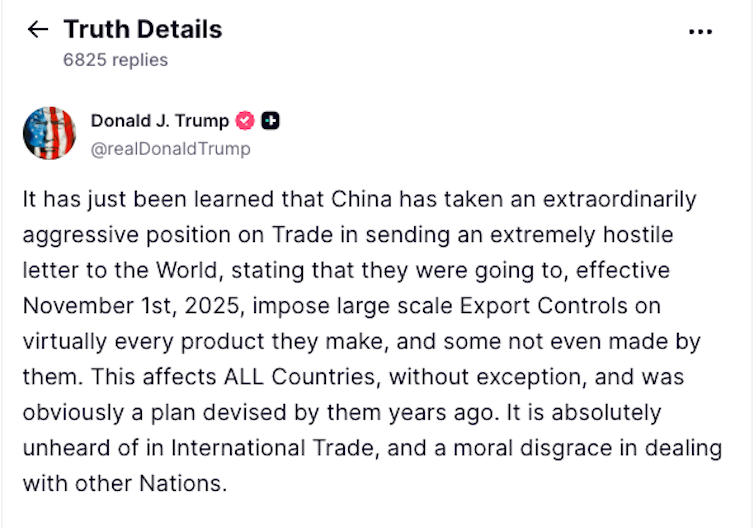
The trade dispute between the United States and China has resumed. US President Donald Trump lashed out at the weekend at Beijing’s planned tightening of restrictions over crucial rare-earth minerals.
In response, Trump has threatened 100% tariffs on Chinese imports.
But with the higher tariff rate not due to start until November 1, and the Chinese controls on December 1, there is still time for negotiation.
This is no longer a trade dispute; it has escalated into a race for control over supply chains, and the rules that govern global trade.
For Australia, this provides an opening to build capacity at home in minerals refining and rare-earths processing. But we also need to keep access to our biggest market – China.
A long-running battle
Since 2018, the US has sought to choke off China’s access to semiconductors and chipmaking tools by restricting exports.
China last week tightened its export controls on rare earth minerals that are essential for the technology, automotive and defence industries. Foreign companies now need permission to export products that derive as little as 0.1% of their value from China-sourced rare earths.
Rare earths are essential to many modern technologies. They enable high-performance magnets for EVs and wind turbines, lasers in advanced weapons, and the polishing of semiconductor wafers. An F-35 fighter jet contains about 417 kilograms of rare earths.
By targeting inputs rather than finished goods, China extends its reach across production lines in any foreign factories that use Chinese rare earths in chips (including AI), automotive, defence and consumer electronics.
A part of US President Donald Trump’s social media post announcing new tariffs on China.
Who holds the upper hand: chips or rare earths?
The US plan is simple: control the key tools and software for making top-end semiconductor chips so China can’t move as fast on cutting-edge technology.
Under that pressure, China is filling the gaps. It’s far more self-sufficient in chips than ten years ago. It now makes more of its own tools and software, and produces “good-enough” chips for cars, factories and gadgets to withstand US sanctions.
Rare earths aren’t literally “rare”; their value lies in complex, costly and polluting separation and purification processes. China has cornered the industry, helped by industry policies and subsidies. China accounts for 60–70% of all mining and more than 90% of rare earths refining.
Its dominance reflects decades-long investment, scale and an early willingness to bear heavy environmental costs. Building a China-free supply chain will take years, even if Western countries can coordinate smoothly.
A window for Australia?
Australia is seen as a potential beneficiary. As Prime Minister Anthony Albanese prepares to meet Trump on October 20 in Washington, many argue the rare-earths clash offers a diplomatic opening.
Trade Minister Don Farrell says Australia is a reliable supplier that can “provide alternatives to the rest of the world”. Australia’s ambassador to the US, Kevin Rudd, has made the same case.
The logic seems compelling: leverage Australia’s mineral wealth for strategic gain with its closest security partner. But that narrative is simplistic. It risks drifting from industrial and economic reality.
The first hard truth is that Australia has the resources, but doesn’t control the market. It is a top-five producer of 14 minerals, including lithium, cobalt and rare earths, yet it doesn’t dominate any of them. Australia’s strength is in mining and extraction, rather than processing.
Here lies the strategic paradox: Australia ships the majority of its minerals to China for processing that turns ore into high-purity metals and chemicals. Building alternative, China-free supply chains to reduce US reliance on China would decouple Australia from its main customer for raw materials.
Demand from the defence sector is not enough. The US Department of Defense accounts for less than 5% of global demand for most critical minerals.
The real driver is the heavy demand from clean energy and advanced technology, including EVs, batteries and solar. China commands those markets, creating a closed-loop ecosystem that pulls in Australia’s materials and exports finished goods. Recreating that integrated system in five to ten years, after Beijing spent decades building it, is wishful thinking.
There will be no simple winner
The US restrictions on chips and the Chinese controls over rare earths are twin levers in the contest between two great powers. Each wants to lead in technology – and to set the rules over global supply chains.
We’ve entered a period where control of a few key inputs, tools and routes gives countries leverage. Each side is probing those “chokepoints” in the other’s supply chains for technology and materials – and using them as weapons. In the latest stand-off, Trump has floated export controls on Boeing parts to China. Chinese airlines are major Boeing customers, so any parts disruption would hit China’s aviation sector hard.
There will be no simple winner. Countries and firms are being pulled into two parallel systems: one centred on US chip expertise, the other on China’s materials power. This is not a clean break. It will be messier, costlier and less efficient, where political risk often outweighs commercial logic.
The question for Australia is not how fast it can build, but how well it balances security aims with market realities.
Marina Yue Zhang does not work for, consult, own shares in or receive funding from any company or organisation that would benefit from this article, and has disclosed no relevant affiliations beyond their academic appointment.
Two books on the recent Erin Patterson trial have just been published, both by experienced true crime writers. Both are meticulously researched (primarily relying on the transcripts of evidence), well written and eminently readable. The timing of their publication is remarkable, given it’s only been a month since the sentencing. Having said that, neither book seems rushed.
Greg Haddrick, who writes from the perspective of “a fictional juror” in The Mushroom Murders, also wrote In the Dead of Night, about the 2020 murder of Russell Hill and Carol Clay in Victoria’s remote Wonnangatta Valley. Duncan McNab, author of Recipe for Murder, is a former detective, a private investigator (specialising in criminal defence) and an investigative journalist.
Review: The Mushroom Murders – Greg Haddrick (Allen & Unwin); Recipe for Murder: The poisonous truth behind Erin Patterson – the mushroom murderer of Leongatha – Duncan McNab (Hachette)
I enjoyed both books immensely – not for the horror of the tale itself, but for the insightful way they tackle this most intriguing story. Neither book offers anything new by way of evidence, as what is written is all on the public record. But readers will nevertheless find a great deal to interest them in the narrative of both authors, especially their descriptions of the legal wranglings and media frenzy.
Haddrick’s imagined perspective as a (female) juror who runs a (fictitious) picture-framing business in Morwell is an intriguing literary device. He is careful to advise readers that he neither approached nor spoke to any of the real jurors. Indeed, the law does not allow such an approach, given the requirement of the confidentiality of their deliberations.
The entire book is narrated by this fictional person. “I wanted readers to feel they were on that journey with the jury,” Haddrick explains in his preface. All the evidence, he says, “comes directly from, and only from, the evidence those jurors heard and saw during the trial”. Some readers may find his choice of storytelling technique somewhat disingenuous, but the narrative gives the book an impressive immediacy.
Haddrick writes, again in his preface: “Like all of us, our narrator has her own strengths, flaws and opinions, and she does speculate. But where she does engage in speculation, it is clearly identified as separate from the evidence that leads to her verdict — and it reveals some surprising insights into police methodology along the way.” True, there is much written about some very impressive policing, but I found none of it surprising.
On the first page of Haddrick’s book, we read: “A family lunch. Three murders. What really happened?” One might opine that it’s a tad misleading to state that a book narrated by a fictional juror and engaging in speculation regarding (her) thought processes can tell us “what really happened”. But this gradual, unfolding narrative from the perspective of an (albeit imaginary) juror remains a compelling tale if the reader is happy to suspend disbelief and see the trial through her (fictional) eyes.
Does this literary device pose an ethical issue? Perhaps so (especially if it leads to misleading understandings of the facts or the law), but in the legal sense there is no difficulty as long as it’s clearly explained.
The setting
On July 29 2023, in the small rural Victorian town of Leongatha, members of Patterson’s extended family sat down for a casual Saturday lunch of beef Wellington. As Haddrick quips in his opening pages, this has become the most talked-about meal since the Last Supper.
The next day, all four guests were hospitalised. Within a week, three of them were dead: Erin’s mother-in-law Gail Patterson, her husband Don Patterson, and Gail’s sister, Heather Wilkinson. Ian Wilkinson, Heather’s husband, was fighting for his life.
When Patterson was arrested and charged with their murders, the case captured media attention around the world. After a trial that lasted 11 weeks and produced 3,500 pages of transcript, a jury of 12 (seven men and five women) determined she had deliberately poisoned her estranged husband’s parents, and his aunt and uncle, leading to the deaths of three of them and the life-threatening illness of the fourth.
As McNab writes,
Patterson’s cruelty in watching four people who had been nothing but kind and loving to her eat a meal she knew would kill them was the ultimate act of betrayal.
Mushroom murders – a fictional juror’s view
Haddrick’s The Mushroom Murders principally tells what was going through the mind of his fictional juror as she heard the evidence. Readers interested in the way criminal evidence is presented will get a clear picture of that process. His speculation of the iterative process that possibly goes through a juror’s thinking as the evidence unfolds is well constructed. But it is only speculative.
The first third of the book takes readers through all the evidence of Erin’s relationship with her estranged husband, Simon. It was a fractured and, at times, tempestuous marriage. It is easy to gloss over this narrative since it reads like Days of Our Lives, but it is important in the story. At this stage, the fictional juror is entirely sympathetic to Erin, taking to heart the trial judge’s reminder to the jury, in his preliminary remarks, of the importance of the presumption of innocence.
But as the story continues and the beef Wellington is served (it arrives halfway through the book), the tempo increases. With a third of the book to go, Haddrick has his juror thinking that sticking with “Team Erin” was becoming more difficult.
It was getting harder and harder to keep “presuming innocence”. At so many moments in the story, there were no reasonable explanations for her behaviour compatible with innocence.
Those moments continue all the way to the book’s conclusion.
Haddrick’s epilogue is devoted to the post-trial release of evidence that had been excluded (and charges dropped) regarding three allegations that Erin attempted to poison Simon during their marriage. His narrator’s strong opinion is that the trial judge’s ruling in a preliminary hearing to exclude these allegations from the trial treated the jury as mugs.
I know we had been told at the beginning of the trial to put those dropped charges out of our minds, but I’m sorry. If it leads to a situation like this, where the blindingly obvious question never gets asked, that’s just legal nonsense.
That might be his fictional juror’s feeling, but Justice Beale’s direction in the preliminary hearing had been vindicated by a three-member Court of Criminal Appeal. The law on this subject is clear: the High Court ruled in 1995 that prejudicial evidence (such as the unsubstantiated allegations regarding three earlier attempts to poison Simon) is inadmissible unless the judge considers that evidence has very strong probative value, that is, evidence sufficiently useful to prove something important in the case at hand.
In this case, he did not. If those charges were to be pursued, that would need to happen in a separate trial.
Recipe for Murder
Duncan McNab’s Recipe for Murder does not have the first-hand immediacy of The Mushroom Murders, but it, too, is compelling. Indeed, some readers may find McNab’s analysis more insightful, as it is not underpinned by Haddrick’s literary musing.
McNab’s book shares a similar structure to Haddrick’s. There is a description of the family, their church, the often fractured relationship between Simon and Erin, their multiple marital separations, their children, their Christian faith (or, in Erin’s case, ostensible atheism) and their finances.
McNab takes readers through the evidence of Erin’s fascination with true crime, and her ill-health self-diagnoses (including ovarian cancer and heart issues). He describes her relationships with her own parents, both deceased. In messages to friends, he reveals, Patterson called her mother “essentially a cold robot” and said “Dad was a doormat”. He also reveals her propensity to be loose with the truth, including her being sacked from her job as an air traffic controller for lying about her work hours.
He departs from the formal record of the trial evidence in explaining Justice Beale’s ruling in the fast-tracked preliminary hearing, namely that the allegations relating to Simon’s previous illnesses (the alleged attempted poisonings) could not be tried in the “beef Wellington” trial.
Moreover, he explains the ruling on the location of the trial (Morwell, not Melbourne), noting that under the Victorian Criminal Procedure Act unless there are strong reasons related to unfairness, the trial should take place at the court most proximate to where the alleged offending occurred. (By contrast, Haddrick’s book does not deal with the reasoning in these preliminary matters at all.)
Next in the McNab narrative comes the meal, the deaths, and the investigations, including a close look at the forensic science evidence, such as the sighting of deathcap mushrooms growing in rural Victoria, and Erin’s phone being “pinged” in the vicinity. Then follows the funerals – and inevitably, the arrest of Erin Patterson.
Because he is writing with the value of hindsight, McNab is never in doubt about the correctness of the verdict.
Read one, not both
Recipe for Murder is significantly more detailed than The Mushroom Murders in relation to the summing up to the jury by prosecution counsel, defence counsel and finally the judge. This process would take nearly six days once the examinations in chief, the cross examinations and reexaminations finally came to an end.
On day 40 of the trial, the jury (after the balloting out of two jurors, to reduce the number to 12) retires to consider its verdict. It returns nearly six days later with guilty verdicts on all four charges.
Surprisingly, neither author makes any comment that this was an extraordinarily lengthy process, other than McNab’s quip that there was “a vast amount of evidence.” Yes, that may be true, but as both authors admit, that evidence was very persuasive.
Importantly, Recipe for Murder then pays significant attention to the victim impact statements. There were 28 tendered to the court, seven of them read aloud; some, like Ian Wilkinson’s, by their authors; some, like Simon Patterson’s, by proxies. Simon’s statement referred to his children:
Like all of us, they face the daunting challenge of trying to comprehend what she has done. The grim reality is they live in an irreparably broken home with a solo parent when almost everybody knows their mother murdered their grandparents.
Directing his attention to the sentencing hearing, McNab tells us Justice Beale heard from defence counsel that Erin would likely spend 22 hours a day in her cell. Beale took that into account. There was to be, he announced, three life sentences (the maximum penalty under Victorian legislation) to be served concurrently. The non-parole period was set at 33 years. (The Victorian Director of Public Prosecutions is now appealing that non-parole period on the basis that it was overly lenient.)
McNab concludes his discussion of the sentencing remarks with suitably understated drama: “An emotionless Erin Patterson was led from the courtroom.”
Both books are commendable. But there is no value in reading both, as they cover much of the same material. If I had to pick one as a tool for teaching students the art of examination (and cross examination) of witnesses, and the processes of trial, verdict and sentencing, McNab’s Recipe for Murder would be my choice.
A third book on the trial will be published next month – The Mushroom Tapes, by Helen Garner, Chloe Hooper and Sarah Krasnostein. It is clear there is more for us to read, and perhaps learn, about what unfolded in the Victorian Supreme Court, sitting at Morwell, during the winter of 2025.
Rick Sarre does not work for, consult, own shares in or receive funding from any company or organisation that would benefit from this article, and has disclosed no relevant affiliations beyond their academic appointment.
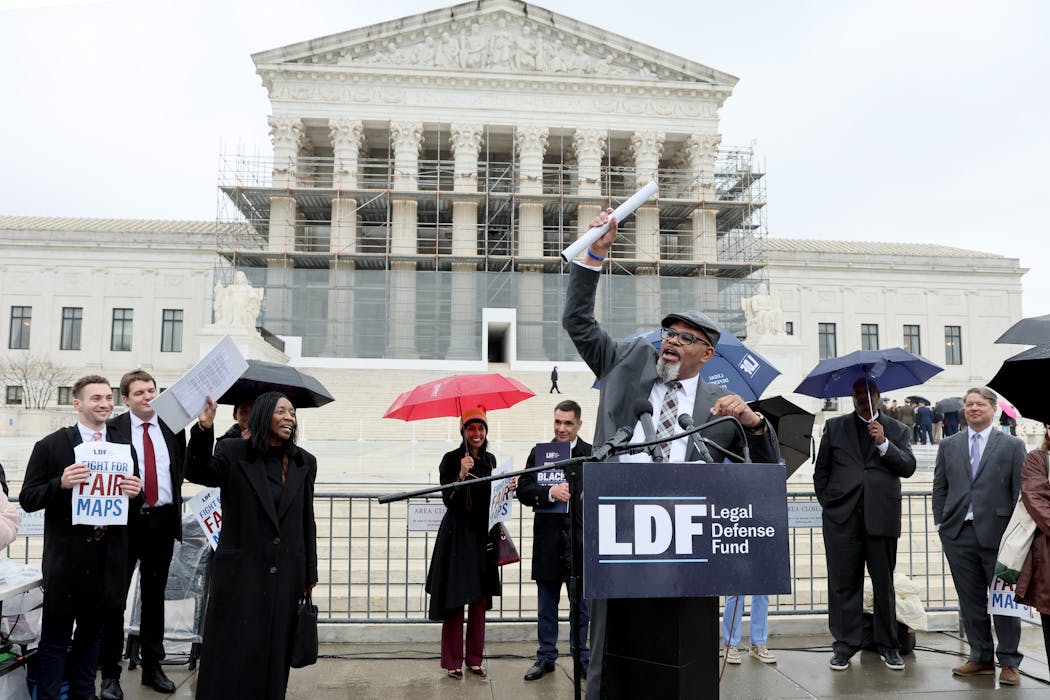
Black Louisiana voters and civil rights advocates ask U.S. Supreme Court justices to uphold a fair and representative congressional map in Louisiana v. Callais on March 24, 2025. Jemal Countess/Getty Images
On Oct. 15, 2025, the Supreme Court will hear oral arguments in one of the most anticipated cases of the 2025-2026 term, Louisiana v. Callais, with major implications for the Voting Rights Act, racial representation and Democratic Party power in congress.
The central question in the case is to what extent race can, or must, be used when congressional districts are redrawn. Plaintiffs are challenging whether the longstanding interpretation of Section 2 of the Voting Rights Act, which requires protection of minority voting power in redistricting, violates the Equal Protection Clause of the U.S. Constitution, which guarantees that individuals should be treated the same by the law.
In short, the plaintiffs argue that the state of Louisiana’s use of race to make a second Black-majority district is forbidden by the U.S. Constitution.
To understand the stakes of the current case, it’s important to know what the Voting Rights Act does. Initially passed in 1965, the act helped end decades of racially discriminatory voting laws by providing federal enforcement of voting rights.
Section 2 of the Voting Rights Act forbids discrimination by states in relation to voting rights and has been used for decades to challenge redistricting plans.
The current case has its roots in the redistricting of Louisiana’s congressional districts following the 2020 Census. States are required to redraw districts each decade based on new population data. Louisiana lawmakers redrew the state’s six congressional districts without major changes in 2022.
State troopers in Selma, Ala., swing billy clubs on March 7, 1965, to break up a march by advocates for Black Americans’ voting rights. AP Photo, File
Soon after the state redistricted, a group of Black voters challenged the map in federal court as a violation of the Voting Rights Act. The plaintiffs argued that the new map was discriminatory because the voting power of Black citizens in the state was being illegally diluted. The state’s population was 31% Black, but only one of the six districts featured a majority-Black population.
The federal courts in 2022 sided with the plaintiffs’ claim that the plan did violate the Voting Rights Act and ordered the state legislature to redraw the congressional plan with a second Black-majority district.
The judges relied on an interpretation of Section 2 of the Voting Rights Act from a 1986 Supreme Court decision in the case known as Thornburg v. Gingles. Under this interpretation, Section 2’s nondiscrimination requirement means that congressional districts must be drawn in a way that allows large, politically cohesive and compact racial minorities to be able to elect representatives of their choice.
Following the court order, the Louisiana state legislature passed Senate Bill 8 in January 2024, redrawing the congressional map and creating two districts where Black voters composed a substantial portion of the electorate in compliance with the Gingles ruling. This map was used in the 2024 congressional election and both Black-majority districts elected Democrats, while the other four districts elected Republicans.
These new congressional districts from Senate Bill 8 were challenged by a group of white voters in 2024 in a set of cases that became Louisiana v. Callais.
Essentially, the plaintiffs claimed that the courts’ interpretation of Section 2 of the Voting Rights Act was unconstitutional and that the use of race to create a majority-minority district is itself discriminatory. Similar arguments about the 14th Amendment’s Equal Protection Clause were also the basis of the Supreme Court’s recent decisions striking down race-based affirmative action in college admissions.
In 2024, a three-judge district court sided with the white plaintiffs in Louisiana v. Callais, with a 2-1 decision. The Black plaintiffs from the original case, and the state of Louisiana, appealed the case to the Supreme Court. The court originally heard the case at the end of the 2024-2025 term before ordering the case re-argued for 2025-2026.
If the Supreme Court ultimately upholds the lower court decision in Louisiana v. Callais, deciding that Louisiana’s congressional districts are unconstitutional racial gerrymanders, it will have substantial impacts on minority representation. The decision would upend decades of precedent for Section 2 of the Voting Rights Act.
For 39 years, Section 2 of the Voting Rights Act has required redistricting institutions to consider racial and ethnic minority representation when devising congressional districts. Majority-minority districting is required when a state has large, compact and cohesive minority communities. Historically, some states have redistricted minority communities in ways that dilute their voting power, such as “cracking” a community into multiple districts where they compose a small percentage of the electorate.
Section 2 also provides voters and residents with a legal tool that has been used to challenge districts as discriminatory. Many voters and groups have used Section 2 successfully to challenge redistricting plans.
Section 2 has been the main legal tool for challenging racial discrimination in redistricting for the past decade. In 2013, the Supreme Court effectively ended the other major component of the Voting Rights Act, the preclearance provision, which required certain states to have changes to their elections laws approved by the federal government, including redistricting.
If the court overrules the current interpretation of Section 2, it would limit the legality of using race in redistricting, end requirements for majority-minority districts and eliminate the most common way to challenge discriminatory districting.
Additionally, because of the strong relationship between many minority communities and the Democratic party, the court’s decision has major implications for partisan control of the House of Representatives.
If Section 2 no longer required majority-minority districts, then Republicans could use the ruling to redraw congressional districts across the country to benefit their party. Politico reported that Democrats could lose as many as 19 House seats if the Supreme Court sides with the lower court.
Recent Supreme Court precedent gives conflicting signals as to how it will decide this case.
Sam D. Hayes does not work for, consult, own shares in or receive funding from any company or organization that would benefit from this article, and has disclosed no relevant affiliations beyond their academic appointment.