Hamas turns to executions as it tries to establish a monopoly on force in Gaza

Source: The Conversation – UK – By Tahani Mustafa, Lecturer in International Relations, King’s College London

An uneasy ceasefire is still in place in Gaza despite Israeli strikes on what it called “Hamas terror targets” in response to what the Israel Defense Forces said here rocket attacks on its positions.

But there appears to be continuing violence between Hamas fighters and members of various armed clans that has increased since the withdrawal of Israel from parts of Gaza. In the days following the ceasefire agreement being struck on October 13. Most notably, videos circulated which appeared to show Hamas executing members of some of the clans. The killings appear to have been brutal and conducted without even the pretence of an impartial legal process.


Read more:
Hamas is battling powerful clans for control in Gaza – who are these groups and what threat do they pose?


Speaking to my contacts in Gaza developed through 15 years of research, including one employee of an international organisation who has advised Hamas and the Palestinian Authority, it appears many Gazans may support these executions. One source in the office of the security coordinator in Gaza told me this week that many people in Gaza believe this show of force could pave the way for the reestablishment of law and order and the effective distribution of aid.

In part, this reflects the situation in Gaza since Israel began its assault two years ago, after the Hamas attack of October 7 2023. That day saw an estimated 3,000 Hamas fighters pour across the borders into southern Israel, killing about 1,200 people and taking 250 hostages.

The months and years that followed saw Israel launched an overwhelming military assault on Gaza, killing more than 68,000 and wounding more than 170,000, according to estimates from the Gaza health ministry. Israel’s declared intention was the destructio of Hamas as both a government and a military force. The civilian population of Gaza witnessed growing chaos and lawlessness as the conflict led Hamas forces into hiding.

But a significant number have survived. AN estimated 7,000 Hamas fighters have now been deployed across the territory. In seeking to crack down publicly and brutally on the most serious forms of lawlessness Gaza has seen over the last two years – including murders, revenge killings, trafficking, kidnappings, robbery, theft and drug dealing – Hamas appears to be demonstrating its resolve to establish an effective monopoly on the use of force in Gaza.

Hamas faced a similar situation in 2007, when it abruptly inherited governance of the Gaza Strip. Fatah, the Palestinian faction that has controlled the Palestinian Authority (PA) since its creation in 1994, moved with the backing of the US, against the then newly elected Hamas government.

After a protracted struggle, Hamas lost control over the West Bank, but expelled Fatah from Gaza. In Gaza, Hamas inherited an administration in the process of being rebuilt after its virtual destruction.

The group addressed the yawning security vacuum and lawlessness in a way similar to the way it appears to be doing now. It employed brutality establish a monopoly on the use of force. It disarmed the various armed factions and established a civil administration. Its administration was based on that of the PA, but was generally recognised to be more effective and less corrupt than the PA and its security forces.

It worked with other political factions in the Strip, including Fatah, in rebuilding Gaza’s administration. Many of the civil servants, judges and even police it employed were not members of Hamas – and were not required to become so.

This is not to say there weren’t limits to important freedoms under Hamas rule – there were. But these were arguably no more authoritarian than those imposed by Fatah in the West Bank.

Who are the clans?

At the centre of the criminality in Gaza today are armed gangs, whose members are often drawn from the territory’s powerful clans. These clans are extended families that have historically played leading roles in their communities – but have also, at times, operated like local mafia.

During the recent conflict, clans have settled old scores with violence. Gangs associated with the clans have expanded into racketeering, drug dealing, kidnapping, robbery and extortion.

Israeli prime minister Benjamin Netanyahu has confirmed his country has armed some of the gangs, following reports of Israeli forces handing over weapons directly or leaving weapons for them to claim hoping they would use them against Hamas. Hamas has made much of this, characterising the men it publicly executed as “collaborators”. The largest assembly of clans, the Palestinian Tribal Committee, has supported Hamas’s crackdown and condemned the criminality of the gangs.

Hamas is reported to have offered an amnesty deal to the clans and gangs, calling on them to surrender their weapons and for any involved in criminality to hand themselves in to face trial. Thus far, the Dogmush and Majaydah clans have complied, days after 26 members of the Dogmush were killed in clashes with Hamas.

US approval

While the US president, Donald Trump, has said that Hamas has to disarm “within a reasonable period of time”, he has also stated that he has given them a green light to reestablish law and order in the Strip “for a period of time”. Flying back to the US from Egypt on October 14, Trump told reporters: “Well, they [Hamas] are standing because they do want to stop the problems, and they’ve been open about it, and we gave them approval for a period of time.”

Trump: Hamas can resore law and order in Gaza.

It is true that order needs to be restored if aid is to reach those who need it. It is also essential if some form of civil administration to provide for the most basic needs of Gazans is to be reestablished in the interim, before a final deal on what to do with Gaza, Hamas and the Israeli occupation of Gaza is agreed.

But by arming these clans, Israel has arguably further destabilised the territory and contributed to the discord and civil strife that threatens to overwhelm the Gaza Strip as Hamas conducts its brutal campaign. The worse things get, the more likely that Gazans will be willing to accept Hamas’s form of order, based not on law but on extrajudicial violence.

The Conversation

Tahani Mustafa is affiliated with the European Council on Foreign Relations (ECFR)

ref. Hamas turns to executions as it tries to establish a monopoly on force in Gaza – https://theconversation.com/hamas-turns-to-executions-as-it-tries-to-establish-a-monopoly-on-force-in-gaza-267558

Could your walk be a signal about your ability to win a fight?

Source: The Conversation – UK – By Connor Leslie, Assistant Professor in Criminology, Northumbria University, Newcastle

Your walk carries information about how much of a threat you might pose. Wirestock Creators/Shutterstock

Humans have been fighting each other since the earliest stages of our species’ history.

Scientists believe that these fights changed how we evolved, particularly men. This is known as intrasexual selection, where competition between members of the same sex shape how they evolve. My new research raises the possibility we may have evolved to detect clues about whether a man is dangerous from the way he walks.

As it was men who were more likely to engage in physical fights in our early history, it would be beneficial for them evolve to win and survive a fight. Men are still more likely to be the perpetrator of violent crimes, and men account for a higher proportion of victims of violence when the perpetrator is a stranger.


Read more:
How much do we actually know about the psychology of violence?


Men on average not only have 80% more arm muscle mass and 50% more lower body muscle mass than women but also tougher skulls to help them survive their fights.

You may win a fight, but if you win with a broken jaw, it will not feel like much of a victory when you try and eat. So evolving the ability to tell if someone can hurt us would have allowed our ancestors to ready themselves for a fight or try and avoid the confrontation if the risk seemed too high.

And it seems that we are good at this, according to research over the last two decades. In a 2009 study participants from several countries including Bolivia, Argentina and the US were asked to look at photographs of men’s faces and bodies.

They could tell when a man was strong, even from just looking at the face pictures. When they looked at photographs of women, the participants could still assess strength, but less accurately compared to the photographs of men.

Voices hold important information about other people’s strength too. A 2010 study
had participants listen to voice recordings of native speakers in English, Spanish, Romanian and indigenous Bolivian language Tsimane. Participants could accurately estimate the speakers’ upper body strength, although they were less accurate when it came to female speakers than men.

Silhouette of man walking through underpass tunnel.
If you find someone’s walk intimidating, it’s not just you.
LBeddoe/Shutterstock

But when a fight is coming our way, it is unlikely that we would only see the person’s face, or just hear their voice.

Research, helped by modern day motion capture techniques, has started to show humans can detect a potential threat from body language. These techniques can produce a computer-generated representation of someone that hides certain physical features. It can make a tall person and short person look the same height or make a person with a lot of muscle look like someone who has very little.

Researchers using these techniques in a 2016 study found that participants could still detect when someone is strong, even though they couldn’t tell what the person looked like. This suggests that there may be something in the way we move that shows to someone else that we can harm them.

One of the videos made with motion capture techniques for the author’s study.

For our new research, my colleagues and I used similar motion capture techniques to represent how 57 different men walked without showing their size. We then asked 137 participants to watch three-second (on average) representations of the models walking.

On average the participants rated the men who were physically bigger (a combination of BMI, bicep, shoulder, chest, and waist circumferences) as higher in physical dominance, even though they couldn’t see how big they were. Higher physical dominance means they are more likely to win a fight.

What we may have found are specific movements that could indicate someone’s size and so their potential ability to cause physical harm. Men who were perceived as being more likely to win a fight had more of a swagger to them, where their shoulders moved more in a swaying motion. This is almost the stereotypical walk of the western movie hero.

The exact nature of this link isn’t clear. Might we simply have evolved to spot bigger men, who tend to walk with a confident swagger? Or are we alert to signals that these men might want to do us harm?

Previous research has suggested men may, consciously or subconsciously, try to give off intimidating signals through their walk.

A 2003 study by cognitive psychologist Nikolaus Troje of people’s perception of other people’s gait used this style of walking as a caricature of male walking style. He pointed out that male animals often try to occupy as much space as possible to appear bigger than he is.

“Like in pigeons where the male puffs up his feathers or like in lions where the male evolves its mane, we find in our species sex-specific differences in the way to move which eventually result in men to appear bigger and heavier.”

It’s also worth noting we found other factors could affect people’s perception. Women participants were more likely to rate the men in the videos as high in physical dominance than the male participants. And older people rated the men’s movements as higher in physical dominance compared to younger participants.

However, our natural movement, our walk, is surprisingly hard to change. So being able to read the signs of danger in someone walking towards us would be a very valuable skill to evolve.

The Conversation

Connor Leslie does not work for, consult, own shares in or receive funding from any company or organisation that would benefit from this article, and has disclosed no relevant affiliations beyond their academic appointment.

ref. Could your walk be a signal about your ability to win a fight? – https://theconversation.com/could-your-walk-be-a-signal-about-your-ability-to-win-a-fight-262649

The exercise paradox: why workouts aren’t great for weight loss but useful for maintaining a healthy body weight

Source: The Conversation – UK – By Rachel Woods, Senior Lecturer in Physiology, University of Lincoln

Studies show exercise only has a modest effect on weight loss. Giuseppe Elio Cammarata/ Shutterstock

The basic principle of weight loss is straightforward: if you consume fewer calories than you burn, you’ll lose weight. In practice though, this isn’t usually so easy or simple.

Alongside counting calories or eating smaller portions, many people add exercise into the equation when trying to lose weight to help tip the balance. Yet research shows that exercise may only have modest effects on weight loss.

But before you ditch your workouts, it’s important to note that exercise still plays a really important role when it comes to health – perhaps especially in keeping the pounds off after reaching your goal weight.

There are several processes that help explain why exercise doesn’t always result in huge amounts of weight loss.

Exercise can stimulate appetite, leading to increased food intake. People may also subconsciously move less throughout the rest of the day after doing a workout, which means exercise may have less impact on their overall calorie deficit.

The body also becomes more efficient over time – burning fewer calories while doing the same activity. This process, sometimes called “metabolic adaptation”, reflects the body’s tendency to defend against weight loss.

From an evolutionary perspective, conserving energy during periods of intense physical activity probably protected our ancestors from starvation. But in today’s world, metabolic adaptation is one of many factors that can make weight loss difficult.

The importance of exercise

Although exercise may not be the main driver of weight loss, it seems it might play a role in maintaining weight loss.


Read more:
Seven techniques to avoid weight regain, approved by experts


In a study of over 1,100 people, physical activity was shown to have little effect on the amount of weight a person initially lost. However, doing higher levels of activity after losing weight was strongly linked to maintaining the weight loss.

It’s worth noting that exercise was also associated with measurable health improvements – including better cholesterol, lower inflammation, better blood sugar control and insulin sensitivity, all of which are associated with lower risk of health problems, such as heart disease and type 2 diabetes.

Two girls perform ab exercises on yoga mats in their living room.
Exercise has many health benefits.
Chay_Tee/ Shutterstock

These many health benefits show just how important it is to exercise both while losing weight and maintaining weight loss.

Evidence also suggests that combining exercise with weight loss drugs (such as Saxenda), may help people maintain their weight loss better than using the drug alone.

Why exercise works

It may seem confusing that exercise isn’t especially effective for losing weight but can help prevent regain. The reasons behind this paradox aren’t fully understood, but several mechanisms may offer an explanation.

The first has to do with our resting energy expenditure (the amount of calories our body burns when doing nothing).

When we lose weight, our resting energy expenditure decreases by more than you would expect for the amount of weight lost. This is thought to contribute to weight regain. But exercise raises total daily energy expenditure, which can help to partially offset this.

A second factor relates to muscle mass.

Weight loss usually results in the loss of both fat and muscle. Losing muscle lowers resting energy expenditure, which can contribute to weight regain.

But exercise, especially resistance training (such as Pilates or lifting weights), can help preserve or even rebuild muscle mass. This can boost our metabolism, which may aid in long-term weight maintenance.

Physical activity also helps our body to maintain its ability to burn fat. After losing weight, the body often becomes less efficient at using fat for energy.

But intense exercise can improve fat burning and metabolic flexibility – the ability to switch between burning carbohydrates and fat depending on what’s available. This helps the body continue burning fat even when calorie intake is low or weight is lost.

Exercise improves insulin sensitivity as well. This reduces the amount of insulin required to regulate blood sugar. This is beneficial as higher insulin levels can promote fat storage and reduce fat breakdown.

Exercise has many indirect effects on us that can aid in weight maintenance. For instance, exercise can improve sleep, mood and reduce stress levels. These all reduce levels of the stress hormone cortisol, which could lower the amount of fat the body stores.

Regular activity can also help regulate appetite and blood glucose, which may help reduce cravings and limit overeating.

It’s important to acknowledge that everyone is different. This means we all respond differently to exercise in terms of how many calories we burn or whether a workout makes us feel hungrier later in the day.

Different types of workouts also confer their own benefits when it comes to health and weight maintenance.

Aerobic exercise (such as brisk walking, cycling or running) burns calories and, at higher intensities, may also enhance the body’s ability to burn fat for fuel.

Resistance training, on the other hand, helps build and preserve muscle mass. This supports a higher resting energy expenditure, aiding long-term weight maintenance.

Exercise may not be the most powerful tool for losing weight, but it could help sustain hard-earned weight loss. Perhaps most importantly, it offers many physical and mental health benefits that go far beyond the numbers on the scale.

The Conversation

Rachel Woods does not work for, consult, own shares in or receive funding from any company or organisation that would benefit from this article, and has disclosed no relevant affiliations beyond their academic appointment.

ref. The exercise paradox: why workouts aren’t great for weight loss but useful for maintaining a healthy body weight – https://theconversation.com/the-exercise-paradox-why-workouts-arent-great-for-weight-loss-but-useful-for-maintaining-a-healthy-body-weight-266715

New study reveals how illegal wildlife trade intersects with organized crime in Canada

Source: The Conversation – Canada – By Michelle Anagnostou, Banting Postdoctoral Fellow, Department of Biology, University of Oxford

When most people hear terms like poaching, wildlife trafficking or illegal wildlife trade, they probably think of threatened species such as elephants, rhinos, tigers or sharks. Geographically, wildlife crime may feel like a problem confined to southern Africa or southeast and East Asia.

Of course, these species have long been heavily trafficked, and those regions are major hotspots for the trade. However, illegal wildlife trade affects thousands of species of wild plants, animals and fungi, and has been reported in 162 countries, including Canada, which is far from a passive bystander.

Illegal wildlife trade is one of the largest criminal activities in the world and some black markets are growing each year. The immense scale of the problem, coupled with a changing climate and a widening gap between organized crime and countries’ capacities to respond, poses a mounting global concern.

Yet one of the biggest gaps in our understanding has been the nature of organized crime connections to illegal wildlife trade, hardly surprising given how difficult criminal networks are to study.

In recent years, experts have increasingly stated illegal wildlife trade converges with other forms of serious and organized crime, such as drug and human trafficking.

Though reported in the media, empirical evidence has been lacking. Much of what we knew about these convergences came from anecdotal reports and reviews. In response, research by our team in 2021 and 2022 reviewed existing knowledge and theorized how these criminal convergences work, laying the groundwork for new empirical research.

Our latest study documents those connections directly through more than 100 interviews with investigators on the ground in Canada, South Africa and Hong Kong. This study mapped how illegal wildlife trade intersects with other organized criminal activities.

A complex web of criminality

Our findings confirm that wildlife trafficking is rarely isolated. Whether in South Africa’s rhino reserves, Hong Kong’s shipping terminals or Canada’s coastal towns, the same pattern repeats: the people and networks trading in wildlife are often involved in other illicit activities.

Our research shows that illegal wildlife trade converges with drug, sex and human trafficking, child abuse, trade in human body parts, forced and bonded labour, arms trafficking; vehicle theft and trafficking, counterfeit and pirated goods trade, and illegal trade in metals and minerals. The list goes on.

In Canada, interviewees described wildlife being bartered like currency. In several provinces, fish and animal parts, such as sturgeon, have been exchanged directly for illegal drugs. One officer recalled raiding a trafficker’s house and finding grizzly bear and polar bear hides that had been exchanged for high-value narcotics.

Similar stories came from other provinces, where guns are often illegally exchanged for wildlife, or where migrant workers are illegally exploited in illegal wildlife processing facilities. Some cases were small-scale, localized operations, while others linked local poachers to sophisticated international organized crime networks.

Still other cases connected wildlife to the murkier “oddities” trade: human bones, preserved reptiles, bird parts and other macabre collectables. In these circles, even the line between wildlife trafficking and the illegal sale of human remains can blur.

How Canada fits a global pattern

The Canadian examples mirrored experiences reported by law enforcement in other countries. In South Africa, rhino horn trafficking networks have also run child exploitation rings; in Hong Kong, shark fins and endangered turtles are trafficked alongside counterfeit and pirated goods. Across all three jurisdictions, convergence of these crimes follows the same logic: shared infrastructure and the pursuit of profit from illegal sources.

Trafficking illegal commodities requires prearranged transportation, trusted fixers, corrupt officials and money laundering channels. Diversifying into wildlife simply offers another revenue stream with relatively low penalties if caught. As one investigator told us: “If you’re a smuggler, the commodity might change, but you will remain a smuggler.”

Despite these convergences, Canada’s response remains siloed, inadequately prioritized and under-resourced. Wildlife crime cases are generally handled by conservation or environment authorities, while narcotics, arms and human trafficking cases fall to police or border agencies, each constrained within geographically defined jurisdictions.

This siloed system creates blind spots that sophisticated networks exploit. Without mechanisms for joint intelligence-sharing and prosecution, each agency sees only pieces of the puzzle.

Tackling converging crimes

Canada’s experience is part of a much larger global challenge. Delegates from around the world will soon gather in Samarkand, Uzbekistan for the 20th meeting of the Conference of the Parties to the Convention on International Trade in Endangered Species of Wild Fauna and Flora (CITES), where they will discuss strengthening enforcement and co-operation. Countering illegal wildlife trade requires collaborative multi-agency and cross-sectoral approaches, in Canada and beyond.

This requires deepening collaborations and information sharing protocols between partners including environmental, policing, financial, customs and organized crime agencies — and recognition that wildlife trafficking is as much an economic crime and security issue as an environmental one.

Stronger penalties, better co-operation and the use of anti-money laundering approaches could significantly improve efforts. Public awareness is also key: illegal wildlife purchases, increasingly via online and social media platforms, represent not only environmental harm, but also link consumers to a criminal economy most would likely want nothing to with.

Unfortunately, the illegal wildlife trade is still one of the most lucrative of all illegal trades. The World Bank estimates that illegal logging, fishing and wildlife trade result in economic losses amounting to trillions of dollars annually. The immense profits are siphoned off by organized crime networks and corrupt officials, instead of supporting conservation and sustainable development.

Moreover, when wildlife trafficking intersects with drug and arms trade, it reinforces the same criminal networks that destabilize communities, laundering dirty money, spreading corruption, eroding governance and weakening the rule of law.

Ultimately, by treating wildlife trafficking as a complex form of organized crime, Canada can help dismantle the networks that profit from exploiting both people and the planet.

The Conversation

Michelle Anagnostou receives funding from the Social Sciences and Humanities Research Council of Canada. She also consults for World Wide Fund for Nature (WWF) and the National Cargo Bureau on counter-wildlife trafficking projects.

Peter Stoett receives funding from the Social Sciences and Humanities Research Council of Canada.

Ashwell Glasson and Brent Doberstein do not work for, consult, own shares in or receive funding from any company or organisation that would benefit from this article, and have disclosed no relevant affiliations beyond their academic appointment.

ref. New study reveals how illegal wildlife trade intersects with organized crime in Canada – https://theconversation.com/new-study-reveals-how-illegal-wildlife-trade-intersects-with-organized-crime-in-canada-266753

With Miss Chief Eagle Testickle, Cree artist Kent Monkman confronts history

Source: The Conversation – Canada – By Anna Hudson, Professor, Art History, York University, Canada

Cree artist Kent Monkman is a contemporary old master most celebrated for his reworking of figurative painting. Now in his 60th year, Monkman’s gut-wrenching recastings of images drawn from the western canon are produced by his atelier, a studio modelled on a longstanding tradition of the artist as chef d’atelier.

His 2019 completion of the commission mistikôsiwak (Wooden Boat People) for the Metropolitan Museum of Art’s (the Met) Great Hall marked the first of three institutional plays by the Met for social relevancy. Monkman, along with African-American contemporary artist Jacolby Satterwhite and Taiwanese calligrapher Tong Yang-Tze, each transformed the vast temple-like lobby into a gathering place for cross-cultural dialogue.

Six years later, Kent Monkman: History is Painted by the Victors, a major retrospective currently on view at the Montréal Museum of Fine Arts, positioned mistikôsiwak as the height of Monkman’s boundary-breaking practice and stratospheric rise to the upper echelons of the contemporary international art world.

Monkman’s hired team of Indigenous and non-Indigenous apprentice painters, actors, makeup artists, fashion designers, filmmakers and photographers carry his epic compositions to completion. Their collaborations balance reference to iconic European, Canadian and American nationalist paintings with Monkman’s Cree perspective on the imperial consumption of Indigenous lands.

At their root is Monkman’s commentary on the imposition of western art education in the Americas through the establishment of fine art academies in new nation states to train settler artists.

Kent Monkman speaks about his work with Denver Art Museum’s Beyond the Art.

Fine art and colonialism

By the late 18th and early 19th centuries, landscape painting developed into one of the most celebrated fine art genres. Colonial landowners and governments saw the land around them as a resource to be documented.

Monkman interrupts this by combining two genres — landscape and history painting — to create monumental documents of colliding worldviews: the colonial investment in individual land ownership versus Indigenous land stewardship.

Landscape painting continues to shape Canadian and American national identity. For example, the works of the Canadian Group of Seven are implicated in the idea of Canadian-ness.

Monkman’s approach channels the Romantic painters, and most compellingly, Théodore Géricault’s 1819 The Raft of the Medusa.“ This painting is a canonical composition of bodies caught in the rawest human dynamic of hope versus despair, life versus death — themes interpreted in Monkman’s work. Géricault was controversially unafraid to focus on the dead, diseased and depraved and highlight political incompetence and corruption.

Gericault’s painting records the aftermath of the 1816 shipwreck of the Medusa, a French Royal Navy frigate commissioned to ferry officials to Senegal to formally re-establish French occupation of the colony. As a result of the captain’s inept navigation, the Medusa struck a sandbank off the West African coast. Survivors piled onto a life raft to endure a dehumanizing and deadly 13 days before being rescued by another ship, barely visible on the painting’s horizon.

Response to the canon

Monkman’s 2019 Great Hall commission of two monumental paintings for the Met marked unheard-of success for a contemporary Indigenous artist. As part of the Met’s initiative to invite artists to create new works inspired by the collection in honour its 150th anniversary, the diptych mistikôsiwak (Wooden Boat People) offers a uniquely re-canonizing response to western art history.

This prestigious commission of two monumental paintings, Welcoming the Newcomers and Resurgence of the People, brought settler reckoning to new audiences in the aftermath of Canada’s Truth and Reconciliation Commission’s (TRC) 94 Calls to Action.

Given its grand size and public location, mistikôsiwak presented a parallel Indigenous canon, a painterly two-row wampum of sorts that runs alongside its western European historical counterpart towards Indigenous survivance — survival, resilience and endurance — and futurity.

The two-row wampum belt created in the 17th century acknowledged the colonial establishment of two paths: western versus Indigenous. Today, they are entangled by neocolonial industrial pollution and climate change. To artist and curator Rick Hill, this reality, along with the arrival on Indigenous homelands of generations of diaspora populations, brings forth the question: “What is your relationship to this land? What is your relationship to your Native neighbours?”

Given that western and Indigenous definitions of sovereignty remain intractably at odds, Hill’s questions provoke a consideration of land as a shared resource, for humans and non-human life.

The Art Gallery of Ontario presents a segment on treaties with artist, writer and curator Rick Hill.


Read more:
From the Amazon, Indigenous Peoples offer new compass to navigate climate change


Transformative painting

Miss Chief Eagle Testickle is Monkman’s dynamic anti-colonial trans superhero who often appears in his work. In mistikôsiwak, Miss Chief is represented alongside the arrival of all sorts: colonizers, settlers, servants, slaves, migrants and refugees who never left.

In Resurgence of the People, Monkman riffs off such American idols as Emanuel Leutze’s Washington Crossing the Delaware (1851), depicting George Washington and Continental Army troops crossing the river prior to the Battle of Trenton on the morning of Dec. 26, 1776.

In Monkman’s remaking, Miss Chief captains a boat of survivors who, together, make a spectacle of the Doctrine of Discovery that granted European authority to claim the lands and resources of non-Christian peoples.

Prime Minister Pierre Trudeau is represented clinging to the boat’s port side, his red tie flailing and his right hand attempting to take control of a paddle. His gold watch is a heart-sinking reminder of the colonial consumption of peoples and land. These representations gesture towards a political versus cultural sense of belonging that underwrote the Liberal government’s 1969 White Paper, which proposed final assimilation of Indigenous Peoples.

In the boat sits Murray Sinclair, the chief commissioner of the Truth and Reconciliation Commission of Canada who fostered understanding, compassion and reconciliation between Indigenous Peoples and non-Indigenous people in Canada.


Read more:
Carrying the spirit and intent of Murray Sinclair’s vision forward in Treaty 7 territory


Resilience and survival

In Welcoming the Newcomers, Miss Chief is the admonishing figure lifted from the academic tradition who locks eyes with the viewer. Her gaze draws us into the drama unfolding on Turtle Island.

Monkman references the Met’s Watson and the Shark, a 1778 painting by American painter John Singleton Copley recounting a young man’s remarkable rescue from a shark attack. In Monkman’s retelling, the boat is capsized, and only the slave pictured in the original is rescued by Miss Chief, who is bathed in breaking light. In the centre, a muscular figure cradles an Indigenous newborn baby.

In French Romantic artist Eugène Delacroix’s early 19th-century painting, The Natchez, also in the Met, a dying baby cradled by a couple signals the massacre of a people. But the washed-up conquistadors scattered along the painted shoreline of Turtle Island remind viewers of more than 500 years of Indigenous resilience. Monkman’s incorporated reference to Delacroix notes the Natchez are alive and well.

Historical revision

Monkman’s paintings present the landscape as a theatrical stage upon which stories of human exploitation play out. Throughout his career, he has consistently transformed European and settler-colonial photography, film, performance and painting into cross-cultural encounters featuring Miss Chief.

Monkman’s goal? To remind settler and diaspora Canadians of their accountability. We share the Earth with each other, human and otherwise, for a collective future.

The Conversation

Anna Hudson receives funding from the Social Sciences and Humanities Research Council of Canada (SSHRC), the Canada Foundation for Innovation (CFI) and the Ontario Research Fund (ORF)

ref. With Miss Chief Eagle Testickle, Cree artist Kent Monkman confronts history – https://theconversation.com/with-miss-chief-eagle-testickle-cree-artist-kent-monkman-confronts-history-252136

OpenAI slipped shopping into 800 million ChatGPT users’ chats − here’s why that matters

Source: The Conversation – USA – By Yuanyuan (Gina) Cui, Assistant Professor of Marketing, Coastal Carolina University

AI could soon be buying things for you – maybe without even asking. Andriy Onufriyenko/Moment via Getty Images

Your phone buzzes at 6 a.m. It’s ChatGPT: “I see you’re traveling to New York this week. Based on your preferences, I’ve found three restaurants near your hotel. Would you like me to make a reservation?”

You didn’t ask for this. The AI simply knew your plans from scanning your calendar and email and decided to help. Later, you mention to the chatbot needing flowers for your wife’s birthday. Within seconds, beautiful arrangements appear in the chat. You tap one: “Buy now.” Done. The flowers are ordered.

This isn’t science fiction. On Sept. 29, 2025, OpenAI and payment processor Stripe launched the Agentic Commerce Protocol. This technology lets you buy things instantly from Etsy within ChatGPT conversations. ChatGPT users are scheduled to gain access to over 1 million other Shopify merchants, from major household brand names to small shops as well.

As marketing researchers who study how AI affects consumer behavior, we believe we’re seeing the beginning of the biggest shift in how people shop since smartphones arrived. Most people have no idea it’s happening.

OpenAI’s ChatGPT takes on e-commerce with Etsy, Shopify partnership.

From searching to being served

For three decades, the internet has worked the same way: You want something, you Google it, you compare options, you decide, you buy. You’re in control.

That era is ending.

AI shopping assistants are evolving through three phases. First came “on-demand AI.” You ask ChatGPT a question, it answers. That’s where most people are today.

Now we’re entering “ambient AI,” where AI suggests things before you ask. ChatGPT monitors your calendar, reads your emails and offers recommendations without being asked.

Soon comes “autopilot AI,” where AI makes purchases for you with minimal input from you. “Order flowers for my anniversary next week.” ChatGPT checks your calendar, remembers preferences, processes payment and confirms delivery.

Each phase adds convenience but gives you less control.

The manipulation problem

AI’s responses create what researchers call an “advice illusion.” When ChatGPT suggests three hotels, you don’t see them as ads. They feel like recommendations from a knowledgeable friend. But you don’t know whether those hotels paid for placement or whether better options exist that ChatGPT didn’t show you.

Traditional advertising is something most people have learned to recognize and dismiss. But AI recommendations feel objective even when they’re not. With one-tap purchasing, the entire process happens so smoothly that you might not pause to compare options.

OpenAI isn’t alone in this race. In the same month, Google announced its competing protocol, AP2. Microsoft, Amazon and Meta are building similar systems. Whoever wins will be in position to control how billions of people buy things, potentially capturing a percentage of trillions of dollars in annual transactions.

What we’re giving up

This convenience comes with costs most people haven’t thought about.

Privacy: For AI to suggest restaurants, it needs to read your calendar and emails. For it to buy flowers, it needs your purchase history. People will be trading total surveillance for convenience.

Choice: Right now, you see multiple options when you search. With AI as the middleman, you might see only three options ChatGPT chooses. Entire businesses could become invisible if AI chooses to ignore them.

Power of comparing: When ChatGPT suggests products with one-tap checkout, the friction that made you pause and compare disappears.

It’s happening faster than you think

ChatGPT reached 800 million weekly users by September 2025, growing four times faster than social media platforms did. Major retailers began using OpenAI’s Agentic Commerce Protocol within days of its launch.

History shows people consistently underestimate how quickly they adapt to convenient technologies. Not long ago most people wouldn’t think of getting in a stranger’s car. Uber now has 150 million users.

Convenience always wins. The question isn’t whether AI shopping will become mainstream. It’s whether people will keep any real control over what they buy and why.

What you can do

The open internet gave people a world of information and choice at their fingertips. The AI revolution could take that away. Not by forcing people, but by making it so easy to let the algorithm decide that they forget what it’s like to truly choose for themselves. Buying things is becoming as thoughtless as sending a text.

In addition, a single company could become the gatekeeper for all digital shopping, with the potential for monopolization beyond even Amazon’s current dominance in e-commerce. We believe that it’s important to at least have a vigorous public conversation about whether this is the future people actually want.

Here are some steps you can take to resist the lure of convenience:

Question AI suggestions. When ChatGPT suggests products, recognize you’re seeing hand-picked choices, not all your options. Before one-tap purchases, pause and ask: Would I buy this if I had to visit five websites and compare prices?

Review your privacy settings carefully. Understand what you’re trading for convenience.

Talk about this with friends and family. The shift to AI shopping is happening without public awareness. The time to have conversations about acceptable limits is now, before one-tap purchasing becomes so normal that questioning it seems strange.

The invisible price tag

AI will learn what you want, maybe even before you want it. Every time you tap “Buy now” you’re training it – teaching it your patterns, your weaknesses, what time of day you impulse buy.

Our warning isn’t about rejecting technology. It’s about recognizing the trade-offs. Every convenience has a cost. Every tap is data. The companies building these systems are betting you won’t notice, and in most cases they’re probably right.

The Conversation

The authors do not work for, consult, own shares in or receive funding from any company or organization that would benefit from this article, and have disclosed no relevant affiliations beyond their academic appointment.

ref. OpenAI slipped shopping into 800 million ChatGPT users’ chats − here’s why that matters – https://theconversation.com/openai-slipped-shopping-into-800-million-chatgpt-users-chats-heres-why-that-matters-267402

Space exploration in the backyard, on a budget – how NASA simulates conditions in space without blasting off

Source: The Conversation – USA – By Jordan Bretzfelder, Postdoctoral Fellow, Earth and Atmospheric Sciences, Georgia Institute of Technology

Analog missions, like those conducted at NASA’s CHAPEA facility at the Johnson Space Center, help scientists study human spaceflight without leaving Earth. Ronaldo Schemidt/AFP via Getty Images

Humanity’s drive to explore has taken us across the solar system, with astronaut boots, various landers and rovers’ wheels exploring the surfaces of several different planetary bodies. These environments are generally hostile to human and equipment health, so designing and executing these missions requires a lot of planning, testing and technological development.

You may have heard about the extensive testing facilities for spacecraft and equipment, but how do scientists prepare for the human aspect of space exploration?

One way to test out techniques and identify situations that may arise during a real mission is using a simulation, which in this field is more commonly known as an analog. Researchers choose and design analog missions and environments to replicate elements of a real mission, using what is available here on Earth.

These missions are conducted in extreme environments on Earth that are comparable to the Moon or Mars, in habitats designed to replicate living quarters, or a combination of both. Researchers can use analogs to study crew performance and procedures, or to test instruments under development for use in space.

For example, operating a drill or wrench may seem easy here on Earth, but try doing the same task in thick gloves on a bulky, pressurized space suit in lower gravity. Suddenly, things aren’t so straightforward. Testing these scenarios on Earth allows researchers to identify necessary changes before launch. The analogs can also train crew members who will one day undertake the actual mission.

I’m a planetary scientist, which means I study the geology of other planets. Currently, I study environments on Earth that are similar to other planets to improve our understanding of their counterparts elsewhere in the solar system. I participated as a volunteer in one of these analog missions as an “analog astronaut,” serving as the crew geologist and applying my prior research findings from studying the surfaces of the Moon and Mars.

These analog missions vary in setting, length and intensity, but all aim to learn more about the human factors involved in space exploration.

Where do we send them?

Analog missions are designed to simulate the crew’s experience in a given mission plan. In some cases, they simulate surface operations on the Moon or Mars for up to a year. Others might replicate the experience of being in transit to Mars for a period of time, followed by the crew “landing” and exploring the surface.

NASA uses several analog mission facilities spread across the world. For example, the Mars Desert Research Station in Utah is located in an environment chosen to imitate conditions on Mars, while analog missions at Aquarius, an undersea research station off the coast of Florida, help scientists learn about crew behavior and psychology in a confined habitat located in a hostile environment.

Some natural environments are commonly used for analog operations, such as volcanic terrains in the western U.S., human-made craters in Nevada, the natural meteor crater in Arizona and research stations in Antarctica. These locations mirror the geologic settings the crews are likely to encounter on future missions, and so training in these locations helps them execute the actual missions.

I participated in a simulated 28-day lunar surface mission at a facility called Hi-SEAS as part of a study on crew dynamics and psychology in extreme isolation. The facility is located on Mauna Loa, a volcano on the big island of Hawaii. This habitat has been used for a variety of studies, as the volcanic terrain is reminiscent of both the Moon and parts of Mars, and the isolated location simulates being in space.

A series of photos showing a dome-shaped habitat; a circular window; a circular doorway labeled 'airlock'; a room full of cabinets and appliances labeled 'laboratory'; a stairwell and elliptical; and a room with a small bed labeled 'cabins'
The HI-SEAS Habitat, which recreates the conditions of living and working on the Moon, is located in Mauna Loa, Hawaii.
Jordan Bretzfelder

Analog mission crews

Most missions require applicants to hold relevant degrees. They must undergo physical health and psychiatric evaluations, with the goal being to select individuals with similar backgrounds to those in the astronaut corps. The ideal crew is typically made up of participants who work and live well with others, and can stay cool under stress.

Crews also include at least one person with medical training for emergencies, as well as a variety of scientists and engineers to operate the habitat’s life support systems.

Two photos of a group of people wearing flight suits walking in a volcanic terrain and standing in front of a geodesic dome.
Special suits were required whenever researchers left the habitat. They consisted of flight suits, protective pads, thick motorcycle gloves and a modified helmet with an air pump unit attached, housed in a backpack. Ensuring the suits and air systems were functioning before and during these short expeditions was critical.
Jordan Bretzfelder

The experiences of each crew varies, depending on the mission design, location and makeup of the crew. My mission was designed so that the six crew members would not have any information about our crewmates until we arrived in Hawaii for training. In addition to geology expertise, I also have some medical training as a Wilderness First Responder, so I was there to assist with any medical issues.

Daily life on an analog mission

Once in Hawaii, the crew spent three days learning how to operate the habitat systems, including the hydroponic garden and solar panels. We practiced emergency procedures and were taught how to perform other tasks.

After that orientation, we were deployed to the habitat for 28 days. We turned in our phones to mission control and could only access the internet to check emails or use a few preapproved websites required for our daily duties. Our days were scheduled with tasks from wake up, about 6:30 a.m., to lights out, about 10 p.m.

A mission patch showing three people wearing masks and flight suits and walking toward a dome-shaped habitat, with a ring around it saying 'Medulla IV' with the names of the participants.
The mission patch from the lunar analog mission.

The tasks included a variety of exercises to assess individual and group performance. They included individual assessments – similar to a daily IQ test – and group computer-based tasks, such as team 3D Tetris. The researchers remotely monitored our interactions during these activities, and the results were analyzed as the mission progressed. They used our fluctuating performance on these activities as a proxy for estimating stress levels, group cohesion and individual well-being.

Additionally, we went on two-to-three-hour extra-vehicular activities, or excursions outside the habitat, on alternating days. During these expeditions, we conducted geologic investigations on the volcano. On our “off days,” we spent two hours exercising in the habitat. We had to be fully suited in a mock spacesuit any time we went outside, and we had to be careful about the airlock procedures. We were never outdoors alone.

We could only eat freeze-dried and powdered foods, aside from what we were able to grow in the hydroponic system. We had no additional food delivered during our stay. Water was also rationed, meaning we had to find innovative ways to maintain personal hygiene. For example, a bucket shower one or two times per week was allowed, supplemented by “wilderness wipe” baths. As someone with a lot of very curly hair, I was happy to figure out a method for managing it using less than two liters of water per week. We were also permitted to do laundry once during our stay, as a group. Sorting through your crewmates’ wet clothes was certainly one way to bond.

Though physically demanding at times, the workload was not unreasonable. We were kept busy all day, as certain everyday tasks, such as cooking, required more effort than they might need in our normal lives. Preparing nutritionally balanced and palatable meals while rationing our very limited resources was hard, but it also provided opportunities to get creative with recipes and ingredients. We even managed to bake a cake for a crew member’s birthday, using peanut butter protein and cocoa powders to flavor it.

After dinner each night, we shared the pre-saved movies and shows we had each brought with us into the habitat, as we could not access the internet. Those of us who had brought physical copies of books into the habitat would trade those as well. One crew member managed to acquire a downloadable form of the daily Wordle, so we could still compete with our friends back home. We also played board games, and all of these activities helped us get to know each other.

Though different from our typical daily lives, the experience was one of a kind. We had the satisfaction of knowing that our efforts advanced space exploration in its own small way, one IQ test and slapdash cake at a time.

The Conversation

Jordan Bretzfelder does not work for, consult, own shares in or receive funding from any company or organization that would benefit from this article, and has disclosed no relevant affiliations beyond their academic appointment.

ref. Space exploration in the backyard, on a budget – how NASA simulates conditions in space without blasting off – https://theconversation.com/space-exploration-in-the-backyard-on-a-budget-how-nasa-simulates-conditions-in-space-without-blasting-off-264658

How AI can improve storm surge forecasts to help save lives

Source: The Conversation – USA (2) – By Navid Tahvildari, Associate Professor of Civil and Environmental Engineering, Florida International University

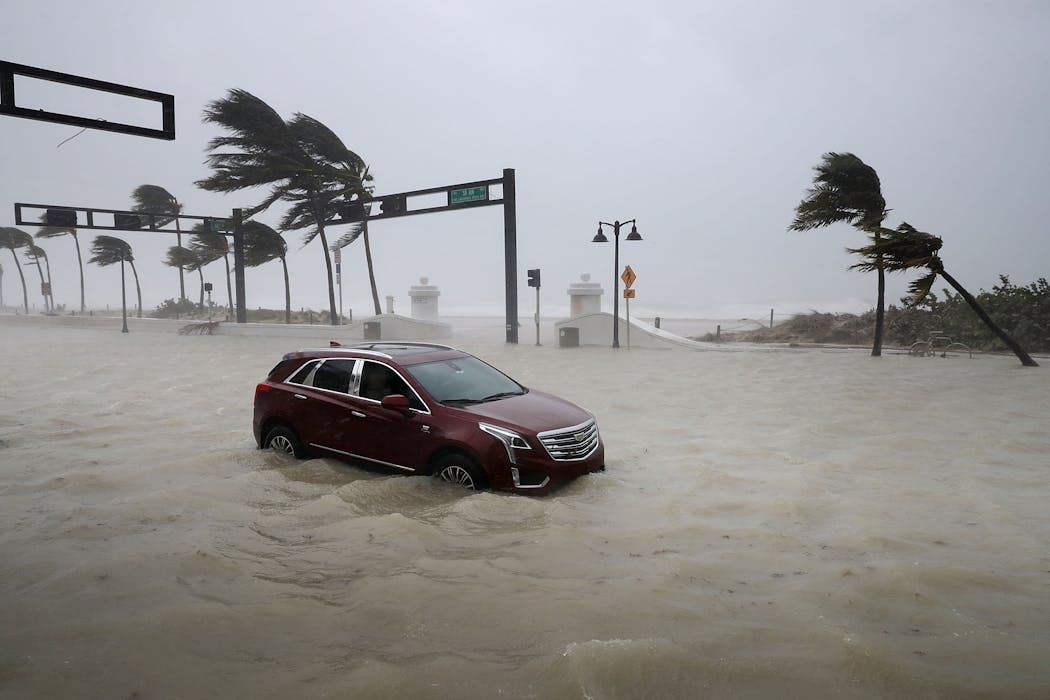
A hurricane’s storm surge can quickly inundate coastal areas. Chip Somodevilla/Getty Images

Hurricanes are America’s most destructive natural hazards, causing more deaths and property damage than any other type of disaster. Since 1980, these powerful tropical storms have done more than US$1.5 trillion in damage and killed more than 7,000 people.

The No. 1 cause of the damages and deaths from hurricanes is storm surge.

Storm surge is the rise in the ocean’s water level, caused by a combination of powerful winds pushing water toward the coastline and reduced air pressure within the hurricane compared to the pressure outside of it. In addition to these factors, waves breaking close to the coast causes sea level to increase near the coastline, a phenomenon we call wave setup, which can be an important component of storm surge.

Accurate storm surge predictions are critical for giving coastal residents time to evacuate and giving emergency responders time to prepare. But storm surge forecasts at high resolution can be slow.

A coastal area with severe damage to homes and others buildings.
An aerial photo of Fort Myers Beach, Fla., in the aftermath of Hurricane Ian in September 2022 shows the damage storm surge can do.
Ricardo Arduengo/AFP via Getty Images

As a coastal engineer, I study how storm surge and waves interact with natural and human-made features on the ocean floor and coast and ways to mitigate their impact. I have used physics-based models for coastal flooding and have recently been exploring ways that artificial intelligence can improve the speed of storm surge forecasting.

How storm surge is forecast today

Today, operational storm surge forecasts rely on hydrodynamic models, which are based on the physics of water flow.

These models use current environmental conditions – such as how fast the storm is moving toward shore, its wind speed and direction, the timing of the tide, and the shape of the seafloor and the landscape – to compute the projected surge height and determine which locations are most at risk.

Hydrodynamic models have substantially improved in recent decades, and computers have become significantly more powerful, such that rapid low-resolution simulations are possible over very large areas. However, high-resolution simulation that provide neighborhood-level detail can take several hours to run.

Those hours can be critical for communities at risk to evacuate safely and for emergency responders to prepare adequately.

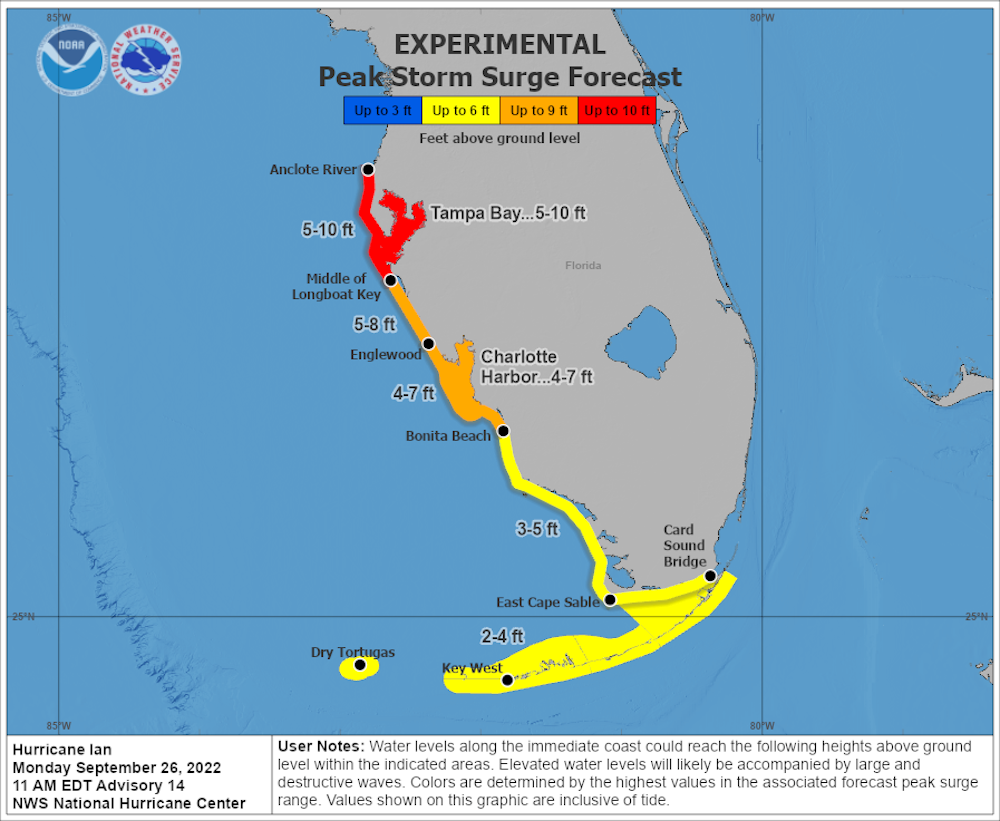
A map of Florida shows areas at greatest risk of storm surge.
The National Hurricane Center’s storm surge forecast for Hurricane Ian two days before it made landfall near Fort Myers, Fla., on Sept. 28, 2022.
NOAA

To forecast storm surge across a wide area, modelers break up the target area into many small pieces that together form a computational grid or mesh. Picture pixels in an image. The smaller the grid pieces, or cells, the higher the resolution and the more accurate the forecast. However, creating many small cells across a large area requires greater computing power, so forecasting storm surge takes longer as a result.

Forecasters can use low-resolution computer grids to speed up the process, but that reduces accuracy, leaving communities with more uncertainty about their flood risk.

AI can help speed that up.

How AI can create better forecasts

There are two main sources of uncertainty in storm surge predictions.

One involves the data fed into the computer model. A hurricane’s storm track and wind field, which determine where it will make landfall and how intense the surge will be, are still hard to forecast accurately more than a few days in advance. Changes to the coast and sea floor, such as from channel dredging or loss of salt marshes, mangroves or sand dunes, can affect the resistance that storm surge will face.

The second uncertainty involves the resolution of the computational grid, over which the mathematical equations of the surge and wave motion are solved. The resolution determines how well the model sees changes in landscape elevation and land cover and accounts for them, and at how much granularity the physics of hurricane surge and waves is solved.

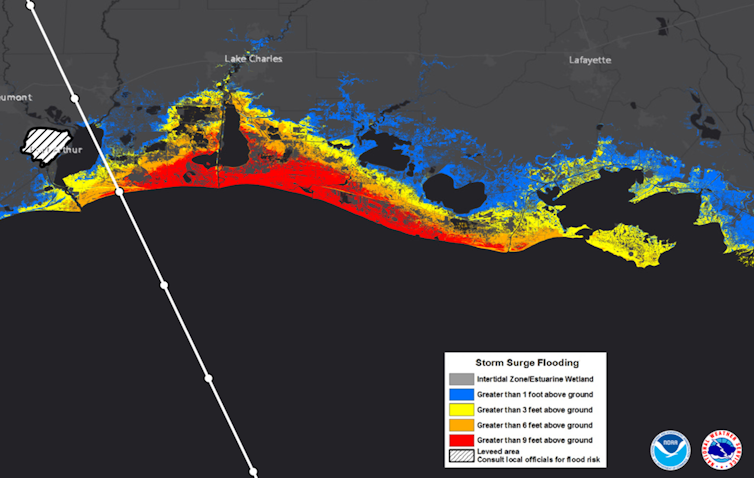
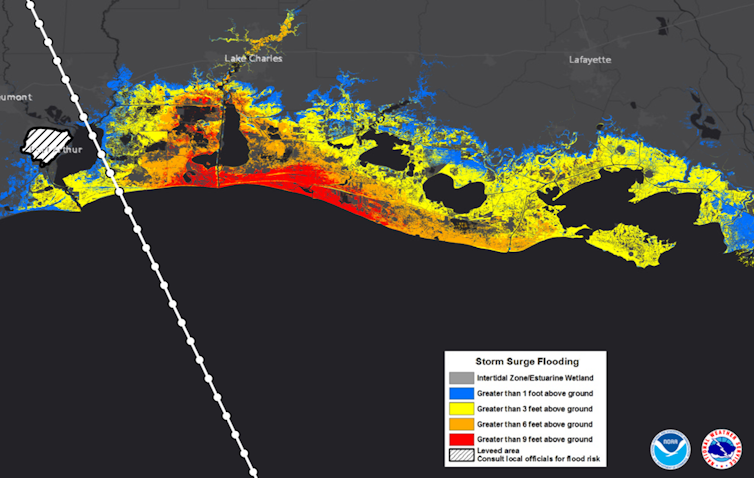
Detailed storm surge models can provide more specific information about expected flood height. These two modeled examples show the difference in expected flooding from a fast-moving storm, above, and a slow-moving storm, below.
NOAA
Slower-moving storms tend to have higher and broader storm surge inland, including into bays and estuaries.
NOAA

AI models can produce detailed predictions faster. For example, engineers and scientists have developed AI models based on deep neural networks that can predict water levels along the coastline quickly and accurately by using data about the wind field. In some cases, these models have been more accurate than traditional hydrodynamic models.

AI can also develop forecasts for areas with little historic data, or be used to understand extreme conditions that may not have occurred there before.

For these forecasts, physics-based models can be used to generate synthetic data to train the AI on scenarios that might be possible but haven’t actually happened. Once an AI model is trained on both the historic and synthetic data, it can quickly generate surge forecasts using details about the wind and atmospheric pressure.

Training the AI on data from hydrodynamic models can also improve its ability to quickly generate inundation risk maps showing which streets or houses are likely to flood in extreme events that may not have a historical precedent but could happen in the future.

The future of AI for hurricane forecasting

AI is already being used in operational storm surge forecasts in a limited way, mainly to augment the commonly used physics-based models.

In addition to improving those methods, my team and other researchers have been developing ways to use AI for storm surge prediction using observed data, assessing the damage after hurricanes and processing camera images to deduce flood intensity. That can fill a critical gap in the data needed for validating storm surge models at granular levels.

As artificial intelligence models rapidly spread through every aspect of our lives and more data becomes available for training them, the technology offers potential to improve hurricane and storm surge forecasting in the future, giving coastal communities faster and more detailed warnings about the risks on the way.

The Conversation

Navid Tahvildari’s research on coastal flooding has been funded by NSF, NOAA, NASA, and DOT.

ref. How AI can improve storm surge forecasts to help save lives – https://theconversation.com/how-ai-can-improve-storm-surge-forecasts-to-help-save-lives-259007

Why is Halloween starting so much earlier each year? A business professor explains

Source: The Conversation – USA (2) – By Jay L. Zagorsky, Associate Professor Questrom School of Business, Boston University

Halloween is a fun, scary time for children and adults alike – but why does the holiday seem to start so much earlier every year? Decades ago, when I was young, Halloween was a much smaller affair, and people didn’t start preparing until mid-October. Today, in my neighborhood near where I grew up in Massachusetts, Halloween decorations start appearing in the middle of summer.

What’s changed isn’t just when we celebrate but how: Halloween has evolved from a simple folk tradition to a massive commercial event. As a business school professor who has studied the economics of holidays for years, I’m astounded by how the business of Halloween has grown. And understanding why it’s such big business may help explain why it’s creeping earlier and earlier.

The business of Halloween

Halloween’s roots lie in a Celtic holiday honoring the dead, later adapted by the Catholic Church as a time to remember saints. Today it’s largely a secular celebration – one that gives people from all backgrounds a chance to dress up, engage in fantasy and safely confront their fears.

That broad appeal has fueled explosive growth. The National Retail Federation has surveyed Americans about their Halloween plans each September since 2005. Back then, slightly more than half of Americans said they planned to celebrate. In 2025, nearly three-quarters said they would – a huge jump in 20 years.

And people are planning to shell out more money than ever. Total spending on Halloween is expected to reach a record US$13 billion this year, according to the federation – an almost fourfold increase over the past two decades. Adjusting for inflation and population growth, I found that the average American will spend an expected $38 on Halloween this year – up from just $18 per person back in 2005. That’s a lot of candy corn.

Candy imports show a similar trend. September has long been the key month for the candy trade, with imports about one-fifth higher than during the rest of the year. Back in September 2005, the U.S. imported about $250 million of the sweet stuff. In September 2024, that figure had tripled to about $750 million.

This is part of a larger trend of Halloween becoming a lot more professionalized. For example, when I was a kid, it wasn’t unusual for households to pass out brownies, candied apples and other homemade treats to trick-or-treaters. But because of safety concerns and food allergies, for decades Americans have been warned to stick to mass-produced, individually wrapped candies.

The same shift has happened with costumes. Years ago, many people made their own; today, store-bought costumes dominate — even for pets.

Why Halloween keeps creeping earlier

While there’s no definitive research establishing why Halloween seems to start earlier each year, the increase in spending is one major driver.

Halloween items are seasonal, which means no one wants to buy giant plastic skeletons on Nov. 1. As total spending grows, retailers order more inventory, and the cost of storing ever-larger amounts of unsold items until the next year becomes a bigger consideration.

Once a season’s commercial footprint becomes large enough, retailers begin ordering and displaying merchandise long before it’s actually needed. For example, winter coats start appearing in stores in early fall and are typically gone when the snow starts falling. It’s the same with Halloween: Retailers put out merchandise early to ensure they’re not stuck with unsold goods once the season is over.

They also often price strategically – charging full price when items first hit the shelves, appealing to eager early shoppers, and then marking down prices closer to the holiday. This clears shelves and warehouses, making room for the next upcoming shopping season.

Over the past two decades, Halloween has become an ever-bigger commercial holiday. The growth in people enjoying the holiday and the increase in spending has resulted in Halloween becoming one giant treat for businesses. The big trick for retailers is preventing this holiday from starting before the Fourth of July.

The Conversation

Jay L. Zagorsky does not work for, consult, own shares in or receive funding from any company or organization that would benefit from this article, and has disclosed no relevant affiliations beyond their academic appointment.

ref. Why is Halloween starting so much earlier each year? A business professor explains – https://theconversation.com/why-is-halloween-starting-so-much-earlier-each-year-a-business-professor-explains-267716

Why are women’s shoes so pointy? A fashion expert on impractical but stylish footwear

Source: The Conversation – USA (2) – By Michael Watson, Interim Associate Chair and Instructor of Retailing, University of South Carolina

One thing uniting humans across history is their willingness to suffer for fashion. Victoria Kotlyarchuk/iStock via Getty Images Plus

Curious Kids is a series for children of all ages. If you have a question you’d like an expert to answer, send it to CuriousKidsUS@theconversation.com.


“Why are ladies’ shoes so pointy? Feet and toes aren’t pointy, most of men’s shoes aren’t pointy, and they hurt my feet.” – Bunny, age 13, Mizpah, New Jersey


While people’s actual feet are rounded on the end, women’s dress shoes often come to a sharp point at the toe. Many people also feel these pointy shoes are uncomfortable to wear. So why do shoe designers keep making them this way?

With over two decades in the fashion industry, I’ve researched and taught on the influences behind fashion design and how it’s used, even when certain traditions and styles seem impractical.

Revisiting the interesting history behind women’s pointy shoes can help us understand the various reasons why they’re still popular.

Pointy poulaines for men

Several current fashion trends for women, including pointy shoes, were in fact initially adopted by men.

In medieval Europe, around the 14th and 15th centuries, pointy leather shoes were popular among wealthy men. Called poulaines – or cracows, after the Polish city Kraków, where historians think they originated – these shoes could run as long as 12 inches in length. To keep the stiff, pointy shape, the wearer would stuff the ends of the shoes with moss or wool.

Black shoes with long, pointed tips
The pointy tip is the point for poulaines.
Deutsches Schuhmuseum Hauenstein, CC BY-SA

Like most items of fashion, shoes signal the wearer’s status to their peers. Poulaines were heavily decorated and expensive to make, and their elongated design made it difficult to move around. Thus, wearing poulaines communicated to others that the wearer was wealthy, having no need to perform physical work that required mobility.

Pointy shoes as status symbol

These shoes became so popular that in 1463 King Edward IV of England passed laws limiting toe length to 2 inches for anyone below a lord in social ranking. This decree had social, political and religious effects.

Socially, restricting the longest-toed shoes to the nobility ensured the shoe would be a visual status marker associated with the upper classes. This obvious sign helped maintain social order and prevented lower-class people from trying to pass themselves off as higher in standing than they were.

Politically, the king used this same legislation to control the textile trade and protect English industries. By regulating the fabrics and accessories necessary to make excessively ornate shoes, Edward IV could limit foreign competition with English textile manufacturers and at the same time manage fashion trends.

Painting depicting various aristocrats wearing pointy shoes at a banquet
Only nobility got to enjoy the longest pointy shoes England could offer.
Loyset Liédet (circa 1470)/Bibliothèque de l’Arsenal

From a religious perspective, King Edward IV passed these laws on the grounds that God was displeased by anything other than modest clothing – for the lower classes, anyway. Additionally, religious leaders believed that the long toes prevented people from kneeling in a respectful, submissive manner and so restricted the ability to properly pray.

The pressure to literally “fit in” to these pointy shoes also came with a physical cost. Poulaines hurt the wearer’s feet and could make their toe bones crooked. Bunions – a bony bump that develops on the inside of the foot at the big toe – became more common with the popularity of these shoes.

Pain with a purpose

Various cultures have adopted pointy shoes throughout history, often to signify status, wealth or a connection to a specific subculture. A few examples include the juttis or khussas of Northern India and Pakistan, respectively; the lotus shoes once popular in China; and the pointed flat slippers worn during the Etruscan civilization.

From a practical standpoint, however, pointy-toed shoes can lead to foot deformities and health problems. Why do people still wear pointy shoes if they’re so painful?

Shoes with a very close taper at the toes and high arches
Fitting into lotus shoes required intentionally breaking one’s feet.
Daniel Schwen/The Children’s Museum of Indianapolis via Wikimedia Commons, CC BY-SA

One reason is a desire to belong. Your brain is programmed to seek out and find people who think and believe like you. Like how early humans needed to stay with their tribe to survive, your brain thinks that being part of a group can help keep you safe.

Because high-heeled, pointed shoes are commonly worn by women, wearing them gives the wearer feelings of acceptance from other women. While there is nothing inherent about pointy shoes that make them feminine or attractive – considering that they were often originally designed for men – fashion often relies on trends that people unconsciously agree on. What is stylish is often influenced by accepted social norms.

Your brain also has clever shortcuts to help you make decisions quickly. One shortcut is to look at what other people are doing. If you see lots of people wearing a certain style or playing a particular game, your brain thinks, well, if everyone is doing this, it must be a good choice. This process helps you make decisions without having to think too hard about every little detail.

Scientists call the powerful, mental influence fashion has on both the person wearing it and the people seeing their outfit enclothed cognition. The shoes you wear may alter how you perceive yourself and others, as well as carry symbolic meaning. So designers might use elongated shoes to create the illusion of a long, slender silhouette to create a look that is not only seen but also personally felt as elegant and powerful.

With new technology and an increased consumer desire for comfort, the good news is that next time you get dressed and want to wear pointy, fashionable shoes, they may be at least a little less painful than they were in the past.


Hello, curious kids! Do you have a question you’d like an expert to answer? Ask an adult to send your question to CuriousKidsUS@theconversation.com. Please tell us your name, age and the city where you live.

And since curiosity has no age limit – adults, let us know what you’re wondering, too. We won’t be able to answer every question, but we will do our best.

The Conversation

Michael Watson does not work for, consult, own shares in or receive funding from any company or organization that would benefit from this article, and has disclosed no relevant affiliations beyond their academic appointment.

ref. Why are women’s shoes so pointy? A fashion expert on impractical but stylish footwear – https://theconversation.com/why-are-womens-shoes-so-pointy-a-fashion-expert-on-impractical-but-stylish-footwear-256174