Why many kidney patients are still choosing hospital dialysis – and how the NHS can help more people access care at home

Source: The Conversation – UK – By Leah McLaughlin, Research Fellow in Health Services, Bangor University

PeopleImages.com – Yuri A/Shutterstock

Every week, thousands of people with kidney disease in the UK spend long hours in hospital receiving life-saving dialysis. For many, this means travelling to a kidney unit three times a week and sitting through sessions that last four hours or more. It’s a huge commitment that affects people’s ability to work, travel and maintain a normal social life.

But for many with kidney failure, there’s another option: dialysis at home. It’s more flexible, often less disruptive and, in the long run, more cost-effective for the NHS. So why do most people still choose hospital dialysis?

A parliamentary summit in May reflected on how to make dialysis more accessible to patients at home. My colleagues and I published research on this topic in 2019. Working in partnership with people who have kidney disease, their families, NHS staff, dialysis providers and kidney charities, we explored the barriers to home dialysis, and how to overcome them.

People with kidney failure need either a transplant or regular dialysis to filter waste from their blood. Despite NHS guidance that at least 20% of people on dialysis should be supported to have this treatment at home, this target isn’t being met in many parts of the UK.

A close up of a kidney dialysis machine.
A kidney dialysis machine.
ali.can0707/Shutterstock

Our research team, which included people who had experienced dialysis, held discussions with 50 people from across Wales. Many told us that hospital dialysis was presented by healthcare staff as the default option. For those who had not yet come to terms with needing dialysis, or who had delayed planning due to the unpredictable nature of kidney disease, hospital treatment felt like the path of least resistance.

Some were concerned about the disruption home dialysis might bring. This included changes to their living space or worries that partners or family members might become their carers. Others valued the routine and regular social contact of hospital dialysis.

Healthcare professionals may unintentionally reinforce this choice. Some feel more comfortable monitoring patients in clinical settings or are unsure about how to support home dialysis effectively. In some cases, home dialysis isn’t an option because local services don’t have the infrastructure to support it.

Rather than simply identifying problems, we worked together to develop practical solutions. In 2021, working with patients, healthcare professionals, charities, commissioners and industry, we devised a new service plan that outlines how kidney services could be redesigned to support more people to choose home dialysis.

One important finding was the power of talking to others already doing it. It’s not just about practical advice, but reassurance that it can work.

We also identified the need for better training for both professionals and patients. People told us they wanted to understand their options earlier, ideally a year before dialysis starts. That means tackling difficult topics, such as advance care planning, sooner and with the right support.

Social care also has an important role to play. People with complex needs – like living alone, having mobility challenges, or experiencing financial hardship – may need home support, welfare advice or help navigating the system.

The cost of choice

In a linked study, published in 2022, we analysed the costs of different dialysis options. Home dialysis was found to cost between £16,000 and £23,000 per person per year.

Hospital dialysis costs more, between £20,000 and £24,000, rising to over £30,000 when ambulance transport is needed. This suggests that encouraging more people to have dialysis at home could deliver savings for the NHS.

In Wales, where all kidney services are coordinated through a single clinical network, home dialysis is more widely available. But in England, services are more fragmented, so access can depend on where you live.

Even if these changes were implemented, fundamental issues may still prevent progress. Beneath the surface of patient satisfaction lies a deeper problem – the NHS dialysis service is no longer working as intended.

Transport is one of the most frequently cited concerns among people receiving hospital dialysis, and no one seems satisfied with current arrangements. But satisfaction surveys fail to capture the complexity of the situation.

People often begin dialysis in a unit that isn’t closest to home due to availability. Later, when given the option to move closer or switch to home dialysis, they may decline. These dialysis units begin to function as surrogate families, offering comfort, routine and social interaction, especially for people who live alone or are isolated.

This emotional connection can obscure the bigger picture. Patients may focus on transport as the issue, rather than recognising that their own decisions – shaped by understandable human needs and system design – are part of the wider challenge.

A close up of an arm receiving kidney dialysis.
shutterstock.
ali.can0707/Shutterstock

Staff are caught in the same dynamic. They worry about losing patients they’ve built relationships with or fear someone may not cope alone. But as a result, the service ends up operating not to help people live well for longer but to preserve a sense of satisfaction with a suboptimal status quo.

By focusing too heavily on keeping people content with the status quo, we risk obscuring what’s truly working, or not. Worse, we may end up wasting already limited resources trying to fix problems that are byproducts of a system shaped more by sentiment than strategy.

Meanwhile, staff are caught in the middle, trying to deliver care under mounting pressure, with increasingly blurred expectations.

What needs to change

To break out of this cycle, different questions should be asked, and not just whether people are satisfied, but whether they are living well, maintaining independence and receiving care that truly reflects their needs and values.

Our research shows that people already on home dialysis are a valuable and underused resource. They can offer support and insight to others who are starting their treatment.

The collaborative approach we used could be a model for other parts of the NHS. By designing services with people, not just for them, we can move closer to a future where more people live comfortably with kidney disease, and care that truly fits around their lives and not the other way round.

The Conversation

Leah McLaughlin receives funding from Health and Care Research Wales. She is affiliated with the Wales Kidney Research Unit.

We would like to acknowledge Dr Gareth Roberts Chief Investigator of the Dialysis Options and Choices study. Dr Gareth Roberts is a Consultant Nephrologist and Associate Medical Director at Aneurin Bevan University Health Board and is clinical lead of the Welsh Renal Clinical Network.

ref. Why many kidney patients are still choosing hospital dialysis – and how the NHS can help more people access care at home – https://theconversation.com/why-many-kidney-patients-are-still-choosing-hospital-dialysis-and-how-the-nhs-can-help-more-people-access-care-at-home-254747

Norman Tebbit, Conservative minister known as Thatcher’s enforcer, dies at 94

Source: The Conversation – UK – By Martin Farr, Senior Lecturer in Contemporary British History, Newcastle University

No man more embodied Thatcherism in the eyes of the public in the 1980s than Norman Tebbit, who died on July 7, aged 94.

Though certainly no yuppie, Lord Tebbit entitled his memoirs Upwardly Mobile. Margaret’s Thatcher’s triumph was also his. She saw in the Essex MP just the uncompromising approach to transforming Britain to which she too was committed.

Both had been disgusted by the Conservative government of Edward Heath blinking when it sought to face down trade unions in the early 1970s. The experience was elemental to their plan for government.

Others were more important to the New Right/neoliberal project elected in 1979: Conservative minister Keith Joseph, and Thatcher’s two chancellors, Geoffrey Howe and Nigel Lawson.

But Tebbit provided something no one else in Thatcher’s cabinet could: an innate connection with white, working-class voters, who may once have been Labour – Tebbit lauded Clement Attlee and Ernest Bevin – but whose values were held to have been washed away in the postwar tide of union militancy, social permissiveness, European integration, and mass immigration.


Get your news from actual experts, straight to your inbox. Sign up to our daily newsletter to receive all The Conversation UK’s latest coverage of news and research, from politics and business to the arts and sciences.


He became a Conservative almost because, rather than in spite, of his background. “Essex man” was a presiding personification of the period.

Unlike almost all of Thatcher’s ministers, Tebbit did not go to university, but left school at 16 to encounter the “closed shop”: that one had to be a member of a particular union to work in a particular workplace. He became determined at that moment to end this practice, and with it so much else of postwar social democracy.

Thirty years later he did, as Thatcher’s secretary of state for employment. Tebbit’s 1982 Employment Act avenged the unions’ defeat of Heath. Union rights were weakened, never to be restored, and those of employers emboldened. It was a significant contribution to Thatcherism’s ledger.

As secretary of state for trade and industry, Tebbit pursued privatisation – the return (as its proponents, simply, put it) of nationalised industries to the private sector – with passion. The postwar settlement in Britain was being upended.

Public image

In an age before the televising of parliament (much less 24-hour news and social media), Tebbit cut through in a way few politicians did.

At at a time of inner-city violence, the public knew Tebbit’s unemployed father, decades earlier, didn’t riot but “got on his bike and looked for work”. No one else could have been called – in the words of Labour’s Michael Foot – a “semi-house-trained polecat”. TV’s puppet satire Spitting Image portrayed him as the “Chingford Strangler”, dressed in biker leathers.

Tebbit felt no need for his contempt for socialism to be leavened by charm or humour. There was invariably a slight sense of menace. He had no interest in ingratiating or propitiating. And so he was as loved by Conservative party members as he was hated by the left. He welcomed their hatred.

Tebbit in particular despised the swinging 60s – fittingly, he entered parliament in the election in which Harold Wilson’s government was unexpectedly ejected – and its legacy of “insufferable, smug, sanctimonious, naive, guilt-ridden, wet, pink orthodoxy”. Thus his trenchancy on immigration, overseas aid (a “sink of iniquity, corruption and violence”), sexuality (he was one of the few still to use the word “sodomite”) and Europe (he was a Eurosceptic before Euroscepticism).

In 1990 Tebbit asked of British-born people of Asian heritage: “Which side do they cheer for? Are you still harking back to where you came from or where you are?”. Tebbit’s “cricket test” is second only to Enoch Powell’s “rivers of blood” speech in the annals of inflammatory – they and their supporters would say candid – rhetoric relating to immigration. Neither would mind the association.


Read more:
Tory humiliation down to campaign length and cult of May – Norman Tebbit Q&A


What silenced most – if not quite all – of his critics, was Tebbit at his most vulnerable. Following the IRA bombing of the Grand Hotel Brighton in 1984, live television footage of him, only partially clad in his pyjamas, covered in dust, being stretchered out of the rubble, became the defining image of the atrocity.

The following year Thatcher moved him from trade and industry to, less happily, chairman of the Conservative party. It was a job that required a lighter touch than Tebbit’s.

Nevertheless, as chairman, he delivered the Conservatives’ third election victory, of 1987 – ensuring the permanence of the transformation – only to immediately retire to the backbenches. Margaret, his wife, had been paralysed by the bomb, and he devoted himself to her care for more than 30 years until her death.

As warranted as his departure from government may have been, Thatcher “bitterly regretted” losing him, a feeling she felt for few. Her defenestration in November 1990 is much harder to imagine had Tebbit still been in the cabinet.

Norman Tebbit’s conservatism and nationalism harked back to an earlier age, yet presaged the populism of the 2020s. In his remarks following the news of Tebbit’s death, Nigel Farage said he thought him “a great man”.

Tebbit’s values endure in public discourse, in more ways than he might have expected even a few years ago. But in his last months he was either unable, or unwilling, to say whether those values were those of the Conservatives, the traditional party of the right, or of another project. That may be a final Tebbit “test”.

The Conversation

Martin Farr does not work for, consult, own shares in or receive funding from any company or organisation that would benefit from this article, and has disclosed no relevant affiliations beyond their academic appointment.

ref. Norman Tebbit, Conservative minister known as Thatcher’s enforcer, dies at 94 – https://theconversation.com/norman-tebbit-conservative-minister-known-as-thatchers-enforcer-dies-at-94-260716

The Edwardians: Age of Elegance – a glimpse into royal patronage of the arts in the early 20th century

Source: The Conversation – UK – By Jane Hamlett, Professor of Modern British History, Royal Holloway University of London

King Edward VII, the son of Queen Victoria, ascended the throne upon her death in 1901, but unlike his mother, he ruled for a very short period and died in 1910. His reign, along with the years immediately before the outbreak of the first world war in 1914, are known as the Edwardian period.

Taking in this particular era, The Edwardians: Age of Elegance at the King’s Gallery in Buckingham Palace, focuses on the artistic patronage of Edward VII and his wife Alexandra of Denmark, and their son George V and his wife Mary of Teck.


Looking for something good? Cut through the noise with a carefully curated selection of the latest releases, live events and exhibitions, straight to your inbox every fortnight, on Fridays. Sign up here.


Edward and Alexandra were married in 1863, and as Prince and Princess of Wales the pair were leading tastemakers in Victorian upper-class society in the years before Edward came to the throne at the beginning of the 20th century.

This is often regarded as a golden age before the carnage and disruption of the great war saw the world indelibly change. However, the exhibition is not confined to these years and also reaches back into the Victorian period (1837-1901).

Those hoping to experience some of the glamour of the royal family won’t be disappointed. The first room takes visitors into the heady atmosphere of the Marlborough House set which centred around Edward and Alexandra’s residence in St James’s. One case commemorates the 1871 Waverley Ball which marked the centenary of popular Scottish novelist Sir Walter Scott. Alexandra’s elaborate Mary Queen of Scots costume – a silk dress with gold lacings – is on display.

The pageantry of the court is communicated through a series of stunning narrative paintings including the Danish artist Laurits Tuxen’s The Garden Party at Buckingham Palace (1897-1900) and The Family of Queen Victoria in 1887 (1887) painted for her golden jubilee in 1887.

This theme is picked up in the second large room, which focuses on the lavish world of the court. Here, the opulent 1911 coronation robes of George and Mary and a case of necklaces and jewellery take centre stage. This exhibit is the star of the show with plenty of visitors posing for photographs in front of it.

Royals as art collectors

But beneath all the glitz and glamour there’s a subtler story about how the royal family worked as collectors and their wider role in Britain and beyond. One of the most interesting things about the exhibition is that it reveals the personal taste of the royals, through what they chose to collect.

Horses, dogs and yachts are prominent. Edward’s dog Caesar, the wire-haired fox terrier who famously followed his funeral procession in 1910, appears in several images, and his race horse Persimmon is also represented.

Edward and Alexandra were patrons of leading artists of the day – he owned a number of works by the popular Victorian painter Frederic Leighton, while she collected art by the Pre-Raphaelite artist Edward Burne Jones. Alexandra also supported Minton’s pottery studio in the 1870s, which employed many women artists.

The exhibition also reveals Alexandra’s personal artistic activities. Like many upper-class Victorian women, she was a keen photographer and creator of photo albums. In the second half of the 19th century, album-making offered women an outlet for creativity and emotional expression. An album of designs made by Alexandra in the 1860s features photos arranged in a spiders web, with family and friends transformed into butterflies and insects.

Royal patronage was often about international connections. Alexandra’s Danish heritage is expressed through pieces from the Royal Copenhagen porcelain manufacturing company, including a massive porcelain cabinet, featuring an ornamental roof topped by a group of dancing monkeys surrounding a large swan.

A larger room is devoted to objects amassed on visits and through diplomatic exchange with the colonies which at the time included India, part of Africa, Australia, Canada and New Zealand. Increasingly speedy travel networks brought the world closer in the late 19th century and the royal family were able to travel further and more frequently than ever before. These visits played an important role in Britain’s imperial identity, and underlined the nation’s global power.

Between 1875 and 1876 Edward toured India. This trip produced a dazzling array of diplomatic gifts, such as a case filled with ornately decorated Indian weapons. After the visit Edward created a special Indian room for them at Marlborough House. Today, they sparkle in their cabinet for the exhibition’s visitors.

The exhibition does a good job of revealing the importance of imperial connections to the royal collections and the role of the royals in the larger colonial project, but in places I would have liked to know more about the stories behind these objects.

There’s a tension between the precise attribution of the work of British and European artists and the objects that have been gifted from the colonies – almost all labelled “unidentified maker”.

The absence of such information is the product of longstanding curatorial habits that shaped these collections in the past and continue to determine what we know about them today. This does mean that there are some absences about the origins and makers of these things, which could have been acknowledged more in some of the exhibition text.

This was particularly evident when looking at a large portrait of the Maori dancer Terewai Horomona by Gottfried Lindauer. The image has an elaborate frame with a plaque declaring it was presented to the Prince of Wales by the New Zealand commissioner for the Colonial and India Exhibition, 1886.

The commentary states that Edward was “enchanted” with the portrait which was “promptly gifted” to him. But this might have been better used as an opportunity to give some thought to the woman whose image was framed, presented and exchanged.

Overall, though, this is an enjoyable exhibition that reveals the royal social world, patronage and imperial connections, and tells a fascinating story about the artistic taste and activities of the lesser-known monarchs of the early 20th century.

The Conversation

Jane Hamlett does not work for, consult, own shares in or receive funding from any company or organisation that would benefit from this article, and has disclosed no relevant affiliations beyond their academic appointment.

ref. The Edwardians: Age of Elegance – a glimpse into royal patronage of the arts in the early 20th century – https://theconversation.com/the-edwardians-age-of-elegance-a-glimpse-into-royal-patronage-of-the-arts-in-the-early-20th-century-259909

Alcohol sales changed subtly after Canada legalized cannabis

Source: The Conversation – Canada – By Michael J. Armstrong, Associate Professor, Operations Research, Brock University

In Canada, some studies indicate alcohol consumption declined slightly as medical cannabis use became more common. Did similar decreases follow recreational legalization? (Unsplash+)

Before Canada legalized recreational cannabis in October 2018, it was unclear how the change might affect beverage alcohol consumption. Would consumers drink less or more after cannabis became legal?

Drinking might decrease, for example, if people used cannabis in place of alcohol. That switch potentially could reduce alcohol-related harms. But economically, it would mean any gains in the cannabis industry would likely come at the expense of alcohol producers.

Conversely, drinking might increase if people used alcohol along with cannabis. That could boost alcohol industry profits and government tax revenues, but at the cost of increased health risks of both substances.

In response to this uncertainty, some businesses diversified. One alcohol producer bought a cannabis grower, while a cannabis firm took took over several beer brewers.

Research from the United States into the relationship between alcohol and cannabis use is inconclusive. Some studies report that alcohol use decreased in states that allowed cannabis, while others said usage increased or didn’t significantly change. Those conflicting conclusions might reflect the complex legal situation in the United States, where cannabis remains illegal under federal law, even in states that allow its use.

In Canada, some studies indicate alcohol consumption declined slightly as medical cannabis use became more common. Did similar decreases follow recreational legalization?

To investigate this question, I first collaborated with health science researchers Daniel Myran, Robert Talarico, Jennifer Xiao and Rachael MacDonald-Spracklin to study Canada’s overall alcohol sales.

Total sales looked stable

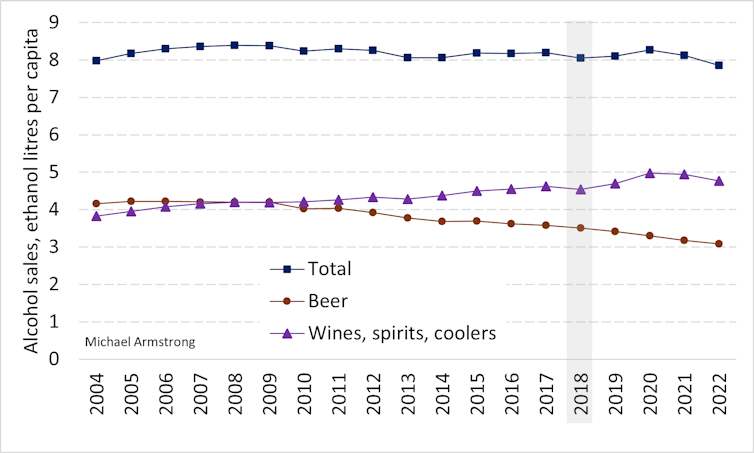
We started our research by examining annual alcohol sales from 2004 to 2022. During that period, beer sales gradually fell, while the sale of coolers and other drinks steadily rose. That left total sales basically unchanged.

So consumers were apparently switching from beer to other beverages. But there were no obvious effects from 2018’s cannabis legalization.

This diagram shows how beer sales declined while other beverage sales increased from 2004 to 2022. Total alcohol sales remained roughly constant.
Annual Canadian beverage alcohol sales from 2004 to 2022, in litres of ethanol content per capita. The vertical gray bar marks cannabis legalization.
(Statistics Canada), CC BY-ND

We also compared monthly sales during the 12 months before legalization versus the 12 after. This included national average sales by liquor retailers and beer producers. In both cases, sales trends showed no significant changes in October 2018.

However, this research on Canada-wide sales was mainly designed to detect large changes. To find subtler ones, I focused on the province of Nova Scotia.

Some liquor stores sold cannabis

When Canada legalized cannabis, most provinces banned liquor stores from selling it to avoid tempting alcohol drinkers into trying cannabis.

Nova Scotia did the opposite. Its government-owned liquor corporation became the main cannabis retailer. After legalization in October 2018, most provincial liquor stores kept selling only alcohol, but some began selling cannabis as well.

This unique situation prompted me to study the province’s sales. I focused on the 17 months before and 17 months after legalization.

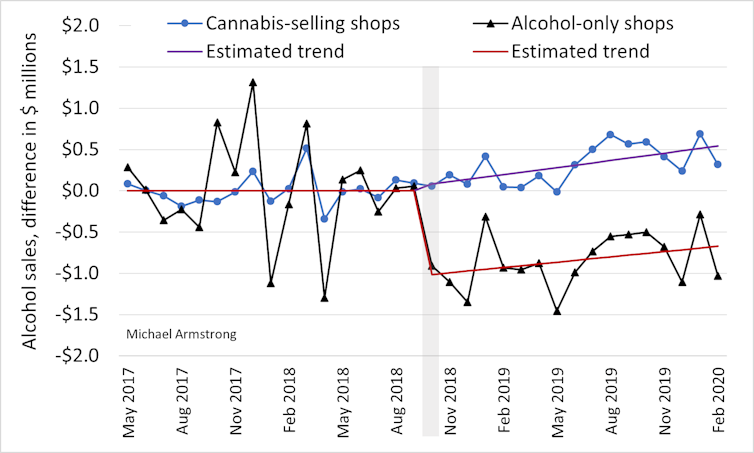
The corporation’s total alcohol sales initially fell in October 2018, then slowly regrew. As a result, monthly sales after legalization averaged about $500,000 below their earlier levels.

More interestingly, the changes differed between the cannabis-selling stores and the alcohol-only ones. At the alcohol-only stores, sales immediately fell. They averaged $800,000 below previous levels.

But at cannabis-sellers, alcohol sales began growing. Total monthly sales from October 2018 to February 2020 averaged $300,000 above earlier levels.

This diagram shows that after October 2018, alcohol sales rose gradually at liquor stores that sold cannabis but fell quickly at stores selling only alcohol.
Seasonally adjusted Nova Scotia Liquor Corporation retail sales of beverage alcohol in Canadian dollars, from May 2017 to February 2020. The vertical gray bar marks cannabis legalization.
(Nova Scotia Liquor Corporation), CC BY-ND

The divergence in sales was larger for beers than for spirits or wines.

Interestingly, alcohol-only stores located near cannabis-selling stores had changes similar to those located farther away, suggesting that cannabis-seller proximity didn’t matter.

Switching substances or stores?

My data can’t say why the sales split occurred, but I can speculate.

Consider the immediate sales drop at alcohol-only stores — this could suggest some consumers switched from alcohol to cannabis right after legalization.

Meanwhile, the lack of a drop at cannabis sellers might mean some consumers simply changed where they shopped. Instead of visiting their local alcohol-only retailer, they went to cannabis sellers to shop for alcohol and cannabis together.

The cannabis sellers’ ongoing growth might reflect people increasingly buying cannabis from licensed stores instead of illegal dealers. They went to those stores to buy weed, but picked up some extra booze while they were there.

Looking ahead

My research so far has focused on the initial post-legalization period, from October 2018 to February 2020.

I plan to study later periods next, when cannabis retailing was more widespread and perhaps more influential.

That will be more challenging, however, because COVID-19 arrived in March 2020. The pandemic disrupted sales of alcohol, though not of cannabis. It will be tricky to separate cannabis effects from pandemic ones, or from Canadian consumers’ evolving drinking habits in general.

My guess is that cannabis legalization had little short-term impact on existing drinkers overall. Most Canadians didn’t suddenly consume cannabis with their cabernet or replace vodka with vapes.

Instead, we might see gradual long-term shifts. Young Canadians now reach legal age in a context where cannabis and alcohol are both allowed. Some folks who previously would have started drinking alcohol might now choose cannabis instead, or in addition.

For now, alcohol drinking is still three times more common than cannabis use. Whether that continues, only time will tell.

The Conversation

Michael J. Armstrong does not work for, consult, own shares in or receive funding from any company or organisation that would benefit from this article, and has disclosed no relevant affiliations beyond their academic appointment.

ref. Alcohol sales changed subtly after Canada legalized cannabis – https://theconversation.com/alcohol-sales-changed-subtly-after-canada-legalized-cannabis-260375

New therapy teplizumab could delay type 1 diabetes by years – if caught early

Source: The Conversation – UK – By Richard Oram, Professor of Diabetes and Nephrology, University of Exeter

Dorde Krstic/Shutterstock.com

For more than a century, type 1 diabetes has meant one thing: a lifetime administering insulin. But for the first time, science is breaking that paradigm – not by managing the disease, but by intercepting it before symptoms even appear.

As the first patients in the UK begin receiving the groundbreaking new therapy, teplizumab, we are developing ways to identify who might benefit from a drug that only works if given before any symptoms appear. At the Royal Devon NHS, we are currently treating the first UK adult, Hannah Robinson, who was found to have early type 1 diabetes by chance during routine pregnancy screening.

About 10% of people with diabetes have type 1, while the remaining 90% have type 2, a condition linked to lifestyle factors where insulin is still produced but does not work properly. Type 1 diabetes is an autoimmune condition that leads to complete loss of insulin production from the pancreas. Without insulin, blood sugar levels rise dangerously, increasing the risk of blindness, kidney failure and early death.

Although type 1 is often thought of as a disease of childhood, research from the University of Exeter has highlighted that more than half of all new cases occur in adults.

For millions around the world living with type 1 diabetes, treatment to keep blood sugar in check means lifelong daily insulin. However, using insulin comes with its own risks.

If blood sugar drops too low, it can cause hypoglycaemia, or “hypos”, which in severe cases may lead to seizures or even death. It is no surprise that constantly balancing between high and low blood sugars takes a heavy toll on both physical and mental health. During her pregnancy, Robinson needed insulin and saw firsthand how “life completely revolves around balancing your blood glucose”.

Teplizumab offers a completely different approach. Instead of simply replacing insulin, it targets the immune attack that causes type 1 diabetes.

Our immune system is usually remarkably good at telling friend from foe, protecting us from infections and cancer while leaving our own organs alone. But sometimes, for reasons still not fully understood, this balance breaks down in a process known as autoimmunity. In type 1 diabetes, the immune system mistakenly attacks the pancreas, destroying insulin-producing cells.

Diabetes symptoms.

Teplizumab works by retraining the immune system and dialling down the specific cells that target the pancreas. Studies show it can delay the disease and the need for insulin therapy by two to three years, with generally mild side-effects. For Robinson, who knows all too well from pregnancy and the full-time job that is living with type 1 diabetes, the possibility of a few extra years without insulin really mattered.

The drug is already approved in the US and is under review for routine NHS use, although a few children and teenagers in the UK have also received it through special access programmes.

Finding people early

There is a catch. By the time people develop symptoms of type 1 diabetes, such as thirst, weight loss and fatigue, more than three-quarters of their insulin-producing capacity is already destroyed.

For teplizumab and similar therapies to work, they need to be given before symptoms appear, while blood sugar levels are still normal. This means these treatments are not an option for people who already have established type 1 diabetes.

So how do we find people at this early stage? Fortunately, it is possible to detect the beginnings of the autoimmune attack many years before symptoms show using simple blood tests that measure immune markers called pancreatic autoantibodies.

Just a few drops from a finger prick can reveal whether the immune system has started to target the pancreas. Finding people early not only offers the chance to delay disease progression, it can also help avoid the life-threatening emergencies that sometimes come with a first diagnosis – such as diabetic ketoacidosis.

With type 1 diabetes affecting roughly one in 200 people, there is still the question of who to test. Not everyone’s risk is the same. When we think of inherited diseases, we often imagine conditions caused by a single gene change, such as cystic fibrosis.

Type 1 diabetes does have a genetic component, but it involves many different genes, each nudging a person’s risk up or down. Having genetic risk alone is not enough, with unknown environmental factors also needed to tip the balance.

Nine in ten people who develop type 1 diabetes have no family history. While testing relatives of people with type 1 is a logical first step, research at the University of Exeter suggests that combining all these genetic factors into a single risk score could help predict who might develop the disease and identify babies who should be monitored more closely. This could become an important tool as we move towards wider genomic screening.

It is still early days, but we are seeing a fundamental shift in how we approach type 1 diabetes. For more than a century, treatment has meant patients taking on the daily burden of replacing the insulin their bodies can no longer make. Now, the focus is turning to therapies that tackle the immune problem at its source, with the hope of stopping the disease before it fully develops and opening the door to an insulin-free future.

The Conversation

Richard Oram has received research grants or contracts from Randox and Sanofi. He has also received royalties and license from Randox, consulting fees from Sanofi, Provention Bio, and Janssen and payment or honoraria from Sanofi and Novo Nordisk. He has served on data safety monitory board or advisory board for Sanofi.

Nicholas Thomas serves on an advisory boards for Sanof (manafacturer of Teplizumab) guiding the technical delivery of therapy within the NHS. He is currently employed by Exeter University as an NIHR Academic Clinical Fellow.

ref. New therapy teplizumab could delay type 1 diabetes by years – if caught early – https://theconversation.com/new-therapy-teplizumab-could-delay-type-1-diabetes-by-years-if-caught-early-259814

Nearly two-thirds of voters think Starmer doesn’t respect them – new poll

Source: The Conversation – UK – By Marc Stears, Director of UCL Policy Lab and Professor of Political Science, UCL

Simon Dawson/Number 10/Flickr, CC BY-NC-ND

Exhausted from a long campaign but buoyed by an extraordinary victory, Keir Starmer stood on the steps of Downing Street just over one year ago to deliver his victory speech. “Your government,” the new prime minister said, “should treat every single person in this country with respect.”

This message of respect resonated strongly in the year leading up to the campaign, coming as close as anything to providing a central argument to Labour’s case for government. And, according to polling and focus groups that my team at UCL Policy Lab designed along with polling company More in Common, it seemed to work.

As our research at the time showed, voters felt that “respecting ordinary people” was the most important attribute that any politician could have, more important than having ideas for the future, managing effectively or having real experience. And they thought Starmer was the leader who displayed that respect most.

A year later, the picture looks quite different. In new polling, we asked a representative sample of over 7,000 people to evaluate the government one year on. On respect, the judgement has not been good.


Want more politics coverage from academic experts? Every week, we bring you informed analysis of developments in government and fact check the claims being made.

Sign up for our weekly politics newsletter, delivered every Friday.


During the general election campaign, 41% of the electorate said that they believed that Starmer “respected people like them”. One year on, that stands at only 24%. At the same time, the number who say that he does not respect them has risen from 32% to 63%. Starmer is now outstripped on that question by Nigel Farage – 33% say the Reform UK leader respects people like them.

Losing support

This view has had crucial political consequences. Of those who voted for Labour in the general election, only 60% of our respondents say they would vote for the party in an election held tomorrow.

And that is not because some other political party is suddenly swooping in for their supporters. Labour’s voters are defecting in a host of different directions: 11% say they would vote Reform; 8% would vote Liberal Democrat; 4% would vote Green and 4% would vote Conservative. A further one in ten say they simply don’t know how they would vote.

Labour’s losses have been most dramatic among their first-time voters. Of those who voted for Labour in 2024 but not in any other general election since 2010, barely a third still support the party, while a fifth would vote for Reform UK.

These political failures, our report contends, are directly related to the declining sense of respect. The top reason voters gave for turning away from Labour are the broken promises and U-turns made by Labour in government, followed by the party’s failure to reduce the cost of living and changes to the winter fuel payment.

The idea of “respect” being key to the public’s sense of whether a government is on their side or not has been growing for many years now, both in academia and in politics itself. Since at least the 2007/8 financial crisis there has been a sense that large swathes of the public feel neglected, overlooked and even disdained by those who govern them.

When people talk about wanting to see “change” in Britain, this is often what they mean. It was a theme I touched on recently in two books, Out of the Ordinary and, with my co-author Tom Baldwin, England.

A smiling Keir Starmer delivers his victory speech, with a crowd of supporters behind him
Just over a year ago, a happier Starmer delivers his victory speech.
Shutterstock

But respect is not just an abstract idea. People appear to judge whether they are respected by those who govern them or not primarily on the basis of whether the government stands up for them against powerful vested interests.

Our earlier research demonstrated that there is a widespread sense among the British public that certain groups have had it too easy for too long. This is either because they have been able to intimidate the government, or because government ministers and advisers have themselves been recruited from among these groups.

In our new report, therefore, we see that the new government’s most popular act was their willingness to raise the minimum wage by £1,400 in April, against the objections of some in business who suggested that such a move was too burdensome on them.

Changes to the winter fuel allowance and proposed changes to the disability benefits system, on the other hand, registered poorly. They suggest that the interests of ordinary and vulnerable people count for too little in decision-making.

These judgements currently shape the mood of the country and probably top the list of issues that the government now needs to address. There is still time for the government to rebuild its appeal, of course. Indeed, our respondents who said they would vote for Labour said they would do so because the party needs more time to fix the problems they inherited.

But as it seeks to do so, voters will want to know who this government stands for. Whose interests does it put first? What kind of people does it respect?

Much of the electorate thought they knew the answer to these questions one year ago. Now they’re not so sure.

The Conversation

Marc Stears directs the UCL Policy Lab, a non-partisan think tank based at University College London. He was previously chief speechwriter to the UK Labour Party.

ref. Nearly two-thirds of voters think Starmer doesn’t respect them – new poll – https://theconversation.com/nearly-two-thirds-of-voters-think-starmer-doesnt-respect-them-new-poll-260606

Cancellations at Canadian film festivals raise questions about accountability

Source: The Conversation – Canada – By Dorit Naaman, Alliance Atlantis Professor of Film and Media, Queen’s University, Ontario

Film festivals are unique cultural institutions, spaces to see diverse films by local and global filmmakers and an important market for distributors. These films are often difficult to see, or even know about, outside of festival circuits.

Festivals are also answerable to funders and to different stakeholders’ interests. Cancellations of planned films raise questions about festivals’ roles and accountability to community groups who find certain films objectionable, the wider public, politicians, festival sponsors, audiences, filmmakers and the films themselves.

In September 2024, The Toronto International Film Festival (TIFF) faced a backlash from pro-Ukrainian groups — and former deputy prime minister Chrystia Freeland, who is of Ukrainian descent — when the documentary Russians at War was included in the program.


Read more:
‘Russians at War’ documentary: From the Crimean to the Iraq War, soldier images pose questions about propaganda


The Ukrainian Canadian Congress and other advocates called on TIFF to cancel the film, directed by Russian Canadian Anastasia Trofimova, which they accused of being Russian propaganda.

TIFF did cancel festival screenings after it was “made aware of significant threats to festival operations and public safety,” but once the festival was over, showed Russians at the TIFF Lightbox Theatre.

In November, the Montréal International Documentary Festival (RIDM) cancelled the Canadian premiere of Rule of Stone, directed by Israeli Canadian director Danae Elon. As a film and media professor, I supervised Elon’s research for the film while she pursued a master’s degree at Queen’s University.

RIDM acknowledged Elon’s “personal commitment to criticizing and questioning the state of Israel” through her story about the stone that, by Israeli law, has to be used on the exterior of every new building in Jerusalem.

In the film, Elon examines how, in post-1967 Jerusalem, “architecture and stone are the main weapons in a silent, but extraordinarily effective colonization and dispossession process” of Palestinians.

As a documentarist and a researcher in Israeli and Palestinian media representations of fighters, I have analyzed both films and followed the controversies. Each focuses on contemporary political issues relevant to our understanding of current affairs.

While the reasons for the cancellations are different, in both cases the festivals responded to pressures from community groups, placing the public right to a robust debate at the festival and beyond as secondary.

‘Russians at War’

Director Anastasia Trifamova embedded herself in a Russian supply unit, and later a medical team, eventually making her way to the front lines in occupied Ukraine.

Trifamova comes across as a naive filmmaker, using an observational, non-judgmental form of filmmaking common in 21st-century war documentaries, as seen in films like Armadillo and Restrepo (respectively following Danish and U.S. troops in Afghanistan).

As noted by TIFF, Russians was “an official Canada-France co-production with funding from several Canadian agencies,” and Trifamova said she did not seek or receive official permission from the Russian army to film.

The film documents the machination of war, where soldiers are both perpetrators of violence and its victims. It humanizes the soldiers, which understandably can be upsetting to Ukrainian and pro-Ukrainian publics. But should emotions of one group, outraged and incensed as they may be, prevent the public from having the difficult conversations promoted by the film?

Early in the film, Trifamova confronts the soldiers about why they are fighting and they respond with Russian propaganda (fighting Nazism, defending the borders).

Later, soldiers approach Trifamova — on camera — to express doubts about the justification of the war and their presence in Ukraine. The film provides an unflattering view of Russia’s attack on Ukraine, emphasizing the futility of the war and the incredible toll on soldiers and civilians (including some Ukrainian civilians). Russian troops appear untrained and poorly equipped to fight in chaotically managed battles.

Like Armadillo and Restrepo, Russians at War represents the soldiers without judgment and contributes to necessary conversations about war. In my analysis, while Trifamova refrains — in her sporadic voice-over — from condemning the war outright, it is difficult to read the film as Russian propaganda.

While TIFF cited security concerns as the reason for cancellation, security was in place for another film that attracted controversy, Bliss.

A cancellation from such an established festival likely has an effect on how a film is able to circulate. For example, TVO, one of the funders of Russians at War, cancelled its scheduled broadcast days after the TIFF cancellation.

‘Rule of Stone’

Rule of Stone, as noted by RDIM, “critically examines the colonialist project of East Jerusalem following its conquest by Israeli forces in 1967.”

The title references a colonial bylaw to clad building with stone, first introduced by the British, which still exists today.

The film, which examines architecture’s role in creating modern Jerusalem, is led by Elon’s voice-over. It mixes her memories of growing up in 1970s Jerusalem and her reckoning with the “frenzy of building,” which included projects by architect Moshe Safdie, a citizen of Israel, Canada and the United States. Elon recounts that her father, journalist and author Amos Elon, was a close friend of Safdie, as well as legendary Jerusalem mayor Teddy Kolek.

Safdie is among the Israeli architects, architectural historians and planners who Elon interviews. The expansion of Jewish neighbourhoods is contrasted with the restrictions on and disposession of Palestinians in Jerusalem. Multiple scenes show the demolition of Palestinian homes or the aftermath. In intervwoven segments, Izzat Ziadah, a Palestinian stonemason who lives in a stone quarry, gives a tour of what is left of his destroyed home.

Viewers hear how the planning, expansion and building of Jewish neighbourhoods, post-1967, were designed to evoke biblical times. As architectural historian Zvi Efrat notes, the new neighbourhoods look like, or attempt to look like, they were there forever.

‘Rule of Stone’ trailer.

As reported by La Presse, the RIDM cancellation came after the festival received information about the documentary’s partial Israeli financing, something that “embarrassed” them with some of the festival’s partners. Funding for the development of the film came from the Makor Foundation for Israeli Films, which receives support from Israel’s Ministry of Culture and Sport.

Two organizations, the Palestinian Film Institute and Regards Palestiniens, opposed the film’s showing on the basis of their commitment to the Palestinian Campaign for the Academic and Cultural Boycott of Israel (PACBI).

In the organizations’ logic, Israel state funding means a film should be subject to boycott as “PACBI specifically targets Israeli institutional funding in the arts which serves to culturally whitewash and legitimize the Israeli state.”

In my view, this position differs from the PACBI guidelines, which state:

“As a general overriding rule, Israeli cultural institutions, unless proven otherwise, are complicit in maintaining the Israeli occupation and denial of basic Palestinian rights, whether through their silence or actual involvement in justifying, whitewashing or otherwise deliberately diverting attention from Israel’s violations of international law and human rights.”

Makor should be exempted since it regularly funds films that draw attention to Israel’s violations of Palestinian human rights. In 2024 alone, the list includes The Governor, The Village League and Death in Um al hiran.

RIDM’s website does not disclose support for a boycott. In the end, RIDM announced that Elon withdrew her film. She stated: “Screening my film at RIDM does not serve the long-term purpose of the festival, nor is it possible now to address the nuances in our common fight for justice for Palestine. I am deeply saddened and distressed by [what] has brought it to this point.”

To date, the film has not found a cinema in Montréal willing to screen it.

Provoking important conversations

The two festivals’ mission statements promise high-quality films that transform or renew audiences’ relationships to the world.

It is clear why programmers chose both films, since they’re cinematically innovative and provoke important conversations.

However, both festivals silenced these films and signalled to other filmmakers that these festivals are not brave spaces to have difficult and necessary conversations.

The Conversation

Dorit Naaman does not work for, consult, own shares in or receive funding from any company or organisation that would benefit from this article, and has disclosed no relevant affiliations beyond their academic appointment.

ref. Cancellations at Canadian film festivals raise questions about accountability – https://theconversation.com/cancellations-at-canadian-film-festivals-raise-questions-about-accountability-250892

Calls to designate the Bishnoi gang a terrorist group shine a spotlight on Canada’s security laws

Source: The Conversation – Canada – By Basema Al-Alami, SJD Candidate, Faculty of Law, University of Toronto

British Columbia Premier David Eby recently called on Prime Minister Mark Carney to designate the India-based Bishnoi gang a terrorist organization.

Brampton Mayor Patrick Brown echoed the request days later. The RCMP has also alleged the gang may be targeting pro-Khalistan activists in Canada.

These claims follow a series of high-profile incidents in India linked to the Bishnoi network, including the murder of a Punjabi rapper in New Delhi, threats against a Bollywood actor and the killing of a Mumbai politician in late 2024.

How terrorism designations work

Eby’s request raises broader legal questions. What does it mean to label a group a terrorist organization in Canada and what happens once that label is applied?

Under Section 83.05 of the Criminal Code, the federal government can designate an entity a terrorist organization if there are “reasonable grounds to believe” it has engaged in, supported or facilitated terrorist activity. The term “entity” is defined broadly, covering individuals, groups, partnerships and unincorporated associations.

The process begins with intelligence and law enforcement reports submitted to the public safety minister, who may then recommend listing the group to cabinet if it’s believed the legal threshold is met. If cabinet agrees, the group is officially designated a terrorist organization.

A designation carries serious consequences: assets can be frozen and financial dealings become criminalized. Banks and other institutions are protected from liability if they refuse to engage with the group. Essentially, the designation cuts the group off from economic and civic life, often without prior notice or public hearing.

As of July 2025, Canada has listed 86 entities, from the Islamic Revolutionary Guard Corps to far-right and nationalist organizations. In February, the government added seven violent criminal groups from Latin America, including the Sinaloa cartel and La Mara Salvatrucha, known as the MS-13.

This marked a turning point: for the first time, Canada extended terrorism designations beyond ideological or political movements to include transnational criminal networks.

Why the shift matters

This shift reflects a deeper redefinition of what Canada considers a national security threat. For much of the post-9/11 era, counterterrorism efforts in Canada have concentrated on groups tied to ideological, religious or political agendas — most often framed through the lens of Islamic terrorism.

This has determined not only who is targeted, but also what forms of violence are taken seriously as national security concerns.

That is why the recent expansion of terrorism designations — first with the listing of Mexican cartels in early 2025, and now potentially with the Bishnoi gang — feels so significant.

It signals a shift away from targeting ideology alone and toward labelling profit-driven organized crime as terrorism. While transnational gangs may pose serious public safety risks, designating them terrorist organizations could erode the legal and political boundaries that once separated counterterrorism initiatives from criminal law.

Canada’s terrorism listing process only adds to these concerns. The decision is made by cabinet, based on secret intelligence, with no obligation to inform the group or offer a chance to respond. Most of the evidence remains hidden, even from the courts.

While judicial review is technically possible, it is limited, opaque and rarely successful.

In effect, the label becomes final. It brings serious legal consequences like asset freezes, criminal charges and immigration bans. But the informal fallout can be just as harsh: banks shut down accounts, landlords back out of leases, employers cut ties. Even without a trial or conviction, the stigma of being associated with a listed group can dramatically change someone’s life.

What’s at stake

Using terrorism laws to go after violent criminal networks like the Bishnoi gang may seem justified. But it quietly expands powers that were originally designed for specific types of threats. It also stretches a national security framework already tainted by racial and political bias.


Read more:
Canadian law enforcement agencies continue to target Muslims


For more than two decades, Canada’s counterterrorism laws have disproportionately targeted Muslim and racialized communities under a logic of pre-emptive suspicion. Applying those same powers to organized crime, especially when it impacts immigrant and diaspora communities, risks reproducing that harm under a different label.

Canadians should be asking: what happens when tools built for exceptional threats become the default response to complex criminal violence?

As the federal government considers whether to label the Bishnoi gang a terrorist organization, the real question goes beyond whether the group meets the legal test. It’s about what kind of legal logic Canada is endorsing.

Terrorism designations carry sweeping powers, with little oversight and lasting consequences. Extending those powers to organized crime might appear pragmatic, but it risks normalizing a process that has long operated in the shadows, shaped by secrecy and executive discretion.

As national security law expands, Canadians should ask not just who gets listed, but how those decisions are made and what broader political agendas they might serve.

The Conversation

Basema Al-Alami does not work for, consult, own shares in or receive funding from any company or organisation that would benefit from this article, and has disclosed no relevant affiliations beyond their academic appointment.

ref. Calls to designate the Bishnoi gang a terrorist group shine a spotlight on Canada’s security laws – https://theconversation.com/calls-to-designate-the-bishnoi-gang-a-terrorist-group-shine-a-spotlight-on-canadas-security-laws-259844

Tax season in South Africa: the system is designed to tackle inequality – how it falls short

Source: The Conversation – Africa – By Nadine Riedel, Director of the Institute for Public and Regional Economics, University of Münster

South Africa’s personal income tax system is in the spotlight as the country’s tax filing season gets under way. Personal income tax is an important way of redistributing income from higher-earning to less-well-off individuals.

But how effectively does it do this and what can get in the way?

At the heart of any redistributive tax system is its structure: which incomes are taxed or exempted, which expenses are tax deductible, how the tax rate schedule is designed, and which tax credits are granted, including how much they reduce the tax owed. The schedule translates taxable income into the taxpayers’ tax liability by defining tax rates by tax brackets. The top tax rate is 45%.

In a recent study we explore how features such as tax rates, deductions, credits, and bracket adjustments shape the redistributive capacity of South Africa’s personal income tax system. For this research, we analyse all the income tax returns of South African taxpayers provided by South Africa’s Revenue Service for the tax years 2015 and 2018. (All records were made anonymous.)

The country´s personal income tax operates under a progressive tax scheme: People pay higher rates of tax as their income rises. Those with lower incomes may owe no income tax at all, while top earners can face marginal rates as high as 45%.

Based on our analysis, this progressive rate schedule is the most effective mechanism for redistributing income from higher- to lower-income earners. By contrast, “tax expenditures” – that is, expenses, which taxpayers can deduct from what they owe in tax – lower the redistributive impact of the personal income tax system.

Put differently: Allowing taxpayers to claim tax deductions and tax credits reduces the extent to which personal income taxation effectively lowers gaps between the after-tax income of high- and low-income earners.

A number of recent tax policy reforms further dampened the redistributive capacity of the system. The spotlight is on potential policy reforms that may counter this.

Weaknesses

Our research shows that the benefits from tax expenditures in the country’s personal income tax system lower its ability to narrow income gaps. South African taxpayers can deduct various expenses from the personal income tax base and their tax liability respectively, including expenses for donations, home offices, certain insurance contributions and public offices.

Many of these benefits are claimed by a relatively small number of taxpayers (often below 1% of the taxpayer population or under 100,000 taxpayers) and are concentrated among top earners. And average deduction amounts can be high.

Even more widely used deductions and credits, such as those for pensions and medical schemes, are disproportionately claimed by higher-income individuals.

We also found that recent reforms have weakened the redistributive capacity of the personal income tax system.

Over the years, adjustments have been made, some intended to improve equity, others driven by the need to bolster revenues. A closer look at three key reforms offers some insight into the impact they have had on the distributive goal of the country’s tax system.

In 2016, pension-related deductions were redesigned to be more generous and to harmonise the treatment of different pension funds. The goal of the reform was to create a fairer and more coherent pension deduction system. While the number of taxpayers claiming pension deductions increased after the reform, our research found that that the policy change still disproportionately benefited higher-income earners. This is because they are more likely to make pension contributions – and do so in larger amounts.

As a result, the policy reduced the overall redistributive impact of the personal income tax system. In other words, it lowered the extent to which personal income taxation reduces income gaps between higher and lower income taxpayers.

The following year, the government introduced a new top tax bracket which raised the marginal tax rate on incomes above R1.5 million (today roughly R1.8 million or US$100,700) from 41% to 45%. That is, if you earn more than R1.5 million, you pay 45% of this income in tax.

The stated aim of the reform was to strengthen the progressivity of the personal income tax system. But our analysis suggests that the real-world impact was limited. This is because the pre-tax incomes of high earners grew more slowly than those of lower-income individuals after the reform. This may reflect that high income earners responded to the reform by lowering their taxable income. They could do so by tax avoidance – high income earners may, for example, shift income to the (potentially lower-taxed) future by compensation through stock options or higher retirement contributions. Or it could be through real adjustments, like earlier retirement entry or less job effort (and, in consequence, lower earnings).

Between 2015 and 2018, inflation pushed wages and prices upward, but tax thresholds did not keep pace. This led to many taxpayers being shifted into higher tax brackets despite no real change in their purchasing power (referred to as bracket creep). This raised effective tax rates, but also had a regressive side-effect: lower- and middle-income earners were disproportionately affected, weakening the personal income tax system’s ability to reduce income inequality.

For example, because of bracket creep, a significant fraction of low-income taxpayers – around 3% – became liable for tax. Without bracket creep they would have stayed below the tax exemption threshold.

Reforms to the tax system

South Africa’s progressive personal income tax structure has played an important redistributive role. Nevertheless, its effectiveness has been weakened by tax expenditures, bracket creep, and uneven reform outcomes.

Targeted policy adjustments can strengthen its redistributive capacity.

Deductions and tax credits: Most of these are regressive, with benefits concentrated among higher-income earners. Phasing out some could strengthen redistribution. But not without trade-offs. After all, deductions and credits also recognise unavoidable expenses, such as work-related or medical costs, and encourage behaviour like charitable giving or retirement saving.

Yet their appropriateness remains widely debated and their use differs across countries.

Beyond fairness, tax expenditures come with other downsides, too. For example, they can complicate tax enforcement and open the door to misreporting, particularly where qualifying expenses are hard to verify.

Policymakers might also consider shifting from deductions to tax credits.
While deductions reduce the taxable income of an individual, tax credits directly reduce the tax owed. Individuals in higher tax brackets gain a relatively higher advantage from deductions, as their tax rate is higher. Contrarily, one rand of tax credit provides the same relief to all taxpayers with a positive tax liability.

Making credits refundable, though potentially costly, could further boost their redistributive effect.

Standardised deductions could help as well, by allowing fixed rand amounts for certain expenses without requiring proof of payment, and offering relief to lower-income taxpayers who often forgo claims due to lack of resources or knowledge.

Finally, addressing bracket creep by automatically indexing tax brackets to inflation could preserve the progressivity of the personal income tax system over time, shielding lower- and middle-income taxpayers from a quiet rise in tax burdens.

The Conversation

Prof. Dr. Nadine Riedel receives funding from UNU WIDER.

This research is part of the so-called SATIED program. In the context of the program, I act as an academic work stream lead and receive compensation through UNU WIDER (which is the University of the UN) for this role.

Ida Zinke does not work for, consult, own shares in or receive funding from any company or organisation that would benefit from this article, and has disclosed no relevant affiliations beyond their academic appointment.

ref. Tax season in South Africa: the system is designed to tackle inequality – how it falls short – https://theconversation.com/tax-season-in-south-africa-the-system-is-designed-to-tackle-inequality-how-it-falls-short-260351

There are many things American voters agree on, from fears about technology to threats to democracy

Source: The Conversation – UK – By Emma Connolly, Research Fellow, Digital Speech Lab, UCL

During his recent public spat with Donald Trump, Elon Musk tweeted a poll asking if a new political party would better represent the 80% of voters in the middle. Hundreds of thousands of people responded and more than 80% answered “yes”.

The middle is still overlooked in US politics. This is because there is a perception that Republicans and Democrats have nothing in common, and therefore no issue will win support from both centrist Republicans and Democrats.

Polarisation is problematic as it is linked to “democratic backsliding” – the use of underhand tactics in political processes. Worst of all, it poses a threat to democracy.

Many think that polarisation is fuelled by echo chambers created on social media platforms. These only expose people to beliefs similar to their own.

However, I study how narratives emerge on social media, and ways to investigate them. My work has two aims: first, to identify political issues that are likely to cross party lines, and a wider goal of exploring the role of social media in mitigating, rather than exacerbating, levels of polarisation.


Get your news from actual experts, straight to your inbox. Sign up to our daily newsletter to receive all The Conversation UK’s latest coverage of news and research, from politics and business to the arts and sciences.


Earlier this year, for example, I sorted through 12,000 posts from Republican and Democrat voters on subreddits (online forums discussing specific topics). Using a technique I developed in my PhD research, I analysed attitudes to contested political issues around the time of Trump’s inauguration. Like other researchers, I am finding that there are things both sides often agree on, and that not every issue splits neatly across party lines.

Pew Research shows what Democrats and Republicans agree on.

Although it’s a complex topic, people from both parties are worried about levels of free speech on social media. According to my work and other sources, some Democrats accuse TikTok of censoring hashtags such as #FreeLuigi (a reference to Luigi Mangione, accused of murdering UnitedHealthcare CEO, Brian Thompson).

Meanwhile, some Republicans are saying they are flooded with what they see as left-wing content pushed by the algorithms. Despite their differences, Republicans and Democrats agree that social media platforms need to be more transparent about the way they work.

Both sides worry about the rise of authoritarianism and the growing negative influence of artificial intelligence in shaping the US’s future. There is a sense among some members of the two parties that the real enemies aren’t each other, but powerful corporations who hold too much power.

People on both sides of the political divide can be distrustful of tech companies and big businesses, where billionaires have power regardless of who’s in charge. Divisions of “up v down” could be alternatives to seeing divisions as “left v right”.

Some people are worried about the creation of a massive database of citizens’ details, and how their details could be used, or abused. Recently Republican Marjorie Taylor Greene said she would have opposed Trump’s “big, beautiful, bill”, had she read the AI clause thoroughly. The clause stops states from passing laws to regulate AI systems for the next ten years.

What do people agree on?

On the topic of protecting democracy, there are some suggestions that many Republicans and Democrats agree this is important, and under threat. In my study, some Republican and Democrat voters object to the possibility of Trump having a third term, aligning with the findings of several recent polls on the subject, and even among Trump’s most loyal support groups.

Both Republicans and Democrats want “the best” leaders who could get things done fast and efficiently. But it would appear that people on both sides are concerned about the “slash-and-burn” way that Doge (the Department for Government Efficiency, the new agency tasked with cutting federal spending) is working.

Also, deciding who is the best leader isn’t always about agreeing with specific policies. Instead, it’s about delivering decisive, efficient action. Even Republicans who don’t back everything Trump is doing say that at least he is doing something, especially in relation to immigration.

Many Republicans criticise the left, and former Democratic presidential candidate Kamala Harris in particular, but for unclear messaging, as much as any one policy. They (and others) put her loss down to a lack of direction and clarity on key issues (among other things). This probably resulted in failing to win votes from independents and moderate Republicans and many Democrats are frustrated that the party still hasn’t addressed this.

Research suggests that Democrat and Republican voters often agree that polarisation causes gridlock and prevents progress, but believe voices from the middle are not being heard. Some Republicans and Democrats also share a concern that both parties are more focused on fighting each other than on solving problems, with 86% of Americans believing this.

Some Republican voters in the posts I am analysing suggest that working together to get things done would be positive, supporting findings from the US and abroad. Other important factors rather than political party, such as religion or family or everyday life experiences can bring people from both sides together.

So, Americans might not be as divided as one might think. Levels of polarisation feel high but this could be skewed by the extreme views of a minority on both sides. And it isn’t helped by some sensationalist media reporting.

Lots of people get their news from social media platforms which reward and monetise engagement. Posts that fuel division are often the most visible, but they rarely tell the whole story. Divisive views are also often shared by those who are themselves the most polarised.

Like Musk’s online poll, research is starting to suggest that there is still a sizeable moderate middle in the US today who are open to compromise through clear messaging. These voters can make all the difference, especially if parties can frame issues in ways that appeal across the divide. With the 2026 midterm elections on the horizon, both sides might want to listen to them more.

The Conversation

Emma Connolly does not work for, consult, own shares in or receive funding from any company or organisation that would benefit from this article, and has disclosed no relevant affiliations beyond their academic appointment.

ref. There are many things American voters agree on, from fears about technology to threats to democracy – https://theconversation.com/there-are-many-things-american-voters-agree-on-from-fears-about-technology-to-threats-to-democracy-258440