XFG could become the next dominant COVID variant. Here’s what to know about ‘Stratus’

Source: The Conversation – Global Perspectives – By Paul Griffin, Professor, Infectious Diseases and Microbiology, The University of Queensland

visualspace/Getty Images

Given the number of times this has happened already, it should come as little surprise that we’re now faced with yet another new subvariant of SARS-CoV-2, the virus responsible for COVID.

This new subvariant is known as XFG (nicknamed “Stratus”) and the World Health Organization (WHO) designated it a “variant under monitoring” in late June. XFG is a subvariant of Omicron, of which there are now more than 1,000.

A “variant under monitoring” signifies a variant or subvariant which needs prioritised attention and monitoring due to characteristics that may pose an additional threat compared to other circulating variants.

XFG was one of seven variants under monitoring as of June 25. The most recent addition before XFG was NB.1.8.1 (nicknamed “Nimbus”), which the WHO declared a variant under monitoring on May 23.

Both nimbus and stratus are types of clouds.

Nimbus is currently the dominant subvariant worldwide – but Stratus is edging closer. So what do you need to know about Stratus, or XFG?

A recombinant variant

XFG is a recombinant of LF.7 and LP.8.1.2 which means these two subvariants have shared genetic material to come up with the new subvariant. Recombinants are designated with an X at the start of their name.

While recombination and other spontaneous changes happen often with SARS-CoV-2, it becomes a problem when it creates a subvariant that is changed in such a way that its properties cause more problems for us.

Most commonly this means the virus looks different enough that protection from past infection (and vaccination) doesn’t work so well, called immune evasion. This basically means the population becomes more susceptible and can lead to an increase in cases, and even a whole new wave of COVID infections across the world.

XFG has four key mutations in the spike protein, a protein on the surface of SARS-CoV-2 which allows it to attach to our cells. Some are believed to enhance evasion by certain antibodies.

Early laboratory studies have suggested a nearly two-fold reduction in how well antibodies block the virus compared to LP.8.1.1.

Where is XFG spreading?

The earliest XFG sample was collected on January 27.

As of June 22, there were 1,648 XFG sequences submitted to GISAID from 38 countries (GISAID is the global database used to track the prevalence of different variants around the world). This represents 22.7% of the globally available sequences at the time.

This was a significant rise from 7.4% four weeks prior and only just below the proportion of NB.1.8.1 at 24.9%. Given the now declining proportion of viral sequences of NB.1.8.1 overall, and the rapid rise of XFG, it would seem reasonable to expect XFG to become dominant very soon.

According to Australian data expert Mike Honey, the countries showing the highest rates of detection of XFG as of mid-June include India at more than 50%, followed by Spain at 42%, and the United Kingdom and United States, where the subvariant makes up more than 30% of cases.

In Australia as of June 29, NB.1.8.1 was the dominant subvariant, accounting for 48.6% of sequences. In the most recent report from Australia’s national genomic surveillance platform, there were 24 XFG sequences with 12 collected in the last 28 days meaning it currently comprises approximately 5% of sequences.

The big questions

When we talk about a new subvariant, people often ask questions including if it’s more severe or causes new or different symptoms compared to previous variants. But we’re still learning about XFG and we can’t answer these questions with certainty yet.

Some sources have reported XFG may be more likely to course “hoarseness” or a scratchy or raspy voice. But we need more information to know if this association is truly significant.

Notably, there’s no evidence to suggest XFG causes more severe illness compared to other variants in circulation or that it is necessarily any more transmissible.

Will vaccines still work against XFG?

Relatively frequent changes to the virus means we have continued to update the COVID vaccines. The most recent update, which targets the JN.1 subvariant, became available in Australia from late 2024. XFG is a descendant of the JN.1 subvariant.

Fortunately, based on the evidence available so far, currently approved COVID vaccines are expected to remain effective against XFG, particularly against symptomatic and severe disease.

Because of SARS-CoV-2’s continued evolution, the effect of this on our immune response, as well as the fact protection from COVID vaccines declines over time, COVID vaccines are offered regularly, and recommended for those at the highest risk.

One of the major challenges we face at present in Australia is low COVID vaccine uptake. While rates have increased somewhat recently, they remain relatively low, with only 32.3% of people aged 75 years and over having received a vaccine in the past six months. Vaccination rates in younger age groups are significantly lower.

Although the situation with XFG must continue to be monitored, at present the WHO has assessed the global risk posed by this subvariant as low. The advice for combating COVID remains unchanged, including vaccination as recommended and the early administration of antivirals for those who are eligible.

Measures to reduce the risk of transmission, particularly wearing masks in crowded indoor settings and focusing on air quality and ventilation, are worth remembering to protect against COVID and other viral infections.

The Conversation

Paul Griffin has been the principal investigator for clinical trials of 8 COVID-19 vaccines. He has previously participated in medical advisory boards for COVID-19 vaccines. Paul Griffin is a director and medical advisory board member of the immunisation coalition.

ref. XFG could become the next dominant COVID variant. Here’s what to know about ‘Stratus’ – https://theconversation.com/xfg-could-become-the-next-dominant-covid-variant-heres-what-to-know-about-stratus-260499

Netflix’s Shark Whisperer wants us to think ‘sexy conservation’ is the way to save sharks – does it have a point?

Source: The Conversation – Global Perspectives – By Susan Hopkins, Senior Lecturer in Education (Curriculum and Pedagogy), University of the Sunshine Coast

Netflix

In the new Netflix documentary Shark Whisperer, the great white shark gets an image makeover – from Jaws villain to misunderstood friend and admirer.

But the star of the documentary is not so much the shark, but the model and marine conservationist Ocean Ramsey (yes, that’s her real name).

The film centres on Ramsey’s self-growth journey, with the shark co-starring as a quasi-spiritual medium for finding meaning and purpose (not to mention celebrity status).

The film, and some in it, are happy to attribute Ramsey’s success as a shark conservation activist to how driven and photogenic she is. Ramsey says “People look first and listen second. I’ll use my appearance, I’ll put myself out there for a cause.”

Her husband, the photographer Juan Oliphant, enthuses she is good for sharks partly because she is so beautiful and uses all the attention she attracts in the selfless service of sharks.

The image of the long-haired, long-limbed young woman in a bikini swimming above an outsized great white shark is not a new one.

Primal fears and fantasies

Since Jaws (1975), generations have been fascinated and titillated by filmic images and promotional materials of bikini-clad young women juxtaposed with dangerous sharks.

The heroine of Deep Blue Sea (1999) is a neuroscientist – however the film and its promotional materials still require her to appear in a wet t-shirt and underwear while pursued by a massive shark monster.

A shark mouth looms above a busty woman.
The poster for 1999’s Deep Blue Sea.
IMDB

The Shallows (2016) presents countless images of its bikini-clad heroine, with partially exposed bottom and long legs marked by bite marks as a kind of meat to be consumed – not least by the voyeuristic lens of the camera.

The poster for 47 Meters Down: Uncaged (2019) features a bikini-clad young woman with legs dangling precariously in front of the gaping jaws of an unnaturally large great white.

I have previously explored the psychosexual symbolism of these films and images. These films were never really about actual sharks. They are about very human fears and fantasies about being exposed and vulnerable.

Whisperer and the Ocean Ramsey website tap into the collective fascination with dangerous sharks fuelled by popular culture. Many online images show Ramsey in a bikini or touching sharks – she’s small, and vulnerable in the face of great whites. As with forms of celebrity humanitarianism, what I have dubbed “sexy conservationism” leaves itself open to criticism about its methods – even if its intentions are good.

The paradox of Shark Whisperer – and indeed the whole Ocean Ramsey empire – is it both resists and relies on Jaws mythology and iconography to surf the image economy of new media.

Saving, not stalking

Ramsey and Oliphant are on a mission not just to save individual sharks, but to change the public perception of great whites to a more positive one.

This mission is reiterated in Shark Whisperer and in the Saving Jaws documentary linked to the website, which also promotes a book, accessories and shark-diving tours.

Ramsay pats a shark.
Shark Whisperer both resists and relies on the mythical status of the shark brought to us by Jaws.
Netflix

It is reassuring to know proceeds from the bikini you buy from the official website are donated to shark conservation. But the (often sexualised) media attention which fuels the whole enterprise still depends on tapping into the legacy of popular culture representations of great whites as fearsome monsters.

In footage, Ramsey seems to spend most of her time with smaller tiger sharks, yet her website and the Shark Whisperer film foreground her rare close encounters with an “enormous” or “massive” great white as the climax and cover shot.

Shark Whisperer also includes the kind of “money shots” we have come to expect: images of a large great white tearing at flesh (here, a whale carcass) with blood in the water. Images like these arouse our collective cultural memory of the filmic great white as the ultimate bestial predator.

In its climactic scene, Whisperer strategically deploys eerie music to build the suspense and foretell the appearance of the enormous great white which rises from the depths. Again echoes of Jaws are used to stimulate viewing pleasures and sell the mixed messages of sexy shark conservation.

A story of (personal) growth

The self-growth narrative which underpins Whisperer will feel familiar to shark film fans. Jaws was always about overcoming fears and past traumas, as in the scene where Quint and Brody compare their real and metaphorical scars.

A shark closes in on a woman in a bikini.
The poster for the 2022 film Shark Bait.
IMDB

Over the past decade, a new generation of post-feminist shark films have used sharks as metaphorical stalkers to tell stories about women overcoming past trauma, grief, “inner darkness” or depression.

In The Reef: Stalked (2022) the heroine must overcome the murder of her sister. In Shark Bait (2022) the heroine must rise above a cheating partner. In The Shallows, the heroine is processing grief.

Whisperer also leans into the idea of Ramsey fighting inner demons on a journey to self-actualisation.

And while Ramsey has undoubtedly raised the profile of shark conservation, as a model-designer-conservationist-entrepreneur she has also disseminated another more dubious message: that the way to enact influence and activism is through instagrammable images of beautiful models in high risk situations.

Happy endings

The end credits of Whisperer are a montage of happy endings: Ramsey frolics with sharks and shows off her diamond ring. There is even an ocean-themed wedding scene.

Yet beneath all the glossy surface lies a sombre reality: globally at least 80 million sharks are killed every year.

The Ramsey website and the film rightly remind us of this. They also remind us that, thanks in part to the hashtag activism of Ocean Ramsey and her millions of fans and followers, Hawaii was the first state in the United States to outlaw shark fishing.

So, Ramsey may be right to argue her ends justify the means.

The Conversation

Susan Hopkins does not work for, consult, own shares in or receive funding from any company or organisation that would benefit from this article, and has disclosed no relevant affiliations beyond their academic appointment.

ref. Netflix’s Shark Whisperer wants us to think ‘sexy conservation’ is the way to save sharks – does it have a point? – https://theconversation.com/netflixs-shark-whisperer-wants-us-to-think-sexy-conservation-is-the-way-to-save-sharks-does-it-have-a-point-260290

A Shakespearean, small-town murder: why Australia became so obsessed with the Erin Patterson mushroom case

Source: The Conversation – Global Perspectives – By Xanthe Mallett, Criminologist, CQUniversity Australia

The “mushroom murder trial”, as it has popularly become known, has gripped Australia over the past 11 weeks. More than that, it’s prompted worldwide headlines, multiple daily podcasts, and even YouTube videos of self-proclaimed “body language experts” assessing defendant Erin Patterson’s every move.

There’s an ABC drama series in the works. Acclaimed Australian author Helen Garner has been in the courtroom.

But why did this tragedy, in which three people died and a fourth was lucky to survive, grip the public consciousness in way no other contemporary Australian case has?


Read more:
Erin Patterson has been found guilty in the mushroom murder trial. Legal experts explain why


A not-so-wholesome family lunch

On July 29 2023, in a sleepy town called Leongatha in the foothills of the Strzelecki Ranges in Victoria, a very normal woman called Erin Patterson made an ostensibly very normal lunch of beef Wellington.

She was cooking for her in-laws, Gail and Don Patterson, Gail’s sister Heather Wilkinson, and Heather’s husband Ian. Erin’s estranged husband, Simon Patterson, was also invited, but chose not to attend.

Simon and Erin had two children, a boy and a girl, who did not attend the lunch either.

Shortly after the lunch, all four guests were admitted to hospital with suspected gastroenteritis. Erin Patterson also presented to hospital, but refused to be admitted.

Within a few days, Gail, Don, and Heather all died as a result of what was later confirmed as poisoning with Amanita phalloides, better known as death cap mushrooms.

Ian survived, but he was lucky. He spent seven weeks in hospital and needed a liver transplant.

The questions became, how did the mushrooms get into the beef Wellington? Was this an awful accident or something more sinister?

Public obsession

These questions became the focus of very significant public and media attention.

Erin Patterson spoke to the media in the days after the incident. She presented as your typical, average woman of 50.

That is, in my opinion, where the obsession with this case began.

This case had the feel of a Shakespearean drama: multiple deaths within one family, death by poison, and a female protagonist.

The juxtaposition between the normality of a family lunch (and the sheer vanilla-ness of the accused) and the seriousness of the situation sent the media into overdrive.

Then there were the lies. Patterson lied about foraging for mushrooms, and about having cancer to encourage the guests to attend.

The location also played a huge part. Leongatha is known for its staggering natural beauty and thriving food and wine scene. It’s hardly a place where the world expected a mass murderer to live.

However, the perception that rural areas are utopias of safety and social cohesion, and cities are dark and dangerous places, is a myth.

One study by the Australian Institute of Health and Welfare paints a different picture.

For serious assault cases that resulted in hospitalisation, for major cities the rates were 65 per 100,000 people. In rural areas, this rose to 1,244 people per 100,000. And for murder, in very remote areas the rate was five per 100,000 population, but fewer than one per 100,000 in urban areas.

Then there was Erin Patterson’s unusual behaviour. She disposed of the desiccator in which the mushrooms she had foraged were dehydrated. She used multiple phones, one of which underwent multiple factory resets on in the days following the lunch. One of these resets was done remotely after police seized her phone.

There are also the much-discussed plates. The court heard she prepared her meal on a different-coloured plate to those of her other guests so they were easily identifiable.

The public latched onto these details, each providing a new talking point around water coolers or spurring new Reddit threads dedicated to unpacking their significance.

The courtroom as a stage

Ultimately, after three months, Erin Patterson was charged with three counts of murder and one count of attempted murder. She pleaded not guilty.

The trial lasted 40 days. The prosecution alleged Patterson intentionally poisoned her guests, whereas the defence suggested it was all an awful, tragic accident.

The jury took six and a half days to deliberate. During that time, various media outlets did everything they could to keep the story on the front page.

Bizarre pieces began appearing online from credible sources such as the ABC, profiling people who had attended court. They included stories of people turning down work to attend the court daily, cases of friendships blossoming during the trial between regular attendees, and the outfit choices of locals turning up every day to watch the drama unfold.

There were also articles profiling local cafe owners and how they felt about being at the centre of the legal theatrics. The daily podcasts continued even when news from the courtroom didn’t.

The vibe felt more appropriate for a royal visit than a triple murder trial.

It seemed everyone in Australia was gripped by one event, united in a way few other things could manage. We all waited with bated breath to see what the 12 men and women of the jury would decide.


Read more:
Justice on demand? The true crime podcasts serving up Erin Patterson’s mushroom murder trial


Humanity behind the spectacle

The end to this strange and unique criminal case came on Monday July 7.

The result? Guilty on all four counts. Erin Patterson is formally a mass murderer, though many in the court of public opinion had reached the same conviction months earlier.

Leongatha will always be known for being the setting of (arguably) the most infamous multiple murder case in Australian history. It will join Snowtown in South Australia (home of the “bodies in the barrell” murder case), Kendall in New South Wales (where William Tyrrell disappeared), and Claremont in Western Australia (the murder or disappearance of three women) as places forever linked to tragic crimes.

While the trial is over, there’s much more content still to come, the public’s appetite yet to be satiated.

But the final word should be saved for the Patterson and Wilkinson families. This is an awful tragedy, and there are no winners. Ian and Simon have lost loved ones. The Patterson children have lost grandparents and now have to come to terms with the fact their mother caused those deaths intentionally.

Amid the spectacle, it’s easy to lose sight of the humanity at the centre. As the media spotlight dims, may the families get the privacy and respect they deserve.

The Conversation

Xanthe Mallett does not work for, consult, own shares in or receive funding from any company or organisation that would benefit from this article, and has disclosed no relevant affiliations beyond their academic appointment.

ref. A Shakespearean, small-town murder: why Australia became so obsessed with the Erin Patterson mushroom case – https://theconversation.com/a-shakespearean-small-town-murder-why-australia-became-so-obsessed-with-the-erin-patterson-mushroom-case-259982

How Philadelphia’s current sanitation strike differs from past labor disputes in the city

Source: The Conversation – USA – By Francis Ryan, Associate Professor of Labor Studies and Employment Relations, Rutgers University

Curbside trash collection has been on pause in Philadelphia since July 1, 2025. AP Photo/Matt Slocum

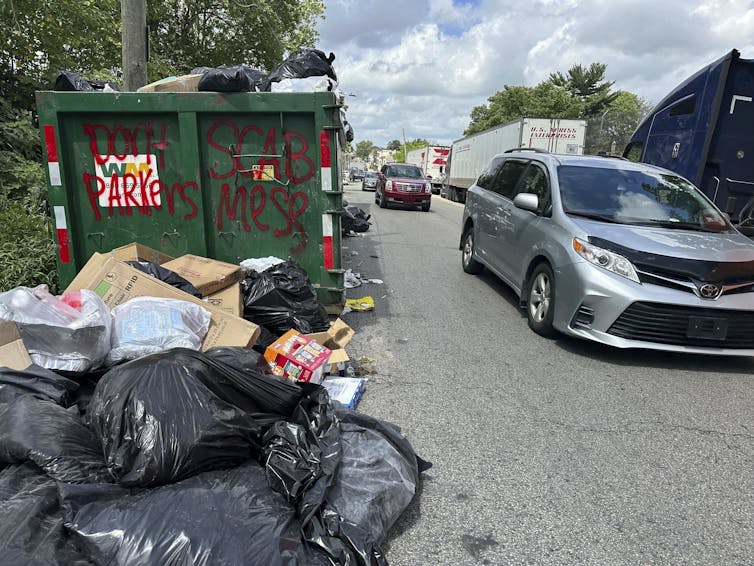
As the Philadelphia municipal worker strike enters its second week, so-called “Parker piles” – large collections of garbage that some residents blame on Mayor Cherelle Parker – continue to build up in neighborhoods across the city.

The AFSCME District Council 33 union on strike represents about 9,000 blue-collar workers in the city, including sanitation workers, 911 dispatchers, city mechanics and water department staff.

The Conversation U.S. asked Francis Ryan, a professor of labor studies at Rutgers University and author of “AFSCME’s Philadelphia Story: Municipal Workers and Urban Power in Philadelphia in the Twentieth Century,” about the history of sanitation strikes in Philly and what makes this one unique.

Has anything surprised you about this strike?

This strike marks the first time in the history of labor relations between the City of Philadelphia and the AFSCME District Council 33 union where social media is playing a significant role in how the struggle is unfolding.

The union is getting their side of the story out on Instagram and other social media platforms, and citizens are taking up or expressing sympathy with their cause.

Piles of garbage on the street beside a green Dumpster spraypainted with 'Don't Scab Parker's Mess'
Some city residents are referring to the garbage build-up sites as ‘Parker piles.’
AP Photo/Tassanee Vejpongsa

How successful are trash strikes in Philly or other U.S. cities?

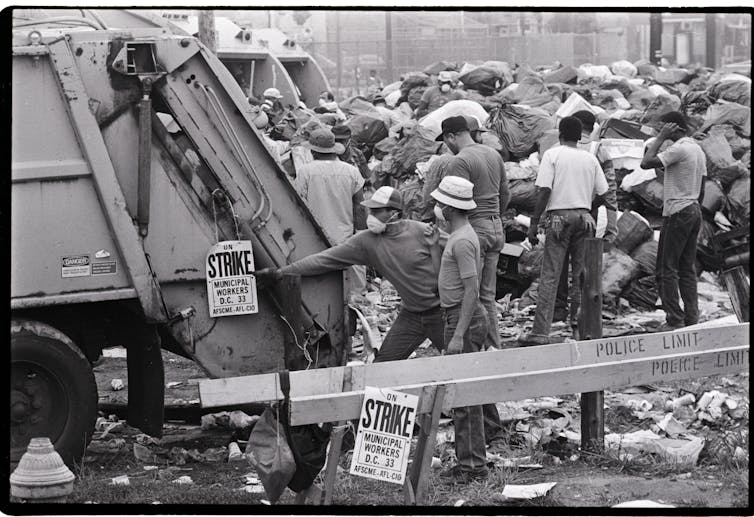
As I describe in my book, Philadelphia has a long history of sanitation strikes that goes back to March 1937. At that time, a brief work stoppage brought about discussions between the city administration and an early version of the current union.

When over 200 city workers were laid off in September 1938, city workers called a weeklong sanitation strike. Street battles raged in West Philadelphia when strikers blocked police-escorted trash wagons that were aiming to collect trash with workers hired to replace the strikers.

Philadelphia residents, many of whom were union members who worked in textile, steel, food and other industries rallied behind the strikers. The strikers’ demands were met, and a new union, the American Federation of State, County and Municipal Employees, or AFSCME, was formally recognized by the city.

This strike was a major event because it showed how damaging a garbage strike could be. The fact that strikers were willing to fight in the streets to stop trash services showed that such events had the potential for violence, not to mention the health concerns from having tons of trash on the streets.

There was another two-week trash strike in Philadelphia in 1944, but there wouldn’t be another for more than 20 years.

However, a growing number of sanitation strikes popped up around the country in the 1960s, the most infamous being the 1968 Memphis Sanitation Strike.

Black-and-white photo of a line of Black men walking past a row of white soldiers in uniform with bayonets fixed
Black sanitation workers peacefully march wearing placards reading ‘I Am A Man’ during the Memphis sanitation strike in 1968.
Bettmann via Getty Images

In Memphis, a majority African American sanitation workforce demanded higher wages, basic safety procedures and recognition of their union. Dr. Martin Luther King, Jr. rallied to support the Memphis workers and their families as part of his Poor Peoples’ Campaign, which sought to organize working people from across the nation into a new coalition to demand full economic and political rights.

On April 4, 1968, Dr. King was assassinated. His death put pressure on Memphis officials to settle the strike, and on April 16 the the strikers secured their demands.

Following the Memphis strike, AFSCME began organizing public workers around the country and through the coming years into the 1970s, there were sanitation strikes and slowdowns across the nation including in New York City, Atlanta, Cleveland and Washington, D.C. Often, these workers, who were predominantly African American, gained the support of significant sections of the communities they served and secured modest wage boosts.

By the 1980s, such labor actions were becoming fewer. In 1986, Philadelphia witnessed a three-week sanitation strike that ended with the union gaining some of its wage demands, but losing on key areas related to health care benefits.

Black-and-white photo of men standing alongside huge pile of trash and two trash trucks
Workers begin removing mounds of trash after returning to work after the 18-day strike in Philadelphia in July 1986.
Bettmann via Getty Images

How do wages and benefits for DC33 workers compare to other U.S. cities?

DC 33 president Greg Boulware has said that the union’s members make an average salary of $46,000 per year. According to MIT’s Living Wage Calculator, that is $2,000 less than what a single adult with no kids needs to reasonably support themselves living in Philadelphia.

Sanitation workers who collect curbside trash earn a salary of $42,500 to $46,200, or $18-$20 an hour. NBC Philadelphia reports that those wages are the lowest of any of the major cities they looked at. Hourly wages in the other cities they looked at ranged from $21 an hour in Dallas to $25-$30 an hour in Chicago.

Unlike other eras, the fact that social media makes public these personal narratives and perspectives – like from former sanitation worker Terrill Haigler, aka “Ya Fav Trashman” – is shaping the way many citizens respond to these disruptions. I see a level of support for the strikers that I believe is unprecedented going back as far as 1938.

What do you think is behind this support?

The pandemic made people more aware of the role of essential workers in society. If the men and women who do these jobs can’t afford their basic needs, something isn’t right. This may explain why so many people are seeing things from the perspective of striking workers.

At the same time, money is being cut from important services at the federal, state and local levels. The proposed gutting of the city’s mass transit system by state lawmakers is a case in point. Social media allows people to make these broader connections and start conversations.

If the strike continues much longer, I think it will gain more national and international attention, and bring discussions about how workers should be treated to the forefront.

The Conversation

Francis Ryan does not work for, consult, own shares in or receive funding from any company or organization that would benefit from this article, and has disclosed no relevant affiliations beyond their academic appointment.

ref. How Philadelphia’s current sanitation strike differs from past labor disputes in the city – https://theconversation.com/how-philadelphias-current-sanitation-strike-differs-from-past-labor-disputes-in-the-city-260676

Brics is sliding towards irrelevance – the Rio summit made that clear

Source: The Conversation – UK – By Amalendu Misra, Professor of International Politics, Lancaster University

The Brics group of nations has just concluded its 17th annual summit in the Brazilian city of Rio de Janeiro. But, despite member states adopting a long list of commitments covering global governance, finance, health, AI and climate change, the summit was a lacklustre affair.

The two most prominent leaders from the group’s founding members – Brazil, Russia, India, China and South Africa – were conspicuously absent. Russia’s president, Vladimir Putin, only attended virtually due to an outstanding arrest warrant issued by the International Criminal Court over his role in the war in Ukraine.

China’s Xi Jinping avoided the summit altogether for unknown reasons, sending his prime minister, Li Qiang, instead. This was Xi’s first no-show at a Brics summit, with the snub prompting suggestions that Beijing’s enthusiasm for the group as part of an emerging new world order is in decline.

Perhaps the most notable takeaway from the summit was a statement that came not from the Brics nations but the US. As Brics leaders gathered in Rio, the US president, Donald Trump, warned on social media: “Any Country aligning themselves with the Anti-American policies of BRICS, will be charged an ADDITIONAL 10% Tariff. There will be no exceptions to this policy.”


Get your news from actual experts, straight to your inbox. Sign up to our daily newsletter to receive all The Conversation UK’s latest coverage of news and research, from politics and business to the arts and sciences.


Trump has long been critical of Brics. This is largely because the group has consistently floated the idea of adopting a common currency to challenge the dominance of the US dollar in international trade.

Such a move makes sense if we focus on trade figures. In 2024, the value of trade among the Brics nations was around US$5 trillion, accounting for approximately 22% of global exports. Member nations have always felt their economic potential could be fully realised if they were not reliant upon the US dollar as their common currency of trade.

During their 2024 summit, which was held in the Russian city of Kazan, the Brics nations entered into serious discussions around creating a gold-backed currency. At a time when the Trump administration is waging a global trade war, the emergence of an alternative to the US dollar would be a very serious pushback against US economic hegemony.


Read more:
Why Donald Trump’s election could hasten the end of US dollar dominance


But the freshly concluded Brics summit did not present any concrete move towards achieving that objective. In fact, the 31-page Rio de Janeiro joint declaration even contained some reassurances about the global importance of the US dollar.

There are two key obstacles hindering Brics from translating its vision of a common currency into reality. First is that some founding member nations are uncomfortable with adopting such an economic model, in large part due to internal rivalries within Brics itself.

India, currently the fourth-largest economy in the world, has a history of periodic confrontation and strategic competition with China. It is reticent about adopting an alternative to the US dollar, concerned that this could make China more powerful and undercut India’s long-term interests.

Second is that the Brics member nations are dependent on their bilateral trade with the US. Simply put, embracing an alternative currency is counterproductive when it comes to the current economic interests of individual countries. Brazil, China and India, for example, all export more to the US than they import from it.

In December 2024, following his election as US president, Trump said: “We require a commitment from these countries that they will neither create a new Brics currency nor back any other currency to replace the mighty US dollar or they will face 100% tariffs and should expect to say goodbye to selling into the wonderful US economy”. This blunt message all but killed any enthusiasm that was there for this grand economic model.

Caught in contradiction

The Brics group is a behemoth. Its full 11 members account for 40% of the world’s population and economy. But the bloc is desperately short of providing any cohesive alternative global leadership.

While Brazil used its position as host to highlight Brics as a truly multilateral forum capable of providing leadership in a new world order, such ambitions are thwarted by the many contradictions plaguing this bloc.

Among these are tensions between founding members China and India, which have been running high for decades.

There are other contradictions, too. In their joint Rio declaration, the group’s members decried the recent Israeli and US attacks on Iran. Brazil’s president, Luiz Inácio “Lula” da Silva, also used his position as summit host to criticise the Israeli offensive in Gaza.

But this moral high ground appears hollow when you consider that the Russian Federation, a key member of Brics, is on a mission to destroy Ukraine. And rather than condemning Russia, Brics leaders used the Rio summit to criticise recent Ukrainian attacks on Russia’s railway infrastructure.

Brics declared intention to address the issue of climate change is also problematic. The Rio declaration conveyed the group’s support for multilateralism and unity to achieve the goals of the Paris agreement. But, despite China making significant advances in its green energy sector, Brics contains some of the world’s biggest emitters of greenhouse gases as well as several of the largest oil and gas producers.

Brics can only stay relevant and provide credible leadership in a fast-changing international order when it addresses its many inner contradictions.

The Conversation

Amalendu Misra is a recipient of British Academy and Nuffield Foundation Fellowships.

ref. Brics is sliding towards irrelevance – the Rio summit made that clear – https://theconversation.com/brics-is-sliding-towards-irrelevance-the-rio-summit-made-that-clear-260653

How to support someone who is grieving: five research-backed strategies

Source: The Conversation – UK – By Lucy Poxon, Senior Lecturer in Counselling Psychology, Department of Social Work Counselling & Social Care , School of Childhood and Social Care, University of East London

PeopleImages.com – Yuri A/Shutterstock

When someone we care about is grieving the loss of a loved one, our natural instinct is to ease their pain. But when words feel clumsy and gestures fall short, it can be hard to know how to help.

Drawing on both my research as a counselling psychologist and 18 years of supporting bereaved clients in therapy, I’ve identified five compassionate, research-backed ways to walk alongside someone who is mourning.

Whether you’re a close friend, family member, or caring colleague, these approaches will help you offer support in meaningful and authentic ways.

1. Grief wears many disguises

Our expectations of how grief should look are often shaped by culture, the media or personal experience, and they may bear little resemblance to how grief is actually lived.

Grief can appear as physical symptoms like exhaustion, loss of appetite, or insomnia; as behaviour like withdrawing from others or drinking more; and as thoughts or emotions ranging from apathy and numbness to anger or intense sadness.

It can be loud and overwhelming or quiet and barely perceptible. Some people feel deep sorrow immediately; others feel nothing for weeks or even months. A lack of overt sadness isn’t necessarily cause for concern; it may reflect relief that a loved one is no longer suffering, or be a sign of early adjustment.


Read more:
Not all mourning happens after bereavement – for some, grief can start years before the death of a loved one


One of the most compassionate things you can do is validate whatever shape grief takes. Reassure the person that there’s no “right” way to grieve and support them in tuning into what their body and emotions need.

2. Acknowledge the death and don’t rush the tears

Nearly every grieving client I’ve worked with has described someone, often a friend, colleague, or even family member, who avoided or ignored them after the loss. It’s one of the most painful experiences for someone already feeling vulnerable.

Often, the avoidance isn’t malicious. It’s driven by fear of saying the wrong thing or not knowing how to help. But by avoiding the subject, we send an unintended message: your grief is too much.

Acknowledging the death, even simply by saying “I’m so sorry to hear about your loss”, is not a reminder of their pain, it’s a sign that you see it and honour it. Inviting someone out, even if they decline, communicates that they still belong and are welcome.

If someone begins to cry, it’s natural to want to fix things, to offer comfort, or even to pass a tissue. But giving a tissue too soon can inadvertently signal that they should stop crying. Sometimes the most supportive thing you can do is to sit with your own discomfort, and simply be present. That silent witness can help a grieving person feel less alone.

3. Let go of the “stages of grief” myth

Many people are still taught to expect a tidy progression of grief: denial, anger, bargaining, depression and acceptance, popularised by Swiss-American psychiatrist Elisabeth Kübler-Ross in the 1960s. While these emotions are real and common, research shows that most people don’t experience them in a neat order, or even experience all five at all.

Despite being widely critiqued, stage-based models are still found in healthcare training manuals and TV scripts, and they can leave people feeling like they’re grieving “wrong”.

If your loved one is worried they should feel more sadness, or wonders why they haven’t yet felt angry, remind them: grief is personal and unpredictable. There’s no timeline, no script and no shame in not following one.

Helping someone let go of these expectations may ease guilt, reduce internal pressure and encourage gentler self-care.

4. Encourage communication – with the living and the lost

Grief often comes with emotional loneliness, a deep sense of aloneness that persists even in the presence of others. It’s different from social isolation; it’s the ache of missing someone irreplaceable.


Read more:
What we can learn from death rites of the past will help us treat the dead and grieving better today


While you can’t fix that loneliness, you can help the bereaved maintain a continuing bond with their loved one. This might include writing letters to the person who has died, speaking to them at a graveside or special place, saying prayers or engaging in meditation or creating memory boxes or rituals.

These forms of connection can help integrate the loss into a new reality. You might offer to visit a meaningful place together, or support them in planning a small memorial gesture.

5. Make specific, practical offers

It’s common to say “Let me know if you need anything”, but for someone in deep grief, reaching out can feel impossible. Emotional overwhelm, fatigue and even shame can prevent them from asking for help, even when they desperately need it.

Instead, make intentional, concrete offers that remove decision-making and emotional labour. These might include:

  • delivering a home-cooked meal once a week

  • taking care of pets or houseplants

  • helping with funeral admin or paperwork

  • offering regular lifts to appointments

  • updating others on their behalf

  • messaging with a clear “no need to reply” reassurance

If you live far away, sending a card, text, or voice note can still be powerful; just be mindful that they may receive many, and feel pressure to respond. A line like, “No need to write back, just wanted you to know I’m thinking of you” can go a long way.

Grief is not a puzzle to solve or a wound to fix. It’s a human response to love and loss – and it’s different for everyone.

The most powerful thing you can do? Be there. Stay present. Listen without judgement. And remember that it’s okay not to have the perfect words. Showing up with authenticity, patience and compassion is what matters most.

The Conversation

Lucy Poxon does not work for, consult, own shares in or receive funding from any company or organisation that would benefit from this article, and has disclosed no relevant affiliations beyond their academic appointment.

ref. How to support someone who is grieving: five research-backed strategies – https://theconversation.com/how-to-support-someone-who-is-grieving-five-research-backed-strategies-260265

As Netanyahu meets Trump in Washington, what hope for peace in Gaza? Expert Q&A

Source: The Conversation – UK – By Jonathan Este, Senior International Affairs Editor, Associate Editor

The US government “remains upbeat” about the prospects for at least a ceasefire in Gaza, according to the latest reports from Washington, where the Israeli prime minister, Benjamin Netanyahu, has been meeting the US president, Donald Trump.

Netanyahu handed the US president a letter nominating him for the Nobel peace prize, saying he deserved it for “forging peace, as we speak, in one country in the region after another”. But as yet there are no signs that either Hamas or Israel have moved any closer to accepting each other’s terms.

In fact, reports emerging from the White House meeting are that the two leaders discussed the displacement of much of the Palestinian population. And a plan revealed by the Israeli foreign minister, Israel Katz, proposed the contruction of a “humanitarian city” at Rafah in the north of the Gaza Strip to house more than 600,000 Palestinians.

The Conversation’s senior international affairs editor, Jonathan Este, spoke with Middle East expert, Scott Lucas, of University College Dublin to address this and other questions.

The two leaders’ discussions in Washington seemed to centre around displacement of the Palestinian population in lieu of a two-state solution. What does this tell you about the chance of a ceasefire deal?

I am fascinated – and sometimes disillusioned – by how some media outlets, led by the nose, miss the main story. Last week Donald Trump pronounced on social media that Israel had agreed to a 60-day ceasefire and Hamas “should take this deal”.

But the Netanyahu government has not accepted the framework, circulated by Trump’s envoy Steve Witkoff, let alone consented to a halt of their attacks, which have continued even as the Israeli prime minister travelled to Washington to meet the US president.

As Trump hosted Netanyahu in the White House on Monday, the line was that the US president was “upbeat on Gaza ceasefire talks”. Meanwhile, few of them seemed to notice the important development. Hamas responded to the US framework with proposals for the staged release of 28 of the remaining 50 Israeli hostages over the 60 days while Israeli troops withdrew from positions inside the Strip and humanitarian aid was restored.

But the Israeli government has thus far not given a substantive response. Instead, while pursuing a plan for the long-term military occupation of Gaza, it may also be seeking the displacement of a large portion of the more than 2.2 million population.


Sign up to receive our weekly World Affairs Briefing newsletter from The Conversation UK. Every Thursday we’ll bring you expert analysis of the big stories in international relations.


Hard-right members of Netanyahu’s cabinet, such as finance minister, Bezalel Smotrich, and internal security minister, Itamar Ben-Gvir, have long called for more than a million Gazans to be moved out of the territory. Reports over the weekend confirmed that this is not rhetoric. Israeli businessmen and venture capitalists have reportedly been working on plans for postwar Gaza, to include a “Trump riviera”, mirroring the displacement declaration by the US President, and an “Elon Musk smart manufacturing zone”.

On Tuesday, security cabinet member Ze’ev Elkin, a Netanyahu loyalist, proclaimed “a substantial chance” for a ceasefire. But Qatari negotiators have said there are currently no talks, only discussions with each side about the framework for talks.

Meanwhile, citing the killing of five Israeli soldiers in Gaza on Sunday night by an improvised explosive device, Ben-Gvir said: “We should not negotiate with those who kill our soldiers. They should be crushed to pieces, starved to death, and not resuscitated with humanitarian aid that gives them oxygen.”

He called for “a complete siege, crushing them militarily” and reiterated the plan for “encouraging [Palestinian] immigration and [Jewish] settlement — these are the keys to complete victory”.

Smotrich also called for a ban on any aid to Gaza: “In addition, I demand … that any territory that was conquered and cleansed of terror with the blood of our fighters not be abandoned.”

So I am not optimistic at the moment.

Looking at the region as a whole, two events have ‘reset’ the Middle East: the October 7 Hamas attacks and Israel’s recent 12-day war. Can you tell me more about the kaleidoscope effect these two events had?

In October 2023, there was no open-ended war in Gaza. Benjamin Netanyahu’s focus was on curbing the Palestinian Authority in the West Bank, blocking any possibility of a two-state solution. His tactic was to ease the economic pressure on Gaza and Hamas, maintaining that organisation as a balance against its West Bank rivals.

Hamas ripped up that approach with its mass murder on October 7 – the first of the two kaleidoscope moments which changed the whole picture in a matter of hours. The attack triggered the deadly Israeli response that continues 21 months later. That response did not “destroy” Hamas, as Netanyahu pledged, but it led the Israelis to take on other foes in the region.

Pursuing its “octopus doctrine”, Israel severely damaged one of the tentacles, Hezbollah, when it destroyed much of the Lebanese group’s leadership in the autumn of 2024. It assassinated senior Iranian commanders and officials in Damascus, and received a further boost when Turkish-backed factions toppled the Assad regime in December.

The 12-day war in June aimed to destroy the head of the octopus: Iran. Israel’s strikes and assassinations killed much of the country’s military leadership and many of its top nuclear scientists. The supreme leader, Ali Khamenei, hid in a bunker, only emerging on July 6. But Israel failed to topple his regime, as it had hoped.

The war was another kaleidoscope moment. Israel had its regional victory. But paradoxically, because there has been no resolution in Gaza, this has come at the cost of further international isolation. Gulf States, having moved away from “normalisation” with Israel, put out tougher statements about “genocide” of Gazans and the violation of Iranian sovereignty. Saudi Arabia’s state media highlighted a letter from Iranian foreign minister Abbas Araghchi to Saudi counterpart Faisal bin Farhan for “ways to support and enhance [relations] across all fields”.

This implies that for any normalisation to occur, Israel must end its military operation in Gaza?

That question cuts to the chase. The Gulf states, with the notable exception of Qatar, are no friends of Hamas. They might even have accepted the destruction of the group if Israel had been able to accomplish it quickly.

But there is no way that they can publicly acquiesce in the killing of almost 60,000 Gazans, the large majority of them civilians, and the humanitarian blockade that threatens every single person living in the Gaza Strip. Nor will they want to see Israel export Gazans across the region in an echo of the 1948 “Nakba” whose legacy is the millions of Palestinians living in refugee camps across the Middle East.

Netanyahu can pursue his “absolute destruction” of Hamas by pursuing the destruction and displacement of Gazans. Or he can try to capitalise on his war with Iran through links with Arab countries. He cannot do both.

Will Donald Trump get his Nobel peace prize?

I don’t know, for that is a question which does not have a logical answer.

Herny Kissinger was the US secretary of state who oversaw an escalation of the Vietnam war in which up to 3 million Vietnamese, 310,000 Cambodians, 62,000 Laotians and 58,220 US service members died. The singer-songwriter Tom Lehrer aptly noted: “Political satire became obsolete when Henry Kissinger was awarded the Nobel Peace Prize.”

We are in a world where having caused so much disorder and chaos, having enabled violence, including Israel’s open-ended war, Donald Trump may succeed in a pose as “peacemaker”.

Some may see the least worst option as flattery, which seems to work as a strategy for dealing with the US president. They may accept the White House theatre in which Netanyahu, wanted by the International Criminal Court for war crimes, personally hands Trump a peace prize nomination.

Meanwhile, in the past 24 hours, according to the Hamas-run Gaza health ministry, the number of casualties in Gaza rose to 57,575 people killed and 136,879 wounded. Twenty hostages spent another day in limbo. That’s what matters here.

The Conversation

ref. As Netanyahu meets Trump in Washington, what hope for peace in Gaza? Expert Q&A – https://theconversation.com/as-netanyahu-meets-trump-in-washington-what-hope-for-peace-in-gaza-expert-qanda-260722

Golden eagles were reintroduced to Ireland, but without prey they’re now struggling to thrive

Source: The Conversation – UK – By Fiona McAuliffe, Lecturer of Ecology, Scotland’s Rural College

Dennis Jacobsen/Shutterstock

In the early 2000s, golden eagles soared once again over the hills of Donegal in northwest Ireland, for the first time in nearly a century. Their return was celebrated as a landmark in Irish conservation, a hopeful sign that one of the island’s most iconic predators was back.

But two decades on, the reality is sobering. The population remains small with just five territorial pairs and an estimated total population of just 20-25 birds. Breeding success is poor, and the golden eagle’s future in Ireland is uncertain. So what went wrong?

Our research published in the Irish Naturalists’ Journal suggests the problem isn’t with the eagles themselves – it’s with the landscape they were released into. On paper, Donegal’s uplands looked ideal: open terrain, low human disturbance and ample wild prey. But over time, key parts of that ecosystem have quietly unravelled.

Golden eagles rely on a steady supply of prey to thrive and raise chicks – notably red grouse and Irish hares. Yet, during our recent surveys along transects (predetermined lines through an area) and footage from camera traps in and around Glenveagh national park, the uplands seemed eerily quiet. Not just quiet of eagles, but of the smaller animals they prey on for food. The landscape looked wild, but had lost some of its vital living components.

When comparing the available prey biomass, that’s the combined weight of grouse and hares per unit area, Donegal had 74-83% less prey than equivalent areas in the Scottish Highlands where golden eagles are thriving. That’s an enormous shortfall. Without enough food, adult eagles must travel further to hunt and spend more energy – and so are less likely to raise chicks successfully. A few lean years can tip a small population like this into crisis.

Why is prey so scarce? One of the main culprits is overgrazing. Red deer numbers have exploded across Ireland in recent decades. In places such as Donegal, their constant browsing and grazing has severely degraded upland habitats. This damages the heather moorlands that grouse and hares depend on, leaving them with less cover and fewer food sources.

A red deer looks at a camera trap in an upland environment.
Red deer were the most common species recorded during camera trap surveys.
Queen’s University Belfast

Add to this the growing pressure from medium-sized predators, including foxes and badgers. Without apex predators such as wolves or lynx to keep them in check, these “mesopredators” flourish. This well-documented phenomenon is known as mesopredator release where populations of mid-sized predators increase after the loss of top predators, often leading to greater pressure on prey species, such as ground-nesting birds and young hares, compounding the challenges for these struggling prey species.

And while Ireland’s conservation laws look strong on paper, implementation often lags behind. Some protected areas remain heavily grazed, burned or unmanaged. Management plans are either missing, unenforced or outdated. This weakens the very protections meant to sustain wildlife.

A lesson for rewilding

The reintroduction of golden eagles was based on the best available knowledge at the time. But ecosystems aren’t static. What may have been viable habitat in the 1990s no longer meets the needs of a breeding eagle population today.

Reintroducing a species isn’t enough. The systems that sustain it also need to be restored. The clichéd paradigm that nature-is-good and humans-are-bad isn’t helpful. Instead modern landscapes are often so degraded that they can’t recover if left alone.

Upland habitat with exposed peat and areas of rock.
Upland areas within Glenveagh national park are overgrazed, leading to exposed peat and erosion.
Fiona McAuliffe

Conservation can facilitate active recovery. Real rewilding is about more than simply “putting animals back” and “letting nature take its course”. It is about putting systems back: predators, prey, plants and the processes that connect them.

Despite the challenges, the golden eagle population has not failed in Ireland – not yet at least. To turn the tide, conservation efforts must go beyond charismatic species and focus on landscape restoration. That means reducing overgrazing, supporting prey recovery, rebalancing predator dynamics and making sure protected areas are actually protected.

Encouragingly, Glenveagh national park has begun some of this work, by reducing deer overgrazing and regenerating native woodlands. If this landscape restoration is sustained and expanded, golden eagles could still thrive in a more balanced, functioning upland ecosystem.

These birds are more than just a symbol of wildness. They are a litmus test of ecosystem health. Right now, they’re telling us something important. Something those calling for the reintroduction of other top predators, including wolves, would do well to consider.


Don’t have time to read about climate change as much as you’d like?

Get a weekly roundup in your inbox instead. Every Wednesday, The Conversation’s environment editor writes Imagine, a short email that goes a little deeper into just one climate issue. Join the 45,000+ readers who’ve subscribed so far.


The Conversation

The authors do not work for, consult, own shares in or receive funding from any company or organisation that would benefit from this article, and have disclosed no relevant affiliations beyond their academic appointment.

ref. Golden eagles were reintroduced to Ireland, but without prey they’re now struggling to thrive – https://theconversation.com/golden-eagles-were-reintroduced-to-ireland-but-without-prey-theyre-now-struggling-to-thrive-258832

Four reasons why many of us feel the global economy is not on our side

Source: The Conversation – UK – By Cahal Moran, Visiting Fellow in the Department of Psychological and Behavioural Science, London School of Economics and Political Science

During my adult life, I have never experienced what it’s like to live in a “good” economy. Starting with the global financial crash in 2008, which hit just as I began studying economics, the world seems to have lurched from crisis to crisis and the UK economy even more so.

Some of those crises, like the crash and COVID, are sudden shocks. Others have been more gradual, such as increasingly unaffordable housing or the rising dominance of the world’s ultra rich.

As I explore in my new book, Why We’re Getting Poorer, the result of these crises is an economic system which works for some much more than it does for others. Here are four reasons why you may be feeling let down.

1. Grasping for growth

Like many of his fellow leaders across the world, the British prime minister, Keir Starmer, is aiming to make economic growth the primary mission of his government. And understandably so.

A growing economy puts more money in people’s pockets and brings other benefits such as low unemployment. But economic growth is not easy (in the UK it has been poor for a long time).

That’s because there’s no GDP dial that a prime minister or president can simply turn up. Research shows that economic growth is an amorphous and difficult goal which depends on many factors – geopolitical, demographic, technological – outside any single country’s control.

One option is to focus on achievable goals around investment, like the public investments of £113 billion on homes, transport and energy planned in the UK. But big projects can take a long time to build and develop, so even if they do boost growth, it can take a while for households to feel the benefits.

2. Inherent inequality

Against the backdrop of low growth in the UK has been high inequality, under Conservative and Labour governments. And again, inequality is an international issue.

The wealth of the richest people in the world skyrocketed over COVID, buoyed in many cases by the increased importance of the tech sector during lockdowns. Even before the pandemic, wealth inequality was a problem across the globe.

This imbalance has given the very richest opportunities to buy up commercial competitors, indulge in space travel and control large parts of the media, exerting extreme economic, social and political power. Needless to say, their economic priorities are not the same as everyone else’s.

Meanwhile, communities and regions may be left behind, with declining physical and social infrastructure. People living in hollowed out areas where incomes and opportunities are limited are unlikely to feel that the economic system is working for them.

3. Globalisation

Globalisation has made a lot of people – in places like China, India and Brazil – better off. But it is not a system which ensures economic benefits for everyone.

With global competition, big businesses are often under pressure to reduce costs. Free trade deals have often failed to enforce labour standards or redistribute gains to poorly paid workers, and in many cases simply made the rich richer.

Such a distorted form of economic governance, where large sections of society end up feeling left behind was bound to provoke a response. Some would link it to recent political events like Brexit and the presidencies of Donald Trump, whose international tariffs are a clear attempt to reverse the rise of globalisation.

Row of parked up colourful lorries.
Sporadic supply chains.
Corona Borealis Studio/Shutterstock

Since the pandemic, more fault-lines have been exposed. The global economy has become too dependent on certain regions, epitomised by Taiwanese dominance in the manufacturing of semiconductors, or European reliance on Russia for gas and oil.

Recent years have also seen supply chain bottlenecks, leading to shortages of goods including cars, phones and even salad ingredients. Inflexible global systems have been ineffective, and internationally agreed fixes are hard to achieve.

4. Climate change

World news at the start of 2020 was dominated by the massive wildfires raging across Australia. At the start of 2025, Los Angeles burned.

As the global climate shifts and lurches, extreme weather events are becoming more common. Floods, hurricanes and extreme temperatures look to be the likely outcome.

When sea levels rise, countless coastal cities will experience flooding, and many Pacific islands may disappear altogether. The UN’s climate science advisory group, the Intergovernmental Panel on Climate Change (IPCC) suggests that humanity will struggle with food production, disease and massive migration.

This will all result in huge economic costs, impeding growth and disrupting livelihoods across the world. According to the IPCC, the impacts could range from extreme weather events disrupting infrastructure to changing weather reducing yields in agriculture, forestry and fishing.

Yet many countries appear to be backtracking on their commitment to reducing emissions. It seems they would prefer to deal with the fallout of climate change rather than invest in potential solutions like carbon taxes, walkable cities or alternative fuels. But such acts of self-harm are not a sound basis for a prosperous economy, society or planet.

The Conversation

Cahal Moran does not work for, consult, own shares in or receive funding from any company or organisation that would benefit from this article, and has disclosed no relevant affiliations beyond their academic appointment.

ref. Four reasons why many of us feel the global economy is not on our side – https://theconversation.com/four-reasons-why-many-of-us-feel-the-global-economy-is-not-on-our-side-252220

I rode the Tour de France to study its impact on the human body – here’s what I learned

Source: The Conversation – UK – By Steve Faulkner, Senior Lecturer in Exercise Physiology, Nottingham Trent University

The Tour de France is often called the world’s biggest annual sporting event. Each July up to 12 million people line the roadside, while the cumulative TV audience tops 3 billion viewers across 190 countries.

In 2025, 184 riders will compete in teams of eight, racing a punishing 3,500 km route with nearly 50,000 metres of climbing – roughly the height of Mount Everest six times over. Across 21 stages riders tackle time trials, flat sprints and brutal mountain passes through the Alps, Pyrenees and Massif Central.

Professional cyclists possess extraordinary endurance and are capable of generating high power outputs day after day. Yet, despite having far less training and support, in recent years a number of amateur cyclists have begun riding the Tour route just days before the pros. The Tour 21 is one such effort and offers cyclists a chance to follow in the tyre tracks of the elite while raising money for a good cause.

In 2021 I joined 19 others to ride the full route in support of Cure Leukaemia, with a shared goal of raising £1 million for blood cancer research. As a blood cancer survivor diagnosed at 16, this challenge combined my love of cycling, my background in science and my deep desire to give back to the community that helped save my life. It was also a unique opportunity to study how amateur cyclists cope with one of the most demanding endurance events in the world.

The research findings were published in the Journal of Science and Cycling, to coincide with 2025’s Grand Départ (the official start of the race) in Lille.

Training for the impossible

Originally, the study planned to include lab-based physiological assessments of the amateur cyclists undertaking the Tour de France route, but the COVID-19 pandemic forced us to adapt and rely instead on data from training diaries. These gave us insight into how much (or little) training had been done leading up to the ride, and how riders managed the physical and mental strain during the event itself.

While professional cyclists typically train 20–25 hours a week – often at altitude, with tailored coaching and racing schedules – our group of amateurs had full-time jobs, were typically 15–20 years older than the pros and trained around seven to ten hours a week.

Our preparation was far from ideal, averaging just 47km per ride and 350 metres of climbing; a fraction of what the Tour demands. In fact, this amounted to less than 10% of the required climbing during the mountain stages.

Once the ride began, the contrast between training and reality was stark. The group averaged nearly seven hours of riding a day, a 300% increase from their usual routine. Within four days signs of overtraining began to emerge: riders were no longer able to elevate their heart rates, a classic marker of central nervous system fatigue and excessive physical stress.

As the days progressed, performance metrics continued to decline: heart rates dropped, power outputs fell and mood scores deteriorated. The cumulative fatigue was undeniable.

Surprisingly, when we compared our amateur data to metrics from professional riders, we found that although pros ride at much higher power outputs, amateurs were subject to greater relative stress. On some days they spent almost double the time in the saddle, which meant they operated closer to their physical limits, with far less time for recovery – and often suboptimal sleep and nutrition.

By the final week many of the riders could no longer produce the same power they had in the first few days. In some cases, heart rates wouldn’t rise above 100 beats per minute – a clear sign of accumulated fatigue and physiological overload.

How to prepare for an ultra-endurance challenge

If you’re planning to take on a major endurance event – whether it’s cycling, running, or hiking – here are some lessons from the road:

1. Train specifically for the event

Your training should mirror the challenge ahead. For the Tour, this meant preparing for long, back-to-back days with significant climbing. Mimic the intensity, volume and terrain as closely as possible.

2. Understand how quickly fatigue builds

Over multiple days, fatigue doesn’t just accumulate – it compounds. Listen to your body, adapt your plan and include plenty of recovery time.

3. Prioritise nutrition and recovery

These two factors can make or break your performance. You’ll need to consume enough energy to fuel the effort, but avoid excessive intake that leads to unnecessary weight gain. Recovery – through sleep, rest and refuelling – is equally vital.

4. Work with an experienced coach

More than fancy bikes or high-tech gear, a good coach is your best investment. They can help tailor your training plan, track your progress and adapt strategies as needed. Don’t underestimate this support.

A ride to remember

Completing the Tour de France route is a monumental achievement for any cyclist — amateur or pro. In 2021, our team not only rode the full route, but also raised over £1 million for Cure Leukaemia. For me, it marked a deeply personal milestone in my cancer journey.

Throughout those 21 days, I thought often of the physical and emotional battles I faced during treatment; moments when I didn’t know if I’d survive, let alone ride across France. That experience gave me the resilience to keep going, even when my body was screaming to stop.

Riding the Tour taught me that we’re capable of far more than we realise, especially when we ride with purpose.

The Conversation

Steve Faulkner does not work for, consult, own shares in or receive funding from any company or organisation that would benefit from this article, and has disclosed no relevant affiliations beyond their academic appointment.

ref. I rode the Tour de France to study its impact on the human body – here’s what I learned – https://theconversation.com/i-rode-the-tour-de-france-to-study-its-impact-on-the-human-body-heres-what-i-learned-260524