Who was the first pirate?

Source: The Conversation – USA (2) – By Brandon Prins, Professor of Political Science, University of Tennessee

Curious Kids is a series for children of all ages. If you have a question you’d like an expert to answer, send it to curiouskidsus@theconversation.com.


Who was the first pirate? – Yandel R., age 11, Lakewood Ranch, Florida


When most people imagine a pirate, they picture actor Johnny Depp playing the mad but likable swashbuckler Jack Sparrow, captain of the sailing ship the Black Pearl.

Depp’s pirate portrayal was inspired by seafaring bandits in older make-believe tales, such as Long John Silver in “Treasure Island,” Captain Hook in “Peter Pan,” or sailor Edmond Dantès in “The Count of Monte Cristo.”

painting of one-legged pirate with parrot on shoulder holds a sword
A 1915 edition of ‘Treasure Island’ illustrated Long John Silver with iconic pirate features.
Louis Rhead/Historica Graphica Collection/Heritage Images via Getty Images

Pirates in these stories were mischievous but also glamorous, courageous and mostly kindhearted. They wore flashy costumes. They had missing limbs, like Captain Cook’s iron hook for a left hand and Long John Silver’s wooden peg leg. They buried treasure chests of gold and silver, forced enemies to walk the plank and had talking parrots as shipboard companions. They flew the Jolly Roger skull and crossbones flag from the ship’s mast to frighten enemies. The new Netflix series “One Piece,” which is based on a Japanese comic book, continues this popular depiction of pirates.

While fun, these portrayals of pirates are mostly invented.

I’m a political scientist who studies modern-day commerce raiding: robbing of private cargo vessels on the high seas. I’m interested in where it happens in the world, who does it and what can be done to stop it. My research finds today’s pirates to be less like swashbuckling Jack Sparrow and more like regular old thieves.

Pirates in the ancient world

Since pirates have been around for as long as people have moved things by boat, it is hard to pin down the very first pirate.

stone relief carving depicting ancient Egyptians in a low boat carrying birds in a cage
Ancient Egyptians tied bundles of reeds together to form watertight boats.
Werner Forman/Universal Images Group via Getty Images

But archaeological evidence shows that boatbuilding goes all the way back to the ancient Egyptians, who used boats made from papyrus reeds as early as 6,000 years ago. These vessels likely carried valuable goods up and down the Nile River, and where valuable goods can be found, you can usually find thieves too. In fact, researchers know that pirates – basically just thieves on the water – targeted these river boats, because Egyptian pharaohs left records grumbling about pirates and their widespread pillaging.

By 3,500 years ago, thieves were using sailing vessels to raid coastal towns and villages in and around the Nile Delta, as well as the Aegean and Adriatic basins. Attacking ships far from land on the high seas and stealing the cargo was a logical next step in the tactics of seafaring raiders.

As trade increased across the Mediterranean Sea, boats carrying valuable cargo, such as pottery, silk, glass, spices and metals, became the targets of ancient pirates. Given the worth of these goods, pirate attacks became widespread across the ancient Mediterranean Sea. With money from the Roman senate and strong effort by a military leader named Pompey, the Roman navy worked hard to stop the pirates – and for a while it did.

The earliest named pirate?

The first mention of a pirate by name may have been in a Greek history book written in the fifth century BCE by an ancient historian named Herodotus.

He briefly describes the adventures of a naval commander by the name of Dionysius who was from Ionia, which is in modern-day Turkey. Dionysius set up a pirate base on the island of Sicily that allowed him and his fellow pirates to plunder ships that happened to sail past.

Pirates of the Caribbean

While Dionysius may have been the first recorded pirate, the most famous pirates lived during the 17th and 18th centuries, which came to be known as the golden age of sea piracy.

This was the heyday of pirates such as Blackbeard, also known as Edward Teach; William Kidd; Henry Morgan; Calico Jack; and Anne Bonny. They plundered Spanish treasure ships in the Caribbean, known as the Spanish Main, that were carrying silver from the mines in Bolivia back to the king of Spain.

Islands such as Jamaica, Tortuga and the Bahamas, as well the North Carolina coast, all became notable pirate havens. Port Royal, on the island of Jamaica, in particular, was a notorious pirate refuge. It was ideally positioned for preying upon Spanish galleons sailing across the Atlantic from ports in Panama and Venezuela. Johnny Depp’s character, Jack Sparrow, swashbuckled around a fictionalized Port Royal in the first “Pirates of the Caribbean” film.

map from west coast of Africa to east coast of Asia with red dots denoting pirate attacks along coasts
Each dot represents a maritime pirate attack that happened between 1995 and 2023.
Brandon Prins

21st-century pirates

The 2013 Hollywood movie “Captain Phillips,” starring Tom Hanks, drew attention back to real-world pirates and piracy. The movie was based on a real-life 2009 attack by Somali pirates on a ship named the MV Maersk Alabama, which was carrying food to Kenya. The 500-foot-long vessel and its crew were rescued by the U.S. Navy.

To better understand 21st-century piracy, my research team compiled data on all pirate attacks from 1995 to the present day. We found three main piracy hot spots: the Gulf of Aden near Somalia, the Strait of Malacca in Southeast Asia and the Gulf of Guinea off the coast of West Africa. All three locations experience the conditions that attract pirates: ship traffic, valuable cargo and weak governments.

Why become a pirate?

People become pirates for many reasons, not the least of which is to escape poverty and enslavement. Others just want adventure and to travel the world. These are the same motivations that drove commerce raiding in the ancient world, during the golden age of piracy, and even today.

While we may never know the first pirate, just like we will never know the very first thief, historical evidence shows that sea-raiding has been around since the very first boats traversed the world’s waterways. Despite efforts to end piracy, my research shows that the conditions that produce ship looting remain and will likely always exist.


Hello, curious kids! Do you have a question you’d like an expert to answer? Ask an adult to send your question to CuriousKidsUS@theconversation.com. Please tell us your name, age and the city where you live.

And since curiosity has no age limit – adults, let us know what you’re wondering, too. We won’t be able to answer every question, but we will do our best.

The Conversation

Brandon Prins received funding from the U.S. Department of Defense, Office of Naval Research, through the Minerva Initiative, awards #N00014-21-1-2030 and #N00014-14-1-0050.

ref. Who was the first pirate? – https://theconversation.com/who-was-the-first-pirate-256314

Zohran Mamdani’s last name reflects centuries of intercontinental trade, migration and cultural exchange

Source: The Conversation – USA (3) – By Iqbal Akhtar, Associate Professor of Religious Studies, Florida International University

Zohran Mamdani takes photos with union members during a campaign rally at the Hotel and Gaming Trades Council headquarters in New York on July 2, 2025. AP Photo/Richard Drew

When Zohran Mamdani announced his candidacy for mayor of New York City, political observers noted his progressive platform and legislative record. But understanding the Democratic candidate’s background requires examining the rich cultural tapestry woven into his very surname: Mamdani.

He takes the name from his father, Mahmood Mamdani, a prominent academic who was raised in Uganda and whose work focuses on postcolonial Uganda. I studied the history of the Khoja community for my doctoral work and have helped develop Khoja studies as an academic discipline. The Mamdani surname tells a story of migration, resilience and community-building that spans centuries and continents.

The Khoja history

Mamdanis in Uganda belong to the Khoja community, a South Asian Muslim merchant caste, that shaped economic development across the western Indian Ocean for centuries.

The name originates from greater Sindh, a region in South Asia that today includes southeastern Pakistan and Kachchh in western India.

Its etymology is twofold. Mām is an honorific title in Kachchhi and Gujarati languages, meaning kindness, courage and pride. Māmadō is a local version of the name Muhammad that often appeared in surnames in Hindu castes that converted to Islam, such as the Memons.

The Khoja were categorized by the British in the early 19th century as “Hindoo Mussalman” because their traditions spanned both religions.

Over time, the Khoja came to be identified only as Muslim and then primarily as Shiite Muslim. Today, the majority of Khoja are Ismaili: a branch of Shiite Islam that follows the Aga Khan as their living imam.

The Mamdani family, however, is part of the Twelver community of Khoja, whose Twelfth Imam is believed to be hidden from the world and only emerges in times of crisis. Twelvers believe he will help usher in an age of peace during end times.

Around the late 18th century, the Khoja helped export textiles, manufactured goods, spices and gems from the Indian subcontinent to Arabia and East Africa. Through this Western Indian Ocean trading network, they imported timber, ivory, minerals and cloves, among other goods.

Khoja family firms were built on kinship networks and trust. They built networks of shops, communal housing and warehouses, and extended credit for thousands of miles, from Zanzibar in Tanzania to Bombay – now Mumbai – on the western coast of India.

Cousins and brothers would send money and goods across the ocean with only a letter. The precarious nature of trade in this period meant that families also served as insurance for each other. In times of wealth, it was shared; in times of disaster, help was available.

Khoja contributions in Africa

The Khoja became instrumental in building the commercial infrastructure of eastern, central and southern Africa. But the Khoja contribution to the development of Africa extended far beyond trade.

In the absence of colonial investment in public infrastructure, they helped build institutions that formed the foundation of the modern nation-states that emerged after colonization. The institutions both facilitated trade and established permanent communities.

For example, the first dispensary and public school in Zanzibar were constructed by a Khoja magnate, Tharia Topan, who made his wealth through the ivory and clove trades. Topan eventually became so prominent that he was knighted by Queen Victoria in 1890 for his service to the British Empire in helping to end slavery in East Africa.

The Khoja community continues to invest in East Africa. The most famous example is the Aga Khan Development Network, whose hospitals and schools operate in 30 countries. In places such as Kenya, Uganda and Tanzania, they are considered the best.

Khoja in Uganda

Like in other parts of Africa, the Khoja settled in Uganda as a liaison business community to develop a market to serve both African and European needs. The linguistic and cultural knowledge, developed over centuries, helped facilitate business despite the challenges of colonization.

A Black man in a suit walking with a woman and another dressed in traditional African attire.
Ugandan President Idi Amin and his wife, Sarah, in Rome on Sept. 10, 1975.
AP Photo

However, in 1972, Ugandan dictator Idi Amin expelled all Asians – approximately 80,000 – forcing families like the Mamdanis into exile. These included indentured laborers, who were brought in to help build the railroad and farm during the British colonial period, and free traders, like the Mamdani family.

Amin saw them all as the same and famously said: “Asians came to Uganda to build the railway. The railway is finished. They must leave now.”

The experience was a bitter one. Families lost everything, and many left with only the clothes on their backs.

Mahmood Mamdani, who came from a Khoja merchant family, was 26 when he was exiled. Yet, unlike most Ugandan Asians, he chose to go back. At Makerere University in Kampala, Uganda’s capital, Mamdani set up the Institute for Social Research, which helped to provide rigorous social science training to Ugandan researchers trying to improve their society.

While the earlier generations of the Khoja tended to choose business or adjacent professions, such as accounting, the subsequent generations – particularly those educated in the West – embraced the knowledge economy as professionals, academics and nonprofit leaders.

Several of Mahmood Mamdani’s generation of Khoja academics conducted path-breaking work on Afro-Asian solidarity – a way of thinking about the world beyond colonial categories, such as the category of religion as a separate domain from the secular. These scholars, such as Tanzania’s Issa Shivji and Abdul Sheriff, worked on creating solidarity among the newly independent states of the Global South.

Mahmood Mamdani is known for his influential post-9/11 academic work, “Good Muslim, Bad Muslim,” which examined how Muslim identities are stereotyped. He argued that these identities are complex and varied, shaped by accumulated history and present experiences.

Interfaith identity

The Khoja community – known globally as the Khoja Shia Ithnasheri Muslim Community – has developed strong transnational connections. Today, they are concentrated in the United Kingdom, Canada, United States and France. However, Khoja can be found in almost any country in the world. In 2013, I met members of the community in Hong Kong.

The Khoja community plays an important role in interfaith dialogue and global development initiatives. A prominent Ismaili Khoja, Eboo Patel, the founder of Interfaith America, has dedicated his life to pluralism and mutual understanding through building up civil society.

Zohran Mamdani’s mother, acclaimed filmmaker Mira Nair, is Hindu by birth. This interfaith marriage exemplifies the flexibility, diversity and tolerance of Khoja Islam, which has historically navigated between Hindu and Islamic traditions.

Whether Mamdani’s policies prove practical remains to be seen, but his background offers something valuable: a deep understanding of how communities build resilience across generations and geographies.

The Conversation

Iqbal Akhtar does not work for, consult, own shares in or receive funding from any company or organization that would benefit from this article, and has disclosed no relevant affiliations beyond their academic appointment.

ref. Zohran Mamdani’s last name reflects centuries of intercontinental trade, migration and cultural exchange – https://theconversation.com/zohran-mamdanis-last-name-reflects-centuries-of-intercontinental-trade-migration-and-cultural-exchange-259967

Cleaner air in east Asia has driven recent acceleration in global warming – new study

Source: The Conversation – UK – By Laura Wilcox, Professor, National Centre for Atmospheric Science, University of Reading

A traffic jam in Beijing in China, where air pollution has drastically reduced. Hung Chung Chih/Shutterstock

Global warming has picked up pace since around 2010, leading to the recent string of record warm years. Why this is happening is still unclear, and among the biggest questions in climate science today. Our new study reveals that reductions in air pollution – particularly in China and east Asia – are a key reason for this faster warming.

Cleanup of sulphur emissions from global shipping has been implicated in past research. But that cleanup only began in 2020, so it’s considered too weak to explain the full extent of this acceleration. Nasa researchers have suggested that changes in clouds could play a role, either through reductions in cloud cover in the tropics or over the North Pacific.

One factor that has not been well quantified, however, is the effect of monumental efforts by countries in east Asia, notably China, to combat air pollution and improve public health through strict air quality policies. There has already been a 75% reduction in east Asian sulphur dioxide emissions since around 2013, and that cleanup effort picked up pace just as global warming began accelerating.

Our study addresses the link between east Asian air quality improvements and global temperature, building on the efforts of eight teams of climate modellers across the world.

We have found that polluted air may have been masking the full effects of global warming. Cleaner air could now be revealing more of the human-induced global warming from greenhouse gases.

In addition to causing millions of premature deaths, air pollution shields the Earth from sunlight and therefore cools the surface. There has been so much air pollution that it has held human-induced warming in check by up to 0.5°C over the last century.

With the cleanup of air pollution, something that’s vital for human health, this artificial sunshade is removed. Since greenhouse gas emissions have kept on increasing, the result is that the Earth’s surface is warming faster than ever before.

Modelling the cleanup

Our team used 160 computer simulations from eight global climate models. This enabled us to better quantify the effects that east Asian air pollution has on global temperature and rainfall patterns. We simulated a cleanup of pollution similar to what has happened in the real world since 2010. We found an extra global warming of around 0.07°C.

While this is a small number compared with the full global warming of around 1.3°C since 1850, it is still enough to explain the recent acceleration in global warming when we take away year-to-year swings in temperature from natural cycles such as El Niño, a climate phenomenon in the Pacific that affects weather patterns globally.

yellow smoggy sky, yellow sun and building
Thick smog influences the effect of greenhouse gases.
Shaun Robinson/Shutterstock

Based on long-term trends, we would have expected around 0.23°C of warming since 2010. However, we actually measured around 0.33°C. While the additional 0.1°C can largely be explained by the east Asian air pollution cleanup, other factors include the change in shipping emissions and the recent accelerated increase in methane concentrations in the atmosphere.

Air pollution causes cooling by reflecting sunlight or by changing the properties of clouds so they reflect more sunlight. The cleanup in east Asian air pollution influences global temperatures because it reduces the shading effect of the pollution over east Asia itself. It also means less pollution is blown across the north Pacific, causing clouds in the east Pacific to reflect less sunlight.

The pattern of these changes across the North Pacific simulated in our models matches that seen in satellite observations. Our models and temperature observations also show relatively strong warming over the North Pacific, downwind from east Asia.

The main source of global warming is still greenhouse gas emissions, and a cleanup of air pollution was both necessary and overdue. This did not cause the additional warming but rather, removed an artificial cooling that has for a time helped shield us from some of the extreme weather and other well-established consequences of climate change.

Global warming will continue for decades. Indeed, our past and future emissions of greenhouse gases will affect the climate for centuries. However, air pollution is quickly removed from the atmosphere, and the recent acceleration in global warming from this particular unmasking may therefore be short-lived.


Don’t have time to read about climate change as much as you’d like?

Get a weekly roundup in your inbox instead. Every Wednesday, The Conversation’s environment editor writes Imagine, a short email that goes a little deeper into just one climate issue. Join the 45,000+ readers who’ve subscribed so far.


The Conversation

Laura Wilcox receives funding from the Natural Environment Research Council (NERC), the Research Council of Norway, the Clean Air Fund, and Horizon Europe.

Bjørn H. Samset receives funding from the Research Council of Norway, the Clean Air Fund, and Horizon Europe.

ref. Cleaner air in east Asia has driven recent acceleration in global warming – new study – https://theconversation.com/cleaner-air-in-east-asia-has-driven-recent-acceleration-in-global-warming-new-study-260601

Was the Air India crash caused by pilot error or technical fault? None of the theories holds up – yet

Source: The Conversation – Global Perspectives – By Guido Carim Junior, Senior Lecturer in Aviation, Griffith University

Over the weekend, the Indian Aircraft Accident Investigation Bureau released a preliminary report on last month’s crash of Air India flight 171, which killed 260 people, 19 of them on the ground.

The aim of a preliminary report is to present factual information gathered so far and to inform further lines of inquiry. However, the 15-page document has also led to unfounded speculation and theories that are currently not supported by the evidence.

Here’s what the report actually says, why we don’t yet know what caused the crash, and why it’s important not to speculate.

What the preliminary report does say

What we know for certain is that the aircraft lost power in both engines just after takeoff.

According to the report, this is supported by video footage showing the deployment of the ram air turbine (RAT), and the examination of the air inlet door of the auxiliary power unit (APU).

The RAT is deployed when both engines fail, all hydraulic systems are lost, or there is a total electrical power loss. The APU air inlet door opens when the system attempts to start automatically due to dual engine failure.

The preliminary investigation suggests both engines shut down because the fuel flow stopped. Attention has now shifted to the fuel control switches, located on the throttle lever panel between the pilots.

This is what the fuel switches look like, with the throttle lever above them.
Aircraft Accident Investigation Bureau

Data from the enhanced airborne flight recorder suggests these switches may have been moved from “run” to “cutoff” three seconds after liftoff. Ten seconds later, the switches were moved back to “run”.

The report also suggests the pilots were aware the engines had shut down and attempted to restart them. Despite their effort, the engines couldn’t restart in time.

We don’t know what the pilots did

Flight data recorders don’t capture pilot actions. They record system responses and sensor data, which can sometimes lead to the belief they’re an accurate representation of the pilot’s actions in the cockpit.

While this is true most of the time, this is not always the case.

In my own work investigating safety incidents, I’ve seen cases in which automated systems misinterpreted inputs. In one case, a system recorded a pilot pressing the same button six times in two seconds, something humanly impossible. On further investigation, it turned out to be a faulty system, not a real action.

We cannot yet rule out the possibility that system damage or sensor error led to false data being recorded. We also don’t know whether the pilots unintentionally flicked the switches to “cutoff”. And we may never know.

As we also don’t have a camera in the cockpit, any interpretation of pilots’ actions will be made indirectly, usually through the data sensed by the aircraft and the conversation, sound and noise captured by the environmental microphone available in the cockpit.

We don’t have the full conversation between the pilots

Perhaps the most confusing clue in the report was an excerpt of a conversation between the pilots. It says:

In the cockpit voice recording, one of the pilots is heard asking the other why did he cutoff. The other pilot responded that he did not do so.

This short exchange is entirely without context. First, we don’t know who says what. Second, we don’t know when the question was asked – after takeoff, or after the engine started to lose power? Third, we don’t know the exact words used, because the excerpt in the report is paraphrased.

Finally, we don’t know whether the exchange referred to the engine status or the switch position. Again, we may never know.

What’s crucial here is that the current available evidence doesn’t support any theory about intentional fuel cutoff by either of the pilots. To say otherwise is unfounded speculation.

We don’t know if there was a mechanical failure

The preliminary report indicates that, for now, there are no actions required by Boeing, General Electric or any company that operates the Boeing 787-8 and/or GEnx-1B engine.

This has led some to speculate that a mechanical failure has been ruled out. Again, it is far too early to conclude that.

What the preliminary report shows is that the investigation team has not found any evidence to suggest the aircraft suffered a catastrophic failure that requires immediate attention or suspension of operations around the world.

This could be because there was no catastrophic failure. It could also be because the physical evidence has been so badly damaged that investigators will need more time and other sources of evidence to learn what happened.

Why we must resist premature conclusions

In the aftermath of an accident, there is much at stake for many people: the manufacturer of the aircraft, the airline, the airport, civil aviation authority and others. The families of the victims understandably demand answers.

It’s also tempting to latch onto a convenient explanation. But the preliminary report is not the full story. It’s based on very limited data, analysed under immense pressure, and without access to every subsystem or mechanical trace.

The final report is still to come. Until then, the responsible position for regulators, experts and the public is to withhold judgement.

This tragedy reminds us that aviation safety depends on patient and thorough investigation – not media soundbites or unqualified expert commentary. We owe it to the victims and their families to get the facts right, not just fast.

The Conversation

Guido Carim Junior has received funding from Boeing R&D Australia to conduct research projects in the past five years.

ref. Was the Air India crash caused by pilot error or technical fault? None of the theories holds up – yet – https://theconversation.com/was-the-air-india-crash-caused-by-pilot-error-or-technical-fault-none-of-the-theories-holds-up-yet-261102

How do you stop an AI model turning Nazi? What the Grok drama reveals about AI training

Source: The Conversation – Global Perspectives – By Aaron J. Snoswell, Senior Research Fellow in AI Accountability, Queensland University of Technology

Anne Fehres and Luke Conroy & AI4Media, CC BY

Grok, the artificial intelligence (AI) chatbot embedded in X (formerly Twitter) and built by Elon Musk’s company xAI, is back in the headlines after calling itself “MechaHitler” and producing pro-Nazi remarks.

The developers have apologised for the “inappropriate posts” and “taken action to ban hate speech” from Grok’s posts on X. Debates about AI bias have been revived too.

But the latest Grok controversy is revealing not for the extremist outputs, but for how it exposes a fundamental dishonesty in AI development. Musk claims to be building a “truth-seeking” AI free from bias, yet the technical implementation reveals systemic ideological programming.

This amounts to an accidental case study in how AI systems embed their creators’ values, with Musk’s unfiltered public presence making visible what other companies typically obscure.

What is Grok?

Grok is an AI chatbot with “a twist of humor and a dash of rebellion” developed by xAI, which also owns the X social media platform.

The first version of Grok launched in 2023. Independent evaluations suggest the latest model, Grok 4, outpaces competitors on “intelligence” tests. The chatbot is available standalone and on X.

xAI states “AI’s knowledge should be all-encompassing and as far-reaching as possible”. Musk has previously positioned Grok as a truth-telling alternative to chatbots accused of being “woke” by right-wing commentators.

But beyond the latest Nazism scandal, Grok has made headlines for generating threats of sexual violence, bringing up “white genocide” in South Africa, and making insulting statements about politicians. The latter led to its ban in Turkey.

So how do developers imbue an AI with such values and shape chatbot behaviour? Today’s chatbots are built using large language models (LLMs), which offer several levers developers can lean on.

What makes an AI ‘behave’ this way?

Pre-training

First, developers curate the data used during pre-training – the first step in building a chatbot. This involves not just filtering unwanted content, but also emphasising desired material.

GPT-3 was shown Wikipedia up to six times more than other datasets as OpenAI considered it higher quality. Grok is trained on various sources, including posts from X, which might explain why Grok has been reported to check Elon Musk’s opinion on controversial topics.

Musk has shared that xAI curates Grok’s training data, for example to improve legal knowledge and to remove LLM-generated content for quality control. He also appealed to the X community for difficult “galaxy brain” problems and facts that are “politically incorrect, but nonetheless factually true”.

We don’t know if these data were used, or what quality-control measures were applied.

Fine-tuning

The second step, fine-tuning, adjusts LLM behaviour using feedback. Developers create detailed manuals outlining their preferred ethical stances, which either human reviewers or AI systems then use as a rubric to evaluate and improve the chatbot’s responses, effectively coding these values into the machine.

A Business Insider investigation revealed xAI’s instructions to human
“AI tutors” instructed them to look for “woke ideology” and “cancel culture”. While the onboarding documents said Grok shouldn’t “impose an opinion that confirms or denies a user’s bias”, they also stated it should avoid responses that claim both sides of a debate have merit when they do not.

System prompts

The system prompt – instructions provided before every conversation – guides behaviour once the model is deployed.

To its credit, xAI publishes Grok’s system prompts. Its instructions to “assume subjective viewpoints sourced from the media are biased” and “not shy away from making claims which are politically incorrect, as long as they are well substantiated” were likely key factors in the latest controversy.

These prompts are being updated daily at the time of writing, and their evolution is a fascinating case study in itself.

Guardrails

Finally, developers can also add guardrails – filters that block certain requests or responses. OpenAI claims it doesn’t permit ChatGPT “to generate hateful, harassing, violent or adult content”. Meanwhile, the Chinese model DeepSeek censors discussion of Tianamen Square.

Ad-hoc testing when writing this article suggests Grok is much less restrained in this regard than competitor products.

The transparency paradox

Grok’s Nazi controversy highlights a deeper ethical issue: would we prefer AI companies to be explicitly ideological and honest about it, or maintain the fiction of neutrality while secretly embedding their values?

Every major AI system reflects its creator’s worldview – from Microsoft Copilot’s risk-averse corporate perspective to Anthropic Claude’s safety-focused ethos. The difference is transparency.

Musk’s public statements make it easy to trace Grok’s behaviours back to Musk’s stated beliefs about “woke ideology” and media bias. Meanwhile, when other platforms misfire spectacularly, we’re left guessing whether this reflects leadership views, corporate risk aversion, regulatory pressure, or accident.

This feels familiar. Grok resembles Microsoft’s 2016 hate-speech-spouting Tay chatbot, also trained on Twitter data and set loose on Twitter before being shut down.

But there’s a crucial difference. Tay’s racism emerged from user manipulation and poor safeguards – an unintended consequence. Grok’s behaviour appears to stem at least partially from its design.

The real lesson from Grok is about honesty in AI development. As these systems become more powerful and widespread (Grok support in Tesla vehicles was just announced), the question isn’t whether AI will reflect human values. It’s whether companies will be transparent about whose values they’re encoding and why.

Musk’s approach is simultaneously more honest (we can see his influence) and more deceptive (claiming objectivity while programming subjectivity) than his competitors.

In an industry built on the myth of neutral algorithms, Grok reveals what’s been true all along: there’s no such thing as unbiased AI – only AI whose biases we can see with varying degrees of clarity.

The Conversation

Aaron J. Snoswell previously received research funding from OpenAI in 2024–2025 to develop new evaluation frameworks for measuring moral competence in AI agents.

ref. How do you stop an AI model turning Nazi? What the Grok drama reveals about AI training – https://theconversation.com/how-do-you-stop-an-ai-model-turning-nazi-what-the-grok-drama-reveals-about-ai-training-261001

Can’t work out without music? Neither could the ancient Greeks and Romans

Source: The Conversation – Global Perspectives – By Konstantine Panegyres, Lecturer in Classics and Ancient History, The University of Western Australia

Wikimedia Commons, CC BY-SA

These days when you see people exercising, they’re usually also listening to music, whether they’re at the gym, or out jogging on the street.

It makes sense, as studies have shown listening to music can help you get the most out of a workout.

Somehow the ancient Greeks and Romans knew this too, long before modern science was there to back it.

A more than 2,000-year-old habit

In his oration To the People of Alexandria, the Greek writer Dio Chrysostom (40-110 CE) complained about a phenomenon he saw all the time.

Dio wrote people loved to listen to music in their daily activities. According to him, music could be found in the courtroom, in the lecture theatre, in the doctor’s room, and even in the gym.

“Everything is done to music […] people will presently go so far as to use song to accompany their exercise in the gymnasium,” Dio wrote.

But exercising to music wasn’t a new thing in his day. This practice has been recorded across the ancient Greek and Roman worlds from the earliest times, and as far back as the poems of Homer (circa 800 BCE).

Why exercise to music?

There are many depictions of professional athletes training, or competing, to the accompaniment of music in ancient Greek vase paintings.

In one vase painting from the 5th century BCE, a group of athletes trains while a musician plays the aulos, a type of ancient pipe instrument.

Young men exercising to the sound of an aulos player (an ancient wind instrument).
Wikimedia

The ancient writer Plutarch of Chaeronea (46-119 CE) tells us music was also played while people wrestled or did athletics.

Athenian writer Flavius Philostratus (circa 170-245 CE) offers clues as to why. In a book about gymnastics, Philostratus wrote music served to stimulate athletes, and that their performance might be improved through listening to music.

Today’s researchers have proven this to be true. One 2020 study involving 3,599 participants showed listening to music during exercise had many benefits, such as reducing the perception of fatigue and exertion, and improving physical performance and breathing.

Singing and trumpets

Since ancient people didn’t have electronic devices, they found other ways to exercise to music. Some had music played by a musician during their exercise routine. Others sang while they exercised.

Singing while playing ball games was particularly popular. In Homer’s Odyssey (circa 8th century BCE), Nausicaa, the daughter of the King of Phaeacia, plays a ball game with her girl friends, and they all sing songs as they play.

Similarly, the historian Carystius of Pergamum (2nd century BCE) wrote the women of his time “sang as they played ball”.

Another popular activity was dancing to music. Dancing was widely regarded as a gymnastic exercise people could do for better health.

One famous advocate of the benefits of dancing as exercise was the great Athenian philosopher Socrates (circa 470-399 BCE). According to the historian Diogenes Laertius (3rd century CE), “it was Socrates’ regular habit to dance, thinking that such exercise helped to keep the body in good condition”.

Exercising to music was depicted in several ancient Greek vase painting.
Wikimedia, CC BY-NC-SA

Apart from individuals using music in their personal exercise, soldiers also did training exercises, and marched to battle, to the sound of trumpets.

Don’t skip leg day

There was a belief in ancient Greek and Roman that music and exercise played an important role in shaping and developing the body and soul.

The ideal was harmony and moderation. The body and soul needed to be balanced and proportionate in all their parts, without any excess. As such, doing one kind of exercise too often, or exercising one body part excessively, was frowned upon.

The physician Galen of Pergamum (129-216 CE) criticised types of exercise that focused too much on one part of the body. He preferred ball games as they exercised the whole body evenly.

Immoderation in music – that is, listening to too much, or listening to music that was too emotional – was also sometimes frowned upon.

For example, the Athenian philosopher Plato (circa 428-348 BCE) famously argued most music should be censored as it can stir the passions too strongly. Plato thought only simple and unemotional music, listened to in moderation, should be allowed.

If the ancients could see today’s people running along the pavement with music thumping in their ears, they would surely be amazed. And they’d probably approve – as long as it wasn’t being done in excess.

The Conversation

Konstantine Panegyres does not work for, consult, own shares in or receive funding from any company or organisation that would benefit from this article, and has disclosed no relevant affiliations beyond their academic appointment.

ref. Can’t work out without music? Neither could the ancient Greeks and Romans – https://theconversation.com/cant-work-out-without-music-neither-could-the-ancient-greeks-and-romans-258069

Cycling can be 4 times more efficient than walking. A biomechanics expert explains why

Source: The Conversation – Global Perspectives – By Anthony Blazevich, Professor of Biomechanics, Edith Cowan University

You’re standing at your front door, facing a five kilometre commute to work. But you don’t have your car, and there’s no bus route. You can walk for an hour – or jump on your bicycle and arrive in 15 minutes, barely breaking a sweat. You choose the latter.

Many people would make the same choice. It’s estimated that there are more than a billion bikes in the world. Cycling represents one of the most energy-efficient forms of transport ever invented, allowing humans to travel faster and farther while using less energy than walking or running.

But why exactly does pedalling feel so much easier than pounding the pavement? The answer lies in the elegant biomechanics of how our bodies interact with this two-wheeled machine.

A wonderfully simple machine

At its heart, a bicycle is wonderfully simple: two wheels (hence “bi-cycle”), pedals that transfer power through a chain to the rear wheel, and gears that let us fine-tune our effort. But this simplicity masks an engineering that perfectly complements human physiology.

When we walk or run, we essentially fall forward in a controlled manner, catching ourselves with each step. Our legs must swing through large arcs, lifting our heavy limbs against gravity with every stride. This swinging motion alone consumes a lot of energy. Imagine: how tiring would it be to even swing your arms continuously for an hour?

On a bicycle, your legs move through a much smaller, circular motion. Instead of swinging your entire leg weight with each step, you’re simply rotating your thighs and calves through a compact pedalling cycle. The energy savings are immediately noticeable.

But the real efficiency gains come from how bicycles transfer human power to forward motion. When you walk or run, each footstep involves a mini-collision with the ground. You can hear it as the slap of your shoe against the road, and you can feel it as vibrations running through your body. This is energy being lost, literally dissipated as sound and heat after being sent through your muscles and joints.

Walking and running also involve another source of inefficiency: with each step, you actually brake yourself slightly before propelling forward. As your foot lands ahead of your body, it creates a backwards force that momentarily slows you down. Your muscles then have to work extra hard to overcome this self-imposed braking and accelerate you forward again.

Kissing the road

Bicycles use one of the world’s great inventions to solve these problems – wheels.

Instead of a collision, you get rolling contact – each part of the tyre gently “kisses” the road surface before lifting off. No energy is lost to impact. And because the wheel rotates smoothly so the force acts perfectly vertically on the ground, there’s no stop-start braking action. The force from your pedalling translates directly into forward motion.

But bicycles also help our muscles to work at their best. Human muscles have a fundamental limitation: the faster they contract, the weaker they become and the more energy they consume.

This is the famous force-velocity relationship of muscles. And it’s why sprinting feels so much harder than jogging or walking – your muscles are working near their speed limit, becoming less efficient with every stride.

Bicycle gears solve this problem for us. As you go faster, you can shift to a higher gear so your muscles don’t have to work faster while the bike accelerates. Your muscles can stay in their sweet spot for both force production and energy cost. It’s like having a personal assistant that continuously adjusts your workload to keep you in the peak performance zone.

A graphic with a cyclist and a pedestrian.
Cycling can be at least four times more energy-efficient than walking and eight times more efficient than running.
The Conversation, CC BY

Walking sometimes wins out

But bicycles aren’t always superior.

On very steep hills of more than about 15% gradient (so you rise 1.5 metres every 10 metres of distance), your legs struggle to generate enough force through the circular pedalling motion to lift you and the bike up the hill. We can produce more force by pushing our legs straight out, so walking (or climbing) becomes more effective.

Even if roads were built, we wouldn’t pedal up Mount Everest.

This isn’t the case for downhills. While cycling downhill becomes progressively easier (eventually requiring no energy at all), walking down steep slopes actually becomes harder.

Once the gradient exceeds about 10% (it drops by one metre for every ten metres of distance), each downhill step creates jarring impacts that waste energy and stress your joints. Walking and running downhill isn’t always as easy as we’d expect.

Not just a transportation device

The numbers speak for themselves. Cycling can be at least four times more energy-efficient than walking and eight times more efficient than running. This efficiency comes from minimising three major energy drains: limb movement, ground impact and muscle speed limitations.

So next time you effortlessly cruise past pedestrians on your morning bike commute, take a moment to appreciate the biomechanical work of art beneath you. Your bicycle isn’t just a transport device, but a perfectly evolved machine that works in partnership with your physiology, turning your raw muscle power into efficient motion.

The Conversation

Anthony Blazevich does not work for, consult, own shares in or receive funding from any company or organisation that would benefit from this article, and has disclosed no relevant affiliations beyond their academic appointment.

ref. Cycling can be 4 times more efficient than walking. A biomechanics expert explains why – https://theconversation.com/cycling-can-be-4-times-more-efficient-than-walking-a-biomechanics-expert-explains-why-257120

Even a day off alcohol makes a difference – our timeline maps the health benefits when you stop drinking

Source: The Conversation – Global Perspectives – By Nicole Lee, Adjunct Professor at the National Drug Research Institute (Melbourne based), Curtin University

d3sign/Getty

Alcohol has many negative effects on our health, some of which may surprise you. These include short-term impacts such as waking up with a pounding head or anxiety, to long-term effects including cancer.

If you are thinking about taking some time off alcohol, you’ll find many quick wins and long-term gains for your health.

How long will you have to wait to feel the benefits?

We’ve made a timeline – based on scientific research – that shows what you might feel in the first days, weeks, months and years after taking a break from alcohol.

Some benefits start immediately, so every day without alcohol is a win for your health.

After one day

Alcohol takes around 24 hours to completely leave your body, so you may start noticing improvements after just one day.

Alcohol makes you need to urinate more often, causing dehydration. But your body can absorb a glass of water almost immediately, so once alcohol is out of your system alcohol dehydration is reduced, improving digestion, brain function and energy levels.

Alcohol also reduces the liver’s ability to regulate blood sugar. Once alcohol leaves the system, blood sugar begins to normalise.

If you are a daily drinker you may feel a bit worse to start with while your body adjusts to not having alcohol in its system all the time. You may initially notice disrupted sleep, mood changes, sweating or tremors. Most symptoms usually resolve in about a week without alcohol.

After one week

Even though alcohol can make you feel sleepy at first, it disrupts your sleep cycle. By the end of an alcohol-free week, you may notice you are more energetic in the mornings as a result of getting better quality sleep.

As the body’s filter, the liver does much of the heavy lifting in processing alcohol and can be easily damaged even with moderate drinking.

The liver is important for cleaning blood, processing nutrients and producing bile that helps with digestion.

But it can also regenerate quickly. If you have only mild damage in the liver, seven days may be enough to reduce liver fat and heal mild scarring and tissue damage.

Even small amounts of alcohol can impair brain functioning. So quitting can help improve brain health within a few days in light to moderate drinkers and within a month even for very heavy dependent drinkers.

Bodies of man and woman sitting on a couch with tv remote and glasses of wine.
Alcohol damages your liver, but it’s very good at regenerating and healing itself.
skynesher/Getty

After one month

Alcohol can make managing mood harder and worsen symptoms of anxiety and depression. After a few weeks, most people start to feel better. Even very heavy drinkers report better mood after one to two months.

As your sleep and mood improve you may also notice more energy and greater wellbeing.

After a month of abstinence regular drinkers also report feeling more confident about making changes to how they drink.

You may lose weight and body fat. Alcohol contains a lot of kilojules and can trigger hunger reward systems, making us overeat or choose less healthy foods when drinking.

Even your skin will thank you. Alcohol can make you look older through dehydration and inflammation, which can be reversed when you quit.

Alcohol irritates the gut and disrupts normal stomach functioning, causing bloating, indigestion, heartburn and diarrhoea. These symptoms usually start to resolve within four weeks.

One month of abstinence, insulin resistance – which can lead to high blood sugar – significantly reduces by 25%. Blood pressure also reduces (by 6%) and cancer-related growth factors declines, lowering your risk of cancer.

After six months

The liver starts to repair within weeks. For moderate drinkers, damage to your liver could be fully reversed by six months.

At this point, even heavy drinkers may notice they’re better at fighting infections and feel healthier overall.

Man looks out the window drinking a beer.
Just a month without alcohol can you make more confident about sticking to changes.
Yue_/Getty

After one year or more

Alcohol contributes to or causes a large number of chronic diseases, including heart disease, stroke, type 2 diabetes, and seven different types of cancer, as well as mental health issues. All of these risks can be reduced by quitting or cutting back on alcohol.

Alcohol increases blood pressure. High blood pressure (hypertension) is the top risk factor for death in the world. A small 2mmHg increase in blood pressure above the normal range (120mmHG) increases death from stroke by 10% and from coronary artery disease by 7%.

Cutting back on alcohol to less than two drinks a day can reduce blood pressure significantly, reducing risk of stroke and heart disease. Reducing blood pressure also reduces risk of kidney disease, eye problems and even erectile dysfunction.

With sustained abstinence, your risk of getting any type of cancer drops. One study looked at cancer risk for more than 4 million adults over three to seven years and found the risk of alcohol-related cancer dropped by 4%, even for light drinkers who quit. Reducing from heavy to moderate drinking reduced alcohol-related cancer risk by 9%.

Making a change

Any reduction in drinking will have some noticeable and immediate benefits to your brain and general health. The less you drink and the longer you go between drinks, the healthier you will be.

Whether you aim to cut back or quit entirely, there are some simple things you can do to help you stick with it:

If you are still wondering about whether to make changes or not you can check your drinking risk here.

If you have tried to cut back and found it difficult you may need professional help. Call the National Alcohol and other Drug Hotline on 1800 250 015 and they will put you in touch with services in your area that can help. You can also talk to your GP.

We would like to thank Dr Hannah MacRae for assistance in identifying the research used in this article.

The Conversation

Nicole Lee works as a paid evaluation and training consultant in alcohol and other drugs. She has previously been awarded grants by state and federal governments, NHMRC and other public funding bodies for alcohol and other drug research. She is CEO of Hello Sunday Morning.

Dr Katinka van de Ven is the Research Manager of Hello Sunday Morning. She also works as a paid evaluation and training consultant in alcohol and other drugs. Katinka has previously been awarded grants by state governments and public funding bodies for alcohol and other drug research.

ref. Even a day off alcohol makes a difference – our timeline maps the health benefits when you stop drinking – https://theconversation.com/even-a-day-off-alcohol-makes-a-difference-our-timeline-maps-the-health-benefits-when-you-stop-drinking-249272

Why Texas Hill Country, where a devastating flood killed more than 130 people, is one of the deadliest places in the US for flash flooding

Source: The Conversation – USA (2) – By Hatim Sharif, Professor of Civil and Environmental Engineering, The University of Texas at San Antonio

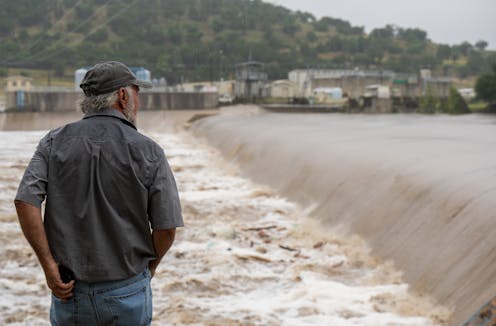
A Kerrville, Texas, resident watches the flooded Guadalupe River on July 4, 2025. Eric Vryn/Getty Images

Texas Hill Country is known for its landscapes, where shallow rivers wind among hills and through rugged valleys. That geography also makes it one of the deadliest places in the U.S. for flash flooding.

In the early hours of July 4, 2025, a flash flood swept through an area of Hill Country dotted with summer camps and small towns about 70 miles northwest of San Antonio. More than 130 people died in the flooding. The majority of them were in Kerr County, including more than two dozen girls and counselors at one summer camp, Camp Mystic. Dozens more people were still unaccounted for a week later.

The flooding began with a heavy downpour, with more than 10 inches of rain in some areas, that sent water sheeting off the hillsides and into creeks. The creeks poured into the Guadalupe River.

A river gauge at Hunt, Texas, near Camp Mystic, showed how quickly the river flooded: Around 3 a.m. on July 4, the Guadalupe River was rising about 1 foot every 5 minutes at the gauge, National Weather Service data shows. By 4:30 a.m., it had risen more than 20 feet. As the water moved downstream, it reached Kerrville, where the river rose even faster.

Flood expert Hatim Sharif, a hydrologist and civil engineer at the University of Texas at San Antonio, explains what makes this part of the country, known as Flash Flood Alley, so dangerous.

What makes Hill Country so prone to flooding?

Texas as a whole leads the nation in flood deaths, and by a wide margin. A colleague and I analyzed data from 1959 to 2019 and found 1,069 people had died in flooding in Texas over those six decades. The next highest total was in Louisiana, with 693.

Many of those flood deaths have been in Hill County. It’s part of an area known as Flash Flood Alley, a crescent of land that curves from near Dallas down to San Antonio and then westward.

The hills are steep, and the water moves quickly when it floods. This is a semi-arid area with soils that don’t soak up much water, so the water sheets off quickly and the shallow creeks can rise fast.

When those creeks converge on a river, they can create a surge of water that wipes out homes and washes away cars and, unfortunately, anyone in its path.

Hill Country has seen some devastating flash floods. In 1987, heavy rain in western Kerr County quickly flooded the Guadalupe River, triggering a flash flood similar to the one in 2025. Ten teenagers being evacuated from a camp died in the rushing water.

San Antonio, at the eastern edge of Hill Country, was hit with a flash flood on June 12, 2025, that killed 13 people whose cars were swept away by high water from a fast-flooding creek near an interstate ramp in the early morning.

Why does the region get such strong downpours?

One reason Hill Country gets powerful downpours is the Balcones Escarpment.

The escarpment is a line of cliffs and steep hills created by a geologic fault. When warm air from the Gulf rushes up the escarpment, it condenses and can dump a lot of moisture. That water flows down the hills quickly, from many different directions, filling streams and rivers below.

As temperature rise, the warmer atmosphere can hold more moisture, increasing the downpour and flood risk.

A tour of the Guadalupe River and its flood risk.

The same effect can contribute to flash flooding in San Antonio, where the large amount of paved land and lack of updated drainage to control runoff adds to the risk.

What can be done to improve flash flood safety?

First, it’s important for people to understand why flash flooding happens and just how fast the water can rise and flow. In many arid areas, dry or shallow creeks can quickly fill up with fast-moving water and become deadly. So people should be aware of the risks and pay attention to the weather.

Improving flood forecasting, with more detailed models of the physics and water velocity at different locations, can also help.

Probabilistic forecasting, for example, can provide a range of rainfall scenarios, enabling authorities to prepare for worst-case scenarios. A scientific framework linking rainfall forecasts to the local impacts, such as streamflow, flood depth and water velocity, could also help decision-makers implement timely evacuations or road closures.

Education is particularly essential for drivers. One to two feet of moving water can wash away a car. People may think their trucks and SUVs can go through anything, but fast-moving water can flip a truck and carry it away.

Officials can also do more to barricade roads when the flood risk is high to prevent people from driving into harm’s way. We found that 58% of the flood deaths in Texas over the past six decades involved vehicles. The storm on June 12 in San Antonio was an example. It was early morning, and drivers had poor visibility. The cars were hit by fast-rising floodwater from an adjacent creek.

This article, originally published July 5, 2025, has been updated with the death toll rising.

The Conversation

Hatim Sharif does not work for, consult, own shares in or receive funding from any company or organization that would benefit from this article, and has disclosed no relevant affiliations beyond their academic appointment.

ref. Why Texas Hill Country, where a devastating flood killed more than 130 people, is one of the deadliest places in the US for flash flooding – https://theconversation.com/why-texas-hill-country-where-a-devastating-flood-killed-more-than-130-people-is-one-of-the-deadliest-places-in-the-us-for-flash-flooding-260555

When disasters fall out of the public eye, survivors continue to suffer – a rehabilitation professional explains how sustained mental health support is critical to recovery

Source: The Conversation – USA (3) – By Lee Ann Rawlins Williams, Clinical Assistant Professor of Education, Health and Behavior Studies, University of North Dakota

In Kerrville, Texas, Leighton Sterling watches the rushing floodwaters along the Guadalupe River on July 4, 2025. Eric Vryn via Getty Images News

The devastating losses from the historic flooding in Texas Hill Country on July 4, 2025, are still coming into grim focus, with 121 deaths confirmed and more than 100 still missing as of July 10.

As emergency responders focus on clearing debris and searching for victims, a less visible and slower disaster has been unfolding: the need for ongoing mental health support long after headlines fade.

This phase is no less critical than restoring power or rebuilding bridges. Disasters destabilize emotional well-being, leaving distress, prolonged recovery and long-term impacts in their wake long after the event is over.

Without sustained emotional support, people and communities face heightened risks of prolonged trauma and stalled recovery.

As an educator and practitioner focused on disability and rehabilitation, I explore the intersection of disaster recovery and the impact of disasters on mental health. Both my research and that of others underscore the vital importance of support systems that not only help people cope in the immediate aftermath of a disaster but also facilitate long-term healing over the months and years that follow – especially for vulnerable populations like children, older adults and people with disabilities.

The emotional toll of disasters

Natural disasters disrupt routines, displace families and challenge people’s sense of control and security. In the immediate aftermath, survivors often experience shock, grief, anxiety and sleep disturbances. Often these symptoms may evolve into chronic stress, depression, post-traumatic stress disorder or a combination of these conditions.

A 2022 study found that Texans who experienced two or more disasters within a five-year span had significantly poorer mental health, as reflected by lower scores on standardized psychological assessments, which highlights the cumulative toll repeated disasters can have on mental well-being.

After Hurricane Katrina ravaged New Orleans in 2005, nearly a third of survivors continued to experience poor mental health years later.

And reports following Hurricane Maria in Puerto Rico in 2017 revealed surging rates of anxiety, depression and suicidal thoughts, especially in areas where services remained unavailable for extended periods of time.

There are actionable ways to make a difference in the recovery process.

Strained recovery systems

Disaster response understandably focuses on immediate needs like rescue operations, providing post-disaster housing and repairing damaged infrastructure. In addition, short-term mental health supports such as mobile health clinics are often provided in the immediate aftermath of a disaster.

However, although emergency services are deployed quickly after a disaster, long-term mental health support is often delayed or under-resourced, leaving many people without continued care during the recovery period, especially in remote or rural communities, exposing deep structural gaps in how recovery systems are designed.

One year after Hurricane Harvey devastated parts of Texas in 2017, more than 90% of Gulf Coast residents reported ongoing stress related to housing instability, financial hardship or displacement. Yet less than 10% of people stated that they or someone in their household had used mental health services following the disaster.

Hurricane Helene in 2024 similarly tested the resilience of rural mental health networks in western North Carolina. The storm damaged roads and bridges, schools and even local clinics.

This prompted a news organization, North Carolina Health News, to warn of rising “trauma, stress and isolation” among residents as providers scrambled to offer free counseling despite legal barriers stemming from licensing requirements to provide counseling across state borders. State health officials activated community crisis centers and helplines, while mobile mental health teams were dispatched from Tennessee to help those impacted by the disaster. However, state representatives stressed that without long-term investment, these critical supports risk being one-off responses.

These events serve as a powerful reminder that while roads and buildings can often be restored quickly, emotional recovery is a slower, more complex process. Truly rebuilding requires treating mental health with the same urgency as physical infrastructure. This requires investing in strong mental health recovery systems, supporting local clinics, sustaining provider networks and integrating emotional care into recovery plans from the start.

Surrounded by community members and volunteers, an emotionally distraught woman speaks to the governor of Texas.
In Hunt, Texas, Gov. Greg Abbott speaks to volunteers and community members during a news conference on July 8, 2025.
Brandon Bell via Getty Images News

Finding mental health support following a disaster

Lessons learned from previous disasters and an abundance of research show how sustained mental health supports can help people recover and build resilience.

These six lessons are particularly helpful for finding needed mental health support following a disaster:

  • If you’re feeling overwhelmed after a disaster, you’re not alone, and help is available. Free and confidential support is offered through resources like the Disaster Distress Helpline (1-800-985-5990 or text TalkWithUs to 66746), which connects you to trained counselors 24/7.

  • Many communities offer local mental health crisis lines or walk-in centers that remain active well after the disaster passes. Check your county or state health department’s website for updated listings and information.

  • Even if physical offices are closed, many clinics now offer virtual counseling or can connect you with therapists and medication refills remotely. If you’ve seen someone before, ask if they’re still available by phone or video.

  • After major disasters, states often deploy mobile health clinics that include mental health services to shelters, churches or schools. These temporary services are free and open to the public.

  • If someone you care about is struggling, help them connect with resources in the community. Share hotline numbers, offer to help make an appointment or just let them know it’s OK to ask for support. Many people don’t realize that help is available, or they think it’s only for more “serious” problems. It’s not.

  • Mental health support doesn’t always arrive right away. Keep an eye on local news, school updates or health department alerts for new services that may become available in the weeks or months after a disaster.

Disasters don’t just damage buildings; they disrupt lives in lasting ways.

While emotional recovery takes time, support is available. Staying informed and sharing resources with others can help ensure that the road to recovery isn’t traveled alone.

The Conversation

Lee Ann Rawlins Williams does not work for, consult, own shares in or receive funding from any company or organization that would benefit from this article, and has disclosed no relevant affiliations beyond their academic appointment.

ref. When disasters fall out of the public eye, survivors continue to suffer – a rehabilitation professional explains how sustained mental health support is critical to recovery – https://theconversation.com/when-disasters-fall-out-of-the-public-eye-survivors-continue-to-suffer-a-rehabilitation-professional-explains-how-sustained-mental-health-support-is-critical-to-recovery-260781