How wind and solar power helps keep America’s farms alive

Source: The Conversation – USA (2) – By Paul Mwebaze, Research Economist at the Institute for Sustainability, Energy and Environment, University of Illinois at Urbana-Champaign
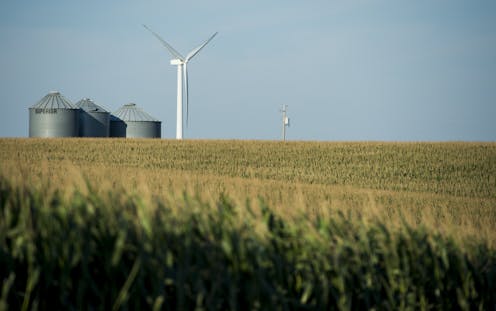
About 60% of Iowa’s power comes from wind. Farmers can earn extra cash by leasing small sections of farms for power production. Bill Clark/Getty Images

Drive through the plains of Iowa or Kansas and you’ll see more than rows of corn, wheat and soybeans. You’ll also see towering wind turbines spinning above fields and solar panels shining in the sun on barns and machine sheds.

For many farmers, these are lifelines. Renewable energy provides steady income and affordable power, helping farms stay viable when crop prices fall or drought strikes.

But some of that opportunity is now at risk as the Trump administration cuts federal support for renewable energy.

Wind power brings steady income for farms

Wind energy is a significant economic driver in rural America. In Iowa, for example, over 60% of the state’s electricity came from wind energy in 2024, and the state is a hub for wind turbine manufacturing and maintenance jobs.

For landowners, wind turbines often mean stable lease payments. Those historically were around US$3,000 to $5,000 per turbine per year, with some modern agreements $5,000 to $10,000 annually, secured through 20- to 30-year contracts.

Nationwide, wind and solar projects contribute about $3.5 billion annually in combined lease payments and state and local taxes, more than a third of it going directly to rural landowners.
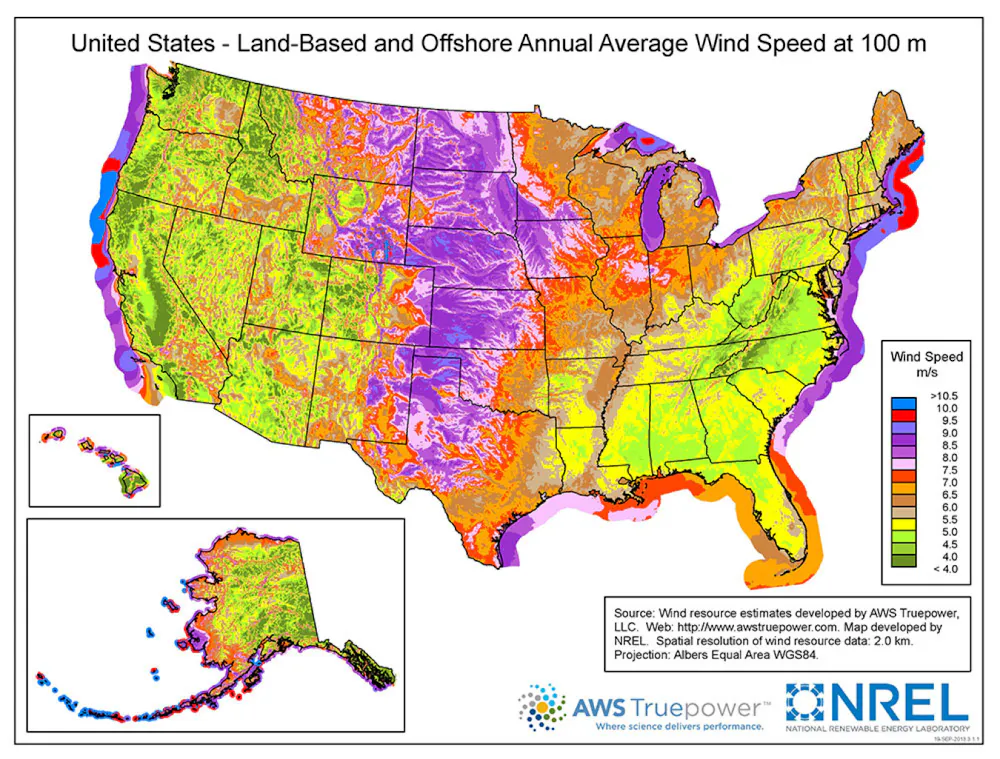
A U.S. map shows the strongest wind power potential in the central U.S., particularly the Great Plains and Midwestern states.
States throughout the Great Plains and Midwest, from Texas to Montana to Ohio, have the strongest onshore winds and onshore wind power potential. These are also in the heart of U.S. farm country. The map shows wind speeds at 100 meters (nearly 330 feet), about the height of a typical land-based wind turbine.
NREL

These figures are backed by long-term contracts and multibillion‑dollar annual contributions, reinforcing the economic value that turbines bring to rural landowners and communities.

Wind farms also contribute to local tax revenues that help fund rural schools, roads and emergency services. In counties across Texas, wind energy has become one of the most significant contributors to local property tax bases, stabilizing community budgets and helping pay for public services as agricultural commodity revenues fluctuate.

In Oldham County in northwest Texas, for example, clean energy projects provided 22% of total county revenues in 2021. In several other rural counties, wind farms rank among the top 10 property taxpayers, contributing between 38% and 69% of tax revenue.

The construction and operation of these projects also bring local jobs in trucking, concrete work and electrical services, boosting small-town businesses.

A worker wearing a hardhat stands on top of a wind turbine, with a wide view of the landscape around him.
A wind turbine technician stands on the nacelle, which houses the gear box and generator of a wind turbine, on the campus of Mesalands Community College in Tucumcari, N.M., in 2024. Colleges in other states, including Texas, also developed training programs for technicians in recent years as jobs in the industry boomed.
Andrew Marszal/AFP via Getty Images

The U.S. wind industry supports over 300,000 U.S. jobs across construction, manufacturing, operations and other roles connected to the industry, according to the American Clean Power Association.

Renewable energy has been widely expected to continue to grow along with rising energy demand. In 2024, 93% of all new electricity generating capacity was wind, solar or energy storage, and the U.S. Energy Information Administration expected a similar percentage in 2025 as of June.

Solar can cut power costs on the farm

Solar energy is also boosting farm finances. Farmers use rooftop panels on barns and ground-mounted systems to power irrigation pumps, grain dryers and cold storage facilities, cutting their power costs.

Some farmers have adopted agrivoltaics – dual-use systems that grow crops beneath solar panels. The panels provide shade, helping conserve water, while creating a second income path. These projects often cultivate pollinator-friendly plants, vegetables such as lettuce and spinach, or even grasses for grazing sheep, making the land productive for both food and energy.

Federal grants and tax credits that were significantly expanded under the 2022 Inflation Reduction Act helped make the upfront costs of solar installations affordable.

A farmer looks at the camera with cows around him and a large red bar with solar panels on the roof behind him. The photos was taken at the Milkhouse Dairy in Monmouth, Maine, on Oct. 3, 2019.
Solar panels can help cut energy costs for farm operations like dairies.
Shawn Patrick Ouellette/Portland Press Herald via Getty Images

However, the federal spending bill signed by President Donald Trump on July 4, 2025, rolled back many clean energy incentives. It phases down tax credits for distributed solar projects, particularly those under 1 megawatt, which include many farm‑scale installations, and sunsets them entirely by 2028. It also eliminates bonus credits that previously supported rural and low‑income areas.

Without these credits, the upfront cost of solar power could be out of reach for some farmers, leaving them paying higher energy costs. At a 2024 conference organized by the Institute of Sustainability, Energy and Environment at the University of Illinois Urbana-Champaign, where I work as a research economist, farmers emphasized the importance of tax credits and other economic incentives to offset the upfront cost of solar power systems.

What’s being lost

The cuts to federal incentives include terminating the Production Tax Credit for new projects placed in service after Dec. 31, 2027, unless construction begins by July 4, 2026, and is completed within a tight time frame. The tax credit pays eligible wind and solar facilities approximately 2.75 cents per kilowatt-hour over 10 years, effectively lowering the cost of renewable energy generation. Ending that tax credit will likely increase the cost of production, potentially leading to higher electricity prices for consumers and fewer new projects coming online.

The changes also accelerate the phase‑out of wind power tax credits. Projects must now begin construction by July 4, 2026, or be in service before the end of 2027 to qualify for any credit.

Meanwhile, the Investment Tax Credit, which covers 30% of installed cost for solar and other renewables, faces similar limits: Projects must begin by July 4, 2026, and be completed by the end of 2027 to claim the credits. The bill also cuts bonuses for domestic components and installations in rural or low‑income locations. These adjustments could slow new renewable energy development, particularly smaller projects that directly benefit rural communities.

While many existing clean energy agreements will remain in place for now, the rollback of federal incentives threatens future projects and could limit new income streams. It also affects manufacturing and jobs in those industries, which some rural communities rely on.

Renewable energy also powers rural economies

Renewable energy benefits entire communities, not just individual farmers.

Wind and solar projects contribute millions of dollars in tax revenue. For example, in Howard County, Iowa, wind turbines generated $2.7 million in property tax revenue in 2024, accounting for 14.5% of the county’s total budget and helping fund rural schools, public safety and road improvements.

In some rural counties, clean energy is the largest new source of economic activity, helping stabilize local economies otherwise reliant on agriculture’s unpredictable income streams. These projects also support rural manufacturing – such as Iowa turbine blade factories like TPI Composites, which just reopened its plant in Newton, and Siemens Gamesa in Fort Madison, which supply blades for GE and Siemens turbines. The tax benefits in the 2022 Inflation Reduction Act helped boost those industries – and the jobs and local tax revenue they bring in.

On the solar side, rural companies like APA Solar Racking, based in Ohio, manufacture steel racking systems for utility-scale solar farms across the Midwest.

An example of how renewable energy has helped boost farm incomes and keep farmers on their land.

As rural America faces economic uncertainty and climate pressures, I believe homegrown renewable energy offers a practical path forward. Wind and solar aren’t just fueling the grid; they’re helping keep farms and rural towns alive.

The Conversation

The Sustainably Co-locating Agricultural and Photovoltaic Electricity Systems (SCAPES) project, led by the University of Illinois Urbana-Champaign, is funded by the U.S. Department of Agriculture’s National Institute of Food and Agriculture.

ref. How wind and solar power helps keep America’s farms alive – https://theconversation.com/how-wind-and-solar-power-helps-keep-americas-farms-alive-260657

The beach wasn’t always a vacation destination – for the ancient Greeks, it was a scary place

Source: The Conversation – USA (3) – By Marie-Claire Beaulieu, Associate Professor of Classical Studies, Tufts University

Ixia Beach, located on the northwestern coast of the Greek island of Rhodes, is a popular destination. Norbert Nagel via Wikimedia Commons, CC BY-SA

Many of us are heading to the beach to bask in the sun and unwind as part of our summer vacations. Research has shown that spending time at the beach can provide immense relaxation for many people. Staring at the ocean puts us in a mild meditative state, the smell of the breeze soothes us, the warmth of the sand envelops us, and above all, the continuous, regular sound of the waves allows us to fully relax.

But beach vacations only became popular in the 19th and early 20th centuries as part of the lifestyle of the wealthy in Western countries. Early Europeans, and especially the ancient Greeks, thought the beach was a place of hardship and death. As a seafaring people, they mostly lived on the coastline, yet they feared the sea and thought that an agricultural lifestyle was safer and more respectable.

As a historian of culture and an expert in Greek mythology, I am interested in this change of attitude toward the beach.

Couple dressed in 19th-century clothing walking on a beach with horse and cart.
‘On the Beach at Trouville,’ an 1863 painting by French artist Eugène Boudin.
Metropolitan Museum of Art, New York

The sensory experience of the beach

As I write in my 2016 book, “The Sea in the Greek Imagination,” Greek literature discounts all the positive sensations of the beach and the sea and focuses on the negative ones in order to stress the discomfort the ancient Greeks felt about the beach and the sea in general.

For instance, Greek literature emphasizes the intense smell of seaweed and sea brine. In the “Odyssey,” an eighth century B.C.E. poem that takes place largely at sea, the hero Menelaus and his companions are lost near the coast of Egypt. They must hide under the skins of seals to catch the sea god Proteus and learn their way home from him. The odor of the seals and sea brine is so extremely repulsive to them that their ambush almost fails, and only magical ambrosia placed under their noses can neutralize the smell.

Similarly, while the sound of the waves on a calm day is relaxing for many people, the violence of storms at sea can be distressing. Ancient Greek literature focuses only on the frightening power of stormy seas, comparing it to the sounds of battle. In the “Iliad,” a poem contemporary with the “Odyssey,” the onslaught of the Trojan army on the Greek battle lines is compared to a storm at sea: “They advanced like a deadly storm that scours the earth, to the thunder of Father Zeus, and stirs the sea with stupendous roaring, leaving surging waves in its path over the echoing waters, serried ranks of great arched breakers white with foam.”

Finally, even the handsome Odysseus is made ugly and scary-looking by exposure to the sun and salt of the sea. In the “Odyssey,” this hero wanders at sea for 10 years on his way home from the Trojan War. At the end of his tribulations, he is barely hanging on to a raft during a storm sent by the angry sea god Poseidon. He finally lets go and swims to shore; when he lands on the island of the Phaeacians, he scares the attendants of the Princess Nausicaa with his sunburned skin, “all befouled with brine.”

A Greek vase showing a naked Odysseus begging from Athena and a young woman, Nausicaa.
A vase depicting Odysseus coming out of the sea and scaring the attendants of Princess Nausicaa. 440 B.C., Staatliche Antikensammlungen, Munich.
Carole Raddato/flickr, CC BY-SA

The sand of the beach and the sea itself were thought to be sterile, in contrast to the fertility of the fields. For this reason, the “Iliad” and “Odyssey” regularly call the sea “atrygetos” – meaning “unharvested.”

This conception of the sea as sterile is, of course, paradoxical, since the oceans supply about 2% of overall human calorie intake and 15% of protein intake – and could likely supply much more. The Greeks themselves ate plenty of fish, and many species were thought to be delicacies reserved for the wealthy.

Death at the beach

In ancient Greek literature, the beach was frightening and evoked death, and in fact, it was common to mourn deceased loved ones on the beach.

Tombs were frequently located by the sea, especially cenotaphs – empty graves meant to memorialize those who died at sea and whose bodies could not be recovered.

Ancient monument on top of a cliff by the sea.
An example of a Greek tomb by the sea. The tomb of the tyrant Kleoboulos on the island of Rhodes, Greece.
Manfred Werner (Tsui) via Wikimedia, CC BY-SA

This was a particularly cruel fate in the ancient world because those who could not be buried were condemned to wander around the Earth eternally as ghosts, while those who received proper funerals would go to the underworld. The Greek underworld was not a particularly desirable place to be – it was dank and dark, yet it was considered the respectable way to end one’s life.

In this way, as classical scholar Gabriela Cursaru has shown, the beach was a “liminal space” in Greek culture: a threshold between the worlds of the living and the dead.

Revelation and transformation

Yet the beach was not all bad for the Greeks. Because the beach acted as a bridge between sea and land, the Greeks thought that it also bridged between the worlds of the living, the dead and the gods. Therefore, the beach had the potential to offer omens, revelations and visions of the gods.

For this reason, many oracles of the dead, where the living could obtain information from the dead, were located on beaches and cliffs by the sea.

The gods, too, frequented the beach. They heard prayers and sometimes even appeared to their worshippers on the beach. In the “Iliad,” the god Apollo hears his priest Chryses complain on the beach about how his daughter is being mistreated by the Greeks. The angry god retaliates by immediately unleashing the plague on the Greek army, a disaster that can only be stopped by returning the girl to her father.

Besides these religious beliefs, the beach was also a physical point of connection between Greece and distant lands.

Enemy fleets, merchants and pirates were all apt to land on beaches or to frequent the coasts because ancient ships lacked the capability to stay at sea for long periods. In this way, the beach could be a fairly dangerous place, as military historian Jorit Wintjes has argued.

On the bright side, flotsam from shipwrecks could bring pleasant surprises, such as unexpected treasure – a turning point in many ancient Greek stories. For example, in the ancient novel “Daphnis and Chloe,” the poor goatherd Daphnis finds a purse on the beach, which allows him to marry Chloe and bring their love story to a happy conclusion.

Perhaps something remains today of this conception of the beach. Beachcombing is still a popular hobby, and some people even use metal detectors. Besides its demonstrated positive psychological effects, beachcombing speaks to the eternal human fascination for the sea and all the hidden treasures it can provide, from shells and sea glass to Spanish gold coins.

Just as it did for the Greeks, the beach can make us feel that we are on the threshold of a different world.

The Conversation

Marie-Claire Beaulieu does not work for, consult, own shares in or receive funding from any company or organization that would benefit from this article, and has disclosed no relevant affiliations beyond their academic appointment.

ref. The beach wasn’t always a vacation destination – for the ancient Greeks, it was a scary place – https://theconversation.com/the-beach-wasnt-always-a-vacation-destination-for-the-ancient-greeks-it-was-a-scary-place-259356

Why government support for religion doesn’t necessarily make people more religious

Source: The Conversation – USA (3) – By Brendan Szendro, Faculty Lecturer in Political Science, McGill University

History offers plenty of lessons about what happens when governments support faith groups – and it doesn’t always help them. cosmonaut/iStock via Getty Images Plus

The IRS will offer religious congregations more freedom to endorse political candidates without jeopardizing their tax-exempt status, the agency said in a July 2025 court filing. President Donald Trump has previously vowed to abolish the Johnson Amendment, which bars charitable nonprofits from taking part in political campaigns – although the latest move simply reinterprets the rule.

Celebrating the change, House Speaker Mike Johnson highlighted an argument that’s popular among some conservatives: that the Constitution does not actually require the separation of church and state.

Thomas Jefferson, who coined the phrase, did not intend “to keep religion from influencing issues of civil government,” Johnson wrote in a July 12 op-ed published on the social platform X. “The Founders wanted to protect the church from an encroaching state, not the other way around.”

Officials in several red states have challenged long-standing norms surrounding religion and state, ranging from introducing prayer and Bibles in public classrooms to attempts to secure government funding for religious schools.

Conservative thinkers have long pushed for closer ties between religion and the government, arguing that religious institutions can create strong communities. In my own research, I’ve found that mass shootings are less likely in a more religious environment.

For critics, of course, attempts to lower the wall of separation between church and state raise constitutional concerns. The First Amendment states that “Congress shall make no law respecting an establishment of religion, or prohibiting the free exercise thereof.” What’s more, critics fear that recent attempts to lower barriers between church and state favor conservative Christian groups over other faiths.

But as a scholar of religion and politics, I believe another reason for caution is being overlooked. Research indicates that strong relationships between religion and state can be a factor that actually decreases religious participation, rather than encouraging it.

All or nothing

Some scholars suggest that religious institutions operate like businesses in a marketplace, competing for believers. Government policies toward religion can change the balance of power between competing firms the same way that economic policies can affect markets for consumer goods.

At a glance, it might seem like government support would strengthen religious institutions. In reality, it can backfire, whether or not the government promotes one particular faith above others. In some cases, adherents who cannot practice religion on their own terms opt out of practicing it entirely.

In Israel, for example, Orthodox Jewish institutions receive government recognition that more liberal Jewish denominations do not. Orthodox authorities are allowed to manage religious sites, run public religious schools and perform marriages. Many couples who do not want to get married under Orthodox law, or cannot, hold a ceremony abroad or register as a common-law marriage.

A couple embraces side by side as they observe a small wedding in a wooded area.
Guests attend a wedding in Israel’s Ein Hemed National Park in December 2017.
AP Photo/Ariel Schalit

In fact, many scholars refer to Israel as an example of a religious “monopoly.” Because the government sponsors a particular branch, Orthodox Judaism, Jewish citizens sometimes face an “all or nothing” choice. The country’s Jewish population is sharply divided between people who are religiously observant and people who identify as secular.

Government involvement can also hurt religious institutions by making them seem less independent, decreasing people’s trust. In a 2023 study of 54 Christian-majority countries, political scientists Jonathan Fox and Jori Breslawski found that some adherents felt that religious institutions become less legitimate when backed by the government. In addition, support from the state decreased people’s confidence in government.

Their findings built on previous research showing that the public is less likely to contribute to faith-based charities and attend religious services when the government offers funding for religious institutions.

In fact, many of the world’s lowest rates of religiosity are found in wealthy countries that have official churches, or had one until relatively recently, such as Sweden. Others have a history of separating people of different faiths into their own schools and other institutions, such as Belgium and the Netherlands.

History lessons

Perhaps the strongest example of how government support for religion can decrease religious participation is found in the former Soviet Union and its allies.

During the Cold War, Soviet officials sought to stamp out religious activity among their citizens. However, policies to repress independent religious institutions worked hand in hand with policies to co-opt religious institutions that would work with the government. Access to religious spaces made it easier for officials to spy on members and punish clergy who protested their rule.

In Hungary, the Communist Party sponsored government-run Catholic churches that were cut off from the Vatican. In Romania, the regime integrated formerly Catholic Churches into a state Orthodox Church. In the former Czechoslovakia, meanwhile, the Communist Party paid clergy’s salaries to keep them subservient.

To this day, many countries in the former Eastern Bloc have low rates of religious participation. In Russia, for example, a majority of citizens call themselves Orthodox Christians, and the church wields influence in politics. Yet only 16% of adults say religion is “very important” in their lives.

While scholars can point to the legacy of overt repression as a source of low religiosity, government support of religious institutions is also a lingering factor. Most post-Soviet states inherited systems that require religious groups to register, and they only provide funding to faiths that the government considers legitimate. Similar policies remain common in southeastern and central Eastern Europe.

In recent years, some countries in the region, including Russia and Hungary, have experienced democratic backsliding at the hands of populist leaders who also politicize religion for their own gain. Because of low rates of religious practice in such countries, religious leaders may welcome government support.

Two men, one in black clerical robes, stand stiffly in an ornate room with gold-framed paintings.
In this photograph distributed by the Russian government news agency Sputnik, President Vladimir Putin and Russia’s Orthodox Patriarch, Kirill, visit the Annunciation Church of the Alexander Nevsky Lavra in Saint Petersburg on July 28, 2024.
Alexey Danichev/Pool/AFP via Getty Images

Free market for faith

Most wealthy countries have witnessed steep declines in religiosity in the modern era. The United States is an outlier.

Overall, the percentage of Americans belonging to a religious congregation is declining, as is the share of Americans who regularly attend worship services. However, the percentage of Americans who are intensely religious has remained unchanged over the past several decades. Around 29% of Americans report praying several times a day, for example, and just under 7% say they attend religious services more than once a week.

Some religion scholars argue that the “free-market approach” – where all faiths are free to compete for worshippers, without government interference or preference – is what makes America relatively religious. In other words, they believe that this so-called “American exception” is because of the separation between church and state, not in spite of it.

Time will tell if conservatives’ push for collaboration between religion and the government will continue, or have its intended effects. History suggests, however, that governments’ attempts to strengthen particular religious communities may backfire.

The Conversation

Brendan Szendro does not work for, consult, own shares in or receive funding from any company or organization that would benefit from this article, and has disclosed no relevant affiliations beyond their academic appointment.

ref. Why government support for religion doesn’t necessarily make people more religious – https://theconversation.com/why-government-support-for-religion-doesnt-necessarily-make-people-more-religious-258541

Is that wildfire smoke plume hazardous? New satellite tech can map smoke plumes in 3D for better air quality alerts at neighborhood scale

Source: The Conversation – USA – By Jun Wang, Professor of Chemical and Biochemical Engineering, University of Iowa

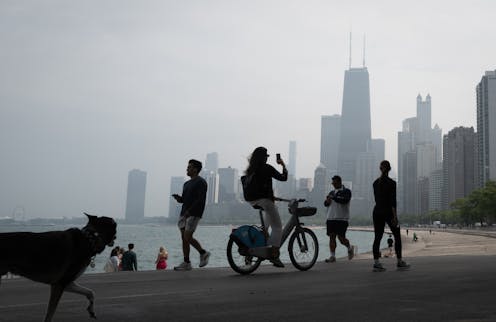
Smoke from Canadian wildfires prompted air quality alerts in Chicago as it blanketed the city on June 5, 2025. Scott Olson/Getty Images

Canada is facing another dangerous wildfire season, with burning forests sending smoke plumes across the provinces and into the U.S. again. The pace of the 2025 fires is reminiscent of the record-breaking 2023 wildfire season, which exposed millions of people in North America to hazardous smoke levels.

For most of the past decade, forecasters have been able to use satellites to track these smoke plumes, but the view was only two-dimensional: The satellites couldn’t determine how close the smoke was to Earth’s surface.

The altitude of the smoke matters.

If a plume is high in the atmosphere, it won’t affect the air people breathe – it simply floats by, far overhead.

But when smoke plumes are close to the surface, people are breathing in wildfire chemicals and tiny particles. Those particles, known as PM2.5, can get deep into the lungs and exacerbate asthma and other respiratory and cardiac problems.

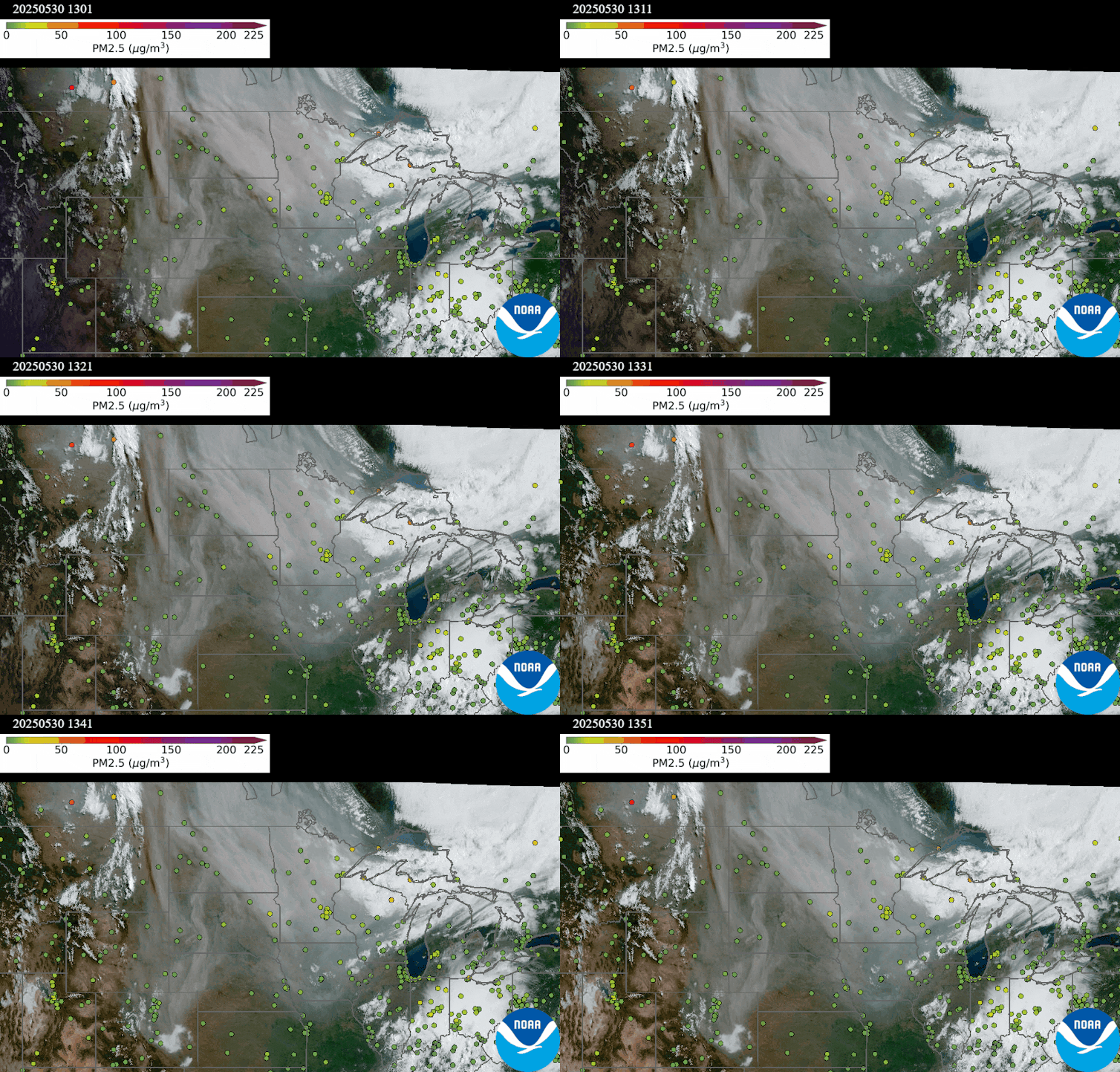
An animation shows mostly green (safe) air quality from ground-level monitors. However, in Canada, closer to the fire, the same plume shows high levels of PM2.5.
An animation on May 30, 2025, shows a thick smoke plume from Canada moving over Minnesota, but the air quality monitors on the ground detected minimal risk, suggesting it was a high-level smoke plume.
NOAA NESDIS Center for Satellite Applications and Research

The Environmental Protection Agency uses a network of ground-based air quality monitors to issue air quality alerts, but the monitors are few and far between, meaning forecasts have been broad estimates in much of the country.

Now, a new satellite-based method that I and colleagues at universities and federal agencies have been working on for the past two years is able to give scientists and air quality managers a 3D picture of the smoke plumes, providing detailed data of the risks down to the neighborhood level for urban and rural areas alike.

Building a nationwide smoke monitoring system

The new method uses data from a satellite that NASA launched in 2023 called the Tropospheric Emissions: Monitoring of Pollution, or TEMPO, satellite.

A map shows blue over the Dakotas, Nebraska and western parts of Minnesota and Iowa. Pink is over Pennsylvania up through Maine.
Data from the TEMPO satellite shows the height of the smoke plume, measured in kilometers. Light blue areas are closest to the ground, suggesting the worst air quality. Pink areas suggest the smoke is more than 2 miles (3.2 kilometers) above the ground, where it poses little risk to human health. The data aligns with air monitor readings taken on the ground at the same time.
NOAA NESDIS Center for Satellite Applications and Research

TEMPO makes it possible to determine a smoke plume’s height by providing data on how much the oxygen molecules absorb sunlight at the 688 nanometer wavelength. Smoke plumes that are high in the atmosphere reflect more solar radiation at this wavelength back to space, while those lower in the atmosphere, where there is more oxygen to absorb the light, reflect less.

Understanding the physics allowed scientists to develop algorithms that use TEMPO’s data to infer the smoke plume’s altitude and map its 3D movement in nearly real time.

An illustration shows a satellite, Sun and smoke plume at different heights. Higher plumes reflect more light.
Aerosol particles in high smoke plumes reflect more light back into space. Closer to Earth’s surface, there is more oxygen to absorb light at the 688 nanometer wavelength, so less light is reflected. Satellites can detect the difference, and that can be used to determine the height of the smoke plume.
Adapted from Xu et al, 2019, CC BY

By combining TEMPO’s data with measurements of particles in the atmosphere, taken by the Advanced Baseline Imager on the NOAA’s GOES-R satellites, forecasters can better assess the health risk from smoke plumes in almost real time, provided clouds aren’t in the way.

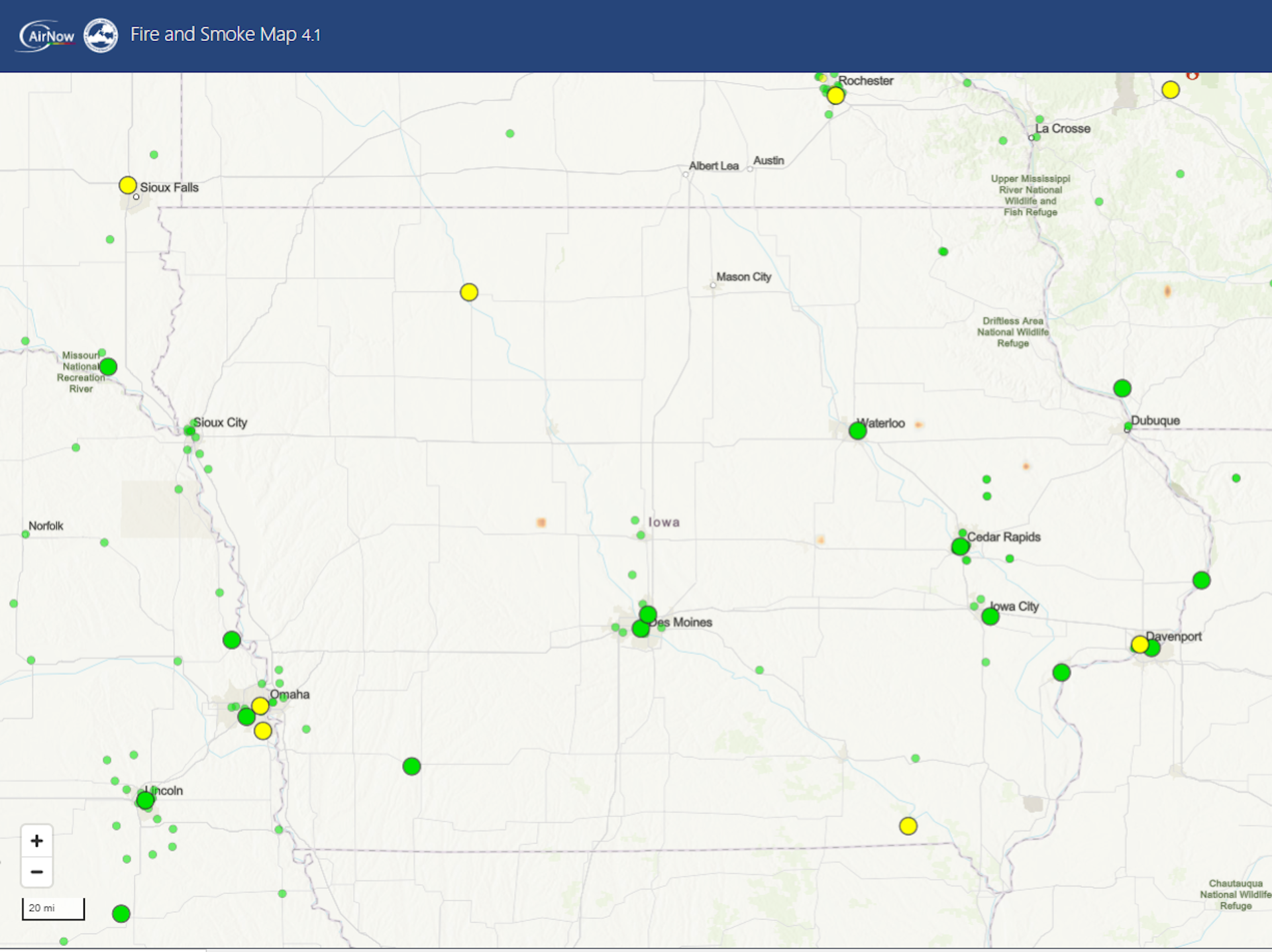
That’s a big jump from relying on ground-based air quality monitors, which may be hundreds of miles apart. Iowa, for example, had about 50 air quality monitors reporting data on a recent day for a state that covers 56,273 square miles. Most of those monitors were clustered around its largest cities.

NOAA’s AerosolWatch tool currently provides a near-real-time stream of wildfire smoke images from its GOES-R satellites, and the agency plans to incorporate TEMPO’s height data. A prototype of this system from my team’s NASA-supported research project on fire and air quality, called FireAQ, shows how users can zoom in to the neighborhood level to see how high the smoke plume is, however the prototype is currently only updated once a day, so the data is delayed, and it isn’t able to provide smoke height data where clouds are also overhead.

Wildfire health risks are rising

Fire risk is increasing across North America as global temperatures rise and more people move into wildland areas.

While air quality in most of the U.S. improved between 2000 and 2020, thanks to stricter emissions regulations on vehicles and power plants, wildfires have reversed that trend in parts of the western U.S. Research has found that wildfire smoke has effectively erased nearly two decades of air quality progress there.

Our advances in smoke monitoring mark a new era in air quality forecasting, offering more accurate and timely information to better protect public health in the face of these escalating wildfire threats.

The Conversation

Prof. Wang’s group have been supported from NOAA, NASA, and Naval ONR to develop research algorithm to retrieve aerosol layer height. The compute codes of the research algorithm were shared with colleagues in NOAA.

ref. Is that wildfire smoke plume hazardous? New satellite tech can map smoke plumes in 3D for better air quality alerts at neighborhood scale – https://theconversation.com/is-that-wildfire-smoke-plume-hazardous-new-satellite-tech-can-map-smoke-plumes-in-3d-for-better-air-quality-alerts-at-neighborhood-scale-259654

Is that wildfire smoke plume hazardous? New satellite tech can map smoke height for better air quality alerts at neighborhood scale

Source: The Conversation – USA (2) – By Jun Wang, Professor of Chemical and Biochemical Engineering, University of Iowa

Smoke from Canadian wildfires prompted air quality alerts in Chicago as it blanketed the city on June 5, 2025. Scott Olson/Getty Images

Canada is facing another dangerous wildfire season, with burning forests sending smoke plumes across the provinces and into the U.S. again. The pace of the 2025 fires is reminiscent of the record-breaking 2023 wildfire season, which exposed millions of people in North America to hazardous smoke levels.

For most of the past decade, forecasters have been able to use satellites to track these smoke plumes, but the view was only two-dimensional: The satellites couldn’t determine how close the smoke was to Earth’s surface.

The altitude of the smoke matters.

If a plume is high in the atmosphere, it won’t affect the air people breathe – it simply floats by, far overhead.

But when smoke plumes are close to the surface, people are breathing in wildfire chemicals and tiny particles. Those particles, known as PM2.5, can get deep into the lungs and exacerbate asthma and other respiratory and cardiac problems.

An animation shows mostly green (safe) air quality from ground-level monitors. However, in Canada, closer to the fire, the same plume shows high levels of PM2.5.
An animation on May 30, 2025, shows a thick smoke plume from Canada moving over Minnesota, but the air quality monitors on the ground detected minimal risk, suggesting it was a high-level smoke plume.
NOAA NESDIS Center for Satellite Applications and Research

The Environmental Protection Agency uses a network of ground-based air quality monitors to issue air quality alerts, but the monitors are few and far between, meaning forecasts have been broad estimates in much of the country.

Now, a new satellite-based method that I and colleagues at universities and federal agencies have been working on for the past two years is able to give scientists and air quality managers a 3D picture of the smoke plumes, providing detailed data of the risks down to the neighborhood level for urban and rural areas alike.

Building a nationwide smoke monitoring system

The new method uses data from a satellite that NASA launched in 2023 called the Tropospheric Emissions: Monitoring of Pollution, or TEMPO, satellite.

A map shows blue over the Dakotas, Nebraska and western parts of Minnesota and Iowa. Pink is over Pennsylvania up through Maine.
Data from the TEMPO satellite shows the height of the smoke plume, measured in kilometers. Light blue areas are closest to the ground, suggesting the worst air quality. Pink areas suggest the smoke is more than 2 miles (3.2 kilometers) above the ground, where it poses little risk to human health. The data aligns with air monitor readings taken on the ground at the same time.
NOAA NESDIS Center for Satellite Applications and Research

TEMPO makes it possible to determine a smoke plume’s height by providing data on how much the oxygen molecules absorb sunlight at the 688 nanometer wavelength. Smoke plumes that are high in the atmosphere reflect more solar radiation at this wavelength back to space, while those lower in the atmosphere, where there is more oxygen to absorb the light, reflect less.

Understanding the physics allowed scientists to develop algorithms that use TEMPO’s data to infer the smoke plume’s altitude and map its 3D movement in nearly real time.

An illustration shows a satellite, Sun and smoke plume at different heights. Higher plumes reflect more light.
Aerosol particles in high smoke plumes reflect more light back into space. Closer to Earth’s surface, there is more oxygen to absorb light at the 688 nanometer wavelength, so less light is reflected. Satellites can detect the difference, and that can be used to determine the height of the smoke plume.
Adapted from Xu et al, 2019, CC BY

By combining TEMPO’s data with measurements of particles in the atmosphere, taken by the Advanced Baseline Imager on the NOAA’s GOES-R satellites, forecasters can better assess the health risk from smoke plumes in almost real time, provided clouds aren’t in the way.

That’s a big jump from relying on ground-based air quality monitors, which may be hundreds of miles apart. Iowa, for example, had about 50 air quality monitors reporting data on a recent day for a state that covers 56,273 square miles. Most of those monitors were clustered around its largest cities.

NOAA’s AerosolWatch tool currently provides a near-real-time stream of wildfire smoke images from its GOES-R satellites, and the agency plans to incorporate TEMPO’s height data. A prototype of this system from my team’s NASA-supported research project on fire and air quality, called FireAQ, shows how users can zoom in to the neighborhood level to see how high the smoke plume is, however the prototype is currently only updated once a day, so the data is delayed, and it isn’t able to provide smoke height data where clouds are also overhead.

Wildfire health risks are rising

Fire risk is increasing across North America as global temperatures rise and more people move into wildland areas.

While air quality in most of the U.S. improved between 2000 and 2020, thanks to stricter emissions regulations on vehicles and power plants, wildfires have reversed that trend in parts of the western U.S. Research has found that wildfire smoke has effectively erased nearly two decades of air quality progress there.

Our advances in smoke monitoring mark a new era in air quality forecasting, offering more accurate and timely information to better protect public health in the face of these escalating wildfire threats.

The Conversation

Prof. Wang’s group have been supported from NOAA, NASA, and Naval ONR to develop research algorithm to retrieve aerosol layer height. The compute codes of the research algorithm were shared with colleagues in NOAA.

ref. Is that wildfire smoke plume hazardous? New satellite tech can map smoke height for better air quality alerts at neighborhood scale – https://theconversation.com/is-that-wildfire-smoke-plume-hazardous-new-satellite-tech-can-map-smoke-height-for-better-air-quality-alerts-at-neighborhood-scale-259654

‘Fibremaxxing’ is trending – here’s why that could be a problem

Source: The Conversation – UK – By Lewis Mattin, Senior Lecturer, Life Sciences, University of Westminster

Soluble fibre. Towfiqu ahamed barbhuiya/Shutterstock.com

You need fibre. That much is true. But in the world of online health trends, what started out as sound dietary advice has spiralled into “fibremaxxing” – a push to consume eye-watering amounts in the name of wellness.

In the UK, NHS guidelines suggest that an adult should consume at least 30g of fibre a day. Children and teens typically need much less.

Yet despite clear guidelines, most Britons fall short of their daily fibre target. One major culprit? The rise of ultra-processed foods, or UPFs. UK adults now get over 54% of their daily calories from ultra-processed foods. For teenagers, it’s nearer 66%.

This matters because UPFs are typically low in fibre and micronutrients, while being high in sugar, salt and unhealthy fats. When these foods dominate our plate, naturally fibre-rich whole foods get pushed out.

Studies show that as ultra-processed food intake increases, fibre consumption decreases, along with other essential nutrients. The result is a population falling well short of its daily fibre target.

Dietary fibre is essential for good health as part of a balanced diet. And it is best found in natural plant-based foods.

Adding high fibre foods to your meals and snacks throughout a typical day, such as switching to wholegrain bread for breakfast, keeping the skin on fruits like an apple, adding lentils and onions to a chilli evening meal and eating a handful of pumpkin seeds or Brazil nuts between meals, would help an average person hit their 30g-a-day dietary requirements.

Displacement

With fibremaxxing, what might make this trend somewhat dangerous is the removal of other food groups such as proteins, carbohydrates and fats and replacing them with fibre-dense foods, supplements or powder. This is where the potential risk could mitigate the benefits of increasing fibre, as no robust studies in humans – as far as I’m aware – have been conducted on long-term fibre intakes over 40g a day. (Some advocates of fibremaxxing suggest consuming between 50 and 100g a day.)

Eating too much fibre too quickly – especially without enough water – can lead to bloating, cramping and constipation. It can also cause a buildup of gas that can escape at the most inconvenient moments, like during a daily commute.

Commuters looking suspiciously at someone off-camera.
Someone’s been fibremaxxing.
William Perugini/Shutterstock.com

Rapidly increasing fibre intake or consuming too much can interfere with the absorption of essential micronutrients like iron, which supports normal body function, as well as macronutrients, which provide the energy needed for movement, repair and adaptation.

However, it’s important to remember that increasing fibre in your diet offers a wide range of health benefits. It supports a healthy digestive system by promoting regular bowel movements and reducing the occurrence of inflammatory bowel disease.

Soluble fibre helps to regulate blood sugar levels by slowing the absorption of glucose, making it especially helpful for people at risk of type 2 diabetes. It also lowers LDL (bad) cholesterol, reducing the risk of heart disease. Fibre keeps you feeling full for longer, which supports healthy weight management and appetite regulation. These findings are all well documented.

Additionally, a high-fibre diet has been linked to a lower risk of certain cancers, particularly colon cancer, by helping to remove toxins efficiently from the body. Gradually increasing fibre intake to recommended levels – through a balanced, varied diet – can offer real health benefits.

Given the evidence, it’s clear that many of us could benefit from eating more fibre – but within reason.

Until we know more, it’s safest to stick to fibre intake within current guidelines, and get it from natural sources rather than powders or supplements. Fibre is vital, but more isn’t always better. Skip the social media fads and aim for balance: whole grains, veg, nuts and seeds. Your gut – and your fellow commuters – will thank you.

The Conversation

Lewis Mattin is affiliated with The Physiological Society, The Society for Endocrinology, In2Science & UKRI funded Ageing and Nutrient Sensing Network.

ref. ‘Fibremaxxing’ is trending – here’s why that could be a problem – https://theconversation.com/fibremaxxing-is-trending-heres-why-that-could-be-a-problem-261280

Netflix is now using generative AI – but it risks leaving viewers and creatives behind

Source: The Conversation – UK – By Edward White, PhD Candidate in Psychology, Kingston University

Netflix’s recent use of generative AI to create a building collapse scene in the sci-fi show El Eternauta (The Eternaut) marks more than a technological milestone. It reveals a fundamental psychological tension about what makes entertainment authentic.

The sequence represents the streaming giant’s first official deployment of text-to-video AI in final footage. According to Netflix, it was completed ten times faster than traditional methods would have allowed.

Yet this efficiency gain illuminates a deeper question rooted in human psychology. When viewers discover their entertainment contains AI, does this revelation of algorithmic authorship trigger the same cognitive dissonance we experience when discovering we’ve been seduced by misinformation?

The shift from traditional CGI (computer-generated imagery) to generative AI is the most significant change in visual effects (VFX) since computer graphics displaced physical effects.

Traditional physical VFX requires legions of artists meticulously crafting mesh-based models, spending weeks perfecting each element’s geometry, lighting and animation. Even the use of CGI with green screens demands human artists to construct every digital element from 3D models and programme the simulations. They have to manually key-frame each moment, setting points to show how things move or change.

Netflix’s generative AI approach marks a fundamental shift. Instead of building digital scenes piece by piece, artists simply describe what they want and algorithms generate full sequences instantly. This turns a slow, laborious craft into something more like a creative conversation. But it also raises tough questions. Are we seeing a new stage of technology – or the replacement of human creativity with algorithmic guesswork?


Looking for something good? Cut through the noise with a carefully curated selection of the latest releases, live events and exhibitions, straight to your inbox every fortnight, on Fridays. Sign up here.


El Eternauta’s building collapse scene demonstrates this transformation starkly. What would once have demanded months of modelling, rigging and simulation work has been accomplished through text-to-video generation in a fraction of the time.

The economics driving this transformation extend far beyond Netflix’s creative ambitions.

The text-to-video AI market is projected to be worth £1.33 billion by 2029. This reflects an industry looking to cut corners after the streaming budget cuts of 2022. In that year, Netflix’s content spending declined 4.6%, while Disney and other major studios implemented widespread cost-cutting measures.

AI’s cost disruption is bewildering. Traditional VFX sequences can cost thousands per minute. As a result, the average CGI and VFX budget for US films reached US$33.7 million (£25 million) per movie in 2018. Generative AI could lead to cost reductions of 10% across the media industry, and as much as 30% in TV and film. This will enable previously impossible creative visions to be realised by independent filmmakers – but this increased accessibility comes with losses too.

The trailer for El Eternauta.

The OECD reports that 27% of jobs worldwide are at “high risk of automation” due to AI. Meanwhile, surveys by the International Alliance of Theatrical Stage Employees have revealed that 70% of VFX workers do unpaid overtime, and only 12% have health insurance. Clearly, the industry is already under pressure.

Power versus precision

While AI grants filmmakers unprecedented access to complex imagery, it simultaneously strips away the granular control that defines directorial vision.

As an experiment, film director Ascanio Malgarini spent a year creating an AI-generated short film called Kraken (2025). He used AI tools like MidJourney, Kling, Runway and Sora, but found that “full control over every detail” was “simply out of the question”.

Malgarini described working more like a documentary editor. He assembled “vast amounts of footage from different sources” rather than directing precise shots.

Kraken, the experimental AI short film by Ascanio Malgarini.

And it’s not just filmmakers who prefer the human touch. In the art world, studies have shown that viewers strongly prefer original artworks to pixel-perfect AI copies. Participants cited sensitivity to the creative process as fundamental to appreciation.

When applied to AI-generated content, this bias creates fascinating contradictions. Recent research in Frontiers in Psychology found that when participants didn’t know the origin, they significantly preferred AI-generated artwork to human-made ones. However, once AI authorship was revealed, the same content suffered reduced perceptions of authenticity and creativity.

Hollywood’s AI reckoning

Developments in AI are happening amid a regulatory vacuum. While the US Congress held multiple AI hearings in 2023, no comprehensive federal AI legislation exists to govern Hollywood’s use. The stalled US Generative AI Copyright Disclosure Act leaves creators without legal protections, as companies deploy AI systems trained on potentially copyrighted materials.

The UK faces similar challenges, with the government launching a consultation in December 2024 on copyright and AI reform. This included a proposal for an “opt-out” system, meaning creators could actively prevent their work from being used in AI training.

The 2023 Hollywood strikes crystallised industry fears about AI displacement. Screenwriters secured protections ensuring AI cannot write or rewrite material, while actors negotiated consent requirements for digital replicas. Yet these agreements primarily cover the directors, producers and lead actors who have the most negotiating power, while VFX workers remain vulnerable.

Copyright litigation is now beginning to dominate the AI landscape – over 30 infringement lawsuits have been filed against AI companies since 2020. Disney and Universal’s landmark June 2025 lawsuit against Midjourney represents the first major studio copyright challenge, alleging the AI firm created a “bottomless pit of plagiarism” by training on copyrighted characters without permission.

Meanwhile, federal courts in the US have delivered mixed rulings. A Delaware judge found against AI company Ross Intelligence for training on copyrighted legal content, while others have partially sided with fair use defences.

The industry faces an acceleration problem – AI advancement outpaces contract negotiations and psychological adaptation. AI is reshaping industry demands, yet 96% of VFX artists report receiving no AI training, with 31% citing this as a barrier to incorporating AI in their work.

Netflix’s AI integration shows that Hollywood is grappling with fundamental questions about creativity, authenticity and human value in entertainment. Without comprehensive AI regulation and retraining programs, the industry risks a future where technological capability advances faster than legal frameworks, worker adaptation and public acceptance can accommodate.

As audiences begin recognising AI’s invisible hand in their entertainment, the industry must navigate not just economic disruption, but the cognitive biases that shape how we perceive and value creative work.

The Conversation

Edward White is affiliated with Kingston University.

ref. Netflix is now using generative AI – but it risks leaving viewers and creatives behind – https://theconversation.com/netflix-is-now-using-generative-ai-but-it-risks-leaving-viewers-and-creatives-behind-261699

Yazidi genocide victims offered glimmer of hope for justice – but challenges remain

Source: The Conversation – UK – By Busra Nisa Sarac, Senior Lecturer in International Security and Gender Studies, University of Portsmouth

A French national called Sonia Mejri will stand trial for her alleged involvement in crimes committed against the Yazidi community, a Paris court ruled in early July. Mejri is accused of having joined the Islamic State (IS) group’s so-called caliphate in Iraq and Syria, and participating in its genocidal campaign against the Yazidi religious minority group 11 years ago.

At that time, IS overran the Sinjar region of northern Iraq and carried out atrocities against the civilian population. The Yazidi people were subjected to murder, rape, enslavement and forced conversion to Islam. Approximately 12,000 Yazidis were killed or abducted by IS, and around 250,000 fled to Mount Sinjar where they faced near starvation.

The Paris court’s ruling follows the prosecution of several other people across Europe in recent years for their role in enslaving Yazidis. These developments have offered the Yazidi community a glimmer of hope for justice.

In 2021, for example, a former member of IS called Taha al-Jumailly was convicted of genocide and crimes against humanity. A court in Frankfurt, Germany, ruled that he intended to eliminate the Yazidis by purchasing two women and enslaving them. This was the world’s first trial concerning the Yazidi genocide.

More recently, in 2024, a Dutch woman known as Hasna Aarab stood trial in The Hague, Netherlands, for charges also related to the enslavement of Yazidi women. She was sentenced to ten years in prison. Then, in February 2025, a Swedish woman called Lina Ishaq was convicted of committing genocide, crimes against humanity and gross war crimes against Yazidis in Syria.

Despite the fact that the international community has been slow in prosecuting members of IS for their roles in the genocide, these cases are a positive development. But it should also be noted that they are the result of years of advocacy and campaigning by Yazidi organisations and activists.

The Free Yezidi Foundation and Nadia’s Initiative are just two examples of organisations that have been fighting for justice and reparation since 2014.

Notwithstanding these developments, and the fact that IS lost control of its territory in Iraq and Syria in 2017, there are still significant challenges facing the Yazidi community. One pressing concern is the whereabouts of the more than 2,000 Yazidis who are still missing.

A few Yazidi women have emerged from different locations in recent years, which has made families hopeful. But the missing elderly women are now presumed dead and many others are believed to have been killed by airstrikes in the international military campaign against IS. These people are thought to be buried in mass graves.

Another concern is linked to the detention camps in northeast Syria, where suspected members of IS are detained indefinitely. A 2024 report by Amnesty International indicated that hundreds of Yazidis are probably being held in the camps.

This can be explained by two factors. First, Yazidi women in these camps may avoid identification due to fears of being separated from their children born in IS slavery. Yazidi leaders have declared that children born to IS members are not welcome and could never be assimilated into Yazidi society.

Second, it’s possible that some Yazidis in the camps no longer know their identity due to prolonged captivity and exposure to radical views from IS members. Both factors may prevent many Yazidis from returning to their communities, compounding the long-term consequences of the genocide.

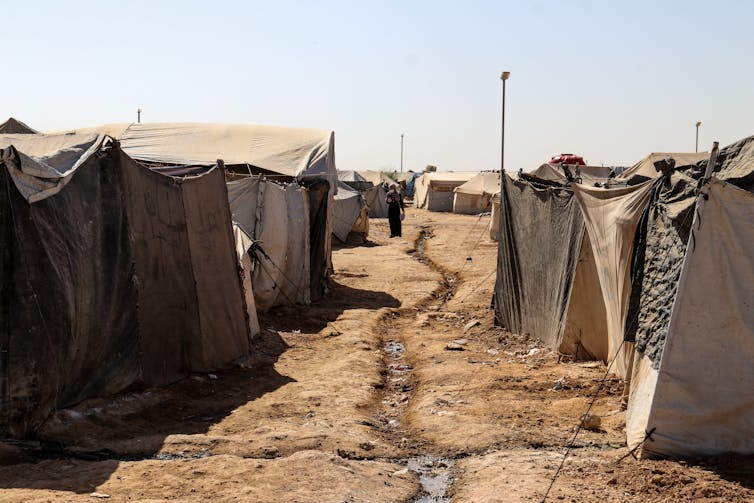
The Al-Hol detention camp in north-eastern Syria.
The Al-Hol detention camp in north-eastern Syria, where many people with ties to IS are held.
Trent Inness / Shutterstock

Persistent security challenges

The Yazidis also continue to face persistent security challenges, as they lack the necessary infrastructure and support to rebuild their home towns. More than a decade on, 200,000 Yazidis remain displaced, with the majority living in makeshift camps. These camps are mainly located in Duhok, a city in the autonomous Kurdistan Region of Iraq.

The Kurdistan regional government has been actively working to close down or merge the displacement camps in an attempt to encourage the displaced families to return home. But a lack of infrastructure, including access to water, and limited employment opportunities continue to hinder their return and resettlement.

Iraq’s federal government has said it will give 4 million Iraqi dinars (roughly £2,250) to each Yazidi family that returns home, as well as offering interest-free bank loans. But the compensation scheme has now been paused due to a lack of funds. Even when it was offered, the amount was not enough to help people rebuild their lives in places that are in ruins.

The presence of various armed groups supported by different states in the region also threatens the safety and security of the Yazidis. Sinjar’s rugged terrain and remoteness from political centres has long encouraged groups, including the Kurdish Workers’ Party and Iraq’s Popular Mobilisation Forces, to establish transit routes there to support their allies in Iraq, Syria, Jordan and Turkey.


Read more:
How does the PKK’s disarmament affect Turkey, Syria and Iraq?


Sinjar is also a disputed territory, claimed by the federal government in Baghdad and the Kurdish regional government in Erbil. Clashes between local militia groups continue to destabilise Sinjar, leading to the re-displacement of some Yazidis who have only recently returned, while preventing many others from returning even if they wanted to do.

The trials of IS members have given Yazidis some hope for justice. But persistent problems since 2014 have made it hard for them to return to their hometowns, or feel safe if they do so. Until these things are dealt with properly, the same problems will continue in the years to come.

The Conversation

Busra Nisa Sarac does not work for, consult, own shares in or receive funding from any company or organisation that would benefit from this article, and has disclosed no relevant affiliations beyond their academic appointment.

ref. Yazidi genocide victims offered glimmer of hope for justice – but challenges remain – https://theconversation.com/yazidi-genocide-victims-offered-glimmer-of-hope-for-justice-but-challenges-remain-261612

AI agents are here. Here’s what to know about what they can do – and how they can go wrong

Source: The Conversation – Global Perspectives – By Daswin de Silva, Professor of AI and Analytics, Director of AI Strategy, La Trobe University

George Peters / Getty Images

We are entering the third phase of generative AI. First came the chatbots, followed by the assistants. Now we are beginning to see agents: systems that aspire to greater autonomy and can work in “teams” or use tools to accomplish complex tasks.

The latest hot product is OpenAI’s ChatGPT agent. This combines two pre-existing products (Operator and Deep Research) into a single more powerful system which, according to the developer, “thinks and acts”.

These new systems represent a step up from earlier AI tools. Knowing how they work and what they can do – as well as their drawbacks and risks – is rapidly becoming essential.

From chatbots to agents

ChatGPT launched the chatbot era in November 2022, but despite its huge popularity the conversational interface limited what could be done with the technology.

Enter the AI assistant, or copilot. These are systems built on top of the same large language models that power generative AI chatbots, only now designed to carry out tasks with human instruction and supervision.

Agents are another step up. They are intended to pursue goals (rather than just complete tasks) with varying degrees of autonomy, supported by more advanced capabilities such as reasoning and memory.

Multiple AI agent systems may be able to work together, communicating with each other to plan, schedule, decide and coordinate to solve complex problems.

Agents are also “tool users” as they can also call on software tools for specialised tasks – things such as web browsers, spreadsheets, payment systems and more.

A year of rapid development

Agentic AI has felt imminent since late last year. A big moment came last October, when Anthropic gave its Claude chatbot the ability to interact with a computer in much the same way a human does. This system could search multiple data sources, find relevant information and submit online forms.

Other AI developers were quick to follow. OpenAI released a web browsing agent named Operator, Microsoft announced Copilot agents, and we saw the launch of Google’s Vertex AI and Meta’s Llama agents.

Earlier this year, the Chinese startup Monica demonstrated its Manus AI agent buying real estate and converting lecture recordings into summary notes. Another Chinese startup, Genspark, released a search engine agent that returns a single-page overview (similar to what Google does now) with embedded links to online tasks such as finding the best shopping deals. Another startup, Cluely, offers a somewhat unhinged “cheat at anything” agent that has gained attention but is yet to deliver meaningful results.

Not all agents are made for general-purpose activity. Some are specialised for particular areas.

Coding and software engineering are at the vanguard here, with Microsoft’s Copilot coding agent and OpenAI’s Codex among the frontrunners. These agents can independently write, evaluate and commit code, while also assessing human-written code for errors and performance lags.

Search, summarisation and more

One core strength of generative AI models is search and summarisation. Agents can use this to carry out research tasks that might take a human expert days to complete.

OpenAI’s Deep Research tackles complex tasks using multi-step online research. Google’s AI “co-scientist” is a more sophisticated multi-agent system that aims to help scientists generate new ideas and research proposals.

Agents can do more – and get more wrong

Despite the hype, AI agents come loaded with caveats. Both Anthropic and OpenAI, for example, prescribe active human supervision to minimise errors and risks.

OpenAI also says its ChatGPT agent is “high risk” due to potential for assisting in the creation of biological and chemical weapons. However, the company has not published the data behind this claim so it is difficult to judge.

But the kind of risks agents may pose in real-world situations are shown by Anthropic’s Project Vend. Vend assigned an AI agent to run a staff vending machine as a small business – and the project disintegrated into hilarious yet shocking hallucinations and a fridge full of tungsten cubes instead of food.

In another cautionary tale, a coding agent deleted a developer’s entire database, later saying it had “panicked”.

Agents in the office

Nevertheless, agents are already finding practical applications.

In 2024, Telstra heavily deployed Microsoft copilot subscriptions. The company says AI-generated meeting summaries and content drafts save staff an average of 1–2 hours per week.

Many large enterprises are pursuing similar strategies. Smaller companies too are experimenting with agents, such as Canberra-based construction firm Geocon’s use of an interactive AI agent to manage defects in its apartment developments.

Human and other costs

At present, the main risk from agents is technological displacement. As agents improve, they may replace human workers across many sectors and types of work. At the same time, agent use may also accelerate the decline of entry-level white-collar jobs.

People who use AI agents are also at risk. They may rely too much on the AI, offloading important cognitive tasks. And without proper supervision and guardrails, hallucinations, cyberattacks and compounding errors can very quickly derail an agent from its task and goals into causing harm, loss and injury.

The true costs are also unclear. All generative AI systems use a lot of energy, which will in turn affect the price of using agents – especially for more complex tasks.

Learn about agents – and build your own

Despite these ongoing concerns, we can expect AI agents will become more capable and more present in our workplaces and daily lives. It’s not a bad idea to start using (and perhaps building) agents yourself, and understanding their strengths, risks and limitations.

For the average user, agents are most accessible through Microsoft copilot studio. This comes with inbuilt safeguards, governance and an agent store for common tasks.

For the more ambitious, you can build your own AI agent with just five lines of code using the Langchain framework.

The Conversation

Daswin de Silva does not work for, consult, own shares in or receive funding from any company or organisation that would benefit from this article, and has disclosed no relevant affiliations beyond their academic appointment.

ref. AI agents are here. Here’s what to know about what they can do – and how they can go wrong – https://theconversation.com/ai-agents-are-here-heres-what-to-know-about-what-they-can-do-and-how-they-can-go-wrong-261579

Donald Trump cannot make the Epstein files go away. Will this be the story that brings him down?

Source: The Conversation – Global Perspectives – By Emma Shortis, Adjunct Senior Fellow, School of Global, Urban and Social Studies, RMIT University

Conspiracy theories are funny things.

The most enduring ones usually take hold for two reasons: first, because there’s some grain of truth to them, and second, because they speak to foundational historical divisions.

The theories morph and change, distorting the grain of truth at their centre beyond reality. In the process, they reinforce and deepen existing divisions, encouraging hateful blindness.

US President Donald Trump is perhaps the most successful conspiracy trafficker in modern American history.

Trump built his political career by trading on conspiracy. These have included a combination of racist birther conspiracies about former president Barack Obama, nebulous ideas about the “Deep State” that conspired against the interests of regular Americans, and nods to a more recent online universe centered on QAnon that alleged a Satanist ring of “elite” pedophiles involving Hillary Clinton was trafficking children.

These theories all had their own grain of truth and tapped into deep-seated historical fears. For example, Obama does have Kenyan heritage, and his Blackness threatened many white Americans’ sense of their own power.

Revelations about disgraced financier Jeffery Epstein’s trafficking in children and the way in which that implicated the “elite” of New York seemed to confirm at least parts of the final theory. It tapped into the belief – one that does have some basis in reality – that America’s elite play by rules of their own, above justice and accountability.

In the lead-up to the 2024 presidential election, Trump increasingly engaged with this online universe. He seemed to quietly enjoy suggestions that he might be “Q” – the anonymous leader who, according to the theory, was going to break the paedophile ring wide open in a “day of reckoning”.

Many of Trump’s perennially online supporters based their championing of him around these conspiracy theories. QAnon believers were among those who stormed the Capitol on January 6 2021. A core section of Trump’s base continues to believe his promises that he would at last reveal the truth – about John F. Kennedy’s assassination, the Deep State, and Epstein.

That it has long been public knowledge that Trump and Epstein had a longstanding friendship did not impinge on these beliefs.

Conspiracy theories have swirled around Epstein since at least his first arrest nearly two decades ago, in 2006. After allegations of unlawful sex with a minor, Epstein was charged with soliciting prostitution. This elicited suggestions he was receiving special treatment because of his elite status as a New York financier and philanthropist.

That pattern continued over the next decade as accusations multiplied, culminating in his arrest in 2019 on federal charges of sex trafficking, including to a private island. The allegations touched the global elite, including former president Bill Clinton, the United Kingdom’s Prince Andrew, and Trump. In August 2019, Epstein was found dead in his cell, allegedly by suicide – adding further fuel to the already intense conspiracy fire.

Epstein’s arrest and death occurred during the first Trump administration. Since then, there has been a steady trickle of accusations and revelations that have increased pressure on the administration to declassify and release material relating to the case. Many of Trump’s most loyal supporters, including a set of influential podcasters and influencers, have built their audiences around Epstein and the insistence that the truth be revealed.

Early in the life of the current administration, Attorney-General Pam Bondi – whom Trump is wont to treat as his personal lawyer – said she was reviewing the Epstein “client list”.

In the past few weeks, however, the administration has indicated it will not release the list or other materials relating to the case. At the same time, more information about Trump’s relationship with Epstein has trickled out, including more photos of the two together. It’s hard to deny the sense there is more to come.

Trump’s posting about the issue, despite his apparent wish to divert from it, seems only to compel more interest. Sections of his online conspiracy base, including vocal supporters such as Tucker Carlson, are outraged at what they see as a betrayal. Reports suggest a significant rift developing between Trump and key backer Rupert Murdoch over the issue. Democrats, rightly, sense weakness.


Read more:
Could Rupert Murdoch bring down Donald Trump? A court case threatens more than just their relationship


Loyal Republicans seem rattled enough that Speaker of the House Mike Johnson called an early summer recess, sending congresspeople home in an apparent effort to avoid any forced vote on the issue.

The obvious inference – though it is inference only – is that Trump and Republicans are so worried about what is in the Epstein material they would rather cop strong backlash from the base, looking scared and weak, than release the information. If nothing else, that is a guaranteed way to fuel an already raging fire.

Trump’s tanking approval rating and the salience of this issue lead to an obvious question: is this going to be the thing that finally scratches the Teflon president? Will his base turn on him at last?

If history is anything to go by, that seems unlikely. Trump is remarkably resilient, using crises like this to consolidate his power. Trump commands loyalty, and he has it from Bondi, Johnson and others in this weakened and increasingly ideologically driven federal government. And his conspiracy-fuelled base is in so deep that turning on the president now is not just a question of admitting error, but one of core identity.

US mainstream media has long pursued a “gotcha” approach to Trump, driven by a model of journalism that still seeks out smoking guns and dreams of Watergate. Not unlike the conspiracy theories it reports on, this framing hopes for a neat, clear resolution to the story of US politics. But politics doesn’t work like that – especially not for Trump.

From the outside, Trump’s attempts to pivot on the issue and build on his existing conspiracies around Obama and Hillary Clinton might look feeble, but they are tried and true. Trump is now focused on fanning theories around Obama and Clinton, broadening them to include accusations of “treason”. Trump’s Director of National Intelligence Tulsi Gabbard went so far as to claim Obama had “manufactured […] a years-long coup against President Trump”. Even reporting on these claims with rightful incredulity adds fuel to the raging fire.

In the personality cult of an authoritarian leader, conspiracy is easily weaponised against enemies, perceived and real. In the febrile environment of US politics, these conspiracy theories tap into and encourage a long vein of white supremacy and racial revanchism that has shaped American politics since even before the nation’s founding.

Trump can morph and change conspiracy theories like no one else, building on fears and deepening existing divisions. He understands the power of pointing to “enemies from within”, and just how well that reinforces the narrative he has already so successfully ingrained in US political culture. We underestimate him, and the power of conspiracy theory, at our peril.

The Conversation

Emma Shortis is Director of International and Security Affairs at The Australia Institute, an independent think tank.

ref. Donald Trump cannot make the Epstein files go away. Will this be the story that brings him down? – https://theconversation.com/donald-trump-cannot-make-the-epstein-files-go-away-will-this-be-the-story-that-brings-him-down-261843