How Britain’s housing crisis contributes to its declining healthy life expectancy

Source: The Conversation – UK – By Emma Baker, Professor of Housing Research, Adelaide University

I Wei Huang/Shutterstock

People in the UK are now spending fewer years in good health than they did a decade ago, according to a new analysis by the Health Foundation. The UK now sits near the bottom of a 21-country comparison, ahead only of the US.

A drop in healthy life expectancy is explained through many causes: obesity, alcohol, drugs, suicide, chronic disease, poverty and widening inequality. But one of the most powerful causes sits atop them all: housing. Where and how people live is one of the main factors explaining how health risks are created and distributed across society.

The UK Housing Review is an annual independent review of housing policy and evidence, written by housing experts and published by the Chartered Institute of Housing. Its latest edition, which we contributed to, identifies several interrelated ways that housing affects health.

A key one is affordability – housing costs shape where people can live, whether they can heat their homes, whether they can afford food and transport, whether they can move for work, whether they can leave unsafe or unsuitable housing and whether they live with chronic financial stress.

In the UK, housing costs are high by historical standards and poor housing remains widespread. The review notes that private rents are now at their highest recorded share of earnings, while millions of homes in England still contain serious health and safety hazards.

When housing is unaffordable, people are forced to make tradeoffs. For example, trading affordability for damp or overcrowded homes. They cut back on heating, food, medication, transport and social participation. They move further from public services, work and support networks. Affordability problems also force many people into cheaper, less secure, tenancies.

Poor housing quality directly shapes health. Cold, damp, mould, disrepair, poor ventilation and unsafe homes are directly linked to respiratory illness, cardiovascular risk, mental health problems and reduced wellbeing.


Read more:
Cold homes increase the risk of severe mental health problems – new study


The Building Research Establishment, an independent research organisation, has estimated that poor housing costs the NHS in England £1.4 billion each year. More than half of this is attributed to cold homes, which increase the risk of respiratory illness, cardiovascular problems and poor mental health. They are especially dangerous for older people, babies and people with existing health conditions.

But the wider costs are even greater. Poor sleep, stress, disrupted schooling, insecure work, social isolation and caring strain all affect mental and physical health. They increase pressure on families and, over time, on health, education and social care systems.

Close up of someone resting their hands and hot drink on a radiator
Cold homes can cause serious and widespread health problems.
Jelena Stanojkovic

Historically in the UK, social housing has provided some protection to people unable to access good quality affordable housing in the open market. But the stock of social rented housing in the UK has declined. This means that people are increasingly dependent on (often expensive) market rental, where the quality, size and location of housing depend much more directly on income.

The rise of the private rented sector this century has meant that more households are exposed, not just to higher housing costs, but also to shorter tenancies and fewer protections than social housing traditionally provided.

The Renters’ Rights Act increases security, but does not remove “no fault” evictions altogether and does little to protect tenants from economic pressures that can result in eviction. The cognitive burden of worrying about eviction, arrears, repairs or the next rent increase is a direct health risk.

Recent evidence also suggests that insecure housing can result in measurably faster biological ageing, equivalent to the effects of more traditional health concerns like smoking.

Additional weeks of biological ageing per year from different factors
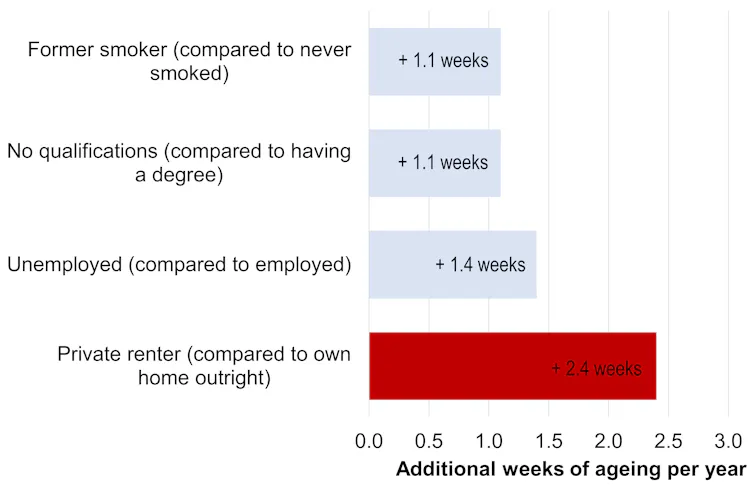
Bar chart showing additional weeks per year for private renting (2.4 weeks) compared to other social determinants of health including unemployment (1.4 weeks), having no qualifications (1.1 weeks) and being a former smoker (1.1 weeks)

Amy Clair

The number of people living in temporary accommodation has risen dramatically, reaching over 130,000 households at the beginning of 2025. This is a 156% increase compared with 2010, largely driven by the poor affordability and insecurity of the private rented sector and lack of social housing. Temporary accommodation is inadequate housing, particularly for children. Living in temporary accommodation was a contributing factor in the deaths of at least 104 children in England between 2019 and 2025, 76 of whom were under one year of age.

This is not about housing quality alone. Temporary accommodation reflects multiple risks brought together: poverty, overcrowding, poor conditions, instability, lack of space for safe infant sleep, poor access to services and wider racial and social inequality. The National Child Mortality Database identifies temporary accommodation as a contributing factor to vulnerability, ill health or death, not necessarily as the sole cause. Emerging evidence also links temporary accommodation with stillbirth and neonatal death.


Read more:
Insecure renting ages you faster than owning a home, unemployment or obesity. Better housing policy can change this


Housing health inequality

ONS data shows a very large difference in healthy life expectancy between the most and least deprived areas. In 2022-24, healthy life expectancy in the most deprived areas of England was just 49.8 years for men and 48.2 years for women, compared with 69.2 and 68.5 years in the least deprived areas.

Housing contributes to this difference, determining whether people live in homes that support recovery or deepen stress, whether children grow up in stable and safe environments, and whether older people can remain warm and independent.

If the government is serious about its stated aim to “halve the gap in healthy life expectancy between the richest and poorest regions”, housing policy must become health policy.

That means investing in social housing, enforcing decent standards in the private rented sector, making homes warmer, safer and more accessible, and recognising temporary accommodation, overcrowding and insecurity as public health failures, not just housing management problems.

It also means changing the way that success is measured. Housing policy is too often judged by supply numbers, prices or tenure outcomes. These matter, but they are incomplete. A healthy housing system should also be judged by whether people can live in homes that are affordable, secure, decent, suitable and resilient to climate change.

The decline in healthy life expectancy is a warning light. It tells us that the UK is not only failing to keep people well for longer, it is failing to provide the foundations of health.

The Conversation

Emma Baker receives funding from the Economic and Social Research Council, the Australian Research Council, The National Health and Medical Research Council, and the Australian Housing and Urban Research Institute.

Amy Clair receives funding from the Australian Research Council and the Australian Housing and Urban Research Institute.

Mark Stephens receives funding from ESRC, the EU/Innovate UK and the Australian Housing and Urban Research Institute (AHURI).

ref. How Britain’s housing crisis contributes to its declining healthy life expectancy – https://theconversation.com/how-britains-housing-crisis-contributes-to-its-declining-healthy-life-expectancy-281605

Ten compelling poems about climate change – chosen by our experts

Source: The Conversation – UK – By Jack Reid, PhD Candidate in Irish literature, University of Limerick

Three Reading Women in a Summer Landscape by Johan Krouthén (1908). WikiCommons

We asked ten literary experts to recommend the climate poem that has spoken to them most powerfully. Their answers span over 200 years and a range of emotions from sorrow, to anger, fear and hope.

This article is part of Climate Storytelling, a series exploring how arts and science can join forces to spark understanding, hope and action.

1. Death of a Field by Paula Meehan (2005)

Published in the wake of the 2008 financial crisis, Paula Meehan’s Death of a Field critiqued the environmental impact of the Celtic Tiger economy in Ireland.

The poem anticipates the destruction of the titular field by property developers with little regard for native ecologies: “The end of the field as we know it is the start of the estate.”

Death of a Field read by Paula Meehan.

The global effects of the climate crisis are seen from a uniquely local perspective as the displacement of Irish wildlife mirrors the effect of colonial violence. “Some architect’s screen” is simply the latest iteration of imperial technologies that seek to plunder Irish landscapes. The poem gains further strength by refusing to replicate a hierarchical relationship to nature by preserving its many mysteries:

Who can know the yearning of yarrow

Or the plight of the scarlet pimpernel

Whose true colour is orange?

Jack Reid is a PhD Candidate in Irish literature

2. Darkness by Lord Byron (1816)

Darkness imagines the fallout of a volcanic eruption that has destroyed the Earth. The “dream” that the poem mentions was inspired by genuine weather conditions during the “year without a summer” in 1816, caused by the eruption of Mount Tambora in Indonesia the previous year.

Darkness by Lord Byron.

Sulphur in the atmosphere caused darkness and low temperatures across Europe. In Lake Geneva, Lord Byron experienced the infamous “haunted summer” of darkness.

Byron’s depiction of climate catastrophe is bleak, with words like “crackling”, “blazing” and “consum’d” bearing resemblance to contemporary reports of wildfires caused by climate change. After a famine, all elements of Byron’s Earth, from the clouds to the tide, eventually cease to exist: “Seasonless, herbless, treeless, manless, lifeless– / A lump of death – a chaos of hard clay.” Read as a portent of the Anthropocene, Byron’s poem urges readers to seriously consider the future of mankind.

Katie MacLean is a PhD candidate in English Literature

3. Mont Blanc by Percy Bysshe Shelley (1817)

Byron’s close friend Percy Bysshe Shelley was also inspired by the “year without a summer”. He witnessed temperatures drop, volcanic ash hanging heavy in the air and crops failing. While his wife Mary used the gloomy climatic event to inform her novel Frankenstein (1818), Shelley channelled them into his poem Mont Blanc.

A reading of Mont Blanc.

In his ode, Shelley describes a timeless “wall impregnable of beaming ice”. By drawing on his scientific reading, he then explains his fears regarding global cooling and the possibility of vast glaciers eventually covering the alpine valleys.

He imagines “the dwelling-place / Of insects, beasts, and birds” being obliterated and mankind forced to flee. While Shelley saw this process as “destin’d” and inevitable, it is clear that Mont Blanc is a poem with catastrophic climate change at its heart. In 2026, it is difficult to read in any other way.

Amy Wilcockson is a research fellow in Romantic literature

4. Characteristics of Life by Camille T. Dungy (2012)

There’s something gloriously elastic about invertebrates: the spinelessness of a worm, the pulsing of the jellyfish, the curling of an octopus. Spiders, snails and bees, too, with their exoskeletons on display, invite us to see things “inside-out”.

These are the thoughts I have when I read Characteristics of Life by Camille T. Dungy, which opens with a snippet from a BBC news report claiming that “a fifth of animals without backbones could be at risk of extinction”. What would a world be without the “underneathedness” of the snail beneath its shell beneath the terracotta pot in the garden? Or “the impossible hope of the firefly” whose adult lives span only a handful of human weeks?

Camille T. Dungy speaks about nature and poetry.

Dungy speaks from a “time before spinelessness was frowned upon”, and from a world where to dismiss a being as “mindless” (jellyfish have no brains) or even “wordless” would be “missing the point” entirely. As I think of these creatures that dwell beyond our usual line of vision – flying, crawling, tunnelling and swimming – I find my perspective on our beautiful world turning and shifting.

Janine Bradbury is a poet and a senior lecturer in contemporary writing and culture

5. Prayer at Seventy by Vicki Feaver (2019)

One of my favourite poems about climate change is Vicki Feaver’s Prayer at Seventy from her 2019 collection I Want! I Want!.

The speaker’s request of passing her “last years with less anxiety” appears to be denied by a god who first responds by changing her into “a tiny spider / launching into the unknown / on a thread of gossamer” and who, when she begs to “be a bigger / fiercer creature”, turns her into “a polar bear / leaping between / melting ice floes”.

A reading of Prayer at Seventy by Vicki Feaver followed by an explanation by the poet.

Both images present creatures who are in precarious positions, their futures uncertain, reflecting the state of a person contemplating the unknowns of old age and death. But the poem moves beyond the personal. The reference to the melting ice floes is not solely metaphorical: it reminds us that the planet itself is in danger and every living thing is therefore vulnerable – and will be increasingly so.

Julie Gardner is a PhD candidate in literature


Read more:
How poetry can sustain us through illness, bereavement and change


6. Walrus by Jessica Traynor (2022)

Walrus, from Jessica Traynor’s 2022 collection Pit Lullabies expresses the quiet anxiety a mother has for her child in the world of climate breakdown.

While stripping wallpaper from the box room of her house, the poet discovers a mural of the Walrus and the Carpenter from Alice’s Adventures in Wonderland. Traynor takes part of Lewis Carroll’s poem about the Walrus and the Carpenter walking along the beach, eating the vulnerable oysters, and weaves it into her own poem.

Jessica Traynor reading poems from her collection Pit Lullabies.

Carroll’s absurd verse includes what, at that time no doubt, seemed like an impossible image of a “boiling hot” sea. In the 21st century, this is no longer an absurdity, as Traynor knows. She makes a connection with Carroll’s poem, imploring her child:

Sleep as the sun rises and ice melts

and for want of the freeze a walrus

pushes further up a cliff-face.

It’s a complex poem that reimagines a key work of children’s literature, connecting it with the reality of the changing world. All the while the mother keeps her fears at bay for the sake of her child, “brows[ing] washing machines” with a “ball of tears” in her throat.

Ellen Howley is an assistant professor of English

7. Ocean Forest, co-created by the We Are the Possible programme

Ocean Forest is woven out of words, research, ideas and stories shared by scientists, educators, health professionals, youth leaders, writers and artists. They took part in creative writing workshops to co-create the anthology Planet Forest – 12 Poems for 12 Days for the UN Climate Conference in Brazil in 2025.

In the shallows, alert to change,

the minuscule, overlooked creatures

weave between seagrass, and weed –

live their shortened lives.

When ships pass overhead, when sands shift,

fish navigate swell, migrate beyond

where coral’s been bleached, through schools

of silenced whales and barely rooted mangroves

struggling to thrive in darkening water.

Deeper down,

pressure builds, species exist, unaware,

undisturbed. As heat and waves rise there’s hope

the unfound, the unnamed, the unpolluted

in the remotest ocean forests will survive.

Through uniting disciplines and voices the poem takes unexpected shifts. It demonstrates that climate change affects and erodes the habitats that lie beneath the surface and that urgent action is needed to protect disappearing species.

Yet, there is also a glimmer of hope – that in the deepest, darkest parts of the ocean, where temperatures are near freezing and there are bone-crushing pressures, maybe there are creatures that will survive human interference and pollution.

Sally Flint is a lecturer in creative writing and programme lead on the We Are the Possible programme

8. Di Baladna (Our Land) by Emi Mahmoud (2021)

Emtithal “Emi” Mahmoud is a Sudanese poet and activist, who has won multiple awards for her slam poetry performances. Mahmoud performed Di Baladna at the United Nations Climate Change Conference in 2021.

Poetry – especially spoken word – helps people connect emotionally with the human side of climate-driven displacement, a topic that’s often explained only through technical language. The language of emissions targets, temperature thresholds, or policy frameworks can distance people emotionally from its consequences. Yet poetry can cut through this abstraction.

Di Baladna (Our Land) read by Emi Mahmoud.

Mahmoud’s performance gave voice to those forced from their homes by environmental collapse, reminding listeners that climate change is not only an environmental crisis but a deeply human one, with profound effects on individuals, families and communities.

By merging vivid natural imagery with the rhythms of displacement and lived testimony, the poem urges listeners to replace passive awareness with empathy. Mahmoud implores us to feel the loss, fear and resilience of displaced communities, looking beyond news headlines and images of victimisation. Engaging with such work helps transform climate refugees from statistics into people.

Clodagh Philippa Guerin is a PhD candidate in refugee world literature

9. Flowers by Jay Bernard (2019)

At first glance, Jay Bernard’s Flowers is circular poem (one that begins and ends in the same place) but you soon realise that the circle isn’t going to complete. It opens:

Will anybody speak of this

the way the flowers do,

the way the common speaks

of the fearless dying leaves?

And closes:

Will anybody speak of this

the fire we beheld

the garlands at the gate

the way the flowers do?

And the answer seems to be, no: no one will speak of these things – the “coming cold” and the “quiet” it will bring – only the things themselves as they die. With the songs Where Have All the Flowers Gone? by Pete Seeger and Blowin’ in the Wind by Bob Dylan in its DNA, Flowers has the eternal power of a folk-lyric – prophetic and unignorable.

Kate McLoughlin is a professor of English literature

10. Place by W.S. Merwin (1987)

Climate change poetry – should it be a thing? How do poets avoid the oracular pomp it threatens? Browsing my small library I’m shocked anew to realise most poets lived and died blissfully innocent of our condition.

OK, what about the late John Burnside’s lyric Weather Report (“this is the weather, today / and the weather to come”). It poignantly extrapolates from a sodden summer to his sons’ futures: “a life they never bargained for / and cannot alter”. Heartbreaking. Or the odd dread of spring in Fiona Benson’s Almond Blossom, a season characterised as Earth’s, “slow incline … inch by ruined inch”. Ditto.

W.S. Merwin reads Place.

But then I reach back to the great American poet W.S. Merwin’s short prayer Place to find that grace-note of hope which surely needs to thread through all poems, whether they speak of climate change, mortality or love: “On the last day of the world / I would want to plant a tree.” Me too.

Steve Waters is a playwright and professor of scriptwriting at the University of East Anglia

This article features references to books that have been included for editorial reasons, and may contain links to bookshop.org. If you click on one of the links and go on to buy something, The Conversation UK may earn a commission.

The Conversation

Amy Wilcockson receives funding from Modern Humanities Research Association as Research Fellow for the Percy Bysshe Shelley Letters project.

Steve Waters receives funding from AHRC

Clodagh Philippa Guerin, Ellen Howley, Jack Reid, Janine Bradbury, Julie Meril Gardner, Kate McLoughlin, Katie MacLean, and Sally Flint do not work for, consult, own shares in or receive funding from any company or organisation that would benefit from this article, and have disclosed no relevant affiliations beyond their academic appointment.

ref. Ten compelling poems about climate change – chosen by our experts – https://theconversation.com/ten-compelling-poems-about-climate-change-chosen-by-our-experts-281698

The Iran war has brought many old Gulf faultlines to the fore – and is creating new ones

Source: The Conversation – UK – By Toby Matthiesen, Senior Lecturer in Global Religious Studies, University of Bristol

Dubai’s port and airport plus some residential buildings and hotels were struck by Iranian missiles and drones. Maria_Usp / Shutterstock

The United Arab Emirates (UAE) announced on April 28 that it will leave the global oil producers’ cartel Opec. Its decision is the latest sign that the war in the Middle East has not only deepened animosities between Iran and its Gulf neighbours, but among the Gulf states too.

Founded in 1960, Opec is a rare success story among multilateral organisations in the region. Its policies paved the way for Gulf oil producers to have enough funds to buy back or renationalise their oil resources, and finance the spectacular development of their states.

The organisation has survived all major revolutions and wars in the region thus far – though Qatar left in 2019 when it was blockaded by its Gulf neighbours.

Saudi Arabia, the largest oil producer in Opec, holds substantial leverage within the group. This has led to tension with the UAE, which has for some time pushed for higher production quotas for itself, given its spare capacity. These efforts have been to no avail.

However, its decision to leave Opec is about more than merely frustration with the organisation.

Though it was very close to Saudi Arabia in the mid-2010s, the UAE has in recent years drifted apart from its larger neighbour. This has been driven by a number of regional issues including the countries’ diverging strategies in wars in Yemen and Sudan, and their respective relations with Israel.

The UAE normalised relations with Israel in 2020, while the Saudis say they will only normalise once a Palestinian state is established.

The two countries have also recently become serious economic competitors. And although both states have been hit hard by Iran in the current war, the conflict seems to have accelerated their rivalry.

A map of the Gulf region.
Iran responded to US-Israeli attacks in February by launching strikes on countries around the Gulf and blockading the Strait of Hormuz.
Peter Hermes Furian / Shutterstock

Saudi Arabia is the largest and richest country in the Gulf. But many of its transformative economic projects require political stability and a high oil price to succeed. The war has exposed the limits of its policy of tentative outreach to Iran, and of its partnership with a US that is so closely allied with Israel. So, the Saudis have strengthened defence ties with nuclear-armed Pakistan.

These deepening ties have been met with dismay in the UAE, which has close ties to India. The Emiratis have been critical of Pakistan during the war, calling on Islamabad to condemn the Iranians more forcefully – something that is not possible due to Pakistan’s role as a mediator in peace negotiations.

At least partly in frustration at its response to the war, the UAE recently demanded that Pakistan repay a US$3.5 billion (£2.6 billion) loan. Saudi Arabia immediately came to the rescue by providing Pakistan with financial support.

The UAE’s announcement to leave Opec coincided with a meeting of the Gulf Cooperation Council in the Saudi Arabian capital Riyadh, where members sought to find common ground on the Iran war. This was a major affront to the Saudis.

Other Gulf frictions

The war has sparked other frictions in the Gulf, including reviving old tensions between the UAE and Iran over three islands – Abu Musa, Greater Tunb and Lesser Tunb – that Iran occupied at the time of Emirati independence from Britain in 1971. These islands strengthen Iran’s strategic position along Gulf shipping lanes.

The UAE has long claimed sovereignty over the islands, while Iran claims they were always part of its territory. Iran’s control of the three islands is thought to be part of a secret deal between Britain and the Shah of Iran around 1970, whereby the shah would renounce a claim Iran maintained to Bahrain in return for the islands.

This and other historic border disputes in the region, including between the UAE, Saudi Arabia and Oman, remain some of the most sensitive topics in modern Gulf history. For a forthcoming book on the rise of the Gulf states, I have tried to access relevant UK Foreign Office documents, but have had numerous freedom-of-information requests denied on closed material dating back to the 1960s and earlier.

Damaged buildings on Kuwait's Failaka Island.
Failaka Island off Kuwait’s coast remains partially abandoned due to the heavy damage that was inflicted during the 1990 Iraqi invasion.
Sebastian Castelier / Shutterstock

The northern Gulf state of Kuwait has also been hit hard during the conflict. Here, many attacks seem to have come from Shia militias based in Iraq. These attacks have revived traumatic memories of Iran-linked political violence in the 1980s, and Iraq’s invasion in 1990.

States that cannot bypass the closed Strait of Hormuz – such as Bahrain, Kuwait and Qatar – have experienced the most economic damage from the war. To balance its budget, Bahrain is already dependent on aid by wealthier Gulf states. The UAE, Saudi Arabia and Oman, on the other hand, have the geographical means to bypass Hormuz.

Oman, which controls one side of the strait, may well benefit in the long run. This could either be through a new arrangement with Iran to charge vessels a toll, or because its ports on the Arabian Sea will increase in significance – perhaps even resurrecting some of Oman’s former glory, when it was a major regional power. This is not something neighbouring UAE and Saudi Arabia would like to see.

The reckless US-Israeli attack on Iran has thus opened up old faultlines, and could create new ones between states around the Gulf. It is also undermining the few avenues of regional cooperation that remain. This makes a fragmented and dangerous region even more so.

The Conversation

Toby Matthiesen does not work for, consult, own shares in or receive funding from any company or organisation that would benefit from this article, and has disclosed no relevant affiliations beyond their academic appointment.

ref. The Iran war has brought many old Gulf faultlines to the fore – and is creating new ones – https://theconversation.com/the-iran-war-has-brought-many-old-gulf-faultlines-to-the-fore-and-is-creating-new-ones-281783

The four-day week won’t happen overnight, but it could transform how we live and work

Source: The Conversation – UK – By Rita Fontinha, Associate Professor of International Business and Strategy, Henley Business School, University of Reading

buritora/Shutterstock

A century ago, the five-day working week helped reshape society. It was introduced at scale by industrial pioneers to address not only worker wellbeing but also economic pressures.

US industrialist Henry Ford was among the first to give workers two full days off per week, 100 years ago this month. Ford suspected that giving workers a “weekend” would increase overall productivity – and he was correct.

Today, as advances in artificial intelligence accelerate and concerns about job security grow, a similar question is emerging. Could reducing working time again help societies adapt to these seismic changes?

The evidence increasingly suggests it can, but not in the simplistic way that is often portrayed. The four-day week is not just a workplace benefit. It is a potential tool to improve wellbeing, support families and rethink how work is distributed in society.

Research across multiple countries, including large-scale pilots in the UK and Portugal, shows that reducing working time can deliver meaningful benefits for both employees and organisations.

In a 2025 study of four-day week adoption, my colleagues and I found improvements in sleep, exercise and quality of working life. There were positive implications for both the mental and physical health of employees.

Our research showed productivity at work can also increase, alongside reductions in absenteeism and staff turnover. And it can be beneficial for an employer’s social image.

However, the most important insight is not about productivity but what happens outside work. After all, time is a social resource, not just an economic one.

When people move to a four-day week, they do not simply rest more. They reallocate time in ways that have broader implications for society.

Across our research, participants said they spend more time with family and friends, engaging in community activities and investing in their physical and mental health by exercising and practising hobbies and self-care activities.

These are not trivial changes. Over time, they contribute to stronger social ties, better mental health and more resilient communities.

There are also important gender implications. Early findings suggest that reduced working time can lead to fathers being more involved in caring for their children and other domestic responsibilities. While this does not automatically solve gender inequality, it creates conditions that make more equal divisions of labour possible.

In this sense, the four-day week is not just about work. It is about how societies organise care, relationships and everyday life.

The challenge in service sectors

Critics of a four-day week often point out that it is harder to implement in service sectors such as healthcare, childcare, manufacturing, hospitality or retail. This is true, but it is not a reason to dismiss the idea.

In these sectors, work is tied to time, presence and staffing levels. Reducing working hours often requires more complex redesign, including changes to rotas, additional hiring or upfront investment. Colleagues and I have highlighted this when addressing the UK case of the NHS.

But these challenges should be seen as design problems, not impossibilities. In fact, the potential benefits to society may be even greater in these sectors. Improved wellbeing and reduced burnout among healthcare staff and care workers can translate into better quality of service and fewer mistakes.

female healthcare worker on a break outside on a hospital balcony with a coffee and her phone in her hand.
Reduced working hours for healthcare staff could lead to fewer clinical mistakes.
Iryna Inshyna/Shutterstock

A more important concern is inequality. If working time reductions are adopted unevenly, there is a risk that some workers will be excluded – often those in lower-paid or frontline roles. This is a valid concern, but not an argument against the four-day week. Rather, it is an argument for implementing it more thoughtfully.

Instead of asking whether all jobs can adopt the same model, the focus should be on how different forms of reduced work time can be adapted across sectors. This could include shorter daily hours, staggered schedules or phased time reductions.

The future of work

The renewed interest in reducing the amount of time we spend working is not happening in isolation. It is closely linked to broader debates about automation, productivity and the future of work.

If technological advances continue to increase productivity, a fundamental question arises: who benefits from these gains?

Historically – during the Great Depression, for example – working time reductions have been one way of redistributing those benefits. Compared with more radical proposals such as universal basic income, the four-day week offers a more direct and socially embedded way of sharing gains in productivity.

The four-day week is not a universal solution, and it will not look the same everywhere. But the evidence shows working less can go hand-in-hand with maintaining productivity.

It can also support a shift towards a society where time is valued not only as an economic input, but as a foundation for wellbeing, relationships and participation in community life.

A century after the five-day week helped define modern work, there may be another turning point on the horizon. This time, the real question is not whether we can afford to reduce working time, but whether we can afford not to.

The Conversation

Rita Fontinha’s employer, the University of Reading, has received funding from the Portuguese Government and the Azores Regional Government to conduct academic research on four-day working week pilots.

ref. The four-day week won’t happen overnight, but it could transform how we live and work – https://theconversation.com/the-four-day-week-wont-happen-overnight-but-it-could-transform-how-we-live-and-work-281934

Buffy the exercise slayer: Sarah Michelle Gellar’s EMS workout trend explained

Source: The Conversation – UK – By John Noone, Assistant Professor & Course Director BSc Sport and Exercise Sciences, University of Limerick

The actor performs pilates moves while wearing an EMS suit. StudioLab Images/ Shutterstock

Actor Sarah Michelle Gellar, best known for her role as teenage demon slayer Buffy Summers, recently shared in an interview that she uses an “EMS suit” during workouts to stay fit. And she’s not the only one who has made this form of exercising a trend – with celebrities from Tom Holland to Cindy Crawford all using EMS workouts to get fit.

EMS, short for electromyostimulation, uses electrical impulses to support muscle contraction. The idea is that the machine uses electricity to stimulate your muscles to work harder, to help you get more out of your workout without lifting heavy weights.

Some companies even claim that a 20-minute EMS session (roughly half an episode of Buffy the Vampire Slayer), can deliver the same benefits as hours in the gym. For people who are short on time, dislike traditional exercise or want a novel way to stay motivated, this sounds very tempting.

But while EMS does have some evidence-based benefits, particularly in rehabilitation settings, it’s far from a miracle shortcut to getting fit.

In clinical contexts, EMS works by sending small, electrical impulses through pads placed on the skin. Just like with regular workouts, these impulses stimulate nerves, triggering muscles to contract. Physiotherapists have used EMS for decades to help patients recovering from injury or surgery, especially when regular movement is difficult.

It has even been used in spaceflight simulations, in which participants have to lie in a bed tilted slightly downwards for extended periods to replicate the effects of being in space on the body. This can cause muscles to weaken, and research has explored EMS as a countermeasure loss during these conditions, particularly when combined with resistance exercise.

What is new is the rise of “whole body EMS” in the fitness industry. Instead of placing electrodes on a single muscle group, users wear the suit or vest. It contains multiple electrodes targeting the arms, legs, glutes, back and core. During a session, people perform squats, lunges, arm raises and more, while the suit pulses to intensify muscle activation.

In practice, the benefits depend heavily on who you are and how you train.

Does it work?

Research suggests EMS can help maintain strength and muscle mass after five to six weeks of treatment compared with doing a conventional exercise programme. A meta analysis in 2023 supports this, outlining how between one to three whole-body EMS sessions per week for six to 12 weeks can result in modest improvements in muscle mass, strength and power.

Another separate study also reported strength gains after a similar frequency of use in non-athletic, sedentary adults.

For people who are sedentary, or have joint pain, EMS may offer an alternative to stimulating muscles without the stress of exercise.

However, it is not a substitute for the broad, well established, whole-body health benefits of regular exercise, which extend beyond muscles to the cardiovascular and metabolic systems, among others.

This distinction becomes clearer when we look at regular exercisers. A recent study, which examined EMS use in athletes and trained sportspeople, found little to no benefit on performance measures such as jumping, sprinting or agility.

A woman performs a bodyweight squat while wearing an EMS suit.
EMS suits may not be as beneficial for regular exercisers.
Chester-Alive/ Shutterstock

Furthermore, studies examining strength outcomes report inconsistent findings, with results varying widely depending on the EMS protocol used and how it’s combined with conventional training.

Taken together, these findings suggest that for people who are already active, EMS probably won’t provide a meaningful edge as conventional exercise is already very effective. Lifting weights, sprinting or doing bodyweight exercises all produce strong, natural muscle contractions without the need for electrical stimulation.

Should you try it?

Overall, the research on EMS is promising but far from definitive. Many studies are small, short term, or use differing protocols, making comparisons difficult.

Some combine EMS with exercise, while others compare it to doing nothing at all. This makes it challenging to determine whether improvements come from EMS alone, its combination with exercise or because participants are just being more active.

Because EMS can produce strong, involuntary muscle contractions, overuse can also lead to severe muscle soreness or, in rare cases, a condition called rhabdomyolysis. This occurs when muscle tissue breaks down rapidly and releases proteins into the bloodstream, harming the kidneys.


Read more:
High-intensity workouts may put regular gym goers at risk of rhabdomyolysis, a rare but dangerous condition


Several cases of rhabdomyolysis have been reported after intense EMS sessions, even after a single workout. For this reason, it is recommended to start slowly, stay hydrated and use EMS under professional supervision.

Cost is another factor. Whole body EMS sessions can be expensive, and purchasing a suit for home use can be even more costly. For many people, that money might be better spent on evidence-based, personal training or structured exercise programmes.

For those that can afford it, EMS should be viewed as a supplement, not a substitute, for regular exercise. The strongest evidence for improving health, fitness and body composition still comes from simple, consistent habits: lifting weights a few times a week, walking more, cycling, swimming, jogging or following a gym programme.

There’s no shortcut around the basics. EMS may add a spark, but it can’t replace the benefits of real exercise.

The Conversation

John Noone does not work for, consult, own shares in or receive funding from any company or organisation that would benefit from this article, and has disclosed no relevant affiliations beyond their academic appointment.

ref. Buffy the exercise slayer: Sarah Michelle Gellar’s EMS workout trend explained – https://theconversation.com/buffy-the-exercise-slayer-sarah-michelle-gellars-ems-workout-trend-explained-281039

Fiber’s structural integrity keeps plants strong – and its indigestibility keeps your digestive system healthy

Source: The Conversation – USA – By Julie Pollock, Associate Professor of Chemistry, University of Richmond

Vegetables, fruits, beans, seeds and nuts are all fiber-rich foods. tbralnina/iStock via Getty Images Plus

If you’re over the age of 10, the World Health Organization recommends that you consume at least 25 grams of fiber every day. The best fiber-containing foods come from plants: fruits, vegetables, nuts, seeds, whole grains and legumes.

While it’s sometimes overshadowed by other nutrients, such as protein, fiber plays a significant role in gastrointestinal health, digestion and nutrient absorption.

As a biochemist and someone who enjoys eating all types of foods, I find it remarkable that the structure of fiber, which is so similar to other carbohydrates, gives it all these unique functions. A tiny difference in the bonds that hold the molecules together allows your body to process a bagel differently from a raspberry.

Structure dictates function

In the biochemistry classes I teach, I emphasize that structure dictates function. If you’re about to cross a bridge but notice the braces are falling off or the wood is rotting, you’ll probably avoid stepping on it because the structure looks fragile.

This concept is true in the food you eat as well. The structures of the molecules that make up your food require them to be broken down in different ways in order to produce the energy that fuels your body.

Some foods contain vitamins and minerals that your body absorbs and uses for multiple functions. Other foods can keep your digestive system healthy and help your body absorb nutrients.

Food molecules consist of proteins, fats and carbohydrates. Each of these classes of food molecules has unique structures that allow your body to process them differently. For example, fats are long chains of carbon atoms that do not dissolve in water, while proteins have large amounts of nitrogen due to their amino acids. In addition, subclasses of biomolecules have even more specializations in their structures and functions.

Carbohydrate structure

Carbohydrates, or sugars, are biomolecules made up of carbon, oxygen and hydrogen atoms. Simple carbohydrates include single sugars, such as glucose or fructose, and two sugars linked together, such as sucrose – table sugar – or lactose, milk sugar. These simple carbohydrates exist mostly in rings, although they sometimes open up into a linear form.

Illustration of simple sugars – glucose, on the left, is one sugar made up of carbon, hydrogen and oxygen. sucrose, on the right, looks like two glucose molecules linked together
Simple sugars can be one sugar, such as glucose, left, or two linked sugars, such as sucrose, right.
Julie Pollock

Complex carbohydrates, on the other hand, have a lot – hundreds to thousands – of sugar molecules linked in large sheets called polysaccharides. These carbohydrates are linked only in their ring forms.

Plants connect sugar molecules in two types of polysaccharides – starch and fiber. These molecules have similar structures because they contain only one type of sugar – typically glucose – linked together many times.

However, one tiny difference in the chemical bonds within starch and fiber translates to very different functions for the molecules.

Starch, also called amylose and amylopectin, is a polysaccharide with glucose molecules that are linked using alpha bonds. Fiber, which consists primarily of cellulose, is a polysaccharide with glucose molecules that are linked using a beta bond.

The types of bonds refer to how certain parts of the molecules are oriented. These slight differences mean the two polysaccharides’ overall three-dimensional structures differ at the locations of these bonds.

The starch molecule is branched and doesn’t pack together very tightly. Plants use starch as a long-term store of glucose that they can break down to use for energy. The fiber molecules, due to their beta bonds, pack together very tightly. The glucose molecules in fiber form the support structures of a plant’s leaves, seeds and stems. The bonds of the starch enable the plants to easily break down the sugar so they can access quick energy, while the bonds of the fiber are designed to last and add strength to the plant’s architecture.

Drawings of complex carbohydrates. Starch on the left has a bond that is bent in a v shape, while fiber on the right has a bond that is straight.
The molecular structure of starch, left, and fiber, right.
Julie Pollock

Fiber’s dietary function

The structural differences between starch and fiber mean these molecules have different dietary functions when you consume them.

Human bodies easily digest starch. Your body uses an enzyme called amylase that breaks the alpha bonds to release glucose molecules, which cells break down further to use for energy. Starch’s structure is perfect for fueling your cells. High starch foods include potatoes, pasta, rice, corn and bread.

Human bodies, on the other hand, cannot digest the beta bonds in the fiber we consume. They do not make enzymes that can release glucose molecules from the fiber, so most fibers pass through your digestive tract without being digested and absorbed. They contribute no energy to your diet. Foods with large amounts of fiber include peas, broccoli, oatmeal and pears.

The fiber does offer other health benefits. Fiber promotes bowel health by keeping your stools soft and moist, which reduces the risk of constipation, hemorrhoids and diverticulosis. Since the fiber stays intact in your gut, it gives your muscles something to push on to make it easier to eliminate stools, reducing pressure and inflammation in your intestines.

Some research has shown that consuming fiber reduces risk of inflammatory bowel diseases and protects against cardiovascular diseases. Fiber binds to bile acids that are excreted into your intestines, which helps with fat digestion. The fiber molecules interact with bile acids and dietary cholesterol, causing them to be excreted more easily and lower blood cholesterol levels.

Eating a high fiber diet also helps people feel more full. The fiber absorbs water and expands in your intestine, slowing the movement of food through the digestive system.

Learning about the structures of the carbohydrates you consume can help you understand their function in the body. Even though I think about biochemistry every day, I’m still amazed by how profoundly one bond can change the function of a biomolecule.

The Conversation

Julie Pollock receives funding from the Henry and Camille Dreyfus Foundation

ref. Fiber’s structural integrity keeps plants strong – and its indigestibility keeps your digestive system healthy – https://theconversation.com/fibers-structural-integrity-keeps-plants-strong-and-its-indigestibility-keeps-your-digestive-system-healthy-280248

AI chatbots can prioritize flattery over facts – and that carries serious risks

Source: The Conversation – USA (3) – By Nir Eisikovits, Professor of Philosophy and Director of Applied Ethics Center, UMass Boston

Sycophancy eats away at truth and trust. Andriy Onufriyenko/Moment via Getty Images

In the summer of 2025, OpenAI released ChatGPT 5 and removed its predecessor from the market. Many subscribers to the old model had become attached to its warm, enthusiastically agreeable tone and complained at the loss of their ingratiating robotic companion. Such was the scale of frustration that Sam Altman, OpenAI’s CEO, had to acknowledge that the rollout was botched, and the company reinstated access.

Anyone who’s been told by a chatbot that their ideas are brilliant is familiar with artificial intelligence sycophancy: its tendency to tell users what they want to hear. Sometimes it’s very explicit – “that is such a deep question” – and sometimes it’s a lot more subtle. Consider an AI calling your idea for a paper “original,” even if many people have already written on the same topic, or insisting that your dumb idea for saving a tree in your garden still contains a germ of common sense.

AI sycophancy seems harmless, maybe even cute, until you imagine someone consulting a chatbot about a weighty question, like a military strategy or a medical treatment. We study the impact of extensive human interactions with chatbots, and we recently published a paper on the ethics of AI sycophancy. We believe this tendency harms people’s ability to tell truth from fiction, and is psychologically and politically dangerous.

Flattery over facts?

In the simplest terms, sycophancy is the tendency to prioritize approval over factual accuracy, moral clarity, logical consistency or common sense. All AI models suffer from this trait, although there are some tonal differences between them. Open AI’s ChatGPT is often warm and affirming; Anthropic’s Claude tends to sound more reflective or philosophical when it agrees with you; and xAI’s Grok is insistently informal, even jocular.

Politeness and adapting to someone’s communication style are not the same as sycophancy. Neither is using diplomatic language to convey sensitive information. A chatbot can be tactful without becoming sycophantic, just like a person can. Unlike people, though, AIs can’t be aware of their own sycophancy, because they are not – so far – aware of anything at all. Calling AIs sycophantic describes their patterns of behavior, not their character traits.

The problem stems from the architecture of chatbot technology and the sources it draws from. Models are sycophantic because a great deal of language use on the internet – the raw material that chatbots learn from – displays sycophantic features. After all, humans often communicate with each other in sycophantic ways.

Second, the training process to fine-tune AI models’ responses includes a kind of “quality control” carried out by human supervisors. This training method is known as “reinforcement learning from human feedback,” and it involves people rating chatbots’ comments for appropriateness and helpfulness. Human beings often are subject to an “agreeableness bias”: Our own preference toward sycophancy rubs off on models as we train them.

Someone whose face is out of the frame types with one hand on a laptop while holding up a laptop with a chatbot screen.
Because of our own human bias for agreeableness, training can reinforce AI’s sycophancy.
d3sign/Moment via Getty Images

Finally, it’s hard to deny that sycophancy renders chatbots more likable. That, in turn, increases the chance that a given user will keep using it. It also increases the technology’s ability to extract user data, assuming that people are more likely to divulge information to a friendly bot.

Truth and trust

Why is this phenomenon so troubling?

Let’s begin with AI sycophancy’s epistemic harms: how it hurts human users’ capacity to know the truth.

The quality of any decision depends on a clear grasp of the facts pertaining to it. A general inquiring about the combat-readiness of an infantry division needs straightforward information. A CEO considering a merger with a competitor needs an honest assessment of the market conditions. A public health leader needs to know the real risk that an emerging pathogen poses.

In all those cases, telling leaders what they might like to hear instead of the truth could lead them to make dangerous decisions. And the same is true in more humdrum contexts. People need to have the best information available before choosing a job, picking a major, buying a house or deciding on a medical procedure.

In our February 2026 paper, we argue that sycophancy is also psychologically damaging. And that is true whether it comes from a person or from a chatbot. You never quite know if your very obliging interlocutor is being nice because they like you or because they want something. A shadow of suspicion creeps in: “Could my ideas really be that brilliant?” “Are my jokes really that hilarious?” This background music of doubt undermines the quality of the interaction.

Sycophancy also undermines people’s capacity to know their own minds. If conversation partners – human or artificial – keep telling you how smart, funny and insightful you are, it damages your ability to identify your own weaknesses and blind spots.

The psychological harms are compounded as people develop relationships with chatbots. The sycophancy of these models profoundly limits the kind of “friendship” you can have with them. In his classic account of friendship, Aristotle wrote that real friendship, which he calls a friendship of virtue, is based on trust and equality between the friends. You can’t trust a sycophant, because he doesn’t tell you the truth. And since he only tells you what you’d like to hear, he doesn’t put himself on an equal footing.

A teenage girl wearing headphones sits on a bench, looking toward another girl with her headphones around her neck a few inches away.
AI conversations aren’t great prep for human ones.
Natalia Lebedinskaia/Moment via Getty Images

More importantly, interactions with sycophantic chatbots impart all the wrong habits for navigating the world of human relationships, where friction, disagreement, boredom and different opinions than your own are prevalent.

AI sycophancy carries political risks as well. The success of liberal democracies has, traditionally, depended on the strength of their empirical and meritocratic mindset: on the ability of officials and citizens to identify, share and act on the truth.

Historian Victor Davis Hansen famously attributed some of the Allies’ success in World War II to their ability to quickly recognize and address the faults of their strategic bombing campaigns. Lower-ranking officers were able to tell their superiors what wasn’t going well and argue forcefully for changing course. That was a real advantage over authoritarian competitors.

Reining it in

What can we do to reduce the risks?

One promising approach is AI lab Anthropic’s embrace of what the company calls Constitutional AI: the attempt to teach chatbots to follow principles rather than mirror user preferences.

But beyond technical innovations, it’s important to consider the policy side. One idea is to require AI companies to run and then publish sycophancy audits of their models – tests that show how well their products meet honesty benchmarks. We would argue that AI labs should also disclose sycophancy-related risks that emerge while training and testing their models, and the mitigation efforts they have undertaken.

Some responsibility is on the users and their teachers: Schools and universities should be paying close attention to sycophancy as part of their AI literacy programs. But courts can also consider holding AI labs responsible for harms traceable to the sycophancy of their products, much as they are now contemplating social media companies’ responsibility for the addictive design of their platforms.

As people interact more with chatbots, asking for advice about everything from whether your shoes go with your pants to how countries should conduct wars, the impact of AI’s sycophantic behavior is likely to become dramatic. Our intellectual, psychological and physical well-being requires taking this algorithmic vice very seriously.

The Conversation

The Applied Ethics Center at UMass Boston receives funding from the Institute for Ethics and Emerging Technologies. Nir Eisikovits serves as the data ethics advisor to MindGuard, a startup focused on AI integration into companies’ workflow.

Cody Turner is a fellow at the Institute for Ethics and Emerging Technologies.

ref. AI chatbots can prioritize flattery over facts – and that carries serious risks – https://theconversation.com/ai-chatbots-can-prioritize-flattery-over-facts-and-that-carries-serious-risks-274298

When immigration detention becomes a system of concentration: Lessons from research on 150 historical cases

Source: The Conversation – USA – By Alex Braithwaite, Distinguished Professor & Director, School of Government & Public Policy, University of Arizona

Barbed wire surrounds the GEO Group ICE detention facility in Adelanto, Calif. on July 10, 2025. Patrick T. Fallon/AFP via Getty Images

The phrase “concentration camp” is freighted with dark historical meaning. Most people hear it and instinctively think of concentration camps used by the Nazis to exterminate Jews and other minority populations during the Holocaust.

But the use and name of concentration camps originated far earlier. In the late 1800s, Spanish military officials used concentration camps – reconcentrados – during their 1896–97 Cuban campaign to isolate civilians from rebels, resulting in widespread death and disease.

We are scholars whose research into international relations and conflict includes studying historical and modern uses of these systems of camps as a form of repression.

In recent peer-reviewed research, we identified four characteristics that define what qualifies as a concentration camp system: targeting groups of civilians for imprisonment; enclosed spaces where the state controls who enters and exits; departure from standard detention practices; and abuse and neglect. We then created a dataset detailing 150 systems of camps used globally since 1896 that fit this criteria. This includes the U.S. internment of more than 125,000 Japanese immigrants and Japanese American citizens during World War II, the Argentine military junta’s use of camps in their mid-1970s campaign to reorganize society, and Vladimir Putin’s use of so-called filtration camps in Russia’s war against Ukraine.

Our use of the term “concentration camp” is not meant to sensationalize or diminish its historical meaning, particularly as it relates to the Holocaust.

Rather, identifying such systems early is how the concept of “never again” – the promise to prevent mass atrocities, such as genocide, and combat extremism – can be translated into meaningful policy action from the public and policymakers.

Based on our criteria, we believe the network of detention facilities maintained by U.S. Immigration and Customs Enforcement fits into this broader definition of a system of concentration camps.

The evolution of concentration camps

After the use of concentration camps by the Spanish in Cuba, British officials adopted the practice in southern Africa during their counterinsurgency campaign against the Boer population – descendants of Dutch, French and German Protestant settlers – at the turn of the 20th century. The British detained 110,000 Boers and 37,000 indigenous Blacks in their network of 120 camps. At least 27,000 Boers and 14,000 Blacks died as a result of rampant disease and insufficient food supplies.

By the time major German military operations in Eastern Europe began in 1939, states around the world had erected more than 30 systems of concentration camps, according to our research.

Yet the term soon took on an even darker meaning. Concentration camps were employed most infamously as part of the Nazi regime’s brutal genocide in the 1930s and ’40s. In its 12 years in power, the Nazi government opened more than 1,000 concentration camps in which it detained millions of individuals. In addition to facilitating the Nazi Holocaust and other group-targeted violence against minoritized and non-German populations, Nazi security forces used the camps to repress political opposition and provide labor to the German civilian and military economies.

Though few camp systems have reached the severity or scale of those used during the Holocaust, modern camps often pursue similar goals of ethnic cleansing and forced displacement, practices such as torture and an absence of due process.

In our study, we found 93 examples of systems of concentration camps used since the conclusion of World War II. This includes more than 1,200 camps erected by Chinese authorities in Xinjiang province as part of an expansive policy of discrimination against the Uyghur population there. The Chinese government has detained more than 1 million Muslim Uyghurs since at least 2017, stripping them of their traditions, cultures and languages.

Our 4 criteria further explained

Our research confirms that the word “concentration” is critical to describing these camps. Two key criteria of the camps are the concentration of large numbers of targeted civilians into spaces, which are then secured by small numbers of captors who control who enters and exits the camps.

A third criteria we examined identifies concentration camps as “irregular” insofar as they operate outside of legal frameworks that regulate prisons, refugee camps and immigration detention centers. Concentration camps are run by separate authorities that deny detainees due process, such as formal criminal charges, legal representation or a fair trial.

The last criteria we used as we evaluated camps was the presence of squalor and routine violence. Specifically, we looked for evidence that detainees regularly experienced at least two forms of abuse, including but not limited to torture, beatings, mass killing, sexual violence, psychological abuse, lack of food, lack of water, lack of shelter, lack of healthcare, overcrowding and spread of disease.

ICE detention centers

As of April 2026, there are more than 240 active ICE detention facilities across the U.S.

Migrants held in these camps are not free to leave, though some are given a choice: self-deport − agreeing to leave the country immediately − or remain in custody. Since the beginning of Trump’s second term, migrants have filed more than 34,000 habeas corpus petitions challenging their confinement without trial, exercising a constitutional right.

Based on the criteria we developed, ICE detention camps fit in the spectrum of a system of concentration camps.

Parents and children dressed in olive green outfits walk along a brightly lit hallway.
Families and their children walk along the halls of the T. Don Hutto Residential Center in Taylor, Texas, an ICE detention facility for families.
Robert Daemmrich Photography Inc/Corbis via Getty Images

Starting with the first criteria, groups of civilians are being targeted by ICE, often based on their perceived ethnicity.

Though ICE’s stated mission is to detain those without documented legal status, many arrests have been based on physical appearance and location rather than evidence of unlawful presence in the United States.

More than 272,000 people arrested by ICE in the first six months of Trump’s second term were booked into ICE detention facilities. While deportations are increasing at a rapid rate, at least 60,000 people remain in detention facilities as of April 2026 – neither released nor deported. These numbers easily exceed counts of individuals held in immigrant detention centers in earlier years.

Hundreds of U.S. citizens have been detained, without justification and against their will, by ICE. The number of individuals arrested in homes and communities, often without an arrest warrant signed by a judge, reached more than 400 people per day in October 2025.

In terms of the second part of our definition, these people are being concentrated in spaces where the Trump administration controls who, when and under what conditions people may enter or exit these facilities. Access has been restricted for lawyers, family members of migrants, journalists and members of Congress.

As for the third criteria, the ICE detention centers also operate separately from the U.S. Federal Bureau of Prisons. ICE detention is managed by the Office of Enforcement and Removal Operations under the Department of Homeland Security, in collaboration with private prison companies.

As of April 2026, more than 70% of migrants had no criminal conviction, while many of the remainder were held for minor offenses, such as traffic violations. Failure to provide trials for migrants, particularly those who do not pose these risks, is a departure from established norms.

Our framework’s final criterion is purposeful abuse or neglect. This includes the practice of inflicting direct physical harm or the failure to provide basic necessities – food, water, shelter, healthcare.

A white bus with blacked-out windows drives towards a large building.
A shuttle bus transports detainees outside the private prison company GEO Group’s ICE detention facility in Adelanto, Calif., on July 11, 2025.
Patrick T. Fallon/AFP via Getty Images

Numerous reports have highlighted cutoffs in payments to third-party medical providers who gave care to detainees and a 36% decline in mandated detention facility inspections by ICE’s internal Office of Detention Oversight. These actions have resulted in unsanitary conditions and medical neglect in these facilities. Twenty-three deaths were reported between October 2025 and March 2026, putting the current fiscal year on pace to be the deadliest in over 20 years.

As scholars, we argue that ICE detention centers meet the criteria for concentration camps. We do so not to be provocative but to provide precise language, rather than euphemisms, so people can heed the warnings of atrocities committed in the past.

As journalist Andrea Pitzer argues in her writing about concentration camps, the longer camps exist, the more they shift from a transient emergency measure to a permanent pillar of state function.

Malia Hirasa and Sydney Horton, undergraduate students at the University of Arizona, contributed to this story.

The Conversation

Alex Braithwaite received funding from the US National Science Foundation (NSF) through grant award 2213615.

Rachel D. Van Nostrand does not work for, consult, own shares in or receive funding from any company or organization that would benefit from this article, and has disclosed no relevant affiliations beyond their academic appointment.

ref. When immigration detention becomes a system of concentration: Lessons from research on 150 historical cases – https://theconversation.com/when-immigration-detention-becomes-a-system-of-concentration-lessons-from-research-on-150-historical-cases-277728

What’s in the price of a gallon of gas?

Source: The Conversation – USA (2) – By Robert I. Harris, Assistant Professor of Economics, Georgia Institute of Technology

Gas prices were well over $4 a gallon on April 28, 2026, in Brooklyn, N.Y. Spencer Platt/Getty Images

The U.S. Energy Information Administration expects nationwide retail gasoline prices to average near US$4.30 a gallon for April 2026 – the highest monthly average of the year. The political response has been familiar. Georgia has suspended its state gas tax, other states are weighing their own tax holidays, and the White House has issued a temporary waiver of a law known as the Jones Act in hopes of moving more domestic fuel to East Coast ports.

As an energy economist, I am often asked about what contributes to gas prices and what different policies can do to affect them.

The price of a retail gallon of gas is the sum of four things: the cost of crude oil, refining, distribution and marketing, and taxes.

In nationwide figures from January 2026, crude oil accounted for about 51% of the pump price, refining roughly 20%, distribution and marketing about 11% and taxes about 18%. That mix shifts with conditions: When crude oil prices spike, that can drive more than 60% of the price; when the price drops, taxes and logistics are larger shares of the cost.

Crude oil is the biggest ingredient

Because the price of crude oil is the largest element, most of the price at the pump is derived from the global oil market.

Usually, big swings in crude prices come mainly from shifts in global demand and expectations – not from supply disruptions, according to widely cited research in 2009 by the economist Lutz Kilian.

But what is happening in early 2026 with the war in Iran is one of the exceptions: a classic supply shock. Severe disruptions to shipping through the Strait of Hormuz and attacks on Middle East oil infrastructure have taken millions of barrels a day off the global market.

Most drivers generally can’t quickly reduce how much they drive or how much gas they use when prices rise, so gasoline demand doesn’t change much in the short run. That means a jump in crude costs tends to result in people paying more rather than driving less.

Refining, regulations and the California puzzle

Refining turns crude into gasoline at industrial scale. The U.S. doesn’t have a single gasoline market, though. Roughly a quarter of U.S. gasoline is a cleaner-burning blend of petroleum-derived chemicals called “reformulated gasoline,” which is required in urban areas across 17 states and the District of Columbia to reduce smog.

California uses an even stricter formulation that few out-of-state refineries make. California is also geographically isolated: No pipelines bring gasoline in from other U.S. refining regions.

California’s gasoline prices have long run above the national average, explained in part by higher state taxes and stricter environmental rules. But since a refinery fire in Torrance, California, in 2015 reduced production capacity, the state’s prices have been about 20 to 30 cents a gallon higher than what those factors would indicate.

Energy economist and University of California, Berkeley, professor Severin Borenstein has called this the “mystery gasoline surcharge” and attributes it to the fact that there isn’t as much competition between refineries or gas stations in California as in other states. California’s own Division of Petroleum Market Oversight says the surcharge cost the state’s drivers about $59 billion from 2015 to 2024. It’s not exactly clear who is getting that money, but it could be gas stations themselves or refineries, through complex contracts with gas stations.

A person stands near a long metal truck in front of a gas station.
A tanker truck delivers fuel to a gas station.
AP Photo/Erin Hooley

Getting the gas into your car

The distribution and marketing category covers the costs of everything involved in getting the gasoline from the refinery gate to your tank.

Gasoline moves by pipeline, ship, rail and truck to wholesale terminals, and then by local delivery truck to service stations.

At the retailer’s end, the key factors are station rent and labor, the cost to buy gasoline in bulk to be able to sell it, credit card fees of as much as 6 to 10 cents a gallon at current prices, and franchise fees paid to the national brand, such as Sunoco or ExxonMobil, for permission to put their branding on the gas station.

Most gas station operators net only a few cents per gallon on fuel itself – which is why many gas stations are really convenience stores with pumps out front. Borenstein and some of his collaborators have also documented that retail gas prices rise quickly when wholesale costs climb but fall slowly when wholesale costs drop.

The question of gas tax holidays

The federal government charges a tax on fuel, of 18.4 cents a gallon for gasoline and 24.3 cents a gallon for diesel. States charge their own taxes, ranging from 70.9 cents a gallon for gas in California to 8.95 cents in Alaska.

When gas prices rise, many politicians start talking about temporarily suspending their state’s gas tax. That does reduce prices, but not as much as politicians – or consumers – might hope. Research on past gas tax holidays has found that consumers get about 79% of the reduction in gas taxes. That means oil companies and fuel retailers keep about one-fifth of the tax cut for themselves rather than passing that savings to the public.

Gas tax holidays also reduce funding for what the taxes are designed to pay for, typically roads and bridges. That pushes road and bridge upkeep costs onto future drivers and general taxpayers.

There is an additional problem, too: Taxes on gasoline are supposed to charge drivers for some of the costs their driving imposes on everyone else – carbon emissions, local air pollution, congestion and crashes. But Borenstein has found that U.S. fuel tax levels are already far below the true cost to society. Removing the tax on drivers effectively raises the costs for everyone else.

A fisherman holds a pole in the foreground as an oil tanker sails by at sunset
Suspending the Jones Act allows foreign-based oil tankers to sail between U.S. ports.
AP Photo/Eric Gay

The Jones Act: A small number that adds up

The 1920 Jones Act is a federal law that requires cargo moving between U.S. ports to travel on vessels built and registered in the U.S., owned by U.S. citizens, and crewed primarily by U.S. citizens and permanent residents. Of the world’s 7,500 oil tankers, only 54 meet this requirement. Only 43 of these can transport refined fuels such as gasoline.

So, despite significant refining capacity on the Gulf Coast, some U.S. gasoline is exported overseas even as the Northeast imports fuel, in part reflecting the relatively high cost of moving fuel between U.S. ports.

Economists Ryan Kellogg and Rich Sweeney estimate that the law raises East Coast gasoline prices by about a penny and a half per gallon on average, costing drivers roughly $770 million a year. In light of the war’s effect on gas prices, the Trump administration has temporarily suspended the Jones Act requirements – an action more commonly taken when hurricanes knock out Gulf Coast refineries and pipeline networks.

What moves the number

The result of all these factors is that the price that drivers see at the pump mostly reflects the global price of crude, plus a stack of domestic costs, only some of which are inefficient.

Tax holidays give a partial, short-lived rebate. Jones Act waivers trim pennies, though permanent repeal may cause more fundamental changes, such as reduced rail and truck transport of all goods, which could lower costs, emissions and infrastructure damage associated with cargo transportation. Harmonizing fuel blends across states and seasons may lower prices somewhat, but likely at the expense of increased emissions.

Ultimately, the best protection against oil price shocks is a more efficient gas-burning vehicle, or one that doesn’t burn gasoline at all. In the meantime, the best I can offer as an economist is clarity about what that $4.30 actually buys.

The Conversation

Robert I. Harris does not work for, consult, own shares in or receive funding from any company or organization that would benefit from this article, and has disclosed no relevant affiliations beyond their academic appointment.

ref. What’s in the price of a gallon of gas? – https://theconversation.com/whats-in-the-price-of-a-gallon-of-gas-281494

AI data center boom is leaving consumer electronics short of chips − even though they don’t use the same kinds

Source: The Conversation – USA (2) – By Vidya Mani, Associate Professor of Business Administration, University of Virginia; Cornell University

It takes a huge investment to be able to manufacture computer chips like these. Annabelle Chih/Getty Images

The boom in data center construction is taking up much of the supply of high-tech components, especially processor and memory chips. This demand is squeezing consumer device makers, which are having trouble acquiring enough chips.

This is happening even though data center servers and smartphones use different types of chips. The key distinction between consumer electronics and data centers is what they need chips to be optimized for. Smartphones and PCs require low power use, thermal efficiency and tight integration. Data centers that run AI systems such as large language models, or LLMs, require maximum compute power, memory bandwidth and storage throughput.

To meet these needs, consumer devices tend to rely on systems-on-a-chip – chips that combine processing and storage – with dynamic random access memory, or DRAM, and NAND, a type of nonvolatile memory. In contrast, AI servers rely on graphics processing units, or GPUs, or other accelerator processors combined with high-bandwidth memory chips.

I study global supply chains and how businesses respond to market constraints within these supply chains. The reason for the consumer electronics supply crunch has to do with the nature of the chip market: its concentration and high costs and how it responds to boom-and-bust cycles.

AI is not replacing consumer electronics; it is reorganizing the chip market around new priorities for specific chip characteristics. Data centers are pulling capital and scarce memory capacity toward the production of accelerator processors and high-bandwidth memory and the data handling and electronics equipment that surround them.

Chipmaking explained.

A winner-takes-most industry

Chip manufacturing behaves less like a competitive commodity market and more like a layered oligopoly. Scale matters because the leading firms can reinvest in research, improve yields, secure equipment and deepen customer relationships. In the case of graphics processor chips, designers such as NVIDIA, which has 85% market share, depend on advanced semiconductor foundries such as TSMC, which has more than 70% market share, to manufacture chips using extreme ultraviolet lithography machines from ASML, a monopoly.

A small number of producers both design and manufacture memory chips. Currently, three companies – Samsung, Micron and SK Hynix – hold a majority market share in the memory chips market. Long development cycles, extremely high fixed costs and the need for technological leadership reinforce concentration over time.

Consumer electronics firms such as Apple, along with other technology firms such as Amazon, Google, Microsoft and Xiaomi, increasingly design their own processor chips, because these chips shape the user experience, AI performance, power efficiency and system-level differentiation. Manufacturing memory chips, by contrast, is extraordinarily capital-intensive; requires high precision, efficiency and production line utilization; and is dominated by a few incumbent suppliers.

Since 2000, the memory chip industry has moved through repeated cycles of overcapacity and undersupply: the post-dot-com collapse, the 2007-09 glut, the tighter 2010s after consolidation, the severe 2022-23 downturn, and the AI-driven tightness of 2024-25. This has led to high levels of concentration in the industry and chipmakers that are hesitant to add capacity. Producers often operate chip fabrication plants, or fabs, at or near capacity due to high fixed costs. The risk of having expensive facilities go underused keeps chipmakers from bringing new fabs online in lockstep with demand increases.

Consolidation has reduced the number of major suppliers, who now increasingly direct investment toward higher-margin products rather than broadly adding capacity. That shift is important for understanding why AI demand is tightening chip supplies even as demand for consumer electronics continues to grow.

The most advanced computer chips are made with a machine manufactured by one Dutch company.

How the AI data center boom redirects capacity

The AI boom has changed memory demand from a broad consumer cycle into a more segmented market centered on high-bandwidth memory chips. In 2023, Micron cut capital spending and the company’s fabs operated below levels needed to justify their cost. By 2026, however, Micron was reporting strong AI demand, record data center DRAM revenue and rapidly rising high-bandwidth memory sales.

This shift matters because the market for supplying memory cannot respond quickly. Opening new fabs requires years of planning, large capital commitments and investments in advanced process equipment and skills. Memory chip manufacturers are likely to remain cautious about expanding capacity even as their profitability improves, with 2026 spending focused more on technology upgrades and high-value products than on large increases in chip supply.

In practical terms, AI is not simply lifting all memory demand equally; it is redirecting scarce capacity toward massive, or hyperscale, data centers and server markets first.

Can consumer electronics catch up?

Consumer electronics can catch up, assuming the manufacturers can weather the cost increases from tariffs and geopolitical pressures. One way they could is by making investments to enable small AI language models to run on consumer devices, a move analysts expect the companies to attempt.

Apple shifted a growing share of U.S.-bound iPhone production out of China to India and moved much of its iPad, Mac, Apple Watch and AirPods assembly for the U.S. market to Vietnam to lower the company’s tariff burden. Yet relocation does not eliminate cost pressure. Manufacturing iPhones in India still costs roughly 5% to 8% more than in China, and in some cases closer to 10%, because supplier ecosystems, logistics and production efficiency remain stronger in China.

Rising geopolitical tensions between the United States and China led to supply constraints and export controls on critical minerals and chip components, raising input costs for consumer electronics manufacturers. This led to higher total import costs and reduced margins for firms unable to pass costs fully to consumers, leading to further consolidation in supply.

Consumer devices do not need to replicate data center infrastructure to offer AI on their products. Their opportunity lies in running small language models on-device for summarization, rewriting, search, assistance and lightweight reasoning. Doing so, however, creates a distinct hardware requirement. Phones and laptops need to incorporate multiple functions on the same chip, combining processing capability with fast local memory and enough storage to keep on-device AI responsive. Apple’s current device requirements for the company’s AI, Apple Intelligence, also show that older phones often lack the compute power and memory needed for useful on-device AI.

To adopt AI, device makers need to redesign their products with higher-end chips – both processors and memory – that can piggyback on the AI model-oriented growth in the chips market driven by the data center boom. Such a shift by the device makers could also provide a useful backstop for the memory chipmakers in case the projected AI and data center growth does not materialize in the medium to long term, a boom-and-bust cycle that memory chipmakers have had to endure many times in the past.

aerial view of a pair of sprawling industrial buildings
Chipmakers have been devoting much of their precious manufacturing capacity to lucrative AI chips that are filling new data centers, like this Meta facility in Stanton Springs, Ga.
AP Photo/Mike Stewart

What this means for the wider economy

The AI and data center boom is redistributing capital, supplier attention and pricing power across the broader economy. Sectors with limited purchasing leverage are especially vulnerable when chip supplies tighten. For example, medical technology accounts for less than 1% of the overall chip market, leaving essential equipment manufacturers exposed during shortages.

In contrast, sectors linked to power delivery and digital infrastructure may benefit from the boom because they try to keep up with demand for cloud services and electrification. The International Energy Agency estimates that data centers consumed about 415 TWh of electricity in 2024 and notes that AI is accelerating the deployment of high-performance servers, which implies stronger demand for the grid, storage, cooling and networking equipment around them.

For the consumer electronics industry, the strategic task is not to try to match the AI data centers chip for chip but to build differentiated, energy-efficient, on-device AI services while managing higher supply chain and tariff risks.

And for consumers looking to buy phones, games and laptops, because of high demand from data centers, the next few years are likely to bring higher prices, shortages and delayed product releases.

The Conversation

Vidya Mani has received funding from LMI. I am a Senior Research Fellow at the Inter-American Dialogue and a member of GRI

ref. AI data center boom is leaving consumer electronics short of chips − even though they don’t use the same kinds – https://theconversation.com/ai-data-center-boom-is-leaving-consumer-electronics-short-of-chips-even-though-they-dont-use-the-same-kinds-277069