Gene Hackman had a will, but the public may never find out who inherits his $80M fortune

Source: The Conversation – USA (2) – By Naomi Cahn, Professor of Law, University of Virginia

Gene Hackman and his wife, Betsy Arakawa, pose for a photo in 1986 in Los Angeles. Donaldson Collection/Michael Ochs Archives via Getty Images

Gene Hackman was found dead inside his New Mexico home on Feb. 26, 2025, at the age of 95. The acclaimed actor’s wife, Betsy Arakawa, had also died of a rare virus – a week before his death from natural causes.

Details about the couple’s plans for Hackman’s reportedly US$80 million fortune are only starting to emerge, months after the discovery of their tragic demise. While their wills have not yet been made public, we have seen them through a reputable source.

Both documents are short and sought to give the bulk of their assets to Hackman’s trust – a legal arrangement that allows someone to state their wishes for how their assets should be managed and distributed. Wills and trusts are similar in that both can be used to distribute someone’s property. They differ in that a trust can take effect during someone’s lifetime and continue long after their death. Wills take effect only upon someone’s death, for the purpose of distributing assets that person had owned.

Both trusts and wills can be administered by someone who does not personally benefit from the property.

Hackman, widely revered for his memorable roles in movies such as “The French Connection,” “Bonnie and Clyde” and “The Birdcage,” made it clear in his will that he wanted the trust to manage his assets, and he apparently named Arakawa as a third-party trustee. But that plan was dashed by Arakawa’s sudden death.

The person managing Hackman’s estate asked the court to appoint a new trustee, a request that the court approved, according to public records. But the court order is not public, and the trust itself remains private, so the public doesn’t yet know who will manage his estate or inherit his fortune. U.S. courts vary in how much access they provide to case records.

As law professors who specialize in trusts and estates, we teach courses about the transfer of property during life and at death. We believe that the drama playing out over Hackman’s assets offers valuable lessons for anyone leaving an estate, large or small, for their loved ones to inherit. It also is a cautionary tale for the tens of millions of Americans in stepfamilies.

‘Pour-over’ wills are a popular technique

The couple signed the wills in 2005, more than a decade before Hackman was diagnosed with dementia. There’s no reason to doubt whether Hackman was of sound mind at that time. Although he had retired from acting and led a very private life for a public figure, after the last film he starred in, “Welcome to Mooseport,” was released in 2004, Hackman continued to write books and narrate documentaries for several more years.

Based on the wills that we have been able to review, Hackman and Arakawa used a popular estate planning technique that combined two documents: a lifetime trust and a will.

The first document, sometimes called a “living trust,” usually contains the most important details about who ultimately inherits a person’s property once they die. All other estate planning documents, including wills, all financial and brokerage accounts, and life insurance policies can pour assets into the trust at death by naming the trustee as the death beneficiary.

The trust is the only document that needs to be updated when life circumstances change, such as divorce, the death of a spouse, or the birth of a child. All of the other planning documents can be left alone because they already name the trustee of the trust as the property recipient.

Hackman also signed a second document, known as a “pour-over” will. A pour-over will is a catchall measure to ensure that anything owned at death ends up in the trust if it wasn’t transferred during life. Hackman’s pour-over will gave his estate at death to Arakawa as the designated trustee of the trust he had created.

The combination of a trust coupled with a pour-over will – a technique that Michael Jackson also used – offers many advantages.

One is that, if the trust is created during life, it can be administered privately at death without the cost, publicity and delay of probate – the court-supervised process for estate administration. That is why, while Hackman’s personal representative filed his will in probate court to administer any remaining property owned at death, the trust created during Hackman’s life can manage assets without court supervision.

An older man and an older woman look puzzled while reading a document.
It’s important to carefully consider what should happen if you both die around the same time.
Inside Creative House/iStock via Getty Images Plus

Who might get what

The trust document has not been made public, but Hackman’s personal representative stated that the trust “contains mainly out-of-state beneficiaries” who will inherit his assets.

Hackman’s beneficiaries are unlikely to be publicly identified because they appear in the trust rather than the pour-over will. His will does not leave anything directly to any relatives. Even Arawaka was not slated to receive anything herself, only as trustee, but the will does mention his children in a paragraph describing his family.

Hackman had three children, all born during his first marriage, to Faye Maltese: Christopher, Elizabeth and Leslie. Hackman had acknowledged that it was hard for them to grow up with an often-absent celebrity father, but his daughters and one granddaughter released a statement after he died about missing their “Dad and Grandpa.” It is possible that Hackman’s children, as well as Arakawa, are named as beneficiaries of the trust.

Arakawa had no children of her own. Little is known about her family, except that her mother, now 91, is still alive. Arakawa’s will gave the bulk of her estate to Hackman as trustee of his trust, but only if he survived her by 90 days. If he failed to survive by 90 days, then she instructed her personal representative to establish a charitable trust “to achieve purposes beneficial to the community” consistent with the couple’s charitable preferences.

Her will refers to charitable “interests expressed … by my spouse and me during our lifetimes.” But it offers no specific guidance on which charities should benefit. Because Hackman did not survive Arakawa by 90 days, no part of her estate will pass to Hackman’s trust or his children.

Christopher Hackman has reportedly hired a lawyer, leading to speculation that he might contest some aspect of his father’s or stepmother’s estates.

Research shows that the average case length of a probate estate is 532 days, but individual cases can vary greatly in length and complexity. It is possible that the public may never learn what happens to the trust if the parties reach a settlement without litigation in court.

Man in tuxedo and a large bowtie stands next to two teenagers who are looking away.
Gene Hackman and his daughters, Elizabeth Hackman and Leslie Hackman, attend the screening of ‘Superman’ in 1978 at the Kennedy Center in Washington, D.C.
Ron Galella Collection via Getty Images

Takeaways for the rest of us

We believe that anyone thinking about who will inherit their property after they die can learn three important lessons from the fate of Hackman’s estate.

First, a living trust can provide more privacy than a will by avoiding the publicity of a court-supervised probate administration. It can also simplify the process for updating the estate plan by avoiding the need to amend multiple documents every time life circumstances change, such as the birth of a child or end of a marriage. Because all estate planning documents pour into the trust, the trust is the only document that requires any updating.

You don’t need a multimillion-dollar estate to justify the cost of creating a living trust. Some online platforms charge less than $400 for help creating one.

Second, remember that even when your closest loved ones are much younger than you are, it’s impossible to predict who will die first. If you do create a living trust, it should include a backup plan in case someone named in it dies before you. You can choose a “contingent beneficiary” – someone who will take the property if the primary beneficiary dies first. You can also choose a successor trustee who will manage the trust if the primary trustee dies first or declines to serve.

Finally, it’s important to carefully consider how best to divide the estate.

Hackman’s children and some of his other relatives may ultimately receive millions through his trust. But parents in stepfamilies must often make difficult decisions about how to divide their estate between a surviving spouse and any children they had with other partners.

The Conversation

The authors do not work for, consult, own shares in or receive funding from any company or organization that would benefit from this article, and have disclosed no relevant affiliations beyond their academic appointment.

ref. Gene Hackman had a will, but the public may never find out who inherits his $80M fortune – https://theconversation.com/gene-hackman-had-a-will-but-the-public-may-never-find-out-who-inherits-his-80m-fortune-259650


Too many em dashes? Weird words like ‘delves’? Spotting text written by ChatGPT is still more art than science

Source: The Conversation – USA (2) – By Roger J. Kreuz, Associate Dean and Professor of Psychology, University of Memphis

Language experts fare no better than everyday people. Aitor Diago/Moment via Getty Images

People are now routinely using chatbots to write computer code, summarize articles and books, or solicit advice. But these chatbots are also employed to quickly generate text from scratch, with some users passing off the words as their own.

This has, not surprisingly, created headaches for teachers tasked with evaluating their students’ written work. It’s also created issues for people seeking advice on forums like Reddit, or consulting product reviews before making a purchase.

Over the past few years, researchers have been exploring whether it’s even possible to distinguish human writing from artificial intelligence-generated text. But the best strategies to distinguish between the two may come from the chatbots themselves.

Too good to be human?

Several recent studies have highlighted just how difficult it is to determine whether text was generated by a human or a chatbot.

Research participants recruited for a 2021 online study, for example, were unable to distinguish between human- and ChatGPT-generated stories, news articles and recipes.

Language experts fare no better. In a 2023 study, editorial board members for top linguistics journals were unable to determine which article abstracts had been written by humans and which were generated by ChatGPT. And a 2024 study found that 94% of undergraduate exams written by ChatGPT went undetected by graders at a British university.

Clearly, humans aren’t very good at this.

A commonly held belief is that rare or unusual words can serve as “tells” regarding authorship, just as a poker player might somehow give away that they hold a winning hand.

Researchers have, in fact, documented a dramatic increase in relatively uncommon words, such as “delves” or “crucial,” in articles published in scientific journals over the past couple of years. This suggests that unusual terms could serve as tells that generative AI has been used. It also implies that some researchers are actively using bots to write or edit parts of their submissions to academic journals. Whether this practice reflects wrongdoing is up for debate.

In another study, researchers asked people about characteristics they associate with chatbot-generated text. Many participants pointed to the excessive use of em dashes – an elongated dash used to set off text or serve as a break in thought – as one marker of computer-generated output. But even in this study, the participants’ rate of AI detection was only marginally better than chance.

Given such poor performance, why do so many people believe that em dashes are a clear tell for chatbots? Perhaps it’s because this form of punctuation is primarily employed by experienced writers. In other words, people may believe that writing that is “too good” must be artificially generated.

But if people can’t intuitively tell the difference, perhaps there are other methods for determining human versus artificial authorship.

Stylometry to the rescue?

Some answers may be found in the field of stylometry, in which researchers employ statistical methods to detect variations in the writing styles of authors.

I’m a cognitive scientist who authored a book on the history of stylometric techniques. In it, I document how researchers developed methods to establish authorship in contested cases, or to determine who may have written anonymous texts.

One tool for determining authorship was proposed by the Australian scholar John Burrows. He developed Burrows’ Delta, a computerized technique that examines the relative frequency of common words, as opposed to rare ones, that appear in different texts.

It may seem counterintuitive to think that someone’s use of words like “the,” “and” or “to” can determine authorship, but the technique has been impressively effective.

Black-and-white photographic portrait of young woman with short hair seated and posing for the camera.
A stylometric technique called Burrow’s Delta was used to identify LaSalle Corbell Pickett as the author of love letters attributed to her deceased husband, Confederate Gen. George Pickett.
Encyclopedia Virginia

Burrows’ Delta, for example, was used to establish that Ruth Plumly Thompson, L. Frank Baum’s successor, was the author of a disputed book in the “Wizard of Oz” series. It was also used to determine that love letters attributed to Confederate Gen. George Pickett were actually the inventions of his widow, LaSalle Corbell Pickett.

A major drawback of Burrows’ Delta and similar techniques is that they require a fairly large amount of text to reliably distinguish between authors. A 2016 study found that at least 1,000 words from each author may be required. A relatively short student essay, therefore, wouldn’t provide enough input for a statistical technique to work its attribution magic.

More recent work has made use of what are known as BERT language models, which are trained on large amounts of human- and chatbot-generated text. The models learn the patterns that are common in each type of writing, and they can be much more discriminating than people: The best ones are between 80% and 98% accurate.

However, these machine-learning models are “black boxes” – that is, we don’t really know which features of texts are responsible for their impressive abilities. Researchers are actively trying to find ways to make sense of them, but for now, it isn’t clear whether the models are detecting specific, reliable signals that humans can look for on their own.

A moving target

Another challenge for identifying bot-generated text is that the models themselves are constantly changing – sometimes in major ways.

Early in 2025, for example, users began to express concerns that ChatGPT had become overly obsequious, with mundane queries deemed “amazing” or “fantastic.” OpenAI addressed the issue by rolling back some changes it had made.

Of course, the writing style of a human author may change over time as well, but it typically does so more gradually.

At some point, I wondered what the bots had to say for themselves. I asked ChatGPT-4o: “How can I tell if some prose was generated by ChatGPT? Does it have any ‘tells,’ such as characteristic word choice or punctuation?”

The bot admitted that distinguishing human from nonhuman prose “can be tricky.” Nevertheless, it did provide me with a 10-item list, replete with examples.

These included the use of hedges – words like “often” and “generally” – as well as redundancy, an overreliance on lists and a “polished, neutral tone.” It did mention “predictable vocabulary,” which included certain adjectives such as “significant” and “notable,” along with academic terms like “implication” and “complexity.” However, though it noted that these features of chatbot-generated text are common, it concluded that “none are definitive on their own.”

Chatbots are known to hallucinate, or make factual errors.

But when it comes to talking about themselves, they appear to be surprisingly perceptive.

The Conversation

Roger J. Kreuz does not work for, consult, own shares in or receive funding from any company or organization that would benefit from this article, and has disclosed no relevant affiliations beyond their academic appointment.

ref. Too many em dashes? Weird words like ‘delves’? Spotting text written by ChatGPT is still more art than science – https://theconversation.com/too-many-em-dashes-weird-words-like-delves-spotting-text-written-by-chatgpt-is-still-more-art-than-science-259629

Water recycling is paramount for space stations and long-duration missions − an environmental engineer explains how the ISS does it

Source: The Conversation – USA – By Berrin Tansel, Professor of Civil and Environmental Engineering, Florida International University

The water recovery system on the ISS is state of the art. Roscosmos State Space Corporation via AP, File

When you’re on a camping trip, you might have to pack your own food and maybe something to filter or treat water that you find. But imagine your campsite is in space, where there’s no water, and packing jugs of water would take up room when every inch of cargo space counts. That’s a key challenge engineers faced when designing the International Space Station.

Before NASA developed an advanced water recycling system, water made up nearly half the payload of shuttles traveling to the ISS. I am an environmental engineer and have conducted research at Kennedy Space Center’s Space Life Sciences Laboratory. As part of this work, I helped to develop a closed-loop water recovery system.

Today, NASA recovers over 90% of the water used in space. Clean water keeps an astronaut crew hydrated, hygienic and fed, as it can use it to rehydrate food. Recovering used water is a cornerstone of closed-loop life support, which is essential for future lunar bases, Mars missions and even potential space settlements.

A rack of machinery.
A close-up view of the water recovery system’s racks – these contain the hardware that provides a constant supply of clean water for four to six crew members aboard the ISS.
NASA

NASA’s environmental control and life support system is a set of equipment and processes that perform several functions to manage air and water quality, waste, atmospheric pressure and emergency response systems such as fire detection and suppression. The water recovery system − one component of environmental control and life support − supports the astronauts aboard the ISS and plays a central role in water recycling.

Water systems built for microgravity

In microgravity environments like the ISS, every form of water available is valuable. The water recovery systems on the ISS collect water from several sources, including urine, moisture in cabin air, and hygiene – meaning from activities such as brushing teeth.

On Earth, wastewater includes various types of water: residential wastewater from sinks, showers and toilets; industrial wastewater from factories and manufacturing processes; and agricultural runoff, which contains fertilizers and pesticides.

In space, astronaut wastewater is much more concentrated than Earth-based wastewater. It contains significantly higher levels of urea – a compound from urine – salts, and surfactants from soaps and materials used for hygiene. To make the water safe to drink, the system needs to remove all of these quickly and effectively.

The water recovery systems used in space employ some of the same principles as Earth-based water treatment. However, they are specifically engineered to function in microgravity with minimal maintenance. These systems also must operate for months or even years without the need for replacement parts or hands-on intervention.

NASA’s water recovery system captures and recycles nearly all forms of water used or generated aboard the space station. It routes the collected wastewater to a system called the water processor assembly, where it is purified into safe, potable water that exceeds many Earth-based drinking water standards.

The water recovery and treatment system on the ISS consists of several subsystems.

Recovering water from urine and sweat

The urine processor assembly recovers about 75% of the water from urine by heating and vacuum compression. The recovered water is sent to the water processor assembly for further treatment. The remaining liquid, called brine, still contains a significant amount of water. So, NASA developed a brine processor assembly system to extract the final fraction of water from this urine brine.

In the brine processor assembly, warm, dry air evaporates water from the leftover brine. A filter separates the contaminants from the water vapor, and the water vapor is collected to become drinking water. This innovation pushed the water recovery system’s overall water recovery rate to an impressive 98%. The remaining 2% is combined with the other waste generated.

An astronaut in a red shirt holds a small metal cylinder.
The filter used in brine processing has helped achieve 98% recovery.
NASA

The air revitalization system condenses moisture from the cabin air – primarily water vapor from sweat and exhalation – into liquid water. It directs the recovered water to the water processor assembly, which treats all the collected water.

Treating recovered water

The water processor assembly’s treatment process includes several steps.

First, all the recovered water goes through filters to remove suspended particles such as dust. Then, a series of filters removes salts and some of the organic contaminants, followed by a chemical process called catalytic oxidation that uses heat and oxygen to break down the remaining organic compounds. The final step is adding iodine to the water to prevent microbial growth while it is stored.

Japan Aerospace Exploration Agency astronaut Koichi Wakata next to the International Space Station’s water recovery system, which recycles urine and wastewater into drinking water. As Wakata humorously puts it, ‘Here on board the ISS, we turn yesterday’s coffee into tomorrow’s coffee.’

The output is potable water — often cleaner than municipal tap water on Earth.

Getting to Mars and beyond

To make human missions to Mars possible, NASA has estimated that spacecraft must reclaim at least 98% of the water used on board. While self-sustaining travel to Mars is still a few years away, the new brine processor on the ISS has increased the water recovery rate enough that this 98% goal is now in reach. However, more work is needed to develop a compact system that can be used in a space ship.

The journey to Mars is complex, not just because of the distance involved, but because Mars and Earth are constantly moving in their respective orbits around the Sun.

The distance between the two planets varies depending on their positions. On average, they’re about 140 million miles (225 million km) apart, with the shortest theoretical approach, when the two planets’ orbits bring them close together, taking 33.9 million miles (54.6 million km).

A typical crewed mission is expected to take about nine months one way. A round-trip mission to Mars, including surface operations and return trajectory planning, could take around three years. In addition, launch windows occur only every 26 months, when Earth and Mars align favorably.

As NASA prepares to send humans on multiyear expeditions to the red planet, space agencies around the world continue to focus on improving propulsion and perfecting life support systems. Advances in closed-loop systems, robotic support and autonomous operations are all inching the dream of putting humans on Mars closer to reality.

The Conversation

Berrin Tansel does not work for, consult, own shares in or receive funding from any company or organization that would benefit from this article, and has disclosed no relevant affiliations beyond their academic appointment.

ref. Water recycling is paramount for space stations and long-duration missions − an environmental engineer explains how the ISS does it – https://theconversation.com/water-recycling-is-paramount-for-space-stations-and-long-duration-missions-an-environmental-engineer-explains-how-the-iss-does-it-260171

To better detect chemical weapons, materials scientists are exploring new technologies

Source: The Conversation – USA – By Olamilekan Joseph Ibukun, Postdoctoral Research Associate in Chemistry, Washington University in St. Louis

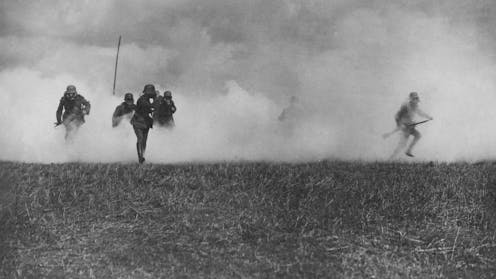
German troops make their way through a cloud of smoke or gas during a gas training drill, circa 1916. Henry Guttmann/Hulton Archive via Getty Images

Chemical warfare is one of the most devastating forms of conflict. It leverages toxic chemicals to disable, harm or kill without any physical confrontation. Across various conflicts, it has caused tens of thousands of deaths and affected over a million people through injury and long-term health consequences.

Mustard gas is a class of chemical that isn’t a gas at room temperature – it’s a yellow-brown oily liquid that can vaporize into a toxic mist. Viktor Meyer refined the synthesis of mustard into a more stable form. Mustard gas gained international notoriety during World War I and has been used as a weapon many times.

A vintage photograph of a soldier poking a cylinder, which releases a cloud of smoke.
German soldiers release poison gas from cylinders during World War I.
Henry Guttmann Collection/Hulton Archive via Getty Images

It is nearly impossible to guarantee that mustard gas will never be used in the future, so the best way to prepare for the possibility is to develop a very easy way to detect it in the field.

My colleagues and I, who are chemists and materials science researchers, are keen on developing a rapid, easy and reliable way to detect toxic chemicals in the environment. But doing so will require overcoming several technological challenges.

Effects on human health and communities

Mustard gas damages the body at the cellular level. When it comes into contact with the skin or eyes or is inhaled, it dissolves easily in fats and tissues and quickly penetrates the body. Once inside the body, it changes into a highly reactive form that attaches to and damages DNA, proteins and other essential parts of cells. Once it reacts with DNA, the damage can’t be undone – it may stop cells from functioning properly and kill them.

Mustard gas exposure can trigger large, fluid-filled blisters on the skin. It can also severely irritate the eyes, leading to redness, swelling and even permanent blindness. When inhaled, it burns the lining of the airways, leading to coughing, difficulty breathing and long-term lung damage. Symptoms often don’t appear for several hours, which delays treatment.

Four photos of people holding out their forearms, which have large blisters.
The forearms of test subjects exposed to nitrogen mustard and lewisite, chemicals that cause large, fluid-filled blisters on the skin.
Naval Research Laboratory

Even small exposures can cause serious health problems. Over time, it can weaken the immune system and has been linked to an increased risk of cancers due to its effects on DNA.

The effect of just one-time exposure carries down to the next generation. For example, studies have reported physical abnormalities and disorders in the children of men who were exposed to mustard gas, while some of the men became infertile.

The best way to prevent serious health problems is to detect mustard gas early and keep people away from it.

Detecting mustard gas early

The current methods to detect mustard gas rely on sophisticated chemistry techniques. These require expensive, delicate instruments that are difficult to carry to the war front and are too fragile to be kept in the field as a tool for detecting toxic chemicals. These instruments are conventionally designed for the laboratory, where they stay in one location and are handled carefully.

Many researchers have attempted to improve detection techniques. While each offers a glimpse of hope, they also come with setbacks.

Some scientists have been working on a wearable electrochemical biosensor that could detect mustard gas in both liquid and vapor form. They succeeded in developing tiny devices that provide real-time alerts. But here, stability became a problem. The enzymes degrade, and environmental noise can cloud the signal. Because of this issue, these strips haven’t been used successfully in the field.

To simplify detection, others developed molecularly imprinted polymer test strips targeting thiodiglycol, a mustard gas breakdown product. These strips change color when they come into contact with the gas, and they’re cheap, portable and easy to use in the field. The main concern is that they detect a chemical present in the aftermath of mustard gas use, not the agent itself, which isn’t quite as effective.

One of the most promising breakthroughs came in 2023 in the form of fluorescent probes, which change color when they sense the chemical. This probe is a tiny detective tool that detects or measures the target chemical and generates a signal. But these probes remain vulnerable to environmental interference such as humidity and temperature, meaning they’re less reliable in rugged field conditions.

Some other examples under development include a chemical sensor device that families could have at home, or even a wearable device.

Wearable devices are tricky, however, since they need to be small. Researchers have been trying to integrate tiny nanomaterials into sensors. Other teams are looking at how to incorporate artificial intelligence. Artificial intelligence could help a device interpret data faster and respond more quickly.

Researchers bridging the gap

Now at Washington University in St Louis, Makenzie Walk and I are part of the team of researchers working on detecting these chemicals, led by Jennifer Heemstra and M.G. Finn. Another member is Seth Taylor, a postdoctoral researcher at Georgia Tech.

Our team of researchers hopes to use the lessons learned from prior sensors to develop an easy and reliable way to rapidly detect these chemicals in the field. Our approach will involve testing different molecular sensor designs on compounds modeled after specific chemical weapons. The sensors would initiate a cascade of reactions that generate a bright, colorful fluorescent signal in the laboratory.

We are figuring out to which compounds these chemicals react best, and which might make a good candidate for use in a detector. These tests allow us to determine how much of the chemical will need to be in the air to trigger a reaction that we can detect, as well as how long it will need to be in the air before we can detect it.

Additionally, we are investigating how the structure of the chemicals we work with influences how they react. Some react more quickly than others, and understanding their behavior will help us pick the right compounds for our detector. We want them to be sensitive enough to detect even small amounts of mustard gas quickly, but not so sensitive that they frequently give falsely positive results.

Eliminating the use of these chemicals would be the best approach to avoid future recurrence. The 1997 Chemical Weapons Convention bans the production, use and accumulation of chemical weapons. But countries such as Egypt, North Korea and South Sudan have not signed or officially adopted the international arms control treaty.

To discourage countries that don’t sign the treaty from using these weapons, other countries can use sanctions. For example, the U.S. learned that Sudan used chemical weapons in 2024 during a conflict, and in response it placed sanctions on the government.

Even without continued use of these chemical weapons, some traces of the chemical may still linger in the environment. Technology that can quickly identify the chemical threat in the environment could prevent more disasters from occurring.

As scientists and global leaders collectively strive for a safer world, the ability to detect when a dangerous chemical is released or is present in real time will improve a community’s preparedness, protection and peace of mind.

The Conversation

Mekenzie Walk and Jen Heemstra contributed to this article.

Heemstra lab receives funding from the Defense Threat Reduction Agency (DTRA).

ref. To better detect chemical weapons, materials scientists are exploring new technologies – https://theconversation.com/to-better-detect-chemical-weapons-materials-scientists-are-exploring-new-technologies-257296

More than 50% of Detroit students regularly miss class – and schools alone can’t solve the problem

Source: The Conversation – USA – By Jeremy Singer, Assistant Professor of Education, Wayne State University

Nobody learns in an empty classroom. Jeffrey Basinger/Newsday RM via Getty Images

Thousands of K-12 students in Detroit consistently miss days of school.

Chronic absenteeism is defined as missing at least 10% of school days – or 18 in a 180-day academic year. In Detroit, chronic absenteeism rose during the COVID-19 pandemic and remains a persistent challenge.

To encourage attendance, the Detroit Public Schools Community District is getting creative. This past year, Michigan’s largest school district awarded US$200 gift cards to nearly 5,000 high schoolers for attending all their classes during a two-week period, and Superintendent Nikolai Vitti also floated the idea of providing bikes to help students get to class. Some district students lack access to reliable transportation.

To understand the consequences of kids regularly missing school, The Conversation U.S. spoke with Sarah Lenhoff, associate professor of education at Wayne State University and director of the Detroit Partnership for Education Equity & Research, an education-focused research collaborative, and Jeremy Singer, an assistant professor of education at Wayne State University. Lenhoff and Singer wrote a book published in March about the socioeconomic drivers of chronic absenteeism in K-12 schools and how policymakers and communities, not just educators, can help.

Is chronic absenteeism the same as truancy?

No. Truancy is how schools have thought about and dealt with student attendance problems since the early days of public education in the United States in the 19th century and is still defined in state law across the country. It focuses on “unexcused” absences and compliance with mandatory school attendance laws. By contrast, chronic absenteeism includes any absence – whether “excused” or “unexcused” – because each absence can be consequential for student learning and development.

Chronic absenteeism is usually defined as missing 10% or more school days. The 10% threshold is somewhat arbitrary, since researchers know that the consequences of missing school accumulate with each day missed. But the specific definition of chronic absenteeism has been solidified in research and by policymakers. Most states now include a measure of chronic absenteeism in their education accountability systems.

How big of a problem is chronic absenteeism in Detroit’s K-12 public schools?

Detroit has among the highest chronic absenteeism rates in the country: more than 50% in recent school years. Prior to the pandemic, the average rate of chronic absenteeism nationwide was about 15%, and it was around 24% in 2024.

In one of our prior studies, we found Detroit’s chronic absenteeism rate was much higher than other major cities – even others with high absenteeism rates such as Milwaukee or Philadelphia.

This is related to the depth of social and economic inequalities that Detroit families face. Compared to other major cities, Detroit has higher rates of poverty, unemployment and crime. It has worse public health conditions. And even its winters are some of the coldest of major U.S. cities. All of these factors make it harder for kids to attend school.

Rates of chronic absenteeism spiked in Detroit during the COVID-19 pandemic, as they did statewide. The Detroit Public Schools Community District has come close to returning to its pre-pandemic levels of absenteeism. The rates were 66% in the 2023-24 school year compared to 62% in the school year right before the pandemic began, 2018-19.

Detroit’s charter schools have struggled more to bring down their chronic absenteeism rates post-pandemic, but the numbers are lower overall – 54% in the 2023-24 school year compared to 36% in 2018-19.

A Black woman wearing a red T-shirt and sunglasses holds up a sign reading 'OUR FIGHT FOR DETROIT KIDS'
A school social worker from Noble Elementary-Middle School protests outside Detroit Public Schools headquarters.
Bill Pugliano/Getty Images

How does missing school affect students?

The connection between attendance and achievement is clear: Students who miss more school on average score worse on reading and math tests. As early as pre-K, being chronically absent is linked to lower levels of school readiness, both academically and behaviorally. By high school, students who miss more school tend to earn lower grades and GPAs and are less likely to graduate.

And it’s not just the absent students who are affected. When more kids in a class miss school regularly, that is associated with lower overall test scores and worse measures of skills such as executive functioning for other students in that class.

Does chronic absenteeism vary by family income or other factors?

Rates of chronic absenteeism are much higher among students from low-income families. In these cases, absenteeism is often driven by factors outside a student’s control such as unstable housing, unreliable transportation, health issues, lack of access to child care, or parents who work nontraditional hours. These challenges make it harder for students to get to school consistently, even when families are deeply committed to education.

School-based factors also influence attendance. Students are more likely to be chronically absent in schools with weaker relationships with families or a less positive school culture. However, even schools with strong practices may struggle if they serve communities facing deep socioeconomic hardship.

Ultimately, we don’t view chronic absenteeism as an issue of student motivation or family values. Rather, we see it as an issue related to the unequal conditions that shape students’ lives.

Does punishing absent kids or their parents work?

Many schools have suspended students for absences, or threatened their parents with fines or jail time. In some cases, families have lost social services due to their children’s chronic absenteeism.

Research shows these strategies are not only ineffective, they can make the problem worse.

For example, we found that when schools respond with punishment instead of support, they often alienate the very students and families who are already struggling to stay connected. Harsh responses can deepen mistrust between families and schools. When absences are treated as a personal failing caused by a lack of motivation or irresponsibility rather than symptoms of deeper challenges, students and parents may disengage further.

Instead, educators might ask: What’s getting in the way of consistent attendance, and how can we help? That shift from blame to understanding can help improve attendance.

What can policymakers, school districts and community organizations do to reduce chronic absenteeism?

Chronic absenteeism is a societal issue, not just a school problem. In other words, we need to recognize that chronic absenteeism is not a problem that schools can solve alone. While educators work to improve conditions within schools, policymakers and community leaders can take responsibility for the broader factors that influence attendance.

This could look like investing more resources and fostering collaboration across sectors such as health care, housing, transportation and social services to better support students and their families. Community organizations can play a role too, offering wraparound services such as mental health care, access to transportation, and after-school programming, all of which can support families. In the meantime, educators can focus on what they can control: strengthening communication with families, building supportive relationships and helping families connect with existing services that can remove attendance barriers.

The Conversation

Sarah Lenhoff receives funding from the Skillman Foundation, the Joyce Foundation, the Kresge Foundation, the William T. Grant Foundation, the American Institutes for Research, and the Urban Institute.

Jeremy Singer does not work for, consult, own shares in or receive funding from any company or organization that would benefit from this article, and has disclosed no relevant affiliations beyond their academic appointment.

ref. More than 50% of Detroit students regularly miss class – and schools alone can’t solve the problem – https://theconversation.com/more-than-50-of-detroit-students-regularly-miss-class-and-schools-alone-cant-solve-the-problem-260773

Why do corporations act against the public interest? We may have the answers (it’s not just greed)

Source: The Conversation – UK – By Stephen R. Buzdugan, Senior Lecturer in International Business, Manchester Metropolitan University

Jeppe Gustafsson/Shutterstock

For the past two years, Tesla has been embroiled in a bitter dispute with the Swedish labour union IF Metall. It is of a scale that the union hasn’t witnessed since the 1930s.

At the heart of the dispute is Tesla’s refusal to sign a collective bargaining agreement. This is a pillar of the “Swedish model” of labour relations, which is prized by Sweden’s citizens due to its perceived contribution to social wellbeing and shared prosperity.

Instead, Tesla has opted to circumvent striking union workers and bring its cars into the country using non-unionised labour and labour from neighbouring countries. Tesla’s actions to undermine a system that Sweden strongly supports are what we call “anti-societal”. That is, they might be said to undermine democratic norms and the broader public interest.

More broadly, it isn’t unusual to see corporations acting in ways that negatively affect the public interest, with effects such as environmental degradation, poor working conditions or violations of anti-trust laws. Multinational corporations are often in the news for violating or avoiding government regulations and working behind the scenes to influence regulation to their advantage.

Among many examples is the Volkswagen group’s “Dieselgate” emissions scandal. The German carmaker cheated on vehicle tests to make diesel cars seem less polluting than they were in reality. The company later acknowledged it had “screwed up” and breached customers’ trust.

And it is believed that oil and gas giant Exxon had evidence in the 1970s that fossil fuels contribute to climate change, but mounted a a campaign of disinformation in order to stifle regulation of their products. (In 2021, Exxon CEO Darren Woods told US politicians that the company “does not spread disinformation regarding climate change”.)

These examples raise the question of why corporations engage in activities against the public interest. Yet browse through any standard textbook used in a university business or management course, and you will struggle to find answers.

Instead, for several decades the standard viewpoint has been that multinational corporations are mainly economic entities without any particular interest in doing either harm or good. Any anti-societal corporate behaviour has typically been chalked up to a few “bad apples”.

The fact that corporations have political power and systematically use it in their interests in ways that harm society has been largely left out of the picture.

Our recent research shows that the underlying nature of the global economy can influence any corporation to behave anti-societally. We argue that under certain circumstances, a corporation like Tesla might face a threat that compromises its market position, assets or even its existence.

IF Metall, for example, poses a significant threat to Tesla’s business model. If the Swedish trade union wins this dispute it could strengthen the bargaining position of trade unions across Europe. In this case, a corporation like Tesla will exert its power to protect itself. But this often comes with negative consequences for society.

We call this the “self-preservation perspective” of the multinational corporation. It illuminates the ways in which corporations use political power to their advantage, often to society’s cost.

The balance of power

The self-preservation perspective can help people to understand how corporate political power should be challenged through both regulation and activism. Trade union action, for instance, can act as a powerful political force to balance corporate power.

The idea of “self-preservation” comes from international relations theory and an overlooked argument by the late Harvard economist John Kenneth Galbraith .These suggest that any organisation – a nation state or a multinational corporation – will seek primarily to preserve itself in the face of threats.

We apply the idea of self-preservation to modern multinational corporations that seek to survive in a global economy marked by fierce competition and complex regulation.

This perspective predicts that, when faced with a regulatory threat, a multinational corporation will weigh up four strategic options.

First, it may try to influence the regulation through sometimes ethically questionable political activities. Second, it may consider avoiding or ignoring the regulation by exploiting loopholes or by taking strategic legal action. Third, it can decide to comply with the regulation. And last, it can think about exiting the market altogether.

We predict that the corporation’s choice depends on its relative level of political power and resources, as well as the profitability of the market it is operating in. However, it also depends on how powerful it is in relation to governments, trade unions and non-governmental organisations (NGOs).

MOT documentation showing volkswagen emission details
Volkswagen tried to cheat its way around emissions regulation.
SGM/Shutterstock

If government enforcement or societal pressure are very strong, this may steer a corporation toward adapting to the regulation, rather than more negative influencing or avoiding behaviour. One example is Apple’s recent changes to its App Store rules in Europe, to comply with the European Union’s Digital Markets Act.

In the case of Tesla versus the Swedish union, Tesla has exerted its power to avoid regulation. In doing so it has considered the scale of the threat to its business model across Europe and its perceived power relative to the trade union. This possibly stems from Tesla’s strong ties to the technology sector, where engagement with unions is often seen as an unnecessary threat to innovation.

If Tesla’s avoidance strategy succeeds, it would effectively dissolve the Swedish model, creating a system that’s less secure for workers. From our self-preservation perspective, IF Metall’s success in the dispute will depend on how well – and how widely – the unions, government and citizens can galvanise opposition. By balancing corporate power in this way, societies might hope to protect their interests against the might of multinational giants.


Get your news from actual experts, straight to your inbox. Sign up to our daily newsletter to receive all The Conversation UK’s latest coverage of news and research, from politics and business to the arts and sciences.

The Conversation

David Freund receives funding from Handelsbanken Research Foundation.

Ulf Holm receives funding from Handelsbanken’s Research Foundations.

Stephen R. Buzdugan does not work for, consult, own shares in or receive funding from any company or organisation that would benefit from this article, and has disclosed no relevant affiliations beyond their academic appointment.

ref. Why do corporations act against the public interest? We may have the answers (it’s not just greed) – https://theconversation.com/why-do-corporations-act-against-the-public-interest-we-may-have-the-answers-its-not-just-greed-261866

From the Green party to Corbyn’s new launch – is it time Westminster took joint leaders more seriously?

Source: The Conversation – UK – By Stefan Stern, Visiting Professor of Management Practice, Bayes Business School, City St George’s, University of London

Are two heads better than one? This is a question that members of the Green party will be asking themselves over the summer as they take part in the election of a new leader … or leaders.

Former co-leader Carla Denyer MP announced in May that she would not be standing again. Her co-leader, Adrian Ramsay MP, is now joined on the prospective leadership ticket by another Green MP, Ellie Chowns. (It is a Green party rule that where there is a joint leadership the job holders must be of different genders.)


Want more politics coverage from academic experts? Every week, we bring you informed analysis of developments in government and fact check the claims being made.

Sign up for our weekly politics newsletter, delivered every Friday.


They are being challenged by Zack Polanski, currently deputy leader of the party and a member of the London Assembly, who has positioned himself not merely as a solo candidate but also as a rather more radical one. While his politics have little in common with those of Reform party leader Nigel Farage, Polanksi has suggested the Greens could learn from his approach.

The contest presents us with an intriguing conundrum – or even a paradox. In the real world – that is, away from Westminster – expecting a single human being to display all the qualities and attributes required to lead a complicated business or organisation is rightly seen as unrealistic. Leadership is a team activity, to be carried out collectively.

This is one reason why it’s so troubling to see excessive pay packets being delivered to bosses who should not be taking all the credit for the success of a business.

Of course, the leadership provided by the ultimate boss matters, but good corporate governance involves testing the suggestions and instincts of the chief executive with the ideas of other senior executives or directors. This is known, perhaps rather euphemistically on occasion, as “challenge”.

But in Westminster politics a rather more traditional (we could say old-fashioned) view of leadership prevails. Here the orthodoxy holds that something called “strong leadership” stems mainly from a dominant single figure who is firmly in charge.

This belief is based in part on the mythology which surrounds the leadership of Margaret Thatcher, the “Iron Lady” who supposedly never took a step back (although she did), and who dismissed “wets” and “moaning minnies” who expressed doubt about her policy choices. Tony Blair in turn paid homage to this mythology, famously once declaring: “I’ve got no reverse gear”.

In Westminster changing your mind, even in the light of new evidence, is invariably labelled a U-turn, and is considered to be bad. This is also how the British media frames their actions.

So here is the Green party’s conundrum: against this backdrop, they would arguably get better media coverage and perhaps win more support from voters if they installed a single leader in the more conventional way. This is the case that could be made for Polanski.

But at the same time, the Greens are not meant to be just like all the other parties. They have a different view of the world, so why should they conform to the other people’s view of what leadership looks like?

Behind every strong leader

Successful businesses have often been led by double acts. Behind some swaggering CEOs there is often a cautious and competent chief financial officer making sure the numbers add up.

When the Granada media group was growing to a dominant market position in the 1990s, its CEO, Gerry Robinson, got most of the attention but his trusted managing director, Charles Allen, was an equally important, if less prominent, figure. Berkshire Hathway, one of the world’s most successful investment vehicles, has been led by the well-known Warren Buffett for decades, but for most of that time he had his old but less famous friend Charlie Munger at his side (Munger died in 2023).

Westminster’s latest prototype party, the alliance of independent pro-Gaza MPs, is also considering a joint leadership structure with former Labour MPs Zarah Sultana and Jeremy Corbyn at the helm. The difficulty here is that it is not yet clear exactly how the two figures would share their leadership duties. The much-discussed launch is planned for later this year.

Voting for the new Green party leader(s) will take place through all of August, with the result declared on September 2. We will see if the arguments in favour of a more conventional leadership structure (albeit with more radical policies and tone) prevail over the less conventional structure (but with a steadier political approach).

Either way, the Greens will continue to provide an alternative voice and approach in our still developing multiparty era. And maybe that’s a good thing too. When you look around the world at some other self-styled “strong leaders” – Trump, Putin, Netanyahu, to name but three – a break from having similar aspiring “strong leaders” at Westminster might be welcome.


Get your news from actual experts, straight to your inbox. Sign up to our daily newsletter to receive all The Conversation UK’s latest coverage of news and research, from politics and business to the arts and sciences.

The Conversation

Stefan Stern does not work for, consult, own shares in or receive funding from any company or organisation that would benefit from this article, and has disclosed no relevant affiliations beyond their academic appointment.

ref. From the Green party to Corbyn’s new launch – is it time Westminster took joint leaders more seriously? – https://theconversation.com/from-the-green-party-to-corbyns-new-launch-is-it-time-westminster-took-joint-leaders-more-seriously-262058

The Assassin: Keeley Hawes drama is a milestone for menopause on screen

Source: The Conversation – UK – By Beth Johnson, Professor of Television & Media Studies, University of Leeds

Keeley Hawes’s new Channel 4 and Prime Video drama, The Assassin, introduces a premise that feels both bold and overdue. It follows Julie (Hawes), a menopausal woman, overlooked and emotionally stalled, who worked as a hitwoman in her youth and unexpectedly comes out of retirement to return to the profession.

It’s pulpy, stylised and laced with dark humour. But beneath the genre trappings lies something more striking – a cultural pivot in how menopause and midlife womanhood is being written and visualised on British television.

Historically, menopause has been television’s silent transition. Onscreen, it was something female characters either didn’t have, didn’t talk about, or, when acknowledged, were mocked for. Sitcoms of the 1980s and 1990s, such as Birds of a Feather or Absolutely Fabulous, played menopausal symptoms for laughs.

In drama, menopause tended to arrive invisibly: women stopped being protagonists, were subtly phased out of storylines, or returned only as wives, mothers, or medical cases.

Television has always been shaped by industry ideas about youth, sex appeal and marketability – ideas that left little room for midlife women unless confined to supporting roles – or contained within the domestic, ensemble structures of soap operas.

While shows like New Tricks (2003), Last Tango in Halifax (2012) and Call the Midwife (2012) gradually shifted the dial, menopause itself remained offscreen: considered either too niche, too biological, or too awkward to dramatise.


Looking for something good? Cut through the noise with a carefully curated selection of the latest releases, live events and exhibitions, straight to your inbox every fortnight, on Fridays. Sign up here.


What The Assassin offers is not just a menopausal character, but midlife as premise. Rather than sidelining her life stage, the show lets its rhythms – emotional turbulence, internal chaos, flickers of disorientation, flashes of wit and a deep, simmering strength – seep into the storytelling itself.

The story ties her hormonal shifts to emotional volatility, a sense of personal invisibility, fractured family life and existential grief. And then she snaps. But it’s not collapse; it’s re-ignition. She becomes lethal — not in spite of midlife, but because of it.

I research the way midlife female protagonists are presented in British television drama. I’ve recently written about Russell T. Davies’ work in particular, arguing that his dramas (such as It’s a Sin, 2021, and Nolly, 2023) reclaim neglected figures by placing their emotional complexity and cultural marginalisation at the centre.

Nolly offered a compelling reappraisal of Noele Gordon (played by Helena Bonham Carter), the soap star unceremoniously dumped from her own show – a decision now widely understood to be rooted in sexism and ageism. Davies refused to let her disappear quietly, instead making her menopause-era strength and defiance the dramatic core of his show.

The trailer for The Assasain.

Similarly, my work with Professor Kristyn Gorton on Sally Wainwright’s series Happy Valley (2014) explores how Catherine Cawood (played by Sarah Lancashire) embodies emotional realism, grief, rage and midlife fatigue – not as flaws, but as substance. These female characters don’t just react to events; they are the story. Their emotions are not incidental but generative, propelling the narrative, shaping its tone and demanding audience recognition.


Read more:
Happy Valley: the art of Sally Wainwright’s perfect TV ending


The Assassin fits this trajectory. It joins a growing body of British TV that blends genre hybridity with emotional and political resonance. Like Killing Eve (2018) or I Hate Suzie (2020), it uses the structure of the thriller to think critically about gender, ageing and identity.

The menopausal hitwoman is, of course, a metaphor as much as a plot. She is rage personified: a woman no longer governed by the social niceties that often temper female representation. She’s also funny, erratic and uncontained.

A menopausal reckoning

Importantly, The Assassin doesn’t simply celebrate her transformation. It stages it as messy, uncomfortable and morally complex. This is menopause not as a redemptive arc but as a reckoning, with a body that’s changing, a past that won’t stay buried, and a society that prefers women neat, young and silent.

There’s still work to do. British television remains far more comfortable exploring middle-aged male protagonists than women in the same life stage. But what’s changing, and what I frequently explore in my research, is the tone and ambition with which female midlife is now being scripted. Where menopause was once a punchline or absence, it’s becoming a story. And not just any story, but one shaped by genre, irony, feeling and risk.

Thanks to its long-form, visual medium, television can explore the ordinary in ways that resonate deeply, from the exhaustion of grief to the frustration of being dismissed. Menopause, long under-explored, offers rich dramatic territory: emotional volatility, bodily transformation, the redefinition of self. What The Assassin understands is that these aren’t signs of decline. They’re tools of narrative power.

By giving us a menopausal character who is central, subversive and narratively in control, The Assassin signals a broader shift. It reminds us that midlife is not an endpoint, but a site of potential – for drama, for comedy and for cultural critique. British television is, at last, beginning to give menopause the storylines it deserves.


Get your news from actual experts, straight to your inbox. Sign up to our daily newsletter to receive all The Conversation UK’s latest coverage of news and research, from politics and business to the arts and sciences.

The Conversation

Beth Johnson does not work for, consult, own shares in or receive funding from any company or organisation that would benefit from this article, and has disclosed no relevant affiliations beyond their academic appointment.

ref. The Assassin: Keeley Hawes drama is a milestone for menopause on screen – https://theconversation.com/the-assassin-keeley-hawes-drama-is-a-milestone-for-menopause-on-screen-262101

UK and France pledges won’t stop Netanyahu bombing Gaza – but Donald Trump or Israel’s military could

Source: The Conversation – UK – By Paul Rogers, Professor of Peace Studies, University of Bradford

Keir Starmer says unless there’s a ceasefire and a peace process leading to a two-state solution, Britain will recognise the state of Palestine at the UN in September. The UK prime minister is following a similar, alebit unconditional, pledge from the French president, Emmanuel Macron.

They are reacting to what Starmer referred to as the “intolerable situation” in Gaza. In Scotland, Donald Trump has also complained at the humanitarian catastrophe of people starving in Gaza, saying: “We’ve got to get the kids fed.”

Does this mean western politicians are finally prepared to act? Quite possibly. Will it have any discernible effect on Benjamin Netanyahu? Doubtful.

Trump still appears to trust Netanyahu to feed the people of Gaza, or so he told reporters as he flew back from his weekend of “golf buggy diplomacy” on July 29. And as long as the US president supports Netanyahu, the Israeli prime minister can act with few restraints.

True, the vigorous international reaction to the food crisis in Gaza has finally had some effect. But the Israeli response so far has been largely symbolic.

It has comprised air drops of aid by Israel and the United Arab Emirates, and some “tactical” or “humanitarian” pauses in the assault in parts of the Gaza Strip to allow for the delivery of aid. Air drops are good for publicity, but the amount of aid they actually deliver is very small and hugely expensive.

How did we get to this point? The current phase of the conflict started in mid-March, when the Israeli government began blocking all aid to Gaza.

That lasted two months until some shipments were allowed. In recent weeks, an average of about 70 trucks a day have crossed the border. But the reality is 500-600 trucks a day are required to support and restore heath to 2 million people.

Meanwhile, more than 1,000 Palestinians have been killed – mostly shot – since May while trying to get food at one of the four overcrowded distribution sites run by the private, US-backed Gaza Humanitarian Foundation (GHF). Before being replaed by the GHF system, UN agencies ran 400 distribution points across the territory.

What the daily pauses in some areas, which began on July 27, actually represent is far from clear, given that fighting continues in much of the Strip. There is little sign that Netanyahu’s government wants an early end to the war. From its perspective, there can only be peace when all the hostages are returned and Hamas has been destroyed.

But Hamas is proving far more resolute than expected. Its survival is little short of remarkable given the huge force the Israelis have used to try and destroy it.

The usual Israeli military priority in dealing with an insurgency is to follow what is known colloquially as the “Dahiya doctrine”. If an insurgency cannot be handled without serious casualties, then the Israel Defense Forces (IDF) directs its operations at civilian infrastructure and the general population to undermine support for the insurgents.

The tactic is so called because it was developed as a way of dealing with a Hezbollah stronghold in the Dahiya suburb of west Beirut in 1982. The reduction of much of Gaza to ruins is taking the doctrine to extremes, yet it is failing – Hamas is still there.

This is reportedly common knowledge in IDF circles, but rarely admitted in public. A notable exception is the senior retired IDF officer, Major-General Itzhak Brik.

Brik’s publicised view is that Hamas has already replaced its thousands of casualties with new recruits. They may not be trained in the conventional sense, but they have learnt their craft while surviving in a war zone and seeing so many of their friends and family killed and wounded.

No end in sight

Israel’s demands may be that it will end the war if Hamas surrenders and disarms, then goes into exile. The problem with this is Hamas doesn’t think Israel would end the war.

Instead, it believes Gaza would be forcibly cleared and resettled, and the occupied West Bank would see a huge increase in settlers. In this scenario, a two-state solution would be a pipe dream, and Israel would be the regional superpower able to rise to any future challenge.

So, is there any prospect of Israel being forced to compromise, to accept a UN-monitored ceasefire and seek a negotiated settlement? External political pressure is certainly rising, especially the potential formal recognition of the state of Palestine by the UK and France.

But in both cases, the conditions for the road to peace are such that they are effectively non-starters. Macron envisages a “demilitarised Palestine” living alongside Israel. Starmer has called for Hamas to disarm and play no role in the future governance of Palestinians. Neither plan has the slightest chance of getting off the ground.

In any case, without Trump’s full backing it would still mean little. Economic and social sanctions by a state or group will have little impact because there will always be states or organisations sufficiently supportive of Israel to bypass them.

We are left with two possible routes to a settlement. One is that Trump is sufficiently motivated to insist Netanyahu negotiates.

That is unlikely, unless the US president somehow gets the idea that his own reputation is being damaged. Even then, the influence of the Israel lobby in the US, especially the support for Israel of tens of millions of Christian Zionists, is formidable.

The other route to a peace deal is if the war is becoming problematic for the Israeli military. If more of the IDF’s top brass recognise that this war, right from the start, was always going to be unwinnable, this might yet move the conflict in the direction of a settlement.


Get your news from actual experts, straight to your inbox. Sign up to our daily newsletter to receive all The Conversation UK’s latest coverage of news and research, from politics and business to the arts and sciences.

The Conversation

Paul Rogers does not work for, consult, own shares in or receive funding from any company or organisation that would benefit from this article, and has disclosed no relevant affiliations beyond their academic appointment.

ref. UK and France pledges won’t stop Netanyahu bombing Gaza – but Donald Trump or Israel’s military could – https://theconversation.com/uk-and-france-pledges-wont-stop-netanyahu-bombing-gaza-but-donald-trump-or-israels-military-could-262131

Viral ‘kettlebell challenge’ could do you more harm than good – here’s why

Source: The Conversation – UK – By Jen Wilson, Senior Exercise and Health Practitioner, Nottingham Trent University

The challenge may sound like a quick and easy way to get fit, but it may actually be the least effective way of adding kettlebells to your workouts. Tongpool Piasupun/ Shutterstock

The “100 kettlebell swings a day” challenge is the latest viral fitness endeavour on social media. The challenge is simple: pick up a kettlebell and do 100 swings (bringing the kettlebell from between your legs and using your core and glutes to swing it up to chest or shoulder height) every day. These can be done either in one stint, or broken up throughout the day.

Proponents of the challenge say it leads to fat loss, improved muscle mass and a stronger posterior chain (glutes, back and hamstrings) – all in a short daily session.

At first glance, it sounds like a time-efficient, no-fuss approach to getting fitter with minimal equipment. But while there’s some merit in consistency, this type of challenge often ignores fundamental principles of exercise and training – and could even do more harm than good.

Here’s a few reasons why it might be best to skip the kettlebell challenge – and what you can try instead.

1. It’s not personalised to you

One of the biggest flaws in the 100 kettlebell swings challenge is that it treats everyone the same, regardless of experience level, injury history, mobility or training goals. What’s manageable for an advanced athlete could cause problems for a beginner with poor hip mobility or lower back issues.

Daily, high-rep dynamic movements which use explosive power, such as kettlebell swings, require good technique, good posture and body awareness. Without that, you’re simply reinforcing poor movement patterns. Worse, you could be inviting injury when such movements are done repeatedly.

Effective training should be personalised – or at least adapted to your movement abilities and fitness requirements in order to have the most impact.

2. No room for progress

The human body adapts quickly. If you do the same 100 reps with the same amount of weight every single day, the challenge becomes less effective over time. That initial burn you felt in week one? It’ll be gone by week three.

In well-designed training programmes, there’s a principle called “progressive overload”. This involves gradually increasing stress on the body, either through the amount of weight you’re lifting, the number of repetitions you do of an exercise, the number of sets you complete or the complexity of your movements.

The 100-swing challenge skips this entirely. This means you’ll probably hit a plateau fairly quickly.

3. Risk of injury

Doing 100 swings every day, especially without rest or proper technique, can lead to injuries such as muscle strains or joint pain in the back and shoulders.

Too much repetitive movement, insufficient recovery time and inexperience can also lead to an increased risk of an overuse injury – a condition caused by repeated stress on muscles, joints or tissues. This often results in pain, swelling, or stiffness and could potentially mean taking weeks or even months off from working out to fully recover.

Picking up this challenge might be appealing but it also ticks a lot of boxes for overuse injury.

4. It undermines recovery

Recovery between workouts is not optional. In fact, it’s where the actual adaptation happens. Training breaks the body down, while recovery builds it back stronger.

Kettlebell swings, especially if performed explosively and with heavier loads, place stress on your central nervous system. Doing them every single day without rest days, mobility work (such as stretching) or variation can lead to chronic fatigue, poor sleep, nagging injuries and even reduced performance in other areas of training.

A group of young, fit people perform kettlebell swings in a gym.
This daily challenge doesn’t leave the body enough time for integral recovery.
wavebreakmedia/ Shutterstock

If you’ve started the challenge and find you’re constantly sore, tight or worn down, the challenge may be doing more harm than good.

5. It’s a one-dimensional solution

Fitness isn’t just about repetition. True strength and conditioning involves a variety of movements, such as pushing, pulling, squatting, rotating and stabilising.

The 100-swing challenge trains only one plane of motion and one movement pattern. While that’s better than nothing, it’s nowhere near comprehensive. Moreover, doing the same task over and over can become mindless. You’re not necessarily getting stronger or fitter – you’re just going through the motions.

A smarter way to use kettlebells

In fairness, the challenge does have some value in the right context. For beginners who need structure, it can help establish a daily habit. It requires minimal equipment, little space and can raise heart rate, build endurance and activate the posterior chain.

But for it to be sustainable and effective, a few things must be in place:

  • Your form must be solid
  • The kettlebell weight must be appropriate for your fitness level
  • You should vary the volume or intensity over time
  • You should include rest days
  • It should be part of a broader training plan – not your only form of training

If you enjoy kettlebell swings, there are more intelligent and safer ways to include them in your training than doing 100 reps every day.

Try incorporating swings into interval sessions, circuits or strength workouts with varied repetitions and loads. Instead of doing 100 swings alone, aim for 100 total reps using a mix of exercises, such as goblet squats, rows and presses. This approach not only keeps things more balanced, but also reduces the risk of injury from overuse and gives different muscle groups time to recover .

The “100 kettlebell swings a day” challenge might sound appealing in its simplicity, but simple doesn’t always mean smart. Without personalisation, progression and recovery, it can quickly turn into a repetitive grind that risks doing more harm than good.

Yes, training should be challenging, but it should also be strategic. Your body deserves more than just a checkbox of daily repetitions – it needs the right moves done the right way.

The Conversation

The authors do not work for, consult, own shares in or receive funding from any company or organisation that would benefit from this article, and have disclosed no relevant affiliations beyond their academic appointment.

ref. Viral ‘kettlebell challenge’ could do you more harm than good – here’s why – https://theconversation.com/viral-kettlebell-challenge-could-do-you-more-harm-than-good-heres-why-260010