Florida’s new open carry law combines with ‘stand your ground’ to create new freedoms – and new dangers

Source: The Conversation – USA – By Caroline Light, Senior Lecturer on Studies of Women, Gender, and Sexuality, Harvard University

As of September 2025, Florida allows open carry and permitless carry, in addition to its stand your ground law. Joe Raedle/Getty Images News

Twenty years ago, Florida Gov. Jeb Bush signed the first “stand your ground” law, calling it a “good, common-sense, anti-crime issue.”

The law’s creators promised it would protect law-abiding citizens from prosecution if they used force in self-defense. Then-Florida state Rep. Dennis Baxley, who cosponsored the bill, claimed – in the wake of George Zimmerman’s controversial acquittal for the killing of Trayvon Martin – that “we’re really safer if we empower people to stop violent acts.”

I’m a historian who has studied the roots of stand your ground laws. I published a book on the subject in 2017. My ongoing investigation of the laws suggests that, 20 years on, they have not made communities any safer, nor have they helped prevent crime. In fact, there is reliable evidence they have done just the opposite.

In the past 20 years, stand your ground has spread to 38 states.

Then, in September 2025, an appellate court struck down Florida’s long-standing ban on the open carry of firearms.

Florida’s attorney general, James Uthmeier, quickly announced that open carry is now “the law of the state,” directing law enforcement not to arrest people who display handguns in public.

Under the state’s permitless carry law, enacted in 2023, adults without a criminal record also don’t need a permit or any training to carry firearms publicly.

In my view, this combination of stand your ground, open carry and permitless carry is likely to make the Sunshine State far less safe.

Let’s look at the evidence.

What ‘stand your ground’ means

Under traditional self-defense law, a person had a duty to retreat – to try to avoid a violent confrontation if they could safely do so – before resorting to deadly force.

The main exception to the duty to retreat was known as the castle doctrine, whereby people could defend themselves, with force if necessary, if they were attacked in their own homes.

Stand your ground laws effectively expand the boundaries of the castle doctrine to the wider world, removing the duty to retreat and allowing people to use lethal force anywhere they have a legal right to be, as long as they believe it’s necessary to prevent death or serious harm.

On paper, the expansion of the right to self-defense may sound reasonable. But in practice, stand your ground laws have blurred the line between self-defense and aggression by expanding legal immunity for some who claim self-defense and shifting the burden of proof to prosecutors.

While supporters of these laws claim they mitigate crime and make people safer, evidence shows the opposite. The nonpartisan RAND Corp. discovered that states adopting stand your ground laws experienced significant increases in homicide, typically between 8% and 11% higher than before the laws took effect.

A study of violent crime in Florida revealed a 31.6% increase in firearm homicides following the 2005 passage of the stand your ground law. There is no credible evidence that these laws deter crime.

On the contrary, evidence shows that stand your ground laws lower the legal, moral and psychological costs of pulling the trigger.

Stand your ground and race

While the language of stand your ground laws is race-neutral, their enforcement is not. Data from the Urban Institute and the U.S. Commission on Civil Rights show that in states with stand your ground laws, homicides are far more likely to be deemed “justified” when the shooter is white and the victim is Black.

I’ve found that these laws have redefined not only when force is justified but who is justified in using force.

In my assessment, these laws don’t create racial bias. Rather, they magnify the biases already present in our criminal legal system. They give broader discretion to a legal system in which law enforcement officers, judges, prosecutors and juries often hold unacknowledged biases that associate Black men with criminality, while perceiving white people who say they were defending themselves as credible.

A sign for a rally after the Trayvon Martin shooting in Sanford, Florida.
Seventeen-year-old Trayvon Martin was unarmed when George Zimmerman shot and killed him on March 20, 2012, in Sanford, Fla. Zimmerman claimed he killed Martin in self-defense and was acquitted by a jury.
Gerardo Mora/Getty Images News

That dynamic is visible in a growing multitude of cases, such as the shootings of unarmed teenagers Trayvon Martin, Jordan Davis, Renisha McBride and Ralph Yarl.

Each instance illustrates how stand your ground transforms ordinary mistakes or misunderstandings into lethal outcomes, and how armed citizens’ claims of “reasonable fear” often reflect racial stereotypes more than objective threats.

A dangerous mix

Florida’s legalization of open carry intersects with the state’s permitless carry and stand your ground laws in alarming ways. Open carry increases the visibility – and perceived legitimacy – of guns in everyday life.

Combined with the removal of licensing procedures and training requirements, laws that broaden the right to use deadly force create a permissive environment for opportunistic violence.

When everyone is visibly armed, every encounter can look like a potential threat. And when the law tells you that you don’t have to back down, that perception can turn lethal in seconds.

Florida has become a model for what gun rights advocates call “freedom” but what public health experts see as a recipe for more shootings and more death.

National implications: ‘Reciprocity’ and expansion

Two decades later, stand your ground laws have spread, in various forms, to 38 states. While 30 states have legislatively enacted stand your ground statutes like Florida’s, eight others implement stand your ground through case law and jury instructions that effectively remove the duty to retreat.

On top of this, 29 states have enacted laws allowing permitless carry, and 47 technically allow open carry, though restrictions vary across the states.

President Donald Trump has made clear he wants to take this deregulatory approach nationwide. While on the campaign trail, he promised to sign a “concealed-carry reciprocity” law, which would require all states to allow people from states with permissive laws to exercise those rights in all 50. “Your Second Amendment does not end at the state line,” he announced in a 2023 video.

If that vision becomes reality, it would mean the most permissive state laws will set the standard for the entire country. National reciprocity would allow Floridians, and other gun owners from permitless carry states, to carry their firearms – and potentially claim stand your ground immunity – in any other state, including those with stricter rules and lower rates of firearm death and injury.

This prospect raises deep questions about states’ rights, safety and justice. Research shows that stand your ground laws increase homicide and exacerbate racial disparities. National reciprocity would export those effects nationwide.

In my view, the convergence of stand your ground, open carry and national reciprocity marks the culmination of a 20-year experiment in armed citizenship. The results are clear: more people armed, more shootings and more deaths “justified.”

The question now is whether the rest of the nation will follow Florida’s lead.

Read more stories from The Conversation about Florida.

The Conversation

Caroline Light is affiliated with GVPedia and collaborates with Giffords.

ref. Florida’s new open carry law combines with ‘stand your ground’ to create new freedoms – and new dangers – https://theconversation.com/floridas-new-open-carry-law-combines-with-stand-your-ground-to-create-new-freedoms-and-new-dangers-267496
Slavery’s brutal reality shocked Northerners before the Civil War − and is being whitewashed today by the White House

Source: The Conversation – USA – By Gerry Lanosga, Associate Professor of Journalism, Indiana University

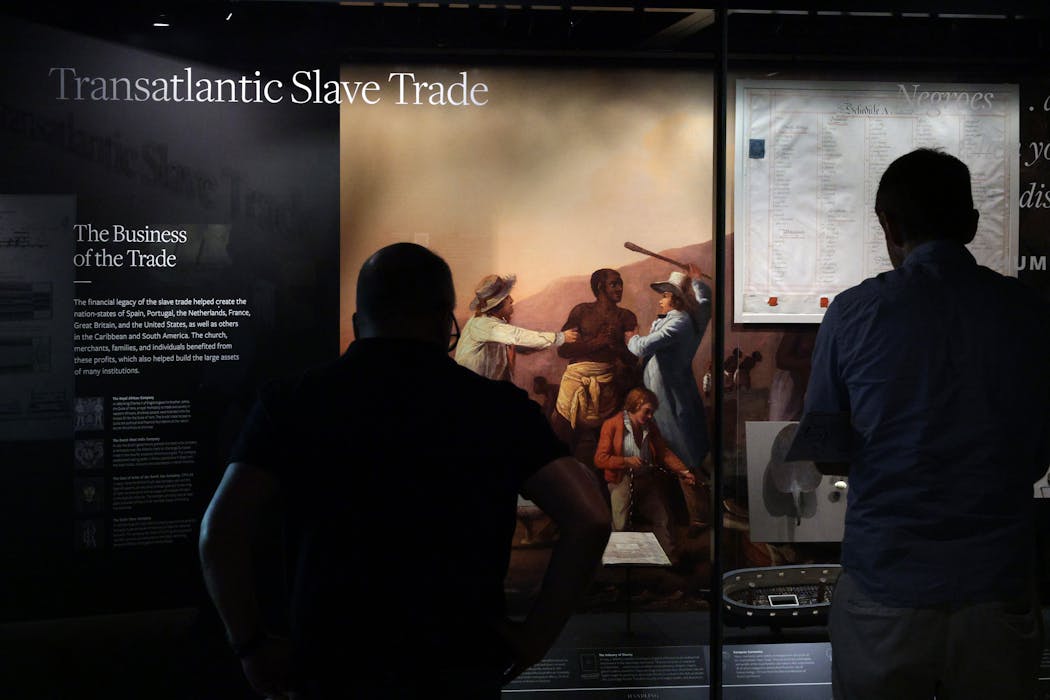
The Trump administration is reviewing Smithsonian exhibits on slavery and other topics to reflect certain values. Alex Wong/Getty Images

Long before the first shots were fired in the Civil War, beginning early in the 19th century, Americans had been fighting a protracted war of words over slavery.

On one side, Southern planters and slavery apologists portrayed the practice of human bondage as sanctioned by God and beneficial even to enslaved people.

On the other side, opponents of slavery painted a picture of violence, injustice and the hypocrisy of professed Christians defending the sin of slavery.

But to the abolitionists, it became crucial to transcend mere rhetoric. They wanted to show Americans uncomfortable truths about the practice of slavery – a strategy that is happening again as activists and citizens fight modern-day attempts at historical whitewashing.

As a media scholar who has studied the history of abolitionist journalism, I hear echoes of that two-century-old narrative battle in President Donald Trump’s effort to purge public memorials and markers honoring the suffering and heroism of the enslaved as well as those who championed their freedom.

Celebration vs. reality

the image shows a Black man sitting and facing away from the camera, his back deeply scarred by whipping
‘The Scourged Back,’ by McPherson & Oliver, is an 1863 image that depicts the scarred back of a formerly enslaved man.
Courtesy National Gallery of Art, Washington

Among the materials reportedly flagged for removal from history museums, national parks and other government facilities is a disturbing but powerful photograph known as “The Scourged Back.”

The 1863 image depicts a formerly enslaved man, his back horrifically scarred by whipping. It’s certainly hard to look at, yet to look away or try to forget it means to ignore what it has to say about the complicated and often brutal history of the nation.

In Trump’s view, these memorials are “revisionist” and “driven by ideology rather than truth.” In an executive order named Restoring Truth and Sanity to American History, Trump said public materials should “focus on the greatness of the achievements and progress of the American people.”

Essentially, the president appears to want a history that celebrates American achievement rather than being forced to look at “The Scourged Back” and other historical realities that document aspects of the American story that don’t warrant celebration.

Combating ignorance of slavery’s horrors

Thinking back to the decades leading up to the Civil War, facts were the weapon abolitionists wielded in their fight against the distortions of pro-slavery forces. It was an uphill battle in the face of indifference by many in the North. After a visit to Massachusetts in 1830, abolitionist writer William Lloyd Garrison blamed such attitudes on “exceeding ignorance of the horrors of slavery.”

It is not surprising that in the early 19th century many Americans would have had limited knowledge of slavery. Travel was arduous, time-consuming and expensive, and most Northerners had little firsthand exposure to slave societies. Abolitionists argued that those who did visit the South were often shielded from the harsher realities of slavery. This extended to the media ecosystem, which lacked any real national news organizations.

Moreover, Southern plantation owners carried out a robust propaganda effort to extol the beneficence of their economic system. In letters, pamphlets and books, they argued that slavery was beneficial to all and that the enslaved were happy and well-treated. They also attacked their opponents as evil and dishonest.

As abolitionist Lydia Maria Child wrote in 1838: “The apologists of Southern slavery are accustomed to brand every picture of slavery and its fruits as exaggeration or calumny.”

Don’t look away

Thus, the challenge for abolitionists was to show slavery as it really was – and to compel people to look. An emphasis on hard evidence took firm hold in the wave of abolitionism in the 1830s.

Activists didn’t yet have photography, so they relied on accounts from eyewitnesses and formerly enslaved people, official reports and even some plantation owners’ own words in Southern newspaper advertisements seeking the return of runaways.

“Until the pictures of the slave’s sufferings were drawn up and held up to public gaze, no Northerner had any idea of the cruelty of the system,” abolitionist Angelina Grimké wrote in her famous “Appeal to the Christian Women of the South” in 1836.

“It never entered their minds that such abominations could exist in Christian, Republican America; they never suspected that many of the gentlemen and ladies who came from the South to spend the summer months in travelling among them, were petty tyrants at home,” Grimké wrote.

In pamphlets and newspapers, Grimké and others laid down a documentary record of the abuses of slavery, naming names and emphasizing legal evidence of their claims. In my research, I have argued that while abolitionists didn’t invent the journalistic exposé, they did develop the first fully articulated methodology for confronting abuses of power through carefully documented facts – laying the groundwork for later generations of investigative reporters and fact-checkers.

Most critically, what they did is point a finger at injustice and demand that America not look away. In its first issue, in 1835, the newspaper Human Rights emphasized “the importance of first settling what slavery really is.” Inside, it included a series of advertisements documenting slave sales and rewards for runaways reprinted from Southern newspapers.

The headline: “ LOOK AT THIS!!

Tried and acquitted

portrait of a Black woman in profile
Angelina Grimké was an American journalist, teacher, playwright and poet who documented slavery’s cruelties.
Interim Archives/Getty Images

One of the most remarkable efforts in this abolitionist campaign was a 233-page pamphlet called “American Slavery As It Is: Testimony of a Thousand Witnesses.” Published in 1839 by Theodore Dwight Weld along with his wife, Angelina Grimké, and her sister, it was an exhaustively documented exposé of floggings, torture, killings, overwork and undernourishment.

One example involved a wealthy tobacconist who whipped a 15-year-old girl to death: “While he was whipping her, his wife heated a smoothing iron, put it on her body in various places, and burned her severely. The verdict of the coroner’s inquest was, ‘Died of excessive whipping.’ He was tried in Richmond and acquitted.”

It is difficult reading, to be sure, and certainly the kind of material that might foster “a national sense of shame,” as Trump’s executive order claims. But getting rid of the evils of slavery meant first acknowledging them. And the second part – critical to avoiding the mistakes of the past – is remembering them.

‘Consciences shocked’

So how effective was this abolitionist campaign to lay bare the terrible facts about slavery?

At least some readers of “American Slavery As It Is” had their consciences shocked. One New Hampshire newspaper reacted this way: “We thought we knew something of the horrid character of slavery before, but upon looking over the pages of this book, we find that we had no adequate idea of the number and enormity of the cruelties which are constantly being perpetrated under this system of all abominations.”

And one famous reader was Harriet Beecher Stowe, who drew on the book as inspiration for “Uncle Tom’s Cabin,” published more than a decade later.

The 1830s reflected the height of the abolitionist movement in books, pamphlets and newspapers. While the activism continued in the 1840s and 1850s, ultimately it took secession and civil war to finally end slavery. But, of course, it didn’t take long for the country to fall into a prolonged period of formal and informal segregation in both the North and the South, many vestiges of which remain.

That reality of a history that doesn’t proceed along a straight path to justice underscores the importance of preserving, remembering and teaching difficult parts of the past such as “The Scourged Back.”

On the title page of “American Slavery As It Is,” Weld and the Grimkés printed a quote from the biblical book of Ezekiel: “Behold the wicked abominations that they do.” It was a command to the nation to look without flinching at what it was, and it is as pertinent today as it was then.

The Conversation

Gerry Lanosga does not work for, consult, own shares in or receive funding from any company or organization that would benefit from this article, and has disclosed no relevant affiliations beyond their academic appointment.

ref. Slavery’s brutal reality shocked Northerners before the Civil War − and is being whitewashed today by the White House – https://theconversation.com/slaverys-brutal-reality-shocked-northerners-before-the-civil-war-and-is-being-whitewashed-today-by-the-white-house-266424

Most colleges score low on helping students of all faiths – or none – develop a sense of belonging. Faculty can help change that

Source: The Conversation – USA (3) – By Matthew J. Mayhew, Professor of Higher Education, The Ohio State University

Students don’t need to be protected from others’ views, but they can benefit from support to keep those conversations respectful. PIKSEL/iStock via Getty Images Plus

What helps students from all walks of life have a good college experience?

Beyond all the concrete things schools can offer – academics, research opportunities, sports, dining halls – is something both basic and hard to define: a sense of belonging.

Factors such as race and gender can influence how at home a student feels on campus, contributing to their overall well-being. But my research highlights the role of religion and spirituality, too: how support for students’ worldviews – whether they’re deeply religious, atheist or somewhere in between – shapes their campus experience.

My recent scholarship with fellow higher education professor Musbah Shaheen argues that a sense of belonging arises mainly from meaningful relationships and conversations about those topics, not from simply having religious clubs and organizations on campus.

With that in mind, we believe universities can move beyond tolerance toward real appreciation for all students, including religious minorities.

Foundational role of relationships

This recent work builds on results from the Interfaith Diversity Experiences and Attitudes Longitudinal Survey, or IDEALS. In 2014, higher education researcher Alyssa N. Rockenbach and I designed the project in partnership with Interfaith America, a nonprofit that encourages interfaith dialogue on campus. Running from 2015 to 2019, it surveyed 3,486 students across 122 campuses to understand the ways colleges could support students’ well-being when it comes to their worldviews, religious identities and spiritual beliefs.

A main theme emerged in students’ responses: Feeling cared about, accepted and valued on campus was rooted in relationships. But faculty and staff also had an important role to play in modeling respectful relationships and in helping students engage respectively with each other.

Rows of young people, most of whom are Black, stand and sing in a large darkened auditorium.
Jackson State University students worship during the Tigerville Gospel Explosion on April 13, 2025, in Jackson, Miss.
Aron Smith/Jackson State University via Getty Images

Findings from the study also showed that campuses can help foster student friendships across religions by creating opportunities for students to engage with each other authentically. They can try to make sure campus conversations about religion and spirituality are built on trust, not proselytizing or coercion. They can offer opportunities for students from different religious backgrounds to participate in service-learning experiences, leadership opportunities and interfaith programs, to name a few.

Respectful relationships are especially important for religious minorities’ sense of belonging. A campus’s climate is often shaped by Christian heritage in ways many students may not even notice: chapels, sometimes repurposed as classroom space; dining halls that don’t offer halal or kosher meals; and academic calendars that prioritize certain religious holidays over others.

Apart from addressing these issues head-on, there are other ways to help offset these dynamics. In the IDEALS study, students who reported having supportive spaces for challenging but respectful dialogues – where they could share perspectives without feeling coerced or harmed – with peers who hold differing worldviews felt a greater sense of belonging.

The answer is not to avoid tough conversations. Instead, it is to ensure they are guided and productive. In this sense, strong academic engagement matters: involving faculty both in and out of the classroom, as one means of helping students engage with one another respectfully.

Academic support

Thanks to the IDEALS survey, we had a sense of what matters to students in making their worldview feel respected on campus. But how are campuses actually doing at implementing those practices?

To find out, Rockenbach and I then designed the Institutional Norms Supporting Pluralism and Inclusive Religious Engagement Study, or INSPIRES. This ongoing project is a multiyear exploration into the factors institutions have in place to support the well-being of students with a wide range of beliefs.

Young men and women stand in rows outside at night, some of them bent forward in prayer.
Jewish students and allies hold a Shabbat and a prayer in solidarity with the pro-Palestinian students encampment at George Washington University in Washington, D.C., on April 26, 2024.
Celal Gunes/Anadolu via Getty Images

The sample included data from 318 colleges and universities. Thirty-one percent were public, while 69% were private. Any university can sign up for the assessment, free of cost, so 174 of these schools have participated multiple times to understand how their campus’s climate is changing – whether it’s becoming more welcoming, and for whom.

Our team used student responses to the IDEALS surveys to develop scales, measuring how welcoming campuses are for students from diverse spiritual backgrounds. We then rated schools from 1 to 5 – the highest rating – on several different areas, such as religious accommodations and efforts to combat hate and intolerance.

One of the most important categories is academic engagement – specifically, how institutions formalize practices designed to foster two things. The first is interfaith literacy: knowledge and understanding of diverse religious traditions. The second is dialogue: structured opportunities for interaction among people of different religious, spiritual and secular beliefs.

The data shows that most schools have lots of room for improvement when it comes to academic engagement about religion. Using the 1-5 scale, 19% of institutions scored a 1, and 33% of schools scored just a 2. Another 30% scored a 3. Seventeen percent scored a 4 – and only two out of the 318 received a 5.

More than 52% of institutions are in the lowest two levels, highlighting the lack of campuswide academic initiatives that foster belonging.

A student's light blue cap has 'My success is only by Allah' penned on it in Arabic and English.
A student wears a graduation cap with a verse from the Quran written on it at Columbia University in New York City on May 21, 2025.
Jeenah Moon/Pool/AFP via Getty Images

5-star standard

The five-star standard includes practices that foster safe, guided interactions among people who hold different worldviews.

In part, that means embedding worldview diversity in the curriculum. Higher-scoring schools offer majors or minors in religious studies. What’s more, they offer courses in many departments that address various spiritual, religious and secular perspectives. Where appropriate, faculty include topics related to students’ identities and worldviews to prompt discussion.

For religious minorities, in particular, seeing their identities reflected in academic offerings helps them feel seen and signals that their traditions are intellectually important.

Five-star schools also make space for academic conversations about religion with faculty outside the classroom. According to IDEALS, students who discussed topics related to personal values or beliefs with faculty outside of class felt a stronger sense of belonging.

Classrooms, office hours and academic group work can be spaces for what we call “provocative encounters,” where students may be uncomfortable being exposed to different perspectives but do not feel coerced or harmed. This turns topics that could leave students feeling marginalized, silenced or preached to into opportunities for meaningful connection.

Students’ sense of religious and spiritual belonging comes from everyday relationships – authentic connections and conversations that faculty and staff can help foster. I believe universities can create an environment where all students, including religious minorities, feel seen, accepted and appreciated.

The Conversation

Matthew J. Mayhew receives funding from the Templeton Religions Trust, the Arthur Vining Davis Foundations, the Pew Charitable Trusts, the Educational Credit Management Corporation (ECMC) Foundation, the National Science Foundation, the Alfred P. Sloan Foundation, the Merrifield Family Trust, the Andrew W. Mellon Foundation, the Fetzer Institute, the Ewing Marion Kauffman Foundation, the Merrifield Family Trust, and the United States Department of Education.

ref. Most colleges score low on helping students of all faiths – or none – develop a sense of belonging. Faculty can help change that – https://theconversation.com/most-colleges-score-low-on-helping-students-of-all-faiths-or-none-develop-a-sense-of-belonging-faculty-can-help-change-that-267271

Student cheating dominates talk of generative AI in higher ed, but universities and tech companies face ethical issues too

Source: The Conversation – USA (3) – By Jeffrey C. Dixon, Professor of Sociology, College of the Holy Cross

A wider look at ethical questions around generative AI brings in much more than academic integrity. Huaxia Zhou via Getty Images

Debates about generative artificial intelligence on college campuses have largely centered on student cheating. But focusing on cheating overlooks a larger set of ethical concerns that higher education institutions face, from the use of copyrighted material in large language models to student privacy.

As a sociologist who teaches about AI and studies the impact of this technology on work, I am well acquainted with research on the rise of AI and its social consequences. And when one looks at ethical questions from multiple perspectives – those of students, higher education institutions and technology companies – it is clear that the burden of responsible AI use should not fall entirely on students’ shoulders.

I argue that responsibility, more generally, begins with the companies behind this technology and needs to be shouldered by higher education institutions themselves.

To ban or not to ban generative AI

Let’s start where some colleges and universities did: banning generative AI products, such as ChatGPT, partly over student academic integrity concerns.

While there is evidence that students inappropriately use this technology, banning generative AI ignores research indicating it can improve college students’ academic achievement. Studies have also shown generative AI may have other educational benefits, such as for students with disabilities. Furthermore, higher education institutions have a responsibility to make students ready for AI-infused workplaces.

Given generative AI’s benefits and its widespread student use, many colleges and universities today have integrated generative AI into their curricula. Some higher education institutions have even provided students free access to these tools through their school accounts. Yet I believe these strategies involve additional ethical considerations and risks.

As with previous waves of technology, the adoption of generative AI can exacerbate inequalities in education, given that not all students will have access to the same technology. If schools encourage generative AI use without providing students with free access, there will be a divide between students who can pay for a subscription and those who use free tools.

On top of this, students using free tools have few privacy guarantees in the U.S. When they use these tools – even as simple as “Hey ChatGPT, can you help me brainstorm a paper idea?” – students are producing potentially valuable data that companies use to improve their models. By contrast, paid versions can offer more data protections and clearer privacy guidelines.

Higher education institutions can address equity concerns and help protect student data by seeking licenses with vendors that address student privacy. These licenses can provide students with free access to generative AI tools and specify that student data is not to be used to train or improve models. However, they are not panaceas.

Who’s responsible now?

In “Teaching with AI,” José Antonio Bowen and C. Edward Watson argue that higher education institutions need to rethink their approach to academic integrity. I agree with their assessment, but for ethical reasons not covered in their book: Integrating generative AI into the curriculum through vendor agreements involves higher education institutions recognizing tech companies’ transgressions and carefully considering the implications of owning student data.

To begin, I find the practice of penalizing students for “stealing” words from large language models to write papers ethically difficult to reconcile with tech companies’ automated “scraping” of websites, such as Wikipedia and Reddit, without citation. Big tech companies have used copyrighted material – some of it allegedly taken from piracy websites – to train the large language models that power chatbots. Although the two actions – asking a chatbot to write an essay versus training it on copyrighted material – are not exactly the same, they both have a component of ethical responsibility. For technology companies, ethical issues such as this are typically raised only in lawsuits.

For institutions of higher education, I think these issues should be raised prior to signing AI vendor licenses. As a Chronicle of Higher Education article suggests, colleges and universities should vet AI model outputs as they would student papers. If they have not done so prior to signing vendor agreements, I see little basis for them to pursue traditional “academic integrity” violations for alleged student plagiarism. Instead, higher education institutions should consider changes to their academic integrity policies.

Then there is the issue of how student data is handled under AI vendor agreements. One likely source of student concern is whether their school, as a commercial customer and data owner, logs interactions with identifiers and can pursue academic integrity charges and other matters on this basis.

The solution to this is simple: Higher education institutions can prominently display the terms and conditions of such agreements to members of their community. If colleges and universities are unwilling to do so, or if their leaders don’t understand the terms themselves, then maybe institutions need to rethink their AI strategies.

The above data privacy issues take on new meaning given the ways in which generative AI is currently being used, sometimes as “companions” with which people share highly personal information. OpenAI estimates that about 70% of ChatGPT consumer usage is for nonwork purposes. OpenAI’s CEO, Sam Altman, recognizes that people are turning to ChatGPT for “deeply personal decisions that include life advice, coaching and support.”

Although the long-term effects of using chatbots as companions or confidants is unknown, the recent case of a teen committing suicide while interacting with ChatGPT is a tragic reminder of generative AI’s risks and the importance of ensuring people’s personal security along with their privacy.

Formulating explicit statements that generative AI should be used only for academic purposes could help mitigate the risks related to students forming potentially damaging emotional attachments with chatbots. So, too, could reminders about campus mental health and other resources. Training students and faculty on all these matters and more can aid in promoting personally responsible AI use.

But colleges and universities cannot skirt their own responsibilities. At some point, higher education institutions may see that such responsibility is too heavy of a cross to bear and that their risk-mitigation strategies are essentially Band-Aids for a systemic problem.

The Conversation

Jeffrey C. Dixon is a faculty representative on the College of the Holy Cross Institutional Review of Artificial Intelligence Task Force.

ref. Student cheating dominates talk of generative AI in higher ed, but universities and tech companies face ethical issues too – https://theconversation.com/student-cheating-dominates-talk-of-generative-ai-in-higher-ed-but-universities-and-tech-companies-face-ethical-issues-too-268167

Why ‘not just living for the weekend’ may be a trend for good

Source: Radio New Zealand

You may have seen people documenting and romanticising their midweek excursions and rituals on social media lately.

There are also spoof versions showing people declaring they’re ‘not just living for the weekend’ before quickly jumping into bed or curling up on the couch.

Emma Dickeson has recently documented a trip to the ballet and a solo swim as part of a ‘not just living for the weekend’ series on TikTok.

Emma Dickeson says she hopes people will be inspired to enjoy their entire week.

Emma Dickeson says she hopes people will be inspired to enjoy their entire week.

Supplied

– Published by EveningReport.nz and AsiaPacificReport.nz, see: MIL OSI in partnership with Radio New Zealand

‘Wild’ night in city as band shouts $35k in free drinks after gig cancelled

Source: Radio New Zealand

Were you there the night Amyl and the Sniffers shouted the city of Melbourne thousands of free drinks?

Perhaps like Woodstock, the number of people who say they were — who will tell mates they scored a beer from one of Australia’s most thrilling guitar bands — might stretch beyond reality.

What is true is that, in the space of a few hours, a bitterly frustrating moment was reconfigured into a lasting memory that summed up the very best of Melbourne’s live music community.

Amyl & The Sniffers

Amyl and the Sniffers have been nominated for a Grammy

supplied

To recap — Friday night should have been a triumphant, crowning communal homecoming.

A free, all-ages gig at Federation Square in Melbourne’s CBD for an in-demand band celebrating an implausible ascent to stardom. 

Take your pick from their recent honours.

Amyl and the Sniffers just sold-out a 10,000-capacity venue in London, capping off a mammoth run of international tour and festival dates.

Last weekend they were nominated for a Grammy.

They currently have a song sound-tracking a Japanese car ad. Not bad for a Melbourne pub band.

On the Friday morning of the Fed Square gig, they encouraged fans on social media to be considerate of younger attendees, clearly mindful that this could be a big one.

Mere minutes before they were due to hit the stage, the show was abruptly cancelled.

Amyl and The Sniffers Fed Square show was cancelled eight minutes before it was scheduled to start.

Amyl and The Sniffers Fed Square show was cancelled eight minutes before it was scheduled to start.

Jason Katsaras

The Melbourne Arts Precinct Corporation (MAP Co), which operates Fed Square, said there had been multiple breaches of security barriers.

The decision to shut it down was “not made lightly” according to MAP Co chief executive Katrina Sedgwick, but the view was “it was unsafe for the audience, the staff and the band to continue”.

The band quickly took to their Instagram page.

“We’re devastated. We’re really apologetic,” said their magnetic lead singer Amy Taylor, sandwiched among some coarse language.

“We were really excited to play. We’re so sorry. Grrrr.”

‘Have a drink on us’

Then, a new post.

Taylor, still jittering with apology, announced the band was relinquishing their performance fee.

Five thousand dollars would go behind the bar at seven of the city’s small live music venues immediately.

“Have a drink on us,” she said in the video, that has since reached more than 1 million views.

“Just have some fun tonight.”

That meant $35,000 worth of free drinks at The Tote, The Old Bar, The Curtin, Labour in Vain, Hell’s Kitchen, Last Chance Rock and Roll Bar, and Cherry Bar.

For a scene hanging on by a frayed guitar lead, that isn’t just generous — it’s unfathomable and unprecedented.

A few kilometres up the road at The Curtin, publican Benjamin “Rusty” Russell found out his establishment was one of the venues.

“I was like … Jesus, that’s wild. Absolutely wild,” he said.

“We talk about Melbourne music community — well that is it. [The band] cut their teeth in places like this, so to see them give back like that is amazing.”

Celebrations rang out across the front bar and drinks (“nothing top-shelf” according to Rusty) began to flow.

In Fitzroy, Louie and his mates were among those lining up outside The Old Bar, having left the “frustrating” Fed Square debacle in search of a free drink.

“We looked up on Instagram and saw they’d put $5K down at a bunch of pubs and bars around town, so we were like, we’ve got to go for one,” Louie said.

“It’s awesome that they’ve pumped a bunch of money into these local venues. Bloody good onyas.”

Around the corner, the $5,000 tab had already run out at the Labour in Vain, but the pub was still heaving.

“We couldn’t have received any more love than what we’ve received tonight from them,” said JP, one of the bar managers.

“We are one of the first pubs they ever played in. We love them, love what they’ve done for the pub, whether it be for publicity or for the community.”

Bar tab comes amid pub woes

There is every chance Friday night will spill into Melbourne’s sticky-carpeted music mythology.

But the once proud label of ‘Australia’s live music capital’ has become something of a grim cliche.

Speak to anyone involved in live music for longer than a politician’s photo shoot, and you’ll find an industry that is hurting.

“It’s terrible right now,” said Fergus, who was working the door at The Old Bar.

“There are so many live music venues closing down, and the government should really do more to support them. It’s great that Amyl are doing it, but they shouldn’t have to, you know?”

At a grassroots level, an industry that saw the losses of the pandemic compounded by changes in spending (and drinking) habits is being squeezed by rising operating and regulatory costs.

Back at The Curtin, publican Rusty used to see Amyl and the Sniffers play to the devoted few in the pub’s front bar.

He’s glad the City of Melbourne is helping them to put on large-scale shows, but believes there’s more to be done to support the next crop of artists.

“A lot of politicians mean well,” he said.

“But when it comes down to it, we are facing significant issues that aren’t really being heard enough.”

It is a point made less diplomatically over the bar by Jess Norman, who walked across from Fed Square.

“You can’t just support people in their glory days,” she said.

“You need to support people when they’re in the dirt and they’re in the grit and they’re doing the hard yards.

“We need to support the venues that support these young acts.”

For Jess and her bar stool companion, Chris Sutherland, beyond any free drinks that may have been poured, this was nonetheless a night to treasure.

“I feel like this could be a huge cultural moment for Victoria and Melbourne,” she said.

“Other acts couldn’t shut down Fed Square. Robbie Williams couldn’t shut down the city! Then you turn around and give everyone a shout at the pub? Like, that’s nuts!

“When Melbourne shuts down your gig and gives you lemons,” Chris Sutherland said, “you turn the answer to lemonade for the whole f…ing town!”

– Published by EveningReport.nz and AsiaPacificReport.nz, see: MIL OSI in partnership with Radio New Zealand

Yes, you can be intolerant to fruit and veg

Source: Radio New Zealand

For most people, eating a wide variety of fruit and vegetables is the cornerstone of a healthy diet.

But those with hereditary fructose intolerance can endanger their internal organs by consuming foods containing the natural sugar – including honey, some vegetables, sweetened drinks, and many packaged foods.

This rare condition isn’t a food allergy or sensitivity.

A close-up of sliced bread.

Many packaged foods, such as cakes, cookies, sauces and some breads, contain fructose.

Karolina Grabowska

– Published by EveningReport.nz and AsiaPacificReport.nz, see: MIL OSI in partnership with Radio New Zealand

Should Canadian politicians be allowed to block their constituents on social media?

Source: The Conversation – Canada – By Victoria (Vicky) McArthur, Associate Professor, School of Journalism and Communication, Carleton University

Canadian politicians have increasingly taken to social media to campaign as well as communicate with constituents, sharing updates on policies, local events, emergencies or government initiatives.

But stories have emerged of constituents being blocked by their representatives. Should Canadian politicians be free to block their own constituents?

Some politicians claim the blocking is to combat increased online harassment, while constituents have claimed that simply being critical of policies or initiatives is enough to get them blocked.

Some recent cases in Canada include federal Environment Minister Steven Guilbeault being asked to unblock Ezra Levant on X in 2023, Alberta Premier Danielle Smith blocking constituents on X in 2023 and Montréal Mayor Valérie Plante blocking comments on X and Instagram in 2024. In 2018, Ottawa Mayor Jim Watson was sued by three local Ottawa activists after blocking them on X.

Research has indicated that politicians in Canada are subject to uncivil messages on their social media accounts and increasing threats and hate are directed to candidates online. Furthermore, social media has been attributed to rising political polarization and the spread of disinformation. The RCMP is currently investigating online threats made to MP Chris d’Entremont after he crossed the floor to join the federal Liberals.

Constituent rights

AI bots on social media are influencing political discourse online in Canada; one researcher has warned these bots “amplify specific narratives, influence public opinion, and reinforce ideological divides.”

But where do Canadian politicians draw the line, and does blocking constituents violate the Canadian Charter of Rights and Freedoms, specifically regarding the rights of citizens to access government information?

The Charter recognizes a derivative right to access government information when it’s essential for meaningful expression about government operations. This is why a court ordered Guilbeault to unblock Levant, founder of Rebel News, two years ago. However, this wasn’t an official ruling, but rather a settlement.

Within Ontario, the Office of the Integrity Commissioner has provided guidance on the use of social media accounts by provincial members of parliament (MPPs). The policy states that MPPs may have social media accounts in their own names, and provides advice on how they are used, but this advice mostly covers polices about partisan content or campaign rules.

The Canadian Civil Liberties Association notes that there is, “a special incentive for politicians to make sure that the online record casts them in the best possible light, even if that means silencing critical or otherwise inconvenient voices.”

Social media platforms generally do not effectively or consistently intervene when it comes to targeted harassment of Canadian politicians. For Canadian politicians who maintain active, public-facing social media accounts, this leaves managing online abuse to the candidates and their staff.

What about constituents who are simply unhappy with their elected officials?

In an era where Canadian politicians increasingly use social media to communicate policy and promote transparency, shouldn’t citizens be able to post critical comments in those same spaces? If these platforms serve as modern public forums, where exactly should democratic debate take place if not there?

Silenced by elected officials?

The issue presently lacks legal precedence in Canada. In the case of Levant/Guilbeault, the decision ordering the former environment minister to unblock Levant appeared to hinge on the nature of Guilbeault’s X account: whether it was a personal account or whether he was using it in an official capacity to communicate updates on his work in Parliament.

In the case of Watson in Ottawa, the three blocked plaintiffs argued the mayor had “infringed their constitutional right to freedom of expression by blocking them from his official Twitter account.” They further argued that his Twitter feed was “a public account used in the course of his duties as mayor” — a point he later conceded in unblocking them and ending the legal battle.

As Canadian politics continues to become integrated with social media, Canada still has no clear legal framework governing when or if politicians can or should block constituents online. The issue sits at the crossroads of digital safety, public accountability and freedom of expression.

Until clearer guidelines emerge, the question remains: how can politicians in Canada safely and effectively use social media to engage with constituents? And how can constituents confidently engage in critique via those same channels without fear of being silenced by their elected officials?

The Conversation

Victoria (Vicky) McArthur receives funding from the Social Sciences and Humanities Research Council, the Natural Sciences and Engineering Research Council, and the Canadian Foundation for Innovation.

ref. Should Canadian politicians be allowed to block their constituents on social media? – https://theconversation.com/should-canadian-politicians-be-allowed-to-block-their-constituents-on-social-media-269165

When we gamble with the integrity of sport, we risk losing the values it offers

Source: The Conversation – Canada – By Jennifer Walinga, Professor, Communication and Culture, Royal Roads University

In the sports documentary miniseries The Last Dance, Michael Jordan describes how, as a young rookie, he was confronted with an invitation to take part in illicit activities with teammates, including drugs and gambling.

He “did not go through that door,” realizing “he was in the NBA to get better.” Nowadays that kind of moral compass feels increasingly rare.

The recent gambling and fraud scandal rocking the NBA, for example, illustrates how, when sport leaders compromise on sport values — respect, excellence, safety and fairness — they compromise the value of sport to individuals and society as a whole.

The purpose of sport is individual and community development. The word “compete” is derived from the Latin competere which means to strive (for excellence) together.

Money changes the game

Adding money to sport requires a high level of regulation to prevent the associated pitfalls of corruption, fraud, power imbalances and excess.

Allowing gambling in sport places stress on sport governance, but also erodes cultural integrity. Betting communicates a tolerance for what has been considered criminal in the past and corrupting in the present.

When a referee tolerates cheating behaviour on the field, they soon lose control of the game, and the game soon loses its value.

Canadian researchers have repeatedly shown the value of sport in fostering individual and community development. From positive youth development to significant social impact and social inclusion of people with disabilities, research shows the positive role sport can have through inspiration, health, confidence, belonging and connection.

The Power of Sport: The True Sport Report 2022, a research series by the Canadian Centre for Ethics in Sport that provides evidence for a values-based approach to sport, consistently finds that “the sport Canadians want” includes safety, integrity and community.

What women’s sport teaches us

A recent report from Women and Sport Canada shows the sport Canadians want is equitable, inspiring and community-oriented. Women’s sport in Canada, for example, has doubled in value over two years to $400 million and is expected to reach $500 million within a year.

Sport organizations such as Speed Skating Canada, Rugby Canada and the Toronto Blue Jays are modelling positive sport values and the result is a growing fan base and participation, record ticket sales and exceptional performances.

In their studies of Speed Skating Canada and Rowing Canada, former professional athletes and organizational psychologists Katrina Monton and Jennifer Walinga found that cultural integrity — living the values of respect, safety and excellence — has created a foundation for optimal performance. Indeed, the Canadian Speed Skaters enjoyed a dominant performance at the recent World Cup.

Rugby Canada leadership stood by the women’s team through two cases of coach abuse to see the women earn Olympic and World Cup silver medals.

In studying rugby and other sports, our research team has found cultural integrity to be essential to a team’s resilience and success.

The Blue Jays have also confirmed it: the Canadian public wants a sport that upholds friendship, respect and excellence on the diamond. Fans are enthusiastically celebrating the expressed and enacted love the players have for one another, the game and the country.


Read more:
Boys do cry: The Toronto Blue Jays challenge sport’s toxic masculinity with displays of love and emotion


Fair play and the public’s trust

The recent gambling scandals in the NBA and the MLB are a product of ill-governed sport. Insider betting and games rigging involving players, coaches and organized crime rings are the fallout of legalized sports betting.

When sport leaders place winning or money at the centre of sport, a “win at all costs” mentality prevails, rationalizing and indirectly promoting behaviours like cheating, inequity and corruption — and the costs are well-documented.

Compromising on sport values creates cultural fractures, contradictions and incongruities across sport, which then undermine public trust and the participation that comes with it.

The Hockey Canada sexual assault settlement scandal, which involved the board using registration fees to settle the claims, is another example of values undermined under the guise of protecting players or the sport. Despite their acquittals, a group of junior hockey players compromised human dignity.

This type of behaviour stems from a cultural belief system that values violence — permitted and promoted in hockey — and leads to compromise across the hockey environment, including fan violence, referee abuse, hazing, bullying, misogyny and toxic masculinity.

These sport scandals are examples of how rationalizing illicit behaviours for the sake of sport — for example, gambling that increases the fan base and ticket sales, which fund sport — leads to value compromises across the sport environment.

UK Sport has relied on $1.5 billion in lottery funding since 1997. Most Canadian provinces rely on gaming grants to fund community sport — arguably a slippery slope.

Gaming, sponsorship and “targeted” performance-based funding models like UK Sport and Canada’s Own the Podium privilege money over ethics and safety, and communicate to athletes, coaches and fans that compromising values is acceptable. Yet, it can be argued, these models enhance funding and bring success. The question becomes: where do we draw the line?

When referees compromise on fair play or lose sight of their role, the game unravels — and so can sport in general unravel without proper governance, accountability, transparency and independence. When the rules no longer seem to apply, athletes believe they are free to push boundaries or take their own form of recourse.

The Edmonton Oilers/St.Louis Blues NHL hockey game in April 2025, when referees were accused of making several questionable calls, is a good example. The doping track-and-field scandals in the 1980s were yet another. When winning becomes the priority, other values fall by the wayside.

Rebuilding sport from the inside out

Sport must be governed by the same principles that define it at its best: excellence, respect, safety, community, accountability, independence, transparency, accessibility and fairness.

Sport based on Olympic and Paralympic values brings tremendous value to society.

Compromising on sport’s values and integrity only serves to squander its local, national and global power. Sport, when done right, unites the world.

The Conversation

Jennifer Walinga receives funding from SSHRC, WorkSafeBC and Royal Roads University

ref. When we gamble with the integrity of sport, we risk losing the values it offers – https://theconversation.com/when-we-gamble-with-the-integrity-of-sport-we-risk-losing-the-values-it-offers-268731

Why aging shouldn’t be classified as a disease

Source: The Conversation – Canada – By Ahmed Al-Juhany, PhD Candidate, University of Calgary

In 2018, the World Health Organization (WHO) released the 11th edition of the International Classification of Diseases — a global, standard-setting guideline for how institutions should understand and organize health information. In it was a new diagnostic category for symptoms and signs of disease: “old age.”

The new category sparked outrage and, in 2021, the WHO backed down. It replaced “old age” with the more cumbersome but less incendiary category of “ageing-associated declines in intrinsic capacities.”

The reversal dealt a blow to scientists who, for years, had fought to have institutions formally classify aging as a disease. Older age, after all, is a major predictor of hypertension, cancer and other chronic conditions. And if we delve into the biology behind this association, we’ll find that the changes making us visibly “age” also make us more susceptible to those chronic conditions over time. The same cellular changes that cause wrinkles, for example, are also involved in atherosclerosis — a chronic condition that can lead to stroke and heart attacks.

With these facts in mind, it can be hard to see why we shouldn’t classify aging as a disease.

And yet, there’s good reason not to. Doing so risks stigmatizing older age and exacerbating ageism. Ethical concerns like these should factor into our medical classifications; in fact, they’re unavoidable. To see why, we’ll need to take a closer look at what it means to call anything a disease.

What we do when we classify diseases

A label is a powerful thing — the “disease” label, especially so.

Classifying anything as a disease marks it as something bad: a defect, a disorder, something we most definitely don’t want.

There are plenty of legitimate reasons why something might be classified as a disease, despite the label’s connotations. It may help set a clear target for medicine to cure, like distinguishing Alzheimer’s disease from other causes of dementia. Or it may help find the right framing for a problem. Classifying alcoholism as a disease, for example, can clarify the fact that people’s struggles with alcohol aren’t owed to a lack of willpower.

But if our classification of diseases depends on our strategic aims, then by implication, they also depend on the ethical values our aims reflect.

Think of the pathologizing views of autism and ADHD that the neurodiversity movement resists. In taking neurodivergent brains to be diseased or disordered, these views implicitly brand them as defective — unfortunate deviations from the way “normal” brains are supposed to work. This results in stigma: prejudicial attitudes that take neurodivergent people to be inferior in some way.

The neurodiversity movement resists these views primarily on ethical grounds. Treating people as though they’re inferior goes against the fundamental belief that, no matter our differences, we should all be able to interact as social equals. We all deserve some baseline of mutual respect.

Why aging shouldn’t be classified as a disease

Which brings us back to aging, an incredibly complex process that influences almost every aspect of our lives. It might make us more vulnerable to some diseases, but it’s more than just a health risk.

It is, in many ways, embodied biography — a physiological testament to all the changes we go through in life (anti-ageism activist Maggie Kuhn took pride in her wrinkles, seeing them as “a badge of distinction”).

Aging is also an opportunity for us to grow. It can mean change, but change that helps keep our lives as rich and rewarding as ever. If, for example, our libidos happen to wane with age, we can often learn to appreciate and practise new ways of showing affection, exploring different touches and intimacies that make us feel even more connected with our partners.

And, contrary to stereotypes, science shows that many things can improve with age, like our emotional well-being, semantic memory and some aspects of our executive function.

There’s a lot to value and celebrate about growing older.

But classifying aging as a disease would flatten all these nuances, all these gains, and frame it as a process of mere decline — one that only robs us of our health.

In an already ageist world, the consequences could be dire. Think of the people pressured out of jobs because their employers believe they’re “too old,” or of the people whose medical concerns get ignored because their doctors believe their ailments are just a “natural” part of getting older. These people aren’t made vulnerable because they’ve aged, but because of the mistaken belief that aging is a process that’s worn them out.

The belief, then, stigmatizes older age. It implies that older people have “deteriorated” and, as a result, have somehow become inferior. Classifying aging as a disease would risk bolstering this harmful belief. It could cement the negative associations people already have about aging and strengthen the hold of their prejudices.

In other words, it could exacerbate ageism.

That is a strong ethical reason to not classify aging as a disease.

The Conversation

Ahmed Al-Juhany does not work for, consult, own shares in or receive funding from any company or organisation that would benefit from this article, and has disclosed no relevant affiliations beyond their academic appointment.

ref. Why aging shouldn’t be classified as a disease – https://theconversation.com/why-aging-shouldnt-be-classified-as-a-disease-268277