Fixing Michigan’s teacher shortage isn’t just about getting more recruits

Source: The Conversation – USA (2) – By Gail Richmond, Professor of Education, Michigan State University
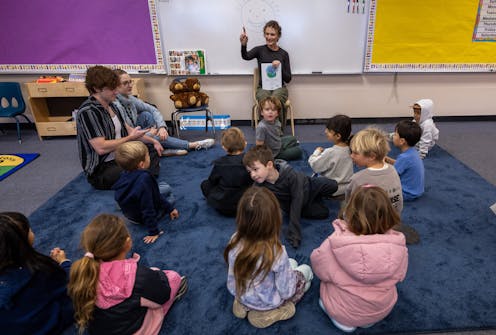
Finding good candidates to fill that teacher’s chair is no easy task. Brian van der Brug/Los Angeles Times via Getty Images

Nearly 500 of Michigan’s 705 school districts reported teaching vacancies in the fall of 2023. That’s up from 262 districts at the beginning of the 2012 school year.

The number of vacancies is likely an undercount, because this number does not include substitutes or unqualified teachers who may have been hired to fill gaps.

Local news reports and job boards suggest that at least some Michigan districts are still struggling to fill open positions for the fall of 2025.

The teacher shortage is a nationwide problem, but it is especially acute in Michigan, where the number of teachers leaving teaching and the overall teacher shortage both exceed the national average. This shortage is particularly severe in urban and rural communities, which have the most underresourced schools, and in specialization areas such as science, mathematics and special education.

For more than two decades, my work at Michigan State University has centered on designing and leading effective teacher preparation programs. My research focuses on ways to attract people to teaching and keep them in the profession by helping them grow into effective classroom leaders.

Low pay and lack of support

Teacher shortages are the result of a combination of factors, especially low salaries, heavy workloads and a lack of ongoing professional support.

A report released last year, for example, found that Michigan teachers and teachers nationwide make about 20% less compared to those in other careers that also require a college education.

From my experience working with teachers and district leadership across the state, I know that beginning teachers – especially those in districts which have severe shortages – are often given the most challenging teaching loads. And in some districts, teachers have been forced to work without the benefit of any kind of planning time in their daily schedule.

The shortage was made much worse by the COVID-19 pandemic, which led many educators to leave the profession. Yet another culprit is the many teachers who, in Michigan as well as nationally, were hired during the 1960s and early ’70s, when school enrollments saw a massive increase, and who in the past decade have been retiring in large numbers.

Creating pathways to certification

One recent strategy to address the teacher shortage in Michigan has been to create nontraditional routes to teacher certification.

The idea is to prepare educators more quickly and inexpensively. A variety of agencies – from the Michigan Department of Education, state-level grants programs such as the Future Proud Michigan Educator program, as well as private foundations and businesses – have helped these programs along financially.

Even some school districts, including the Detroit Public Schools Community District, have adopted this strategy in order to certify teachers and fill vacant positions.

A modern-looking multi-story building made from glass and red cladding materials
Cass Technical High School is a magnet school in midtown Detroit.
WikiMedia Commons, CC BY-ND

Other similar programs are the product of partnerships between Michigan’s intermediate school districts, community colleges and four-year colleges and universities. One example is Grand Valley State University’s Western Michigan Teacher Collaborative, which targets interested students of college age. Another is MSU’s Community Teacher Initiative, designed to attract students into teaching while they are still in high school.

Perhaps even more visible are national programs such as Teachers of Tomorrow and Teach for America. Candidates in such programs often work as full-time teachers while completing teacher training coursework with minimal oversight or support.

‘Stuffing the pipeline’ is not the solution

But simply “stuffing the pipeline” with new recruits is not enough to solve the teacher-shortage problem in Michigan.

The loss of teachers is significantly higher among individuals in nontraditional training programs and for teachers of color. This starts while they are preparing to be certified and continues for several years after certification.

The primary reasons for the higher attrition rates include a lack of awareness of the complexity of schools and schooling, the lack of effective mentoring during the certification period, and the absence of instructional and other professional guidance in the early years of teaching.

How to repair the leaky faucet

So how can teachers be encouraged to stay in the profession?

Here are a few of the things scholars have learned to improve outcomes in traditional and nontraditional preparation programs:

Temper expectations. Teaching is a critically important career, but leading individuals to believe that they can repair the damage done by a complex set of socioeconomic issues – including multigenerational poverty and lack of access to healthy and affordable food, housing, drinking water and health care – puts beginning teachers on a short road to early burnout and departure.

Give student teachers strong mentors. Working in schools helps student teachers deepen their knowledge not only of teaching but also of how schools, families and communities work together. But these experiences are useful only if they are overseen and supported by an experienced and caring educator and supported by the organization’s leadership.

Recognize the limits of online learning. Online teacher preparation programs are convenient and have their place but don’t provide student teachers with real-world experience and opportunities for guided discussion about what they see, hear and feel when working with students.

Respect the process of “becoming.” Professional support should not end when a new teacher is officially certified. Teachers, like other professionals such as nurses, doctors and lawyers, need time to develop skills throughout their careers.

Providing this support sends a powerful message: that teachers are valued members of the community. Knowing that helps them stay in their jobs.

The Conversation

Gail Richmond does not work for, consult, own shares in or receive funding from any company or organization that would benefit from this article, and has disclosed no relevant affiliations beyond their academic appointment.

ref. Fixing Michigan’s teacher shortage isn’t just about getting more recruits – https://theconversation.com/fixing-michigans-teacher-shortage-isnt-just-about-getting-more-recruits-252606
PBS accounts for nearly half of first graders’ most frequently watched educational TV and video programs

Source: The Conversation – USA (2) – By Rebecca Dore, Director of Research of the Crane Center for Early Childhood Research and Policy, The Ohio State University

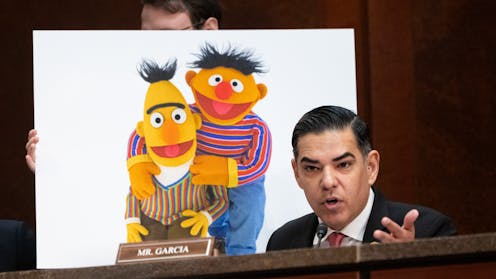
Rep. Robert Garcia, a California Democrat, speaks during a House hearing in March 2025, months before Congress rescinded two years of public media funding. Nathan Posner/Anadolu via Getty Images

CC BY-ND

At U.S. President Donald Trump’s request, Congress voted in July 2025 to claw back US$1.1 billion it had previously approved for the Corporation for Public Broadcasting. That measure, which passed in the House and the Senate by very narrow margins, will cut off all federal tax dollars that would have otherwise flowed to PBS and its affiliated TV stations for the next two fiscal years.

The public media network has played a crucial role in producing educational TV programs, especially for children, for nearly 60 years. It has been getting 15% of its budget in recent years from the federal government. Many of its affiliate stations are far more reliant on Washington than that – leading to a flurry of announcements regarding planned program cuts.

Sesame Street” is still in production, joined by newer TV shows like “Wild Kratts” and “Daniel Tiger’s Neighborhood.” PBS KIDS, in addition to producing popular age-appropriate programs, has a website and multiple apps with games and activities that provide other opportunities for learning.

Local PBS affiliate stations offer educational programming and other resources for schools, families and communities.

I’m a child development researcher studying how kids engage with digital media and how educational programming and other kinds of content help them learn. I also have two children under 5, so I’m now immersed in children’s media both at work and at home.

What kids watch

In a study about the kinds of media kids consume that the Journal of Applied Developmental Psychology published in June 2025, my colleagues and I surveyed the parents and other kinds of caregivers of 346 first graders. The study participants listed the TV shows, videos, apps and games the kids used the most.

Our research team then used a systematic coding process to look at how much children access educational programming in their favorite media – whether it’s through their favorite TV shows, web videos or video games.

We found that only 12% of this content could be described as educational. This amount varied widely: For some children, according to the adults we surveyed, educational media comprised their top three to five sources. Others listed no educational media consumption at all.

We also looked into who is taking advantage of educational media.

Our team found no differences in kids’ educational media use according to how many years of education their parents had. That finding suggests that kids of all backgrounds are equally likely to consume it.

A tween boy plays a videogame with two screens.
The vast majority of the media that kids consume has little educational value.
Neilson Barnard/Getty Images

The Role of PBS

This peer-reviewed study didn’t break down our results by specific media outlets. But in light of the cessation of federal funding, I wanted to find out how much of the educational content that children watch comes from PBS.

By revisiting our data with this objective in mind, I learned that PBS accounted for 45% of the educational TV or videos parents said their kids watched most often. This makes PBS the top source for children’s educational programming by far. Nickelodeon/Nick Jr. was in second place with 14%, and YouTube, at 9%, came in third.

PBS accounted for a smaller portion, just 6%, of all educational apps and games. I believe that could be because a few non-PBS apps, like Prodigy and i-Ready, which can be introduced in school, dominate this category.

‘Daniel Tiger’s Neighborhood,’ a cartoon, will seem familiar to anyone who grew up watching ‘Mr. Rogers’ Neighborhood.‘

An Uncertain future

Independent production companies collaborating on programming with PBS consult experts in child development and children’s media and conduct research throughout the production process to see how children respond and learn, often in partnership with PBS KIDS.

This rigorous production process can include observing children watching the show, conducting focus groups and surveying parents about their experiences. It requires a lot of time and money to produce this kind of thoughtfully crafted educational media. This process ensures that the programming is both fun for children and helps them learn.

What the end of federal funding will mean for PBS’ educational programming for kids is still unclear. But to me, it seems inevitable that my children – and everyone else’s kids – will have fewer research-informed and freely accessible options for years to come.

At the same time, there will likely be no shortage of flashy and shallow content marketed to kids that offers little of value for their learning.

The Conversation

Rebecca Dore has conducted previous consulting work for PBS KIDS and engages with a PBS KIDS staff member who is a member of the advisory board for one of Dore’s current federally funded grants.

ref. PBS accounts for nearly half of first graders’ most frequently watched educational TV and video programs – https://theconversation.com/pbs-accounts-for-nearly-half-of-first-graders-most-frequently-watched-educational-tv-and-video-programs-261996

Plantation tourism, memory and the uneasy economics of heritage in the American South

Source: The Conversation – USA (2) – By Betsy Pudliner, Associate Professor of Hospitality and Technology Innovation, University of Wisconsin-Stout

The American South – and the nation more broadly – continues to wrestle with how to remember its most painful chapters. Tourism is one of the arenas where that struggle is most visible.

This tension came into sharp relief in May 2025, when the largest antebellum mansion in the region – the 19th-century estate at Nottoway Plantation in Louisiana – burned to the ground. While some historians, community members and tourism advocates mourned the loss of a landmark site, many activists and others critical of slavery’s past celebrated its destruction.

Soon after the fire, Nottoway’s owner indicated an interest in rebuilding. And within weeks, a new restaurant had opened on a different part of the site. That speed underscores how quickly memory, history and economics can collide – and how tourism sits at the center of that tension.

As a professor who studies tourism, I know that the impulse to monetize history isn’t new. Six months after the First Battle of Manassas in 1861, the site was already developing as a tourist attraction. People have been traveling to historic sites, buying souvenirs and leaving their mark on the landscape for centuries. That tradition continues, and evolves, today.

Wealth, slavery and the battle over memory

Nottoway is one of more than 300 such plantation sites across the country, which together generate billions of dollars in revenue each year. This type of tourism forces communities and visitors alike to ask a difficult question: What parts of the past do Americans preserve, and for whom?

A local news segment about the Nottoway fire.

Nottoway, completed in 1859, was built by 155 enslaved people. Blending Greek Revival and Italianate styles, it stood as a monument to wealth built on forced labor and racial exploitation. Over the decades, it passed through different owners, survived the Civil War and was eventually restored and converted into a resort and wedding venue. Critics have long argued that this commercial reinvention downplayed the lives and labor of enslaved people, neglecting the site’s foundations in brutality.

Beyond its symbolism, Nottoway has long been recognized as a cornerstone of Iberville Parish’s tourism economy. Research shows that sites like Nottoway can anchor regional economies by encouraging longer stays and local spending. These can stimulate nearby businesses through the multiplier effect.

Nottoway’s sociocultural significance was far more complex – as shown by the celebrations that followed the fire. For many, Nottoway was a site of trauma and erasure. With its white columns and manicured lawns, Nottoway was pervaded by a sense of romanticism that relied on selective memory. For example, as of June 2025, the Nottoway website’s “History” page made no mention of slavery.

In other words, the fire didn’t just destroy a building. It disrupted a layered ecosystem of economic livelihood, memory and contested meaning.

Tourism and the power of the past

To understand why people visit places like Nottoway, it helps to turn to the four main categories of travel motivation: physical, cultural, interpersonal and status. Plantation venues typically draw cultural tourists seeking heritage, history and architecture.

They also draw those engaged in what scholars call “dark tourism”: traveling to places associated with tragedy and death. While dark tourism may imply voyeurism, many such visits are deeply reflective. These travelers seek to confront hard truths and process collective memory. But if interpretation is selective – focusing on opulence while minimizing suffering – tourism then becomes a force of historical distortion.

Some tourists choose plantations for a sense of romance, others for education, and still others for reckoning. These motivations complicate how such places should be preserved, interpreted or transformed.

Over the past decade, innovative sites like the Whitney Plantation have gained national attention for centering the lives and stories of the enslaved, rather than the architecture or planter families. Opened to the public in 2014, Whitney reframed the traditional plantation tour by prioritizing historical truth over nostalgia – featuring first-person slave narratives, memorials and educational programming focused on slavery’s brutality.

A CBS News report on Whitney Plantation.

This approach reflects a growing segment of travelers seeking deeper engagement with difficult histories. As Whitney draws visitors for its honesty and restorative framing, it raises a key question: Is the future of plantation tourism splitting into two tracks – one rooted in reflection, the other in romanticism?

Many Americans still picture the antebellum South through the lens of popular culture – a romanticized vision shaped by novels and films like “Gone with the Wind,” with its iconic Tara plantation. This “Tara effect” continues to influence how plantations are portrayed and remembered, often emphasizing beauty and grandeur while downplaying the brutality of slavery.

That’s why sites like the Donato House in Louisiana are important. Built and owned by Martin Donato, a formerly enslaved man who later became a landowner – and, complicating the narrative, also a slaveholder – this modest home offers a counterpoint to the opulence of estates like Nottoway.

Still in the hands of Donato’s descendants and slowly developing as a tourist site, the Donato House reflects the layered and often uncomfortable truths that challenge simple historical categories. Sites like this remind us that tourism plays a vital role in educating society about the complexity of our past. Heritage travel isn’t just about iconic landmarks; it’s about broadening our perspective, confronting historical bias and helping visitors to engage with the fuller, often uncomfortable, truths behind the stories we tell.

Controlling the narrative: Who tells the story?

What is chosen to be preserved – or let go of – shapes not only our memory of the past but our vision for the future.

When the last generation with firsthand experience of a historical moment is gone, their stories remain in fragments – photos, recordings such as those in the National Archives, or family lore. Some memories are factual, others softened or sharpened with time. That’s the nature of memory: It changes with us.

My late father, a high school history teacher, often reminded his students and his children to study the full spectrum of history: the good, the bad and the profoundly uncomfortable. He believed one must dive deep into its complexity to better understand human behavior and motivation.

He was right. Tourism has always echoed the layered realities of the human experience. Now, as Americans reckon with what was lost at Nottoway, we’re left with the question: “What story will be told – and who will get to tell it?”

The Conversation

Betsy Pudliner is affiliated with ICHRIE.

ref. Plantation tourism, memory and the uneasy economics of heritage in the American South – https://theconversation.com/plantation-tourism-memory-and-the-uneasy-economics-of-heritage-in-the-american-south-258558

For America’s 35M small businesses, tariff uncertainty hits especially hard

Source: The Conversation – USA (2) – By Peter Boumgarden, Professor of Family Enterprise, Washington University in St. Louis

Imagine it’s April 2025 and you’re the owner of a small but fast-growing e-commerce business. Historically, you’ve sourced products from China, but the president just announced tariffs of 145% on these goods. Do you set up operations in Thailand – requiring new investment and a lot of work – or wait until there’s more clarity on trade? What if waiting too long means you miss your chance to pull it off?

This isn’t a hypothetical – it’s a real dilemma faced by a real business owner who spoke with one of us over coffee this past spring. And she’s not alone. As of 2023, of those U.S. companies that import goods, more than 97% of them were small businesses. For these companies, tariff uncertainty isn’t just frustrating – it’s paralyzing.

As a family business researcher and a former deputy administrator of the U.S. Small Business Administration and entrepreneur, we hear from a lot of small-business owners grappling with these challenges. And what they tell us is that tariff uncertainty is stressing their time, resources and attention.

The data backs up our anecdotal experience: More than 70% of small-business owners say constant shifts in trade policy create a “whiplash effect” that makes it difficult to plan, a recent national survey showed.

Unlike larger organizations with teams of analysts to inform their decision-making, small-business owners are often on their own. In an all-hands-on-deck operation, every hour spent focusing on trade policy news or filling out additional paperwork means precious time away from day-to-day, core operations. That means rapid trade policy shifts leave small businesses especially at a disadvantage.

Planning for stability in an uncertain landscape

Critics and supporters alike can agree: The Trump administration has taken an unpredictable approach to trade policy, promising and delaying new tariffs again and again. Consider its so-called “reciprocal” tariffs. Back in April, Trump pledged a baseline 10% tariff on imports from nearly everywhere, with extra hikes on many countries. Not long afterward, it hit pause on its plans for 90 days. That period just ended, and the administration followed up with a new executive order on July 31 naming different tariff rates for about 70 countries. The one constant has been change.

Bloomberg TV covers the administration’s “surprise announcements” on trade the day before a key self-imposed deadline.

This approach has upended long-standing trade relationships in a matter of days or weeks. And regardless of the outcomes, the uncertainty itself is especially disruptive to small businesses. One recent survey of 4,000 small-business owners found that the biggest challenge of tariff policies is the sheer uncertainty they cause.

This isn’t just a problem for small-business owners themselves. These companies employ nearly half of working Americans and play an essential role in the U.S. economy. That may partly explain why Americans overwhelmingly support small businesses, viewing them as positive for society and a key path for achieving the American dream. If you’re skeptical, just look at the growing number of MBA graduates who are turning down offers at big companies to buy and run small businesses.

But this consensus doesn’t always translate into policies that help small businesses thrive. In fact, because small businesses often operate on thinner margins and have less capacity to absorb disruptions, any policy shift is likely to be more difficult for them to weather than it would be for a larger firm with deeper pockets. The ongoing tariff saga is just the most recent example.

Slow, steady policies help small-business owners

Given these realities, we recommend the final negotiated changes to trade policy be rolled out slowly. Although that wouldn’t prevent businesses from facing supply chain disruptions, it would at least give them time to consider alternate suppliers or prepare in other ways. From the perspective of a small-business owner, having that space to plan can make a real difference.

Similarly, if policymakers want to bring more manufacturing back to the U.S., tariffs alone can accomplish only so much. Small manufacturers need to hire people, and with unemployment at just over 4%, there’s already a shortage of workers qualified for increasingly high-skilled manufacturing roles.

Making reshoring a true long-term policy objective would require creating pathways for legal immigration and investing significantly in job training. And if the path toward reshoring is more about automation than labor, then preparing small-business owners for the changes ahead and helping them fund growth strategically will be crucial.

Small businesses would benefit from more government-backed funding and training. The Small Business Administration is uniquely positioned to support small firms as they adjust their supply chains and manufacturing – it could offer affordable financing for imports and exports, restructure existing loans that small businesses have had to take on, and offer technical support and education on new regulations and paperwork. Unfortunately, the SBA has slashed 43% of its workforce and closed offices in major cities including Atlanta, Chicago, Denver, New Orleans and Los Angeles. We think this is a step in the wrong direction.

Universities also have an important role to play in supporting small businesses. Research shows that teaching core management skills can improve key business outcomes, such as profitability and growth. We recommend business and trade schools increase their focus on small firms and the unique challenges they face. Whether through executive programs for small-business owners or student consulting projects, universities have a significant opportunity to lean into supporting Main Street entrepreneurs.

Thirty-five million small businesses are the engine of the U.S. economy. They are the job creators in cities and towns across this country. They are the heartbeat of American communities. As the nation undergoes rapid and profound policy shifts, we encourage leaders in government and academia to take action to ensure that Main Streets across America not only endure but thrive.

The authors would like to thank Gretchen Abraham and Matt Sonneborn for their support.

The Conversation

Dilawar Syed is a board member of Small Business Majority, a nonprofit organization.

Peter Boumgarden does not work for, consult, own shares in or receive funding from any company or organization that would benefit from this article, and has disclosed no relevant affiliations beyond their academic appointment.

ref. For America’s 35M small businesses, tariff uncertainty hits especially hard – https://theconversation.com/for-americas-35m-small-businesses-tariff-uncertainty-hits-especially-hard-262306

Fetal autopsies could help prevent stillbirths, but too often they are used to blame mothers for pregnancy loss

Source: The Conversation – USA (3) – By Jill Lens, Professor of Law, University of Iowa

At least 1 in 4 stillbirths in the U.S. are preventable, research shows. O2O Creative/iStock via Getty Images Plus

About 60 pregnancies per day in the U.S. end in stillbirth.

The best way to find out why a stillbirth occurred is a fetal autopsy – yet these procedures are performed in only 1 in 5 of the over 20,000 stillbirths that occur each year. As I explain in my recent book, “Stillbirth and the Law,” the fact that so few fetal autopsies are performed after stillbirths is actually a driver of the disproprotionately high number of stillbirths in the U.S.

One major exception to the rarity of fetal autopsies is when pregnancy loss ends with criminal arrest. Arrests after pregnancy loss are not new, but according to data compiled by the nonprofit group Pregnancy Justice, they have increased since the Supreme Court overturned the federal constitutional right to abortion in 2022.

As a legal scholar who studies pregnancy loss and its potential legal implications, I’m struck by this disparity: Autopsies are rare when the goal is general medical insight about the causes of stillbirth and pregnancy loss more generally, but they are seemingly routine when criminal consequences are possible.

Stillbirth and the inevitability myth

In the U.S., pregnancy loss before 20 weeks is called miscarriage, and pregnancy loss after 20 weeks is called stillbirth. Miscarriage is much more common, with some studies estimating it occurs in as many as 1 in 4 pregnancies. Stillbirth is rarer, but the incidence is still surprisingly high. Currently, about 1 in 170 births in the U.S. is a stillbirth, a rate higher than in many other high-income countries.

Moreover, that number masks a dramatic racial disparity. Black women in the U.S. face double the risk of stillbirth compared with white women.

Gynecologist doing an ultrasound on a pregnant woman in a clinic.
In the U.S., about 60 pregnancies a day end in stillbirth.
Maskot via Getty Images

Doctors – and, consequently, their patients – widely assume that pregnancy losses are inevitable. That’s relatively accurate for miscarriages, especially those before 12 weeks, which researchers believe are usually caused by chromosomal abnormalities. But it’s not accurate for stillbirths: Research shows that abnormalities account for fewer than 8% of stillbirths after 28 weeks.

In the U.S., at least 1 in 4 stillbirths are preventable – and that rate is closer to 50% for stillbirths at term, meaning after 37 weeks of pregnancy. Yet there’s been little movement toward prevention. According to a 2020 UNICEF report, the U.S. ranks 185th out of 195 countries in reductions to stillbirth rates from 2000-2019.

The U.S. outpaces other high-income countries in maternal mortality – rates that continue to rise dramatically – and in infant and child mortality. It’s also worth noting that the number of stillborn babies every year in the U.S. consistently exceeds the number of infant deaths from all causes.

The rarity of fetal autopsies

There is no one solution to reducing the U.S.’s stillbirth rate, but gathering data about its causes is a necessary step. A fetal autopsy is widely considered the gold standard for determining the cause of death after stillbirth. The autopsy procedure is extensive, with X-rays, external evaluations of the baby and examinations of internal organs and tissue sampling.

Not only are fetal autopsies extremely rare, but the data from fetal autopsies that do occur is likely not representative. Women with higher levels of education are more likely to get a fetal autopsy after stillbirth. Women with lesser income, however, have double the risk of stillbirth.

One barrier is cost. Many hospitals will not cover the costs of a fetal autopsy. Medicaid does not cover the exam either, and neither do many private insurance companies. Out-of-pocket costs range from $1,500 to $5,000. Stillbirth is surprisingly expensive, and many families understandably choose to use their funds to cover other costs.

Close up view of a pregnant woman touching and holding her belly while sitting on the bed. -
Black women in the U.S. face double the risk of stillbirth as white women.
MANUEL PUGA/iStock via Getty Images Plus

The way that doctors bring up the subject of fetal autopsy can also influence whether parents decide on one. Research suggests that parents often do not receive compassionate counseling on this issue. Some parents reported feeling that providers actively discourage them from having one. Providers often lack knowledge about the benefits of fetal autopsy and of the process itself. Doctors’ reactions to stillbirth as a rare, freak event dissuades parents from exploring the cause of their child’s stillbirth and conveys that nothing would be gained from a fetal autopsy.

Finally, there simply aren’t enough qualified pathologists who have expertise in stillbirth evaluation in the U.S. Fetal autopsies are complex. Performing them requires synthesizing knowledge about birth defects, genetic syndromes, maternal effects, fetal development and more. Pathologists must evaluate the placenta and the umbilical cord and factor in maternal health. According to a 2019 report, only 268 out of more than 21,000 pathologists in the U.S. had specialized training in pediatric pathology. And even those pathologists are not guaranteed to have expertise in evaluating fetal or neonatal deaths.

Fetal autopsies’ misuse as criminal evidence

In my view, the rarity of fetal autopsies feeds a sort of vicious cycle. If the cause of a stillbirth is unknown, it opens the doors to suspicion that the pregnant person caused their pregnancy loss.

Overwhelmingly, the women who have been arrested after their pregnancy loss have been from marginalized communities, suggesting that bias also plays a strong role in these arrests. And in these cases, fetal autopsies are common. For instance, authorities conducted one on the fetus of Selena Chandler-Scott in April 2025, when she was arrested after having a miscarriage at 19 weeks. A pathologist concluded from the autopsy that Chandler-Scott did not cause the miscarriage.

Arrests after pregnancy loss have increased after the constitutional right to abortion was overturned in 2022.

More often though, autopsies in such cases are used to conclude that the pregnant person was at fault. There’s every reason, however, to question those conclusions. Fetal autopsies help identify underlying causes of pregnancy loss only when performed by pathologists specifically qualified to perform them. And in many high-profile criminal cases, it’s clear that pathologists lacked the required expertise to assess fetal deaths.

Consider, for example, Rennie Gibbs, who experienced a stillbirth in Mississippi when she was 16. Her baby girl was born with the umbilical cord wrapped around her neck, yet the de facto state medical examiner at the time – who was not a certified pathologist and therefore clearly lacked the needed specialization – concluded she had died due to Gibbs’ cocaine use. Chelsea Becker of California had at least three infections that increase the risk of stillbirth, yet the pathologist, who also lacked the needed specialization, concluded the baby died due to Becker’s methamphetamine use – and later admitted he had never even looked at her medical history.

But it’s hard to rebut these conclusions without building a foundation of research on why stillbirths are happening. Fetal autopsies performed by qualified pathologists to systematically assess the causes of death are a key component of that research – which, I believe, will both help prevent stillbirths and decrease the inclination to blame people who experience pregnancy loss.

The Conversation

Jill Lens is on the Board of Directors of PUSH for Empowered Pregnancy, a nonprofit group.

ref. Fetal autopsies could help prevent stillbirths, but too often they are used to blame mothers for pregnancy loss – https://theconversation.com/fetal-autopsies-could-help-prevent-stillbirths-but-too-often-they-are-used-to-blame-mothers-for-pregnancy-loss-253898

Beyond brute strength: A fresh look at Samson’s search for intimacy in the Hebrew Bible

Source: The Conversation – USA (3) – By Tanner Ethan Walker, Assistant Professor of Religion, Wesleyan University

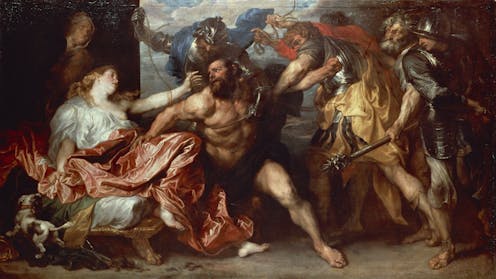
‘Samson and Delilah,’ by Anthony van Dyck, 1599-1641. DeAgostini/Getty Images

The biblical figure of Samson has long been understood as a man of brute strength, a warrior on the margins of society whose story is often defined by violence and destruction. Yet alongside his strength, Samson is known for his entanglements with women.

Samson’s story is told in the Book of Judges, Chapters 13-16. In the biblical context, judges were not legal authorities but leaders meant to rescue the Israelites from oppression. Samson is one such judge, chosen by the deity before birth to deliver the Israelites from Philistine rule.

With his enormous strength, Samson performs extraordinary feats, including slaying a lion with his bare hands and massacring a Philistine army with a donkey’s jawbone.

He is feared by both Israelites and Philistines; he engages in acts of destruction without clear goals. He often acts against the Philistines not in defense of the Israelites, but due to personal grievances. He eventually dies alongside his enemies, the Philistines.

Many scholarly and theological interpretations highlight his impulsive nature. Even as a heroic, superhuman and legendary figure, Samson is not often viewed as a role model, but as someone driven by unchecked appetites and poor judgment.

But the story of Samson is defined also by Samson’s failed search for companionship. Samson attempts to marry a Philistine woman who betrays his trust. Later, he famously falls in love with Delilah, a woman who learns the secret of his strength and has his hair cut, robbing him of his power and leading to his capture.

In my work as a Hebrew Bible scholar, I read the text through the lens of intimacy. I argue that the text, as much as it emphasizes Samson’s violence, also emphasizes his emotional depth and search for romantic connection.

Stronger than a lion

Spurning social norms and the wishes of his parents, Samson, who was born to an Israelite mother, decides to marry a Philistine woman. At the wedding, he poses a seemingly lighthearted riddle to those gathered. He wagers 30 linen and festal garments with the guests that they won’t be able to solve it.

Prior to the wedding, Samson had encountered a lion on the road and, through sheer strength, killed it with his bare hands.

Later, he found something equally remarkable: Bees had made honey within the lion’s remains. Rather than sharing this discovery with others, Samson kept it to himself, eating the honey in silence.

This hidden act provides the foundation for the riddle he presents to the Philistines: “Out of the eater came something to eat, out of the strong came something sweet.”

Because Samson has told no one about this act, the Philistines cannot solve Samson’s riddle. Not wanting to lose the wager, they coerce his bride into betraying Samson’s trust. Under threat, she pushes for Samson to reveal the answer to her.

Seeing her distress and need for the answer to his riddle, Samson gives her the key to understanding his riddle. She then conveys theses “answers” to the Philistines, who then presumably repeat the words he had spoken to her back to him: “What is sweeter than honey? What is stronger than a lion?”

Samson’s intimacy and betrayal

These “answers” are odd. Not only are they questions, they are only a partial answer to Samson’s original riddle. Additionally, rather than being rhetorical questions, which both Samson’s bride and the Philistines assume them to be, both questions have definite answers.

Samson himself is stronger than a lion – he proved this when he killed one with his bare hands. And the question of “what is sweeter than honey?” should not be viewed as rhetorical either. While biblical texts sometimes liken honey to wisdom or divine instruction, these explanations do not fully align with Samson’s context. He is not asking about abstract virtues or knowledge; his riddle was spoken to his bride in an intimate setting.

Ancient Akkadian love poetry, written in ancient Mesopotamia potentially alongside many of the stories in the Hebrew Bible, repeatedly describes love and intimacy as being “sweeter than honey.” Lovers describe their passion in this way to evoke both physical pleasure and emotional connection.

With this in mind, I argue that Samson is attempting to express something personal and meaningful to his bride. When she pushes him for the answer to his riddle, he instead poses a new riddle to her alone: Two questions with definite answers – answers she should know if she is going to be his bride.

In effect, he’s saying, “I am stronger than a lion, and our love will be sweeter than honey.” His use of language is not that of a brute but of a man trying to forge a connection through poetic expression.

Yet his bride cannot answer the questions. She immediately betrays him, repeating the same questions he presented to her back to the Philistines who had threatened her. When the Philistines repeat his words back to him, they strip them of their intimacy, turning them into public mockery.

The narrative, then, does not present Samson as merely a violent strongman but as a thoughtful figure who uses language to seek connection.

Vulnerability and intimacy

Unlike other judges in the Hebrew Bible, Samson does not lead an army, unite Israel, or receive divine commands in the traditional sense. Instead, he operates in near-total isolation, a figure alienated by his divine strength.

This isolation is mirrored in his relationships. After the incident with the riddle, Samson leaves and his Philistine bride is married to another man. This first attempt at marriage is overshadowed by secrecy, betrayal and coercion. His bride is manipulated by the Philistines, forced to extract the answer to his riddle under the threat of violence.

Even in his final relationship with Delilah, Samson displays a striking willingness to trust after a lifetime of betrayal.

In Judges 16, Delilah asks Samson repeatedly to reveal the secret of his strength, and each time he gives her the wrong answer. This back-and-forth seems to be a game between them. He tells her a false answer and she uses it against him, attempting to have him captured by the Philistines.

A painting showing a man with a bare upper body surrounded by several men and women trying to hold him.
‘Samson captured by the Philistines,’ Guercino, 1600.
Geoffrey Clements/Corbis/VCG via Getty Images

After three such attempts, each one ending with an ambush, Samson still remains with her. Eventually, he reveals that his strength is tied to his uncut hair. The deity had ordered that Samson not cut his hair, and here Samson reveals that it is the source of his divine strength.

This moment of confession following clear signs of manipulation from Delilah, in my reading, is not foolishness – it is a final act of vulnerability, a deliberate choice to seek intimacy despite the cost. His relationships are not simply careless indulgences; they reflect a deep desire to be known and loved for more than his strength, even in the face of danger.

Rethinking Samson’s story

By reevaluating the Samson narrative, readers can move beyond the one-dimensional portrayal of him as an overly masculine, violent brute.

His story is not just one of strength but also of longing, intimacy and deep emotional vulnerability. His riddle may not be a challenge meant to humiliate his enemies, but an expression of personal connection, one that is ultimately betrayed.

The Conversation

Tanner Ethan Walker does not work for, consult, own shares in or receive funding from any company or organization that would benefit from this article, and has disclosed no relevant affiliations beyond their academic appointment.

ref. Beyond brute strength: A fresh look at Samson’s search for intimacy in the Hebrew Bible – https://theconversation.com/beyond-brute-strength-a-fresh-look-at-samsons-search-for-intimacy-in-the-hebrew-bible-248820

Meet ‘lite intermediate black holes,’ the supermassive black hole’s smaller, much more mysterious cousin

Source: The Conversation – USA – By Bill Smith, Ph.D. Candidate in Physics & Astronomy, Vanderbilt University

Merging black holes generate gravitational waves, which astronomers can track. SXS, CC BY-ND

Black holes are massive, strange and incredibly powerful astronomical objects. Scientists know that supermassive black holes reside in the centers of most galaxies.

And they understand how certain stars form the comparatively smaller stellar mass black holes once they reach the end of their life. Understanding how the smaller stellar mass black holes could form the supermassive black holes helps astronomers learn about how the universe grows and evolves.

But there’s an open question in black hole research: What about black holes with masses in between? These are much harder to find than their stellar and supermassive peers, in size range of a few hundred to a few hundred thousand times the mass of the Sun.

We’re a team of astronomers who are searching for these in-between black holes, called intermediate black holes. In a new paper, two of us (Krystal and Karan) teamed up with a group of researchers, including postdoctoral researcher Anjali Yelikar, to look at ripples in space-time to spot a few of these elusive black holes merging.

Take me out to the (gravitational wave) ball game

To gain an intuitive idea of how scientists detect stellar mass black holes, imagine you are at a baseball game where you’re sitting directly behind a big concrete column and can’t see the diamond. Even worse, the crowd is deafeningly loud, so it is also nearly impossible to see or hear the game.

But you’re a scientist, so you take out a high-quality microphone and your computer and write a computer algorithm that can take audio data and separate the crowd’s noise from the “thunk” of a bat hitting a ball.

You start recording, and, with enough practice and updates to your hardware and software, you can begin following the game, getting a sense of when a ball is hit, what direction it goes, when it hits a glove, where runners’ feet pound into the dirt and more.

Admittedly, this is a challenging way to watch a baseball game. But unlike baseball, when observing the universe, sometimes the challenging way is all we have.

This principle of recording sound and using computer algorithms to isolate certain sound waves to determine what they are and where they are coming from is similar to how astronomers like us study gravitational waves. Gravitational waves are ripples in space-time that allow us to observe objects such as black holes.

Now imagine implementing a different sound algorithm, testing it over several innings of the game and finding a particular hit that no legal combination of bats and balls could have produced. Imagine the data was suggesting that the ball was bigger and heavier than a legal baseball could be. If our paper was about a baseball game instead of gravitational waves, that’s what we would have found.

Listening for gravitational waves

While the baseball recording setup is designed specifically to hear the sounds of a baseball game, scientists use a specialized observatory called the Laser Interferometer Gravitational-Wave Observatory, or LIGO, to observe the “sound” of two black holes merging out in the universe.

An L-shaped facility with two long arms extending out from a central building.
The LIGO detector in Hanford, Wash., uses lasers to measure the minuscule stretching of space caused by a gravitational wave.
LIGO Laboratory

Scientists look for the gravitational waves that we can measure using LIGO, which has one of the most mind-bogglingly advanced laser and optics systems ever created.

In each event, two “parent” black holes merge into a single, more massive black hole. Using LIGO data, scientists can figure out where and how far away the merger happened, how massive the parents and resultant black holes are, which direction in the sky the merger happened and other key details.

Most of the parent black holes in merger events originally form from stars that have reached the end of their lives – these are stellar mass black holes.

An illustration of a black hole with gas swirling around it, coming from a large cloud around a star on the right.
This artist’s impression shows a binary system containing a stellar mass black hole called IGR J17091-3624. The strong gravity of the black hole, on the left, is pulling gas away from a companion star on the right.
NASA/CXC/M.Weiss, CC BY-NC

The black hole mass gap

Not every dying star can create a stellar mass black hole. The ones that do are usually between about 20 to 100 times the mass of the Sun. But due to complicated nuclear physics, really massive stars explode differently and don’t leave behind any remnant, black hole or otherwise.

These physics create what we refer to as the “mass gap” in black holes. A smaller black hole likely formed from a dying star. But we know that a black hole more massive than about 60 times the size of the Sun, while not a supermassive black hole, is still too big to have formed directly from a dying star.

The exact cutoff for the mass gap is still somewhat uncertain, and many astrophysicists are working on more precise measurements. However, we are confident that the mass gaps exist and that we are in the ballpark of the boundary.

We call black holes in this gap lite intermediate mass black holes or lite IMBHs, because they are the least massive black holes that we expect to exist from sources other than stars. They are no longer considered stellar mass black holes.

Calling them “intermediate” also doesn’t quite capture why they are special. They are special because they are much harder to find, astronomers still aren’t sure what astronomical events might create them, and they fill a gap in astronomers’ knowledge of how the universe grows and evolves.

Evidence for IMBHs

In our research, we analyzed 11 black hole merger candidates from LIGO’s third observing run. These candidates were possibly gravitational wave signals that looked promising but still needed more analysis to conclusively confirm.

The data suggested that for those 11 we analyzed, their final post-merger black hole may have been in the lite IMBH range. We found five post-merger black holes that our analysis was 90% confident were lite IMBHs.

Even more critically, we found that one of the events had a parent black hole that was in the mass gap range, and two had parent black holes above the mass gap range. Since we know these black holes can’t come from stars directly, this finding suggests that the universe has some other way of creating black holes this massive.

A parent black hole this massive may already be the product of two other black holes that merged in the past, so observing more IMBHs can help us understand how often black holes are able to “find” each other and merge out in the universe.

LIGO is in the end stages of its fourth observing run. Since this work used data from the third observing run, we are excited to apply our analysis to this new dataset. We expect to continue to search for lite IMBHs, and with this new data we will improve our understanding of how to more confidently “hear” these signals from more massive black holes above all the noise.

We hope this work not only strengthens the case for lite IMBHs in general but helps shed more light on how they are formed.

The Conversation

Bill Smith receives funding from an NSF Research Trainee Grant called EMIT.

Karan Jani is a member of the LIGO Scientific Collaboration.

Krystal Ruiz-Rocha receives funding from an NSF research grant called EMIT.

ref. Meet ‘lite intermediate black holes,’ the supermassive black hole’s smaller, much more mysterious cousin – https://theconversation.com/meet-lite-intermediate-black-holes-the-supermassive-black-holes-smaller-much-more-mysterious-cousin-259976

2 spacecraft flew exactly in line to imitate a solar eclipse, capture a stunning image and test new tech

Source: The Conversation – USA – By Christopher Palma, Teaching Professor of Astronomy & Astrophysics, Penn State

The solar corona, as viewed by Proba-3’s ASPIICS coronagraph. ESA/Proba-3/ASPIICS/WOW algorithm, CC BY-SA

During a solar eclipse, astronomers who study heliophysics are able to study the Sun’s corona – its outer atmosphere – in ways they are unable to do at any other time.

The brightest part of the Sun is so bright that it blocks the faint light from the corona, so it is invisible to most of the instruments astronomers use. The exception is when the Moon blocks the Sun, casting a shadow on the Earth during an eclipse. But as an astronomer, I know eclipses are rare, they last only a few minutes, and they are visible only on narrow paths across the Earth. So, researchers have to work hard to get their equipment to the right place to capture these short, infrequent events.

In their quest to learn more about the Sun, scientists at the European Space Agency have built and launched a new probe designed specifically to create artificial eclipses.

Meet Proba-3

This probe, called Proba-3, works just like a real solar eclipse. One spacecraft, which is roughly circular when viewed from the front, orbits closer to the Sun, and its job is to block the bright parts of the Sun, acting as the Moon would in a real eclipse. It casts a shadow on a second probe that has a camera capable of photographing the resulting artificial eclipse.

An illustration of two spacecraft, one which is spherical and moves in front of the Sun, another that is box-shaped facing the Sun.
The two spacecraft of Proba-3 fly in precise formation about 492 feet (150 meters) apart.
ESA-P. Carril, CC BY-NC-ND

Having two separate spacecraft flying independently but in such a way that one casts a shadow on the other is a challenging task. But future missions depend on scientists figuring out how to make this precision choreography technology work, and so Proba-3 is a test.

This technology is helping to pave the way for future missions that could include satellites that dock with and deorbit dead satellites or powerful telescopes with instruments located far from their main mirrors.

The side benefit is that researchers get to practice by taking important scientific photos of the Sun’s corona, allowing them to learn more about the Sun at the same time.

An immense challenge

The two satellites launched in 2024 and entered orbits that approach Earth as close as 372 miles (600 kilometers) – that’s about 50% farther from Earth than the International Space Station – and reach more than 37,282 miles (60,000 km) at their most distant point, about one-sixth of the way to the Moon.

During this orbit, the satellites move at speeds between 5,400 miles per hour (8,690 kilometers per hour) and 79,200 mph (127,460 kph). At their slowest, they’re still moving fast enough to go from New York City to Philadelphia in one minute.

While flying at that speed, they can control themselves automatically, without a human guiding them, and fly 492 feet (150 meters) apart – a separation that is longer than the length of a typical football stadium – while still keeping their locations aligned to about one millimeter.

They needed to maintain that precise flying pattern for hours in order to take a picture of the Sun’s corona, and they did it in June 2025.

The Proba-3 mission is also studying space weather by observing high-energy particles that the Sun ejects out into space, sometimes in the direction of the Earth. Space weather causes the aurora, also known as the northern lights, on Earth.

While the aurora is beautiful, solar storms can also harm Earth-orbiting satellites. The hope is that Proba-3 will help scientists continue learning about the Sun and better predict dangerous space weather events in time to protect sensitive satellites.

The Conversation

Christopher Palma does not work for, consult, own shares in or receive funding from any company or organization that would benefit from this article, and has disclosed no relevant affiliations beyond their academic appointment.

ref. 2 spacecraft flew exactly in line to imitate a solar eclipse, capture a stunning image and test new tech – https://theconversation.com/2-spacecraft-flew-exactly-in-line-to-imitate-a-solar-eclipse-capture-a-stunning-image-and-test-new-tech-259362

The case that saved the press – and why Trump wants it gone

Source: The Conversation – USA – By Stephanie A. (Sam) Martin, Frank and Bethine Church Endowed Chair of Public Affairs, Boise State University

Donald Trump wants to restrict journalists’ ability to publish or broadcast critical stories. Mesh cube, iStock/Getty Images Plus

President Donald Trump is again attacking the American press – this time not with fiery rally speeches or by calling the media “the enemy of the people,” but through the courts.

Since the heat of the November 2024 election, and continuing into July, Trump has filed defamation lawsuits against “60 Minutes” broadcaster CBS News and The Wall Street Journal. He has also sued the Des Moines Register for publishing a poll just before the 2024 election that Trump alleges exaggerated support for Democratic candidate Kamala Harris and thus constituted election interference and fraud.

These are in addition to other lawsuits Trump filed against the news media during his first term and during his years out of office between 2021 and 2025.

At the heart of Trump’s complaints is a familiar refrain: The media is not only biased, but dishonest, corrupt and dangerous.

The president isn’t just upset about reporting on him that he thinks is unfair. He wants to redefine what counts as libel and make it easier for public officials to sue for damages. A libel suit is a civil tort claim seeking damages when a person believes something false has been printed or broadcast about them and so harmed their reputation.

Redefining libel in this way would require overturning the Supreme Court’s 1964 ruling in New York Times Co. v. Sullivan, one of the most important First Amendment legal rulings in American constitutional history

Trump made overturning Sullivan a talking point during his first campaign for president; his lawsuits now put that threat into action. And they raise the question: What happened in Sullivan, and why does it still matter?

President Donald Trump discusses U.S. libel laws on Jan. 10, 2018, calling them a ‘sham’ and a ‘disgrace’ during comments to reporters at the White House.

What Sullivan was about

As chair of a public policy institute devoted to strengthening deliberative democracy, I have written two books about the media and the presidency, and another about media ethics. My research traces how news institutions shape civic life and why healthy democracies rely on free expression.

In 1960, The New York Times published a full-page advertisement titled “Heed Their Rising Voices”. The ad, which included an appeal for readers to send money in support of Martin Luther King Jr. and the movement against Jim Crow, described brutal and unjust treatment of Black students and protesters in Montgomery, Alabama. It also emphasized episodes of police violence against peaceful demonstrations.

The ad was not entirely accurate in its description of the behavior of either protesters or the police.

It claimed, for instance, that activists had sung “My Country ’Tis of Thee” on the steps of the state capitol during a rally, when they actually had sung the national anthem. It said that “truckloads of police armed with shotguns and tear-gas” had “ringed” a college campus, when the police had only been deployed nearby. And it asserted that King had been arrested seven times in Alabama, when the real number was four.

Though the ad did not identify any individual public officials by name, it disparaged the behavior of Montgomery police.

That’s where L.B. Sullivan came in.

As Montgomery’s police commissioner, he oversaw the police department. Sullivan claimed that because the ad maligned the conduct of law enforcement, it had implicitly defamed him. In 1960 in Alabama, a primary defense against libel was truth. But since there were mistakes in the ad, a truth defense could not be raised. Sullivan sued for damages, and an Alabama jury awarded him US$500,000, equivalent to $5,450,000 in 2025.

The message to the press was clear: criticize Southern officials and risk being sued out of existence.

In fact, the Sullivan lawsuit was not an isolated incident, but part of a broader strategy. In addition to Sullivan, four other Montgomery officials filed suits against the Times.

In Birmingham, public officials filed seven libel lawsuits over Times reporter Harrison Salisbury’s trenchant reporting about racism in that city. The lawsuits helped push the Times to the edge of bankruptcy. Salisbury was even indicted for seditious libel and faced up to 21 years in prison.

Alabama officials also sued CBS, The Associated Press, the Saturday Evening Post and Ladies’ Home Journal – all for reporting on civil rights and the South’s brutal response.

Four men in suits standing together and smiling.
Montgomery, Ala., Police Commissioner L.B. Sullivan, second left, and his attorneys celebrate his $500,000 libel suit victory in a county court on Nov. 3, 1960.
Bettman/Getty Images

The Supreme Court decision

The jury’s verdict in favor of Sullivan was unanimously overturned by the Supreme Court in 1964.

Writing for the court, Justice William Brennan held that public officials cannot prevail in defamation lawsuits merely by showing that statements are false. Instead, they must prove such statements are made with “actual malice”. Actual malice means a reporter or press outlet knew their story was false or else acted with reckless disregard for the truth.

The decision set a high bar.

Before the ruling, the First Amendment’s protections for speech and the press didn’t offer much help to the press in libel cases.

After it, public officials who wanted to sue the press would have to prove “actual malice” – real, purposeful untruths that caused harm. Honest mistakes weren’t enough to prevail in such lawsuits. The court held that errors are inevitable in public debate and that protecting those mistakes is essential to keeping debate open and free.

Nonviolent protest and the press

In essence, the court ruling blocked government officials from suing for libel with ulterior motives.

King and other civil rights leaders relied on a strategy of nonviolent protest to expose injustice through public, visible actions.

When protesters were arrested, beaten or hosed in the streets, their goal was not chaos – it was clarity. They wanted the nation to see what Southern oppression looked like. For that, they needed press coverage.

If Sullivan’s lawsuit had succeeded, it could have bullied the press away from covering civil rights altogether. The Supreme Court recognized this danger.

Public officials treated differently

Another key element of the court’s reasoning was its distinction between public officials and private citizens.

Elected leaders, the court said, can use mass media to defend themselves in ways ordinary people cannot.

“The public official certainly has equal if not greater access than most private citizens to media of communication,” Justice Brennan wrote in the Sullivan ruling.

Trump is a perfect example of this dynamic. He masterfully uses social media, rallies, televised interviews and impromptu remarks to push back. He doesn’t need the courts.

Giving public officials the power to sue over news stories they dislike could well create a chilling effect on the media that undermines government accountability and distorts public discourse.

“The theory of our Constitution is that every citizen may speak his mind and every newspaper express its view on matters of public concern and may not be barred from speaking or publishing because those in control of government think that what is said or written is unwise,” Brennan wrote.

“In a democratic society, one who assumes to act for the citizens in an executive, legislative, or judicial capacity must expect that his official acts will be commented upon and criticized.”

Why Sullivan still matters

The Sullivan ruling is more than a legal doctrine. It is a shared agreement about the kind of democracy Americans aspire to. It affirms a press duty to hold power to account, and a public right to hear facts and information that those in power want to suppress.

The ruling protects the right to criticize those in power and affirms that the press is not a nuisance, but an essential part of a functioning democracy. It ensures that political leaders cannot insulate themselves from scrutiny by silencing their critics through intimidation or litigation.

Trump’s lawsuits seek to undo these press protections. He presents himself as the victim of a dishonest press and hopes to use the legal system to punish those he perceives to be his detractors.

The decision in the Sullivan case reminds Americans that democracy doesn’t depend on leaders who feel comfortable. It depends on a public that is free to speak.

The Conversation

Stephanie A. (Sam) Martin does not work for, consult, own shares in or receive funding from any company or organization that would benefit from this article, and has disclosed no relevant affiliations beyond their academic appointment.

ref. The case that saved the press – and why Trump wants it gone – https://theconversation.com/the-case-that-saved-the-press-and-why-trump-wants-it-gone-261821

Why people ignore debt letters – and what it says about inequality today

Source: The Conversation – UK – By Ryan Davey, Lecturer in Social Sciences, Cardiff University

Thomas Andre Fure/Shutterstock

You get a payment reminder through the letterbox, maybe for a credit card, an overdraft, a bill, or a parking fine. You ignore it and leave the envelope unopened, or put it to one side to deal with later. Many of us will recognise this scenario.

Ignoring debts and other payment commitments is often dismissed as being irresponsible. But a closer look reveals that many people see things differently, reflecting a deeper point about inequality in Britain today.

To understand people’s experiences of debt problems better, I lived in a low-income community in the south of England for 18 months, where debt problems were commonplace. I also interviewed debt advisers and their clients across the UK. It gave me a unique opportunity to understand their situation and how they respond to debt, something which I detail in my new book.

While debt relative to income is falling, the total amount of unsecured household debt now far outstrips its peak during the 2008 global financial crisis.

Amid big rises in the cost of living, more and more people have been borrowing money to cover essentials like food, energy, rent or council tax. In October 2024, 4 million low-income households held loans they took out for this purpose, and nearly nine out of ten of them were going without essentials anyway.

Meanwhile, lenders continue to charge the highest interest to those least able to afford it. In 2024, an estimated 5.5 million people were falling behind on their bills or credit repayments.

In the community where I lived, many people worked, but their wages were not enough to afford what they needed. So residents borrowed money to make ends meet, claimed welfare benefits or did cash-in-hand work. This reflects a broader reality with labour markets in Britain today, where 4.5 million wage-workers are paid below the real living wage.

As a result, most of the residents I worked with were in arrears with one or more payments. They received phone calls, letters and knocks at the door from debt collectors, threatening court orders, or they had to deal with bailiffs trying to seize their possessions. Some worried about being evicted.

This is a distressing situation that can easily lead to mental health problems. Debt problems are strongly linked to diagnosed mental health disorders and even suicide. All of the debt advice clients I interviewed had experienced anxiety, depression, suicidal thoughts or other mental health issues.

Making light

However, in the community where I temporarily lived, many residents had found ways to try to stay optimistic despite the threats of debt enforcement. Some made light of their debts by joking about how bad they were at repaying or how poor their credit ratings were.

Many people focused on their home and family life. One woman worried about it being “a skint few weeks”, saying: “We’ll get through it. We always do. You just focus on what’s around you.”

An unemployed man in his late forties told me how his pride in his 12-year-old daughter kept him from “going suicidal”.

Most of all, though, people avoided their creditors. Residents often strained to meet repayment demands, but just as often they ignored them. They hung up the telephone when debt collectors called, left envelopes unopened or stashed away, or pretended not to be at home if bailiffs visited. One man said when he received a demand to pay his water bills: “Well, they can fuck off,” and threw the letter in the bin.

Trying to deal with debt head-on, in the sense of paying what debt collectors were demanding by the exact time they demanded it, could create immense anxiety and even physical health problems. One man told me: “You know, for a while I was trying to keep on top of them and eventually … well, it was making me ill [because of worrying about it]. So I couldn’t keep on like that. I just left them and got on with things.”

These accounts reveal a deeper point about inequality in Britain. Financial lending tends to extract wealth from those with less and transfer it towards the better-off. Debt is a systemic feature of our economy, and debt problems have complex causes. However, the threat of enforcement convinces many people they are single-handedly responsible for being in debt. This places the blame for poverty on the shoulders of those experiencing it, subtly implying the wealthy are morally superior.

Stigma

More than mere personal prejudice, the stigma around debt is hard-wired into the legal system. If we assume that every legally valid debt must be paid as a moral duty, no matter what, then we ignore the economic realities that make borrowing a necessity for so many. This simplistic assumption only reinforces the hardship of those in debt.

Take the example of people ignoring their debts. Usually they are labelled as irresponsible or lacking financial skills. But ignoring debts is often a deliberate response to a situation that people find immoral or harmful to their health.

It is tempting to think that if debt is the problem, the remedy is to reform it. Subsidising credit so lower-income groups pay lower interest, restoring funding for debt advice, amplifying the voices of those who have been in debt and widening access to insolvency and debt cancellation could all improve things.

But reliance on borrowing is also a symptom of broader issues. These may be better addressed by efforts to redistribute resources and curb coercive sanctions, such as taxing wealth, guaranteeing higher incomes (both wages and benefits), controlling the cost of rent and other essentials, protecting against eviction and abolishing bailiffs.

In the meantime, many indebted people on low incomes will continue to ignore debt collectors’ demands. Through their actions, I believe they question the widely held assumption that there is always a moral duty to pay in our unequal world.

The Conversation

Ryan Davey has received funding from the Economic and Social Research Council, the William Wyse Fund and the Cambridge Political Economy Society Trust at the University of Cambridge, and a Vice-Chancellor’s Fellowship at the University of Bristol.

ref. Why people ignore debt letters – and what it says about inequality today – https://theconversation.com/why-people-ignore-debt-letters-and-what-it-says-about-inequality-today-256293