Menopause and brain fog: why lifestyle medicine could make a difference

Source: The Conversation – UK – By Maria Pertl, Lecturer in Psychology, Department of Health Psychology, RCSI University of Medicine and Health Sciences

SpeedKingz/Shutterstock

By 2030, an estimated 47 million women worldwide will enter menopause each year. The transition through menopause can last several years and brings with it a host of physical, mental and brain changes. One of the most distressing symptoms reported by women is “brain fog”.

This umbrella term refers to difficulties with memory, concentration and mental clarity. Women may find themselves forgetting words, names or appointments, or misplacing items. While these symptoms can be alarming, they usually resolve after menopause and are not a sign of dementia.

Hormonal fluctuations, particularly declining oestrogen levels, are a key driver of cognitive changes during the menopause transition. But it’s not just hormones. Hot flushes, night sweats, poor sleep and low mood all contribute to cognitive difficulties. The good news? Many of the contributing factors are modifiable. That’s where lifestyle medicine comes in.

Lifestyle medicine is an evidence-based approach that uses lifestyle interventions to prevent and manage chronic conditions such as heart disease, diabetes and dementia. It focuses on six pillars: sleep, physical activity, nutrition, stress management, social connection and avoidance of harmful substances. These same pillars can also support cognitive health during menopause.

Sleep is an underestimated factor in brain health — it is essential for memory consolidation and brain repair. Yet one in three women going through menopause experience significant sleep disturbance. Hot flashes, anxiety, and hormonal changes can all disrupt sleep, creating a vicious cycle that worsens brain fog.

Improving sleep hygiene can help. This includes avoiding caffeine late in the day, reducing screen time before bed, keeping a consistent sleep schedule and maintaining a cool bedroom. Physical activity during the day – especially outside in the morning – also supports better sleep.

Physical activity is one of the most powerful tools for brain health. It improves blood flow to the brain, reduces inflammation and increases the size of the hippocampus (the brain’s memory centre). It also helps regulate mood, improve sleep and support cardiovascular and metabolic health. For menopausal women, it has the added benefit of improving bone health, sexual function and maintaining a healthy weight.

The World Health Organization recommends at least 150–300 minutes of moderate-intensity aerobic activity per week, plus two sessions of muscle-strengthening exercises. Even brisk walking can make a difference.

Stress can make it difficult to think clearly and chronic stress may accelerate brain ageing through chronically elevated cortisol levels. Menopause can be a stressful time, especially when cognitive changes affect sleep, confidence and daily functioning.

Mindfulness, yoga, tai chi and breathing exercises can help reduce stress and improve focus. Cognitive behavioural therapy (CBT), a form of talking therapy, is also effective in addressing negative thought patterns and improving coping strategies. Finding a hobby that brings joy or a sense of “flow” can also be a powerful stress reliever.

What we eat plays a crucial role in brain health. The Mediterranean diet — rich in vegetables, fruits, whole grains, legumes, nuts, olive oil and fish — has been linked to better memory and reduced risk of cognitive decline.

Omega-3 fatty acids, found in fatty fish and flaxseeds, are particularly beneficial for brain function. Avoiding ultra-processed foods, added sugars and trans fats can help reduce inflammation and stabilise energy levels.

Social connection is a powerful yet often overlooked pillar of lifestyle medicine that has substantial effects on physical, mental and brain health. During menopause, women may feel less able to participate in social activities and experience increased isolation or changes in relationships, which can negatively affect mood and cognition.

Strong social ties stimulate the brain, support emotional regulation, and buffer against stress. Quality matters more than quantity. Regular check-ins with friends, joining a club, volunteering, or even brief positive interactions can all make a difference.

Alcohol and other substances can have a circular effect on sleep, mood, and cognition. While alcohol may initially feel relaxing, it disrupts sleep quality and can worsen anxiety and memory issues.

Reducing alcohol and avoiding tobacco and recreational drugs can improve sleep, mood and cognitive clarity. If cutting back feels difficult, seeking support from a healthcare professional or support group can be a helpful first step.

Making lifestyle changes can feel overwhelming, especially when you’re already feeling tired or stressed. Financial pressures or personal circumstances can make lifestyle changes feel out of reach. Start small. Make just one change in one pillar, such as sticking to a regular bedtime or adding a short daily walk, and build from there. Small, consistent steps can make a big difference to clearing brain fog.

Menopausal brain fog is real, but it’s also manageable. By focusing on the six pillars of lifestyle medicine, women can take proactive steps to support their cognitive health and overall wellbeing during this important life transition.

The Conversation

Maria Pertl receives research funding from the Irish Cancer Society and the National Cancer Control Programme. She is a committee member of the Irish Society of Lifestyle Medicine.

Lisa Mellon co-founded the Irish Society for Lifestyle Medicine.

ref. Menopause and brain fog: why lifestyle medicine could make a difference – https://theconversation.com/menopause-and-brain-fog-why-lifestyle-medicine-could-make-a-difference-261683

My research team used 18 years of sea wave records to learn how destructive ‘rogue waves’ form – here’s what we found

Source: The Conversation – USA – By Francesco Fedele, Associate Professor of Civil and Environmental Engineering, Georgia Institute of Technology

Rogue waves have captivated the attention of both seafarers and scientists for decades. These are giant, isolated waves that appear suddenly in the open ocean.

These puzzling giants are brief, typically lasting less than a minute before disappearing. They can reach heights of 65 feet (20 meters) or greater and often more than twice the height of surrounding waves. Once a nautical myth, rogue waves have now been observed around the world. Because they’re so tall and powerful, they can pose a danger to ships and offshore structures.

To rethink what rogue waves are and what causes them, I gathered an international team of researchers. Our study, published in Nature Scientific Reports, sheds light on these oceanic giants using the most comprehensive dataset of its kind.

By analyzing 18 years of high-frequency laser measurements from the Ekofisk oil platform in the central North Sea, we reached the surprising conclusion that rogue waves aren’t just freak occurrences. They arise under the natural laws of the sea. They are not mysterious, but somewhat simple.

27,500 sea states

We analyzed nearly 27,500 half-hour wave records, or sea states, collected between 2003 and 2020 in the central North Sea. These records, taken every 30 minutes, describe how elevated the sea surface was compared to the average sea level. They include major storms, such as the Andrea wave event in 2007.

Several structures standing in the sea.
A complex of platforms on the Ekofisk oil field in the North Sea.
BoH/Wikimedia Commons, CC BY-SA

Under normal conditions, waves arise from wind blowing over the sea surface. It’s like when you blow over your cup of coffee and form small ripples on the surface. At sea, with enough time and space, those ripples can turn into large waves.

We focused on understanding what causes waves to suddenly go rogue and rise far above their neighboring waves. One proposed theory is based on modulational instability, a phenomenon described by complex mathematical models. I’ve revised these models in the past, as my work suggests that this theory doesn’t fully explain what causes rogue waves in the open ocean.

A diagram showing the height of waves in different sea states, with the tallest reaching about half the height of a large commercial boat.
Sea states record the height of waves and show when some waves rise high above sea level.
U.S. Government Accountability Office

When waves are trapped within a narrow channel, the modulational instability theory describes their rippling movement well. However, it starts to fall apart when you look at the real ocean. In open environments such as the North Sea, waves are free to propagate from multiple directions.

To understand the difference, imagine a crowd of spectators leaving a stadium after a football game. If the exit is a long, narrow hallway with tall walls, people are forced to move in a single direction. Those at the back push forward, and some may even climb over others, piling up between the confining walls. This catastrophic pileup would resemble a rogue wave, caused by their confinement.

In contrast, if the stadium’s exit opens onto a wide field, spectators can disperse freely in all directions. They don’t push on each other, and they avoid pileups.

Similarly, researchers can generate rogue waves in a confined channel in the lab, where they obey modulational instability. But without the confinement of a channel, rogue waves usually won’t follow those physics or form the same way in the open sea.

Our team knew we had to study the open sea directly to figure out what was really going on. The real-world data my team examined from the North Sea doesn’t line up with modulational instability – it tells a different story.

A sailboat caught in the swell of a tall wave, under a cloudy sky
Rogue waves are much taller than the others around them.
John Lund/Stone via Getty Images

It’s just a bad day at sea

We analyzed the sea state records using statistical techniques to uncover patterns behind these rare events. Our findings show that instead of modulational instability, the extreme waves observed more likely formed through a process called constructive interference.

Constructive interference happens when two or more waves line up and combine into one big wave. This effect is amplified by the natural asymmetry of sea waves – their crests are typically sharper and steeper than their flatter troughs.

Rogue waves form when lots of smaller waves line up and their steeper crests begin to stack, building up into a single, massive wave that briefly rises far above its surroundings. All it takes for a peaceful boat ride to turn into a bad day at sea is a moment when many ordinary waves converge and stack.

These rogue waves rise and fall in less than a minute, following what’s called a quasi-deterministic pattern in space and time. This type of pattern is recognizable and repeatable, but with touches of randomness. In an idealized ocean, that randomness would almost vanish, allowing rogue waves to grow to nearly infinite heights. But it would also take an eternity to witness one of these waves, since so many would have to line up perfectly. Like waiting for Fortuna, the goddess of chance, to roll a trillion dice and have nearly all of them land on the same number.

In the real ocean, nature limits how large a rogue wave can grow thanks to wave breaking. As the wave rises in height and energy, it can’t hold itself beyond a certain point of no return. The tip of the wave spills over and breaks into foam, or whitecap, releasing the excess energy.

The quasi-deterministic pattern behind rogue waves

Rogue waves aren’t limited to the sea. Constructive interference can happen to many types of waves. A general theory called the quasi-determinism of waves, developed by oceanographer Paolo Boccotti, explains how rogue waves form, both in the ocean and in other wave systems.

For example, for turbulent water flowing through a confined channel, a rogue wave manifests in the form of an intense, short-lived spike in vortices – patterns of spinning swirls in the water that momentarily grow larger as they move downstream.

While ocean waves seem unpredictable, Boccotti’s theory shows that extreme waves are not completely random. When a really big wave forms, the waves in the sea around it follow a recognizable pattern formed through constructive interference.

We applied Boccotti’s theory to identify and characterize these patterns in the measured North Sea wave records.

The giant waves observed in these records carry a kind of signature or fingerprint, in the form of a wave group, which can reveal how the rogue wave came to life. Think of a wave group like a small package of waves moving together. They rise, peak and then fade away through constructive interference. Tracking these wave groups allows researchers to understand the bigger picture of a rogue event as it unfolds.

As one example, a powerful storm hit the North Sea on Nov. 24, 2023. A camera at the Ekofisk platform captured a massive 55 foot (17 meter) rogue wave. I applied the theory of quasi-determinism and an AI model to investigate the origin of this extreme wave. My analysis revealed that the rogue event followed these theories – quasi-determinism and constructive interference – and came from multiple smaller waves repeatedly stacking together.

Left: Stereo video footage of a powerful storm in the North Sea on Nov. 24, 2023, recorded at the Ekofisk platform.
Right: The wave group signature of the recorded rogue wave.

Recognizing how rogue waves form can help engineers and designers build safer ships and offshore platforms – and better predict risks.

The Conversation

Francesco Fedele does not work for, consult, own shares in or receive funding from any company or organization that would benefit from this article, and has disclosed no relevant affiliations beyond their academic appointment.

ref. My research team used 18 years of sea wave records to learn how destructive ‘rogue waves’ form – here’s what we found – https://theconversation.com/my-research-team-used-18-years-of-sea-wave-records-to-learn-how-destructive-rogue-waves-form-heres-what-we-found-260900

Women in STEM face challenges and underrepresentation – this course gives them tools to succeed

Source: The Conversation – USA – By Filomena Nunes, Professor of Physics, Michigan State University

Women with strong networks and communities are most likely to succeed in the STEM fields. LWA/Dann Tardif via Getty Images

As a graduate student in physics, I was often the only woman in the room. As I gained more experience, I learned valuable lessons about the scientific community and how to better advance my career. Once I started mentoring female graduate students, I realized that many of them had also felt alienated around some scientists, an experience that chipped away at their confidence or the passion for their work.

Over two decades of doing research and mentoring students, I have compiled some tools that give women the power to improve their own experiences in the STEM world. In 2019, I turned these resources into an experiential course called Tools for Women in STEM. Although the course is designed for women, all genders are welcome.

There are many reasons women are underrepresented in STEM, including bias and stereotypes, but also workplace cultures and the absence of policies for work-life balance. A report from the American Association for University Women makes recommendations for improving the retention of women in STEM careers: ensuring women are getting the mentoring they need, supporting a work-life balance and creating a welcoming culture.

This is all easier said than done. Despite the many programs and initiatives implemented across the country since 2010, when the AAUW report came out, the percentage of women in many fields of science, technology, engineering and math continues to stay very low, with a trend that is flat at best. Even if they come into the field, many choose to leave.

What does the course explore?

To help young women navigate their professional lives in STEM, I start by taking each student on a personal journey, beginning by contextualizing their experiences in STEM. Students reflect on the shame triggers that can make them feel like they’re not good enough even when their record is stellar, as well as any biases they may have about others. Self-awareness is an essential starting point.

Students then work on skills with real-life impact, ranging from networking at meetings and building effective relationships with mentors to negotiations, dealing with harassment and exploring leadership roles. This is done through in-class activities and often followed up with practice in their real life.

Two women, one older and one younger, sitting in front of a computer screen.
Strong relationships with mentors can help women succeed in the STEM field.
Willie B. Thomas/DigitalVision via Getty Images

What does the course prepare students to do?

Prepped by videos and papers, students practice these skills and discuss strategies in small groups. This model provides an opportunity for collaboration and for assimilating and sharpening all the skills covered in the course.

Take mentoring as an example. Students practice reaching out to potential mentors and establishing a new mentoring relationship. Through discussion, students learn to both receive and provide useful feedback. When students have a safe, trusting environment, they’re more inclined to try out new things.

During the last month of the course, students practice communicating effectively in a wide range of circumstances characteristic of a STEM career. They focus on one type of communication each week: scientific presentations, posters, research group meetings and outreach, all important skills in a STEM job that aren’t always formally taught.

We wrap up the course with a “Women in STEM” outreach event that is fully created and implemented by the students themselves. This event has ranged from organizing a STEM research fair, speaking to undergrads about bridges between STEM and real life, and collecting sticky notes from researchers about their experiences in STEM.

A chalkboard covered in post it notes.
Graduate students in the Tools for Women in STEM course collected sticky notes about other researchers’ experiences in the STEM field as part of the course.
Filomena Nunes

As students work together in a safe, trusting environment, they develop their own voices and gain confidence. And the connections established during the course can continue throughout their graduate program.

Why is this course relevant now?

Today, women in STEM have higher expectations for their workplace than those of previous generations, and they are less tolerant of toxic environments. Courses like this can empower students to advocate for a better experience and promote a healthy culture for women in STEM.

Women aren’t the only group underrepresented in STEM. Instruction that tailors these lessons to the challenges faced by other identity groups could help many other students succeed.

Uncommon Courses is an occasional series from The Conversation U.S. highlighting unconventional approaches to teaching.

The Conversation

Filomena Nunes receives funding from NSF and DOE.

ref. Women in STEM face challenges and underrepresentation – this course gives them tools to succeed – https://theconversation.com/women-in-stem-face-challenges-and-underrepresentation-this-course-gives-them-tools-to-succeed-261505

San Francisco and other cities, following a Supreme Court ruling, are arresting more homeless people for living on the streets

Source: The Conversation – USA – By Stephen Przybylinski, Assistant Professor of Geography, Michigan State University

A person walks past a homeless encampment in the Skid Row community in Los Angeles in June 2024. Mario Tama/Getty Images

Homelessness is on the rise in the United States, and in some places, it is becoming more common for the police to arrest someone for sleeping or living in a public space.

In June 2024, the Supreme Court issued a ruling, Grants Pass v. Johnson, that determined it is constitutional to issue citations to or arrest homeless people, even when there is no available shelter.

The ruling reversed earlier federal appeals court rulings from 2019 and 2022 that determined cities cannot enforce anti-camping laws against homeless people if there are not enough shelter beds available for them.

The Supreme Court’s ruling also determined that the Eighth Amendment’s prohibition on cruel and unusual punishments does not protect homeless people from laws criminalizing resting in public places.

As someone who has spent more than a decade researching homelessness and speaking with unhoused communities, I have seen firsthand how enforcement of such laws imposes unavoidable hardships on homeless people and makes it harder for them to find a stable home.

A woman wearing a white pantsuit walks alongside a few people in a street that is littered in front of a few large buildings.
Los Angeles Mayor Karen Bass visits the site of a city-led sweep of a homeless encampment in Van Nuys, Calif., on July 31, 2025.
David Pashaee/Middle East Images/AFP via Getty Images

A rise in punitive action against homelessness

In 2024, there were an estimated 771,480 people in the U.S. who experienced homelessness on a single night, the highest number ever recorded.

Since June 2024, almost 220 local measures have passed that restrict or ban acts like sleeping, sitting or panhandling in public in cities that include Phoenix; Gainesville, Florida, and Reno, Nevada.

The rate of unsheltered homelessness, meaning homeless people who are sleeping in places that are not meant for humans to rest in, like parks or cars, is the highest in California.

After the Supreme Court’s decision, California Gov. Gavin Newsom issued an executive order in July 2024 that directs state agencies and departments to adopt new policies that remove homeless encampments. Those are temporary outdoor living spaces used by homeless people, often on public or private property.

Following this executive order, more than two dozen California cities and towns adopted or considered adopting sweeping bans on homeless encampments.

Not every leader has embraced this approach of what some observers call criminalizing homelessness. Los Angeles Mayor Karen Bass, for example, rejected criminalizing homelessness as “backwards” in June 2024.

Nevertheless, many cities are enforcing existing and new bans on homeless encampments more aggressively than before the Supreme Court decision – despite evidence that such enforcement is not effective in dealing with the problem of homelessness.

The impacts of aggressive enforcement

Research shows that arresting someone without a home for sitting, resting or sleeping in a public place does not reduce homelessness.

Instead, encampment sweeps and camping bans typically displace people from one area to another, while discarding or destroying their personal belongings in the process, such as identification cards, medications and sleeping gear.

This approach also wastes public resources by paying groups to throw away people’s belongings instead of investing that money into actual housing solutions, like creating more affordable housing options.

Homeless encampment sweeps by police or other government officials are also shown to make people living in camps sicker, leading to increases in hospitalizations and even deaths among those dependent on drugs or alcohol.

A punitive shift in San Francisco

San Francisco is an example of an American city with a relatively large homeless population that has taken a more aggressive approach to enforcing bans on homeless encampments over the past year.

A few weeks after the Supreme Court decision, then-San Francisco Mayor London Breed promised to be “very aggressive” in removing homeless encampments. She also said that “building more housing” would not solve the homelessness crisis.

City data shows that in the 12 months since the Supreme Court ruling, San Francisco police had arrested more than 1,000 homeless people for living in a public space – a scale of enforcement rarely seen in the city’s past. In the year leading up to the ruling, 111 people were arrested for illegal lodging

San Francisco identified approximately 8,300 homeless city residents in 2024.

In June 2025, I conducted a survey of 150 homeless people in San Francisco. About 10% of those people who gave a reason for a recent arrest reported being jailed for lodging without permission. Another 6% said they were arrested for trespassing.

In the same survey, which is part of an ongoing project, 54% of homeless San Francisco residents reported being forced to move from a public space at least once.

Another 8% reported being cited for another reason related to trespassing.

A less aggressive path in Portland

Other western American cities with large homeless populations have taken slightly different approaches to removing homelessness encampments since June 2024.

Portland, Oregon, for example, began enforcing a new daytime camping ban in July 2024. But Portland police have only made 11 arrests of homeless people for camping-related violations over the past year.

Other homeless people in Portland have received police citations for other offenses, like trespassing.

As part of my June 2025 study, I surveyed 150 homeless Portland residents. About 49% of respondents reported having been arrested at some point in their lives. Though no respondents were arrested for camping in a prohibited place, 68% of people I spoke with reported that police or other government officers forced them to leave a public space at some point over the past year.

And 13% of those who gave a reason for being cited by police said it was for camping in a prohibited place. Another 11% of homeless people were cited for some other reason related to living without shelter.

As part of the study, I also interviewed residents who had been arrested while living on the street. One Portland resident I interviewed – who asked not to be named to preserve their anonymity – told me they lost the chance to rent an apartment because they were arrested in 2023 on a preexisting, unrelated warrant after a police officer checked their ID – just days before they were supposed to pick up their keys.

“Many unhoused people have warrants simply for failing to appear after being cited for sitting or resting in public space,” they said. “I was supposed to go get the keys and, bam, I got picked up. I was arrested and went to court. Just me being in jail for five, six or five days screwed it all. I didn’t show up to get the keys, and then (the landlord) couldn’t get ahold of me, and they had no idea what was going on.”

The weeklong jail stay not only pushed this person back onto the street, but it also put them back onto a waiting list for housing – where they remain in 2025.

A person wearing a dark sweatshirt and hat holds onto a wheelchair as a man crouches in front of a tent next to the wheelchair.
A volunteer helps a person into his tent after relocating him from one park to another in Grants Pass, Oregon, in March 2024.
AP Photo/Jenny Kane

Looking ahead

The Supreme Court’s 2024 ruling did not mandate that cities criminalize homelessness. But it effectively gave cities the green light to do so without fear of violating people’s constitutional protections.

The effects of this ruling will be further felt with President Donald Trump’s July 24, 2025, executive order that ended federal support for approaches like Housing First, a policy that prioritizes providing homeless people with housing, before any other needed help. The order also calls for involuntarily committing homeless people with mental illness to mental health institutions.

As more cities consider tougher encampment ordinances, I think it is worth considering if more punitive measures really address homelessness. Decades of evidence suggest they won’t.

Instead, arresting homeless people often deepens their poverty, increases displacement and diverts public funding away from the real solution – stable, affordable housing.

The Conversation

Stephen Przybylinski does not work for, consult, own shares in or receive funding from any company or organization that would benefit from this article, and has disclosed no relevant affiliations beyond their academic appointment.

ref. San Francisco and other cities, following a Supreme Court ruling, are arresting more homeless people for living on the streets – https://theconversation.com/san-francisco-and-other-cities-following-a-supreme-court-ruling-are-arresting-more-homeless-people-for-living-on-the-streets-262664

The new NextGen Acela trains promise faster travel and more seats – but arrive as US rail faces an uncertain future

Source: The Conversation – USA – By David Alff, Associate Professor of English, University at Buffalo

The new Acela trains are scheduled to start running on the Northeast Corridor soon. Courtesy of Amtrak

When former President Joe Biden unveiled his US$1.9 trillion infrastructure plan in 2021, he found the perfect place to go public: Philadelphia’s 30th Street Station rail yard.

Over the din of crackling wires and grumbling engines, the president made his case for revitalizing the country’s roads, ports, airports and rail lines.

Behind Biden sat rows of gleaming Amtrak trains. Among them was a prototype of NextGen Acela, a sleek machine engineered to deliver the fastest passenger service in American history.

On Aug. 28, 2025, NextGen will finally hit the rails, after years of delays.

As the author of a book on the Northeast Corridor, the rail line that connects Boston, New York, Philadelphia and Washington, I know this new train cannot come soon enough for many seaboard riders, even though it launches at a time of diminished political will for passenger rail.

Interior of modern train with seats with red headrests
Red headrests distinguish first-class cars from business class on the NextGen Acela trains.
Courtesy of Amtrak

Rail renaissance under fire

The French-designed, American-manufactured NextGen arrives years late due to mechanical defects and failed simulation tests mandated by the Federal Railroad Administration. The new Acela will begin whisking passengers along the corridor after a chaotic year that saw downed wires, busted circuit breakers and brushfires disrupt Amtrak operations.

Gone is Amtrak’s White House champion, railfan-in-chief Biden, replaced by Donald Trump, whose one-time adviser, Elon Musk, called Amtrak a “sad situation,” and who proposed replacing the government-owned carrier with private competitors.

Man in suit and blue baseball cap speaks behind a lectern in front of a train with an urban skyline in the background
Former President Joe Biden delivers remarks at an Amtrak 50th anniversary event in Philadelphia in 2021.
AP Photo/Patrick Semansky

Amtrak CEO Stephen Gardner resigned in March 2025, and, in May, Amtrak cut 450 employee positions.

NextGen Acela promises an American rail renaissance in a moment when federally sponsored trains are fighting for their lives, as Biden’s infrastructure ambitions fall to an administration bent on cutting government costs.

These contradictions, however, are nothing new.

Not-so-fast trains

America’s love-hate relationship with fast trains stretches back to October 1964, when Japanese National Railways opened its Shinkansen high-speed line between Tokyo and Osaka.

Japan’s iconic 130-mph bullet train entranced audiences, many of whom saw footage of the new service during televised coverage of the Tokyo Olympics.

High-speed bullet train crosses bridge between skyscrapers
A Shinkansen high-speed bullet train passes through Tokyo.
Richard A. Brooks/AFP via Getty Images

Americans wanted their own bullet train but were reluctant to pay the massive infrastructural costs of a Shinkansen system. When Congress passed the High-Speed Ground Transportation Act of 1965, it prioritized the development of trains over the reconstruction of tracks, power systems and maintenance facilities.

The resulting services underperformed.

On Dec. 20, 1967, a gas turbine train manufactured by United Aircraft topped 170 mph while testing in New Jersey. But when the so-called TurboTrain entered service, it managed an average pace of just 63 mph on the weaving track between New York and Boston.

The electric-powered Metroliner, which began service in 1969, boasted similar potential but rarely held triple-digit speeds in service and broke down so often that its carrier, the Penn Central Railroad, struggled to keep the trains running between New York and Washington.

Historians usually regard these high-speed forays as resounding failures.

But riders loved them.

Technical flaws aside, both the TurboTrain and Metroliner were a hit with northeastern riders, so much so that Amtrak retained the Metroliner brand until 2006, long after it had retired the ‘60s-era trains.

Reflecting in 1999, rail journalist Don Phillips expressed disbelief “that those dogs were actually popular with the riding public.”

The birth of Acela

Amtrak opened a new era of high-speed rail in 2000 when it launched Acela Express.

Derived from France’s acclaimed TGV design, Acela carries passengers at speeds up to 150 mph on the Northeast Corridor.

Like the Metroliner before it, Acela suffered from design problems and mechanical faults, including cracked yaw dampers and brake discs, which temporarily sidelined the trains.

Rail writer Joseph Vranich described Acela as both “Amtrak’s crown jewel” and a “remarkable fiasco.”

And yet riders flocked to the service. Acela became one of Amtrak’s most popular and lucrative trains – so attractive that it lured business travelers off regional airlines.

When Acela entered service in 2000, Amtrak trains claimed just 37% of air-rail traffic between New York and Washington. By 2021, it had 83%. Between New York and Boston, that figure jumped from 20% to 75%.

Passengers stand on platform waiting to board a train
Acela trains are popular and lucrative for Amtrak, in part because they draw so many business travelers.
Anna Moneymaker via Getty Images

Acela 2.0

Now, NextGen Acela takes up the fraught legacy of American high-speed rail. What can we expect of the new train?

NextGen is faster than the original Acela but will not set any world speed records. Its top velocity of 160 mph falls short of global benchmarks set by China’s Fuxing, which hits 217 mph, and Japan’s newest Shinkansens, which reach 200 mph.

With better tracks and signals, NextGen could conceivably ramp up to 186 mph, though such speeds won’t be possible anytime soon.

For now, NextGen will make do with an imperfect corridor. The train’s lightweight design means faster acceleration and lower energy consumption. An enhanced dynamic tilting system will let carriages lean into curves on the corridor’s twisting track, so they lose less speed on turns. The original Acela also tilted, but not as much.

Modern white-and-red bathroom with changing table open
The NextGen Acela bathrooms are more spacious and have more touchless features than the previous design.
Courtesy of Amtrak

The upgraded onboard experience includes winged headrests, seat-side USB ports and 5G Wi-Fi. More importantly, each NextGen train can seat 82 more passengers than its predecessor. When Amtrak’s full fleet of 28 NextGens enters service, sending the first-generation trains into retirement, Acela service capacity will have increased by 4,728 seats.

This figure may be the train’s greatest achievement in a congested region at a time when Amtrak is posting record ridership.

The effects of the Northeast’s post-pandemic passenger surge are nowhere more visible than the Philadelphia rail yard where Biden spoke four years ago. Amtrak is constructing a new maintenance shop beside the Schuylkill River that will service NextGen trains and cement Philly’s role in the railroad’s addition of a million annual seats to its non-Acela corridor trains. Powered by conventional electric locomotives, these slower, cheaper “Regionals” accounted for 77% of corridor ridership in 2024 and will continue to carry the bulk of northeastern passengers.

Meanwhile, a quarter-mile south of the maintenance shop, America’s third-busiest passenger hub, 30th Street Station, is receiving a generational overhaul with a new food court, exterior plaza, shops and underground access to rapid transit.

These projects demonstrate the economic power of fast, frequent trains in Philly and throughout trackside communities of the Northeast. America’s embattled but resilient high-speed rail tradition may never be the world’s best, but even incremental improvements, like NextGen, cannot help but transform the places they serve.

For Amtrak’s corridor region, the stakes have never been higher.

Read more of our stories about Philadelphia.

The Conversation

David Alff is a member of the Empire State Passenger Association.

ref. The new NextGen Acela trains promise faster travel and more seats – but arrive as US rail faces an uncertain future – https://theconversation.com/the-new-nextgen-acela-trains-promise-faster-travel-and-more-seats-but-arrive-as-us-rail-faces-an-uncertain-future-256675

4 laws that could stymie the Trump EPA’s plan to rescind the endangerment finding that underpins US climate policies

Source: The Conversation – USA (2) – By H. Christopher Frey, Glenn E. Futrell Distinguished University Professor of Environmental Engineering, North Carolina State University

U.S. Interior Secretary Doug Burgum, left, takes a selfie with Energy Secretary Chris Wright, center, and EPA Administrator Lee Zeldin in front of the Trans-Alaska oil pipeline. AP Photo/Jenny Kane

The Trump administration’s plan to unravel many of the nation’s climate policies hinges on rescinding what’s known as the endangerment finding. But its strategy for doing that appears to run afoul of several federal laws.

The endangerment finding is a 2009 determination by the Environmental Protection Agency that six greenhouse gases, including carbon dioxide, contribute to climate change and therefore pose a threat to public health and welfare.

The scientific evidence of these threats has gotten stronger in the years since the endangerment finding was made. That evidence is laid out in multiple national and international reports written by hundreds of scientists who reviewed the data and research.

In contrast, the EPA’s proposal to now rescind the endangerment finding is based in part on a new Department of Energy report written by five people, named as the “Climate Working Group.” All five have been outspoken critics of mainstream climate science. Energy Secretary Chris Wright said he handpicked the group to write the report.

The group’s report cherry-picks information and misrepresents uncertainties. Some scientists whose studies it cites have complained that the authors misrepresented their research. Others are speaking out about factual problems with the report.

I have served in the federal government and on numerous scientific federal advisory committees, and I’ve seen firsthand the rigorous requirements that federal agencies are supposed to meet so that scientific information they disseminate can be trusted by the public.

The Energy Department and the EPA seem to have run afoul of four laws in particular that may be tricky for the administration to get around.

1. Has the Energy Department produced a credible report?

A casual reader might think the Energy Department climate report is credible.

Its inside cover affirms that it “is being disseminated … in compliance with” the Information Quality Act. The word “disseminated” means that this is a final report and not just a draft.

The Information Quality Act, passed by Congress in 2000, requires “ensuring and maximizing the quality, objectivity, utility, and integrity of information (including statistical information) disseminated by Federal agencies.”

An image of the title page pointing out important problems.
The author annotates the title page of the Energy Department’s report.
Christopher Frey

This law is the basis for federal guidance on scientific peer review for all agencies. It also requires agencies to provide the public with an opportunity to request corrections in final reports if they were not properly developed or lack balance, accuracy and objectivity. The agency decides whether to grant the request, but there is an appeals process.

Government scientific products considered final also must have previously undergone independent external peer review conducted in an “open and rigorous manner,” according to the White House Office of Management and Budget.

One author of the Energy Department’s report stated that the report was reviewed by “eight scientists/administrators employed by the DOE.” However, this does not meet the government’s standards for implementing the law, which requires a public record of review by scientific experts not affiliated with the department that issued the report.

2. Agencies cannot cherry-pick groups to give answers they want

The Federal Advisory Committee Act of 1972, or FACA, addressed concerns that “special interest groups” could “exercise undue influence” in promoting “their private concerns” on “matters in which they have vested interests.”

The law requires a public process for creating and appointing groups to advise the government and requires that the properly appointed group operates in public view and takes public comments along the way.

According to the DOE’s own guidance, “FACA applies when a group is asked to render advice or recommendations as a group and not a collection of individuals.”

Thus, the group chosen to write the department’s report falls within the scope of FACA. The law requires that a committee representing a fair balance of viewpoints be chartered under FACA and that members be appointed only after a public nomination process with public opportunity to comment on the list of candidates.

Once appointed, a balanced group is also required to deliberate in public and receive public comments in formulating their report. That didn’t happen.

3. Federal agencies cannot be arbitrary or inconsistent in rulemaking

The Administrative Procedure Act of 1946 requires federal agencies to allow public participation in rulemaking processes and to follow consistent procedures and practices when developing regulations.

The law prohibits actions that are “arbitrary and capricious” – meaning decisions made without justification or regard for facts – or an “abuse of discretion.”

Agencies are expected to examine relevant data. They must not only follow applicable laws, such as FACA, but also must follow procedures established to implement those laws, such as balanced membership of the committee and opportunity for public comment when formulating the report.

A schematic of different laws and their impact
Four federal laws that apply to the EPA’s effort.
Christopher Frey

4. Science Advisory Board review is also required

The EPA is also subject to the Environmental Research, Development and Demonstration Authorization Act of 1978. The act mandated that the EPA must establish a Science Advisory Board. It also requires that agency make available to its Science Advisory Board relevant scientific and technical information on any “proposed criteria document, standard, limitation, or regulation.”

The board must be given time to review the scientific and technical basis of the proposed action – in this case, the disseminated Energy Department report – now that the EPA is using this report to inform its regulatory action.

Under the Information Quality Act, the EPA may not develop a regulation based on a draft report.

The EPA’s Science Advisory Board website lists zero members as of mid-August 2025. On Jan. 28, 2025, the EPA dismissed all of the board’s previous members. Nominations for new board members were due on June 2. At best, it will be months before the EPA can seat a new Science Advisory Board because of time needed to complete the selection, appointment and ethics review processes.

An annotated screenshot of the EPA’s Science Advisory Board website shows no members as of Aug. 11, 2025.
EPA

Either the EPA could follow the law and suspend any proposed actions until the Science Advisory Board is available, or accept legal risk for not following the Environmental Research, Development and Demonstration Authorization Act.

What’s next?

These laws exist to protect the public by preventing the federal government from being unduly influenced by narrow interests when disseminating evidence that informs policy decisions. Science-based agencies such as the Energy Department and the EPA have a legal requirement to follow the science.

The public has a chance to comment on the EPA’s proposal to rescind the 2009 endangerment finding and greenhouse gas vehicle standards until Sept. 15, 2025. And although the Energy Department disseminated its report as a final version, the department is accepting public comments on the report through Sept. 2.

For both, the most effective comments are evidence-based and not merely opinion.

The National Academies of Sciences, Engineering and Medicine, independent nonprofit institutions that advise the government, announced in early August that they will conduct a fast-track review of the science on whether greenhouse gas emissions endanger public health and welfare to submit as a public comment.

Because the Energy Department report is presented as final, it is also subject to the “request for correction” process under the Information Quality Act within 60 days of its initial release.

Given the Energy Department report’s legal vulnerabilities, the Trump administration could consider withdrawing the report and starting over with a legally and scientifically valid approach. If these vulnerabilities are not corrected and the EPA rescinds the endangerment finding based on the Energy Department report, years of litigation are likely to slow the administration’s efforts.

The Conversation

Dr. H. Christopher Frey is currently a professor of environmental engineering at North Carolina State University. He has served on numerous scientific advisory committees, including the U.S. Environmental Protection Agency FIFRA Scientific Advisory Panel (2004-2006), Science Advisory Board (2012-2018), and Clean Air Scientific Advisory Committee (2008-2015). He was chair of CASAC from 2012 to 2015. He has served on study committees of the National Academies of Science, Engineering, and Medicine. He served at EPA from 2021 to 2022 as Deputy Assistant Administrator for Science Policy and from 2022 to 2024 as Assistant Administrator for Research and Development and Science Advisor. While in federal service he co-chaired the National Science and Technology Council Committee on Environment.

ref. 4 laws that could stymie the Trump EPA’s plan to rescind the endangerment finding that underpins US climate policies – https://theconversation.com/4-laws-that-could-stymie-the-trump-epas-plan-to-rescind-the-endangerment-finding-that-underpins-us-climate-policies-262952

US has slashed global vaccine funding – if philanthropy fills the gap, there could be some trade-offs

Source: The Conversation – USA (3) – By Amy E. Stambach, Professor of Cultural Anthropology and International Studies, University of Wisconsin-Madison

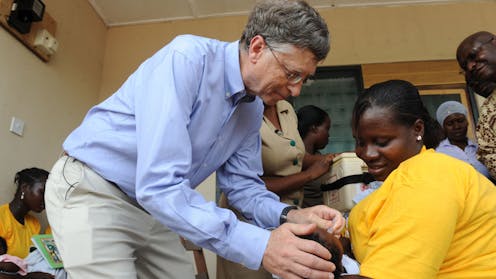
Bill Gates gives a baby in a woman’s arms a rotavirus vaccine in Ghana in 2013. Pius Utomi Ekpei/AFP via Getty Images

The U.S. government is relaxing federal vaccine requirements and cutting vaccine research and development funding here at home. Elsewhere, it’s going even further.

The Trump administration has stopped funding Gavi, a global initiative that helps millions of children in low-income and medium-income countries get vaccinated against measles, cholera and other preventable diseases. Gavi, the Vaccine Alliance, is an international organization that collects money from government and private donors. It spends around US$1.7 billion annually to buy and deliver vaccines.

Gavi has helped vaccinate over 1.1 billion children in 78 countries since 2000. Those vaccinations, according to the alliance, have prevented more than 18 million deaths from meningitis, diphtheria, tetanus, polio and other deadly diseases – saving more than $250 billion in health and economic costs.

In 2024, the U.S. was its third-biggest funder – after the U.K. and the Gates Foundation. It contributed $3.7 billion between 2000 and early 2025.

The Biden administration had promised to kick in $1.6 billion over five years beginning in 2026, plus another $300 million for the rest of 2025.

But Health and Human Services Secretary Robert F. Kennedy Jr. announced on June 26, 2025, that the Trump administration would not honor those commitments, ripping a gaping hole in Gavi’s budget.

A woman holding an infant stands in a hallway with papers affixed to the walls.
A Nicaraguan woman carries her infant after the child received a pneumococcal vaccine at a Gavi-funded clinic in 2011.
Elmer Martinez/AFP via Getty Images

Becoming more reliant on philanthropy

Kennedy criticized what he alleged was Gavi’s weak track record on vaccine safety.

Many scientists and pediatricians have disputed his rationale for cutting funding, partly because Kennedy referred to a single, contested study in his remarks that was based on 40-year-old data.

So far, Gavi’s other donors – a mix of nations, foundations, drugmakers and other corporations, including Cisco, Mastercard and Shell – haven’t said they’ll step up their support enough to plug the $3 billion hole in Gavi’s five-year plan. But several of the initiative’s biggest donors, particularly the U.K. and the Gates Foundation, have reiterated their commitments of $1.7 and $1.6 billion, respectively, to be disbursed from 2026 to 2030.

In the meantime, Gavi is trying to cut costs and is seeking new funders. Unless other governments decide to make up for the loss of U.S. funding, which so far they have not, Gavi will likely become more dependent on philanthropy than ever before.

In 2024, more than 20% of its funding came from companies and foundations. Now, the vaccine alliance wants to grow that percentage, in part by slowly gaining new donors.

In my research with collaborators on vaccine hesitancy, and through fieldwork in clinics in South Africa and Tanzania, I have seen both the strengths and weaknesses of Gavi’s reliance on the Gates Foundation and corporate donors. These donors either provide funding for vaccines or donate vaccines directly for Gavi to distribute.

While most of the media coverage of the U.S. halting its funding focuses on the fact that U.S. pullout is likely to mean that more children around the world will die, I’m also concerned about another issue.

An illustration of a medical syringe emblazoned with the Gavi vaccine alliance logo and branding.
The U.S. has ceased funding for Gavi, ripping a hole in the global initiative’s budget for the next five years.
Pavlo Gonchar/SOPA Images/LightRocket via Getty Images

Encountering some complications

When philanthropy helps fill funding gaps in the public sphere, challenges can arise.

Gavi’s vaccine programs have undoubtedly increased childhood vaccination rates. But they would be even more helpful if they could more consistently help countries build the strong and lasting vaccination systems that low-income and medium-income countries need to make sure vaccines can eventually be delivered without foreign aid.

One problem is that corporate donors and foundations don’t have to answer to voters or taxpayers in the countries they give money to. This can make it harder for countries where Gavi operates to understand philanthropic decisions.

Gavi has received more funding from the Gates Foundation than from any other private contributor. The foundation says it has disbursed or pledged, since Gavi’s launch in 2000, a total of $30.6 billion to “advance vaccines – investing in their discovery, development, and distribution.” And $7.7 billion of that sum has been “directed to Gavi” to vaccinate kids.

In so doing, the Gates Foundation, which announced on Aug. 4, 2024, that it intended to devote $2.5 billion toward improving women’s health care around the world by 2030, has helped Gavi vaccinate more children against preventable diseases than government money alone could have accomplished.

But when one donor wields that much influence, I’ve observed, tensions can follow .

I heard about such tensions at African vaccine clinics where I conducted research between 2021 and 2023.

Bill Gates in a suit and tie stands against a purple background.
Bill Gates, in 2023, speaks in Belgium about another initiative besides Gavi that the Gates Foundation is supporting, which aims to give the polio vaccine to hundreds of millions of children.
Thierry Monasse/Getty Images

Concerns about influence

At clinics across South Africa, Tanzania and other parts of sub-Saharan Africa, I spoke with doctors, nurses and public health officials working directly with Gavi-supported programs. Many of the people I interviewed acknowledged the vital role the Gates Foundation has played in expanding access to vaccines.

I am not naming the people who I interviewed to protect their confidentiality, in keeping with social science research norms.

But many expressed concern about the outsized influence that can follow when one donor gives so much money. For example, several people I interviewed said they believed they had no control over which brand of vaccines to use or which age group to vaccinate first.

“That’s all decided by donor offices – not by our own (health) ministry,” said a doctor in Dar es Salaam, Tanzania. She pointed to the walls of her clinic, plastered with promotional posters for the Gates Foundation and Gavi.

Gavi, however, says on its website that its board chooses the vaccines it invests in after extensive research.

And many of the people I interviewed said they believed that some donors push for vaccines made by companies they have invested in through their endowments and other assets.

Health workers also told me that Gates Foundation-funded reporting requirements added pressure and extra work without improving care. A district health official in rural Tanzania said his clinic had to meet strict targets set by a Gates Foundation–backed program. This meant quickly submitting forms with detailed information about numbers vaccinated and each patient’s health history – sometimes taking a toll on the quality of care.

“We’re spending more time filling out reports for the donor than talking to patients,” he said. Because the clinic had no computers and lacked a stable flow of electricity, keeping up with the paperwork was tedious.

Across interviews and locations, a common pattern emerged. I frequently heard that the Gates Foundation had helped clinics operate and pay staff with its grant money, but its programs followed a business model focused on meeting targets and showing results.

“It’s all about hitting numbers, not building systems,” one official in Cape Town, South Africa, told me. Many health care workers said this model shifted public health priorities toward the Gates Foundation’s goals at the expense of developing sustainability.

A white man in a suit and tie beholds a baby held by a Black woman in a clinic.
David Cameron tours a Gavi vaccination clinic in 2011, in Lagos, Nigeria, while serving as U.K. prime minister.
AP Photo/ Christopher Furlong

The limits of philanthropy

Funding from foreign governments can also shift local priorities, though possibly to a lesser degree than philanthropy. That’s because governments often work through bilateral agreements and are subject to diplomatic protocols and political accountability, which can temper their influence. In contrast, large foundations like the Gates Foundation may operate with more autonomyallowing them to shape programs more directly around their goals.

Ultimately, without democratic oversight or deep roots where they donate, foreign philanthropy can be seen as overriding local priorities. Donations from foundations and corporations can be perceived as exerting influence over public health goals, stirring resentment.

The Gates Foundation agrees that philanthropy cannot replace U.S. government assistance.

“There is no foundation – or group of foundations – that can provide the funding, workforce capacity, expertise, or leadership that the United States has historically provided to combat deadly diseases and address hunger and poverty,” Rob Nabors, director of the North America Program at the Gates Foundation, wrote in response to a query from me.

Nabors’ statement underscores why the end of U.S. government funding for, and involvement in, Gavi matters.

The U.S. government has historically engaged in diplomacy and forged long-term partnerships with health ministries in other countries. It has also traditionally spent billions of dollars on infrastructure, like research labs and refrigerated systems to store and transport vaccines.

Foundations typically don’t operate on the scale of government aid operations.

The Gates Foundation provided some information upon request that pointed to efforts it has made in this regard. For example, it had spent $1 billion by 2018 to support vaccine manufacturers located in developing countries and “related grantees,” working with 19 of those manufacturers in “11 countries to bring 17 vaccines to market.” It also pointed to the $15 million it announced in 2022 for a “South African specialty pharmaceutical company to support its capabilities to manufacture lifesaving routine and outbreak vaccines for Africa.”

Regardless of where its funding comes from, Gavi is essential for everyone, including Americans, because diseases like measles don’t respect borders. Because global air travel shuffles millions of people around the world daily, an outbreak of a very contagious disease anywhere can become a threat everywhere. That makes U.S. funding for Gavi not just an act of generosity toward people in other countries, but one of protecting the U.S. as well.

The Gates Foundation has provided funding for The Conversation U.S. and provides funding for The Conversation internationally.

The Conversation

Amy E. Stambach has received funding from the Council on Foreign Relations (CFR), the U.S. National Science Foundation, the Wenner-Gren Foundation for Anthropological Research and the U.S. Fulbright Scholars program. She has served as a CFR fellow with USAID.

ref. US has slashed global vaccine funding – if philanthropy fills the gap, there could be some trade-offs – https://theconversation.com/us-has-slashed-global-vaccine-funding-if-philanthropy-fills-the-gap-there-could-be-some-trade-offs-260383

The dark history of forced starvation as a weapon of war against Indigenous peoples

Source: The Conversation – USA (3) – By Rosalyn R. LaPier, Professor of History, University of Illinois at Urbana-Champaign

Yazan Abu Ful, a 2-year-old malnourished child, sitting in the Shati refugee camp in Gaza City on July 23, 2025.
AP Photo/Jehad Alshrafi

There is increasing evidence that “widespread starvation, malnutrition and disease” are driving a rise in hunger-related deaths“ in Gaza, a group of United Nations and aid organizations have repeatedly warned.

A July 29, 2025, alert by the Integrated Food Security Phase Classification, a global initiative for improving food security and nutrition, reported that the “worst-case scenario of famine is currently playing out in the Gaza Strip,” as access to food and other essential items is dropping to an “unprecedented level.”

More than 500,000 Palestinians, one-fourth of Gaza’s population, are experiencing famine, the U.N. stated. And all 320,000 children under age 5 are “at risk of acute malnutrition, with serious lifelong physical and mental health consequences.”

U.N. experts have accused Israel of using starvation “as a savage weapon of war and constitutes crime under international law.”

They are calling on Israel to urgently “restore the UN humanitarian system in Gaza.”

Israel is not the only government in history to cut off access to food and water as a tool of war. As an Indigenous scholar who studies Indigenous history, I know that countries – including the United States and Canada – have used starvation to conquer Indigenous peoples and acquire their land. As a descendant of ancestors who endured forced starvation by the U.S. government, I also know of its enduring consequences.

Dismantling Indigenous food systems

From the founding of the U.S. and Canada through the 20th century, settler colonizers often tried to destroy Indigenous communities’ access to food, whether it was their farms and livestock or their ability to access land with wild animals – with the ultimate aim of forcing them off the land.

In 1791, President George Washington ordered Secretary of War Henry Knox to destroy farms and livestock of the Wea Tribe that lived along the Ohio River valley – a fertile area with a long history of growing corn, beans, squash and other fruits and vegetables.

Knox burned down their “corn fields, uprooted vegetable gardens, chopped down apple orchards, reduced every house to ash, [and] killed the Indians who attempted to escape,” historian Susan Sleeper-Smith noted in her 2018 book, “Indigenous Prosperity and American Conquest.” Women and children were taken hostage. The goal was to destroy villages and farms so that Indigenous people would leave and not return.

Seventy-two years later, General Kit Carson conducted a scorched-earth campaign to remove the Navajo from what is now Arizona and New Mexico. Similar to Knox, he destroyed their villages, crops and water supply, killed their livestock and chopped down over 4,000 peach trees. The U.S. military forced over 10,000 Navajo to leave their homeland.

Indigenous famine

By the late 19th century, numerous famines struck Indigenous communities in both the U.S. and Canada due to the “targeted, swift, wholesale destruction” of bison by settlers, according to historian Dan Flores; this, too, was done in an effort to acquire more Indigenous land. One U.S. military colonel stated at the time: “Kill every buffalo you can! Every buffalo dead is an Indian gone.”

There were an estimated 60 million bison before U.S. and Canadian settlement; by the 1890s, there were fewer than 1,000. Indigenous communities on the northern Great Plains in both the U.S. and Canada, who believed bison were a sacred animal and who relied on them for food, clothing and other daily needs, now had nothing to eat.

Historian James Daschuk revealed in his 2013 book, “Clearing the Plains: Disease, Politics of Starvation, and the Loss of Aboriginal Life,” that between 1878 to 1880, Canadian Prime Minister Sir John A. Macdonald did little to stop a multiyear famine on the Canadian Plains, in what is now Manitoba, Saskatchewan and Alberta. Macdonald did not hide his intentions. He and his government, he said, were “doing all we can, by refusing food until the Indians are on the verge of starvation.”

Indigenous peoples on the Canadian Plains were forced to eat their dogs, horses, the carcasses of poisoned wolves and even their own moccasins. All the Indigenous peoples in the region – an estimated 26,500 people – suffered from the famine. Hundreds died from starvation and disease.

Malcolm C. Cameron, a House of Commons member at the time, accused his government of using “a policy of submission shaped by a policy of starvation” against Indigenous peoples. His denunciation did little to change their policy.

What my great-grandparents experienced

Many Indigenous peoples’ families in the U.S. and Canada have stories of surviving forced starvation by the government. Mine does, too.

In the winter of 1883-1884, my grandmother and grandfather’s parents experienced what is remembered as the “starvation winter” on the Blackfeet reservation in what is now Montana.

Similar to what happened in Canada, the near extinction of bison by American settlers led to a famine on the Blackfeet reservation. In an effort to slow the famine, Blackfeet leaders purchased food with their own money, but the U.S. government supply system delayed its arrival, creating a dire situation. Blackfeet leaders documented 600 deaths by starvation that one winter, while the U.S. government documented half that amount.

As historian John Ewers noted, the nearby “well-fed settlers” did nothing and did not offer “any effective aid to the Blackfeet.”

My family survived because a few men and women within our family were able to travel far off the reservation by horseback to hunt and harvest Native foods. I was told the story of the “starvation winter” my entire life, as were most Blackfeet. And I now share these stories with my own children.

Weapon of war

Thousands of children in Gaza are malnourished and dying of hunger-related causes.

Due to mounting international pressure, Israel is pausing its attacks in some parts of Gaza for a few hours each day to allow for some aid, but experts have noted it is not enough.

“We’re talking about 2 million people. It’s not 100 trucks or a pausing or a few hours of calm that is going to meet the needs of a population that has been starved for months,” Oxfam official Bushra Khalidi told The New York Times.

“This is no longer a looming hunger crisis – this is starvation, pure and simple,” Ramesh Rajasingham, director of the U.N.’s Office for the Coordination of Humanitarian Affairs, said on Aug. 10, 2025.

Many might assume that the use of starvation as a weapon of war happened only in the past. Yet, in places like Gaza, it is happening now.

The Conversation

Rosalyn R. LaPier does not work for, consult, own shares in or receive funding from any company or organization that would benefit from this article, and has disclosed no relevant affiliations beyond their academic appointment.

ref. The dark history of forced starvation as a weapon of war against Indigenous peoples – https://theconversation.com/the-dark-history-of-forced-starvation-as-a-weapon-of-war-against-indigenous-peoples-262564

Getting beyond answers like ‘fine’ and ‘nothing’: 5 simple ways to spark real talk with kids

Source: The Conversation – USA (2) – By Shelbie Witte, Dean, College of Education and Human Development, University of North Dakota

Most kids want to know whether the adults in their lives are genuinely interested in their day – and aren’t just going through the motions. FG Trade/E+ via Getty Images

Each afternoon, a familiar conversation unfolds in many households.

“How was school today?”

“Fine.”

“What did you learn?”

“Nothing.”

In the classroom, teachers also struggle with stonewalling students. They’ll pose a question, only to be met with blank stares. They might incorporate “wait time” to give students a moment to gather their thoughts. But even then, their students offer brief or vague responses. Students, meanwhile, often get nervous about asking for clarification or diving deeper into a topic in front of their peers.

This can have consequences: Children who hesitate to ask or answer questions risk becoming adults with the same habits. Adults who avoid asking questions or avoid admitting what they don’t know can become willfully ignorant: They skirt the consequences of their lack of knowledge and the impact it can have on themselves and others.

With the start of school just around the corner, it’s an important time to create opportunities for children to stretch their conversational and curiosity muscles.

I’m an educator, researcher and parent who studies adolescent education and teacher preparation.

Here are five strategies parents and caregivers can use with children to make them better conversationalists and cultivate curiosity. The suggestions might appear straightforward. But they outline an easy way to avoid being iced out with “yes” or “no” answers.

1. Be creative with your questions

Part of the issue arises from asking questions that can be batted away with a one-word response.

Children want to know whether the adults in their lives are genuinely interested in their day. Asking the same, rote questions each day says otherwise.

Try shaking things up and ask more specific, open-ended questions instead: “What was the most interesting thing you did today?”

“If you could turn back time and change how you handled something at school today, what would it be?”

“If you were in charge of your class tomorrow, what would you teach?”

2. Engage with their curiosity

As important as it is for adults to ask questions that convey genuine interest, it’s just as valuable to engage with questions kids ask.

Young children ask “why” so often that adults can find themselves falling back on a classic retort: “Because I said so!”

When a “why” gets shut down, a child’s curiosity and wonder are also snuffed out. Instead, try acknowledging and engaging with this curiosity: “Good question. Here’s my thinking …” or “Let’s talk about why this is important …”

At the same time, you can also model other ways to ask questions: “I’ve wondered that too. Do you think it’s because …?”

3. Think out loud

When adults verbalize their thinking out loud, they’re showing children how their brains work and how problems get solved.

“Do you ever wonder why cats purr?”

“Do you think I can mix the dry and wet ingredients for the cake at the same time?”

“I noticed the flags were at half-staff today in front of your school. Could you ask someone to find out why?”

Doing so encourages children to listen to their inner voice – and to trust the questions that emerge, no matter how silly they might seem.

4. Be a seeker

Admitting you don’t know the answer to something can be uncomfortable, especially because children often expect their parents to know everything. But simply responding “I don’t know” to a question isn’t enough. It’s important to show children how to find answers, whether it’s through assembly manuals, recipes or a nutrition label.

If you come across a confusing passage in a book, you can show kids how to use the tools contained within the book: a glossary, table of contents or index.

Then there are the questions that don’t have a single, simple answer. You can explain how more than one internet search might be necessary and it’s probably not a great idea to simply accept the first answer that pops up.

By showing children that it’s OK to not know all the answers, you give them the confidence to ask more questions.

5. What I heard you say was …

Children can have a hard time articulating what they’re curious or confused about.

For this reason, active listening is a critical behavior to model. If you’re confused about what you’re hearing, rather than saying something like, “I don’t get what you’re saying,” you could repeat what you heard, and then ask, “Is that what you’re saying?”

If they give a meandering answer to your question – even if they go off topic – you can highlight what stood out to you to show that you were really listening: “What I really appreciated about your answer to my question was …”

Avoid the temptation to multitask when children approach you with questions. If you put your phone away, make eye contact and ask follow-up questions, kids will be more willing to keep asking questions in the future.

Children are born with a natural wonder and enthusiasm for learning. As Carl Sagan said, “The complex and subtle problems we face can only have complex and subtle solutions and we need people able to think complex and subtle thoughts. I believe a great many children have that capability if only they are encouraged.”

Prodding children to tap into their own curiosity while respecting their needs, limitations and fears can have a powerful impact on their ability to ask and answer questions about the world, big and small – or, at the very least, give them the confidence to try.

The Conversation

Shelbie Witte does not work for, consult, own shares in or receive funding from any company or organization that would benefit from this article, and has disclosed no relevant affiliations beyond their academic appointment.

ref. Getting beyond answers like ‘fine’ and ‘nothing’: 5 simple ways to spark real talk with kids – https://theconversation.com/getting-beyond-answers-like-fine-and-nothing-5-simple-ways-to-spark-real-talk-with-kids-261823

Weight loss support before IVF could boost pregnancy chances – and reduce the need for treatment

Source: The Conversation – UK – By Nerys M. Astbury, Associate Professor, Health Behaviours, University of Oxford

Close-up of in vitro fertilisation in a petri dish Rohane Hamilton/Shutterstock

Around one in five women of childbearing age are living with [obesity], defined by the World Health Organization as having a body mass index (BMI) over 30 kg/m². Compared with women in the healthy BMI range (18.5–24.9 kg/m²), those living with obesity are three times more likely to experience fertility problems and nearly twice as likely to have a miscarriage. Many turn to in vitro fertilisation (IVF) in the hope of having a baby.

Women with obesity who are planning a pregnancy are already advised that losing weight can improve their chances of conceiving. Our research suggests that structured weight loss support may also improve outcomes for those seeking IVF.

Our study analysed data from 12 international trials involving 1,921 women living with obesity, all planning IVF. It compared those offered a weight loss programme before IVF with those receiving standard care, which typically does not include such support.

Women who took part in a weight loss programme had a 21% higher chance of becoming pregnant overall – whether naturally or through IVF. The biggest difference was in natural conceptions: the likelihood of getting pregnant without IVF rose by 47%, meaning some women avoided fertility treatment altogether.

However, despite these higher pregnancy rates and no increase in miscarriage risk, there was no clear evidence of an effect on live birth rates. This may be because many of the included studies didn’t track live birth outcomes – even though this is the result that matters most to patients.

IVF access paradox

In the UK, publicly funded IVF is restricted to women with a BMI under 30. Similar weight-based eligibility rules exist in many other countries. These policies disproportionately affect women from more deprived backgrounds and some ethnic groups, who are more likely to be living with obesity.

The paradox is clear: women with obesity are more likely to need IVF, but less likely to be eligible for it.

Some can afford private weight loss programmes to meet the BMI requirement. Others resort to unproven or unsafe methods to lose weight quickly, risking their health in order to access fertility care.

Our research findings suggest that offering structured weight loss programmes to women with obesity who are otherwise ineligible for IVF could help more women become pregnant – and in some cases avoid IVF altogether.

This approach could also make fertility treatment more equitable. Since the cost of weight loss support is relatively low compared with IVF, including it in the treatment pathway might offer better value for healthcare providers.

Weight loss options before IVF

The most effective non-surgical option for significant weight loss is a class of medications called GLP-1 receptor agonists – such as Wegovy or Mounjaro – which have been shown to lead to substantial weight reduction.

However, these drugs should not be used during pregnancy, while trying to conceive, or while breastfeeding, as there’s little safety data in humans – and animal studies suggest potential harm to foetal development. Anyone who becomes pregnant while taking GLP-1 drugs should stop immediately and consult a healthcare professional.

For women planning to conceive soon, there are other safe and effective options, including structured support groups and low-energy diet programmes. The problem is that such services are not offered as part of standard IVF care.

While some NHS weight management programmes exist, access is limited, waiting lists can be long, and most are aimed at people with obesity-related health conditions rather than those seeking fertility treatment. In many other countries, insurance coverage for weight loss support is similarly patchy, meaning these services must often be funded privately – a cost that can put them out of reach for those who could benefit most.

The message from this research is clear: targeted, supportive weight loss programmes before IVF don’t just improve pregnancy chances – they could also reduce the need for IVF, promote fairer access to fertility treatment, and save healthcare resources. The challenge now is making sure they’re available to everyone who needs them, not just those who can afford to pay.

The Conversation

The authors do not work for, consult, own shares in or receive funding from any company or organisation that would benefit from this article, and have disclosed no relevant affiliations beyond their academic appointment.

ref. Weight loss support before IVF could boost pregnancy chances – and reduce the need for treatment – https://theconversation.com/weight-loss-support-before-ivf-could-boost-pregnancy-chances-and-reduce-the-need-for-treatment-260544