Worker honey bees can sense infections in their queen, leading to revolt

Source: The Conversation – Canada – By Alison McAfee, Postdoctoral Fellow, Applied Ecology, University of British Columbia; North Carolina State University
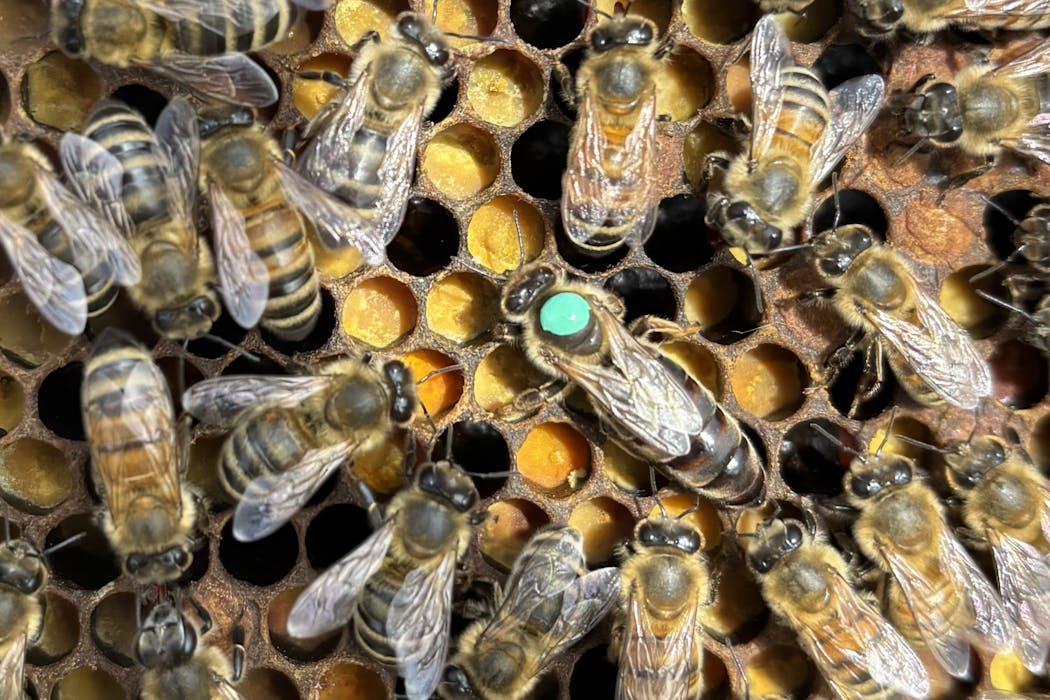
A queen honey bee (marked blue) surrounded by her workers. A typical queen bee lays thousands of eggs a day to keep the hive going. (Abigail Chapman)

When the results of the Canada’s national honey bee colony loss survey were published in July 2025, they came as no surprise. According to the Canadian Association of Professional Apiculturists, an estimated 36 per cent of Canada’s 830,000 honey bee colonies had perished over the winter.

These figures used to make headlines. But after almost two decades of the same story ― colonies dying in the winter, beekeepers struggling to rebuild, somewhat succeeding, rinse and repeat ― the sad statistics are no longer news, and we are still working out why the cycle persists.

Now, we might be having a light-bulb moment. My colleague Abigail Chapman and I recently found that queen honey bees are infected with viruses that compromise their fertility and may get them ousted from their colonies. And that’s meaningful, because “poor queens” is the top-ranked cause of colony losses reported by Canadian beekeepers.

The life of a queen

A typical honey bee colony has a single queen at the helm, and she is solely responsible for laying thousands of eggs per day ― more than her own body weight ― to grow and replenish the colony’s population for years.

A healthy, productive queen also secretes pheromones that, like a chemical bouquet, signal her quality to the workers (sterile females who make up most of the colony’s population).

The queen cannot afford to get sick. She already barely has time to sleep, and the colony depends on her to remain reproductive. But she may indeed become sick.

Queen “autopsies” point to viruses

Our surveys of queens from members of the British Columbia Bee Breeders’ Association showed that “failing” (poor quality, unproductive) queens had a higher viral burden than their healthy counterparts. That is, they were either infected with more viruses, had more intense infections, or both. The failing queens also had smaller ovaries, a sign they could be less fertile.

But this doesn’t necessarily mean that viruses were the culprit or that queens were sick, per se. They could have been failing for other reasons that also made them more susceptible to infection.

So, Chapman designed an experiment to take a closer look. She infected queens with two common honey bee viruses, then measured the queens’ egg-laying activity and the mass of their ovaries.

Not only did the infected queens lay fewer eggs per day, they were less likely to lay eggs at all when compared with controls, at least during the monitoring period, despite all queens laying normally before the experiment. When we saw that the infected queens also had shrunken ovaries, just like the queens supplied by B.C. beekeepers, we knew we were onto something.

In the apiary, too, infected queens had problems. The worse a queen’s infection was, the more likely her workers were to begin rearing a replacement ― a process known as “supersedure.” If the upcoming replacement queen reaches adulthood, she will normally duel any other queen to the death, mate and become the new conveyor of eggs.

The workers’ dilemma

Superseding colonies are over three times more likely to perish when compared with healthy colonies, in part because there is no guarantee that the new queen will successfully mate. But from the workers’ perspective, supersedure is a necessary risk. If the old queen is compromised, producing a new one is the colony’s best chance at survival.

Normally, the queen produces and secretes a retinue pheromone — a blend of at least nine different chemical components — that, among other functions, inhibits workers from replacing her if all is well. But if one or more of those cues is disrupted by a viral infection, that could act like a red flag, we reasoned, signalling to the workers that the queen can’t lay her weight.

Our new data shows that this is the very process underlying the workers’ drive to replace infected queens. The infections caused a deficiency in methyl oleate ― one flower in the queen’s bouquet. This change encourages the workers to begin raising a new queen.

bees moving along a hive
Normally, the queen produces and secretes a retinue pheromone that inhibits workers from replacing her, but a viral infection can disrupt those cues.
(Unsplash/Boba Jaglicic)

From beekeeper to queenkeeper

This validates beekeepers’ reports of having “queen issues” when infection levels are high and supports murmurs of queens not lasting as long as they used to. There are many other reasons why a queen may sputter, including pesticide exposure, extreme temperatures, poor mating and more. But viruses are a universal problem, and we did not previously understand the extent to which they could compromise queens.

Now that we do, colonies can be managed differently to better support the queen. There are currently no treatment options for honey bee viruses and there is a real need for commercial products, but luckily, there is still a way to act. Viruses are spread and sometimes amplified by varroa, a parasitic mite that can thankfully be controlled.


Read more:
Deadlier than varroa, a new honey-bee parasite is spreading around the world


Varroa treatments ― which must be conducted two to three times per year to keep colonies alive ― already keep beekeepers up at night. Some may want to surrender at the thought of needing to be even more diligent.

But until an antiviral is developed and brought to market, stepping up varroa control is likely the best defence for keeping queens healthy and bringing down colony losses. Pollination of our fruits, nuts and seeds will depend on it.

The Conversation

Alison McAfee receives funding from Project Apis m. She is affiliated with the Canadian Association of Professional Apiculturists and the British Columbia Honey Producers’ Association.

ref. Worker honey bees can sense infections in their queen, leading to revolt – https://theconversation.com/worker-honey-bees-can-sense-infections-in-their-queen-leading-to-revolt-269054

Global inequality is as urgent as climate change: the world needs a panel of experts to steer solutions

Source: The Conversation – Africa – By Joseph E. Stiglitz, Professor, Columbia Business School, Columbia University

Given the escalating scale of inequality in the world, shouldn’t countries be banding together to set up an international panel on the issue, along the same lines as the Intergovernmental Panel on Climate Change (IPCC), the United Nations body set up to assess the science related to climate change? The idea of setting up an international panel on inequality has been recommended by the G20 Extraordinary Committee of Independent Experts on Global Inequality.

The thinking behind the panel is set out in a report delivered to the G20 by the experts on the inequality committee. They argue that the proposed inequality panel would “support governments and multilateral agencies with authoritative assessments and analyses of inequality”. It wouldn’t make any recommendations for countries. Rather it would offer a menu of policies that could be used to address inequality. Panel leader and Nobel laureaute Joseph E. Stiglitz explains what’s behind the idea.

What are the report’s main findings on inequality?

Our report looked at the research on the state of inequality – and the conclusion should alarm us all. Wealth inequality is far worse than income inequality and has intensified in most countries over the last 40 years.

The global increase in income and wealth at the upper end of the scale is particularly worrying. The very richest people are amassing fortunes while ordinary people’s lives stagnate. For every dollar of wealth created since the year 2000, 41 cents have gone to the richest 1% of people, while just one cent has gone to the bottom 50%.

This wealth brings huge influence over economies and politics, threatening economic performance and the very foundations of democracy.

What does the report recommend the G20 countries do to deal with inequality?

Inequality is a choice. There are policies that can reduce it. These include more progressive taxation, debt relief, rewriting global trade rules and curbing monopolies.


Read more:
Inequality in Africa: what drives it, how to end it and what some countries are getting right


Our committee found that there has been significant progress in tracking inequality’s scale, drivers and policy solutions. Nevertheless, policymakers still lack sufficient, dependable or accessible information on inequality.

There is a great institutional need for strong inequality analysis.

In 1988, governments set up the Intergovernmental Panel on Climate Change (IPCC) to assess the data and provide rigorous analyses to help governments tackle the climate emergency. Today, we are in an inequality emergency and need a similar global effort.

That is why our primary recommendation is to establish an International Panel on Inequality.

Drawing from the report, what do you recommend South Africa should do to reduce inequality?

South Africa has shown extraordinary leadership in focusing its G20 presidency on solidarity, equality and sustainability. This report is testament to that. We hope that South Africa will continue to champion our recommendations, particularly the establishment of an International Panel on Inequality.

Our committee chose not to comment on specific policies in specific countries. But our report contains a menu of policies which can tackle inequality. These include national measures like stronger competition laws, pro-worker regulation, investing in public services, and more progressive tax and expenditure policies.

The Conversation

Joseph E. Stiglitz is chair of the G20 Extraordinary Committee of Independent Experts on Global Inequality.

Imraan Valodia does not work for, consult, own shares in or receive funding from any company or organisation that would benefit from this article, and has disclosed no relevant affiliations beyond their academic appointment.

ref. Global inequality is as urgent as climate change: the world needs a panel of experts to steer solutions – https://theconversation.com/global-inequality-is-as-urgent-as-climate-change-the-world-needs-a-panel-of-experts-to-steer-solutions-270102

Kiwi in Darwin recovering from a ‘very stormy night’ after Cyclone Fina

Source: Radio New Zealand

Roofing partially collapsed on the first floor of Royal Darwin Hospital as a result of the wild weather.

Roofing partially collapsed on the first floor of Royal Darwin Hospital as a result of the wild weather. Photo: Supplied / ABC News

A New Zealander living in the Australian city of Darwin has survived a “very, very stormy night”, as Tropical Cyclone Fina tore through the Northern Territory capital.

Laurent Marsch, who moved from Auckland in March, has been hunkering down in his apartment.

He told RNZ of significant damage, especially to the Royal Darwin Hospital in the northern suburb of Tiwi.

“This is the first cyclone we’ve had in six years,” he said. “This one started at category two and then intensified to a category three overnight.

“It’s intensifying to a category four, but it’s going over the sea, so just a lot of rain at the moment.”

Marsch said several trees had also been uprooted, but he was not quite sure of the extent of the damage to his new home.

“They’re still busy assessing that… they’ll only know in the next few days, I guess.”

The ABC reports Fina was the strongest cyclone to pass through Darwin since the deadly Cyclone Tracy in 1974.

The system was also more powerful than Cyclone Marcus, which struck Darwin as a category two in 2018.

However, Fina has not changed Marsch’s mind about his move across the ditch – which came with a $40,000 pay rise in his role as a correctional officer, on top of Australia’s minimum 12 percent superannuation contribution.

“There’s nothing I miss about Auckland.

“The only thing I miss is my kids and my grandkids – that’s the only thing I miss.”

Sign up for Ngā Pitopito Kōrero, a daily newsletter curated by our editors and delivered straight to your inbox every weekday.

– Published by EveningReport.nz and AsiaPacificReport.nz, see: MIL OSI in partnership with Radio New Zealand

Why Oscar-winning artist quit Hollywood – and what made him return

Source: Radio New Zealand

Academy Award–winning artist Kazu Hiro says the cruelty of a few actors eventually chipped away at his love for the craft he had devoted his life to — pushing him to walk away from Hollywood.

The Japanese-American special and makeup effects artist is behind some of Hollywood’s most astonishing metamorphoses: Jim Carrey in How the Grinch Stole Christmas (2000), Angelina Jolie in Salt (2010), Gary Oldman in Darkest Hour (2017) and, more recently, Dwayne Johnson in The Smashing Machine (2025).

Working under Oscar-winning makeup titan Rick Baker early in his career, Hiro had little control over his assignments.

Makeup and Hairstyling for Bombshell, Kazu Hiro attends the 92nd Annual Academy Awards at Hollywood and Highland on February 09, 2020 in Hollywood, California.

Special effects and make-up artist Kazu Hiro.

Amy Sussman / Getty Images / AFP

– Published by EveningReport.nz and AsiaPacificReport.nz, see: MIL OSI in partnership with Radio New Zealand

High-rise living in Nairobi’s Pipeline estate is stressful – how men and women cope

Source: The Conversation – Africa – By Mario Schmidt, Associate Researcher, Max Planck Institute for Social Anthropology

Within sight of Kenya’s main international airport in Nairobi’s east, Pipeline residential estate stands out like a sore thumb. Composed almost entirely of tightly packed high-rise tenement flats, the estate has been described by the media as an urban planning nightmare. They point to its garbage problem, its waterlogged and frequently impassable streets, and the effect of dense living conditions on children’s health.

Pipeline’s transformation started roughly two decades ago. High-rise apartment blocks were a response to demand for low-cost rental housing in the rapidly urbanising capital. Individual private developers gradually converted the area, roughly 2km², into a dense, high-rise residential district. On average each block of flats hosts 200 or 300 tenants.

Pipeline is an example of how private sector developers can contribute to solving Nairobi’s housing crisis. But it’s also an example of how unregulated and poorly planned housing construction can have a negative impact on the social, economic and psychological well-being of households.

Pipeline is not the only tenement district in Nairobi. But it is one of the densest neighbourhoods in the city of over 4 million. The quality of buildings varies, but there are similarities:

  • rental flats mainly comprise single rooms with shared ablutions

  • unit design gives little attention to lighting, air circulation, or open space

  • tenants are forced into unfavourable rental relationships, where delays or default in payments can lead to water or electricity cuts.

The flats in Pipeline are almost exclusively inhabited by rural-urban migrants. They are attracted here by cheap accommodation and the promise of modernity. The flats have running water, tiled floors, individual electric meters and formal rental agreements.

We are researchers who study urban development, urban migration, and urban communities. Our fieldwork research sought to understand how the physical and social spaces created in neighbourhoods like Pipeline shape the experience of stress and pressure among men and women. We also looked at the strategies they apply to cope or reduce social, economic and romantic pressure.

Pipeline is a marked improvement from the options provided in Nairobi’s traditional informal settlements. Still, most basic services in the area are intermittent, or privatised. This is because the unplanned densification has outpaced the capacity of public infrastructure and services. This forces residents to pay for education, health, water, recreation and other services.


Read more:
Nairobi’s slum residents pay a high price for low quality services


Many of these tenants are unemployed, or employed in low-wage industrial work, precarious gig work, or domestic work.

We found that men and women experience and try to cope with stress in diverse ways. Both men and women located the cause of their distress within their marital home. But the meanings and reactions to that stress diverged sharply in the migrant household.

We found that migrant men tend to experience stress in the form of pressure and migrant women in the form of tiredness.

Previous evidence points to the different ways in which stress is experienced based on biological differences between men and women. However, we propose that the tight coupling between men and pressure and between women and tiredness is the result of the expectation that men will be breadwinners. This drives men towards action and prevents women from expressing a will towards action.

Fieldwork and findings

We discovered our shared interest in studying Nairobi’s high-rise estates during a workshop on urban Nairobi.

Mario had carried out longitudinal ethnographic work with rural–urban migrants in Pipeline. His two-year-long fieldwork mostly took place in near-exclusively male spaces, such as gyms, barber shops and bars. Roughly 50 in-depth qualitative interviews revealed how men navigated urban lives that were increasingly defined by stress, pressure and exhaustion.

Miriam’s research focused on how Nairobi’s privately developed low-cost tenement precincts created environments of everyday urban dysfunction.

After the first meeting, we concluded that it would be beneficial to get a deeper understanding of women’s experiences of stress. This would help us to understand men’s and women’s experiences of stress and pressure. It would also enable us to compare how these different groups managed and coped with stress.

We designed a semi-structured questionnaire and conducted interviews with a dozen female residents. The interviewees spanned single and married women, members of a financial self-help group (chama), female neighbours who usually spent time together on balconies, a sex worker, and an entrepreneur who owned a hair salon.

Comparing the two sets of interviews provides ethnographic support for our hypothesis, which is that men and women tend to experience different types of stress: masculine “pressure” and feminine “tiredness”.

Masculine pressure is defined as an experience that provokes action. The pressure is intrinsically attached to the cause of stress and driven by the hope that overcoming it will promise social validation linked to the male provider model.

The male interviewees tended to engage in outward-oriented strategies to overcome this pressure. These include social drinking, extramarital affairs, or violent reaffirmations of gender identity. In this way, the form and design of Pipeline offered plentiful avenues for commercialised, stress-reducing activities.


Read more:
How elites and corruption have played havoc with Nairobi’s housing


In contrast, feminine tiredness emerged as an experience that inhibited action. Female respondents were constrained from aggressive responses, lest they risk being branded immoral or losing vital male financial support.

Married women, or single parents, found themselves largely confined to the small apartments. Their inward-oriented coping strategies were sometimes identified as “doing nothing” or watching TV, or performing household tasks. This passive endurance of stress was also seen as a means to “persevere” (Kiswahili: kuvumulia). In some cases, women used intermediate semi-private spaces, such as balconies, chamas or church, to connect with neighbours.

Taken together, these responses and expectations structure the modes by which male and female migrants react to or attempt to mitigate or relieve stress. This stress is not only caused by poverty but by expectations of middle-class success, ideals of romantic family life and economic progression.

Conclusions

As yet, there are no policies or programmes that seek to reverse the complex challenges created through neighbourhoods like Pipeline. Kenya’s national affordable housing programme is focused on home-ownership solutions. However, with over 90% of the city’s population renting their dwellings, and 87% renting from private individuals, Nairobi needs a better solution for rental housing.


Read more:
Kenya’s push for affordable housing is creating opportunities despite barriers


This could be through redevelopment and area-based upgrading, expansion of basic social and community services, incentives for private developers to incrementally upgrade their housing stock, rental and tenant protection legislation, and support for sustainable, communal, and cooperative housing alternatives spearheaded by citizens themselves.

The Conversation

Mario Schmidt received funding from the German Research Foundation and the Max Planck Institute for Social Anthropology. He currently works for Busara, Nairobi (Kenya).

Miriam Maina undertook this research as part of her Postdoctoral research work at the African Cities Research Consortium (ACRC) in the University of Manchester. The ACRC is a a six-year investment by FCDO to fund new, operationally-relevant research to address intractable development challenges in African cities.

ref. High-rise living in Nairobi’s Pipeline estate is stressful – how men and women cope – https://theconversation.com/high-rise-living-in-nairobis-pipeline-estate-is-stressful-how-men-and-women-cope-265499

Africa’s hidden stillbirth crisis: new report exposes major policy and data gaps

Source: The Conversation – Africa (2) – By Mary Kinney, Senior Lecturer with the Global Surgery Division, University of Cape Town

Nearly one million babies are stillborn in Africa every year. Behind every stillbirth is a mother, a family and a story left untold. Most of these are preventable, many unrecorded, and too often invisible. Each number hides a moment of heartbreak, and every uncounted loss represents a missed opportunity to learn and to act.

As a public health researcher specialising in maternal and newborn health, I have spent the past two decades working on strengthening health systems and quality of care across Africa. My research has focused on understanding how health systems can prevent stillbirths and provide respectful, people-centred care for women and newborns. Most recently, I was part of the team that led a new report called Improving Stillbirth Data Recording, Collection and Reporting in Africa. It is the first continent-wide assessment of how African countries record and use stillbirth data.

The study, conducted jointly by the Africa Centres for Disease Control and Prevention, the University of Cape Town, the London School of Hygiene & Tropical Medicine and the United Nations Children’s Fund, surveyed all 55 African Union member states between 2022 and 2024, with 33 countries responding.

The burden of stillbirths in Africa is staggering. Africa accounts for half of all stillbirths globally, with nearly eight times higher rates than in Europe. Even stillbirths that happen in health facilities may never make it into official statistics despite every maternity registry documenting this birth outcome.

Part of the challenge is that there are multiple data systems for capturing births and deaths, including stillbirths, like routine health information systems, civil registration and other surveillance systems. But these systems often don’t speak to each other either within countries or between countries. This data gap hides both the true burden and the preventable causes.

Despite advances in several countries to prevent stillbirths, large gaps remain, especially on data systems. Only a handful of African countries routinely report stillbirth data to the UN, and many rely on outdated or incomplete records. Without reliable, comparable data, countries cannot fully understand where and why stillbirths occur or which interventions save lives.

Strengthening stillbirth data is not just about numbers; it is about visibility, accountability and change. When countries count every stillbirth and use the data for health system improvement, they can strengthen care at birth for mothers and newborns and give every child a fair start in life.

Findings

The report was based on a regional survey of ministries of health. This was followed by document reviews and expert consultations to assess national systems, policies and practices for stillbirth reporting and review.

The report reveals that 60% of African countries have national and sub-national committees responsible for collecting and using stillbirth data, which produce national reports to respective health ministries. But data use remains limited. Capacity gaps, fragmented systems and insufficient funding prevents many countries from translating information into action.

To guide investment and accountability, the report categorises countries into three readiness levels:

  1. Mature systems needing strengthening, such as Kenya, Rwanda and Uganda. These countries have consistent data flows but need more analysis and use.

  2. Partial systems requiring support, where reporting mechanisms exist but are not systematically implemented, like Ghana, Malawi and Tanzania.

  3. Foundational systems still being built, including fragile or conflict-affected countries like South Sudan and Somalia. Here, policies and structures for data collection and use remain absent.

The findings show both progress and persistent gaps. Two-thirds of African countries now include stillbirths in their national health strategies, and more than half have set reduction targets. Nearly all countries report that they routinely record stillbirths through their health sectors using standard forms and definitions, yet these definitions vary widely. Most systems depend on data reported from health facilities. But the lack of integration between health, civil registration and other data systems means that countless losses never enter national statistics.

For example, if a woman delivers at home alone in Mozambique and the baby is stillborn, the loss is only known to the family and community. Without a facility register entry or civil registration notification, the death never reaches district or national statistics. Even when a stillbirth occurs in a health centre, the health worker may log it in a facility register but not report it to the civil registration system. This means the loss of the baby remains invisible in official data.

What this means

Stillbirths are a sensitive measure of how health systems are performing. They reflect whether women can access timely, quality care during pregnancy and at birth. But unlike maternal deaths, which are often a benchmark for health system strength, stillbirths remain largely absent from accountability frameworks.

Their causes, like untreated infections, complications during labour, or delays in accessing emergency caesarean sections, are often preventable. The same interventions that prevent a stillbirth also reduce maternal deaths. These improve newborn survival, and lay the foundation for better health and development outcomes in early childhood.

Accurate data on stillbirths can guide clinical care and direct scarce resources to where they are needed most. When data systems are strong, leaders can identify where and why stillbirths occur, track progress and make informed decisions to prevent future tragedies.

The analysis also highlights promising signs of momentum. Over two-thirds of countries now reference stillbirths in national health plans, an important marker of growing political attention. Several countries are moving from isolated data collection to more coordinated, system-wide approaches. This progress shows that change is possible when stillbirths are integrated into national health information systems and supported by investment in workforce capacity, supervision and data quality.

What’s needed

Africa has the knowledge, evidence and experience to make change happen.

The report calls for harmonised definitions, national targets and stronger connections and data use between the different data sources within and across African countries. Above all, it calls for collective leadership and investment to turn information into impact, so that every stillbirth is counted, every death review leads to learning and no parent grieves alone.

The author acknowledges and appreciates the partners involved in developing the report and the support from the Global Surgery Division at UCT.

The Conversation

Mary Kinney and the team at UCT receive funding from UNICEF, Laerdal Foundation, and the South African Medical Research Council.

ref. Africa’s hidden stillbirth crisis: new report exposes major policy and data gaps – https://theconversation.com/africas-hidden-stillbirth-crisis-new-report-exposes-major-policy-and-data-gaps-268901

The secret mission to save Gaza’s historical artefacts

Source: Radio New Zealand

Brushing away layers of soot and dust, archaeologist Hanin Al-Amassi examines the brittle pages of a manuscript carrying the weight of Gaza’s history.

The item once sat in the Omari Mosque, one of Gaza’s oldest and most revered landmarks in the heart of Gaza City’s old quarter.

Covering 4100 square metres and with a courtyard of 1190 square metres, the site was once a cornerstone of Gaza’s religious and cultural life until it was flattened during more than 15 months of Israeli attacks on the strip.

Video poster frame

This video is hosted on Youtube.

– Published by EveningReport.nz and AsiaPacificReport.nz, see: MIL OSI in partnership with Radio New Zealand

Paul Costelloe, personal designer to Princess Diana, dies at 80

Source: Radio New Zealand

Irish fashion designer Paul Costelloe, personal designer to the late Princess Diana, who became a fixture at London Fashion Week for four decades, has died aged 80, his family said in a statement, quoted by local media.

Costelloe was appointed as Diana’s personal designer in 1983, shortly after establishing his own label, Paul Costelloe Collections, and their collaboration continued until her death in a car crash in Paris in 1997.

He led the development of all his collections from his studio in central London, was invited to show at the city’s premier catwalk event in its inaugural year in 1984 and was there in September to present his latest spring-summer creations.

Costelloe died peacefully, surrounded by his wife and seven children in London following a short illness, the family said in the statement quoted by local media. A spokesperson for Costelloe could not immediately be reached for comment.

He was born in Dublin in 1945, where he initially trained before moving to Paris’ revered Chambre Syndicale de la Haute Couture and then to another fashion capital, Milan, where he was a designer for the luxury department store La Rinascente.

Costelloe spent some time in New York, where he established his own label before settling in London, where his partnership with Princess Diana flourished. His collections today include womenswear, menswear, bags, homeware and jewellery.

“Paul led a remarkable life as a leading figure in Irish, UK and international fashion and business for decades. He built a hugely successful business through incredible talent, discipline, and an unwavering commitment to quality,” Ireland’s deputy prime minister Simon Harris said in a statement.

“His was and is a quite remarkable Irish success story.”

– Published by EveningReport.nz and AsiaPacificReport.nz, see: MIL OSI in partnership with Radio New Zealand

Bullied contestant gets payback by capturing Miss Universe crown

Source: Radio New Zealand

Fátima Bosch Fernández of Mexico has been crowned Miss Universe 2025, a dramatic victory for a 25-year-old at the centre of the turbulent 74th staging of the popular beauty pageant in Bangkok who stood up to public bullying from one of the hosts.

The issues at this year’s event sprang from a sharp-tongued scolding of Bosch, which sparked a controversy marked by a walkout, feminist solidarity and a teary, melodramatic apology from the local organiser who set it all off.

When Bosch was announced as the winner, cheers and screams erupted from the audience, with Mexican flags waved by elated supporters.

Miss Mexico Fatima Bosch (C) is surrounded by contestants as she celebrates winning the 2025 Miss Universe pageant in Nonthaburi, north of Bangkok, on November 21, 2025.

Miss Mexico Fatima Bosch (C) is surrounded by contestants as she celebrates winning the 2025 Miss Universe pageant in Nonthaburi, north of Bangkok, on 21 November, 2025.

AFP / Lillian Suwanrumpha

– Published by EveningReport.nz and AsiaPacificReport.nz, see: MIL OSI in partnership with Radio New Zealand

Why celebrity scandals leave us feeling shattered

Source: Radio New Zealand

Celebrity scandals are a staple diet of mainstream media, and sometimes that means seeing your favourite artist, actor or influencer in a new light.

Whether it’s controversy around a jeans ad, voting for a political party you disagree with, or criminal allegations, it can feel confronting to learn more about a person you admire.

“When you find out information that is contradictory about what you believe, or how you [personally] would behave, it’s really quite shocking and disappointing,” explains Danya McStein, a psychologist and media consultant. “It shatters that image you had of the person.”

A digital advertising display featuring US actress Sydney Sweeney is seen outside an American Eagle store in Times Square in New York City.

American actress Sydney Sweeney’s controversial campaign for the clothing brand American Eagle sparked a debate about beauty standards and race.

TIMOTHY A. CLARY / AFP

– Published by EveningReport.nz and AsiaPacificReport.nz, see: MIL OSI in partnership with Radio New Zealand