Exactly what is in the Ivy League deals with the Trump administration – and how they compare

Source: The Conversation – USA (2) – By Brendan Cantwell, Professor of Higher, Adult, and Lifelong Education, Michigan State University
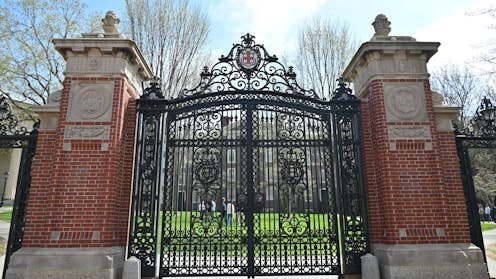
Brown University is one of the Ivy League universities that has recently made a deal with the White House to end the government’s inquiry into its treatment of Jewish students, among other practices, on campus. Kyle Mazza/Anadolu via Getty Images

The Trump administration and Harvard University are reportedly close to reaching a settlement that would require Harvard to pay US$500 million in exchange for the government releasing frozen federal funding and ending an investigation into antisemitism on campus.

This follows similar deals the White House struck with Columbia University and Brown University in July 2025. Both of those universities agreed to undertake campus reforms and pay a large sum – more than $200 million in the case of Columbia and $50 million for Brown – in order to receive federal funding that the Trump administration was withholding. The White House originally froze funding after saying that these universities had created unsafe environments for Jewish students during Palestinian rights protests on campus in 2024.

As a scholar of higher education politics, I examined the various deals the Trump administration made with some universities. When Harvard announces its deal, it will be informative to see what is different – or the same.

I believe the Columbia and Brown deals can be used as a blueprint for Trump’s plans for higher education. They show how the government wants to drive cultural reform on campus by giving the government more oversight over universities and imposing punishments for what it sees as previous wrongdoing.

Here are four key things to understand about the deals:

Two young women wearing long light blue graduation robes walk past a row of police officers outside two large buildings on a gray day.
Columbia University students walk past police on commencement day on May 21, 2025, outside the campus on Broadway in New York.
Selcuk Acar/Anadolu via Getty Images

1. Antisemitism isn’t a major feature of the agreements

The Trump White House accused Brown and Columbia of tolerating antisemitism during campus protests. But the administration neither followed federal standards for investigating antisemitism, nor did it dictate specific reforms to protect Jewish students.

Ahead of its deal, Columbia in March 2025 adopted a new, broader definition of antisemitism that was created by the International Holocaust Remembrance Alliance. The United Nations and most European Union countries also use this definition.

Yet the school’s 22-page deal mentions antisemitism only once, where it says Columbia is required to hire an additional staff member to support Jewish students’ welfare.

Brown’s deal, meanwhile, did not involve the university adopting a particular definition of antisemitism. But Brown did commit to offering “research and education about Israel, and a robust Program in Judaic Studies.” Brown already hosts a Judaic Studies program, and it is unclear from the agreement’s text what additional measures are required.

The deals also extend well beyond antisemitism concerns and into questions of gender and the composition of student bodies.

Columbia agreed to provide “single-sex” housing and sports facilities, for example. The university has an optional Open Housing program that allows mixed-gender roommates and several gender-neutral restrooms.

This places the school in line with Donald Trump’s January executive order that says a person’s gender is based on their sex as assigned at birth.

Brown’s deal also requires single-sex sports and housing facilities. In addition, Brown committed to using definitions of men and women that match Trump’s executive order.

Columbia, which enrolls about 40% of its students from other countries, also agreed to “decrease financial dependence on international student enrollment.”

The Brown deal says nothing about international education.

2. Both deals are expensive but vague about financial details.

Columbia must pay a fine of more than $200 million to the federal government, while Brown will make $50 million in donations to Rhode Island workforce development programs.

In both cases, it is not clear where the money will go or how it will be used.

Congress passed The Clery Act in 1990, creating a legal framework for fining campuses that failed to protect students’ safety.

Since then, the government has reached different settlements with universities.

Liberty University, in Lynchburg, Virginia, was required to pay the federal government $14 million in 2024, for example, for failing to investigate sexual assault allegations.

But Columbia’s payment is far larger than any previous university and government settlement. Columbia will make three payments of about $66 million into the Treasury Department over three years, according to The Chronicle of Higher Education. But it isn’t clear how the money will exactly be spent and what will happen after those three years, The Chronicle of Higher Education reported in August 2025.

Only Congress can legally decide how to spend Treasury Department funds. But Trump has ignored Congress’ appropriation directives on a number of occasions.

Brown, meanwhile, will not pay the government anything. Instead, its deal will go “to state workforce development organizations operating in compliance with anti-discrimination laws, over the ten years.”

The Brown deal doesn’t say what qualifies as qualified workforce development organizations.

3. Trump wants to influence university admissions.

While the Brown and Columbia deals have several differences, the agreements have nearly identical language giving the Trump administration oversight of the way they admit students.

The deals say that the universities must provide the government with detailed information about who applied to the schools and was admitted, broken down by grades and test scores, as well as race and ethnicity. The government could then conduct a “comprehensive audit” of the schools, based on this information.

This information could also be used to determine if universities are showing a preferences for students of color. Without providing evidence, conservative activists have alleged that selective colleges discriminate against white people and that this is a violation of the Civil Rights Act of 1964.

Experts have said that these reporting requirements appear to be intended to increase the number of white students admitted to Ivy League schools.

An older white man with a beard, flanked by two men in suits, bumps fists with a young person in a crowd.
Harvard President Alan Garber greets graduating students at Harvard’s commencement on May 29, 2025, in Cambridge, Mass.
Rick Friedman/AFP via Getty Images

4. The deals could open more doors to federal intrusion.

Claire Shipman, Columbia’s acting president, said in July that the deal would allow the university’s “research partnership with the federal government to get back on track.”

Christina Paxson, Brown’s president, also defended the agreement in a statement, writing that it “enables us as a community to move forward after a period of considerable uncertainty in a way that ensures Brown will continue to be the Brown that our students, faculty, staff, alumni, parents and friends have known for generations.”

But the deals could invite more scrutiny from the federal government.

Both deals spell out the government’s right to open new investigations against Brown and Columbia, or to reopen old complaints if the administration is not satisfied with how the universities are implementing the agreement.

Trump is now pressuring Harvard, UCLA and other universities to strike deals, also based on similar antisemitism allegations.

The White House announced on Aug. 8 that it could seize the research patents, worth hundreds of millions of dollars, that Harvard holds. Since 1980, universities have been able to legally hold, and profit from, patents resulting from federally funded research.

The federal government has long influenced higher education through funding and regulation. But the government has never tried to dictate what happens on campus before now.

Higher education experts like me believe that political goals now drive the way the government approaches higher education. Some of Trump’s conservative allies are now urging the president to go even further, saying “we have every right to renegotiate the terms of the compact with the universities.”

Given these and other pressure tactics, academics who study the law and government warn that the university deals indicate encroaching authoritarianism.

The Conversation

Brendan Cantwell does not work for, consult, own shares in or receive funding from any company or organization that would benefit from this article, and has disclosed no relevant affiliations beyond their academic appointment.

ref. Exactly what is in the Ivy League deals with the Trump administration – and how they compare – https://theconversation.com/exactly-what-is-in-the-ivy-league-deals-with-the-trump-administration-and-how-they-compare-262912


Crowdfunded companies are ‘ghosting’ their investors – and getting away with it

Source: The Conversation – USA (2) – By Andrew A. Schwartz, DeMuth Chair of Business Law, University of Colorado Boulder

Imagine you invest US$500 to help a startup get off the ground through investment crowdfunding. The pitch is slick, the platform feels trustworthy and the company quickly raises its target amount from hundreds of people just like you. Then – silence. No updates, no financials, not even a thank-you.

You’ve been ghosted – not by a friend, but by a company you helped fund.

This isn’t just an unlucky anecdote. It’s happening across the United States. And while it may violate federal law, there’s little enforcement – and virtually no consequences.

Thanks to a 2012 law, startups can raise up to US$5 million per year from the general public through online platforms such as Wefunder or StartEngine. The law was intended to “democratize” investing and give regular people, not just the wealthy, a chance to back promising young companies.

But there’s a catch: Companies that raise money this way are required to file an annual report with the U.S. Securities and Exchange Commission and post it publicly. This report, intended to show whether the business is making progress and how it is using investor funds, is a cornerstone of accountability in the system.

As a professor of business law, I wrote the book on investment crowdfunding. And in my recent research, I found that a majority of crowdfunded companies simply ignore this rule. They raise the money and go silent, leaving investors in the dark.

In most cases, I suspect their silence isn’t part of an elaborate con. More likely, the founders never realized they had to file, forgot about the requirement amid the chaos of running a young business, or shut down entirely. But whether it’s innocent oversight or deliberate avoidance, the effect on investors is the same: no information, no accountability.

This kind of vanishing act would be unthinkable for public companies listed on the stock market. But in the world of investment crowdfunding, limited oversight means that going silent, whatever the reason, is all too easy.

It’s not just 1 or 2 victims

When startups go dark, they don’t just leave their investors behind – they undermine the entire crowdfunding model.

Investment crowdfunding was meant to be an accessible, transparent way to support innovation. But when companies ghost their backers, the relationship starts to look less like an investment and more like a donation.

It’s not just unethical – it’s illegal. Federal law requires at least one annual update. But so far, enforcement has been almost nonexistent.

Concerned state attorneys general have encouraged the SEC to ramp up enforcement actions. This could work in theory, but it’s unrealistic in practice, given the SEC’s limited resources and broad mission.

If nothing changes, the crowdfunding experiment could collapse under the weight of mistrust.

Incentives work − let’s use them

Fortunately, there’s a low-cost solution.

I propose that crowdfunding platforms hold back 1% of the capital raised until the company files its first required report. If it complies, it gets the funds. If not, it doesn’t.

It’s a small but powerful incentive that could nudge companies into doing the right thing, without adding bureaucratic complexity.

It’s the same principle used in escrow arrangements, which are common in finance. In a home sale, for example, part of the money goes into a neutral holding account – escrow – until the seller meets certain agreed conditions. Only then is it released. Applying that approach here, a small slice of crowdfunding proceeds would stay in escrow until the company files its first annual report. No report, no release.

Unfortunately, crowdfunding platforms are unlikely to adopt this voluntarily. They compete with one another for deal flow, and any rule that makes fundraising slightly harder at one platform could send startups to a rival site.

However, the SEC has the legal authority to update its rules, and this change would be easy to implement – no new laws, no congressional fights, just a bit of regulatory will. I’ve even drafted a proposed rule, ready-made for the SEC to adopt, and published it in my recent article, Ghosting the Crowd.

The idea behind investment crowdfunding remains powerful: Open the door to entrepreneurship and investment for everyone. But if that door leads to silence and broken promises, trust will disappear – and with it, a promising financial innovation.

A tiny tweak to the rules could restore that trust. Without it, investors will keep getting ghosted. And the market might ghost them right back.

The Conversation

Andrew A. Schwartz does not work for, consult, own shares in or receive funding from any company or organization that would benefit from this article, and has disclosed no relevant affiliations beyond their academic appointment.

ref. Crowdfunded companies are ‘ghosting’ their investors – and getting away with it – https://theconversation.com/crowdfunded-companies-are-ghosting-their-investors-and-getting-away-with-it-261346

The paradox of pluralism: How college shapes students’ views of other religions

Source: The Conversation – USA (3) – By Ilana Horwitz, Assistant Professor of Jewish Studies and Sociology, Tulane University

Religious pluralism means more than living around people of different faiths. Thai Noipho/iStock via Getty Images Plus

Students at elite universities tend to talk a good game when it comes to religious pluralism. Many of them show up on day one already saying all the right things about respecting different faiths.

But here’s the paradox: They don’t grow from there, according to our research published in The Journal of Higher Education. Students at less selective colleges, meanwhile, do develop more pluralistic attitudes. And by their fourth year, they participate in interfaith activities, such as taking courses about different religions or joining in interfaith dialogues, just as much as anyone else.

Religious pluralism goes beyond tolerance or diversity, which are simply coexisting with people of different faiths. Pluralism involves actively seeking to understand other traditions, talking with people from other backgrounds and working with them toward common goals.

As scholars of religion and education, we worked with sociologist of education David Shuang Song to study how students’ attitudes and actions change over time. We examined data from more than 3,100 students at 112 colleges, using the Interfaith Diversity Experiences and Attitudes Longitudinal Survey. Our study tracked students for four years, measuring two things: their attitudes about appreciating different faiths, and their actual participation in interfaith activities.

Our study revealed three findings.

First, freshmen at highly selective schools – institutions that typically admit fewer than 1 in 5 applicants – often start with stronger support for religious pluralism. Compared with freshmen at less selective schools, they are more likely to agree with questions like “I respect people who have religious or nonreligious perspectives that differ from my own,” though the difference was modest.

Second, fourth-year students at less selective schools showed more pluralistic attitudes than at the start of college. In contrast, students at elite institutions maintained their high initial attitudes without any measurable change.

Third, students at all types of institutions participated in more interfaith activities by the end of college, on average, with less selective schools showing slightly larger gains. That might mean attending services of different faiths, taking courses about other religions or joining dialogue groups.

The bottom line: At less selective colleges, students tended to develop stronger attitudes about religious pluralism, and they also increased their interfaith activities. At elite colleges, students increased their activities, but their attitudes more often remained flat.

Why it matters

The United States is growing more religiously diverse – with growing numbers of non-Christian and nonreligious adults – and more divided across religious lines. Antisemitic and Islamophobic incidents have surged over the past few years, including on college campuses. All of this makes it especially urgent that colleges prepare students to bridge divides.

Our findings reveal an interesting paradox: Elite institutions admit students who already express strong support for religious pluralism on surveys. On average, however, students’ attitudes don’t deepen during college, although their interfaith activities do increase somewhat.

And students’ answers to questions about pluralism don’t necessarily demonstrate genuine commitment. For example, these attitudes may be part of how some elite students learn to seem culturally sophisticated – voicing ideals they associate with being open-minded, cosmopolitan and educated.

The findings may challenge assumptions about where meaningful education about diversity occurs. On average, less selective institutions, which educate most college students, begin with students less inclined toward pluralism. Yet in general, we found that these schools successfully foster growth in both attitudes and behavior – particularly when interfaith programs are integrated into everyday campus life and curriculum. All colleges can challenge students through experiences like interfaith events, research projects or internships.

What’s next

Today’s college students are tomorrow’s civic leaders, educators, policymakers and professionals. If institutions are struggling to cultivate the skills students need to have conversations and collaborate with people from diverse religious backgrounds, the cultural divides that already fracture our democracy are at risk of deepening.

We believe colleges must go beyond performative pluralism to foster the habits of curiosity, humility and collaboration. Pluralism isn’t just a campus value. It’s a civic necessity.

The Research Brief is a short take on interesting academic work.

The Conversation

The authors do not work for, consult, own shares in or receive funding from any company or organization that would benefit from this article, and have disclosed no relevant affiliations beyond their academic appointment.

ref. The paradox of pluralism: How college shapes students’ views of other religions – https://theconversation.com/the-paradox-of-pluralism-how-college-shapes-students-views-of-other-religions-261901

Maths is most popular A-level again – more students should get the opportunity to take their study further

Source: The Conversation – UK – By Neil Saunders, Senior Lecturer in Mathematics, City St George’s, University of London

Gorodenkoff/Shutterstock

In 2025, more young people than ever have opened their A-level results to find out how they did in their maths exam. Once again, maths has been the most popular A-level subject, with 112,138 entries in 2025.

This is up by more than 4% compared with 2024. Entries in further maths, an A-level that expands on the maths curriculum, have also risen – an increase of 7% since 2024, with over 19,000 entries this year.

As a professional mathematician this is pleasing news. Some of these students will be happily receiving confirmation of their place to study maths at university.

The joy I experienced when I discovered in my maths degree that many of the subjects I studied at school – chemistry, biology, physics and even music – are woven together by a mathematical fabric, is something I’ve never forgotten.

I’m excited by the idea that many young people are about to experience this for themselves. But I am concerned that fewer students will have the same opportunities in the future, as more maths departments are forced to downsize or close, and as we become more reliant on artificial intelligence.

There are a number of differences between studying maths at university compared with school. While this can be daunting at first, all of these differences underscore just how richly layered, deeply interconnected and vastly applicable maths is.

At university, not only do you learn beautiful formulas and powerful algorithms, but also grapple with why these formulas are true and dissect exactly what these algorithms are doing. This is the idea of the “proof”, which is not explored much at school and is something that can initially take students by surprise.

But proving why formulas are true and why algorithms work is an important and necessary step in being able discover new and exciting applications of the maths you’re studying.

Student writing on whiteboard
Maths degrees involve finding out why mathematics works the way it does.
Gorodenkoff/Shutterstock

A maths degree can lead to careers in finance, data science, AI, cybersecurity, quantum computing, ecology and climate modelling. But more importantly, maths is a beautifully creative subject, one that allows people to be immensely expressive in their scientific and artistic ideas.

A recent and stunning example of this is Hannah Cairo, who at just 17 disproved a 40-year old conjecture.

If there is a message I wish I knew when I started studying university mathematics it is this: maths is not just something to learn, but something to create. I’m continually amazed at how my students find new ways to solve problems that I first encountered over 20 years ago.

Accessiblity of maths degrees

But the question of going on to study maths at university is no longer just a matter of A-level grades. The recent and growing phenomenon of maths deserts – areas of the country where maths degrees are not offered – is making maths degrees less accessible, particularly for students outside of big cities.

Forthcoming research from The Campaign for Mathematical Sciences (CAMS), of which I am a supporter, shows that research-intensive, higher tariff universities – the ones that require higher grades to get in – took 66% of UK maths undergraduates in 2024, up from 56% in 2006.

This puts smaller departments in lower-tariff universities in danger of closure as enrolments drop. The CAMS research forecasts that an additional nine maths departments will have fewer than 50 enrolments in their degrees by 2035.

This cycle will further concentrate maths degrees in high tariff institutions, reinforcing stereotypes such as that only exceptionally gifted people should go on to study maths at university. This could also have severe consequences for teacher recruitment. The CAMS research also found that 25% of maths graduates from lower-tariff universities go into jobs in education, compared to 8% from higher tariff universities.

Maths in the age of AI

The growing capability and sophistication of AI is also putting pressure on maths departments.

With Open AI’s claim that their recently released GPT-5 is like having “a team of PhD-level experts in your pocket”, the temptation to overly rely on AI poses further risks to the existence and quality of future maths degrees.

But the process of turning knowledge into wisdom and theory into application comes from the act of doing: doing calculations and forming logical and rigorous arguments. That is the key constituent of thinking clearly and creatively. It ensures students have ownership of their skills, capacities, and the work that they produce.

A data scientist will still require an in-depth working knowledge of the mathematical, algorithmic and statistical theory underpinning data science if they are going to be effective. The same for financial analysts, engineers and computer scientists.

The distinguished mathematician and computer scientist Leslie Lamport said that “coding is to programming what typing is to writing”. Just as you need to have some idea of what you are writing before you type it, you need to have some idea of the (mathematical) algorithm you are creating before you code it.

It is worth remembering that the early pioneers in AI – John McCarthy, Marvin Minsky, Claude Shannon, Alan Turing – all had degrees in mathematics. So we have every reason to expect that future breakthroughs in AI will come from people with mathematics degrees working creatively in interdisciplinary teams.

This is another great feature of maths: its versatility. It’s a subject that doesn’t just train you for a job but enables you to enjoy a rich and fulfilling career – one that can comprise many different jobs, in many different fields, over the course of a lifetime.

The Conversation

Neil Saunders is a supporter of The Campaign for Mathematical Sciences.

ref. Maths is most popular A-level again – more students should get the opportunity to take their study further – https://theconversation.com/maths-is-most-popular-a-level-again-more-students-should-get-the-opportunity-to-take-their-study-further-263060

Will Trump-Putin summit leave Ukraine and Europe out in the cold?

Source: The Conversation – UK – By Michelle Bentley, Professor of International Relations, Royal Holloway University of London

Donald Trump will sit down with Vladimir Putin at a snap summit in Alaska on August 15 to discuss the war in Ukraine.

The American president has claimed it’s a victory his Russian counterpart is coming to the US at all. But hanging over the meeting is the fact Alaska was Russian until America acquired it in 1867, with the implicit message that territory does change hands from time to time.

The Alaska meeting is the latest in a series of US-backed attempts to end the war. Trump announced the summit on August 8 after Putin failed to meet a deadline that day to put a ceasefire in place or face US sanctions.

With Putin apparently set to ignore Trump’s threat, the hastily arranged summit was organised to allow the US president to look as if he is still able to wield diplomatic clout over Ukraine. But the danger is that, far from settling the conflict, this meeting could aggravate an already contentious situation.

Putin knows what he wants from the summit: to be awarded territory in Ukraine that his military has occupied, assurances that Ukraine will never join Nato, a demilitarised Ukraine with a Moscow-friendly government, and to end a war he never thought would be so difficult to win.

It’s less clear what Trump wants. The US president hasn’t clarified exactly what his plans are or even what his role is, saying that it isn’t up to him to “make a deal” between Russia and Ukraine.

Trump has described the summit as a “listening exercise”, words that have been seen by some analysts as a way of managing expectations. But Trump has also said there will be “severe consequences” if Putin doesn’t take action to stop the war.

This confusion opens up big questions as to what this summit is actually supposed to do in terms of reaching a meaningful solution.

Clearly, however, a lot hinges on territory. Ahead of Friday’s meeting, Trump has talked of “land-swapping”.

But what does this mean? The US president told a news conference on August 11 that he wants to return territory to Ukraine and “get back Ukraine’s oceanfront property”.

His public statements, which had always been either ambivalent or supportive of Putin, have been tougher on the Russian president of late – recently calling Putin a “disappointment” and describing Russian attacks on Ukraine as “disgusting”. Trump also upped the ante when he ordered two US nuclear-armed submarines to deploy closer to Russia earlier this month.

Given all this, it might seem on the surface as if Trump has moved closer to supporting Ukraine. But the reference to swapping land has caused alarm.

Ukraine has never laid claim to any Russian territory – it just wants its own back. It’s not clear Kyiv has anything to “swap” but land that was part of Ukraine before Russia invaded.

Russian land grab

The fact is that Putin isn’t talking about a land-swap – he’s talking about land acquisition. After some confusion when US envoy Steve Witkoff appeared to be mistaken about what Putin is asking for, it became clear that Putin is playing hardball.

The Russian president is calling for Ukraine’s withdrawal from its defensive positions in Donetsk and Luhansk in exchange for a ceasefire. These are regions which were partly occupied by Russia in 2014, more of which was taken after the 2022 invasion.

Ukrainian president Volodymyr Zelenksy has ruled this option out, saying it would be both unacceptable and illegal under Ukraine’s constitution.

ISW map showing the state of the conflict in Ukraine as of August 12 2025.
The state of the conflict in Ukraine as of August 12 2025.
Institute for the Study of War

It isn’t clear that Trump will respect Ukraine’s position. Despite his more recent criticisms of Putin, Trump has a track record of public support for the Russian president.

And Trump has now given Putin a sense of credibility by simply agreeing to see him. A meeting with the US president carries a lot of weight. It’s a fact not lost on Zelensky, who called the summit “a personal victory” for Putin.

Who isn’t in the room?

Another problem is that Zelensky is not on the summit’s guest list. While Trump spoke to Zelenksky and EU leaders on Wednesday – and has floated the idea of future discussions between Ukraine and Russia – this is not the same as being in the room where it happens now.

Zelensky has made it clear that any negotiation which does not directly involve Ukraine will produce “dead decisions”.

Europe is similarly unimpressed at being sidelined from the meeting. The EU and Nato’s European member states have clear expectations about what Trump’s efforts should involve.

Nato secretary-general, Mark Rutte, believes the summit should be about “testing Putin” to see how serious the Russian president is when it comes to a plan for stopping the conflict.

While Rutte did not rule out some concessions on territory, he has also called on both the US and Russia to respect Ukrainian sovereignty and provide security guarantees to back any ceasefire agreement. If Trump doesn’t deliver on this, this will upset US relations with the rest of Nato.

Putin may have been hoping that the summit would put pressure on Ukraine to concede to his demands. He is likely hoping that if he can give the impression that he is willing to make a deal and it’s Ukraine that is the sticking point, the international community will be sympathetic towards him.

But Ukraine and European leaders clearly expect more and are unlikely to play along with that narrative.

So a lot will depend on how Trump now frames the discussion. If he repeats his past performances at summits with Putin and appears to back the Russian leader over his country’s closest allies, it is likely to cause a dangerous rift in the western alliance.

The Conversation

Michelle Bentley does not work for, consult, own shares in or receive funding from any company or organisation that would benefit from this article, and has disclosed no relevant affiliations beyond their academic appointment.

ref. Will Trump-Putin summit leave Ukraine and Europe out in the cold? – https://theconversation.com/will-trump-putin-summit-leave-ukraine-and-europe-out-in-the-cold-262974

Trump’s Alaska summit with Russia is shaping up to be the most important of his second presidency

Source: The Conversation – UK – By Stefan Wolff, Professor of International Security, University of Birmingham

What happens when a convicted felon and a man under indictment for alleged war crimes get together? What sounds like the opening line of a great joke, sadly, is probably the defining meeting of the second term of Donald Trump as US president.

As with any meetings involving Trump, expectations are low and anxieties are high in the run-up to the US-Russia summit in Alaska on August 15.

The White House, and Trump himself, have played down expectations of an imminent breakthrough towards peace in Ukraine, claiming that this would be “a feel-out meeting” to determine whether a ceasefire is possible. In typical hyperbole, the US president added that he was confident that it would probably only take him two minutes to know whether a deal is possible.

A subsequent threat that “there will be very severe consequences” if Putin does not agree to stop the fighting appears somewhat hollow now given that the reward for Putin ignoring Trump’s last deadline was an invitation to the US.

While framed almost solely as a meeting about the Russian war against Ukraine, it would be naive to assume that this is all that is on Trump’s agenda. There are two possible deals Trump could try to make: a deal with Putin on a ceasefire for Ukraine and a deal resetting relations between Russia and the US. Trump is interested in both, and he does not see them as mutually exclusive.

Trump has long talked about a ceasefire, and is probably genuinely keen for the fighting to stop. He probably also sees value in a ceasefire agreement in his quest for the Nobel peace prize.

There have been serious and justified misgivings in Ukraine and among Kyiv’s European allies that this two-way get-together will take place without any Ukrainian or European participation. This has prompted a flurry of diplomatic activity within Europe and across the Atlantic. Ukraine’s red lines have been clearly set out and fully backed by European leaders.

Neither will accept full legal recognition of the kinds of land swaps that both Trump and his secretary of state, Marco Rubio, have suggested. Security guarantees and Russian reparations for the damage done to Ukraine in three-and-a-half years of war are other likely stumbling blocs.

ISW map showing what Novorossiya (New Russia) would look like if Putin's demands for a ceasefire are met.
What Novorossiya (New Russia) would look like if Putin’s demands for a ceasefire are met.
Institute for the Study of War

If there is a deal on a ceasefire, this will probably take the form of a broad and ambiguous framework that all sides would subsequently interpret differently. Part of such a framework would likely be a timeline and conditions for a Trump-Putin-Zelensky summit – most likely again without European participation.

This would be another gift for the Russian president as it would potentially put Zelensky in a position where both Trump and Putin would pressure him to accept an unfavourable deal or lose all US support.

By contrast, a US-Russia reset would be a more straightforward business deal – primarily with US economic interests in mind, but with significant geopolitical implications. There are few signs that Trump has given up on his agenda to “un-unite” Russia and China.

But, importantly, this is less about new American alliances and more about Trump’s ideas of re-ordering the world into American, Russian and Chinese spheres of influence. This would be easier to for the White House to achieve after a reset with the Kremlin.

Likely outcomes

As an outcome of the Alaska summit, such a reset of US-Russia relations is also most likely to materialise as a framework that simply identifies areas for future deals between the two sides. Any process to implement such a bilateral agreement between Moscow and Washington could begin immediately and run in parallel to any Ukraine negotiations.

This, too, would be a big bonus for Moscow. The Kremlin will be hoping that the further along things move on the US-Russia reset track, the more likely Trump will be to back Putin in negotiations with Ukraine.

Putin is clearly more interested in improving bilateral relations with the US than he is in a ceasefire. He has, for now, skilfully avoided Trump’s threats of sanctions while his forces have achieved what looks like an important breakthrough on the battlefield. This is not necessarily a game changer in the war overall, but it certainly strengthens Putin’s hand ahead of his meeting with Trump.

His troops’ battlefield success also decreases the urgency with which the Russian president is likely to approach negotiations – in the absence of Trump following through on his recent ultimatum threats, and with Ukraine and its European allies shut out of their meeting, Putin has every incentive to play for more time.

But the Russian president has to tread a careful line, bearing in mind that Trump got increasingly frustrated when, after seemingly productive phone calls between them, Putin then launched airstrikes a few hours later. Putin might offer a limited pause in Russia’s air campaign to avoid the civilian casualties that Trump has condemned.

But as long as his ground troops make further territorial gains, he is unlikely to stop – at least until he has full control of the four Ukrainian regions that the Kremlin has claimed as Russian in addition to Crimea.

Ukraine, by contrast, needs a ceasefire now and then a credible peace deal in which any necessary concessions are minimal and which comes with proper security guarantees. The European-led coalition of the willing appears to offer such guarantees now, and Trump might even support this.

But this is no guarantee that the US president will not flip again to take Putin’s side and push for an overly pro-Russian deal at a future three-way summit. During such a summit, even if it were just a scripted signing ceremony, there is every chance that Trump would go off-script or that Putin would manipulate him to do so.

This could then derail in a way similar to what happened during the White House row between Trump and Zelensky on February 28.

Kyiv’s European allies have made it clear that they will not abandon Ukraine. For all his deal-making bluster, a similar commitment is unlikely to be made by Trump.

The Conversation

Stefan Wolff is a past recipient of grant funding from the Natural Environment Research Council of the UK, the United States Institute of Peace, the Economic and Social Research Council of the UK, the British Academy, the NATO Science for Peace Programme, the EU Framework Programmes 6 and 7 and Horizon 2020, as well as the EU’s Jean Monnet Programme. He is a Trustee and Honorary Treasurer of the Political Studies Association of the UK and a Senior Research Fellow at the Foreign Policy Centre in London.

ref. Trump’s Alaska summit with Russia is shaping up to be the most important of his second presidency – https://theconversation.com/trumps-alaska-summit-with-russia-is-shaping-up-to-be-the-most-important-of-his-second-presidency-263087

Alaska summit: why Donald Trump should heed the lessons of Munich 1938 when he meets Putin

Source: The Conversation – UK – By Tim Luckhurst, Principal of South College, Durham University

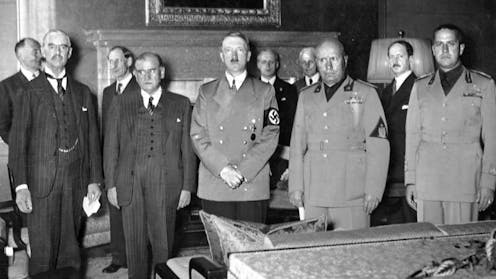
Betrayal: where were the Czechs when their country was given away? Bundesarchiv, CC BY-ND

Donald Trump meets Russian president Vladimir Putin in Alaska on September 15 for their first summit of Trump’s second term. Their topic of discussion will be the war in Ukraine. The pair may decide the fate of the country which Putin began to illegally occupy in 2014 and which Russian forces invaded in an outright war of aggression in February 2022.

Trump has hinted that he could agree, in a two-way summit without the involvement of the Ukrainian president Volodymyr Zelensky, to the handing over of Ukrainian territory to Russia. If he does, this would bear close resemblance to an act of betrayal which took place in Munich on September 30 1938 and, ominously, is now understood as a key step on the road to the second world war.

The deal struck by the then British prime minister, Neville Chamberlain, and his French counterpart, Édouard Daladier, with the German leader Adolf Hitler handed Hitler territory in Germany’s neighbour Czechoslovakia in return for what Chamberlain erroneously boasted would be “peace in our time”. Within months Nazi Germany would take control of much of the rest of Czechoslovakia and in less than a year the whole of Europe would be at war.

Similar to the Trump-Putin summit’s exclusion of Zelensky, the Czech leader Edvard Beneš was not included in the Munich summit. There had already been ample indication of Hitler’s bad faith in the spring and summer of 1938. Hitler had begun issue increasingly strident complaints about alleged Czech mistreatment of the German-speaking minority in Sudetenland, territory which had been handed to the newly formed state of Czecholoslovakia after the first world war, but which contained 3 million ethnic Germans.

By May Hitler was openly talking about destroying Czechoslovakia and on September 12 he made a speech vowing to “solve the question” once and for all. In response Chamberlain flew to see Hitler at Bad Godesberg, where they agreed that Germany would take control of all areas of the Sudetenland with a greater than 50% concentration of Germans.

The British prime minister persuaded the Czech president Edvard Beneš to accede to this demand, but within days Hitler had reneged, saying he would have the whole territory by October 1. This prompted Britain and France to accelerate their rearmament efforts. Chamberlain ordered the British fleet to put out to sea and on September 25 France ordered its army to mobilise.

The next step was choreographed with the help of Italy’s fascist dictator Benito Mussolini who – in the knowledge that Italy was not ready for a European war at that stage – set up another conference for September 29-30 in Munich. Britain and France agreed to travel to meet Hitler, who at that stage was aware that there was little appetite for war either among the German people or his own generals.

Beneš, meanwhile, was preparing his people to resist the German threat. Troops were sent to the borders between Sudetenland and Germany where Czechoslovakia had built considerable fortifications.

Chamberlain and Daladier duly met Hitler in Munich where over two days an agreement for the occupation of Sudetenland was thrashed out and a four page document signed by the three leaders and Mussolini. No Czech official was involved in either the negotiations or the signing of the agreement.

Map of Czechoslovakia in 1938 with Sudetenland.
Czechoslovakia in 1938 with Sudetenland.
Weiner Holocaust Library

On hearing of the deal, Beneš said: “Munich is a betrayal that will be its own punishment,” adding: “Britain and France think they will save themselves from war and revolution at our expense, but they are wrong.” He stepped down a few days later.

Relief – but a disastrous outcome

At the time, the British press cheered Chamberlain as a hero and the agreement as a diplomatic triumph. It’s important to remember that at that stage, just 20 years after the catastrophic Great War had finished, there was very little appetite for another major conflict in Europe.

As The Times, which was in lockstep with the government on this issue, explained in an editorial “feelings were running so high” that the separation of the Sudetenland from Czechoslovakia “without a plebiscite seemed the only solution”. The newspapers editor at the time, Geoffrey Dawson, was a convinced supporter of Chamberlain so closely connected to the British Government that he has been described as “an ex officio member of the Cabinet”.

Hitler’s gamble had paid off. His troops occupied the Sudetenland on October 1 1938, securing for Germany the extensive border fortifications Czechoslovakia had prepared for its own defence. Within a matter of months Germany was ready to execute the second part of Hitler’s plan for Czechoslovakia.

On March 15, having used the same strategy of reporting the mistreatment of ethnic Germans in Bohemia and Moravia, Hitler summoned Emil Hácha, a quietly spoken lawyer who had been drafted in to replace Beneš after Munich.

Informing the new Czech leader that the order had already been given to the Luftwaffe to launch bombing raids over Prague and other big cities, the German leader forced Hácha to agree to accept an agreement whereby his country would become a German protectorate.

Chamberlain’s efforts to appease Hitler may have secured time for Britain to rearm and prepare for war. However, this had not been Chamberlain’s objective. He believed that by offering the Nazi regime what it wanted, he could secure an enduring peace. In fact, his concessions encouraged Hitler’s belief that threats of force could secure territorial gains.

The concern now must be that if Donald Trump accedes too readily to Putin’s territorial demands, Ukraine may suffer the same fate. Trump has already talked of “land swaps”.

If he agrees to allow Russia to annex what is left of the Donbas, it will mean that a vital area of territory where Ukraine’s armed forces have been holding Russia at bay since 2014 will be handed to Russia. This would leave the way clear for a resumption of hostilities at a later date, this time without the barriers of Ukraine’s fortified defensive line.

Ukraine – and Europe – will be hoping that Trump can hold his nerve when he meets Putin in Alaska on Friday.

The Conversation

Tim Luckhurst has received funding from News UK and Ireland Ltd. He is a member of the Free Speech Union and a member of the Editorial Board of The Conversation UK. His latest book, Reporting the Second World War – The Press and the People 1939-1945 is published by Bloomsbury Academic.

ref. Alaska summit: why Donald Trump should heed the lessons of Munich 1938 when he meets Putin – https://theconversation.com/alaska-summit-why-donald-trump-should-heed-the-lessons-of-munich-1938-when-he-meets-putin-263125

Botox: unlicensed injections are increasingly being linked to serious illness in the UK

Source: The Conversation – UK – By Adam Taylor, Professor of Anatomy, Lancaster University

A confirmed 41 cases of botulism have been reported in the UK between June and August of this year. Prostock-studio/ Shutterstock

Botox is the most common non-surgical procedure performed globally – with nearly 9 million procedures estimated to take place each year. In the UK alone, around 900,000 Botox injections are carried out each year.

But with a the growing popularity of this procedure comes an increase in risks and unwanted outcomes.

The UK Health Security Agency has recently reported a significant rise in clinically confirmed cases of botulism – a rare illness that can cause symptoms ranging from fatigue, headaches and dizziness to difficulty breathing. Between June 4 and August 6 2025, 41 cases have been confirmed in the UK. While these cases appear to be linked to the use of unlicensed products which are much more potent than Botox, even licensed products can sometimes come with risks.

Botox is short for botulinum toxin. It’s the most lethal toxin known to man. Even just a small fragment of botulinum toxin – weighing a fraction of the weight of a grain of salt – can be enough to kill a human. This is a key reason why only approved Botox products should be used, as their ingredients and strength have been carefully scrutinised.

Botox is produced by a bacterium called Clostridium Botulinum, which is usually found in water, soil and the intestinal tracts of animals. These bacteria can produce seven distinct types of toxin. Only types A and B are used clinically, though Botox type A is the one most commonly used in cosmetic procedures.

Botulinum toxin acts as a neurotoxin – meaning it impacts nerve function. It specifically inhibits the function of the neurotransmitter acetylcholine which is found in the neuromuscular junction between the nerve and muscle. A variety of nerves use this neurotransmitter – including those involved in key bodily functions such as digestion, breathing and movement.

Botox works cosmetically by inhibiting the function of the neuromuscular junction, which paralyses the nerve. This means the muscle doesn’t contract, limiting the overlying skin’s ability to wrinkle. This same function is also the reason Botox is used to treat eye twitches, chronic migraines, neck spasms, excess sweating, overactive bladder and crossed eyes.

It can take a few days after injection for the full effect of the Botox to occur. From here, the body begins breaking it down. After around three to four months its effects have fully diminished, which is why follow-up treatments are required.

Botox and botulism

As with any procedure, Botox comes with risks.

The most common side-effects people experience are some initial bruising and swelling and tenderness around then injection site.

An older man receives a Botox injection into his forehead from a woman who is wearing scrubs and organ surgical gloves.
Even licensed Botox products can come with risks.
Tijana Simic/ Shutterstock

But the more concerning side-effect is the risk of botulism. This is a rare complication that can cause symptoms ranging from mild to severe. It isn’t known how common botulism is in people who get Botox, but up to 25% of people who receive cosmetic Botox have complications. Botulism symptoms usually appear the day after receiving botox – but in some cases, they can manifest as many as 36 days later.

Mild symptoms include fatigue, headaches, dropping eyelids and visual disturbances. Moderate symptoms involve mild symptoms and difficulty swallowing.

In the worst case scenario, botulism can lead to anaphylactic shock and respiratory failure. Around 5-10% of untreated botulism cases result in death.

Thankfully, if identified early, treatments are available and effective. But it’s important to note that these treatments cannot reverse any damage that has already been done. They only work to halt further damage. Recovery from botulism can take months.

Botuslism can sometimes be mistaken for myasthenia gravis or Guillain-Barre syndrome, two autoimmune conditions that have overlapping symptoms. This is why it’s important to tell your doctor if you’ve had Botox, as there’s no immediate test for the toxin and those tests that show its presence take several days to produce results.

Staying safe

A few key factors can increase your risk of developing botulism from Botox.

Improper administration increases the likelihood of Botox spreading away from the injection site. This increases the risk of experiencing side-effects – including botulism.

Exceeding the maximum dose is another factor that increases your risk of botulism. This can happen through basic calculation errors and injecting the wrong amount for the injection site. For instance, men require a higher dose than women due to their increased muscle mass. Not accounting for this could easily result in a dosing error.

Repeated Botox use can also lead to Botox resistance, where a patient has built antibodies against the toxin or metabolises the Botox very quickly. This means they wouldn’t get the required Botox effect. It may mean that a patient would request a higher dose – potentially above recommended administration levels – to get any effect.

This can be dangerous and also counterproductive as increasing amounts of Botox runs the risk of increasing antibody production and further reducing the effectiveness of Botox. It also increases the risk of botulism.

Unlicensed Botox products also come with the risk of botulism. The recent spike of botulism cases in the UK have been linked to two unlicensed products, Innonox and Toxpia. Both are illegal to supply and use in the UK because their safety hasn’t been assessed by regulatory bodies.

These products also work differently to Botox. For instance, Innonox is also a “ready-made solution”, which means it can be injected without having to be dissolved in saline. This could lead to an increased risk of dosing errors if a practitioner is not used to the product or switches between using licensed Botox products and unlicensed ones.

Using a reputable and qualified practitioner is the best way to avoid contracting botulism. They will know how to properly inject Botox, which dose is safe for you and will only use products that are approved for cosmetic use.

The Conversation

Adam Taylor does not work for, consult, own shares in or receive funding from any company or organisation that would benefit from this article, and has disclosed no relevant affiliations beyond their academic appointment.

ref. Botox: unlicensed injections are increasingly being linked to serious illness in the UK – https://theconversation.com/botox-unlicensed-injections-are-increasingly-being-linked-to-serious-illness-in-the-uk-262398

Edinburgh Festival: ten of the best art shows to see this summer

Source: The Conversation – UK – By Katarzyna Kosmala, Chair in Culture Media and Visual Arts, University of the West of Scotland

Edinburgh is once again joyfully alive with creativity and originality as the UK’s largest arts event returns. Staged in the oak grove of the city’s Botanical Gardens, the opening night of the 2025 Edinburgh Art Festival presented a sensory explosion that set the tone for the entire run.

British artist Linder’s dazzling, genre-defying performance spectacle fused Holly Blakey’s visceral choreography, Maxwell Sterling’s haunting soundscapes and Ashish Gupta’s flamboyant fashion, showcasing an eerie synthesis of body and nature.

This year – the 21st edition – offers a rich celebration of memory, identity and imagination, and with 82 exhibitions across 45 venues, it’s the biggest yet. Here’s our pick of the best from a visual feast for lovers of contemporary art.

1. Linder: Danger Came Smiling

This exciting show is a retrospective spanning five decades of fearless, boundary-pushing art. From punk and feminist photomontages to surreal fashion interventions and video work, Linder dissects our cultural obsessions with feminism, fairytales, flora and the human form. A rich tapestry of provocation and enchantment, this is a show not to be missed.

Royal Botanic Garden, Arboretum Place until October 19 2025, free

2. Who Will Be Remembered Here

Lewis Hetherington and CJ Mahony present a powerful, poetic film connecting queer lives across Scottish heritage sites. Developed in collaboration with Historic Environment Scotland, this is a deeply moving multilingual tribute to silenced histories and a comment on the erasure of cultures and identities. Personal stories are performed with passion in English, Scots, Gaelic and BSL. The show features places imbued with personal meaning, such as the industrial ruins of Biggar gasworks and the 2000-year-old Machrie Moor stone circle on Arran.

EAF Pavilion, 45 Leith Street until August 24 2025, free

3. Drama 1882

The UK premiere of Egyptian artist Wael Shawky’s exhibition explores the Anglo-Egyptian war through film installation featuring puppetry, drawings and historical narrative. Visually stunning and politically resonant, Shawky narrates religious wars, the Crusades and events leading up to the British occupation of Egypt from an Arab perspective. The show embraces lesser known and contradictory accounts to represent the making of history from an alternative perspective.

Talbot Rice Gallery, South Bridge until September 28 2025, free

4. Fire on the Mountain, Light on the Hill

Buenos Aires-based artist Mercedes Azpilicueta’s monumental tapestry weaves stories of protest and political expression in a vibrant collage of archival and contemporary imagery. Referencing war, food economies, collective action and women-led rights movements, this is a powerful and insightful commentary on overlooked histories. August 22 marks Azpilicueta’s live performance exploring themes of the struggles and resistance of women – real and fictional – across time.

The Collective Gallery, City Observatory at Calton Hill until September 7 2025, free; live performance on Calton Hill, August 22, free

5. Humpty Dumpty

British artist Mike Nelson has appropriated the Fruitmarket’s Warehouse space to recreate a haunting labyrinth of a derelict housing estate in his latest show. Unable to put things back together again, the installations arise from two sets of photographs documenting the condemned Heygate council estate in London, and new infrastructure building plans in Mardin, a city in eastern Turkey, near the Syrian border. The work captures cities in flux, commenting on construction and destruction, global politics and people’s struggle against regeneration, gentrification and social cleansing.

Fruitmarket Gallery, 45 Market Street until October 5, 2025, free

6. Give Light And People Will Find The Way (Ella Baker)

Scottish-Pakistani artist Rabiya Choudhry joins Chloe Reith (The Common Guild) and Martha Burns (National Library of Scotland) in conversation to discuss her new installation. Drawing on the legacy of African-American civil rights activist Ella Baker, it merges her powerful and inspiring words with Andrew Carnegie’s flaming torch – a symbol of enlightenment and public access to knowledge.

The illuminated work, representing collective strength, resilience and the power of learning, finds its permanent home at Craigmillar Library, a civic space rooted in community. The unveiling coincides with Dear Library, a new exhibition celebrating the centenary of the National Library of Scotland, and reflecting the role of libraries as beacons of hope and empowerment.

Craigmillar Library, 101 Niddrie Mains Road; Dear Library in-conversation event with Rabiya Choudhry, National Library of Scotland, George IV Bridge, August 14, 5.30pm, free

7. Resistance

Curated by British artist and filmmaker Steve McQueen, this striking show explores how countercultures and acts of protest have shaped life across the UK, and the powerful role of photography in documenting and driving change. It features renowned photographers such as Paul Trevor, Fay Godwin, Vanley Burke, John Deakin and Tish Murtha alongside lesser-known names. Underrepresented and marginalised voices are highlighted in this compelling exploration of overlooked histories.

Modern Two, National Galleries of Scotland, 73 Belford Road until January 4 2026, £14 (£2-£12 concession)

8. The Edinburgh Seven Tapestry

This extraordinary piece of work designed by Scottish artist Christine Borland and created by the city’s Dovecot Studios, commemorates the first women to enrol at Edinburgh University to study medicine. In 1870, the Surgeons’ Hall riot saw student and public protesters attempting to block the seven women from sitting an anatomy exam. Although the riot proved unsuccessful, the women’s fight to qualify as doctors eventually led to the Medical Act of 1876, legally permitting women to practise medicine.

The tapestry was created using a combination of traditional and modern materials and techniques. Borland’s organic shapes are ingeniously based on cellular structure in motion, with magenta and cyan hues representing the dyes that were used in both textiles and the scientific staining of human cells in the 19th century.

Edinburgh Futures Institute, 1 Lauriston Place until December 31 2025, free

9. Ring of Truth

A rare fusion of art, music and ancient philosophy makes up this collaboration between artists, musicians and historians. The show explores cosmic harmony and mysticism inspired by the Music of the Spheres manuscripts – ancient Coptic compositions from 5th and 6th-century Egypt. It features the work of Nurah Farahat, Haroon Mirza, Jack Jelfs, Craig Coulthard, Luke Fowler, David Maclean, Julie Johnstone, Edward Summerton, Alan Grieve and William Voelkle.

Blackie House, 6 Wardrop’s Court until August 24, free

10. Let Me Show You Who I Am

Created to be shown on billboards across the city, Alice Rekab’s arresting work delves into themes of diaspora, migration, queer identity and mixed heritage. The artworks have been created through a dynamic series of workshops exploring Black and Irish legacies of community activism and creativity across the UK. The artist’s explorations of Irish, Sierra Leonean, and Syrian family histories create powerful visual narratives of belonging.

Across Edinburgh until August 24, free


Looking for something good? Cut through the noise with a carefully curated selection of the latest releases, live events and exhibitions, straight to your inbox every fortnight, on Fridays. Sign up here.


The Conversation

Katarzyna Kosmala does not work for, consult, own shares in or receive funding from any company or organisation that would benefit from this article, and has disclosed no relevant affiliations beyond their academic appointment.

ref. Edinburgh Festival: ten of the best art shows to see this summer – https://theconversation.com/edinburgh-festival-ten-of-the-best-art-shows-to-see-this-summer-262748

The Materialists: a sadly conservative view on marriage

Source: The Conversation – UK – By Sarah Louise Smyth, Lecturer in Department of Literature Film and Theatre Studies, University of Essex

This article contains spoilers for The Materialists

The Materialists purports to be a romantic comedy with a cynical and pragmatic look at romantic relationships. Its protagonist, Lucy (Dakota Johnson), a professional matchmaker, insists that a successful partnering is all about pairing the right numbers: salary, assets, height, weight, age. The man should be tall, the woman should be young and slim; both need to be rich.

This is a world of traditional gender norms, so the film does not concern itself with queer relationships. That is beyond one gag when Lucy interviews a woman who wants to find a Republican lesbian.

As the film goes on, Lucy’s matchmaking philosophy is tested when she becomes acquainted with Harry (Pedro Pascal) – tall, slim, handsome, wealthy, single (what the matchmaking business in the film calls “a unicorn”). At the same time, she runs into her ex-boyfriend John (Chris Evans), who, despite also being tall, slim and handsome, is poor and living in a squalid apartment with dysfunctional flatmates (all reasons they broke up the first time around). The film hinges on the question: what will Lucy choose, love or money?

As an expert in romantic comedies, I can tell you they have long been concerned with the marriage of romance and money, even if economics are tastefully relegated to the background.

Ground zero for the romance plot was Jane Austen’s Pride and Prejudice, which set the template. Elizabeth Bennet fell in love with Mr Darcy – and it was a wonderful coincidence that he just so happened to be rich.

Since then, this plot has repeated in Pretty Woman (1990), Sex and the City (1998-2004), Bridget Jones’s Diary (2001), You’ve Got Mail (1998) and Crazy Rich Asians (2018), to name a few. In these romances, a key part of the fantasy is not only that the woman (for it is always a woman) is saved from abject singledom, but that she enters the upper echelons of society through her partner’s wealth.

The Materialists attempts to puncture this fantasy by foregrounding the role of money in relationships. A delicious scene occurs early on when Lucy is summoned to a bridal suite where her client is having cold feet about the man she is marrying. The suite looks expensive and the bride is beautiful.

Lucy asks the bride why, in her darkest moments, she wants to marry her fiancé. The bride sheepishly replies that it makes her sister jealous. Her fiancé is better looking, taller and richer than her sister’s husband. A flash in Lucy’s eyes suggests she can work with this. This is about being valued, Lucy reassures the bride, you want to be seen and to get what you deserve.

The stakes of this world are made clear: a good match is about perception and prestige and the emotional implications that come with it can be manipulated to justify these standards.

However, the burgeoning love triangle between Lucy, Harry and John confuses these insights. Director and writer Celine Song’s beautiful, tender and restrained debut, Past Lives (2023), also explored a love triangle. While the romantic entanglements of this film were nuanced, the emotional stakes were always clear eyed. This is less true in The Materialists.

Lucy insists that marrying someone wealthy is non-negotiable for her but then breaks up with Harry for no discernible reason. Just before the breakup scene, the film reveals a strange twist in the story. Harry got painful and invasive leg lengthening surgery, enabling him to reach the critical height of six foot. Lucy is insistent that this is not the reason she breaks up with Harry and the film seems to believe her, so the role of this storyline is unclear. Is it that, in this world, women (except for Lucy, perhaps) are as shallow as men?

Lucy then gets back together with John despite no clear indication of what he offers her emotionally or financially, especially as there has been no change in his circumstances. And this is to say nothing of a sexual assault storyline that is uncomfortably shoe-horned in, or the role of race and ethnicity in matchmaking.

Like queer sexuality, race is introduced as a joke by a white character who only wants to date other white people. Also, the role of Harry’s heritage (Pascal is Latino) was not mentioned as a potential problem for the wasps (white Anglo-Saxon protestants) who make up the majority of New York’s elite.

Ultimately, The Materialists suggests that people should stay in their lane. Lucy and Harry come from different worlds, while Lucy and John’s are very similar. As they admit to each other, as well as coming from modest backgrounds, they are both smokers, come from “shitty families” and support left-wing politics. The Pride and Prejudice plot may be a crass fantasy of social mobility, but The Materialists appears all the more conservative. If it is not clear whether Lucy and John marry for love nor money, what do they marry for?


Looking for something good? Cut through the noise with a carefully curated selection of the latest releases, live events and exhibitions, straight to your inbox every fortnight, on Fridays. Sign up here.


The Conversation

Sarah Louise Smyth does not work for, consult, own shares in or receive funding from any company or organisation that would benefit from this article, and has disclosed no relevant affiliations beyond their academic appointment.

ref. The Materialists: a sadly conservative view on marriage – https://theconversation.com/the-materialists-a-sadly-conservative-view-on-marriage-263136