Tanzania’s independence leader Julius Nyerere built a new army fit for African liberation: how he did it

Source: The Conversation – Africa (2) – By Michelle Moyd, Associate Professor, Department of History, Michigan State University

Tanzania has long enjoyed a reputation as a peaceful country. In contrast to most of its neighbours, this east African nation of 67 million people has largely avoided large-scale violence within its borders.

That didn’t seem likely in the early years after independence from Britain in December 1961. A little over two years into independence – in January 1964 – the founding president, Julius Nyerere, faced two political crises. The first started on 12 January 1964 in the form of the Zanzibar Revolution. Weeks of violence and destruction by Afro-Shirazi Party members followed. As many as 16,000 Zanzibaris were killed or forced into exile.

Then the country’s military, the Tanganyika Rifles, mutinied. Its soldiers were incensed over inadequate pay, loss of privileges, and poor prospects for upward mobility. A rattled Nyerere needed British military support to quell the mutiny. He ordered the arrests of its leaders, and effectively dismantled the entire force.

Nyerere then faced the dilemma of leading a new nation-state with no army and few resources to build one. His socialist agenda (Ujamaa, in Kiswahili) had prioritised other aspects of nation-building, especially education and public health. Nonetheless, with assistance from the Organisation of African Unity (OAU) and the willingness of some of its member states to provide troops, the Tanzania People’s Defence Force was established in September 1964.

In his new book, Ujamaa’s Army: The Creation and Evolution of the Tanzania People’s Defence Force, 1964-1979, Charles G. Thomas, a scholar of post-colonial African military history, skilfully narrates this complex and absorbing history. The book covers the formation and transformations of the defence force through the new nation’s first 15 years as it shed its connections to the colonial past and charted a new path.

Unlike other writing on African armies – particularly the body of work on colonial armies – this one does not centre rank-and-file troops. Instead, Thomas’s analysis is based on rich interviews with high-ranking officers who led and moulded the force in its first two decades. This has enabled him to offer a top-down view of the construction of the army.

A rocky start

Nyerere undertook the work of unifying Tanganyika and Zanzibar in the first few months of 1964 with an eye to the region’s security. The Zanzibar revolution and the Afro-Shirazi Party’s Marxism had called attention to the island as a potential Marxist outpost. Violence against the island’s ruling party and those perceived as wealthy elites seemed to bolster this perception. In the context of the cold war, this fuelled western fears of Zanzibar becoming the “Cuba of east Africa”. An influx of Soviet and Chinese military advisers to Zanzibar made western powers nervous.

Nyerere and foreign minister Oscar Kambona worked with Afro-Shirazi Party leader Abeid Karume to unify Tanganyika and Zanzibar to reassure westerners.

The rollout of the defence force in September 1964 thus included members of the Zanzibari People’s Liberation Army. This signalled that the initial 1,000-man army would serve the larger interests of socialist Tanzania.

A regional role

Throughout the 1960s, Tanzania became, alongside Zambia, Botswana, Lesotho, Angola and Mozambique, a supporter of southern African liberation struggles. The OAU formally recognised this group of nations as the “frontline states” in 1975.

Nyerere convinced the OAU Liberation Committee to set up its headquarters in Dar es Salaam in 1963 because Tanganyika was already hosting many southern African exiles. Also, conflicts in neighbouring states, such as Mozambique, were spilling over into Tanganyika. It became the nerve centre for coordinating African liberation efforts.

Liberation organisations from across southern Africa also established offices in Dar es Salaam. These included the African National Congress and the Pan-Africanist Congress from South Africa; the People’s Movement for the Liberation of Angola (MPLA); Zimbabwe African People’s Union (Zapu) and Zimbabwe African National Union (Zanu); South West Africa People’s Organisation (Swapo) from Namibia; and Mozambique Liberation Front (Frelimo).

The Tanzanian defence force took on a key role in frontline liberation struggles. In 1964 it established the Special Duties Unit, which provided a logistics pipeline to serve liberation armies.

The defence force also established training camps for liberation armies within Tanzania. And it took on a protective and support function in southern Tanzania, where Frelimo’s operations against the Portuguese embroiled communities.

Tanzania’s involvement in struggles against the white settler states of southern Africa intensified in the late 1960s and early 1970s. After Portugal retreated from its colonies, Nyerere sent the defence force to help stabilise the new Frelimo government in Mozambique against the South African- and Rhodesian-backed guerrilla force Renamo.

At the same time, the book explains, Tanzania was contending with the disruptive politics and threatening military actions of its northern neighbour, Uganda.

Uganda gained independence from Britain in 1962. In 1971 Idi Amin seized power in a military coup that ousted Uganda’s first president, Milton Obote.

Amin and Nyerere antagonised each other personally, politically and militarily for the next eight years.

In 1972, Amin bombed Tanzanian border cities in retaliation for Nyerere’s support of the invasion of Uganda by Obote supporters in 1972. In 1978, Uganda annexed the Kagera Salient across its south-western border with Tanzania. In 1979, Tanzania invaded Uganda and ousted Amin from power.

The Tanzanian defence force remained in Uganda for nearly two years, providing security as the new government attempted to re-establish services and governance for post-Amin Uganda.

Catalyst for new inquiries

Thomas’s sustained research is based in large measure on hard-won connections with defence force officers. He also used alternative sources rather than relying heavily on Tanzanian, British and US archives. Canadian military archives, for example, showed how Tanzania’s forces benefited from Canadian training and resources.

OAU archival materials helped with understanding the Tanzania People’s Defence Force as part of African solidarity efforts against apartheid and colonialism.

The book also paints a clear picture of Nyerere’s role in Africa’s postcolonial politics. It shows him as a shrewd negotiator and a “pragmatic pluralist” in a fraught cold war world, where there were many competitors for military aid, but few sources to provide it to a country seeking a non-aligned position. His decision to form the Tanzania People’s Defence Force, and his encouragement of its role in supporting liberation struggles, helped Tanzania stand apart from its neighbours.

The Conversation

Michelle Moyd does not work for, consult, own shares in or receive funding from any company or organisation that would benefit from this article, and has disclosed no relevant affiliations beyond their academic appointment.

ref. Tanzania’s independence leader Julius Nyerere built a new army fit for African liberation: how he did it – https://theconversation.com/tanzanias-independence-leader-julius-nyerere-built-a-new-army-fit-for-african-liberation-how-he-did-it-246688


Fela and food: how Lagos restaurants are serving up the music star’s legacy

Source: The Conversation – Africa – By Garhe Osiebe, Research Fellow, Rhodes University

In Lagos, Nigeria’s commercial and creative capital, food is doing something unusual. It’s keeping alive the spirit of a musician.

Fela Anikulapo-Kuti, one of Africa’s most influential artists, was the architect of Afrobeat (not to be confused with today’s Afrobeats, which was born from it).

Fela pioneered his politically charged, musically expansive sound in the early 1970s by blending jazz, highlife, funk and Yoruba rhythms. He paired these with lyrics that took aim at corruption, oppression and postcolonial disillusionment. His songs were as much rallying cries as they were works of art.


Read more:
Fela Kuti is more famous today than ever – what’s behind his global power


Today, dishes named after Fela’s protest anthems – and restaurant soundscapes steeped in Afrobeats – are making dining in Lagos a journey through African music history.

As a musicologist involved in African Studies, I research the legacy of Fela Kuti and how it manifests in new forms today, in music, political life and even food. I first raised Fela’s legacy in food in a 2022 article for the book that accompanied a major exhibition in France called Fela Anikulapo-Kuti: Rébellion Afrobeat.

For me the new Lagos trend raises a question: do these culinary tributes preserve the radical edge of Fela’s art – or do they dilute it by commercialising it?

From protest songs to plated specials

In May 2025, The Afrobeat opened at EbonyLife Place, a high-profile entertainment and hospitality complex in Lagos. It markets itself as

The world’s first restaurant dedicated to celebrating Africa’s vibrant music genre.

The Afrobeat offers not just meals but a fully curated cultural experience. Yet it was not the first to blend food and Fela.

That distinction belongs to Kuti’s Bistro, launched in 2019 by the family of Seun Kuti, Fela’s youngest son. It’s currently closed for diners but still delivers meals.

Positioned as a pan-African eatery, the bistro’s dining area was steeped in Afrobeat imagery and sound, with walls adorned in Fela-inspired art. Its dishes draw on regional African culinary traditions, from Nigerian staples to cross-continental flavours.

Like so many restaurants in Lagos today, its playlist was dominated by Afrobeats, the electronically driven pop music now dominant across west Africa and its diasporas. Afrobeats owes much to Fela’s pioneering spirit.

The menu is where the homage becomes striking. Meals at Kuti’s are named after some of Fela’s most famous songs: breakfast plates called Yanga, starters like Shakara, hearty mains such as Feast for Nation, Roforofo Fight, and I No Be Gentleman. Even desserts bear provocative titles like Trouble Sleep Yanga Wake Am and Expensive Shit.

These are not just playful references. They’re a way of transforming Fela’s work into living memory.


Read more:
The daughters and sons of Fela in African Pop


The pairing of food and music creates a layered cultural experience. The textures and spices of the food evoke place and tradition; the music anchors the experience in a living, evolving sound. Diners are invited to consume Fela’s legacy with all their senses: sight, sound, smell, taste, and even memory.

In this way, these restaurants function as more than dining spaces. They are cultural archives. They stage a performance of history and identity every time a plate leaves the kitchen.

Preserving or packaging the radical?

Still, the shift from protest anthem to menu item raises questions.

Can a song like Expensive Shit, originally a razor-sharp satire on state harassment, retain its political bite when it is served as a dessert on a polished ceramic plate? Does turning Roforofo Fight into a main course preserve its cultural meaning? Or does it risk reducing it to a quirky marketing hook? This tension is not unique to Fela’s legacy.

Around the world, radical art often undergoes a process of “heritagisation” and commodification. It becomes a celebrated cultural product, sometimes losing the confrontational edge that defined it.

Yet this transformation does not necessarily strip away its significance. It can create new pathways for engagement. For younger diners, who may know Fela only as a name in music history or a face on a T-shirt, a menu item can become a spark of curiosity. It might prompt a search for the original song, leading to a deeper encounter with his music and the politics behind it.

A legacy that adapts

Fela’s artistic and political vision was always about creating spaces where African identity could be expressed on its own terms.

In the 1970s and 80s, that space was his nightclub, the Afrika Shrine, where music, conversation and resistance flowed freely. In 2025, it might be a restaurant table in Lagos, where I No Be Gentleman arrives as a sizzling platter of suya-spiced beef.

These spaces also speak to the adaptability of Fela’s legacy. His music has inspired entire genres; his persona has been invoked in theatre, literature, political protests, art exhibitions, films, and now dining.

Each iteration, like the opening of the New Afrika Shrine in 2000, reinterprets him for new audiences, keeping his name and ideas in circulation.


Read more:
Detty December started as a Nigerian cultural moment. Now it’s spreading across the continent – and minting money


Today’s blending of food and music illustrates how cultural memory works in Africa. Artistic legacies can be preserved not just through direct performance, but through symbolic transformation into other mediums; mediums that engage the senses, draw on tradition, and thrive in the global marketplace.

The Afrobeat-themed restaurants of Lagos are not just curiosities for tourists or novelties for locals. They are living experiments in how to honour a cultural icon while making him relevant to the present.

Whether these spaces ultimately radicalise or simply entertain, they ensure that Fela Anikulapo-Kuti remains part of the city’s sensory landscape; not only heard, but tasted. And in a rapidly changing Lagos, that may be one of the most enduring tributes possible.

The Conversation

Garhe Osiebe does not work for, consult, own shares in or receive funding from any company or organisation that would benefit from this article, and has disclosed no relevant affiliations beyond their academic appointment.

ref. Fela and food: how Lagos restaurants are serving up the music star’s legacy – https://theconversation.com/fela-and-food-how-lagos-restaurants-are-serving-up-the-music-stars-legacy-262994

Abdulrazak Gurnah: searching for signs of Zanzibar’s most famous writer, all I found was trinkets and tourists

Source: The Conversation – Africa – By Tinashe Mushakavanhu, Assistant Professor, Harvard University

Nobel Prize-winning author Abdulrazak Gurnah in Denmark in 2025. Hreinn Gudlaugsson/Wikimedia Commons

Zanzibar has long been an island of arrivals for traders, sailors, slaves and, more recently, waves of tourists. I arrived as a wedding guest and a reader of the Zanzibar born novelist Abdulrazak Gurnah, in search of the literary and emotional landscapes that shape his fiction. For a week, I was part of the tourist economy of this east African island, passively complicit in its curated pleasures.

For all its beautiful images on social media, Zanzibar is a site of difficult memory. It was once a central node in the Indian Ocean slave trade, so its past is carved into the coral-stone buildings that reflect a complex fusion of Swahili, Indian, Arab and European influences in architecture and town planning.

An island outcrop with buildings.
Zanzibar’s tourist attraction Stone Town from the air.
Wegmann/Wikimedia Commons, CC BY-SA

A visit to the Old Slave Market was sobering. You cannot look away once you’ve seen it. And yet, Zanzibar is now overlaid with carefully packaged experiences: boutique hotels with infinity pools, beach picnics with imported champagne, stalls of “African” art mass-produced for western eyes. The art has become so generic that it hurts. All the curio markets on the island look the same.

Even the language has been commodified. Everyone is selling something. Everyone is searching. “Jambo,” (Hello) say mostly young men offering one service or another. “Hakuna matata.” (No worries.) “Pole pole.” (No rush.) These cheerful Kiswahili phrases made famous by the likes of the Lion King movie are repeated like slogans and feel soulless.

Most of the cars on the roads operate as taxis with stickers that say: Private Hire. The tuk tuks, three-wheeled tricycles, weave in and out of traffic because movement is an act of constant negotiation, part of a tourist infrastructure that operates as a regulated service.

A black and white photo of a bustling market street lined by old buildings.
The tourist markets of Stone Town.
Rod Waddington/Flickr/Wikimedia Commons, CC BY-SA

Amid the hum of engines and the ceaseless choreography of traffic, I kept searching not just for respite from the heat or wifi or good coffee, but for something literary. I was looking for the celebrated writer Abdulrazak Gurnah. Not the man (he hasn’t lived in Zanzibar for decades), but the essence of his writing, informed by this place: the ache of exile, the weight of history, the restless question of belonging he grapples with.

Gurnah is not just a writer I’ve read; he examined my doctoral dissertation at the University of Kent, where he taught for many years until his retirement. He is an important part of my intellectual development.

As a scholar of African literature, I engage deeply with the traditions, debates and histories that Gurnah’s novels illuminate, so my attempt to map his legacy in Zanzibar carried both personal and professional significance.

Absence of literary memory

Gurnah was born here, on this island of contradictions. He left following the Zanzibar Revolution of 1964, a violent outbreak of anti-Arab violence in postcolonial Africa. He was a teenager when he moved to England as a refugee, and has lived there ever since.

I expected, perhaps foolishly, to see a plaque with his name. A mural. Something. But there was nothing, even in Stone Town, where the past feels pressed into every narrow alley. This historical capital is an indecipherable tangle of markets, bathhouses, former colonial offices and palaces. I asked about bookshops at every turn. Locals looked puzzled, amused. “Why?” one asked. “You want to read on holiday?” That is because I can’t imagine a beach without a book.


Read more:
Abdulrazak Gurnah: what you need to know about the Nobel prize-winning author


Eventually, I found Gurnah’s famous novels in a souvenir shop that mostly sold skin-care products. They sat beside cookbooks and Swahili language guides. The only other meaningful literary encounter came via the mainland: a newly published Tanzanian literary journal, Semi za Picha, sent by ferry.

That little package was the most precious thing I took away from Zanzibar. It’s described as “a film journal” and edited by Jesse Gerard Mpango and Dismas Sekibaha, who are members of an audio-visual collective, Ajabu Ajabu, based in Dar es Salaam.

It’s not that Zanzibar lacks intellectual life. There is a State University. A global centre for Swahili Studies. Museums and Unesco heritage sites.

But there are no visible monuments to literature. There is no street named after Abdulrazak Gurnah. And yet, his imagination haunts the island. Reading his fiction made me more aware of the surfaces I was treading on, all the stories hiding under sand and souvenirs here, or submerged in the waters of the Indian Ocean.

Gurnah’s novels are known for their moral precision and speak to the legacies of colonialism and displacement along the Swahili coast. His characters often inhabit spaces between languages, continents and allegiances. In many ways, the disjuncture Gurnah explores, especially the fraught layering of history, is what unfolded before us.


Read more:
Why the work of Abdulrazak Gurnah, the champion of heartbreak, stands out for me


We criss-crossed Zanzibar by car, drove through villages with crumbling schools and no paved roads in search of the perfect beach. Then the ocean would appear, in its glimmering glory, and there were always many people taking pictures, as if the world was just a beautiful pose. But there’s something repugnant about turning people’s homes into backgrounds for entertainment. In our swimsuits, we were trespassing through communities, not just beautiful landscapes.

Zanzibar is not local anymore. It is a mesh of immigrants and itinerants: its service industry jobs are all occupied by people from many places. Local Tanzanian hotel staff, Kenyan chefs, French and South African restaurateurs, Belgian and German landlords. Whether you’re walking, or sitting at the beach, you can hear a babel of languages: Arabic, Chinese, Dutch, French, Hebrew, Italian, Shona, Swahili, Zulu.

A row of wood-carved African masks, all similar.
African masks at the island’s many tourist shops.
Djordje Markovic/Wikimedia Commons, CC BY-SA

Maybe my search for Gurnah and for literature was a search for an ethical place to stand. In Zanzibar, billboards of Tanzanian president Samia Suluhu Hassan are prominently displayed, projecting an image of calm authority. Once welcomed as a reformer, Hassan now faces growing criticism over alleged human rights abuses. But beneath the façade lies a more contested reality.

Zanzibar is a semi-autonomous archipelago with its own president and parliament, yet remains politically tethered to the mainland of Tanzania. This union has long been marked by tension over power, identity and representation as many Zanzibaris continue to assert a distinct cultural and political identity.

At the wedding, we didn’t speak of any of this. There was music, speech-making and laughter. This island, beautiful and bruised, is the backdrop of the absurdity of overtourism. And I still can’t get over the fact that in Zanzibar I could find no bookshops.

The Conversation

Tinashe Mushakavanhu does not work for, consult, own shares in or receive funding from any company or organisation that would benefit from this article, and has disclosed no relevant affiliations beyond their academic appointment.

ref. Abdulrazak Gurnah: searching for signs of Zanzibar’s most famous writer, all I found was trinkets and tourists – https://theconversation.com/abdulrazak-gurnah-searching-for-signs-of-zanzibars-most-famous-writer-all-i-found-was-trinkets-and-tourists-262886

Don’t write off the Putin-Trump summit just yet – its outcome might confound critics

Source: The Conversation – Global Perspectives – By Peter Rutland, Professor of Government, Wesleyan University

The Alaska summit is the first time the two leaders have met face-to-face since 2019. AP Photo/Alexander Zemlianichenko, Pool, Mark Schiefelbein, File

Like many such confabs before it, the Aug. 15, 2025, Alaska red carpet rollout for Russian President Vladimir Putin is classic Donald Trump: A show of diplomacy as pageantry that seemingly came out of nowhere, replete with vague goals and hardened expectations about the outcome from Trump supporters and opponents alike before the event has even taken place.

Trump is seemingly trying to dial down expectations, billing the summit as a “feel-out meeting” with the Russian leader to try to reach a diplomatic solution to the more than 3-year-old Russian war in Ukraine.

The event follows a recent period where Trump had become more critical of Putin’s role in continuing the war, giving the Russian leader a 50-day deadline to end the war or else face new U.S. sanctions. Trump subsequently reversed course on military support for Ukraine and stepped up weapons shipments. However, he has always made it clear that his priority is to restore a good relationship with Russia, rather than save Ukraine from defeat.

Trump’s track record of admiration for Putin, and the summit format that excludes both Ukraine and its European allies, has provided ample fodder for critics of U.S. policy under Trump.

Military scholar Lawrence Freedman expressed a common critical refrain in expressing fears that Trump will concede Putin’s core demands in Ukraine in return for a ceasefire. Likewise, CNN’s international security editor, correspondent Nick Paton Walsh, said “it is hard to see how a deal emerges from the bilateral that does not eviscerate Ukraine.” Indeed, few mainstream establishment commentators in the U.S. or European capitals are supporting Trump’s initiative, though Anatole Lieven, at the anti-interventionist Quincy Institute, was one of the few giving at least a lukewarm endorsement.


Read more:
This isn’t how wars are ended − a veteran diplomat explains how Trump-Putin summit is amateurish and politically driven


Meanwhile, in Moscow, despite Trump’s vague talk of a “land swap” that implies Ukraine could regain some lost territory, the uniformly pro-government Russian press is already hailing the upcoming summit as a victory for Putin and a “a catastrophe for Kyiv”,“ as the MK newspaper declared.

Still, as a long-time observer of Russian politics, I believe it would be premature to write off the summit as an exercise doomed to fail. Respected Russian émigré journalist Tatyana Stanovaya, for one, has argued that the meeting offers the “first more or less real attempt to stop the war.” And there are several important developments that mainstream commentary has overlooked in arguing against prospects for the Alaska summit.

What has changed?

Despite Trump’s repeated pledge to end the war in Ukraine, there has been no progress to that end thus far. Trump’s earlier efforts to broker a ceasefire, in February and April, were both rebuffed by Putin.

But since then, a number of factors have shifted that could allow Trump some leverage in talks this time around.

Seven months into his second term, Trump appears flush with confidence and has shown more willingness to project power to advance American interests.

In June, he joined Israel’s airstrikes against Iran, Russia’s biggest ally in the Middle East. On Aug. 8, he hosted the presidents of Armenia and Azerbaijan at the White House to sign a historic peace deal – a huge diplomatic defeat for Russia, which historically has dominated the politics of the south Caucasus region.

Trump’s ongoing global trade war is also alarming for Russia. On Aug. 7, Trump slapped punitive new tariffs on 90 countries that failed to make deals before his deadline. Trump has shown himself willing to use American power to bully trade partners who cannot effectively retaliate — such as Brazil, Canada, Switzerland and now India.

Indeed, Trump noticed that India bought US$80 billion of Russian oil last year — more than China. On Aug. 6, the same day that Trump announced the Alaska meeting, he imposed 50% tariffs on India, which will not come into effect for 21 days unless India cuts back on imports of Russian crude.

That creates real leverage for Trump against Putin should he want to use it in Alaska. With the Russian economy under strain and with global oil prices falling, Russia risks losing critical revenue from selling oil to India. That could conceivably be the tipping point for Putin, persuading him to halt the war.

Why it still may not be enough

As significant as those shifts could be, there are still several grounds for skepticism.

First, India may ignore Trump’s oil sanction. Key Indian exports to the U.S., such as iPhones and pharmaceuticals, are exempt from the 50% tariff, and they account for about $20 billion of India’s $80 billion annual exports to the U.S.

Second, the global oil market is highly adaptable. Russian oil not bought by India could easily be picked up by China, Turkey, Italy, Malaysia and others. Even if Russia lost $10 billion to 20 billion as a result of the India sanctions, with overall government revenue of $415 billion a year, that would not derail Moscow’s ability to wage war on Ukraine.

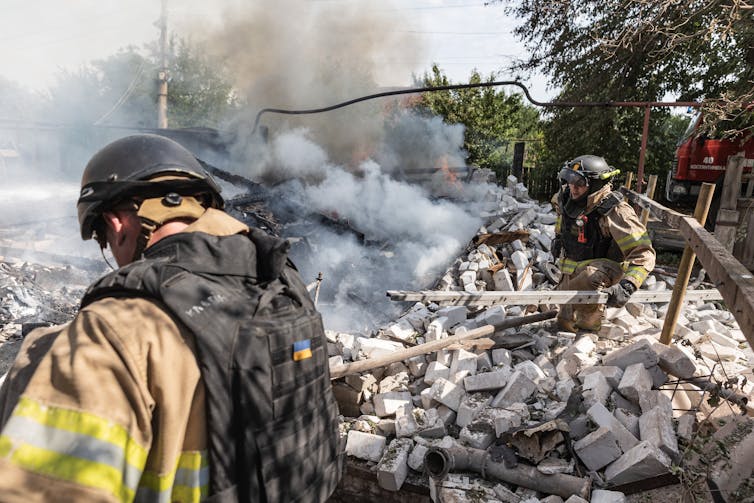
Firefighters wade through rubble.
Ukrainian firefighters work to put out fires stemming from Russian artillery shelling of the city of Kostiantynivka, a sign of the nearly constant toil of the conflict.
Photo by Diego Herrera Carcedo/Anadolu via Getty Images

The devil in the details

It remains unclear what Trump actually wants to achieve in Alaska. The details of the deal he is trying to persuade Putin to accept are unclear. For the Trump administration, the basic idea for ending the conflict appears to be land for peace: an end to military action by both sides and de facto recognition of the Ukrainian territory currently occupied by Russian forces.

One glaring problem with this formulation is that Russia does not control all the territory of the four Ukrainian provinces that it claims. They occupy nearly all of Luhansk, but not all of Donetsk, and only 60% of Zaporizhzhia and Kherson. If Russia insists on taking all of Donetsk province, for example, Ukraine would have to hand over about 2,500 square miles (6,500 square kilometers), with 200,000 people, mainly in the cities of Kramatorsk and Slovyansk.

It is hard to imagine President Volodymyr Zelenskyy agreeing to such a concession.

Yet it is equally hard to see Putin giving up his claim to all four provinces, which were formally incorporated into the Russian Federation in October 2022. In a June 2024 speech to the Russian foreign ministry, Putin laid out his most thorough analysis of the “root causes” and course of the conflict. He stated that the legal status of the four provinces as part of Russia “is closed forever and is no longer a matter for discussion.”

Clearly, the territorial question is the biggest hurdle facing any would-be peacemaker, including Trump.

Other issues, such as Ukraine’s request for security guarantees, or Russia’s demands for the “denazification” and “demilitarization” of Ukraine, could be dealt with later through negotiation and third-party mediation.

There are other factors that play into the chances of peace now.

Both Ukrainian and Russian societies are tired of a conflict that neither of them wanted. But at the same time, in neither country does most of the public want peace at any price.

If Trump can persuade Putin to agree to give up his claims to the entire territory of the four provinces in Ukraine’s east, that would be a substantial concession – and one that Zelenskyy may be well-advised to pocket. Putin would also expect something in return — such as the lifting of international sanctions and restoration of full diplomatic relations with the U.S. Then Putin could fly back to Moscow and tell the Russian people that Russia has won the war.

If such a deal transpires in Alaska, Trump would then face the challenge of persuading Ukraine and Europeans to accept it.

However, given Putin’s apparent confidence that Russia is winning the war, it remains unlikely that he will be persuaded by anything that Trump has to offer in Anchorage.

The Conversation

Peter Rutland does not work for, consult, own shares in or receive funding from any company or organization that would benefit from this article, and has disclosed no relevant affiliations beyond their academic appointment.

ref. Don’t write off the Putin-Trump summit just yet – its outcome might confound critics – https://theconversation.com/dont-write-off-the-putin-trump-summit-just-yet-its-outcome-might-confound-critics-262933

Child malnutrition is a sign of conflict to come: Nigerian study links climate change, food and violence

Source: The Conversation – Global Perspectives – By Marina Mastrorillo, Senior Economist, CGIAR

The pathway from climate change to violent conflict is not simple. There are the obvious immediate effects of global warming like water scarcity and crop failure. But beyond these, climate stress can pave the road to violence through indirect channels – a gradual rise in food insecurity and growing social tensions that set the stage for more armed violence.

We are a team of researchers who investigate the links between climate change, food systems and conflict. We set out to explore the relationship between climate variability, child malnutrition and violent conflict.


Read more:
Climate and mortality rates in Kenya, Mali, and Malawi: what we found


Our study focused on Nigeria. The country has faced rising temperatures, recurrent droughts, and one of the highest burdens of food insecurity and conflict in Africa. Its northern and north-eastern regions in particular have fragile agrifood systems, limited public services, and ongoing insecurity. This makes them especially vulnerable to the impacts of climate shocks.

In north-eastern Nigeria, 8.8 million people are threatened by a nutrition crisis. About 12,000 children in the Lake Chad area suffer from acute malnutrition as a result of resource depletion, climate change and insecurity.

For our research, we used household data from the Nigeria demographic and health surveys and combined this with information on climate and conflict. We applied a system of equations to separate the role child malnutrition plays in climate-related conflict from other factors that aren’t easily observed but which contribute to shape the climate-conflict link.

From this, we found that rising temperatures don’t immediately trigger violence. Instead, they set off a chain reaction: heat stress on the planet over time stresses food systems. As crops fail and household incomes fall, the youngest and most vulnerable are often the first to show signs of distress and become malnourished.


Read more:
The Lake Chad Basin is a security nightmare. 5 guidelines for finding solutions


Climate change contributes to higher rates of acute child malnutrition, or wasting. This is where children have very low weight for their height, usually because of sudden food shortages or illness. Wasting is one of the clearest signs that a child is not getting enough to eat.

In Nigeria, formal safety nets are limited. This means that the social strain of malnourished communities can become a powerful driver – or justification – for engaging in violence, mostly as a desperate alternative source of income or safety. People who aren’t getting the food they need may be increasingly inclined to support or be recruited by armed groups to ensure food security, shelter and physical protection.

One of the study’s key contributions is its use of child malnutrition indicators to trace the indirect effects of climate stress on conflict. Our research shows that acute malnutrition – especially wasting – is an early warning signal of social breakdown in fragile settings.


Read more:
Malnutrition among children is rife in Nigeria. What must be done


We recommend that systems that give early warnings of conflict should analyse nutrition in climate change-affected areas and use the levels of malnutrition as a way to predict potential conflict. Taking nutrition into account is a practical way to anticipate and prevent violence before it erupts.

Malnutrition as a hunger signal

Think of climate-driven conflict like a tangled web. We’ve managed to trace one clear thread – malnutrition – and show how it is linked to violence. But even after accounting for that thread, the web still holds tight. That’s because other forces, like economic shocks, migration, or institutional breakdown, are still tugging at the system.

We carefully mapped the indirect role of malnutrition through a method that helps identify how one factor (climate stress) affects another (conflict) through an intermediate pathway (malnutrition), while also taking other factors into account. This enabled us to calculate the contribution of malnutrition to climate related conflict.

We examined how shifts in climate affect child malnutrition in Nigeria – specifically wasting, stunting and underweight – and how these, in turn, relate to violent outbreaks. Among the various indicators, wasting stood out.


Read more:
11 million Nigerian children are going hungry: how this hurts their health and what needs to be done


Severe wasting is responsible for one in five deaths among children under the age of five globally, making it one of the leading threats to child survival. Because wasting reflects short-term nutritional stress, it can act as an early warning sign that communities are struggling to cope with climate shocks.

This finding is particularly relevant in farming communities where people depend on predictable weather to grow food and earn a living.

This offers a new way to think about climate, peace, and security. It’s about how weather changes unfold through daily meals, children’s diets and household decisions, sometimes quietly but no less dangerously.

Turning data into defence

Our study will improve the accuracy of current estimates of indirect impacts of climate change on conflict, because it looks at how these impacts are mediated by food and nutrition security outcomes.

Integrating malnutrition data into early warning systems, investing in nutrition-sensitive climate adaptation, and targeting support to the most vulnerable regions can reduce both human suffering and the risk of conflict.


Read more:
Extreme weather is disrupting lives in southern Africa: new policies are needed to keep the peace


Today, headlines focus on armed groups and battlefield dynamics, which is understandable. But we risk overlooking the quieter patterns beneath the surface.

The next crisis may not start with a bullet but with starvation.

We gratefully acknowledge the collaboration and support of Anna Belli, a junior professional officer at the Office of the Chief Economist at the Food and Agriculture Organisation and lead author of this research, Antonio Scognamillo, economist in the Agrifood Economics and Policy Division, and Ada Ignaciuk, chief editor of the State of Food Security and Nutrition at the Food and Agriculture Organisation.

The Conversation

Marina Mastrorillo works for The Alliance of Bioversity and CIAT of CGIAR. She receives funding from the CGIAR Trust Fund (https://www.cgiar.org/funders/) through the CGIAR Climate Action and Food Frontiers and Security Science Programmes.

This research was supported by the CGIAR Climate Action and Food Frontiers and Security Programmes, with funding from the CGIAR Trust Fund.

Chun Song works for The Alliance of Bioversity and CIAT of CGIAR. She receives funding from the CGIAR Trust Fund (https://www.cgiar.org/funders/) through the CGIAR Policy Innovation Program.

Grazia Pacillo works for The Alliance of Bioversity and CIAT of CGIAR. She receives funding from the CGIAR Trust Fund (https://www.cgiar.org/funders/) through the CGIAR Climate Action and Food Frontiers and Security Science Programmes. This research was supported by the CGIAR Climate Action and Food Frontiers and Security Science Programmes, with funding from the CGIAR Trust Fund.

Victor Villa works for the Alliance of Bioversity International and CIAT, which is part of CGIAR. He receives funding from the CGIAR Trust Fund (https://www.cgiar.org/funders/) through the CGIAR Science Programmes on Climate Action and Food Frontiers and Security.

ref. Child malnutrition is a sign of conflict to come: Nigerian study links climate change, food and violence – https://theconversation.com/child-malnutrition-is-a-sign-of-conflict-to-come-nigerian-study-links-climate-change-food-and-violence-262359

After 4 years of repressive Taliban rule, Afghans are suffering in silence. Is the world still watching?

Source: The Conversation – Global Perspectives – By Niamatullah Ibrahimi, Senior Research Fellow, Initiative for Peacebuilding, The University of Melbourne

On August 15 2021, Afghanistan’s democratic republic collapsed.

As the last US and NATO troops departed the country, the Taliban swept back into power and the Afghan people braced for an uncertain future.

Despite promises of moderation and inclusion, four years later, the Taliban has established a repressive, exclusionary regime – one that has dismantled institutions of law, justice and civil rights with ruthless efficiency.

As the Taliban regime has tightened its grip, international attention has waned. Crises in Ukraine, Gaza and elsewhere have dominated the global agenda, pushing Afghanistan out of the spotlight.

With the Taliban seeking to end its isolation and gain legitimacy, can the international community find the will now to exert real pressure?

The Taliban’s emirate of repression

After coming back into power, the Taliban discarded the country’s 2004 constitution, allowing the regime to operate without a transparent rule of law. Instead, Mullah Hibatullah Akhundzada, the reclusive Taliban leader, rules by decree from his base in Kandahar.

The Taliban’s repression of women and girls has been so severe, human rights groups now call it “gender apartheid” and argue it should be a new international crime.

Edicts have erased women from public life, banning them from education beyond primary school (with the exception of religious education), employment and public spaces. Women also cannot move freely in public without a mahram, or male guardian.

The Taliban also dismantled the Ministry of Women’s Affairs, replacing it with the Ministry for the Propagation of Virtue and Prevention of Vice. As a central instrument of repression, the ministry reinforces institutionalised gender discrimination through regular raids and arrests, surveillance and monitoring of public spaces.

Taliban rule has also led to the exclusion and persecution of minority ethnic and religious groups such as Hazaras, Shias, Sikhs and Christians.

In the province of Panjshir, the focal point of resistance to the Taliban, human rights groups have documented the Taliban’s severe crackdowns on the local population, including mass arrests and detentions, torture and extrajudicial killings.

More broadly, the Taliban has decimated the civic space in the country. Journalists and activists have been silenced through fear, violence and arbitrary arrests. This has led to widespread self-censorship and an information blackout that allows abuses to continue with impunity.

Despite the immense risks, activists, journalists and ordinary citizens continue to resist the Taliban. Women have staged peaceful protests in the face of harsh crackdowns, while others run secret schools for girls and document abuses in the hope of future accountability.

Humanitarian aid dwindling

Although most countries do not recognise the Taliban as the formal and legitimate government of the country, some regional states have called for an easing of its international isolation.

Last month, Russia became the first country to recognise the Taliban. China is also deepening its economic and diplomatic ties with the group. India’s foreign minister recently met with his Taliban counterpart, after which the Taliban called New Delhi a “significant regional partner”.

International aid continues to flow into Afghanistan, but a report from a US watchdog this week documented how the Taliban uses force and other means to divert it.

The United States had still accounted for more than 40% of all humanitarian support to Afghanistan after the Taliban’s return. But US President Donald Trump’s decision to decimate the US Agency for International Development means this funding has all but disappeared.

This has crippled essential services and threatens to plunge the country into one of the world’s worst humanitarian crises. Health facilities have closed and malnutrition is rising. The mass deportation of hundreds of thousands of Afghans from Iran and Pakistan has only further added to the humanitarian catastrophe.

For years, the United Nations has tried to facilitate talks between the Taliban and international community in Qatar with the aim of improving conditions in the country. However, it has faced repeated setbacks.

The Taliban only decided to attend the talks in mid-2024 after the UN conceded to excluding women and civil society groups and restricting the agenda. The meeting resulted in no breakthroughs or concessions.

Another round of talks is anticipated, but the central dilemma remains: how to engage the Taliban without legitimising its repressive rule.

Courts making some progress

The Taliban’s systematic human rights abuses have global repercussions. Experts warn of a rising trend of similarly styled repression, dubbed “Talibanisation”, taking root in other countries.

In Yemen, for example, Houthi leaders have imposed restrictions eerily similar to Taliban edicts, banning women from walking in public without a male guardian and restricting their work.

While individual states have failed to agree on a coordinated response to the Taliban, international institutions have taken steps in the right direction.

In July, the International Criminal Court issued arrest warrants for Akhundzada and the Taliban chief justice, accusing them of crimes against humanity for gender-based persecution.

Separately, four countries – Australia, Germany, the Netherlands and Canada – have begun the process of bringing a case against the Taliban to the International Court of Justice for gender discrimination. This would be a first for the court.

To complement these efforts, the UN member states must establish an independent international investigative mechanism to systematically document and investigate crimes committed by the Taliban. Such a mechanism would help preserve evidence and lay the groundwork for future prosecutions.

Without concerted international pressure, the suffering of the Afghan people will only worsen and the Taliban’s brand of repression will continue impact women’s rights far beyond Afghanistan’s borders.


The authors are holding a day-long conference with other academics on Afghanistan, four years after the Taliban takeover, at the Monash University Law Chambers in Melbourne on August 15. More information can be found here.

The Conversation

Nothing to disclose.

Arif Saba and Niamatullah Ibrahimi do not work for, consult, own shares in or receive funding from any company or organisation that would benefit from this article, and have disclosed no relevant affiliations beyond their academic appointment.

ref. After 4 years of repressive Taliban rule, Afghans are suffering in silence. Is the world still watching? – https://theconversation.com/after-4-years-of-repressive-taliban-rule-afghans-are-suffering-in-silence-is-the-world-still-watching-262801

Older Americans are using AI − study shows how and what they think of it

Source: The Conversation – USA – By Robin Brewer, Associate Professor of Information, University of Michigan

Most older adults who use AI use smart speaker assistants. Six_Characters/E+ via Getty Images

Artificial intelligence is a lively topic of conversation in schools and workplaces, which could lead you to believe that only younger people use it. However, older Americans are also using AI. This raises the questions of what they’re doing with the technology and what they think of it.

I’m a researcher who studies older age, disability and technology use. I partnered with the University of Michigan’s National Poll on Healthy Aging to survey nearly 3,000 Americans over the age of 50. We asked them whether and how they use AI and what concerns they have about using it.

Of the older people we surveyed, 55% responded that they had used some type of AI technology that they can speak to, like Amazon’s Alexa voice assistant, or type to, like OpenAI’s ChatGPT chatbot. Voice assistants were overwhelmingly more popular than text chatbots: Half of them reported using a voice assistant within the past year, compared to 1 in 4 who used a chatbot.

Popular, among some

Independent living continues to be a major goal of older Americans as they either do not want to or are unable to afford to live in long-term care communities, and AI may be a tool to support this goal. Our findings show that older adults who use AI in their homes find it helpful for living independently and safely.

They mostly used these technologies for entertainment or searching for information, but some of their responses show more creative uses, such as generating text, creating images or planning vacations.

Nearly 1 in 3 older adults reported using AI-powered home security devices, including doorbells, outdoor cameras and alarm systems. Nearly all of those people – 96% – felt safer using them.

While there has been some concern about privacy when using cameras indoors to monitor older people, cameras aimed outdoors seem to provide a sense of security for those who may be aging in their homes alone or without family nearby. Of the 35% of older adults who reported using AI-powered home security systems, 96% said they were beneficial.

a video monitor view of a person wearing a yellow safety vest carrying packages
AI-powered security devices such as smart doorbells make many older adults feel safer.
O2O Creative/E+ via Getty Images

However, when we dove into which older adults are using AI, we saw that demographics matter. Specifically, those in better health, with more education and higher incomes were more likely to have used AI-powered voice assistants and home security devices in the past year. This pattern seems to follow adoption trends of other technologies such as smartphones.

Trusting AI is tricky

As more information about AI’s accuracy emerges, so do questions about whether people can trust it. Our survey results show that older Americans are split on whether to trust content that was generated by AI: 54% said they trust AI, and 46% said they do not. People who trusted AI more were more likely to have used some type of AI technology within the past year.

Further, AI-generated content can sometimes look correct but be inaccurate. Being able to identify incorrect information from AI is important for assessing whether and how to use AI-generated search results or chatbots. However, only half of the older people surveyed were confident that they could identify whether content from AI was incorrect.

More educated users were more likely to say they felt confident they could spot inaccuracies. Conversely, older adults who reported lower levels of physical and mental health were less likely to trust AI-generated content.

What to do?

Together, these findings repeat a common cycle of technology adoption that is pervasive even among younger demographics, where more educated and healthy people are among the first to adopt and be aware of newer technologies. This raises questions about how to best reach all older people about the benefits and risks of AI.

How can older people who are not AI users get support for learning more so that they can make informed decisions about whether to use it? How can institutions develop better training and awareness tools so that older people who trust AI avoid trusting it too much or inappropriately using AI to make important decisions without understanding the risks?

Our survey results highlight potential starting points for developing AI literacy tools for older adults. Nine in 10 older people wanted to know when information had been generated by AI. We are starting to see AI labels on search engine results, such as Google search’s AI snippets.

a screenshot off a webpage showing a block of text
Some AI-generated content, like this Google AI Overview search summary, is clearly labeled as AI, but not all are.
Screenshot by The Conversation

Michigan and other states have adopted policies for disclosing AI content in political ads, but these notices could be made more visible in other contexts, such as nonpolitical advertising and on social media. Further, nearly 80% of older people wanted to learn more about AI risks – where might it go wrong and what to do about it.

Policymakers can focus on enforcing AI notices that signal content was generated by AI, particularly at a critical time when the U.S. is considering revising its AI policies to do just the opposite – removing language about risk, discrimination and misinformation – based on a new executive order.

Overall, our findings show that AI can support healthy aging. However, overtrust and mistrust of AI could be addressed with better training tools and policies to make risks more visible.

The Conversation

Robin Brewer receives funding from the National Science Foundation and the National Institutes of Health. She has previously received funding from Google, the Retirement Research Foundation, and the U.S. Department of Transportation.

ref. Older Americans are using AI − study shows how and what they think of it – https://theconversation.com/older-americans-are-using-ai-study-shows-how-and-what-they-think-of-it-262411

Genomics can help insect farmers avoid pitfalls of domestication

Source: The Conversation – USA – By Christine Picard, Professor of Biology, Indiana University

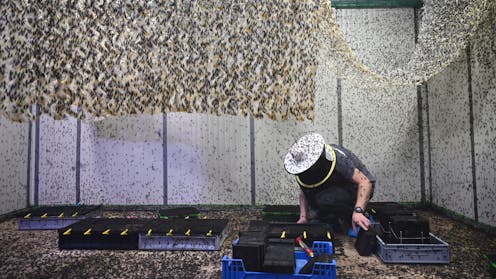
A biologist maintains a large population of black soldier flies for protein farming. picture alliance/Contributer via Getty Images

Insects are becoming increasingly popular to grow on farms as feed for other animals, pet food and potentially as food for people. The process of bringing a wild animal into an artificial environment, known as domestication, comes with unique challenges. Luckily, there are important lessons to be learned from all the other animals people have domesticated over millennia.

As researchers who study how domesticating animals changes their genes, we believe that recognizing the vulnerabilities that come with domestication is important. Today’s powerful biotechnology tools can help researchers anticipate and head off issues early on.

Domestication is nothing new

From grain domestication starting as far back as 12,000 years ago to today’s high-tech, genome-based breeding strategies, humans have long bent nature to suit their purposes. By selectively breeding individual plants or animals that have desirable traits – be it appearance, size or behavior – humans have domesticated a whole host of species.

The same principle underlies all domestication attempts, from dogs to crops. A breeder identifies an individual with a desired trait – whether that’s a dog’s talent for tracking or a plant’s ability to withstand pests. Then they breed it to confirm that the desired trait can be passed down to offspring. If it works, the breeder can grow lots of descendants in a lineage with the genomic advantage.

People have made crops resilient to disease and environmental challenges, docile cows that yield more milk or meat, large-breasted poultry and cute dogs.

A long history of insects working for people

Insect domestication is also far from new. People have reared silkworms (Bombyx mori) to produce silk for over 5,000 years. But selective breeding and isolation from wild relatives have led to their inability to fly, dependence on one food source and need for assistance to reproduce. As a result, silkworms are wholly reliant on humans for survival, and the original species doesn’t exist anymore.

A white moth sitting on a white cocoon on top of a leaf
Silk moths have lost their ability to fly and are completely dependent on humans for survival.
baobao ou/Moment Open via Getty Images

Similarly, people have maintained colonies of the western honeybee (Apis mellifera) for pollination and honey production for centuries. But bees are at risk due to colony collapse disorder, a phenomenon where worker bees disappear from seemingly healthy hives. The causes of colony collapse disorder are unknown; researchers are investigating disease and pesticides as possible factors.

Now the insect agriculture industry has set its sights on domesticating some other insects as a source of sustainably farmed protein for other animals or people.

Insects such as the black soldier fly (Hermetia illucens) and the mealworm (Tenebrio molitor) can grow on existing organic waste streams. Rearing them on organic farm and food waste circularizes the agricultural system and reduces the environmental footprint of growing proteins.

But these insects will need to be grown at scale. Modern agriculture relies on monocultures of species that allow for uniformity in size and synchronized growth and harvest. Domesticating wild insects will be necessary to turn them into farmed animals.

A large number of white larvae in a dry food medium
Black soldier fly larvae feed on a mixture of wheat bran, corn and alfalfa when reared in labs and farms.
Christine Picard

Domestication has an immunity downside

Chickens today grow faster and bigger than ever. But factory-farmed animals are genetically very homogeneous. Moreover, people take care of everything for these domesticated animals. They have easy access to food and are given antibiotics and vaccines for their health and safety.

Consequently, industrially-farmed chickens have lost a lot of their immune abilities. Building these strong disease-fighting proteins requires a lot of energy. Since their spotless, controlled environments protect them, those immune genes are just not needed. The energy their bodies would typically use to protect themselves can instead be used to grow bigger.

In the wild, individuals with faulty immune genes would likely be killed by pathogens, quickly wiping these bad genes out from the population. But in a domesticated environment, such individuals can survive and pass on potentially terrible genes.

The H5N1 bird flu provides a recent example of what can go wrong when a homogeneous population of domesticated animals encounters a dangerous pathogen. When disease broke out, the poor immune systems of domesticated chickens cracked under the pressure. The disease can spread quickly through large facilities, and eventually all chickens there must be euthanized.

Hundreds of brown chickens with red crowns being reared in an indoor facility
Industrially-farmed chickens are genetically homogenous and have lost much of their immune defenses.
pidjoe/E+ via Getty Images

Domestication and the risks of monoculture

Weak immune systems aren’t the only reason the bird flu spread like it did.

Domestication often involves growing large numbers of a single species in small concentrated areas, referred to as a monoculture. All the individuals in a monoculture are roughly the same, both physically and in their genes, so they all have the same susceptibilities.

Banana cultivars are one example. Banana plants grown in the early 1900s were all descendants of a single clone, named Gros Michel. But when the deadly Panama disease fungus swept through, the plants had no defenses and the cultivar was decimated.

Banana growers turned to the Cavendish variety, grown in the largest banana farms today. The banana industry remains vulnerable to the same kind of risk that took down Gros Michel. A new fungal strain is on the rise, and scientists are rushing to head off a global Cavendish banana collapse.

Lessons about weaknesses that come with domestication are important to the relatively new industry advancing insects as the future of sustainable protein production and organic waste recycling.

How genomics can help correct course

Modern genomics can give insect agriculture a new approach to quality control. Technological tools can help researchers learn how an organism’s genes relate to its physical traits. With this knowledge, scientists can help organisms undergoing domestication bypass potential downsides of the process.

For instance, scientists combined data from hundreds of different domesticated tomato genomes, as well as their wild counterparts. They discovered something you’ve probably experienced – while selecting for longer shelf life, tomato flavor genes were unintentionally bred out.

A similar approach of screening genomes has allowed scientists to discover the combination of genes that enhances milk production in dairy cows. Farmers can intentionally breed individuals with the right combinations of milk-producing genes while keeping an eye on what other genes the animals have or lack. This process ensures that breeders don’t lose valuable traits, such as robust immune systems or high fertility rates, while selecting for economically valuable traits during domestication.

Insect breeders can take advantage of these genetic tools from the outset. Tracking an animal population’s genetic markers is like monitoring patients’ vital signs in the hospital. Insect breeders can look at genes to assess colony health and the need for interventions. With regular genetic monitoring of the farmed population, if they begin to see individuals with markers for some “bad” genes, they can intervene right away, instead of waiting for a disaster.

Mechanisms to remedy an emerging disaster include bringing in a new brood from the wild or another colony whose genes can refresh the domesticated population’s inbred and homogeneous genome. Additionally, researchers could use gene-editing techniques such as CRISPR-Cas9 to replicate healthy and productive combinations of genes in a whole new generation of domesticated insects.

Genomics-assisted breeding is a supplement to standard practices and not a replacement. It can help breeders see which traits are at risk, which ones are evolving, and where natural reservoirs of genetic diversity might be found. It allows breeders to make more informed decisions, identify genetic problems and be proactive rather than reactive.

By harnessing the power of genomics, the insect agriculture industry can avoid setting itself up for an accidental future collapse while continuing to make inroads on sustainable protein production and circularizing the agricultural ecosystem.

The Conversation

Christine Picard receives funding in part by the National Science Foundation through the Industry-University Cooperative Research Centers NSF cooperative agreements. Any opinions, findings, and conclusions or recommendations expressed in this material are those of the author(s) and do not necessarily reflect the views of the National Science Foundation or the Industry Advisory Board Members of the Center for Insect Biomanufacturing and Innovation. Christine Picard is a member of the North American Coalition of Insect Agriculture, an Associate Editor for the Journal of Insects as Food and Feed, and the Treasurer for the Academic Society of Insects as Food and Feed.

Hector Rosche-Flores receives funding in part by the National Science Foundation through the Industry-University Cooperative Research Centers NSF cooperative agreements. Any opinions, findings, and conclusions or recommendations expressed in this material are those of the author(s) and do not necessarily reflect the views of the National Science Foundation or the Industry Advisory Board Members of the Center for Insect Biomanufacturing and Innovation. 

ref. Genomics can help insect farmers avoid pitfalls of domestication – https://theconversation.com/genomics-can-help-insect-farmers-avoid-pitfalls-of-domestication-261357

‘It’s a complicated time to be a white Southerner’ − and their views on race reflect that

Source: The Conversation – USA – By James M. Thomas, Professor of Sociology, University of Mississippi

Scholars interviewed white Southerners to get past the stereotypes people hold of them. CGInspiration, iStock/Getty Images Plus

Historian Nell Painter remarked in 2011, “Being white these days isn’t what it used to be.”

For the past decade, wave upon wave of protests against police violence and mass incarceration have drawn the public’s attention toward the continued significance of America’s color line, the set of formal and informal rules that maintain white Americans’ elevated social and economic advantages.

Meanwhile, an explosion of popular literature scrutinizes those rules and places white people’s elevated status in sharp relief.

How are white people making sense of these tensions?

In his 1935 publication “Black Reconstruction in America,” sociologist W.E.B. Du Bois described the “public and psychological wage” paid to white workers in the post-Reconstruction era on account of their being white. Today those “wages of whiteness” remain durable as ever. Nearly 60 years removed from the high water mark of the Civil Rights movement, its aims have not been met.

A man with glasses and wearing a suit talks from behind a table into a large microphone.
Sociologist W.E.B. Du Bois described in 1935 the ‘public and psychological wage’ paid to white workers because they were white.
Keystone-France/Gamma-Rapho via Getty Images

White people still enjoy better jobs, health care, housing, schooling and more.

I’m a sociologist of race and racism. My team of graduate student researchers and I have spent the past four years interviewing white people to understand how they make sense of their white racial status today. We concentrated our efforts among white people living in the U.S. South because that region is seen as more responsible for shaping what it means to be white, and the social and economic advantages of being white, than any other.

There is not much research on how white people think about what it means to be white. Meanwhile, popular and scholarly treatments of white Southerners as overwhelmingly conservative and racially regressive abound.

Some white Southerners we spoke with fit those tropes. Many others do not. Overall, we found white Southerners across the political spectrum actively grappling with their white racial status.

As Walter, 38, from Clarksdale, Mississippi, told us, “It’s a complicated time to be a white Southerner.” We use pseudonyms to protect anonymity.

Crises cast a long shadow

The Italian political theorist Antonio Gramsci defined a crisis as a historical period in which “the old is dying and the new cannot be born.” Within this space between, Gramsci argued, “morbid phenomena of the most varied kind come to pass.”

Many people we spoke with lived through the defining ruptures of the 20th century that forever changed the South, and America too: the formal demise of Jim Crow rule, violent and bloody struggles over integration, and the slow, uneven march toward equal rights for all Americans.

Still others came of age against the backdrop of the defining shocks of this new century: 9/11 and the war on terrorism, Hurricane Katrina, the racial backlash to the election of Barack Obama, and the Black Lives Matter movement.

For some, the political rise of Donald Trump and his willingness to traffic in racist rhetoric constituted a crisis, too. “He embodies everything that is immoral,” said Ned, 45, from Vardaman, Mississippi. The town Ned is from is named for James K. Vardaman, former governor of Mississippi who once declared that “if it is necessary every Negro in the state will be lynched; it will be done to maintain white supremacy.”

Taken together, these crises cast a long shadow of uncertainty over white people’s elevated social position and anchor how white Southerners understand their white racial status.

Resistance to desegregation

Miriam, 61, from Natchez, Mississippi, grew up under the last gasps of Jim Crow. She recalled her parents pulling her from public school and sending her to a nearby private school shortly after the Supreme Court’s 1969 Alexander v. Holmes ruling, which ordered the immediate desegregation of Southern schools.

Her new school was one of hundreds of “segregation academies” founded across the South in the aftermath of the court’s ruling.

“You didn’t go over there, by the Black school,” Miriam recalled. “You stayed over by the white school. … I remember as a kid that made quite an impression.”

Reflecting on what it means to be a white Southerner today, Miriam drew from these experiences living under the region’s long shadow of segregation.

“There’s been so much hatred and so much unpleasantness. I want to do everything I can to make relations better,” she said. “I think that is part of being white in the South.”

Daryl, 42, a self-described conservative, lived in several Southern communities as a child, including Charlotte, North Carolina, in the mid-1980s as the city wrestled with its court-ordered school busing program. Daryl recalled his parents and other white people complaining about the poor quality of newly integrated schools, including telling him “stories of things like needles on the playground.”

Daryl rarely, if ever, talked with his own parents about race, but he broaches these topics with his own children today.

A self-described “childhood racist,” Daryl draws from his experiences to frame his conversations with his own children. “I remind them that there used to be this day where this was OK, and this is how things were thought of,” he says.

‘Good reason to be mad’

The region’s history also includes more contemporary crises.

Lorna, 34, is a registered Republican from Marion, Arkansas. She described how recent protests against police violence are affecting her understanding of America’s color line.

“I feel like Black people are mad or angry. They’re tired of violence and, you know, profiling,” she said. “And I don’t think it’s just in the South. I think it’s all over the United States. And they have a good reason to be mad.”

Kenneth, 35, lives in Memphis. Like Lorna and others, Kenneth’s sense of what it means to be white has been shaped by more recent crises, including the racial backlash to Obama’s elections in 2008 and 2012 that motivated Trump’s election in 2016.

Reflecting on these episodes, Kenneth believes he has an obligation as a white Southerner to become more informed about “the legacy of racism in the South and the impact that it still has today.”

Becoming more informed, Kenneth says, “will cause me to reflect on how I should think about that, and what, if anything, I should do differently now.”

A classrom with only white children, sitting at typewriters.
The scholars interviewed one woman who was sent to a segregation academy, like this one in Virginia, by her parents. ‘There’s been so much hatred. … I want to do everything I can to make relations better,’ she said.
Trikosko/Library of Congress/Interim Archives/Getty Images

Uncovering what’s minimized or ignored

Our interviews reveal a range of beliefs and attitudes among white Southerners often discounted or dismissed altogether by more popular and scholarly treatments of the region.

Contrary to research that finds white people minimizing or ignoring their elevated social status, the white Southerners we spoke with showed a profound awareness of the advantages their white racial status affords them.

“I have to admit I’m glad I’m white,” said Luke, 75, from Melber, Kentucky. “Because in the United States you probably have a little advantage.”

Our research also shows that how white people make sense of who they are is also a matter of where they are.

Places – and not just Southern ones – are imbued with ideas and beliefs that give meaning and significance to the people within them. The region’s history of racial conflict, meanwhile, renders the “wages of whiteness” more plain to see for white Southerners in ways we are only beginning to understand.

Put plainly: Place matters for how race matters.

Emphasizing this more complicated understanding of race and place allows for a more complete account of the South, including how the unfolding racial dramas of the past several decades continue to shape the region and its people.

The Conversation

James M. Thomas’s research has been funded by the National Science Foundation and the Russell Sage Foundation

ref. ‘It’s a complicated time to be a white Southerner’ − and their views on race reflect that – https://theconversation.com/its-a-complicated-time-to-be-a-white-southerner-and-their-views-on-race-reflect-that-261454

Why rural Coloradans feel ignored − a resentment as old as America itself

Source: The Conversation – USA – By Kayla Gabehart, Assistant Professor of Environmental Policy, Michigan Technological University

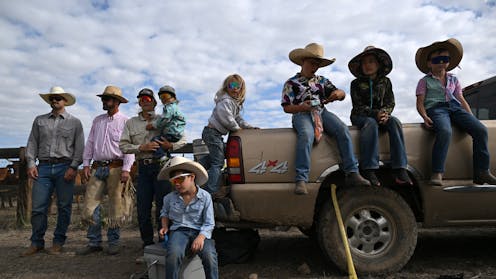
Many rural Americans feel largely left out of American culture. Helen H. Richardson/Getty Images

Many rural Coloradans, especially in agricultural communities, feel looked down on by their urban counterparts. One cattle rancher I spoke to put it plainly. “It’s an attitude … we are the idiots … we are the dumb farmers … we don’t really matter.”

The sentiment is also portrayed in popular culture such as the hit TV show “Yellowstone.”

“It’s the one constant in life. You build something worth having, someone’s gonna try to take it,” says patriarch John Dutton. He was facing repeated threats by developers from “the city” to annex his land for a luxury hotel and resort development.

As a policy scholar, I’ve talked to and interviewed many dozens of people in rural areas in Colorado. I’ve also read hundreds of newspaper articles and watched hundreds of hours of legislative testimony that capture the sentiment of rural people being left behind, left out and snubbed by their urban counterparts.

Recently, I studied the divide between rural and urban Coloradans by looking at their responses to four statewide policies. A designated day to forgo eating meat, two political appointees and the ongoing wolf reintroduction.

These policies, while specific to Colorado, are symptoms of something larger. Namely, an ever-urbanizing, globalized world that rural, agricultural citizens feel is leaving them behind.

‘MeatOut’ or misstep?

My expertise doesn’t just come from my research – I’ve lived it.

I grew up in a rural community in Elbert County, Colorado, about an hour- and-a-half southeast of Denver.

In early 2021, Gov. Jared Polis declared via proclamation that March 20 would be a “MeatOut Day.” For health and environmental reasons, Colorado residents were encouraged to forgo meat for a single day.

Supported by the Farm Animal Rights Movement, MeatOuts have been promoted across the U.S. since the 1980s. Typically, gubernatorial proclamations, of which hundreds are passed each year and are completely ceremonial and devoid of any long-term formal policy implications, go largely unnoticed. And in Denver, Colorado’s metropolitan center, this one did too.

Not so in rural Colorado.

My neighbors in Elbert County promptly responded with outrage, flying banners and flags declaring their support for agriculture and a carnivorous diet.

One rancher from Nathrop painted a stack of hay bales to say, “Eat Beef Everyday.”

Communities all over the state, and even in neighboring states, responded with “MeatIns,” where they gathered to eat meat and celebrate agriculture and the rural way of life. They also coupled these events with fundraisers, for various causes, for which hundreds of thousands of dollars were raised across the state. While Polis backed off the MeatOut after 2021, Denver Mayor Mike Johnston has, just this year, supported a similar “Eat Less Meat” campaign, prompting similar rural outrage.

Did I mention there are nearly 36,000 cattle in Elbert County? This is relatively typical of a rural Colorado county, particularly on the Plains.

In Colorado, 2.7 million cattle are raised annually, with a value of US$4.5 billion. The industry is consistently the top agricultural commodity and the second-largest contributor to Colorado’s GDP, at about $7.7 billion per year.

In early March 2021, Polis declared March 22 “Colorado Livestock Proud Day,” in response to the backlash.

Other policies

This came on the heels of several policies supported by Polis prior to the MeatOut controversy that critics considered anti-agriculture.

In 2020, he appointed Ellen Kessler, a vegan and animal rights activist, to the State Veterinary Board. Kessler criticized 4-H programs, designed to educate youth on agriculture and conservation, on her social media, insisting they “don’t teach children that animal lives matter.” Kessler resigned in March 2022, just days before she was cited for 13 counts of animal cruelty. More recently, in May 2025, Polis appointed Nicole Rosmarino to head the State Land Board. Rosmarino has ties to groups that oppose traditional agricultural practices, historically a key component of Colorado State Land Board operations.

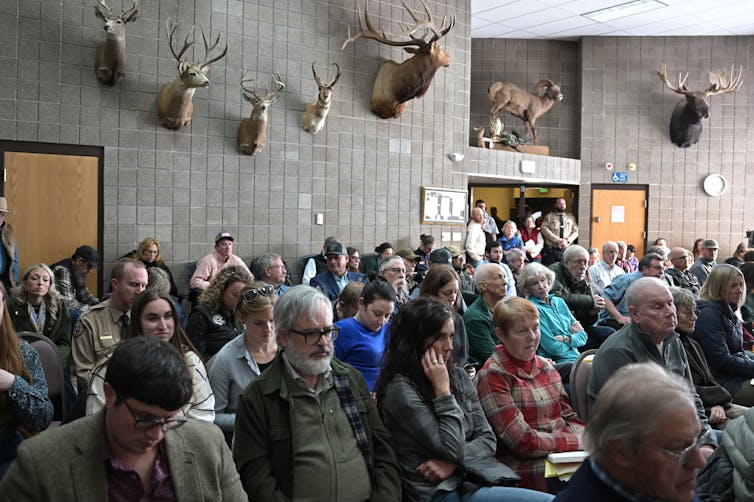
People sit in a room with stuffed deer heads in the background.
Community members gather at the Colorado Parks and Wildlife hunter education building in Denver. Colorado ranchers petitioned the state’s wildlife commission to delay the next round of wolf releases in September 2024. The petition was denied.
Hyoung Chang/Getty Images

Then came wolf reintroduction, passed by urban voters by just under 57,000 votes in the 2020 general election and supported by the governor. Those in support advocated for a return to natural biodiversity; wolves were hunted to extinction in the 1940s.

Rural residents voted decidedly against the initiative. Despite much legislative and grassroots action to oppose it, wolves were reintroduced in December 2023 in various areas along the Western Slope, in close proximity to many ranches. Several cattle have since been killed by wolves. Ever since, rural interests have been working to overturn wolf reintroduction on the 2026 ballot.

An American mess

Rural residents in Colorado have told me they feel excluded. This is not new or exclusive to Colorado, but a story as old as America itself.

University of Wisconsin political scientist Katherine J. Cramer wrote about this rural exclusion in Wisconsin, calling it “rural resentment.” Berkeley sociologist Arlie Russell Hochschild called it “stolen pride.” In their book, Tom Schaller, a political scientist at the University of Maryland, and Paul Waldman, a longtime journalist, characterize it as “white rural rage.”

It’s a dynamic that descends from slavery. Isabel Wilkerson, in her book “Caste: The Origins of Our Discontents,” demonstrates that while Black Americans have historically been relegated to the bottom of the hierarchy of an American caste system, poor white people are strategically positioned just above them but below white Americans of higher socioeconomic status. As Wilkerson explains, this is a durable system sustained by norms, laws and cultural expectations that feel “natural.” But they are entirely constructed and designed by the American upper class to intentionally exploit resentment of working-class white people.

The result is what sociologist Michael M. Bell calls a “spatial patriarchy” that characterizes rural America as dumb, incapable, racist, poor and degraded as “white trash.”

This spatial patriarchy is as old as industrialization and urbanization. One of the first policy iterations was rural school consolidation during the turn of the 20th century, designed to modernize schools and make them more efficient. Urban policymakers were influenced by eugenics and the assumption that rural schools “were populated by cognitively deficient children whose parents had not been smart enough or fortunate enough to leave the decaying countryside,” according to sociologist Alex DeYoung.

So, states around the country consolidated schools, the lifeblood of rural communities. Where a school closed, the town often died, as in small towns, schools are not just socioeconomic hubs but centers of cultural and social cohesion.

Environmental impact

The same concept – that urban policymakers know better than rural Americans – is manifest in the modern environmental movement. Like with the MeatOut, rural communities also distrust environmental policies that, in their view, intentionally target a rural way of life. Rural communities take the position that they’ve been made to bear the brunt of the transformations of the global economy for generations, including those that deal with energy and the environment.

For example, environmentalists frequently call for lowering meat consumption and enacting livestock taxes to lower global greenhouse gas emissions.

But, there’s a huge, untapped potential for environmental policies that use language consistent with rural attitudes and values, such as ideas about conservation and land stewardship. Political scientists Richard H. Foster and Mark K. McBeth explain, “Rural residents perceive, probably correctly, that environmental ‘outsiders’ are perfectly willing to sacrifice local economic well-being and traditional ways of life on the altar of global environmental concerns.” They instead suggest “emphasizing saving resources for future generations” so that rural communities may continue to thrive.

The Food and Agriculture Organization of the United Nations attribute between 18% to 24% of greenhouse gas emissions to agriculture, while the International Panel on Climate Change places the estimate closer to 10%. However, agricultural producers point out that, while they may be responsible for that 10%, just 100 companies, such as BP and ExxonMobil, have produced 70% of all emissions. Agricultural producers say policies such as livestock taxes would disproportionately impact small-scale farmers and intensify rural inequality.

Rural communities have the distinct feeling that urban America doesn’t care whether they fail or flourish. Nearly 70% of rural voters supported Trump in the 2024 presidential election. He won 93% of rural counties. Rural Americans feel left behind, and for them, Trump might be their last hope.

The Conversation

Kayla Gabehart does not work for, consult, own shares in or receive funding from any company or organization that would benefit from this article, and has disclosed no relevant affiliations beyond their academic appointment.

ref. Why rural Coloradans feel ignored − a resentment as old as America itself – https://theconversation.com/why-rural-coloradans-feel-ignored-a-resentment-as-old-as-america-itself-260894