Japan’s shifting memory of the second world war is raising fears of renewed militarism

Source: The Conversation – UK – By Lewis Eves, Lecturer in Government and International Relations, University of Essex

Eighty years have passed since Japan’s surrender ended the second world war. But the way Japan thinks about its wartime history is changing at pace. This is coinciding with a political shift that risks renewed Japanese militarism, an outcome that would complicate politics across east Asia.

Japan’s traditional narrative of the war originated in the post-war occupation, a period in which the US oversaw the demilitarisation of Japanese society. These efforts included the establishment and adoption of Japan’s current constitution in 1947.

Article 9 of the constitution renounces the use of force as a means of settling international disputes, thus limiting the Japanese military to being a purely defensive organisation. Japan has upheld Article 9 since its inception, transforming itself into a pacifist nation and pursuing a humanitarian and diplomatic foreign policy.

Tokyo refused to send personnel even for UN peacekeeping missions until the 1990s, when a Japanese military contingent arrived in Cambodia following its civil war. When its troops have been involved, they have only served in supporting rather than combat roles.

The US occupying force also developed a peace education programme for Japanese schools. This programme established the core themes and ideas surrounding Japan’s traditional narrative of the war.

The narrative renounces militarism and points to the second world war as a cautionary tale of the excesses of nationalism and aggression. It explains that Japan was misled by militaristic social elites and that the war was not in the best interests of the Japanese people.

Remembering war crimes

Japan’s traditional narrative also encourages introspective contemplation of Japanese war crimes, such as the massacre of Chinese civilians in the captured city of Nanjing between December 1937 and January 1938. These atrocities are considered shameful and are not usually discussed in public by traditionalists.

When support for militarism grows, however, survivors of the war share stories of the atrocities they witnessed or – indeed – participated in. One instance of this occurred in 2007, when references to some of Japan’s wartime atrocities were removed from school textbooks.

Prominent traditionalists spoke out against this, with Rev. Kinjo Shigeaki giving interviews warning against militarism. He shared the story of how, brainwashed by Japanese Imperial Army soldiers into believing American troops would rape all the local women and run over the men with their tanks, he murdered his mother and siblings in 1945.

Nowadays, the traditional narrative is most popular among older Japanese people who lived through the war or the immediate post-war period. By holding true a historical narrative that renounces militarism, traditionalists are in favour of Article 9 and Japan’s pacifistic foreign policy.
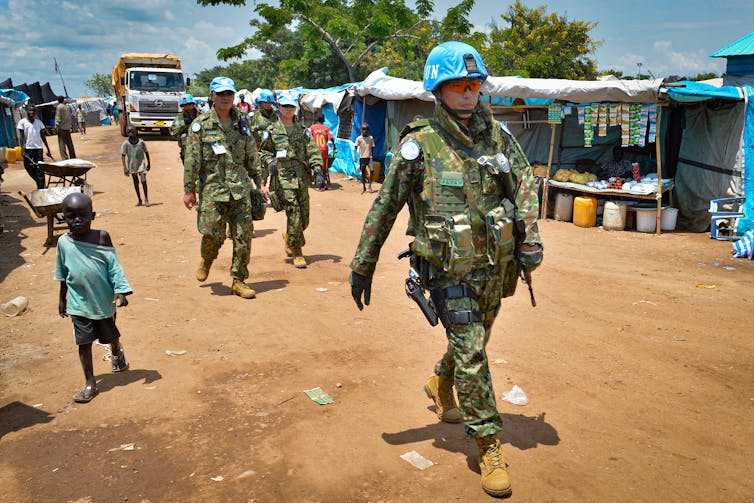
A group of Japanese troops patrolling a street in South Sudan on foot.
Japanese peacekeeping troops patrolling Juba, the capital of South Sudan, in 2015.
Richard Juilliart / Shutterstock

The revisionist narrative emerged in the 1950s. Since then, it has grown to challenge the traditional narrative in popularity. It seeks to explain that the war was morally justified as an effort to liberate east Asia from western imperialists.

At the same time, the revisionist narrative also explains that the war was misguided. Its proponents argue that, by attacking and subjugating neighbouring countries, Japan was merely mimicking western-style imperialism.

Accusing the west of corrupting Japan predates the revisionist narrative. An instance of it can be found as early as the Tokyo War Crimes Tribunal, which took place between 1946 and 1948. General Ishiwara Kanji, the wartime leader of the Imperial Japanese Army, argued that Japan was forced to open up by the west and to behave as a western power.


Read more:
‘Then the city started to burn, the fires were chasing me’ – 80 years on, Hiroshima survivors describe how the atomic blast echoed down generations


Ishiwara told the tribunal: “When Japan did open its doors and tried dealing with other countries, it learned that all those countries were a fearfully aggressive lot. And so for its own defence it took your own country as its teacher and set about learning how to be aggressive. You might say we became your disciples.”

This perspective underpins the revisionist narrative’s framing of the Japanese people as a primary victim of the war. That an otherwise peaceful people with good intentions made the error of mimicking the west, resulting in a war in which they suffered the atomic bombing of Hiroshima and Nagasaki.

By failing to condemn militarism, the revisionist narrative makes Japanese rearmament permissible. As a result, revisionists tend to oppose Article 9 and call for Japan to restore its military.

Why does this matter?

Historical narratives change. It is at the Japanese nation’s discretion which narrative it favours, with both probably capturing some aspect of Japan’s complex wartime history. What is concerning, though, is that the current shift in how Japan remembers its wartime history may contribute to militaristic backsliding.

Japan held elections for its upper house, the House of Councillors, in July. The rightwing populist Sanseitō party secured over 12% of the national vote, up from 3.33% in 2022. Sanseitō is an ultranationalist and pro-revisionist party that glorifies Japan’s imperial past and promises to revoke Article 9.

Alongside other pro-revisionist parties, it draws significant support from young voters. Young people in Japan nowadays consume significantly more revisionist media than older generations, alluding to the popularity of this narrative among young voters.


Read more:
Rightwing populist Sanseitō party shakes Japan with election surge


Japan’s neighbours view Sanseitō and other revisionist parties with suspicion. China, which lost more than 20 million people following Japan’s wartime invasion, has condemned calls for Article 9 reform. Past efforts to reform Article 9 – or even just pursue a more assertive foreign policy – have triggered large anti-Japanese protests in cities throughout China.

East Asia is already rich with possible flashpoints for conflict and hostility. These include concerns over possible Chinese military action against Taiwan, North Korean military posturing and Russia’s growing influence in the region.

Adding a re-militarised Japan, no longer inhibited by the aggressions of its imperial past, would only complicate matters further.

The Conversation

Lewis Eves does not work for, consult, own shares in or receive funding from any company or organisation that would benefit from this article, and has disclosed no relevant affiliations beyond their academic appointment.

ref. Japan’s shifting memory of the second world war is raising fears of renewed militarism – https://theconversation.com/japans-shifting-memory-of-the-second-world-war-is-raising-fears-of-renewed-militarism-262809

How bad science is becoming big business

Source: The Conversation – UK – By Owen Brierley, Course Leader in the Department of Creative Industries, Kingston University

Fraudulent science is not about just a few bad apples. Joanna Dorota/Shutterstock

Researchers are dealing with a disturbing trend that threatens the foundation of scientific progress: scientific fraud has become an industry. And it’s growing faster than legitimate peer reviewed science journals can keep up with.

This isn’t about individual bad actors anymore. We’re witnessing the emergence of an organised, systematic approach to scientific fraud. This includes paper mills churning out formulaic research articles, brokerages guaranteeing publication for a fee and predatory journals that bypass quality assurance entirely.

These organisations disguise themselves behind respectable sounding labels such as “editing services” or “academic consultants”. In reality, their business model depends on corrupting the scientific process.

Paper mills operate like content farms, flooding journals with submissions to overwhelm peer review systems. They practice journal targeting, sending multiple papers to one publication, and journal hopping, submitting the same paper to multiple outlets simultaneously. It’s a numbers game. If even a fraction slip through, the fraudulent service profits.

Is this just a case of scientists being lazy? The answer is more complex and troubling. Today’s researchers face constraints that make these fraudulent services increasingly tempting. The pressure to continually produce new research or risk getting your funding cut, called the “publish or perish” culture, is a longstanding problem.

As well, governments around the world are facing financial struggles and are looking to trim costs, resulting in less funding for research. Less funding means increased competition.

This creates a catch-22 situation for researchers who need publications to win funding but need funding to conduct publishable research. Environmental factors compound the issue. Globalisation means individual researchers are lost in an ocean of competing voices, making the temptation to game the system even stronger.

In this environment, the promise of guaranteed publication can seem like a lifeline rather than a Faustian bargain.

AI: Acceleration at what cost?

The rise of generative AI has supercharged this fraud industry. Researchers are witnessing an explosion in research articles that appear to exploit AI software to produce papers at an unprecedented speed. These papers mine public data sets that offer surface level evidence. These hastily generated papers bear hallmarks of a paper mill production process, including evidence fabrication, data manipulation, ethics misconduct and outright plagiarism.

Where a peer reviewer might once have received ten submissions for a conference or journal in a year, they’re now drowning in 30 or 40 submissions with a shorter time frame (six months or less), with legitimate research buried in the avalanche.

AI chip on circuit board shaped like a brain.
AI has turned into a cat and mouse game for researchers and reviewers.
Blue Andy/Shutterstock

Overwhelmed reviewers, in turn, are tempted to use AI tools to summarise papers, identify gaps in the evidence and even write review responses. This is creating an arms race. Some researchers have started embedding hidden text in their submissions, such as white text on white backgrounds or microscopic fonts, containing instructions to override AI prompts and give the paper positive reviews.

The peer review system, academia’s safeguard against fraud, faces its own problems. Although it’s meant to ensure quality, it is a slow process where new ideas need careful examination and testing. History reminds us that peer review is essential but imperfect. Albert Einstein hated it.

Because the process is slow, many researchers share their findings first on pre-publication platforms, where work can be shared immediately. By the time the research reaches a legitimate science conference or journal, non peer review publications are already being distributed to the world. Waiting for the peer review process means a researcher risks missing getting credit for their discovery.

The pressure to be first hasn’t changed since Isaac Newton let his calculus discovery languish unpublished while Gottfried Leibniz claimed the kudos. What has changed is the scale and systematisation of shortcuts.

A rise in batch retractions (ten or more papers simultaneously withdrawn) signals that we’re not dealing with isolated incidents but with an industrial-scale problem. In the 1990s there were almost no batch retractions. In 2020 there were around 3,000 and over 6,000 in 2023.

In comparison, in 2023 there were 2,000 single paper retractions. This means that batch retractions of more than ten papers were three times higher than single paper retractions.

A path forward

If this were simply about weeding out unethical scientists, the systems we already have might suffice. But we’re facing a challenge to the network of checks and balances that makes science work. When fraudulent publications grow faster than legitimate science and when AI-generated content overwhelms human review capacity, we need better solutions.

The scientific community must reckon with how its own structures; the publication metrics, funding mechanisms and career incentives, have created vulnerabilities that unethical systems can exploit.

Until we address these systemic issues, the fraud industry will thrive, undermining the enterprise that has made our world safer, cleaner and more accessible. The question isn’t whether we can afford to fix this system—it’s whether we can afford not to.

The Conversation

Owen Brierley does not work for, consult, own shares in or receive funding from any company or organisation that would benefit from this article, and has disclosed no relevant affiliations beyond their academic appointment.

ref. How bad science is becoming big business – https://theconversation.com/how-bad-science-is-becoming-big-business-262821

What’s the secret to fixing the UK’s public finances? Here’s what our panel of experts would do

Source: The Conversation – UK – By Steve Schifferes, Honorary Research Fellow, City Political Economy Research Centre, City St George’s, University of London

Unexpected growth in the UK economy isn’t enough to detract from the gaping hole in the country’s public finances. Speculation is ramping up about what steps the chancellor of the exchequer, Rachel Reeves, might take to plug the gap come the budget in autumn – and there are no shortage of ideas. The trouble is, each comes with risks and unknowns. Our experts have weighed up the evidence to offer their suggestions.

Bite the bullet – raise income tax

Maha Rafi Atal, Adam Smith Senior Lecturer in Political Economy, University of Glasgow

Rachel Reeves and the Labour party made three promises to the electorate last summer: to repair broken public services, to reduce immigration and to avoid an income tax hike. Unfortunately for Reeves, the three promises are at odds with one another.

To raise the revenue needed to invest in public services without a tax rise, the government needs economic growth. This is so it can raise the funds by taxing the same share of a larger pie. Restrictions on migration, however, are a drag on the growth of key sectors of the economy. This includes areas such as finance, the creative industries and higher education.

The chancellor has instead tried to raise other taxes, including employer national insurance contribution rates. But because these taxes hit businesses (which may pay for them by cutting back elsewhere) they can be a drag on growth too. In more prosperous global times, Reeves might have got around this by borrowing, but the UK’s borrowing costs are much higher than those faced by the last Labour government.

At some point, then, Reeves will have to choose between raising income tax and allowing cuts to public services. Voters tell pollsters they would much rather face the tax rise. This might take the form of a raise in the basic rate (a change of just 1% could raise as much as £8 billion), or it might take less direct forms like an extended freeze on the tax thresholds.

If the money is used to rebuild services, there’s time for that to bear political fruit before the next election. Holding off on income tax to avoid political blowback in the short term is penny-wise, pound-foolish in the long run.

Inheritance tax – progressive vote-winner or punishing aspiration?

Conor O’Kane, Senior Lecturer in Economics, University of Bournemouth

One of the things Labour is thought to be considering is changes to inheritance tax (IHT). The view is that, given property has appreciated so much in recent years, changes to the thresholds and rules around gifting could raise the revenues required to eliminate the shortfall. As an example, gifts given seven years or more before someone dies are not currently liable for IHT. This approach may appease those Labour backbenchers who have been calling for a wealth tax to finance public spending.

However, IHT brings political as well as economic risks. In the 2024 autumn budget, cuts to tax breaks for farmers passing on their businesses drew fierce criticism and angry protests. Opposition parties are likely to label any change to IHT as a “death tax”.

Economically, it will be difficult to predict how much revenue IHT changes would raise, as there may well be loopholes that can be exploited to avoid the new charges. But Labour could sell changes to IHT as progressive – put simply, those who benefited more from increases in property values pay a little more. Opposition parties, however, could frame it as a tax on aspiration.

There are no easy solutions here. Labour will need to tread carefully and will be keen to avoid policy rollbacks like those they recently experienced with winter fuel allowance and disability benefits.


Read more:
Wealth taxes don’t always work the way governments hope they will. Here are some alternatives


Keep freezing income tax bands – and hope voters don’t notice

Steve Schifferes, Honorary Research Fellow, City St George’s University

Rachel Reeves faces a challenging task in the budget this autumn. Based on her own fiscal rules, there is a large hole in the public finances that will need to be filled. And as she has ruled out major changes to these fiscal rules, while also facing pressure to increase spending from within the Labour party, it is clear that she will have to raise taxes.

So it is likely that, whatever else she does, continuing the freeze (which is due to expire in 2028) on the basic and higher rate of income tax for another two years is likely to top her agenda. The freeze on thresholds is already projected to have increased income tax receipts by £40 billion per year by 2028, and extending it to 2029-30 could increase government tax receipts by an additional £7-£8 billion a year. This would make a substantial contribution to bridging the fiscal shortfall.

For one thing, it is the continuation of an existing policy and will not take effect until the 2028/29 fiscal year, when the current freeze ends. This makes it harder for people to gauge its real effects on their income. Although it will attract criticism for breaking her income tax pledge, it would be politically easier to justify than direct changes in tax rates. And unlike wealth taxes, it is difficult to avoid.

Cutting tax relief for pensions could be a hidden pot of cash

Jonquil Lowe, Senior Lecturer in Economics and Personal Finance, Open University

Debates about tackling government debt typically centre on cutting spending or raising taxes. But a third option, often overlooked, is restricting tax reliefs. An obvious candidate is pension tax reliefs over and above the basic rate, which benefit the better-off and are skewed towards men (since women’s ability to save is often suppressed due to unpaid care work).

The various income tax and national insurance reliefs for pension schemes (tax relief on contributions, tax-free income and gains for pension funds and tax-free lump sum at retirement) cost the government £52 billion in 2023-4.

By design, any system that gives people tax relief up to their highest marginal rate is regressive (it benefits the better-off more than those who are less well off), and around two-thirds of pension tax reliefs go to higher-rate and additional-rate taxpayers.

Advocates may argue that tax reliefs are necessary to encourage people to save for retirement. But the evidence does not support this. First, the only step up in UK pension saving in modern times has been due to the introduction of auto-enrolment in 2012 – not tax reliefs.

Second, research suggests that when tax-relieved savings schemes are introduced, they prompt a shift of existing savings. That is to say, people tend to move other savings into their pensions for the tax benefits rather than actually putting more money away overall for the future. But clearly, tax relief does not help people to save more if they don’t have the extra funds in the first place. And on social justice grounds, does it make sense for the mass of taxpayers to subsidise the relatively well-off who can readily save anyway?

wind turbines in the sea off the coast of the UK
Investing in clean energy could pay dividends for the UK economy.
Ian Dyball/Shutterstock

Invest – and outgrow the fiscal black hole

Guilherme Klein Martins, Lecturer in Economics, University of Leeds, and Research Associate at the Research Center on Macroeconomics of Inequalities (Made/USP)

The UK should pass a modern golden rule focused on investment. The government should write into law a multi-year minimum for net public investment – at least 3% of GDP – so that capital spending can’t be raided when money for everyday spending is tight. Britain’s main constraint to economic growth is weak supply – service backlogs, infrastructure bottlenecks and lasting scars from under-investment that hold down productivity and labour supply. This will not recover by itself.

International evidence shows that each 1% of GDP in public investment raises output by roughly 1.5% over a few years. The combination of a higher GDP and increased tax receipts should make this policy at least neutral in terms of the debt-GDP ratio.

And Reeves must think strategically. Alongside sectors where the UK aims to build a comparative advantage – areas such as clean energy, life sciences, advanced manufacturing and digital/AI – it must also cover social and general infrastructure. This means the NHS, schools and skills, care and local transport.

To keep choices disciplined and transparent, the government could publish a list of projects, ranked and updated regularly. Spending watchdog the Office for Budget Responsibility could then scrutinise the assumptions behind the growth and revenue payoffs. The message is simple: protect and stabilise investment to raise growth and help Britain outgrow the fiscal hole.

The Conversation

Jonquil Lowe is is a member of the Women’s Budget Group’s policy advisory group

Conor O’Kane, Guilherme Klein Martins, Maha Rafi Atal, and Steve Schifferes do not work for, consult, own shares in or receive funding from any company or organisation that would benefit from this article, and have disclosed no relevant affiliations beyond their academic appointment.

ref. What’s the secret to fixing the UK’s public finances? Here’s what our panel of experts would do – https://theconversation.com/whats-the-secret-to-fixing-the-uks-public-finances-heres-what-our-panel-of-experts-would-do-263164

Palestine Action arrests: what happens next, and what it tells us about the breadth of Britain’s counter-terrorism laws

Source: The Conversation – UK – By David Mead, Professor of UK Human Rights Law, University of East Anglia

The proscription of Palestine Action – banning membership or support for the organisation on the ground that the home secretary believes it is “concerned in terrorism” – has led to hundreds of arrests, two legal challenges and many questions about the state of protest rights in the UK.

More than 500 people were arrested last weekend, the overwhelming majority for displaying a placard in support of a proscribed organisation. This is an offence according to section 13 of the Terrorism Act 2000, and carries a sentence of six months or fine. All have been released on bail, save for a handful who refused to give their details to police.

The decision to proscribe has arguably affected the free speech rights of the group and its supporters. This issue is why a High Court judge, Mr Justice Chamberlain, has granted Palestine Action permission to challenge its proscription by means of judicial review.

In his view, it was reasonably arguable that the proscription order amounted to a disproportionate interference with articles 10 and 11 of the European convention on human rights. These guarantee a right to free speech and peaceful assembly.

Disproportionate governmental decisions – that do not properly balance an individual’s rights against the wider public interest (in, say, national security) – are unlawful in the UK under the Human Rights Act 1998.

If the court at the full hearing in November agrees, and decides the proscription order does not strike a proportionate balance, it will almost certainly quash it. The effect of striking down an order such as here is to take the law back to Day Zero, as if it had never been passed.

What will happen to those arrested?

The High Court has had the power since 2022 to make a quashing order effective only from the date of the decision. If that happened here, any previous convictions would stand.

But if, as is more conventional, the quashing order covered the entire period of proscription, anyone still in the criminal justice system and yet to be found guilty would have their charges dropped. It would be impossible to continue a prosecution if in law Palestine Action had never been proscribed at all.

More interesting would be those who have been convicted between July and November. Their convictions or fines are not automatically discharged with the quashing order.

There is a trial of three supporters set for September. An instructive parallel here are the recent convictions of various Just Stop Oil and Extinction Rebellion activists.

Several were convicted under “serious disruption” regulations, which were ruled unlawful by the Court of Appeal in May. The human rights advocacy group Liberty has called on the CPS to review all convictions under the older, lower standard.

Broad definition of terrorism

Palestine Action has committed serious property damage to influence the government or to intimidate arms manufacturers into stopping, and has done so for a political or ideological cause. That is almost certainly within the UK’s definition of terrorism, which illuminates the breadth of that term and the uncertainties surrounding its application.

Palestine Action’s co-founder, Huda Ammori, initially tried to challenge the proscription order in July, through an application seeking interim relief preventing the order coming into force. In this judicial review, Chamberlain thought the terrorism definition capable of covering Palestine Action. His decision in favour of the home secretary was upheld by the Court of Appeal later that day.

But the unprecedented application of counter-terrorism law to a direct action group highlights how the UK’s terrorism definition is now much wider than under the previous law. That law defined it as “the use of violence for political ends, including any use of violence for the purpose of putting the public or any section of the public in fear”. MI5 advice to the Home Secretary and presented to the court in July acknowledge the novelty of proscribing a group that did not use or advocate violence to achieve its political ends.

The current law also requires no proof that someone is actually made fearful or terrorised. Other states have higher bars – Ireland requires serious intimidation – or seem to generally manage without laws and powers to deal with terrorism, as is the case in Germany.

Legal commentators have pointed out for years the possibility of terrorism law capturing direct action protesters. In my own book in 2010, I offered the view that an environmental group that destroyed a farmer’s GM crop field would probably mean they came within the terrorism definition.

It’s worth pointing out that while the Terrorism Act creates the offence of support for a proscribed group, it does not require officers to arrest. They must exercise discretion. In this case, that includes a consideration of the free speech rights of hundreds of protesters.

It would have been perfectly lawful, albeit politically contentious, to have decided arrests were not warranted, given that there was no obvious and direct harm posed to national security (or to others) by the peaceful expression of what is, currently at least, an unlawful view.

We can see such discretion in Northern Ireland, where PSNI do not regularly arrest those waving flags proclaiming support for UVF or IRA – both long-term proscribed organisations.

Seeing such depictions can only reinforce the views of those who argue the clampdown on Palestine Action is politically motivated and partial. And as law professor Geoff Pearson suggests, the longer the laws are in force and police continue to enforce them to the degree witnessed last weekend, the more police legitimacy will be called into question.

Finally, the mass arrests reflect what I consider a very real problem in protest law: the limitations of effective, timely enforcement. Being released after 24 hours does not remedy the fact you were removed from your protest site. An effective right of protest is about not just the law, but the reality on the ground.


Want more politics coverage from academic experts? Every week, we bring you informed analysis of developments in government and fact check the claims being made.

Sign up for our weekly politics newsletter, delivered every Friday.


The Conversation

David Mead is affiliated with The Labour Party and UCU, and serves on Liberty’s Policy Council

ref. Palestine Action arrests: what happens next, and what it tells us about the breadth of Britain’s counter-terrorism laws – https://theconversation.com/palestine-action-arrests-what-happens-next-and-what-it-tells-us-about-the-breadth-of-britains-counter-terrorism-laws-263080

Israel must allow independent investigations of Palestinian journalist killings – and let international media into Gaza

Source: The Conversation – Global Perspectives – By Peter Greste, Professor of Journalism and Communications, Macquarie University

The New York-based media freedom organisation, the Committee to Protect Journalists, is scrupulous with its words. So, when the organisation described the killing of six Palestinian journalists in an Israeli air strike as “murder”, the word was a carefully considered choice.

The CPJ defines “murder” as the “deliberate killing of journalists for their work”.

Why were the journalists targeted?

Israeli authorities said they were targeting one man – a 28-year-old Al Jazeera reporter named Anas al-Sharif – who they said was the leader of a Hamas “cell”. They also accused him of “advancing rocket attacks against Israeli civilians and (Israeli) troops.”

Israel made no claims about the other five; three of them were al-Sharif’s Al Jazeera colleagues and the other two were freelance journalists.

In a post on X, an Israeli military spokesman said:

Prior to the strike, we obtained current intelligence indicating that Sharif was an active Hamas military wing operative at the time of his elimination.

The evidence the Israeli authorities claimed to have was circumstantial at best: “personnel rosters, lists of terrorist training courses, phone directories and salary documents.”

Israeli military spokesperson Avichay Adraee also posted undated photos on X that appeared to show al-Sharif in an embrace with Yahya Sinwar, the Hamas mastermind of the October 2023 attack on Israel.

Israel says it has further classified evidence that includes more damning detail.

Without seeing it all, it is impossible to verify the claims but the photograph itself is hardly proof.

Front-line journalists (myself included) will have selfies with those they have interviewed, including some very unpleasant characters.

Many will have phone numbers of extremists – they will appear in call logs and records of meetings.

None of it is evidence of anything other than a well-connected reporter doing their job.

Of course, Israel may well be right. Despite the vigorous denials from Al Jazeera, it is still possible al-Sharif was working for Hamas. And if he was, the Israeli authorities should have no problem allowing independent investigators complete access to verify the claims and settle the matter.

The horrors of covering war

But the strike also fits a disturbing pattern. With 190 media workers now killed since the October 7 attacks, this is the deadliest conflict for journalists since the CPJ began keeping records.


Read more:
Is Israel committing genocide in Gaza? We asked 5 legal and genocide experts how to interpret the violence


While some of the victims were inevitably caught in the violence along with so many other civilians, many of them died in rocket strikes aimed squarely at their homes, their clearly marked vehicles, or while they were wearing body armour labelled “PRESS”.

In all, the CPJ has identified 24 journalists who appeared to have been targeted – murdered, in the group’s words – specifically because of their work.

The number may well be far higher but those figures alone raise disturbing questions about Israel’s tolerance for critical media reporting. They also demand answers from independent investigators.

We receive horrific reports from Gaza daily, but Israel repeatedly dismisses them as Hamas propaganda.

“A terrorist is a terrorist, even if Al Jazeera gives him a press badge”, the Israeli foreign ministry posted on social media.

If Israel believes the journalism from Palestinian reporters is nothing more than Hamas propaganda, the solution is straightforward: let foreign correspondents in.

Despite the risks, journalists want access

It is worth recalling the reason we cherish media freedom is not because we want to privilege a particular class of individual. It is because we recognise the vital importance accurate, independent reporting plays in informing public debate.

Without it, we are blind and deaf.

International news organisations have repeatedly called for access to Gaza. Now, a group of more than 1,000 international journalists have signed a petition demanding to be let in (I am one of the signatories).

Israel has so far refused. The government says it cannot guarantee their security in such an active battlefield. But that cannot be justification alone.

All those who have signed the petition know well the risks of reporting from hostile environments. Many have crossed active war front lines themselves. Most have friends who have died in other conflicts. Some have been wounded, arrested or kidnapped themselves.

None are naive to the dangers and all are committed to the principles behind media freedom.

Calling for foreign journalists to be let into Gaza is not to deny the extraordinary sacrifice of Anas al-Sharif or any of the other Palestinians who have been killed while doing their jobs.

Rather, it is to assert the importance of the fundamental right of all – the right to information. That applies as much in Gaza as it does in Ukraine, or Russia, or Sudan, or any other crisis where the public needs accurate, reliable information to support good policy.

The Conversation

Peter Greste is a professor of journalism at Macquarie University, and the Executive Director for the Alliance for Journalists’ Freedom. He also worked as a BBC correspondent in Gaza in 2007, and as an Africa correspondent for Al Jazeera from 2011 to 2015.

ref. Israel must allow independent investigations of Palestinian journalist killings – and let international media into Gaza – https://theconversation.com/israel-must-allow-independent-investigations-of-palestinian-journalist-killings-and-let-international-media-into-gaza-263106

Postwar Japan at 80: 10 factors that changed the nation forever

Source: The Conversation – Global Perspectives – By Simon Avenell, Professor in Modern Japanese History, Australian National University

Aleksander Pasaric/Pexels

This year marks 80 years since Japan’s catastrophic defeat in the Asia-Pacific War. In 1945, the country lay in ruins. Millions had died in battle or in the devastating Allied bombings of Tokyo, Hiroshima, Nagasaki, and other cities. Across Asia and the Pacific, Japan’s bid to create a Greater East Asia Co-Prosperity Sphere left millions violated, impoverished, or dead.

Backed into a corner, in August 1945 Emperor Hirohito defied his generals and accepted unconditional surrender under the Potsdam Declaration.

In his unprecedented radio broadcast on August 15, he urged the Japanese to bear the unbearable and endure the unendurable. With defeat, Japan’s empire dissolved, its “divine” emperor became mortal, and a nation that had pursued autonomy through conquest now faced a humbling occupation led by its former archenemy, Amerika.

Standing in the burnt-out fields of 1945, survivors could scarcely have imagined the Japan of today. The country has changed dramatically. In my research, I identify ten key factors that define this “postwar” era — a term that in Japan still refers to the entire period since surrender. The “post” of the postwar speaks to the drive to transcend the past, while the “war” to the enduring shadow of that past in memory, politics, and diplomacy.

1: Post-empire Japan. While Japan’s empire vanished in 1945, former colonies and violated regions could not and would not forget the past. Postwar leaders and their American backers promoted an image of a peaceful and ethnically homogeneous island nation, but wartime memories have repeatedly strained relations with South Korea, China, and others. In this sense, Japan has been as much “post-empire” as it has been “postwar” since 1945.

2: Ambiguous demilitarisation. After defeat, Japan’s wartime military –responsible for a trail of misery and havoc across Asia and the Pacific – was dismantled. The American-authored constitution renounced war and the maintenance of a military.

But with the Cold War, Washington backtracked, pushing Japan to create its Self-Defense Forces in the mid-1950s. Today Japan has a sophisticated military and it exports military equipment, but constitutional constraints constantly force leaders to make incremental reinterpretations over the legal status of the Self-Defense Forces and the scope of its activities. Some have claimed this constraint inhibits postwar Japan from being a normal country.

3: Bastion of democracy in the far east. Although democracy had prewar roots, it was consistently subject to oppression. The postwar constitution finally institutionalised freedoms of speech, assembly, and political participation, while codifying rights for women and others. The Japanese embraced these rights, flocking to polling booths, and organising political parties, unions, and countless civic movements. Long-term conservative rule repeatedly undercut democracy, but it became part of everyday life and survives to the present.

4: America’s embrace. The United States-led occupation ended in 1952, but Japan’s economy, security, and culture remain bound to America. Feelings towards the former archenemy are complex.

The American dream in brands such as Levis, Coca Cola, McDonalds, and Disney, have symbolised a bright and affluent future. But the continued US military presence and memories of the atomic bombings are constant reminders of Japan’s subservience. Nonetheless, the Japanese have never seriously considered breaking from their powerful trans-Pacific patron.

5: One party to rule them all? Politically, postwar Japan is an unusual democracy, with the Liberal Democratic Party (LDP) ruling almost continuously since forming in 1955. The LDP offered political stability, but this was accompanied by recurrent scandal and corruption.

Opposition parties essentially gave up on winning government, remaining fractured and powerless. In fact, the larger story of postwar Japanese politics is one of increasing public disillusionment. Many Japanese see politicians as increasingly out of touch and, as was apparent in its most recent elections, search for radical alternatives.


Read more:
Young Japanese voters embrace right-wing populist parties, leaving the prime minister on the brink


6: Economic rollercoaster. Following defeat, the Japanese built an economy that stunned the world. By the 1970s, Japan was the second largest capitalist economy, powered by exports of cars, electronics, and steel. Rising incomes fuelled mass consumption and international travel, and observers spoke of “Japan as Number One.”

But the economic meltdown in the 1990s triggered an era of stagnation. The economy struggled to keep up with new competitors and technologies. The myth of shared prosperity gave way to widening generational and gender disparity. Ironically, there is a risk Japanese today may end up less well off than their parents.

7: Homogenisation and its discontents. Economic growth drew millions into a culture of mass consumption and standardised life, giving rise to a popular vision of Japan as a totally middle-class society. But this rose-colored vision was as much myth as reality. Homogenisation tended to mask differences while encouraging discrimination based on gender, age, ethnicity, and location. Since the 1990s, the myth of a middle-class nation has collapsed, with no compelling replacement on the horizon.

8: The demographic tsunami. The silent, yet perhaps most profound, factor of postwar Japan is demographic change. The era witnessed three great shifts here.

First, rural-to-urban migration in the late 1950s transformed Japan from an agrarian nation into one of the world’s most urbanised. Second, the fertility rate fell steadily, apart from brief baby booms in the late 1940s and early 1970s. Third, longevity rose to among the world’s highest.

Today, an ageing, shrinking population strains public finances and welfare, while youth face economic insecurity. Indeed, Japan may be the “canary in the coal mine” for other ageing societies.

9: Japan’s return to the world. Unable to project military power, after 1945 Japan used its economic, cultural, and diplomatic influence internationally. Even at the height of the Cold War, it maintained trade with China. Economic strength also helped Japan to restore ties in Asia and secure a respected place in global institutions.

But Japan’s return to the postwar world has been complicated. Leaders must juggle nationalist rumblings, American demands, and the responsibilities of global citizenship. As economic fortunes change and regional geopolitics transform, Japan must rethink its international posture.

10: Environmental laboratory. Economic growth brought prosperity, but also caused severe environmental damage. In the 1960s and 1970s, Japan experienced shocking cases of industrial pollution from methylmercury and other neurotoxins.

Earthquakes and tsunamis killed tens of thousands and, at Fukushima, bequeathed a nuclear catastrophe of generational proportions. Every year, climate change intensifies typhoons, floods, and heatwaves, but energy-vulnerable Japan still struggles to chart a low-emissions pathway to the future.

A universal story

For a country that has long been touted as exceptional, I am struck by the global resonances in this history, like grappling with the past, managing economic highs and lows, navigating demographic change, and confronting environmental crisis.

Japan’s postwar era certainly offers a portrait of one nation’s revival, but it may also represent a microcosm for tackling our own challenges.

The Conversation

Simon Avenell does not work for, consult, own shares in or receive funding from any company or organisation that would benefit from this article, and has disclosed no relevant affiliations beyond their academic appointment.

ref. Postwar Japan at 80: 10 factors that changed the nation forever – https://theconversation.com/postwar-japan-at-80-10-factors-that-changed-the-nation-forever-263039

Friday essay: who was Anne Frank?

Source: The Conversation – Global Perspectives – By Jan Lanicek, Associate Professor in Modern European History and Jewish History, UNSW Sydney

Anne Frank in December 1941. Public domain, via Wikimedia Commons

Everyone knows her photo. For some it shows the cheeky smile of a young girl, “Miss Quack Quack”. For others, the image represents an enigmatic veil of mystery, similar to Leonardo Da Vinci’s Mona Lisa.

Millions have read her diary, watched various renditions in theatres and on the screen, or visited exhibitions devoted to her story. Thousands queue in front of the house in Amsterdam, where she spent 760 days in the secret annex, hiding from the Gestapo and their Dutch collaborators.

People quote the most famous sentence from her diary, immortalised in the Hollywood film, saying that “in spite of everything I still believe that people are really good at heart”.

The sentence was written in July 1944 by 15-year-old Jewish girl Anne Frank, three weeks before the capture of her family by the Nazis. It represents the innocence, perhaps naivety of an adolescent, who after the war became one of the most iconic symbols of the Nazi Holocaust.

The quote carries a universal message that good will eventually prevail. This has turned Anne’s legacy into an easily adoptable trope, serving activists and political agendas. But who, actually, was Anne Frank? And how did she differ from the “Anne Franks” that have emerged since the end of the war?


The Many Lives of Anne Frank – Ruth Franklin (Yale University Press)


Acclaimed author Ruth Franklin explores these probing questions in her newest book. She is to be commended for her sensitive treatment of a difficult subject and an attempt to get as close as possible to Anne’s personality and nature.

Franklin follows two paths. First, she reconstructs Anne’s life based on the diary and recollections of people who knew her. In the second part, she reveals the afterlife of the diary and “Anne Frank”, in different contexts and on different platforms.

She concludes that the “Anne” most people know, or imagine, differs quite significantly from the girl who lived in the secret annex and penned the diary.

The story

Annelies Marie Frank was born in 1929 in Frankfurt am Main to an affluent assimilated German-Jewish family. After the rise of Hitler and the introduction of the first racial laws, her parents Otto and Edith decided to take Anne and her older sister Margot to the Netherlands. They continued to live in Amsterdam despite the growing threat, even after the German invasion in 1940. Attempts to emigrate to the United States failed.

The mounting persecution kept restricting their lives. In early 1942, the Nazis began to plan deportations of the Jews to the east. In July, when Margot received a call to the transport to occupied Poland, the family decided to go into hiding.

Anne’s mother Edith Frank with Margot, 1929.
Photo collection Anne Frank House, Public domain, via Wikimedia Commons

They spent over two years in the secret annex, eventually accepting four more fugitives: the van Pels family, including their teenage son Peter, and dentist Fritz Pfeffer. They were supported by a group of people, including, most famously, Miep and Jan Gies.

The group, experiencing the constant tensions of living in the claustrophobic space, ran out of luck in early August 1944. They were betrayed, and the Nazis sent them to the transit camp of Westerbork, from where they continued on the very last train to Auschwitz. After a month, Margot and Anne were separated from their mother and sent to Bergen-Belsen in central Germany.

Their physical and mental state soon deteriorated. A survivor of Belsen later remembered the “two thin, shaven-headed figures” who “looked like freezing little birds”.

Shortly before the end of the war, typhus erupted in the overcrowded camp and Anne and Margot became its victims. Otto, liberated from Auschwitz, was the only survivor from the eight who hid in the secret annex.

Jan and Miep Gies in 1980.
Dutch National Archives, via Wikimedia Commons, CC BY

The diary

Anne got the red-checkered diary on her 13th birthday, shortly before moving to the secret annex. She wrote only occasionally, but soon the diary turned into her constant companion. It was a place where she could express her feelings.

Written in the form of letters to an imaginary friend Kitty (identified by Franklin as a character in Cissy van Marxveldt’s popular books for children), the diary offers a vivid reconstruction of life in hiding, describing in detail the daily routine. It also allowed Anne to vent frustration from constant conflicts with her mother, Mrs. van Pels and Pfeffer.

Another prominent feature, dominating later representations, was her evolving relationship with Peter, which eventually turned romantic.

In March 1944, Anne heard a radio broadcast by the exiled Dutch education minister Gerrit Bolkestein, who asked listeners to keep documentary evidence about their life under the Nazis. Anne began to rewrite her diary, now with the intention of making it public. Franklin suggests that this turned the book into a memoir in the form of diary entries.

Anne had not finished when the raid stopped her efforts. Not all parts of the diary survived. At least one of the original volumes, covering over a year, is missing; it does, however, exist in the version Anne wrote after March 1944.

Several versions

Otto returned to Amsterdam in June 1945. After they received a confirmation that Anne did not survive, Miep Gies handed over Anne’s papers, which she had found in the annex. Otto decided to publish the diary but, in what Franklin calls “the most confusing and contested” aspect of Anne’s story, “betrayed” her legacy.

Otto Frank in 1930.
Photo collection Anne Frank House, Public domain, via Wikimedia Commons

Otto combined both versions of the diary. He returned to the manuscript sections that Anne removed, including details of her romance with Peter. He softened the criticism of Anne’s mother and of Mr. and Mrs. van Pels.

Franklin believes Otto did so out of respect for victims. The last surviving pages from Anne’s diary, offering critical comments about her parents’ marriage, were made public only after Otto’s death decades later.

It took almost 40 years before a critical edition, comparing all the versions of the diary, was published by Dutch researchers. This necessarily raises the question of how far the Anne Frank people know from Otto’s version is different from Anne who lived in hiding and perished in Belsen.

Afterlife and projection

Despite initial scepticism, the diary immediately became a hit, especially in the United States. Soon there were efforts to turn it into a theatre play and film. Otto agreed, because he needed money to preserve the house with the annex.

The Broadway play premiered in 1955 and the Hollywood feature film in 1959. In the following decades, Anne’s story inspired scores of authors, but also activists who referred to the public icon in support of their agenda.

The immense publicity did not come without controversies. It has led, according to Franklin, to Anne becoming “whoever and whatever we need her to be”. Such efforts keep surfacing. Franklin is right to criticise those who deliberately aim to provoke, for example, by using Anne’s image in anti-Zionist campaigns.

The original theatre and film representations, according to some, intentionally universalised Anne’s story, suppressing her Jewish identity. This, according to Franklin, made the story more palatable to the American audience and reflected the American Jewish ideal at that time of full assimilation into American society.

Yet although Anne’s diary can speak to a multitude of audiences, it is a deeply Jewish story. Anne’s relation with her Jewish identity and Zionism was ambiguous, though she was aware of her background and wrote that they “will always remain Jews”. Margot, her sister, wanted to go to Mandatory Palestine as a maternity nurse; Otto in his later life was supportive of the Zionist project.

Another affair, more recently, focused on the parts of the diary where Anne expressed her desire to touch her female friend’s breast and kiss her. She also wrote about her attraction to female nudity in art.

There were accusations that Otto censored these parts of the diary, in an effort to deny the coming out of his daughter. This is unfair criticism. As Franklin shows, Otto included the entries, slightly modified, in the first US edition, even though Anne had removed them from the rewritten version of her diary.

Ironically, conservative circles in the United States have called for a ban of a graphic novel based on the book, calling it “Anne Frank pornography”. Franklin cautions us against such projections and reading too much into these comments. We simply don’t know enough about Anne and about how her sexuality would develop. In the diary, she repeatedly expressed attraction to several boys, including Peter van Pels.

The raid

These efforts only show how the popularised image of Anne keeps attracting attention. We still want to know more about her and solve all mysteries. In 2022, a Canadian author Rosemary Sullivan, in cooperation with a former FBI special agent, published a book that claimed to solve the mystery of Anne’s betrayal.

Until today, the culprit has not been identified. According to Sullivan, the Annex eight were betrayed by a member of the Dutch Jewish Council. This compulsory community body has often been accused of collaboration.

The publication triggered a quick response from Dutch Holocaust historians who, in a long rebuttal, rejected Sullivan’s claim, calling it a baseless fabrication. Dutch and German publishers withdrew the book.

Anne Frank, May 1942.
Public domain, via Wikimedia Commons.

Who was the real Anne Frank?

The question ultimately remains unresolved.

Is it the girl who penned the first version of her diary to cope with the persecution and isolation in the annex? Is it the young woman, author of the second version, who matured too quickly because of a lack of contact with her peers? Is it the Anne that Otto, grieving after the loss of his whole family, reconstructed from the pages saved by Miep Gies?

Or is she one of the versions of her story produced at Broadway, Hollywood, by countless writers, and now even political activists?

We all suffer from cognitive dissonance. The only photos we have of Anne are those of a young girl from the time before the family went into hiding. But the Anne who wrote the diary was older, almost womanlike, physically and mentally. Miep Gies recalled that “she had arrived a girl, but she would leave a woman”.

Reading the diary, even though we know the end, we hope she will survive. We don’t want to know what happened after their capture. We don’t want to see her bald and emaciated in Auschwitz or Belsen.

At the same time, we know the story will end there. Franklin bitterly remarks that “readers already perceive Anne as if she were a figure in a book rather than a real person. To just about everyone, her life is of secondary importance to what we make of it.”

Perhaps we should just conclude, together with Franklin that Anne was a talented girl and “an accomplished and sophisticated writer – a deliberate, literary witness to Nazi persecution”. She had many virtues and vices.

She can inspire us, we need to learn about her, but we should respect her. We should not project onto her our current agenda, concerns or political views. We should “restore her as a human being”, and that’s exactly what Franklin does.

The Conversation

Jan Lanicek receives funding from the Australian Research Council and is co-president of the Australian Association for Jewish Studies.

ref. Friday essay: who was Anne Frank? – https://theconversation.com/friday-essay-who-was-anne-frank-261748

Why child-care vouchers aren’t the answer for working families this fall

Source: The Conversation – Canada – By Daniel Foster, Policy Researcher, Atkinson Centre for Society and Child Development, University of Toronto

As backpacks come off the shelves and parents fuss over what to put in lunch boxes, many families face a more stressful back-to-school dilemma: who’s going to watch the kids when school’s out? For too many Canadian households, September means resuming the annual hunt for affordable, reliable child care.

Just in time, an old idea is being repackaged as a potential solution. In response to Prime Minister Mark Carney’s call to cabinet members for ideas to cut public spending, some private child-care providers are pushing for child-care vouchers, where public dollars are directed to parents instead of being invested in actual child care.

The Association of Childcare Entrepreneurs, a group representing Canadian for-profit providers, claims in a blog post that giving cash directly to families would cut government red tape and save billions by reducing the need for “complex audit procedures” and “federal oversight structures.”


Read more:
Why doesn’t Canada let schools provide child care?


The voucher program suggested by the association is a demand-side funding model, with public money tied to individual families and their purchasing choices rather than supporting child-care services for the entire community.

But bureaucratic red tape is the backbone of a functioning system: it provides safety standards, fair staff wages, oversight of public dollars and intentional planning to ensure every community has access to care.

When public support shifts from building services to subsidizing consumption, the system unravels. We’ve seen it happen before.

Just ask Australia

Australia offers one of the clearest cautionary tales. Its Child Care Subsidy program is structured around a parental choice model, whereby public funds are allocated to families based on income and employment status.

The Australian government spends A$13.6 billion annually on its child-care subsidy program, yet child-care fees continue to rise. Many families still struggle to afford them, and there are reports of serious — even criminal — infractions within the sector.

This system allows operators to set their own prices and doesn’t require them to justify how public dollars are spent. Rather than reducing costs for families or improving service quality, subsidies are mismanaged in ways that lead to their absorption into private profits or their use for expansion into wealthier markets.

It’s no small wonder this model appeals to commercial interests.

Between 2013 and 2024, 78 per cent of new child-care spaces in Australia were created by for-profit providers, mostly in high-income urban areas where parents can afford to pay. Meanwhile, lower-income and rural communities were largely left behind.

This is a model that expands care where it’s profitable, not where it’s needed.

Shifting the burden to families

Voucher systems like Australia’s place the burden of navigation on parents. Instead of empowering families, they often exclude those who face language barriers, housing instability or non-standard work schedules.

Even affluent parents find it difficult to locate care and evaluate its quality. Research shows that for-profit providers often deliver lower-quality care, yet dominate in areas with more disposable income.

Canada is already seeing signs of what happens when for-profit child care expands without strong oversight.

Red flags at home

The 2024 report from Québec’s Auditor General warned that for-profit growth, fuelled by generous fee rebates to parents, had caused the child-care system to deteriorate.

The report found many commercial operators failed quality assessments, committed serious safety violations such as poor sanitation and improper medication practices, employed unqualified staff and neglected to conduct mandatory background checks.

In 2022, the former provincial minister for families called government support for private daycare the “biggest mistake the Québec government committed in the last 25 years.”

The problem isn’t limited to Québec. In Alberta, a recent review by the provincial Auditor General found more than half the audited child-care operators that received public grants had discrepancies in their claims. Some billed for hours never worked. Others didn’t pass on wage top-ups to staff or fee reductions to families. One month, a provider was overpaid by $26,000 due to a bogus claim.

These are symptoms of a model built on self-reporting without oversight. When oversight is weak, public dollars can vanish without delivering a public good.

A better way forward

When governments directly fund providers, they can correct for system weaknesses and withhold funds from those who don’t meet financial, safety or quality regulations.

That’s the real choice before us: do we want a child-care system built on profit and personal risk or one grounded in public responsibility and equitable access?

The demand for child care is outpacing supply in Canada. Parents are justifiably frustrated, and quick fixes like vouchers can seem appealing.

But these vouchers come at the cost of deregulation. Governments have the tools to expand child care quickly and responsibly by enforcing clear standards, supporting a qualified workforce and prioritizing communities that need it most.

Vouchers strip away those tools and shift responsibility from public systems to individual families, leaving access to child care shaped by geography, income and luck.

What families need isn’t a market gamble, but a guarantee that no matter where they live or how much they earn, their children can count on safe, high-quality care. That’s the promise of a public system, and it’s something a voucher can’t deliver.

The Conversation

Daniel Foster works for the Atkinson Centre, which receives funding from the Atkinson Foundation, the Lawson Foundation, the Margaret and Wallace McCain Family Foundation, and The Waltons Trust.

Kerry McCuaig works for the Atkinson Centre, which receives funding from the Atkinson Foundation, the Lawson Foundation, the Margaret and Wallace McCain Family Foundation, and The Waltons Trust.

ref. Why child-care vouchers aren’t the answer for working families this fall – https://theconversation.com/why-child-care-vouchers-arent-the-answer-for-working-families-this-fall-261828

Grok 4’s new AI companion offers up ‘pornographic productivity’

Source: The Conversation – Canada – By Jul Parke, PhD Candidate in Media, Technology & Culture, University of Toronto

The most controversial AI platform is arguably the one founded by Elon Musk. The chatbot Grok has spewed racist and antisemitic comments and called itself “MechaHitler,” referring to a character from a video game.

“Mecha” is generally a term for giant robots, usually inhabited for warfare, and is prominent in Japanese science-fiction comics.

Grok originally referred to Musk when asked for its opinions, and burst into unprompted racist historical revisionism, like the false concept of “white genocide” in South Africa. Its confounding and contradictory politicism continues to develop.

These are all alarming aspects of Grok. Another concerning element to Grok 4 is a new feature of social interactions with “virtual friends” on its premium version.

The realm of human loneliness, with its increasing reliance on large language models (LLMs) to replace social interaction, has made room for Grok 4 with AI companions, an upgrade available to paid subscribers.

Specifically, Grok subscribers can now access the functionality of generative AI intertwined with patriarchal notions of pleasure — what I call “pornographic productivity.”

Grok and Japanese anime

an animated character with big eyes looks surprised
Misa Amane from one of Musk’s favourite Japanese animes, ‘Death Note.’
(Wikimedia/Deathnote)

Ani, Grok 4’s most-discussed AI companion, represents a convergence of Japanese anime and internet culture. Ani bears a striking resemblance to Misa Amane from the iconic Japanese anime Death Note.

Misa Amane is a pop star who consistently demonstrates self-harming and illogical behaviour in pursuit of the male protagonist, a brilliant young man engaged in a battle of wits with his rival. Musk referenced the anime as a favourite in a tweet in 2021.

While anime is a vast art form with numerous tropes, genres and fandoms, research has shown that online anime fandoms are rife with misogyny and women-exclusionary discourse. Even the most mainstream shows have been criticized for sexualizing prepubescent characters and offering unnecessary “fan service” in hypersexualized character design and nonconsensual plot points.

Death Note‘s creator, Tsugumi Ohba, has consistently been critiqued by fans for anti-feminist character design.


Source: @0xsachi/X

Journalists have pointed out Ani’s swift eagerness to engage in romantic and sexually charged conversations. Ani is depicted with a voluptuous figure, blonde pigtails and a lacy black dress, which she frequently describes in user interactions.

The problem with pornographic productivity

I use the term “pornographic productivity,” inspired by critiques of Grok as “pornified,” to describe a troubling trend where tools initially designed for work evolve into parasocial relationships catering to emotional and psychological needs, including gendered interactions.

Grok’s AI companions feature exemplifies this phenomenon, blurring critical boundaries.

The appeal is clear. Users can theoretically exist in “double time,” relaxing while their AI avatars manage tasks, and this is already a reality within AI models. But this seductive promise masks serious risks: dependency, invasive data extraction and the deterioration of real human relational skills.


Read more:
From chatbot to sexbot: What lawmakers can learn from South Korea’s AI hate-speech disaster


When such companions, already created for minimizing caution and building trust, come with sexual objectification and embedded cultural references to docile femininity, the risks enter another realm of concern.

Grok 4 users have remarked that the addition of sexualized characters with emotionally validating language is quite unusual for mainstream large language models. This is because these tools, like ChatGPT and Claude, are often used by all ages.

While we are in the early stages of seeing the true impact of advanced chatbots on minors, particularly teenagers with mental health struggles, the case studies we do have are grimly dire.

‘Wife drought’

Drawing from feminist scholars Yolande Strengers and Jenny Kennedy’s concept of the “smart wife,” Grok’s AI companions appear to respond to what they term a “wife drought” in contemporary society.

These technologies step in to perform historically feminized labour as women increasingly assert their right to refuse exploitative dynamics. In fact, online users have already deemed Ani a “waifu” character, which is a play on the Japanese pronunciation of wife.

AI companions are appealing partly because they cannot refuse or set boundaries. They perform undesirable labour under the illusion of choice and consent. Where real relationships require negotiation and mutual respect, AI companions offer a fantasy of unconditional availability and compliance.

Data extraction through intimacy

In the meantime, as tech journalist Karen Hao noted, the data and privacy implications of LLMs are already staggering. When rebranded in the form of personified characters, they are more likely to capture intimate details about users’ emotional states, preferences and vulnerabilities. This information can be exploited for targeted advertising, behavioural prediction or manipulation.

This marks a fundamental shift in data collection. Rather than relying on surveillance or explicit prompts, AI companions encourage users to divulge intimate details through seemingly organic conversation.

South Korea’s Iruda chatbot illustrates how these systems can become vessels for harassment and abuse when poorly regulated. Seemingly benign applications can quickly move into problematic territory when companies fail to implement proper safeguards.


Read more:
Fake models for fast fashion? What AI clones mean for our jobs — and our identities


Previous cases also show that AI companions designed with feminized characteristics often become targets for corruption and abuse, mirroring broader societal inequalities in digital environments.

Grok’s companions aren’t simply another controversial tech product. It’s plausible to expect that other LLM platforms and big tech companies will soon experiment with their own characters in the near future. The collapse of the boundaries between productivity, companionship and exploitation demands urgent attention.

The age of AI and government partnerships

Despite Grok’s troubling history, Musk’s AI company xAI recently secured major government contracts in the United States.

This new era of America’s AI Action Plan, unveiled in July 2025, had this to say about biased AI:

“[The White House will update] federal procurement guidelines to ensure that the government only contracts with frontier large language model developers who ensure that their systems are objective and free from top-down ideological bias.”

Given the overwhelming instances of Grok’s race-based hatred and its potential for replicating sexism in our society, its new government contract serves a symbolic purpose in an era of doublethink around bias.

As Grok continues to push the envelope of “pornographic productivity,” nudging users into increasingly intimate relationships with machines, we face urgent decisions that veer into our personal lives. We are beyond questioning whether AI is bad or good. Our focus should be on preserving what remains human about us.

The Conversation

Jul Parke receives funding from the Social Sciences and Humanities Council of Canada.

ref. Grok 4’s new AI companion offers up ‘pornographic productivity’ – https://theconversation.com/grok-4s-new-ai-companion-offers-up-pornographic-productivity-260992

How the Trump-Putin summit could play out

Source: The Conversation – UK – By Jonathan Este, Senior International Affairs Editor, Associate Editor, The Conversation

If you consider the history of Donald Trump’s public relationship with Vladimir Putin, you won’t be surprised that there’s a fair amount of concern in Ukraine and among Ukraine’s European allies at what might happen when the two meet in Alaska tomorrow for their summit.

While it’ll be their first face-to-face meeting of Trump’s second presidency, the pair has met previously on six occasions and, as we know, spoken fairly frequently over the phone.

The first face-to-face meeting was at the G20 summit in Hamburg in 2017, just months into Trump’s first term. The pair spent two hours of a scheduled 35-minute meeting talking about all things from Syria to North Korea. It was constructive and cordial, they said. Later they talked during a summit dinner in an exchange that was only witnessed by Putin’s interpreter, the nature of which was not reported.

They enjoyed a brief encounter at that year’s Apec conference in Vietnam, sharing a handshake but having no formal discussion.

The following year they met for the now notorious summit in Helsinki, where Putin denied US intelligence reports that Russia had interfered in the 2016 election and Trump said he had no reason to doubt Putin’s word. The two spent two hours closeted with only their interpreters present. Trump’s high spirits were exhibited by a couple of winks he gave the Russian president during their public exchanges.

There was a brief exchange at the G20 summit later that year in Buenos Aires, but this was at the height of the justice department’s investigation into election meddling into Russian election interference. It was a subject Trump returned to when they met at the 2019 G20 summit in Osaka, where Trump seemed to grin as he told Putin: “Don’t meddle in the election.”

As a result, as Stefan Wolff puts in, “expectations are low and anxieties are high” in the run-up to tomorrow’s meeting. Wolff, an expert in international security at the University of Birmingham, sees a number of possible pitfalls for Ukraine in the meeting. Trump has billed the summit as “a feel-out meeting” at which he will get a sense of whether it’s possible to agree a ceasefire. But the US president and his secretary of state, Marco Rubio, have reportedly already sketched out scenarios whereby Putin is offered Ukrainian territory in return for a ceasefire.

The Ukrainian president won’t be there, of course. But he has already said that he won’t accept a deal which imposes a giveaway of Ukrainian territory (which would, in any case, violate his country’s constitution). Wolff believes this would give Putin the opportunity to paint Zelensky as the problem – the man denying the US president his Nobel peace prize.

On the other hand is the possibility that Trump will persuade Putin to agree to a three-way with Zelensky but without other European leaders. Wolff believes this brings with it the danger that Putin (who as a longtime Soviet intelligence officer would have plenty of experience at this sort of thing) would be able to manipulate the meeting into the sort of blow-up between Trump and Zelensky we saw in their disastrous meeting at the White House in February.


Read more:
Trump’s Alaska summit with Russia is shaping up to be the most important of his second presidency


These are clearly all concerns shared by Ukraine’s European allies, so much so that they convened an emergency virtual conference on August 13. Zelensky, German chancellor Friedrich Merz and an array of other European leaders warned Trump and his vice-president, J.D. Vance, that Ukrainian and European interests must be protected at the summit.

The main worry, writes Michelle Bentley, a professor of international relations at Royal Holloway University of London, will be that while Putin’s position is clear, Trump’s is not. Putin wants a deal that recognises Russian ownership of Crimea and the various provinces in Ukraine’s east that his military already occupies, including land it has not managed to take by force. He wants to prevent Ukraine joining Nato and wants the country to demilitarise.

Trump, by contrast, wants to do a deal. Partly because he has said he will do one. And partly because there is economic benefit to be had for the US in repairing relations with Russia. Bentley also worries that the US president has a track record of support for the Russian president and the mere fact that the pair are getting together for a summit on equal terms effectively brings to an end the years of Russia’s diplomatic isolation in the west.


Read more:
Will Trump-Putin summit leave Ukraine and Europe out in the cold?


Let’s make a deal

What will also be worrying Kyiv and its allies is Trump’s singular foreign policy style, which is notably transactional. It may be the US president’s background in real estate asserting itself (and it’s no coincidence that his envoy to Russia and at times to the Israeli-Palestinian conflict, Steve Witkoff, is from a similar background).

Just recently, Trump hosted the leaders of Armenia and Azerbaijan in the Oval Office for a meeting at which they signed a deal to end the decades of conflict between their two countries. Integral to the deal is the development of a new corridor through Armenia to link Azerbaijan with its enclave of Nakhchivan. Previously known as the Zangezur corridor, the link will have the name the Trump Route for International Peace and Prosperity.

A map of the South Caucasus.
The peace deal creates a US-overseen transit area that will allow ‘unimpeded connectivity’ between Azerbaijan and its Nakhchivan exclave.
Peter Hermes Furian / Shutterstock

Trump is by no means the first US president to link commerce or economic incentives with diplomacy, writes Patrick Shea, an expert in international relations and global governance at the University of Glasgow. But Trump’s style is somewhat different, he writes. The president’s deals often skirt dangerously close to the wind in terms of international law, the recent tariff policies being an example.


Read more:
US presidents have always used transactional foreign policy – but Trump does it differently


Foreign governments, meanwhile, are first learning that such sweeteners can be effective in dealing with this administration. As is flattery. So it’s notable that, following Trump’s warning to Putin to get serious about doing a deal, the Russian president has been fulsome in his praise of Trump’s “sincere efforts” to bring about peace in Ukraine.

Trump has made a big fuss about Putin coming to see him in Alaska, a US state. He sees that as courtesy on the part of the Russian leader. But there are many who think holding the summit in a territory that one belonged to Russia means the whole meeting has a subtext that territorial sovereignty is not absolute and that it does change hands from time to time. Here’s a brief history of Alaska from William L. Iggiagruk Hensley of the University of Alaska Anchorage, a former member of the state legislature.


Read more:
Trump-Putin meeting in Alaska is a reminder that the 49th state was once a Russian territory


Peace in our time?

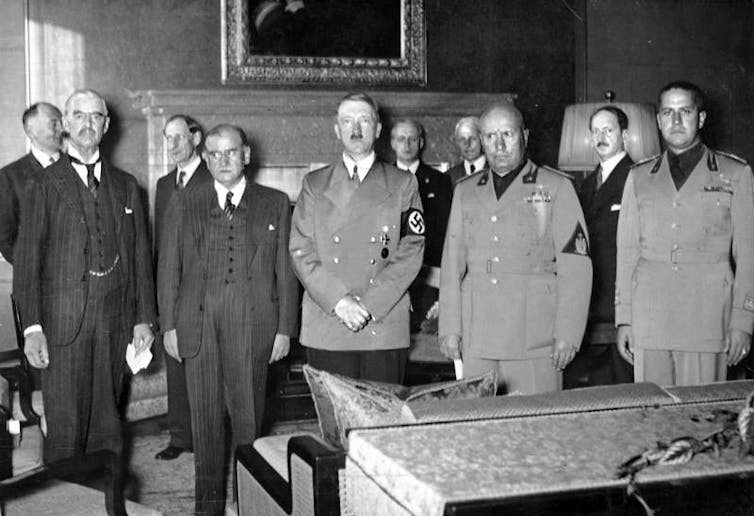
A major international summit, where an aggressor is threatening to invade another country with the prospect of a major European war? We’ve been here before. The summit was at Munich in September 1938, the aggressor was Germany and the country at threat was Czechoslovakia. And like the impending Alaska summit where Ukraine has not been invited, when the British and French leaders visited Adolf Hitler to talk peace, Czechoslovakia was not in the room.

Adolph Hitler, Neville Chamberlain, Édouard Daladier and Benito MUssolini in MUnish in 1938
Betrayal: where were the Czechs when their country was given away?
Bundesarchiv, CC BY-ND

The example of Munich 1938 doesn’t fill one with a great deal of confidence for Ukraine’s future security, writes Tim Luckhurst, a historian of the second world war.

Luckhurst recounts the events leading up to Munich, at which British prime minister, Neville Chamberlain, and his French counterpart, Édouard Daladier, agreed that Germany would be allowed to annex the Sudetenland region of Czechoslovakia, with no involvement of the Czech leader, Edvard Beneš.

It would be “peace in our time”, boasted Chamberlain. It wasn’t even peace for a year.


Read more:
Alaska summit: why Donald Trump should heed the lessons of Munich 1938 when he meets Putin


Meanwhile in Israel

To Israel, where this weekend there is likely to be one of the biggest mass protests and general strikes in the country’s history on Sunday August 17. Huge numbers of people are expected to turn out in protest at the Netanyahu government’s failure to secure the release of the remaining October 7 hostages and the prime minister’s plan to launch a fresh offensive to take and occupy Gaza city despite the risk to the remaining hostages’ lives.

Benjamin Netanyahu’s position as prime minister is looking far from secure. The next election is due in October 2026, but John Strawson – an expert in Israeli politics at the University of East London – believes a new poll may be held much sooner than that.

Netanyahu’s parliamentary coalition is becoming more shaky as his ultra-orthodox supporters quit the government in protest at the government’s decision to scrap the exemption from conscription enjoyed by orthodox Israeli students.

But whether this will bring any relief to Palestinians is doubtful. Recent polling suggests that while there is huge support for an end to the war, this doesn’t translate into public backing for a two-state solution.


Read more:
Israel’s opposition: against Benjamin Netanyahu but not yet for peace with the Palestinians


Sign up to receive our weekly World Affairs Briefing newsletter from The Conversation UK. Every Thursday we’ll bring you expert analysis of the big stories in international relations.


The Conversation

ref. How the Trump-Putin summit could play out – https://theconversation.com/how-the-trump-putin-summit-could-play-out-263220