Most normal matter in the universe isn’t found in planets, stars or galaxies – an astronomer explains where it’s distributed

Source: The Conversation – USA – By Chris Impey, University Distinguished Professor of Astronomy, University of Arizona

Mysterious blasts of radio waves from across the universe called fast radio bursts help astronomers catalog matter. ESO/M. Kornmesser, CC BY-SA

If you look across space with a telescope, you’ll see countless galaxies, most of which host large central black holes, billions of stars and their attendant planets. The universe teems with huge, spectacular objects, and it might seem like these massive objects should hold most of the universe’s matter.

But the Big Bang theory predicts that about 5% of the universe’s contents should be atoms made of protons, neutrons and electrons. Most of those atoms cannot be found in stars and galaxies – a discrepancy that has puzzled astronomers.

If not in visible stars and galaxies, the most likely hiding place for the matter is in the dark space between galaxies. While space is often referred to as a vacuum, it isn’t completely empty. Individual particles and atoms are dispersed throughout the space between stars and galaxies, forming a dark, filamentary network called the “cosmic web.”

Throughout my career as an astronomer, I’ve studied this cosmic web, and I know how difficult it is to account for the matter spread throughout space.

In a study published in June 2025, a team of scientists used a unique radio technique to complete the census of normal matter in the universe.

The census of normal matter

The most obvious place to look for normal matter is in the form of stars. Gravity gathers stars together into galaxies, and astronomers can count galaxies throughout the observable universe.

The census comes to several hundred billion galaxies, each made of several hundred billion stars. The numbers are uncertain because many stars lurk outside of galaxies. That’s an estimated 1023 stars in the universe, or hundreds of times more than the number of sand grains on all of Earth’s beaches. There are an estimated 1082 atoms in the universe.

However, this prodigious number falls far short of accounting for all the matter predicted by the Big Bang. Careful accounting indicates that stars contain only 0.5% of the matter in the universe. Ten times more atoms are presumably floating freely in space. Just 0.03% of the matter is elements other than hydrogen and helium, including carbon and all the building blocks of life.

Looking between galaxies

The intergalactic medium – the space between galaxies – is near-total vacuum, with a density of one atom per cubic meter, or one atom every 35 cubic feet. That’s less than a billionth of a billionth of the density of air on Earth. Even at this very low density, this diffuse medium adds up to a lot of matter, given the enormous, 92-billion-light-year diameter of the universe.

The intergalactic medium is very hot, with a temperature of millions of degrees. That makes it difficult to observe except with X-ray telescopes, since very hot gas radiates out through the universe at very short X-ray wavelengths. X-ray telescopes have limited sensitivity because they are smaller than most optical telescopes.

Deploying a new tool

Astronomers recently used a new tool to solve this missing matter problem. Fast radio bursts are intense blasts of radio waves that can put out as much energy in a millisecond as the Sun puts out in three days. First discovered in 2007, scientists found that the bursts are caused by compact stellar remnants in distant galaxies. Their energy peters out as the bursts travel through space, and by the time that energy reaches the Earth, it is a thousand times weaker than a mobile phone signal would be if emitted on the Moon, then detected on Earth.

Research from early 2025 suggests the source of the bursts is the highly magnetic region around an ultra-compact neutron star. Neutron stars are incredibly dense remnants of massive stars that have collapsed under their own gravity after a supernova explosion. The particular type of neutron star that emits radio bursts is called a magnetar, with a magnetic field a thousand trillion times stronger than the Earth’s.

An illustration of a bright star with circular rings around it representing magnetic field lines
A magnetar is a rare type of neutron star with an extremely strong magnetic field.
ESO/L. Calçada, CC BY-ND

Even though astronomers don’t fully understand fast radio bursts, they can use them to probe the spaces between galaxies. As the bursts travel through space, interactions with electrons in the hot intergalactic gas preferentially slow down longer wavelengths. The radio signal is spread out, analogous to the way a prism turns sunlight into a rainbow. Astronomers use the amount of spreading to calculate how much gas the burst has passed through on its way to Earth.

Puzzle solved

In the new study, published in June 2025, a team of astronomers from Caltech and the Harvard Center for Astrophysics studied 69 fast radio bursts using an array of 110 radio telescopes in California. The team found that 76% of the universe’s normal matter lies in the space between galaxies, with another 15% in galaxy halos – the area surrounding the visible stars in a galaxy – and the remaining 9% in stars and cold gas within galaxies.

The complete accounting of normal matter in the universe provides a strong affirmation of the Big Bang theory. The theory predicts the abundance of normal matter formed in the first few minutes of the universe, so by recovering the predicted 5%, the theory passes a critical test.

Several thousand fast radio bursts have already been observed, and an upcoming array of radio telescopes will likely increase the discovery rate to 10,000 per year. Such a large sample will let fast radio bursts become powerful tools for cosmology. Cosmology is the study of the size, shape and evolution of the universe. Radio bursts could go beyond counting atoms to mapping the three-dimensional structure of the cosmic web.

Pie chart of the universe

Scientists may now have the complete picture of where normal matter is distributed, but most of the universe is still made up of stuff they don’t fully understand.

The most abundant ingredients in the universe are dark matter and dark energy, both of which are poorly understood. Dark energy is causing the accelerating expansion of the universe, and dark matter is the invisible glue that holds galaxies and the universe together.

A pie chart showing the composition of the universe. The largest proportion is dark energy, at 68%, while dark matter makes up 27% and normal matter 5%. The rest is neutrinos, free hydrogen and helium and heavy elements.
Despite physicists not knowing much about it, dark matter makes up around 27% of the universe.
Visual Capitalist/Science Photo Library via Getty Images

Dark matter is probably a previously unstudied type of fundamental particle that is not part of the standard model of particle physics. Physicists haven’t been able to detect this novel particle yet, but we know it exists because, according to general relativity, mass bends light, and far more gravitational lensing is seen than can be explained by visible matter. With gravitational lensing, a cluster of galaxies bends and magnifies light in a way that’s analogous to an optical lens. Dark matter outweighs conventional matter by more than a factor of five.

One mystery may be solved, but a larger mystery remains. While dark matter is still enigmatic, we now know a lot about the normal atoms making up us as humans, and the world around us.

The Conversation

Chris Impey has received funding from NASA, NSF, Howard Hughes Medical Institute, and the Templeton Foundation.

ref. Most normal matter in the universe isn’t found in planets, stars or galaxies – an astronomer explains where it’s distributed – https://theconversation.com/most-normal-matter-in-the-universe-isnt-found-in-planets-stars-or-galaxies-an-astronomer-explains-where-its-distributed-269313
Measuring Colorado’s mountains one hike at a time

Source: The Conversation – USA – By Eric Gilbertson, Associate Teaching Professor of Mechanical Engineering, Seattle University

Using lightweight tools, Eric Gilbertson hikes the world’s tallest mountains to measure their heights. Elijah Gendron

In the middle of a chilly October night in 2025, my two friends and I suited up at the Cottonwood Creek trailhead and started a trek into the Sangre de Cristo mountains of Colorado. It was a little below freezing as we got moving at 1:30 a.m., and the Moon illuminated the snowy mountaintops above us.

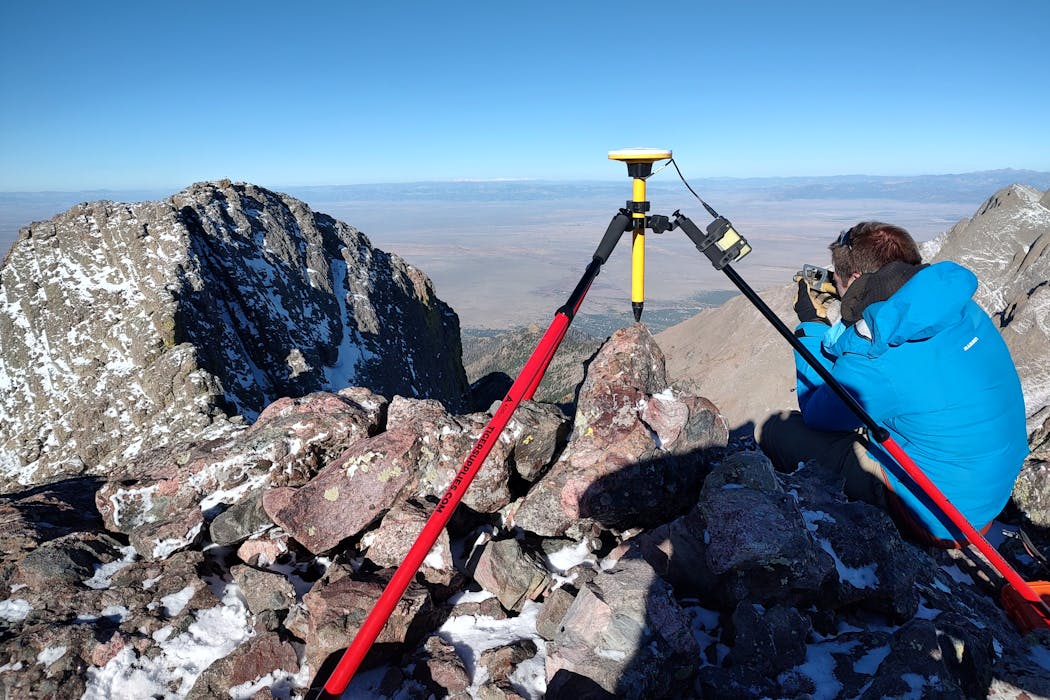
Our packs were a bit heavier than normal because we were hauling highly accurate surveying equipment to the summits of two peaks, each over 14,000 feet (4,267.2 meters). The peaks, Crestone and East Crestone, were close enough in height, with a short enough saddle in between, that only the taller of the two would count as a true 14er and the other as a sub-peak.

Crestone had traditionally been thought to be taller and sees hundreds of ascents each year. East Crestone, traditionally believed to be shorter, sees only a fraction as many ascents. Colorado has 58 mountain peaks over 14,000 feet that peakbaggers consider 14ers. For locals and visitors alike, bagging a 14er is a sport, and some people post reports about having climbed all 58.

I wanted to measure which was taller, since I suspected previous measurements people had trusted for years might be erroneous.

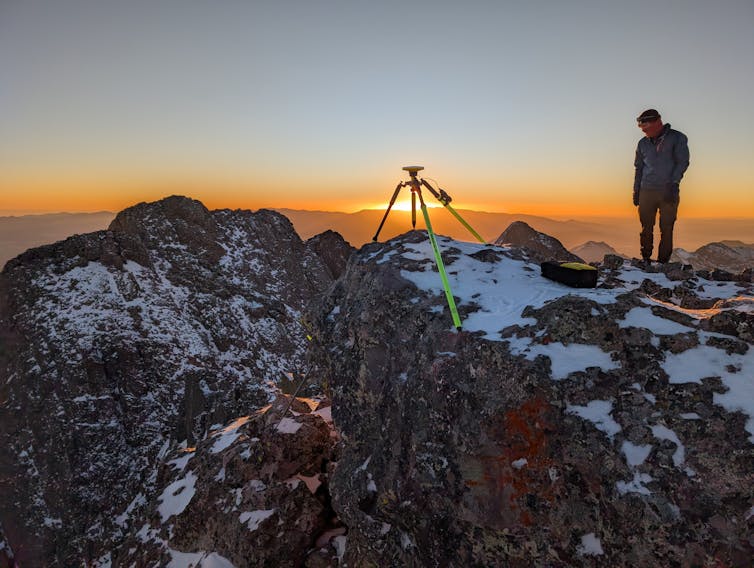
A man stands near a tripod at the top of a mountain.
GPS allows Eric Gilbertson to measure the peaks of Crestone and East Crestone in Colorado in October 2025.
Eric Gilbertson

I teach mountain surveying, and I climb and research mountains around the world for fun. I’m trying to climb the highest mountain in every country on Earth. I have so far climbed 147 of 196, including tough, high-altitude technical ones such as K2 without supplemental oxygen in Pakistan and Pobeda in Kyrgyzstan.

Through my experience climbing, I discovered that not all countries in the world have been surveyed accurately enough to know the country’s true high point. The high point is geographically significant, as it’s the highest natural point or peak in the country, state or province. Often, high points are a source of national or state pride. I taught myself surveying to determine and verify these high points on my own.

Discovering high points around the world

I’ve so far discovered new high points in seven countries: Colombia – Pico Simón Bolívar; Saudi Arabia – Jabal Ferwa; Uzbekistan – Alpomish; Togo – Mount Atilakoutse; Gambia – Sare Firasu Hill; Guinea Bissau – Mount Ronde; and Botswana – Monalanong Hill.

A man in cold-weather clothing sits on an icy mountain peak.
Ginge Fullen, a climbing partner of Eric Gilbertson, sits atop the peak of Pico Simon Bolivar in Colombia in December 2024.
Eric Gilbertson

I’ve surveyed over 60 peaks in the U.S. and Canada. In 2025 I discovered a new state high point in Michigan, Mount Curwood, at 1,979.3 feet (603.3 meters), and a new provincial high point of Nova Scotia, Western Barren, at 1,743.2 feet (531.3 meters).

I’ve determined the 100 highest peaks in Washington state, where I live and work, and studied how climate change is affecting the elevations of ice-capped peaks. My research showed that, while historically the contiguous U.S. had five ice-capped peaks, only two remain – Liberty Cap and Colfax, both in Washington state. Mount Rainier used to have as its highest point an ice dome named Columbia Crest on the western rim of the summit crater. But since 1998, Columbia Crest has melted more than 20 feet (6 meters) and is no longer the highest point on the mountain. The highest point is now a rock 436 feet (133 meters) to the south, on the southwest edge of the summit crater.

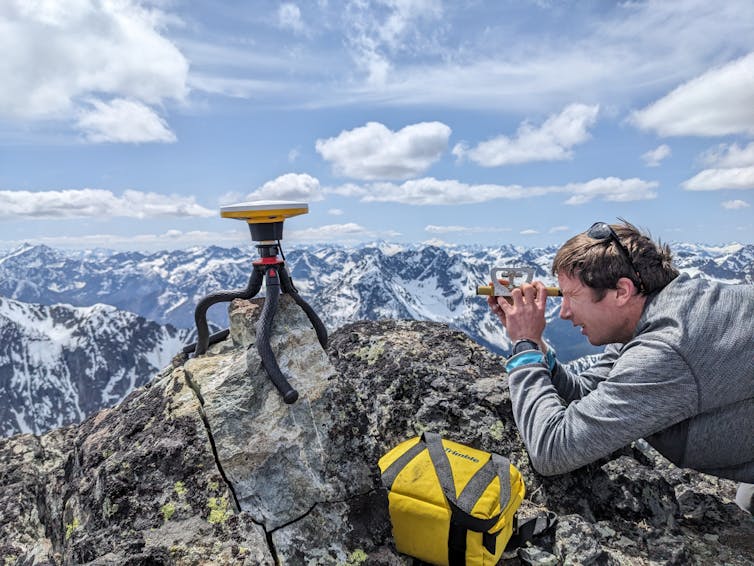
A small flat instrument sits on a tripod near a man who holds a measuring device to his eyes.
At the very top of South Mirror Image Peak in Washington, Eric Gilbertson uses an Abney level to measure nearby mountain heights.
Matthew Gilbertson

How to survey mountain high points

Surveying mountains is challenging due to the altitude, long approaches, difficult weather conditions and technical climbing. To get accurate surveying equipment to the summits requires ingenuity and specialized gear. Equipment needs to be as light as possible and adaptable to tricky terrain. For these reasons, very few mountains have been surveyed to the level of accuracy I can attain.

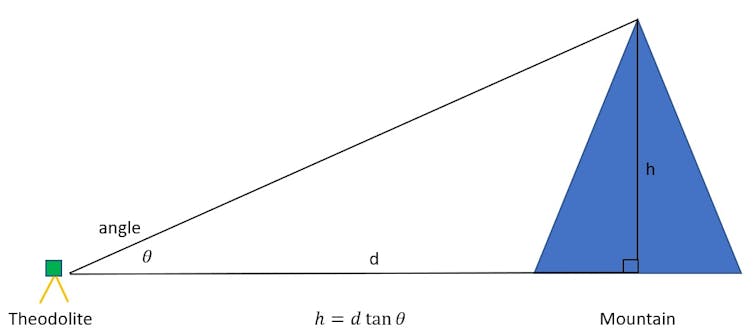
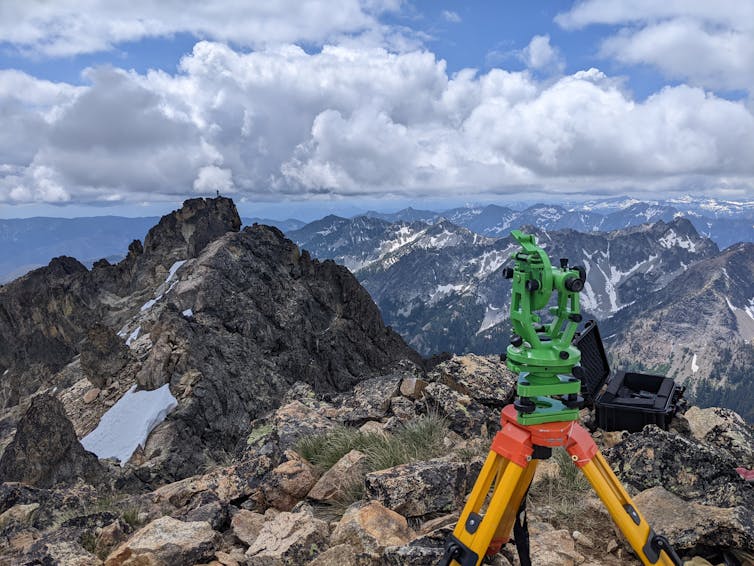
Historically, measurements have generally been made from a distance with theodolites. These are mechanical devices that can measure an angle up to a mountain summit very accurately. The distance to the mountain can be measured by other means, and trigonometry can be used with the distance and angle to calculate the summit elevation. But if the measurement is taken too far away, the error in elevation can be high. Theodolites are heavy and not easy to carry close to a peak.

An illustration shows how a theodolite measures angles.
Schematic diagram of how a theodolite is used to measure an angle to the summit of a mountain.
Eric Gilbertson

I sometimes carry a 30-pound (13.61 kg) theodolite to a summit, but if the mountain is technical, this is challenging and requires complicated rope systems to haul it up. More often I bring an Abney level, which is a lighter mechanical device that also measures angles. I bring this to a summit to measure relative angles between nearby points to identify which is the highest point on the mountain.

A greean machine with yellow tripod legs sits on a mountain top.
A theodolite is a mechanical devices that can measure angles up to a summit very accurately. Here one is used on Cardinal Peak in Washington in June 2023.
Eric Gilbertson

I then use a highly accurate, survey-grade GPS to measure the absolute elevation of the highest point. The GPS requires an hour or more to get an accurate measurement, so it wouldn’t make sense timewise to measure many nearby points with this device. I’ve found time is usually limited when surveying a summit, due to incoming storms or approaching darkness when descents need to be made in daylight for safety. This is why I first identify the highest point with an Abney level or theodolite.

Many satellites overhead send data down that is collected by the GPS device and used to calculate the device’s position. To save weight, I use a device that then sends measurements over Bluetooth to my phone instead of requiring a dedicated computer.

A GPS receiver generally needs to be mounted on a vertical rod that touches the exact summit. I measure the GPS height, subtract the rod height, and that gives the summit height. To keep the rod perfectly vertical I use a tripod, and this also requires innovation.

A man with a red helmet and jacket adjusts a small device on the top of a mountain.
Eric Gilbertson uses a GPS to measure East Fury in Washington.
Courtesy of Ross Wallette

Sometimes a summit is so sharp that regular tripod legs aren’t long enough to touch the ground. In this case, I strap on hiking poles to extend the legs. Another solution is to use a tripod with flexible legs, and I mold the legs to conform to the shape of a sharp boulder. This is what I used to measure the high point of Uzbekistan.

Another tool I use is LiDAR, which stands for light detection and ranging. This works by an airplane flying over a mountain and bouncing light signals off the summit. By using the plane’s location and the time it takes the signal to bounce back, the mountain’s elevation can be calculated.

Colorado 14ers

All measurements can have errors. I traveled to Colorado because I suspected LiDAR measurements of Crestone Peak, considered a 14er, might be erroneous. LiDAR measurements have been taken for nearly all mountains in Colorado, and these measurements are generally the most accurate available for mountain elevations.

LiDAR measurements hit the ground every few feet of horizontal spacing and can miss the top of sharp summits, leading to an underestimate of summit height. They can also hit things such as bushes, leading to an overestimate of summit height.

LiDAR data showed Crestone Peak and East Crestone within a few feet of the same height. But, interestingly, it showed a 3-4 foot (0.9-1.2 meter) spike on the top of Crestone. I climbed Crestone in 2020 while doing the Rocky Mountain Slam, a challenge to climb all the Colorado 14ers, Wyoming 13ers and Montana 12ers in two months, and knew the summit was pretty flat. I speculated that spike could have easily been a person, which meant the LiDAR elevation of Crestone might be too high.

East Crestone has a sharp boulder on the summit, which LiDAR could easily miss because of the horizontal gaps between measurements. So that elevation was possibly too short. In Colorado a point needs 300 feet (91.44 meters) of prominence to count as a separate peak. Other states have different rules, like in Washington where 400 feet (121.92 meters) is required. Prominence is a measure of how high a peak sticks up above a saddle connecting it to a taller peak. The saddle between Crestone and East Crestone is short enough that only the taller of them is a true peak and the other is a sub-peak.

On East Crestone I first set up a tall tripod, but the wind blew it down, nearly over a cliff. I switched it out with a shorter one, which was more stable.

A man in a green jacket sits near a device on a tripod on the top of a mountain.
Eric Gilbertson hiked Crestone, one of Colorado’s 14ers, to determine its true height.
Elijah Gendron

I then scrambled over to Crestone Peak and mounted another identical GPS device. That summit was on the edge of a cliff, and I needed to extend one tripod leg with a hiking pole so it could touch the ground.

I logged data for over two hours with both devices simultaneously. This ensured both were receiving the same satellite signals – so any atmospheric distortion would be the same – and that enough data was logged so I could get elevations accurate to the nearest inch. This gave me a lot of time to admire the views and take pictures, but I also needed to check on the equipment every 5-10 minutes to ensure it was working properly.

After packing up, hiking down and flying home to Seattle, I spent a few weeks poring over the data. The results showed East Crestone is 0.3 feet (0.09 meters) taller than Crestone, with more than 99.9% confidence that East Crestone is taller.

This means Colorado has a new 14er: East Crestone. Crestone is, in fact, a sub-peak. Discussions are ongoing about whether this means the 14ers list that peakbaggers climb should retain Crestone and add East Crestone to be 59 peaks, or whether East Crestone should replace Crestone so the list stays at 58 peaks.

I’m planning to continue my work surveying mountains in Colorado and around the world to determine accurate summit elevations. My next plan is surveying several country high points in Africa this winter. The Benin country high point is still not known, and I hope to solve that mystery next.

Read more of our stories about Colorado.

The Conversation

Eric Gilbertson receives funding from The American Alpine Club.

ref. Measuring Colorado’s mountains one hike at a time – https://theconversation.com/measuring-colorados-mountains-one-hike-at-a-time-269343

Down-ranking polarizing content lowers emotional temperature on social media – new research

Source: The Conversation – USA – By Tiziano Piccardi, Assistant Professor of Computer Science, Johns Hopkins University

Social media posts that stoke division don’t have to top your feed. Gama5/iStock via Getty Images

Reducing the visibility of polarizing content in social media feeds can measurably lower partisan animosity. To come up with this finding, my colleagues and I developed a method that let us alter the ranking of people’s feeds, previously something only the social media companies could do.

Reranking social media feeds to reduce exposure to posts expressing anti-democratic attitudes and partisan animosity affected people’s emotions and their views of people with opposing political views.

I’m a computer scientist who studies social computing, artificial intelligence and the web. Because only social media platforms can modify their algorithms, we developed and released an open-source web tool that allowed us to rerank the feeds of consenting participants on X, formerly Twitter, in real time.

Drawing on social science theory, we used a large language model to identify posts likely to polarize people, such as those advocating political violence or calling for the imprisonment of members of the opposing party. These posts were not removed; they were simply ranked lower, requiring users to scroll further to see them. This reduced the number of those posts users saw.

We ran this experiment for 10 days in the weeks before the 2024 U.S. presidential election. We found that reducing exposure to polarizing content measurably improved participants’ feelings toward people from the opposing party and reduced their negative emotions while scrolling their feed. Importantly, these effects were similar across political affiliations, suggesting that the intervention benefits users regardless of their political party.

This ‘60 Minutes’ segment covers how divisive social media posts get more traction than neutral posts.

Why it matters

A common misconception is that people must choose between two extremes: engagement-based algorithms or purely chronological feeds. In reality, there is a wide spectrum of intermediate approaches depending on what they are optimized to do.

Feed algorithms are typically optimized to capture your attention, and as a result, they have a significant impact on your attitudes, moods and perceptions of others. For this reason, there is an urgent need for frameworks that enable independent researchers to test new approaches under realistic conditions.

Our work offers a path forward, showing how researchers can study and prototype alternative algorithms at scale, and it demonstrates that, thanks to large language models, platforms finally have the technical means to detect polarizing content that can affect their users’ democratic attitudes.

What other research is being done in this field

Testing the impact of alternative feed algorithms on live platforms is difficult, and such studies have only recently increased in number.

For instance, a recent collaboration between academics and Meta found that changing the algorithmic feed to a chronological one was not sufficient to show an impact on polarization. A related effort, the Prosocial Ranking Challenge led by researchers at the University of California, Berkeley, explores ranking alternatives across multiple platforms to promote beneficial social outcomes.

At the same time, the progress in large language model development enables richer ways to model how people think, feel and interact with others. We are seeing growing interest in giving users more control, allowing people to decide what principles should guide what they see in their feeds – for example the Alexandria library of pluralistic values and the Bonsai feed reranking system. Social media platforms, including Bluesky and X, are heading this way, as well.

What’s next

This study represents our first step toward designing algorithms that are aware of their potential social impact. Many questions remain open.

We plan to investigate the long-term effects of these interventions and test new ranking objectives to address other risks to online well-being, such as mental health and life satisfaction. Future work will explore how to balance multiple goals, such as cultural context, personal values and user control, to create online spaces that better support healthy social and civic interaction.

The Research Brief is a short take on interesting academic work.

The Conversation

This research was partially supported by a Hoffman-Yee grant from the Stanford Institute for Human-Centered Artificial Intelligence.

ref. Down-ranking polarizing content lowers emotional temperature on social media – new research – https://theconversation.com/down-ranking-polarizing-content-lowers-emotional-temperature-on-social-media-new-research-271071

Declaration of Independence’s promises ring out today as loudly as they did for Lincoln, FDR and through 249 years of US history

Source: The Conversation – USA – By Graeme Mack, Visiting Assistant Professor of History, University of Richmond

The Declaration of Independence declares the nation’s credo, that ‘all men are created equal.’ Tetra Images/Getty Images

The Declaration of Independence’s 250th anniversary in 2026 is certain to be a time of national reflection.

Americans tend to look to the Constitution to assess whether the nation is living up to its founding principles when navigating major social and political issues.

But it is the declaration, signed on July 4, 1776, that declares the nation’s credo, that “all men are created equal.”

Throughout history, Americans have turned to the declaration for guidance about what the nation should stand for.

As a historian of the United States and the coordinator for the University of Richmond’s Forging a New Nation initiative, which commemorates the Declaration of Independence’s 250th anniversary, I have been thinking a lot about this phenomenon.

Particularly during times of social and political upheaval, Americans have sought out the Declaration of Independence when they wanted to remedy contemporary problems and create new visions for the country’s future. Many of the nation’s greatest leaders have praised and memorialized its rhetoric and ideas in the promotion of their own.

Inalienable rights?

During the turbulent 1850s, the divisive issue of slavery permeated every facet of American life and challenged basic precepts of American freedom.

In his 1852 speech “What to the Slave is the Fourth of July?Frederick Douglass, the formerly enslaved abolitionist, used the declaration to set a standard for American society. As a Black American, Douglass insisted he was “not included within the pale” who enjoyed the “inalienable rights” articulated in the declaration.

Nonetheless, the “great principles of the Declaration” gave Douglass hope and cause for optimism. He predicted that the “glorious hour” would soon arrive when all Americans would be defined “by equal birth.”

Conceived in liberty

An antique photo of a crowd of soldiers and civilians listening to someone talking in the middle.
A photo by Mathew Brady of Abraham Lincoln – center, bareheaded – giving the Gettysburg Address in 1863.
Bettman/Getty Images

In its 1857 Dred Scott v. Sanford decision, the Supreme Court denied Black Americans the rights of citizenship.

Abraham Lincoln denounced the decision and countered by defining a more capacious view of American freedom based on the declaration.

Lincoln told one audience that Thomas Jefferson and the signers of the declaration “set up a standard maxim for free society,” which they “intended to include all men” and to be “constantly looked to, constantly labored for.”

Their goal, Lincoln said, was “augmenting the happiness and value of life to all people of all colors everywhere.”

As civil war ravaged the country and claimed thousands of American lives, Lincoln again drew on the declaration to articulate a vision for the country as president.

In his 1863 Gettysburg Address, commemorating the dead on that Pennsylvania battlefield, Lincoln described the United States as a “nation, conceived in liberty, and dedicated to the proposition that all men are created equal.”

The nation, he said, was undergoing a “new birth of freedom” as it waged war on slavery and defended its government against domestic rebellion.

Self-evident truth

Seventy years later, the declaration provided inspiration for President Franklin D. Roosevelt as he steered the nation through a crippling economic depression and the run-up to a world war. Roosevelt advocated for building America’s first social safety net by drawing on the declaration.

Reflecting Roosevelt’s aims, the 1936 Democratic Party platform illustrated this rhetorical strategy, borrowing from the declaration at its very beginning: “We hold this truth to be self evident – that government in a modern civilization has certain inescapable obligations to its citizens.”

During his 1944 State of the Union Address, Roosevelt said the nation was built on the rights embedded in the Declaration of Independence and the Constitution. But, he argued, “true individual freedom cannot exist without economic security and independence.”

All created equal

In his 1963 “I Have a Dream” speech, Martin Luther King Jr. drew on the declaration to define America’s promises to all its citizens.

Amid the political and social upheaval of the 1960s, the Rev. Martin Luther King Jr. drew directly and self-consciously on the declaration.

In his 1963 “I Have a Dream” speech, King defined an America that “guaranteed unalienable rights of life, liberty and the pursuit of happiness” to its citizens.

Though the nation had “defaulted on this promissory note insofar as its citizens of color are concerned,” King said, the declaration still offered him hope: “I have a dream that one day this nation will rise up and live out the true meaning of its creed: We hold these truths to be self evident, that all men are created equal.”

In 2025, Americans saw the deployment of U.S. troops in major cities, as well as mass immigrant deportations. These changes have upended communities and challenged basic norms of civil society. They have also challenged Americans’ understanding of themselves as a nation of immigrants.

With the declaration’s anniversary coming up at a time when so much about contemporary society and politics are being contested, Americans may well return once again to this founding document to define themselves as a people and a nation.

The Conversation

Graeme Mack does not work for, consult, own shares in or receive funding from any company or organization that would benefit from this article, and has disclosed no relevant affiliations beyond their academic appointment.

ref. Declaration of Independence’s promises ring out today as loudly as they did for Lincoln, FDR and through 249 years of US history – https://theconversation.com/declaration-of-independences-promises-ring-out-today-as-loudly-as-they-did-for-lincoln-fdr-and-through-249-years-of-us-history-269355

Everything everywhere all at once: How Zohran Mamdani campaigned both online and with a ground game

Source: The Conversation – USA – By Stuart Soroka, Professor, Communications and Political Science, University of California, Los Angeles

New York mayoral candidate Zohran Mamdani and U.S. Rep. Pramila Jayapal meet voters to go door-knocking in Jackson Heights on Sept. 14, 2025. Selcuk Acar/Anadolu via Getty Images

Accounts of Zohran Mamdani’s campaign for New York City mayor have highlighted both his online presence and his ground game.

Mamdani won the general election with 50.4% of the vote, a larger share than was predicted by most polls, and his get-out-the-vote campaign has received some of the credit. Mamdani claims that his campaign had over 100,000 volunteers knocking on doors across New York City.

This focus on on-the-ground mobilization stands out given the increasing attention devoted to online campaigning over the past 15 years.

Particularly during that time period, online platforms have been a major focus of political campaigns and campaign research. Targeted advertising and new media strategies are increasingly viewed as central to campaign success. So is coverage of the campaign by legacy and social media more generally.

Moreover, solid empirical evidence of the effectiveness of door-to-door canvassing is limited. Recent work finds very few effects of in-person canvassing, except in very specific circumstances. One recent paper suggests that door-to-door canvassing by the candidate can make a difference to election outcomes. But in a race in New York City, it is not likely that Mamdani himself was able to reach enough voters to make a difference.

How much did Mamdani’s ground game contribute to his victory? As a political communication scholar, I know that assessing the impact of different methods used by political campaigns is difficult – in part because political campaigns include multiple lines of communication.

‘Hybrid’ campaigns

No campaign exists in isolation — nearly every candidate’s campaign occurs alongside opposing candidates’ campaigns. The effects of one campaign are often masked by the countering effects of the other.

The size of a campaign on one platform also tends to be correlated with the size of that candidate’s campaign on other platforms. When television advertising increases alongside social media advertising and door-to-door canvassing, identifying the effects of any single platform can be difficult.

Clever research designs are in some instances able to identify effects. These generally find that the impact of not just door-knocking but also ads and online advertising can be relatively limited.

In the modern technological environment, the impact of any single aspect of a campaign may be especially difficult to assess. Campaigning increasingly occurs in what researchers have called a “hybrid media” environment. Campaigns are waged in person, on the news and across multiple social media.

Each of these platforms comes with different advantages and disadvantages. Each also prioritizes different kinds of information.

Plainly stating your policy platform may work for coverage of a campaign stop on the evening news. But if you want that policy to go viral on TikTok, then you may need to add a dance – or an influencer.

Find volunteers online, send them knocking

Candidates have increasingly recognized the need to tailor messages for different communication platforms, such as television ads, Facebook posts and TikToks, building hybrid campaigns that attempt to spread a message across multiple, different spaces.

This interactivity across platforms has been especially evident in postelection assessments of the Mamdani campaign. His social media campaign was adept at producing the kinds of content that attract attention online. That campaign also appears to have been able to convert online engagement into real-world activism, including door-to-door canvassing.

There have been growing concerns among academics and campaign organizers about “slacktivism” — activism that amounts to one or two clicks online but nothing more. One worry is that a quick online endorsement may in some instances give people a sense that they have done their share and limit more active forms of engagement. The Mamdani campaign appears to have overcome this problem, at least in part.

But 100,000 people knocking on doors probably does not happen without the success of an online campaign. Finding and mobilizing campaigners was one important focus of Mamdani’s engagement online, after all.

Do it yourself − then repeat on socials

In-person campaigning by Mamdani, on the street and in the taxi line, is almost certainly made more effective through circulation on Instagram and TikTok.

Using mass media to broadcast campaign stops is not new, of course.

The construction of campaign stops that produce good social media content is becoming more common, however. The ways in which campaigns unfold in person are increasingly intertwined with the way they unfold online.

In this way, the Mamdani campaign may have been a textbook example of a modern hybrid campaign and an illustration of the coevolution of digital and on-the-ground campaigning.

To be clear, the success of the Mamdani campaign is probably not about his online presence or his ground game, but both at the same time.

The Conversation

Stuart Soroka research has been funded from the National Science Foundation and the Social Sciences and Humanities Research Council of Canada.

ref. Everything everywhere all at once: How Zohran Mamdani campaigned both online and with a ground game – https://theconversation.com/everything-everywhere-all-at-once-how-zohran-mamdani-campaigned-both-online-and-with-a-ground-game-269693

Outdoor swimming is becoming a sanctuary for female swimmers in the UK

Source: The Conversation – UK – By Abi Lafbery, PhD Candidate, Sociology, Lancaster University

Wild swimmers in Burry Port, Wales. jax10289/Shutterstock

Centuries after the upper class flocked to the coast for therapeutic sea bathing, outdoor swimming is having a renaissance. Swimmers enter cold water for the many physical and mental health benefits it offers.

Despite the dangers – hypothermia, cardiac-related death and drowning – for many women, outdoor swimming feels like a safe space. My PhD research, which explored outdoor swimming in north-west England, found that some women experience their swimming as a form of liberation, from what they see as a male-centric culture, the male gaze and social convention.

Despite recent gains in women’s sport, men are still participating in higher numbers, especially in outdoor activities. However, approximately two-thirds of outdoor swimmers are women.

In this environment, stripping off at the water’s edge can feel like stripping back notions of how female swimmers feel they “ought to” look or behave.

This is particularly relevant in a context where more than half of women feel that the UK has become more dangerous in the past five years, and reports of violence against women are increasing.

While men are loved and valued members, founders of and advocates for outdoor swimming communities across the UK, female swimmers comment on enjoying a female-majority atmosphere. Compared to perceived male-dominated environments such as the city, where women may feel that they need to take precautions to ensure their safety, or change how and where they exercise during darker winter months, one woman described outdoor swimming as, “a sense of freedom that I don’t think I would necessarily have elsewhere”.

Outdoor spaces are widely perceived to be a male domain. The outdoors is where tropes of masculinity, including stoicism and the conquering of nature, are performed.

Through the practice of outdoor swimming, female swimmers are rewriting outdated ideas of how women might be, do and what they look like in the outdoors.

As late as the Victorian era, many outdoor sports were imagined to threaten a woman’s femininity and fertility. Recent research has shown that mainstream media often portrays women as passive or requiring male assistance during outdoor activities.

Outdoor swimming is a sport in which female physiology provides a significant edge, and women can feel athletic and empowered, no matter their body type.

Many of the swimmers in my research are between their 30s and 60s, and several are experiencing the menopause or ageing bodies. In each other’s company and in the water, patriarchal and capitalist ideals of a “good body” (slim, able-bodied and cisgender), are felt to wash away.

Female swimmers laugh heartily about their “bioprene”, a beloved euphemism for the body fat that allows them to outlast their husbands in cold water. As one swimmer in my study said:

When you’re swimming outdoors, there’s no glamour … it’s a levelling thing and I think in a world where we’re just bombarded with what we should be doing and what we should look like, it’s the way that people can just be themselves.

The outdoor swimming movement is known for its self-proclaimed non-conformist and subversive roots. For some female swimmers, their personal practice is a way to be unconventional. One swimmer commented:

I’ve got this concern about convention and what I ought to be doing, what people expect me to do, but I’ve got more concerned with what I need to do to find pleasure and peace.

For this swimmer, letting go of social norms is a way to find peace within herself.

Finding community

A sense of peace also comes in the form of the friendships that are forged in the water. Previous research has indicated that the social and communal elements of outdoor swimming are an important factor in the sense of wellbeing associated with the practice.

My research indicates that the femininity of some swimming circles can be a harbour for emotional intimacy.

One swimmer described how she and her fellow swimmers have had beautiful exchanges while immersed in the waves, including singing together:

That lovely little moment, which, had it been a male-dominated environment, we perhaps wouldn’t have felt comfortable to be like that. Lots of women around you, you just feel freer… it was spontaneous, it was beautiful.“

The rivers, lakes and seas of the UK offer energising and emboldening spaces where many women feel safe to be fully and unapologetically themselves. As outdoor swimming grows in popularity, and grassroots organisations such as Mental Health Swims have closed due to a lack of funding, nurturing female communities in the outdoors is increasingly important, such that more women may find safety, joy and more of themselves in the outdoors.

The Conversation

Abi Lafbery received funding from the Economic and Social Research Council, North West Social Science Doctoral Training Partnership, ES/P000665/1.

ref. Outdoor swimming is becoming a sanctuary for female swimmers in the UK – https://theconversation.com/outdoor-swimming-is-becoming-a-sanctuary-for-female-swimmers-in-the-uk-268009

Why our physical bodies may be a core part of conscious experience – new research

Source: The Conversation – UK – By Renzo Lanfranco, Principal Researcher, Department of Clinical Neuroscience, Karolinska Institutet

Inna_Kandybka/Shutterstock

Most of us go through the day without thinking much about our bodies – until something goes wrong. Yet beneath that apparent simplicity lies a remarkable achievement: the brain must constantly knit together sights, touches and signals from muscles and joints into a coherent sense of “this body is mine”.

Psychologists and neuroscientists call this body ownership. It is a key part of self-consciousness: the feeling of being a self located in a particular body, separate from the world around you. It’s partly what makes us different to AI.

For decades, theories have proposed that a lot of this bodily processing happens outside awareness. It’s a kind of unconscious process that quietly guides our movements while consciousness focuses on other things. Now our new study challenges this idea – giving interesting insights into theories of consciousness.

Most experiments on consciousness have used flashes of light or sounds, asking when and how these external stimuli reach awareness. Surprisingly, very little work has directly tested how conscious awareness relates to the bodily self.

Rubber hand experiments

To investigate this, we used a modern version of the famous rubber hand illusion. In this illusion, a participant’s real hand is hidden from view while a lifelike rubber hand is placed in front of them. If both hands are stroked in synchrony, most people begin to feel that the rubber hand is, strangely, part of their own body.

We built a robotic set-up that allowed us to control this illusion with millisecond precision. In our main experiment, 32 participants saw two rubber hands side by side, while a robot tapped their real, hidden hand.

On every trial, one rubber hand was tapped in perfect synchrony with the real hand and the other was tapped with a slight delay – from 18 to 150 milliseconds. After a short sequence of taps, people had to choose which rubber hand felt more like their own. Then they rated how clear that feeling was.

This gave us two things to compare. One was objective performance – how accurately people’s feeling of hand ownership could tell which hand matched their real hand’s timing. The second was subjective awareness – how clearly they reported feeling that sense of ownership.

If a lot of body ownership processing happens unconsciously, we might expect people to be more likely to pick the correct rubber hand, even when they report only a vague or unclear feeling of ownership.

Illustration of the rubber hand illusion
The rubber hand illusion with two rubber hands presented simultaneously.
Illustration by Mattias Karlén, CC BY

That is not what we found. As we increased the lack of synchrony between the real and fake hands, people became better at picking the “correct” hand. Crucially, their awareness ratings improved in lockstep.

Both objective performance and reported clarity started to rise at around 30 milliseconds of mismatch. Below that, people were essentially guessing; above that, they both chose more accurately and reported clearer feelings of ownership.

In other words, as soon as the brain started to reliably tell the difference between “my hand” and “not my hand”, people’s conscious experience reflected that difference. We did not see the common pattern reported in visual studies, where unconscious processing can occur before stimuli reach awareness.

Body ownership vs timing

To test whether this was really about body ownership – rather than simply noticing timing – we ran two control experiments. When we rotated the rubber hands into an anatomically impossible position, the illusion disappeared and people mostly reported no clear feeling of ownership, regardless of timing.

And when we replaced the hands with wooden blocks and asked people to judge simultaneity instead of ownership, their awareness no longer tracked their performance as tightly. This suggests that strong conscious access is specific to body ownership, not just to any kind of multisensory integration.

In further experiments, we asked whether the same close relationship holds when body ownership builds up gradually. In one study, we varied how many taps people received before making their choice. More taps meant more sensory evidence. As expected, their ability to discriminate ownership improved with more touches. But again, their awareness ratings improved proportionally.

Taken together, our findings point to a simple but powerful conclusion: for body ownership, consciousness seems to have continuous, privileged access to the relevant information.

This contrasts with many studies of vision and hearing, where stimuli can be processed and influence behaviour without ever entering awareness. It suggests that the bodily self may occupy a special place in our conscious lives.

One reason may be that body ownership is intrinsically self-related: it anchors a first-person perspective in space and underpins almost everything else we experience. Another is that it depends on complex integration across many senses, which may require the kind of widespread brain activation associated with conscious experience.

Implications for mental health

Understanding how body ownership and awareness are linked is not just a philosophical exercise. Distortions of bodily self-perception are common in conditions such as schizophrenia, eating disorders, borderline personality disorder and autism spectrum disorders, where people may feel alienated from their bodies or misperceive their size, shape or boundaries. Our work offers new tools to study how finely tuned the system is.

The findings also resonate with rapidly developing technologies in virtual reality and prosthetics. Many applications aim to “embody” a user in a digital or artificial body. Knowing that body ownership is tightly tied to awareness suggests that successful embodiment will depend on keeping multisensory signals aligned in a way that sustains a clear, conscious sense of “this is me”.

Finally, our results speak to big-picture theories of consciousness. If information about our own body is almost always admitted into awareness, this supports the idea that maintaining a stable, embodied self may be one of the core functions of conscious experience. This perspective ultimately highlights a key gap between humans and current artificial systems, challenging the idea that AI – at least in its current forms – could resemble human consciousness.

The Conversation

Renzo Lanfranco receives funding from the Swedish Research Council (Vetenskapsrådet) and the Strategic Research Area Neuroscience (StratNeuro).

ref. Why our physical bodies may be a core part of conscious experience – new research – https://theconversation.com/why-our-physical-bodies-may-be-a-core-part-of-conscious-experience-new-research-270836

How the UK’s dependency on cars slows down the economy

Source: The Conversation – UK – By Renaud Foucart, Senior Lecturer in Economics, Lancaster University Management School, Lancaster University

Jarek Kilian/Shutterstock

The UK government makes a lot of money from cars. It taxes car ownership, it taxes the fuel, and it is about to charge drivers of electric vehicles by the distance they travel.

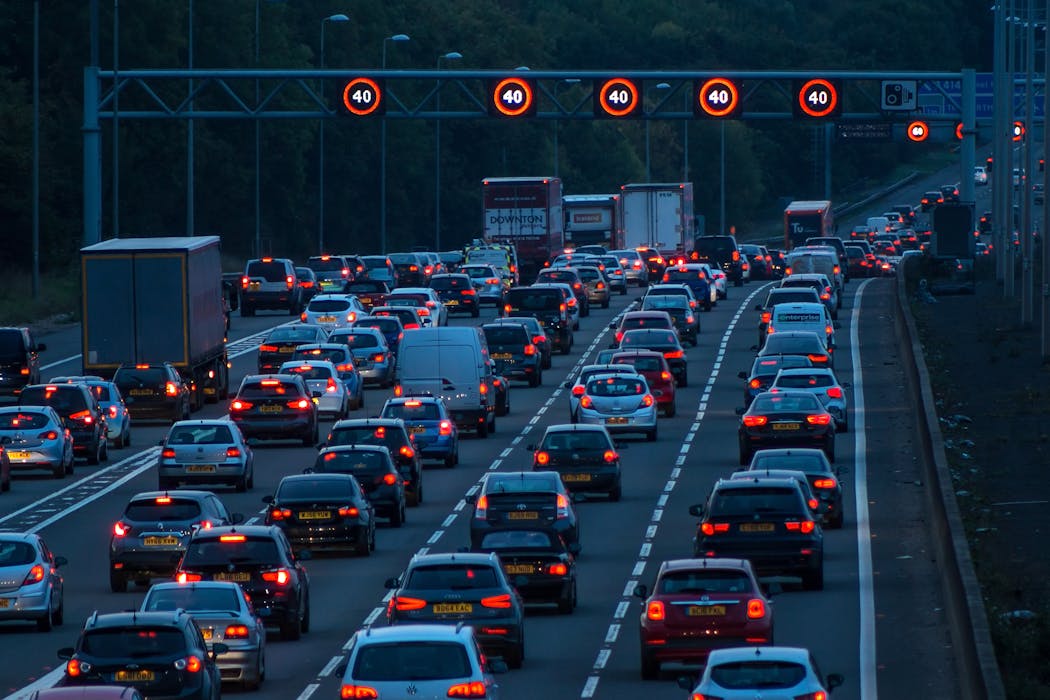
But Britons’ reliance on their 34 million cars also comes at great expense to the economy. Heavy traffic and congestion costs £7.5 billion a year in wasted time. An estimated £17 billion is needed to fix the worn out road network.

In the last 30 years, as the UK population has grown by 19%, the number of cars has exploded by 56%. Outside of London, 81% of British households own at least one car.

Fitting all of these vehicles into a fairly small country means that driving has clear priority over other forms of transport. In Germany, 90% of people living in large cities have access to a tramway or underground train system. In France, it’s 80%.

In the UK, the figure is less than 20%, a similar level to the US.

But the US has vast amounts of space, where brand new roads are regularly built to ease congestion. And so the UK has to deal with a population density comparable to the Netherlands (at least for England) and the urban transport choices of Texas.

This lack of decent public transport is expensive to sustain for all sorts of reasons – like the councils forking out £2.3 billion a year transporting 470,000 children to school, mostly in taxis. Or the cost of subsidising 800,000 motability vehicles, which accounted for one in every five new cars sold in 2024.

While the government should absolutely support the travel needs of people with disabilities and help children get to school, in a strange case of state-provided individualism, the UK has become a country where only cars can deliver these vital public services.

Designated drivers

Yet urban design is ultimately a choice. While the UK has a system which allows for 560 cars per 1,000 people, other places have taken a different route.

In Singapore, there are 146 cars per 1,000 people. This came about after the government implemented a quota system to release a limited number of (expensive) car-ownership licenses to limit congestion and finance public transport.

A ten-year “certificate of entitlement” to own a car in Singapore now costs more than US$100,000 (£76,000) on top of an additional congestion tax.

Red locomotive on rails.
Public transport in Singapore.
Tupungato/Shutterstock

The result? Singapore’s public transport is cheap, fast, reliable and efficient.

People without cars are fine, because the number of overall cars is so small that buses and taxis don’t get stuck in traffic. People with cars subsidise the buses and trains, while enjoying smooth traffic.

The Netherlands used a different strategy. In the 1970s, Dutch streets were dominated by cars and had become dangerous for pedestrians and cyclists. Protests led to a reorganisation of cities to become far less car friendly.

My research with a fellow economist demonstrated that if you decrease the space given to cars, they go slower, public transit goes faster, and walking and cycling become safer.

Then, as more people turn to public transport, the higher uptake makes it a faster and more reliable form of transit. It gets to a point where people who would never have taken public transport end up using it and getting to their destination much more quickly than when the car was dominant.

So for the UK to be more like Singapore, the government needs to make motorists pay much more for their car use. To be more like the Netherlands, it must take away their space.

The UK, and especially England, which invented the railway and used to be full of electric tramways, has the population density to make a dramatic switch away from cars actually work. In fact, it’s hard to think of a country better suited to public transport, or where it is more needed. It just hasn’t been built.

Or at least, it has not been built outside of London, the only place in the UK where most households don’t own a car.

So London is rich, well connected and people don’t need cars. Elsewhere, people park on pavements in derelict high streets and drive to supermarkets and places of work.

With stretched public finances, doing nothing about this state of affairs is a risky option. The UK has been described by the Local Government Association as a “country in a jam”, where productivity is held back by car traffic, with no hope for improvement. Lost time on roads is set to increase by 27% in the coming decades.

Moving to a situation where cars are not considered the fastest and most convenient mode of transportation will take ambition and imagination. But the alternative is a very expensive dependency, which clogs up the UK economy.

The Conversation

Renaud Foucart does not work for, consult, own shares in or receive funding from any company or organisation that would benefit from this article, and has disclosed no relevant affiliations beyond their academic appointment.

ref. How the UK’s dependency on cars slows down the economy – https://theconversation.com/how-the-uks-dependency-on-cars-slows-down-the-economy-270393

The UK’s food supply is more fragile than you might think – here’s why it should be a national priority

Source: The Conversation – UK – By Sven Batke, Associate Head of Research and Knowledge Exchange – Reader in Plant Science, Edge Hill University

Ink Drop/Shutterstock

If you walked into a supermarket during a supply hiccup, storm, fuel protest, or even the early days of the COVID pandemic, you will remember the sight of empty shelves. For most people in the UK, these moments are surprising, even unsettling, precisely because they are rare. We are a generation largely spared the rationing, shortages and hunger our grandparents and great-grandparents once endured.

But that rarity is exactly why we must not become complacent. Food security (the reliable availability, access and affordability of food) should be recognised as a major national concern. That means placing it firmly on the UK’s national risk register.

The national risk register is the UK government’s openly available list of the most serious risks that could affect the country in the short to medium term. These risks range from flooding and heatwaves to threats such as cyberattacks and energy shortages.

Being listed on the register does not mean the event is likely to happen tomorrow (but it could). It means the government has assessed it as significant enough, based on impact and probability, to require planning and mitigation measures.

Think of the national risk register as the country’s official “what could really go wrong?” list. If a threat is on the register, policymakers, emergency planners and critical industries take it seriously and plan accordingly. If it is not, the risk can drift into the background (even when it should not).

For all its importance, food security occupies a limited and somewhat indirect presence in the risk register. It only appears within broader categories such as supply-chain disruption, fuel shortages and animal disease. It’s not mentioned as a clearly defined risk in its own right.

Placing food security on the national risk register as its own defined category would send a clear signal that safeguarding stable, affordable food is a national priority – on par with energy, health and security. My team’s recent white paper for the government highlights this urgency.

Our modern food system is more complex, interconnected and vulnerable than many people realise. The UK imports around half of its food.

Some categories, such as fruit and vegetables, depend on imports for as much as 80–95% of supply. We rely on long, intricate supply chains involving overseas farming conditions, global shipping routes, international labour markets and constantly changing energy prices. When any of these are disrupted, our food system feels the shock.

In 2023, extremely bad weather in Spain and Morocco reduced crop yields, leaving UK supermarkets rationing tomatoes and peppers. The war in Ukraine has caused spikes in grain and sunflower oil prices. And the COVID pandemic and subsequent labour shortages have exposed how reliant farming and food distribution are on migrant workers.

An uncomfortable truth lies behind each of these disruptions: we are more dependent on global systems than the public think. Those systems are under pressure from climate change, geopolitical instability and resource competition.

Food systems also operate with tight margins. Fresh produce is harvested, shipped and sold quickly. Livestock feed supply needs to be constant. Fertiliser production depends heavily on natural gas for providing both the hydrogen feedstock and the energy required to make ammonia, the key ingredient in most nitrogen fertilisers. All of these dependencies create points of vulnerability. When several of those break at once, shortages can cascade.


Read more:
How unsustainable global supply chains exacerbate food insecurity


For many households, even small disturbances lead to real consequences: higher prices, reduced choice and increased stress about meeting weekly food bills. Families on tight budgets feel these effects most sharply.

While we are nowhere near the wartime rationing experienced by earlier generations, food banks across the UK are already serving record numbers, and food-price inflation has recently reached levels not seen in decades. Food insecurity is not a hypothetical risk for millions, it is a reality.

An expert explains the meaning of climate resilience.

Lessons from the past

Historically, Britain has faced food insecurity before. During the second world war, German U-boats targeted supply ships, leading to rationing that lasted until 1954. Earlier still, crop failures and poor harvests in the 19th century caused widespread hardship. Today we benefit from refrigeration, global trade, advanced agriculture and data-driven logistics, but those advantages can create an illusion of invulnerability that our supply chains are robust.

Food security, even in the UK, is more fragile than it might seem. Our shelves look full until suddenly they do not. A combination of climate-driven harvest failures, rising energy prices and trade disruptions could create national shortages or unaffordable prices much more quickly than many people may expect.

Including food security on the national risk register would prompt government departments to plan coordinated responses. It would drive investment in resilient agriculture, storage and domestic production while encouraging diversification of food imports to avoid overreliance on just a few regions.

Better risk planning would also support households through better safety nets and targeted interventions such as emergency rations and direct support to vulnerable households. Raising public awareness that food security is a shared national responsibility does not suggest panic – it means preparation.


Don’t have time to read about climate change as much as you’d like?

Get a weekly roundup in your inbox instead. Every Wednesday, The Conversation’s environment editor writes Imagine, a short email that goes a little deeper into just one climate issue. Join the 47,000+ readers who’ve subscribed so far.


The Conversation

Sven Batke is affiliated with the Greenhouse Innovation Consortium.

ref. The UK’s food supply is more fragile than you might think – here’s why it should be a national priority – https://theconversation.com/the-uks-food-supply-is-more-fragile-than-you-might-think-heres-why-it-should-be-a-national-priority-270709

Good sleep starts in the gut

Source: The Conversation – UK – By Manal Mohammed, Senior Lecturer, Medical Microbiology, University of Westminster

Zhur_Sa/Shutterstock

You might think good sleep happens in your brain, but restorative sleep actually begins much lower in the body: in the gut.

The community of trillions of microbes living in your digestive tract, known as the gut microbiome, plays a powerful role in regulating sleep quality, mood and overall wellbeing. When the gut microbiome is balanced and healthy, sleep tends to follow. When it is disrupted, insomnia, restless nights and poor sleep cycles often appear.

Gut and brain communicate constantly through the gut-brain axis. This communication network involves nerves, hormones and immune signals.

The best known part of this system is the vagus nerve, which acts like a two-way communication line carrying information between gut and brain. Researchers are still studying how important the vagus nerve is for sleep, but evidence suggests that stronger vagal activity supports calmer nervous system states, steadier heart rhythms and smoother transitions into rest.

Because of this intimate connection, changes in the gut influence how the brain regulates stress, mood and sleep.

So, how does the gut actually communicate these signals to the brain?

Gut microbes do more than digest food. They produce neurotransmitters and metabolites that influence sleep-related hormones. Metabolites are small chemical by-products created when microbes break down food or interact with each other. Many of these compounds can influence inflammation, hormone production and the body’s internal clock. When the gut is in balance, these substances send steady, calming signals that support regular sleep. When the microbiome becomes imbalanced, a condition known as dysbiosis, this messaging system becomes unreliable.

The gut also produces several key sleep-related chemicals. Serotonin, for example, regulates mood and helps set the sleep-wake cycle. Most of the body’s serotonin is produced in the gut, and healthy bacteria help keep its production stable. Melatonin, which makes you feel sleepy at night, is made not only in the pineal gland but also throughout the digestive tract. The gut helps convert serotonin into melatonin, so its condition directly shapes how efficiently this happens.

The gut also supports the production of Gaba (gamma-aminobutyric acid), a calming neurotransmitter made by certain beneficial microbes. Gaba quiets the nervous system and signals that the body is safe enough to relax. Together, these chemicals form part of the body’s circadian rhythm, the internal 24-hour cycle that regulates sleep, appetite, hormones and temperature. When harmful bacteria dominate, that rhythm becomes less stable, which can contribute to insomnia, anxiety at bedtime and fragmented sleep.

Another major route linking gut and sleep is inflammation. A healthy gut maintains a balanced immune response. It does this by protecting the gut lining, hosting microbes that regulate immune activity and producing compounds that calm inflammatory reactions. If dysbiosis develops or a poor diet irritates the gut lining, gaps can form between the cells of the intestinal wall. This allows inflammatory molecules to escape into the bloodstream, creating chronic, low-grade inflammation.

Inflammation is known to interfere with sleep regulation. It disrupts the brain’s ability to coordinate smooth transitions between the stages of sleep because inflammatory chemicals influence the same brain regions that control alertness and rest. People with inflammatory gut conditions often experience this in very practical ways.

Irritable bowel syndrome, food sensitivities or increased intestinal permeability, often called leaky gut, all involve irritation or loosening of the gut lining. This allows immune-triggering substances to enter the bloodstream more easily, which increases inflammation and interferes with sleep. Inflammation also raises levels of the stress hormone cortisol, which makes the body feel primed for action rather than rest.

Stress, sleep and gut health continually reinforce each other. Stress alters the gut microbiome by reducing beneficial microbes and increasing inflammatory compounds. A disrupted gut then sends distress signals to the brain, which heightens anxiety and disrupts sleep. Poor sleep raises cortisol further, which worsens gut imbalance. This creates a cycle that can be difficult to break unless the gut is supported.

Strengthening the gut can make sleep noticeably better, and the changes do not need to be complicated. Eating prebiotic and probiotic foods, particularly fermented foods, supports beneficial microbes because fermentation creates live cultures that help repopulate the gut. Reducing sugar and ultra-processed foods lowers inflammation and prevents dysbiosis because these foods tend to feed bacteria that promote irritation or produce inflammatory by-products.

Keeping consistent meal times helps the gut maintain a steady daily rhythm because the digestive system has its own internal clock. Managing stress makes a difference. Staying well hydrated helps the gut microbiome because fluid supports digestion, nutrient transport and the mucus layer that protects the gut lining. Together, these changes create a more stable gut environment that supports deeper and more restorative sleep.

Good sleep does not begin the moment you climb into bed. It begins long before that, shaped by the health of the gut and the messages it sends to the brain throughout the day. When the gut is supported and balanced, the body is better able to settle, recover and shift into the rhythms that allow sleep to improve naturally.

The Conversation

Manal Mohammed does not work for, consult, own shares in or receive funding from any company or organisation that would benefit from this article, and has disclosed no relevant affiliations beyond their academic appointment.

ref. Good sleep starts in the gut – https://theconversation.com/good-sleep-starts-in-the-gut-270487