Santa Claus: The Movie at 40 – how a box office flop became a ‘pure panto’ British Christmas staple

Source: The Conversation – UK – By Thomas Ruys Smith, Professor of American Literature and Culture, University of East Anglia

It’s December 1985, I’m six years old and I’m sat next to my dad in a small-town cinema in Norfolk. Some might unkindly describe the venue as a fleapit permanently on the brink of closure. Today, though, there’s snow on the ground and magic in the air.

Instead of the usual sparse attendance, the place is packed. It’s already been a legendary festive season for the young cinemagoer: The Goonies and Back to the Future have just been released. But even those Hollywood behemoths have nothing on the excitement that has brought out this record crowd.

We’re crammed together to watch Santa Claus: The Movie, and as the house lights dim there’s a palpable hum. By the time the final credits roll, we’re all true believers. I’m certain I’ve just watched a timeless classic that will take its place in the pantheon of Christmas greats.

Four decades later, six-year-old me might be disappointed. Time and the crushing weight of critical opinion have conspired to prove me painfully wrong. At least in the UK, Santa Claus: The Movie was a massive commercial success, sitting proudly at the top of the box office for all of December and landing as one of the biggest grossing films of the year. The rest of the world? Not so much.

In the US, Santa Claus: The Movie became an infamous flop, failing to make back its hefty production budget. Since I wasn’t a regular subscriber to the New York Times in 1985, I didn’t know that the movie had been panned by Vincent Canby: “elaborate and tacky … It has the manner of a listless musical without any production numbers.” Even in the UK, the critics hardly raved. The Daily Express judged it to be “the kind of film that gives Christmas a bad name”.

The film was even briefly a tabloid sensation when it emerged that ten reindeer had been shot in Norway to provide skins for the animatronic movie versions.

The trailer for Santa Claus: The Movie.

The passing years haven’t done much to moderate critical opinion. When the movie was remastered and briefly re-released in cinemas in 2023, The Guardian’s Peter Bradshaw called it “the filmic equivalent of the uneaten toffee left at the bottom of the Quality Street tin”.

Alonso Durande, author of the definitive guide to festive viewing Have Yourself a Movie Little Christmas, included Santa Claus: The Movie on his list of the worst Christmas movies of all time. He called it “a train-wreck of a Christmas film that’s so very wrong that you won’t be able to tear yourself away from it” – which is, at least, a kind of recommendation.

Even its cast members have added to the pile-on. Anyone who’s seen the movie will recall John Lithgow’s spirited turn as the evil corporate toymaker B.Z. Indeed, even in 1985 he managed to squeeze some begrudging praise out of the otherwise hostile New York Times (“the film’s only remotely stylish performance”). But interviewed by the AV Club in 2019, Lithgow did not have fond festive memories of Santa Claus: The Movie. He described it as “one of the tackiest movies I’d ever been in. It seemed cheesy. It certainly never stuck”.

Except, of course, there was one place that it did stick. Lithgow remains well aware of its popularity in England: “It’s huge over there,” he marvelled, clearly bemused, “it is still, every Christmas”. Apparently, even now British fans routinely approach him to declare their undying love for the film. For Lithgow, rewatching the movie amounts to “a tacky Christmas tradition over there”.

Statistically speaking at least, he’s right. Believe it or not, according to analysis undertaken by The Guardian in 2023, Santa Claus: The Movie holds the title of the most-shown film on UK television at Christmas time, having been screened 21 times since its release. All these years later, despite the derision, Santa Claus: The Movie clings on in the national Christmas consciousness.

Apart from the cumulative effect of repeat screenings, there are undoubtedly other reasons why the film abides in British memories while it’s reviled elsewhere. British cast members abound – and not just the star turn of Dudley Moore as Patch the Elf. Sitcom stalwarts like Judy Cornwell, Don Estelle and Melvyn Hayes help to give proceedings a peculiarly British flavour for a film set largely in New York, and which features notorious product placements for McDonald’s and Coca Cola.
In life as in the film itself, plucky British eccentricity apparently proved more powerful than American corporate might.

Dudley Moore stars as Patch the Elf.

I reached out to Alonso Durande to see if he’d had any further thoughts on the movie since he put it on his naughty list. He had this telling insight into the profound Transatlantic split in the movie’s reception: “If there’s one factor that makes this film beloved in the UK and reviled in the US, it’s John Lithgow’s performance; American audiences think they’re watching a distinguished actor go off the rails, but for Brits, he’s pure panto, and just in time for Christmas.”

Pure panto, a peculiar type of British whimsy, an expression of the festive season that’s as distinctive as Christmas pudding and Christmas crackers and all the other trappings of the season that failed to make a Transatlantic translation. Perhaps that is the secret of the UK’s embrace of this unloved Christmas orphan. For us true believers, the idiosyncratic magic of that first viewing in 1985 has never dimmed.

On its 40th anniversary, maybe it’s time for the UK to fully embrace the curious legacy of Santa Claus: The Movie as a fundamental part of our Christmas landscape.


Looking for something good? Cut through the noise with a carefully curated selection of the latest releases, live events and exhibitions, straight to your inbox every fortnight, on Fridays. Sign up here.


This article features references to books that have been included for editorial reasons, and may contain links to bookshop.org. If you click on one of the links and go on to buy something from bookshop.org The Conversation UK may earn a commission.

The Conversation

Thomas Ruys Smith does not work for, consult, own shares in or receive funding from any company or organisation that would benefit from this article, and has disclosed no relevant affiliations beyond their academic appointment.

ref. Santa Claus: The Movie at 40 – how a box office flop became a ‘pure panto’ British Christmas staple – https://theconversation.com/santa-claus-the-movie-at-40-how-a-box-office-flop-became-a-pure-panto-british-christmas-staple-268925

Climate change is affecting your food – and not in your favour

Source: The Conversation – UK – By Sterre ter Haar, PhD researcher and lecturer, Industrial Ecology Department of the Institute of Environmental Sciences (CML), Leiden University

Silhouhette of a cornfield at sunset
Luiza Braun/Unsplash

Scientists thought they had finally stumbled upon a possibly positive side effect of climate change. While rising CO₂ levels have been linked to various effects, from rising sea levels to changing temperatures, could an increase in CO₂ also be good for something? Plants use carbon dioxide and sunlight for photosynthesis, so more CO₂ could theoretically mean more food.

It sounds almost too good to be true, but science backs part of this up. Plants do grow faster when CO₂ levels increase, but this doesn’t mean we will have more food and less hunger. Other research has shown that where we can grow our food is not only shifting, but also shrinking.

Changing weather patterns and extreme weather events, such as heat waves, drought, or extreme rainfall, will become more frequent and limit our global food production.

So increasing CO₂ might be good for how fast a plant grows and not so good for where it grows, but what about the effect on the plant itself? The majority of our diets come from crops or from animals that eat (mostly) plants. If plants respond to rising CO₂ levels, that could mean their nutritional value is also changing.

The first studies were inconclusive. The way to test this sounds simple: grow two plants under identical conditions, except one is given more CO₂, and then compare them. Scientists observed differences, but they couldn’t say if the result was significant or merely a coincidence.

Comparing many studies together would help, but that is harder than it sounds. Due to our ever-increasing amount of CO₂ emissions, the study baselines were also increasing, so we couldn’t directly compare studies from different years to each other. We had a lot of data, but few answers.

My new analysis with colleagues shows an interesting picture: each bite of food is becoming comparatively higher in calories but lower in nutrients. We compiled 59,048 measurements from 109 studies and compared results at a baseline of 350 ppm of atmospheric carbon dioxide to an elevated level of 550 ppm.

We looked at 32 nutrients across 43 different crops. For the first time, we could see a clear shift in plant composition across a wide range of species and essential nutrients.

As carbon dioxide increases, so does carbon uptake, and more carbon means more carbohydrates, like sugars and starch. However, critical nutrients such as iron, zinc, and protein all decreased. Our food might have more carbs but fewer essential nutrients. While the average decrease in nutrition was only a few percent, certain foods saw large decreases, such as a 38% zinc reduction in chickpeas (Figure 1).

What also stood out were heavy metals such as lead. They might be increasing in our food – a serious concern because lead is toxic even at very low levels and can harm the brain, heart, and nervous system – but that’s not something we can say for sure based on our study.

Biologists tend to study plants to understand what is happening to the nutrients they need, while researchers who focus on human health examine plants to see what is happening to the nutrients we need. But neither plants nor humans require heavy metals such as lead, so very few studies tracked them.

The few that did recorded a concerning increase. Coincidence? We’re not sure — which is precisely why we need to start taking a closer look.

We might need to reconsider what a healthy diet looks like in the coming decades. Food security will not necessarily imply nutrient security. A healthy diet today might contain too few nutrients in the future due to the shifting composition of our crops, despite still containing enough calories.

Think of our diet like a recipe. Changing the amounts of one ingredient can change the entire outcome. Not only will the nutrient values of our food change, but also our ability to cook with it. The changing plant composition may also affect our ability to bake bread or make pasta.

Closeup of fresh food in a shop inside Mercado de La Boqueria, in Barcelona.
Fresh food in a shop inside Mercado de La Boqueria, Barcelona.
Jacopo Maiarelli/Unsplash

If our food is becoming more calorific for relatively fewer nutrients, in extreme cases, we could see increases in both average body mass and undernutrition. Scientists are now looking at what this means for our diets, but in the meantime, a good way to buffer these potential effects would be to eat a diverse diet.

Climate change feels like a faraway problem, but it’s already here. A substantial part of our increasing food prices has already been linked to climate change. Certain foods are getting harder to obtain. Weather disasters alone accounted for $20.3 billion in damage to American farmers last year.

Our study looked at the effect of increasing CO₂ from 350 ppm, which is sometimes referred to as the last “safe” level for humans, to 550 ppm. We are currently at around 426 ppm, putting us almost halfway through the modelled effects. Climate change is happening now, and the effects are already on our dinner plates.

The Conversation

This study was supported by the European Union’s Horizon 2020 Research and Innovation program under grant agreement no. 101003880. Sterre ter Haar receives funding from the Frontiers Planet Prize.

ref. Climate change is affecting your food – and not in your favour – https://theconversation.com/climate-change-is-affecting-your-food-and-not-in-your-favour-270323

The American fixation on white Afrikaners in South Africa stretches back nearly a century

Source: The Conversation – UK – By Gemma Ware, Host, The Conversation Weekly Podcast, The Conversation

A few days after Donald Trump boycotted a G20 summit in Johannesburg, he announced South Africa would not be invited to the next G20 meeting, taking place at his resort in Miami in March 2026.

Trump said it was a “total disgrace” that South Africa hosted the November event, citing allegations of a “white genocide” against Afrikaner farmers. This is vigorously denied by the South African government which says such claims are “widely discredited and unsupported by reliable evidence”.

Trump’s fixation on South Africa’s white Afrikaner minority has become a central plank of US refugee policy, with their applications now given priority under a new refugee system.

This preoccupation by some Americans with white Afrikaners has a long history dating back to the publication of a large sociological study focusing on poor white Afrikaners in the 1930s.

In this episode of The Conversation Weekly podcast, we speak to Carolyn Holmes, an assistant professor of political science at the University of Tennessee, Knoxville, to trace the history of the links between white nationalists in the US and South Africa. She says:

South Africa has always been a shadow case for the US. It has been for a century … It’s a way of talking about US politics without ever saying civil rights, without ever saying United States.

Listen to the interview with Carolyn Holmes on The Conversation Weekly podcast.

This episode of The Conversation Weekly was written and produced by Mend Mariwany, Gemma Ware and Katie Flood. Mixing by Michelle Macklem and theme music by Neeta Sarl.

Newsclips in this episode from PBS Newshour, The Hindustan Times, CNN, CBS News, ABC News and Forbes Breaking News.

Listen to The Conversation Weekly via any of the apps listed above, download it directly via our RSS feedor find out how else to listen here. A transcript of this episode is available via the Apple Podcasts or Spotify apps.

The Conversation

Carolyn Holmes has received funding in the past from the Institute for International Education. The Conversation Africa receives funding from the Carnegie Corporation of New York.

ref. The American fixation on white Afrikaners in South Africa stretches back nearly a century – https://theconversation.com/the-american-fixation-on-white-afrikaners-in-south-africa-stretches-back-nearly-a-century-270145

God in Nigeria: the country’s novelists help us understand the complexity of Christianity

Source: The Conversation – Africa – By Adriaan van Klinken, Professor of Religion and African Studies, University of Leeds

From conflict to prosperity, Nigerian novels trace a history of how Christianity has changed after colonialism. Luis Quintero/Pexels

In African literature, Christianity has usually been shown as a foreign religion brought to the continent by European missionaries and colonisers. But in the past few decades, Nigeria’s writers have dealt with it in a far more complex way as Christianity is rooted in, and transformed by, local realities, ranging from conflict to prosperity.

A new open source book by a scholar of African religion, Adriaan van Klinken, sets out to understand these changes through the eyes of Nigeria’s fiction writers. We asked him five questions.


What made you decide to use fiction to understand religion?

What fiction and religion have in common is that both are works of human imagination and meaning-making. I became interested in literary writing as a commentary on religion. As the late Kenyan writer, Ngũgĩ wa Thiong’o, put it:

The novel, like the myth and the parable, gives a view of society from its contemplation of social life, reflecting it, mirror-like, but also reflecting upon it.

In the book I ask a two-fold question. How do the novels of today’s writers represent religion as a central part of African social life? But also, how do they reflect on religion, critiquing and reimagining it?

I chose Nigeria because the country has become the continent’s major centre of both literary production and Christian growth. (According to researchers, Nigeria’s Christian population grew by 25% to 93 million from 2010 to 2020. The country is projected to have the third largest Christian population in the world by 2060.)

When I started reviewing novels by contemporary Nigerian writers, I discovered that, in many texts, Christianity is a central theme in one way or another.

So, how is Christianity being written about?

The Nigerian classic Things Fall Apart by Chinua Achebe was published in 1958. It’s about the changes and tensions in traditional Igbo society because of colonisation. Christianity is described as a newly arriving religion. At first it has little traction but thanks to its links to colonial institutions, it gradually grows its influence, causing division in society.

This critical take on Christianity by Achebe and other African writers of his generation has been well documented.

But both African literature and African Christianity have developed. The writers I discuss were born after independence and engage with Christianity in the postcolonial period.


Read more:
Chimamanda’s Lagos homecoming wasn’t just a book launch, it was a cultural moment


Chimamanda Ngozi Adichie’s 2003 novel Purple Hibiscus signals a transition. In it a teenage Igbo girl, Kambili, grows up in a family dominated by a fanatically religious father.

By contrasting how faith is experienced in two Catholic families, Adichie explores the complexity of Nigerian Catholicism and its transformation from a European missionary product into something locally rooted. Towards the end, Kambili has an apparition of the Virgin Mary in a Nigerian landscape. It’s an empowering religious experience for her.

Adichie invokes Christian imagery and symbols in a story about gender issues. Other writers have done something similar in stories about issues of sexuality (Chinelo Okparanta’s Under the Udala Trees) and ecology (Chigozie Obioma’s The Fisherman). Dominant forms of Christianity are critiqued in these novels for their links to colonialism, patriarchy, homophobia, and environmental destruction. But Christian traditions are also creatively reinterpreted.

Nigerian-born sociologist Wale Adebanwi argues that African literary writers are social thinkers. I expand this to argue they’re religious thinkers, too. They think about and with religion, precisely because religion – not only Christianity, but also Islam and indigenous religions – is part of the fabric of society that shapes their own identities.

What can we learn about Christianity and conflict?

In one chapter I focus on the Biafran War (1967–1970). This tragic episode in Nigerian history is still a source of national trauma, especially among the mainly Christian Igbo people in the east. Although far from simply a religious conflict between Christians and Muslims, the civil war shows how religion is enmeshed with other major divisions in Nigerian life. Like ethnicity, economic resources, political power.

The war and its aftermaths are a big theme in Nigerian literature. I discuss two novellas – Chris Abani’s Song for Night and Uzodinma Iweala’s Beasts of No Nation. They don’t mention the war by name but can be seen as a commentary on it.

Both tell of the traumatising impact of brutal violence through the eyes of child soldiers. Both draw on Christian objects, texts, and symbols while processing postwar memory and the complex question of forgiveness. Avoiding simple answers, the books suggest Christianity might offer resources for a much-needed path of healing and reconciliation.


Read more:
Is there a Christian genocide in Nigeria? Evidence shows all faiths are under attack by terrorists


Another chapter is about Christian-Muslim relations. This is important given Nigeria’s religious demographics (both Christian and Muslim populations are growing fast, with Muslims in a slight majority). But also because of the history of tensions and conflicts between Christians and Muslims. This has (geo)political significance (just see US president Donald Trump’s threat of military intervention over alleged “Christian persecution” in Nigeria).

Uwem Akpan’s Luxurious Hearses (2008), E.E. Sule’s Sterile Sky (2012) and Adaobi Tricia Nwaubani’s Buried Beneath the Baobab Tree (2018) are all set in the Muslim-dominated north.

They all complicate simplistic views and offer nuanced insight into inter-religious relations in a time of escalating tensions between Christians and Muslims. Written by authors from Christian backgrounds, they interrogate the tendency among some Nigerian Christians to see Muslims as the enemy. They also suggest that Christian radicalisation is part of the problem.

By including Muslim characters who protect Christians, and other examples of Christians and Muslims living together harmoniously, these novels promote an everyday practice of neighbourliness.

How do writers discuss Pentecostalism?

Nigeria, and Lagos in particular, has been described as the Pentecostal capital of the world. Pentecostalism is a fast-growing form of Christianity. It emphasises the experience of the holy spirit, energetic worship, divine healing, and a gospel of prosperity. Nigeria (and Africa more generally) has become a major centre of Pentecostalism. As such it’s become a prominent theme in Nigerian literature.

By and large, it’s not favourably depicted. The satirical novel Foreign Gods, Inc by Okey Ndibe (2014) is a case in point. Through the character of Pastor Uka, it explores how hypocricy, exploitation and deception could accompany the prosperity gospel. It suggests Pentecostalism could be continuing the colonial project, with its hostility towards indigenous religions.

For my part I agree, but argue that the depiction of Pentecostalism in Nigerian fiction is somewhat one-sided. It fails to consider the diversity and possibilities within this movement.

Pentecostalism also gives hope to impoverished communities. It empowers people socially and economically. It creates local and global networks, and even builds new cities.

What do you hope readers will take away?

Of course, I hope people will go and read these novels (as well as many others I couldn’t include). Then they too can experience the fascinating life-worlds in them that religion is such an intricate part of.

Good literature is able to avoid simplistic accounts of religion and social life, because by including a diverse range of characters, viewpoints and events it adds nuance and complexity to the conversation.


Read more:
Nigeria’s violent conflicts are about more than just religion – despite what Trump says


Debates about whether Christianity has been good or bad for Africa, and Nigeria in particular, can probably never be settled, because so much depends on context and perspective. Nigeria’s writers offer just that.

The Conversation

Adriaan van Klinken does not work for, consult, own shares in or receive funding from any company or organisation that would benefit from this article, and has disclosed no relevant affiliations beyond their academic appointment.

ref. God in Nigeria: the country’s novelists help us understand the complexity of Christianity – https://theconversation.com/god-in-nigeria-the-countrys-novelists-help-us-understand-the-complexity-of-christianity-270894

Who was Albert Luthuli? The murdered South African leader who put his people above himself

Source: The Conversation – Africa (2) – By Judith Coullie, Senior Research Associate, English Studies, University of KwaZulu-Natal

South African liberation leader Albert Luthuli died on 21 July 1967 near his home in Groutville, in the South African province of KwaZulu-Natal. A government inquest concluded his death was an accident – that he was hit by a train. This was always disputed by his family and almost 60 years later they were vindicated.

In 2025, a court ruled that Luthuli was murdered, his death the result of “assault by members of the security special branch of the South African police”. The ruling corrects long-standing historical records. It adds Luthuli’s murder to the catalogue of torture and assassination that the apartheid government increasingly relied on to suppress dissent.

Albert John Mvumbi Luthuli was born around 1898. He was an educator, Zulu chief, and religious leader. Africa’s first Nobel Peace Prize winner was also president-general of the African National Congress (ANC) from 1952 until his death at 69.

The ANC resisted white minority rule in South Africa and Luthuli was active in the organisation’s defiance campaign. He became head of the ANC in 1952, four years after apartheid was formalised.

In the last decades of his life, Luthuli was silenced and persecuted. Once democracy was achieved in 1994, honours were heaped on him – his image is the watermark on South African passports.

Still, Luthuli is largely overshadowed by fellow Peace Prize winners Nelson Mandela and Desmond Tutu. And while over 14 million copies of Mandela’s autobiography, Long Walk to Freedom, have been sold, Luthuli’s account of his own life, Let My People Go, is comparatively little known.

Much of my research on life writing has focused on autobiography published during apartheid, including analysis of Let My People Go.

It’s a book that deserves to be more widely read. It defies expectations that the autobiographer will offer a candidly personal account of self and life.

Luthuli’s autobiography mostly focuses on the struggle for justice. It depicts a steadfastly moral man whose fight against racist oppression inspired activists within and beyond South Africa, and should still.

Who was Albert Luthuli?

Let My People Go offers a brief sketch of Luthuli’s ancestors and early life. His grandparents were Zulu Christian converts. He was born, he calculated, “in the year 1898, and certainly before 1900” near Bulawayo, in today’s Zimbabwe. He was not born in his ancestral home, Groutville, because his father had left to serve in the Second Matabele War. After the conflict, his parents stayed on at a Seventh Day Adventist mission station.

His father died when Luthuli was a baby. At about 10, he was sent back to Groutville for his schooling. Qualifying as a teacher, he became principal of a small school. A government bursary allowed him to study further at Adams College, where he performed exceptionally well and was invited to join the staff and rose up the ranks. He met Nokukhanya Bhengu there and they married in 1927.

Luthuli loved teaching. However, in 1935, after prolonged urging from tribal elders, he and Nokukhanya decided he was duty-bound to accept nomination as chief of the Umvoti Mission Reserve.

For 17 years, he dedicated himself to improving the lot of the people of Groutville and providing principled leadership in confronting the injustices of racism. He took the “revolutionary step of admitting women” to local meetings. He organised African sugar farmers and held a seat on the Native Representatives Council. In 1938, he was a member of the executive of the Christian Council of South Africa.

In the years that followed he would remain deeply involved in Christian and civic organisations. In 1945 he was elected onto the executive of the ANC’s provincial branch, becoming president of it in 1951 and, in 1952, of the whole organisation.

An oval-framed vintage studio photo of a young African man in suit and tie, a middle path in his hair and a proud expression on his face/.
A young Luthuli.
Wikimedia Commons

Overseas travel widened Luthuli’s perspective, whether it was a missionary conference in India (1938) or a nine month church-sponsored lecture tour of the US (1948).

His autobiography recounts in detail his religious, civic and political involvement, weaving in a narrative of increasingly draconian and devastating apartheid policies.

Writing painstakingly and usually without emotion – though disgust and horror sometimes break through – he challenges the “twisted, distorted” versions of history promoted by the regime. He offers meticulous evidence of the irrationality and immorality of racism.

Banned

From 1953, repeated banning orders prevented Luthuli from leaving his home or publishing or distributing any written material. In 1956 he was arrested on a charge of high treason. (Discharged in 1957, he was acquitted in 1961.)

Despite this, Luthuli carried on with his autobiography, dictating his story to his friends Rev Charles Hooper and his wife Sheila Hooper. They compiled the draft which Luthuli then edited.

It was a foregone conclusion that Let My People Go would be banned and Luthuli knew it was unlikely to enlighten apartheid rulers:

There is not really even a common language in which to discuss our agonising problems. (They) cannot speak to Africans except in the restricted language of Baasskap.

The term refers to whites being boss, and anyone classified as non-white adopting a position of subservience.

Nonetheless, the narrator insists that:

If the whites are ignorant of the realities, the fault does not lie with us.

Autobiography of a selfless self

Readers of autobiography tend to look for insight into the author’s personal life, but Luthuli’s gives greater weight to political-historical analysis.

In the book, he repeatedly denies his own importance, reminding readers that much of what he experienced was shared by other oppressed South Africans. This is key to the depiction of his character in the book.

He only briefly mentions his family. He and Nokukhanya have seven children, but he doesn’t share their names and draws a “veil” over any details about their marriage.

Four statues stand against a backdrop of Table Mountain in Cape Town. They are slightly stylised.
From left, statues of Luthuli, Tutu, De Klerk and Mandela, peace prize winners.
flowcomm/Flickr, CC BY

Nokukhanya, he writes, “ungrudgingly” assumed full responsibility for their home and smallholding so that he could focus on his public duties. At Adams College, for example, he was also a choirmaster, soccer team administrator and Zulu cultural organiser, and served on an association for African teachers.

Under his leadership, the ANC became a mass organisation. Luthuli had to travel the country in support of the defiance campaign:

I quite literally neglect my family and feel extremely guilty about it.

Luthuli’s reserve is reinforced by his use of the passive voice. For instance, he describes being urged to take leadership roles, rather than seeking these himself.

Nonetheless, even in these apparent self-deflections, Luthuli’s character emerges: his centre of gravity does not lie in the domestic sphere but in service to the community. He is driven by his “desire to serve God and neighbour”.

By refusing the “self-assertion and self-display” that is typical of autobiography, Let My People Go portrays a selfless self.

The humility of a man who cannot be humiliated

Luthuli’s story depicts a humble man who refuses to yield, despite growing persecution. Or, as Charles Hooper observes in the introduction, the “humility of a man who cannot be humiliated”. Luthuli expresses gratitude when outrage might seem more reasonable. He describes his prison cell, when he was ill and isolated, as a prayerful “sanctuary”.

A leafy park with a realistic statue of a black man, dapper in a suit.
Statue of Luthuli in KwaZulu-Natal, where he was born.
J Ramatsui/Wikimedia Commons, CC BY-SA

Accounts of casual racism, police harassment and brutal assault are harrowing. Hard to read, too, is Luthuli’s self-recrimination. He reproaches himself for “having contributed too little” to the political struggle.

This reserve doesn’t obscure his character, it illuminates it. He emerges as a thoughtful, humble man committed to non-racism, non-violence and justice who even tries to understand Afrikaners’ fears of “being swamped”.

Farsighted, he predicted the rise of “terrorism (and) legalised murder by army and police forces”. Yet he retained faith that “the outcome of the struggle” would be justice for all.

After his release from prison, Luthuli, still banned, lived in isolation in Groutville. He was murdered before the banning order expired.

The Conversation

Judith Coullie does not receive funding from any organisation.

ref. Who was Albert Luthuli? The murdered South African leader who put his people above himself – https://theconversation.com/who-was-albert-luthuli-the-murdered-south-african-leader-who-put-his-people-above-himself-269729

Facing myriad global pressures, Iran intensifies outreach to African partners for critical needs

Source: The Conversation – Global Perspectives – By Eric Lob, Associate Professor of Politics and International Relations, Florida International University

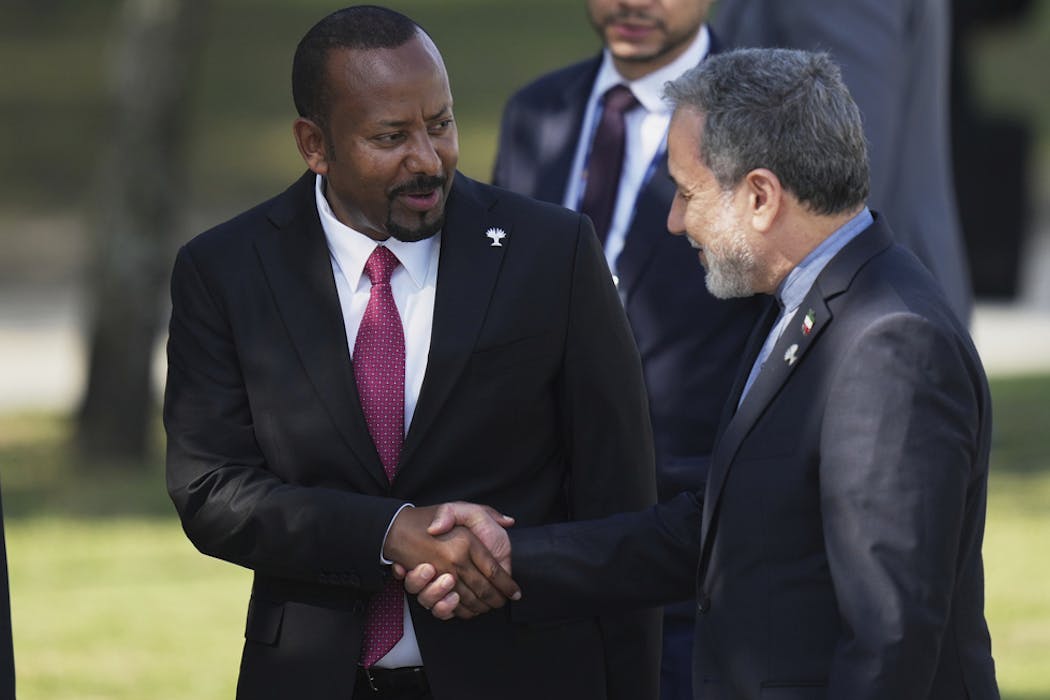
Prime Minister of Ethiopia Abiy Ahmed shakes hands with Iranian Foreign Minister Abbas Araghchi during the 17th annual BRICS summit on July 6, 2025.
AP Photo/Silvia Izquierdo

Burkina Faso’s security minister headed to Tehran on Nov. 12, 2025, for high-level talks with Iranian officials. The visit was a fruitful one: The West African nation reopened its Iranian embassy, finalized new agreements on security cooperation and held discussions about strengthening relations in agriculture and industry.

Far from being a routine bilateral diplomatic event for both countries, the trip was part of a broader trend. Since the onset of war in Gaza in late 2023, sparked by the Tehran-aligned and -funded Palestinian group Hamas, Iran has found itself increasingly isolated and facing a number of political and economic crises. Internationally, Tehran’s network of proxy nonstate groups across the Middle East, its so-called axis of resistance, was stretched to a breaking point with Israel’s brutal campaigns against Hamas and Hezbollah, as well as the fall of the Assad regime in Syria in late 2024.

Tehran’s regional difficulties then culminated with a punishing 12-day war with Israel in June 2025, which the United States joined, and the subsequent EU-imposed U.N. “snapback” sanctions – a series of penalties against Iran that were initially lifted after it signed a deal in 2015 limiting Tehran’s nuclear program in return for the easing of sanctions.

On top of this, Iran is now facing an environmental crisis in the shape of severe drought affecting the capital.

As Iranian officials attempt to weather this rocky new reality, they have looked to advance geostrategic interests elsewhere. As an expert on Iran’s foreign policy, I believe one key emergent area for this is Africa, where Iran has increased its outreach to historically dependable and strategically significant partners such as Burkina Faso. This outreach has created important opportunities for Tehran to engage with countries on issues such as security and critical minerals, while also expanding its market for weapons and other exports while bypassing sanctions.

Security, uranium and economy in West Africa

In addition to Burkina Faso, Iran has intensified its outreach to other African countries in West Africa and the Sahel region, such as Mali and Niger.

Since the early 2020s, these countries have experienced military coups and distanced themselves from the West. They have also confronted serious security threats from rebels, militias and jihadists. Consequently, and as was the case with Ethiopia, they have looked toward Iran as a security partner and a potential supplier of arms, drones and other equipment.

For Iran, expanding relations with these African countries holds the benefit of opening up economically critical markets, including metals and minerals. For instance, Tehran has aspired to access gold from Burkina Faso and Mali, and uranium from Niger. Depending on the extent of the damage and destruction to Iran’s nuclear program during the 12-day war, the potential uranium procured from these countries could be particularly critical if Iran decides to reconstitute or weaponize its program.

After the Iranian and Malian foreign ministers met in May 2024, they did so again the following year in October to discuss reinforcing bilateral and multilateral relations.

To this end, both nations agreed to hold a joint economic commission and to show solidarity and support at meetings of international organizations such as the U.N. and the Non-Aligned Movement.

Meanwhile, in April and May 2025, Iran and Niger signed economic and security agreements after earlier inking a deal by which Tehran would acquire 300 tons of uranium for US$56 million.

A man gives a speech at a conference.
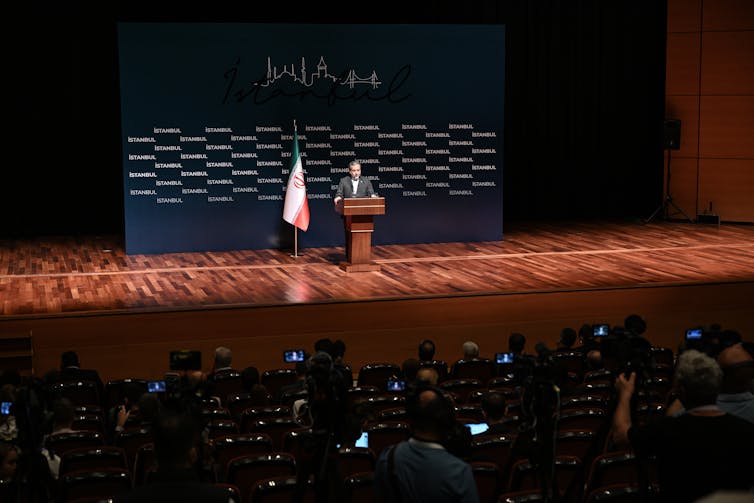
Iranian Foreign Minister Abbas Araghchi delivers a speech at the 51st meeting of the Council of Foreign Ministers of the Organization of Islamic Cooperation on June 22, 2025.
Elif Ozturk / Anadolu via Getty Images

From February to October, Iran also looked to deepen diplomatic relations with Sierra Leone by holding bilateral meetings with the West African nation. Apart from attempting to access uranium, Tehran sought Sierra Leone’s support in multilateral institutions such as the U.N. and the Organization of Islamic Cooperation.

That said, Sierra Leone, while serving as a nonpermanent member of the U.N. Security Council, voted against lifting sanctions on Iran in September, due in part to the African nation’s dependence on British aid.

Outreach opportunities in Africa

In addition to its engagement with countries in West Africa, Iran has also looked elsewhere on the continent for areas of strategic significance.

Between October and November 2025, Tehran coordinated with Malawi on circumventing sanctions and importing aircraft.

In August, Iran sought to strengthen security ties with South Africa – its largest trading partner on the continent by far. At the time, the South African army chief, Gen. Rudzani Maphwanya, made statements supporting Iran and criticizing Israel that created controversy. Between April and October, Iran held meetings and signed agreements with Zimbabwe in the areas of economy, the environment and medical tourism.

While attending the Non-Aligned Movement’s meeting of foreign ministers in Kampala in October, Iranian Foreign Minister Abbas Araghchi met with Ugandan President Yoweri Museveni and thanked him for Uganda’s condemnation of the U.S. and Israel during the 12-day war, during which Uganda evacuated 41 students from Iran. Araghchi also expressed Tehran’s interest and intent on strengthening cooperation with Kampala in agriculture, the economy and commerce.

For Iran, Uganda is strategically important because it possesses not only uranium but also cobalt, which is used to manufacture lithium batteries, superalloys and other industrial products.

A man in a suit sits at a conference.
Iran’s strategic conundrum has only worsened after numerous foreign and domestic challenges.
Arif Hudaverdi Yaman/Anadolu via Getty Images

How Iran is still constrained

While Iran has increased its outreach to reliable and significant African partners across the continent, it has encountered a number of consequential constraints.

For one, there continues to be extensive trade competition from Iran’s Middle East rivals. As recently as 2023, the United Arab Emirates was a top export partner for Burkina Faso, Mali, Niger, Uganda and Zimbabwe, as well as a top import partner of Malawi, Niger, Sierra Leone, Uganda and Zimbabwe. As it had done with several countries in the Horn of Africa in 2016, the UAE, alongside Saudi Arabia, could pressure others on the continent to reduce or eliminate their engagement with Tehran.

Particularly with the U.N. snapback sanctions now back in place, the ongoing reality of global economic pressure on Iran could also give African countries pause when considering stronger bilateral ties with Tehran. Yet before then, and even with the U.S. reimposing sanctions on Tehran after withdrawing from the Iran nuclear deal in 2018, these countries did not simply stop engaging with Tehran.

The final constraint is the transactional nature of Iran’s outreach. This could create distrust among its African partners. In November 2025, for instance, Tehran reportedly supplied drones to Eritrea as tensions escalated between it and Ethiopia. Such a move by Iran could complicate its relationship with Ethiopia and put Tehran in the middle of another conflict between those countries.

Time will tell whether the opportunities outweigh the constraints as Iran attempts to forge closer relations with the continent. Yet for government officials in Tehran weathering sundry crises at home and abroad, it will feel like they have few alternatives than to seek opportunities where they can find them.

The Conversation

Eric Lob receives funding from the Carnegie Endowment for International Peace. He is affiliated with the organization as a non-resident scholar in its Middle East Program.

ref. Facing myriad global pressures, Iran intensifies outreach to African partners for critical needs – https://theconversation.com/facing-myriad-global-pressures-iran-intensifies-outreach-to-african-partners-for-critical-needs-270603

The housing crisis is forcing Americans to choose between affordability and safety

Source: The Conversation – USA (2) – By Ivis García, Associate Professor of Landscape Architecture and Urban Planning, Texas A&M University

Picture this: You’re looking to buy a place to live, and you have two options.

Option A is a beautiful home in California near good schools and job opportunities. But it goes for nearly a million dollars – the median California home sells for US$906,500 – and you’d be paying a mortgage that’s risen 82% since January 2020.

Option B is a similar home in Texas, where the median home costs less than half as much: just $353,700. The catch? Option B sits in an area with significant hurricane and flood risk.

As a professor of urban planning, I know this isn’t just a hypothetical scenario. It’s the impossible choice millions of Americans face every day as the U.S. housing crisis collides with climate change. And we’re not handling it well.

The numbers tell the story

The migration patterns are stark. Take California, which lost 239,575 residents in 2024 – the largest out-migration of any state. High housing costs are a primary driver: The median home price in California is more than double the national median.

Where are these displaced residents going? Many are heading to southern and western states like Florida and Texas. Texas, which is the top destination for former California residents, saw a net gain of 85,267 people in 2024, much of it from domestic migration. These newcomers are drawn primarily by more affordable housing markets.

Housing costs are the main driver of the California exodus, the Los Angeles Times notes.

This isn’t simply people chasing lower taxes. It’s a housing affordability crisis in motion. The annual household income needed to qualify for a mortgage on a mid-tier California home was about $237,000 in June 2025, a recent analysis found – over twice the state’s median household income.

Over 21 million renter households nationwide spent more than 30% of their income on housing costs in 2023, according to the U.S. Census Bureau. For them and others struggling to get by, the financial math is simple, even if the risk calculation isn’t.

I find this troubling. In essence, the U.S. is creating a system where your income determines your exposure to climate disasters. When housing becomes unaffordable in safer areas, the only available and affordable property is often in riskier locations – low-lying areas at flood risk in Houston and coastal Texas, or higher-wildfire-risk areas as California cities expand into fire-prone foothills and canyons.

Climate risk becomes part of the equation

The destinations drawing newcomers aren’t exactly safe havens. Research shows that America’s high-fire-risk counties saw 63,365 more people move in than out in 2023, much of that flowing to Texas. Meanwhile, my own research and other studies of post-disaster recovery have shown how the most vulnerable communities – low-income residents, people of color, renters – face the greatest barriers to rebuilding after disasters strike.

Consider the insurance crisis brewing in these destination states. Dozens of insurers in Florida, Louisiana, Texas and beyond have collapsed in recent years, unable to sustain the mounting claims from increasingly frequent and severe disasters like wildfires and hurricanes. Economists Benjamin Keys and Philip Mulder, who study climate change impacts on real estate, describe the insurance markets in some high-risk areas as “broken”. Between 2018 and 2023, insurers canceled nearly 2 million homeowner policies nationwide – four times the historically typical rate.

Yet people keep moving into risky areas. For example, recent research shows that people have been moving toward areas most at risk of wildfires, even holding wealth and other factors constant. The wild beauty of fire-prone areas may be part of the attraction, but so is housing availability and cost.

The policy failures behind the false choice

In my view, this isn’t really about individual choice – it’s about policy failure. The state of California aims to build 2.5 million new homes by 2030, which would require adding more than 350,000 units annually. Yet in 2024, the state only added about 100,000 – falling dramatically short of what’s needed. When local governments restrict housing development through exclusionary zoning, they’re effectively pricing out working families and pushing them toward risk.

My research on disaster recovery has consistently shown how housing policies intersect with climate vulnerability. Communities with limited housing options before disasters become even more constrained afterward. People can’t “choose” resilience if resilient places won’t let them build affordable housing.

The federal government started recognizing this connection – to an extent. For example, in 2023, the Federal Emergency Management Agency encouraged communities to consider “social vulnerability” in disaster planning, in addition to things like geographic risk. Social vulnerability refers to socioeconomic factors like poverty, lack of transportation or language barriers that make it harder for communities to deal with disasters.

However, the agency more recently stepped back from that move – just as the 2025 hurricane season began.

In my view, when a society forces people to choose between paying for housing and staying safe, that society has failed. Housing should be a right, not a risk calculation.

But until decision-makers address the underlying policies that create housing scarcity in safe areas and fail to protect people in vulnerable ones, climate change will continue to reshape who gets to live where – and who gets left behind when the next disaster strikes.

The Conversation

Dr. Ivis García has received funding from the National Science Foundation; the U.S. Department of Housing and Urban Development; the U.S. Department of Transportation’s National Institute for Transportation and Communities; the Centers for Disease Control and Prevention; the Environmental Protection Agency; the National Academies of Sciences, Engineering and Medicine; JPB Foundation; Ford Foundation, Pritzker Traubert Foundation; Chicago Community Trust, SBAN, Texas Appleseed, Fundación Comunitaria de Puerto Rico, Urban Institute & UNIDOS, and Natural Hazards Center.

ref. The housing crisis is forcing Americans to choose between affordability and safety – https://theconversation.com/the-housing-crisis-is-forcing-americans-to-choose-between-affordability-and-safety-266136

Tired of the same old Christmas songs? So were these countercultural carolers

Source: The Conversation – USA (2) – By Florian Walch, Assistant Professor of Music Theory, West Virginia University

What happens when the grinding sounds of metal music collide with the innocence of Christmas? Alexander Koerner/Getty Images

With Mariah Carey and Wham! saturating airwaves with their holiday tunes, it’s beginning to sound a lot like Christmas.

But if all you want for Christmas is a reprieve from stereotypical Christmas music, you’re not alone.

Despite the fact that they often rebel against conformity and commercialism, many countercultural musicians have been inspired to produce holiday tracks of their own. Because the symbols of Christmas are so widely recognizable, juxtaposing them with the sounds and values of more niche musical styles can have striking effects.

Here’s how genres like roots reggae, thrash metal and pop punk have added new layers to familiar holiday tropes:

A roots reggae Christmas revival

Certain sounds elicit certain expectations.

If you hear sleigh bells and a children’s choir, lyrics about wintry fun can’t be far. If you hear off-beat reggae guitars and Jamaican accents, you’ll probably picture pot and palm trees, not Christmas.

And yet the roots reggae sound of Jacob Miller’s “We Wish You A Irie Christmas” infuses the classic “We Wish You a Merry Christmas” with Rastafarian liberation theology.

Singers of the classic carol – which some historians trace to 16th-century England – clamor for figgy pudding, a traditional British Christmas dessert. They refuse to leave until they get their sweets: “We won’t go until we get some / So bring it out here!”

By contrast, Miller’s Christmas is “irie,” which, in Jamaican Patois, roughly translates to contentment and inner peace.

Jacob Miller’s 1978 recording ‘We Wish You A Irie Christmas’ critiques materialism.

In his version, Miller points out that poverty and joy are not mutually exclusive: “We rub it and dub it to the Christmas ‘pon a broke pocket this year.” He also stresses freedom from material desire: “Don’t kill nuf oneself to buy it all.”

After all, the biblical Christmas in Bethlehem had no toys – and no snow either, just like the Caribbean.

For Rastafarians like Miller, the renewal promised by Christmas was deeply personal. In the track, a word that sounds like “Ice-mas” is actually “I’s-mas.” In Rastafarianism, the “I” is the deity contained in each person. Miller’s Christmas revelers dance to their own divinity, anticipating a return to the promised land.

In doing so, Miller turns a simple, well-worn carol into an anthem of self-worth and liberation.

Thrash metal Christmas horror

Other genres can recast an innocent carol’s lyrics into a horror story.

The 19th-century German carol “Kling, Glöckchen, Klingelingeling” was written from the perspective of the “Christkind,” a Christmas gift-bringer in parts of Europe and South America. This “little Jesus” brings gifts in countries where Santa Claus isn’t part of holiday traditions.

Each stanza is framed by a melody and words that evoke the sounds of a ringing bell, which are reflected in the title. In the carol, the Christkind implores children to let it inside so it doesn’t freeze to death. Next, the Christkind promises gifts in return for being let into the living room. Finally, the Christkind asks the children to open their hearts to it.

Who could corrupt this child-friendly pitch for piety?

Enter Thomas “Angelripper” Such, a former coal miner and the front man of the German thrash metal band Sodom.

Where earlier heavy metal could be gloomy and occult, Sodom raised the temperature even more with gory, blasphemous lyrics, buzzsaw guitars and snarled screams. Sodom’s side project, Onkel Tom Angelripper, has recorded metal versions of popular German songs, including “Kling, Glöckchen, Klingelingeling.”

Things take an ominous turn in Onkel Tom Angelripper’s version of the German Christmas classic ‘Kling, Glöckchen, Klingelingeling.’

Without changing the lyrics, the thrash metal sound transforms the carol’s wholesomeness into horror. A twee wind arrangement is cut off by heavy, distorted guitars and a growled “Kling.” Metal musicians often use these sounds to evoke feelings of danger.

Angelripper’s caroler sounds more like a large predator who manipulates and bribes his way into a home. In this framing, the final stanza’s line – “open your hearts to me!” – sounds less like a call for communion and more like an ominous threat of mutilation. It’s a home invasion akin to that in the classic Christmas movie “Home Alone,” but it’s all terror, no humor.

This musical corruption of ambiguous lyrics lays bare the fragility of festive innocence.

Christmas grief gets the punk treatment

There’s a whole catalog of melancholic Christmas songs, from Elvis Presley’s “Blue Christmas” to Bing Crosby’s “I’ll Be Home for Christmas.”

But few touch on painful themes of substance abuse, suicide and guilt like the raw-yet-catchy “Christmas Vacation” by pop-punk pioneers the Descendents.

For better or worse, many of the Descendents’ songs are unabashedly immature, petulant and sometimes offensive. Yet their boyish bravado puts moments of vulnerability into relief.

“Christmas Vacation” is no different.

Over jangly guitars and sparse bass, front man Milo Aukerman recalls an alcoholic friend or partner who “took a vacation into oblivion.” And while this turn of events wasn’t a surprise to the narrator, that didn’t change anything: “I knew about your plans / I really did understand / But you didn’t let me know / I wasn’t invited to go.”

The Descendents’ 1985 track ‘Christmas Vacation’ is about loss and longing.

The lyrics portray a process of ongoing grief. What makes “Christmas Vacation” poignant is its lyrical vacillation. The narrator wonders: Did she leave forever? Will she be back? Is she to blame? Am I?

The vocal harmony in the chorus – a pop punk staple – mirrors this ambivalence. In the track, the joining of voices starts to sound like a wail. An expected feature of pop punk is transformed into a moving expression of grief and loneliness: a common, less celebrated, holiday experience.

Rather than sneer at or mock Christmas, these three tracks give voice to the complicated emotions that can accompany the holidays. Miller evokes gratitude and hope; Angelripper provokes fear and vulnerability; the Descendents dwell on grief and longing. And all three perspectives end up complementing the focus of mainstream music on food, fancy gifts, snow and family.

The Conversation

Florian Walch does not work for, consult, own shares in or receive funding from any company or organization that would benefit from this article, and has disclosed no relevant affiliations beyond their academic appointment.

ref. Tired of the same old Christmas songs? So were these countercultural carolers – https://theconversation.com/tired-of-the-same-old-christmas-songs-so-were-these-countercultural-carolers-270751

Meditating on the connectedness of life could help reunite a divided country – here’s how ‘interbeing’ works

Source: The Conversation – USA (3) – By Jeremy David Engels, Liberal Arts Endowed Professor of Communication, Penn State

Meditation can make us more aware of the miracle of existence of everything in this world. Anna Sunderland Engels

The late Vietnamese Zen master Thich Nhat Hanh often emphasized the interconnectedness of everything in this world. He explained how meditation can change our perceptions about the things we encounter in our daily lives by revealing this interdependence.

Take the example of an apple: Before meditation, an apple is just a piece of fruit. During meditation, the meditator sees how deeply the apple is interconnected with the world – the apple would not exist without the rain, the sunshine, the soil and the farmer who planted the seed. These are just a few of the causes and conditions that allow the apple to exist.

The apple is because of all these other things. An apple is not just a piece of fruit. The apple is also part rain, part sunlight, part soil, part farmer.

After meditation, an apple goes back to being an apple again. The meditator continues to call it an “apple,” but they understand its true nature. Hanh calls this sense of connection “interbeing.”

The apple insight applies to any object: a mountain, a river, a tree, a person.

In my research, I explore how the insights gained by practicing meditation can change how we live our daily lives. Inspired by Hanh, in my forthcoming book “On Mindful Democracy: A Declaration of Interdependence to Mend a Fractured World,” I explore what happens when we make “interbeing” – or interdependence – the foundation of democracy.

The essence of interbeing

In his book “The Other Shore,” Hanh recounts how he coined the term “interbeing” during a retreat in California in the 1980s, while guiding a mindfulness meditation on the nature of a chair.

He asked his students to look at the chair and notice the trees, sunshine, rain and clouds in it. He then wondered aloud if there was a word in English or French that could capture the reality that a chair is made up of things other than a chair: “I asked if the word ‘togetherness’ would do. Somebody said that it sounded strange, so I suggested the word ‘interbeing.’”

Hanh explains that interbeing means “this is because that is.” No rain means no tree, and no tree means no apple and no chair.

According to Hanh, this knowledge can help us to live a happier life because it reveals the miracle of existence.

Consider all the causes and conditions that had to happen exactly as they did for an apple to exist. Had there been a drought that killed the tree when it was young, or a late spring freeze that stunted the apple flower, or had a person chopped the tree down to make space for a housing development, this particular apple would not exist. The apple is a small miracle composed of many other small miracles.

From what I noticed staying at the Plum Village monastery Hanh established in southern France, people who practice mindfulness meditation in Hanh’s tradition are able to see miracles everywhere, because they recognize interbeing in daily life. Even commonplace activities can become special.

When drinking tea at Plum Village, for example, meditators are encouraged to “drink your cloud,” because the water in the tea was once a cloud that was once a river that will one day again fall from the sky as raindrops nourishing the apple trees.

Meditating with Thich Nhat Hahn.

A person is not (just) a person

The knowledge gained in meditation applies to people, too.

We as human beings are also interbeing. We are not separate from the world or each other. We are mutually interdependent. None of us would exist without rain, sunshine, food, a planet Earth – and the efforts of other people, including parents, neighbors, teachers, scientists, farmers and doctors.

A white scroll with the words, 'This moment is full of wonders.'
Thich Nhat Hanh’s calligraphy, Plum Village, France.
Anna Sunderland Engels

A person is more than a single, solitary individual. We contain multitudes.

Seen from this perspective, being a human is miraculous. Think of how the stars had to align so that each of us could be here today. Had the Earth been a little farther from the Sun, or one of our ancestors slipped and fallen down a cliff before their children were conceived, we wouldn’t be here at all.

“People usually consider walking on water or in thin air a miracle. But I think the real miracle is to walk on earth,” Hanh wrote in his book “The Miracle of Mindfulness.” Each breath, each step, becomes a miracle in this practice of meditation.

Mindful democracy

Many of Hanh’s writings and talks were focused on drawing out the civic and ethical implications of interbeing. He believed that a better, more just world is possible if people are committed to cultivating an awareness of “the interconnectedness of all things.”

Everything is interdependent, so it’s not enough to focus on individual well-being while ignoring the well-being of others or the world.

“With the insight of interbeing – that we are inherently interconnected with all other beings – we know that when other people suffer less, we suffer less. And when we suffer less, other people suffer less,” Hanh observed.

As I explain in my new book, “On Mindful Democracy,” to foreground interbeing changes democracy.

It’s common today to talk about democracy as a partisan conflict and to interpret events through the lens of which party will win.

From the perspective of interbeing, we are interdependent, so we all win, or we all lose, together. To practice meditation is to see that underneath our partisan disagreements, we are interconnected. I therefore define mindful democracy as the practice of caring for each other and for the miraculous life we share.

Concretely, this means building welcoming, vibrant communities where people can meditate on interbeing together. It means learning to disagree – and still work together to reduce suffering – without turning each other into enemies.

Life is a shared project, and all of us benefit when we cooperate to ensure that there is less suffering, and more joy, in the world.

The Conversation

Jeremy David Engels does not work for, consult, own shares in or receive funding from any company or organization that would benefit from this article, and has disclosed no relevant affiliations beyond their academic appointment.

ref. Meditating on the connectedness of life could help reunite a divided country – here’s how ‘interbeing’ works – https://theconversation.com/meditating-on-the-connectedness-of-life-could-help-reunite-a-divided-country-heres-how-interbeing-works-269919

People who talk with their hands seem more clear and persuasive – new research

Source: The Conversation – USA – By Giovanni Luca Cascio Rizzo, Assistant Professor of Marketing, University of Southern California

An appropriate hand gesture can help drive your point home. Fajrul Islam/Moment via Getty Images

When people use hand gestures that visually represent what they’re saying, listeners see them as more clear, competent and persuasive. That’s the key finding from my new research published in the Journal of Marketing Research, where I analyzed thousands of TED Talks and ran controlled experiments to examine how gestures shape communication.

Talking with your hands

Whether you’re giving a presentation, pitching an idea or leading a meeting, you probably spend most of your prep time thinking about what you’ll say. But what about the ways you’ll move your hands?

I grew up in Italy, where gesturing is practically a second language. Now that I live in the United States, I’ve become acutely aware of how cultures differ in how, and how much, people move their hands when they talk. Still, across contexts and cultures, one thing is constant: People do talk with their hands.

As someone who studies communication, I’d noticed how some speakers seemed instantly clearer when they gestured. This made me wonder: Do gestures actually make communicators more effective?

The short answer is yes, but only when the gestures visually represent the idea you’re talking about. Researchers call these movements “illustrators.” For example:

  • When talking about distance, you might spread your hands apart while saying something is “farther away.”
  • When explaining how two concepts relate, you might bring your hands together while saying “these ideas fit together.”
  • When describing how the market demand “is going up and down,” you could visually depict a wave shape with your hands.
man speaking holds his hands apart
One video included in the study provides an example of a TED speaker on stage gesturing as he presents his talk.
YouTube/TED – David Agus: A new strategy in the war against cancer

To study gestures at scale, my team and I analyzed 200,000 video segments from more than 2,000 TED Talks using AI tools that can detect and classify hand gestures frame by frame. We paired this with controlled experiments in which our study participants evaluated entrepreneurs pitching a product.

The same pattern of results appeared in both settings. In the AI-analyzed TED Talk data, illustrative gestures predicted higher audience evaluations, reflected in more than 33 million online “likes” of the videos. And in our experiments, 1,600 participants rated speakers who used illustrative gestures as more clear, competent and persuasive.

How hands can help get your point across

What I found is that these gestures give listeners a visual shortcut to your meaning. They make abstract ideas feel more concrete, helping listeners build a mental picture of what you’re saying. This makes the message feel easier to process – a phenomenon psychologists call “processing fluency.” And we found that when ideas feel easier to grasp, people tend to see the speaker as more competent and persuasive.

But not all gestures help. Movements that don’t match the message – like random waving, fidgeting or pointing to things in the space – offer no such benefit. In some cases, they can even distract.

A practical takeaway: Focus on clarity over choreography. Think about where your hands naturally illustrate what you’re saying – emphasizing size, direction or emotion – and let them move with purpose.

What’s next

Your hands aren’t just accessories to your words. They can be a powerful tool to make your ideas resonate.

I’m now investigating whether people can learn to gesture better – almost like developing a nonverbal vocabulary. Early pilot tests are promising: Even a 5-minute training session helps people become clearer and more effective through the use of appropriate hand gestures.

While my research examined how individual gestures work together with spoken language, the next step is to understand what makes a communicator effective with their voice and, ultimately, across all the channels they use to communicate – how gestures combine with voice, facial expressions and body movement. I’m now exploring AI tools that track all these channels at once so I can identify the patterns, not just the isolated gestures, that make speakers more effective communicators.

The Conversation

Giovanni Luca Cascio Rizzo does not work for, consult, own shares in or receive funding from any company or organization that would benefit from this article, and has disclosed no relevant affiliations beyond their academic appointment.

ref. People who talk with their hands seem more clear and persuasive – new research – https://theconversation.com/people-who-talk-with-their-hands-seem-more-clear-and-persuasive-new-research-270352