From concrete walls to living edges, here’s how riverside habitats are being restored along the Thames

Source: The Conversation – UK – By Wanda Bodnar, PhD Candidate, Marine and Estuarine Science, UCL

The Thames estuary in southeast England — the tidal stretch of the river — once supported extensive saltmarshes, seagrass meadows and oyster beds. These shallow areas, which flood and drain with the tides, provided vital feeding and nursery grounds for fish. But centuries of urban development have replaced them with concrete walls, docks and flood defences.

Much of this change happened in the Victorian era. The Thames embankment straightened and hardened the river’s edge, severing the natural connection between land and water. Today, barely 1% of those original intertidal habitats — the shallow zones between the low and high tide mark — remain. But while the physical landscape has continued to shrink, the condition of the water has taken a very different path.

Since the 1960s, water quality has improved dramatically, and more than 125 fish species have been recorded in the Thames river system. Some even spawn in the Thames. With stable oxygen levels and declining pollution, the river has made an impressive biological recovery — but not a physical one. Fish have returned, but the habitats they depend on have not. With so few natural areas left today, young fish have far fewer places to feed and grow than they once did.

Restoring life at the edge

To counter this loss, new aquatic habitats have been created across London over the past 25 years. The Estuary Edges project — led by the Thames Estuary Partnership with the Environment Agency and the Port of London Authority — shows how to soften hard riverbanks and make space for wildlife.

These created or “engineered” habitats come in many shapes and forms. Some are “setbacks”, where parts of the river wall are opened or moved back to allow tides to flood naturally. Others are gently sloping vegetated terraces. These are sections of hard wall or steep bank that have been reshaped and planted with aquatic and saltmarsh plants to recreate a more natural edge.

Even vertical walls can be improved by adding ledges and textured surfaces. These features give aquatic wildlife places to cling, feed and shelter.

Between 2017 and 2023, nine “estuary edges” sites were surveyed, from Barking Creek to Wandsworth in London. Using specialised nets, more than 1,000 fish were recorded — including gobies, seabass and the critically endangered European eel. Almost all were juveniles, showing that even small, vegetated areas can shelter young fish in the heart of London. The surveys also showed that design and time matter. Habitats with gentle slopes, channels and good water flow supported more fish. Sites with barriers or poor drainage often trapped water — and fish — on the falling tide.

At Greenwich Millennium Terraces, an area of the peninsula that was redeveloped in 1997, a natural drainage channel formed over the years. By 2023, the site supported mullet, flounder and many eels. At Barking Creek, a tidal channel that reformed after reed overgrowth restored fish access and increased diversity. The neighbouring setback site, built in 2011, kept water flowing throughout the tide and consistently supported gobies, seabass, flounder and eels.

These examples show that habitat creation works — but they also highlight significant knowledge gaps. Compared with decades of research on water quality, studies on habitat function remain limited, especially across different habitat types and levels of human impact.

Further downstream, the Transforming the Thames project is now scaling up restoration. Led by the Zoological Society of London, it focuses on the outer estuary, where there is more space to restore and reconnect habitats.

Together, Estuary Edges and Transforming the Thames offer complementary approaches to habitat recovery: creating new habitats along the urban river edge while restoring those lost across the broader estuary.

This connection underpins my PhD research. I study how fish use natural, degraded, created and restored habitats across the Thames. By combining environmental DNA with net surveys, diet analysis, and stable isotope techniques, I explore how fish feed, move and interact with different habitat types. This helps reveal how these habitats support fish — and how fish respond as restoration progresses.

Creating and restoring habitats is not only about helping fish and other wildlife. Shallow, plant-rich edges stabilise sediments, absorb waves, improve water quality and strengthen climate resilience. They also create peaceful “blue havens”: places where people can reconnect with the river.

Once declared “biologically dead”, the Thames has made a remarkable comeback. Its revival story, however, is still being written.


Don’t have time to read about climate change as much as you’d like?

Get a weekly roundup in your inbox instead. Every Wednesday, The Conversation’s environment editor writes Imagine, a short email that goes a little deeper into just one climate issue. Join the 47,000+ readers who’ve subscribed so far.


The Conversation

This article draws on decades of research and collaboration across the Thames Estuary, made possible by the work of many individuals and organisations. I am especially grateful to Steve Colclough, whose long-standing work continue to influence restoration efforts across the region. I worked full-time at the Thames Estuary Partnership between 2018 and 2024, and I am now undertaking a NERC-funded PhD jointly hosted by Queen Mary University of London, the Institute of Zoology and University College London.

ref. From concrete walls to living edges, here’s how riverside habitats are being restored along the Thames – https://theconversation.com/from-concrete-walls-to-living-edges-heres-how-riverside-habitats-are-being-restored-along-the-thames-269420

Parental child abduction: why extending criminalisation is not the answer

Source: The Conversation – UK – By Allison Wolfreys, Lecturer in Law, The Open University

PrasitRodphan/Shutterstock

The government is proposing a change in the law on parental child abduction. The crime and policing bill, under consideration in parliament, would make it a crime for a parent to take their child on holiday and then not return them at the end of the agreed holiday period. This would be punishable by up to seven years’ imprisonment.

The government is attempting to remedy what could be seen as a gap in the law. But this approach fails to take into account what we know about the situations in which this kind of parental child abduction occurs. In many cases, it involves a mother fleeing domestic abuse with her children.

Parental child abduction happens when a child is taken to another country without the other parent’s knowledge or consent, or when one parent takes the children abroad for a holiday and keeps them overseas beyond the agreed holiday period. Currently, the recourse for parents left behind is contained in the 1980 Hague Convention on the Civil Aspects of Child Abduction.

This was created with the objective of minimising harm to children. It enables the left-behind parent to apply to the court in the country the children were taken to for their prompt return. The Convention remains the primary legal instrument of response, with 103 signatory member states.

The crime and policing bill currently before Parliament will leave the 1980 Convention untouched but bolster criminal sanctions against parents who take children by amending the Child Abduction Act 1984, which applies to England and Wales.

The 1984 Act made it an offence for a parent to take or send a child out of the jurisdiction without the other parent’s consent. The parent who took the children is sanctioned only if police pursue a complaint made by the left-behind parent, which is then subject to a decision by the Crown Prosecution Service to prosecute.

Silhouetted man and child
The key focus in existing legislation is the return of children.
KieferPix/Shutterstock

Now, the government seeks to strengthen criminal sanctions against parents who fail to return children. But the proposed seven years’ imprisonment does not align with what research and practice tells us about parental child abduction in 2025.

Profile of the abductor

There was little hard statistical data available on parental child abduction when the Hague Convention was created. However, the abduction of children was primarily seen as something done by fathers who were not the primary carer of their children.

The picture is now very different. Research conducted in 2015 found that 73% of taking parents were mothers, an increase from earlier years, and of these 91% are primary carers. My research and that of other scholars has found that domestic abuse features heavily in these cases. Essentially, these mothers are taking their children and attempting to escape an abusive situation. Research suggests that domestic abuse may be present in approximately 70% of child abduction cases.

If this amendment proceeds, then mothers who have fled overseas with their children to escape an abusive relationship may refuse to return for fear of prosecution. But through the mechanism set up under the Hague Convention, the children can still be ordered to go back. This proposed change in law takes no account of the impact on children of criminalising the parent who will most often be their primary carer. The potential criminalisation of primary carers will inevitably compound the trauma for children at the centre of these cases.

The reasons for parental child abduction are multifaceted and complex. The forum for resolving family law disputes is the family court, and punitive criminal sanctions are likely to cause harm to children. Furthermore, the potential criminalisation of mothers in the context of domestic abuse flies in the face of current government policy to support victims of abuse. It also fails to prioritise the individual needs of children caught up in parental conflict.

It is disappointing to note that the House of Commons has to date given scant attention to this proposed change to the law. It was not debated at report stage (when MPs have an opportunity to consider amendments to a bill).

Currently there are several members of the House of Lords with expertise in family law. Now that the bill has reached committee stage – a detailed examination of each line – in the House of Lords, I hope that they will draw attention to this issue and persuade others that the change in law should be abandoned. These complex cases should be left to the family court where they properly belong.

The Conversation

Allison Wolfreys does not work for, consult, own shares in or receive funding from any company or organisation that would benefit from this article, and has disclosed no relevant affiliations beyond their academic appointment.

ref. Parental child abduction: why extending criminalisation is not the answer – https://theconversation.com/parental-child-abduction-why-extending-criminalisation-is-not-the-answer-271019

Warm oceans seem to be turning even ‘weak’ cyclones into deadly rainmakers

Source: The Conversation – UK – By Ligin Joseph, PhD Candidate, Oceanography, University of Southampton

The final week of November was devastating for several South Asian countries. Communities in Sri Lanka, Indonesia and Thailand were inundated as Cyclones Ditwah and Senyar unleashed days of relentless rain. Millions were affected, more than 1,500 people lost their lives, hundreds are still missing, and damages ran into multiple millions of US dollars. Sri Lanka’s president even described it as the most challenging natural disaster the island has ever seen.

When disasters like this happen, the blame often falls on a failure in early warnings or poor preparedness. This was the case with major floods in Kerala, south India, in 2018, which devastated my hometown.

But this time, the forecasts were largely accurate; the authorities knew the storms were coming, yet the devastation was still immense.

So, if the forecasts were good enough, why were the impacts still so severe?

Weak winds, extreme rain

One emerging explanation is that these storms were not dangerous because of their winds, but because they produced unusually intense rainfall.
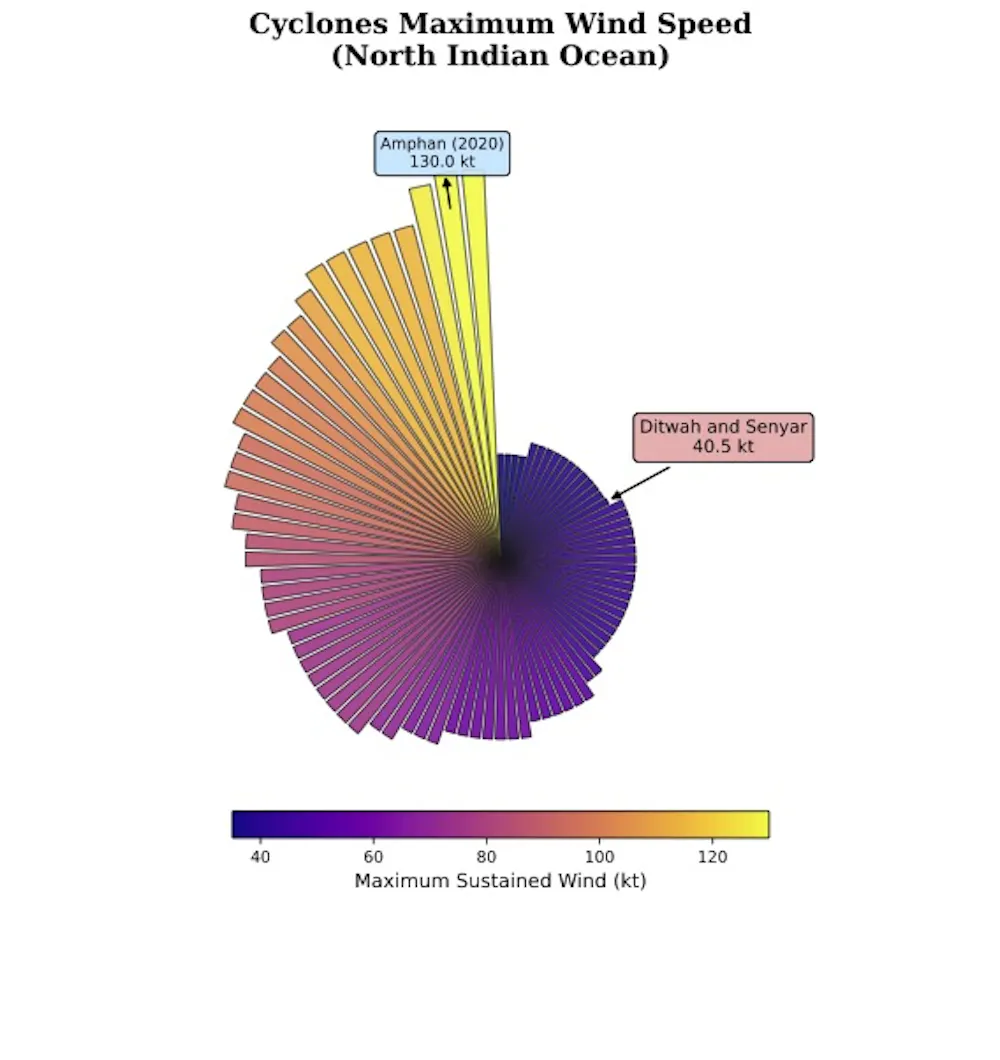
Graph of wind speeds
This graph of all cyclonic storms over the north Indian Ocean since 2001 shows Ditwah and Senyar weren’t particularly windy. (Wind speed measured in knots. 1 knot is about 1.15 mph or 1.85 kph)
Ligin Joseph (data: IBTrACS), CC BY-SA

Consider Cyclone Ditwah. Its peak winds were around 75 km/h (47 mph). That’s windy, but nothing special. In the UK, it would be classified merely as a “gale” rather than a “storm”. It was far weaker than the 220 km/h winds of the powerful 1978 cyclone that also struck Sri Lanka. Yet Ditwah still caused massive devastation.

What explains this apparent contradiction? It’s too early to say definitively, but climate change is likely a part of the story. Even when storms are not especially strong in wind terms, the amount of rain they carry is increasing.

A warmer atmosphere holds more water

A well established meteorological rule helps explain why. For every degree of global warming, the atmosphere can hold about 7% more moisture.

As the planet warms, the air above us becomes a larger reservoir, waiting to dump more water on us. When storms form, they can tap into this expanded supply, often in extremely short bursts. Even if wind speeds are modest, the rainfall alone can be catastrophic.

The oceans matter even more

Warming oceans play an even more powerful role, as cyclones draw their energy from warm ocean waters. Satellite data from late November shows just how warm the eastern Indian Ocean was, with large areas more than 1°C above normal during Ditwah and Senyar.

Coloured map of Indian Ocean and SE Asian seas
In the days before the cyclones formed (20–24 November), the oceans were even warmer than usual, creating conditions that could have fuelled and intensified the rainfall.
Ligin Joseph (Data: OISST; track positions are approximate), CC BY-SA

Such warm anomalies are no longer unusual. The oceans have absorbed more than 90% of the excess heat trapped by greenhouse gases, and long-term observations show a clear upward trend in ocean temperatures.

That doesn’t necessarily mean cyclones are becoming more frequent – their formation still depends on other ingredients, such as low wind shear (small differences in wind speed and direction with height) and the right atmospheric structure.

What warmer oceans do change, however, is the amount of energy available to any storm that does manage to form. When the ocean is warmer, cyclones have more fuel and evaporation increases, loading the atmosphere with moisture that can fall as intense rain once a storm develops. Even weak cyclones can therefore hold exceptional amounts of rain.

Coloured map of Indian Ocean and SE Asian seas
Evaporation averaged for 26–27 November. Ditwah especially travelled over warm waters supplying large amounts of moisture to the atmosphere.
Ligin Joseph (Data: ERA5), CC BY-SA

The winds near the surface help this process along. As they move across the ocean, they sweep away the moisture-filled air just above the water and replace it with drier air, allowing evaporation to continue. Put together, warmer oceans, higher evaporation, and an atmosphere that can store more moisture, these factors can significantly intensify the rainfall associated with cyclones.

Coastline hugging makes flooding worse

Local geography amplified these effects. Both Ditwah and Senyar formed unusually close to land and travelled along the coastline for an extended period. This meant they stayed over warm waters long enough to continuously draw moisture, but remained close enough to land to dump that moisture as intense rainfall almost immediately.

Cyclone Ditwah, in particular, moved slowly as it approached Sri Lanka. Slow-moving storms can be especially dangerous as they repeatedly dump rain over the same area. Even if winds are weak, this combination of warm seas, coastal proximity and slow forward speed can be devastating.

A new threat

These storms suggest that climate change – especially ocean warming – is reshaping the risks posed by cyclones. The most dangerous storms may no longer simply be the ones with the strongest winds, but also the ones with the most moisture.

Forecasting systems, including new AI-powered weather models, are getting better at predicting cyclone tracks and wind speeds. Yet rainfall-driven flooding remains far harder to forecast. As oceans continue to warm, governments and disaster agencies will need to prepare for storms that may be weak in wind but extreme in rain.

These insights are based on preliminary analysis and emerging scientific understanding. More detailed peer-reviewed studies will be needed to pinpoint exactly why Ditwah and Senyar produced such extreme rainfall. But the pattern that is emerging – weak cyclones delivering outsized floods in a warming world – must not be ignored.

The Conversation

Ligin Joseph receives funding from the UK’s Natural Environment Research Council (NERC).

ref. Warm oceans seem to be turning even ‘weak’ cyclones into deadly rainmakers – https://theconversation.com/warm-oceans-seem-to-be-turning-even-weak-cyclones-into-deadly-rainmakers-271550
What the US national security strategy tells us about how Trump views the world

Source: The Conversation – UK – By Andrew Gawthorpe, Lecturer in History and International Studies, Leiden University

Russia has called US president Donald Trump’s new national security strategy ‘largely consistent’ with Moscow’s vision. Photo Agency / Shutterstock

The White House has released its national security strategy, a document put out by every US presidential administration in order to spell out its foreign policy priorities. These documents are legally required to be released by Congress and are typically written by a committee. Still, they bear the president’s signature and usually serve as a distillation of how the current commander in chief views the world.

This latest document is no exception. But perhaps even more so than any previous national security strategy, it reflects a focus on the views and activities of the current president. It touts supposed achievements of the Trump administration in a way that would be more appropriate in a campaign speech. And at numerous points, it lavishes praise on Donald Trump for upending conventional wisdom and setting US foreign policy on a new course.

So what can we learn from this document about how Trump views the world? Three themes stand out. The first is that, contrary to some claims, Trump is not an isolationist. He doesn’t want to pull the US back from foreign entanglements completely. If he did, it would hardly make sense to boast of having brokered eight peace deals or of having damaged Iran’s nuclear programme.

Like more traditional national security strategy documents, the latest one still portrays the US as having a responsibility for global peace and prosperity. But within that broad remit, it has a new set of priorities.

The most striking is the focus on the western hemisphere. Whereas recent administrations have identified the containment of China as their key priority, Trump vows he will “restore American preeminence in the western hemisphere”. Yet the only concrete “threats” the document identifies as originating in the region are drug cartels and flows of irregular migrants.

Viewed from the standpoint of previous administrations, this makes little sense. US foreign policy has usually been concerned mainly with grave security threats, particularly from Russia and China. Drugs and migrants were less important than nuclear weapons and aircraft carriers.

Trump views things differently. From his perspective, dangerous narcotics and migrants who he has previously said are “poisoning the blood” of the US are much more direct threats to the American people. Putting “America First”, to use Trump’s favourite phrase for describing his own foreign policy, means focusing on them.

But this does not mean Trump is isolationist. Protecting the American people, even in the way Trump understands it, means having an active foreign policy.

The second key theme of the document is its attitude towards “civilisation”. In it, Trump has returned to a central aspect of his political rhetoric – that “western civilisation” is under attack from a combination of hostile migrants, spineless liberals and cultural degeneracy. Just as Trump appears to see himself as leading the fightback against these forces in the US, he wants others to do the same.

In passages that have sent shockwaves through Europe’s political establishment, the national security strategy lambasts European governments for allegedly welcoming too many migrants, persecuting far-right political parties and betraying the west’s civilisational heritage.

Again, these are not the words of an isolationist. They are the words of someone who, as I have concluded in my own research, views themselves as the protector of a racially and culturally defined civilisation that covers both the US and Europe.

The particularism here is striking. Whereas past US national security strategies spelled out a desire for Washington to spread liberal democracy throughout the world, Trump’s document says this is an unachievable goal. Instead, he seems to be interested primarily in the destiny of white Europeans – and in shaping their democracy and values to conform with his own.

The national security strategy warned that several countries risk becoming “non-European” due to migration, adding that if “present trends continue, the continent will be unrecognisable in 20 years or less”. This is a stance that some observers say echoes the racist “great replacement theory”, a comparison the White House has branded as “total nonsense”.

The third and final theme that stands out from the document is its intensely economic focus. The most detailed parts of the document relate to economic statecraft – how to reshore industries to the US, reshape the global trading system and enlist US allies in the mission of containing the economic rise of China.

Regional security matters, by contrast, receive much less attention. Russia’s ambitions in Europe are barely mentioned as a problem for the US, and Taiwan merits only a paragraph. Indeed, the Kremlin has said the new strategy is “largely consistent” with its vision.

Rarely has a US national security strategy been so transactional. In its discussion of why the US will support Taiwan, the document only invokes the island’s semiconductor industry and strategic position as reasons. Not a word is said about the intrinsic worth of Taiwanese democracy or the principle of non-aggression in international law.

The impression this leaves is that, in foreign policy, Trump prioritises economics over values. He views leaders such as China’s Xi Jinping and Russia’s Vladimir Putin not as implacable dictators hell-bent on regional domination, but as possible business partners. He seems to believe the focus of foreign policy ought to be to maximise profits.

For US allies in Europe and Asia, this raises an uncomfortable question: what if the profitable thing to do turns out to be to abandon them and strike a grand bargain with Russia or China? Based on this document, they have little reason to think Trump will do anything else.

The Conversation

Andrew Gawthorpe is affiliated with the Foreign Policy Centre in London.

ref. What the US national security strategy tells us about how Trump views the world – https://theconversation.com/what-the-us-national-security-strategy-tells-us-about-how-trump-views-the-world-271438

Ovid’s Metamorphoses is all about mothers

Source: The Conversation – UK – By Frances Myatt, College Teaching Associate (Peterhouse), University of Cambridge

Cornelia, Mother of the Gracchi, Pointing to Her Children as Her Treasures by Angelica Kauffman (1785). Virginia Museum of Fine Arts, Richmond

Even if you haven’t heard of Ovid, you almost certainly know some of his stories. His most famous work, the Metamorphoses, is a Latin epic poem composed of hundreds of tales of mythical transformations, many of which are still being told and retold today.

Take Ovid’s story of the sculptor Pygmalion, who crafted an impossibly beautiful woman from ivory. After falling in love with his own creation, he prayed to the goddess Venus and she brought the statue to life. You can trace the echoes of this story through the centuries – from George Bernard Shaw’s play Pygmalion (1913), which recast the sculptor as a speech therapist and became the musical My Fair Lady (1956), to Spike Jonze’s film Her (2013), which reimagines the tale for the AI generation.

The Pygmalion story was also recently retold from the statue’s perspective by Madeline Miller in her novella Galatea (2013), the name given to Pygmalion’s statue by later writers. With its unflinching descriptions of sexual abuse, Miller’s novella brings the darker aspects of Ovid’s tale into sharp focus.

Indeed, the Metamorphoses as a whole has had its own #MeToo moment in recent years. In 2015, Columbia undergraduates even argued that the book should have trigger warnings due to its many brutal rape scenes. However, while authors, journalists and academics are now all reckoning with Ovid’s disturbing fondness for scenes of rape, there is another, striking aspect of the Metamorphoses that we’re still overlooking – Ovid’s fascination with motherhood.


This article is part of Rethinking the Classics. The stories in this series offer insightful new ways to think about and interpret classic books and artworks. This is the canon – with a twist.


Mothers don’t normally belong in Latin epics, which were meant to be devoted to warriors and warfare. When mothers do pop up in epic poems, they’re immediately pushed away.

In Virgil’s Aeneid, for instance, Aeneas escapes from the ruins of Troy with his father and son – but tells his wife to follow behind, where she is lost and killed. Later, a grieving mother is hidden away in her tent, in case her tears dishearten the soldiers. But in the Metamorphoses, mothers are everywhere, even in the most epic of myths.

The 12 labours of Hercules is one of the most famous legends of the classical world – but Ovid spends far longer recounting the labours of Hercules’ mother, Alcmene. What is more, Alcmene narrates her labours herself, to her daughter-in-law Iole.

Latin literature expert Mairéad McAuley argues that this unusual first-person account of pregnancy and birth reimagines the epic tradition as an intimate exchange of knowledge between women, and it plays with both the idea of epic heroism and the question of what kinds of stories properly belong in the epic canon.

On an even more fundamental level, the world of the Metamorphoses is rooted in motherhood. After a great flood, the human race is renewed from “the bones of our great mother” – the stones of our mother earth. She then “gave birth” to all other animals, which grew in warm, wet mud “as though in the womb of a mother”.

Later, Mother Earth herself appears as a character in the poem, when the world is burning and she begs the king of the gods to save the earth from the devouring flames. It’s a passage that perhaps has even more resonance for us now than in Ovid’s time.

The transformation of motherhood

Motherhood is also present in the Metamorphoses in more subtle ways. =Alison Sharrock, a professor of Latin, has pointed out that Ovid uses the vocabulary of fertility and childbirth to describe Pygmalion crafting his statue. The story then ends with the newly alive statue giving birth to a daughter, Paphos, who gave her name to the Greek island.

Painting of a woman rising from the sea, with cherubs shooting arrows at her from above and a battle being fought around her.
The Triumph of Galatea by Raphael (c. 1512).
Villa Farnesina museum, Rome

Miller picks up on this in her novella, where Pygmalion creepily insists that he is Galatea’s “mother”, as well as “husband, and father”. However, Pygmalion can neither understand nor control Galatea’s true maternal love for her daughter. It is this love that drives her to escape, so that her daughter might be free from Pygmalion’s abusive power.

While Ovid gives a surprising amount of space to mothers, that doesn’t mean he was some sort of proto-feminist. His mothers are certainly powerful, complex characters – but they are also often figures of violence and destruction.

Medea, infamous killer of her own children, was one of Ovid’s favourite characters, and the star of the only play he ever wrote. While this play has unfortunately been lost over the millennia, he devotes half a book of the Metamorphoses to her – and Medea is far from the only murderous mother of the poem.

After Procne’s husband rapes her sister and tears out her tongue, she kills their son and serves the meat to her husband at the dinner table – a gruesome plot that inspired Shakespeare’s Titus Andronicus (1588).

In the final book of the poem, Ovid equates birth and metamorphosis, when the Greek philosopher Pythagoras preaches a doctrine of reincarnation, claiming that “what is called being born, is just beginning to be something else”.

This speech of Pythagoras looks back to the very beginning of the poem, when Ovid says that he will tell of “bodies changed into new forms”. And what change is more dramatic than pregnancy and childbirth, when the mother’s body metamorphoses, and one body becomes two?

Beyond the canon

As part of the Rethinking the Classics series, we’re asking our experts to recommend a book or artwork that tackles similar themes to the canonical work in question, but isn’t (yet) considered a classic itself. Here is Frances Myatt’s suggestion:

The stand-out modern poet of motherhood and metamorphosis is unquestionably Fiona Benson. Her collection Vertigo & Ghost was awarded both the Forward Prize and the Roehampton Prize in 2019.

The first half of the collection explicitly reworks tales from Ovid’s Metamorphoses. Here, motherhood offers moments of loving care and affection amid the sickening brutality of Ovid’s repeated rapes, reimagined in modern settings.

Fiona Benson reads Transformation, from Vertigo & Ghost.

While the second half of the collection doesn’t overtly rewrite Ovidian myths, it is nonetheless equally Ovidian in character. Benson glides seamlessly between the human and animal worlds, with childbirth acting as a key thread that links the poems together.

In Wildebeest, particularly, motherhood is unambiguously portrayed as a form of metamorphosis. Benson describes how “I became beest” while giving birth, slipping between human, animal, water, metal and star, in a glorious profusion of transformation, as dramatic and poetic as any Ovidian metamorphosis.


Looking for something good? Cut through the noise with a carefully curated selection of the latest releases, live events and exhibitions, straight to your inbox every fortnight, on Fridays. Sign up here.


The Conversation

Frances Myatt has received research funding from the University of Cambridge and the Caroline Fitzmaurice Trust.

ref. Ovid’s Metamorphoses is all about mothers – https://theconversation.com/ovids-metamorphoses-is-all-about-mothers-266383

Immigrant women care workers keep Ontario’s home care afloat under exploitative conditions

Source: The Conversation – Canada – By Naomi Lightman, Associate Professor of Sociology, Toronto Metropolitan University

Despite recent provincial investments, Ontario’s home-care system is still in crisis. Underfunding, rationed care and ideological preferences for privatization of services undermine dignified aging and care for those in need of support at home.

At the same time, home-care providers, who are disproportionately racialized immigrant women, experience precarious, exploitative and sometimes dangerous working conditions.

My newly released research report, entitled “Caring about Care Workers: Centring Immigrant Women Personal Support Workers in Toronto’s Home Care Sector,” is a collaboration with Social Planning Toronto(SPT), a non-profit, community-based agency. In it, we highlight the concerns and preferences of these undervalued workers.

Our report presents data from interviews with 25 immigrant women working as personal support workers (PSWs) in home care in the City of Toronto. Our conversations, conducted between 2023 and 2025, focused on employment conditions and workplace safety, the critical need for systems change and the possibilities for building PSW collective power.

A vital service held together by precarious labour

Home care provides crucial supports to seniors who want to live in their own homes longer, facilitates the autonomy of people with disabilities and aids in the recovery of individuals following a hospital stay.

Their work both supports widespread client preferences to “age in place” and reduces pressure on hospitals and emergency departments. Yet it is routinely neglected and chronically under-resourced.

PSWs provide the majority of home care services. In 2022, an estimated 28,854 individuals were employed as PSWs in the home-care sector in Ontario. Home-care PSWs collectively provided 36.7 million hours of care to Ontario residents in 2023-24 through the provincially funded system.

Immigrant and racialized women comprise the majority of home care PSWs in the Greater Toronto Area. Home-care PSW labour is characterized by low wages, lack of employment benefits, health and safety risks and unique challenges associated with working alone in private homes.

Among PSWs in Ontario, those working in the home and community care sector have the lowest average wage, making about 21 per cent less on average than PSWs working in hospitals and 17 per cent less than those in long-term care. Inadequate provincial funding and inequitable and restrictive funding arrangements are the primary drivers that create and exacerbate these unacceptable conditions.

PSWs are absorbing the real cost of care

Our research participants explained how the normal costs associated with providing home care are offloaded onto them in several ways.

First, most PSWs in home care provide personal care to multiple clients each day. Travel between client homes is a requirement of their work. Yet participants shared that they either receive low pay or no pay for travel time between client homes.

One of our participants, Kemi, explained how travel time works in her agency:

“The travel time that we are paid is one hour. If I’m working five hours, that’s six hours I’ll be paid. But the thing is that the travel time amount is not the same as your regular wage… travel time is paid some amount less.”

If it takes more than an hour a day to travel between client homes, Kemi does not receive any compensation for that additional time. Yet this is a reality for her on a regular basis.

Joy, another participant, noted that PSWs in her agency personally pay more than half of their transit costs:

“They give us $1.60 per travel, but the payment we give the TTC is $3.50. I requested the company to make it the same, or at least a free TTC pass for the month. But the employer said it wasn’t appropriate.”

At the same time, many PSWs have long gaps of unpaid time between client visits during their workday. These gaps in their workday result in a full-time shift but only part-time compensation, with many getting paid for only a few hours each day. The result is full time work for a part-time wage.

In addition, participants noted that PSWs can have their work hours and income reduced if their caseload is reduced. This occurs when a client dies, moves, enters hospital or long-term care, switches home care providers or no longer requires services.

Ann-Marie described the precariousness of working in home care:

“You know why the hours are not guaranteed? For instance, I have eight clients, and out of eight clients, I have three clients that passed away. That’s all my hours reduced until they able to find another client to fit into my schedule.”

Reform must start with fair working conditions

Our report provides detailed policy recommendations targeted to both levels of government, home-care service provider organizations, unions and the community sector.

In particular, we advocate for the creation of a comprehensive public non-profit home-care system where home care workers, Ontario residents receiving care and their families play a central role. Rather than continuing with a fee-for-service model, we recommend adopting a grant-based funding model to better support the full cost of care provision.

We also advocate for developing employment standards for home care PSWs and improvement of public transparency and accountability in home care through data collection and analysis, along with regular public reporting and independent research. And, finally, rather than continuing to allow large home-care companies to extract millions in profit, we want every public dollar to support high-quality care and good working conditions for home care workers.

For the good of everyone in Ontario, it’s essential that the provincial government take bold action to reform the home-care system. The very least we can do for these essential and valuable workers is to ensure fair compensation, guaranteed work hours and good working conditions.

The Conversation

Naomi Lightman receives funding from the Social Science and Humanities Research Counsel of Canada (Insight Grant number 435-2021-0486).

ref. Immigrant women care workers keep Ontario’s home care afloat under exploitative conditions – https://theconversation.com/immigrant-women-care-workers-keep-ontarios-home-care-afloat-under-exploitative-conditions-270007

Aging bridges are crumbling. Here’s how new technologies can help detect danger earlier

Source: The Conversation – Canada – By Amirreza Torabizadeh, PhD candidate, Civil Engineering, Concordia University

New signs of deterioration recently discovered on the Île-aux-Tourtes Bridge in Montréal have spurred the Québec government to reinforce beams and install shoring just to keep the structure open.

The bridge carries about 87,000 vehicles a day, yet requires constant monitoring and emergency repairs to ensure its safety.

This is a reminder of how aging concrete can deteriorate and cause safety problems.

Canada has thousands of concrete bridges like Île-aux-Tourtes that are reaching or exceeding their intended lifespans. As these structures age, they become more prone to deterioration, much of it happening slowly and out of sight.

Detecting danger earlier

Our research focuses on the modelling of concrete structures that might deteriorate due to environmental stresses and aging. Our goal is to determine how long a structure remains safe and, if necessary, what retrofitting strategies are applicable.

To fully understand these risks, researchers can make use of the most recent technological advances such as drone imaging, AI-assisted defect detection and non-destructive testing to collect regular and reliable data about a structure’s condition.

Combining these technologies with advanced computer modelling techniques could move Canada towards a system that detects danger earlier, prevents costly failures and supports smarter decisions about repair and retrofit strategies.

Across Canada, many of the concrete bridges built between the 1960s and 1980s are now nearing the end of their service life. The 2019 Canadian Infrastructure Report Card found that nearly 40 per cent of the country’s roads and bridges were in fair, poor or very poor condition, showing how widespread the problem has become.


Read more:
Concrete with a human touch: Can we make infrastructure that repairs itself?


Due to environmental conditions in Canada, freeze-thaw cycles, road salt and moisture serve to accelerate cracking and surface deterioration. Research on concrete durability in cold climates has documented how these mechanisms gradually reduce structural performance.

Climate change is also intensifying heavy rainfall, temperature swings and loading conditions, all of which place additional stress on aging structures. In Western Canada, seismic vulnerability adds another layer of risk for older concrete bridges.

Together, these factors contribute to growing maintenance backlogs and a pattern where deterioration is often addressed only after it becomes visible or disruptive.

Old inspection models are inefficient

Traditional bridge inspections performed by rope access teams — trained professionals who use ropes and specialized gear to work at height on complex structures like bridges — often require lane closures, disrupt traffic and are expensive.

As a result, these inspections are infrequent, allowing damage to develop unnoticed between inspection cycles. The information collected during these inspections is often inconsistent, since different crews may use different ways of recording defects.

When problems are found late, repairs require more lane closures, detours and long work periods. These shutdowns also carry economic costs because downtime affects businesses, commuters and essential services. Earlier detection would let cities plan smaller repairs and use strengthening methods that cause less disruption.

Cost, time and accuracy are the three main factors engineers must balance when assessing aging infrastructure. Our research focuses on accurately predicting the structural risks by modelling how concrete deteriorates over time by considering the occurrence of cracks and environmental stresses.

But even the best model relies on the sufficiency of the collected field information and how much it represents the current state of the structure. To predict the behaviour of a bridge accurately, data must be precise, consistent and updated regularly, something that traditional inspections rarely provide.

How tech can help

New technological advancements on data science and observation techniques are now changing this landscape.

Drones can capture high-resolution images of cracks and surface damage in minutes, without lane closures or heavy equipment. AI systems can scan these images and highlight subtle patterns that might go unnoticed in a manual survey. Other non-destructive testing methods, like radar or ultrasonic scanning, can detect hidden problems beneath the surface.

When these technologies are combined with advanced computer modelling, civil engineers get a much clearer picture of the state of a structure. This early and accurate understanding helps them plan repairs that are faster and less disruptive. It also reduces downtime — the closures and delays that can create economic costs for businesses and commuters.


Read more:
After the Baltimore bridge collapse, we need clear-eyed assessments of the risks to key infrastructure


With better information, communities can choose repair and retrofit solutions that are more efficient and better timed.

Canada cannot rely on infrequent inspections and emergency repairs to manage its aging bridges. By combining better models with more consistent and automated data collection, engineers can detect problems earlier and avoid the large disruptions that come with last-minute closures.

These tools will not replace engineers, but they will give decision-makers clearer information and more time to plan. Investing in these modern approaches now can help keep our bridges safer, our cities moving and our communities better protected in the years ahead.

The Conversation

Emre Erkmen receives funding from Natural Sciences and Engineering Research Council of Canada.

Amirreza Torabizadeh does not work for, consult, own shares in or receive funding from any company or organisation that would benefit from this article, and has disclosed no relevant affiliations beyond their academic appointment.

ref. Aging bridges are crumbling. Here’s how new technologies can help detect danger earlier – https://theconversation.com/aging-bridges-are-crumbling-heres-how-new-technologies-can-help-detect-danger-earlier-270845

Concrete with a human touch: Can we make infrastructure that repairs itself?

Source: The Conversation – Canada – By Mouna Reda, Post doctorate fellow, Department of Civil Engineering, McMaster University

As winter approaches, Canada’s roads, bridges, sidewalks and buildings are facing a familiar problem: cracks caused by large temperature swings. These cracks weaken infrastructure and cost millions to repair every year.

But what if concrete could heal itself like human skin, keeping our structures, roads and bridges strong and saving millions of dollars?

Concrete is the most widely used construction material, known for its durability and low maintenance. Yet it’s still susceptible to cracking.


Read more:
Aging bridges are crumbling. Here’s how new technologies can help detect danger earlier


Concrete is made by mixing cement, water, aggregate and other chemicals used to enhance its properties. As cement reacts with water, it forms a paste that binds everything together.

During this process, changes in volume, improper placement and finishing, and later environmental factors can create cracks. These cracks allow water, other liquids, gases and harmful chemicals to penetrate the concrete, compromising its strength over time.

This challenge has led researchers to eagerly explore what can be done to heal these cracks. In our research, we are researching how self-healing concrete can make infrastructure more durable.

Self-healing concrete

a cracked concrete slab on pillars below an elevated roadway
Cracked concrete under the Spadina Avenue exit ramp on Toronto’s Gardiner Expressway.
(Sylvia Mihaljevic)

When our skin is cut, it’s able to heal on its own. Inspired by this, researchers started re-imagining concrete with similar abilities.

Traditional concrete is able to mend small cracks when water triggers leftover cement in a process known as autogenous healing. This process, however, is very slow and limited to narrow cracks. Since concrete is man-made, it has limited ability to “self-heal” without a little extra help. This led researchers to develop what is called autonomous healing.

Autonomous healing mimics nature by adding special materials like minerals, polymers, micro-organisms or other healing agents into concrete. These materials react chemically or physically with concrete to fill the cracks.

The first modern concept of self-healing concrete was introduced by American researcher Carolyn M. Dry in the early 1990s. In 2006, Dutch microbiologist Hendrik M. Jonkers developed a special concrete that uses bacteria to heal cracks.

Later, Jonkers and civil engineer Erik Schlangen gained attention with “bio-concrete” that incorporates bacteria in spore form. When moisture enters a crack, the spores activate and produce calcium carbonate, one of the most suitable fillers for concrete.

This process, called microbiologically induced calcite precipitation, can heal cracks up to one millimetre wide. The process, however, is very slow and depends on the presence of calcium and moisture in concrete, which makes applying it on a large scale challenging.

Beyond bacteria

The limitations of bacteria-based self-healing led researchers to explore chemical-based mechanisms. These healing agents will react with water, air, cement or curing agent to fill in cracks quickly.

Healing agents can work in two ways: some use a single material, like sodium silicate. Others, like dicyclopentadiene, need two materials. For a two-component type, a substance must be added to start the reaction, and both materials must be released at the same time to repair cracks.

This chemical method can repair larger cracks and works faster than the bacteria-based approaches but comes with its own challenges. The biggest question is: How can we ensure the healing agent survives concrete mixing and is only released when a crack forms?

To address this, researchers store the healing agent in protective mediums — either a special network (called a vascular network) or tiny capsules. These storage mediums protect the healing material until a crack forms. When that happens, the capsules or network rupture to release the healing agent and fill the crack.

Vascular networks require an external reservoir to supply the healing agent, which makes them difficult to cast, vulnerable to damage during casting and susceptible to leaks. Because of this, encapsulation has emerged as a promising approach.


Read more:
Thin, bacteria-coated fibers could lead to self-healing concrete that fills in its own cracks


Encapsulation as a potential solution

Encapsulation involves coating the active agent with polymeric shells to create micro-capsules. Despite its promise, this technique still faces hurdles. Researchers use different methods to make and test the capsules, and there is no standardized way to compare results or test efficacy. The bond between the capsule and the surrounding concrete poses additional challenges and needs more investigation.

In our lab at McMaster University, we are researching the optimum geometrical and mechanical properties of capsules that are compatible with the surrounding concrete. The capsules should survive concrete harsh mixing conditions, while still rupture upon cracking.

We’re also developing a standarized test method to evaluate the survival capsule rate during mixing, and another test to evaluate the efficiency of the self-healing concrete system. And we’re investigating the feasibility of incorporating both bacteria- and chemical-based capsules for short- and long-term self-healing.

More research is needed to determine which self-healing method works best —bio-concrete, chemical-based concrete or perhaps a combination of both.

Ultimately, finding ways to integrate these solutions into infrastructure will benefit communities around the world. Cracks in concrete don’t just look bad; they lead to deterioration over time and costly repairs. That is why developing concrete that resists cracking or heals itself is so important.

The Conversation

Mouna Reda receives funding from Natural Sciences and Engineering Research Council of Canada.

Samir Chidiac receives funding from Natural Sciences and Engineering Research Council of Canada.

ref. Concrete with a human touch: Can we make infrastructure that repairs itself? – https://theconversation.com/concrete-with-a-human-touch-can-we-make-infrastructure-that-repairs-itself-271462

Health insurance premiums rose nearly 3x the rate of worker earnings over the past 25 years

Source: The Conversation – USA (3) – By Vivian Ho, Professor and Chair of Health Economics, Rice University

Patients and employers are feeling the pain of increased health premiums. wildpixel/iStock via Getty Images Plus

Health insurance premiums in the U.S. significantly increased between 1999 and 2024, outpacing the rate of worker earnings by three times, according to our newly published research in the journal JAMA Network Open.

Premiums can rise if the costs of the medical services they cover increase. Using consumer price indices for the main components of medical care – such as services provided in clinics and hospitals as well as administrative expenses – based on federal data and data from the Kaiser Family Foundation, we found that the cost of hospital services increased the most, while the cost of physician services and prescription drugs rose more slowly.

Some of the premium increases can be attributed to an increase in hospital outpatient visits and coverage of GLP-1 drugs. But research, including our own, suggests that premiums have rapidly escalated mostly because health system consolidation – when hospitals and other health care entities merge – has led hospitals to raise prices well above their costs.

Hospital CEOs prioritize profit

Hospitals are aggressively raising their prices because hospital CEOs have incentives to do so.

One study found that for nonprofit health systems, the greatest pay increases between 2012 and 2019 went to hospital CEOs who grew the profits and size of their organizations the most. However, the financial reward of delivering above-average quality of care declined. Increased charity care – free or discounted health services nonprofit hospitals must provide some of their patients who cannot afford medical care – was not significantly tied to CEO compensation.

Board members set performance criteria that determine the base salary and bonus payments for CEOs. Over half of board members at top U.S. hospitals have professional backgrounds in finance or business. As a result, researchers and advocates have raised concerns that financial success is the dominant priority at these institutions.

Close-up of medical bill and credit cards
Health care is getting more expensive for everyone.
DNY59/iStock via Getty Images Plus

One way to help ensure that nonprofit hospitals make the health of their local communities a top priority is to require their boards to disclose their executive compensation guidelines for salary and bonuses, similar to the information that for-profit health care companies disclose to their stockholders. The general public could pressure companies to put greater weight on affordability and quality of care when setting performance targets for nonprofit hospital executives.

Some economists suggest that hospital prices be regulated. This approach involves capping prices for health care services at the most expensive hospitals and restricting price growth for all hospitals. Regulators would also focus on flexible but service-specific oversight to quickly respond to unintended market disruptions.

What employers can do

Costs for health insurance coverage provided by employers are expected to surge by 9.5% in 2026.

Employers, who bear the bulk of premium increases when purchasing insurance for their workers, could include more price sensitivity when designing benefits for their employees to help keep insurance affordable for workers.

One study found that a health insurance plan that introduced three copayment levels corresponding to three hospital tiers of low, medium and high prices achieved savings of 8% per hospital stay after three years, with no evidence of a reduction in quality.

Roughly one-third of large employers are offering nontraditional health plans in 2026. For example, a variable copay plan has no or low deductibles and sets higher copayments for services at providers charging higher fees.

Holding hospitals to account

The mission statements of the largest nonprofit health care systems in the U.S. often express a desire to improve the health of the communities they serve, especially the most vulnerable.

Restraining price growth among nonprofit hospitals would introduce greater price competition to the health care market, likely forcing for-profit providers to lower their prices as well.

The Conversation

Vivian Ho has received grant funding from HCSC Affordability Cures Initiative and ArnoldVentures. She is a Fellow at Rice University’s Baker Institute for Public Policy

Salpy Kanimian does not work for, consult, own shares in or receive funding from any company or organization that would benefit from this article, and has disclosed no relevant affiliations beyond their academic appointment.

ref. Health insurance premiums rose nearly 3x the rate of worker earnings over the past 25 years – https://theconversation.com/health-insurance-premiums-rose-nearly-3x-the-rate-of-worker-earnings-over-the-past-25-years-271450

Struggling to find a job? Three reasons why the UK labour market is stuck right now

Source: The Conversation – UK – By Paul Allan, Associate Head of Academic Operations and Quality, Sheffield Hallam University

Irene Miller/Shutterstok

Britain’s jobs market appears to have entered a “low-hire, low-fire” freeze, creating stagnation that could affect everyone from school-leavers to professionals. But unlike recessions characterised by mass layoffs, this scenario represents a market in which workers cling to their jobs while newcomers find the door shut.

The number of job vacancies paints a stark picture. For 39 quarters in a row, they have fallen, with just 717,000 open roles by mid-2025. This is well below pre-pandemic levels. According to one survey, only 11% of British businesses plan to hire staff – compared to 28% last year.

Chancellor Rachel Reeves’ budget in November attempted to address the UK’s fiscal challenges. But it risks deepening the weakness in vacancies through measures that increase the tax burden on both workers and businesses.

Three factors help to explain why the UK jobs market is gridlocked, and how recent policy changes have left employers with tough choices.

1. Growing employment costs

There has been a fundamental shift in the economics of hiring. April’s national insurance increase for employers added £25 billion a year in costs. This changes the cost-benefit calculation that businesses must make when considering new recruits. Combined with higher minimum wages and other rising expenses, businesses have suddenly felt pressure to limit hiring.

The 2025 budget compounded this by putting extra pressure on wage negotiations. Freezing income tax thresholds until 2031 – extending what is known as fiscal drag – means many workers face declining real take-home pay even as it appears their wages are rising. With 780,000 extra people at the basic rate of income tax, 920,000 at the higher rate and 4,000 at the additional rate by 2029-30, employees will demand larger gross salary increases to maintain living standards.

At the same time, the £2,000 cap on salary-sacrifice pension schemes from 2029, raising £4.7 billion per year for the government, removes another avenue for workers to reduce their tax bills. Businesses now face a dilemma – absorb higher wage demands and erode margins, or resist pay claims and lose talent.

Even before the budget, the proportion of private sector businesses planning to hire had fallen from 65% in 2024 to just 57% by mid-2025. As the cost of making a recruiting mistake rises, businesses become more risk-averse.

2. The rise of the ‘job hugger’

There has been a shift in how organisations view their workforce. After the “great resignation” of the pandemic years, more workers are now “job hugging”.

With tighter household budgets as fiscal drag erodes purchasing power, workers have less financial cushion. This makes changing jobs riskier, as probation periods, loss of flexible arrangements or pension resets could leave them worse off.

This reflects more than fear, however. It also demonstrates the value that employers place on the knowledge and experience that builds up in an organisation. Businesses are reluctant to lose workers with valuable tacit knowledge – the unwritten expertise about how things actually get done. This knowledge cannot be simply replaced by employing someone with comparable skills.

So businesses are taking longer to make hiring decisions and offering smaller salary increases, while candidates fret about job security and losing flexibility. This creates “a matching problem” – workers and jobs that might be better suited to each other cannot connect because neither party wants to move first.

3. Tech is reshaping entry-level hiring

Automation and AI are transforming business operations, particularly in relation to entry-level jobs. Businesses are rapidly replacing routine tasks once performed by junior staff, changing the traditional path to professional employment.

Entry-level vacancies have dropped dramatically in 2025. Even the IT sector saw a significant drop in the number of job adverts.

The government’s response, £820 million over three years for a “youth guarantee” programme, provides young people with guaranteed placements in college, apprenticeships or personalised job support. Yet at roughly £273 million per year, this cannot counteract the powerful economic incentives for automation.

Business hiring had already been declining over recent years, with recent drops spurred by higher labour costs and economic uncertainty. Meanwhile, rising unemployment is creating a buyer’s market where employers can be selective. Rather than investing in training and development internally, businesses increasingly seek fully formed talent from competitors. Yet when everyone pursues this strategy simultaneously, the pipeline of talent development breaks down.

A vicious cycle

These factors interact – as employment costs rise, businesses become more cautious about hiring. Workers are less likely to leave when there are fewer vacancies, and reduced staff turnover implies fewer entry-level positions, which gives businesses an additional reason to automate instead of recruiting.

laptop on a desk with a chatbot conversation showing on the screen.
AI can be a cheaper alternative to entry-level human labour.
Chay_Tee/Shutterstock

The budget’s approach reveals a fundamental tension. By increasing taxes by £26 billion by 2029-30, Reeves created a tax-heavy consolidation that reinforces each element of the gridlock. Squeezed household incomes lower workers’ desire to change jobs, while businesses with tight margins become even more cautious about hiring.

This situation represents a stable state that no one chose but from which nobody can escape. Each business making rational decisions in its own interest contributes to an outcome that leaves everyone worse off. This prevents movement to a better equilibrium.

Breaking this gridlock requires an understanding that job markets are more than just transactions and price signals. Addressing employment costs alone will not suffice if workers’ fears remain and entry-level positions stay blocked. Costs need to be recalibrated in a way that encourages hiring without sacrificing workers’ protections. Entry pathways must be preserved even as automation advances – and this requires interventions on a far larger scale than is planned.

Without this coordination, there is a risk that these temporary shocks create permanent scarring. Workers locked out now may never catch up and skills that deteriorate during prolonged unemployment may never recover.

In essence, the UK’s job market freeze is a coordination failure where rational individual choices add up to a collective problem. Breaking free demands active intervention – before temporary paralysis becomes permanent damage.

The Conversation

The authors do not work for, consult, own shares in or receive funding from any company or organisation that would benefit from this article, and have disclosed no relevant affiliations beyond their academic appointment.

ref. Struggling to find a job? Three reasons why the UK labour market is stuck right now – https://theconversation.com/struggling-to-find-a-job-three-reasons-why-the-uk-labour-market-is-stuck-right-now-269152