Why you feel pressure to adhere to Christmas traditions – and how to reject the ones you don’t like

Source: The Conversation – UK – By Robert Dempsey, Senior Lecturer in Psychology, Manchester Metropolitan University

Roman Samborskyi/Shutterstock

It’s December, the weather’s turning, and the holidays are fast approaching. You’ve got to find the perfect gift for your partner, parents or that weird relative you only see once a year. At work, there’s the secret Santa for a colleague you barely know, and the office party you’d rather avoid.

Maybe you’re planning Christmas lunch – is it turkey and all the trimmings? There’s travel to sort out, dodging the rush hour trains or traffic. You might feel obliged to appear merry, even if you’re already exhausted.

Where exactly did this to-do list come from? Many of these pressures – these “got tos” – have their basis in social norms, not actual rules.

Social norms are unwritten rules or expectations that guide our behaviour. They reflect what we perceive as normal or correct in a given situation. Norms can help to create a sense of belonging, set expectations and help us avoid social friction. But norms can and do change.

While social norms can be important for regulating group behaviour and relationships, people can feel pressure to conform to these expectations. Not conforming could have potential consequences – like feeling socially excluded or losing status – but this will depend on the social group. Saying that, you’re allowed to reinterpret norms, question them or ignore them entirely.

In the UK, buying and sharing gifts, going to the work party, having large family gatherings, wearing Christmas jumpers, putting up decorations, eating and drinking too much and spending more money than usual are common Christmas norms. These norms are context-dependent though. Other countries, cultures and religions may have their own unique norms or not share celebrations at this time of year.

Social norms shape our sense of what we think we should do or feel during the festive season. Such norms can be positive or negative in nature, and may not always be helpful to adhere to.

Christmas norms have many origins. The pressure to buy “the perfect gift” largely emerged from 20th-century mass marketing, which encouraged people to spend more in shops and buy specific products. Other traditions, like sending Christmas cards, pulling crackers or decorating Christmas trees, date back to the Victorian era.

Today, the internet and social media expose us to a stream of photos, posts and adverts presenting an idealised Christmas. Television and film also reinforce polished images of festive harmony. We might see these portrayals weeks or months before Christmas, shaping our expectations – and possible anxieties – about how we ought to celebrate.

Why we follow norms

We tend to follow social norms through conformity: changing our behaviour to align with what we think others are doing or think is important. Sometimes we do this to fit in (known as normative influence). Other times we do it because we believe others know the right thing to do (informational influence).

Several things could make Christmas norms feel powerful.

Social comparison plays a big role. A perfectly staged Instagram photo of a family in matching jumpers, smiling in front of a table piled high with food, can pressure others to match or outdo that ideal. Not meeting such perceived standards may make us feel worse about ourselves in comparison.

Mere exposure can also be important. Simple repeated viewing of others’ Christmas posts on social media can influence what we think is the norm.

We may also fear judgement for not conforming. Having a smaller Christmas, changing traditions or opting out entirely can feel risky if we worry others will see us as stingy, antisocial or a grinch.

A family decorating a christmas tree
Pressure to conform can come from social media photos and advertising.
Syda Productions/Shutterstock

Another factor is pluralistic ignorance: assuming everyone else loves and expects full-scale Christmas celebrations. Others might actually prefer a smaller, quieter Christmas, but feel they can’t have one. My research with colleagues frequently finds that people misperceive what others actually think or do, and these misperceptions add extra pressure to conform to an imagined standard.

None of these factors make us irrational. Perceived social norms are a useful guide and can provide comfort, predictability and connection. But when norms become rigid they can generate stress, financial strain and emotional burnout. Rethinking such norms isn’t rebellious – it’s healthy.

How to let go of Christmas norms

Understanding these pressures can help us make conscious choices about which traditions to keep and which to let go. We know that social norms can be flexible, develop and change over time. Most families already have their own variations on Christmas norms and traditions.

Mine certainly does. In the 1990s, we always visited my grandparents on Christmas Eve for a family meal. Grandad, a non-smoker for the rest of the year, was known to treat himself to a Christmas cigar and a whisky. As kids, we were allowed to open a few presents early because Grandma had “spoken to Father Christmas” – and we didn’t argue with her.

Later on, we stopped having turkey on Christmas Day. My brother and I were never that keen; what we really wanted were the Yorkshire puddings and pigs in blankets. Eventually we shifted to different meals altogether, including curries and Mum’s famous spaghetti bolognese. Dad, who liked traditional roast meals, missed turkey – but our neighbours would sneak over a leftover plate across the fence so he didn’t lose out.

None of these changes meant abandoning tradition or rejecting each other. They simply reflected what worked for us. Often, doing Christmas differently opens the door for more honest conversations about what people enjoy and what they find overwhelming.

Our perceptions of what we think we should do can lead us to take on obligations we might not actually want. Notice which norms feel meaningful to you, and which feel burdensome. You could travel less, spend less, do less or simply not feel festive. You can keep some traditions and let others go. You can establish your own Christmas norms – or have none at all.

The Conversation

Robert Dempsey receives funding from the BIAL Foundation for ongoing psychometric research..

ref. Why you feel pressure to adhere to Christmas traditions – and how to reject the ones you don’t like – https://theconversation.com/why-you-feel-pressure-to-adhere-to-christmas-traditions-and-how-to-reject-the-ones-you-dont-like-268707

Eyes Wide Shut is the ultimate Christmas film

Source: The Conversation – UK – By Nathan Abrams, Professor of Film Studies, Bangor University

Forget Die Hard, Eyes Wide Shut is really the Christmas film hiding in plain sight.

Released in 1999 and set entirely during the festive season, the film follows a doctor, Bill Harford (Tom Cruise), whose wife Alice (Nicole Kidman) admits she once considered an affair. Shaken, he becomes obsessed with pursuing his own sexual encounter and stumbles into an underground world of masked orgies and ritualised desire.

Director Stanley Kubrick chose Christmas after deciding that the original mardi gras setting from Arthur Schnitzler’s novella wouldn’t work in contemporary New York. Christmas offered the closest equivalent. After all, it’s a modern period of ritual excess, indulgence and office-party transgressions.

It’s also a season of overeating, drinking and heightened expectations, which makes it the perfect environment for exploring jealousy, deceit and desire, the film’s defining concerns.

Kubrick also uses Christmas to highlight the thin line between social and sexual ritual. Both are governed by rules, masks and secrecy, and by the privileges of those with enough power or money to ignore the rules altogether.

Eyes Wide Shut (1999) Official Trailer.

In this, Kubrick was curiously prophetic, pointing to the predations of the likes of Jeffrey Epstein. Meanwhile, the lavishness hints at the world of Donald Trump, who, when Kubrick made the film, was just a real estate and hotel entrepreneur.

Christmas is also the season for performing middle-class normality, a performance the film slowly unravels. The festive backdrop disguises the fact that Kubrick recreated New York on London streets and soundstages, contrasting choreographed gaiety with the darker psychological terrain of the story.

The setting also serves a crucial aesthetic purpose. The near-pervasive Christmas lights and decorations suit Kubrick’s love of practical lighting. These are visible, realistic light sources that add texture and colour, contributing to its dreamlike atmosphere. The original story he adapted was called Traumnovelle (German for “dream story”).

There may have been another reason, too. As I’ve written about extensively, Bill functions as a hidden Jewish character like the protagonist of the original book. The pervasiveness of Christmas underscores his sense of being an outsider. As Kyle Broflovski sang in the TV series South Park: “It’s hard to be a Jew on Christmas.”


Read more:
Eyes Wide Shut at 25: why Stanley Kubrick’s final film was also his greatest


Eyes Wide Shut depicts the upper-middle-class and moneyed elites of Manhattan, who use those beneath them to “service” their needs. Bill is summoned for his medical expertise when a sex worker overdoses at Victor Ziegler’s lavish party. He might just as easily be a plumber called to fix a leak.

Sex workers fare worse still. In the masked ceremony, the naked participants are staged as tableaux, basically objects, even furniture, for others’ pleasure.

Christmas consumerism also frames Bill and Alice’s marital tensions. The film repeatedly places Bill in service spaces like coffee shops, boutiques, hotels and hospitals. Even the apartment of Domino, the sex worker he meets, is presented as a workplace. On her shelf sits a copy of Introducing Sociology, reinforcing the consumerist theme.

By contrast, the Harfords’ flat, modelled on Kubrick’s own 1960s New York apartment, is warm and inviting. Kubrick lingers on domestic rituals such as brushing teeth, undressing, everyday movement. But even this comfort feels modest beside Ziegler’s townhouse or the opulent mansion where the orgy takes place.

Class anxiety runs through the film. Bill is preoccupied with his status, flashing his medical ID to access restricted spaces like the morgue and a closed costume shop. But such credentials barely get him close to the elite worlds he longs to enter.

To infiltrate them, he must use disguise. Money guides him; his wallet is always full, and his very name, Bill, seems a wry nod to economic power. Affluent by ordinary standards, he is still dwarfed by Ziegler’s wealth.

His masculinity is even more under threat. Alice cuckolds him, shattering his complacent illusion of security. She revels in puncturing his smugness.

Kubrick played cleverly with Tom Cruise’s Mission Impossible persona, simultaneously using and undermining it. Bill’s most heroic act is offering a handkerchief to a model. “That’s the kind of hero I can be,” he says.

We’re not sure whether he’s being self-deprecating. He is flirting, but all his sexual encounters other than those with Alice are unconsummated. The only real act of heroism in the movie is done for him when the mysterious woman saves him at the orgy.

Why was the film so misunderstood?

When Eyes Wide Shut was released, audiences had been waiting 12 years for a new Kubrick film. If you wait 12 years for anything, you’ll probably be disappointed.

Many expected another grand narrative about war, geopolitics or technology. Instead they found a slow, dreamlike study of marital insecurity. And because the film opened in July, most critics missed its subversive Christmas commentary entirely. They didn’t connect the dots.

Kubrick spent his career making subversive films, intellectually and technologically. Eyes Wide Shut was no exception. As his final work, it stands as the ultimate counter-Christmas film, made, fittingly, by a man who knew what it meant to be a lonely Jew at Christmas.

The Conversation

Nathan Abrams has received external funding from government-funded organisations, charities, foundations, and research council grants.

ref. Eyes Wide Shut is the ultimate Christmas film – https://theconversation.com/eyes-wide-shut-is-the-ultimate-christmas-film-271158

Internationally experienced teachers: An overlooked resource to address teaching shortages

Source: The Conversation – Canada – By Gloria Ramirez, Associate Professor of Education, Thompson Rivers University

The increasing teacher shortage is a concerning global crisis. It will reach a shortfall of 44,000,000 teachers by 2030, according to the United Nations Educational Scientific and Cultural Organization.

From rural and remote school districts struggling to recruit staff to urban districts scrambling to cover classrooms, the signs are everywhere: unfilled positions, growing reliance on uncertified substitutes and an overextended workforce.


Read more:
Solving teacher shortages depends on coming together around shared aspirations for children


Canada is no exception. Ontario anticipates a full-blown shortage in core areas like French immersion by 2027. In British Columbia, uncertified teachers filled an estimated 20 per cent of teaching positions in the Peace River South district during 2023–24.

Teacher shortages are concerning because study after study has shown teaching quality is the most important in-school factor for student learning and well-being.

Yet, as our research is examining, internationally educated and experienced teachers (IETs) remain sidelined, underemployed or forced into careers outside education.

Ten years ago, a report by the Council of Ministers of Education, Canada noted that
thousands of internationally educated teachers apply for certification in Canada each year.

In our ongoing study with IETs in the B.C. interior, and in our work there, we’ve seen that many IETs have masters degrees or PhDs.

Findings from a 2024 study conducted on behalf of B.C.’s Ministry of Education and Child Care revealed systemic barriers to certification in the province for internationally educated and experienced teachers, including long wait times, unclear application procedures and high costs. The study included more than 730 survey responses and numerous interviews.

Barriers to teaching

Many internationally experienced and educated teachers who participated in the B.C. ministry study expressed frustration. Some considered abandoning their goal of teaching in B.C. altogether.

Key obstacles included requirements such as completing a new practicum and taking additional coursework at Canadian universities. Many study participants perceived these additional requirements as redundant and exclusionary given their prior qualifications and professional experience.

This begs the question, why are highly qualified IETs less able to secure teaching jobs in Canadian public schools?

Canadian teaching standards

The argument made by Canadian credentialing bodies is that their processes are in place to protect Canadian professional teaching standards. No one would argue with the importance of maintaining high standards, particularly in an education system highly regarded around the world, with students ranking comparatively highly on international tests.

One could argue that underneath the surface, these reasons mask unconscious biases that few are willing to recognize and acknowledge. Some researchers have said IETs are viewed as inexperienced, insufficiently attuned to local contexts or suspect. Their education systems are often seen as less rigorous and their professional identities as somehow inferior. There have been calls to use a more personal approach to better assess their qualifications.

The demographics of internationally educated and experienced teachers mirror the diversity of Canadian classrooms. Despite diverse Canadian classrooms, the teaching workforce remains predominantly white. The systemic distrust for internationally educated and experienced teachers comes at a steep price.

Students lose out on the diversity of perspectives and the cultural wealth these professionals bring. Schools miss out on teachers fluent in multiple languages, familiar with global education and research — and ways of teaching experienced in contexts of migration, displacement and resilience.

Ongoing research

Our ongoing study examines the experiences of 11 IETs who are participating in an orientation to Canadian kindergarten to Grade 12 education course and learning in K-12 classrooms in an interior city of B.C.

Early data from interviews with these study participants, teacher mentors and district administrators confirms the benefits of integrating IETs into our classrooms. Students in K-12 respond positively to seeing a teacher in the classroom who looks like them.

Many of the IETs participating in our study have moved from large metropolitan areas in their country of origin. Their ability to move from cities such as Shanghai, Manila, Jakarta, Delhi, Tokyo — with recorded populations of well over 25 million — to a small semi-rural urban centre of less than 100,000 people shows great adaptability.

While the adjustment requires a reorienting of thinking, these IETs do adjust, demonstrating adaptability. They come to love the open space and access to nature that Canada offers. They also value the sense of community found in small cities.

They want to stay. They are willing to relocate to stay. They need to work, and they want to be teachers. They just need an opportunity to demonstrate skills.

Extensive prior experience, resilience

One factor fuelling Canada’s teacher shortage is burnout. Many leave the profession within just a few years, citing overwhelming workloads, lack of support and mental health strain.

Around 25 to 75 per cent of Canadian teachers report experiencing moderate to severe burnout, with high emotional exhaustion affecting up to three quarters of teachers in some provinces.

Against this backdrop, IETs represent a formidable, yet under-tapped, resource. These educators have already demonstrated resilience. Many have taught in environments with class sizes of 50 or more, managed demanding schedules with little institutional support and thrived where resources are scarce.

Learning curve is expected for many teachers

The concern that internationally educated teachers lack Canadian classroom experience is no different from the learning curve faced by novice teachers educated in Canada.

Findings from the 2021-22 British Columbia New Teachers Survey reveal that many new B.C.-trained teachers begin their careers feeling under-prepared for essential aspects of teaching — from managing diverse learning needs to handling workload pressures and classroom complexity.

In contrast, IETs often bring extensive prior experience and resilience.

Fear from employers

The fear — often unspoken — is that recognizing their qualifications would mean lowering standards. But this argument has no validity.

The B.C. Teacher Regulation Branch (TRB) currently grants internationally certified teachers temporary teaching permits, typically valid for three years. But rather than assessing these teachers’ suitability based on demonstrated classroom performance during that period, the TRB requires them to complete multiple additional university courses before obtaining a full B.C. teaching certificate.

The best way to understand existing school systems is to work in them — to teach, to interact with students and colleagues, to participate in the daily life of a school.

By denying internationally trained teachers this route, B.C. undermines its own educational philosophy.

If Canada is serious about addressing the teacher shortage, it must take immediate steps to dismantle credentialing barriers for IETs. Canada cannot afford to let bias stand in the way of solutions. Internationally educated and experienced teachers are not a problem to be fixed — they are part of the solution for a system under strain.

The Conversation

Gloria Ramirez receives funding from The Social Sciences and Research Council of Canada

Victoria Handford and Wei Lin Ang do not work for, consult, own shares in or receive funding from any company or organisation that would benefit from this article, and have disclosed no relevant affiliations beyond their academic appointment.

ref. Internationally experienced teachers: An overlooked resource to address teaching shortages – https://theconversation.com/internationally-experienced-teachers-an-overlooked-resource-to-address-teaching-shortages-267171

War of words between China and Japan is fuelling real tension in the Asia-Pacific region

Source: The Conversation – Canada – By Kuan-Wei Chen, Researcher, Air and Space Law, McGill University; Bond University

In a now deleted social media post, the Consul General of the People’s Republic of China to the Japanese city of Osaka recently threatened to “cut off” Japanese Prime Minister Sanae Takaichi’s “filthy head.”

This graphic threat was in response to Takaichi’s suggestion that Japan’s Self-Defense Forces may exercise the right of collective self-defence and become involved in the event of a Chinese attack on Taiwan.

China has called on Takaichi to retract her “erroneous remarks.”

The Chinese outrage is apparently intensifying after Chinese military planes were accused of locking their radar on Japanese fighter jets near the Okinawa islands. China also imposed a ban on Japanese seafood imports.

China’s response has political and nationalistic undertones. China views Taiwan as an “inalienable part” of its territory, a reminder of the “century of humiliation” when the [island was ceded by Imperial China to Japan and became a Japanese colony in 1895].

A matter of history — and law

Even after the Second World War ended, sovereignty over Taiwan was never formally settled. China believes Taiwan must be “reunified” with the motherland, if necessary by force.

The number and intensity of Chinese military drills aimed at intimidating Taiwan have significantly increased in recent years. Chinese leader Xi Jinping has reportedly begun mobilizing the People’s Liberation Army for an invasion of Taiwan by 2027.

Taiwan’s status is complicated under international law. While it has a functioning government, population and defined territory — all necessary elements of statehood — much of the world does not officially recognize Taiwan as a state.

Most countries, including Canada and the United States, engage with Taiwan in a non-official capacity and simply “acknowledge” China’s insistence that Taiwan is part of China.

This respect paid to China is a matter of geopolitics and strategic ambiguity likely due to China’s global economic and political clout, and has little foundation in law.

International resolutions, declarations

China often asserts the 1943 Cairo Declaration as the legal basis for its claim over Taiwan. However, this unsigned media communiqué lacks legal force under international law, something pointed out by British Prime Minister Winston Churchill in 1955.

At the outbreak of the Korean War, U.S. President Harry Truman stated unequivocally that the “determination of the future status of (Taiwan) must await the restoration of security in the Pacific, a peace settlement with Japan or consideration by the United Nations.”

The 1951 Treaty of San Francisco, which ended the war between Japan and the Allied powers, is a legally binding treaty. While Japan renounced “all right, title and claim” to Taiwan, there was no mention of the People’s Republic of China — established only two years earlier — in terms of Taiwanese sovereignty.

The United Nations has never considered, let alone decided upon, the issue of sovereignty over Taiwan. China often cites the UN’s General Assembly Resolution 2758 in 1971 as another legal basis for its assertion of sovereignty over Taiwan. But that resolution only addresses the status of the People’s Republic of China as the legitimate representative of China and makes no mention of Taiwan.

The European Parliament and the parliaments of Australia, the Netherlands, as well as U.S. congress, have openly opposed China’s distortion of the UN resolution and attempts to exert undue influence over international organizations for political ends.

Japan-Taiwan proximity

Takaichi’s remarks are simply a reiteration of the late Japanese Prime Minister Shinzo Abe’s remarks that “a Taiwan emergency is a Japan emergency (台湾有事は日本有事).”

This is no surprise since, at their closest point, Japan and Taiwan are just over 100 kilometres apart. Japan’s deployment of anti-air missiles on the Okinawa prefecture’s Yonaguni Island and long-range anti-ship missiles at the mouth of the Miyako Strait are clearly aimed at countering a potential Chinese offensive.

The site of the largest American Air Force base in East Asia just a 90-minute flight from Taiwan, and is similarly already gearing up for a potential Chinese missile attack amid rising tensions.


Read more:
Why a row over military bases on Okinawa spells trouble for US-Japan relations


Taiwan itself is situated at the crossroads of vital maritime and aviation routes, and manufactures more than 70 per cent of the world’s microchips.

If China opts to blockade or attack Taiwan, it will severely impact the world economy since a fifth of global maritime trade, valued at $2.5 trillion, transits through the Taiwan Strait.

It’s in no one but China’s interests if the Chinese mount an attack, and certainly it’s not the will of the 23 million inhabitants of the independent island nation who enjoy some of the highest levels of political and civil liberties in the world.

The U.S. continues to bolster Taiwan’s defence to deter a Chinese attack since Taiwan’s security is pivotal to America’s strategic standing in the Asia-Pacific region and the world.

Global peace and security

With great power comes great responsibility, and this is true for all states. Threats of invasion, the use of force and non-peaceful means of settling disputes are all prohibited under international law. Undiplomatic rhetoric and distortions of history and the law is also detrimental to peace.

If Taiwan truly is a part of China, then there would be no need for an invasion or threats to “crush” any foreign interference. Through its wolf-warrior diplomacy and shows of force, China is in effect globalizing the Taiwan issue.

As the recent G7 statement states, the international community has “an interest in the preservation of peace and stability across the Taiwan Strait” as China’s military drills and threats of war jeopardize “global security and prosperity.”

In a world beset by conflict in the Middle East and an enduring war in Ukraine, tensions are again heating up in East Asia. Will cooler heads prevail?

The Conversation

Kuan-Wei Chen is the recipient of a Australian Government Research Training Program scholarship.

ref. War of words between China and Japan is fuelling real tension in the Asia-Pacific region – https://theconversation.com/war-of-words-between-china-and-japan-is-fuelling-real-tension-in-the-asia-pacific-region-270434

Lower-cost space missions like NASA’s ESCAPADE are starting to deliver exciting science – but at a price in risk and trade‑offs

Source: The Conversation – USA – By Ari Koeppel, Earth Sciences Postdoctoral Scientist and Adjunct Associate, Dartmouth College

This artist’s rendering shows the ESCAPADE probes near Mars. NASA

After a yearslong series of setbacks, NASA’s Escape and Plasma Acceleration and Dynamics Explorers, or ESCAPADE, mission has finally begun its roundabout journey to Mars.

Launched on Nov. 13, 2025, aboard Blue Origin’s New Glenn rocket, ESCAPADE’s twin probes will map the planet’s magnetic field and study how the solar wind – the stream of charged particles released from the Sun – has stripped away the Martian atmosphere over billions of years.

When I was a doctoral student, I helped develop the VISIONS camera systems onboard each of ESCAPADE’s spacecraft, so I was especially excited to see the successful launch.

But this low-cost mission is still only getting started, and it’s taking bigger risks than typical big-ticket NASA missions.

ESCAPADE is part of NASA’s Small Innovative Missions for Planetary Exploration, or SIMPLEx, program that funds low‑cost, higher‑risk projects. Of the five SIMPLEx missions selected so far, three have failed after launch due to equipment problems that might have been caught in more traditional, tightly managed programs. A fourth sits in indefinite storage.

ESCAPADE will not begin returning science data for about 30 months, and the program’s history suggests the odds are not entirely in its favor. Nonetheless, the calculus goes that if enough of these missions are successful, NASA can achieve valuable science at a reduced cost – even with some losses along the way.

Two images showing the side of a solar panel. The left shows the image in visible light – it looks dark brown in color. The right shows the image lit up in bright yellow and orange light, in the infrared.
First light taken Nov. 21, 2025, from the VISIONS camera aboard Gold, one of NASA’s ESCAPADE spacecraft, showing the side of a solar panel. The left image is the visible-light camera, sensitive enough to image Mars’ green aurora. The right image is from an infrared camera and shows temperature differences, from warmer (yellow and orange) to cooler (purple and black), that can distinguish geologic features on Mars.
NASA/UCB-SSL/RL/NAU-Radiant/Lucint

Lower cost, higher risk

NASA classifies payloads on a four‑tier risk scale, from A to D.

Class A missions are the most expensive and highest priority, like the James Webb Space Telescope, Europa Clipper and the Nancy Grace Roman Space Telescope. They use thoroughly proven hardware and undergo exhaustive testing.

ESCAPADE is at the other end. It’s a class D mission, defined as having “high risk tolerance” and “medium to low complexity.”

Of the 21 class D missions that have launched since the designation was first applied in 2009, NASA has not had a single class D mission launch on schedule. Only four remained under budget. Four were canceled outright prior to launch.

ESCAPADE, which will have cost an estimated US$94.2 million by the end of its science operations in 2029, has stayed under the $100 million mark through a series of cost‑saving choices. It has a small set of key instruments, a low spacecraft mass to reduce launch costs, and extensively uses generic commercial components instead of custom hardware.

NASA also outsourced to private companies: Much of the spacecraft development went to Rocket Lab and the trajectory design to Advanced Space LLC, with tight contract limits to make sure the contractors didn’t go over budget.

Additional savings came from creative arrangements, including the university‑funded VISIONS camera package and a discounted ride on New Glenn, which Blue Origin wanted to fly anyway for its own testing objectives.

Commercial space

ESCAPADE launched at a moment of transition in space science.

NASA and other science agencies are facing the steepest budget pressures in more than 60 years, with political winds shifting funding toward human spaceflight. At the same time, the commercial space sector is booming, with long-imagined technologies that enable cheap space travel finally entering service.

That boom has, in part, led to a resurgence in NASA’s “faster, better, cheaper” push that originated in the 1980s and ‘90s – and which largely faded after the 2003 Columbia disaster.

In theory, leaner NASA oversight, greater use of off‑the‑shelf hardware and narrower science goals can cut costs while launching more missions and increasing the total science return. If ESCAPADE succeeds in delivering important science, it will be held up as evidence that this more commercial, risk-tolerant template can deliver.

The trade-offs

A concept put forward by Jared Isaacman, the Trump administration’s nominee to lead NASA, is that 10 $100 million missions would be better than one $1 billion flagship – or top-tier – mission. This approach could encourage faster mission development and would diversify the types of missions heading out into the solar system.

But that reorganization comes with trade-offs. For example, low‑cost missions rarely match flagship missions in scope, and they typically do less to advance the technology necessary for doing innovative science.

With a narrow scope, missions like ESCAPADE are unlikely to produce the most transformative discoveries about, for instance, the origins of life or the nature of dark matter, or the first chemical analyses of oceans on a new world. Instead, they focus on more specific questions.

Early in ESCAPADE’s development, my role was to help create a planning document for the VISIONS cameras called the Science Traceability Matrix, which defines an instrument’s scientific goals and translates them into concrete measurement requirements.

My colleagues and I systematically asked: What do we want to learn? What observations prove it? And, critically, how precisely does the instrument need to work to be “good enough,” given the budget? Loftier goals usually demand more complex instruments and operations, which drive up costs.

ESCAPADE’s broader goals are to create a clearer picture of Mars’ magnetic field, how the solar wind interacts with it, and figure out what that process does to Mars’ atmosphere. That is valuable science. But it is more modest than the $583 million predecessor mission MAVEN’s more extensive scope and richer suite of instruments. It was MAVEN that determined how and when Mars lost its once-dense atmosphere in the first place.

Both ESCAPADE and MAVEN are dwarfed again by the open‑ended potential of an operation like the James Webb Space Telescope, which observes a limitless slate of astronomical objects in the infrared light spectrum with a higher resolution than any combination of prior smaller telescopes.

Flagship missions like the James Webb Space Telescope push the state of the art in new technologies and materials. These innovations then filter into both future missions and everyday life. For example, the Webb telescope advanced the medical tools used in eye exams. Smaller missions rely more heavily on existing, mature technologies.

And when systems are built by private companies rather than NASA, those companies keep tight control over the patents rather than openly spreading the technology across the scientific community.

A tense road to launch

ESCAPADE’s principal investigator, Rob Lillis, has joked that it is the mission with 11 lives, having survived 11 near‑cancellations. Problems ranged from being late in reaching the technology readiness levels that helped ensure the probes wouldn’t malfunction after launch, to the loss of its original free ride, with NASA’s Psyche mission.

In 2024, ESCAPADE received support from NASA to ride on New Glenn’s maiden flight, only to face delays as Blue Origin worked through technical hurdles. At last, in October 2025, ESCAPADE reached the launchpad.

I traveled to Cape Canaveral for the launch and felt the tension firsthand. The first window was scrubbed by bad weather and issues with ground equipment. Then a strong solar storm — ironically, a key driver of the very processes ESCAPADE will study — shut down the second window.

Concurrently, the Federal Aviation Administration imposed new launch restrictions due to the government shutdown that would have postponed the launch further if not for a last-minute exemption.

Finally, on Nov. 13, after repeated setbacks, New Glenn lifted off to cheers around the country. ESCAPADE reached orbit, and after a nervous few hours of receiver misalignment, mission controllers established communication with the spacecraft.

What’s next

While in Florida, I also watched another milestone in commercial spaceflight: the record-breaking 94th launch from Cape Canaveral in 2025, marking the most launches from Florida in a single year. It was a SpaceX Falcon 9 carrying Starlink satellites.

Like New Glenn, SpaceX’s Falcon 9 saves money by landing and reusing rockets. If multiple providers like SpaceX and Blue Origin compete to keep launch prices low, the economics of small science missions will only improve.

A bright light arching through a dark sky.
On Nov. 10, SpaceX launched a Falcon 9 rocket from Cape Canaveral, the record-breaking 94th launch of 2025.
SpaceX

If ESCAPADE’s twin spacecraft reach Mars and deliver new insights as planned, they will demonstrate how minimalist, commercial-forward approaches can expand the planetary knowledge base.

But even then, a string of future SIMPLEx successes would likely not be a substitute for the uniquely capable, technology‑advancing flagship missions that answer the most far‑reaching questions. ESCAPADE can instead help test whether a broader mix of small missions – leaning on commercial partners and a few big, ambitious flagships – can together sustain planetary science in an era of tight budgets.

For now, that balance remains an open experiment, and only time will tell whether ESCAPADE is a lone bright spot or the start of a real shift.

The Conversation

Ari Koeppel was a team member on ESCAPADE’s VISIONS cameras and has previously received funding from NASA research grants. He currently works with The Planetary Society.

ref. Lower-cost space missions like NASA’s ESCAPADE are starting to deliver exciting science – but at a price in risk and trade‑offs – https://theconversation.com/lower-cost-space-missions-like-nasas-escapade-are-starting-to-deliver-exciting-science-but-at-a-price-in-risk-and-trade-offs-270619

6 myths about rural America: How conventional wisdom gets it wrong

Source: The Conversation – USA – By Tim Slack, Professor of Sociology, Louisiana State University

Dusk in downtown Lumberton, county seat in Robeson County, N.C., the most diverse rural county in America. AP Photo/David Goldman

Roughly 1 in 5 Americans live in rural areas – places the federal government defines based on small populations and low housing density.

Yet many people understand rural America through stereotypes. Media and political conversations often use words or terms such as “fading,” “white,” “farming,” “traditional” and “politically uniform” to describe rural communities.

In reality, rural communities are far more varied. Getting these facts right matters because public debates, policies and resources – including money for programs – often rely on these assumptions, and misunderstandings can leave real needs neglected.

We are rural demographers at Louisiana State University and Syracuse University who study the causes and consequences of well-being in rural America. Here we outline six myths about rural America – a few among many – highlighted in our recent book “Rural and Small-Town America: Context, Composition, and Complexities.”

Myth 1: Rural America is disappearing due to depopulation

Many people think rural America is emptying out. The story is more complicated. It’s true that from 2010 to 2020 most rural counties lost population. But about one-third grew, especially those near cities or those with lakes, mountains and other natural attractions. And there have been times, like in the 1970s and 1990s, when rural populations grew faster than cities – periods called “rural rebounds.

An important thing to know about rural population change is that the places defined as “rural” change over time. When a rural town grows enough, the U.S. Office of Management and Budget reclassifies it as “urban.” In other words, rural America isn’t disappearing – it’s changing and sometimes urbanizing.

Myth 2: Most rural Americans live on farms

Farming is still important in many rural places, but it’s no longer the way most rural Americans make a living. Today, roughly 6% of rural jobs are in agriculture. And most farm families also have members who work off-farm jobs, often for access to health insurance and retirement benefits.

A bigger source of employment in rural America is manufacturing. In fact, manufacturing plays a larger role as a share of jobs and earnings in rural areas than in cities. That also means that deindustrialization – steady job losses in manufacturing over the decades – has been especially painful in rural America. Unlike large cities with lots of employers, rural communities rely on just a few. When a rural plant or factory closes, the local impacts are often devastating.

The largest share of rural jobs today is in service-sector work, such as retail, food service, home health care and hospitality. These jobs often pay low wages, offer few benefits and have unstable hours, making it harder for many rural families to stay financially secure.

Myth 3: Only white people live in rural America

People often picture rural America as mostly white, but that’s not the full story. About 1 in 4 rural residents are nonwhite. Hispanic and Black people make up the largest shares, and Indigenous people have a greater portion of their population living in rural areas than any other racial group.

Rural America is also getting more racially and ethnically diverse every year. Young people are leading that change: About 1 in 3 rural children are nonwhite. The future of rural America is racially diverse, even if popular images don’t always show it.

Myth 4: Rural America is healthier than urban America

Many people imagine rural life as healthier than city life. But the opposite is true. People in rural areas die younger and at higher rates than people in cities. Scholars call this the “rural mortality penalty,” and it has been widening for years. The COVID-19 pandemic made the gap even larger due to higher death rates in rural communities.

This isn’t just because rural areas have more older people. Rural working-age people, ages 25 to 64, are dying younger than their urban peers, and the gap is growing. This trend is being driven by nearly all major causes of death. Rural residents have higher rates of early death from cancers, heart disease, COVID-19, motor vehicle crashes, suicide, alcohol misuse, diabetes, stroke and pregnancy-related complications.

Myth 5: Rural families are more traditional than urban families

Images of rural life often evoke households in which married couples are raising children in traditional family structures. Historically, rural children were more likely to live with married parents. But that’s no longer the case.

Today, rural children are less likely than urban children to live with married parents and are more likely to live with cohabiting unmarried parents or in the care of grandparents or other relatives. Partly as a result, rural child poverty rates are higher than urban rates, and many rural families rely on safety-net supports such as the food aid program SNAP. Rural families are diverse, and many are economically vulnerable.

Myth 6: A new ‘rural revolt’ gave Donald Trump his presidential victories

Many rural voters have supported Donald Trump, but this didn’t happen overnight.

For much of the 20th century, Democrats drew major support from rural areas due to the party’s alignment with the working class and 100 years of single-party rule in the South spanning Reconstruction to the civil rights era.

However, social class and regional flips in voting patterns have meant rural voters have been shifting toward Republicans for nearly 50 years. The last time rural and urban residents voted within 1 percentage point of each other was in 1976, when Georgia peanut farmer and former governor Jimmy Carter was elected.

The partisan gap between rural and urban voters averaged 3 percentage points in the 1980s and 1990s, before growing to 10 percentage points in the 2000s and 20 percentage points in recent cycles. So, Trump’s support in rural America was not a new “revolt” but part of a long-term trend.

And in 2024, the key geographic story wasn’t rural voters at all – it was the sharp drop in turnout in big cities. Both candidates got fewer urban votes than in 2020, with Kamala Harris capturing over 10 million fewer votes in major and medium-sized cities than Joe Biden had four years earlier.

The Conversation

Tim Slack has received funding from the NSF, USDA, NIH, U.S. Department of the Interior, U.S. Department of Energy, Louisiana Department of Energy and Natural Resources, and Gulf of Mexico Research Initiative.

Shannon M. Monnat receives funding from the National Institutes of Health and the Lerner Center for Public Health Promotion and Population Health at Syracuse University.

ref. 6 myths about rural America: How conventional wisdom gets it wrong – https://theconversation.com/6-myths-about-rural-america-how-conventional-wisdom-gets-it-wrong-269037

US oil industry doesn’t see profit in Trump’s ‘pro-petroleum’ moves

Source: The Conversation – USA (2) – By Skip York, Nonresident Fellow in Energy and Global Oil, Baker Institute for Public Policy, Rice University

Expanding offshore drilling is one of President Donald Trump’s key policy goals for his second term. Mario Tama/Getty Images

As the Trump administration makes announcement after announcement about its efforts to promote the U.S. fossil fuel industry, the industry isn’t exactly jumping at new opportunities.

Some high-profile oil and gas industry leaders and organizations have objected to changes to long-standing government policy positions that give companies firm ground on which to make their plans.

And the financial picture around oil and gas drilling is moving against the Trump administration’s hopes. Though politicians may tout new opportunities to drill offshore or in Arctic Alaska, the commercial payoff is not clear and even unlikely.

Having worked in and studied the energy industry for decades, I’ve seen a number of discoveries that companies struggled to moved forward with because either the discovery was not large enough to be commercially profitable or the geology was too difficult to make development plausible. Market conditions are the prime drivers of U.S. energy investment – not moves by politicians seeking to seem supportive of the industry.

Market fundamentals trump policy announcements

The general decline in oil prices from 2022 through late 2025 has reduced the attractiveness of many drilling investments.

And opening the East and West coasts to drilling may sound significant, but these regions have unconfirmed reserves. That means a lot of subsurface work, such as seismic surveys, stratigraphic mapping and reservoir characterization – potentially taking years – would need to be done before any drilling would begin.

Offshore drilling also faces enormous opposition.

On the West Coast, California Gov. Gavin Newsom and California Attorney General Rob Bonta have made forceful statements against any new California offshore oil drilling. They have said any effort is economically unnecessary, environmentally reckless and “dead on arrival” politically in the state.

California local governments, environmental groups, business alliances and coastal communities also oppose drilling and have vowed to use legal and political tools to block them.

There is opposition on the East Coast, too. More than 250 East Coast local governments have passed resolutions against drilling.

Governors on both sides of the aisle, including Democrat Josh Stein of North Carolina and Republicans Brian Kemp of Georgia and Henry McMaster of South Carolina, have spoken out against drilling off their coasts.

Arctic drilling is even harder

Drilling for oil and gas in the Arctic National Wildlife Refuge and the Beaufort Sea off Prudhoe Bay in Alaska would be a massive undertaking. These projects require years of development and are subject to future reversals in federal policy – just as Trump has lifted long-standing drilling bans in those areas, at least for now.

In addition, Alaska is one of the most expensive and technically challenging places to drill. Specialized equipment, infrastructure for frozen landscapes, and risk mitigation for extreme weather drive costs far above other regions. These projects also face logistical challenges, such as pipelines running hundreds of miles through remote, icy terrain.

Natural gas from Alaska would likely be sold to Asian buyers, who increasingly have alternative sources of supply from Australia, Canada, Qatar and even the U.S. Gulf Coast. As production rises in those places, the entrance of Alaskan natural gas into the market raises the risk for global oversupply, which could depress prices and reduce profitability.

Despite political support from the Trump administration, the oil and gas companies would need financing to pay for the drilling. And those loans won’t come if the oil companies don’t have agreements with buyers for the petroleum products that are produced. Major oil companies have withdrawn from Alaska and signaled skepticism about attractive long-term returns.

A close-up of a person holding a pen and signing a piece of white paper.
President Donald Trump has signed several executive orders seeking to boost the oil and gas industry.
Shawn Thew-Pool/Getty Images

Trump has helped some

In the first 10 months of the second Trump administration, the president has signed at least 13 executive orders pertaining to the energy industry. Most of them focus on streamlining U.S. energy regulation and removing barriers to the development and procurement of domestic energy resources. However, the broad nature of some of these orders may fall short of establishing the stable regulatory environment necessary for the development of capital-intensive energy projects with long time horizons.

Those efforts have reversed the Biden administration’s go-slow approach to oil drilling, reducing – though not completely eliminating – the backlog of requests for onshore and offshore drilling permits that accumulated during Biden’s presidency.

Delays in permit approvals increase project costs, risk and uncertainty. Delays can increase the chances that a project ultimately is downsized – as happened with ConocoPhillips’ Willow project in Alaska – or canceled altogether. Longer timelines increase financing and carrying costs, because capital is tied up without generating revenue and developers must pay interest on the debt while waiting for approvals. Delays also lead to higher project costs, eroding project economics and sometimes preventing the project from turning a profit.

Investment follows economics, not politics

Unlike in some countries, such as with Saudi Arabia’s Aramco, Norway’s Equinor or China’s CHN Energy, the U.S. does not have a national oil or gas company. All of the major energy producers in the U.S. are privately owned and answer to shareholders, not the government.

Executive orders or political slogans may set a tone or direction, but they cannot override the fundamental requirement for profitability. Investments can’t be mandated by presidential decree: Projects must make economic sense. Without that, whether due to low prices, high costs, uncertain demand or changing regulations, companies will not proceed.

Even if federal policies open new areas for drilling or relieve some regulatory restrictions, companies will invest only if they see a clear path to profit over the long term.

With most energy investments costing large amounts of money over many years, the industry likely wants a sense of policy stability from the Trump administration. That could include lowering barriers to profitable investments by accelerating the approval process for supporting infrastructure, such as transmission power lines, pipelines, storage capacity and other logistics, rather than relying on sweeping announcements that lack market traction.

The Conversation

Skip York does not work for, consult, own shares in or receive funding from any company or organization that would benefit from this article, and has disclosed no relevant affiliations beyond their academic appointment.

ref. US oil industry doesn’t see profit in Trump’s ‘pro-petroleum’ moves – https://theconversation.com/us-oil-industry-doesnt-see-profit-in-trumps-pro-petroleum-moves-270518

You care about fairness at work – so why do you feel like a fake?

Source: The Conversation – USA (2) – By Meg Warren, Associate Professor of Management, Western Washington University

Most people care about fairness at work and want to support colleagues who face marginalization – for example, people of color, women and people with disabilities. Our research has found that 76% of employees want to be allies to co-workers who face additional challenges, and 84% value equity. That’s in line with a 2025 national survey that found 88% of employees supported employers offering training on how to be more inclusive.

So why doesn’t that support always turn into action?

Our new study in the Journal of Workplace Behavioral Health points to one reason: Some people may freeze with worry because they feel like a fake. Specifically, they feel like they don’t have the skills to effectively support their marginalized co-workers, even though they want to. Those feelings may block action, which makes people feel even more fraudulent – creating a loop that’s hard to break.

Together, we – Meg Warren, Michael T. Warren and John LaVelle – found that 1 in 5 people who want to support marginalized groups experience the impostor phenomenon even when they have the skills to be effective allies.

The impostor phenomenon, formerly called the “impostor syndrome,” is the feeling that you’re not good enough – even when there’s objective evidence that you are. Researchers have documented it across many workplace and professional settings, including in health care, technology, entrepreneurship, the C-suite and academia.

Importantly, these feelings are linked to significantly higher anxiety and feelings of depression among people who want to be allies. We found that men, leaders, younger employees and people of color were more likely to experience the impostor phenomenon in the context of allyship.

What the impostor phenomenon looks like for allies

Consider “James,” a senior project manager. For the past few years, his company has expected all managers to undergo diversity, equity and inclusion training and to support the company’s Black Employee Network. Earlier this year, however, the company publicly withdrew its commitment to DEI and removed all mentions of it from its website.

When his team asked for his thoughts, James felt lost. The facts he learned during the Black Employee Network meetings were unsettling and undeniable. Before, he regularly cited these during various meetings with his colleagues and senior leaders. Now, he felt pressured to act as if none of this mattered. He felt frustrated, at a loss for words and a complete fake – like he didn’t know how to support his colleagues anymore.

While “James” is a composite character drawn from many stories we’ve heard over the course of our research, his experience captures the bind that many would-be allies face.

When allies feel this way, they often compare themselves to an imagined “perfect ally,” thinking that if they can’t be outrageously heroic, they must be failures. They then deal with feelings of inadequacy by procrastinating or overpreparing before stepping up for others – to the point where they miss crucial opportunities where they could have made a difference.

People tend to feel like an impostor when they encounter a challenge that seems bigger than their ability to cope with it. So it’s not surprising that a lot of people feel this way about workplace equity. Inequity and bias play out in complex ways in organizations: The rules change rapidly, and people can receive mixed messages about what behaviors are appropriate, valued and rewarded. This can make allyship feel overwhelmingly challenging, even for those who are otherwise skilled.

Work culture also matters. In toxic organizational cultures or hypercompetitive environments, people feel pressure to hide their mistakes, they worry about colleagues sabotaging their efforts, and they see humility as a weakness. In such places – and especially when the would-be ally’s role is highly visible and entails heavy responsibility – people are vulnerable to impostor feelings.

Past criticism can add fuel, too. If you’ve been admonished for standing up for a colleague or have seen others be attacked – including by those who wish to maintain an unjust status quo – you might further feel pressure to only act in ways that are immune to criticism. That’s an impossible standard.

Consequences of feeling like an impostor: Feeling worse, doing worse

Leaders in particular are vulnerable to feeling like impostors on allyship. Many haven’t been properly trained on how to listen to and support co-workers who might be facing discrimination and are quietly suffering, yet are held responsible for solving complex issues around fairness that long predated them.

And when stuck in this uncomfortable space, people who feel like impostors are likely to become defensive and feel pressured to be a hero. To prove themselves, they may overcompensate in ways that backfire – for example, by loudly claiming support for disadvantaged workers without following up with useful action, or by swooping in to fix issues without respecting the preferences of the people involved.

Unfortunately, this not only affects their ability to be a supportive colleague, but it also likely harms their mental health. Indeed, the impostor phenomenon has been found to be linked to heightened anxiety and feelings of depression, both in our study and beyond.

So you might wonder: What if I opt out of all of this by not thinking about inequity at all? Our research suggests that this is a bad idea. People who are disengaged from issues of inequity, and who don’t invest in learning and growing as allies, experience lower self-confidence at work and have lower job satisfaction. Checking out of allyship could be bad for your professional well-being.

The good news is you don’t have to be stuck feeling this way. You can take low-risk, bite-sized actions that can pull you out of feeling fake and boost your confidence, all while improving your own professional success and mental health.

Research points to three simple ways forward. First, recognize and loudly celebrate the strengths of marginalized colleagues, which creates an uplifting work culture. Second, take concrete steps to build trust – for example, by giving proper credit to a disadvantaged colleague if their merit is wrongfully questioned. And finally, overcome your cynicism – which research shows invariably suppresses constructive action – and instead adamantly choose hope, even when it’s hard.

The Conversation

The authors do not work for, consult, own shares in or receive funding from any company or organization that would benefit from this article, and have disclosed no relevant affiliations beyond their academic appointment.

ref. You care about fairness at work – so why do you feel like a fake? – https://theconversation.com/you-care-about-fairness-at-work-so-why-do-you-feel-like-a-fake-271081

Sabrina Carpenter’s and Chapelle Roan’s sexy pop hits have roots in the bedroom ballads of Teddy Pendergrass and Philly soul

Source: The Conversation – USA (2) – By Jared Bahir Browsh, Assistant Teaching Professor of Critical Sports Studies, University of Colorado Boulder

Teddy Pendergrass was known for romantic R&B ballads like the 1978 hit “Close the Door.” Michael Putland via Getty Images

When Sabrina Carpenter’s provocative 2024 pop single “Bed Chem” plays on the radio, and I hear the lyrics

But I bet we’d have really good bed chem / How you pick me up, pull ‘em down, turn me ’round / Oh, it just makes sense / How you talk so sweet when you’re doing bad things

it reminds me of a song released 45 years earlier:

Let’s take a shower, said a shower together, yes / I’ll wash your body and you’ll wash mine, yeah / Rub me down in some, some hot oils, baby / And I’ll do the same thing to you
—“Turn Off the Lights” by Teddy Pendergrass

Growing up in Philadelphia in the 1990s, I listened to soul singer-turned-R&B sex symbol Teddy Pendergrass and other artists who defined the Sound of Philadelphia. Now, as a professor of ethnic studies, I teach students about the influence of Black artists on modern pop culture.

Pendergrass would have turned 75 this year. Although he died in 2010, he helped usher in an era of music that brought both disco and more mature, sensual music to the mainstream – and I see his influence in a number of pop and R&B hits today.

“Turn Off the Lights” by Teddy Pendergrass.

The Philadelphia sound

Theodore DeReese Pendergrass was born in South Carolina in 1950, but he grew up in North Philadelphia, where he sang and played drums in church and became an ordained minister at age 10.

He dropped out of Thomas Edison High School in the 11th grade to pursue a music career, and he recorded “Angel With Muddy Feet” in 1967. The song was not a commercial success, so he focused on playing drums for a number of local bands.

In 1970, Pendergrass was invited by Philly soul and R&B singer Harold Melvin to play drums with his group, the Blue Notes. During a performance, Pendergrass sang along, leading Melvin to invite him to take over as lead vocalist after John Atkins left the group. The following year, Harold Melvin and the Blue Notes signed a record deal with the newly created Philadelphia International Records, forging a partnership between Pendergrass and label founders and legendary producers Kenny Gamble and Leon Huff that would last over a decade.

Five male musicians dressed in dark suits perform on stage in front of microphones
Teddy Pendergrass (second from right) performs with Harold Melvin and the Blue Notes at the Greek Theatre in 1973 in Los Angeles.
Sherry Rayn Barnett /Michael Ochs Archives via Getty Images

Philadelphia International’s influence was felt throughout the music industry, with Gamble and Huff producing many of the hits performed by the label’s artists. Gamble and Huff blended soul and funk with complex horn and string arrangements to create the Philly soul sound.

This sound became key in the development of disco, smooth jazz and neo-soul. Slower, more intimate R&B and smooth jazz also formed the foundation for the “quiet storm” radio format that Pendergrass helped foster as a solo artist on stations like WDAS in Philadelphia.

Marvin Gaye’s 1973 album “Let’s Get It On” was Motown’s response to the emergence of Philly Soul, and helped popularize more explicitly sensual R&B and soul.

Harold Melvin and the Blue Notes had their first No. 1 hit with 1972’s “If You Don’t Know Me by Now.” While on the Philadelphia International label, the group recorded four gold records between 1972 and 1976. One of their biggest hits, “Don’t Leave Me This Way” in 1975, was not released until November 1976. It charted after R&B and disco singer Thelma Houston’s cover of the song hit No. 1 on the Billboard Hot 100 chart in 1977.

Going solo

Pendergrass left the Blue Notes in 1976 after disputes with Melvin over money, but he stayed on with Philadelphia International and began a solo career. His self-titled album was released in 1977, and the first single, “I Don’t Love You Anymore,” reached No. 5 on the R&B charts, helping to push the album into the top 20.

The following year, his “Life Is a Song Worth Singing” hit No. 1 on the Soul LP chart behind the sensual single “Close the Door.”

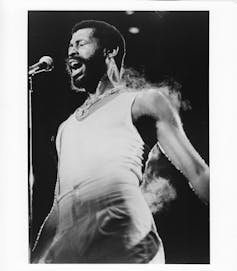
Black-and-white photo of singer wearing white undershirt singing in front of microphone, with steam coming off his body
R&B heartthrob Teddy Pendergrass performs on stage circa 1977.
Gilles Petard/Redferns via Getty Images

Pendergrass, with his stylish good looks, quickly became not just a heartthrob, but a top R&B artist with five consecutive platinum albums between 1977 and 1981. He was selling out concerts, and legendary producer Shep Gordon recognized that the vast majority of the attendees were women. This led to Pendergrass’ “Ladies Only” tour in 1978, which became a template for future soul and R&B tours by contemporaries like Luther Vandross and later artists like Ginuwine, whose tours were also marketed specifically to women.

The 1979 erotic hit “Turn Off the Lights” strengthened Pendergrass’ reputation as a sex symbol. While Marvin Gaye was dealing with both financial and personal issues, Pendergrass became the top performer of soul “bedroom ballads.”

Pendergrass and Gaye, along with other contemporaries like Barry White, Minnie Riperton and Donna Summer, included more explicitly erotic themes and lyrics than earlier artists.

For example, in Gaye’s “Let’s Get it On,” he implores to his lover:

“There’s nothin’ wrong with me / Lovin’ you, baby love, love / And givin’ yourself to me can never be wrong / If the love is true, oh baby.”

In “Close the Door,” Pendergrass similarly tells his lover:

“Close the door / Let me give you what you’ve been waiting for / Baby I got so much love to give / And I wanna give it all … to you …”

One challenge for the songwriters like Gamble and Huff was to balance the sensuality that fans loved with Federal Communication Commission rules regarding profane language. Songs like “Turn Down the Lights,” written by Gamble and Huff for Pendergrass, describe a detailed night of romance without language that would be considered obscene by the FCC.

Slow jams and sex positivity

R&B and soul slow jams by artists like Freddie Jackson and Vandross dominated bedroom music through the 1980s, although derivative genres like neo-soul and quiet storm continued to produce bedroom ballads like Gaye’s “Sexual Healing” in 1982.

Madonna and Cyndi Lauper helped bring a female perspective to more sex-positive pop music with songs including “Like a Virgin” and “She Bop.” Janet Jackson and Salt-N-Pepa did the same in R&B and hip-hop. Other groups embraced their sex symbol status through the 1990s, exemplified by TLC’s “Ain’t 2 Proud 2 Beg” and “Creep,” and Next’s “Too Close.” The artists of the 1980s and 1990s were also boosted by MTV, bringing a visual element to their sensual lyrics.

The emergence of new jack swing, a term coined in 1987 to define a new style that combined dance, hip-hop and R&B, ushered in higher-tempo erotic songs like “Do Me!” by Bel Biv Devoe along with slower bedroom ballads like “I’ll Make Love to You” by Philadelphia’s Boyz II Men.

Philly’s Boyz II Men carried the bedroom ballad tradition into the 1990s with “I’ll Make Love to You.”

Bedroom ballads with disco-synth makeover

Philadelphia International’s sound and sensual lyrics have reemerged in recent years through artists Sabrina Carpenter and Chapelle Roan, whose synth-pop and disco sound can be traced back to Gamble and Huff, and the label’s stable of artists.

Proto-disco songs like “The Love I Lost” and “Don’t Leave Me This Way” by Harold Melvin and the Blue Notes, and Pendergrass’ disco hit “Get Up, Get Down, Get Funky, Get Loose” – or his later synthesizer-heavy album “Joy” – would influence current synth-pop hits like Roan’s disco-influenced “Pink Pony Club” and Carpenter’s synth-pop “Manchild.”

Chapelle Roan’s campy, disco-influenced hit “Pink Pony Club.”

Carpenter in particular has seemingly struck that balance between mainstream success and sensual lyrics. Her past three albums have been certified platinum and embrace increasingly mature themes such as female arousal.

“Man’s Best Friend,” released in August 2025, sparked controversy with a sexually suggestive album cover that further cemented her Carpenter’s symbol image. This image is reinforced by her stage presence, like dancing in her underwear on “Saturday Night Live” and mature songs like “Tears,”

“Tears” by Sabrina Carpenter.

Pendergrass’ career was derailed when he lost control of his car on Lincoln Drive in the East Falls neighborhood of Philadelphia in 1982. The accident left him a tetraplegic. He later continued his music career, but the “Black Elvis” moved away from bedroom ballads.

Although Pendergrass’ meteoric rise was cut short, his influence is still seen and heard across music genres today, especially as empowered female artists utilize disco and synth-pop sounds while embracing their sexuality through their songs and performances.

Read more of our stories about Philadelphia, or sign up for our Philadelphia newsletter on Substack.

The Conversation

Jared Bahir Browsh does not work for, consult, own shares in or receive funding from any company or organization that would benefit from this article, and has disclosed no relevant affiliations beyond their academic appointment.

ref. Sabrina Carpenter’s and Chapelle Roan’s sexy pop hits have roots in the bedroom ballads of Teddy Pendergrass and Philly soul – https://theconversation.com/sabrina-carpenters-and-chapelle-roans-sexy-pop-hits-have-roots-in-the-bedroom-ballads-of-teddy-pendergrass-and-philly-soul-270035

Outside the West, the Kundalini tradition presents a model of the ‘divine feminine’ beyond binary gender

Source: The Conversation – USA (3) – By Anya Foxen, Associate Professor of Religious Studies, California Polytechnic State University

A piece of art shows the tantric tradition’s depiction of Kundalini and energy centers – or chakras. Tantrika painting/Wellcome Collection, CC BY

The notion of the divine feminine is a recurring motif in American pop culture, playing with the assumptions people make when referring to God – often the deity described in the Bible – as “He.”

Whether it’s Alanis Morissette’s iconic portrayal of God in the 1999 comedy “Dogma” or Ariana Grande’s titular declaration in her 2018 track “God is a Woman,” the effect is the same: a mixture of irreverence and empowerment. It dovetails, moreover, with a ubiquitous political slogan: “The future is female.”

But in a historical moment when society is bitterly contesting ideas about gender, we’d note that these notions still rely on a simplistic binary.

As two scholars who study the entangled history of spirituality and gender, we often observe an especially fraught version of this dynamic playing out among “spiritual but not religious” practitioners, often called spiritual seekers. To many such people, the divine feminine represents an escape from oppressive gender norms, and yet many stumble in trying to reconcile the idea with the embodied realities of biological sex.

An approach that escapes this dilemma is the centuries-old Kundalini tradition, which paints a model of the divine feminine beyond gender altogether.

The feminine Shakti

There are certainly examples of the feminine divine to be drawn from Christian and other Abrahamic religious traditions. Yet many seekers quickly find themselves reaching beyond these borders.

When they do, one of the first concepts they come across is Shakti, a divine feminine energy that manifests in the human body as the electrifying force of Kundalini. Both terms originate in South Asian religions – especially Hinduism – that fall under the broad umbrella of tantra.

Tantric cultural and spiritual traditions, which began to emerge in the early centuries of the Common Era, take a positive perspective on the material world in general and the human body in particular, as opposed to traditions that regard both as inherently illusory or sinful. In tantra, the material world and physical body are suffused by divine energy. This energy is called Shakti, and it is feminine.

Another key idea common to tantric traditions is that the universe is composed of two fundamental principles – or rather that it has two poles: a dynamic energy, which is female, balanced by an unchanging consciousness, which is male. As the great Goddess, Shakti goes by many names, including Durga, Kali and myriad others. The masculine principle is usually called Shiva, though this can vary as well.

Divinity beyond binaries

Tantric traditions span over a millennium in time and a subcontinent in space, so it should come as no surprise that they are incredibly diverse. However, most practices that enjoy global popularity today, especially those centered on the divine feminine energy of Kundalini, can be traced to a specific tradition called Kaula Tantra, which developed in the northeast of modern-day India near Kashmir.

An old painting of a many-armed religious figure.
A picture of tantric art from the 19th century.
Pictures From History/Universal Images Group via Getty Images

This tradition is distinctive by maintaining that while the cosmos is polar, it is also nondual, meaning that there is only one ultimate reality. So, the pairing of Shakti and Shiva, feminine and masculine, energy and consciousness, is best understood not as a binary but as the two sides of a Mobiüs strip, where one seamlessly flows into the other.

Take a strip of paper, twist it into a figure eight – also the symbol we use for infinity – and glue the back to the front. That’s the Kaula model of the universe.

In such a world, Shiva is Shakti. The masculine is the feminine. Both are divine, but even more than this, both are ultimate, because there is no difference between them. God is goddess, and both are nonbinary.

Awakening Kundalini

Kundalini yoga is a centuries-old practice quite different from the branded version popularized more recently by Yogi Bhajan. It involves using complex meditative and physical techniques to awaken and raise this energy from its usual resting place in the bottom of the torso.

In doing this, tradition says the practitioner experiences a radical transformation both of the body and of consciousness. Premodern texts describe Kundalini’s fiery energy burning through the tissues of the body, shooting up to the crown of the head, where the feminine Shakti unites with her masculine counterpart and all dissolves into oneness.

While some texts treat this ascent as equivalent to a sort of voluntary death, others describe how, once she has ascended, Kundalini returns to bathe the body in a cooling nectar of immortality, resulting in an embodied state of enlightenment and liberation.

According to this tradition, the body may appear the same but is now enlivened with a new consciousness that has transcended all dualities – including male and female.

Is the divine feminine female?

Human gender norms often prove difficult to shake, however. Though the energy of Kundalini is understood as feminine, Kundalini yoga in South Asia has been traditionally practiced by men. The reasons for this are perhaps almost entirely social, and yet they remain a powerful force.

Ironically, the very fact that Kundalini is often believed to be associated with womanhood has resulted in women being excluded – or at least deprioritized – from cultivating their own practice. Instead, they have historically become assistants or accessories to the enlightenment of men.

The fieldwork we present in our recent book on the topic bears this out. Among South Asian practitioners, the common attitude is that women embody the maternal principle, and this makes them extremely powerful. In them, the energy of Kundalini operates naturally. Men, on the other hand, need to be purified by a woman through ritual in order to effectively engage in Kundalini practice.

A woman meditates in the forest.
A woman meditates during festival for a modern, branded version of Kundalini yoga.
Godong/Universal Images Group via Getty Images

Such ideas are also common among Western practitioners, who tend to believe women have a more natural aptitude for Kundalini awakening. One of our subjects said this is because women have less ego. Another attributed it to female sexual fluids.

However, cultural difference plays a role, too. Western notions of the divine feminine are much more inclined to cling to the binary, resisting the idea that male and female bodies alike are ultimately woven from the same nondual reality.

Most striking, perhaps, one man who had spent a lifetime among seekers at spiritual retreats in the U.S. and South America told us of a long-held and common belief that only women were capable of Kundalini experience. It was, to him, an energy exclusive to the female body. He recounted having been shocked, only months prior, at encountering a copy of the 1967 classic “Kundalini: The Evolutionary Energy in Man,” authored by the decidedly male Gopi Krishna.

The broader point, however, is that the historical core of Kundalini practice has always been about transcending all dualities.

Thus, even as a goddess representing the ultimate “She,” Kundalini is best understood as nonbinary. Perhaps if we can wrap our heads around this idea, we can cultivate a more inclusive empowerment.

The Conversation

The authors do not work for, consult, own shares in or receive funding from any company or organization that would benefit from this article, and have disclosed no relevant affiliations beyond their academic appointment.

ref. Outside the West, the Kundalini tradition presents a model of the ‘divine feminine’ beyond binary gender – https://theconversation.com/outside-the-west-the-kundalini-tradition-presents-a-model-of-the-divine-feminine-beyond-binary-gender-263402