Charlie Kirk and the politics of rhetoric and division

Source: The Conversation – UK – By Rachael Jolley, International Affairs Editor, The Conversation

Republican political activist Charlie Kirk was killed as he spoke at a Utah Valley University event on September 10. Just three months earlier, Minnesotan House Democrat Melissa Hortman and her husband were shot and killed by a masked gunman.

According to a thinktank, the Institute of Strategic and International Studies, violence against those in US political life in the four years to 2024 was nearly triple the number of incidents in the previous 25 years combined.

Historically the killings of significant political figures has sometimes been the precursor to dramatic repression or further violence. The killing of Archduke Franz Ferdinand in 1914 led precipitously to the beginning of the first world war. The murder of German diplomat Ernst vom Rath by a Jewish refugee was used as a pretext for the slaying of Jews in Berlin and the justification for unleashing a wave of violence and destruction across Nazi Germany in what became known as Kristallnacht.

There are, of course, alternative lessons from historic moments. When British MP Jo Cox was slain on the streets of Birstall, near Leeds, in 2016, politicians from across the divide condemned it. Labour leader Jeremy Corbyn and Conservative prime minister David Cameron visited the town where Cox was murdered together: a symbol of political unity against violence.

Violent speech

Political violence is defined by the United Nations as that which is intended to achieve political goals or intimidate opponents through the use of physical force or threats to influence a political outcome or silence dissent. Katie Pruszynski, who researches political violence at the University of Sheffield, finds that the use of polarising and extreme language in debate has stoked up something she calls “hyperpartisanship”, where opponents have become “enemies” and those with different worldviews have become “traitors”. This tension stokes distrust and radicalisation, she warns. So then, this fits within the framework of the US president’s immediate reaction. In a video published on X, Trump vowed to root out “the radical left” whose rhetoric is “directly responsible” for Kirk’s killing.


Read more:
Charlie Kirk shooting: another grim milestone in America’s long and increasingly dangerous story of political violence


Melissa Butcher, a professor emeritus at Royal Holloway, University of London, researches political polarisation, and its causes. She also spent time listening to Kirk’s speeches at the conservative rally AmericaFest in 2021.

As part of her work on the political and ideological divides in the US, Butcher has listened to conversations in all sorts of locations, from social clubs to shooting ranges and offices. Those discussions suggest a widespread feeling that community is breaking down. She has talked to Americans who believe that the promise of an affluent future is disappearing in the face of environmental collapse and successive financial crises.

News breaks of the killing of US political activist Charlie Kirk.

Her research suggests that some Americans now see the world as scary and unsafe. And these emotions can provoke rage as well as despair. But more hopefully, she found, that many people want hope, safety and to live in a caring community.


Read more:
Charlie Kirk was emblematic of a country polarised and imploding


Religion and debate

To outsiders the significant role of religion in US politics can come as a shock. Quotes from the Bible regularly make an appearance in speeches and questions about church attendance are thrown at candidates. Gordon Lynch, a professor of religion at the University of Edinburgh, has studied Kirk’s leadership in the white Christian nationalist movement within the US.

For Christian nationalists, the idea of the separation of church and state acknowledges not having an official state church. But the complete separation of Christianity from public institutions is anathema and secular institutions such as public schools and universities are often regarded as hostile ground, says Lynch.

Lynch notes the role of Kirk’s organisation, Turning Point USA, in calling on students to name and shame professors who they judged to have problematic or socialist views, and creating a watchlist. But he also feels that a different part of Kirk’s legacy could be acknowledging the activist’s commitment to debate with, and listen to, those whose views he disagreed with. And this could be extremely valuable in the current climate, if stressed by Republican leaders.


Read more:
Charlie Kirk: why the battle over his legacy will divide even his most ardent admirers


On the borders of Europe, an emergency

Meanwhile, another crisis which needs the US president’s attention is unravelling on the other side of the Atlantic, on the Polish border with Russia. Putin’s drones ventured into Polish airspace and were shot down by Nato fighter jets. Many see this as Russian president, Vladimir Putin, testing the mettle of the Nato allies to find out the level of their response.

Poland immediately invoked article 4 of the Nato treaty. The alliance’s members met to discuss the threat and the UN security council are due to meet on September 12 about the incident. Stern words have been issued and troops dispatched to Nato’s eastern border. But Stefan Wolff from the University of Birmingham, believes that Putin will not be worried by the west’s response. As Wolff observes, the Russian leader will be buoyed by his military’s recent advances on the battlefield. He’ll also be basking in the warmth of recent talks with Xi Jinping of China, Narendra Modi of India and Kim Jong-un of North Korea. So Nato’s response is hardly likely to have him rattled.


Read more:
Russian drones over Poland is a serious escalation – here’s why the west’s response won’t worry Putin


Russia’s future plans to add more territory (not just areas that it currently controls within Ukraine) were laid out in detail by the University of Aberystwyth’s Jenny Mathers, who researches the war in Ukraine, this week. At a briefing given by Russia’s chief of the general staff, Valery Gerasimov, that has now come to light, a map was shown in the background suggesting Russia’s intention to claim the areas around Odesa and Mykolaiv along the coast of the Black Sea. These would give Moscow important economic and strategic control of sea routes but also potential to create a land corridor to Transnistria, a pro-Russia breakaway region within Moldova that seeks independence.


Read more:
Russia has provided fresh evidence of its territorial ambitions in Ukraine


The upcoming Moldovan election on September 28 must be recognised as another struggle to maintain European security in the face of Russian aggression, says Amy Eagleston, a political scientist at Leiden University. Eagleston points to Russian cyber interference in a past Moldovan election as evidence for worries about what could happen this time. She stresses Moldova’s strategic position as a support for Ukraine, under its current government. Things could change fast, she warns.


Read more:
Why Moldova’s election is important for the whole of Europe


Israel’s unprecedented strike

Another strike that shook the world this week was Israel’s unprecedented airstrike on the Qatari capital of Doha where Hamas officials were discussing a peace deal. This was the first time that Israel had directly attacked a Gulf state.

Scott Lucas, an international politics professor at University College Dublin and an expert on the Israel/Gaza crisis, argues that this showed the current Israeli government was not willing to engage in any kind of peace negotiation. It was, he said, clearly ready to level parts of Gaza City, kill Hamas’s leadership and completely break up the organisation. Lucas believes there will be no more talk of a ceasefire with Hamas, only capitulation.


Read more:
Middle East leaders condemn Israel’s attack on Qatar as Netanyahu ends all talk of Gaza ceasefire – expert Q&A


Long arm of the law?

In a week when international law was being tested to its outer limits, James Sweeney, a professor of law at Lancaster University, spoke up for its long-term relevance and his belief that it would outlast political careers.

History shows that leaders who once seemed untouchable have eventually faced justice in one form or another, said Sweeney, pointing to the Nuremberg trials of Nazis and how former Chilean leader Augusto Pinochet died awaiting trial for human rights abuses to house arrest. Pinochet may well have believed that would never happen to him. It did.

Something for today’s leaders to contemplate carefully.


Read more:
International law isn’t dead. But the impunity seen in Gaza urgently needs to be addressed


Sign up to receive our weekly World Affairs Briefing newsletter from The Conversation UK. Every Thursday we’ll bring you expert analysis of the big stories in international relations.


The Conversation

ref. Charlie Kirk and the politics of rhetoric and division – https://theconversation.com/charlie-kirk-and-the-politics-of-rhetoric-and-division-265149

Bolsonaro joins a rogues’ gallery of coup plotters held to account for their failed power grab

Source: The Conversation – Global Perspectives – By John Joseph Chin, Assistant Teaching Professor of Strategy and Technology, Carnegie Mellon University

Soon to be exchanging blinds with bars? Sergio Lima/AFP via Getty Images

Jair Bolsonaro’s conviction on Sept. 11, 2025, puts the former Brazilian president in a rogues’ gallery of failed coup plotters to be held to account for their attempted power grab.

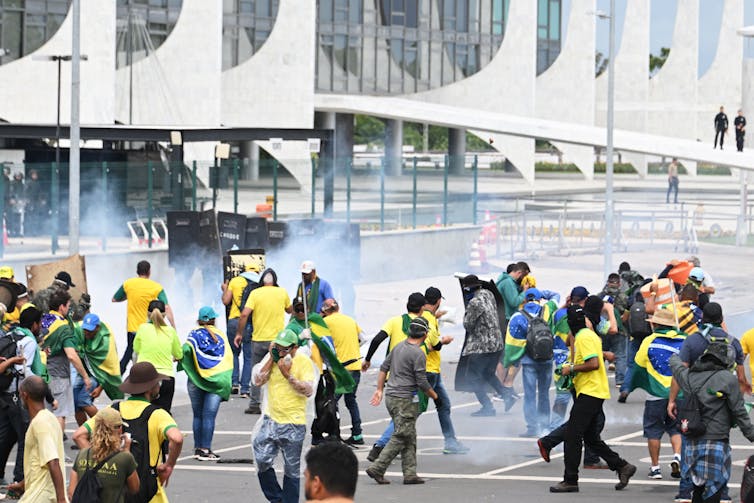
Brazil’s Supreme Court found Bolsonaro guilty of being part of an armed criminal organization and other counts relating to a coup plot to overturn the ex-president’s 2022 election defeat to Luiz Inácio Lula da Silva. Prosecutors had earlier argued that Bolsonaro and others discussed a scheme to assassinate Lula and incited a riot on Jan. 8, 2023, in hopes that Brazil’s military would intervene and return Bolsonaro to power.

Four of the five justices on the panel voted to convict. Justice Cármen Lúcia, who was among the majority, said that the right-winger acted “with the purpose of eroding democracy and institutions.” sentenced to 27 years and three months behind bars, but is expected to appeal the verdict.

As political scientists who have documented the fate of hundreds of coup leaders in the book “Historical Dictionary of Modern Coups D’état,” we have collected a dataset of every coup attempt since the end of World War II. Bolsonaro is now one of thousands of coup plotters who have been brought to justice.

Not all coup plotters are held accountable for their actions. And even for those, like Bolsonaro, who are – it doesn’t necessarily mark the end of their political ambitions.

Men and women fill a street with smoke swirling around.
Supporters of former President Jair Bolsonaro clash with police outside the Planalto Palace in Brasilia on Jan. 8, 2023.
Evaristo Sa/AFP via Getty Images

Coup and punishments

Plotting a coup is risky business. Some of those who attempt to seize or usurp power unconstitutionally are killed during their takeover bid, particularly when security forces loyal to the incumbent leader foil the attack. Christian Malanga, an exiled former army captain who led a violent attempt to seize power in the Democratic Republic of Congo, is one such example. He was killed in the ensuing shootout in May 2024.

But most leaders of failed coups survive.

And although they typically face punishment, the severity of consequences varies greatly; it often depends on whether the attempt is a self-coup, which is a power grab by an incumbent leader, or an attempt to oust a sitting government.

The most common fate of failed self-coup leaders in democracies is impeachment and removal from office, as occurred to Indonesia’s Abdurrahman Wahid in July 2001, Ecuador’s Lucio Gutiérrez in April 2005, Peru’s Pedro Castillo in December 2022, and South Korea’s Yoon Suk Yeol in April 2025.

Some coup plotters and their co-conspirators are charged in a court and, if convicted, sent to prison. Malanga’s American co-conspirators were ultimately sentenced to life in prison in April 2025.

A similar fate has now befallen Bolsonaro. His conviction means that unless successful on appeal, Bolsonaro could end his days in confinement.

Still, it could have been worse – failed coupmakers are often punished outside of independent courts, where the penalty is often more severe. Coup plotters have been summarily executed or sentenced to death by a military tribunal or a “people’s court.” The longtime Zairean dictator Mobutu Sese Seko executed over a dozen junior officers and civilians after his government uncovered an alleged coup plot in 1978.

One recent estimate suggests 40% of coup conspirators suffer relatively light punishment. Many coup backers are simply demoted or purged from the government without facing trial or execution. An especially popular move is to send coup plotters into exile to discourage their supporters from mobilizing against the regime. Former Haitian president Dumarsais Estimé was forced into exile after his self-coup attempt failed in May 1950; he died in the U.S. a few years later.

Punishment doesn’t always end threat

The problem facing governments is that failed putschists pose a lingering political threat. Ousted leaders often plot “counter-coups” to return to power. For example, former president of the Philippines Ferdinand Marcos, after being ousted in the 1986 People Power movement, masterminded coup plots from exile, though he never returned to power.

Some succeed, such as David Dacko, who returned from exile to grab power in the Central African Republic in 1979, but only with the help of French forces.

Even when convicted or exiled, coup plotters may be later freed. Some members of Brazil’s Congress had already, prior to the verdict, introduced a bill that could grant Bolsonaro amnesty.

A few former failed coup leaders manage to come to power later. Ghana’s Jerry Rawlings led a failed coup in May 1979 but went on to seize power in subsequent coups in June 1979 and 1981; Hugo Chavez was convicted and jailed for leading a failed coup in 1992 but ended up being elected president in Venezuela in 1998.

The risk of coup leaders going unpunished

Only one failed self-coup leader, as designated in our dataset, has managed to retain office – from where he worked, critics say, to successfully dismantle democracy: El Salvador’s strongman, Nayib Bukele. In February 2020, amid a standoff with the political opposition, Bukele threatened to dissolve the Legislature, bringing with him armed soldiers to occupy the legislative assembly.

Though Bukele temporarily backed down, he faced no legal or political backlash. His party won a legislative supermajority in 2021, and he won reelection in 2024. Bukele’s ruling party recently lifted presidential term limits, allowing him to potentially rule for life.

The good news about punishing unsuccessful coup plotters is that because they’ve failed, they do not have to be coaxed out of power. Thus, holding them accountable for their actions should deter future plotters from attempting the same thing. In contrast, for a leader who has done unsavory things while still in office – such as killing domestic dissidents or committing war crimes – the threat of punishment once they leave power can backfire by giving them a reason to fight to stay in power.

In the long term, failed coup leaders who escape punishment are more likely to make a political comeback.

When defeated at the polls, both Donald Trump and Bolsonaro tried to overturn the official results. Both attempted to alter vote totals after they had lost and block an election winner from being inaugurated.

But for Trump there was no censure or punishment, and he is now back in power, where he has weakened the checks and balances that we and other political scientists see as crucial for the preservation of liberty and growing economic prosperity.

In contrast, a conviction for Bolsonaro means it is now unlikely he will follow the same path to political resurrection. Even if he’s eventually pardoned, a guilty verdict makes him ineligible to compete again for Brazil’s presidency.

This is an updated version of an article that was first published in The Conversation on Sept. 8, 2025.

The Conversation

Joe Wright received funding for research on coups from the National Science Foundation and the Minerva Research Initiative.

John Joseph Chin does not work for, consult, own shares in or receive funding from any company or organization that would benefit from this article, and has disclosed no relevant affiliations beyond their academic appointment.

ref. Bolsonaro joins a rogues’ gallery of coup plotters held to account for their failed power grab – https://theconversation.com/bolsonaro-joins-a-rogues-gallery-of-coup-plotters-held-to-account-for-their-failed-power-grab-265170

‘Liberal’ has become a term of derision in US politics – the historical reasons are complicated

Source: The Conversation – Global Perspectives – By Russell Blackford, Conjoint Senior Lecturer in Philosophy, University of Newcastle

Statue of Liberty, New York. Celso Flores, via Wikimedia Commons, CC BY

Kevin M. Schultz is Chair of the Department of History at the University of Illinois Chicago, where he specialises in 20th- and 21st-century American history. In Why Everyone Hates White Liberals (Including White Liberals), he explores how the word liberal – and particularly its variant white liberal – became a term of derision across the American political spectrum.

Why, he asks, are so many Americans unwilling to identify as liberals, white or otherwise, even while supporting government programs that fall squarely within the American liberal tradition?


Review: Why Everyone Hates White Liberals (Including White Liberals): A History – Kevin M. Schultz (University of Chicago Press)


Why Everyone Hates White Liberals is written by an American academic for an American audience. It tries to assess the current political situation in the United States in the light of history. It asks how American liberals should respond to a situation where they are often viewed with disdain.

The book’s relevance is less obvious for those of us who live outside the US, but it promises to shed light on America’s political volatility and culture warring, which eventually affect us all in one way or another.

This thing called liberalism

Unfortunately, liberalism defies definition. Its roots can be traced to early European modernity, and especially to debates over religious toleration in the 16th and 17th centuries. Its more immediate background was the 18th-century Age of Enlightenment, culminating in great revolutions in America and France.

From the beginning of the 19th century, liberalism evolved into something distinct, with its own name, founding figures and institutions. It responded to a changed world marked by population growth, revolutionary turmoil, an expanding sphere of public discussion in Europe and North America, and the beginnings of industrialisation and corporate capitalism.

Schultz skates over this quickly, but he correctly refers to Madame de Staël and Benjamin Constant as originating figures in 19th-century France, and to Spain and Sweden as pioneers in the rise of liberal political parties.

Portrait of Madame de Staël – Marie-Éléonore Godefroid.
After François Gérard, Public domain, via Wikimedia Commons

It’s worth adding that, as liberalism took its early forms, it had input from numerous groups. These included religious non-conformists, free-market economists inspired by Adam Smith, utilitarian philosophers, and European thinkers (such as de Staël and Constant) who admired the French Revolution in its early years before the Reign of Terror.

Given its mix of influences, liberalism never became a unified ideology or political theory. It was more a tradition or tendency in politics. It took many directions, frequently questioned itself, discarded old ideas and embraced new ones, and changed emphases in response to emerging circumstances.

Comprehensive histories of liberalism give the impression of a chameleon-like quality. At different times, liberals have accommodated economic policies from unfettered free-market capitalism to a degree of socialism. Confronted with such a rich – or even contradictory – tradition, we might feel at a loss in giving liberalism any recognisable content.

Still, we can find some common themes. At a certain level of abstraction, liberalism favours toleration, individual freedom, acceptance of social pluralism, and cautious optimism about the possibilities for intellectual and social progress. With these core ideas go more specific political principles, including free speech, secular government, and the rule of law. To this we can add values such as individuality, creativity and suspicion of hierarchies of birth.

With that in mind, it’s usually clear enough what is being alleged if someone is accused, in a political context, of being “illiberal”. The accusation suggests intolerance, especially of opposed viewpoints or unusual ways of life, and hostility to individual freedom.

People who advertise themselves as liberals can sometimes be revealed as illiberal in this broad sense. If that sounds paradoxical, the paradox is easily resolved as long as we’re clear about what concepts are in play.

American liberals

After a sketchy introduction to liberalism, Schultz zooms in on the 1930s in the US, when the depression-era presidential rivals Herbert Hoover and Franklin D. Roosevelt each claimed to be a true liberal. As Schultz observes, few Americans before this had thought of themselves as liberals.

In the 1930s, Franklin D. Roosevelt defined the word liberal for the purposes of US electoral politics.
Vincenzo Laviosa, public domain, via Wikimedia Commons.

Roosevelt succeeded in redefining the words liberal and liberalism for the purposes of American electoral politics. In Roosevelt’s usage, they meant openness to new kinds of government intervention to address social problems. Thereafter, American liberalism can trace its history from the 1930s New Deal. It came to mean, in large part, policies of wealth redistribution and economic intervention.

Roosevelt’s success as a national leader lent prestige to his redefined conception of liberalism. For several decades, it attracted allegiance across social and political divides.

For Schultz, therefore, American liberalism in the New Deal tradition means “generosity of spirit and expansion of individual freedom” or using the power of the state “to ensure individual freedom for the maximum number of people”.

These definitions fall within the general tradition of liberalism, but they have a more specific suggestion of government interventions for the common good.

That might seem attractive as a political vision – so what went wrong?

Liberalism unravels

As Schultz tells the story, by the late 1950s and early 1960s, some figures on America’s left were losing patience with what they saw as a stultifying, bureaucratic, politically timid liberal establishment.

Schultz pinpoints 1964 as a key year when American liberalism began to lose its prestige. As he describes in detail, there was a marked change in political tone between 1963 and 1964, when Black radicals started to criticise white liberal allies, whom they had come to regard as spineless and hypocritical. From this point, white liberal crystallised as a term of abuse on the political Left.

Schultz appears sympathetic to the Black civil rights leaders of the time, whose impatience with the pace of change was understandable. But he also reminds us of the considerable effort, self-sacrifice and achievements of white liberals during the 1950s and early 1960s, culminating in dramatic initiatives such as the landmark Civil Rights Act.

Part of the problem was a mismatch, not only of priorities, but perceptions of what was realistically achievable. As radical left-wing movements emerged during the 1960s, their leaders distanced themselves from liberals and liberalism.

American liberals endured much worse from the conservative side of politics. During the “long” 1960s – the decade and a half from the late 1950s to the early 1970s – there was a right-wing backlash. Key conservative figures, such as William F. Buckley, ceded the term liberal to their opponents, which Herbert Hoover had refused to do in the 1930s. Then they attacked it and everything that it stood for within their understanding.

Conservatives like William F. Buckley associated ‘liberals’ with radical politics.
Public domain, via Wikimedia Commons

Political conservatives associated liberals with radical politics, atheism, communism, and what Schultz refers to as “cultural effeteness”. Richard Nixon and Spiro Agnew weaponised this narrative in the the 1972 presidential election and inflicted a catastrophic defeat on the Democratic Party’s candidate, George McGovern.

Schultz sees the term liberal as having been abandoned during the 1970s, in the sense that almost nobody in politics or public debate wanted to identify with it. Instead, it was used to label others. More recently, liberalism has been blamed for the harshest outcomes of what is known as neoliberalism, although the latter has little to do with traditional liberal ideas such as individual freedom, social toleration, or the rule of law.

The term neoliberal has a history dating back to at least the 1930s, but has been applied to regimes and administrations not otherwise regarded as liberal. As Schultz reminds us, it was first applied pejoratively to the economic policies of the brutal Chilean dictator Augusto Pinochet.

Schultz emphasises an “owning the libs” strategy that has recently prevailed on the American right. Anybody with even slightly left-wing, liberal or progressive tendencies is now painted by conservatives as an unhinged radical deserving of mockery and political, if not personal, destruction. The “libs” have thus become an imaginary enemy against which disparate groups on the right can unify and rally.

Ironically, historic liberal reforms in areas such as health care and social security remain widely popular with the American electorate, but the actual words liberal and liberalism seem to have become toxic.

Some deeper issues

In explaining the challenges to American liberalism during the long 1960s, Schultz adds to our understanding. Yet Why Everyone Hates White Liberals is seriously incomplete: it glosses over important issues and entire decades.

I can only go so far in exploring what it omits, but for a start, Schultz ignores important developments in the late 1970s and the 1980s. This was a time marked by fraught debates over censorship, pornography, abortion and numerous other hot-button issues. These debates severely tested what liberalism stood for in the US.

As the legal scholar Owen M. Fiss has argued, the debates of that era revealed “liberalism divided”. On the left side of politics, identity-based demands, (mild) socialist influences, and activist approaches to legal interpretation increasingly clashed with the liberal instinct to restrain government power and support individual freedom. This rupture within American liberalism, or perhaps within America’s broader political left, has never healed.

At one point, Schultz drops a clue to some of the deeper issues. Following the historian David L. Chappell, he identifies a fundamental disconnect between white liberal reformers in the 1960s and the Black activists who came to despise them. Despite some common goals, they had different temperaments and worldviews, grounded in different experiences and cultural histories.

The white liberals’ optimism about human nature and the possibilities for incremental progress clashed with the Black activists’ prophetic sensibility, their more pessimistic view of human nature, and their demands for national repentance and total transformation of American society.

This points to a larger problem that only became more difficult in the decades that followed. It’s one thing to defend the rights and freedoms of one or another oppressed group, viewing the issues from a traditional liberal perspective. It’s a different thing to defend a group’s rights and freedoms by adopting whatever ideology or rationalisation the group itself (or its leaders) might develop.

Moreover, as oppressed groups recognise each other’s struggles and form pragmatic political coalitions, they tend to see analogies between each other’s causes and attempt an ideological synthesis. As they do so, they are likely to seek insights from whatever sources they can find. Importantly, they needn’t confine themselves to ideas and thinkers from the liberal political tradition.

A demonstration by members of the Black Panther Party on the steps of the Washington State Capitol building in Olympia, Washington, February 28, 1969.
CIR Online, via Wikimedia Commons, CC BY

Thus, liberals can find themselves supporting demographic groups whose representatives are, in turn, nourished by various kinds of religious fervour – or else by Marxism, feminism, postmodernism and other -isms that are not especially concerned with liberalism’s traditional ideas, such as freedom and toleration. Goals might be shared at a high conceptual level, but with starkly different perceptions of legitimate methods and acceptable costs.

In this setting, liberals face a conundrum. How far should they maintain traditional liberal ideals, and how far should they move towards non-liberal, and potentially illiberal, ideologies if these seem more promising for the purposes of social change?

When rapid and comprehensive change seems imperative, might this justify illiberal methods, such as attempts to control what people say and think? In the past, revolutionaries have often believed so, but the conflict with traditional liberalism is obvious.

Yet Schultz appears dismissive of any idea that American liberals sometimes veer in illiberal directions, or that this might undermine their credentials if they still claim to be part of the broader liberal tradition springing from the Enlightenment.

Useful, but frustrating

Why Everyone Hates White Liberals offers a useful, if limited, defence of America’s (white) liberals and their achievements, particularly in the face of unfair criticism and derision since the 1960s.

As far it goes, the book’s history is accurate. But it is incomplete, and hand-in-hand with this there’s a frustrating analytical shallowness.

For Schultz, the actual words liberal and liberalism are irredeemable in the US. For all I know, this might be correct (though it might also be slightly hyperbolic). Be that as it may, Schultz backs off examining how the problems for American liberals go deeper than slogans and words. These problems deserve a bolder reckoning.

The Conversation

Russell Blackford does not work for, consult, own shares in or receive funding from any company or organisation that would benefit from this article, and has disclosed no relevant affiliations beyond their academic appointment.

ref. ‘Liberal’ has become a term of derision in US politics – the historical reasons are complicated – https://theconversation.com/liberal-has-become-a-term-of-derision-in-us-politics-the-historical-reasons-are-complicated-262217

‘This will not end here’: A scholar explains why Charlie Kirk’s killing could embolden political violence

Source: The Conversation – USA – By Arie Perliger, Director of Security Studies and Professor of Criminology and Justice Studies, UMass Lowell

A boy in Scottsdale, Ariz., attends a Catholic rosary prayer vigil for Charlie Kirk after he was killed during a Utah college event on Wednesday, Sept. 10, 2025. AP Photo/Ross D. Franklin

The fatal shooting of prominent conservative activist Charlie Kirk on Sept. 10, 2025, has brought renewed attention to the climate of political violence in America. Kirk’s death reflects a sizable increase in threats against officeholders and politicians at the local and federal level.

Alfonso Serrano, a politics editor at The Conversation, spoke with University of Massachusetts Lowell scholar Arie Perliger after Kirk’s shooting. Perliger studies political violence and assassinations and spoke bluntly about political polarization in the United States.

Serrano: What were your initial thoughts after Charlie Kirk’s fatal shooting?

Perliger: It was a bit unusual that the attack was not against an elected official. Rarely have we seen political assassinations that are aimed at the nonprofit political landscape. Usually those people are not deemed important enough.

Secondly, and it’s something I see a lot in my research, political assassinations come in waves. We see that not only in the United States but other countries. I’ve looked at political assassinations in many democracies, and one of the things I see in a fairly consistent manner is that political assassinations create a process of escalation that encourages others on the extreme political spectrum to feel the need to retaliate. And that is my main concern. That this process creates legitimization and acceptance, that it provides the sense that this is an acceptable form of political action. This will not end here.

In 2024, there were two attempts to assassinate Donald Trump. Then, in early 2025, the residence of Gov. Josh Shapiro in Pennsylvania was firebombed on Passover, and within months the U.S. witnessed the killing of Minnesota state lawmaker Melissa Hortman and her husband, among other acts of political violence. The U.S., of course, is not immune to political violence, as we saw in the 1960s. But what stands out about this latest wave?

The data shows that there’s a substantial increase in the level of threats against officeholders at the local and federal level. What’s different now is we see an increased support in political violence from both sides of the political spectrum. Consistently, almost a quarter of the public is willing to support political violence in some form, or see that as a legitimate form of political action.

And as we see an increased political polarization, and the increased demonization of political rivals, we see the decline and disappearance of political discourse and policymaking. The bipartisan political process in Congress in the past few years has been almost nonexistent. And that spills over to the public, where the other (political) side is seen as a one-dimensional figure that is a threat.

A man in a suit holds a microphone and speaks to a crowd, with the American flag in the background.
Turning Point USA founder Charlie Kirk speaks in West Palm Beach, Fla., on July 26, 2024.
AP Photo/Alex Brandon, File

We’ve had political polarization in the U.S. in the past, but usually it was around a specific issue like civil rights in the 1960s and the Vietnam War. But this time there is no specific issue that we can say, “If we solve this, we solve the political polarization.” The problem is that there’s no space for convergence from both sides where they can work together, so there’s no bridges they can rely on to come together.

Does it strike you that Kirk’s assassination occurred on a college campus? It seems as if college campuses have become a flash point of violence in the U.S.

Campuses are becoming more and more contentious spaces. They were always intellectual hubs where political views were debated intensively. Activism was always part of campus life. But what we’ve seen in the past year is that campus life has become in some cases more violent. And the fact that Kirk was killed on a campus is, I think, heartbreaking because campuses symbolize a place where you can engage in political debate in a way that encourages intellectual exploration.

What’s happened in the past year is that campuses are not those spaces anymore. Yes, we still see political activism, but it’s the activism that doesn’t leave any room for actual debate. It’s just two sides that are completely hostile to each other and unwilling to hear each other.

Trump on Wednesday night blamed the media and the “radical left” for language used to describe people like Kirk. He said this rhetoric is “responsible for the terrorism that we’re seeing in our country today.” Any thoughts?

I agree that language and rhetoric impact people’s behavior. I’ve seen that again and again in my studies, that the discourse of political figures impacts the way people think of the legitimacy of violence. Of course, we need to understand the context here, which is that Trump himself was willing to pardon thousands of people who engaged in political violence.

So, on the one hand, I agree with him that political leaders should be responsible for how they discuss political issues. It’s important for them to convey that political discourse can be constructive. However, we need to acknowledge that our own government, in many cases, sends signals that provide encouragement and support that legitimize violence. I think it’s important for politicians on both sides to be consistent in understanding that the way they discuss their political rivals is important.

A white tent appears on a college campus.
The scene after shots were fired at an appearance by Charlie Kirk at Utah Valley University on Sept. 10, 2025, in Orem, Utah.
Trent Nelson/The Salt Lake Tribune/Getty Image

You’re an expert on the history of political assassinations. How do countries untangle themselves from waves of political violence?

Political leaders need to insist on working together. There are lots of policy areas where politicians can work together. When we see that people can work together within the political system, that sends an important message, that there is a space where we can work together. The second thing is trying to think about how the U.S. can restructure part of the political process to ensure that there is a real competition of ideas, to incentivize a constructive, productive approach that will legitimize those who are willing to engage in constructive policymaking.

Any last thoughts?

As part of my work, I track the most extremist online social media accounts, and what we see right now is a strong sense that this assassination is being celebrated by parts of the left. And that has created an escalation of language from those in the extreme right social media ecosystem. There is much more willingness to discuss issues of retaliation, an actual civil war.

And that’s my biggest worry. If you look at social media, what we see is that both sides embrace this kind of rhetoric that really concerns me. More than ever, I’ve seen calls for retaliation and a strong sense that the other side is unwilling to show any sympathy to what happened. Emotions are running very high, and I’m very worried about what may happen in the next few weeks.

The Conversation

Arie Perliger does not work for, consult, own shares in or receive funding from any company or organization that would benefit from this article, and has disclosed no relevant affiliations beyond their academic appointment.

ref. ‘This will not end here’: A scholar explains why Charlie Kirk’s killing could embolden political violence – https://theconversation.com/this-will-not-end-here-a-scholar-explains-why-charlie-kirks-killing-could-embolden-political-violence-265060

Detroit is the most challenging place in the country for people with asthma − here’s how to help kids in the Motor City breathe easier

Source: The Conversation – USA (3) – By Rhonda Conner-Warren, Assistant Professor of Health Programs, Michigan State University

Smoke and haze from a Canadian wildfire blankets downtown Detroit in August 2025. AP Photo/Ryan Sun

Detroit kids 17 and under were nearly three times more likely to be hospitalized for asthma than other kids in Michigan, according to data from the Michigan Department of Health and Human Services released on Sept. 2, 2025. The data examines the years 2019 to 2023.

During those years, the asthma death rate among Detroit kids was more than four times higher than the state average, according to the state’s data. Dying from asthma is rare and largely preventable.

Detroit was also named the most challenging place to live with asthma in the country by the Asthma and Allergy Foundation of America’s annual rankings of asthma capitals. The ranking, released on Sept. 9, 2025, looked at the 100 largest cities in the U.S. The high number of low-income residents in Detroit and the city’s air pollution are among the risk factors that can worsen asthma and drive asthma rates, the report said. Last year the city ranked third.

Even mild asthma exacerbations such as coughing or congestion can disrupt a child’s and family’s daily routines. When a child is unwell, parents may have to miss work, and children can fall behind in school, adding stress for everyone in the family.

September is the peak month for asthma flare-ups in children. It’s a time when they can be exposed to a variety of triggers such as mold, pollen and respiratory viruses at school or home.

As a pediatric nurse practitioner and clinical faculty member in community health, I partner with health educators and families to create personalized, practical care plans that promote children’s well-being.

I currently work with Focus: HOPE’s early childhood education center in Detroit. During the 2024–25 school year, Focus: HOPE observed a 20% increase in asthma diagnoses among students, meaning we were serving 30 children with asthma, a trend that aligns with state health data.

Although Focus: HOPE shut down part of its Head Start program in August 2025 after losing federal funding, I remain deeply proud of the work my colleagues and I have done to care for children and their families. We remain committed to finding new ways to support our families, communities and children at risk for poor health and educational outcomes.

What worsens asthma symptoms

Asthma is a condition that affects the child’s lungs. It causes the airway to become swollen and narrow, sometimes producing extra mucus. This can make it harder to breathe and may lead to symptoms such as coughing, wheezing – a whistling sound when breathing out – and shortness of breath.

Asthma is not always classified strictly as an allergic disease, but many cases are allergy related, and such cases are becoming more common worldwide. This increase is fueled in part by climate and environmental changes, living in urban populations, increased time spent indoors, obesity and use of cleaning products that can worsen asthma and allergies.

Understanding asthma medications

Asthma is treated with medications, including emergency inhalers, daily long-acting inhalers, combination inhalers, which contains two or more medicines and nebulizer machines. Knowing when and how to use each is essential, and your child’s provider should review this with you regularly.

Many parents from my practice share a common concern about their children taking asthma medications with steroids. They often worry their children will build up a resistance or intolerance to them.

I tell them inhaled steroids go straight to the lungs and don’t affect the whole body like oral or systemic steroids do. They help control daily inflammation and prevent attacks.

A Black boy holds a medical device in his mouth.
Inhalers send medicine directly to the lungs and can make it easier to breathe.
Universal Images Group/via Getty Images

An oral corticosteroid “burst” is a short-term treatment, typically lasting five to seven days, used to rapidly reduce severe airway inflammation during asthma flare-ups. It’s usually given in a tapering dose and is not meant for long-term use. These medications are safe, targeted and can make a huge difference in keeping your child out of the ER.

Many believe that children and families will simply “grow out of” asthma. While some with mild symptoms may improve over time, others remain at risk, especially when exposed to common triggers such as freshly cut grass or outdoor play during high-pollen days. Even simple activities such as running through a field can lead to serious asthma flare-ups.

Here are practical steps to help protect your child from experiencing an asthma attack:

  • Talk with their health care provider to create an asthma action plan.

  • Clearly label inhalers.

  • Keep their vaccines up to date.

  • Limit exposure to outdoor allergens.

Emergency medical plans at school

Every school staff member should be prepared for a student’s asthma flare-up with a documented emergency plan, knowledge of triggers and medication protocols.

Children should be sent to school with an individualized asthma action plan. An asthma action plan is a form that outlines what to do when symptoms such as coughing, wheezing, fatigue or abdominal pain occur. It specifies the medication, dosage, frequency and when to call parents or 911. The plan should be signed by the provider and kept in the child’s classroom file with their medication.

At school, ensure your child’s inhaler is clearly labeled. Put a prescription label showing the child’s name on both the box and the canister itself. Ask your pharmacy for an extra label, since unlabeled inhalers can easily get lost or mixed up, especially on the playground.

Viruses can trigger serious asthma attacks and lead to complications such as bronchitis or pneumonia. Staying up to date on yearly immunizations, especially the flu and COVID vaccines, can lower these risks and keep your child breathing easier.

Keep your child’s provider up to date about any changes, improvements or worsening symptoms — such as during travel or after moving to a new area. Ask about environmental irritants in your area and what “poor air quality,” increasingly caused by wildfire smoke in Michigan, means for your child’s breathing.

Protect your child from outdoor allergens at home

Everything your child brings in from outside – on their clothes, shoes, and even in their hair – can trigger allergies or asthma symptoms indoors. Here’s how you can help reduce exposure and keep their environment healthy:

  1. Vacuum or dust floors frequently to remove allergens that may trigger an asthma attack. Install HEPA filters on vacuums and HVAC systems to improve air quality in the home.

  2. Take shoes off at the door. Leave sneakers and outdoor shoes outside to avoid tracking allergens inside.

  3. Change clothes before entering bedrooms. Clothes worn outside can carry pollen, dust and other irritants.

  4. Wash hair before bed. Outdoor allergens can settle in your child’s hair and transfer to their pillow, increasing overnight exposure. If daily washing isn’t possible, consider using a bonnet and changing pillowcases frequently.

  5. Daily hygiene matters. A warm shower and nose-blowing at the end of the day help clear inhaled irritants.

  6. Stay hydrated. Keeping your child well hydrated helps thin mucus and reduce respiratory discomfort.

The Conversation

Rhonda Conner-Warren Full-time faculty at MSU College of Nursing, with part of my time subcontracted to Focus: HOPE in Detroit.

ref. Detroit is the most challenging place in the country for people with asthma − here’s how to help kids in the Motor City breathe easier – https://theconversation.com/detroit-is-the-most-challenging-place-in-the-country-for-people-with-asthma-heres-how-to-help-kids-in-the-motor-city-breathe-easier-262474

Deaf: a powerful film about the real struggles of deaf families navigating medical institutions and parenthood

Source: The Conversation – UK – By Dai O’Brien, Associate Professor, BSL and Deaf Studies, York St John University

Deaf is a deeply emotional examination of what having a baby can mean for a mixed deaf and hearing couple. Spanish director Eva Libertad’s film explores where access, language and trying to keep a family together under the extreme pressure of new parenthood and social expectations come to a point.

Throughout the film, there is a clear divide in deaf and hearing spaces, and clear differences in how people are treated in each one. A key element of this is the thoughtful effort to facilitate communication by adapting to people’s different abilities.

At home, Ángela (played by deaf actor Miriam Garlo) and her partner Héctor (Álvaro Cervantes) communicate easily and comfortably in a mixture of sign and speech. Ángela’s experience in work is similar. While her work colleagues don’t sign fluently, they obviously value her and care about her and put effort into their communication and relationships. This care is reflected in the baby mobile they give Ángela, which has carefully moulded hands in different configurations so that Ángela’s language is represented in her baby’s toys.

Ángela is made to feel safe and valued at home and work thanks to the care and respect everyone shows to each other when communicating, whether in speech, sign or a mixture of both. The same is true of the deaf communities in which she and Héctor are involved – Héctor is embraced, teased, accepted and treated as an equal. But when their relationship encounters the hearing world, this all changes.

Despite Héctor’s efforts to help Ángela communicate with healthcare staff, the indifferent medical system and emotional strain take their toll on him.

The issue comes to a head when the gynaecologist demands that he stops interpreting and moves out of Ángela’s line of sight while Ángela is giving birth. This leaves her alone, scared and with her hands restrained by anonymous medical professionals whom she can’t understand.

This deeply traumatic experience of giving birth is something that is very common for deaf women, which makes it extremely uncomfortable to watch on screen. It’s an impossible decision that is forced on Héctor: does he insist on staying when the full power of the medical institution is drawn against him, possibly putting Ángela in further danger? Or does he acquiesce and leave his partner alone during this horribly traumatic ordeal?

It’s a choice that colours their relationship. It is also a taste of what is to come. Together, they will have to make similarly impossible compromises, which are forced upon them by the discriminatory institutions and attitudes that surround them and their own emotions and beliefs.

The separation of the environments in which Ángela feels able to exist as a mother becomes increasingly stark as the film progresses. Her lack of access to speech and the lack of accommodations offered to her are cruelly highlighted in several of the interactions she has with hearing people, resulting in her growing alienation and isolation from the other parents in her daughter Una’s nursery.

The speech- and hearing-centred expectations of the parent group and the nursery itself make her feel unable to be a competent mother in that environment. She is unable to join in with the simplest games and activities the nursery leader does with Una and the other children, as they are all based around sound.

While she is still embraced as herself by the deaf community, she finds it difficult to be a mother in those settings as well. She finds it difficult to integrate the compromises she is having to make at home with who she sees herself to be, and this is affecting every part of her life.

In their home, where previously Ángela and Héctor were able to build a haven of communication based on equality, the invasion of Ángela’s parents and Héctor’s friends, none of whom sign well, unbalances the status quo they have carefully constructed. This disrupts the linguistic care work they each do for the other to the point that their relationship creaks under the strain.

This film isn’t just about being deaf, although that is a huge part of Ángela’s life, and the heartbeat of the film. It will also resonate with those who have multilingual families. It highlights the compromises, the guilt, the heartbreak and the joy that raising kids in multilingual and multicultural contexts can bring, and the huge amount of emotional work that goes with that. It’s an important film, one that takes authenticity and representation seriously, and is one that anybody who works with deaf people at any stage of pregnancy and parenthood should watch.


Looking for something good? Cut through the noise with a carefully curated selection of the latest releases, live events and exhibitions, straight to your inbox every fortnight, on Fridays. Sign up here.


The Conversation

Dai O’Brien does not work for, consult, own shares in or receive funding from any company or organisation that would benefit from this article, and has disclosed no relevant affiliations beyond their academic appointment.

ref. Deaf: a powerful film about the real struggles of deaf families navigating medical institutions and parenthood – https://theconversation.com/deaf-a-powerful-film-about-the-real-struggles-of-deaf-families-navigating-medical-institutions-and-parenthood-265013

The French economy has a boomer problem and is spending way too much on pensions

Source: The Conversation – UK – By Renaud Foucart, Senior Lecturer in Economics, Lancaster University Management School, Lancaster University

Catarina Belova/Shutterstock

Before resigning from his nine-month stint as French prime minister, François Bayrou had claimed that if France failed to cut its public deficit, young people would pay the price “for the sake of the comfort of boomers”.

This blunt assessment cut to the heart of France’s current economic reality. For behind the country’s growing budget deficit lies a story of generational unfairness. And those who created the problem are unlikely to pay for its solution.

The crux of that problem is that for decades now, the French government has spent much more than it earns. At the moment, it is borrowing around 6% of GDP a year. Over time, these borrowings have added up, so total public debt now stands at €3.3 trillion (£2.8 trillion), equivalent to 114% of GDP.

By contrast, the UK’s public debt is around 101% of GDP, and the EU average is 81%. (There are extreme cases like Japan, where the figure is 250%.)

As Bayrou made clear, the French deficit is mostly a boomer problem, as it has subsidised privileges for a very lucky generation. People born in the 1950s generally paid just a small proportion of their salaries to finance generous pensions, and voted to lower the pension age.

Spending on public pensions now makes up a quarter of France’s budget, with the average payment around €1,500 per month (£1,300, compared to around £1,000 in the UK). But 1.7% of French pensioners receive more than €4,500 per month, and a former senior executive could be receiving over €100,000 every year from the government.

This means that while public pensions in the UK cost around 5% of GDP, in France it is almost 14%. An early retirement age and longer life expectancy means that a French worker retiring now can expect to enjoy around 25 years of retirement, compared to 21 in the UK, or 20 in the US.

The economic impact of this situation is profound. On average, people currently retired in France end up with a pension pot containing double their own contribution – much more than future generations can hope to receive.

So on the whole, today’s French pensioners are doing pretty well.

For the time being the debt remains manageable. France currently borrows at a much cheaper rate than the 12% Portugal or Ireland had to pay during the eurozone crisis.

The trouble is that new debts racked up by France are becoming more expensive. As rating agencies re-evaluate French debt the cost is likely to increase further.

And like the proverbial frog in gradually boiling water, France may not realise that its ability to sustain its public finance is changing until it’s too late.

France v UK

The situation is different from the economic challenges facing the UK, which is experiencing increasing costs to finance its own debt, and is much more reliant than France on international investment.

France tends not to depend on investment and loans from the rest of the world as the UK does, and is able to borrow from French savers and the European Central Bank. It is also part of the eurozone, where that same bank is committed to doing “whatever it takes” to preserve the euro. This effectively protects member countries from foreign investors betting on their bankruptcy.

But just because France’s debts are different does not mean they do not to have to be managed. To be sustainable, public debt cannot be allowed to keep on rising as a share of GDP.

If it does, simply paying the interest of the debt becomes unaffordable. To avoid defaulting, France would then need to ask the help of the European Central Bank, and accept reforms imposed by other European countries, just like Greece and the Republic of Ireland had to cut benefits and raise taxes in exchange for bailouts during the Eurozone debt crisis.

And ultimately, there will be no solution to France’s financial problems without talking about – and changing – pensions. The current generational unfairness is so stark that subsequent governments use complex accounting tricks to try to deal with it.

Almost 10% of the schools budget, for example, is diverted to fill the gaps in the entire public sector pension system. But these kinds of loopholes will not be enough in the long term.

Eventually, freezing or lowering pensions and moving to a cheaper system will be unavoidable. Bayrou’s government fell as it tried to do this. It failed to build the necessary coalitions to govern such a divided country. But it may end up succeeding in delivering a message.

And that message is that France’s fiscal future depends on confronting the privileges of those who created the problem. The question is not whether this reckoning will come, but whether it arrives through political choice or economic necessity. The latter would be much more damaging for the younger generations of France.

The Conversation

Renaud Foucart does not work for, consult, own shares in or receive funding from any company or organisation that would benefit from this article, and has disclosed no relevant affiliations beyond their academic appointment.

ref. The French economy has a boomer problem and is spending way too much on pensions – https://theconversation.com/the-french-economy-has-a-boomer-problem-and-is-spending-way-too-much-on-pensions-264912

How adding sprints to your usual jogs can boost the health benefits of running

Source: The Conversation – UK – By Christopher Gaffney, Senior Lecturer in Integrative Physiology, Lancaster University

Interval running is a form of HIIT. baranq/ Shutterstock

Running has a huge number of benefits. The popular workout can prevent disease, improve mental health and even slow the biological ageing process.

But around 31% of us aren’t regularly doing enough physical activity – including going for a run. The most commonly cited barrier to exercise is a lack of time.

But what if all the benefits of running could be had but in a fraction of the time? This is where interval running comes in.

Interval running is a form of high-intensity interval training (HIIT). HIIT has been around for almost a century, but gained popularity throughout the 90s and 2000s thanks to workouts such as Tabata (20 seconds of intense exercise, ten seconds of rest) and CrossFit (a high-intensity workout that combines weightlifting, gymnastics and cardio).

The key aspect of HIIT is alternating between bursts of highly intense exercise followed by periods of rest or low-intensity exercise. For instance, during a regular HIIT workout you might perform 30 seconds of burpees at your maximum effort, before resting for 30 seconds. The move is then be repeated a few times.

HIIT principles can also easily be applied to your regular runs if you’re looking to reap the benefits of this workout but in a shorter time-frame.

For instance, with the “10-20-30 method”, runners start with 30 seconds of jogging or walking, followed by 20 seconds of running at a moderate pace – then finishing with a ten second sprint.

Or, the “fartlek” method (Swedish for “speed play”) is another easy way to get into interval running. This involves mixing in a few sprints during your jog instead of just keeping a steady pace.

The benefits of intervals

Interval running HIIT workouts can have numerous benefits – including for your cardiovascular system, your metabolism and your body composition (how much fat you have and where it’s stored).

For instance, research has shown that in overweight and obese people, sprints provided even greater gains in a specific aspect of cardiovascular fitness when compared with those who did a regular, steady pace run. The participants who performed sprints saw greater improvements in their V̇O₂ max – the amount of oxygen the body is able to use to fuel intense exercise.

In those who already run regularly, a 12-week trial found that adding HIIT workouts to a weekly endurance run for 12 weeks improved V̇O₂ peak to a greater extent than when they did longer continuous runs. V̇O₂ peak is a measure of cardiovascular fitness which shows your cardiovascular capacity. A bigger V̇O₂ peak is helpful for performance and also reduces the risk of death from any cause.

Research has also shown that interval walking and running has a more potent effect on your metabolic health – specifically the regulation of blood glucose levels, which can help lower risk of type 2 diabetes – than a continuous walk does.

HIIT workouts such as the 10-20-30 method have a greater effect on the energy-producing parts of our cells (known as the mitochondria) than continuous exercise. This means greater stamina and lower risk of diabetes and cardiovascular disease. The 10-20-30 method also has the benefit of reducing our “bad cholesterol” and blood pressure more than continuous running does. This means reduced risk of cardiovascular disease.

A man and woman in workout clothes run across a grassy field.
Interval running provides all the benefits of a jog in a fraction of the time.
buritora/ Shutterstock

Finally, while both continuous running and HIIT can reduce visceral fat levels – the dangerous fat stored around our organs – HIIT can do this in a more time-efficient way.

In each of these instances, the benefits are accrued in a fraction of the time it would take with a conventional run. As little as 18 minutes of sprint interval runs three times a week can lead to health benefits.

How to get started

If you’re keen to give interval running a try, there are a few different ways you can get started.

If you normally run outdoors, you can try sprinting from one lamp post to the next – then recovering by walking or jogging to the next lamppost before sprinting again. This is a form of fartlek training.

In a gym setting, this can be done using both a non-motorised treadmill or a traditional motorised treadmill. The latter usually has interval training programmes that you can select – allowing for sprints then recovery. This can also be done with walking.

Sprints can be completed for just a few seconds to a couple of minutes. The key with interval running is to get your heart rate towards 90% of your maximum during the “intense” part to get the most benefits. Ensure you recover sufficiently between sprints.

Like with any exercise programme, it’s important to build up your activity levels over time.

If you’ve been sedentary for a few years, jumping immediately into interval running probably isn’t a good idea.

It’s also sensible to consult with your GP before starting new exercise regimes, particularly if you have any medical conditions. For instance, HIIT can actually increase blood sugar levels, resulting in hyperglycaemia in those with diabetes, so they should definitely speak to their doctor before giving this a try.

A good rule of thumb is try adding in a few sprints during your next run – be that for a few seconds to a minute. In two to three months, you’ll probably start to see the benefits.

Or, if you don’t care to try sprints, you could do the “10-20-30” method during your runs, or try “Jeffing” (the run a bit, walk a bit method).

Increasing the intensity even just a little bit occasionally during your runs can lead to numerous benefits for your health and fitness.

The Conversation

Christopher Gaffney receives funding from UKRI, NIHR, North West Cancer Research, and the Ministry of Defence.

ref. How adding sprints to your usual jogs can boost the health benefits of running – https://theconversation.com/how-adding-sprints-to-your-usual-jogs-can-boost-the-health-benefits-of-running-263745

Indigestion is commonplace but sometimes concerning. Here’s what you need to know

Source: The Conversation – UK – By Dan Baumgardt, Senior Lecturer, School of Psychology and Neuroscience, University of Bristol

Doucefleur/Shutterstock

Every so often, a completely random advert stops me in my tracks and makes me wonder what on earth went on in the room where it was created. For me, that moment came this past weekend, courtesy of a bubblegum-pink, cheerfully surreal advert for Pepto-Bismol.

Pepto-Bismol has been around since 1901, when it was first designed to ease the symptoms of cholera. Over the decades, it’s evolved into the familiar pink liquid we know today, promising to treat nausea, heartburn, indigestion and – as their jingle suggests – diarrhoea-ah!

Absurd advert? Definitely. But effective nonetheless, since it actually got me thinking about Pepto-Bismol for the first time in years. And, to its credit, the advertisers slipped in a piece of genuinely useful advice: that if your symptoms persist, see a doctor. That matters, because ongoing indigestion can be a sign of something more serious.

Understanding the upper gastrointestinal tract

In medicine, the gut is divided into two regions: upper and lower. The upper tract includes the mouth, pharynx, oesophagus (or gullet), stomach and the first section of the small intestine: the duodenum. Symptoms from these areas can point to a range of conditions.

One common cluster is dyspepsia: discomfort or pain often accompanied by bloating, burping, nausea and a feeling of fullness. Most of us will have experienced it at some point.

It can also involve reflux – the sensation of stomach contents coming back up – or waterbrash, a bitter taste from stomach acid hitting the back of the throat. Patients describe these in many ways: heartburn, acid reflux or “food that repeats on you”.

Pharmacies offer a wide range of remedies to treat indigestion. The familiar Pepto-Bismol is just one example. Alginates, such as Gaviscon, are medicines that contain seaweed-derived compounds which form a protective “raft” that floats on top of stomach contents, reducing reflux and preventing irritation of the stomach wall by acid. Chewable tablets like Rennies neutralise stomach acid. Even acid-reducing medications like omeprazole can be purchased over the counter. While these can ease symptoms, they can also delay diagnosis and treatment of potentially serious conditions if relied upon for long periods of time.

What causes indigestion?

After a rich or spicy meal or a stomach bug, some indigestion is expected – and might last a few days. Indigestion can also stem from benign conditions such as a hiatus hernia, where part of the stomach pushes through the diaphragm into the chest, making reflux more likely. This is common: it’s estimated that around a third of people over 50 may have one.

Other risk factors include coffee, alcohol, spicy or fatty foods, large portions, pregnancy, obesity and smoking. Some medications, including antidepressants, ibuprofen, anti-inflammatories and iron tablets, can also trigger symptoms.

However, persistent dyspepsia can sometimes be linked to more serious conditions. Inflammation of the oesophagus, stomach or duodenum has many causes, including infection with Helicobacter pylori a common bacteria that can live in the stomach lining and is a leading cause of ulcers. Antibiotics and omeprazole may be required to treat it. In some cases, this infection can progress to a peptic ulcer, which carries serious risks of bleeding or perforation of the gut.

More worryingly, indigestion can occasionally be a symptom of upper gastrointestinal cancers. In such cases, an endoscopy – a flexible camera that examines the upper gut – may be needed, with alternative tests available for those unable to tolerate the procedure.

Other internal cancers can also cause indigestion among other symptoms, including pancreatic and ovarian cancer. Even cardiac chest pain can mimic indigestion.

Symptoms can vary considerably between different conditions and different patients. This is why it’s important not to self-diagnose, and seek medical advice so a doctor can put the pieces together and make an appropriate plan of action.

When to worry

Guidelines from the National Institute for Health and Care Excellence (NICE) – an independent public body that provides national guidance and advice to improve health and social care in England – recommend urgent investigation with endoscopy for patients with a mass in the abdomen or who experience difficulty swallowing (dysphagia). Unexplained weight loss or upper abdominal pain alongside indigestion are also concerning, especially for patients in their 50s, where the risk of cancer is higher.

Investigation may also be considered for persistent indigestion, or that which doesn’t respond to treatment and in patients with iron-deficiency anaemia or a history of peptic ulcers. Family history is also relevant. Having two first-degree relatives (close family such as parents, siblings or children) with upper gastrointestinal cancer is another risk factor.

Acute gastrointestinal bleeding associated with cancer or an ulcer is an emergency. This can present as vomiting blood – either fresh red or looking like coffee-grounds. Some patients can pass blood mixed in their poo or black, tarry, foul-smelling stools. This “melaena” indicates digested blood. Here, immediate hospital care is essential.

Other warning signs include the presence of jaundice (yellowing of the skin), nausea and vomiting, altered bowel habits and tiredness. And since conditions like ischaemic heart disease (a narrowing of the heart’s blood vessels that can restrict blood flow and cause chest pain) may present like indigestion, vigilance is important for cardiac symptoms, especially in people with risk factors.

While advertising for Pepto-Bismol might spark a smile (or grimace), here’s the reality check: indigestion is common but not always harmless. Over-the-counter treatments can provide relief and many benign conditions often prove to be the underlying cause. But in some cases, persistent symptoms may signal a more serious underlying condition, including cancer.

So, if it’s a recurrent, persistent or severe problem, or you notice other worrying changes, skip a refill at the self-medication aisle. Make an appointment with your GP instead. Sometimes that pink bottle isn’t enough and catching problems early can make all the difference.

The Conversation

Dan Baumgardt does not work for, consult, own shares in or receive funding from any company or organisation that would benefit from this article, and has disclosed no relevant affiliations beyond their academic appointment.

ref. Indigestion is commonplace but sometimes concerning. Here’s what you need to know – https://theconversation.com/indigestion-is-commonplace-but-sometimes-concerning-heres-what-you-need-to-know-262982

From the Great Stink to the modern sewage scandal: why 19th-century sewers are failing 21st-century England

Source: The Conversation – UK – By Ruth Emily Sylvester, Research Fellow in Water and Health Governance, University of Leeds

The raw sewage in England’s rivers and seas is not just a story of corporate failure. It’s also a legacy of Victorian sewers – impressive and high-tech in their day, but with inequality and exploitation baked in.

In the summer of 1858, London succumbed to a “Great Stink” as hot weather exacerbated the smell of human waste in and around the River Thames. Along parts of the Thames, sewage was piled six foot deep.

This compelled the Victorians to find a new way of handling the faeces of the world’s largest city. The new Houses of Parliament rushed through legislation and soon commissioned the engineer Joseph Bazalgette to design and build a new sewer system.

Bazalgette’s design was hailed as visionary: a modern network that collected household waste and pumped it to centralised containment points. The shift away from informal sanitation to a formalised system was the bedrock of a public health revolution.

But the system was also a product of its time, and some people and environments benefited more than others. It prioritised the wealthy, and dumped the consequences downstream.

This Victorian legacy infrastructure forms the blueprint of the sewage crisis of the 2020s, in London and across the country. Sewers (often literally the same sewers with the same 150-year-old bricks) still spill untreated waste into rivers when it rains. And, just as in the 19th century, the costs are carried disproportionately by the poor and the environment.

New infrastructure required

Between 1800 and 1850, a third of the population in England moved into urban industrial centres, a shift that ushered in a new era of public health risks from faecal-oral diseases such as cholera. Sustaining this industrial and social revolution required new infrastructure. But sewers built in London and elsewhere were a response to, and a reproduction of, the social arrangements of the industrial period.

Their core design values were to protect the health of the labouring workforce and to secure the lifestyle of wealthy people. Rich neighbourhoods were the first to receive sewer connections, and the business of sewer building became a lucrative investment for the upper classes.

The pipes themselves were designed to both drain rainwater and transport sewage. During periods of heavy rainfall, the combined contents would flush out through pressure relief valves – known as combined sewer overflows – into the Thames and its tributaries. In 2024, these same overflows dumped sewage into England’s watercourses for a total of 3.6 million hours.

Initially, treatment works at Beckton and Crossness were simply discharge points that continued to release raw sewage into the Thames, only further downstream and at the ebb of the tide, blighting many working-class residents of east London.

My research with Anna Mdee and Paul Hutchings found that this also applies elsewhere in England. For instance by the mid-19th century, the city of Bradford became known as “the wool capital of the world”. Yet the Bradford Beck, the river at this city’s heart, was a hotbed of sewage and disease, even after sewers were built in the 1860s. Working class communities living close to its banks were most affected. Tragically, at this time, only 30% of children born to mill workers lived beyond the age of 15.

It was not until the Princess Alice disaster in 1878, when more than 600 people drowned after a passenger ferry sank in a stretch of the Thames near sewage outlets, that politicians called for a better solution for human waste treatment.

drawing of boat accident
A cargo ship slams into the passenger steamer Princess Alice, an hour after a twice-daily release of 75 million gallons of raw sewage into the Thames nearby.
wiki / Illustrated London News 1878, CC BY-SA

Settling tanks were introduced, which separated the liquid and solid elements of sewage, yet both components were disposed of in rivers or seas via pipes or boats transporting the solids out and dumping in deeper waters.

Left to the market

Progress on connecting households to sewers was very uneven. As industrialisation accelerated in London and across England, local governments became ill equipped to address the emerging complexities of sanitation, and often left it to private companies and the market instead.

In Birmingham, for instance, the town centre and wealthy suburbs were connected to sewers in the 1850s, while working-class neighbourhoods had to wait until the 1870s and 1880s.

By the 1890s, wealthy people enjoyed running water and fully plumbed bathrooms, or water closets, containing raised cisterns with the classic Victorian chain pull. Some houses had multiple WCs including separate facilities in servant quarters. However, many working class and rural households still lacked them well into the mid-20th century.

Profits flow upwards

The way sanitation is financed has always reflected inequality. In the 19th century, wealthy city dwellers got sewers first, while upper-class investors and private companies made money from waste. The same pattern persists today. Under England’s privatised water regime, profits flow upwards – not just to CEOs but now to international investors and shareholders. Thames Water, for instance, has been part-owned in turn by a German energy firm, an Australian investment bank and now a Canadian pensions group.

Since privatisation in 1989, these inequalities have been exacerbated. Water companies are highly profitable, yet rivers are still used to dump sewage.


Read more:
‘Noisome stinking scum’: how Londoners protested river pollution in the 1600s


This is why creating a new regulator, as proposed in a recent independent review, or renationalising the sector are not enough: the social hierarchies and environmental exploitation of Victorian England are still ingrained in the pipes themselves.

For centuries, nature was seen as a treatment plant, with rivers, lakes and seas absorbing our faeces. This is no longer acceptable.

Sewers built in the 19th century are failing 21st-century England. Just as Joseph Bazalgette reimagined sanitation for the Victorian era, we need an equally bold vision today – one that stops exploiting both rivers and people.


Don’t have time to read about climate change as much as you’d like?

Get a weekly roundup in your inbox instead. Every Wednesday, The Conversation’s environment editor writes Imagine, a short email that goes a little deeper into just one climate issue. Join the 45,000+ readers who’ve subscribed so far.


The Conversation

Dr Ruth Emily Sylvester has previously received funding from EPSRC for her PhD studies. This article is partly based on findings and outputs from her doctoral research.

ref. From the Great Stink to the modern sewage scandal: why 19th-century sewers are failing 21st-century England – https://theconversation.com/from-the-great-stink-to-the-modern-sewage-scandal-why-19th-century-sewers-are-failing-21st-century-england-263364