What Canada’s public sector voting divide could mean for future elections

Source: The Conversation – Canada – By Matt Polacko, Postdoctoral Researcher, University of Calgary; University of Toronto

The Liberal government’s recent budget aims to reduce the size of the federal public service by around 40,000 positions, which is roughly 10 per cent of the workforce. The government argues that the size of the public service has swelled to an unsustainable level.

Needless to say, federal public sector workers cannot relish this prospect.

Along with the Conservatives, two NDP members voted to pass the budget in order to avoid another election. But in their public responses to the budget, New Democrats have emphasized concern over the cuts by expressing their hesitation about supporting it.

This decision could have significant electoral consequences in that it may drive public sector workers away from the Liberal Party of Canada to the NDP in the next election.

Deep divide?

A conventional understanding of Canadian politics suggests a stark divide between public sector workers who support expanding the welfare state and private-sector employees who oppose that.

A Conservative-leaning pundit has portrayed contemporary Canadian politics as a battle between a “public class, who live on the avails of taxation, and a private class, who pay the taxes.” The “public class” in this instance is largely made up of public sector workers who “would welcome an expansion of the state, which would benefit their class.”

In a recent paper published in the Canadian Review of Sociology, we studied the political divide between Canadian public and private-sector workers.

We identified a sectoral divide whereby public sector workers are distinctly less likely to vote for the Conservatives than other parties. The graphs below show how being in the public sector has on impact on whether someone votes for the Conservatives, Liberals or NDP versus the two other parties combined since the 1960s.

Sectoral status seems to have the largest impact on NDP support, rather than the Liberals. But one feature of our analysis shows that increased support for the NDP and the Liberals is primarily — although not exclusively — attributable to the fact that the public sector is heavily unionized.

Effectively, non-unionized public sector workers demonstrate a weaker proclivity to support the Liberals and the NDP.

This is curious and complicates some of the stark commentary on the divide between public and private sector workers. If public sector workers were so interested in choosing a party out of self-interest, they would presumably support the federal Liberals because of their greater electability, rather than the NDP, who rarely exercise influence at the federal level.

Left-leaning attitudes

Overall, our data says something about motivation: public sector voters in Canada are more inclined to support the NDP and the Liberals — not necessarily out of self-interest to expand their budgets or increase their salaries, but because they have political attitudes more to the left than their private sector counterparts.

We show this from the information illustrated below, which shows the average support for four different types of socio-economic policies: publicly delivered child care; a government role in creating jobs, increased wealth redistribution from rich to poor and increased spending on welfare.

These data points were amassed from the Canada Election Studies from 1993 to 2019, and report support for these policies by class and sector of employment.

What’s striking about this chart is that on all four measures, public sector managers and professionals are more left-wing than their public sector counterparts.

But there is virtually no difference in the policy preferences at the level of working or routine non-manual classes. By contrast, if we run the same analysis with measures on social or cultural issues, we find almost no difference between public and private sector employees.

So the public and private sector divide in Canada today exists in some small measure because higher-class public sector workers are more left-wing economically than their higher-class private sector counterparts.

Hope on the horizon for the NDP?

We also examined whether public sector employees vote at higher rates. If public sector workers were interested in voting for the left in order to maximize their budgets, presumably, they would vote at greater rates overall.

But we found that public and private sector employees vote at roughly the same rate.

Overall, we find that there is in fact a sectoral divide in Canada. Public sector workers in Canada tend to vote Liberal or NDP. However, they do so primarily because of their more left-wing attitudes toward economic policy and redistribution, not necessarily only because of narrower interests related to job security.

The Liberal government’s intention to reduce the size of the federal public service could very likely drive some of their voters back to the NDP in the next federal election.

The Conversation

Matt Polacko receives funding from the Social Sciences and Humanities Research Council (SSHRC).

Peter Graefe has received funding from the Social Sciences and Humanities Research Council. He is a research fellow at the Broadbent Institute.

Simon Kiss receives funding from the Social Sciences and Humanities Research Council for research into the New Democratic Party and is a longtime member of the NDP.

ref. What Canada’s public sector voting divide could mean for future elections – https://theconversation.com/what-canadas-public-sector-voting-divide-could-mean-for-future-elections-272144

Chile elects most right-wing leader since Pinochet – in line with regional drift, domestic tendency to punish incumbents

Source: The Conversation – Global Perspectives – By Andra B. Chastain, Associate Professor of History, Washington State University

A supporter holds a portrait of José Antonio Kast, presidential candidate of the opposition Republican Party, after results show him leading in the presidential runoff election in Santiago, Chile.
AP Photo / Matias Delacroix

Chileans have elected the most right-wing presidential candidate since the end of the Augusto Pinochet dictatorship over three and a half decades ago.

In a runoff held on Dec. 14, 2025, José Antonio Kast, a Republican Party ex-congressman and two-time former presidential candidate, won just over 58% of the vote, while his opponent, Jeannette Jara, the left-wing labor minister of current President Gabriel Boric, won nearly 42%.

Approximately 15.6 million Chileans were eligible to vote in the first presidential election to take place with mandatory voting and automatic voter registration.

As a result of those new election rules, which went into place in 2022, an estimated 5 million to 6 million new voters went to the polls. These voters – found to be largely younger, male and lower-middle class – are seen as lacking a strong ideological identity and rejecting politics altogether.

The verdict delivered by Chile’s voters puts it in line with a broader right-wing regional shift – most recently in Bolivia – that has reversed the “pink tide” of left-leaning governments in the past two decades. But as a historian of modern Latin America and Chile, I believe Chile’s election also reflects the important local context of years of increasing disenchantment with the political system.

Amid Chile’s expanded electorate, the primary issues of voter concern during this campaign were crime and immigration. An October 2025 poll specifically found delinquency to be the top issue, with immigration, unemployment and health care also marking high.

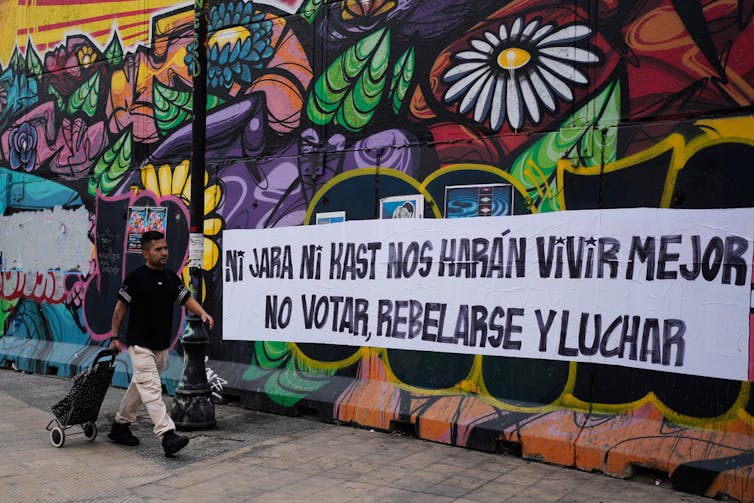
A person walks by a spray-painted political mural.
A campaign banner reads in Spanish: Neither Jara nor Kast will make our lives better, don’t vote, rebel and fight.
AP Photo / Natacha Pisarenko

Though Chile has one of the lowest crime rates in Latin America, high-profile cases of organized crime have shaken the nation in recent years. Homicides increased between 2018 and 2022 and have decreased slightly since then. Immigration has also risen significantly, with a large number of immigrants coming to Chile having fled economic and political crises in Venezuela, as well as in Peru, Haiti, Colombia and Bolivia. The foreign-born population in Chile rose from 4.4% in 2017 to 8.8% in 2024.

The key constitutional context

Many commentators have highlighted the stark polarization of this election, with a Communist Party labor minister campaigning against the arch-conservative Kast, who has lauded the Pinochet dictatorship under which his deceased older brother once served. But there is more to the story.

Some observers have drawn comparisons between Kast and other far-right Latin American leaders like Nayib Bukele in El Salvador, Javier Milei in Argentina and Jair Bolsonaro in Brazil. But Chile is not merely following the same far-right playbook of its neighbors.

In the weeks leading up to the runoff in Chile, both candidates moved toward the center. Jara vowed to expand the prison system to combat rising crime, while Kast – who had previously threatened expulsion of undocumented migrants – softened his tone to say they would be “invited” to leave.

Moreover, Kast learned from his previous failed attempts at the presidency by speaking less about his controversial or more socially conservative positions. For example, he played down opposition to abortion under any circumstances. Chilean voters, in contrast, overwhelmingly approve of the limited abortion rights that were passed by Congress in 2017.

Yet beyond the campaign trail messaging, the results also reflect a structural fact of Chilean politics that mirror political realities of other parts of Latin America, and even globally. In every presidential election since 2006, Chileans have voted out the incumbency to swing to the opposing side of the political spectrum. With candidates barred from consecutive presidential terms, the pendulum has swung back and forth since the alternating presidencies of socialist Michelle Bachelet – 2006-2010 and 2014-2018 — and conservative Sebastián Piñera – 2010-2014 and 2018-2022.

Supporters at a political rally wave flags.
At a José Antonio Kast rally in Santiago on Dec. 14, 2025, supporters wave various flags, including one depicting late dictator Augusto Pinochet.
Eithan Ambramovich / AFP vis Getty Images

Boric, a former left-wing student leader, took office in 2022 following a wave of upheaval and popular protests over inequality in 2019-2020. In what was a historic moment, the country voted to begin a process of rewriting its Pinochet-era constitution, which entrenched neoliberal economic policies and limited the government’s capacity to confront inequality. The constitutional convention was made up of directly elected citizens, many of them from grassroots movements.

Yet in a stunning reversal, the progressive constitution – which would have protected rights to nature, Indigenous rights and social rights – was roundly defeated in a plebiscite in 2022. Just over a year later, voters similarly rejected a second attempt to rewrite the constitution, albeit under a process that conservative parties helped shape.

Boric’s approval ratings, already low, suffered from this failed constitutional process. More than the right-wing elections elsewhere in the region, this national context helps to explain Chile’s own conservative turn.

The ever-present discontent of voters

Even as the pendulum has swung back and forth in recent Chilean presidential elections, there are deeper continuities across the different Chilean governments in the 21st century. Important among them is generalized voter discontent with the political system.

This has traditionally been expressed in popular protests, such as the student movements of 2006 and 2011 and the Estallido Social – or Social Uprising – of 2019-2020 that were the largest protests since the return to democracy in 1990 and helped propel Boric to power. Public discontent was also expressed in the overwhelming vote to rewrite the constitution, which passed with 78% of the vote in 2020.

A massive crowd is shown from above during a protest.
In this Oct. 25, 2019, photo, anti-government protesters fill Plaza de la Dignidad – Dignity Square – in Santiago, Chile, during a nationwide call for socioeconomic equality and better social services.
AP Photo / Rodrigo Abd, File

Even though the constitutional process was ultimately rejected by voters, this underlying discontent has not gone away.

One of the recent signs of discontent with the political choices on offer was in the first round of voting on Nov. 16: The third-place candidate was not one of the veteran politicians on the right, but Franco Parisi, a populist economist who has not set foot in Chile in years and who called on his supporters to intentionally vote null – or “spoil” their votes. Discontent has taken many forms – outrage about inequality and neoliberalism in 2019-2020, or unease about economic precarity and crime in the current election. But it has persisted, even as Chile’s political system remains stable.

Some observers have pointed out that, unlike in many places around the world, Chile’s democratic norms are holding strong. The fact that power continues to pass peacefully despite major ideological differences is significant, particularly in light of the long struggle for democracy during the Pinochet regime. Kast’s style, for what it’s worth, is not as bombastic as that of U.S. President Donald Trump or Argentina’s Milei.

Still, his apparent politeness belies what many fear is a coming erosion of rights: the rights of women to bodily autonomy; the rights of individuals] to due process; the rights of workers to dignified conditions. These may well be up for negotiation under the new administration.

Kast, a staunch Catholic and father of nine, is opposed to abortion under any circumstances and has even attempted to ban the morning-after pill. He was a supporter of Pinochet up until the regime’s end, campaigning for the “yes” vote in 1988 that would have seen eight more years for the authoritarian leader after 15 years already in power. Kast has likewise vowed to slash public spending and deregulate the economy, a clear echo of the Pinochet years.

Despite the momentous shift heralded by Kast’s election, though, it is unlikely to change one of the principal challenges of Chile’s democracy in the 21st century: voter discontent and disenchantment. There has been a consistent trend for the government in power to lose popular support and face strong headwinds in Congress from the opposition. For all the celebration happening right now for Kast and his supporters, it is hard to see that changing once the new government takes office in March 2026.

The Conversation

Andra B. Chastain receives funding in 2025-26 from a Fulbright-García Robles research grant in Mexico. She has previously received funding for research in Chile from the Social Science Research Council and the PEO Foundation.

ref. Chile elects most right-wing leader since Pinochet – in line with regional drift, domestic tendency to punish incumbents – https://theconversation.com/chile-elects-most-right-wing-leader-since-pinochet-in-line-with-regional-drift-domestic-tendency-to-punish-incumbents-272042

Epstein’s victims deserve more attention than his ‘client list’

Source: The Conversation – USA – By Stephanie A. (Sam) Martin, Frank and Bethine Church Endowed Chair of Public Affairs, Boise State University

Survivors, including Anouska De Georgiou, center, during a news conference with victims of Jeffrey Epstein outside the U.S. Capitol on Sept. 3, 2025. Chip Somodevilla/Getty Images

The Jeffrey Epstein story has slipped in and out of the headlines for years, but in a very particular way. Most news articles ask a specific question – which powerful men might be on “the list”?

Headlines focus on unidentified elites and who may be exposed or embarrassed, rather than on the people whose suffering made the case newsworthy in the first place: the girls and young women Epstein abused and trafficked.

Right now, the story is entering a new phase. A federal judge has authorized the Justice Department to unseal grand jury transcripts and other evidence from Epstein companion Ghislaine Maxwell’s sex trafficking case. A court in Florida has cleared the release of grand jury records from a federal investigation into Epstein himself, all under the new Epstein Files Transparency Act. Passed in November 2025, that law gives the Justice Department 30 days to release nearly all Epstein-related files. The deadline is Dec. 19.

Journalists and the public are watching to see what those documents will reveal beyond names we already know, and whether a long-rumored client list will finally materialize.

Alongside that, there has been a stream of survivor-centered reporting. Some outlets, including CNN, have regularly featured Epstein survivors and their attorneys reacting to new developments. Those segments are a reminder that another story is available, one that treats the women at the center of the case as sources of understanding, not just as evidence of someone else’s fall from grace.

These coexisting storylines reveal a deeper problem. After the #MeToo movement peaked, the public conversation about sexual violence and the news has clearly shifted. More survivors now speak publicly under their own names, and some outlets have adapted.

Yet long-standing conventions about what counts as news – conflict, scandal, elite people and dramatic turns in a case – still shape which aspects of sexual violence make it into headlines and which stay on the margins.

That tension raises a question: In a case where the law largely permits naming victims of sexual violence, and where some survivors are explicitly asking to be seen, why do journalistic practices so often withhold names or treat victims as secondary to the story?

A “CBS Evening News” story from Dec. 12, 2025, teases the photos revealed by House Democrats of famous men with Jeffrey Epstein.

What the law allows – and why newsrooms rarely do it

The U.S. Supreme Court has repeatedly held that government generally may not punish news organizations for publishing truthful information drawn from public records, even when that information is a rape victim’s name.

When states tried in the 1970s and 1980s to penalize outlets that identified victims using names that had already appeared in court documents or police reports, the court said those punishments violated the First Amendment.

Newsrooms responded by tightening restraint, not loosening it. Under pressure from feminist activists, victim advocates and their own staff, many organizations adopted policies against identifying victims of sexual assault, especially without consent.

Journalism ethics codes now urge reporters to “minimize harm,” be cautious about naming victims of sex crimes, and consider the risk of retraumatization and stigma.

In other words, U.S. law permits what newsroom ethics codes discourage.

How anonymity became the norm and #MeToo complicated it

Anti-rape culture protesters gathered in a crowd.
The anti-rape movement in the U.S. forced newsrooms to revisit assumptions about whose voices should lead a story.
Cory Clark/NurPhoto via Getty Images

For much of the 20th century, rape victims were routinely named in U.S. news coverage – a reflection of unequal gender norms. Victims’ reputations were treated as public property, while men accused of sexual violence were portrayed sympathetically and in detail.

By the 1970s and 1980s, feminist movements drew attention to underreporting and intense stigma. Activists built rape crisis centers and hotlines, documented how rarely sexual assault cases led to prosecution, and argued that if a woman feared seeing her name in the paper, she might never report at all.

Lawmakers passed “rape shield laws” that limited the use of a victim’s sexual history in court. Some states went further by barring publication of victims’ names.

In response to these laws, as well as feminist pressure, most newsrooms by the 1980s moved toward a default rule of not naming victims.

More recently, the #MeToo movement added a turn. Survivors in workplaces, politics and entertainment chose to speak publicly, often under their own names, about serial abuse and institutional cover-ups. Their accounts forced newsrooms to revisit assumptions about whose voices should lead a story.

Yet #MeToo also unfolded within existing journalistic conventions. Investigations tended to focus on high-profile men, spectacular falls from power and moments of reckoning, leaving less space for the quieter, ongoing realities of recovery, legal limbo and community response.

The unintended effects of keeping survivors faceless

There are good reasons for policies against naming victims.

Survivors may face harassment, employment discrimination or danger from abusers if they are identified. For minors, there are additional concerns about long-term digital evidence. In communities where sexual violence carries intense social stigma, anonymity can be a lifeline.

But research on media framing suggests that naming patterns matter. When coverage focuses on the alleged perpetrator as a complex individual – someone with a name, a career and a backstory – while referring to “a victim” or “accusers” in the singular, audiences are more likely to empathize with the suspect and scrutinize the victim’s behavior.

In high-profile cases like Epstein’s, that dynamic intensifies. The powerful men connected to him are named, dissected and speculated about. The survivors, unless they work hard to step forward, remain a blurred mass in the background. Anonymity meant to protect actually flattens their experience. Different stories of grooming, coercion and survival get reduced to a single faceless category.

A window into what we think is ‘news’

That flattening is part of what makes the current moment in the Epstein story so revealing. The suspense is less about whether more victims will be heard and more about what being named will do to influential men. It becomes a story about whose names count as news.

Carefully anonymizing survivors while breathlessly chasing a client list of powerful men unintentionally sends a message about who matters most.

The Epstein scandal, in that framing, is not primarily about what was done to girls and young women over many years, but about who among the elite might be embarrassed, implicated or exposed.

A more survivor-centered journalistic approach would start from a different set of questions, including wondering which survivors have chosen to speak on the record and why, and how news outlets can protect anonymity, when it is asked for, but still convey a victim’s individuality.

Those questions are not only about ethics. They are about news judgment. They ask editors and reporters to consider whether the most important part of a story like Epstein’s is the next famous name to drop or the ongoing lives of the people whose abuse made that name newsworthy at all.

The Conversation

Stephanie A. (Sam) Martin does not work for, consult, own shares in or receive funding from any company or organization that would benefit from this article, and has disclosed no relevant affiliations beyond their academic appointment.

ref. Epstein’s victims deserve more attention than his ‘client list’ – https://theconversation.com/epsteins-victims-deserve-more-attention-than-his-client-list-270244

How good people justify bending the rules at work — and what leaders can do about it

Source: The Conversation – Canada – By Lorne Michael Hartman, Associate Faculty, Faculty of Medicine, University of Toronto; York University, Canada

Consider the following scenario. You’re facing pressure to meet quarterly targets, but the numbers aren’t quite where they need to be. With a deadline looming, you “round up” a figure just slightly to make the results look better.

This kind of thinking is far more common than many realize. Research in behavioural ethics shows these subtle choices are exactly how unethical behaviour takes root in organizations.

Most people see themselves as fair, rational and ethical, yet research in behavioural ethics consistently shows we are far less objective than we assume.

Even well-intentioned people can explain away questionable actions — not because they’re immoral, but because their minds are wired to protect their moral self-image.

How we talk ourselves into bad decisions

The concept of moral disengagement describes the subtle mental moves people use to convince themselves that ethical standards don’t apply “just this once.” Rather than viewing themselves as rule-breakers, people reframe their behaviour in ways that allow them to feel moral while acting otherwise.

These rationalizations tend to take the following forms:

  • “It’s just creative accounting.” This is euphemistic labelling, which reframes misconduct in more acceptable terms.
  • “I did it for the team.” A form of moral justification that recasts a self-serving decision as altruistic.
  • “Everyone signed off on it.” Here, individuals displace responsibility onto colleagues or superiors.
  • “It’s not a big deal.” This involves distorting the consequences and minimizing impacts of choices.
  • “At least we’re not as bad as the competition.” Known as advantageous comparison, this tactic makes questionable behaviour seem reasonable by contrasting it with a worse alternative.

These narratives allow people to preserve a positive self-image even when their actions contradict their values. Over time, these narratives can normalize misconduct and corrode workplace culture.

The real-world impact of moral rationalization

Unethical behaviour in organizations isn’t rare, nor is it limited to a few “bad apples.” Research indicates that harmful or dishonest actions at work result in significant financial losses for companies and society, amounting to billions of dollars each year.

While we often assume unethical behaviour is driven by personal greed, high-profile corporate scandals tell a different story. In cases like the Boeing 737 Max crashes, Siemens’ corruption scandal or Volkswagen’s emissions scandal, news coverage suggest employees were motivated by a sense of obligation, loyalty or pressure to advance company goals, not by personal gain.

What’s striking is not just the number of people who participated, but how many recognized wrongdoing and remained silent. This pattern highlights a deeper problem: ethical failures rarely result from deliberate malice.

They emerge when ordinary people talk themselves into crossing lines they would normally respect. Understanding how that happens is essential if leaders want to create workplaces where employees don’t just know the right thing to do, but actually act on it.

Why ethics training often falls flat

Many organizations assume that teaching employees the rules will naturally translate into better behaviour. However, knowledge alone doesn’t close the gap between intention and action.

Across several studies, I examined whether moral disengagement can be reduced through training and reframing. In one experiment, participants learned to spot eight common rationalizations. They became adept at identifying these cognitive traps, but their awareness didn’t translate into making more ethical choices later.

In another experiment, we tried shifting how people thought about responsibility by emphasizing individual accountability over group harmony. This framing slightly reduced moral disengagement, especially among women, but the overall impact was modest.

Across all studies, the bottom line is that moral disengagement is stubborn. Simply knowing better rarely ensures that people will act better.

Why is it so difficult to move the needle? A key reason is that our explanations for why we behave the way we do are shaped by cultural norms learned early in life. Once formed, these beliefs are surprisingly resistant to change, even in the face of evidence or explicit instruction.

Culture is what drives ethical behaviour

If ethics training alone has limited impact, what does make a difference?

Our research points to workplace culture, which strongly shapes levels of moral disengagement and the ethical choices that follow.

We found that environments that prize assertiveness, competition and material success are more likely to encourage rationalizations. By contrast, cultures that emphasize care, modesty and concern for others make moral disengagement harder.

Ethical behaviour, in other words, is less a matter of personal integrity than organizational context.

When employees face unrealistic goals, aggressive norms or leaders who silence dissent, the space for ethical reflection becomes increasingly narrow. Rationalization fills the gap, allowing people to maintain a sense of integrity even as their decisions drift further from their values.

7 ways to resist rationalization at work

Creating an ethical organization means designing systems that make reflection easier and self-justification harder. Effective strategies include:

1. Normalizing ethical dialogue. Ethical dilemmas often arise in grey areas, where there is no clear right or wrong answer. Leaders should encourage open discussions about ambiguous situations before they escalate into problems.

2. Rewarding the process, not only the result. When outcomes are all that matter, employees are more likely to cut corners or bend rules to achieve targets. By recognizing the work process, organizations reinforce the importance of integrity alongside performance.

3. Modelling moral humility. Leaders set the tone for acceptable behaviour. When they admit mistakes, they signal ethics is about vigilance, not moral perfection.

4. Building in “ethical speed bumps.” People are more likely to rationalize decisions under pressure. Interventions like checklists, second reviews or pausing to slow down can give employees the time to consider whether their actions align with ethical standards.

5. Creating psychological safety. Employees must feel confident that raising concerns or questioning decisions won’t lead to fear of reprisal or harm to their careers. Creating psychologically safe workplaces reduces the likelihood of ethical lapses.

6. Aligning incentives with values. When incentives focus only on short-term results or profit, employees are more likely to justify harmful shortcuts. Performance metrics should emphasize collaboration, accountability, feedback and conflict resolution.

7. Supporting well-being and work-life balance. Stress and burnout make people more prone to self-justification. Policies that support well-being indirectly foster ethical workplace behaviour.

These approaches reflect growing evidence that behaviour change requires more than information. It requires habit formation, cultural reinforcement and aligned systems.

Learning to be more reflective

Humans are rationalizing creatures. We edit our moral narratives to protect our sense of ourselves as good, competent and principled people. But understanding this tendency is empowering.

Leaders who recognize the psychology of moral disengagement can design workplace environments where ethical reflection is routine and the right decision is the easier one.

While we may never be able to fully eliminate rationalization, we can learn to notice it, question it and choose differently. Ethical workplace cultures are built on systems that help ordinary people do the right thing.

The Conversation

Lorne Michael Hartman does not work for, consult, own shares in or receive funding from any company or organisation that would benefit from this article, and has disclosed no relevant affiliations beyond their academic appointment.

ref. How good people justify bending the rules at work — and what leaders can do about it – https://theconversation.com/how-good-people-justify-bending-the-rules-at-work-and-what-leaders-can-do-about-it-270427

Uganda election: Museveni will win, but the landscape has changed since his last victory

Source: The Conversation – Africa (2) – By Luke Melchiorre, Assistant Professor of Political Science, Marist College

On the eve of Uganda’s 2021 presidential election, it was clear that regardless of how Ugandans voted, the incumbent, Yoweri Museveni, would most likely be declared the winner. Amid mounting repression, accusations of vote rigging, and an internet blackout, that is exactly what transpired. Museveni was declared the winner for his sixth consecutive term in office.

Five years on, that prediction could just as easily and accurately be applied to the 15 January 2026 vote. This should not be taken as evidence that national politics in Uganda have remained static. Far from it.

It is true that state repression has remained a constant since the 2021 polls. Museveni’s main opponent continues to be a youthful, charismatic political outsider. But the landscape of opposition politics has shifted significantly along with speculation about 81-year-old Museveni’s potential successor.

Moreover, recent elections in Mozambique and Tanzania offer a pointed political lesson. Though an oppressive and entrenched ruling party can virtually assure its electoral triumph at the polls, it does not mean that everything after the election will go to its plan.

As a researcher of democracy and its discontents in African politics (with a particular focus on east Africa), I have followed the Ugandan case closely over the last six years. In this article, I will elaborate on the four key sources of continuity and change which mark the country’s politics heading into the upcoming election.

Bobi Wine remains the face of opposition

Robert Kyagulanyi entered the political scene in 2017 as an independent candidate in a parliamentary by-election, which he won by a landslide. Better known by his stage name, Bobi Wine, the 43-year-old popular musician-turned-presidential candidate has defied the predictions of friends and foes alike to become the undisputed face of Uganda’s political opposition.

In my academic research, I have documented his remarkable political rise and ideological evolution.

In an era of African politics marked by growing intergenerational tensions, Bobi Wine has been able to mobilise the younger generation in opposition to almost four decades of Museveni’s rule.

His captivating narrative: rising from humble origins in a ghetto of Kamwookya to a life of pop stardom and political defiance. This has made him a global icon, attracting attention in the West, as the subject of an Oscar-nominated documentary and Spotify podcast.


Read more:
Bobi Wine has shaken up Ugandan politics: four things worth knowing about him


Since 2017, he has carved a national political reputation in Uganda. Notably, he:

  • led protests against the constitutional amendment that lifted presidential age limits, allowing Museveni to run again in 2021

  • mobilised against a new social media tax that would limit (young) people’s access to social media debates

  • led his party, the National Unity Platform (NUP), to a strong showing in the 2021 election.

With 57 seats in parliament, National Unity Platform became the country’s official opposition party. It won impressive support in traditional ruling party strongholds.

The party’s massive rallies and Bobi Wine’s recent attempts to build bridges across ethno-regional divides suggest that the National Unity Platform is still the country’s best hope of toppling Museveni at the polls.

But the opposition faces the ruling party’s continued use of violence to manipulate the election. This makes it difficult to know how the National Unity Platform might perform in a free and fair election. More troubling, the incumbent’s iron grip on the Ugandan military makes it nearly impossible to imagine a peaceful transfer of power.

State repression persists

As Bobi Wine’s popularity has risen, so has state violence against his movement. Nationwide protests against his arrest in November 2020 led to police killings of at least 54 people.

Bobi Wine’s political stance has also come at a great cost to himself. He has been arrested, tortured, shot in the leg, and survived multiple assassination attempts.

In the run-up to the 2026 election, prominent the National Unity Platform members remain in detention and have been tortured. In November 2024, opposition veteran Kizza Besigye was renditioned from Nairobi and has since been held in a maximum security prison.

Bobi Wine has likened the campaign trail to “a war”. Video footage recently captured police and defence force soldiers beating National Unity Platform security personnel.

The severity of the violence has led the United Nations High Commissioner for Human Rights to warn of a “deepening crackdown on Uganda’s opposition” and urge the Museveni regime to “cease … such repressive tactics”.

Museveni’s manoeuvrings

The Museveni regime has effectively coopted key political opponents, infiltrated opposition parties, and sowed the seeds of distrust and division among and within them.

In July 2022, the Democratic Party (DP) leader Norbert Mao was appointed as Museveni’s new justice minister. Mao once bragged that he could “never be bought”. Subsequently, the Democratic Party – Uganda’s second oldest political party – entered into a formal cooperation agreement with the ruling National Resistance Movement.

Meanwhile, Besigye has left the Forum for Democratic Change (FDC) after accusing fellow party leaders of accepting “dirty money” from State House.

Even National Unity Platform “isn’t really safe from Museveni’s infiltration”. In early 2024, a high-ranking leader, Mathias Mpuuga, left the party, amid allegations of corruption and wrongdoing during his tenure as leader of the opposition. Mpuuga subsequently started a new party, the Democratic Front. He has since publicly criticised his former party leader.

Breeding internal suspicion and division undermines the opposition’s ability to mount a united front against the incumbent.

The rise of Muhoozi

The 2026 elections raise political questions about the fate of Uganda post-Museveni. In the last five years, speculation has centred on the Ugandan president’s eldest son, Gen Muhoozi Kainerugaba.

There is a widely held belief that Museveni is grooming his son, the current defence force chief, to be his presidential successor.

The constitution prohibits serving members of this institution from running for political office. Yet Muhoozi has made his own ambitions for political power clear.

Uncharacteristic of a decorated military officer, Muhoozi is given to erratic and at times shocking public outbursts. He also constantly stokes controversy.


Read more:
Museveni’s first son Muhoozi: clear signals of a succession plan in Uganda


But Museveni appears to continue to lay the groundwork for his son’s political ascendance. A cabinet reshuffle in March 2024, and more recent party elections, phased out “the old guard” in favour of Muhoozi loyalists. This suggests that the influence and power of Museveni’s son is growing.

As political scholar Kristof Titeca recently noted, the National Resistance Movement’s electoral victory in January is certain. But the politics of “succession are not”.

Paying close attention to the fortunes of Muhoozi loyalists on key party committees and within Museveni’s new cabinet after the election, perhaps the Ugandan president’s last, will reveal much about the fate of the Muhoozi project. And the political future of Uganda more broadly.

The Conversation

Luke Melchiorre receives funding from NORHED-II.

ref. Uganda election: Museveni will win, but the landscape has changed since his last victory – https://theconversation.com/uganda-election-museveni-will-win-but-the-landscape-has-changed-since-his-last-victory-271535

How bus stops and bike lanes can make or break your festive city trip

Source: The Conversation – UK – By Harry Radzuan, Lecturer in Project Management, London South Bank University; University of Manchester

William Perugini/Shutterstock

Picture yourself strolling through Christmas markets, sipping mulled wine. Would you want to spend more time exploring the city or waiting for a taxi in the cold?

City breaks during the Christmas holiday period often promise festive lights, markets and cosy cafés – but how much of that depends on something as ordinary as a bus stop or as simple as a bike lane? Our spatial mapping using geographic information systems (GIS) of city accommodation, attractions, public transport stops and cycle paths reveals how accessibility shapes tourism in cities.

Accessibility isn’t just about convenience. It’s the difference between a stress-free festive getaway and hours stuck in traffic. It’s also about being inclusive of people with different accessibility needs (think about people using wheelchairs, strollers, crutches or mobility scooters). Tourism activities drive 10% of global GDP and account for about 9% of global carbon emissions. But poor connectivity can weaken these benefits.

Research shows that a lack of accessible transport stops people exploring. For tourists, this means fewer opportunities to discover local attractions – or worse, missing out on entire destinations. That’s a bigger problem for people with mobility needs.

Accessibility gaps don’t just inconvenience tourists; they marginalise communities. Poorly connected neighbourhoods lose out on visitor spending, cultural exchange and everyday opportunities.

The UK government’s inclusive transport strategy indicates that inaccessible bus stops and train stations prevent disabled people from participating in social activities. The result is not just fewer trips but fewer chances to work, study and connect, which creates a bigger problem – transport poverty.

Cities that integrate transport with tourism infrastructure don’t just move people, they move economies. Better accessibility boosts travellers’ confidence, satisfaction, and encourages greater spending. Since tourists often allocate a large share of their budget to local travel, making destinations easier to navigate directly increases how much they spend and how long they stay.


Read more:
Dreaming of a green Christmas? Here are five ways to make it more sustainable


GIS can help plan transport and tourism. Visitors to Copenhagen, Denmark’s capital, use GIS to plan cycle-friendly routes with details about the path, distance, cycling duration, complexity and slope conditions to help them navigate the city.

GIS also allows researchers like us to visualise what the naked eye misses. In 2024, Edinburgh welcomed 5.05 million overnight visitors, generating £2.56 billion in tourism spending.

But while the Royal Mile and city centre boast strong bus networks, facilities that promote active travel (such as bike parking and bike lanes) are lacking beyond the centre. Around Arthur’s Seat, a popular place that people visit for walking, climbing and other recreational activities, there are fewer than ten bike parking spaces in the entire area. Due to the lack of active travel options, people may choose to drive, which causes further congestion.

map of Edinburgh with red circle
Cycle parking (red dots) and cycle routes in Edinburgh – note lack of cycle parking at Arthur’s Seat and limited cycle routes around the city.
Produced with OpenStreetMap and dataset from Edinburgh Council (https://data.edinburghcouncilmaps.info/maps/213d09a7cab745eb8e7cd08521419805), CC BY-NC-ND

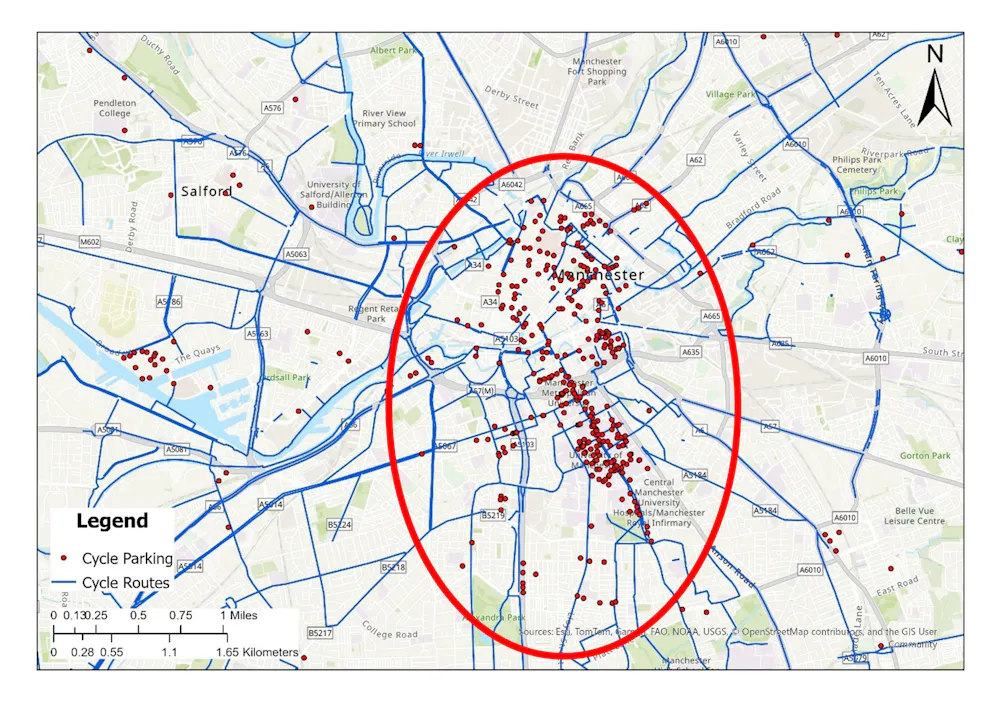
In Manchester too, bike parking is concentrated in specific areas despite the strong cycle network around the city. This can limit the amount of cycling if people cannot easily park their bikes beyond the city centre area.

map of Manchester with red circle showing where cycling facilities are concentrated
Map shows concentration of cycle parking around Manchester city centre and university areas – and lack of cycle parking elsewhere.
Produced with OpenStreetMap and dataset from the UK Government (https://www.data.gov.uk/dataset/655a1680-fe40-44c0-832f-131067256db6/gm-cycle-routes), CC BY-NC-ND

Smart tourism meets sustainable transport

The carbon footprint from air travel is high, and the amount of long-distance flights is projected to increase by 25% by 2030. Meanwhile, car travel accounts for the majority of global tourism journeys (around 77%), largely due to its flexibility, affordability and independence – but it is not the most sustainable method, of course.

Encouraging the use of buses and bikes isn’t just green, it’s strategic.
With GIS mapping, we can pinpoint where new bike lanes and bus routes can be expanded to link tourist attractions, accommodations and restaurants, to create seamless, low-carbon journeys.

Imagine cycling from your hotel to a historic site, hopping on an electric bus to a museum and strolling to dinner, all without a car. That’s not a fantasy; it’s a blueprint for sustainable tourism.

Our research shows that sustainable tourism depends on active community participation and inclusive planning whether in tourism or transport, proving that equitable access to resources leads to long-term sustainability.

During our recent fieldwork, two young wheelchair users’ faces lit up when we discussed active travel such as wheeling as well as cycling and walking. Their enthusiasm is a reminder that these groups’ travel needs should be strengthened and prioritised in future mobility planning, not treated as an afterthought.

With open-access GIS technology and datasets available, these blind spots can be exposed, giving policymakers the help they need to design fairer, more inclusive cities. Interactive GIS maps can support smart tourism apps, offering live bus schedules and bike sharing availability.

Inclusive destination planning isn’t just a policy goal. It shapes people’s travel experiences. The choices cities make about transport modes and accessibility determine whether holidays feel effortless, or exhausting.

So, what kind of Christmas travel do you want? One spent exploring joyfully, or one stuck waiting for a taxi in the cold? Before you book that festive getaway, check the map. Does your destination offer easy, sustainable access from one place to another? Will you be stuck in traffic – or will you have the freedom to walk, cycle and easily hop on a bus?


Don’t have time to read about climate change as much as you’d like?

Get a weekly roundup in your inbox instead. Every Wednesday, The Conversation’s environment editor writes Imagine, a short email that goes a little deeper into just one climate issue. Join the 47,000+ readers who’ve subscribed so far.


The Conversation

Harry Radzuan receives funding from the British Academy/Leverhulme to conduct this research.

Siti Intan Nurdiana Wong Abdullah receives funding from British Academy/Leverhulme to conduct this research.

Jiaying Xue does not work for, consult, own shares in or receive funding from any company or organisation that would benefit from this article, and has disclosed no relevant affiliations beyond their academic appointment.

ref. How bus stops and bike lanes can make or break your festive city trip – https://theconversation.com/how-bus-stops-and-bike-lanes-can-make-or-break-your-festive-city-trip-269961

How abandoned land can power a fair energy transition

Source: The Conversation – UK – By Harry Radzuan, Lecturer in Project Management, London South Bank University; University of Manchester

EvaL Miko/Shutterstock

Across the UK, millions of households are struggling to afford to heat their homes. Energy poverty has risen sharply since 2021, with around 6 million households unable to keep warm without cutting back on essentials.

At the same time, the UK faces a race to meet net zero by 2050, including delivering 70GW of solar power by 2035 (that’s enough energy to power 35 million homes).

Brownfield sites – the abandoned or disused lands that dot the UK’s cities and towns as a result of de-industrialisation – could be an untapped asset.

As a multidisciplinary sustainability researcher, I have seen how brownfield has slowly been incorporated into urban planning in the UK – from locally managed brownfield assets and datasets through to combined brownfield datasets and eventually to a national register.

To date, there are still more than 37,000 brownfield sites in England alone, many in deprived areas where property values are low and investment scarce. These sites range from as small as 0.001 hectares (0.00000386 square miles) to 157,945 hectares (610 square miles), according to the UK government’s brownfield land register.

Although different countries have different interpretations of what constitutes brownfields, they are often fenced off, contaminated or derelict – a symbol of neglect rather than renewal.

My team’s recent study shows that repurposing this land for community-based renewable energy projects, such as solar farms, wind turbines or ground source heat pumps, could not only help boost the renewable energy uptake, but also cut carbon footprint and tackle energy poverty.


Read more:
Green belt land just isn’t that green anymore


The idea is simply to transform brownfield land from environmental liability and eyesore into local renewable energy generators. Even the smallest brownfield site can house a small number of solar PVs, rooftop wind turbines or a deep-borehole ground-source heat collector.

In the US, this is already happening. Since 1999, the Brightfields Initiative has converted disused industrial sites in California, Connecticut, Minnesota, New York and Virginia into solar farms. The US Environmental Protection Agency has also created a national RE-Powering Mapper tool to find suitable brownfield lands for renewable energy projects.

solar panels and heat pump
The grid of the future will include a mix of renewable energy sources such as solar and air-source heat pumps.
ThomsonD/Shutterstock

The UK has yet to adopt a similar approach. Since launching in 2017, the current brownfield register mainly tracks potential housing sites, which may limit its redevelopment opportunity due to the site contamination that may require a high cleanup cost and a long restoration period before it can be safe for habitation. Energy development is rarely considered, even though many brownfield sites sit near densely populated areas that would benefit most from cheaper, cleaner power.

The good news is that momentum is building. The energy bill was amended in July 2023 to encourage solar installations on rooftops and brownfield land. In 2024, the government launched its brownfield passport consultation to seek ways to speed up redevelopment of derelict land. Our research supports this effort, and suggests that energy generation should be a formal part of that strategy.

Turning brownfields into brightfields

Brownfield redevelopment isn’t just about land use, it is also about energy justice, where fair access to affordable and sustainable, clean energy can be guaranteed.

This involves three principles. Distributive justice is the element of ensuring a fair allocation of energy resources and burdens between individuals and communities. In this case, brownfield renewable energy can supply affordable energy directly to low income households, who tend to live in underdeveloped areas, reducing their dependence on volatile fossil fuel prices.

This can be more affordable because community-owned renewables avoid profit-driven pricing, reduce transmission losses by generating energy locally and benefit from lower operating costs once the systems are installed. This means savings can be passed directly to households.

Procedural justice emphasises fairness and inclusion in energy-related decision making. In other words, brownfield development should integrate greater public participation, enabling communities to co-design and co-own energy solutions (such as Brixton Energy in London).

Recognition justice involves acknowledging individual and collective energy needs, values and rights. Many brownfield sites lie in areas long burdened by environmental damage. Renewable energy projects can therefore revitalise the land, create jobs and improve local wellbeing.

Community energy, where residents jointly own and manage renewable energy, delivers on all three of these principles. Community energy projects create local jobs, generate income that stays in the area and build trust between citizens and local authorities.

But renewable brownfield redevelopment is not simple. Contamination, complex regulations and financing challenges have slowed progress for decades. Developers also frequently shy away from uncertain cleanup costs or lengthy approvals. These barriers can be overcome through targeted policy support, such as grants for site remediation, streamlined planning processes and public-private partnerships that can reduce financial risks while ensuring community participation.

By developing brownfield for renewable energy, multiple issues can be addressed using existing resources while reaping benefits beyond free sustainable energy. It can enrich energy poor households, enhance biodiversity, provide cleaner air, create safe neighbourhoods and increase property values. This reduces the competition for fresh land development, often termed as greenbelt.

With coordinated policies, community participation and a clear national vision, the energy system can become more just.


Don’t have time to read about climate change as much as you’d like?

Get a weekly roundup in your inbox instead. Every Wednesday, The Conversation’s environment editor writes Imagine, a short email that goes a little deeper into just one climate issue. Join the 47,000+ readers who’ve subscribed so far.


The Conversation

Harry Radzuan does not work for, consult, own shares in or receive funding from any company or organisation that would benefit from this article, and has disclosed no relevant affiliations beyond their academic appointment.

ref. How abandoned land can power a fair energy transition – https://theconversation.com/how-abandoned-land-can-power-a-fair-energy-transition-269730

What makes people welcome or reject refugees? What research in Germany reveals

Source: The Conversation – UK – By Tobias Hillenbrand, PhD candidate, Innovation, Economics, Governance and Sustainable Development, UNU-MERIT, United Nations University

Across the EU, immigration is one of the most divisive topics in politics today. Germany, a country once known for its “Willkommenskultur” (welcome culture), is a case in point.

The German chancellor, Friedrich Merz, has recently said that Syrians no longer have “grounds for asylum in Germany”, and that they will be encouraged to return voluntarily. Some could also be deported in the near future.

Polling suggests that tough approaches to immigration resonate well with the public, reflecting a broader shift toward more negative immigration attitudes.

What determines whether people in a host country like Germany welcome or reject refugees? This is what my colleagues Bruno Martorano, Laura Metzger and Melissa Siegel and I sought to better understand in a recent paper.

Through a survey experiment, we tested how different factors would affect whether participants express concern for refugees’ wellbeing, or consider them a threat.

The study was designed to assess the effects of different factors on people’s attitudes towards refugees. For example, whether a participant held humanitarian values (is committed to help fellow humans in need). We measured this based on their responses to a frequently-used set of four questions. Humanitarian considerations have received little attention in earlier studies in this area.

We also measured if people’s views changed depending on the amount of adversity refugees faced (such as whether they were fleeing war), and the personal characteristics of the refugees – their age and gender, and whether they were part of families.

We surveyed more than 2,000 participants in 2023, using short, professionally-produced videos about Syrian refugees in Turkish refugee camps.

Some participants watched a control video, which provided only some background information. Others watched one of four videos: two emphasised the humanitarian situation of Syrian refugees in refugee camps in Turkey, the other two stressed challenges that the immigration of these refugees may imply for German society.

One of the “humanitarian message” videos and one of the “threat message” videos focused on families with small children among the refugees. The other two highlighted young refugee men.

After they watched the videos, we surveyed respondents about their views and concerns about the refugees.

Humanitarian compassion

On average, respondents overall showed a moderate level of concern for the wellbeing of Syrian refugees. They were somewhat more worried about the impact on Germany’s welfare system, security and cultural life. Fears that refugees might take away jobs were less common.

We identified a strong correlation between how humanitarian someone generally is, and the compassion that respondent expressed toward the refugees. We also found that exposure to short videos highlighting the humanitarian plight of refugees made participants care significantly more for most aspects of refugees’ wellbeing, compared to those who only saw the control video.

Additionally, we gave participants the possibility to sign pro-refugee policy petitions within the survey. Only a quarter of respondents overall signed a petition calling for increased funding for Syrian refugees abroad. An even smaller share supported a petition for more admissions of Syrians to Germany. But highlighting the humanitarian plight of refugees largely increased the share of respondents advocating for more support for refugees abroad.

The limits of this kind of messaging were also apparent. Watching the humanitarian videos did nothing to reduce immigration-related fears, nor did it increase acceptance for allowing refugees into the country.

Scepticism of (some) refugees

Those who watched videos of young male refugees were significantly less likely to support allowing more refugees into the country. Our data suggests that this is likely due to heightened concerns about negative cultural effects among those who viewed a video featuring young refugee men, rather than economic concerns or participants feeling more physically threatened.

Those who watched the videos highlighting families were more concerned about the refugees’ safety. Yet, they also expressed greater concerns that refugees may represent a burden for the welfare state.

The videos did not impact all respondents equally. For example, among respondents who identified as politically leftwing, seeing a video with a humanitarian message was associated with fewer cultural concerns about immigration, compared to the control group. For right-leaning respondents, we observed the opposite: seeing one of the humanitarian videos was associated with more concerns.

In addition, it was remarkable how differently east and west Germans reacted to our experiment. The political legacy of eastern Germany – the region which used to be the socialist authoritarian German Democratic Republic (GDR) until 1990 – is relevant in explaining persistent differences between the eastern and western German populations. It has been well established that east and west Germans differ in their values, preferences and voting behaviour, including support for the anti-immigration party AfD.

While similar at baseline, we found that exposure to the four videos affected the views of east Germans more negatively than those of west Germans, regardless of the exact message or the group of refugees the video highlighted. For example, focusing on refugee families largely boosted the share of west Germans who supported increasing support for refugees abroad. Among east Germans though, it had if anything the reverse effect.

It was remarkable how different these populations reacted to the very same message. Their reactions diverge more strongly than across any other divide, such as age or education.

Taken together, our results suggest that people’s opinions on immigration are more complex than a simple pro- v anti-immigration split. Whether a political message is effective or not – that is, whether it changes minds – depends on the framing of the message itself, as well as the views and values held by the people receiving that message.

The Conversation

Tobias Hillenbrand does not work for, consult, own shares in or receive funding from any company or organisation that would benefit from this article, and has disclosed no relevant affiliations beyond their academic appointment.

ref. What makes people welcome or reject refugees? What research in Germany reveals – https://theconversation.com/what-makes-people-welcome-or-reject-refugees-what-research-in-germany-reveals-269436

As flu cases spike, is it time to start wearing masks again?

Source: The Conversation – UK – By Paul Hunter, Professor of Medicine, University of East Anglia

Yau Ming Low/Shutterstock.com

With flu season arriving early and NHS leaders encouraging people with symptoms to wear masks in public, a question arises: do masks actually work against the flu?

The short answer is that the evidence remains surprisingly weak. Studies conducted before the COVID pandemic generally found that masks made little to no difference in the spread of flu in everyday settings. There is little reason to think this has changed, although the COVID pandemic has taught us more about when masks can be helpful in reducing the spread of respiratory diseases.

This matters because flu cases began rising earlier than usual this year and are higher than we would normally expect at this point in the season.

While the number of people being admitted to hospital with a diagnosis of flu is still at moderate levels, the number of daily admissions is increasing. There are real concerns that we are heading towards an especially bad winter. This year, Australia suffered its worst flu season in at least 20 years.

The main flu strain currently circulating in the UK is a type of influenza A known as H3N2 – subclade K. This strain probably appeared first in the US, from where it has spread globally, extending the flu season in Australia and New Zealand and causing the early start of the flu season in Europe.

Crucially, this strain is quite different from the one used in this year’s vaccine. This means the vaccine may be less effective at preventing infection, although it should still help protect against severe illness.

Against this backdrop, Daniel Elkeles, the chief executive of NHS Providers, told Times Radio that if you’re coughing and sneezing “then you must wear a mask when you’re in public spaces, including on public transport, to stop the chances of you giving your virus to somebody else”.

The government guidance is less forthright, with a government spokesperson stating that people should consider wearing a mask in such circumstances, not that they must wear one.

Before the COVID pandemic, there had been several studies investigating the benefits of face coverings for respiratory viruses, including influenza. The most thorough of those reviews concluded that overall, masks made little or no difference to the spread of flu, either in the home or in public places.

They also concluded that N95 masks (tight-fitting, high-filtration masks) were no better than surgical masks in everyday settings. However, the authors were only able to identify a single low-quality study to support this finding.

Blue surgical masks and white N95 masks.
In real-world studies, N95 masks perform no better than surgical masks.
Maridav/Shutterstock.com

In a review my colleagues and I conducted on the effectiveness of masks on the spread of respiratory infections prior to COVID, we found a similar poor effect overall. But individual studies in the review often gave very different results to each other.

Weaker studies were more likely to suggest masks work

Some studies suggested a strong protective effect, while others showed greater infection risk when people wore masks. Better-quality studies, such as randomised trials, generally found little or no benefit. In contrast, weaker study designs were more likely to suggest that masks worked.

The COVID pandemic added new evidence. The most robust recent review of masks and COVID in the community concluded that mask wearing was associated with a reduced risk of COVID transmission outside of healthcare settings. There was insufficient evidence to comment on the relative effectiveness of N95 respirator masks compared to standard surgical masks in public spaces, but in hospitals the balance of evidence was that there was little difference between the two types of mask.

These real-world studies contrast sharply with laboratory studies, which have generally found masks to be highly effective at reducing the amount of virus people release into the air and showing that properly fitted N95 masks are more effective than surgical masks for COVID and flu.

In the flu study, the researchers reported that a properly fitted N95 mask reduced the amount of flu virus released into the air by more than 94%. However, a poorly fitting N95 mask performed no better than an ordinary surgical mask – a crucial finding that suggests the gap between laboratory and real-world effectiveness may come down to how people actually wear masks.

The COVID lesson

Some of the most convincing evidence for the effectiveness of masks at preventing COVID was the UK’s Office for National Statistics (ONS) COVID infection survey. In this survey, up to 150,000 people were screened every two weeks for the virus whether or not they had symptoms. For part of the time, the survey also collected data on mask wearing.

My colleagues and I analysed data from the ONS survey and concluded that, in adults, always wearing a mask at work or in enclosed spaces – or both – was associated with about a 20% reduction in the risk of catching COVID during the time the delta variant was the dominant strain of the virus. But after the appearance of the omicron variant, there was little if any reduced risk in mask wearers.

In children, mask wearing was associated with less of a reduction in risk of testing positive for COVID, and during the omicron period there was even a small increased risk.

Evidence for the value of masks for flu remains less clear, suggesting little if any benefit. Nevertheless, I would still encourage people who are at risk of severe disease if they catch the flu to wear a mask in crowded indoor environments – especially if they have not yet received the vaccine.

If someone is ill with the flu, it is best that they should stay at home. If they have to go out into crowded indoor environments, then I would also encourage them to wear a mask. I would not encourage mask wearing in children, given the lack of clear benefit and potential for improper use.

For most people, the overall evidence does not support routine mask wearing. I would also not encourage the general public to wear N95 masks because these masks need to be properly fitted for them to be effective. Nevertheless, wearing a mask is a personal decision, and people should be free to decide on what makes them feel most comfortable.

The Conversation

Paul Hunter consults for the World Health Organization. He receives funding from National Institute for Health Research and has received funding from the World Health Organization and the European Regional Development Fund

ref. As flu cases spike, is it time to start wearing masks again? – https://theconversation.com/as-flu-cases-spike-is-it-time-to-start-wearing-masks-again-271904

Cannabis dependence is rising in England and Wales – but treatment is lagging

Source: The Conversation – UK – By Francesca Spiga, Research Fellow in Research Synthesis, University of Bristol

Cannabis is often seen as relatively harmless – but the latest figures tell a different story. Julian Wiskemann/ Shutterstock

Cannabis dependence is on the rise, according to the latest data on drug use and dependence published by NHS England.

Although cannabis use has remained stable over the past decade in England and Wales, dependence on the drug has risen significantly. In 2024, 6.7% of people aged 16 to 64 showed signs of drug dependence – compared with only 3.8% in 2014. This rise in drug dependence has mainly been attributed to an increase in the number of adults reporting cannabis dependence.

In England’s substance misuse treatment services alone, 86% of children aged 14-17 enrolled in treatment between 2024 and 2025 were there for cannabis problems – making it by far the most commonly used substance among young people.

Trends are slightly different in adults, with 21% of those in treatment reporting issues with cannabis use alongside opiates. Among people entering treatment for substance misuse, 22.2% were there for cannabis problems – continuing a steady climb since 2022 (20.9%).

Cannabis is often seen as relatively harmless, but these figures tell a different story. For some, cannabis use becomes difficult to control – interfering with work, relationships and mental health. It can also lead to cannabis use disorder, a serious condition that, due to its relatively mild perceived physical harms, receives far less attention than other substance use disorders.

What is cannabis use disorder?

Cannabis remains the most commonly used illicit drug in the UK. While many people use it without major problems, some develop patterns of harmful or dependent use.

Cannabis use disorder is defined by symptoms such as difficulty cutting down cannabis use, spending excessive time using or recovering from use, and continuing to use cannabis despite negative consequences. These problems can affect education, employment and relationships, and are linked to mental health issues such as psychosis and depression.


Read more:
What is cannabis use disorder? And how do you know if you have a problem?


Despite these risks, cannabis is often perceived as “safe” compared to other drugs. The perception that cannabis doesn’t cause serious problems increases the risk of use and decreases the motivation to stop. This perception may partly explain why treatment services are now seeing such high numbers of young people with cannabis-related problems.

The latest ONS figures highlight a persistent public health challenge – one that requires more than just awareness.

Can cannabis use disorder be treated?

Treatment for cannabis use disorder isn’t straightforward. Unlike opioid dependence, there are no approved drug-based treatments for cannabis problems.

Current UK clinical guidelines recommend psychosocial interventions, such as cognitive behavioural therapy, as first-line options. But the evidence base for these therapies is surprisingly thin. Studies are small, inconsistent and often measure success in different ways – making it hard to know what really works.

A young girl smokes a marijuana cigarette.
In England, 85% of young people in treatment programmes were there for cannabis problems.
2Design/ Shutterstock

Our research group recently reviewed all available trials of psychosocial and pharmacological treatments for cannabis use disorder.

We found that while psychosocial approaches such as cognitive behaviour therapy (teaching people practical strategies to change unhelpful thoughts and actions and boost motivation) and acceptance-based approaches (teaching skills to manage difficult emotions, accept challenging thoughts and stay focused on the present moment) show promise, the benefits are modest and vary widely between studies.

Other psychological strategies such as contingency management (offering rewards for meeting treatment goals) have shown some success for other substance use disorders (such as cocaine and amphetamine). But the evidence for cannabis is limited.

The benefits of prescription drug treatments for cannabis use disorder remain uncertain. No drug that has been investigated to date, including antidepressants and cannabinoid agonists (which mimic the effects of cannabis), have produced convincing results.

In short, while there are some encouraging findings, the research base is still too limited to draw firm conclusions about which interventions work best. This leaves doctors and patients with uncertainty and limited guidance on treatments.

Where do we go from here?

The rise in cannabis-related treatment demand comes at a time when recreational cannabis use is highly common and high-potency products are increasingly available. This means that it could become a more common problem, which is why developing a treatment base is so important.

But a challenge researchers face in developing suitable treatments for cannabis use disorder is deciding what counts as a good outcome.

Many trials aim to have participants achieve abstinence (complete cessation of cannabis use) – but this isn’t always realistic or even what people want. For some, reducing use rather than stopping completely can still improve mental health and quality of life.

Yet there’s no universal agreement on what constitutes meaningful change. This matters because treatment goals should reflect what people actually value. If someone wants to cut down rather than quit, measuring success only by abstinence risks overlooking meaningful progress.

So until researchers agree on a core outcome set, comparing studies and developing treatment guidelines will remain difficult.

To ensure that support is based on robust evidence, we need more research, better and bigger trials and a clearer understanding of what works – and for whom.

The good news is that with growing recognition of cannabis use disorder as a genuine public health concern, researchers have an opportunity to shape a more effective and compassionate response.

For those personally affected by cannabis use disorders, psychosocial therapies are still the most supported options. Opening a non-judgemental conversation, encouraging professional support and staying informed about what treatments are available can make a real difference.

The Conversation

Francesca Spiga is funded by the NIHR Evidence Synthesis Programme. The views expressed are those of the authors and not necessarily those of the NIHR or the Department of Health and Social Care.

Monika Halicka is funded by the NIHR Evidence Synthesis Programme. The views expressed are those of the authors and not necessarily those of the NIHR or the Department of Health and Social Care.

ref. Cannabis dependence is rising in England and Wales – but treatment is lagging – https://theconversation.com/cannabis-dependence-is-rising-in-england-and-wales-but-treatment-is-lagging-271642