2 superpowers, 1 playbook: Why Chinese and US bureaucrats think and act alike

Source: The Conversation – Global Perspectives – By Daniel E. Esser, Associate Professor of International Studies, American University

An official walks past the U.S. and Chinese national flags on April 6, 2024. Pedro Pardo/AFP via Getty Images

The year 2025 has not been a great one for U.S.-Chinese relations. Tit-for-tat tariffs and the scramble over rare earth elements has dampened economic relations between the world’s two leading economies. Meanwhile, territorial disputes between China and American allies in the Indo-Pacific region have further deepened the intensifying military rivalry.

This rift has often been portrayed as a clash of opposing ideological systems: democracy versus autocracy; economic liberalism versus state-led growth; and individualism versus collectivism.

But such framing relies on a top-down look at the two countries premised on statements and claims of powerful leaders. What it obscures is that both superpowers are administered by the same kind of professionals: career bureaucrats.

We are an international team of researchers investigating bureaucratic preferences and behavior. Earlier this year, we hosted a two-day workshop with participants from China, the United States and other countries to compare bureaucratic agencies’ responses to global challenges.

Our research and that of others shows that, despite the ideological standoff at the leadership level, officials in China and the U.S. are shaped by comparable incentives and dynamics that lead them to act in surprisingly similar ways. In other words, when it comes to the women and men who carry out the actual work of government – from drafting regulation to enforcing compliance – China and the U.S. aren’t really that different.

Separated by politics, not practice

That’s not to suggest there aren’t differences in aspects of China’s and the U.S.’s bureaucratic base.

China’s system is more centralized, with a larger civil service of around 8 million employees as of 2024. The U.S. bureaucracy is more decentralized across federal, state and local levels and employs fewer bureaucrats, with around 3 million federal employees in 2024.

Still, comparative research on bureaucracies around the world shows that civil servants act similarly when confronted with complex problems, regardless of political system or policy field.

Whether they are municipal bureaucrats in Brazil, foreign aid officials in Germany, Norway and South Korea, or international civil servants at the United Nations, they all operate within the constraints of politically embedded organizations while pursuing their individual careers. In other words, they want to get ahead in their jobs while navigating constantly changing political winds.

Bureaucrats in the U.S. and China also navigate changing demands from their political leaders while seeking to gain expertise and progress in their careers.

Managing public expectations

Foreign aid, environmental management and pandemic governance in the U.S. and China provide telling examples of these parallels.

At first glance, the approaches of China and the U.S. to the use of foreign aid may appear as complete opposites. The former established the China International Development Cooperation Agency in 2018. Since then it has expanded and evolved its engagement abroad.

By contrast, the U.S. abolished USAID earlier in 2025, slashed its foreign aid budget, and moved remaining staff members into the State Department.

It would therefore seem that the U.S. and China are on opposing trajectories. Yet, the current moment obscures similarities between foreign aid bureaucrats in the two countries. Their tasks entail satisfying political objectives, overseeing taxpayer-funded projects abroad, and managing domestic public expectations.

The expertise required of these bureaucrats is to increase their country’s “soft power” while avoiding the appearance of wasting scarce funds abroad amid looming domestic needs.

With foreign aid admonished by the Trump administration as wasteful politics, officials in Washington are under unprecedented pressure to pursue financial diplomacy that recognizably serves U.S. interests while supporting foreign leaders whom the president considers allies. This agenda shift moves the U.S. closer to the Chinese foreign aid principle of seeking mutual benefits.

Meanwhile, Chinese aid officials are pivoting away from prioritizing large-scale infrastructure projects and toward a purported “small but beautiful projects” approach that centers on the well-being of beneficiaries. This pivot aligns their thinking with “softer” topics emblematic of U.S. foreign aid until 2024.

A sign saying USAID is seen behind glass.
Foreign aid practices in Washington and Beijing are converging.
Pete Kiehart for The Washington Post via Getty Images

The logic of blame avoidance

The case of bureaucratic responses to environmental pollution scandals is equally instructive. Again, one might expect bureaucrats in the U.S. and China, operating within different governance systems, to approach the problem differently.

In practice, however, bureaucrats in both countries are often motivated by an urge to avoid blame.

Rather than building on policy success stories, they tend to seek to deflect criticism for policy failures onto others. The underlying reason is so-called asymmetric payoffs: Success stories may lead to short-term public acclaim; policy failures jeopardize entire careers.

In China, the anti-air pollution measures introduced in Hebei province, which borders the capital Beijing, provide a prime example of the logic of blame avoidance. When the central government in 2017 urged provincial officials to reduce air pollution by banning coal heating, the officials’ overzealous implementation was motivated by a desire to shield themselves from potential blame from national leadership.

As a result, the needs of Hebei residents were ignored, with schoolchildren shivering in unheated classrooms. Rather than assuming the blame, both national and local officials shifted the focus onto middle-class Beijing residents, who were pilloried in the media for prioritizing clean air over the well-being of others.

Meanwhile in the U.S., the city of Flint, Michigan, had been reeling from decades of industrial decay and financial distress. The state government appointed an emergency manager who implemented cost-cutting measures, including switching the city’s water source from Lake Huron to the Flint River. This change resulted in lead contamination and widespread health impacts, escalating into a national scandal. As in Hebei, all parties – from state regulators to local officials and environmental agencies – blamed each other in an attempt to avoid responsibility.

Careerism as constraint

Parallel bureaucratic behaviors also became apparent during the COVID-19 pandemic. In China and the U.S. alike, public officials worked at the forefront of implementing public health guidelines. The Chinese response was said to benefit from an “authoritarian advantage,” allowing its authorities to impose drastic measures rapidly and comprehensively.

However, evidence-based policymaking was constrained by political preferences and bureaucratic careerism – the drive of officials to prioritize actions that help them get promoted.

It produced similar dynamics to those observed in the more decentralized U.S. setting. In both China and the U.S., bureaucrats were risk averse and anxious not to fall out with supervisors and political leaders.
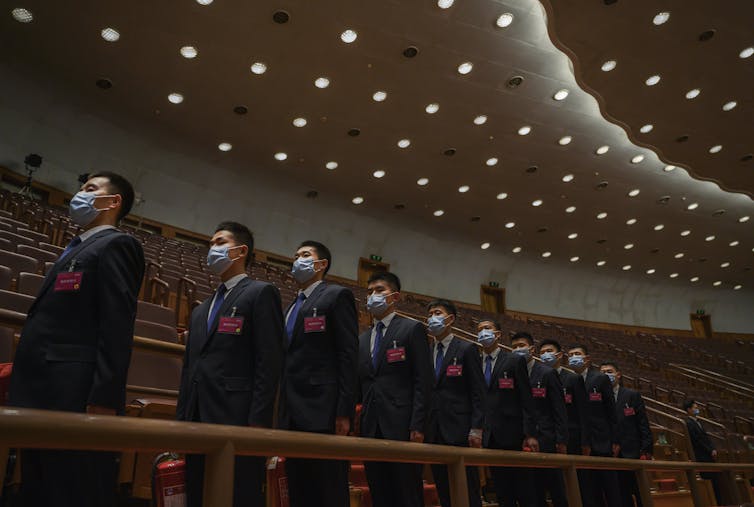
A line of men in suits with masks on.
Chinese bureaucrats faced the same constraints as their U.S. counterparts during the COVID-19 pandemic.
Frayer/Getty Images

The Chinese approach resulted in a decrease in public trust, a phenomenon that has also been unfolding in the U.S.

And much like their American counterparts, Chinese bureaucrats initially scrambled together information from a cacophony of political and expert voices. This indecision blunted their response to the viral outbreak in the decisive early days of the pandemic, even though it was eventually replaced by an official narrative emphasizing efficiency and success. In both systems, bureaucratic delays had detrimental consequences for public health.

An anchor of stability

Amid the heightened geopolitical tensions between Beijing and Washington, it is important to remember that all powers rely on capable administrations to implement political directives. Politics set the tone, but bureaucrats shape reality.

And the modus operandi of Chinese and American bureaucrats has remained strikingly stable over the years – driven primarily by incentives rather than ideology. This similarity is increasingly being reflected by converging leadership styles at the top of each political system.

U.S. President Donald Trump resembles Chinese President Xi Jinping in his campaign-style politics and the cult of personality that many political observers see developing around him.

There is a definite upside to similar bureaucratic behavior. It renders the two superpowers more predictable in periods of increasingly heated political rhetoric.

For national leaders’ proclamations to have any effect, large bureaucratic organizations need to translate political content into national and international action. Not only does this take time and resources, but erratic announcements are dissipated by bureaucratic routines.

And that provides an anchor of stability in volatile times.

The Conversation

While working for the German Institute of Development and Sustainability, Daniel E. Esser received funding from the Federal Ministry for Economic Cooperation and Development.

Heiner Janus works for the German Institute of Development and Sustainability (IDOS), which receives funding from the German Federal Ministry for Economic Cooperation and Development.

Mark Theisen works for the German Institute of Development and Sustainability (IDOS), which receives funding from the German Federal Ministry for Economic Cooperation and Development.

Tim Röthel works for the German Institute of Development and Sustainability (IDOS), which receives funding from the German Federal Ministry for Economic Cooperation and Development.

ref. 2 superpowers, 1 playbook: Why Chinese and US bureaucrats think and act alike – https://theconversation.com/2-superpowers-1-playbook-why-chinese-and-us-bureaucrats-think-and-act-alike-266305

With UK unemployment rising, will the goverment’s plan for young people pay off? An economist’s view

Source: The Conversation – UK – By Rachel Scarfe, Lecturer in Economics, University of Stirling

Monkey Business Images/Shutterstock

There are nearly one million young people in the UK who are not in employment, education or training (so-called Neets). After falling in number during the 2010s before the pandemic, this cohort of 16 to 24-year-olds has grown from 750,000 only six years ago. This is a worrying shift, for several reasons.

Research shows that a spell of unemployment at a young age can have outsized negative effects on the young person. Workers who were unemployed for even a short time at a young age have to contend with lower wages and poorer mental health even years later. In the three months to October, unemployment in the UK climbed to 5.1%, with young people particularly badly affected.

To address these challenges, the UK’s autumn budget introduced a package of measures intended to help young people move into stable work. The announcements include more apprenticeships, employment support and a guaranteed work placement for long-term unemployed young people.

There were also policies aimed at young people already in work. The government previously promised to abolish the “discriminatory” lower minimum wage for 18 to 20-year-olds. As a step towards that, the minimum wage for this age group will increase by 85p per hour in April 2026, from £10 to £10.85. This compares to an increase of 50p per hour, from £12.21 to £12.71, for workers aged 21 or over.

To make sure employers play by the rules, the government also announced stricter enforcement of employment regulations, including the minimum wage, by the new Fair Work Agency.

Together, these policies have a range of implications for young workers. The minimum wage increase means that full-time workers aged over 21 will earn around £900 more per year. And those aged 18 to 20 will receive about £1,500 more.

Stronger enforcement should reduce the risk of young people being underpaid. This year, more than 40,000 workers won compensation for earning less than the minimum wage. But of course, these are only employees of firms that have been caught – the actual number of underpaid workers is likely to be higher. More effective enforcement should boost workers’ pay and living standards.

The guaranteed jobs scheme is expected to create around 55,000 jobs – and research indicates that programmes of this kind can help young people remain in employment even after the placement ends. More funding for apprenticeships also opens up opportunities for young people to enter skilled careers.

The other side of the coin

But there are also downsides. Although the minimum wage has increased substantially over the past few years from a maximum of £8.91 in 2022 to £12.71 from April, living costs have been rising as well. As the table below shows, increases in other costs have absorbed much of the rise. In particular, average monthly rents have been rising nearly as fast as the minimum wage over the last few years.

Not only that, but employers may respond to higher minimum wages by reducing new hires or relying more heavily on flexible arrangements, such as zero-hours contracts. Evidence shows that as the minimum wage has risen, employers have moved towards flexible, temporary and hourly-paid jobs.

This is concerning for full-time workers, but also for young people relying on part-time work in sectors such as hospitality or retail while studying.

For businesses, the debate has centred on rising costs, but the picture is actually more nuanced. Higher minimum wages do increase labour and administration costs. And employing young workers can be riskier – they have less experience and it is not easy for firms to know how productive they might be compared to more seasoned workers. As a result, higher minimum wages for young workers can encourage firms to substitute towards hiring older, and possibly less risky, workers.

A more cautious approach might have been for the government to address the challenges for young people sequentially, first expanding employment opportunities, and then later raising their minimum wage.

Yet the measures in the budget could create opportunities. Evidence has consistently shown that higher minimum wages can reduce staff turnover by encouraging workers to stay in their jobs, which are now worth more to them. This is particularly true for younger workers, who tend to move jobs more often. This can lower recruitment costs and reduce interruptions for businesses, especially when they have invested in training staff.

Small and medium-sized firms will benefit directly from government-funded apprenticeships. They will no longer have to pay 5% of the training costs, making employing an apprentice more cost effective. And more flexible rules around apprenticeships give businesses greater freedom to tailor training to their needs, helping them build a workforce with relevant skills at a time of increasing technological change.

Today’s young people face significant uncertainty – nobody knows what the labour market will look like in five years’ time. But these changes represent a modest step towards supporting them.

But by increasing the minimum wage at the same time, the government is taking a gamble. On the one hand, higher wages alongside policies aimed at reducing the number of Neets could help young people into work and encourage them to stay there. But on the other, the wage increase could undermine these efforts if firms begin hiring fewer young workers. In that case, even well-designed employment schemes would struggle to offset the loss of opportunities.

The Conversation

Rachel Scarfe is a member of the Labour Party.

ref. With UK unemployment rising, will the goverment’s plan for young people pay off? An economist’s view – https://theconversation.com/with-uk-unemployment-rising-will-the-goverments-plan-for-young-people-pay-off-an-economists-view-271993

How cranberries can be a Christmas cracker for health this festive season

Source: The Conversation – UK – By Dipa Kamdar, Senior Lecturer in Pharmacy Practice, Kingston University

Media_Photos/Shutterstock

From festive sauces to brightly coloured juices, cranberries have long been part of our diets. Beyond their tart flavour and seasonal appeal, these red berries are often described as a superfood with several potential health benefits.

Cranberry supplements are promoted as a convenient way to get these benefits without the sugar or sharp taste of the juice. So what does the science actually say about cranberries, and are supplements as effective as eating the fruit?

Cranberries are best known for their role in helping prevent urinary tract infections (UTIs). The fruit contains compounds called proanthocyanidins. These compounds appear to stop bacteria such as E. coli from sticking to the lining of the urinary tract, which is one of the first steps in developing an infection. This explains why cranberry products may help prevent UTIs, although they do not treat infections once bacteria have already attached and multiplied. Research supports cranberry’s preventive role in women who experience recurrent infections and in children, although results vary between studies. One study found both cranberry juice and tablets reduced UTI rates in women, but tablets worked slightly better and were more cost-effective. Both forms reduced antibiotic use compared with placebo.

Hand pouring cranberry juice into a glass with ice cubes. A bowl of fresh cranberries is nearby.
Some research suggests cranberry juice can help reduce urinary tract infections in women and children.
Pixel-Shot/Shutterstock

Cranberries have also been investigated for their effects on heart health. They are rich in antioxidants such as anthocyanins, proanthocyanidins and quercetin. Antioxidants help protect cells from damage caused by unstable molecules called free radicals. Research shows that cranberry juice or extracts can improve several risk factors for heart disease.

These include raising levels of HDL cholesterol, often called good cholesterol because it helps remove excess cholesterol from the bloodstream, and lowering LDL cholesterol in people with diabetes. LDL is sometimes described as bad cholesterol because high levels can build up in artery walls, and it becomes even more harmful when it is oxidised. Oxidised LDL is more likely to stick to artery walls and fuel inflammation, which contributes to plaque formation. Cranberries’ antioxidants may help slow this process. They may also improve flexibility in blood vessels, reduce blood pressure and lower homocysteine, an amino acid linked to inflammation at high levels. However, not all studies report the same findings, so the evidence remains mixed.

Researchers are also studying cranberries for their possible role in cancer prevention. Lab and animal studies show that cranberry compounds, including ursolic acid, may slow the growth of tumour cells. Some compounds have anti-inflammatory effects, which is important because chronic inflammation can contribute to the development of cancer. A clinical trial found that cranberry juice may help reduce the risk of stomach cancer by blocking H. pylori, a bacterium strongly linked to this form of cancer, from attaching to the stomach lining. Adults who drank about two glasses of cranberry juice had lower infection rates. Lab and animal studies point to other possible anti-cancer effects, and upcoming research will determine whether these laboratory findings translate to humans.

The antioxidant and anti-inflammatory properties of cranberries may also support brain health. A 2022 study found that adults who consumed freeze-dried cranberry powder each day, which is equivalent to about 100 grams of fresh cranberries, showed better memory for daily tasks and improved blood flow to brain regions involved in learning. They also had reduced LDL cholesterol. High LDL can contribute to hardened arteries, which affects circulation.

Cranberries may also support the immune system. Studies suggest their natural compounds can make it less likely to catch colds or flu. Cranberries are a source of vitamin C, vitamin E, carotenoids and iron, all of which contribute to normal immune function.

Supplements, juice and whole fruits

Cranberry supplements are often promoted as an easier alternative to juice or fresh fruit. They deliver concentrated extracts of dried, powdered cranberries, usually standardised to contain a set amount of proanthocyanidins. This allows people to obtain active compounds without the sugars found in many commercial cranberry juices. However, whole fresh or frozen cranberries provide fibre and a wider range of nutrients that may be missing in supplements. Eating fruit also encourages healthier overall habits, while capsules can tempt people to treat them as a shortcut.

Wooden spoon with cranberry supplements and fresh cranberries in a bowl berries
Supplements provide concentrated extracts of dried, powdered cranberries but the whole fruit provides fibre and a wider range of nutrients too.
Pixel-Shot/Shutterstock

For most people, cranberries are safe to consume in moderation. Large amounts of juice or supplements can cause stomach upset or diarrhoea. Cranberries contain oxalates, natural chemicals that may contribute to kidney stones in people who are prone to them. Sweetened cranberry juices can also undermine potential health benefits by raising sugar intake.

The most important safety concern is the potential interaction between cranberries and certain medicines. Some case reports suggest cranberry juice may enhance the blood thinning effect of warfarin, which increases the risk of bleeding. Evidence is inconsistent, but people taking warfarin are usually advised to avoid large quantities of cranberry products. There may also be interactions with other drugs processed by the liver, although these effects are not well established.

Cranberries, then, whether eaten whole or taken as supplements, offer real health benefits, especially in reducing the risk of recurrent urinary tract infections. They may also support heart health, reduce inflammation and provide some protection against certain cancers, although the evidence for these effects is less clear. Supplements cannot replace a balanced diet, and whole cranberries provide additional nutrients and fibre that extracts cannot match. Some people should exercise caution, particularly those at risk of kidney stones or those taking specific medications.

Cranberries are not a magic solution, but they can be a valuable addition to the table, whether in a festive sauce, a handful of fruit or an occasional supplement. Enjoy them for their flavour and colour, and consider any health benefits a welcome bonus.

The Conversation

Dipa Kamdar does not work for, consult, own shares in or receive funding from any company or organisation that would benefit from this article, and has disclosed no relevant affiliations beyond their academic appointment.

ref. How cranberries can be a Christmas cracker for health this festive season – https://theconversation.com/how-cranberries-can-be-a-christmas-cracker-for-health-this-festive-season-269522

Doubts about women in combat don’t stand up to history

Source: The Conversation – UK – By Ashleigh Percival-Borley, PhD Candidate in the Department of History, Durham University

British special forces soldiers take part in a training exercise. PRESSLAB / Shutterstock

Germany has unveiled plans to introduce voluntary military service. From January 2026, all 18-year-old men will be required to complete a questionnaire asking if they are interested and willing to join the armed forces. Women will not be required to fill out this form.

Across Europe, the pattern is similar. In countries where military service is compulsory such as Austria, Cyprus, Estonia, Finland, Greece, Latvia, Lithuania, Switzerland and Ukraine, women’s enlistment remains voluntary.

The German government’s move, which has sparked a debate within the country about the role of women in the armed forces, comes months after the US defence secretary, Pete Hegseth, said in a speech to a hall of generals that if “no women qualify for some combat jobs, then so be it”.

As a former British Army combat medic who served in Afghanistan, what I recognise here is an age-old myth that war is, and always has been, a man’s world.

During my military service, I learned the different sounds made by bullets whizzing past my ears or pinging overhead. I also became familiar with the unmistakable ringing after an IED explosion. I know from experience that competence, professionalism, teamwork and a certain amount of luck all matter on the battlefield. A person’s gender does not.

History agrees with this sentiment. From the Scythian warriors of the ancient steppes – the inspiration for the Amazons’ race of women warriors in Greek mythology – and Viking shieldmaidens, to the Japanese samurai and women fighting in the crusades, evidence reveals women not only participating in battle but leading it.

The modern era has been no different. Women like Harriet Tubman guided raids during the American civil war in the 19th century.

Polish women performed crucial roles in the Warsaw uprising against German forces in 1944. And Britain’s female agents in the Special Operations Executive (SOE) assassinated, sabotaged and led resistance forces in the second world war.

A portrait image of Odette Hallowes.
Odette Hallowes joined the Special Operations Executive in 1942 and was sent to occupied France to work with the French resistance.
Imperial War Museums / Wikimedia Commons

Yet these women are largely remembered as exceptions, having performed extraordinary roles due to wartime necessity, rather than as proof of a long tradition of competence and ability under fire. Their stories remain at odds with the wider war narrative in a culture that is uncomfortable seeing women as combatants.

This was evident in Britain following the second world war, which saw the largest mobilisation of women for war work in history. Women were called upon to carry out a variety of war roles, including pilots and anti-aircraft gunners. Some women even parachuted into occupied territories as secret soldiers.

These roles allowed women to bypass the combat taboo. Yet they were still regarded as temporary, effectively excluding them from the broader war story. After the war ended, there was a strong push in Britain for women to return to traditional roles as housewives and mothers.

This was not new. Following the first world war, the 1919 Restoration of Pre-War Practices Act forced women out of the jobs they had taken during the war so that returning soldiers could be reinstated. There was no similar law following the second world war, but the government and media still encouraged women to leave working roles and focus on home life.

Magazines promoted the idea of the perfect homemaker, with Christian Dior’s 1947 “new look” fashion collection reinforcing a nostalgic vision of femininity that symbolised the broader cultural return to pre-war gender norms.

Some women welcomed this return to gendered ideals, others resisted. Pearl Witherington, an SOE agent who commanded 3,500 Maquis resistance fighters in France, was recommended for a Military Cross medal following the war. But, as a woman, she was not allowed to receive it.

Witherington refused a civil MBE honour when offered it instead, writing in a letter to Vera Atkins, an intelligence officer in the SOE: “The work which I undertook was of a purely military nature in enemy occupied country … The men have received military decorations, why this discrimination with women when they put the best of themselves into the accomplishment of their duties?”

Witherington became so important in Nazi-occupied France that the Germans put up posters offering one million francs for her capture. The reluctance to recognise her achievements shows how women’s military service was quietly stripped of its combat significance in the post-war years.

Excluding women no more

Modern conflicts have made the exclusion of women’s presence in war increasingly untenable. Insurgencies, as well as cyber and drone warfare, mean the boundaries between combatants and non-combatants have become much more blurred. Many wars nowadays no longer have clear frontlines, making it harder to distinguish between those who fight and those who don’t.

The increasing complexity of modern battlefields has demanded broader thinking and adaptability beyond traditional combat practices. This shift has contributed to the adoption of gender-neutral military standards and the more widespread inclusion of women in combat roles in many armies.

A female soldier in the Ukrainian army with a Ukraine flag wrapped around her.
Women are serving on the frontlines in Ukraine.
Dmytro Sheremeta / Shutterstock

The British Army has employed gender-neutral physical standards for combat roles since 2019. Male and female recruits must pass a 4km march carrying 40kg of equipment in less than 40 minutes, followed by a 2km march carrying 25kg of equipment in under 15 minutes.

The Australian Defence Force has adopted similar standards since 2017, while the Canadian military has been employing women in combat roles for 25 years. As a former combat medic, I support this approach.

War has always been a test of human skill and courage, not of gender. A bullet doesn’t care which body it shatters and nor should history.

The Conversation

Ashleigh Percival-Borley does not work for, consult, own shares in or receive funding from any company or organisation that would benefit from this article, and has disclosed no relevant affiliations beyond their academic appointment.

ref. Doubts about women in combat don’t stand up to history – https://theconversation.com/doubts-about-women-in-combat-dont-stand-up-to-history-268589

Teenagers are preparing for the jobs of 25 years ago – and schools are missing the AI revolution

Source: The Conversation – UK – By Irina Rets, Research Fellow, Institute of Educational Technology, The Open University

Matej Kastelic/Shutterstock

The government has recently released its national youth strategy, which promises better career advice for young people in England. It’s sorely needed: for teenagers today, the future of work probably feels more like a moving target than a destination. Barely three years after ChatGPT went mainstream, the labour market has already shifted under young people’s feet.

In the US, job postings for roles requiring no degree have dropped by 18% since 2022, and roles requiring no prior experience by 20%. Administrative and professional service jobs – once key entry points for school-leavers – are down by as much as 40%.

While headlines often warn of looming mass job losses due to GenAI, the reality is more complex. Jobs are not simply disappearing but transforming, and new kinds of jobs are appearing.

Research has projected that the adoption of new technologies will displace around two million jobs in the UK by 2035. However, this loss is expected to be offset by the creation of approximately 2.6 million new roles, particularly in higher-skilled occupations and healthcare roles.

Despite a transformed job market, OECD data from 80 countries shows that most young people still aim for traditional roles – as architects, vets and designers as well as doctors, teachers and lawyers – even as demand rises in digital, green and technical sectors. One-third of students in the OECD survey said school has not taught them anything useful for a job.

Students from more disadvantaged backgrounds are hit hardest. They engage less in career development activities, have less access to online career information and are less likely to recognise the value of education for future transitions.

Meanwhile, the very skills young people say they lack – digital skills and being informed, followed by drive, creativity and reflection – are the ones the labour market now demands.

The workforce challenge is, fundamentally, an education challenge. But schools aren’t keeping up with the world students are entering. Despite unprecedented labour-market change, teenagers’ career aspirations have not shifted in 25 years.

While older students and graduates often have networks or some workplace experience to fall back on, school-leavers do not. Yet they need to prepare for a future in which the labour market is changing faster than ever.

Future-proof skills

Young people are told they need “skills for the future”. But the evidence about which skills matter is messy, uneven and often contradictory.

A few things are clear, though. One is that digital and AI-related skills now carry significant premiums. Workers with AI or machine-learning skills earn more, and early evidence suggests that GenAI literacy can boost wages in non-technical roles by up to 36%.

Cognitive skill requirements have also surged. Critical thinking, prompt engineering – the ability to ask the right questions and provide clear, context-rich instructions to AI tools to obtain relevant results – and evaluating AI outputs are increasingly valued.

Boy with laptop looking stressed
School leavers are likely to need AI skills in the job market.
MAYA LAB/Shutterstock

However, not everything can be outsourced to AI – especially numbers. While large language models (LLMs) excel at text, they do not perform as well on quantitative tasks that involve pattern detection or numerical reasoning, although this may change with new LLM models. This makes strong numeracy a growing advantage for humans, not a declining one.

Creativity and empathy also matter – even though AI is everywhere. The future paradox is clear: young people are expected to adapt to AI systems while also offering the human qualities that machines cannot. They must be data-savvy and emotionally intelligent, digitally fluent and genuinely collaborative.

It doesn’t help that even employers are confused. Many organisations, especially small and medium-sized businesses, may not fully understand which AI-related skills they need or how to identify them. This confusion shows up in job ads, which shape who applies and who is excluded.

My research with colleagues shows, for example, that language describing jobs influences the gender and racial makeup of applicants. Ads emphasising flexibility and caring qualities tend to attract more women, reinforcing workforce segregation. If employers do not know what skills they need, or what signals they are sending, it is unreasonable to expect schools to fill the gap alone.

Identifying demand

The UK lacks a coordinated national labour market information system that could help schools, policymakers and employers see – in real time – where demand is emerging.

Preparing teenagers for the future cannot be left to a single careers lesson or a one-off talk from a visiting employer. Nor can it rely solely on career advisers operating in isolation.

A whole-school approach, supported by the wider employment and labour-market ecosystem, would make a significant difference. This means linking every subject to real-world skills and careers, and every student routinely encountering employers, workplaces and skills-building opportunities. Teenagers need up-to-date information and advice about higher education and careers, and support that challenges stereotypes and barriers.

This is not about telling students there is a “right” job or a single future path. It is about giving them tools to navigate uncertainty with confidence.

Young people need schools that understand the world they are entering, and employers who understand what they are asking for. Most of all, they need systems that recognise the future of work has changed – and help them change with it.

The Conversation

Irina Rets does not work for, consult, own shares in or receive funding from any company or organisation that would benefit from this article, and has disclosed no relevant affiliations beyond their academic appointment.

ref. Teenagers are preparing for the jobs of 25 years ago – and schools are missing the AI revolution – https://theconversation.com/teenagers-are-preparing-for-the-jobs-of-25-years-ago-and-schools-are-missing-the-ai-revolution-270630

Christmas at the end of the world: the curious allure of festive apocalypse films and TV

Source: The Conversation – UK – By Andrew Crome, Senior Lecturer in History, Manchester Metropolitan University

Navigating the chaos of Christmas celebrations can feel a bit like fighting through the battle of Armageddon. Yet while it might be tempting to escape this with a hot chocolate and another viewing of Love Actually, Christmas films needn’t be jolly.

Each year brings its share of snowbound action films and bauble-laden slasher movies. But some filmmakers choose to take things a step further – to the apocalypse. If you find yourself longing for the end of civilisation as December 25 nears, fear not – film and TV have you covered.

This link isn’t as counterintuitive as it might seem. In the Christian church calendar, the lead up to Christmas is supposed to heighten anticipation for Christ’s return. The theme of apocalypse resonates through some of the best-known Christmas images: Sandro Botticelli’s famous Mystic Nativity(1500), for example, depicts the birth of Christ along with scenes from the Bible’s Book of Revelation. An inscription declares that the artist was living through “the second woe of the Apocalypse”.

My research has explored how and why popular culture might use Christmas when depicting “the end”. Like the Ghost of Christmas yet-to-come, I can therefore point you in the direction of some of the best festive end-times stories.

The trailer for Night of the Comet.

Some seasonal horror films use festive settings to add a lighter, playful touch. In the December zombie apocalypse Night of the Comet (1984), Christmas trees and Santa suits appear amid the chaos, while Scottish musical horror Anna and the Apocalypse (2017) creatively turns giant candy canes into weapons against the undead.

Others use the holiday to generate strong emotions. As the most widely celebrated cultural festival in the west, depictions of Christmas have an obvious emotional appeal. This is why the imminent destruction of Earth sees families recreate Christmas celebrations at all times of the year as they await the end, as in Last Night (1998) or the Netflix animation Carol and the End of the World (2023).

TV shows, from Fear the Walking Dead (2015) to the comedy The Last Man on Earth (2018), have depicted characters drawing strength from memories of festivities or attempting to recreate a post-apocalyptic Christmas.

This reflects religious studies researcher Christopher Deacy’s observation that even secular visions of Christmas often contain a sense of “eschatological hope” – the desire to enter a transformed, ideal and perfected world.

While in English the word “apocalypse” suggests catastrophe or extinction, in Greek the term signifies a “revelation” of reality on both a personal and cosmic level. A last Christmas, therefore, serves as revelatory for characters – as they realise what truly matters to them beyond their own needs, fulfilling one of the classic functions of an apocalyptic story.

Christmas after the bomb

Ancient depictions of the apocalypse, like the Book of Revelation, often sought to confront readers with the horrors awaiting those who did not repent. In apocalyptic media, Christmas can serve a similar, confrontational role. The 1939 animated, Oscar-nominated short Peace on Earth depicted humanity’s destruction through endless warfare, with animals rebuilding a new world after discovering the Bible and the hope of Christmas.

Hanna-Barbera’s 1955 remake, Good Will to Men (also Oscar-nominated), heightened the Dickensian festive imagery before delivering an even more devastating vision, as an elderly mouse graphically recounts humanity’s annihilation by the atomic bomb.

Although Christmas survived the fallout in this instance, in British productions it wasn’t so lucky. The haunting portrayal of the first Christmas after the bomb, in Peter Watkin’s 1965 docudrama The War Game, showed an unshaven and haggard vicar playing Silent Night on a gramophone to traumatised survivors. The carol’s lyrics about hopeful birth and childhood are undercut with narration revealing the fate of survivors – a mother who will give birth to a stillborn child, a child who will be bedbound until death, and other youngsters expressing their desire to die.

Hanna-Barbera’s Good Will to Men.

Even grimmer is the brief festive scene in the BBC’s notorious 1984 nuclear apocalypse film, Threads. A group of shattered survivors sit in silence around a fire, the only soundtrack a baby’s wails in a grim parody of the nativity scene. The on-screen caption identifies the date only as December 25, rather than as Christmas Day. The festival has ceased to exist here; it is a day of subsistence survival like every other.

Perhaps the bleakest depiction in recent years belongs to 2021 British black comedy Silent Night. When a group of British families gather in the country to celebrate Christmas, it slowly becomes apparent they are awaiting certain death at the hands of climate catastrophe on Boxing Day. Armed with government-issued suicide pills and a special “Exit” app, the cosy festive stylings of the majority of the film are replaced by toxic fogs, horrifying injuries and parents euthanising their own children.

These apocalyptic scenarios are what researchers have described as “avertive”. They portray a horrifying future to encourage viewers to fight against it, whether encouraging protest to nuclear proliferation or environmental destruction.

Although this sort of vision might not seem particularly festive, it has a deeper root in Christmas storytelling than we might think. After all, when Scrooge is shown Tiny Tim’s death in A Christmas Carol (1843), or George Bailey the corruption of Pottersville in It’s a Wonderful Life (1946), it is precisely to avert those horrific visions from becoming a reality.

So why not wrap up in a warm blanket, grab a mulled wine, and settle down to consider the end of everything – and your role in it – this Christmas? On second thoughts, maybe Love Actually doesn’t sound so bad.


Looking for something good? Cut through the noise with a carefully curated selection of the latest releases, live events and exhibitions, straight to your inbox every fortnight, on Fridays. Sign up here.


The Conversation

Andrew Crome does not work for, consult, own shares in or receive funding from any company or organisation that would benefit from this article, and has disclosed no relevant affiliations beyond their academic appointment.

ref. Christmas at the end of the world: the curious allure of festive apocalypse films and TV – https://theconversation.com/christmas-at-the-end-of-the-world-the-curious-allure-of-festive-apocalypse-films-and-tv-271025

Internet shutdowns are increasing dramatically in Africa – a new book explains why

Source: The Conversation – Africa (2) – By Tony Roberts, Digital Research Fellow, Institute of Development Studies

Between 2016 and 2024 there were 193 internet shutdowns imposed in 41 African countries. This form of social control is a growing trend in the continent, according to a new open access source book. It has provided the first-ever comparative analysis of how and why African states use blackouts – written by African researchers.

The book, co-edited by digital rights activist and internet shutdown specialist Felicia Anthonio and digital researcher Tony Roberts, offers 11 in-depth case studies of state-sponsored shutdowns. We asked five questions about it.


How do you define an internet shutdown and why do they happen?

Put simply, an internet shutdown is an intentional disruption of online or mobile communications. They’re usually ordered by the state and implemented by private companies, internet service providers or mobile phone companies, or a combination of those.

The book argues that internet shutdowns are not legal, necessary or proportional in accordance with international human rights law. Shutdowns intentionally prevent the free flow of information and communication. They disrupt online social, economic and political life. So, each internet shutdown typically violates the fundamental human rights of millions of citizens. This includes their rights to freedom of expression, trade and commerce, democratic debate and civic participation online.

Our research looked at case studies from 11 countries between 2016 and 2024. It reveals these shutdowns are timed to coincide with elections or peaceful protests in order to repress political opposition and prevent online reporting.

In Senegal five politically motivated shutdowns in just three years transformed the country’s digital landscape. It cut off citizens’ access to online work, education and healthcare information.

The Uganda chapter shows how the government imposed social media shutdowns during the election. They were fearful of dissenting voices online including that of musician and politician Bobi Wine.

In Ethiopia internet shutdowns are timed to coincide with opposition protests and to prevent live coverage of state violent repression.

In Zimbabwe the government cut off the internet in 2019 to quell anti-government demonstrations.

It should be a concern that regimes are imposing these digital authoritarian practices with increasing frequency and with impunity.

What are the big trends?

The report warns that internet shutdowns are being used to retain power through authoritarian controls. Across Africa, governments are normalising their use to suppress dissent, quell protests and manipulate electoral outcomes.

These blackouts are growing in scale and frequency from a total of 14 shutdowns in 2016 to 28 shutdowns in 2024. There have been devastating consequences in an ever-more digitally connected world.

Internet shutdowns have also increased in sophistication. Partial shutdowns can target specific provinces or websites, so that opposition areas can be cut off. In recent years foreign states, military regimes and warring parties have also resorted to the use of internet shutdown as a weapon of war. This was done by targeting and destroying telecommunications infrastructure.

Ethiopia has experienced the most internet shutdowns in Africa – 30 in the last 10 years. They’ve become a go-to tactic of the state in their attempt to silence dissent in the Oromo and Amhara regions. Shutdowns are timed to coincide with state crackdowns on protests or with military actions – preventing live reporting of human rights violations. Ethiopia is a clear example of how internet shutdowns both reflect and amplify existing political and ethnic power interests.

Zimbabwe is one of many examples in the book of the colonial roots of shutdowns. The first media shutdowns in Zimbabwe were imposed by the British, who closed newspapers to silence calls for political independence. After liberation, the new government used its own authoritarian control over the media to disseminate disinformation and curtail opposition calls for justice and full democracy.

Towards the end of former president Robert Mugabe’s rule, the government imposed a variety of nationwide internet shutdowns. It also throttled the speed of the mobile internet, degrading the service enough to significantly disrupt opposition expression and organisation.

Sudan has experienced 21 internet shutdowns in the last decade. These have increased in recent years as the political and military action has intensified. Intentional online disruption has been consistently deployed by the state during protests and periods of political unrest, particularly in response to resistance movements and civil uprisings during the ongoing conflict.

Has there been effective resistance to shutdowns?

Activists resist by using virtual private network software (VPNs) to disguise their location. Or by using satellite connections not controlled by the government and foreign SIM-cards. They also mobilise offline protests despite violent repression.

Nigeria has not suffered the same volume of internet shutdowns as Sudan or Ethiopia. This is partly because civil society is stronger and is able to mount a more robust response in the face of state disruption of the right to free expression. When an internet shutdown has been imposed in Nigeria, the state has not enjoyed the same impunity as the government in Zimbabwe or elsewhere.

When Nigerians were unable to work online or participate in the online social and political life of the community, they took decisive action by acting collectively. They selectively litigated against the government. This led to the courts ruling that the internet shutdown was not lawful, necessary or proportionate. The government was forced to lift the ban.

How has 2025 fared when it comes to shutdowns?

We have seen both positive and negative trends in 2025. The total number of internet shutdowns across the continent continues to grow. The increasing ability of regimes to narrowly target shutdowns on specific areas is of great concern as it allows the state to punish opposition areas while privileging others.

On the positive side, we have seen resistance rise: both in terms of the use of circumvention technologies but also in the emerging ability of civil society organisations to stand up to repressive governments.

What must happen to prevent shutdowns?

The right to work, freedom of expression and association, and the right to access education are fundamental human rights both offline and online. African governments are signatories to both the Universal Convention on Human Rights and to the Africa Union Charter on Human and People’s Rights. Yet, politicians in power too often ignore these commitments to preserve their personal hold on power.

In some African countries citizens are now exercising their own power to hold governments to account but this is easier in countries that have strong civil society, independent courts and relatively free media. Even where this is not the case the constitutional court is an option for raising objections when the state curtails fundamental freedoms.

And while it is states that order internet shutdowns, it is private mobile and internet companies that implement them. Private companies have obligations to promote and protect human rights. If companies agreed collectively not to contribute to rights violations and refused to impose internet shutdowns, it would be a great leap forward in ending this authoritarian practice.

The Conversation

Tony Roberts receives funding from the Open Society Fund.

ref. Internet shutdowns are increasing dramatically in Africa – a new book explains why – https://theconversation.com/internet-shutdowns-are-increasing-dramatically-in-africa-a-new-book-explains-why-271222

National cabinet agrees to sweeping overhaul of Australia’s gun laws in response to Bondi massacre

Source: The Conversation – Global Perspectives – By Michelle Grattan, Professorial Fellow, University of Canberra

Federal, state and territory governments have agreed to the biggest overhaul of Australia’s gun laws since the Howard government’s post-Port Arthur reforms, in a response to the Bondi massacre that has claimed the lives of 15 victims so far and one of the perpetrators.

After a late Monday afternoon meeting of national cabinet, Prime Minister Anthony Albanese announced the leaders had commissioned police ministers and attorneys-general to develop options for extensive changes. These include:

  • accelerating work on standing up the National Firearms Register

  • allowing for additional use of criminal intelligence to underpin firearms
    licensing that can be used in administrative licensing regimes

  • limiting the number of firearms to be held by any one individual

  • limiting open-ended firearms licensing and the types of guns that are legal,
    including modifications and,

  • a condition of a firearm license is holding Australian citizenship.

Albanese said, in a statement after national cabinet, leaders had agreed “that strong, decisive and focused action was needed on gun law reform as an immediate action”.

This included “renegotiating the National Firearms Agreement, first established after the 1996 Port Arthur tragedy, to ensure it remains as robust as possible in today’s changing security environment”.

As an immediate priority, the federal government will prepare further customs restrictions for the import of firearms and other weapons. This will include 3D printing, novel technology and firearms equipment that can hold large amounts of ammunition.

Before the national cabinet meeting Albanese said, “People’s circumstances change, people can be radicalised over a period of time. Licences should not be in perpetuity.”

New South Wales Premier Chris Minns earlier flagged that NSW was looking to make changes to its gun laws.

“We need to make sure the firearms legislation in New South Wales is fit for purpose. That does mean restricting firearms for the general public, for the people of New South Wales,” Minns said.

The shootings were carried out by a father and son. The father, Sajid Akram, 50, was killed, while his son, Naveed Akram, 24, is in hospital. The father, who came to Australia in 1998 on a student visa, had a gun licence and six weapons.

Names and details of victims emerged during the day. They included a 87-year-old Holocaust survivor, Alexander Kleytman, and a 10-year-old girl, Matilda. Other victims were Rabbi Eli Schlanger, 41, local Jewish volunteer Marika Pogany, 82, and former NSW police officer Peter Meagher, 78. French National Dan Elkayam and one Israeli national were also killed.

Late Monday NSW Health confirmed 27 patients were receiving care in Sydney hospitals.

In a day of crisis talks, federal cabinet also met, as well as its national security committee.

Albanese declared, “We will do whatever is necessary to stamp out antisemitism”.

But pressed on the recommendations of the government’s envoy to combat antisemitism, Jillian Segal, who reported some months ago, Albanese did not commit to implementing her more radical proposals

Segal on Monday reiterated antisemitism needed to be attacked “through education, through very clear guardrails in relation to what’s acceptable in terms of our laws, through carrying through with prosecutions and penalties, through what’s happening on social media and through community speaking out.

“It means bringing that definition of antisemitism alive through the public sector. It means making sure our immigration settings are appropriate at a state level. I think we obviously need to review gun licenses.”

The Bondi attack attracted attention around the world.

Israeli Prime Minister Benjamin Netanyahu strongly attacked Albanese.

“Your government did nothing to stop the spread of antisemitism in Australia.

“You did nothing to curb the cancer cells that were growing inside your country. You took no action. You let the disease spread and the result is the horrific attacks on Jews we saw today.”

Netanyahu made special reference to Ahmed Al Ahmed who disarmed one of the gunmen: “a brave man, turns out a Muslim […] and I salute him”.

Local Jewish leaders condemned what they regard as inadequate past action against antisemitism and called for renewed efforts to combat it.

Josh Frydenberg, former Liberal treasurer in the Morrison government and a leader in the Jewish community said: “our governments, federal and state, our leadership in our civil institutions have not done enough.

“And the questions must be asked, why didn’t they act? Why didn’t they listen to the warnings, including from those who were heading up our intelligence and security agencies like ASIO, who said the rising antisemitism was their number one concern?” Frydenberg said.

The opposition was highly critical of the Albanese government.

Opposition leader Sussan Ley said, “We’ve seen a clear failure to keep Jewish Australians safe. We’ve seen a clear lack of leadership in keeping Jewish Australians safe. We have a government that sees antisemitism as a problem to be managed, not evil that needs to be eradicated.”

Former shadow home affairs spokesman Andrew Hastie claimed the government’s attention on gun reform was “a massive deflection” by the prime minister.

Hastie said the question was why when ASIO had identified Naveed Akram in 2019, his father been allowed to keep six guns.

“Let’s be clear here, it looks like radical militant Islam, who used guns to cut down people, innocent people, during a very significant religious festival, Hanukkah.” Hastie said.

He also stressed the need for screening people’s values as well as their views in relation to antisemitism.

“I want to see people coming to this country who speak English, who support Australian values of faith, reason, inquiry and debate […] we are a Judeo-Christian country, in the sense that that’s the basis on which our democracy works,” he told Sky.

The Conversation

Michelle Grattan does not work for, consult, own shares in or receive funding from any company or organisation that would benefit from this article, and has disclosed no relevant affiliations beyond their academic appointment.

ref. National cabinet agrees to sweeping overhaul of Australia’s gun laws in response to Bondi massacre – https://theconversation.com/national-cabinet-agrees-to-sweeping-overhaul-of-australias-gun-laws-in-response-to-bondi-massacre-271949

In a cynical industry, Rob Reiner’s films taught us the power of sincerity

Source: The Conversation – Global Perspectives – By Adam Daniel, Associate Lecturer in Communication, Western Sydney University

Rob Reiner, the celebrated Hollywood director whose diverse filmography was loved by a broad array of audiences, was found dead on Sunday in Los Angeles. He was 78.

Authorities have described the deaths of Reiner and his wife, Michele Singer Reiner, as suspected homicide. Their son, Nick, has been arrested in relation to their death.

Despite this tragic and shocking news, the many tributes to Reiner that have emerged overnight have celebrated the evident warmth, intelligence and humour of the man and his work.

From my perspective, Reiner’s career stands as one of the clearest demonstrations of a director moving fluidly across genres while maintaining a consistent worldview.

Whether they were romantic comedies (When Harry Met Sally…, The American President, The Sure Thing), thrillers (Misery), courtroom dramas (A Few Good Men) or coming-of-age fables (Stand By Me), Reiner’s films return again and again to deeply humanist beliefs: that people, however flawed, are capable of growth and connection; that care and empathy for each other is vital; and that cinematic stories can help us recognise this in one another.

Taking comedy seriously

First entering the cultural imagination as Meathead on TV’s All in the Family (1971–79), Reiner’s performances as an actor often concealed his sharp political intelligence beneath blunt humour.

This tension between surface comedy and underlying seriousness would also become a defining feature of his work as a director.

From the outset of his directing career with This Is Spinal Tap (1984), Reiner used comedy as a way of revealing character, contradiction and vulnerability.

This Is Spinal Tap became one of the most influential comedies ever made and my personal favourite comedy of all time.

Often celebrated for its improvisational brilliance and satirical sharpness, I think the film is equally remarkable for its affection towards its characters. It treats the titular band’s absurdity as inseparable from their sincerity.

In doing so, Reiner also helped define a new comedic grammar in the mockumentary format that was incredibly influential for future generations of comedy filmmakers.


Read more:
Why This Is Spinal Tap remains the funniest rock satire ever made


A huge emotional range

Across the late 1980s and early 1990s, Reiner’s extraordinary run of films demonstrated not only technical versatility but an emotional range that was rare among his peers.

The Princess Bride (1987) fused fairy-tale romance, adventure and meta-humour. When Harry Met Sally… (1989) remains one of the great comedic explorations of love, intimacy and relationships in American cinema.

Perhaps most striking was Reiner’s comfort with tonal complexity.

Stand by Me (1986), adapted from a Stephen King novella, looks back on childhood with both nostalgic memory and an acknowledgement of the darkness underneath suburban adolescence. Misery (1990), another King adaptation, examines toxic fandom and obsession in a taut and compelling thriller with splashes of dark humour.

A Few Good Men (1992) brings courtroom theatrics into conversation with questions of authority and ethical responsibility in the military, and gave us two iconic performances from Hollywood superstars Tom Cruise and Jack Nicholson.

What unites these films is not a particular style or subject matter, but perspective.

Reiner’s direction often privileged performance and emotion. Even when working within genre frameworks, he never accepted genre as a cage. Instead, he understood the pleasures of genre and how to utilise their tropes to explore broader questions of humanity.

Sincerity as a strength

Politically outspoken and unapologetically engaged, Reiner also never separated civic responsibility from artistic practice.

However, his films resisted dogma. In an industry that often privileges cynicism or ironic distance, Reiner’s work insisted on sincerity as a strength.

If there was a through-line to Rob Reiner’s legacy, I would argue it is a desire for audiences to feel deeply without embarrassment. His films demonstrated that laughter could be one of the most humane forces storytelling has to offer.

As an adolescent cinephile raised in the 1980s and 1990s, Reiner’s work opened my eyes to how important emotional connection was in the pact between audience and film.

His ability to work effectively across genres was due to the masterful and sincere way he made us care for his characters, be they buffoonish rock stars, princes and princesses, military lawyers and generals, or teenage boys facing their first exposure to mortality.

The Conversation

Adam Daniel does not work for, consult, own shares in or receive funding from any company or organisation that would benefit from this article, and has disclosed no relevant affiliations beyond their academic appointment.

ref. In a cynical industry, Rob Reiner’s films taught us the power of sincerity – https://theconversation.com/in-a-cynical-industry-rob-reiners-films-taught-us-the-power-of-sincerity-272164

Why can someone in suburban Sydney own 6 guns legally? New laws might change that

Source: The Conversation – Global Perspectives – By Suzanna Fay, Associate Professor in Criminology, The University of Queensland

Australians have watched on in horror as more details have come to light about the shooters in the Bondi terror attacks.

As people grapple with the tragedy, many wonder how such a thing could have happened in a country that has long prided itself on its tough gun laws.

The 50-year-old father, Sajid Akram, and 24-year-old son, Naveed Akram, had six guns. Police confirmed all of them were registered firearms. The father, who was fatally shot by police, had a recreational hunting licence and was a member of a gun club.

National Cabinet has since committed to a raft of new gun laws, including renegotiating the National Firearms Agreement, caps on the amount of firearms any one person can own and limiting open-ended licensing.

So how easy is it to get a gun in Australia currently, and how might the reforms work?

The laws of gun ownership

Gun control laws vary slightly in each state and territory, but are broadly similar. We’ll look here at the laws in New South Wales.

The first step is to apply for a firearms licence. As part of this, authorities will conduct a background check to ensure there’s no criminal history, including mental health orders or domestic violence charges.

The applicant must also pass the “fit and proper person” test. NSW Police says this test checks someone is “of good character, law abiding, honest, and shows good judgement”.

If these standards are met, a firearms licence is granted.

But in order to actually buy a firearm, people must apply for a “permit to acquire”. This is linked to the specific firearm they’d like to purchase.

If it’s their first gun, there’s a 28 day waiting period before they can have it in their possession. Subsequent guns do not need a waiting period as long as it’s in the same category they already have approval to own.

They must also pass a safety course, with both practical and theoretical components, including a written test.

Firearms, once acquired, must be stored in a specific way. Guns cannot be stored while loaded, for instance, and ammunition must be kept in a separate safe.

Finally, someone must have a “genuine reason” to buy a firearm. These include working as a primary producer, or participating in recreational hunting, among others. They need to prove a genuine reason for each and every firearm purchase. Personal protection is not a a genuine reason.

Applicants need to prove their reason is truthful. This may be proof of membership to a gun club, or a letter with express permission from the landowner on whose property they intend to hunt.

Importantly, if someone holds a firearm licence for recreational purposes, they must compete in a certain amount of competitions each year. In NSW, it’s two to four.

What works well?

Many parts of Australian gun control laws work well.

The genuine reason provisions are particularly useful. By requiring people to engage with the firearm-owning community, it stops so called “lone-wolves” from buying a gun just to have.

My research with gun clubs has also shown members can be a crucial grassroots safety check. They typically look out for each other and check in if there’s a concerning shift in someone’s attitudes or beliefs.

If things seem particularly dangerous, many report fellow members to the police so they can investigate further. The gun owning community also want our communities to be safe.

It raises the question of how engaged the shooter in this case was with his local gun community.

What could change?

While the exact circumstances for these two shooters are still emerging, we know one of the men was known to ASIO (the Australian Security Intelligence Organisation). The guns were registered to the father.

National Cabinet has agreed to a list of measures, including speeding up work on a national firearms register and limiting gun licences to Australian citizens.

They will also move to cap the number of guns a person can own. Western Australia did this earlier this year. Recreational shooters in WA can have up to five firearms, while primary producers and competition shooters can have up to ten.

It’s not uncommon for people to have more than one firearm. Licensed firearm owners in NSW have an average of about four, according to a 2025 report.

While it’s reasonable to examine the working of our current gun control measures, it’s unclear how effective such a measure would be. In the case of the Bondi attack, we need more information about the sorts of guns that were used and how many were used.

Plus, under the current laws across the country, people can’t buy more guns just because they feel like it. They have to prove a genuine reason to own another one.


Read more:
Bondi Beach shooting: how it happened


What about reviewing licences?

National Cabinet also decided to limit open-ended firearm licensing.

As it stands, licences are usually not granted for life. Renewal periods differ depending on the jurisdiction, but in NSW most licences are issued for somewhere between two and five years. We don’t yet know if any changes would make these renewal periods more frequent.

But licensing mechanisms, like recent concerns over working with children checks in the childcare sector, only capture what we know has happened. Unless people have already fallen foul of the law, authorities won’t necessarily find any concerning behaviour.

Indeed, authorities have said the Bondi shooter who owned these firearms had “no incidents” with his licence. Renewing it more regularly may have unearthed something important, or it may not have. We don’t know enough about this incident yet to say if such a law change would have been useful here.

If reviews were made much more frequent, that would require a large-scale increase in police resources.

One change that might help would be to actively involve firearms dealers in these legal changes. They have the most contact with those purchasing guns and may have valuable intelligence about how their customers are behaving and thinking.

So while changes in the letter of the law may or may not help monitor firearms owners, we have to ensure it’s implemented effectively too. This means resourcing authorities properly, working closely with communities and making sure legal changes would actually tell us what we need to know to prevent deadly gun violence.

The Conversation

Suzanna Fay has received funding from the Sporting Shooters Association of Australia for a research project in 2018 and the University of Queensland.

ref. Why can someone in suburban Sydney own 6 guns legally? New laws might change that – https://theconversation.com/why-can-someone-in-suburban-sydney-own-6-guns-legally-new-laws-might-change-that-272067