How Luxembourg detects microbes in its water supply before they pose a health risk

Source: The Conversation – UK – By Jean-Baptiste Burnet, Lead R&T Scientist, Luxembourg Institute of Science and Technology (LIST)

Microbes in water are like invisible travellers – and some carry disease with them. Keeping the water that flows through our treatment plants, rivers and taps healthy and safe from microbial infection is a challenge.

The distribution of microbes varies considerably across time and space. This makes them difficult to track through conventional monitoring programmes which rely on infrequent sampling (monthly or weekly at best) at fixed locations.

When contamination occurs, it can be very episodic (for just a few hours, say) and microbial concentrations can be extremely low. Without advanced and highly sensitive detection methods, some microbes will remain undetected.

Continuous monitoring is the best way to detect epidemics before they explode, identify contaminations before they spread, and proactively protect public health. In the small country of Luxembourg, we have been trialling new online monitoring initiatives such as Microbs and Cyanowatch to achieve this at a national level.

Luxembourg acts as a “living laboratory” where, by collaborating directly with local authorities, our team at the Luxembourg Institute of Science and Technology (List) is developing ways to prevent swimmers’ exposure to toxic bacteria, for example, or to protect people during viral outbreaks like the COVID-19 pandemic.

Water flows from natural sources through streams and rivers to treatment plants, then through distribution networks to our homes, and finally to wastewater treatment – before returning back into the environment. At each step, our dedicated observatories, equipped with multiple sampling and measurement instruments, continuously collect samples and monitor microbial water quality.

These observatories mean we can assess risks to the Luxembourg public’s health continuously – and take rapid, meaningful decisions early when needed.

Meet the microbes

These advanced surveillance systems become even more crucial as global changes intensify the microbial threats we face. Climate change, population growth, biodiversity loss and agricultural intensification are creating an explosive cocktail for the emergence – or re-emergence – of human and animal pathogens, by enabling more contact between people and animals.

aerial view looking down on wastewater treatment plant
A wastewater treatment plant.
Bilanol/Shutterstock

Blue-green algae known as cyanobacteria are ancient bacteria that can turn toxic when flooded with excess nutrients (phosphorous and nitrogen) from sewage and agricultural run-off. In warm, stagnant waters, this can create massive algal blooms that cost societies billions each year.

These blooms can disrupt natural ecosystems through the release of toxins into the water. In acute cases of human exposure, they can trigger gastro-intestinal, skin or neurological symptoms.

Viruses present a different challenge. These tiny invaders survive in water for extended periods, spreading rapidly through interconnected wastewater and drinking water supplies. From SARS-CoV-2 (the virus that causes COVID-19) to the noroviruses that cause vomiting and diarrhoea, they can trigger major outbreaks of disease.

This triple threat – climate change-induced water temperature increase, nutrient pollution, and the complex ways that pathogens circulate – demands monitoring approaches that can detect these hazards before they strike.

Monitoring these microbes

At List, we are creating innovative tools to protect public health by closely monitoring microbial hazards.

For example, at Haute-Sûre reservoir (the country’s main recreation site and drinking water supplier), a field observatory is equipped with automated instruments for real-time, 24-7 monitoring of cyanobacteria blooms. Automated cameras take hourly images at key locations, and sensor buoys in the water detect early signs of harmful blooms.

When a risk is detected, on-site toxin tests are performed – with results available within an hour. Local authorities can be alerted immediately to issue bathing bans in contaminated areas while keeping safe zones open. Such bans can also be lifted more quickly using this system.

Another water observatory was recently set up in Luxembourg to remotely and continuously monitor bacteria in drinking water. Using sensors which transmit high-resolution data in near-real time, this observatory tracks changes in microbial water quality at strategic spots across the drinking water supply network. This helps improving water management and supports the long-term supply of safe drinking water.

Meanwhile, our wastewater-based observatory, Microbs, brings together information from the inlets of 13 wastewater treatment plants across the country to monitor viruses such as SARS-CoV-2 and influenza. On-site instruments autonomously collect wastewater samples which are analysed in the lab to provide an early warning of viral outbreaks – often before they appear in the community.

Covering around 75% of Luxembourg’s population, this observatory played a key role during the COVID-19 pandemic. The data, shared regularly with health authorities, became as important as case numbers or hospitalisations, helping to guide targeted testing and implement an early response to protect the population.

To complement our technology-driven observatories, we have also launched a citizen-based observatory. Together with UK scientists, we adapted an app called Bloomin’ Algae which allows the public to report and upload photos of cyanobacteria blooms at Luxembourg’s bathing sites. These can then be verified by experts, with confirmed sightings appearing on a public map.

As climate change and population growth put strain on precious water resources, technology and citizen input, used together, are an important way to improve water monitoring and protect public health, quickly.


Don’t have time to read about climate change as much as you’d like?

Get a weekly roundup in your inbox instead. Every Wednesday, The Conversation’s environment editor writes Imagine, a short email that goes a little deeper into just one climate issue. Join the 45,000+ readers who’ve subscribed so far.


The Conversation

Jean-Baptiste Burnet receives funding from the National Research Fund Luxembourg (project 329963 INTER AUDACE) and from the Ministry of Environment (SMARTWATER, CYANOMON and CYANOWATCH projects).

Leslie Ogorzaly receives funding from the National Research Fund Luxembourg (Grant numbers: COVID-19/2022/14806023/CORONASTEP+, C21/BM/15793340/VIRALERT) and jointly from the Ministry of Health and Social Security and the Ministry of Environment (SUPERVIR project).

ref. How Luxembourg detects microbes in its water supply before they pose a health risk – https://theconversation.com/how-luxembourg-detects-microbes-in-its-water-supply-before-they-pose-a-health-risk-258018


Israel is committing genocide in Gaza, says UN commission. But will it make any difference?

Source: The Conversation – UK – By Malak Benslama-Dabdoub, Lecturer in law, Royal Holloway University of London

The UN’s independent international commission of inquiry has just released a report that may go down as one of the most significant documents in modern international law. After nearly two years of investigation, the commission has concluded that Israel is committing genocide in Gaza.

Chaired by former UN human rights chief Navi Pillay and supported by human rights experts Miloon Kothari of India and Chris Sidoti of Australia, the commission made the explosive determination of “genocidal intent”. It’s a legal and moral threshold that few international bodies have thus far dared to cross.

The Israel Defense Forces (IDF) are pressing ahead with a new ground offensive in Gaza City, despite criticism from human rights bodies as well as many of Israel’s allies and large numbers of Israeli citizens, who have protested against the ongoing military operation.

So, the UN commission’s report prompts an important question: does this determination matter? And if the UN’s most serious legal finding cannot compel action to prevent further genocidal acts (if that is what Israel is guilty of), what is the fate of the rules-based international order?

What makes this report fundamentally different from prior condemnations is its focus on intent. Accusations of war crimes and crimes against humanity have been levelled before, but genocide, as defined by the 1948 convention, requires a specific mindset. To prove genocide, it’s necessary to show an “intent to destroy, in whole or in part, a national, ethnic, racial or religious group”.

The commission’s finding is not merely an interpretation of Israel’s actions but a direct indictment of its leadership’s purpose. The report cites statements by senior Israeli officials as “direct evidence of genocidal intent” – such as Yoav Gallant describing Gazans as “human animals” when the then-defense minister announced that Israel would impose a total siege of Gaza, two days after the October 7 Hamas attack.

Israel’s president, Isaac Herzog, is also quoted by the report saying: “It’s an entire nation out there that is responsible. It is not true, this rhetoric about civilians who were not aware and not involved. It is absolutely not true.” His words are taken by the commission as “incitement to the Israeli security forces personnel to target the Palestinians in Gaza as a group as being collectively culpable for the 7 October 2023 attack in Israel”.

The report cites Israel’s prime minister Benjamin Netanyahu’s reference to the bible story in which God tells the Israelites to wipe out their enemies in the town of Amalek – “kill both man and woman, child and infant, ox and sheep, camel and donkey” – as evidence of genocidal intent. It further notes that IDF personnel “yelled and chanted direct references to Amalek as they launched attacks in Gaza”.

The UN commission also singles out the destruction of Gaza’s only IVF clinic. The clinic had stored an estimated 4,000 embryos and 1,000 sperm samples. Deliberate targeting of the clinic was, the report said, “a measure intended to prevent births among Palestinians in Gaza”.

It concludes that “genocidal intent was the only reasonable inference that could be drawn from the totality of the evidence”.

Does this determination matter?

This is the first time an international body has named a genocide as it unfolds. In Rwanda in 1994, officials avoided the word “genocide” until most of the killing had already taken place. In Bosnia, the Srebrenica massacre was only formally recognised as genocide years later by international courts. In Myanmar, the UN fact-finding mission waited until 2018 – a year after the military’s campaign against the Rohingya – to conclude that the generals acted with genocidal intent.

Here, the UN is recognising genocide as it takes place. The Commission’s report could provide fresh evidence for the ongoing cases against the state of Israel and its leaders that are before the International Court of Justice and International Criminal Court (ICC).

Yet here lies the core problem. Courts can issue orders and warrants but without cooperation from states, enforcement is weak. Israel is not an ICC member, and its powerful allies are unlikely to surrender any of Israel’s leaders who may face charges.

Meanwhile the UN security council, paralysed by the US’s use of its veto, cannot compel action. Israel has repeatedly ignored all UN resolutions and reports, calling them biased.

The UK, too, has continued to do business with Israel. Just this month, its prime minister, Keir Starmer, hosted Herzog in Downing Street. Enforcement depends on state power. If the US, UK and EU continue to shield Israel diplomatically, the commission’s report will not translate into any tangible resolutions or actions – thereby illustrating the weakness of international law.

International law at stake

Genocide against the Palestinian people must be prevented at all costs. But the credibility of international law is also at stake if nothing is done in response to the UN commission’s determination.

The UN charter was designed to prevent the very kind of impunity we are witnessing. Yet when one permanent member of the security council, the US, can unilaterally block action, the system itself breaks down.

The commission’s report lays bare the hypocrisy of a global system that claims to be governed by law but is, in practice, governed by the political will of a few powerful states.

If a formal legal finding of genocide has no practical effect on the ground – if it does not stop the killing, the starvation or the destruction – this implies that international law is merely a suggestion, not a mandate, when powerful nations are at the centre of the controversy.

For Palestinians, the report is validation. For international law, it is a test. Either the genocide determination triggers real accountability – sanctions, arms embargoes, prosecutions – or it exposes the gap between lofty promises and political reality.

The UN commission’s report is likely to fuel pressure in the UN general assembly. It will undoubtedly energise civil society and may strengthen ongoing legal cases. But whether it has concrete consequences depends on states being willing to act against Israel – and, crucially, whether the US and UK maintain their protective stance.

The UN still counts for something, but perhaps not in the way it once did. Its power is not in the capacity to enforce, but in the power to name, to document and to judge.

The future of international law may well be judged on what happens next: whether the gravest crime in its canon can be recognised but left unchecked.

The Conversation

Malak Benslama-Dabdoub does not work for, consult, own shares in or receive funding from any company or organisation that would benefit from this article, and has disclosed no relevant affiliations beyond their academic appointment.

ref. Israel is committing genocide in Gaza, says UN commission. But will it make any difference? – https://theconversation.com/israel-is-committing-genocide-in-gaza-says-un-commission-but-will-it-make-any-difference-265513

What NATO could learn from Ukraine as it navigates Russian threats to European security

Source: The Conversation – Canada – By James Horncastle, Assistant Professor and Edward and Emily McWhinney Professor in International Relations, Simon Fraser University

Russian drones recently violated Polish and Romanian airspace.

These intrusions, whether intentional or not, caused Poland to shut down airports and both Polish and Romanian officials deployed their air forces. The Polish air force, ultimately, succeeded in downing 19 drones while Romania monitored but did not engage for fear of collateral damage.

The media focus in the aftermath of these incursions is on the political ramifications. Both Poland and Romania are NATO members, and Poland has invoked Article 4 of the NATO treaty. It’s one of only eight times a country has invoked it.

Article 4, the shortest of the NATO treaty’s 14 articles, states that:

“The Parties will consult together whenever, in the opinion of any of them, the territorial integrity, political independence or security of any of the Parties is threatened.”

‘Here we go!’

American President Donald Trump wrote about the incursions on social media: “What’s with Russia violating Poland’s airspace with drones? Here we go!

This statement stoked hopes among Ukraine’s supporters that Trump would increase either his support for Ukraine or boost sanctions on Russia. Besides stating that he would impose harsh sanctions if NATO countries stop importing Russian oil, Trump has so far done nothing.

The political ramifications are important. Noted war theorist Carl von Clausewitz, after all, defined war as a political act.

What’s missing from recent analyses, however, is how Ukraine’s struggle over the last three years has yielded valuable lessons for Europe’s defence.

A BBC report on Russian drones in Poland.

An ongoing peace

Polish Prime Minister Donald Tusk, in the aftermath of the intrusion, declared in parliament that “this situation brings us the closest we have been to open conflict since World War Two.” Tusk’s statement highlighted the political significance of Russia’s actions and underscored the seriousness of the incident.

It also highlights how many European countries have had little engagement with direct conflict since the Second World War. There are notable exceptions to this point, specifically for the United Kingdom and France, but for many European countries, their engagement with war has been more theoretical and less practical.

Even in the case of the U.K. and France, military operations they’ve engaged in are not similar to those Ukraine faces against Russia. France and Britain have fought either insurgency campaigns or in wars against states that lacked their military capabilities, like Iraq.

These actions, while useful from a military standpoint, could be distorting perceptions about their capabilities when it comes to engaging against a competitor with similar military strength.

Fighting the ‘last war’

Militaries face a constant problem in their preparations as they determine what tools will be needed for the next war. This question is complex.

The interaction between new technologies and human beings can create unique dynamics that can alter the balance of warfare. Germany’s ability to combine radio, mobility and mission tactics in the form of the Panzer tank, for example, initially shifted the balance of the Second World War.

Some technologies, however, can end up being a proverbial dead end and cost a state significantly for no appreciable gain. Admiral John Fisher, the First Sea Lord of the British Royal Navy at the start of the 20th century, believed a vessel known as the battle cruiser would revolutionize warfare. Battle cruisers were ships with the weapons of a battleship and the armour and speed of a cruiser.

The concept of the battle cruiser, one that would outrun a battleship and destroy any lesser ship, was sound. Human nature and a lack of creativity, however, meant that British admirals frequently used them against battleships. Deploying battle cruisers against targets they were not designed to fight ended in tragedy.

The result of such deployments was disaster at the Battle of Jutland off the coast of Denmark in the First World War, and further calamity when the German battleship Bismarck sank the British battle cruiser HMS Hood during the Second World War.

In other words, armed forces can spend large sums of money on technological innovations and end up with no appreciable gain. In fact, a country can place itself at a distinct disadvantage if it invests incorrectly.

A black-and-white photo shows to large battle cruisers at anchor in a harbour.
Battle cruisers HMS. Hood, with the HMS Repulse behind it, at anchor during a visit by the Royal Naval Fleet to South Australia in January 1924.
(State Library of South Australia), CC BY

Finding the right tools and practices

Russia’s incursion into Polish and Romanian airspace has the potential to expose the vulnerability of both countries, and more broadly NATO as well. Although Poland succeeded in eliminating the drones, it needed to employ aircraft to do so. Ukraine’s experience demonstrates there are much cheaper and more efficient ways of eliminating enemy drones than employing expensive aircraft.

Ukraine continues to develop a multi-layered air defence system to protect its soldiers and civilians from Russia’s nightly drone bombardment.

These methods range from interceptor drones to electronic warfare jammers.

In the aftermath of Russia’s incursion into Poland, in fact, European nations are looking for guidance from Ukraine on practices and technology to combat drone attacks.

Dealing with drones in contemporary warfare is just one facet of what observers can learn from the enduring war in Ukraine. But there are other lessons that could have an even greater impact on what European countries should consider in their defence policies.

Learning from Ukraine

First among them is the importance of mass armies. Western military doctrine seeks to overcome the question of mass through technological innovations that promote manoeuvre on the battlefield to overcome larger armies.

But unfortunately, technological innovations in the war in Ukraine — whether they’ve involved drones or advanced sensors — have reinforced attrition versus the manoeuvre tactics favoured by western countries. In such a war the size of one’s army, and its capacity to produce munitions, are of paramount importance.

Second, the western experience of peace has distorted collective perceptions of war. Ukraine has shown us that disinformation campaigns, often considered a form of warfare by the West, are simply not on par with the destruction and harm a conventional war inflicts on people.

Western countries have spent too much energy preparing for disinformation campaigns and other forms of hybrid warfare versus the traditional-style war Ukraine faces against Russia.


Read more:
Russian propaganda is making inroads with right-wing Canadians


This distortion has contributed to the West’s slow response time in Ukraine. European states, three years after the current phase of the conflict, are still coming up short. Armaments production in the European Union is not sufficient to support Ukraine, let alone the continent’s needs.

Throughout its war with Russia, Ukraine is providing a formula: large armies and certain new technologies are what European and other states require for a contemporary war. The question remains, however, if these states will heed these lessons.

The Conversation

The authors do not work for, consult, own shares in or receive funding from any company or organisation that would benefit from this article, and have disclosed no relevant affiliations beyond their academic appointment.

ref. What NATO could learn from Ukraine as it navigates Russian threats to European security – https://theconversation.com/what-nato-could-learn-from-ukraine-as-it-navigates-russian-threats-to-european-security-265347

Your immune system attacks drugs like it does viruses – paradoxically offering a way to improve cancer treatment

Source: The Conversation – USA – By Tom Anchordoquy, Professor of Pharmaceutical Sciences, University of Colorado Anschutz Medical Campus

Researchers are studying the potential of gold nanoparticles (yellow dots) to deliver drugs into the body. Veronika Sapozhnikova, Konstantin Sokolov, Rebecca Richards-Kortum/M.D. Anderson Cancer Center and Rice University via NIH/Flickr

When the first cells appeared on Earth approximately 3.8 billion years ago, viruses were already here to greet them. Ever since, viruses have been devising ways to infect cells, and cells have been responding by evolving ways to stop these infections. This evolutionary dance eventually led to the development of your immune system.

A key aspect of your immune system is to distinguish “self” from “nonself” so it can destroy and remove foreign materials from your body. While this immune reaction protects you from viruses, it also has implications for how well foreign materials such as medications work.

I am a researcher studying ways to make drugs work better, including how to get them to the site of disease within the body before being removed or destroyed. One way to do this is to encapsulate drugs in nanoparticles – materials small enough to be taken up by cells. While these materials still trigger an immune response to get them out of the body, scientists like me have found that this reaction could actually be used to improve the effectiveness of cancer treatment.

The immune system and drug delivery

In addition to detecting pathogens, your immune system also responds to tissue damage. You might observe this reaction as inflammation – such as redness and swelling – when drugs are injected into your body with a needle.

Typically this inflammatory response is minimal. But the potential for a sustained reaction increases when drugs are administered slowly over a prolonged period of time, such as during chemotherapy infusions that can take an hour or more. For this reason, some patients are given anti-inflammatory medications before infusion to reduce the potential for an adverse immune response during treatment.

The most recent breakthroughs in getting drugs into the body is using nanoparticles. These materials – which can be made from lipids, proteins, gold or other components – have the advantage of being very small: The diameter of a typical nanoparticle is about 10-thousandths of a millimeter. Their small size allows diseased cells to easily take them up. So when nanoparticles contain drugs, they can act as a drug delivery system.

Nanomaterials are used across many industries, including medicine.

Despite being so small, nanoparticles can hold a large number of drug molecules, allowing them to deliver a potent cargo of treatment directly into a cell. They can also deliver drugs made of DNA and RNA. The most well-known example of this technology is the COVID-19 vaccine, which uses nanoparticles made of modified fat molecules to deliver mRNA that teaches the immune system to protect itself against COVID-19 infection.

Your innate immune system also identifies nanoparticles as foreign invaders when they are injected into your body. As a result, some patients experience an initial inflammatory reaction when the body tries to attack the nanoparticle.

But what if this reaction could actually be used to improve treatment?

Exploiting the innate immune response

For the past 30 years, my laboratory at the University of Colorado has been studying how nanoparticles deliver drugs. More recently, we have focused on understanding how the innate immune system responds to an injection of nanoparticles. While this immune reaction is typically considered a drawback, we wanted to explore whether it could enhance therapy.

In a 2022 study on how nanoparticles affect the immune response in mice, we found that the innate immune response triggered by an initial dose of nanoparticles carrying a drug will also reduce the effects of a second dose if it is injected shortly afterward – typically within days. It does this by clearing the drug out from the body more quickly. This reaction is similar to how an initial viral infection would trigger a short-term protective response against a subsequent infection from another virus.

Microscopy image of blue spheres surrounded by magenta borders, many small yellow dots concentrated inside
Nanoparticles – the yellow dots – can be designed to home in on cancer cells, which are blue.
NIH

One critical aspect of this protective effect involves the production of a protein called interferon lambda. This molecule “interferes” with the infection process by restricting viruses from gaining access to different tissues in the body. Researchers have previously tested this protein as a potential antiviral drug to treat COVID-19.

Similarly, the interferon lambda made in response to the first dose of nanoparticles limits the ability of the second dose to deliver the drug to healthy tissues in the body. However, it did not affect the nanoparticle’s ability to access tumors, possibly because tumors can impair the immune response.

In conventional cancer treatment, chemotherapy drugs are used to kill the tumor. Because these drugs are also toxic to healthy cells, patients often experience side effects such as hair loss, gastrointestinal problems and skin rashes. Using nanoparticles to deliver cancer treatment could help reduce these side effects, and combining them with interferon lambda could allow the nanoparticle-encapsulated drug to stay in the body long enough to have its full effects.

Our team is studying whether directly injecting interferon lambda before chemotherapy with nanoparticles could help limit the amount of drug that ends up in healthy tissues while increasing their concentration in tumors. In an initial test of this strategy in mice with colon cancer, all mice that received interferon lambda saw increased survival time and reduced weight loss. A better understanding of how this effect happens could help researchers eventually test this approach to cancer treatment in human patients.

Scientists have a long way to go in developing nanoparticles that are as efficient as viruses at getting into cells. But our hope is that exploiting an immune response that evolved approximately a billion years ago to prevent viral infections could help reduce the toxic side effects from treatment while improving its effectiveness.

The Conversation

Tom Anchordoquy receives funding for this work from the Nationals Institutes of Health through grant # RO1 CA289447.

ref. Your immune system attacks drugs like it does viruses – paradoxically offering a way to improve cancer treatment – https://theconversation.com/your-immune-system-attacks-drugs-like-it-does-viruses-paradoxically-offering-a-way-to-improve-cancer-treatment-249824

Mars rovers serve as scientists’ eyes and ears from millions of miles away – here are the tools Perseverance used to spot a potential sign of ancient life

Source: The Conversation – USA – By Ari Koeppel, Earth Sciences Postdoctoral Scientist and Adjunct Associate, Dartmouth College

Scientists absorb data on monitors in mission control for NASA’s Perseverance Mars rover. NASA/Bill Ingalls, CC BY-NC-ND

NASA’s search for evidence of past life on Mars just produced an exciting update. On Sept. 10, 2025, a team of scientists published a paper detailing the Perseverance rover’s investigation of a distinctive rock outcrop called Bright Angel on the edge of Mars’ Jezero Crater. This outcrop is notable for its light-toned rocks with striking mineral nodules and multicolored, leopard print-like splotches.

By combining data from five scientific instruments, the team determined that these nodules formed through processes that could have involved microorganisms. While this finding is not direct evidence of life, it’s a compelling discovery that planetary scientists hope to look into more closely.

A streaked and spotted rock surface
Bright Angel rock surface at the Beaver Falls site on Mars shows nodules on the right and a leopard-like pattern at the center.
NASA/JPL-Caltech/MSSS

To appreciate how discoveries like this one come about, it’s helpful to understand how scientists engage with rover data — that is, how planetary scientists like me use robots like Perseverance on Mars as extensions of our own senses.

Experiencing Mars through data

When you strap on a virtual reality headset, you suddenly lose your orientation to the immediate surroundings, and your awareness is transported by light and sound to a fabricated environment. For Mars scientists working on rover mission teams, something very similar occurs when rovers send back their daily downlinks of data.

Several developers, including MarsVR, Planetary Visor and Access Mars, have actually worked to build virtual Mars environments for viewing with a virtual reality headset. However, much of Mars scientists’ daily work instead involves analyzing numerical data visualized in graphs and plots. These datasets, produced by state-of-the-art sensors on Mars rovers, extend far beyond human vision and hearing.

A virtual Mars environment developed by Planetary Visor incorporates both 3D landscape data and rover instrument data as pop-up plots. Scientists typically access data without entering a virtual reality space. However, tools like this give the public a sense for how mission scientists experience their work.

Developing an intuition for interpreting these complex datasets takes years, if not entire careers. It is through this “mind-data connection” that scientists build mental models of Martian landscapes – models they then communicate to the world through scientific publications.

The robots’ tool kit: Sensors and instruments

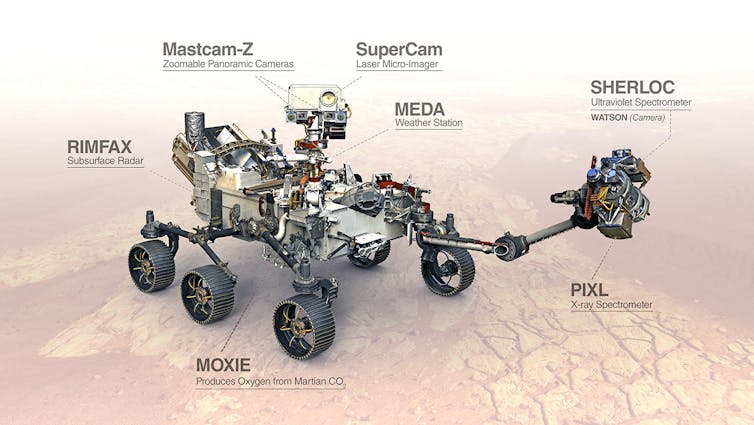
Five primary instruments on Perseverance, aided by machine learning algorithms, helped describe the unusual rock formations at a site called Beaver Falls and the past they record.

Robotic hands: Mounted on the rover’s robotic arm are tools for blowing dust aside and abrading rock surfaces. These ensure the rover analyzes clean samples.

Cameras: Perseverance hosts 19 cameras for navigation, self-inspection and science. Five science-focused cameras played a key role in this study. These cameras captured details unseeable by human eyes, including magnified mineral textures and light in infrared wavelengths. Their images revealed that Bright Angel is a mudstone, a type of sedimentary rock formed from fine sediments deposited in water.

Spectrometers: Instruments such as SuperCam and SHERLOC – scanning habitable environments with Raman and luminescence for organics and chemicals – analyze how rocks reflect or emit light across a range of wavelengths. Think of this as taking hundreds of flash photographs of the same tiny spot, all in different “colors.” These datasets, called spectra, revealed signs of water integrated into mineral structures in the rock and traces of organic molecules: the basic building blocks of life.

Subsurface radar: RIMFAX, the radar imager for Mars subsurface experiment, uses radio waves to peer beneath Mars’ surface and map rock layers. At Beaver Falls, this showed the rocks were layered over other ancient terrains, likely due to the activity of a flowing river. Areas with persistently present water are better habitats for microbes than dry or intermittently wet locations.

X-ray chemistry: PIXL, the planetary instrument for X-ray lithochemistry, bombards rock surfaces with X-rays and observes how the rock glows or reflects them. This technique can tell researchers which elements and minerals the rock contains at a fine scale. PIXL revealed that the leopard-like spots found at Beaver Falls differed chemically from the surrounding rock. The spots resembled patterns on Earth formed by chemical reactions that are mediated by microbes underwater.

A diagram of the Perseverance rover with lines pointing to its instruments
Key Perseverance Mars Rover instruments used in this analysis.
NASA

Together, these instruments produce a multifaceted picture of the Martian environment. Some datasets require significant processing, and refined machine learning algorithms help the mission teams turn that information into a more intuitive description of the Jezero Crater’s setting, past and present.

The challenge of uncertainty

Despite Perseverance’s remarkable tools and processing software, uncertainty remains in the results. Science, especially when conducted remotely on another planet, is rarely black and white. In this case, the chemical signatures and mineral formations at Beaver Falls are suggestive – but not conclusive – of past life on Mars.

There actually are tools, such as mass spectrometers, that can show definitively whether a rock sample contains evidence of biological activity. However, these instruments are currently too fragile, heavy and power-intensive for Mars missions.

Fortunately, Perseverance has collected and sealed rock core samples from Beaver Falls and other promising sites in Jezero Crater with the goal of sending them back to Earth. If the current Mars sample return plan can retrieve these samples, laboratories on Earth can scrutinize them far more thoroughly than the rover was able to.

The Perseverance rover on the dusty, rocky Martian surface
Perseverance selfie at Cheyava Falls sampling site in the Beaver Falls location.
NASA/JPL-Caltech/MSSS

Investing in our robotic senses

This discovery is a testament to decades of NASA’s sustained investment in Mars exploration and the work of engineering teams that developed these instruments. Yet these investments face an uncertain future.

The White House’s budget office recently proposed cutting 47% of NASA’s science funding. Such reductions could curtail ongoing missions, including Perseverance’s continued operations, which are targeted for a 23% cut, and jeopardize future plans such as the Mars sample return campaign, among many other missions.

Perseverance represents more than a machine. It is a proxy extending humanity’s senses across millions of miles to an alien world. These robotic explorers and the NASA science programs behind them are a key part of the United States’ collective quest to answer profound questions about the universe and life beyond Earth.

The Conversation

Ari Koeppel previously received funding from NASA science grants. He is affiliated with The Planetary Society. Any views represented in this article are those of the author. The budget cuts do not directly affect the author’s work and he is not currently formally connected to the rover campaign.

ref. Mars rovers serve as scientists’ eyes and ears from millions of miles away – here are the tools Perseverance used to spot a potential sign of ancient life – https://theconversation.com/mars-rovers-serve-as-scientists-eyes-and-ears-from-millions-of-miles-away-here-are-the-tools-perseverance-used-to-spot-a-potential-sign-of-ancient-life-265144

How a fly sees the world – and why understanding its vision can help prevent disease

Source: The Conversation – UK – By Roger Santer, Lecturer in Zoology, Aberystwyth University

What do you look like to a house fly? Lee Hua Ming/Shutterstock

Jakob von Uexküll was a Baltic German biologist ahead of his time, intrigued by the idea that animals inhabit unique perceptual worlds quite unlike our own. In 1934, he described angling for flies by swinging an adhesive-covered pea on a thread, finding that male flies would dive on the pea and be caught. Within the perceptual world of a fly, the swinging pea was a potential mate.

We can’t be exactly sure what a fly’s perceptual world looks like, but we know it must be very different to our own. And learning about it can do much more than satisfy our curiosity. It could help keep people safe from disease.

While a human eye has only one lens, the main eyes of flies are compound eyes that each consist of hundreds or thousands of individual lenses. A fruit fly eye has about 700, and a blowfly eye 5,000. Each of these lenses is part of a sampling unit called an ommatidium, which also contains eight light-sensitive photoreceptor cells.

The structure of the compound eye affects a fly’s ability to make out shapes and patterns. In houseflies, light from a given point in its field of view activates seven photoreceptors in seven separate ommatidia through their respective lenses. Combined, that information is a bit like an image pixel.

Information about shape and pattern is generated when the visual system compares neighbouring “pixels”. The arrangement of lenses in the compound eye limits the minimum size of a “pixel” and thus a fly’s ability to make out spatial details.

As a result, a fly can only resolve relatively coarse spatial detail. If a housefly and a human with 20/20 vision were taking an eyesight test, the fly would need to be about 6cm from the chart to make out the detail that the human could at six metres. For the fly to achieve human-like spatial resolution, it would need larger lenses and a flatter eye, resulting in a compound eye about one metre in diameter.

This lack of spatial acuity is compensated for with speed. Some fly species’ photoreceptors respond much faster than human photoreceptors. This is true of day-active flies which have faster-responding photoreceptors than their more ponderous, nocturnal kin. For us, a flashing light blurs into a constant one at 50-90 flashes per second, but a blowfly’s photoreceptors can distinguish more than 200 separate flashes per second. Thus, we perceive motion in the fast sequence of static images comprising a cartoon, but a fly might not be fooled.

Green bottle fly on leaf.
Blowfly photoreceptors are much faster than human ones.
PARMAM-BHUN2556/Shutterstock

Given this, it’s no wonder that swatting an irritating fly can be a challenge.
When a scientist from Florida tried to photograph resting long-legged flies, he found that the flies were generally in flight, potentially startled by the flash, before the image was even captured.

Saying this, some fly eyes are specially adapted for both spatial and temporal detail. Male flies of many species have eyes that meet at the top and front of the head, whilst those of females have an obvious gap. The extra region of the male eye is the “love spot”, with larger lenses and faster-responding photoreceptors that give improved sensitivity to small and fast-moving objects needed for tracking females during high-speed airborne courtship chases.

Killer fly relatives of the humble housefly are also adapted for great visual prowess, here needed to catch small insect prey like fruit flies mid-flight.

Most people don’t consider perception as they try to shoo an annoying fly out of an open window, or whack it with a newspaper. However, understanding insect perception can inspire new ways of controlling pests, as von Uexküll’s fly “fishing rod” demonstrated. This is important because lots of flies transmit disease, so we need to control flies to prevent sickness in humans and animals.

Perception of colour is important in this context. The human retina has three kinds of cone photoreceptors sensitive to blue, green and red light, and our brains compare those three signals to create colour perceptions. By contrast, a typical housefly ommatidium has five types of photoreceptors including a couple sensitive to UV, but none that are particularly sensitive to red light.

As a result, colour perceptions must be quite different for flies and humans, and experiments with blowflies suggest they perceive just four distinct colours, some with no human equivalent. Whether this is true of other flies remains to be seen.

In Africa, tsetse flies spread sleeping sickness, which has profound effects on the central nervous system that upset the sleep/wake cycle, cause confusion and sensory disturbances, and ultimately lead to death without treatment.

Coloured fabric targets doused with insecticide are often used to control tsetse flies and protect humans and animals, and normally these targets are blue. However, we modelled fly colour perception to develop a better colour for luring flies, which turned out to be purple to a human eye. We recently found that this colour attracts stable flies and houseflies as well, which are also vectors of human and animal disease.

In urban settings, we are combining colour and spatial vision models to understand how to better manage flies in these environments. A particular challenge is that artificial lighting is designed for human vision, and lacks UV wavelengths that flies are sensitive to. This gives the light an entirely different colour from their point of view, and potentially prevents flies from differentiating between colours that they otherwise would under natural lighting.

By delving into the fly’s perceptual world, we hope we can better understand their behaviour, and devise new methods to control them.

The Conversation

Roger Santer has received funding from the Global Challenges Research Fund delivered through the Higher Education Funding Council for Wales and distributed via the Centre for International Development Research at Aberystwyth. He has also benefitted from funding from the Biotechnology and Biological Sciences Research Council to Aberystwyth University.

Matt Sparks receives funding from a PhD studentship through an EPSRC UKRI Doctoral Training Partnership between Swansea University and Rentokil Initial under the name ‘Characterisation and manipulation of urban light environments for fly control’.

ref. How a fly sees the world – and why understanding its vision can help prevent disease – https://theconversation.com/how-a-fly-sees-the-world-and-why-understanding-its-vision-can-help-prevent-disease-257151

Harvard, like all Americans, can’t be punished by the government for speaking freely – and a federal court decision upholds decades of precedents saying so

Source: The Conversation – USA – By Stephanie A. (Sam) Martin, Frank and Bethine Church Endowed Chair of Public Affairs, Boise State University

The Trump administration’s actions against Harvard threaten a foundational American value – free speech. zpagistock/Getty Images

When the federal government threatened to cancel billions in research funds from Harvard University – as it has also done to other research universities – the message was clear: Institutions that speak or think in ways elected officials dislike can expect to pay a price.

But in a recent ruling that underscored a principle at the heart of American democracy, a federal judge struck down the Trump administration’s move. The “government-initiated onslaught against Harvard was much more about promoting a governmental orthodoxy in violation of the First Amendment than about anything else,” U.S. District Judge Allison Burroughs wrote.

The Harvard controversy began when the Trump administration announced plans to cut off billions in federal research funds because it objected to the university’s public positions, campus culture and some of its academic scholarship. No one contended that Harvard had mismanaged money or failed to meet grant requirements.

Instead, the White House said the school had done too little to eliminate so-called woke diversity, equity and inclusion – DEI – policies and alleged that antisemitism proliferated on campus, as evidenced by student demonstrations against Israel’s conduct in the Gaza war.

Along with the American Association of University Professors, Harvard filed suit in response to the funding cuts, arguing that the administration’s action was punitive and unconstitutional – a textbook case of retaliation. By canceling funding, the government was deploying financial pressure to silence disfavored speech.

White House Press Secretary Karoline Leavitt on April 15, 2025, spoke about President Donald Trump’s moves against Harvard.

Protection for dissent and disagreement

In striking down the funding cut, Burroughs ruled that the administration’s move violated the First Amendment. The First Amendment protects freedom of speech, press, religion and assembly by limiting government intrusion. While government officials may disagree with Harvard’s speech – whether that means faculty scholarship, public statements or the culture of campus debate – they cannot retaliate by pulling federal support, the judge wrote.

As chair of a public policy institute devoted to strengthening deliberative democracy, I have written two books about the media and the presidency, and another about media ethics. My research traces how news institutions shape civic life and why healthy democracies rely on free expression.

The principle at work in the Harvard case is simple: Free speech protections don’t just apply to individuals in the town square or in places where public decisions are being made.

First Amendment rights extend to private institutions, even when their views or policies contravene official government opinions, and even when they receive funding from the government. Government reprisal does more than chill speech – it sets up a system where only state-approved viewpoints can flourish.

Supreme Court has seen this before

The ruling in Harvard’s favor follows a long legal tradition of Supreme Court rulings that bar the government from demanding ideological acquiescence in exchange for support.

In the case Speiser v. Randall that was decided in 1958, the court struck down a California law requiring veterans to sign loyalty oaths to receive tax exemptions. The decision created the doctrine of unconstitutional conditions, a principle that forbids government from making the receipt of a government benefit or entitlement conditional in a way that interferes with the exercise of a constitutional right.

In Perry v. Sindermann, a 1972 decision, a professor was denied reappointment at a state college after criticizing administrators. Even without tenure, the court held, the government could not retaliate against him for protected speech.

And in Legal Services Corp. v. Velazquez, the court in 2001 invalidated restrictions that barred federally funded legal aid lawyers from challenging welfare laws. Justice Anthony Kennedy wrote that such limits “distort the legal system” by preventing some members of the bar from making arguments on behalf of their clients, while the government would face no similar restriction in promoting their own views.

A large, columned building with red banners hanging from the front.
People walk past the Harry Elkins Widener Memorial Library on Harvard’s campus on June 5, 2025.
Heather Diehl/The Boston Globe via Getty Images

Supreme Court’s contemporary signals

More recent cases show the court wrestling with the same question in new contexts.

The court’s 2013 decision in Agency for International Development v. Alliance for Open Society International struck down a requirement that nonprofits adopt a government-approved position opposing prostitution in order to receive global health funding.

The government, Chief Justice John Roberts wrote, could not make program funds dependent on grant-seeking groups adopting particular political or moral beliefs. In this case, that meant the Alliance for Open Society did not have to condemn sex work in order to qualify for public health funding.

Likewise, in Janus v. AFSCME from 2018, the court struck down an Illinois law that required public employees who chose not to join a union to still pay fees to support it. The state had argued that these “fair-share fees” were necessary because unions bargain on behalf of all workers. But the court said that forcing nonmembers to pay was a form of compelled speech – subsidizing union political organizing – that abridged the First Amendment.

While the context is very different from Harvard’s funding dispute, both cases highlight the same principle: The government cannot use money – whether through subsidies, grants or mandatory fees – as a way to compel or suppress expression. These rulings show that the First Amendment protections apply to government funding and policy questions that quietly shape who gets heard and who does not.

Long history of retaliation

While American myth celebrates the idea that the United States welcomes dissent, the government has a history of punishing protesters.

The Alien and Sedition Acts of 1798 criminalized criticism of the federal government. During World War I, the Espionage and Sedition Acts were used to imprison activists and silence newspapers. In the 1950s, Sen. Joseph McCarthy’s crusade against alleged communists extended to universities, with faculty losing jobs and having their careers destroyed.

In each of those episodes, dissent was framed as dangerous to national security or social stability. And in each case, the tools of government – whether criminal law, congressional investigations or funding threats – were used to discipline voices that strayed from the party line. The impulse to punish institutions for perceived ideological deviance is part of a recurring American story.

What’s distinctive today is how the tactic has been folded into the culture wars.

Where earlier generations of politicians used criminal prosecution or loyalty oaths, the contemporary fight often plays out in budget spreadsheets. Defund public radio. Cut university budgets. Zero out grants to the arts.

These are not just fiscal decisions; they are symbolic moves aimed at disciplining institutions seen by conservatives as too liberal or too critical.

A portrait of an 18th-century man, with white curls and wearing old-fashioned clothes.
President John Adams supported the 1798 Alien and Sedition Acts, which criminalized criticism of him but not opposition leader and Vice President Thomas Jefferson.
Library of Congress

Why this matters beyond the courts

The latest ruling may protect Harvard in this instance, but the larger conflict is not going away.

The legal decision confirms that retaliation violates the First Amendment, but political leaders may continue to test the boundaries. And among the public, the idea that universities should play along with official doctrine in exchange for continued government funding may eventually gain traction. That possibility feels especially real given Trump’s promises, echoed by Vice President JD Vance and White House Deputy Chief of Staff Stephen Miller, to wield federal power against universities and civic groups they portray – often inaccurately – as leftist, radical or violent.

A society where public funding flows only to institutions aligned with those in power is not a free society. It’s one where government can shape the landscape of knowledge and debate to its own ends.

The Harvard decision offers a reminder: The First Amendment is not just about the right to speak without fear of jail. It’s also about ensuring that the government cannot punish speech indirectly by threatening livelihoods and institutions. That’s why this case matters to the future of free expression in American democracy.

The Conversation

Stephanie A. (Sam) Martin does not work for, consult, own shares in or receive funding from any company or organization that would benefit from this article, and has disclosed no relevant affiliations beyond their academic appointment.

ref. Harvard, like all Americans, can’t be punished by the government for speaking freely – and a federal court decision upholds decades of precedents saying so – https://theconversation.com/harvard-like-all-americans-cant-be-punished-by-the-government-for-speaking-freely-and-a-federal-court-decision-upholds-decades-of-precedents-saying-so-264743

Federal judge overturns part of Florida’s book ban law, drawing on nearly 100 years of precedent protecting First Amendment access to ideas

Source: The Conversation – USA – By James B. Blasingame, Professor of English, Arizona State University

Some school librarians in Florida have found themselves in the midst of controversy over complaints of “obscene” titles in their libraries. Trish233/iStock via Getty Images

When a junior at an Orange County public high school in Florida visited the school library to check out a copy of “On the Road” by Jack Kerouac, it wasn’t in its Dewey decimal system-assigned location.

It turns out the title had been removed from the library’s shelves because of a complaint, and in compliance with Florida House Bill 1069, it had been removed from the library indefinitely. Kerouac’s quintessential chronicle of the Beat Generation in the 1950s, along with hundreds of other titles, was not available for students to read.

Gov. Ron DeSantis signed the bill into law in July 2023. Under this law, if a parent or community member objected to a book on the grounds that it was obscene or pornographic, the school had to remove that title from the curriculum within five days and hold a public hearing with a special magistrate appointed by the state.

On Aug. 13, 2025, Judge Carlos Mendoza of the U.S. Middle District of Florida ruled in Penguin Random House v. Gibson that parts of Florida HB 1069 are unconstitutional and violate students’ First Amendment right of free access to ideas.

The plaintiffs who filed the suit included the five largest trade book publishing houses, a group of award-winning authors, the Authors Guild, which is a labor union for published professional authors with over 15,000 members, and the parents of a group of Florida students.

Though the state filed an appeal on Sept. 11, 2025, this is an important ruling on censorship in a time when many states are passing or debating similar laws.

I’ve spent the past 26 years training English language arts teachers at Arizona State University, and 24 years before that teaching high school English. I understand the importance of Mendoza’s ruling for keeping books in classrooms and school libraries. In my experience, every few years the books teachers have chosen to teach come under attack. I’ve tried to learn as much as I can about the history of censorship in this country and pass it to my students, in order to prepare them for what may lie ahead in their careers as English teachers.

Legal precedent

The August 2025 ruling is in keeping with legal precedent around censorship. Over the years, U.S. courts have established that obscenity can be a legitimate cause for removing a book from the public sphere, but only under limited circumstances.

In the 1933 case of United States v. One Book Called Ulysses, Judge John Munro Woolsey declared that James Joyce’s classic novel was not obscene, contradicting a lower court ruling. Woolsey emphasized that works must be considered as a whole, rather than judged by “selected excerpts,” and that reviewers should apply contemporary national standards and think about the effect on the average person.

In 1957, the Supreme Court further clarified First Amendment protections in Roth v. United States by rejecting the argument that obscenity lacks redeeming social importance. In this case, the court defined obscenity as material that, taken as a whole, appeals to a prurient – that is, lascivious – interest in sex in average readers.

The Supreme Court’s 1973 Miller v. California decision created the eponymous Miller test for jurors in obscenity cases. This test incorporates language from the Ulysses and Roth rulings, asking jurors to consider whether the average person, looking at the work as a whole and applying the contemporary standards in their community, would find it lascivious. It also adds the consideration of whether the material in question is of “serious literary, artistic, political, or scientific value” when deciding whether it is obscene.

Another decision that is particularly relevant for teachers and school librarians is 1982’s Island Trees School District v. Pico, a case brought by students against their school board. The Supreme Court ruled that removing books from a school library or curriculum is a violation of the First Amendment if it is an attempt to suppress ideas. Free access to ideas in books, the court wrote, is sacrosanct: “If there is any fixed star in our constitutional constellation, it is that no official, high or petty, can prescribe what shall be orthodox in politics, nationalism, religion or other matters of opinion.”

Covers of 23 books with the quote from Judge Mendoza, 'None of these books are obscene.'
These 23 books were removed from Florida school libraries under Florida HB 1069. In his ruling in Penguin Random House v. Gibson, Judge Carlos Mendoza named them and stated, ‘None of these books are obscene.’
Illustration by The Conversation

What this ruling clarifies

In his ruling in August 2025, Mendoza pointed out that many of the removed books are classics with no sexual content at all. This was made possible in part by the formulation of HB 1069. The law allows anyone from the community to challenge a book simply by filling out a form, at which point the school is mandated to remove that book within five days. In order to put a book back in circulation, however, the law requires a hearing to be held by the state’s appointed magistrate, and there is no specified deadline by which this hearing must take place.

Mendoza did not strike down the parts of HB 1069 that require school districts to follow a state policy for challenging books. In line with precedent, he also left in place challenges for obscenity using the Miller test and with reference to age-appropriateness for mature content.

The Florida Department of Education argued that HB 1069 is protected by Florida’s First Amendment right of government speech, a legal theory that the government has the right to prevent any opposing views to its own in schools or any government platform. Mendoza questioned this argument, suggesting that “slapping the label of government speech on book removals only serves to stifle the disfavored viewpoints.”

What this means for schools, in Florida and across the US

In the wake of Mendoza’s decision, Florida schools are unlikely to pull more books from the shelves, but they are also unlikely to immediately return them. Some school librarians have said that they are awaiting the outcome of the appeal before taking action.

States with similar laws on the books or in the works will also be watching the appeal.

Some of these laws in other states have also been challenged, with mixed outcomes. The U.S. Court of Appeals for the 5th Circuit already struck down Texas’ appeal of a ruling against Texas House Bill 900. And parts of an Iowa bill currently are being challenged in court.

But the NAACP’s lawsuit against South Carolina Regulation 43-170 was dismissed On Sept. 8, 2025. And Utah’s House Bill 29 has not yet faced a challenge in court, though it could be affected by the outcomes of these lawsuits in other states.

The Conversation

James B. Blasingame does not work for, consult, own shares in or receive funding from any company or organization that would benefit from this article, and has disclosed no relevant affiliations beyond their academic appointment.

ref. Federal judge overturns part of Florida’s book ban law, drawing on nearly 100 years of precedent protecting First Amendment access to ideas – https://theconversation.com/federal-judge-overturns-part-of-floridas-book-ban-law-drawing-on-nearly-100-years-of-precedent-protecting-first-amendment-access-to-ideas-263893

‘Fat but fit’: what the latest study reveals

Source: The Conversation – UK – By Rachel Woods, Senior Lecturer in Physiology, University of Lincoln

Being a bit overweight later in life may have protective health effects. Niks Ads/Shutterstock.com

Being slightly overweight might not shorten your life, but being very thin might. A large Danish study tracking more than 85,000 adults has found that people with a BMI below 18.5 were nearly three times more likely to die early than those in the middle to upper end of the so-called “healthy” range.

The link between body weight and health is more complicated than often assumed. This new research, which is yet to be peer reviewed, suggests that the lowest risk of death may not sit neatly in the traditional “healthy” body mass index (BMI) range.

Instead, the findings suggest that people with BMIs that would normally be classed as “overweight” appear to have outcomes that are just as good as, or even better than, those with lower BMIs.

Researchers found a U-shaped curve when plotting BMI against mortality, meaning those with the lowest and highest BMIs were at the highest risk of death.

In the data, presented as a conference paper at the Annual Meeting of the European Association for the Study of Diabetes, being underweight carried the greatest danger. People with a BMI below 18.5 were nearly three times more likely to die prematurely than those with a BMI between 22.5 and 24.9.

Those at the lower end of the “healthy” range also faced higher risks, with BMIs between 18.5 and 19.9 doubling the likelihood of death. Even people with BMIs between 20 and 22.4 were at a 27% higher risk of an early death compared with the reference group. These findings seem surprising, given that the BMI range of 18.5 and 24.9 is usually considered optimal.

At the other end of the scale, carrying extra weight did not always translate into greater risk. In the study, people with BMIs between 25 and 35 (typically categorised as “overweight” or “obese”) showed no significant increase in mortality compared with the reference group.

Only those with a BMI of 40 or more saw their risk of death rise substantially, more than doubling (2.1 times).

These findings add further data that challenges the common societal association between thinness and health. But research shows that being underweight is a risk to health, particularly in older age.

Having some fat reserves can help the body cope with illness. For example, patients undergoing cancer treatments, such as chemotherapy, tend to lose weight due to factors such as appetite loss and changes to taste.

Those with more fat reserves at the start can draw on them, helping their bodies continue essential functions. In contrast, someone with very little fat may run out of reserves quickly, limiting their body’s ability to recover.

Unintentional weight loss is also often a warning sign of illness, with conditions such as cancer and type 1 diabetes often resulting in weight loss before diagnosis. This means a low BMI can sometimes be a marker of underlying disease.

Not surprising

Following on from the researchers’ conference paper, there have been headlines such as: Being too thin can be deadlier than being overweight, Danish study reveals. That might sound surprising, but it shouldn’t. We need food to survive, and without it, we will die. We know this, and have known this for hundreds, if not thousands of years.

Without food, the body enters a catabolic state, where it breaks down tissues to get the energy needed to keep the brain functioning. In this process, other important body functions, such as immune function, are put on hold to prioritise energy for the brain.

It is worth noting that the Danish participants in this study had all undergone body scans for health reasons. These scans are costly, so they are usually carried out for a good reason – when a health issue is suspected.

The researchers acknowledge that a possible reason for their findings is that participants could be losing weight due to an underlying illness, and so it could be the illness itself, rather than the associated weight loss that is increasing the risk of death.

Still, the findings reinforce what other research has suggested: thinness is not always protective, and extra weight is not always harmful. The concept that you can be “fat but fit” continues to gain scientific backing.

Does this mean the “healthy” BMI range should be revised upward? The researchers suggest this, saying that modern medical advances, which help people manage obesity-related conditions such as diabetes and heart disease, could be shifting the safest weight range higher than before. A BMI between 22.5 and 30 may now carry the lowest risk of death, at least in the Danish population studied.

A man pointing at a body mass index chart.
A blunt tool.
Elnur/Shutterstock.com

A blunt tool

The trouble is, BMI has always been a blunt tool, as I have previously argued. It doesn’t take into account important factors for health, such as diet, lifestyle, and fat distribution, among others.

BMI can be misleading for people from different racial, ethnic, or cultural backgrounds. Critics say the standard cutoffs are based on white body types, which can make perfectly healthy bodies from other groups seem “unhealthy”.

Indeed, BMI was developed nearly two centuries ago using data from a small sample of white, European men. Although some efforts have been made to adapt ranges for certain ethnic groups, for example, NHS guidance lowers the BMI thresholds for increased risk of diabetes in Asian and black groups, BMI still fails to account for differences in body composition, fat distribution and baseline risk among individuals in our diverse society.

When significant healthcare decisions – such as access to fertility treatments and certain surgeries – are based on BMI, we should expect it to be an accurate and fair measure, developed and validated in populations that truly represent the people it is applied to.


Read more:
Why you can’t judge health by weight alone


In an ideal world, healthcare professionals would have access to more detailed measures such as blood tests, imaging scans, and detailed lifestyle information. These are costly and time consuming, but they reveal much more than a height-to-weight ratio ever can. Until better measures are widely available, BMI will continue to be used, but studies like this underline the need to refine how it is interpreted.

The Danish data is still preliminary. More details and further research will be needed before drawing firm conclusions. But the headline message stands: being very thin is dangerous, and carrying some extra weight may not shorten life. The real lesson is not that thin is bad and fat is good, but that BMI alone is a fragile measure of health.

The Conversation

Rachel Woods does not work for, consult, own shares in or receive funding from any company or organisation that would benefit from this article, and has disclosed no relevant affiliations beyond their academic appointment.

ref. ‘Fat but fit’: what the latest study reveals – https://theconversation.com/fat-but-fit-what-the-latest-study-reveals-265305

Why are state visits such powerful diplomatic tools? A constitutional expert explains

Source: The Conversation – UK – By Stephen Clear, Lecturer in Constitutional and Administrative Law, and Public Procurement, Bangor University

The US president and first lady, at the king’s invitation, are on a state visit to the UK and will stay at Windsor castle. The event is laden with ceremony and glitz, but it also carries great political potential – for the host nation in particular.

Formal visits by foreign heads of state are generally aimed at strengthening international relationships. The invitation for this visit was handed to Donald Trump in the Oval Office, on camera, by Keir Starmer at a time when the British prime minister was seeking to act as the bridge between the US and Europe over the war in Ukraine.

While many countries have state visits, their ceremonial style varies. In the US, ceremonial honours usually involve arrival on the White House south lawn, accompanied by a military band, 21-gun salute and then a state dinner. But it is the scale and grandeur of the UK’s carriage processions, state banquets, speeches in parliament and military pageantry, tied to the monarchy’s long history, which make them a powerful diplomatic tool for the UK. Trump has made no secret of his delight at being invited for an unprecedented second state visit.

Trump’s praise of the royal family is testament to the soft power at work here. An offer of an audience with the king can deepen diplomatic ties. In this instance, it’s a powerful tool for enhancing the UK-US relationship at a time when this is a priority for Britain.

How state visits work

In the UK, the procedures surrounding state visits are guided by conventions (traditions) and protocols. The prerogative – the government’s residue discretionary power – also comes into play.

The formal invitation for a UK state visit is issued in the name of the king, as head of state. However, in practice, the decision as to who receives them is usually based on another country firstly expressing an interest, and then the UK government offering ministerial advice to the king to extend an invitation. This advice usually comes from the foreign secretary in conjunction with the prime minister, as part of their prerogative powers surrounding foreign relations.

Windsor castle
Most of Trump’s visit will take place at Windsor castle.
Shutterstock/Tomas Marek

Once an invitation is issued, the Foreign, Commonwealth and Development Office, together with the royal household, will set the agenda for ceremonies, banquets, guards of honour and meetings with the king and prime minister.

Typically, the king will receive two foreign heads of state per year. In 2024, he hosted the emperor and empress of Japan, and the amir sheikh and sheikha of Qatar. These visits are usually only a couple of days and start with a ceremonial welcome attended by the king and other senior royal family members.

Having arrived in London on Tuesday, September 16, Trump will spend Wednesday at Windsor castle with the royal family and attend a state banquet in the evening. He will leave on Thursday for Chequers, the prime minister’s country residence, where the two will hold a bilateral meeting.

Diplomatic immunity, costs and threat levels

To facilitate secure visits, the State Immunity Act 1978 affords heads of state the same privileges as are applied to the heads of diplomatic missions. The visits are further underpinned by customary international sources such as the Vienna Convention on Diplomatic Relations of 1961. While these do not make explicit reference to state visits, they establish practices surrounding immunities and the treatment of heads of state in the discharge of their public duties.

In reality, hosting the US president means the UK has to manage a high threat level – which also means paying a lot, mostly for security and policing. Trump’s last state visit in 2019 cost £3.9 million.

But state visits bring reward as well as expenditure. These are not just opportunities for ceremony: meetings take place around the pomp, and there are always vigorous diplomatic efforts to reach agreements that can be announced while leaders are delivering speeches during the visit.

Even before Trump had touched down, it had been announced that Google would invest £5 billion in artificial intelligence in the UK over the next two years. More announcements of this kind can be expected to follow.

This will go some way to meeting a call from the UK parliament’s Business and Trade Committee for Starmer to apply “maximum pressure” on Trump to secure a trade and technology alliance to rival China. Starmer will also be hoping to negotiate on tariffs during the Chequers meeting on Thursday.

What the king does

The UK is a constitutional monarchy, meaning the king’s powers are limited by law, and are largely used by the UK government rather than the royal family. While the king is able to “advise and warn”, decisions are ultimately taken by the government. In that sense, the king reigns, but does not rule.

Nonetheless, the monarchy is very useful in delicate diplomatic situations. Wielding significant soft power in international diplomacy and serving as a visible symbol of stability and continuity on the global stage as head of the Commonwealth, the king can promote shared values and cooperation across borders.

His role in awarding honours, celebrating the voluntary and charitable sector, and delivering speeches often makes him synonymous with officially recognising success and excellence. The demands made of the monarchy to remain politically neutral on all matters can lead to them being seen as a unifying force.

It is noteworthy that even during moments of intense geopolitical tension, such as after the Russian invasion of Ukraine in 2022 when significant economic sanctions were being placed on Russia by the UK, the Russian president, Vladimir Putin, still offered condolences to the new king upon the death of Queen Elizabeth II – describing it as a “heavy, irreparable loss” of an “authority on the world stage”.

In this context, the king’s capacity to act as a bridge in diplomacy is an asset. Starmer will be hoping that the cost of hosting this second state visit will translate into tangible outcomes for the UK.

The Conversation

Stephen Clear does not work for, consult, own shares in or receive funding from any company or organisation that would benefit from this article, and has disclosed no relevant affiliations beyond their academic appointment.

ref. Why are state visits such powerful diplomatic tools? A constitutional expert explains – https://theconversation.com/why-are-state-visits-such-powerful-diplomatic-tools-a-constitutional-expert-explains-265425