Imagine taking out a 12-inch ruler and finding that the number 12 is on the left side and the number 1 is on the right side. For most native English speakers, this would be disorienting. We are used to seeing the numbers move from smallest to largest, from left to right. When this layout flips, people struggle because the numbers are now in the “wrong” place.
Psychologists have long known that people in Western cultures tend to associate smaller numbers with the left side of space and larger numbers with the right, a phenomenon called the SNARC effect – short for Spatial-Numerical Association of Response Codes.
In the lab, researcherslike us test this tendency by asking people to press a left or a right button when shown a numerical digit. Native English speakers are generally quicker to press left for small numbers and right for large numbers because these locations match our mental number line.
But here’s the twist: What feels like the “correct” direction depends on where you grew up and where you live. In places with right-to-left languages like Arabic, the pattern often flips: People are faster to press right for small numbers and left for large numbers. Speakers of Farsi, a right-to-left language, who were born in Iran but move to France gradually shift toward a left-to-right mapping the longer they stay.
Even literacy matters. On average, people who never learned to read or count don’t show the effect at all. Researchers aren’t sure why. Maybe these people do not map numbers to space. Or maybe each individual has their own different orientation – left-to-right vs. right-to-left – that wash each other out when investigators average them all together.
Although people in Western cultures are used to seeing numbers increase left to right on keypads, rulers or classroom number lines, the SNARC effect isn’t limited to numbers. In the lab, similar left-to-right patterns appear with other magnitudes, including size, height and brightness.
A key question is the origin of the SNARC effect. Some researchers point to brain lateralization: the differences in how the left and right sides of the brain are wired and used. Others suggest it is a broader cognitive habit: When people line things up, they prefer to sort them in an order that makes sense for them. For example, if you are comparing 5 inches to 9 inches, you might think of 5 on the left and 9 on the right. But if you were comparing 5 o’clock to 9 o’clock, you might think of 5 on the right and 9 on the left, based on the face of an analog clock.
But culture matters, too: Cultural experience learning that “small” is on the left and “large” is on the right results in a stronger SNARC effect. It’s therefore not yet clear where the SNARC effect comes from because in humans, biology and culture are all tangled up.
Do other animals have mental number lines?
Our fieldof study is comparative cognition. We study how primates and birds make sense of the world: how they think, learn and remember. Animals share many cognitive processes with humans, but lack cultural experiences like reading, writing and counting, making them ideal subjects for investigating this number-line question.
We and other researchers in our field started by developing a SNARC task for nonhuman animals. We showed orangutans and gorillas two sets of dots on a touchscreen, one on the left and the other on the right. If these animals naturally associate “less” with left and “more” with right, then on average they should have been more accurate and faster at picking out the smaller set when it appeared on the left than when it appeared on the right. But that is not what happened.
An orangutan and a pigeon select the smaller number of dots on a touchscreen computer task meant to measure the SNARC effect – how they map quantities onto space. Reggie Gazes and Olga Lazareva
Looking closer at the individuals, we saw why: Some apes showed a left-to-right pattern and others preferred right-to-left. These individual preferences canceled each other out in our overall averaged results. This split suggested that apes, like humans, do organize magnitudes in space. But without cultural cues like reading or counting direction, each animal developed its own preferred ordering direction.
We and others have since replicated the original study in rhesus monkeys, pigeons and blue jays and our ongoing, not yet peer-reviewed study with chickens. In all of these cases, there’s strong evidence for spatial representation of magnitude, along with clear individual differences in direction.
Number-line direction may not be so clear-cut
Finding so much variability in animals made us think: Might individual people also differ more than the averages suggest? Many SNARC studies report only average scores combining all the people tested, making it hard to see whether individual people vary like other animals do.
So we ran a new study in which native English speakers from the United States judged different magnitudes ranging from Arabic numerals to dot quantities and the brightness of a square. The averages showed the expected left-to-right pattern. But individuals often didn’t.
Nearly a quarter of participants judging dot quantities showed a right-to-left pattern, contradicting their reading and counting history. When judging brightness of a square, the split was almost 50/50, erasing the average effect altogether, just like in animals.
Our results suggest that the SNARC effect isn’t a universal rule etched into human brains by culture. Instead, it looks more like a flexible way of thinking that can vary among individuals, species – or even from task to task in the same person. Some people like arranging things left-to-right, others prefer right-to-left, and the same is true of animals.
By looking beyond averages, we see a richer story: Minds can be flexible and inventive, whether they belong to apes, birds or humans.
The authors do not work for, consult, own shares in or receive funding from any company or organization that would benefit from this article, and have disclosed no relevant affiliations beyond their academic appointment.
Even advanced technology can struggle when the real world becomes unpredictable. In April 2026, a Waymo robotaxi in San Antonio, Texas, drove into a flooded lane during severe weather, prompting the company to recall about 3,800 vehicles for a software fix.
No one was injured, but the incident exposed a deeper challenge: intelligence is not just about processing data. It is about knowing where to look, what to notice, when to act and how to use previous experience when conditions change.
AI researchers are now looking at bees and other insects to help them design machines and robots that can make better decisions.
By combining behavioural experiments, neural recording (for example, measuring signals from the brain) and neuromorphic computing (an approach to computing inspired by the animal brain), my goal is to uncover the biological code that allows tiny brains to navigate a complex world and make efficient decisions. I have also worked in industry to translate these biological discoveries into robotic applications – bringing the intelligence of the hive to machine intelligence.
Research on honeybee decision making has shown that bees make rapid and accurate choices about whether to accept or reject flowers. They do not need perfect information. Instead, they combine sensory evidence, past experience and the likely value of a reward (for example, how much nectar they might gather).
Many autonomous systems need to be able to do this. A robot exploring a greenhouse, warehouse or disaster zone cannot wait for perfect data. Bees offer a model based on flexible decisions and useful shortcuts rather than huge computation.
With brains smaller than a sesame seed, bees navigate long distances, move through cluttered landscapes, identify rewarding flowers, avoid danger, communicate with nestmates and make rapid decisions. They achieve this with a tiny fraction of the energy used by modern computers, and can learn after only a few experiences that a new colour, scent or pattern predicts food.
This makes the bee an unlikely blueprint for low-power, robust AI and autonomous systems that can cope with the real world.
Bees can multitask
Many AI systems are designed to do one task well, such as recognising an image, following a route or detecting an object. Robotics has a harder ambition: compact machines that handle many tasks in unpredictable environments while using little power.
Bees offer a working example. During one foraging trip, a bee must find food, stay orientated, avoid danger and update its choices from experience, all with a brain containing around one million neurons. They do this by combining vision, smell, touch, vibration and airflow. Rather than processing every detail, they fuse information streams and extract what matters for survival.
Bees are valuable for robotics because they show how a small system can coordinate many tasks without huge computing power. That principle could guide low-power autonomous systems for agriculture, search and rescue, environmental monitoring and planetary exploration.
Bees also show that intelligence depends not only on what an animal senses, but also on how it moves to gather and shape information. This idea, known as active sensing, could transform robotics. When a bee approaches a flower, it does not take a still image like a camera. It moves its head and body; changes angle and creates patterns of visual motion across its eyes. These movements help useful information stand out, allowing the bee to ignore irrelevant details. This is why bees do not need to remember a flower as a detailed image. They only need to learn the key cues that help them recognise it again. Movement becomes part of sensing.
That is different from many machine-vision systems, which passively analyse images. A small robot using the bee’s strategy would not need to process every pixel. It could move to make the scene easier to understand, shifting position to judge distance, turning to improve contrast or using motion to detect obstacles.
The lesson is simple: intelligence is less about processing everything and more about using the right strategy to find the right information at the right time.
For a foraging bee, a bad decision can be costly. Visiting the wrong flower after a long journey wastes time and energy. Taking too long can mean losing an opportunity or being exposed to danger. To solve this, bees use relatively simple neural circuits to make rapid, accurate and risk-aware decisions. They do not need a huge brain or vast computing power. Instead, this minimal circuit helps them quickly decide whether to reject a flower or land on it safely.
Robotic navigation inspired by honey bee flight.
Navigation without a map
Navigation is another area where bees inspire engineers. Bees can travel several kilometres from the hive to food sources and return home using visual landmarks, distance estimates and memory. New research inspired by honeybee flights has shown how tiny drones could navigate using very small neural networks. In the study, a bee-inspired system called Bee-Nav allowed small robots to travel away from home and return using only a compact neural memory. Therefore, future drones may not need GPS, detailed maps or large onboard computers.
Instead, they may use compact memories of important views and simple movement rules. Such systems could be useful where GPS is unreliable, such as in forests, tunnels, greenhouses or collapsed buildings.
Many future machines, from small drones to farm robots and environmental sensors, will need to act without heavy batteries or constant cloud computing. Like bees, they will need simple navigation strategies that work with limited energy, memory and information.
The real lesson is broader: intelligence does not always require scale. As AI becomes more common in daily life, the bee offers an elegant answer to rising energy demands. For decades, the ambition of AI was to build systems that match the human mind, but the bee shows that smart does not have to mean big.
By mimicking the bee’s ability to learn fast, navigate without maps and integrate multiple sources of information, we may build technology that is more efficient, flexible and resilient.
HaDi MaBouDi does not work for, consult, own shares in or receive funding from any company or organisation that would benefit from this article, and has disclosed no relevant affiliations beyond their academic appointment.
The 46 countries bound by the European Convention on Human Rights (ECHR) have signed a new declaration on migration, setting out how they believe human rights law should apply to migration issues.
With the ECHR playing a contentious role in immigration discourse in the UK, the UK government trailed this declaration as a “more modern interpretation” of the ECHR that would help “restore order and control”. Yet the declaration may not change very much in practice.
The ECHR is a key human rights treaty signed by almost every European country, binding them to respect a list of fundamental rights. The European Court of Human Rights in Strasbourg has the final say in interpreting what these rights require in practice.
Two ECHR rights are particularly important when it comes to immigration: Article 8 (the right to respect for private and family life), and Article 3 (the right to freedom from torture or inhuman treatment). This new declaration, signed in the Moldovan capital of Chișinău, follows a campaign by some countries, including the UK, to change the interpretation of these rights to make removing migrants easier. It does not remove the authority of the Strasbourg court on these issues, but is likely to influence it.
The right to family life
Article 8, the right to family life, is known as a “qualified right”. This means that governments can make decisions that interfere with it (such as deporting someone with family in the UK) to pursue aims like immigration control – so long as their actions are “proportionate” to their aims.
The UK government wants a “rebalancing” of this right, giving more weight to the “public interest” and less to offenders’ family ties. The Chișinău declaration says that Strasbourg should respect national governments’ views, intervening only very exceptionally.
In reality, however, the Strasbourg court has already been doing this for years. In 2017, the court held that as long as ECHR countries carefully weighed up all relevant factors, such as the extent of the person’s family life and nature of their offending, then, “it is not for the court to substitute its own assessment”.
The other right up for reinterpretation is Article 3, covering torture or inhuman treatment. This is an “absolute” right, meaning states are forbidden from such treatment under any circumstances.
Strasbourg’s interpretation of this right in migration has caused a genuine problem for governments. An example is the recent case of Nicolas de Brito, who was wanted on murder charges in Brazil. After fleeing to the UK, he successfully challenged extradition because prison conditions in Brazil fell below Strasbourg’s standards for inhuman treatment, due to overcrowding. He was released to live and work in the UK, and the murder case in Brazil had to be shelved.
In my forthcoming research, I argue that results like this arise from a crucial mistake made by Strasbourg. The problem began with a case in 1989, when the court first considered a new question: can a European state extradite someone if they might suffer inhuman treatment in the country receiving them?
The court’s judgment was ambiguously written. In my view, it is best read as saying that the ECHR does not normally govern what another state outside Europe does after extradition. However, removal should be blocked if there is a risk of exceptionally grave treatment.
In subsequent cases, though, Strasbourg arguably misinterpreted this. Instead of holding that only the most serious forms of mistreatment should prevent a person’s removal, it began holding that anything that would breach Article 3 should prohibit a person being extradited, if it might happen abroad.
When “inhuman treatment” was later expanded to include overcrowded prisons, this created a difficult situation for governments trying to extradite people. If a European country’s own prison systems are found to fall below acceptable standards, they can respond by changing them. However, they cannot control prisons in countries like Brazil. This means that in a case like de Brito’s, they are forced to release him regardless of the murder charges, as this is the only way to ensure he does not enter these conditions.
The solution is to recognise that while the ECHR should still bar European governments from imposing inhuman prison conditions themselves, the position must be different when it comes to conditions in another country. Then, only the most serious matters should block extradition. This is not because someone in de Brito’s situation has inferior rights to a prisoner in Europe, but because it is Brazil, not the UK, that is responsible for fulfilling his rights.
While the new declaration made in Moldova expresses that states are “concerned” about the implications of this issue, it otherwise again simply restates the law as it already is. This is a missed opportunity to untangle the knot in which the court has tied itself.
Finally, in a section on “new approaches to migration”, the declaration says that European states are allowed to process asylum seekers’ claims in another country. This could include schemes like the UK’s now-abandoned Rwanda plan.
However, this is not a new position. The UK’s plan wasn’t blocked because countries could not process asylum claims abroad in principle. Instead, it was because the UK’s specific scheme failed to ensure these claims would be properly dealt with. This remains the case: the declaration says that states’ power to operate such schemes applies only “provided that they continue to fulfil their [ECHR] obligations”.
Overall, then, the declaration does very little to change how countries may legally approach immigration control. It spends much time restating existing law, while missing a chance to meaningfully engage with the hardest issue.
Rights groups worried that the declaration would weaken protections for migrants. Their concern should not be with the declaration itself, but the wider political context in which it originates – and that debate is set to rumble on.
Angus Harrison does not work for, consult, own shares in or receive funding from any company or organisation that would benefit from this article, and has disclosed no relevant affiliations beyond their academic appointment.
Set in 1930s Taiwan under Japanese colonial rule, Taiwan Travelogue follows fictional Japanese novelist Aoyama Chizuko and her Taiwanese interpreter, Ō Chizuru (or Ông Tshian-ho’h), as they journey across colonial Taiwan by rail, encountering its diverse local food cultures. But Taiwan Travelogue is far more than a historical travel narrative. Through meals, translation and silences, Yáng explores colonial power, intimacy and the limits of empathy.
At first glance, the novel almost resembles a cookbook. Each chapter is named after a meal shared by the two women. Taiwan Travelogue’s prose lingers over the preparation of meals, unfamiliar ingredients and the rituals of eating together. Food is not simply decorative detail, but a way of unfolding history and negotiating power.
Readers expecting a gentle culinary novel may initially miss how carefully constructed the book really is. Nearly every detail acquires new meaning in retrospect. The novel rewards rereading because Yáng quietly plants clues throughout the text, allowing seemingly ordinary moments to gather emotional and political weight over time.
Despite its engagement with colonial violence and historical trauma, Taiwan Travelogue never feels emotionally heavy handed. Much of the pleasure of reading the novel lies in its warmth and humour: the fragrant descriptions of food, the characters’ banter and their small moments of laughter and companionship. Yáng has a remarkable ability to smuggle larger political questions into scenes of everyday intimacy. Reflections on empire and power emerge gradually through conversations about local dishes, cooking techniques or dining etiquette.
One of the book’s most striking features is its meta-fictional structure, which layers a fictional author, a fictional translator and a fictional contemporary introduction, written as though by a real person. This is not merely stylistic play, but a structural argument about mediation: who is authorised to produce knowledge, whose voice is foregrounded and whose remains partial or silent. Unreliability here is not a narrative flaw but a reflection of how colonial power shapes what can be known and said.
This framing matters because the novel is deeply concerned with who gets to speak, who gets represented, whose feelings are recognised and whose knowledge remains hidden. Chizuko, the Japanese “mainlander” novelist, may appear to guide the narrative, but much of the novel’s emotional and political force lies in what the Taiwanese “islander” interpreter Chizuru chooses not to say.
One of the most striking aspects of the novel is how it handles intimacy between the two women. Their relationship is never explicitly named. Instead, Yáng renders undercurrents of queer desire through shared meals, gestures and unfinished conversations.
The restraint is precisely what makes the relationship so affecting. The novel captures how intimacy can emerge within unequal structures of power. But it never allows readers to forget the colonial conditions shaping these encounters.
This subtle treatment of queer intimacy is characteristic of Yáng Shuāng-zǐ’s wider body of work. In the Sinophone world, Yáng is already well known for writing in the yuri (sappic/lesibian) genre, often blending queer desire with historical settings and literary imaginary worlds. Taiwan Travelogue introduces Anglophone readers to a writer whose work has long occupied an important place within Sinophone queer literary culture.
Add subhead here
One line in particular lingered with me long after finishing the novel:
There is nothing in the world more difficult to refuse than self-righteous goodwill.
The sentence speaks not only to colonialism in 1930s Taiwan, but also to contemporary forms of neocolonialism or liberal benevolence that leave little room for refusal or disagreement. Yáng never forces present day parallels onto the reader, but the connections feel unmistakable.
The International Booker Prize recognises both author and translator. Lin King’s translation is central to the novel’s achievement. King preserves the novel’s shifting textures and layered voices while guiding English-language readers through its historical and linguistic complexities – not just Mandarin Chinese, but also Japanese and Taigi used throughout the book. Even names and terms appear in several transliterations, tracing the complex linguistic legacy produced by Taiwan’s multiple colonial histories.
As King noted in her acceptance speech, translators are often deemed successful when their presence is rendered invisible within the text. Yet her work resists that invisibility. Through carefully placed footnotes and subtle contextual guidance, she makes translation feel less like a transparent bridge and more like an ongoing process of cultural negotiation and interpretation.
What makes Taiwan Travelogue stand out is the subtlety of its political vision. Yáng avoids dramatic revelations or moral certainty. Instead, she asks readers to sit with ambiguity: with partial understanding, unequal intimacy and the uneasy coexistence of everyday banter, affection and colonial violence.
It is this quiet complexity that makes the novel so memorable. Taiwan Travelogue begins as a richly sensory journey through food and travel, but gradually opens into questions of identity, history and geopolitics. Though set in colonial Taiwan, its reflections on cultural power, democracy and whose stories get told feel strikingly relevant today.
This article features references to books that have been included for editorial reasons, and may contain links to bookshop.org. If you click on one of the links and go on to buy something, The Conversation UK may earn a commission.
Eva Cheuk-Yin Li does not work for, consult, own shares in or receive funding from any company or organisation that would benefit from this article, and has disclosed no relevant affiliations beyond their academic appointment.
In the recent king’s speech, King Charles outlined a series of UK government proposals, including plans to move forward with digital identity through the digital access to services bill.
The government says the scheme is designed to modernise access to public services, allowing people to verify who they are more quickly and securely. The proposal is voluntary. But after last September’s politically bruising debate over compulsory national ID cards, digital identity may once again become a contentious issue.
Digital IDs are electronic forms of identification used instead of paper documents. They are typically accessed through smartphones or smartcards. Finland became the first country to introduce a national electronic identity card in 1999, and over 130 countries have since rolled out some form of digital ID system.
The UK has revisited the idea repeatedly. In 2006, the Labour party’s attempt to introduce an identity card scheme collapsed amid concerns over cost, privacy and state surveillance. Despite the political failure of that project, the UK has steadily moved towards a digital-first approach in everyday life.
That’s something that is often overlooked in debates around identity systems. Outside a few areas such as international travel and right-to-work checks, online identification has become increasingly common. People already use apps to access banking, healthcare, transport and government services.
The pandemic also accelerated expectations around digital access to services. People increasingly expect interactions with government to mirror the convenience offered by organisations like banks and streaming platforms. They want services to be accessible on demand, on the device of their choosing, with updates and progress tracking built in.
Government figures suggest 93% of UK adults now own a smartphone. A recent report found that 90% of adults under 65 use smartphones daily. Even among over-65s, usage stood at 76%, suggesting digital technology is now embedded across generations.
The proposed digital ID scheme would store basic identifying information, like name, date of birth, nationality or residency status and a photo. This would be accessible through a smartphone.
With the introduction of GOV.UK wallet (which will let people save documents like a driving licence, veteran’s card or certain qualifications to their phone) in 2027, it’s possible that convenience could play a role in public acceptance of the idea.
Drawbacks
Some of the objections that haunted earlier ID card proposals have not disappeared, however. Critics of compulsory digital IDs have warned about threats to civil liberties and the potential expansion of state monitoring. While the new scheme is voluntary, campaigners argue that voluntary systems can gradually become unavoidable in practice.
The Digital Poverty Alliance charity has warned that digital ID could deepen existing inequality if access to services increasingly depends on smartphones or online verification. Elizabeth Anderson, the organisation’s chief executive, has argued that when public and private services begin relying on digital ID systems, offline alternatives can become “slow, complex, or difficult to access”.
That concern reflects a broader issue of digital inequality in the UK. Around 2.4 million households can’t afford their mobile phone contracts, including having to cancel or change services and missing payments. Also, more than 1.5 million people don’t own a smartphone. So, as digital ID becomes more widely adopted, the pressure to improve digital access and literacy will only grow.
The politics surrounding identity cards have also changed. Public concern over illegal immigration and small boat crossings has increased pressure on the government to appear decisive. In September 2025, Keir Starmer’s proposal for compulsory ID cards was presented by supporters as a tougher approach to immigration control.
But the backlash was swift. Critics questioned whether compulsory ID cards would reduce illegal immigration, and warned about issues with privacy, surveillance and government overreach. A petition opposing the proposal attracted millions of signatures, which may have contributed to the government’s eventual retreat towards the voluntary model now being proposed.
That may prove politically safer. But the debate is unlikely to disappear.
Supporters see digital ID as a practical modernisation of public services and identity verification. Critics fear a gradual drift towards a society in which proving who you are becomes a routine requirement for everyday life.
So, the central issues remain unresolved. With Starmer already facing political pressure on several fronts, digital identity may become yet another divisive battleground.
Tim Holmes does not work for, consult, own shares in or receive funding from any company or organisation that would benefit from this article, and has disclosed no relevant affiliations beyond their academic appointment.
Source: The Conversation – Canada – By Amir Bahman Radnejad, Chair and Associate Professor of Innovation and Marketing, Mount Royal University
The Canadian government’s discussion paper, Getting Major Projects Built in Canada, represents a significant and long overdue shift in how it approaches major infrastructure and energy development.
After years of slow, fragmented and unpredictable project approvals, the recognition that Canada’s regulatory system has undermined competitiveness and discouraged investment is both accurate and welcome.
Investor surveys in Canada’s resource sector consistently identify regulatory uncertainty and approval delays as major deterrents to investment.
If implemented effectively, the proposed reforms — particularly efforts to reduce duplication, co-ordinate consultations, establish clearer timelines and move toward a “one project, one review” framework — could enhance Canada’s appeal to energy investors and move the country closer to its ambition of becoming an “energy superpower.”
But regulatory reform alone won’t solve Canada’s deeper problem.
The discussion paper assumes that major project delays are primarily due to inefficient processes that can be corrected through administrative streamlining. That’s only partially correct.
Many of the barriers facing Canadian energy development are structural, deeply embedded in the country’s constitution, federal system, legal environment and institutional culture. These obstacles cannot simply be resolved through compressed timelines and updated procedures.
Landmark Supreme Court decisions such as the 2004 Haida Nation v. British Columbia and the 2005 Mikisew Cree First Nation v. Canada rulings established that governments must meaningfully consult Indigenous communities when government decisions may affect asserted or established rights.
This makes Canada fundamentally different from jurisdictions like the United Kingdom or Australia, where governments face fewer constitutional constraints in fast-tracking infrastructure approval.
The federal government’s proposed One Crown Consultation Process may reduce duplication and consultation fatigue. But it doesn’t eliminate litigation risk.
The Trans Mountain pipeline expansion offers a clear warning. In 2018, the Federal Court of Appeal quashed the project’s approval because the consultation process with Indigenous communities was deemed inadequate. A project considered nationally strategic was significantly delayed not by engineering failures, but by procedural legitimacy.
The government’s fast-tracking proposals are therefore at risk of backfiring: pushing timelines too hard could slow projects down if courts keep intervening.
Canada’s federal system
The second challenge is federalism. Major energy projects in Canada require collaboration among Ottawa, provinces, municipalities and local regulators. The discussion paper assumes a level of federal-provincial co-ordination that may prove difficult in practice.
Will the federal government confront provinces that oppose nationally significant energy projects? Will Ottawa pressure British Columbia to recognize that its ports and coastal infrastructure serve national economic interests, not solely provincial ones? Will it challenge Québec’s long-standing resistance to certain pipeline and energy developments?
Provinces have several tools to delay projects through permitting processes, environmental conditions and parallel regulatory assessments. Recent history offers examples.
The third challenge is institutional inertia. Research in public administration suggests institutional delays are often driven not only by formal rules, but by bureaucratic risk aversion and organizational inertia.
For almost 10 years of Liberal rule under former prime minister Justin Trudeau, the federal public service expanded significantly, with the number of employees growing by more than 40 per cent.
Large administrative systems develop their own cultures, norms and decision-making habits. For Prime Minister Mark Carney’s Liberals, the challenge is not only the size of the bureaucracy, but its ability to adjust to a different governing philosophy and priorities.
In bureaucracies, officials are often more likely to be criticized or penalized for approving a controversial project than for letting things stall. Changing laws alone doesn’t fully change that reality.
The government’s proposed solutions are structurally sound, but they assume officials will stay committed under pressure. This is where leadership matters: implementation depends on whether commitments are seen as firm or flexible.
Institutional inertia is shaped by how federal employees and officials read their leaders’ behaviour. If ministers hold firm on timelines despite pushback, officials treat them as binding; if ministers retreat or soften them, processes expand and timelines slip.
The need for committed leadership
Many of the aforementioned structural barriers cannot simply be resolved through procedural reform unless Canada undergoes far more fundamental constitutional and institutional change, which isn’t likely.
The central challenge facing Canada today is therefore not regulatory design, but leadership. Will the prime minister and Liberal officials champion these reforms if they become politically costly? Will they make decisions that may prove unpopular — particularly among voters in seat-rich provinces like Ontario, Québec and British Columbia — defend those decisions publicly and deal with the political consequences?
The government’s discussion paper is ambitious, but ambition on paper isn’t the same as execution. Reforms of this scale will face resistance from provinces, courts, advocacy groups and the bureaucracy itself. Success will depend less on design than on whether the federal government remains committed throughout implementation.
For Canada’s regulatory reform to work, federal leaders need to stick to tight timelines even when faced with lawsuits and provincial pushback. Without that commitment, new bodies like the Federal Review Coordinator and Crown Consultation Hub could end up adding process rather than speeding up approvals.
The real question is no longer whether the problems are understood — they are — but whether the federal government has the resolve to push through resistance from provinces, the bureaucracy and political opponents.
Without that kind of sustained leadership, these proposed reforms risk becoming another set of well-meaning changes that add co-ordination but don’t meaningfully speed up energy development.
Amir Bahman Radnejad is affiliated with Canadian Global Affairs Institute
Brenda Nguyen is affiliated with the Strategic Capability Network
Source: The Conversation – UK – By Helen Vassallo, Associate Professor of French and Translation, University of Exeter
Cathedrals is the latest work by Argentinian crime writer Claudia Piñeiro to be published in English by Charco Press, in a translation by Frances Riddle. The crime is the murder and dismemberment of 17-year-old Ana Sardá 30 years ago. Yet, as ever in Piñeiro’s work, nothing is quite what it seems.
Each section is written from the perspective of a key character, and the truth emerges gradually as the stories intertwine. The first section is narrated by Lía, Ana’s middle sister. Cathedrals opens with Lía’s loss of faith, confirmed 30 years earlier at Ana’s funeral. This sets up a core premise of the book: how can a barbaric act that takes a human life ever be rationalised as “God’s will”?
Lía left Argentina, unable to remain with a family who, apart from her father Alfredo, were all content to move on when the local police closed the unsolved murder investigation. Now running a bookstore in Santiago de Compostela, Spain, Lía corresponds with Alfredo via a postal locker, refusing to hear any news of the rest of her family.
This silence is shattered when the eldest sister, Carmen, and her husband Julián turn up in Lía’s bookshop. Their son Mateo has disappeared, and they believe Lía can help them find him. In the course of the conversation, Lía learns that Alfredo is dead.
Narration of the next section falls to Mateo, who has grown up with the family scar of the murder and dismemberment of an aunt he never knew. Despite Carmen and Julián’s dogmatic efforts to impose a “normal” family life on him, Mateo is defined by the inherited trauma of Ana’s death. Urged on by his grandfather Alfredo, Mateo embarks on a pilgrimage that will be Alfredo’s last gift to his family.
The distinctive voices of each narrator represent one of the great successes of Riddle’s translation. She deftly navigates a significant shift in style in the third section: this is narrated by Marcela, Ana’s best friend, a retrograde amnesiac. Condemned to create no new memories after a statue fell on her head the day of Ana’s death, Marcela’s section is cyclical, returning again and again to her final memory: Ana dying in her arms. Yet everyone tells Marcela that this moment, in which her memory is forever suspended, cannot truly have happened.
Next we hear from Elmer, the now-retired police officer assigned to Ana’s murder case, whose investigations were shut down by a line manager keen to move on from a community scandal. Narration of the final chapters then returns to Ana’s family: first her weak brother-in-law Julián, and then Carmen, a sister blinded by unquestioning religious faith. In a moving twist, the last words fall to Alfredo.
Cathedrals is crime fiction with social comment. The characters’ experiences are connected to the sociopolitical context in Argentina: the dictatorship is still fresh, and society has not broken free of its restrictions. Poverty is rising, and religious doctrine is a powerful means of keeping women in set roles, because in the Bible “[n]o one cares about heroines, they care about mothers and wives.” Those who think for themselves or break with expectations are ostracised.
Piñeiro takes on the institution of the Catholic church, describing its teachings as “stories that do not stand up to the credibility we demand from any minor work of fiction”, and exposing the hypocrisy of those who preach God’s word as a way of hiding from their own sins. As the truth is revealed little by little, the most aberrant crime is reasoned away as part of “God’s plan”. How easy it is to hide a crime in a society that normalises gender violence, and how cruel it is to twist faith into some kind of moral immunity.
With her characteristic edge-of-the-seat storytelling, Piñeiro exposes not only the monsters we live among, but also the society that produces them. Yet she also tells a personal tale of loss, scars and kinship that shows humanity in the darkest of human experiences, and the dignity we can afford others by acknowledging our own failings.
This article features references to books that have been included for editorial reasons, and may contain links to bookshop.org. If you click on one of the links and go on to buy something, The Conversation UK may earn a commission.
Helen Vassallo receives funding from the British Academy. She has previously collaborated with Charco Press on La Lucha: Latin American Feminism Today.
As more people look for ways to stay younger for longer, the supplement industry has moved beyond creams and cosmetic fixes to something more ambitious: products that claim to slow ageing by acting on cellular processes.
Among the most heavily marketed compounds are NAD+, NMN and resveratrol, often described as supporting cellular repair, energy production and healthy ageing. But what do they actually do, where are they being used, and how strong is the evidence?
To make sense of the claims, it helps to separate three things: the molecule NAD+, the compounds sold to raise it, and the products, such as supplements, creams and serums, that contain them.
Nicotinamide adenine dinucleotide, or NAD+, is a coenzyme found in all living cells. A coenzyme is a helper molecule that allows enzymes to carry out chemical reactions in the body. NAD+ plays an essential role in energy metabolism, DNA repair, inflammation and the activity of a family of proteins involved in cellular stress responses.
NAD+ levels tend to decline with age, although this decline is complex and may vary between tissues. Lower NAD+ availability has been linked to reduced mitochondrial function, meaning reduced activity in the cell structures that help produce energy. This is one of the biological changes associated with ageing.
NAD+ in creams and serums
NAD+ has begun appearing in skincare creams and serums, but the evidence is even less developed here than it is for supplements.
While NAD+ is important for skin-cell energy and repair, it remains unclear whether topical NAD+ in ordinary creams can penetrate the skin in sufficient amounts to produce meaningful anti-ageing effects.
Better-established ingredients, such as sunscreen, retinoids and niacinamide, currently have much stronger evidence for improving visible signs of skin ageing.
NAD+ precursors as supplements
Because NAD+ itself is not thought to be absorbed efficiently when swallowed, much research has focused on NAD+ precursors. Precursors are compounds the body can convert into another substance. In this case, they are compounds the body can convert into NAD+. Two of the best known are nicotinamide mononucleotide (NMN) and nicotinamide riboside (NR).
In animal studies, NAD+ precursors have produced promising results. Older mice given these compounds have shown improvements in energy metabolism, insulin sensitivity and aspects of physical function. Some studies have also reported improvements in healthspan and lifespan-related measures in animal models, although these findings vary by model and do not translate neatly into humans. These results have helped drive enormous commercial interest, but turning promising mouse studies into meaningful benefits for people has proved far harder.
Human clinical trials suggest that NMN and NR can raise NAD+ levels, or related markers of NAD+ activity, in blood and tissues. However, the strongest evidence is for changes in blood, while evidence for meaningful effects in specific tissues is still limited.
Some small studies have reported possible benefits for metabolic health, including insulin sensitivity in specific groups. Others have explored potential effects on muscle mass, but recent reviews have not found convincing evidence that NMN or NR preserve muscle mass or function in older adults.
When researchers look at outcomes that matter more directly to everyday ageing, such as strength, cognition, frailty or biological age, the picture is much less clear. Biological age is a contested estimate of how old the body appears at a cellular or molecular level. One major problem is that ageing unfolds over a long period, while most supplement trials last only weeks or months.
Resveratrol
Resveratrol is another compound often promoted for anti-ageing, but it is different from NMN and NR. It is not an NAD+ precursor. It belongs to a group of natural plant chemicals called polyphenols and is found in red grapes, berries and peanuts.
In laboratory and animal studies, resveratrol has been associated with lower levels of inflammation and improved mitochondrial function, meaning better activity in the parts of cells that help produce energy.
The difficulty is that resveratrol has poor oral bioavailability. This means much of what is swallowed is broken down or modified before it can reach tissues in the form and concentration used in laboratory experiments. This creates a large gap between what resveratrol can do in cells in a dish and what a supplement is likely to do in the human body. So far, human trials have not shown convincing evidence that resveratrol slows ageing, and findings on cardiovascular and anti-inflammatory benefits remain mixed.
Resveratrol may interact with some medications, especially anticoagulant and antiplatelet drugs, often described as blood-thinning medicines. High doses can also cause side effects such as gastrointestinal symptoms. Anyone taking regular medication, managing a chronic condition, pregnant or breastfeeding should seek medical advice before taking high-dose supplements.
So, are NAD+, NMN and resveratrol the elixir of youth? No. The key distinction is between biological plausibility and proven benefit. These compounds are not biologically implausible: they act on real pathways involved in energy production, stress responses and cellular maintenance. But affecting a pathway is not the same as slowing ageing in a person.
In humans, the evidence so far suggests possible benefits in limited contexts, but major questions remain about long-term safety, optimum doses and who is most likely to benefit. The science is plausible, but the marketing often turns “this affects a process associated with ageing” into “this supplement will keep you young”.
For now, the best-supported ways to support healthy ageing remain far less glamorous: regular exercise, good sleep, a balanced diet, avoiding smoking, limiting alcohol and managing long-term health conditions. Supplements may eventually prove useful, but at present, the evidence for staying younger for longer is much stronger for everyday habits than for anti-ageing products.
The authors do not work for, consult, own shares in or receive funding from any company or organisation that would benefit from this article, and have disclosed no relevant affiliations beyond their academic appointment.
Who owns a swarm of bees? And what happens when they stray onto a neighbour’s land?
In early medieval Ireland, such questions were addressed by a remarkable set of laws known as the Bechbretha, which set out the rights and responsibilities associated with beekeeping. Also known as bee-judgments, these laws formed part of the wider medieval Irish legal system, Brehon law (known in Old Irish as fénechas or customary law).
Brehon law espoused restorative rather than criminal justice and was chiefly concerned with the type of compensation to be paid for crimes committed. Most of these laws were written down in the 7th and 8th centuries, but they probably preserve much older traditions that had previously been passed down orally.
Early medieval Irish society was hierarchical. In legal cases, the amount of compensation owed or received depended entirely on a person’s social rank, with payments varying according to their status.
The Bechbretha provided a legal guide for lawyers dealing with cases involving bee trespass (where a neighbour’s bees came onto another’s land and supposedly stole nectar from flowers and plants), injuries or death caused by bees, beehive theft and the compensation owed in each situation.
In medieval Ireland, bees were given legal status because they were classified as domestic livestock. Like cattle, horses, pigs, poultry and sheep, they were legally protected because of their considerable value. Beekeeping produced a wide range of goods, including honey for food and sweetening, as well as mead and beer, beeswax for candles, sealants and writing tablets, and other products used in medicine, polishing, lubrication, skincare and waterproofing.
The Bechbretha also had another purpose – maintaining good relations within local communities. According to the Bechbretha and another legal text, the 8th-century Bretha Comhaithchesa, Judgements on Neighbourhood, a mutual agreement among the farming community ensured compensation would be paid if and when animal trespass, theft or injury occurred. A certain level of trust between neighbours was required for this process to work.
That said, it is one thing to show where a neighbour’s large domestic animal has trespassed or caused damage. It is something else to prove that neighbouring bees had rampaged through your flowers, stealing nectar before buzzing away with their ill-gotten gains.
One suggestion the Bechbretha makes is to dust flour over bees, follow them to source and identify the culprits. Because honeybees tend to return repeatedly to the same nectar sources, tracking and marking them with white flour – which scatters onto the ground as they fly, leaving a visible flight path – can be effective. The laws also state that the owner of stray bees has three years to collect their honey, but by the fourth year must surrender the first swarm from that hive to the wronged party.
The Bechbretha also dealt with questions about ownership of swarms which settled and built new hives on either private or common land. The beekeeper who found the new hive was entitled to a third of the honey for three years but after that time elapsed, the landowner on which the swarm settled became its owner. Where a swarm was discovered in woodland, the finder was entitled to (almost) everything. The local church and patriarch of the finder’s kin-group were both entitled to a share.
Where hives were stolen or illegally moved and where perpetrators got stung or died from being stung, beekeepers were not held responsible. Where bees stung people without provocation, compensation was due, though if the victim killed the bee(s), their death was deemed recompense enough. Generally, for valid situations where someone was stung, killed or maimed, hives were given over in payment.
Theft of beehives carried hefty penalties, dependent on their location. The closer a hive was to a homestead, particularly a high-status one, the larger the compensation. This was usually in the form of cattle, the main currency used in pre-coinage Ireland. Theft of hives from monasteries also carried imposing fines.
That there were a set of early medieval Irish laws solely for bees reveals the high regard with which these little creatures were held. Restitution through beehives and bee produce helped the proliferation of beekeeping throughout the community. In pre-industrial, early medieval Ireland, where society’s survival depended so much upon the climate, bees were a pivotal part of the agricultural system, as they are today.
At the close of the tenth century, writers of Irish historical records documented two instances of bech-dibad – bee mortality – which resulted in mass famine and death among the human population. The fact that these disasters were recorded is significant in that it suggests an awareness about what happens if the bees disappear.
Today, bee colonies around the world face multiple threats – from habitat loss, climate change, toxic chemicals and deadly invasive parasites. The Bechbretha shows that if the will is there and communities are involved and feel invested, protecting our bees is possible.
Chris Doyle does not work for, consult, own shares in or receive funding from any company or organisation that would benefit from this article, and has disclosed no relevant affiliations beyond their academic appointment.
As part-night lighting (i.e., turning off streetlights in the middle of the night) becomes more widespread among local authorities, three studies focusing, respectively, on robins, toads and bats show that, often, turning off the lights for a few hours is not enough to restore natural night. In terms of biodiversity, the challenge is not just about switching off the lights, but knowing when and where to do so.
In recent years, switching off street lighting in the middle of the night has turned out to be a no-brainer for several challenges: reducing energy bills, demonstrating a commitment to energy efficiency, and limiting light pollution and its effects on ecosystems.
From a biodiversity perspective, the best solution would be to have no lighting at all.
But this option clashes with other legitimate uses of night-time spaces: our own! This leaves one question: is switching off the lights for a few hours in the middle of the night really enough to reduce the impact of light on biodiversity? Not necessarily: its effects on organisms depend on the context – location, large-scale light landscape, weather conditions – and the species concerned.
A widespread measure whose biological effects remain poorly understood
Not all species actually use night-time in the same way. The early evening, the middle of the night and the hours leading up to dawn are often associated with different behaviours: foraging, movement, returning to roost, falling asleep and waking up, communication… In this context, part-night lighting may limit certain effects of light pollution on biodiversity… or miss the mark entirely if it doesn’t coincide with species’ peak activity times.
Another important point: switching off lights locally does not necessarily mean returning to total darkness. In towns and cities, nearby lighting – streetlights on adjacent streets, shop signs, shop windows or private lighting – as well as light scattered by clouds often maintain residual brightness. And this effect is not limited to urban zones: in rural areas too, the light halo from towns and cities can remain visible for several dozen kilometres (approx. 15 miles). For the species most sensitive to light, the difference between periods when lights are on and off may, therefore, be minimal, even when public lighting is switched off locally. A local council’s switch-off schedule is therefore not sufficient, on its own, to describe the actual lighting conditions to which animals are exposed.
The European robin, commonly found in cities: switching off the lights in the middle of the night isn’t enough
This is what we observe in the European robin. For this diurnal bird, part-night lighting is not sufficient, in an urban context, for restoring activity patterns comparable to those observed in unlit areas. Even when streetlights are switched off between 11:00 pm and 6:00 am, the birds tend to sing earlier in the morning and later in the evening than in truly dark areas.
Spectogram of the European robin’s song. Fourni par l’auteur
To test this effect in the Nantes metropolitan area (Loire-Atlantique department) in France, we compared three types of site: unlit sites, sites lit up all night, and sites where street lighting is switched off for part of the night.
We used a simple indicator: the European robin’s song. By recording the soundscape over several days, we can reconstruct the species’ singing patterns across the entire day-night cycle and see how they vary according to light conditions.
The result is clear: sites where lighting is cut off in the middle of the night often look more like sites lit all night than unlit ones. The gap appears mainly at key moments for this species, at dawn and dusk – respectively around 40 minutes before sunrise and 20 minutes after sunset – which correspond to its peak vocal activity.
The familiar bird song of robins, as well as those of the Eurasian wren, chaffinches and blackcaps. Laurent Godet, Fourni par l’auteur737 ko(download)
In our study, the peak in the “dawn chorus” occurs on average before sunrise, by a matter of tens of minutes. However, it is precisely at this time, in an urban landscape that is already well lit, that part-night lighting is barely distinguishable from continuous lighting.
This is no doubt due to the central roles dawn and dusk play in diurnal species: these transitions serve as reference points for synchronising daily rhythms. Many lighting systems still leave lights on in the early evening and switch them back on before dawn. In other words, lights are switched off in the middle of the night, but are kept on at the two times that matter most for synchronising activity.
For a robin, this shift can have very real consequences: singing earlier also means defending its territory earlier, interacting differently with other birds, and bringing forward essential activities such as foraging or attracting a mate.
The data alone does not allow us to conclude that there is a direct effect on reproduction or survival. However, it does show that part-night lighting does not automatically bring the situation back to normal, particularly in urban areas where darkness is often incomplete even when a street or neighbourhood is in the dark.
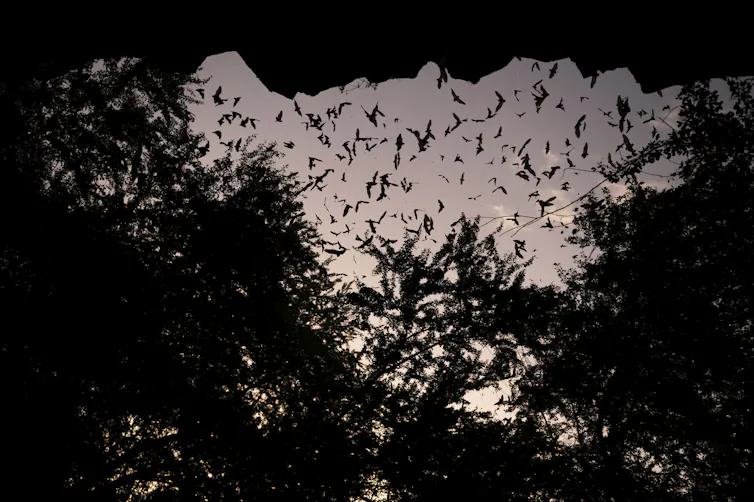
A bat from Réunion: switching lights off slightly earlier could make all the difference
A free-tailed bat native to the island of Réunion (Mormopterus acetabulosus). Paul Jossigny, CC BY
For the free-tail bat, a nocturnal bat endemic to Réunion, bringing forward the switch-off times by two hours is enough to mitigate the effect of the lighting at the start of the night. However, this effect persists at the end of the night, when lighting in the morning is switched on early.
We studied this species, Mormopterus francoismoutoui, in a setting that allowed us to go beyond a simple comparison between lit and unlit sites. For one month, at certain sites, the part-night lighting scheme was altered: the streetlights were switched off two hours earlier than usual. This allowed us to compare the situation before and after this change at the same sites, alongside unlit control sites. Bat activity was monitored acoustically, using recording devices to capture their echolocation calls. This is not a direct count of individuals, but an indicator of their activity.
Free-tailed bats in Réunion flying out of a roost. Samuel Challéat, CNRS Nocturnal Environment Observatory, UMR Géode, Fourni par l’auteur
The results show that as long as the streetlights remain on, bats are detected more frequently near the lit areas, particularly at the beginning and end of the night, i.e. during their peak activity periods. When the evening switch-off is brought forward, this effect disappears at the start of the night: the light no longer “structures” their activity as it did before. However, a difference tends to persist before dawn, which is consistent with the morning switch-on remaining unchanged. Bats therefore still seem to be attracted to lit areas during their peak of activity before dawn, particularly when the weather was favourable.
This result highlights an important point: the effectiveness of part-night lighting depends on how much it overlaps with the activity rhythms of the species present. Turning off the lights in the middle of the night may have little effect if a species concentrates its movements and foraging at the beginning or end of the night. Conversely, a seemingly modest adjustment – in this case, switching off the lights two hours earlier in the evening – may be enough to mitigate the effect of lighting for part of the night.
However, we must exercise caution when interpreting these findings. A higher presence near streetlights does not necessarily mean that light is beneficial. It may reflect an opportunity, for example, if insects are attracted to the light but it may also indicate more ambiguous effects: altered movement patterns, a concentration of individuals in certain areas, increased competition, or greater exposure to predators. In other words, these results primarily show a redistribution of activity over time and space, without allowing us to conclude that artificial lighting is, in itself, beneficial or harmful.
For toads, partial switch-off remains only a partial solution
For the spiny toad (Bufo spinosus), a primarily nocturnal amphibian, part-night lighting mitigates certain effects of artificial light to some extent, without recreating the conditions of a truly dark night.
The spiny toad is a common species in southern and western France, frequently found near inhabited areas, including urban and suburban settings. For its very close relative, the common toad (Bufo bufo), artificial light at night is already known to affect behaviour, physiology and even gene expression in cells: over 1,000 genes malfunction when the animals are exposed to low-intensity light at night! However, in these animals, activity is often most pronounced at the start of the night, suggesting that part-night lighting can, at best, only mitigate the effects.
What is meant by ‘gene expression’?
Gene expression refers to the way in which an organism “activates” or “deactivates” certain genes, depending on the time of day, the environment or the state it is in. Not all genes are active all the time. Depending on whether it is day or night, or whether an animal is resting, active or under stress, certain genes are activated more than others. This enables the production of the molecules necessary for the organism to function. To say that artificial light can alter gene expression therefore means that it does not merely change the visible behaviour of animals: it can also profoundly affect their biological functioning.
We tested this hypothesis experimentally on individuals from one of the areas least affected by light pollution in western France – in Mayenne and Orne. Three groups were formed: one group was kept in natural darkness, one group was exposed to low light levels throughout the night (0.5 lux) and one group was subjected to a part-night lighting scheme between 11:00 pm and 5:00 am, but with the same light intensity of 0.5 lux for the rest of the night. After at least nine days of exposure, we monitored the males’ activity via video during the night.
The distance travelled varied little between the different groups, no doubt partly due to the experimental setup. However, one finding stands out clearly: the longer the toads are exposed to light, the more time they spend in their shelter. The individuals subjected to part-night lighting occupy an intermediate position between those placed in darkness and those exposed to light all night. This is also the only group to show a resumption of activity after the lights were switched back on at 5:00 am.
For a toad, this can have very real consequences: spending more time in hiding potentially means having less time to forage for food, find a mate or move to another site. The surge in activity observed when the lights were switched on again could represent extra energy spent or a source of stress. Part-night lighting therefore reduces certain behavioural effects, but for these animals it does not seem to be equivalent to a completely unlit night.
We still do not know whether this attenuation also results in a reduction in the physiological or genetic effects of artificial light. We also need to gain a better understanding of the impact of a sudden change in light intensity, both when the lights are switched off and when they are switched back on.
A common finding: the importance of key moments during the night
It would be an oversimplification to conclude that part-night lighting is pointless. However, our findings serve as a reminder that it is primarily designed with human night-time activities in mind – when public spaces are less busy and traffic is lighter – rather than with the times when light has the greatest influence on biodiversity.
In our three studies, it is precisely the early and late hours of the night that appear to be decisive. For robins, maintaining light at dusk and dawn is sufficient for sustaining shifts in activity, even when the lights are switched off in the middle of the night. For free-tail bats, bringing forward the evening switch-off reduces the effect of light at the start of the night but not at the end of the night if the morning switch-on remains unchanged. Where toads are concerned, switching the lights back on at the end of the night revives activity at a time when it would normally be decreasing. In all three cases, the conclusion is the same: to be effective, part-night lighting must coincide with the periods when species are most sensitive to light and produce a genuinely perceptible reduction in brightness.
Finally, describing part-night lighting simply as “turning lights off” can be misleading. This method of managing street lighting also involves abrupt, artificial transitions: switching on, switching off, and switching on again, which can disrupt organisms. Turning off the lights in the middle of the night is, therefore, not just about less light: it is also another way of artificially dividing up the night.
What are the implications for local action?
These findings do not, of course, provide a one-size-fits-all solution. However, they suggest three key measures if we are to ensure that part-night lighting also benefits biodiversity.
Firstly, adjust lighting schedules around dusk and dawn, which are often crucial for species’ rhythms and activity. Secondly, reduce light spill from areas that remain lit – adjacent streets, shop signs, private lighting – so that switching off the lights results in a real reduction in brightness. Finally, adapt the lighting strategy to suit different locations – city centres, residential areas, the outskirts of nature areas – rather than applying the same rule everywhere.
Such planning decisions are best informed by both environmental expertise and residents’ experience, so as to identify sensitive locations and times, make decisions transparently, and then adjust the choices in light of feedback and observations.
A weekly e-mail in English featuring expertise from scholars and researchers. It provides an introduction to the diversity of research coming out of the continent and considers some of the key issues facing European countries. Get the newsletter!
Samuel Challéat is coordinator of the CNRS Nocturnal Environment Observatory, director of CNRS GDR 2202 LUMEN (Light & Nocturnal Environment), and deputy director of UMR 5602 GÉODE (Geography of the Environment, CNRS, Toulouse 2 University). He has received funding from La Réunion National Park as part of the FENOIR programme, and from the CNRS Mission for Transversal and Interdisciplinary Initiatives (MITI) as part of the OUTRENOIR programme.
Jean Secondi est membre du GDR2202 LUMEN (Lumière & environnement nocturne) du CNRS
Kévin Barré est membre de l’Observatoire de l’environnement nocturne du CNRS et du GDR2202 LUMEN (Lumière & environnement nocturne) du CNRS. Il a reçu des financements du Parc national de La Réunion et de la Mission pour les initiatives transverses et interdisciplinaires (MITI) du CNRS
Laurent Godet is a member of UMR 6554 LETG, the CNRS Nocturnal Environment Observatory, and the CNRS GDR2202 LUMEN (Light & Nocturnal Environment). He has received funding from the Réunion National Park, the CNRS Mission for Transversal and Interdisciplinary Initiatives (MITI) and the Fondation de France as part of the LARN project.
Léa Mariton is a member of the CNRS Nocturnal Environment Observatory and of the CNRS GDR 2202 LUMEN (Light & Nocturnal Environment). She has received funding from La Réunion National Park and from the CNRS Mission for Transversal and Interdisciplinary Initiatives (MITI).
Thierry Lengagne est membre du GDR2202 LUMEN (Lumière & environnement nocturne) du CNRS.