What the hyperproduction of AI slop is doing to science

Source: The Conversation – Global Perspectives – By Vitomir Kovanovic, Associate Professor and Associate Director of the Centre for Change and Complexity in Learning (C3L), Education Futures, University of South Australia

ChatGPT, CC BY

Over the past three years, generative artificial intelligence (AI) has had a profound impact on society. AI’s impact on human writing, in particular, has been enormous.

The large language models that power AI tools such as ChatGPT are trained on a wide variety of textual data, and they can now produce complex and high-quality texts of their own.

Most importantly, the widespread use of AI tools has resulted in hyperproduction of so-called “AI slop”: low-quality AI-generated outputs produced with minimal or even no human effort.

Much has been said about what AI writing means for education, work, and culture. But what about science? Does AI improve academic writing, or does it merely produce “scientific AI slop”?

According to a new study by researchers from UC Berkeley and Cornell University, published in Science, the slop is winning.

Generative AI boosts academic productivity

The researchers analysed abstracts from more than a million preprint articles (publicly available articles yet to undergo peer review) released between 2018 and 2024.

They examined whether use of AI is linked to higher academic productivity, manuscript quality and use of more diverse literature.

The number of preprints an author produced was a measure of their productivity, while eventual publication in a journal was a measure of an article’s quality.

The study found that when an author started using AI, the number of preprints they produced increased dramatically. Depending on the preprint platform, the overall number of articles an author published per month after adopting AI increased between 36.2% and 59.8%.

The increase was biggest among non-native English speakers, and especially for Asian authors, where it ranged from 43% to 89.3%. For authors from English-speaking institutions and with “Caucasian” names, the increase was more modest, in the range of 23.7% to 46.2%.

These results suggest AI was often used by non-native speakers to improve their written English.

What about the article quality?

The study found articles written with AI used more complex language on average than those written without AI.

However, among articles written without AI, ones that used more complex language were more likely to be published.

This suggests that more complex and high-quality writing is perceived as having greater scientific merit.

However, when it comes to articles written with AI support, this relationship was reversed – the more complex the language, the less likely the article was to be published. This suggests that AI-generated complex language was used to hide the low quality of the scholarly work.

AI increased the variety of academic sources

The study also looked at the differences in article downloads originating from Google and Microsoft search platforms.

Microsoft’s Bing search engine introduced an AI-powered Bing Chat feature in February 2023. This allowed the researchers to compare what kind of articles were recommended by AI-enhanced search versus regular search engine.

Interestingly, Bing users were exposed to a greater variety of sources than Google users, and also to more recent publications. This is likely caused by a technique used by Bing Chat called retrieval-augmented generation, which combines search results with AI prompting.

In any case, fears that AI search would be “stuck” recommending old, widely used sources was not justified.

Moving forward

AI has had significant impact on scientific writing and academic publishing. It has become an integral part of academic writing for many scientists, especially for non-native speakers and it is here to stay.

As AI is becoming embedded in many applications such as word processors, email apps, and spreadsheets, it will be soon impossible not to use AI whether we like it or not.

Most importantly for science, AI is challenging the use of complex high-quality language as the indicator of scholarly merit. Quick screening and evaluation of articles based on language quality is increasingly unreliable and better methods are urgently needed.

As complex language is increasingly used to cover up weak scholarly contributions, critical and in-depth evaluations of study methodologies and contributions during peer review are essential.

One approach is to “fight fire with fire” and use AI review tools, such as the one recently published by Andrew Ng at Stanford. Given the ever-growing number of manuscript submissions and already high workload of academic journal editors, such approaches might be the only viable option.

The Conversation

Vitomir Kovanovic does not work for, consult, own shares in or receive funding from any company or organisation that would benefit from this article, and has disclosed no relevant affiliations beyond their academic appointment.

ref. What the hyperproduction of AI slop is doing to science – https://theconversation.com/what-the-hyperproduction-of-ai-slop-is-doing-to-science-272250

Revolutionary rap: Nigerian star Falz has kept protest music alive

Source: The Conversation – Africa – By Paul Onanuga, Lecturer, Federal University, Oye Ekiti

Nigerian rapper, actor and social media star Falz released his sixth studio album, The Feast, in 2025.

Few Nigerian popular musicians have shown as much versatility and staying power as the man behind the #ElloBae and #WehDoneSir social media trends. For over a decade now, Falz has been marrying musical skills and social activism with digital savvy and comedy.

His rise to global prominence was solidified with his 2018 song This is Nigeria. But it began in 2014 with Marry Me off his debut album Wazup Guy.

As a young artist known for his video skits, he created an online challenge ahead of releasing the song Ello Bae (Hello Babe). In it he tries to romance a woman who appreciates him and his ambition, but is looking for a man with money. It remains a common hashtag when TikTokers post about love and money.

In 2017 he released Wehdone Sir (Well Done, Sir), a witty takedown of people with fake glamour lifestyles. #WehDoneSir is still used on social media to satirise pretentious individuals.

Falz would become known for his unique blend of hip-hop and Afropop, but what really made him stand out was his skill at infusing humour into his socially conscious, often revolutionary, songs.

It’s often argued that Falz is a natural heir to Fela Anikulapo-Kuti. He was the Nigerian music legend and activist who helped create the Afrobeat movement (a precursor to today’s Afrobeats).

Like Fela, Falz packs his music with playfulness and satire while also stirring public consciousness with activist lyrics. Both call for action against the oppressive political class. In 2020, when young Nigerians took to the streets to demand an end to police corruption, Fela and Falz were both part of the inventory of #EndSARS protest songs.

As a scholar of Nigerian hip-hop, I have published papers on Fela and Falz and how they have shaped protest music that responds to social challenges in Nigeria.

So, who is Falz, and how has he spread his message – and come to be the political voice of his generation, as Fela was to his?

Who is Falz?

Falz (real name Folarin Falana) was born in 1990 in Mushin, Lagos. He is the son of a respected human rights lawyer and activist father, Femi Falana, and lawyer mother, Funmi Falana. In fact, his father was Fela’s lawyer, defending him against charges brought by the state.

Falz also qualified as a lawyer, but chose instead to pursue his interests in music and acting. These multiple skills feed into his productions on diverse levels. Beyond his songs, he is also very active on Instagram and Tik-Tok, where he establishes trends, especially around his songs and films.

His character in Ello Bae, for instance, struggles with English, using big formal words in unexpected ways, finding comedy in his faux Yoruba inflections. It would be a trademark of the #ElloBaeChallenge and would enjoy renewed public attention when Falz was cast in the TV series Jenifa’s Diary playing a similar character.

In 2016, Falz won best new international act at the BET Awards in the US. Numerous other awards would follow. His albums have received commercial and critical success. His roles in movies have further solidified his status as a multitalented entertainer.

Activism

Falz does not shy away from living the talk. He took part in the 2020 #EndSARS protests and his work repeatedly tries to steer the government towards addressing socio-economic challenges.

Soon after the protests, he released Moral Instruction. On the album, the track Johnny depicts the everyday experiences of Nigerians. This is Nigeria, a localised version of US rapper Childish Gambino’s This is America, depicts Nigeria as a country struggling with corruption, lawlessness and social injustice. A stark contrast to its potential. The video reflects a breakdown in law and order, corrupt officials, and the struggles of young people facing limited opportunities and resorting to crime.

Falz has used his platform as a celebrity and his background as a lawyer to call for social justice and for young people to make a difference.

Fela and Falz

There have been a number of pretend heirs to Fela’s throne of musical consciousness. Many of these have either not lived up to the hype or have fizzled out.

However, many popular Nigerian artists leverage Fela’s ethos through sampling his beats and lyrics. This is evident in Falz’s musicography too.

My study on the lyrical and thematic connections between Fela and Falz songs compares a number of tracks. Fela’s No Agreement and Falz’s Talk, for example, both draw attention to social inequality and systemic challenges in Nigeria.

Fela’s song was produced in the context of a military regime while Falz’s was within a democratic dispensation. But both speak of a crisis of leadership in Nigeria, as is the case in many postcolonial societies. What particularly links Fela and Falz is that both are unrelenting in their revolutionary struggles and determination to ensure an equitable Nigerian society.

Religious leaders are not spared criticism. Echoing Fela’s Coffin for Head of State (1980), Falz’s Amen (2019) points to the deceptive practices and complicity of religious leaders in poor political leadership and endemic poverty. Both critique the double standards that have become normal in the country.

Falz’s Follow Follow (2019) addresses current realities in Nigerian society – a lack of personal conviction and independent thought and the mindless following of social media trends. Integrating lyrics from Fela’s Zombie (1976), the song is about asserting one’s identity. It also rehashes Fela’s Follow Follow, mocking those who allow themselves to be led blindly by others.

To make sure his advocacy resonates, Falz co-opts his listeners through a call-and-response strategy. A phrase is sung and the next phrase answers it. This way, along with catchy lyrics, the audience become active participants.

This also echoes the traditional Yoruba chant-and-refrain rendition used by musicians, poets and bards to engage their audience. Its possible nod to the indigenous is also at the heart of his faux Yoruba accent, a style that downplays his prestigious upbringing and connects him to ordinary people, much like Pidgin did for Fela.

But echoes of Fela don’t in any way take away from the creative force of Falz’s work. Rather they reinforce his critique of how the postcolonial Nigerian state has failed to live up to its promise.

Into the future

While Fela was unrepentantly anticolonial, Falz is sublimely hybridised. His mixture of talents and views creates a pulsating pan-African consciousness that’s able to exist in a global contemporary world view.

His lyrics and videography are aimed at the masses – especially young people – who have the most to gain from positive social change. In this way Falz can be said to represent a generational conscience. He uses his empowering songs to motivate his fans to take their destinies in their own hands.

The Conversation

Paul Onanuga does not work for, consult, own shares in or receive funding from any company or organisation that would benefit from this article, and has disclosed no relevant affiliations beyond their academic appointment.

ref. Revolutionary rap: Nigerian star Falz has kept protest music alive – https://theconversation.com/revolutionary-rap-nigerian-star-falz-has-kept-protest-music-alive-266529

Dispatches from a year of global conflict and uncertainty

Source: The Conversation – UK – By Jonathan Este, Senior International Affairs Editor, Associate Editor, The Conversation

This newsletter was first published in The Conversation UK’s World Affairs Briefing email. Sign up to receive weekly analysis of the latest developments in international relations, direct to your inbox.


Volodymyr Zelensky says there will almost certainly be no ceasefire in Ukraine before Christmas. This means the war is more than likely to stretch on into a fifth year to the dismay of everyone – barring, perhaps Vladimir Putin, for whom the war seems to be a means to a number of different ends.

Whatever the Russian president wants to gain immediately – prestige, territory, a pliant government in Kyiv, access to eastern Ukraine’s considerable resources – the war also appears to be fulfilling a number of Putin’s long-term foreign policy aims: it is driving a wedge between the US and Europe and exposing big divisions within Europe itself.

At present it looks as if we’re witnessing another of the diplomatic loops that have characterised much of the year as Donald Trump has tried to make good on his pledge to end the war. The latest deal is still being thrashed out between negotiators from the US, Ukraine and its European allies. But it’s far from clear that whatever the joint talks produce will receive buy-in from the US president, whose position – as we have seen all year – can change overnight depending on whom he talks to.

What’s more clear is that Putin will almost certainly reject the plan outright. How this will play in the White House is anyone’s guess. While the US president has shown that he is susceptible to the Russian leader’s blandishments, he has also displayed a short fuse when he thinks Putin isn’t taking him seriously enough.

Looking back on the year, it’s clear that – in the sphere of international relations – pretty much all roads lead back to Donald Trump. Most of the big international stories we’ve covered have featured the US president as a key player. So it makes sense to begin a review of the past year in international affairs with the return of Trump to the White House.

Donald Trump: a politician of consequence

After Trump was elected for a second term in November 2024, James Cooper of York St John University referred to the president as an “international disruptor”. Cooper predicted that Trump’s unconventional style might yield results via the “madman theory”, which holds that his unpredictability could prove to be an effective foreign policy approach. Quite how effective remains to be seen.


Read more:
History will remember Donald Trump as a highly consequential president


Cooper also predicted that Ukraine and America’s Nato allies might find Trump’s foreign policy outlook a major concern. And so it has proved. The US has halted military aid to Ukraine, leaving Kyiv scrambling to secure reliable support from its European allies which – as we’ve seen, are struggling to secure the funds. And America’s Nato allies in Europe learned last month, when the US released its 2025 national security strategy, that they can no longer rely on the US for security in the way that they have in the eight decades since the end of the second world war.

The strategy makes for sobering reading if you live in Europe, writes Andrew Gawthorpe, a lecturer in history and international studies at Leiden University. The 33-page public document is harshly critical of what it sees as Europe’s weakness, saying the continent risks “civilizational erasure” thanks to migration.

Gawthorpe notes that Russia has welcomed the strategy as “largely consistent” and predicts that America’s allies in Asia and Europe may have to face the prospect that Trump may prefer to align the US in a “grand bargain” with Russia and China.


Read more:
What the US national security strategy tells us about how Trump views the world


Ukraine conflict: no end in sight

Despite nearly ten months elapsing, it’s hard to forget the now-notorious White House meeting at which Trump and his vice-president, J.D. Vance, lambasted Zelensky for not being grateful for the help the US had given Ukraine. All diplomatic niceties abandoned, the Americans rounded on the Ukrainian president, accusing him of “gambling with world war three” and demanding: “You either make a deal or we are out.”

ISW map showing the state of the conflict in Ukraine, December 16.
The state of the conflict in Ukraine, December 16, 2025.
Institute for the Study of War

Stefan Wolff and Tetyana Malyarenko reported at the time that the real issue was Trump’s desire for US firms to exploit Ukraine’s considerable mineral reserves (many of Trump’s peace deals are also business deals, as we noted in a separate article last month).

Wolff, of the University of Birmingham, and Malyarenko, of the University of Odesa, have been contributing to our coverage of the conflict between Russia and Ukraine and its geopolitical implications for more than a decade. For them, the US national security strategy was confirmation of something they have suspected for a while: that Europe will be left struggling to keep Ukraine in the fight as the continent re-arms itself in the face of the very real prospect that Putin doesn’t want to stop at Ukraine.


Read more:
New US national security strategy adds to Ukraine’s woes and exacerbates Europe’s dilemmas


Our coverage of the Ukraine conflict has also been informed by Frank Ledwidge, formerly of UK military intelligence, now an expert in military strategy at the University of Portsmouth. Ledwidge is a regular visitor to Ukraine and in August contributed this vivid piece of reportage from Kharkiv, Ukraine’s “unbreakable” eastern capital.


Read more:
Kharkiv: what I saw in Ukraine’s ‘unbreakable’ eastern capital


The tragedy of Palestine

This was the year that many western countries came off the sidelines and formally declared their recognition of Palestinian statehood. These declarations, by the UK, France, Australia and Canada, were largely symbolic. As things stand the prospect of a two-state solution remains as remote as ever. The (very tenuous) ceasefire in Gaza has not progressed further than a cessation of the wholesale killing of Palestinian civilians in the enclave.

And as Leonie Fleischmann, an expert in the Israeli-Palestinian conflict at City St Georges, University of London, reports, illegal Israeli settlements have multiplied to such an extent that they threaten to cut the West Bank in two, which – as Israel’s far-right finance minister Bezalel Smotrich noted – “buries the idea of a Palestinian state”.


Read more:
Israel’s plan for massive new West Bank settlement would make a Palestinian state impossible


In Gaza meanwhile, and despite the ceasefire, the violence continues – albeit on a smaller scale, at present. Within days of the ceasefire being signed, and notwithstanding a stipulation that Hamas must disarm and disband, the militant Palestinian group was already regrouping.

Tahani Mustafa, formerly a Palestine analyst for the international crisis group and now a lecturer in international relations at King’s College London, used her considerably range of contacts on the ground in Gaza to bring us this report.


Read more:
Hamas turns to executions as it tries to establish a monopoly on force in Gaza


What 2026 may hold for the people of Gaza remains uncertain. There’s been little or no progress on establishing a framework for governance in the enclave and at present Israel’s strategy seems to be to encourage as many Gaza residents as possible to leave via the Rafah crossing into Egypt.

Whether we will see the beginnings of the realisation of the Trump blueprint for the redevelopment of much of Gaza into commercial and tourism property, sometimes called the “Trump riviera”, may become clearer next year.


Read more:
Donald Trump’s vision for Gaza’s future: what a leaked plan tells us about US regional strategy


What is clear, though, is that whatever Israeli and its allies plan to do in Gaza, it will be critical to secure the support and cooperation of the Gulf states, without which any plan for the future of the region will be a non-starter.

Scott Lucas, a Middle East expert at the Clinton Institute, University College Dublin, has been contributing to our coverage of the region for more than a decade. As the Gaza ceasefire was announced in October, he answered our questions and underlined the vital role played by other powers in the Middle East.


Read more:
Israel and Hamas agree ceasefire deal – what we know so far: expert Q&A


Civil war in Sudan

The bitter conflict in Sudan has often been eclipsed this year by the wars in Ukraine and Gaza, and it’s significant that it is not among the wars the US president claims to have solved in his eleven months in power. But the regular reports of wholesale slaughter of civilians, mass rape and other war crimes have been no less terrible for that.

The conflict is often reported as an ethnic clash: Arab militias from the country’s northern provinces fighting against African groups from Sudan’s west and south. But Justin Willis of Durham University and Willow Berridge of Newcastle University – both experts in the history of the Sudan conflict – believe it’s more complicated than that and has much to do with international meddling.


Read more:
Why has Sudan descended into mass slaughter? The answer goes far beyond simple ethnic conflict


But when you strip away the geopolitics, as ever, it is innocent civilians who are left to bear the lion’s share of the suffering, as is clear from this harrowing report based on interviews with refugees flooding south to escape the violence.


Read more:
‘I have to talk about it so that the world can know what happened to women and girls in Sudan’ – rape and terror sparks mass migration


We’re going to take a two week break over the holiday season. The next world affairs update will be on January 8 2026. Many thanks for your support over the year.


Sign up to receive our weekly World Affairs Briefing newsletter from The Conversation UK. Every Thursday we’ll bring you expert analysis of the big stories in international relations.


The Conversation

ref. Dispatches from a year of global conflict and uncertainty – https://theconversation.com/dispatches-from-a-year-of-global-conflict-and-uncertainty-272295

Universities’ work towards Indigenous identity policies signals difficult conversations

Source: The Conversation – Canada – By Frank Deer, Professor, Faculty of Education, University of Manitoba

In recent years, members of the Canadian public have witnessed the misrepresentation of Indigenous identities.

Recently, we learned that University of Guelph professor emeritus Thomas King is not Indigenous. The highly regarded author of literary works such as The Inconvenient Indian: A Curious Account of Native People in North America and The Back of the Turtle captured the imagination of readers interested in Indigenous experiences.

Both non-Indigenous readers, either less or more familiar with Indigenous lives, and Indigenous readers trusted and respected King. Many of us revered him.

In King, we had a source of literary representation that informed knowledge of the Indigenous experience, and inspired curiosity about who Indigenous people are — and how we might understand “their” or “our” knowledge, histories and experiences.

King’s situation is yet another in a queue of high-profile individuals such as Buffy Sainte-Marie, Carrie Bourassa and Vianne Timmons who have made dubious claims about Indigenous identities.


Read more:
Thomas King: As we learn another ‘hero’ is non-Indigenous, let’s not ignore a broader cultural problem


Some Canadian universities have begun to develop policies to address erroneous claims to indigeneity. Some have already been affected by the fallout of such cases, while others wish to mitigate potential problems of misrepresentation.

Our respective research interests are in Indigenous education related to Indigenous identity and languages and interdisciplinary research related to intersectional justice, decolonization and equity.

We are both “Status Indian,” who consider ourselves to have connections to our respective communities, in Kanienkeha’ka (Frank) and Wendat (Annie) territories. In our own cases, and many others, these connections are also made complicated by migration, work/life changes and relationships.

Universities address Indigenous identity

Many universities are attempting to develop appropriate policies for Indigenous identity verification that will address and possibly prevent false claims to Indigenous identity.

For example, community consultations at the University of Manitoba and working groups at the University of Winnipeg have provided some valuable input into the problem of false claims of Indigenous identity and potential approaches to address them.

The University of Montréal is also in the process of developing a policy on Indigenous self-declaration, although it has not yet been formally adopted.

While there are many aspects to take into consideration, policies may vary from one institution or community to another. Yet across contexts, policy development about Indigenous identity will often lead to difficult conversations.

Indentity is personal and complex

As such policies emerge, it ought to be acknowledged that Indigenous identity is profoundly personal and complex. For instance, some Indigenous people may lack connections due to the Sixties Scoop phenomenon.


Read more:
How journalists tell Buffy Sainte-Marie’s story matters — explained by a ’60s Scoop survivor


Viewing the complexities that may exist when considering an individual’s Indigenous identity as “challenges” might adversely affect our orientations toward the exercise.

Fundamentally, the constituent elements of one’s Indigenous identity ought to be treated charitably. This approach should not be understood as a dismissal of the problems experienced when one misrepresents their identity as being Indigenous. The concern here is the impact that such dialogue has upon Indigenous people and Peoples at large.

Rights of individuals, nations

We acknowledge the prevailing notion that claims of Indigenous identity ought to be consistent with the rights of nations: this has become an important concern for how Indigenous Peoples understand membership in their communities.

The current prevailing view among many is that some sort of national affiliation is central to any personal declaration to Indigenous identity.

Many academics have expressed confidence in the notion that Indigenous communities are in the best positions to determine how Indigenous identity may be understood in their respective communal or national contexts.

It is also important to include the rights of individuals in the conversation on Indigenous identity. This reflects what is contained in Article 33 of the United Nations Declaration on the Rights of Indigenous Peoples which affirms Indigenous peoples’ right to define their own identity and membership based on their customs and traditions.

Although connections to Indigenous communities are regarded as essential to claims of Indigenous identity, many Indigenous people may not be connected to their community.

Thus, claims to indigeneity made by those without such apparent connections must be considered carefully.

Non-material harms of false claims

While prospective policies around Indigenous identity are developed to regulate situations that would lead a person to make a false claim for material benefits — like access to funding or Indigenous-specific hiring — we believe that non-material impacts, such as community well-being and trust, should also be considered.

False declarations unquestionably impact the person and, sometimes, the reputation of the institution. These also also harm other groups like Indigenous academics, and wider research communities, through division and the erosion of confidence.

Impacts of misrepresentation

Although the Tribal Alliance Against Frauds highlighted the dubiousness of King’s claims to indigeneity, King has owned up publicly to his misrepresentation.

In an essay in The Globe and Mail, King shared what he had learned of his non-Cherokee ancestry, family stories shared about his darker skin, as well as the impacts that his misrepresentation has had on others.

Perhaps we can be charitable to a man who has learned about himself, set the record straight and contributed to a difficult conversation.

The Conversation

Frank Deer receives funding from the Social Sciences and Humanities Research Council of Canada.

Annie Pullen Sansfaçon receives funding from the Canada Research Chair Program. She is member of the National Indigenous University Senior Leaders’ Association (NIUSLA)

ref. Universities’ work towards Indigenous identity policies signals difficult conversations – https://theconversation.com/universities-work-towards-indigenous-identity-policies-signals-difficult-conversations-271074

Sudan’s civil war: A visual guide to the brutal conflict

Source: The Conversation – Global Perspectives – By Christopher Tounsel, Associate Professor of History, University of Washington

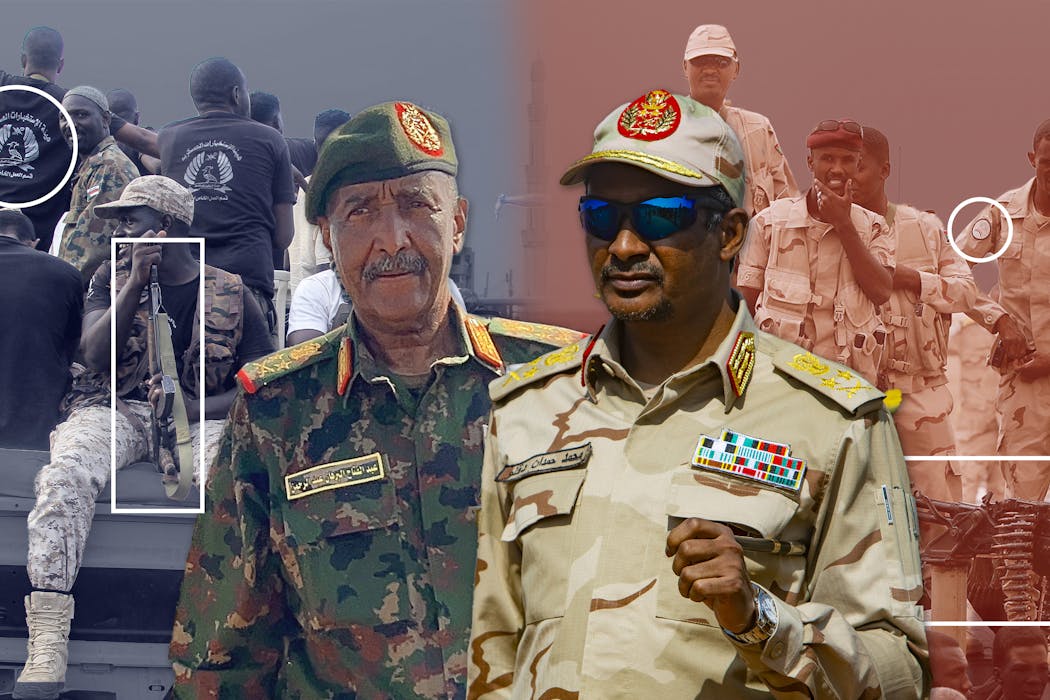
Mahmoud Hjaj/Anadolu Agency via Getty, Ebrahim Hamid, Getty, Hussein Malla/Getty, Anadolu/Getty, The Conversation

Sudan’s brutal civil war has dragged on for more than 2½ years, displacing millions and killing in excess of 150,000 people – making it among the most deadly conflicts in the world today.

As of December 2025, the paramilitary Rapid Support Forces appear to be making gains, seizing a key oil field in central Sudan and forcing the retreat of the Sudanese Armed Forces in key cities in the country’s west.

But fighting has ebbed and flowed throughout the war, with parts of the country changing hands a number of times. It has left a complicated picture of a nation mired in violence. Here’s a visual guide to help understand what is going on and the toll it has taken on the Sudanese population.

What military forces are involved?

Men holding guns and in army gear sit on trucks
Sudanese army soldiers take part in a military parade.
Ebrahim Hamid, Getty

The two main warring parties are the Sudanese Armed Forces (SAF) and the Rapid Support Forces (RSF).

The SAF is the nation’s official military. Prior to the civil war, it was responsible with enforcing the border, protecting the country from foreign entities and maintaining internal security. As of April 2023, the SAF had an estimated force of up to 200,000 people.

Men in military gard stand in a group.
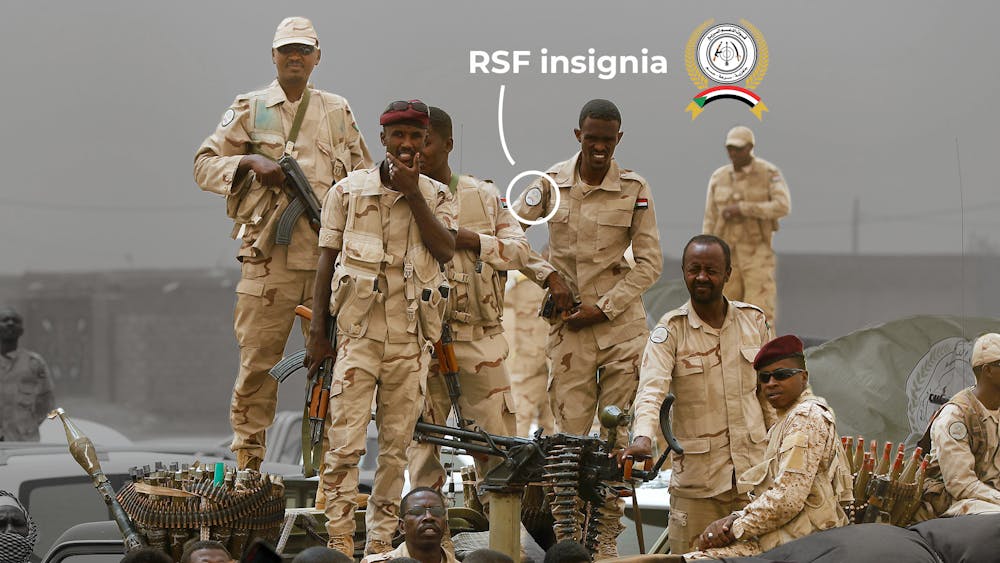
Members of a Rapid Support Forces unit stand on their vehicle during a military-backed rally.
Hussein Malla/Getty

The paramilitary RSF is a semi-autonomous organization that was created in 2013 to confront rebel groups. Its origins lie in the feared Janjaweed militia that gained international notoriety for its scorched-earth tactics, extrajudicial killings and sexual assaults during a campaign in Darfur between 2003 and 2005.

Rebranding as the RSF, the paramilitary force evolved to become President Omar al-Bashir’s personal security force before al-Bashir’s ouster in 2019.

After that, the RSF and the SAF worked together to stage a 2021 coup against Prime Minister Abdalla Hamdok in 2021. But a power struggle emerged between the leaders of the RSF and SAF amid disagreements over the future direction of the country and whether the RSF would be incorporated into the army.

By the outbreak of the civil war in 2023, the RSF had amassed around 100,000 troops.

Various other armed groups have lent their support to the RSF and SAF during the conflict, including the rebel Sudan People’s Liberation Movement-North, which supports the RSF, and the army-aligned Justice and Equality Movement

Who are the main leaders?

A man in army fatigues stands.
Abdel Fattah al-Burhan visits the Al-Afadh refugee camp in Al Dabbah, Northern State, on Nov. 8, 2025.
Anadolu/Getty

The SAF is led by General Abdel Fattah al-Burhan, the nation’s top military commander and de facto head of state. The longtime soldier rose to the rank of regional commander in 2008 and was promoted a decade later to the position of army chief of staff.

Following Bashir’s 2019 ouster, Burhan was appointed to lead the Transitional Military Council and its successor civilian-military entity known as the Sovereign Council. As leader of the Sovereign Council, Burhan occupied the nation’s highest office.

His reputation has been marred by his own military’s attacks on civilians in Darfur in the early 2000s and, more recently, his reliance on support from Islamist groups.

A man in military uniform and sunglasses.
Mohamed Hamdan Dagalo attends a military graduation ceremony of special forces in Khartoum.
Mahmoud Hjaj/Anadolu Agency via Getty

The RSF leader, Mohamed Hamdan Dagalo, also known as “Hemedti,” was Burhan’s second-in-command.

Born to a poor family that settled in Darfur, Hemedti was part of the Janjaweed militia that President Bashir deployed to crush non-Arab resistance in the country’s west. Becoming leader of the Janjaweed before going on to head the RSF, Hemedti acquired a reputation as a ruthless commander whose brutal methods disturbed some fellow officers.

Where are the weapons, funding coming from?

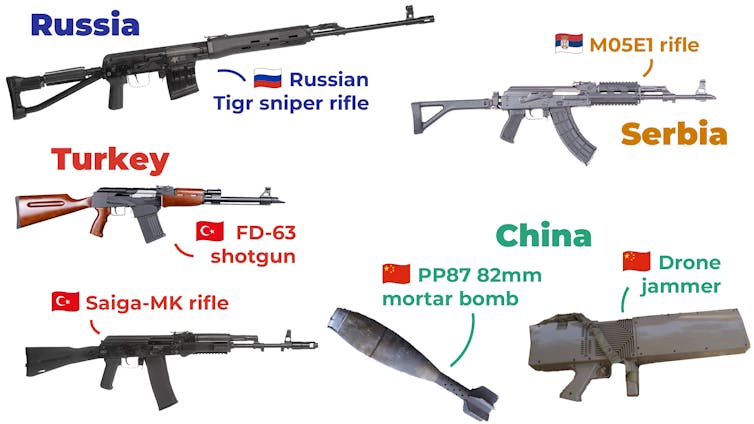
Graphic of guns and bombs fuelling the Sudan conflict
A few of the verified weapons imported and seen being used by both sides of the war.
Amnesty International – New weapons fuelling the Sudan conflict

While the fighting has largely been contained to within Sudan’s boundaries, it is being fueled from outside the country.

Amnesty International has reported that despite a decades-old arms embargo by the United Nations Security Council, recently manufactured weapons and equipment from China, Russia, Turkey and the United Arab Emirates have been used by both sides in the conflict.

The Sudanese government has accused the UAE of providing military assistance to the RSF, which in turn has been accused of using the UAE for illegal gold trafficking.

In addition to providing military assistance, the UAE has been accused of providing economic support for the RSF. In January 2025, the Biden administration sanctioned seven UAE-based companies funding Hemedti.

Saudi Arabia, which sees Sudan as an ally to counter Iran’s regional influence, has provided financial support to the SAF. In October 2025, the SAF-backed government announced that Saudi Arabia planned to invest an additional US$50 billion into Sudan, on top of the $35 billion it has already invested.

Egypt, allied with Burhan in a dispute with Ethiopia over the Grand Ethiopian Renaissance Dam, has supplied the SAF with warplanes and pilots.

Meanwhile, Iran and Russia have each extended support for the Sudanese government. It is believed that Iran, which renewed diplomatic ties with Sudan in October 2023, has provided the SAF with attack drones, while Russia has provided Sudan’s government with diplomatic and military support.

What areas are controlled by whom?

As of December 2025, the RSF and SAF control different halves of the country split along a roughly north-south axis. The SAF controls a little more than half of the country.

The SAF has a stronghold in the nation’s capital Khartoum. In the east, the army controls the city of Port Sudan on the Red Sea coast. The SAF also controls approximately three-quarters of the Sudanese border with Egypt to the north.

Strategically, the areas under SAF control provide the advantages of access to the Red Sea – a crucial transport hub through which 12% of the world’s maritime trade passes – as well as the historic demographic and administrative epicenter of Khartoum, situated at the confluence of the Blue and White Niles, and the livestock-rich Kassala state.

In all, Sudanese researcher Jihad Mashamoun estimates that as of November 2025, the SAF controlled 60% of the country.

Meanwhile, the RSF has consolidated control over Darfur – the massive western region that has been a hub for gold mining and trafficking routes – and the regional capital of el-Fasher, an economic hub connecting routes to Libya to the north, the Nile to the east and Chad to the west.

As researcher Bravin Onditi has noted, el-Fasher’s fall to the RSF in late October eliminated the SAF’s last stronghold in Darfur from which it could assert authority in western Sudan.

Outside of Darfur, the RSF controls most the country’s oil fields, many of the goldfields in central and southwest Sudan, and splits control over important grazing lands with the SAF.

What has been the toll on Sudan’s citizens?

One of the war’s distinguishing horrors has been repeated incidents of civilian killings.

Both sides have been accused of war crimes that include targeted attacks on civilians, medical centers and food systems. Mass killings in Khartoum, Darfur, Kordofan, Gezira, Sennar and White Nile states reflect the general scope of slaughter that has swept the country.

In some instances, this violence has taken on a decidedly ethnic dimension. Human Rights Watch reports that from late April to early November 2023, the RSF and its allied militias systematically sought to remove — including by murder — ethnic Masalit people from El Geneina, capital of West Darfur.

In October 2025, following the RAF’s siege of el-Fasher, the world watched in horror as satellite images of “clusters” consistent with bodies and blood-red discoloration could be seen on the ground. The U.N. Security Council held an emergency meeting condemning the RSF’s killing of nearly 500 people in el-Fasher’s Saudi Maternity Hospital.

More than 9.5 million people are classified as internally displaced, having fled violence. The International Organization for Migration reports that North and South Darfur states host the largest number of internally displaced people, followed by Central and East Darfur states.

Meanwhile, over 4 million have fled to the neighboring countries of Egypt, South Sudan and Chad.

Image sources:

FD-63 – Dağlıoğlu Silah,
Saiga MK .223, Kalashnikov Group,
Tigr DMR, Kalashnikov Group,
M05E1, Zastava Arms,
PP87 82MM mortar bomb, Amnesty International,
CKJ-G7 drone jammer, Amnesty International,
Streit Gladiator, Streit Group,
Terrier LT-79, Streit Group,
INKAS Titan-S, INKAS Armored Vehicles

The Conversation

Christopher Tounsel does not work for, consult, own shares in or receive funding from any company or organization that would benefit from this article, and has disclosed no relevant affiliations beyond their academic appointment.

ref. Sudan’s civil war: A visual guide to the brutal conflict – https://theconversation.com/sudans-civil-war-a-visual-guide-to-the-brutal-conflict-271429

Trump tariffs and warming India-China ties have silenced the Quad partnership … for now

Source: The Conversation – Global Perspectives – By Hyeran Jo, Associate Professor of Political Science, Texas A&M University

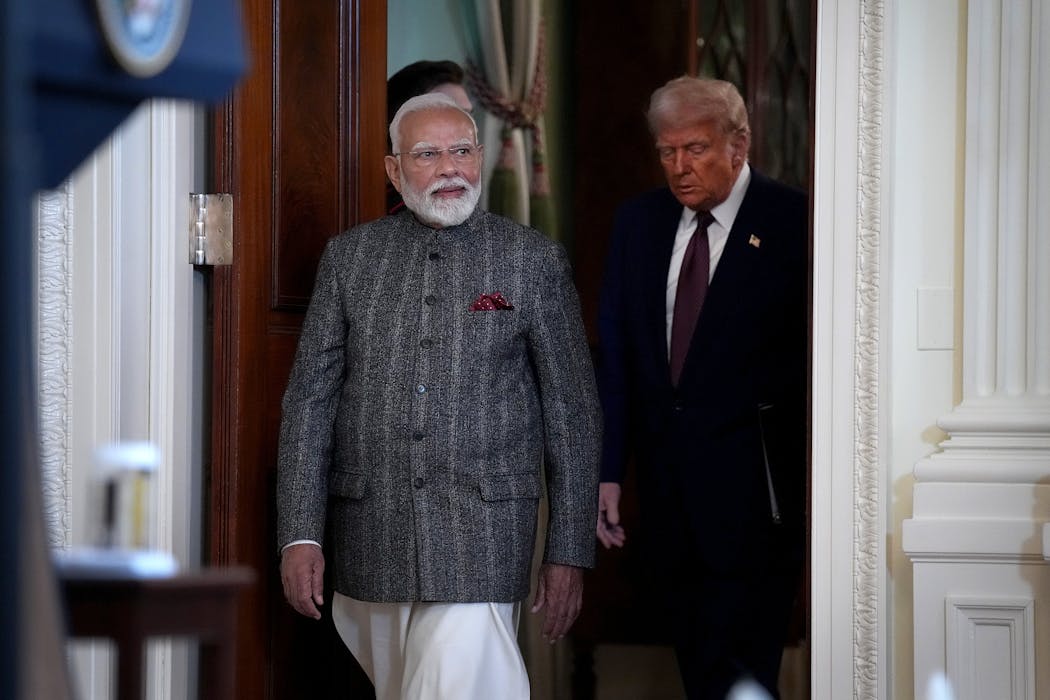
When one diplomatic dance ends, Prime Minister Narendra Modi and President Donald Trump have sought partners elsewhere. Andrew Harnik/Getty Images

When leaders of “the Quad” last met in September 2024, host and then-President Joe Biden declared the partnership between the United States, India, Australia and Japan to be “more strategically aligned than ever before.”

“The Quad is here to stay,” trumpeted Indian Prime Minister Narendra Modi.

Fast-forward a little over a year, however, and the tune has changed.

Leaders of the Quad were due to hold their latest summit in November 2025, with India hosting. But the month came and went, and no event was held. A future date has yet to be announced.

Why the silence? As experts of international institutions and the geopolitics and geoeconomics of the Indo-Pacific, we believe the answers can be found in the calculus of the two largest members involved: India and the U.S.

For the Trump administration, the domestic dividends of the Quad are not immediately obvious. Meanwhile, New Delhi is more concerned about how to position itself amid the great power competition between China and the U.S.

The result is paralysis for the Quad, for now.

The evolution of the Quad

The Quadrilateral Security Dialogue, to give the Quad its full name, began life in 2004.

The Quad 1.0 focused on humanitarian disaster assistance and cooperation after the Indian Ocean tsunami. In 2007, under the vision of then-Japanese Prime Minister Shinzo Abe, the Quad was recast as a platform to promote a free and prosperous Indo-Pacific, with an eye toward maritime security and economic cooperation.

Since then, the Quad has seen many fits and starts. Australia withdrew from the partnership in 2008 when it prioritized trade relations with China. India, too, has at times been tepid about the Quad’s continuation, partly due to its legacy of nonalignment and concerns over managing relations with Beijing.

The Quad 2.0 came to life in 2017 as the four core members coalesced around a shared sentiment of countering China’s rising power.

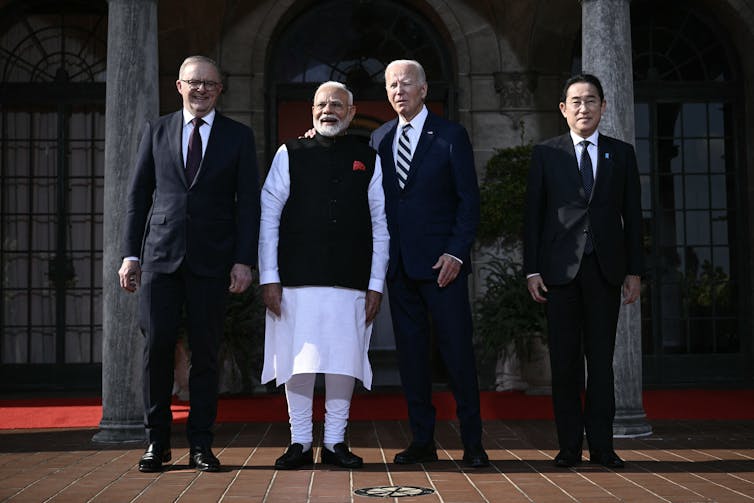
Four men stand for a photo
President Joe Biden participates in a 2024 Quad summit with prime ministers Anthony Albanese of Australia and Narendra Modi of India and Fumio Kishida of Japan.
Brendan Smialowski/AFP via Getty Images

Despite its name, the Quadrilateral Security Dialogue has increasingly gravitated toward nonsecurity agendas, from global health to maritime domain awareness and critical technologies.

Yet even as this emerging Quad 3.0 has foregrounded cooperation around the slogan “development, stability and prosperity,” it is over trade and tariffs that the two largest members of the Quad are not seeing eye to eye.

The eagle and elephant tussle over tariffs

On Aug. 1, 2025, Washington imposed a 25% reciprocal tariff on Indian goods over long-standing trade frictions, notably over access to India’s agricultural market. It was followed by an additional 25% punitive duty for New Delhi’s continued purchases of Russian oil.

The combined 50% U.S. tariff was accompanied by another move that upset New Delhi: new U.S. restrictions on H-1B visas. Some 70% of all holders of the U.S. visas, designed for temporary skilled workers, are Indian nationals.

The rift between New Delhi and Washington widened with India’s decision to attend a meeting in Rio de Janeiro in September of the so-called BRICS nations. That was interpreted as an “anti-U.S.” summit by Washington given its composition of largely Global South nations and other countryies antagonistic to the West, including Russia and China.

As a key member of the BRICS grouping, India’s attendance should have come as no real surprise. Even so, and despite Modi’s decision not to attend personally, the U.S. took umbrage, with U.S. Secretary of Commerce Howard Lutnick criticizing India’s BRICS membership and accusing New Delhi of having “rubbed the United States the wrong way.”

Lutnick’s comments are indicative of the cooling ties between New Delhi and Washington. Since the end of the Cold War, India has been seen by Washington as a democratic ally and a vital U.S. partner in the Indo-Pacific. The two countries have shared strategic and defense partnerships – a foundational aspect of the Quad.

And despite recent tensions, the factors underpinning U.S.-India relations remain constant. The U.S. is India’s largest trading partner, with bilateral trade reaching US$131.84 billion in the 2024-25 fiscal year.

This gives New Delhi not only economic leverage over the U.S. but also a strategic rationale to continue its cooperation with Washington.

A countering ‘Dragon-Elephant’ tango?

Yet at the same time, India appears to be increasingly tilting toward China, both economically and in geopolitics.

Modi visited China during the Shanghai Cooperation Organization summit meeting in August and framed the two countries as development partners, not rivals. This has been interpreted as a rapprochement between China and India after decades of border skirmishes and maritime friction.

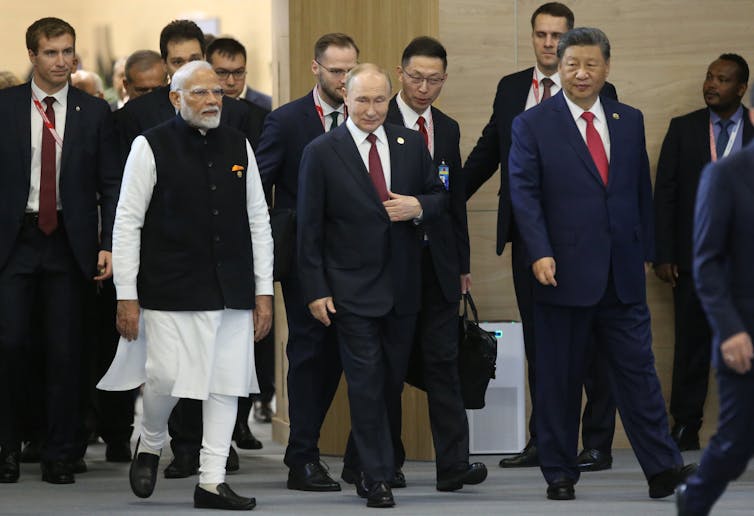
A group of men walk together.
Indian Prime Minister Narendra Modi, Russian President Vladimir Putin and China’s Xi Jinping attend the BRICS leaders summit on Oct. 23, 2024.
Contributor/Getty Images

Earlier this year, Chinese leader Xi Jinping used the term “Dragon-Elephant Tango” to promote a vision of India-China ties based on “mutual achievement.”

Despite the U.S. surpassing China as India’s biggest trading partner in 2021-22, investment ties between New Delhi and Beijing have grown steadily between 2005 and 2025, with only some intermittent friction.

However, what can appear as a tilt toward Beijing is better understood through structural roots in India’s economic realities as well as the country’s long-standing commitment to nonalignment.

The relationship between India and China is marked by significant economic interdependence rather than political convergence. India’s imports are largely coming from China, especially in the areas of machinery, electronics and other intermediate goods.

Yet for all of the convergence, areas of bilateral tensions remain. India’s growing trade deficit with China and Beijing’s ironclad relationship with Pakistan – along with unresolved border issues – limit how far New Delhi is willing to align with Beijing strategically.

Nevertheless, India-China relations are no doubt warming, especially in the wake of Trump’s tariffs. Indicative of that shift were India’s exports to China, which surged by 90% in November to $2.2 billion.

Broader sources of Indian-US tension

It isn’t just the warming China-India relationship that has thrown a wrench into the Quad’s works. The Trump administration’s growing embrace of India’s archrival Pakistan has also soured U.S.-India ties.

Trump’s claim to have mediated an end to the brief Pakistan-India war in May and his subsequent invitation of Pakistan’s army chief to the White House were met with anger in India.

That dispute was mirrored by the one over Russian oil, which had precipitated some of Trump’s tariffs on India. Modi’s government has walked a tightrope between the U.S. and Russia, wanting to keep open the possibility of good relations with Russian President Vladimir Putin, while managing tensions with the U.S. That’s why Putin’s visit to India in December held such symbolic value.

The Modi government stopped short of explicit long-term commitments to new Russian oil purchases and did not chart any new defense deals. In that, as with the issue over Washington’s embrace of Pakistan, India has sought to balance competing camps, creating space to maintain an open door with the U.S. without abandoning India’s strategic autonomy on what nations it does business with.

Optimism amid paralysis

So, how does all this diplomatic tangoing affect the Quad?

The result, it appears, is paralysis at this juncture. But it is important to point out that neither country wants to pronounce the Quad dead. The latest National Security Strategy of the United States explicitly mentions the Quad as part of efforts to “win the economic future” in Asia.

And both nations continue to reaffirm their commitment to the partnership – betting that political conditions will stabilize and that global trends may turn in their favor.

So there are still reasons for guarded optimism. Recent progress in trade negotiations and gradual reductions in Russian oil imports could ease Washington’s skepticism over India.

And for their part, Japan and Australia are trying to keep the momentum going – Japan with its naval and coast guard capabilities and Australia with infrastructure and health initiatives.

If a mutually acceptable trade deal with the U.S. can emerge, and New Delhi can craft an agenda for the Quad framework that is acceptable to the current U.S. administration, a leaders summit could still materialize in 2026.

But the louder the tariff wars between India and the U.S. become, the slimmer the chance for a stronger Quad in the near term.

The Conversation

Hyeran Jo receives funding from the Carnegie Corporation of New York (G-PS-24-62004, Small State Statecraft and Realignment). The statements made and views expressed are solely the responsibility of the author.

Yoon Jung Choi does not receive funding from any organization related to this article. The statements made and views expressed are solely the responsibility of the author.

ref. Trump tariffs and warming India-China ties have silenced the Quad partnership … for now – https://theconversation.com/trump-tariffs-and-warming-india-china-ties-have-silenced-the-quad-partnership-for-now-270606

Battleship Potemkin at 100: how the Soviet film redrew the boundaries of cinema

Source: The Conversation – Global Perspectives – By Alexander Howard, Senior Lecturer, Discipline of English and Writing, University of Sydney

IMDB

People crowd together in the sun. All smiles and waves. Joyous.

Pandemonium erupts. Panic hits like a shockwave as those assembled swivel and bolt, spilling down a seemingly infinite flight of steps.

Armed men appear at the crest, advancing with mechanical precision. We are pulled into the chaos, carried with the writhing mass as it surges downward. Images sear themselves on the retina. A child crushed underfoot. A mother cut down mid-stride.

An infant’s steel-framed pram rattling free, gathering speed as it hurtles downward. A woman’s glasses splinter, skewing across her bloodied face as her mouth stretches open in a soundless scream.

I’ve just described one of the most famous sequences in the history of film: the massacre of unarmed civilians on the steps of Odessa. Instantly recognisable and endlessly quoted, it is the centrepiece of Sergei Eisenstein’s masterpiece, Battleship Potemkin, which turns 100 this month.

A new front for cinema

Battleship Potemkin redrew the boundaries of cinema, both aesthetically and politically.

It is a dramatised retelling of a 1905 mutiny in the Black Sea Fleet of the Imperial Russian Navy – a key cresting point in the wave of profound social and political unrest that swept across the empire that year.

The first Russian revolution saw workers, peasants and soldiers rise up against their masters, driven by deep frustration with poverty, autocracy and military defeat.

Although the tsar remained in power, the discord forced him to concede limited reforms that fell far short of what had demanded.

The impetus for the historical mutiny on the Potemkin was a protest over rotten food rations. Eisenstein emphasises this in his film, lingering on stomach-churning close-ups of maggots crawling over spoiled meat.

When the sailors refuse to eat the putrid rations, they are accused of insubordination and lined up before a firing squad. The men refuse to gun down their comrades and the crew rises up, raising the red flag of international solidarity as they symbolically nail their colours to the mast.

A sailor called Vakulinchuk, who helped lead the uprising, is killed in the struggle. Sailing to Odessa, the crew lays his body out for public mourning and the mood in the city becomes increasingly volatile. Support for the sailors swells, and the authorities respond with lethal force, sending in troops and prompting the slaughter on the Odessa Steps.

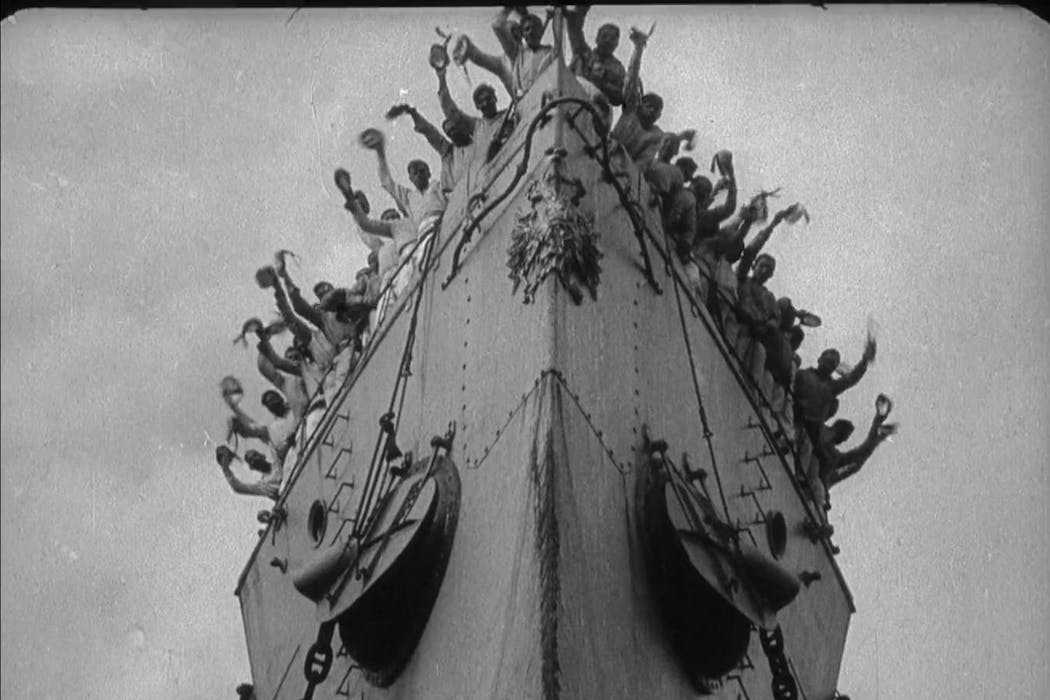
The Potemkin fires on the city’s opera house in retaliation, where military leaders have gathered. Soon after, a squadron of loyal warships approaches to crush the revolt. The mutineers brace for battle, but the sailors on the other boats choose not to fire. They cheer the rebels and allow the Potemkin to pass in an act of comradeship.

At this point Eisenstein departs from the historical record: in reality, the 1905 mutiny was thwarted and the revolution suppressed.

Political myth-making

Battleship Potemkin was commissioned by the Soviet State to commemorate the 20th anniversary of the revolution.

The new Bolshevik administration viewed cinema as a powerful tool for shaping public consciousness and Eisenstein – then in his late 20s and gaining attention for his radical theatre work – was tasked with creating a film that would celebrate the origins of Soviet power.

Eisenstein initially planned a sprawling multi-part film canvasing the revolution’s major events, but faced production constraints. He turned instead to the Potemkin, a story which allowed him to depict oppression, collective struggle and the forging of revolutionary unity in a distilled form.

The finished piece was less a literal history lesson than a highly stylised piece of political myth-making.

When Potemkin was presented at Moscow’s Bolshoi Theatre in December 1925 the invited spectators, a mix of communist dignitaries and veterans of the abortive 1905 mutiny, punctuated the screening with bursts of wild applause – none more ecstatic than when the battleship’s crew unfurl the red flag, hand-tinted a vivid red on the black and white film.

Celebrated – and banned

Battleship Potemkin was a global sensation. Filmmakers and critics hailed it as truly groundbreaking. Charlie Chaplin declared it “the best film in the world”.

Yet its impact also made it feared. Governments recognised the volatile political charge running through its images. In Germany it was heavily cut, and in Britain it was banned. Even so, prints continued to circulate, and the film’s reputation only grew.

Eisenstein’s growing international status did little to protect him at home. As the 1920s gave way to the 1930s, the tides of Stalinist cultural policy began to turn sharply against him. Eisenstein’s approach was profoundly out of step with the new aesthetic of Socialist Realism, which demanded clear narratives, heroic characters and unambiguous political messaging.

Where his signature technique, montage, was dynamic and dialectical, Socialist Realism insisted on straightforward storytelling and easily digestible moral lessons. As a result, Eisenstein found himself accused of obscurity, excess and political unreliability.

Several of his projects were halted; others were taken out of his hands altogether. Those he did complete were admired, but none matched the impact of Battleship Potemkin.

A century on, its vision of oppression, courage and collective resistance still crackles with an energy that reminds us why cinema matters.

The Conversation

Alexander Howard does not work for, consult, own shares in or receive funding from any company or organisation that would benefit from this article, and has disclosed no relevant affiliations beyond their academic appointment.

ref. Battleship Potemkin at 100: how the Soviet film redrew the boundaries of cinema – https://theconversation.com/battleship-potemkin-at-100-how-the-soviet-film-redrew-the-boundaries-of-cinema-267433

After Canada legalized cannabis, police caught more drunk drivers

Source: The Conversation – Canada – By Michael J. Armstrong, Associate Professor, Operations Research, Brock University

When Canada legalized cannabis in October 2018, there were many concerns about its potential impacts. One of them involved cannabis-impaired driving.

Before legalization, police were already catching more drug-impaired drivers each year. So, people naturally worried that more stoned drivers would appear on the road after legalization.

To lower that risk, the federal government updated its driving laws. Impairment by alcohol or drugs separately was already illegal. In December 2018, Canada also banned impairment by combinations of alcohol and drugs, or by unspecified substances.


Read more:
Cannabis-impaired driving: Here’s what we know about the risks of weed behind the wheel


The government likewise helped police to better enforce those laws. For example, it gave them more power to obtain breath and blood samples from drivers. And it funded more training to help them recognize symptoms of drug impairment.

However, it was unclear how much impaired driving would really increase due to legalizing cannabis.

For example, drivers injured in collisions often test positive for cannabis, but also for other drugs. Cannabis consumers claim they are driving less often after use. And police say that drivers’ symptoms more often imply impairment by stimulants or narcotics than by cannabis.

Given this uncertainty, I decided to dig into the police data.

Police-reported impairment

My research analyzed the annual rates of impaired driving cases that police investigated between 2009 and 2023. The reporting covered four substance categories: alcohol, drugs, drugs-and-alcohol combined and unknown substances.

Note that “drugs” includes cannabis but also other chemicals like opioids and amphetamines. Publicly available data unfortunately don’t name the drugs involved.

I first estimated the trends in alcohol and drug impairment up until 2018. I then calculated how much rates changed from 2019 onward.

I also checked several potential explanations for those changes. Those included the level of legalized cannabis sales and the share of adults consuming cannabis in each province. I also considered each province’s number of police trained in drug recognition and their degree of COVID-19 pandemic restrictions.

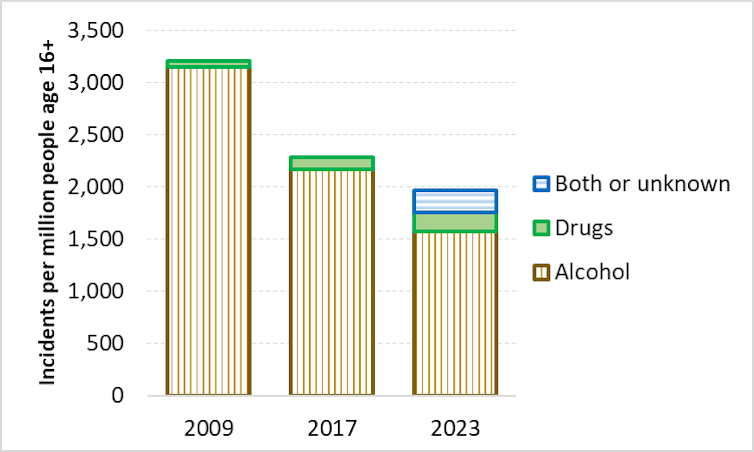
The data showed that during the 15-year study period, alcohol remained the most common impairment category. But its share of all cases dropped from 98 per cent in 2009 to 95 per cent in 2017 and to just 80 per cent in 2023.

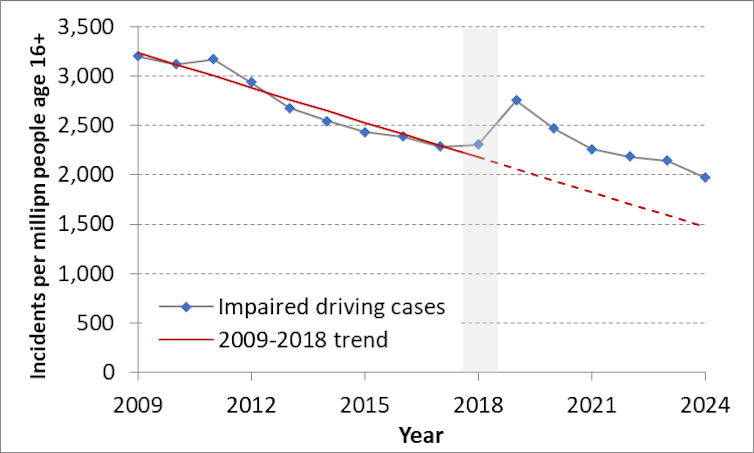
Up until 2018, the total impairment rate also fell each year.

This line chart shows how Canada's impaired driving rates were decreasing from 2009 until 2018, jumped higher in 2019, and then resumed their downward trend from 2020 onward.
Canadian average police-reported impaired driving incidents per million population aged 16+, comparing actual rates to the 2009-2018 trend.
Statistics Canada, CC BY

More drinks and drugs

But in 2019, rates jumped substantially. As a result, police reported 31 per cent more impairment cases during 2019-23 than the 2009-18 trend had projected.

The impairment increases varied between provinces. For example, there was no significant change in Québec and Saskatchewan. But rates doubled in British Columbia and Newfoundland.

Percentage-wise, the drugs category saw the most growth. It averaged 42 per cent higher during 2019-23 than had been projected.

But alcohol impairment rose too. It averaged 17 per cent above its previous trend.

And when counting drivers, alcohol’s growth was larger. The increase in drinking drivers caught by police was four times the increase in drugged drivers.

The new offenses for impairment by drugs and alcohol combined, or by unspecified substances, also contributed to the higher rate.

So, police clearly found more impaired drivers after 2018. But was that because more impaired drivers were on the road? Because police got better at catching them? Or both?

This bar chart shows that overall impairment rates were lower in 2023 than in 2009, but with an increasing proportion due to drugs or drugs and alcohol combined.
Canadian average police-reported impairment rates in 2009, 2017, and 2023, broken down by substance category.
Statistics Canada, CC BY

Constables, COVID and cannabis

My analysis showed the impairment changes were correlated most strongly with the number of police trained in drug recognition. Not surprisingly, when provinces gave police more training, they caught more impaired drivers.

The restrictions that provinces imposed during the COVID-19 pandemic showed the second biggest correlations with impairment. But interestingly, alcohol and drugs diverged: when provinces tightened restrictions, they got less impairment from alcohol but more from drugs.

Presumably, lockdowns meant fewer bars open, and so fewer people driving home drunk. But perhaps lockdowns also meant more laid-off workers using drugs at home before going grocery shopping.


Read more:
Alcohol sales changed subtly after Canada legalized cannabis


Alcohol impairment showed no relationship with the numbers of Canadians consuming cannabis or the amount of cannabis legally sold. That’s not surprising. Canadians didn’t suddenly replace their cabernet with cannabis after legalization.

But it was surprising that drug impairment likewise showed no relationship with cannabis consumer numbers. And it was only weakly correlated with legal sales.

This might imply that most drug impairment came from chemicals other than cannabis. Or perhaps most legal cannabis purchases simply replaced existing illegal ones, rather than adding to total usage.

Consuming responsibly

Overall, Canadian police reported noticeably more drug-impaired and alcohol-impaired driving after 2018. But the growth seemed related mostly to enhanced enforcement and pandemic disruptions, rather than to legalized cannabis. And fortunately, the long-term decline in impaired driving resumed in 2020.

All road users benefit from that continuing decline. And we each play a role in maintaining it. Whether your preferred intoxicant is booze, weed or something else, please consume responsibly. And use designated drivers or public transit to get home.

After all, flashing coloured lights look much nicer on a tree standing in your home than on a police car pulling you over.

The Conversation

Michael J. Armstrong does not work for, consult, own shares in or receive funding from any company or organisation that would benefit from this article, and has disclosed no relevant affiliations beyond their academic appointment.

ref. After Canada legalized cannabis, police caught more drunk drivers – https://theconversation.com/after-canada-legalized-cannabis-police-caught-more-drunk-drivers-272244

Deception and lies from the White House to justify a war in Venezuela? We’ve seen this movie before in run-ups to wars in Vietnam and Iraq

Source: The Conversation – USA – By Betty Medsger, Professor Emeritus of Journalism, San Francisco State University

Military personnel on the amphibious assault ship USS Iwo Jima on Dec. 16, 2025, in Ponce, Puerto Rico, during a U.S. military campaign in the Caribbean and eastern Pacific. Miguel J. Rodriguez Carrillo/AFP via Getty Images

Are Americans about to be led again into a war based on misrepresentations and lies? It’s happened before, most recently with the wars in Iraq and Vietnam.

President Donald Trump and his administration have presented the country’s growing military operations against Venezuela as a war against drug trafficking and terrorism. Trump has designated the government of Venezuela President Nicolas Maduro as a foreign terrorist organization, the first country to ever receive that designation.

The U.S. military has killed at least 99 crew members of small boats that Trump claims, without presenting evidence, were carrying illegal drugs destined for the U.S. The New York Times reports, however, that “Venezuela is not a drug producer, and the cocaine that transits through the country and the waters around it is generally bound for Europe.”

Trump’s administration has justified the bombing of these boats by declaring they are manned by combatants. U.S. Sen. Jack Reed, a Democrat from Rhode Island, told the Intercept news outlet that the administration “has offered no credible legal justification, evidence or intelligence for these strikes.”

There is no war. Yet.

On Dec. 12, 2025, Trump said, “It’s going to be starting on land pretty soon” and announced four days later a “total and complete blockade of all sanctioned oil tankers going into, and out of, Venezuela.”

As Trump increasingly sounds like he is preparing to go to war against Venezuela, it might be helpful to examine the run-ups to the wars in Iraq and Vietnam – two wars based on lies that led, together, to the deaths of 62,744 Americans.

As an investigative journalist who has written about the vast, secret operations of the FBI and the man who ran it for decades, I am well aware of the dangerous ability the government has to deceive the public. I also covered the opposition to the Vietnam war and the release of information years later that revealed that lies were at the heart of the start of both the Vietnam and Iraq wars.

Author Betty Medsger speaks about her story on Donald Trump’s targeting of his perceived enemies and its connection to her book on the FBI.

Fear used to gin up public support

Consider the run-up to the Iraq War.

Fear was the main tool used to convince the public that it was essential for the U.S. to go to war in Iraq. The manufacturing of fear was evident in a speech by Vice President Dick Cheney in August 2002 to a convention of the Veterans of Foreign Wars.

In 2003, Secretary of State Colin Powell addressed the U.N. Security Council on information and intelligence that he believed showed the possibility of weapons of mass destruction in Iraq.

Cheney said, without evidence, that Iraq’s Saddam Hussein was planning to use weapons of mass destruction against the United States and its allies. If the U.S. did not go to war against Iraq, he said, it might experience another Pearl Harbor.

President George W. Bush chose Secretary of State Colin Powell to make the administration’s most prominent public case for going to war in Iraq in a televised speech at the United Nations. Powell was perhaps the most respected official in the Bush administration.

The White House provided Powell with a draft speech. But Powell pressed the CIA regarding what he thought were unsupported claims in the White House draft. Despite his efforts, his speech on Feb. 5, 2003, contained significant unsupported claims, including that Hussein had authorized his military to use poison gas if the U.S. invaded.

“Leaving Saddam Hussein in possession of weapons of mass destruction for a few more months or years is not an option, not in a post-September 11th world,” Powell solemnly declared that day.

He later expressed regret for making the case for war.

“I’m the one who presented it on behalf of the United States to the world,” Powell later said. By then, he said, the speech was “painful” for him personally and would forever be a “blot” on his reputation.

Intelligence agencies pressed to justify war

No weapons of mass destruction existed in Iraq, nor was Hussein connected with al-Qaida, as the Bush administration had said it was. And Iraq did not release poison gas when the U.S. invaded the country. Early postwar assessments of how the U.S. could have invaded Iraq on the basis of serious false claims suggested it happened because the CIA and other intelligence agencies gave President Bush false or inadequate intelligence.

But as extensive official records of pre-war deliberations became available to journalists and others in response to Freedom of Information Act requests, a different explanation emerged.

John Prados, historian at the National Security Archives, discovered an explanation in hundreds of official records that meticulously document the run-up to the war.

They revealed that U.S. intelligence agencies had let themselves be used, he wrote, as “a tool of a political effort, vitiating the intelligence function … They all yielded intelligence predictions of exactly the kind the Bush administration wanted to hear … The intense focus on achieving the conditions for war instead of solving an international problem led to crucial faults in military planning and diplomatic action.”

The administration did not attempt to engage in diplomacy before deciding to go to war. There never was a serious effort, even within the administration, to consider alternatives to war.

George J. Tenet, director of the CIA at the time, later wrote that “based on conversations with colleagues, in none of the meetings can anyone remember a discussion of the central questions: Was it wise to go to war? Was it the right thing to do?”

Most journalists accepted PR at face value

A dearth of serious reporting contributed to the public being ill-informed.

Dan Kennedy, professor of journalism at Northeastern University, recently wrote that only one news organization, the Washington bureau of Knight Ridder – later known as McClatchy – exposed the Bush-Cheney “administration’s lies and falsehoods during the run-up to the disastrous war in Iraq.”

Other reporters relied on the public relations push for war being made to journalists by high-level political appointees in the military, foreign service and intelligence agencies. But Knight Ridder journalists relied on expert, longtime career officers in those agencies who were “deeply troubled by what they regarded as the administration’s deliberate misrepresentation of intelligence, ranging from overstating the case to outright fabrication.”

Lies to Congress and the public also were at the heart of the run-up to the war in Vietnam.

President Johnson reports to Congress and the American people on the Gulf of Tonkin incident, which he said happened off the coast of Vietnam but which was later disputed.

Of the two attacks on a destroyer that the administration of President Lyndon Johnson said required an immediate vast buildup of troops in August 1964, one was provoked by the United States and the other one never happened.

Few if any questions were asked when the House and Senate voted – with only two no votes – on the request for what would be known as the Gulf of Tonkin Resolution. The resolution was used by Johnson and his successor, President Richard Nixon, to keep expanding the war for nearly a decade. By mid-1969, there were 543,400 American troops in Vietnam.

Truth and transparency are crucial

It may seem obvious that the most important lesson to be learned from those wars is that the president and all who contribute to decisions to go to war should tell the truth. But, as shown by the presidents who led the U.S. into wars in Iraq and Vietnam and from Trump’s daily remarks, truth is a frequent casualty.

That increases the need for Congress, the public and the press to demand to be fully informed about these decisions that will be carried out in their name, with their money and with the blood of their sons and daughters. That’s necessary to prevent a president and Congress from making decisions that lead to consequences like these:

In the Iraq War, 4,492 American military members were killed and approximately 200,000 Iraqi civilians were killed. In the Vietnam War, 58,252 American military members were killed, 1.1 million Vietnamese military members were killed, and a staggering 2 million Vietnamese civilians were killed.

The Conversation

Betty Medsger does not work for, consult, own shares in or receive funding from any company or organization that would benefit from this article, and has disclosed no relevant affiliations beyond their academic appointment.

ref. Deception and lies from the White House to justify a war in Venezuela? We’ve seen this movie before in run-ups to wars in Vietnam and Iraq – https://theconversation.com/deception-and-lies-from-the-white-house-to-justify-a-war-in-venezuela-weve-seen-this-movie-before-in-run-ups-to-wars-in-vietnam-and-iraq-272044

RFK Jr. wants to scrutinize the vaccine schedule – but its safety record is already decades long

Source: The Conversation – USA (3) – By Jake Scott, Clinical Associate Professor of Infectious Diseases, Stanford University

Children today receive more vaccines than children did in the past, but due to advances in vaccine technology, today’s shots contain far fewer immune-stimulating molecules. SDI Productions/iStock via Getty Images Plus

The U.S. childhood immunization schedule, the grid of colored bars pediatricians share with parents, recommends a set of vaccines given from birth through adolescence to prevent a range of serious infections. The basic structure has been in place since 1995, when federal health officials and medical organizations first issued a unified national standard, though new vaccines have been added regularly as science advanced.

Vaccines on the childhood schedule have been tested in controlled trials involving millions of participants, and they are continuously monitored for safety after being rolled out. The schedule represents the accumulated knowledge of decades of research. It has made the diseases it targets so rare that many parents have never seen them.

A bar chart showing the U.S. childhood vaccine schedule.
The U.S. childhood vaccine schedule recommends a set of vaccines given from birth through adolescence. The schedule shown here was last updated in August 2025.
Centers for Disease Control and Prevention

But the schedule is now under scrutiny.

On Dec. 16, 2025, the Centers for Disease Control and Prevention adopted its first major change to the childhood immunization schedule, under Kennedy’s leadership. The agency accepted an advisory committee’s vote to drop a long-held recommendation that all newborns be vaccinated against hepatitis B, despite no new evidence that questions the vaccine’s long-standing safety record.

Health and Human Services Secretary Robert F. Kennedy Jr., who has cast doubt on vaccine safety for decades, has said he plans to further scrutinize the vaccines children receive.

I’m an infectious disease physician who treats vaccine-preventable diseases and reviews the clinical trial evidence behind immunization recommendations. The vaccine schedule wasn’t designed in a single stroke. It was built gradually over decades, shaped by disease outbreaks, technological breakthroughs and hard-won lessons about reducing childhood illness and death.

With federal officials now casting doubt on its foundations, it’s helpful to know how it came about.

The early years

For the first half of the 20th century, smallpox vaccination was common, required by most states for school entry. But there was no unified national schedule. The combination vaccine against diphtheria, tetanus and pertussis, known as the DTP vaccine, emerged in 1948, and the Salk polio vaccine arrived in 1955, but recommendations for when and how to give them varied by state, by physician and even by neighborhood.

The federal government stepped in after tragedy struck. In 1955, a manufacturing failure at Cutter Laboratories in Berkeley, California, produced batches of polio vaccine containing live virus, causing paralysis in dozens of children. The incident made clear that vaccination couldn’t remain a patchwork affair. It required federal oversight.

In 1964, the U.S. surgeon general established the Advisory Committee on Immunization Practices, or ACIP, to provide expert guidance and recommendations to the CDC on vaccine use. For the first time, a single body would evaluate the evidence and issue national recommendations.

A CDC poster for oral polio vaccine with a striped bee saying be well.
Polio vaccines, as advertised in this CDC poster from 1963, were administered on a large scale throughout the U.S. starting in 1955.
Centers for Disease Control and Prevention

New viral vaccines

Through the 1960s, vaccines against measles (1963), mumps (1967) and rubella (1969) were licensed and eventually combined into what’s known as the MMR shot in 1971. Each addition followed a similar pattern: a disease that killed or disabled thousands of children annually, a vaccine that proved safe and effective in trials, and a recommendation that transformed a seemingly inevitable childhood illness into something preventable.

The rubella vaccine went beyond protecting the children who received it. Rubella, also called German measles, is mild in children but devastating to fetuses, causing deafness, heart defects and intellectual disabilities when pregnant women are infected.

A Rubella epidemic in 1964 and 1965 drove this point home: 12.5 million infections and 20,000 cases of congenital rubella syndrome left thousands of children deaf or blind. Vaccinating children also helped protect pregnant women by curbing the spread of infection. By 2015, rubella had been eliminated from the Americas.

Technology opens new doors

One limitation of some early bacterial vaccines was that they didn’t work well in infants. Young children’s immune systems couldn’t mount a strong response to the sugar coating on certain bacteria. In the 1980s, scientists developed a method called conjugate vaccine technology, in which sugars on bacterial pathogens are linked to proteins that the immune system – even in infants – can more easily respond to.

The first target of this innovation was a bacterium called Haemophilus influenzae Type b, or Hib. Before vaccination, Hib was the leading cause of bacterial meningitis in American children, causing roughly 20,000 cases of the disease annually and killing hundreds.

The Hib conjugate vaccine was licensed for use in infants in 1990, and within five years Hib disease in young children dropped by more than 99%. Most pediatricians practicing today have never seen a case.

Hepatitis B and the safety net

In 1991, the CDC added hepatitis B vaccination at birth to the schedule. Before then, around 18,000 children every year contracted the virus before their 10th birthday.

Many parents wonder why newborns need this vaccine. The answer lies in biology and the limitations of screening.

An adult who contracts hepatitis B has a 95% chance of clearing the virus. An infant infected in the first months of life has a 90% chance of developing chronic infection, and 1 in 4 will eventually die from liver failure or cancer. Infants can acquire the virus from their mothers during birth, from infected household members or through casual contact in child care settings. The virus survives on surfaces for days and is highly contagious.

Early strategies that targeted only high-risk groups failed because screening missed too many infected mothers. Even today, roughly 12% to 18% of pregnant women in the U.S. are never screened for hepatitis B. Until ACIP dropped the recommendation in early December 2025, a first dose of this vaccine at birth served as a safety net, protecting all infants regardless of whether their mothers’ infection status was accurately known.

This safety net worked: Hepatitis B infections in American children fell by 99%.

Access becomes a right

The schedule’s expansion was enabled by a crucial policy change. From 1989 to 1991, a measles outbreak swept through American cities, causing more than 55,000 cases and over 120 deaths. Investigators found that many infected children had seen doctors but never been vaccinated. Their families couldn’t afford the shots, and the system had failed to catch them.

Measles is one of the most contagious viruses known, and infection can cause lifelong harm and even death in children.

Congress responded by creating the Vaccines for Children program in 1994, which provides free vaccines to children who are uninsured, underinsured or on Medicaid. With cost no longer a barrier, ACIP could recommend vaccines based on science rather than worrying about who could afford them.

A unified standard

For decades, different medical organizations issued their own, sometimes conflicting, recommendations. In 1995, ACIP, the American Academy of Pediatrics and the American Academy of Family Physicians jointly released the first unified childhood immunization schedule, the ancestor of today’s familiar grid. For the first time, parents and physicians had a single national standard.

The schedule continued to evolve. ACIP recommended vaccinations for chickenpox in 1996; rotavirus in 2006, replacing an earlier version withdrawn after safety monitoring detected a rare side effect; and HPV, also in 2006.

Each addition followed the same rigorous process: evidence review, risk-benefit analysis and a public vote by the advisory committee.

More vaccines, less burden

One fact often surprises parents: Despite the increase in recommended vaccines, the number of immune-stimulating molecules in those vaccines, called antigens, has dropped dramatically since the 1980s, which means they are less demanding on a child’s immune system.

The whole-cell pertussis vaccine used in the 1980s alone contained roughly 3,000 antigens. Today’s entire schedule contains fewer than 160 antigens, thanks to advances in vaccine technology that allow precise targeting of only the components needed for protection.

What lies ahead

For decades, ACIP recommended changes to the childhood schedule only when new evidence or clear shifts in disease risk demanded it. Rolling back a long-standing recommendation with no new safety data represents a significant break from that norm.

In June 2025, Kennedy fired all 17 members of ACIP and replaced them) with his own choices, many of whom had a history of anti-vaccine views.

Given this and other unprecedented changes Kennedy has made to vaccine policy in his first year as health secretary, this is unlikely to be the last such reversal.

Members of the CDC Advisory Committee on Immunization Practices sitting at a long table.
On Dec. 5, 2025, the Advisory Committee on Immunization Practices voted to withdraw a long-standing recommendation that all babies receive a dose of the hepatitis B vaccine at birth.
Elijah Nouvelage/Stringer via Getty Images

Kennedy, his newly appointed ACIP panel and others within HHS have pushed to align the U.S. vaccine schedule with European countries such as Denmark, which recommends fewer vaccines. But every country’s schedule reflects its specific disease burden, health care infrastructure and access to care.

Denmark’s more targeted approach works in a small, wealthy country with universal public health care, equitable access and a national registry that tracks every patient. The U.S. health care system is fragmented: Millions are uninsured, many families move between providers, and screening systems have significant gaps.

Major medical organizations, including the American Academy of Pediatrics and the American College of Obstetricians and Gynecologists, have rejected the reversal on hepatitis B’s routine use at birth. More broadly, these organizations and several states, including California, New York and Illinois, have indicated they will continue following established, evidence-based guidelines if federal recommendations diverge on other vaccines in the future.

The Conversation

Jake Scott does not work for, consult, own shares in or receive funding from any company or organization that would benefit from this article, and has disclosed no relevant affiliations beyond their academic appointment.

ref. RFK Jr. wants to scrutinize the vaccine schedule – but its safety record is already decades long – https://theconversation.com/rfk-jr-wants-to-scrutinize-the-vaccine-schedule-but-its-safety-record-is-already-decades-long-271408