When a doctor can’t find an interpreter, many now reach for Google Translate. It seems like a practical fix to a pressing problem. But a new study warns this quick solution may be putting refugee and migrant patients at serious risk – exposing them to translation errors that could lead to misdiagnosis, wrong treatment or worse.
The study, led by an interdisciplinary team of researchers at the University of Limerick – of which we were part – examined how artificial intelligence (AI) is being used to bridge language gaps between doctors and patients. The findings reveal a troubling pattern: AI translation tools are increasingly replacing human interpreters in GP surgeries, even though none of these apps have been tested for patient safety.
Anyone who has tried to explain themselves across a language barrier knows how easily meaning can slip away. In everyday situations – from the nail salon to the car mechanic – we often manage with gestures, guesses and good humour. But healthcare is different.
Clear communication between a patient and their doctor must be accurate and safe. It is the cornerstone of good medical care, especially when symptoms, risks or treatment decisions are involved, and it allows patients to feel heard and to participate meaningfully in decisions about their own health.
When a patient and doctor do not speak the same language and rely instead on an AI translation app such as Google Translate, communication becomes less certain and more problematic. What appears to be a convenient solution may obscure important details at precisely the moment when clarity matters most.
The recognised standard for cross-cultural communication in healthcare is access to a trained interpreter. The role of an interpreter is to provide impartial support to both the patient and the doctor. However, interpreters are often inaccessible in practice, due to availability, time pressures and limited resources in general practice.
Consequently, doctors report that they increasingly turn to the device in their pocket – their phone – as a quick, improvised solution to bridge communication gaps during consultations. Google Translate is now being used as an interpreter substitute, despite not being designed for medical communication.
My colleagues and I examined international studies from 2017 to 2024 and found no evidence that an AI-powered tool can safely support the live, back-and-forth medical conversations needed in clinical consultations.
In all the studies we reviewed, doctors relied on Google Translate, and they consistently raised concerns about its limitations. These included inaccurate translations, failure to recognise medical terminology and the inability to handle conversations that unfold over multiple turns.
The studies reported translation errors that risk misdiagnosis, inappropriate treatment and, in some cases, serious harm. Worryingly, the research found no evidence that Google Translate has ever been tested for patient safety in general practice.
In other studies, Google Translate was shown to misinterpret key medical words and phrases. Terms such as congestion, drinking, feeding, gestation, vagina and other reproductive organs were sometimes mistranslated in certain languages.
It also misinterpreted pronouns, numbers and gender, and struggled with dialects or accents, leading to confusing or inaccurate substitutions. Alarmingly, researchers also reported “hallucinations” – where the app produced fluent-sounding but entirely fabricated text.
Relying on Google Translate to support doctor-patient communication carries the risk of displacing human interpreters and creating an overdependence on AI tools that were not designed for medical interpretation. It also normalises the use of AI apps that have not undergone the safety testing expected of healthcare technologies.
It is difficult to imagine any other area of medical practice where such an untested approach would be considered acceptable.
The study found that refugee and migrant advocates prefer human interpreters, particularly in maternal healthcare and mental health. Patients also raised concerns about consenting to the use of AI and about where their personal information might be stored and how it might be used.
To deliver safe healthcare to refugees and migrants, doctors should ensure that patients have access to trained interpreters, whether in person, by video, or by phone. Clear instructions for accessing these interpreters must be available in every healthcare setting so that staff can arrange support quickly and confidently.
The evidence shows that AI tools not specifically designed and tested for medical interpreting should no longer be used, as they cannot yet provide safe or reliable communication in clinical situations.
The Conversation asked Google to comment on the issues raised by this article but received no reply.
Anthony Kelly receives funding from Innovation Fund Denmark.
Anne Cronin does not work for, consult, own shares in or receive funding from any company or organisation that would benefit from this article, and has disclosed no relevant affiliations beyond their academic appointment.
Great apes are humans’ closest relatives in the animal kingdom. As much as 98.8% of their DNA is shared, but while the number of humans living on the planet is increasing fast, other great apes are in decline. Five out of the seven species are now critically endangered.
The UN has estimated that about 22,000 great apes disappeared from their natural habitats between 2005 and 2011. Adults are mostly killed, their meat and body parts sold for bushmeat, traditional medicine or, in some cases, traditional ceremonies.
Babies and juvenile apes, on the other hand, command a much higher price alive. They are also easier to smuggle across borders. Seizures and confiscations of illegal animal trades are rare and often poorly documented.
Through the decades, great apes have remained an acquisition target for some zoos and animal attractions, sometimes by dodging the rules. The desire to keep “exotic” animals as pets also remains a key driver of the illegal global wildlife trade.
Social media has made the illegal trade in great apes much more efficient: sellers and buyers can use online platforms to exchange messages about prices and transport.
The convention was formed 50 years ago to create rules for a legal trade in wildlife and to stem the decline in wild animal populations. Under Cites, commercial trade in great apes is effectively banned. But it has been long known that the complex, paper-based permit system can be avoided or ignored.
Jane Goodall warned of the threats to great apes for years.
So why are governments not doing more? First, the organisation meant to provide oversight and monitoring of wildlife trade – the Cites secretariat – is underfunded. While the legal global wildlife trade market is valued at US$220 billion (£164 billion) a year, the secretariat has an annual budget of about US$20 million. And like most international treaties, it is reliant on the collaboration of its 185 state members, with all the complexities of international politics.
State governments also don’t treat the illegal wildlife trade as high a priority as illegal drugs, weapons or human trafficking – despite the well-known connections between these. And many still operate an outdated permit system developed in the 1970s, instead of the proposed electronic version which would provide much better protection against fraudulent permits, faster and transparent reporting, and increased collaboration with customs officials.
Moving apes around
There are, however, legitimate reasons to transfer great apes internationally. Moving second-generation, captive-bred animals from one registered zoo to another would be a typical example. Getting an export permit showing the animal as captive-born is one of the easiest ways to transport great apes internationally.
But this can also be used as a loophole. In the late 2000s, some 150 chimpanzees, bonobos and gorillas were reportedly exported from Guinea to China, although there is no known facility in Guinea breeding either species. In this case, high-level corruption was a key factor: in 2015, Ansoumane Doumbouya, then head of the Cites management authority in Guinea, was arrested and sentenced to 18 months in prison for selling fraudulent export permits. He was later pardoned by the president of Guinea.
In September 2025, Cites officials visited one of the largest private animal collections in the world. Vantara, India’s wildlife sanctuary turned mega-zoo, was hailed by some as an amazing story of love and care for wildlife. But the Wildlife Animal Protection Forum of South Africa, a national network of 30 South African organisations, has been increasingly concerned about the fast-paced imports of over 2,000 wild animal species from all over the world. Vantara now reportedly keeps close to 150,000 animals, more than any other well-known zoo.
In a recent investigation, the Indian Supreme Court absolved Vantara from any wrongdoing in relation to animal imports. But after this ruling, the Cites secretariat also visited the zoo. Its recent report raised significant concerns about several issues relating to animal transportation involving Vantara.
Vantara has claimed that Cites gave “a clean chit” to the facility, and that it had noted that all animal transfers to the facility were “fully legitimate and transparent, in accordance with Indian law”.
The Cites report said chimpanzees were imported from the Democratic Republic of Congo and also Middle Eastern countries (via the United Arab Emirates) as captive animals. As far as the author is aware, none of these countries are known to breed chimpanzees in zoos or other captive facilities.
Even more worryingly, a bonobo from Iraq, a mountain gorilla from Haiti, and a Tapanuli orangutan from Indonesia were also acquired. There are few recognised zoos globally which breed bonobos, and none breeding either mountain gorillas or Tapanuli orangutans. There is only a single male Tapanuli orangutan kept in an Indonesian zoo. Based on the Zoological Information Management System, the global zoo database, there is currently no mountain gorilla in zoos worldwide.
More generally, Cites has called on member countries affected by the great ape trade – both as a source and destination – to implement additional measures to prevent any illegal transfers. The International Union for Conservation of Nature, the world’s largest conservation alliance, has also called for “international action to protect wild great apes in their natural habitats, with a focus on addressing poaching and illegal trade”.
Introducing a modern electronic permit system and carrying out more enforcement would be important first steps to tackling these crimes. Otherwise, these species that are so close to humans will disappear in front of our eyes.
Prof Matyas Liptovszky is a director of Wilder International, and in a voluntary capacity affiliated with the European Association of Zoos and Aquariums.
With Something Good, the arts and culture newsletter from The Conversation, we aim to cut through the noise and recommend the very best in new releases every fortnight. And what a soundtrack this year’s newsletters have had. From Lily Allen’s devastating breakup album West End Girl to Rosalía’s genre-defying LUX, these are the best albums of 2025 according to our academic experts.
1. Teal Dreams by Yazmin Lacey
Yazmin Lacey’s second album, Teal Dreams, builds on her well-received multi-genre debut, Voice Notes (2023). Featuring a more confident and developed sound, this album is a rich blending of roots and soul. The Londoner’s vocal delivery spans a range of emotional registers, exploring themes of growth and renewal throughout.
There are beautiful, melodic moments aplenty. From the slow-burn build of Grace to the sassy swagger of Crutch, all reward repeated listening.
Ain’t I Good For You by Yazmin Lacey.
On Ribbons, Lacey addresses personal loss, expressing feelings of change and longing, declaring she’s “not the same Yazmin”, “misses your big ideas” and wants “to talk about love and fear”.
Meanwhile her 2024 collaboration with Ezra Collective, God Gave Me Feet For Dancing, continues with the grooviness of Ain’t I Good For You. The song and album serve as an open invitation to dive in and enjoy the reflective beauty Lacey offers.
Hussein Boon is chair of the Black Music Research Unit
2. The Dreaming Prince in Ecstasy by Lamp of Murmuur
The Dreaming Prince in Ecstasy is one of 2025’s most striking extreme-metal releases. Not just because it blends black metal with psychedelic tones reminiscent of David Bowie, but because it plays with the genre’s emotional architecture in unusually vulnerable ways.
Under the swirling tremolo and gothic theatrics sits an affective register closer to yearning than nihilism. The album leans into a kind of decadent, romantic masculinity, accentuated by the complete anonymity of the band’s members, and refusal to confirm to normative maleness in the genre.
The Dreaming Prince in Ecstasy by Lamp of Murmuur.
For researchers like me who study men and masculinities, it’s a compelling artifact: a reminder that subcultural performance is never just noise, but a way of working through desire, fantasy and the uneasy labour of feeling.
In a music scene often caricatured as hostile or hypermasculine, The Dreaming Prince in Ecstasy offers a glimpse of what happens when intensity becomes a mode of introspection rather than domination.
Chris Waugh is a lecturer in Criminology & Sociology
3. LUX by Rosalía
For anyone unfamiliar with Rosalía’s journey from flamenco experimentalist to global pop innovator, LUX might seem like a bold leap – yet its seeds were always there. A heartfelt offering of avant-garde classical pop, sung across 13 languages, this record feels both operatic and immediate, expansive yet relatable.
Berghain by Rosalía.
What’s most impressive is the album’s sheer conceptual depth, weaving together romance, divinity and gender without ever feeling academic or inaccessible. Drawing on historic figures such as the German Benedictine abbess and philosopher Hildegard von Bingen (1089-1179) and Taoist master Sun Bu’er (1119-1182), the record situates contemporary pop within a lineage of female mysticism and intellectual devotion. Yet songs like La Perla bring the album back to earth with cutting lyricism that feels instantly resonant.
It’s rare to hear pop music this conceptually daring become such a commercial and critical force, but this success feels wholly earned.
Eva Dieteren is a PhD researcher in gender and popular music
From the dual tin whistle strains of Welcome To My Mountain, the opening song from Junior Brother’s startling third album The End, you quickly realise that this is a greeting of a different kind.
There are musical references; a touch of Richard Thompson here, a flash of Kate Bush there, but Kealy is more closely aligned with the singular songwriting styles of John Spillane, Jinx Lennon, Lisa O’ Neill and Seamus Fogarty.
This is an astonishing record. It demands the attention of the listener, and rewards with each repeated listen.
Stephen Ryan is course director for the MA in songwriting
5. Rainy Sunday Afternoon by The Divine Comedy
The Divine Comedy’s mastermind Neil Hannon brings his unique blend of upbeat poppy tunes and romantic melancholia to the band’s 13th studio album, Rainy Sunday Afternoon. And it reminds us that he really is one of the great songwriters, with a range so impressive that he can turn effortlessly from the achingly beautiful (Achilles and I Want You) to scathing, witty satire (Mar-a-Lago by the Sea) via the sparkling Christmas song All the Pretty Lights.
Achilles by The Divine Comedy.
No, Hannon may never again see the commercial heights of National Express, a song The Guardian describes as his “worst song and greatest hit”, and nor may he wish to. After three decades in the business, Hannon is doing something much more valuable: writing emotive, catchy songs which continue to connect with people.
Glenn Fosbraey is an associate dean of humanities and social sciences
6. You Are Safe From God Here by The Acacia Strain
With the 13th album of their career, The Acacia Strain have released one of their most dense and uncompromising records to date. You Are Safe From God Here combines riff and drum brutality and crushing lyrical passages.
Most of the tracks are around two minutes long, giving the album a relentless, all-killer-no-filler directness. This is then contrasted by the colossal closing song Eucharis II: Blood Loss, which spans 14 minutes. It’s a hypnotic and bleak descent and unforgettable album closer.
A Call Beyond by The Acacia Strain.
Lyrically, the album dives into themes of isolation, depression and a “dark fantasy” of visions of an uncaring and predatory god. The album performance feels venomous and emotionally exposed – channelling both rage and despair. The result is an album that is not only sonically devastating but also emotionally overwhelming.
While less accessible to its predecessors, You Are Safe From God Here is more atmospheric and brutal. A harrowing, standout chapter in The Acacia Strain’s evolution as a band and rightly a top contender for album of the year in the metal scene. Ultimately, the album lives up to its name: in the depths that The Acacia Strain explore on this record, you really are safe from god.
Douglas Schulz is a lecturer in sociology and criminology
7. West End Girl by Lily Allen
Lily Allen returned to making music after seven years in October – and redefined the breakup album in the process. Written and recorded over just ten days, West End Girl is a concept album that fictionalises Allen’s journey from her casting in the play 2:22 – A Ghost Story, through to her eventual break up with her ex-husband, American actor David Harbour.
West End Girl by Lily Allen.
Lyrical rawness is the essence of this album, with Allen refusing to hold anything back in articulating her feelings towards an ex and their alleged secret lover, referred to on the album as “Madeline”. In this fictionalisation of events Allen calls the ex a sex addict and shares her discomfort with his alleged request for an open relationship with brutal honesty.
Musically Allen reasserts herself, reminding us of her influence on younger artists such as PinkPantheress and Charli XCX through her vocal and musical delivery, and by packing her lyrics full of contemporary and relatable cultural references.
In the space of four years, PinkPantheress has gone from producing songs on GarageBand in her university halls of residence to an award-winning international artist. Not bad for a 24-year-old from Bath who became a viral TikTok sensation after posting faceless snippets of her songs.
Stateside by PinkPantheress.
Her latest album, Fancy That is ridiculously brief, but filled with bubble gum earworms and sweetly sung bops. PinkPantheress’s breathy falsetto combines with her lullaby lyrics about gen-Z life to showcase her as an extremely gifted songwriter and producer. More disco babe than Brat, Fancy That is the soundtrack to a party where everyone is invited.
Like Jim Legxacy’s mixtape Black British Music (also released this year), there is a sense of anemoia – a yearning for a time that you did not experience – that comes with Fancy That. The deep rolling 80s electronic bass of Stateside. The electronic chords of Illegal. The rave-like Girl Like Me. This trademark gen-Z hybridity should produce a sound that is cacophonic; however, the genres of drum and bass, house, garage, jungle and electronic pop coalesce to produce something that sounds fresh and new.
Julia Toppin is a senior lecturer in music enterprise and entrepreneurship
9. Let God Sort Em Out by Clipse (July)
Advances in music technology have allowed artists such as Billie Eilish and Lil Nas X to create huge hits outside of conventional studios, using DIY home recording set-ups. But Clipse’s new album — the first in 16 years from brothers Gene “Malice” and Terrence “Pusha T” Thornton — must be the first to be recorded within the headquarters of a fashion mega-brand.
Chains & Whips by Clipse and Kendrick Lamar.
Producer Pharrell Williams oversaw Let God Sort Em Out while serving as Louis Vuitton’s creative director, using a custom-built studio in their Paris headquarters. The luxurious setting seems to influence the sound: the hard-hitting percussive edge of earlier Clipse recordings gives way to woozier, synth-laden beats, exemplified by the hypnotically off-kilter P.O.V.
Clipse are pioneers of “coke rap”, and there are still plenty of bars here that engagingly recount their triumphs and near-misses in the drug trade. Now in their 50s, though, their lyrics also explore broader themes: The Birds Don’t Sing honours their recently deceased parents, while closing track By The Grace of God reflects on the improbable longevity of their careers.
Ellis Jones is a lecturer in music and management
10. Non Fiction: Piano Concerto in Four Movements by Hania Rani
Polish neo-minimalist composer and singer Hania Rani has collaborated with the Manchester Collective and improvisers Valentina Magaletti and Jack Wyllie to record her most ambitious work yet, Non Fiction.
IV. Semplice by Hania Rani, Manchester Collective, Jack Wyllie and Hugh Tieppo-Brunt.
The album was inspired by the work of Jewish child prodigy Josimah Feldschuh. Feldschuh made her concert debut in the Warsaw Ghetto just before the second world war at the age of 11. There, she also began to write her own music. She died of tuberculosis just outside of Warsaw at the age of 13, having fled the ghetto with her family. Only 17 of Feldschuh’s compositions survived.
Inspired, Rani set about writing and recording Non Fiction. However, the project’s focus was soon unsettled by more recent horrors: Russia’s full-scale invasion of Ukraine in 2022, and Israel’s invasion of Gaza after the October 7 attacks. Rani perceived similarities between images of Gaza’s destruction shared online, and photographs of Warsaw’s destruction during the second world war.
The result is an instrumental album of scope and depth. Non Fiction stands as a reflection on war and brutality that allows just enough grace, tenderness and humanity to keep us hopeful.
Andrew Green is a lecturer in the anthropology of music
What was your favourite album of 2025? Let us know in the comments below.
Looking for something good? Cut through the noise with a carefully curated selection of the latest releases, live events and exhibitions, straight to your inbox every fortnight, on Fridays. Sign up here.
Samuel Murray is affiliated with the Musicians’ Union and a writer member of PRS for Music.
Andrew J. Green, Chris Waugh, Douglas Schulz, Ellis Jones, Eva Dieteren, Glenn Fosbraey, Hussein Boon, Julia Toppin, and Stephen Ryan do not work for, consult, own shares in or receive funding from any company or organisation that would benefit from this article, and have disclosed no relevant affiliations beyond their academic appointment.
In no particular order, here are The Conversation’s top five films of 2025 as reviewed by our experts.
1. One Battle After Another
The latest film from director Paul Thomas Anderson follows Bob (Leonardo DiCaprio), an ageing hippie hero and a relic of a fictional noughties brigade, the French 75. Led by his lover Perfidia Beverley Hills (Teyana Taylor), they robbed banks, bombed buildings and liberated detention centres in the name of their ideology of “free borders, free choices, free from fear”.
Left to bring up their daughter, Willa (Chase Infiniti), Bob spends his days off-grid unshaven, smoking weed. All is (somewhat) well until the brutal army veteran, Colonel Lockjaw (Sean Penn), who believes himself to be Willa’s real father, barrels back into their lives in pursuit of his “daughter”.
It is at heart a family melodrama, drawing on the classic tropes of bad versus good father and conflicted mother, questioning the legitimacy of the family unit. On to these narratives bones, Anderson grafts a vision of a post-Obama America in thrall to shadowy corporate interests, a legacy of rounding up and deporting immigrants, and an old white male order hell-bent on its own agenda of personal revenge.
After the lights have gone up, it may well be that what stays with you most is its terrifying imagery of detention centres and the horror of immigrant round-ups. It is this certainly that led Steven Spielberg to acclaim “this insane movie” as more relevant than Anderson could ever have imagined.
Ruth Barton, Fellow Emeritus in Film Studies at Trinity College Dublin
2. Sinners
Sinners is set in Jim Crow-era Mississippi, a time of harsh segregation and racial injustice. It follows Sammie (Miles Caton), a young Black guitar player, who gets his big break when his cousins, the gangster twins Smoke and Stack (both played by Michael B. Jordan), return to open a juke joint in their hometown. This new venture brings money, music and a sort of freedom but also danger to their door.
On the juke joint’s opening night, Sammie’s blues music draws the Irishman Remmick (Jack O’Connell) to the bar. But Remmick is no average man, he’s a vampire.
Remmick uses his own song, The Rocky Road to Dublin to invite the Black patrons to join him and the others he has turned into vampires, offering them the chance to escape Jim Crow Mississippi. The song he chooses, although catchy, is a story of exchanging one form of suffering (life in Ireland during the height of English oppression) for another – life on the English mainland where the ballad tells of victimisation and violence. This is one of many moment where the real stories of Irish and Indigenous Choctaw oppression are used in the film to draw connection between oppressed people and the stories they tell and were told.
Such nuance within the film meant that I watched it several times and gained more insight and enjoyment with each viewing.
By Rachel Stuart, Senior Lecturer in Criminology and Deviant Identities at Brunel
3. A Real Pain
We are constantly confronted by history. The history of our cultures and traditions. Of our families. Of our own personal relationships. Can we – or should we seek to – ever escape the tightly woven net of our preoccupation with our past?
Jesse Eisenberg explores these questions with curiosity, humour and insight in the lightly plotted, semi-road movie, A Real Pain.
David (Eisenberg) and Benji (Kieran Culkin) are 40-something cousins, who are reunited for a trip to Poland in memory of their recently deceased grandmother, a Holocaust survivor with whom both, especially Benji, were very close.
The tourist group perform their Jewishness within unstated yet acknowledged limits to their engagement– with Poland, with Jewish history, with each other and indeed with themselves. Within this muted, routinised remembrance culture, Benji’s unpredictable behaviour starts to detonate small outbreaks of “real pain”, which are annoying and upsetting in equal measure.
What “pain” should take precedence? That of the violently amputated cultural history to which its inheritors feel a moral duty of remembrance? Or the ongoing needs and demands of the present, which cannot linger indefinitely in history’s dark shadow. The great strength of Eisenberg’s subtle, understated film is to pose such questions without suggesting, let alone imposing, facile answers.
By Barry Langford, Professor of Film Studies at Royal Holloway, University of London
4. Sorry, Baby
Sorry, Baby is the directorial debut of its writer and star, Eva Victor. The film follows Agnes (Victor), an English professor at a small American college, in the aftermath of a sexual assault by one of her teachers when she was a student there.
The story, based on Victor’s own experience of trauma, is structured in non-linear chapters encompassing the time after, before and during the assault. The result is a raw and unflinching, yet nuanced, depiction of trauma’s aftermath, which presents Agnes as a fully rounded and complex character.
Sorry, Baby resists the idea that trauma must define a character’s identity. Instead, the film explores how people live with, around and beyond painful experiences. Agnes carries trauma with her, but moves forward with hurt, joy, and desire – alive with humour and contradiction.
This debut marks Victor as a distinctive voice in contemporary cinema, one who trusts her characters and her audience alike. With Sorry, Baby, Victor shows us a new way to tell stories about trauma, healing, and the small, vital moments in between. This is a filmmaker to watch.
Laura O’Flanagan, PhD Candidate in the School of English at Dublin City University
5. Weapons
The film opens with the chilling premise of 17 children from the same classroom vanishing without a trace, leaving behind only grainy security footage of them running with their arms outstretched, like little planes. However, the true horror unfolds as the community of Maybrook – a small town in Pennsylvania – spirals into chaos instead of unity.
Parents accuse teachers, neighbours distrust one another and innocent lives are upended in the search for a culprit. This breakdown is grounded in psychological research, showcasing how human behaviour can deteriorate under pressure.
Social identity theory is a scientific concept that theorises that your brain is wired to compartmentalise the world into “us” (those we consider good) and “them” (those perceived as threats). This process intensifies when people face fear or stress.
In Weapons, we see this theory in action as the community dismantles itself. Teacher Justine Gandy (Julia Garner) becomes an easy target, not due to concrete evidence, but because she fits neatly into the role of the other – “them”. The parents of the missing children seek someone to vilify, and she becomes the scapegoat of their fears.
Weapons succeeds as horror because it doesn’t rely on supernatural monsters or gore. Instead, it shows us the real monsters – the ones we become when our psychology works exactly the way evolution has led it to.
Edward White, PhD Candidate in Psychology at Kingston University
Looking for something good? Cut through the noise with a carefully curated selection of the latest releases, live events and exhibitions, straight to your inbox every fortnight, on Fridays. Sign up here.
The authors do not work for, consult, own shares in or receive funding from any company or organisation that would benefit from this article, and have disclosed no relevant affiliations beyond their academic appointment.
Luxury pet pampering packages at hotels, menus with dog-friendly roast dinners and £6,000 animal-friendly charter flights. Pet travel isn’t just a trend, it’s something of a transformation. This is the “pawprint economy” – and it’s booming.
Globally, the pet industry is projected to reach US$500 billion (£375 billion) by 2030, with pet travel services alone expected to be valued at US$5.9 billion by 2034. In the UK, where 60% of households have pets – including roughly 13.5 million dogs – that’s a substantial market.
People travel with their pets for leisure, business, relocation and specialist care. And while some people even travel with horses, cats, birds or other small animals, it’s dogs that dominate the leisure travel surge. For people who enjoy travelling with their pets, the benefits are real for both parties: strengthened bonds, shared experiences and opportunities to build skills and confidence.
But there’s a growing gap between what the industry is offering and what people and pets need. As this market explodes, it’s a good time to ask whether the travel industry is genuinely adapting or just coming up with superficial offerings.
While humans and dogs have travelled together for millennia, today’s growth reflects something distinctly modern: pets are now family members. With 40% of people viewing their dog as their child and nearly half calling them their best friend, dogs occupy a central place in millions of UK homes.
During COVID restrictions, pet acquisition surged globally. Today nearly half of “pet parents” are first timers. The years since COVID emerged have seen an acceleration in the inclusion of pets in leisure life, from dog-friendly cafes to outdoor festivals, paddleboarding and holidays.
Even cost-of-living pressures haven’t dampened this enthusiasm. While 34% of people who have pets have altered their pet-related behaviour due to financial pressures (changing to a cheaper brand of pet food, for example), pet travel continues to grow. UK pet families take an average of two domestic holidays every year with their animals.
Here’s where the disconnect emerges. While providers advertise “pawsecco” and pet spas, research has shown that people prioritise practical care over “extras”.
Studies identify six key attributes that people are looking for: service design (pet-friendly room placement, shared dining), activity support (walking guides, bins), safety, pet-savvy staff, transparent policies with fair fees, and lastly, amenities. This is a low priority for travellers with pets, but often what providers focus on. Crucially, green spaces drive pet travel planning, boosting wellbeing for both human and animal. After all, this is the fundamental reason why people choose to travel with pets.
Love me, love my pet
Yet many people with pets say they don’t believe any accommodation is truly pet friendly, signalling a trust gap. Many properties advertise as “pet friendly” but impose restrictions, surprise fees or go no further than simply allowing pets to stay.
Part of the problem seems to be one-size-fits-all thinking. Research identifies three distinct segments of people travelling with dogs. There are those seeking basic, convenience-focused accommodation. Premium experience seekers are willing to pay for luxury. And activity-loving travellers prioritise outdoor adventures. A chihuahua on a city break has different needs to a labrador on a hiking trip, yet many providers offer generic packages that delight no one.
The evidence from both researchers and industry is clear: people will pay more to travel with their pets. For tourism providers, the opportunities are significant. For example, hotel pet fees in the UK can range from £15-40 daily or £20-75 per stay. Being viewed as pet friendly can drive repeat visits and brand loyalty for travel-related providers and dining outlets.
But there’s one area where UK travellers seem to be less enthusiastic. When it comes to overseas travel, 54% are “very unlikely” to go abroad with their pet (compared to 37% globally). Only 7% actually have plans to do so. This hesitancy is probably driven by complicated, costly regulations and rules.
Eurostar bans pets on its trains and UK aviation regulations effectively prohibit pets in the cabin on inbound flights, with few airlines offering cabin options outbound. Most pets must fly as cargo in the hold, which often causes worry for their humans.
Brexit also ended the UK’s access to the EU pet passport system, requiring expensive animal health certificates for each trip. A 2025 UK-EU agreement will eventually see the reinstatement of pet passports, however.
The UK dog travel market is heavily skewed towards domestic holidays, with travellers largely preferring coastal retreats and rural escapes, prioritising walks and eating out. This presents clear opportunities for domestic providers to capture demand, and for travellers to choose more environmentally friendly, sustainable destinations closer to home.
The travel industry in the UK and beyond faces a choice: continue offering superficial “pet-friendly” experiences or genuinely adapt and ease the stress for travellers and their pets.
The evidence shows that pet-centric facilities, support with activities, and attentive service outweigh add-ons. Delivering this means providing transparent online information so travellers can assess facilities and policies confidently, designing spaces that genuinely welcome pets, and training staff to deliver a knowledgeable service.
The appetite for pet travel is overwhelming and the pawprint economy represents a huge business opportunity, if accommodation, travel and leisure providers are willing to prioritise genuine pet friendliness. After all, if the hospitality industry makes pets and their people happy, they will come back for more – with smiles and tails wagging.
Lori Hoy does not work for, consult, own shares in or receive funding from any company or organisation that would benefit from this article, and has disclosed no relevant affiliations beyond their academic appointment.
Evidence from Canada, the United States and Europe shows that weather-related disasters aren’t experienced equally. The people hardest hit are often those with the fewest resources to cope.
Lower-income and marginalized populations face greater exposure, have fewer resources to prepare or recover and incur a higher proportion of losses not covered by insurance.
Even if they are insured, many people have difficulty covering the deductible because they lack emergency savings. This means damage is not repaired, people live in unsafe or unhealthy conditions and the financial and personal risk of future events is increased.
When households are uninsured, losses can strain household budgets and leave people unable to meet their basic needs. As extreme weather escalates, so does the likelihood that more families will find themselves unable to recover.
Affordability is the primary driver of the protection gap, but it is not the only one. Many Canadians do not understand the benefits of insurance, or underestimate the probability and cost of suffering a loss.
Accessibility to insurance is also a challenge, especially in remote areas where it is usually purchased in person. While the growth of digital purchasing channels helps, it is not a solution for those without reliable internet or sufficient digital skills.
Finally, the market itself does not always meet the needs of low-income or otherwise marginalized groups. There is a lack of insurance products designed for these groups, leaving many without the protection they need.
Strengthening community resilience
Better insurance options, stronger investments in mitigation and better support for consumers can help reduce inequities and strengthen resilience.
Community-level mitigation is a good starting point. Land-use planning that steers development away from high-risk areas can prevent future losses. Programs like FireSmart, which reduces wildfire losses, and infrastructure designed for a changing climate also help limit damage as severe weather becomes more frequent.
National assessments show that making housing more resilient reduces exposure for lower-income and marginalized households that are more likely to live in older or poorly maintained homes, putting them at greater risk.
While major retrofits can be costly, even small upgrades such as improving drainage, installing backwater valves or fire-resistant materials can help prevent damage. Many municipalities provide targeted subsidies and incentive programs that support these upgrades, particularly for households facing greater financial constraints.
Making hazard information easier to find and understand can also help ensure no one is left behind when disasters strike. Many Canadians lack clear information about the hazards they face and how to prepare for them. Some residents, including newcomers and seniors, may face barriers in accessing or acting upon available information.
Finally, community supports can further strengthen resilience. People with strong social ties and access to community organizations recover more quickly after disasters. Programs that build local networks and support neighbourhood groups can help accomplish this at a relatively low cost.
Closing the protection gap
A critical step in reducing the unequal impacts of weather-related hazards is closing Canada’s insurance protection gap. Microinsurance is one promising solution, and these simplified, low-cost policies can provide basic protection at a fraction of the cost for households that cannot afford traditional coverage.
Embedded tenant insurance — automatically included when renters sign a lease — is another approach that ensures basic coverage.
Digital tools, such as mobile-friendly sign-up platforms and plain-language policy explanations, can reduce barriers for those who struggle with technology.
Public support for income-tested premium subsidies or credits can bring essential coverage within reach for low-income households, while community-based catastrophe insurance — where local governments or community groups arrange coverage on behalf of residents — offers another option.
While Canadians can’t stop extreme weather, we can work together to prevent it from worsening inequality. Increasing awareness, reducing losses, closing insurance gaps and building resilience are key to protecting those at greatest risk.
Derek Cook is the Director of the Canadian Poverty Institute that receives funding from The Co-operators Insurance Company. The Canadian Poverty Institute is also a partner with The Resilience Institute on a collaborative project that is funded by the Canada Mortgage and Housing Company (CMHC).
Mary Kelly has received funding from Finance Canada and the Social Sciences and Humanities Research Council of Canada. She is also on the board of directors of Heartland Mutual Insurance Company.
Anne E. Kleffner does not work for, consult, own shares in or receive funding from any company or organisation that would benefit from this article, and has disclosed no relevant affiliations beyond their academic appointment.
The most memorable musical moments in the film are not by film composer Dimitri Tomkin. (Wikimedia)
Hailed by many critics and movie lovers as a “timeless classic” — and ranking first on the American Film Institute’s list of the 100 most inspiring films of all time — It’s a Wonderful Life (1946) has found a secure place in the hearts of audiences.
1946 poster for ‘It’s a Wonderful Life.’ (Wikimedia Commons)
The story revolves around George Bailey, who sacrifices his personal dreams to support the small community of Bedford Falls. When a financial crisis pushes him to the brink of despair, an angel intervenes and reveals what the town’s life would look like had George never been born.
George is confronted with an alternative reality in what the film frames as a foil city, Pottersville. There, he rediscovers the value of his contributions and returns to Bedford Falls renewed, to what some viewers regard as an outpouring of communal generosity and small-town virtue.
The movie’s soundtrack — including contributions by Hollywood composer Dimitri Tiomkin — plays a central role in It’s a Wonderful Life, underscoring problems and tensions beneath the surface. Some depictions of music and sound beg analysis around how these reflect racist ideas about “proper” musical, social and community norms.
Film origins
The film began its life as a short story called The Greatest Gift (1939). Film studio RKO bought the story in 1944 and sold it to director Frank Capra’s new company, Liberty Films, in 1945.
Director and producer Frank Capra. (Wikimedia Commons)
A team of writers — including Capra himself — rewrote the script and set to work on getting Jimmy Stewart, earlier cast in two of Capra’s pre-war films, to star.
Just back from serving in the Second World War, Stewart was reluctant, not least because of what was then known as shellshock and is now called post-traumatic stress disorder from his wartime experiences. Capra successfully coaxed Stewart into taking the role.
It’s a Wonderful Life was intended for release in January 1947, but the studio moved up the premiere to Dec. 20 in order to qualify for the 1946 Academy Awards.
The film’s success came after early scrutiny. An FBI agent attended an early screening and found the film undermined the institution of banking and advanced notions of a demoralized public, but the bureau decided not to pursue prosecution.
Less often acknowledged is that, owing to a clerical failure to file the necessary copyright renewal, the film slipped into the public domain, ensuring decades of holiday broadcasts that ultimately recast it as a Christmas icon.
Musical score
Film composer Dimitri Tiomkin. (Wikimedia Commons)
Tiomkin had already worked with Capra on several film projects, including Lost Horizon (1937) and Mr. Smith Goes to Washington (1939), as well as providing music for the director’s Why We Fight series (1942-1945).
Capra’s selection of Tiomkin for It’s a Wonderful Life is not surprising, yet little of his score remains in the final film.
Tiomkin had composed a full set of cues, which the movie condenses to about 25-30 minutes in a 130-minute run time. Tiomkin’s original cues bear such titles as “Death Telegram” and “George Is Unborn,” and are available on a 2014 recording consisting of 28 tracks.
Memorable musical moments
However, the most memorable musical moments in the film aren’t Tiomkin’s. Instead, they involve citations of well-known traditional and holiday favourites including Twinkle, Twinkle, Little Star, Auld Lang Syne, Silent Night, Adeste Fidelis as well as the folk song Buffalo Gals,“ arranged by Tiomkin, and the popular jazz composition, The Charleston by James P. Johnson.
The film score emerges as choppy and highly varied, not only because of Capra’s cuts, but also by his tracking in cues from other movies. Alfred Newman’s Hallelujah from the Hunchback of Notre Dame (1939) is heard as George jubilantly runs down the main street of Bedford Falls.
A key concerning aspect to the music heard in It’s a Wonderful Life revolves around the portrayal of Black musical forms and practitioners.
Capra’s known racism against Blacks, consistent with racist discourses and practices of the era, is reflected in how jazz and other Black musical forms appear and are framed.
Outside the bar, we hear the fragmented strains of jazz from the dive bar pouring into the town’s main street.
Outside the bar, George bumps into Bedford Falls characters who are, in this alternate setting, destitute and desperate. The quaint main street is overrun by nightclubs and full of bright lights. Through Pottersville, the film projects a sense of moral degradation.
While negatively portraying jazz practised by Black artists, the film simultaneously draws upon and appropriates Black musical forms as necessary and key to popular American life but in a white-controlled version.
Not-so-idyllic Bedford Falls
Despite Capra’s attempt at a happy ending, in the not-so-idyllic Bedford Falls, George is not fully aware of the malicious meddling of a rich, white citizen of Bedford — Henry F. Potter — which catalyzed his financial problems.
George awakens from his Pottersville reverie to re-commit to small-town life. While some viewers see the ending as affirming community, the film also keeps George partly ignorant of how the forces of inequity are actually operating in his largely white community.
Maybe we can appreciate the film on a deeper level, when we consider its varied and competing narratives around music, race, class and belonging.
The holidays can be filled with joy and positive emotion, but they can also be a time when stress is in overdrive. To-do lists can be long, with little time for personal well-being.
Identifying evidence-based strategies and using them to support your well-being is critical to experiencing the holiday season at its best. For example, writing a to-do list before bed can reduce worry and increase the speed of falling asleep.
It requires considering whether there are alternative explanations for a seemingly negative or ambiguous situation. Less offensive interpretations can help regulate negative emotions. In this way, cognitive reframing can reduce stress, improve emotional resilience and help manage anxiety by shifting negative thought patterns into more positive ones.
Sleep matters more during holidays
Approximately 25 per cent of Canadian workers engage in some form of shift work, making healthy sleep habits particularly difficult. With ever-growing to-do lists during the holidays, cutting back on sleep to fit everything in can seem like a good idea.
Practise good sleep hygiene, defined as a set of habits that promote sound sleep, such as maintaining a consistent sleep schedule and an environment free of distractions.
It can be challenging, but it’s essential to reducing irritability and helping you remember the items on your to-do list.
Eating mindfully amid indulgence
Decadent desserts and specialty treats are usually found in abundance during family gatherings and holiday work parties. Although it may be difficult to always make healthier choices during the holidays, try engaging in mindful eating.
Be aware of what you are consuming (and how much) to help you make decisions that are consistent with your longer-term goals.
Disrupted routines and staying active
Physical activity can improve mood, decrease stress and increase energy levels. Engaging in some activity most days can support mental health.
Exercise can have a significant impact on your well-being by increasing serotonin and dopamine, two neurotransmitters that are important for a positive mood. Physical exercise can also improve self-esteem, helping you tackle stressful situations as well as lowering your anxiety levels.
The holidays can disrupt exercise routines, with fewer opportunities for longer workouts. Opt for brief (10-minute) and more frequent workouts (twice a day) to maintain the benefits that physical activity can have on your well-being.
Finding some time for yourself can seem impossible, even though research demonstrates that spending some time on your own can help recharge your emotional and cognitive batteries. When preparing for busy holiday gatherings, spend some time away from everyone to feel calmer, refreshed and revitalized.
Although the optimal amount of alone time each person needs will vary, 15 minutes a day can be restorative. During this “me time,” choose activities that you look forward to, find meaning in and find satisfying (such as reading, knitting or going on a walk.)
Strengthening family and social ties
Approximately two million Canadian seniors aged 65 and older live alone, with almost 20 per cent experiencing loneliness. Good relationships can increase our happiness, health and longevity, which makes the holidays a great opportunity to reconnect with loved ones.
Family dynamics, however, can be complex. Approximately 34 per cent of Canadians report some sort of family dispute. If relationships are strained, consider keeping the interactions brief.
If connecting with others isn’t possible, short conversations with strangers also can improve well-being. Striking up a conversation while waiting for your coffee order can be help decrease loneliness and improve mood.
Consider creating new traditions that are consistent with your current situation to increase wellness. Be sure to manage your expectations for the holidays, however, as others may have different priorities.
By having a flexible mindset — the ability to adapt thinking and behaviour to new information or circumstances — you can reduce stress and decrease disappointment, allowing you to maintain a positive outlook for the holidays.
Source: The Conversation – Canada – By Sadaf Mehrabi, Postdoctoral Research Associate, Environmental Engineering, Iowa State University
When a crisis strikes, rumours and conspiracy theories often spread faster than emergency officials can respond and issue corrections.
In Canada, social media posts have falsely claimed wildfires were intentionally set, that evacuation orders were government overreach or that smoke maps were being manipulated. In several communities, people delayed leaving because they were unsure which information to trust.
This wasn’t just online noise. It directly shaped how Canadians responded to real danger. When misinformation delays evacuations, fragments compliance or undermines confidence in official warnings, it reduces the state’s ability to protect lives and critical infrastructure.
At that point, misinformation is no longer merely a communications problem, but a national security risk. Emergency response systems depend on public trust to function. When that trust erodes, response capacity weakens and preventable harm increases.
Canada is entering an era where climate misinformation is becoming a public-safety threat. As wildfires, floods and droughts grow more frequent, emergency systems rely on one fragile assumption: that people believe the information they receive. When that assumption fails, the entire chain of crisis communication begins to break down. We are already seeing early signs of that failure.
This dynamic extends far beyond acute disasters. It also affects long-running climate policy and adaptation efforts. When trust in institutions erodes and misinformation becomes easier to absorb than scientific evidence, public support for proactive climate action collapses.
Recent research by colleagues and me on how people perceive droughts shows that members of the public often rely on lived experiences, memories, identity and social and institutional cues — such as environmental concerns, perceived familiarity and trust — to decide whether they are experiencing a drought, even when official information suggests otherwise.
These complex cognitive dynamics create predictable vulnerabilities. Evidence from Canada and abroad documents how false narratives during climate emergencies reduce protective behaviour, amplify confusion and weaken institutional authority.
Tackling misinformation
Canada has invested billions of dollars in physical resiliency, firefighting capacity, flood resiliency and energy reliability. In addition, the Canadian government also recently joined the Global Initiative for Information Integrity on Climate Change to investigate false narratives and strengthen response capacity.
These are much needed steps in the right direction. But Canada still approaches misinformation as secondary rather than a key component of climate-risk management.
That leaves responsibility for effective messaging fragmented across public safety, environment, emergency management and digital policy, with no single entity accountable for monitoring, anticipating or responding to information threats during crises. The cost of this fragmentation is slower response, weaker co-ordination and greater risk to public safety.
Canada also continues to rely heavily on outdated communication mediums like radio, TV and static government websites, while climate misinformation is optimized for the social-media environment. False content often circulates quickly online digitally, with emotional resonance and repetition giving it an advantage over verified information.
Governments typically attempt to correct misinformation during emergencies when emotions are high, timelines are compressed and false narratives are already circulating. By then, correction is reactive and often ineffective.
Trust cannot be built in the middle of a crisis. It is long-term public infrastructure that must be maintained through transparency, consistency and modern communication systems before disasters occur.
Proactive preparedness
Canada needs to shift from reactive correction to proactive preparedness. With wildfire season only months ahead, this is the window when preparation matters most. Waiting for the next crisis to expose the same weaknesses is not resilience, but repetition.
We cannot afford another round of reacting under pressure and then reflecting afterwards on steps that should have been taken earlier. That shift requires systemic planning:
Proactive public preparedness: Federal and provincial emergency agencies should treat public understanding of alerts, evacuation systems and climate risks as a standing responsibility, not an emergency add-on. This information must be communicated well before disaster strikes, through the platforms people actually use, with clear expectations about where authoritative information will come from.
Institutional co-ordination: Responsiblity for tackling climate misinformation currently falls between departments. A federal-provincial co-ordination mechanism, linked to emergency management rather than political communications, would allow early detection of misinformation patterns and faster response, just as meteorological or hydrological risks are monitored today.
Partnerships with trusted messengers: Community leaders, educators, health professionals and local organizations often have more credibility than institutions during crises. These relationships should be formalized in emergency planning, not improvised under pressure. During recent wildfires, community-run pages and volunteers were among the most effective at countering false claims.
We cannot eliminate every rumour or every bit of misinformation. But without strengthening public trust and information integrity as core components of climate infrastructure, emergencies will become harder to manage and more dangerous.
Climate resilience is not only about physical systems. It is also about whether people believe the warnings meant to protect them. Canada’s long-term security depends on taking that reality seriously.
Sadaf Mehrabi does not work for, consult, own shares in or receive funding from any company or organisation that would benefit from this article, and has disclosed no relevant affiliations beyond their academic appointment.
Both scenarios were unusual – and they were largely directed by the polar jet stream.
What is a jet stream?
Jet streams are narrow bands of high-speed winds in the upper troposphere, around four to eight miles (seven to 13 kilometers) above the surface of the Earth, flowing west to east around the entire planet. They form where strong temperature contrasts exist.
Each hemisphere hosts two primary jet streams:
The polar and subtropical jet streams in positions similar to much of summer 2025. NOAA
The polar jet stream is typically found near 50 to 60 degrees latitude, across Canada in the Northern Hemisphere, where cold polar air meets warmer midlatitude air. It plays a major role in modulating weather systems in the midlatitudes, including the continental U.S. With winds up to 200 mph, it’s also the usual steering force that brings those bitter cold storms down from Canada.
The subtropical jet stream is typically closer to 30 degrees latitude, which in the Northern Hemisphere crosses Florida. It follows the boundary between tropical air masses and subtropical air masses. It’s generally the weaker and steadier of the two jet streams.
A cross section of atmospheric circulations shows where the jet streams exist between large cells of rising and falling air, movements largely driven by solar heating in the tropics. NOAA
Stronger (faster) jet streams can intensify storm systems, whereas weaker (slower) jet streams can stall storm systems, leading to prolonged rainfall and flooding.
2025’s intense summer of flooding
Most summers, the polar jet stream retreats northward into Canada and weakens considerably, leaving the continental U.S. with calmer weather. When rainstorms pop up, they’re typically caused by localized convection due to uneven heating of the land – picture afternoon pop-up thunderstorms.
During the summer of 2025, however, the polar jet stream shifted unusually far south and steered larger storm systems into the midlatitudes of the U.S. At the same time, the jet stream weakened, with two critical consequences.
First, instead of moving storms quickly eastward, the sluggish jet stream stalled storm systems in place, causing prolonged downpours and flash flooding.
Second, a weak jet stream tends to meander more dramatically. Its broad north-south swings in summer 2025 funneled humid air from the Gulf of Mexico deep into the interior, supplying storm systems with abundant moisture and intensifying rainfall.
Search-and-rescue crews look for survivors in Texas Hill Country after a devastating July 4, 2025, flash flood on the Guadalupe River swept through a girls’ camp, tearing walls off buildings. Ronaldo Schemidt/AFP via Getty Images
This moisture surge was amplified by unusually warm conditions over the Atlantic and Gulf regions. A warmer ocean evaporates more water, and warmer air holds a greater amount of moisture. As a result, extraordinary levels of atmospheric moisture were directed into storm systems, fueling stronger convection and heavier precipitation.
Finally, the wavy jet stream became locked in place by persistent high-pressure systems, anchoring storm tracks over the same regions. This led to repeated episodes of heavy rainfall and catastrophic flooding across much of the continental U.S. The same behavior can leave other regions facing days of unrelenting heat waves.
The jet stream buffered US in hurricane season
The jet stream also played a role in the 2025 hurricane season.
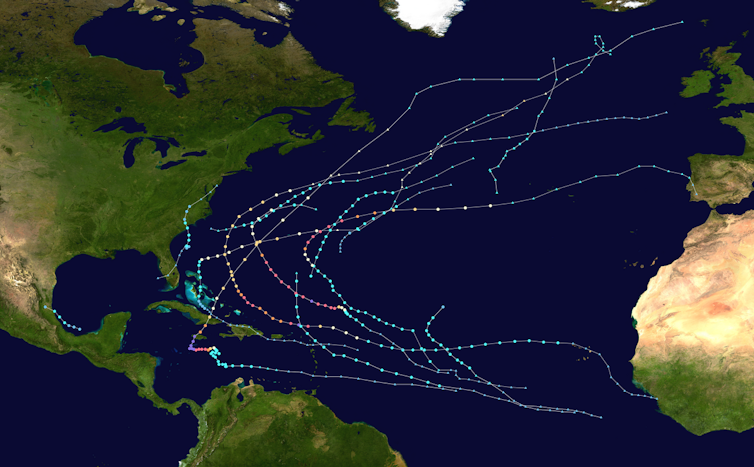
Given its west-to-east wind direction, the southward dip of the jet stream – along with a weak high pressure system over the Atlantic – helped steer all five hurricanes away from the U.S. mainland.
The 2025 Atlantic hurricane season’s storm tracks show how most of the storms steered clear of the U.S. mainland and veered off into the Atlantic. Sandy14156/Wikimedia Commons
Most of the year’s 13 tropical storms and hurricanes veered off into the Atlantic before even reaching the Caribbean.
A higher temperature contrast leads to stronger jet streams. As the planet warms, the Arctic is heating up at more than twice the global average rate, and that is reducing the equator-to-pole temperature difference. As that temperature gradient weakens, jet streams lose their strength and become more prone to stalling.
This increases the risk of persistent extreme rainfall events.
Weaker jet streams also meander more, producing larger waves and more erratic behavior. This increases the likelihood of unusual shifts, such as the southward swing of the jet stream in the summer of 2025.
A recent study found that amplified planetary waves in the jet streams, which can cause weather systems to stay in place for days or weeks, are occurring three times more frequently than in the 1950s.
What’s ahead?
As the global climate continues to warm, extreme weather events driven by erratic behavior of jet streams are expected to become more common. Combined with additional moisture that warmer oceans and air masses supply, these events will intensify, producing storms that are more frequent and more destructive to societies and ecosystems.
In the short term, the polar jet stream will be shaping the winter ahead. It is most powerful in winter, when it dips southward into the central and even southern U.S., driving frequent storm systems, blizzards and cold air outbreaks.
Shuang-Ye Wu does not work for, consult, own shares in or receive funding from any company or organization that would benefit from this article, and has disclosed no relevant affiliations beyond their academic appointment.