The universe may be lopsided – new research

Source: The Conversation – UK – By Subir Sarkar, Emeritus professor, University of Oxford

The shape of the universe is not something we often think about. But my colleagues and I have published a new study suggests it could be asymmetric or lopsided, meaning not the same in every direction.

Should we care about this? Well, today’s “standard cosmological model” – which describes the dynamics and structure of the entire cosmos – rests squarely on the assumption that it is isotropic (looks the same in all directions), and homogeneous when averaged on large scales.

But several so-called “tensions” – or disagreements in the data – pose challenges to this idea of a uniform universe.

We have just published a paper looking at one of the most significant of these tensions, called the cosmic dipole anomaly. We conclude that the cosmic dipole anomaly poses a serious challenge to the most widely accepted description of the universe, the standard cosmological model (also called the Lambda-CDM model).

So what is the cosmic dipole anomaly and why is it such a problem for attempts to give a detailed account of the cosmos?

Let’s start with the cosmic microwave background (CMB), which is the relic radiation left over from the big bang. The CMB is uniform over the sky to within one part in a hundred thousand.

So cosmologists feel confident in modelling the universe using the “maximally symmetric” description of space-time in Einstein’s theory of general relativity. This symmetric vision for the universe, where it looks the same everywhere and in all directions, is known as the “FLRW description”.

This vastly simplifies the solution of Einstein’s equations and is the basis for the Lambda-CDM model.

But there are several important anomalies, including a widely debated one called the Hubble tension. It is named after Edwin Hubble, who is credited with having discovered in 1929 that the universe is expanding.

The tension started to emerge from different datasets in the 2000s, mainly from the Hubble space telescope, and also recent data from the Gaia satellite. This tension is a cosmological disagreement, where measurements of the universe’s expansion rate from its early days don’t match up with measurements from the nearby (more recent) universe.

The cosmic dipole anomaly has received much less attention than the Hubble tension, but it is even more fundamental to our understanding of the cosmos. So what is it?

Having established that the cosmic microwave background is symmetric on large scales, variations in this relic radiation from the big bang have been found. One of the most significant is called the CMB dipole anisotropy. This is the largest temperature difference in the CMB, where one side of the sky is hotter and the opposite side cooler – by about one part in a thousand.

The cosmic microwave background is relic radiation from the Big Bang.
ESA/Planck Collaboration

This variation in the CMB does not challenge the Lambda-CDM model of the universe. But we should find corresponding variations in other astronomical data.

In 1984, George Ellis and John Baldwin asked whether a similar variation, or “dipole anisotropy”, exists in the sky distribution of distant astronomical sources such as radio galaxies and quasars. The sources must be very distant because nearby sources could create a spurious “clustering dipole”.

If the “symmetrical universe” FLRW assumption is correct, then this variation in distant astronomical sources should be directly determined by the observed variation in the CMB. This is known as the Ellis-Baldwin test, after the astronomers.

Consistency between the variations in the CMB and in matter would support the standard Lambda-CDM model. Discord would directly challenge it, and indeed the FLRW description. Because it is a very precise test, the data catalogue required to perform it has become available only recently.

The outcome is that the universe fails the Ellis-Baldwin test. The variation in matter does not match that in the CMB. Since the possible sources of error are quite different for telescopes and satellites, and for different wavelengths in the spectrum, it is reassuring that the same result is obtained with terrestrial radio telescopes and satellites observing at mid-infrared wavelengths.

The cosmic dipole anomaly has thus established itself as a major challenge to the standard cosmological model, even if the astronomical community has chosen to largely ignore it.

This may be because there is no easy way to patch up this problem. It requires abandoning not just the Lambda-CDM model but the FLRW description itself, and going back to square one.

Yet an avalanche of data is expected from new satellites like Euclid and SPHEREx, and telescopes such as the Vera Rubin Observatory and the Square Kilometre Array. It is conceivable that we may soon receive bold new insights into how to construct a new cosmological model, harnessing recent advances in a subset of artificial intelligence (AI) called machine learning.

The impact would be truly huge on fundamental physics – and on our understanding of the universe.

The Conversation

Subir Sarkar receives funding from the UK Research & Innovation (UKRI) councils.

ref. The universe may be lopsided – new research – https://theconversation.com/the-universe-may-be-lopsided-new-research-265256

Ecological myopia: the blind spot holding back climate action

Source: The Conversation – UK – By Tom Pegram, Associate Professor in Global Governance and Deputy Director of UCL Global Governance Institute, UCL

Khanthachai C/Shutterstock

Global debate about how to navigate the climate crisis often centres on high-level pledges and whether national targets are being met. Yet focusing on these technical outcomes obscures a deeper problem that keeps climate action falling short.

This problem is ecological myopia: treating climate change as one issue among many rather than as a sign of wider Earth system disruption. It narrows how we understand risk and allows politics, business and daily life to proceed as if planetary stability could still be taken for granted.

Set against the backdrop of a drying and burning Amazon, the UN climate summit in Brazil in November 2025 showed why this way of seeing no longer works.

Ecological myopia interprets climate change as a conventional environmental problem rather than as a planetary one. It assumes climate sits in a box labelled environment or sustainability while the rest of social and economic life sits in separate silos. But this is short sighted.

Political geoecology – an approach that sees politics as inseparable from the Earth’s ecological systems – offers one way to understand what this leaves out. The idea is that politics and ecology cannot be separated because modern societies are built into the Earth system through energy use, land change and industrial infrastructures. These connections shape climate risks and inequalities yet remain largely invisible.

In many people’s conversations, record heat or flooding are still described as odd weather rather than recognised as signs of a shifting climate that affects food prices and public health. Companies announce net-zero plans yet expand activities that embed new emissions.

Meanwhile, governments hand responsibility to environment ministries even though the main drivers sit in finance or security. We need to see much more clearly.


Read more:
To address the environmental polycrisis, the first step is to demand more honesty


The past ten years have been the hottest on record. The Amazon, host of this year’s UN climate summit, is experiencing droughts so severe that they disrupt river transport and rainfall patterns across the Americas. These developments are not isolated. They reflect mounting pressure on the Earth system.

Modern societies also forget that their prosperity rests on a simple physical process: burning things. Contemporary civilisation has been built around combustion, from coal and oil to natural gas that run homes and industries.

This has turned humanity into a planetary force of disruption, reshaping the atmosphere, the oceans and the ecosystems on which all life depends.

Yet ecological myopia makes it difficult for governments and institutions to respond with the urgency required. When climate is treated as a sector, action is funnelled into narrow channels such as emissions targets or carbon markets, while the deeper forces reshaping the planet continue largely unchecked. Land use, fossil-fuel infrastructure and global supply chains remain the structural drivers of destabilisation.

planet earth
The cure for ecological myopia is to reframe how we see planetary systems.
Negro Elkha/Shutterstock

A planetary lens

A cure for ecological myopia requires using the planetary lens that political geoecology offers. It starts from a simple premise: Everything people depend on, including energy, water, food and health, is embedded in the Earth system.

Looking through this lens shifts priorities. Climate policy becomes inseparable from economic and social policy. Emissions targets are linked to land use and infrastructure, and what societies produce and build.

Indigenous and local knowledge systems are recognised as essential sources of resilience. Protecting ecosystems such as the Amazon is understood as protecting the processes that sustain rainfall and regional stability.

This perspective echoes ideas in research and policy circles on planetary governance, which is not simply global governance at a larger scale. It focuses on how societies can govern within ecological limits and in response to feedbacks – the knock-on effects the Earth system sends back as conditions change – rather than managing climate as an external problem.

For example, shrinking river flows that threaten hydropower or severe flooding that disrupts food production and transport show how Earth system changes spill across sectors, not just climate policy.

Seeing more clearly is the first step toward wiser action.

The central challenge is not only to cut emissions. It is to rethink how societies understand and organise their relationship with the living Earth and to overcome ecological myopia in media narratives, institutional design and economic choices.

The Amazon is often described as the lungs of the planet. It is also a mirror that shows how closely human life is bound into the wider Earth system and how vulnerable that system has become. Now, it’s time to use this mirror to tackle our ecological myopia.


Don’t have time to read about climate change as much as you’d like?

Get a weekly roundup in your inbox instead. Every Wednesday, The Conversation’s environment editor writes Imagine, a short email that goes a little deeper into just one climate issue. Join the 47,000+ readers who’ve subscribed so far.


The Conversation

Prior to retirement Simon Dalby was funded by the Canadian Social Sciences and Humanities Research Council.

Tom Pegram does not work for, consult, own shares in or receive funding from any company or organisation that would benefit from this article, and has disclosed no relevant affiliations beyond their academic appointment.

ref. Ecological myopia: the blind spot holding back climate action – https://theconversation.com/ecological-myopia-the-blind-spot-holding-back-climate-action-270912

Fossil-fuel propaganda is stalling climate action. Here’s what we can do about it.

Source: The Conversation – Canada – By Samuel Lloyd, PhD Candidate, Department of Psychology, University of Victoria

2025 has been a year of setbacks for Canada’s climate policy. In November, the federal and Alberta governments signed a memorandum of understanding to remove strict climate policies in the province and to support the construction of a new pipeline from Alberta to northern British Columbia.

The government also cancelled the federal carbon tax this year, while ending funding for home energy-efficiency programs and delaying sales mandates for zero-emission vehicles.

These steps have pushed Canada even further from meeting its climate goals, which were already too weak to limit global warming to 1.5 C, as outlined in the Paris Climate Agreement.

What’s behind these changes and why is Canadian progress on tackling climate change so slow? Put simply, it’s because climate action threatens the profits of the fossil-fuel industry, and they’ve spent the past 50 years doing everything they can to prevent it.

While the industry has used many tools in this endeavour, perhaps its most effective has been its propaganda machine — a global network of foundations, think tanks and lobbyists known as the Climate Change Counter Movement.

In our newly published study, we review the academic and non-academic literature to map how this movement has used its influence to delay climate action in Canada.


Read more:
Why Mark Carney’s pipeline deal with Alberta puts the Canadian federation in jeopardy


The Climate Change Counter Movement

For years, the movement’s main strategy was to deny that climate change was happening or to claim that humans weren’t causing it. However, as summers got hotter and wildfires, floods and hurricanes became increasingly common, this narrative became less convincing.

The propaganda machine then adopted a new tactic. Rather than denying climate science, it exploited legitimate debates about how climate policy should be designed to sow confusion, cause political deadlock and suggest policies that don’t threaten their profits.

Three examples of these new narratives are particularly widespread in Canada: fossil-fuel solutionism (that fossil fuels can be part of efforts to tackle climate change), “whataboutism” and appeals to well-being.

Together, they uphold the claim that fossil fuels are a necessary and unavoidable part of everyday life and that Canadian fossil fuels are less carbon-heavy than those produced in the rest of the world, meaning that supporting the Canadian fossil-fuel industry would supposedly reduce greenhouse-gas emissions.

These arguments are logically flawed — fossil fuels are incompatible with a world below 1.5 C warming. They’re also based on a falsehood, because oil from the Canadian oilsands is roughly 21 per cent more polluting than conventional crude oil.

Another common argument is that fossil fuels are essential to the Canadian economy, but this narrative overstates the costs of transitioning away from fossil fuels and understates the enormous costs of allowing climate change to continue unmitigated.

While these narratives do originate from elite members of the Climate Change Counter Movement, our case study found evidence that they’re already being repeated by members of the general public and might even explain why many Canadians falsely believe that a clean energy future could include fossil fuels.

How can we tackle false fossil-fuel narratives?

1. Know ourselves

If we want to challenge false narratives about fossil fuels, we should begin by reflecting on how the Climate Change Counter Movement might have affected us already. Fossil-fuel propaganda is everywhere, and it’s hard to avoid internalizing some of it. It’s also important to consider whether challenging the fossil-fuel industry might expose us to physical or financial danger before taking action.

2. Know our enemy

Next, it’s important for us to learn as much as we can about the Climate Change Counter Movement. Who are its members? What propaganda are they spreading, and where are they spreading it? Which narratives work and which don’t? Answering these questions will be the work of academics, journalists and citizen researchers, who can take cues from efforts like the Corporate Mapping Project in their approach.

3. Target them directly

Once we have that information, we can use it to hold the fossil-fuel industry legally (and thus financially) accountable for their role in delaying climate action. Examples of these kinds of lawsuits are appearing all over the world, including in Canada where the Sue Big Oil campaign is uniting B.C. municipalities in suing fossil-fuel companies for their role in the escalating costs of climate change.

These campaigns not only discourage future meddling, but also move funds directly from the fossil-fuel industry to the communities they’ve affected, allowing them to build their own defences against future attacks.

4. Heal our wounds

However, even if lawsuits successfully discourage future activity by the Climate Change Counter Movement, we’ll still need to undo the damage they’ve already done to our society. Their efforts have left the public polarized, untrusting of governments, confused about fact versus fiction and feeling hopeless. We must reinvest in our communities and heal these societal wounds. Climate assemblies, an approach to government which emphasizes public engagement, offer a promising pathway towards many of these goals.

5. Pick our battles

It’s also vital for governments to continue advancing climate action, even when public appetites have been damaged by propaganda campaigns. They can do this by strengthening policies that are relatively unknown, yet still effective and popular.

These policies have not been exposed to the same levels of propaganda as others like the carbon tax and are therefore still popular, while also being effective enough to account for the majority of emission reductions in Canada, the United Kingdom and California.

6. Challenge the structural roots of their power

Finally, we need to remove the root of the fossil-fuel industry’s economic and cultural power. Within our current economic system, this means redirecting financial flows away from the industry by removing fossil-fuel subsidies and implementing stringent compulsory policies to realign markets with climate goals.

The Climate Change Counter Movement is several steps ahead of us, but it hasn’t won yet. If climate change is to be stopped, we have to stop ignoring the elephant in the room and unite against the fossil-fuel industry.

The Conversation

Samuel Lloyd received funding from the Pacific Institute for Climate Solutions for the research project that inspired the research in this article. He wrote that paper while receiving funding from the Canada First Research Excellence Fund as part of the University of Victoria-led Accelerating Community Energy Transformation Initiative.

Katya Rhodes receives funding from Canada First Research Excellence Fund as part of the University of Victoria-led Accelerating Community Energy Transformation Initiative.

ref. Fossil-fuel propaganda is stalling climate action. Here’s what we can do about it. – https://theconversation.com/fossil-fuel-propaganda-is-stalling-climate-action-heres-what-we-can-do-about-it-272227

The dangers of blurring fact and fiction in Holocaust TV narratives

Source: The Conversation – Canada – By Regan Lipes, Assistant Professor of Comparative Literature and English, MacEwan University

In 2020, streaming platform Amazon Prime released Hunters, a thriller mystery about apprehending and eliminating Nazi war criminals living incognito in the United States.

The 18-episode, two-season series, starring Hollywood legend Al Pacino, depicts one particularly haunting scene where a concentration camp guard plays a game of deadly human chess with prisoners used as the pieces.

As pieces are captured, the terrified people are shot. What unfolds on screen is ghastly, but completely fictional. Amazon Prime Video used its X-Ray feature — an interactive overlay that allows viewers on a computer to pause and hover over a scene and access explanatory or historical annotations — to explain the scene fabrication.

As a scholar of Holocaust literary and film narratives, I have been increasingly troubled by the presentation of fictionalized Holocaust atrocities since first watching this show.

Were there not enough real acts of unimaginable violence? Why is there a need to make things up? This excess of creative licence for the sake of drawing in audiences can be desensitizing or can even fuel a fetish for Holocaust horror.

Perhaps, as journalist Tanya Gold wrote regarding John Boyne’s Holocaust novels instrumentalizing Jewish suffering to serve non-Jewish stories, audiences “are greedy for our tragedy.”

When storytelling becomes sensationalism

More recently, after watching the 2025 Netflix limited series, Monster: The Ed Gein Story, I am again exceptionally troubled by how the Holocaust is being portrayed with the integration of convicted war criminal Ilse Koch as a gruesome role model for the title character.

The series has received criticism for portraying Gein, a murderer and ghoulish pilferer of human remains, in a sympathetic light. But instances of fictionalized Holocaust portrayals have a larger potential impact.

For audiences, this can lead to misinformation, misrepresentation or, more dangerously, the questioning of how much content they consume is real or worse, distortion and denial.

Koch appears as a character in the series, portrayed by Vicky Krieps, an actress originally from Luxembourg. The title character, Ed Gein, portrayed by Charlie Hunnam, is obsessed with the Nazi concentration camps in a way that can only be interpreted as fetishism.

In modern Poland, this phenomenon of fetishized consumption of Holocaust content is referred to as “holo polo,” defined by cultural anthropologist Sylwia Chutnik as:

“A way of dealing with the ‘discomfort’ of the horrors of war and violence, by creating a more comfortable version of it. Instead of describing the horrors of the Holocaust, Holo-polo trivializes and misrepresents its significance, depicting melancholy, sentiment, and nostalgia in the light of a pop-cultural emotional trap. Kitschy clichés are misused and certainly do not serve memory, literature or respect for Holocaust victims and survivors.”

Repackaging Koch as seductive, sympathetic

Ilse Koch was the inspiration for the 1975 Canadian exploitation film Ilse She Wolf of the SS, rooted in the countless reports of the historical figure’s cruelty, sadism and twisted sexual appetites.

There has been debate over the extent of Koch’s sadism and sexual deviancy, but the “Witch of Buchenwald,” as she was known, was certainly guilty of war crimes regardless of possible media embellishment.

This newest dramatization portrays Koch as an attractive sexual temptress with dark impulses, but as the title protagonist idolizes her, her abuses fail to appear as sinister, but rather as fetishism. The series takes documented events and creatively amplifies them.

Koch and her husband, Karl Otto Koch — who served as commandant of Buchenwald and Majdanek — did build a massive indoor equestrian riding facility but the series portrays this as a gruesome circus where a scantily clad Krieps wearing an SS hat chases an almost nude female concentration camp prisoner while whipping her inside the backroom of a lavish party. Koch was known to ride on horseback whipping prisoners, but the farcical mockery and dramatization could leave viewers pondering what is fact.

At times, the fictionalization of the story goes as far as to depict a transatlantic ham radio conversation between Gein and Koch. The clandestine friendship is purely a fabrication of Gein’s troubled mind, but nevertheless allows Koch to passionately plead her innocence through Krieps’ performance.

Artistic licence: Real consequences

While artistic licence in historical dramatization is part of the process of storytelling, it must be undertaken responsibly to preserve the authenticity of true events.

Fictionalization is the fabrication of events that never took place for the sake of manufacturing a more compelling narrative. But fictional content can quickly morph into fetishization where the invented portion of story is packaged in a way that intends to exploit history to satisfy audience fascination with the macabre.


Read more:
How Jan. 27 came to be International Day of Commemoration in Memory of the Victims of the Holocaust


In Monster: The Ed Gein Story, Koch emotionally chastises authorities for taking her fourth child, born during her incarceration, from her arms, illustrating maternal tenderness and evoking compassion and sympathy from viewers. Before hanging herself, as the real Koch did on Sept. 1, 1967, Krieps’ character is driven mad by an unseen golem that has been dispatched to exact vengeance for the countless Jewish deaths she was responsible for.

Koch was a woman who used tattooed human skin to make artifacts such as a lampshade, and despite this too being chronicled in the miniseries, the crimes come off as eccentricities rather than heinous acts of barbarity.

Leah Abrahamsson, an influencer from the Orthodox Jewish community, writes on her blog, Jew in the City in response to watching Hunters:

“Creating a fake situation located in a real spot of historical significance lessens the impact and knowledge of the real events that unfolded. By fictionalizing the past, future generations are more susceptible to false information and denying the Holocaust completely.”

Could society be feeding diluted history to a new generation that won’t heed the lessons learned from the Holocaust?

A 2025 report from the International Holocaust Remembrance Alliance corroborates that denial, distortion and revisionism are on the rise in Europe.

The study offers a stark assessment of this in Austria, Germany, the Czech Republic, Italy and Poland. It shows “how antisemitic narratives adapt to societal crises, are exploited for political gain, often evade legal accountability, and erode historical truth with harmful consequences for Jewish communities, Holocaust survivors and their descendants.”

With Holocaust denial posing a very real threat globally it becomes increasingly vital that storytellers be more responsible with their fictionalizations and use of artistic liberties.

The Conversation

Regan Lipes does not work for, consult, own shares in or receive funding from any company or organisation that would benefit from this article, and has disclosed no relevant affiliations beyond their academic appointment.

ref. The dangers of blurring fact and fiction in Holocaust TV narratives – https://theconversation.com/the-dangers-of-blurring-fact-and-fiction-in-holocaust-tv-narratives-270768

Everyday chemicals, global consequences: How disinfectants contribute to antimicrobial resistance

Source: The Conversation – Canada – By Milena Esser, Postdoctoral Researcher, Department of Biology, McMaster University

During the COVID-19 pandemic, disinfectants became our shield. Hand sanitizers, disinfectant wipes and antimicrobial sprays became part of daily life. They made us feel safe. Today, they are still everywhere: in homes, hospitals and public spaces.

But there’s a hidden cost. The chemicals we trust to protect us may also inadvertently help microbes evolve resistance and protect themselves against antibiotics.

QACs: The chemicals in most disinfectants

Among the most common active ingredients in disinfectants are quaternary ammonium compounds (QACs). They are found not only in the wipes, sprays and liquids we use to clean surfaces at home and in hospitals, but also in everyday products like fabric softeners and personal care products.

Roughly half of the products on the U.S. Environmental Protection Agency’s (EPA) List N of disinfectants effective against SARS-CoV-2 and List Q for emerging viral pathogens contain QACs.

Due to their widespread use, QACs enter wastewater treatment plants in substantial amounts, with effluents and sewage sludge being the main pathways through which QACs are released into the environment.

Within wastewater treatment plants, more than 90 per cent of QACs are typically removed, but small amounts remain in the effluents and reach rivers and lakes, where they accumulate.

Once QACs enter the environment, they meet microbial communities, networks of bacteria, archaea and fungi that recycle nutrients, purify water and support food webs.

Given that QACs are designed to kill microbes, it is no surprise that they can affect environmental ones. Yet microbial communities are remarkably adaptable; some die, but others survive and evolve resistance.

The paradox of protection

Unlike antibiotics, which target specific cellular processes, QACs attack microbes and viruses in many ways, damaging cell walls, proteins and lipids. This broad attack makes QACs powerful disinfectants.

However, microbes are resourceful. Faced with these chemicals, some strengthen their cell membranes, pump toxins out or form protective biofilms. These adaptations don’t just help them survive QACs, but increasing evidence shows they can also boost antibiotic resistance.

At the genetic level, QAC resistance genes are often carried on mobile DNA, segments of genetic material that can move between different bacteria. When these elements carry both QAC and antibiotic resistance genes, the resistances travel together and can spread across bacterial communities, a phenomenon called co-resistance.

In other cases, a single defence mechanism protects against both QACs and antibiotics, a process known as cross-resistance. The widespread and increasing use of QACs amplifies these mechanisms, creating more opportunities for resistance to spread. This, in turn, establishes pathways through which antimicrobial resistance can reach human pathogens, contributing to the global rise of antibiotic-resistant infections.

According to a new World Health Organization (WHO) report, antimicrobial resistance is “critically high and rising” globally: In 2023, one in six laboratory-confirmed bacterial infections responsible for common illnesses worldwide were resistant to antibiotic treatment. Between 2018 and 2023, resistance increased in more than 40 per cent of the pathogen-antibiotic combinations that are monitored, with an average annual rise of five to 15 per cent.

The WHO estimates that in 2019, bacterial antimicrobial resistance directly caused 1.27 million deaths and contributed to nearly five million more worldwide. What begins as a household cleaning choice can ripple outward, connecting our everyday habits to one of the most pressing public health challenges of our time.

Antimicrobial resistance is often seen as a clinical problem caused by antibiotic misuse, but it begins much earlier, in households, wastewater, rivers, lakes and soils. These are battlegrounds where microbes share resistance traits and adapt to human-made chemical pressures. Once resistance arises, it can make its way back to us.

At its core, the disinfectant dilemma is a feedback loop: we disinfect to prevent disease, but the chemicals we rely on may quietly make microbes harder to control.

Rethinking clean

This doesn’t mean we should stop disinfecting. Disinfectants play an essential role in infection control, especially in hospitals and high-risk settings where their benefits far outweigh their risks. The issue lies in their overuse in everyday life, where “clean” is often equated with “microbe-free”, regardless of necessity or consequence.

What we rarely consider is that cleaning doesn’t end when the surface looks hygienic. Some disinfectants remain active long after use, continuing to shape microbial communities well beyond their intended moment of control. QACs are a clear example: they persist in the environment, exposing microbes to low, chronic selective pressures that can favour the development of resistance.

Other disinfectants, such as alcohol and bleach, may carry different, but still meaningful environmental risks, underscoring the need for risk assessments that more explicitly integrate long-term ecological consequences.

Ultimately, the disinfectant dilemma reminds us that managing microbes is as much about ecology as it is about chemistry. To clean responsibly, we need to think beyond what kills microbes today and consider how our choices shape the microbial world we will face tomorrow.

The Conversation

Milena Esser does not work for, consult, own shares in or receive funding from any company or organisation that would benefit from this article, and has disclosed no relevant affiliations beyond their academic appointment.

ref. Everyday chemicals, global consequences: How disinfectants contribute to antimicrobial resistance – https://theconversation.com/everyday-chemicals-global-consequences-how-disinfectants-contribute-to-antimicrobial-resistance-270936

From stadium to the wild: Sports clubs as new champions of biodiversity

Source: The Conversation – France – By Ugo Arbieu, Chercheur postdoctoral, Université Paris-Saclay

When you walk around the Groupama Stadium in Lyon (France), you can’t miss them. Four majestic lions in the colours of Olympique Lyonnais stand proudly in front of the stadium, symbols of the influence of a club that dominated French football in the early 2000s. The lion is everywhere in the club’s branding: on the logo, on social media, and even on the chests of some fans who live and breathe for their team. These are the ones who rise as one when Lyou, the mascot, runs through the stands every time the team scores a goal. Yet while it roars in the Lyon stadium, in the savannah, the lion is dying out.

On the ninth day of Ligue 1 (whose matches took place from October 24 to 26, 2025), there were twice as many people in the stadium for the Lyon-Strasbourg match (just over 49,000 spectators) as there are lions in the wild on the planet (around 25,000). Lion populations in Africa and India fell by 25% between 2006 and 2018, like many other species on the planet, according to the International Union for Conservation of Nature (IUCN).

One of the lions that stand guard in front of the Groupama Stadium in Lyon (France).
Zakarie Faibis, CC BY-SA

This is a striking paradox: while the sports sector is booming – often capitalising on animal imagery to develop brands and logos and unite crowds around shared values – those same species face numerous threats in the wild, weakening ecosystems without fans or clubs being truly aware of it.

This paradox between the omnipresence of animal representations in sport and the global biodiversity crisis was the starting point of a study published in BioScience. The study quantified the diversity of species represented in the largest team sports clubs in each region of the world, on the one hand, and assessed their conservation status, on the other. This made it possible to identify trends between regions of the world and team sports (both women’s and men’s).

The goal was to explore possible links between professional sport and biodiversity conservation. Sport brings together millions of enthusiasts, while clubs’ identities are based on species that are both charismatic and, in most cases, endangered. The result is a unique opportunity to promote biodiversity conservation in a positive, unifying, and rewarding context.

Nature on jerseys: The diversity of species represented in team sports

This research, based on 43 countries across five continents, reveals several key insights – chief among them, the importance and sheer scale of wildlife represented in sports emblems. A full 25% of professional sports organisations use a wild animal in their name, logo, or nickname. This amounts to more than 700 men’s and women’s teams across ten major team sports: football (soccer), basketball, American football, baseball, rugby union and league, volleyball, handball, cricket, and ice hockey.

Bears (here, a polar bear for the Orlando hockey team in the United States) are among the animals most commonly used as mascots by the team sports listed in the study.
Vector Portal/Creative Commons, CC BY

Unsurprisingly, the most represented species are, in order: lions (Panthera leo), tigers (Panthera tigris), wolves (Canis lupus), leopards (Panthera pardus), and brown bears (Ursus arctos).

While large mammals dominate this ranking, there is in fact remarkable taxonomic diversity overall: more than 160 different types of animals. Squid, crabs, frogs, and hornets sit alongside crocodiles, cobras, and pelicans – a rich sporting bestiary reflecting very specific socio-ecological contexts. We have listed them on an interactive map interactive map available online.

Animal imagery is often associated with major US leagues, such as the NFL, NBA, or NHL, featuring clubs like the Miami Dolphins (NFL), the Memphis Grizzlies (NBA), or the Pittsburgh Penguins (NHL). Yet other countries also display diverse fauna, with over 20 species represented across more than 45 professional clubs in France for instance.

Cultural, aesthetic, or identity-based motivations behind animal emblems

Club emblems often echo the cultural heritage of a region, as in the Quetzales Sajoma basketball club in Mexico that uses the quetzal (Tragonidaespp.), an emblematic bird from the Maya and Aztec cultures. Animal symbols also communicate club values such as unity or solidarity – for example, the supporter group of LOU Rugby is called “La Meute” (“The Pack”). Nicknames can also highlight a club’s colours, as with the “Zebras,” nickname of Juventus FC, whose jerseys are famously black and white.

Logo of the Lyon Olympique Universitaire rugby team.
LOU Rugby

Finally, many emblems directly reference the local environment – such as the Parramatta Eels, named after the Sydney suburb, whose Aboriginal name means “place where eels live”.

The Wild League: Sports clubs as allies to wildlife

The sports sector has grown increasingly aware of climate-related issues, both those related to sports practice and sporting events. Biodiversity has not yet received the same attention. The study also shows that 27% of the animal species used in sports identities face risks of extinction in the near or medium term. This concerns 59% of professional teams. Six species are endangered or critically endangered, according to the IUCN: the black rhinoceros (Diceros bicornis), blue whale (Balaenoptera musculus), African elephant (Loxodonta africana), Asian elephant (Elephas maximus), tiger, and Puerto Rican blackbird (Agelaius xanthomus). Lions and leopards – two of the most represented species – are classified as vulnerable.

Moreover, 64% of teams have an emblem featuring a species whose wild population is declining, and 18 teams use species for which no population trend is known. If this seems surprising, think again: the polar bear (Ursus maritimus), orca (Orcinus orca), and European wildcat (Felis silvestris) are among these poorly understood species.

Under these circumstances, can sport help promote biodiversity conservation in an inspiring way? Indeed, iconic clubs and athletes, whose identities are based on often charismatic but endangered species, bring together millions of enthusiasts.

Another study by the same research team presents a model aligning the interests of clubs, commercial partners, supporter communities, and biodiversity advocates around the central figure of animal sports emblems.

Playing as a team for a common goal: Protecting biodiversity

The Wild League project, which builds upon these recent scientific publications, aims to implement this model with the support of clubs (professional and amateur) and their communities, in order to involve as many stakeholders as possible (teams, partners, supporters) in supporting ecological research and biodiversity conservation.

These commitments are win-win: for clubs, it is an opportunity to reach new audiences and mobilise supporters around strong values. Sponsors, for their part, can associate their brands with a universal cause. By scaling up, a professional league, if it mobilised all its teams, could play a key role in raising awareness of biodiversity.

Almost all of the emblems of the German ice hockey league DEL refer to animals.
Deutsche Eishockey Liga/X.com

Many mechanisms could help implement such a model, involving teams, partners, and supporters in changes to individual and institutional behaviour. Teams from different sports that share the same emblem could pool resources to create coalitions for the protection of the species and its ecosystem.

Conversely, an entire professional league with numerous teams represented by different animals could raise awareness by embracing biodiversity as a collective theme. For example, Germany’s top ice hockey league (DEL) includes 15 teams, 13 of which feature highly charismatic animals: every week, panthers face polar bears, penguins battle tigers, and sharks challenge grizzlies! These emblems provide a unique opportunity to raise awareness of the Earth’s biological diversity.

Some well known but taxonomically vague nicknames – such as “Crabs,” “Bats,” or “Bees” – conceal immense species diversity: more than 1,400 species of freshwater crabs, as many bat species (representing one in five mammal species), and over 20,000 species of bees exist worldwide.

Finally, more than 80 professional teams have a unique one-to-one association with a species. The Auckland Tuatara basketball team, for instance, is the only one to feature the Tuatara (Sphenodon punctatus), a reptile found only in New Zealand. These exclusive connections create ideal opportunities to foster a sense of responsibility between a species and its team.

Sport is above all an entertainment industry, offering powerful emotional experiences rooted in strong values. The animal emblems of sports clubs can help reignite a passion for the natural world and engage sporting communities in its protection and in broader biodiversity conservation – so that the roar of lions does not become a distant memory, and so that the statues proudly standing before our stadiums regain their colour and meaning.

The Conversation

Ugo Arbieu is the founder of The Wild League, an international project aimed at promoting the integration of biodiversity protection issues into professional sports organisations.

Franck Courchamp ne travaille pas, ne conseille pas, ne possède pas de parts, ne reçoit pas de fonds d’une organisation qui pourrait tirer profit de cet article, et n’a déclaré aucune autre affiliation que son organisme de recherche.

ref. From stadium to the wild: Sports clubs as new champions of biodiversity – https://theconversation.com/from-stadium-to-the-wild-sports-clubs-as-new-champions-of-biodiversity-272300

How the ‘slayer rule’ might play a role in determining who will inherit wealth from Rob Reiner and his wife

Source: The Conversation – USA – By Naomi Cahn, Professor of Law, University of Virginia

Michele Singer Reiner and Rob Reiner pose with their children, Jake, Romy and Nick, far right, at a 2014 gala. Michael Loccisano/Getty Images

The fatal stabbings of filmmaker and actor Rob Reiner and his wife, the photographer and producer Michele Singer Reiner, have sparked widespread grieving. This tragedy, discovered on Dec. 14, 2025, is also increasing the public’s interest in what happens when killers could inherit wealth from their victims. That’s because Nick Reiner, their son, was charged with two counts of first-degree murder four days after the couple’s deaths at their Los Angeles home.

What’s the ‘slayer rule’?

All states have some form of a slayer rule that prevents killers from inheriting from their victims. While the rules differ slightly from state to state, they always bar murderers from profiting from their own crimes.

Simply put, if you’re found guilty of killing someone or plead guilty to their murder, you can’t inherit anything from your victim’s estate.

In some states, this might go beyond inheritance and apply to jointly held property, insurance policies and other kinds of accounts.

Most of these slayer rules, including California’s, apply only to “felonious and intentional” killings, meaning that they don’t apply if you accidentally kill someone. Although there doesn’t have to be a guilty verdict by a judge or a jury, or a guilty plea from the accused, there must be some finding by a criminal or civil court of an intentional and felonious killing.

These rules, known as slayer rules, have a long history in the United States. They became more prominent following an 1889 murder case in New York state, in which a 16-year-old boy poisoned his grandfather to get an inheritance that was written into his grandfather’s will.

How often are slayer rules invoked?

It’s hard to say for sure. As far as we know, nobody’s tried to keep track.

Slayer rules come into play whenever someone who would otherwise inherit assets from an estate is convicted of or found liable for murder, and the slayer is entitled to inherit from the victim.

These tragic cases almost always involve murders committed by relatives. Many of the high-profile ones have been tied to murders that occurred in California.

Famous disinherited murderers include Lyle and Erik Menendez, the Californians known as the Menendez brothers. In 1996, a jury found them guilty of the first-degree murder of their parents, José and Mary Louise “Kitty” Menendez. The Menendez brothers’ parents, who were killed in 1989, had a fortune that today would be worth more than $35 million.

The brothers, who became eligible for parole but were denied it in 2025, have been in prison ever since.

Once there has been a finding of an intentional and felonious killing, even if the slayer is later released on parole – or even if they serve no prison time at all – they would still not inherit anything.

In practical terms, that means if one or both of the Menendez brothers were to win parole in the future, they would still be ineligible to inherit any of their parents’ wealth upon their release from prison.

California’s slayer rule also meant that salesman Scott Peterson, who was convicted of killing his pregnant wife, Laci Peterson, in 2002, couldn’t collect the money he would otherwise have been due from her life insurance policy.

Peterson has been in prison since 2005.

Two young men, wearing prison garb, sit in a courtroom.
Erik Menendez, left, and Lyle Menendez, seen standing trial for their parents’ murders, in 1994. They were convicted in 1996.
Ted Soqui/Sygma via Getty Images

What can block its application?

In the absence of a murder conviction, the slayer rule may not apply. For example, a conviction for a lesser criminal offense, such as manslaughter, might allow the accused – or their lawyers – to argue that the killing was unintentional.

This exception could be relevant to the prosecution of the Reiners’ murders if it were to turn out that Nick Reiner’s defense can show that substance abuse or schizophrenia rendered him insane when he allegedly killed his parents at their Los Angeles home.

On the other hand, under California law, even if there is no conviction the probate court administering the murder victim’s estate could still separately find that the killing was intentional and felonious. That civil finding would bar the slayer from inheriting without a criminal conviction.

Rob Reiner holds a microphone next to a young man with a banner for the movie 'Being Charlie' visible in the background.
Rob Reiner and his son Nick, seen in 2016 speaking about ‘Being Charlie,’ the movie about a young man’s struggle with substance use that they made together.
Laura Cavanaugh/FilmMagic via Getty Images

Does this only apply to families with big fortunes?

Slayer rules apply to anyone who kills one or more of their relatives, whether their victims were rich, poor or in between.

When large amounts of money are at stake, cases tend to garner more attention due to media coverage during the criminal trial and subsequent inheritance litigation.

Who will inherit Rob Reiner’s and Michele Singer Reiner’s wealth?

It’s too soon for both the public and the family to know who will inherit ultimately from the Reiners.

Wills are typically public documents, although the Reiners may have also engaged in other types of estate planning, such as trusts, that do not typically become public records. And celebrities with valuable intellectual property rights, such as copyrights from the Reiners’ many film and television properties, tend to establish trusts.

Assuming that, like many parents, the Reiners left most of their fortune – which reportedly was worth some US$200 million – to their children, including Nick, then California’s slayer statute may come into play. The couple had two other children together, Romy and Jake.

Rob Reiner also had another daughter, Tracy Reiner, whom he adopted after his marriage to his first wife, the actor and filmmaker Penny Marshall.

It’s also likely that the Reiners included charitable bequests in their estate plans. They were strong supporters of many causes, including early childhood development.

Might the slayer rule apply to Nick Reiner?

It’s much too soon to know.

It is important to emphasize that the wills and other estate planning documents of Rob Reiner and Michele Singer Reiner have not yet been made public. That means what Nick Reiner might stand to inherit, if the slayer rule were to prove irrelevant in this case, is unknown.

Nor, with the investigation of the couple’s deaths still underway, can anyone make any assumptions about Nick’s innocence or guilt.

And, as of mid-December 2025, an unnamed source was telling entertainment reporters that Nick Reiner’s legal bills were being paid for by the Reiner family.

The Conversation

The authors do not work for, consult, own shares in or receive funding from any company or organization that would benefit from this article, and have disclosed no relevant affiliations beyond their academic appointment.

ref. How the ‘slayer rule’ might play a role in determining who will inherit wealth from Rob Reiner and his wife – https://theconversation.com/how-the-slayer-rule-might-play-a-role-in-determining-who-will-inherit-wealth-from-rob-reiner-and-his-wife-272171

The celibate, dancing Shakers were once seen as a threat to society – 250 years later, they’re part of the sound of America

Source: The Conversation – USA (3) – By Christian Goodwillie, Director and Curator of Special Collections and Archives, Hamilton College

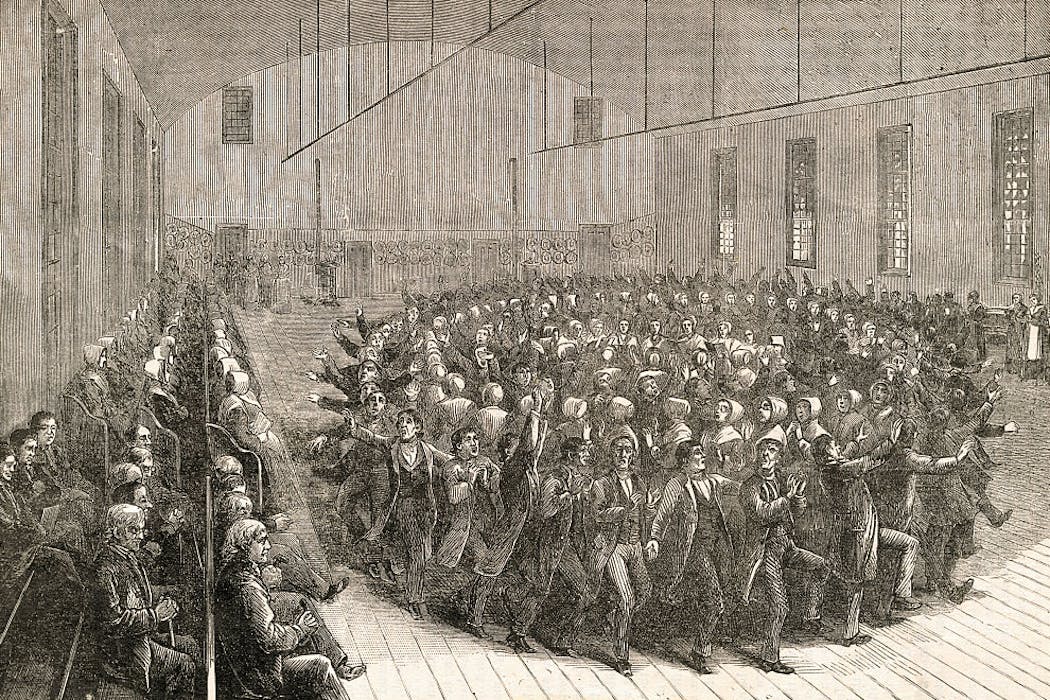
In the Shakers’ early years, dance was one of the most distinct aspects of the Christian group’s worship. Bettmann via Getty Images

Director Mona Fastvold’s new film, “The Testament of Ann Lee,” features actor Amanda Seyfried in the titular role: the English spiritual seeker who brought the Shaker movement to America. The trailer literally writhes with snakes intercut amid scenes of emotional turmoil, religious ecstasy, orderly and disorderly dancing – and sex. Intense and sometimes menacing music underpins it all: the sounds of the enraptured, singing their way to a fantastic and unimaginable ceremony.

The trailer is riveting and unsettling – just as the celibate Shakers were to the average observer during their American emergence in the 1780s.

I sit on the Board of Trustees of Hancock Shaker Village in Massachusetts, where some of the film was shot, though I have not seen the film, which is due to be released on Christmas Day. I was the curator at Hancock from 2001 to 2009 and have studied the Shakers for more than 25 years, publishing numerous books and articles on the sect.

Fascination with the Shakers is enduring, as are they. The sect once had several thousand members; today, three Shakers remain, practicing the faith at their village in Sabbathday Lake, Maine, as they have since 1783.

Mona Fastvold’s film depicts the group’s early years in North America.

Many characteristics of Shaker life and belief set them apart from other Protestant Christians, but their name derives from one of the most obvious. Early Shakers manifested the holy spirit that they believed dwelled within them by shaking violently in worship. While they called themselves “Believers,” observers dubbed them “Shakers.” Members eventually adopted the name, although officially they are the United Society of Believers in Christ’s Second Appearing.

The Shakers developed unique worship practices in both music and dance that expressed their faith. Until the 1870s, Shaker music was monophonic, with a single melodic line sung in unison and without instrumental accompaniment. Many of their melodies, Shakers said, were given to them by spirits. Some of these charmed and haunting strains have permeated through broader American musical culture.

New form of family

The Shakers first began to organize in Manchester, England, in 1747. By 1770, they came to believe that the spirit of Christ had returned through their leader, “Mother” Ann Lee. However, “Mother Ann was not Christ, nor did she claim to be,” the Shakers state. “She was simply the first of many Believers wholly embued by His spirit, wholly consumed by His love.”

In 1774, Lee led eight followers to North America, settling near what is now Albany, New York. As is still true today, Shakers held their property in common, following the model of the earliest Christians that is recorded in the Bible’s Book of Acts. At its height, the movement had 19 major communities.

A sepia-toned image of a man in a white shirt, dark vest and straw hat standing under a hilltop tree overlooking many houses.
A stereograph card shows a man looking over the Shaker settlement in Mount Lebanon, N.Y.
Digital Collections, Hamilton College Library

Shakers work out their salvation each day by physical and spiritual labor. They do not subscribe to the common Christian doctrine that Jesus’ death atoned for the sins of mankind. And Shakers are celibate – one of the practices that most startled their neighbors in 18th- and 19th-century America. Lee taught that humanity could not follow Christ in the work of spiritual regeneration, or salvation, “while living in the works of natural generation, and wallowing in their lusts.” For Shakers, celibacy is one way people can reunite their spirits with God, who they believe is dually male and female.

Almost every Shaker, therefore, joined the faith as a convert, or the child of converts. Families who joined their communities were effectively dissolved: Husbands and wives became brothers and sisters; parents and children the same. Early accounts report that, in extreme instances, children publicly denounced their parents and pummeled their genitals in an effort to subdue the flesh and its earthly ties.

Shaking with the spirit

The Shakers of Lee’s day – now seen as American as apple pie – were regarded as a fundamental threat to society. In part, that stemmed from their perceived dissolution of families. But many outsiders were also alarmed by their ritual dances, whose intensity and emotion demonstrated a physicality seemingly incongruous with their celibacy.

In the early years, Shaker worship was an unbridled individual expression of spiritual enthusiasm. Eventually, it transformed into highly choreographed dances. At first, these were agonizingly slow and laborious series of movements designed to mortify the flesh – to help the spiritual overcome the physical – and instill discipline and union among the members.

Historians and reenactors have recreated some Shaker dances.

What kind of music accompanied such striking movements? The earliest Shaker songs, including ones attributed to Lee, have no intelligible language. Rather, they were sung using vocalized syllables or “vocables,” such as lo-de-lo or la-la-la or vi-vo-vum. Shakers invented a new form of notation to record their songs, using letters adorned with a variety of hashmarks to denote pitch and rhythm.

Early observers of the Shakers noted the effects of their unique musical practice:

They begin by sitting down and shaking their heads in a violent manner, … one will begin to sing some odd tune, without words or rule; after a while another will strike in; … after a while they all fall in and make a strange charm … The mother, so called, minds to strike such notes as makes a concord, and so form the charm.

The Shakers were meticulous recordkeepers regarding every aspect of community life. Music was no exception. More than 1,000 volumes of Shaker music survive in manuscript: tens of thousands of songs dating from Lee’s day to the mid-20th century.

Scholars, musicians and researchers have extracted treasures from this repertoire. Most notably, composer Aaron Copland adapted Elder Joseph Brackett’s famous 1848 tune “Simple Gifts” for “Appalachian Spring”: the ballet that won Copland a Pulitzer in 1945. Hidden gems must still abound in the remaining unplumbed depths of Shaker manuscript songbooks.

In contrast, the Shakers left few detailed instructions for their dance. But eyewitness accounts abound, and scholars have made careful and respectful reconstructions.

Living faith

Fastvold’s film evokes the chaotic, violent world of the first Shakers in America, who converted farm families along the New York-Massachusetts border during the Revolutionary War. Some outsiders regarded the sect as an English plot to neutralize the populace with religious fervor, opening the way for a British reconquest of New England.

A balding man in a red sweatshirt bends down to nuzzle a white sheep.
Brother Arnold, one of the three Shakers now living at Sabbathday Lake, Maine, scratches a ram after shearing in 2024.
Gregory Rec/Portland Press Herald via Getty Images

The director’s vision, incarnated by Seyfried’s bewitching presence and voice, invokes the uncanny atmosphere of early Shakerism. However, Shakerism is a living, ever-changing faith, whose presence in America is older than the country itself. The fact is, Shakers have not regularly danced in worship since the 1880s – or less than half of the total time the sect has endured.

Outsiders judged and named the Shakers in reaction to their external qualities in worship. The movement’s endurance and core, however, lies in its spiritual teachings. As the Believers asserted in their 1813 hymn “The Shakers,” “Shaking is no foolish play.”

The Conversation

Christian Goodwillie is the Director and Curator of Special Collections and Archives at Hamilton College in Clinton, NY. He was Curator of Collections at Hancock Shaker Village from 2001-2009, where he now sits on the Board of Trustees and is a paid consultant. Three songs from his 2002 book Shaker Songs, co-authored with Joel Cohen, were used as sources for music in the The Testament of Ann Lee. Portions of the Testament of Ann Lee were filmed at Hancock Shaker Village.

ref. The celibate, dancing Shakers were once seen as a threat to society – 250 years later, they’re part of the sound of America – https://theconversation.com/the-celibate-dancing-shakers-were-once-seen-as-a-threat-to-society-250-years-later-theyre-part-of-the-sound-of-america-265828

Great apes are humans’ closest relatives, but many are endangered by illegal trading. Here’s what needs to be done

Source: The Conversation – UK – By Matyas Liptovszky, Professor of Practice and Head of Division of Population Science, University of Nottingham

Great apes are facing extinction. yebemoto/Shutterstock

Great apes are humans’ closest relatives in the animal kingdom. As much as 98.8% of their DNA is shared, but while the number of humans living on the planet is increasing fast, other great apes are in decline. Five out of the seven species are now critically endangered.

The UN has estimated that about 22,000 great apes disappeared from their natural habitats between 2005 and 2011. Adults are mostly killed, their meat and body parts sold for bushmeat, traditional medicine or, in some cases, traditional ceremonies.

Babies and juvenile apes, on the other hand, command a much higher price alive. They are also easier to smuggle across borders. Seizures and confiscations of illegal animal trades are rare and often poorly documented.

Part of the problem is great apes are very attractive. Ever since the first animals arrived at European zoos, these species have been popular with visitors. Some, like Barcelona zoo’s white gorilla Snowflake or Twycross zoo’s “PG Tips chimps”, even became celebrities.

Through the decades, great apes have remained an acquisition target for some zoos and animal attractions, sometimes by dodging the rules. The desire to keep “exotic” animals as pets also remains a key driver of the illegal global wildlife trade.

Social media has made the illegal trade in great apes much more efficient: sellers and buyers can use online platforms to exchange messages about prices and transport.

For years, conservation NGOs such as the Jane Goodall Institute, Traffic and the African Wildlife Foundation have been warning about the threat of extinction for great apes. Now a great ape enforcement taskforce – set up by member-nations of the Convention on the International Trade in Endangered Species of Wild Fauna and Flora (Cites) – is being established to try and tackle the escalating illegal trade.

The convention was formed 50 years ago to create rules for a legal trade in wildlife and to stem the decline in wild animal populations. Under Cites, commercial trade in great apes is effectively banned. But it has been long known that the complex, paper-based permit system can be avoided or ignored.

Jane Goodall warned of the threats to great apes for years.

The illegal trade of live great apes is not a simple logistical exercise. These animals are agile, clever and strong, even when young. They need ongoing care and can make noises that may reveal them hidden away in cargo. But for years, these transactions have been made easier by weak law enforcement, lack of capacity of government departments, and widespread corruption. Falsifying and laundering documents to pretend these animals are traded legally is another route.

What are the problems?

So why are governments not doing more? First, the organisation meant to provide oversight and monitoring of wildlife trade – the Cites secretariat – is underfunded. While the legal global wildlife trade market is valued at US$220 billion (£164 billion) a year, the secretariat has an annual budget of about US$20 million. And like most international treaties, it is reliant on the collaboration of its 185 state members, with all the complexities of international politics.

State governments also don’t treat the illegal wildlife trade as high a priority as illegal drugs, weapons or human trafficking – despite the well-known connections between these. And many still operate an outdated permit system developed in the 1970s, instead of the proposed electronic version which would provide much better protection against fraudulent permits, faster and transparent reporting, and increased collaboration with customs officials.

Moving apes around

There are, however, legitimate reasons to transfer great apes internationally. Moving second-generation, captive-bred animals from one registered zoo to another would be a typical example. Getting an export permit showing the animal as captive-born is one of the easiest ways to transport great apes internationally.

But this can also be used as a loophole. In the late 2000s, some 150 chimpanzees, bonobos and gorillas were reportedly exported from Guinea to China, although there is no known facility in Guinea breeding either species. In this case, high-level corruption was a key factor: in 2015, Ansoumane Doumbouya, then head of the Cites management authority in Guinea, was arrested and sentenced to 18 months in prison for selling fraudulent export permits. He was later pardoned by the president of Guinea.

In September 2025, Cites officials visited one of the largest private animal collections in the world. Vantara, India’s wildlife sanctuary turned mega-zoo, was hailed by some as an amazing story of love and care for wildlife. But the Wildlife Animal Protection Forum of South Africa, a national network of 30 South African organisations, has been increasingly concerned about the fast-paced imports of over 2,000 wild animal species from all over the world. Vantara now reportedly keeps close to 150,000 animals, more than any other well-known zoo.

In a recent investigation, the Indian Supreme Court absolved Vantara from any wrongdoing in relation to animal imports. But after this ruling, the Cites secretariat also visited the zoo. Its recent report raised significant concerns about several issues relating to animal transportation involving Vantara.

Vantara has claimed that Cites gave “a clean chit” to the facility, and that it had noted that all animal transfers to the facility were “fully legitimate and transparent, in accordance with Indian law”.

The Cites report said chimpanzees were imported from the Democratic Republic of Congo and also Middle Eastern countries (via the United Arab Emirates) as captive animals. As far as the author is aware, none of these countries are known to breed chimpanzees in zoos or other captive facilities.

Even more worryingly, a bonobo from Iraq, a mountain gorilla from Haiti, and a Tapanuli orangutan from Indonesia were also acquired. There are few recognised zoos globally which breed bonobos, and none breeding either mountain gorillas or Tapanuli orangutans. There is only a single male Tapanuli orangutan kept in an Indonesian zoo. Based on the Zoological Information Management System, the global zoo database, there is currently no mountain gorilla in zoos worldwide.

More generally, Cites has called on member countries affected by the great ape trade – both as a source and destination – to implement additional measures to prevent any illegal transfers. The International Union for Conservation of Nature, the world’s largest conservation alliance, has also called for “international action to protect wild great apes in their natural habitats, with a focus on addressing poaching and illegal trade”.

Introducing a modern electronic permit system and carrying out more enforcement would be important first steps to tackling these crimes. Otherwise, these species that are so close to humans will disappear in front of our eyes.

The Conversation

Prof Matyas Liptovszky is a director of Wilder International, and in a voluntary capacity affiliated with the European Association of Zoos and Aquariums.

ref. Great apes are humans’ closest relatives, but many are endangered by illegal trading. Here’s what needs to be done – https://theconversation.com/great-apes-are-humans-closest-relatives-but-many-are-endangered-by-illegal-trading-heres-what-needs-to-be-done-270333

Over 16,000 dinosaur tracks discovered at a site in Bolivia

Source: The Conversation – UK – By Sally Christine Reynolds, Associate Professor in Hominin Palaeoecology, Bournemouth University

Dinosaur tracks at the Carreras Pampas tracksite in Torotoro National Park. Plos One

Scientists have discovered the single largest dinosaur track site in the world in Carreras Pampa, Torotoro National Park, Bolivia. The tracks were made around 70 million years ago, in the late Cretaceous Period, by theropods – bipedal three-toed dinosaurs – with bird tracks also present in this ancient beach scene.

Over 16,600 footprints and swim traces cover the ancient trackway surface, all heading in the same direction. Swim traces form when floating or swimming animals briefly touch the bottom, often with just their toes making contact. The researchers suggest the traces were made parallel to an ancient shoreline, which preserves beautiful ripple marks.

Modern studies of animals at African water holes and lake margins suggest that herbivores tend to move perpendicular to a shore, moving quickly across the open areas close to a lake. In contrast, carnivores tend to travel parallel to the shore, since this gives them the best chance of intersecting prey.

There are no hard and fast rules here, just general principles, which may or may not apply in this case. Although it is likely that at least some of the traces were made by carnivorous dinosaurs.

Tricky identification

The research was announced in a Plos One paper, which documents 1,321 trackways plus 289 isolated tracks, totalling 16,600 theropod (three-toed) tracks.

They also record 280 “swim” trackways (1,378 swim tracks) and multiple tail traces, with some bird tracks occurring locally alongside the theropod tracks.


Plos One

These traces can often resemble scratches and are different from the tracks the same animal might make on land. They tell a story of behaviour that is rich in detail.

The site preserves at least a dozen distinct track morphologies (shapes or forms), implying multiple kinds of animals, but the study doesn’t translate those into a specific number of species.

Identifying the species of the trackmakers is difficult for two reasons. First, a single animal can make footprints with different shapes and forms depending on the motion of the foot and the consistency of the underlying ground.

Second, fossil bones are not always found at footprint sites, because the conditions needed for fossil bones to be retained are often different from those needed to preserve footprints.

This makes it harder to identify specific groups or species of dinosaur. The researchers overcome this in the paper by defining “morphotypes”, or put another way, recurring footprints of different types, or forms.

When looking at a track site like this, the number of tracks – and there are lots at this site – does not necessarily equate to the number of animals. One animal moving back and forth across a surface can make lots of tracks. Equally, lots of animals moving once across a surface can leave the same number of tracks.

The find is significant because it captures a range of behaviour from a variety of species. This provides researchers with a window into ancient behaviour, like whether these dinosaurs moved in groups and, potentially, how they foraged and travelled along the stretch of beach.

For example, there is evidence of individual dinosaurs moving in the same direction, which can be due to dinosaurs moving in social groups, performing tasks such as hunting or migrating. However, this phenomenon can also arise because of other factors, such as geographical barriers.

Importantly, the study of the footprints allows researchers to document species that would have occurred together in the landscape during the short time interval when the tracks were forming. This makes the site an archive of an ancient ecosystem, rather than just a single species. Further analysis to yield fascinating insights into the daily lives of the creatures passing along this stretch of shore.

The longest prehistoric trackway made by people, in White Sands National Park (New Mexico), helped us appreciate that one trackmaker on a single journey can make a variety of different types of track based on what they were doing. There could be parallels here with the dinosaur trackway in Bolivia.

Something to ponder as you next walk on a well-trodden beach.

The Conversation

Sally Christine Reynolds does not work for, consult, own shares in or receive funding from any company or organisation that would benefit from this article, and has disclosed no relevant affiliations beyond their academic appointment.

ref. Over 16,000 dinosaur tracks discovered at a site in Bolivia – https://theconversation.com/over-16-000-dinosaur-tracks-discovered-at-a-site-in-bolivia-271636