Is TikTok right? Should I avoid matcha if I have low iron?

Source: The Conversation – Global Perspectives – By Margaret Murray, Senior Lecturer, Nutrition, Swinburne University of Technology

Tom Werner/Getty

The popularity of matcha continues to boom. But recent videos on social media have suggested it could be bad for you if you have low iron.

One Sydney woman recently told media she had “no idea” her daily matcha latte could affect her health until she started experiencing headaches, and noticed her hair and nails were brittle and she was bruising easily. Blood tests found she was severely low in iron.

Similar videos on TikTok show women in hospital getting iron transfusions – and blaming their matcha habit.

So, let’s unpack this. How healthy is matcha? And can it really cause low iron?

What is matcha?

Matcha is a fine powder made from dried and ground-up green tea (Camellia sinensis) leaves. It has recently gained popularity as a drink and a flavour variety in many different foods.

Matcha contains many beneficial compounds (for example, dietary fibre and polyphenols) as well as being a source of caffeine.


Read more:
Matcha is having a moment. What are the health benefits of this green tea drink?


Including matcha, or green tea, as part of a balanced diet may provide health benefits such as supporting healthy brain function and blood pressure.

However despite its health benefits, research has shown that drinking a lot of green tea is linked to lower levels of iron in the blood.

We need iron – but can’t make it

Iron is an essential micronutrient that helps transport oxygen around the body, as well as supporting many other important biological processes.

Our bodies can’t make iron, so we need to get it from our diet to support these functions. But even if we eat a lot of iron-rich foods, other things in our diet – such as coffee, red wine, calcium-rich foods and yes, matcha – can interfere with absorbing the iron.

So people with low iron levels need to be careful.

In particular, women who menstruate have an increased risk of low iron because of iron lost through bleeding.

You may have an iron deficiency if your iron falls below certain levels – typically for adults, less than 30 micrograms of iron per litre of blood. There are different cut offs for children.

Iron deficiency anaemia is a condition where very low levels of iron affect the functioning of red blood cells. It is diagnosed based on levels of haemoglobin in the blood (these cutoffs vary by age, sex and pregnancy status).

What does matcha do to iron levels?

There are two main components in green tea that stop us absorbing iron. These are polyphenols and phytic acid (also known as phytate).

Both polyphenols and phytic acid have their own health benefits, for example, protecting against chronic diseases such as type 2 diabetes. But they also bind to iron and prevent it from being absorbed into the body.

So, if you have a lot of food or drink that contains these components – especially in combination with iron-rich foods – they can reduce iron absorption.

However, it’s not only matcha that can interfere. Phytic acids are also found in other teas and many plant foods, such as nuts, cereals and legumes. Tea, coffee, berries, and other fruits and vegetables are also high in polyphenols.

How much matcha will affect your iron levels?

This varies between people.

One study showed people who drink three or more cups of green tea a day had lower blood iron levels than those who drink less than one a day. But they didn’t experience iron deficiency any more often.

However other research has linked moderate green tea consumption (two cups a day) to iron deficiency anaemia.

Whether or not your matcha latte will contribute to an iron deficiency depends on many other factors, including your existing iron levels.

So, what about matcha-flavoured foods?

In these – for example, matcha ice cream – the actual amount of green tea powder is very low. This means it’s unlikely to significantly affect iron absorption.

But it’s not just about quantity – when you drink your matcha also matters.

To reduce the impact on iron absorption, it’s recommended you have green tea separately from meals – at least one hour between eating and drinking tea.

What else to keep an eye on

Multiple other factors in your diet can influence iron absorption. What you eat may either exacerbate or counteract the effects of your matcha latte on iron absorption.

Overall, balance is key to ensure you are getting the full spectrum of nutrients the body requires.

To support iron levels, you can incorporate iron-rich foods (such as beans, lentils, meat, fish and fortified cereals) into a healthy diet.

Eating vitamin C-rich foods (such as capsicum, broccoli, kiwifruit and other fruit and vegetables) along with foods that contain iron can help to enhance iron absorption.

If you are concerned about your iron levels, you should speak to a health-care professional – especially if experiencing symptoms of iron deficiency (such as tiredness, weakness or dizziness).

A blood test can diagnose low iron levels. If you have an iron deficiency, your GP or dietitian will help you manage symptoms and work out what is right for you.

The Conversation

Margaret Murray does not work for, consult, own shares in or receive funding from any company or organisation that would benefit from this article, and has disclosed no relevant affiliations beyond their academic appointment.

ref. Is TikTok right? Should I avoid matcha if I have low iron? – https://theconversation.com/is-tiktok-right-should-i-avoid-matcha-if-i-have-low-iron-264261

From anime to activism: How the ‘One Piece’ pirate flag became the global emblem of Gen Z resistance

Source: The Conversation – Global Perspectives – By Nuurrianti Jalli, Assistant Professor of Professional Practice, School of Media and Strategic Communications, Oklahoma State University

The Jolly Roger of the Straw Hat Pirates is flown during a protest in Rome. Vincenzo Nuzzolese/SOPA Images/LightRocket via Getty Images

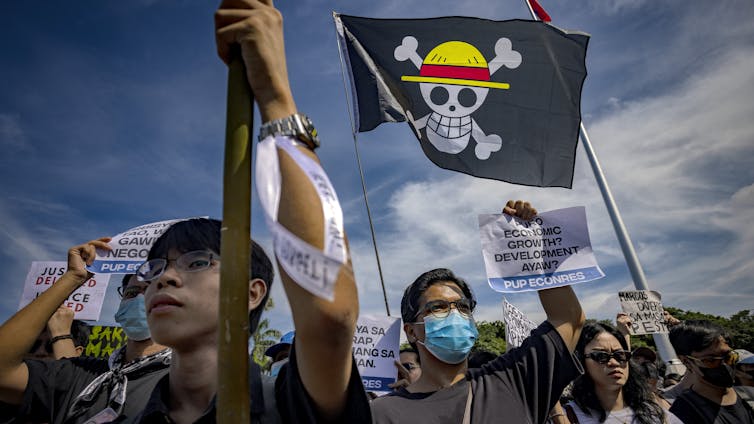
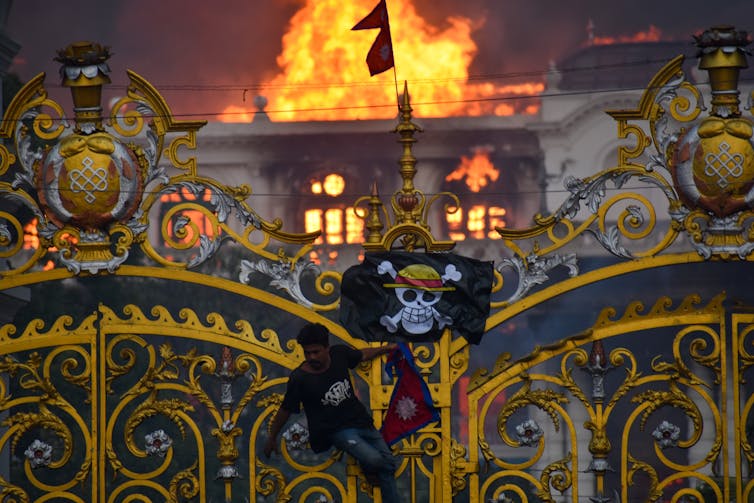
From Paris and Rome to Jakarta, Indonesia, and New York, a curious banner has appeared in protest squares. With hollow cheeks, a broad grin and a straw hat with a red band, the figure is instantly recognizable and has been hoisted by young demonstrators calling for change. In Kathmandu, Nepal, where anger at the government boiled over in September 2025, the flag became the defining image as flames spread through the gates of Singha Durbar, Nepal’s ornate palace complex and seat of power.

A skull-and-crossbones flag is seen in front of a blazing building
The Straw Hat Pirates’ Jolly Roger flies in front of the Singha Durbar after people set fire to the seat of Nepal government in Kathmandu.
Sunil Pradhan/Anadolu via Getty Images

The image, usually adorning a flag with a black background, comes from “One Piece,” a much-beloved Japanese manga.

And what began as a fictional pirate crew’s emblem almost three decades ago has become a powerful symbol of youth-led resistance, appearing in demonstrations from Indonesia and Nepal to the Philippines and France.

As a scholar of media and democracy, I see the spread of the Jolly Roger of the Straw Hats Pirates – which has gone from manga pages to protest squares – as an example of how Gen Z is reshaping the cultural vocabulary of dissent.

Protesters, some in masks, hold aloft a flag with a skull in a straw hat.
Filipinos wave a ‘One Piece’ flag as they take part in a protest against corruption at Rizal Park on Sept. 21, 2025, in Manila.
Ezra Acayan/Getty Images

Pop culture as political expression

“One Piece” arrived at the birth of Gen-Z, created in 1997 by Japanese manga artist Eiichiro Oda.

Since then, it has sold more than 500 million copies and has a Guinness World Record for its publishing success.

It has spawned a long-running TV series, live-action films and a more-than-US$20 billion industry, with merchandise licensing alone generating about $720 million each year from Bandai Namco, the company best known for creating Pac-Man and Tekken.

At its core, “One Piece” follows Monkey D. Luffy and his crew, the Straw Hat Pirates, as they challenge a corrupt world government while seeking freedom and adventure.

For fans, the “One Piece” flag is not a casual decoration but an emblem of defiance and perseverance. Luffy’s ability to stretch beyond physical limits after consuming a magical fruit has become a powerful metaphor for resilience, while his unwavering quest for freedom against impossible odds resonates with young people navigating political environments marked by corruption, inequality and authoritarian excess.

When protesters adopt this flag, they are not simply importing an aesthetic from popular culture, but are drawing on a narrative already legible to millions.

The flag began cropping up in protests over the past few years. It was being waved at a “Free Palestine” protest in 2023 in Indonesia and in the same year in New York during a pro-Palestinian demonstration.

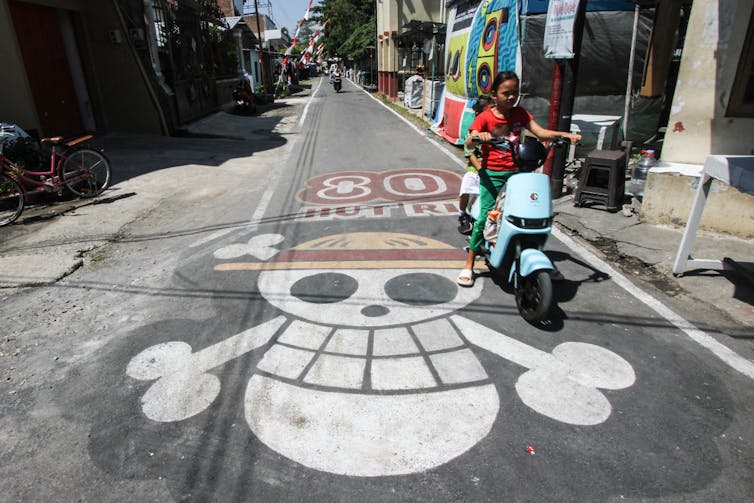
But it was in Indonesia in August 2025 that the flag’s political life truly took hold. There, protesters embraced it to voice frustration with government policies and mounting discontent over corruption and inequality. The timing coincided with government calls for patriotic displays during independence celebrations, sharpening the contrast between official nationalism and grassroots dissent.

Two people on a moped drive over a mural showing a skull and crossbones in a hat.
One Piece’s Jolly Roger flag became synonymous with Indonesian protests in August 2025.
Dika/AFP via Getty Images

The movement gained momentum when authorities responded with strong criticism of the flag’s use, inadvertently drawing more attention to the symbol. Government officials characterized the displays as threats to national unity, while protesters viewed them as legitimate expressions of political frustration.

Why the flag travels

The speed with which the “One Piece” Jolly Roger flag spread across borders reflects the digital upbringing of Gen Z. This is the first cohort to grow up fully online, immersed in memes, anime and global entertainment franchises. Their political communication relies on what scholars call “networked publics” – communities that form and act through digital platforms rather than formal organizations.

Solidarity in this setting does not require party membership or ideology. Instead, it depends on shared cultural references. A meme, gesture or flag can instantly carry meaning across divides of language, religion or geography. This form of connection is built on recognizable cultural codes that allow young people to identify with each other even when their political systems differ.

Social media gives this solidarity reach and speed. Videos of Indonesians waving the flag were clipped and reshared on TikTok and Instagram, reaching audiences far beyond their original context. By the time the symbol appeared in Kathmandu, the Nepalese capital, in September, it already carried the aura of youthful defiance.

Crucially, this was not simple imitation. In Nepal, the flag was tied to anger at youth unemployment and at the ostentatious wealth of political dynasties displayed online. In Indonesia, it reflected disillusionment with patriotic rituals that felt hollow against a backdrop of corruption. In both cases, the Jolly Roger flag worked like open-source code – adaptable locally but instantly legible elsewhere.

Part of the flag’s effectiveness comes from its ambiguity. Unlike a party logo, the “One Piece” Jolly Roger flag originates in popular culture, which makes it difficult for governments to suppress without appearing authoritarian. During the latest protests in Indonesia, authorities confiscated banners and labeled them treasonous. But such crackdowns only amplified public frustration.

A large flag with a skull and crossbones on it is surrounded by people.
The Jolly Roger flag flies amid protests in the Philippines on Sept. 21, 2025.
@rimurutempestuh/x

Fiction as reality

The “One Piece” flag is not alone in being reimagined as a symbol of resistance.

Across movements worldwide, pop culture and digital culture have become a potent resources for activists. In Chile and Beirut, demonstrators wore Joker masks as a visual shorthand for anger at corruption and inequality. In Thailand, demonstrators turned to “Hamtaro,” a children’s anime about a hamster, parodying its theme song and waving plush toys to lampoon political leaders.

This blending of politics, entertainment and personal identity reflects a hybrid media environment in which symbols drawn from fandom gain power. They are easy to recognize, adapt and defend against state repression.

Yet cultural resonance alone does not explain the appeal. The “One Piece” flag caught on because it captured real-life grievances. In Nepal, where youth unemployment exceeds 20% and migration for work is common, protesters paired the emblem with slogans such as “Gen Z won’t be silent” and “Our future is not for sale.”

In Indonesia, some protesters argued that the national flag was “too sacred” to be flown in a corrupt system, using the pirate banner as a statement of disillusionment.

The spread of the flag also reflects a broader shift in how protest ideas move across borders. In the past, what tended to travel were tactics such as sit-ins, marches or hunger strikes. Today, what circulates fastest are symbols, visual references from global culture that can be adapted to local struggles while remaining instantly recognizable elsewhere.

People walk past a skull-and-crossbones poster.
A ‘One Piece’ flag stuck in front of a high school in France during protests.
Pat Batard/Hans Lucas/AFP via Getty Images

The flag goes global

The flag’s journey from Asian streets to protests in France and Slovakia demonstrates how the grammar of dissent has gone global.

For today’s young activists, culture and politics are inseparable. Digital nativity has produced a generation that communicates grievances through memes, symbols and cultural references that cross borders with ease.

When protesters in Jakarta, Kathmandu or Manila wave the “One Piece” Jolly Roger flag, they are not indulging in play-acting but transforming a cultural icon into a living emblem of defiance.

The Conversation

Nuurrianti Jalli is affiliated with Institute for Southeast Asian Studies (ISEAS) Yusof Ishak Institute Singapore as Non Residential Visiting Fellow for Media, Technology and Society Program.

ref. From anime to activism: How the ‘One Piece’ pirate flag became the global emblem of Gen Z resistance – https://theconversation.com/from-anime-to-activism-how-the-one-piece-pirate-flag-became-the-global-emblem-of-gen-z-resistance-265526

Why Argentina is looking to the Trump administration for a bailout − and what the US Treasury can do to help

Source: The Conversation – USA (2) – By Arturo Porzecanski, Research Fellow, Center for Latin American & Latino Studies, American University

Done deal? U.S. President Donald Trump shakes hands with Argentine counterpart Javier Milei during a bilateral meeting on Sept. 23, 2025. Chip Somodevilla/Getty Images

President Donald Trump vowed to help out his Argentine counterpart Javier Milei on Sept. 23, 2025, a day after the U.S. administration said “all options” were on the table in regard to a bailout for the Latin American country’s rocky economy.

A day after Trump and Milei’s meeting on the sidelines of the United Nations General Assembly in New York, U.S. Treasury Secretary Scott Bessent said he was prepared to lend Argentina up to US$20 billion via currency swaps and bond purchases.

But what caused Milei to go hat in hand to the U.S. in the first place? And what would a U.S. bailout of Argentina look like? For answers, The Conversation turned to Arturo Porzecanski, an expert on Latin American economies at American University.

Why is the Argentine government seeking a bail out?

The event that sparked discussion of U.S. intervention was a sharp sell-off of the Argentine currency, the peso, as well as the country’s stocks and bonds.

Over the course of three days ending on Sept. 19, the country’s central bank spent over $1 billion of its hard-currency reserves defending the Argentine peso from further depreciation. To be sure, instead of dialing up his contacts in the Trump administration, Milei could have allowed the currency to find its market-clearing value – that is, the price at which supply and demand match.

Alternatively, he could have kept up the effort to stabilize the peso by spending still more billions of dollars previously borrowed from the International Monetary Fund.

However, he decided to call Washington and ask for financial support, hoping that the friendship with Trump he has been cultivating from even before Milei was elected would finally pay off.

The Argentine authorities fear that a sharper depreciation will reignite expectations of high inflation, and they also wish to conserve those IMF funds to help cover nearly $20 billion in interest and principal payments on dollar debts coming due in the next 15 months. The Argentine government would also rather not have the central bank raise interest rates by tightening monetary policy still more, nor implement additional cuts in government spending given that the economy is either stagnant or already in a recession.

Argentina’s economy got here because prior to Milei taking office in December 2023, his predecessor applied very loose monetary and fiscal policies – such as keeping interest rates low and spending high to stimulate the economy – as well as business-unfriendly regulations. That rocketed annual inflation into triple digits and led to the crumbling of confidence among domestic and foreign investors, thus complicating the government’s ability to refinance its maturing debt obligations.

While Milei reversed many of those harmful policies during the course of 2024, notably achieving a balanced government budget and a sharp deceleration of inflation, his popular support and confidence in his ability to manage the country’s remaining challenges have weakened in recent months.

A woman casts a vote into a box.
Argentine voters handed President Javier Milei a political blow in legislative elections on Sept. 7, 2025.
Tobias Skarlovnik/Getty Images

The economy has stalled, with job losses and unemployment rising. Phone recordings suggesting corruption involving the president’s family were released. And Milei’s party did surprisingly poorly in recent elections that took place in the large province of Buenos Aires. With midterm congressional elections scheduled for Oct. 26, Milei badly needs political and financial support from the Trump administration in order to stabilize the local financial markets and project a sense of order.

What options are there for the US to help Argentina?

The U.S. government has already been unusually supportive of Argentina from its dominant positions on the board of directors of the IMF, World Bank and Inter-American Development Bank. Earlier this year, it helped the country to secure from them pledges and disbursements worth tens of billions of dollars in new loans.

What is very new and different now is the prospect of direct lending from the U.S. Treasury to the government of Argentina. As previewed by Treasury Secretary Scott Bessent on Sept. 24, his team is currently in negotiations with their counterparts in Argentina for a $20 billion swap line, which presumably would involve the Treasury’s temporary purchase of Argentine pesos in exchange for the delivery of U.S. dollars. This could possibly be supplemented by the Treasury’s temporary purchase of Argentine government bonds, likely payable in dollars, whether newly issued or already in circulation.

Bessent’s announcement, coming on the heels of Trump’s vow to help out his Argentine counterpart, has prompted local and foreign investors to regain confidence in Argentina, such that beaten-up stocks and bonds have bounced back and the currency has appreciated.

This immediate and enthusiastic market response, if sustained, means that the Treasury may not have to spend too many billions of U.S. dollars to boost public confidence in Milei and Argentina, at least until the upcoming midterm elections.

Should Milei’s party do well in the late-October contest, enabling it to gain seats in the House and Senate and thus have more political support in the national legislature, a relatively small and temporary investment may yield a worthwhile payoff for the Trump and Milei administrations.

Why is the US keen on helping out?

Normally the U.S. government does not involve itself directly in foreign bailouts unless a country is systemically important – namely, when its troubles affect its neighbors, a number of other countries, or the United States itself.

For example, in the 1990s the U.S. Treasury offered direct support to other countries during crises in Mexico, East Asia and Russia, and in 1995 Argentina was one of the beneficiaries. And in 2008, in the wake of the global financial crisis, the Fed made available dollars in exchange for the currencies of about a dozen foreign countries – currency swaps mainly with European countries but also with Brazil, Canada and Mexico, since the meltdown affected Washington’s North American neighbors and many nations in Europe.

Moreover, in most cases, whatever Treasury or Fed funding is made available is soon repaid by upcoming loans from institutions such as the IMF and the World Bank, or else by major banks or institutional investors. In other words, most U.S. official support has been of the “bridge lending” kind, because the Treasury and the Fed can act within days, whereas other financial actors require weeks or even months to approve and disburse funding.

In the case of Argentina, it is notable that Bessent has stated that Argentina is systemically important, even though its troubles have so far not affected any other country. Left unsaid is how Argentina would repay the U.S. Treasury, because the pipeline of upcoming disbursements from official international organizations is not very large.

Therefore, the funds under discussion are not clear bridges to anything. In similar circumstances in the past, the U.S. Treasury has sought payment guarantees from foreign governments. Given the transactional approach favored by Trump, certain conditions may be demanded from Argentina – a country endowed with lithium, rare earths, shale oil and other resources.

What is the US Treasury’s Exchange Stabilization Fund?

The Exchange Stabilization Fund is the Treasury’s crisis-funding vehicle through which the bridging loan to prop up the Argentine currency would be made.

The fund was established in the mid-1930s. It was endowed with the profits that the U.S. Treasury realized when the official price of gold rose from $20.67 to $35 per ounce, increasing the value of U.S. government gold holdings.

For several decades through the 1980s, namely before the U.S. currency was allowed to float freely, the fund’s main purpose was to provide the funding for Treasury operations to affect the price of the dollar. A secondary purpose was to provide short-term, government-to-government loans mainly to Latin American countries, yet starting in the mid-1990s this became its primary objective.

The last Exchange Stabilization Fund loan was granted to Uruguay in mid-2002, in the wake of a major financial crisis in next-door Argentina that had triggered a bank run in Uruguay – and threatened to spread elsewhere around the region. The Treasury sent $1.5 million to Uruguay on a Monday to back at least the government-owned banks, and the funds were returned to Washington that same Friday. The bank run was stopped and thus the loan succeeded magnificently.

The Conversation

Arturo Porzecanski does not work for, consult, own shares in or receive funding from any company or organization that would benefit from this article, and has disclosed no relevant affiliations beyond their academic appointment.

ref. Why Argentina is looking to the Trump administration for a bailout − and what the US Treasury can do to help – https://theconversation.com/why-argentina-is-looking-to-the-trump-administration-for-a-bailout-and-what-the-us-treasury-can-do-to-help-265924

Paracetamol use during pregnancy not linked to autism, our study of 2.5 million children shows

Source: The Conversation – UK – By Renee Gardner, Principal Researcher, Department of Public Health Sciences, Karolinska Institutet

Andrey_Popov/Shutterstock

United States President Donald Trump recently claimed that using the common painkiller acetaminophen (also known as paracetamol and by the brand name Tylenol in the US) during pregnancy is fuelling the rise in autism diagnoses. He then went on to suggest pregnant women should “tough it out” rather than use the common painkiller if they experience fever or pain.

This announcement has caused alarm and confusion worldwide. But despite Trump’s claim, there is no strong scientific evidence to back it up. Our study of nearly 2.5 million births in Sweden published in 2024 shows no evidence that acetaminophen use during pregnancy increases a child’s risk of autism. This is the largest study conducted on the subject to date.

To understand whether acetaminophen really poses a risk in pregnancy, we turned to Sweden’s national health registers, which are among the most comprehensive in the world. Our study followed nearly 2.5 million children born between 1995 and 2019, tracking them for up to 26 years.

Using prescription records and interviews that midwives conducted during prenatal visits, we could see which mothers reported using acetaminophen (about 7.5% of pregnancies) and which did not.

We also made sure to account for any variables that may have affected the results of our statistical analysis – including controlling for health factors, such as fever or pain, which would have influenced whether or not a mother used acetaminophen during her pregnancy. This was to ensure a more fair comparison between the two groups.

We then looked at the children’s neurodevelopmental outcomes – specifically whether they were diagnosed with autism, ADHD or an intellectual disability.

The real strength of our study came from being able to compare siblings. This allowed us to compare children born to the same mother, where acetaminophen had been used during one child’s pregnancy but not the other. We compared over 45,000 sibling pairs, where at least one sibling had an autism diagnosis.

This sibling design is powerful because siblings share much of their genetics and family environment. This allows us to tease apart whether the drug itself – rather than underlying family traits or health conditions – is responsible for any apparent risks for neurodevelopmental outcomes.

Acetaminophen use

When we first looked at the entire population, we saw a pattern that echoed earlier studies: children whose mothers reported using acetaminophen during pregnancy were slightly more likely to be diagnosed with autism, ADHD or an intellectual disability.

But once we ran the sibling comparisons, that association completely disappeared. In other words, when we compared sets of siblings where one was exposed in the womb to acetaminophen and one was not, there was no difference in their likelihood of later being diagnosed with autism, ADHD or an intellectual disability.

A pregnant woman holds a glass of water in one hands and a pill in the other hand.
Our study found no association with acetaminophen use during pregnancy and a child’s risk of being diagnosed with autism.
Dragana Gordic/ Shutterstock

Our study is not the only one to put this question to the test. Researchers in Japan recently published a study using a similar sibling-comparison design, and their results closely matched ours.

Importantly, they replicated our findings in a population with a different genetic background and where patterns of acetaminophen use during pregnancy are quite different. Nearly 40% of mothers in Japan reported using the drug during pregnancy. In comparison, less than 10% of Swedish mothers had used it.

Despite these differences, the conclusion was the same. When siblings are compared, there is no evidence that acetaminophen use during pregnancy increases the risk of autism or ADHD.

These findings mark an important shift from earlier studies, which relied on more limited data, used smaller cohorts and didn’t account for genetic differences. They also did not fully account for why some mothers used pain relief during pregnancy while others didn’t.

For example, mothers who take acetaminophen are more likely to also have migraines, chronic pain, fever or serious infections. These are conditions that are themselves genetically linked to autism or ADHD, as well as a child’s likelihood of later being diagnosed with one of these conditions.

These types of “confounding factors” can create associations that look convincing on the surface, but may not reflect a true cause-and-effect relationship.

That brings us to the real question on many people’s minds: what does this mean if you’re pregnant and dealing with pain or fever?

It’s important to recognise that untreated illness during pregnancy can be dangerous. A high fever in pregnancy, for example, is known to increase the risk of complications for both mother and baby. “Toughing it out,” as the president suggested, is not a risk-free option.

That’s why professional medical organisations such as the American College of Obstetricians and Gynecologists and the UK’s Medicines and Healthcare products Regulatory Agency continue to recommend acetaminophen (paracetamol) as the safest fever reducer and pain reliever during pregnancy when used at the lowest effective dose and only when necessary. This has been the guidance for decades.


Read more:
Paracetamol, pregnancy and autism: what the science really shows


Of course, if someone finds themselves needing to take acetaminophen regularly over a longer period of time, that’s a decision best made in consultation with their doctor or midwife. But the idea that acetaminophen use during pregnancy causes autism simply isn’t supported by the best available science.

The greater danger is that alarmist messaging will discourage pregnant women from treating pain or fever – putting both themselves and their babies at risk.

The Conversation

Renee Gardner receives funding from the Swedish Research Council; the Swedish Research Council for Health, Working Life, and Welfare; and the US NIH.

Brian Lee received funding from the NIH, Pennsylvania Department of Human Services, Department of Defense and Pennsylvania Department of Health CURE SAP, as well as personal fees from Beasley Allen Law Firm, Patterson Belknap Webb & Tyler LLP and AlphaSights.

Viktor H. Ahlqvist receives funding from the Swedish Society for Medical Research

ref. Paracetamol use during pregnancy not linked to autism, our study of 2.5 million children shows – https://theconversation.com/paracetamol-use-during-pregnancy-not-linked-to-autism-our-study-of-2-5-million-children-shows-265919

How the First Amendment protects Americans’ speech − and how it does not

Source: The Conversation – USA – By Ray Brescia, Associate Dean for Research and Intellectual Life, Albany Law School

Demonstrators protest the suspension of the “Jimmy Kimmel Live!” show on Sept. 18, 2025, in Los Angeles, Calif. Photo by Mario Tama/Getty Images

Imagine a protest outside the funeral of a popular political leader, with some of the protesters celebrating the death and holding signs that say things like “God Hates the USA/Thank God for 9/11,” “America is Doomed” and “Don’t Pray for the USA.”

No matter the political leanings of that leader, most Americans would probably abhor such a protest and those signs.

What would tolerate such activities, no matter how distasteful? The First Amendment.

The situation described above is taken from an actual protest, though it did not involve the funeral of a political figure. Instead, members of the Westboro Baptist Church protested outside the funeral of Marine Lance Cpl. Matthew Snyder, a U.S. service member killed in Iraq.

Through demonstrations like this, members of this group were conveying their belief that the U.S. is overly tolerant of those they perceive as sinners, especially people from the LGBTQ community, and that the death of U.S. soldiers should be recognized as divine retribution for such sinfulness.

Snyder’s family sued for intentional infliction of emotional distress, among other claims. A jury issued a US$5 million jury award in favor of the family of the deceased service member. But in a nearly unanimous decision issued in 2011, the U.S. Supreme Court found that the First Amendment insulated the protesters from such a judgment.

This holding is particularly instructive today.

The Trump administration has vowed to crack down on what it calls hate speech. It has labeled antifa, a loosely organized anti-fascist group, a terrorist organization. And it has sought to punish figures such as TV host Jimmy Kimmel for statements perceived critical of conservative activists.

What the First Amendment makes clear is that it does not just protect the rights of speakers who say things with which Americans agree. Or, as the Supreme Court said in a separate decision it issued one year after the case involving the funeral protesters: “The Nation well knows that one of the costs of the First Amendment is that it protects the speech we detest as well as the speech we embrace.”

But free speech is not absolute. As a legal scholar who has studied political movements, free speech and privacy, I realize the government can regulate speech through what are known as “reasonable time, place, and manner” restrictions. These limits cannot depend upon the content of the speech or expressive conduct in which a speaker is engaged, however.

For example, the government can ban campfires in an area prone to wildfires. But if it banned the burning of the U.S. flag only as a form of political protest, that would be an unconstitutional restriction on speech.

Protected and unprotected speech

There are certain categories of speech that are not entitled to First Amendment protection. They include incitement to violence, obscenity, defamation and what are considered “true threats.”

When, for example, someone posts threats on social media with reckless disregard for whether they will instill legitimate fear in their target, such posts are not a protected form of speech. Similarly, burning a cross on someone’s property as a means of striking terror in them such that they fear bodily harm also represents this kind of true threat.

There are also violations of the law that are sometimes prosecuted as “hate crimes,” criminal acts driven by some discriminatory motive. In these cases, it’s generally not the perpetrator’s beliefs that are punished but the fact that they act on them and engage in some other form of criminal conduct, as when someone physically assaults their victim based on that victim’s race or religion. Such motives can increase the punishment people receive for the underlying criminal conduct.

Speech that enjoys the strongest free-speech protections is that which is critical of government policies and leaders. As the Supreme Court said in 1966, “There is practically universal agreement that a major purpose of (the First) Amendment was to protect the free discussion of governmental affairs.”

As the late Justice Antonin Scalia would explain in 2003, “The right to criticize the government” is at “the heart of what the First Amendment is meant to protect.”

Restrictions on government action

The First Amendment prevents the government from taking direct action to curtail speech by, for example, trying to prevent the publication of material critical of it. Americans witnessed this in the Pentagon Papers case, where the Supreme Court ruled that the government could not prevent newspapers from publishing a leaked – and politically damaging – study on U.S. military involvement in Vietnam.

But it also applies when the government acts in indirect ways, such as threatening to investigate a media company or cutting funding for a university based on politically disfavored action or inaction.

In 2024 the Supreme Court ruled unanimously that the state of New York’s efforts to punish companies that did business with the National Rifle Association because of the organization’s political positions violated the group’s First Amendment rights.

Similarly, in recent months, courts have ruled on First Amendment grounds against Trump administration efforts to punish law firms or to withhold funds from Harvard University.

And just last week, a federal court in Florida threw out a lawsuit filed by President Trump against The New York Times seeking $15 billion for alleged harm to the president’s investments and reputation.

Nevertheless, some people fear government retribution for criticizing the administration. And some, like the TV network ABC, have engaged in speech-restricting action on their own, such as taking Kimmel temporarily off the air for his comments critical of conservative activists in the wake of Charlie Kirk’s killing.

Before Kimmel’s suspension, Federal Communications Commission Chairman Brendan Carr described his negotiations with ABC’s parent company, Disney, to take action against him. “We could do this the easy way or the hard way,” Carr said. And Trump said that some media companies might “lose their license” for criticizing the president. It is encouraging that, in the face of these threats, ABC has reversed course and agreed to put Kimmel back on the air.

A man listens to reporters.
President Trump speaks to reporters aboard Air Force One after attending a memorial service for conservative activist Charlie Kirk in Glendale, Ariz., on Sept. 21, 2025.
AP Photo/Julia Demaree Nikhinson

The First Amendment protects speech across the political spectrum, even speech Americans do not like. Both liberal comedian Jon Stewart and conservative commentator Tucker Carlson have recently agreed on this. As Carlson said recently, “If they can tell you what to say, they’re telling you what to think. … There is nothing they can’t do to you because they don’t consider you human.”

Just last year in the NRA case referenced above, the Supreme Court clearly stated that even indirect government efforts to curtail protected speech are indeed unconstitutional. In light of that ruling, efforts to limit criticism of the administration, any administration, should give all Americans, regardless of their political views, great pause.

The Conversation

Ray Brescia does not work for, consult, own shares in or receive funding from any company or organization that would benefit from this article, and has disclosed no relevant affiliations beyond their academic appointment.

ref. How the First Amendment protects Americans’ speech − and how it does not – https://theconversation.com/how-the-first-amendment-protects-americans-speech-and-how-it-does-not-265655

Is meat masculine? How men really talk about being carnivores

Source: The Conversation – UK – By Annayah Prosser, Assistant Professor in Marketing, Business and Society, University of Bath

Cast Of Thousands/Shutterstock

There are lots of good reasons not to eat meat or dairy products. It might be for your health or for the sake of the environment. Or you might have moral concerns about consuming animals.

Yet many of us continue to eat meat, especially men, who eat more of it than women, and are less likely to opt for a vegetarian or vegan diet.

So is there a link between meat consumption and perceptions of masculinity? Does the mindset of the prehistoric caveman hunter live on in today’s restaurants and weekend barbecues?

To explore this idea, my colleagues and I conducted a survey of more than 1,000 men in the UK, which revealed that social ideas involving “avoidance of femininity” and status were indeed linked to higher levels of meat-eating and a notion that meat is masculine.

The survey showed that those sympathetic to traditional masculine norms consumed more red meat and poultry, and were less keen to part from the meat and dairy in their diet. We then followed up with some of the men who had high levels of “meat attachment” to join an online discussion, and used remotely moderated focus groups to listen in on their conversations about their diets.

So what did they talk about?

More often than not, men were reluctant to talk about the role of gender in meat consumption, or completely rejected the notion that there was any link, with one participant in his thirties saying: “I don’t think gender influences what I eat at all. If there’s something I want [to eat] I’ll just have it.”

He went on: “There’s no such thing as a manly or womanly dish if you ask me. It’s just food, so it’s literally got zero influence on whether I’d eat something or not.”

For others, the relationship between meat and masculinity was more complex. Some men noted for example that the women in their lives were more likely to reduce their meat consumption.

One man in his forties, said: “I live with five women and most of them would happily not eat meat at all. Also [the female] partners of quite a lot of my friends don’t eat a lot of meat. They would happily eat no meat at all. Whereas all of us [men], you know, we like our meat.”

For others, the link between meat and masculinity was explicit, with meat consumption linked to status within social groups. John, in his forties, commented on the obligation he sometimes feels when dining with what he called “alpha males” to “always go for a meat dish or a steak or something like that”.

He added: “Maybe I feel a slight obligation to go down [the meat] route sort of subconsciously. I’ve probably felt I need to have a steak here or need to have something that [perhaps] shows my masculinity.

“I feel sort of safer behind choosing something like that rather than, say, a pasta or a salad-based dish.”

What’s at stake?

We also found mention of an idea revealed in other research which describes meat being commonly understood in terms of “four Ns”: “natural”, “normal”, “necessary” and “nice”. These kinds of values came up in our groups’ discussions, but rarely applied to discussions of plant-based meat and dairy alternatives, which men seemed to consider “unnatural”, “insufficient” and “not nice”.

One participant in his twenties commented: “Chicken will just say ‘chicken’ on the back, whereas a plant-based [alternative to chicken] would have something like glycolic acid or something. I have no idea what that is.”

Another man commented: “I think if you switched maybe most of the time or full time to plant based diets, would you be missing out on certain nutrients?”

Man turning burgers on a grill.
Manning the barbecue.
PeopleImages/Shutterstock

A fellow meat eater added: “The meat alternative options never taste very nice.

“I’ve always found that they just taste really bland [and] it’s an unusual texture.”

It was difficult for many of the men in our groups to imagine consuming a fully plant-based diet. They often spoke of extreme or specific situations as the only situations in which they would consider doing so.

“I’d need the doctor to tell me you’ve got six months [to live],” said one man in his fifties.

Another in his forties explained: “It would only really be health-related stuff. If someone said to me you’re gonna have to [cut down on meat] or it’s going to knock years off your life.”

One participant in the 18-29 age bracket said a meat diet was heavily linked to his social life where his friends relied on meat for protein because of their fitness regimes.

He said: “I would have to change my friends [if I stopped eating meat]. Basically, I have friends who are gym rats, who love to go to the gym together, who love to do strength training. So I would have to change my friends to people who are probably agriculturists – and have more interest in plants.”

These and many other contributions led us to conclude that men can have a mixed –and often contradictory – understanding of the role of gender in their food choices. And while our survey data reveals a strong link between masculinity and diet, our focus group data casts doubt on whether men are generally aware of this connection.

The Conversation

The research study reported here was funded by ProVeg International, a food awareness organisation working to transform the global food system. ProVeg had no role in the study in terms of design, analysis, and reporting. Annayah Prosser’s contributions to the project were not funded by ProVeg and she reports no conflicting interests.

ref. Is meat masculine? How men really talk about being carnivores – https://theconversation.com/is-meat-masculine-how-men-really-talk-about-being-carnivores-265236

Information could be a fundamental part of the universe – and may explain dark energy and dark matter

Source: The Conversation – UK – By Florian Neukart, Assistant professor of Physics, Leiden University

Credits: ESA/Webb, NASA & CSA, G. Östlin, P. G. Perez-Gonzalez, J. Melinder, the JADES Collaboration, M. Zamani (ESA/Webb), CC BY-SA

For more than a century, physics has been built on two great theories. Einstein’s general relativity explains gravity as the bending of space and time.

Quantum mechanics governs the world of particles and fields. Both work brilliantly in their own domains. But put them together and contradictions appear – especially when it comes to black holes, dark matter, dark energy and the origins of the cosmos.

My colleagues and I have been exploring a new way to bridge that divide. The idea is to treat information – not matter, not energy, not even spacetime itself – as the most fundamental ingredient of reality. We call this framework the quantum memory matrix (QMM).

At its core is a simple but powerful claim: spacetime is not smooth, but discrete – made of tiny “cells”, which is what quantum mechanics suggests. Each cell can store a quantum imprint of every interaction, like the passage of a particle or even the influence of a force such as electromagnetism or nuclear interactions, that passes through. Each event leaves behind a tiny change in the local quantum state of the spacetime cell.

In other words, the universe does not just evolve. It remembers.

The story begins with the black hole information paradox. According to relativity, anything that falls into a black hole is gone forever. According to quantum theory, that is impossible. Information cannot be ever destroyed.

QMM offers a way out. As matter falls in, the surrounding spacetime cells record its imprint. When the black hole eventually evaporates, the information is not lost. It has already been written into spacetime’s memory.

This mechanism is captured mathematically by what we call the imprint operator, a reversible rule that makes information conservation work out. At first, we applied this to gravity. But then we asked: what about the other forces of nature? It turns out they fit the same picture.

Black hole. Elements of this image furnished by NASA.
Could quantum memory explain what happens to information in a black hole?
PatinyaS/Shutterstock

In our models assuming that spacetime cells exist, the strong and weak nuclear forces, which hold atomic nuclei together, also leave traces in spacetime. Later, we extended the framework to electromagnetism (although this paper is currently being peer reviewed). Even a simple electric field changes the memory state of spacetime cells.

Explaining dark matter and dark energy

That led us to a broader principle that we call the geometry-information duality. In this view, the shape of spacetime is influenced not just by mass and energy, as Einstein taught us, but also by how quantum information is distributed, especially through entanglement. Entanglement is a quantum feature in which two particles, for example, can be spookily connected, meaning that if you change the state of one, you automatically and immediately also change the other – even if it’s light years away.

This shift in perspective has dramatic consequences. In one study, currently under peer review, we found that clumps of imprints behave just like dark matter, an unknown substance that makes up most of the matter in the universe. They cluster under gravity and explain the motion of galaxies – which appear to orbit at unexpectedly high speeds – without needing any exotic new particles.

In another, we showed how dark energy might emerge too. When spacetime cells are saturated, they cannot record new, independent information. Instead, they contribute to a residual energy of spacetime. Interestingly, this leftover contribution has the same mathematical form as the “cosmological constant”, or dark energy, which is making the universe expand at an accelerated rate.

Its size matches the observed dark energy that drives cosmic acceleration. Together, these results suggest that dark matter and dark energy may be two sides of the same informational coin.

A cyclic universe?

But if spacetime has finite memory, what happens when it fills up? Our latest cosmological paper, accepted for publication in The Journal of Cosmology and Astroparticle Physics, points to a cyclic universe – being born and dying over and over. Each cycle of expansion and contraction deposits more entropy – a measure of disorder – into the ledger. When the bound is reached, the universe “bounces” into a new cycle.

Reaching the bound means spacetime’s information capacity (entropy) is maxed out. At that point, contraction cannot continue smoothly. The equations show that instead of collapsing to a singularity, the stored entropy drives a reversal, leading to a new phase of expansion. This is what we describe as a “bounce”.

By comparing the model to observational data, we estimate that the universe has already gone through three or four cycles of expansion and contraction, with fewer than ten remaining. After the remaining cycles are completed, the informational capacity of spacetime would be fully saturated. At that point, no further bounces occur. Instead, the universe would enter a final phase of slowing expansion.

That makes the true “informational age” of the cosmos about 62 billion years, not just the 13.8 billion years of our current expansion.

So far, this might sound purely theoretical. But we have already tested parts of QMM on today’s quantum computers. We treated qubits, the basic units of quantum computers, as tiny spacetime cells. Using imprint and retrieval protocols based on the QMM equations, we recovered the original quantum states with over 90% accuracy.

This showed us two things. First, that the imprint operator works on real quantum systems. Second, it has practical benefits. By combining imprinting with conventional error-correction codes, we significantly reduced logical errors. That means QMM might not only explain the cosmos, but also help us build better quantum computers.

QMM reframes the universe as both a cosmic memory bank and a quantum computer. Every event, every force, every particle leaves an imprint that shapes the evolution of the cosmos. It ties together some of the deepest puzzles in physics, from the information paradox to dark matter and dark energy, from cosmic cycles to the arrow of time.

And it does so in a way that can already be simulated and tested in the lab. Whether QMM proves to be the final word or a stepping stone, it opens a startling possibility: the universe may not only be geometry and energy. It is also memory. And in that memory, every moment of cosmic history may still be written.

The Conversation

Florian Neukart does not work for, consult, own shares in or receive funding from any company or organisation that would benefit from this article, and has disclosed no relevant affiliations beyond their academic appointment.

ref. Information could be a fundamental part of the universe – and may explain dark energy and dark matter – https://theconversation.com/information-could-be-a-fundamental-part-of-the-universe-and-may-explain-dark-energy-and-dark-matter-265415

Russia is turning to African women and conscripted North Koreans to tackle its defence worker shortage

Source: The Conversation – UK – By Jennifer Mathers, Senior Lecturer in International Politics, Aberystwyth University

US president Donald Trump has said Ukraine could win back all of the territory it has lost in the ongoing war, but Russia’s president Vladimir Putin shows no signs of wanting a peace deal, or reducing the military offensive.

Instead, night after night Russia continues to launch hundreds of drones and missiles at Ukraine, killing civilians and destroying homes, public buildings and infrastructure.

Russia can only continue this war if it has enough workers. It has one of the world’s largest armed forces (composed of 1.32 million active military personnel), but its military recruiters face a challenging job in outpacing the enormous losses of soldiers who are killed or seriously injured in Ukraine.

However, the staffing needs of Russia’s military are tiny compared with its defence industry. Russian factories that produce weapons and equipment for the war employ approximately 4 million workers – and they have been suffering from a serious labour shortage.

According to a statement made in the Russian parliament in 2024, the country’s defence industry needs approximately 400,000 more workers than it currently employs.

But how can Russia, with a population of 143 million people have a labour shortage in a sector of the economy that is so crucial for the war?

There are a variety of reasons. An estimated 1 million Russian citizens fled Russia in 2022 – either because they opposed the war in principle or because they wanted to avoid being forced to join the military and fight – or both. Although as many as 45% of those who fled are believed to have returned to Russia over the past three years, that would mean Russia lost approximately 650,000 people from its workforce, at least for the duration of the war and perhaps permanently.

North Korean soldiers captured by Ukrainian forces have talked about the conditions they faced.

Russia’s defence industry is also in direct competition with the army for workers. The Russian state has substantially increased the salaries and various benefits that it offers to new military recruits. Salaries of 200,000 roubles – more than US$2,000 (£1,481) – a month are typical, putting combat soldiers in the top 10% of Russia’s earners.

The defence industry has had to raise the wages it offers during the war, increasing average salaries by 65% between 2022 and 2024, up to about 89,700 roubles per month. New recruits to the military, however, can expect a one-off signing bonus of as much as 4 million roubles in addition to their monthly salary.

Declining birth rate

Demographic patterns also play a part. There was a sharp drop in the birth rate in Russia in the 1990s, which means there are fewer people in their 20s and 30s seeking employment.

The defence industry has introduced a number of initiatives since the start of Russia’s mass invasion of Ukraine in February 2022 to cope with the increased demand for the production of new weapons and equipment along with the need to repair damaged and broken military hardware.

Many facilities are working around the clock: introducing compulsory 12-hour shifts and work weeks of six days on, one day off. Other parts of the defence industry are reportedly using inmates from local prisons to fill staffing gaps, including Uralvagonzavod, which is Russia’s largest manufacturer of tanks.

Russia has turned to ally North Korea to fill some of its military and labour shortages. Thousands of Koreans have been sent to Russia to work in factories and in construction, as part of a deal between Putin and North Korea’s leader Kim Jong-un. There have been reports of “slave labour” conditions and 18-hour days. North Koreans have also been sent to bolster the Russian military.

Attitudes to women

Despite all the shortages, the military industry is not recruiting Russia’s women to work in most roles. Although some Russian women do work in defence industry, labour regulations introduced in the 1970s exclude women from many roles that are important to defence production, such as working with hazardous chemicals or heavy metals.

These restrictions are designed to protect pregnant women and the fertility of future mothers. Considering Putin’s emphasis on increasing the birth rate and on presenting Russia as a bastion of traditional gender roles, this is unlikely to change.


Read more:
Putin forced to send wounded back to fight and offer huge military salaries as Russia suffers a million casualties


However, the reluctance to recruit Russian women into jobs in the defence industry does not extend to women from other countries. Around 200 women, mainly from central and west Africa, have been hired to work in defence industry factories located in the Alabuga special economic zone in Tatarstan, a Russian republic located east of Moscow. Many of these factories build drones assembled from components imported from Iran – weapons that have been used extensively by Russia in its attacks on civilians in Ukraine.

The African women employed to build drones in Tatarstan were recruited through a programme called Alabuga Start, which targets young female migrant workers.

It is advertised extensively on social media, including through paid influencers on TikTok. The salaries offered are high in relation to the wages that these women could earn in their own countries. However, Alabuga Start recruits earn around 40,000 roubles a month – less than half the amount that Russian defence industry workers receive.

The programme is focused on recruiting foreign women for a mix of practical, financial reasons and gender stereotypes. African women will work for less money than Russians. They are also believed to be easier to control than foreign men, while women are perceived to be better than men at tasks that require patience and precision.

The Alabuga Start website appears to offer an attractive package of work experience, on-the-job training, accommodation, Russian language lessons and free flights to Russia. The sectors for employment identified include catering, hospitality and service jobs with no mention of drone assembly.

However, once they arrive, the young women can find themselves living very different lives to those they had anticipated. There are reports of working long hours and exposure to dangerous chemicals, with passports being withheld to prevent women from leaving. For instance, Kenya has launched an investigation into Alabuga Start, which may see the programme shut down in that country.

The difficulties of recruiting and retaining labour for Russia’s defence industry, including bringing in foreign migrant workers and their treatment, reveal some serious weaknesses in Moscow’s military planning. While those are probably not enough to stop Russia’s war effort, they do indicate some of the strains that the war is placing on the country’s economy.

The Conversation

Jennifer Mathers does not work for, consult, own shares in or receive funding from any company or organisation that would benefit from this article, and has disclosed no relevant affiliations beyond their academic appointment.

ref. Russia is turning to African women and conscripted North Koreans to tackle its defence worker shortage – https://theconversation.com/russia-is-turning-to-african-women-and-conscripted-north-koreans-to-tackle-its-defence-worker-shortage-264731

One Battle After Another: this insane movie about leftwing radicals and rightwing institutions is a powerful exploration of US today

Source: The Conversation – UK – By Ruth Barton, Professor in Film Studies, Trinity College Dublin

The recent death of Robert Redford was a reminder of just how much All the President’s Men unsettled old certainties about American democracy. An exposé of the Watergate scandal of 1972 (when members of the campaign to re-elect Richard Nixon were caught planting secret recording devices at the Democratic National Committee’s Watergate building), Alan J. Pakula’s film fed into an increasing sense that the institutions of American governance were riddled with corruption.

Maybe not everyone agreed with Pakula’s dark vision. But he was not alone. Over the years since, Oliver Stone could also be relied on to make state-of-the-nation cinema, as could Martin Scorsese – or before them, Frank Capra. Such films attempted to capture, usually to critique, the national mood at that moment in time.

Paul Thomas Anderson’s new film, One Battle After Another, suggests that there is still a place for challenging filmmaking in today’s culture. Along with the recently released Eddington by director Ari Aster, these new state-of-the-nation films explore an America that is in crisis and throw it in our faces in staggering, epic narratives.


Read more:
The Long Walk: a brutal, brilliant film about suffering in the name of patriotism


Both films speak to the chaos of a social order that is falling apart. Both, but particularly Eddington, also threaten to be so overwhelmed by this chaos that they end up by falling into incoherence.

The term, “incoherence”, is not chosen at random. One of the seminal texts for film scholars of the 1980s was Robin Wood’s The Incoherent Text, Narrative in the 70s. Looking back at a series of films from this decade, Wood argued that “here, incoherence is no longer hidden and esoteric: the films seem to crack open before our eyes”. These two films do much the same, exposing through chaos something incomprehensible about our times and falling into incoherence in the process.

Set during the pandemic in a desert town, Eddington hurls itself from one flashpoint to the next. The sheriff, Joe Cross (Joaquin Phoenix) refuses to wear a mask and this apparently minor infraction soon pits him against his old enemy and competitor in love, Mayor Ted Garcia (Pedro Pascal). Borrowing from Maga-style campaigning, Cross enters the election as candidate for new mayor.

At home, Cross is living with his conspiracy theory-loving mother-in-law, Dawn (Deirdre O’Connell). His wife Louise (Emma Stone) is retreating further into mental illness and isolation.

On the edges of this, a mysterious conglomerate is building a data centre just outside of town. Race riots are also breaking out following the George Floyd killing. But there is much more to come.

Director Ari Aster could hardly have dreamed up more issues than he does here. With so much weight piling onto the narrative, Eddington concludes with an extended shoot-out that tips an already over-extended film into terminal disarray.

One Battle After Another, like Eddington, is a truly American film. Where Aster shot his neo-western in classic Panavision, Anderson goes one further, following The Brutalist in creating a VistaVision print, a format that is best experienced on a 70mm screen. These formats hark back to Hollywood’s grandiose epics of the 1950s, adding to the films’ evocation of history – both filmic and social.


Read more:
One Battle After Another is the latest film shot in VistaVision, a 1950s format making a big comeback


A further historical layering is Anderson’s source material for One Battle, Thomas Pynchon’s Vineland. Anderson updates Vineland’s kaleidoscopic exhumation of the revolutionary movements of the 60s by casting his ageing hippie hero, now called Bob (Leonardo di Caprio), as a relic of a fictional noughties brigade, the French 75. Led by his lover Perfidia Beverley Hills (Teyana Taylor), they robbed banks, bombed buildings and liberated detention centres in the name of their ideology of “free borders, free choices, free from fear”.

Left to bring up their daughter, Willa (Chase Infiniti) as a single parent, Bob spends his days off-grid unshaven, smoking weed, and watching the classic political drama, The Battle of Algiers. All is (somewhat) well until the brutal army veteran, Colonel Lockjaw (Sean Penn), who believes himself to be Willa’s real father, barrels back into their lives in pursuit of his “daughter”.

In common with Eddington, One Battle is at heart a family melodrama. It draws on the classic tropes of bad versus good father and conflicted mother, questioning the legitimacy of the family unit. On to these narratives bones, Anderson grafts a vision of a post-Obama America in thrall to shadowy corporate interests, a legacy of rounding up and deporting immigrants, and an old white male order hell-bent on its own agenda of personal revenge.

Robin Wood concluded his thoughts on American cinema of the 70s with the prognosis that in their incoherence they pointed to one inescapable solution: the logical necessity for radicalism.

Aster and Anderson have looked radicalism in the eye and dismissed it as yet another failed ideology. Neither names the forces behind their vision of the end of American democracy and, to be fair, the current political crisis postdates both films’ completion in early 2024.

Where Aster sees only bloodshed and impotence, Anderson clings on to a fragile utopianism that in the present day is as unlikely as it is consoling. After the lights have gone up, it may well be that what his film leaves behind is its terrifying imagery of detention centres and the horror of immigrant round-ups. It is this certainly that led Steven Spielberg to acclaim “this insane movie” as more relevant than Anderson could ever have imagined.

Looking for something good? Cut through the noise with a carefully curated selection of the latest releases, live events and exhibitions, straight to your inbox every fortnight, on Fridays. Sign up here.


The Conversation

Ruth Barton does not work for, consult, own shares in or receive funding from any company or organisation that would benefit from this article, and has disclosed no relevant affiliations beyond their academic appointment.

ref. One Battle After Another: this insane movie about leftwing radicals and rightwing institutions is a powerful exploration of US today – https://theconversation.com/one-battle-after-another-this-insane-movie-about-leftwing-radicals-and-rightwing-institutions-is-a-powerful-exploration-of-us-today-265818

Empathy is under attack — but it remains vital for leadership and connection

Source: The Conversation – Canada – By Leda Stawnychko, Associate Professor of Strategy and Organizational Theory, Mount Royal University

Once considered a universal good, empathy now divides as much as it unites. Empathy has long been viewed as a straightforward strength in leadership, but it has recently become a political flashpoint.

Some conservative voices, including billionaire Elon Musk, have criticized empathy, with Musk calling it a “fundamental weakness of western civilization.”

Joe Rigney, a theology fellow at New Saint Andrew’s College in Idaho, has gone further, calling it a “sin”. He argues “untethered empathy” can distort moral judgment because it may lead to people excusing harmful behaviour simply because they sympathize with the person experiencing it.

Few qualities in public life have undergone such a dramatic shift in perception as empathy. Once celebrated as both a marker of moral character and an essential leadership skill, empathy now sits at the centre of polarized debates about governance and policy.

The so-called “war” over empathy reveals not only divided views of leadership but also deeper anxieties about how we connect with one another. These tensions raise important questions about the history, promise, pitfalls and future of empathy.

What is empathy?

The modern term traces back from the German term einfühlung, which was first used in the context of esthetics to describe the emotional response a person feels when imagining themselves moving through a painting, sculpture or scene of natural beauty.

The English term “empathy” was coined in 1908. What began as a way of describing how people relate to art later moved into psychology and leadership as researchers began to study how people identify with the feelings of others.

From there, empathy evolved into a cornerstone skill in business and management to help leaders connect more deeply with others and improve both relationships and performance.

For decades, this was presented as a clear asset. Today, however, that same capacity is viewed by some as a liability rather than a strength.

Why empathy matters

Empathetic leaders can translate this capacity into practical advantage. In organizations, empathy fosters innovation by creating psychological safety — the sense that people feel they can take interpersonal risks, such as sharing ideas without fear of ridicule or retaliation.

Research shows teams learn faster and perform better when people feel safe to speak up. Empathy supports that safety by making listening genuine rather than performative. For example, when leaders regularly ask “What perspectives are we missing?” they signal that speaking up carries little risk. Empathy also strengthens collaboration by enabling leaders to recognize diverse perspectives and weave them into collective problem-solving.

By supporting growth and risk-taking, it reinforces succession pipelines and helps employees step into new responsibilities. Through deep listening and thoughtful responses, empathetic leaders build trust, inspire commitment and help teams remain resilient in the face of change.

Beyond the workplace, empathy also contributes to broader human flourishing. Findings vary across studies, but empathetic people tend to be happier, form stronger friendships and excel in their work. Health-care patients, employees and romantic partners all report higher satisfaction when empathy is present.

Still, despite its many benefits, empathy is not immune to distortion in workplaces, politics and society at large.

The paradox and politics of empathy

Empathy carries an inherent paradox: people can feel genuine compassion while also recognizing the practical limits of what can realistically be offered.

In workplaces, for example, managers may empathize with employees seeking flexibility while also facing pressure to deliver results. Leaders often face difficult questions about fairness when resources are tight and not everyone’s needs can be met.

In politics, a similar dilemma arises. Leaders may, for example, express concern for refugees fleeing conflict while balancing that compassion against constraints on housing, health care and employment in the host country. Here, empathy can clash with competing obligations.

Beyond these limits, empathy can also be distorted when it lacks ethical grounding. Without self-awareness and judgment, it can lead to compassion fatigue or even be used strategically as a tool of manipulation and control. For example, after a child in Texas died from measles, anti-vaccine influencers used the case to stoke outrage and influence public opinion.

Research on negotiations highlights a related risk. Being able to understand someone else’s perspective can help reveal the other side’s constraints and lead to better deals, but feeling their emotions too deeply can pull negotiators off their strategy.

These concerns echo in the broader culture. Critics of empathy argue it has been politicized or weaponized to enforce conformity, with those who fail to display it toward certain groups being portrayed as weak or immoral.

The future of empathy

Although findings are mixed, some studies suggest that empathy, especially among younger generations, has been in decline over the past few decades.

The reasons for this are debated, ranging from the rise of digital communication to broader social and political polarization. Regardless of the cause, the perception of decline has fuelled renewed interest in its study.

Empathy does not mean blindly agreeing with everyone or absorbing every emotion. It calls for listening with genuine curiosity, asking perspective-seeking questions and creating space for others to share their truths.

Simple practices such as naming emotions, noticing body language or imagining how a situation might feel to someone else can strengthen our capacity to connect.

When practised ethically and with courage, empathy has the potential to extend from private virtue to collective strength, and be used to rebuild trust, bridge divides, sustain communities and keep leadership anchored in humanity.

The Conversation

Leda Stawnychko has received SSHRC funding.

Kris Hans does not work for, consult, own shares in or receive funding from any company or organisation that would benefit from this article, and has disclosed no relevant affiliations beyond their academic appointment.

ref. Empathy is under attack — but it remains vital for leadership and connection – https://theconversation.com/empathy-is-under-attack-but-it-remains-vital-for-leadership-and-connection-265468