Trump’s annexation of Greenland seemed imminent. Now it’s on much shakier ground.

Source: The Conversation – Global Perspectives – By Eric Van Rythoven, Instructor in Political Science, Carleton University

Looking at headlines around the world, it seemed like United States President Donald Trump’s annexation of Greenland was imminent. Buoyed by the success of his military operation to oust Venezuelan President Nicolás Maduro, Trump has ratcheted up his rhetoric and is now threatening tariffs on any nation that opposes him.

Adding insult to injury, he’s openly mocked European leaders by posting their private messages and sharing an AI-generated image of himself raising the American flag over Greenland.

But behind these headlines a different story is emerging.

Trump’s military threats have toxic polling numbers with the American public. His Republican allies have openly threatened to revolt. European countries are rapidly sending reinforcements, raising the costs of any invasion. And Europeans are starting to think about what economic retaliation might look like.

Far from being inevitable, Trump’s Greenland gambit appears to be on increasingly shaky ground.

No good options

Trump has three options to take control of Greenland: diplomacy, money and military force. The latest diplomatic talks collapsed as Greenland and Denmark’s foreign ministers left the White House in “fundamental disagreement” over the future of the territory.

Simply buying the territory is a non-starter. Greenlanders have already said the territory is not for sale, and U.S. Congress is unwilling to foot the bill. That’s left military force, the worst possible option.

It’s difficult to convey in words just how stunningly unpopular this option is with Americans. A recent Ipsos poll found that just four per cent of Americans believe using military force to take Greenland is a good idea.

To put that in perspective, here are some policies that are more popular:

If your official foreign policy is less popular than pardoning drug traffickers, then your foreign policy might be in trouble.

Sensing this unpopularity, Trump has already begun to walk back his military threats. Using his platform at Davos, he claimed “I don’t have to use force. I don’t want to use force. I won’t use force.”

It is too early to tell whether Trump’s claims are sincere. Not long after claiming to be the “president of peace,” he was invading Venezuela and bombing Iran.

The broader point is that if diplomacy has failed, money is a non-starter, and now military action is ostensibly being taken off the table, then Trump has no good options.

The danger of defections

Trump’s political coalition, in fact, is increasingly fragile and in danger of defections. The Republican House majority has shrunk to a razor-thin margin, and Republicans are already signalling a loud break with Trump over Greenland.

Nebraska congressman Don Bacon recently told USA Today: “There’s so many Republicans mad about this … If he went through with the threats, I think it would be the end of his presidency.”

The situation in the Senate looks even worse. Multiple Republican senators have pledged to oppose any annexation, with Thom Tillis and Lisa Murkowski visiting Copenhagen to reassure the Danish government. With enough defections, Congress could sharply curtail Trump’s plans and force a humiliating climb-down.

There’s yet another danger of defection. Senior military officers can resign, retire or object to the legality of orders to attack America’s NATO allies. Just last year, Adm. Alvin Holsey, the leader of U.S. Southern Command, abruptly retired less than year into what is typically a multi-year posting.

Holsey’s departure came amid reports that he was questioning the legality of U.S. boat strikes in the Caribbean. Americans still have a high level of confidence in the military, so when senior officers suddenly leave, it can set off alarm bells.

Creating a tripwire

In recent days, Denmark and its European allies have rushed to send military reinforcements to Greenland. These forces, however, have no hope of defeating a committed American invasion. So why are they there?

In strategic studies, we call this a “tripwire force.” The reasoning is that any attack on this force will create strong pressures at home for governments to respond. Once Danes and Swedes — and other Europeans for that matter — see their soldiers being captured or killed, this will force their governments to escalate the conflict and retaliate against the United States.

The Trump administration would like to seize Greenland, face no European forces and suffer no consequences. But the entire point of a tripwire force is to deny easy wins and to signal that any attack would be met with costly escalation. It creates a price to invading Greenland for an administration that rarely wants to pay for anything.

The B-word

Amid the Trump administration’s threats, people are forced to grapple with what comes next. European governments are already quietly debating retaliation, including diplomatic, military and economic responses.

Chief among these is the European Union’s Anti-Coercion Instrument, colloquially known as the “trade bazooka,” that could significantly curb America’s access to the EU market.

But for ordinary Europeans a different B-word will come to mind: boycott.

Some Europeans began boycotting U.S. goods last year amid Trump’s trade threats — but never to the same level as Canadians. That could quickly change if the U.S. engages in a stunning betrayal of its European allies. Fresh anger and outrage could see Europeans follow Canada’s lead.

Trump repeatedly threatened Canada with annexation, and it triggered a transformation of Canadian consumer habits. Canadians travel to the U.S. less, buy less American food and alcohol and look for more home-grown alternatives. Despite Canada’s small population, these boycotts have caused pain for U.S. industries.

Now imagine a similar scenario with the EU. In 2024, the U.S. exported almost US$665 billion in goods and services to the EU. It’s one of the largest export markets for the U.S., fuelling thousands of jobs and businesses.

The real danger for American companies, however, is when consumer pressure moves upwards to governments and corporations. European governments and corporations who buy from American giants like Microsoft, Google and Boeing will start to see public pressure to buy European — or at least not American. America’s most valuable corporate brands risk being contaminated by the stigma of the U.S. government.

Will he, won’t he?

None of this will stop the Trump administration from trying. Trump’s own words — that there is “no going back” on his plans for Greenland — ensure he’s backed himself into corner.

The more likely scenario seems to be starting to play out — Trump will try and then fail. His threats to annex Greenland will likely be remembered next to “90 trade deals in 90 days” and “repeal and place” in the pantheon of failed Trump policies.

The tragedy here is not simply a Trump administration with desires that consistently exceeds its grasp. It’s that the stain of betraying America’s closest allies will linger long after this administration is gone.

The Conversation

Eric Van Rythoven does not work for, consult, own shares in or receive funding from any company or organisation that would benefit from this article, and has disclosed no relevant affiliations beyond their academic appointment.

ref. Trump’s annexation of Greenland seemed imminent. Now it’s on much shakier ground. – https://theconversation.com/trumps-annexation-of-greenland-seemed-imminent-now-its-on-much-shakier-ground-273787
Bearing witness after the witnesses are gone: How to bring Holocaust education home for a new generation

Source: The Conversation – USA (3) – By Chad Gibbs, Assistant Professor of Jewish Studies, College of Charleston

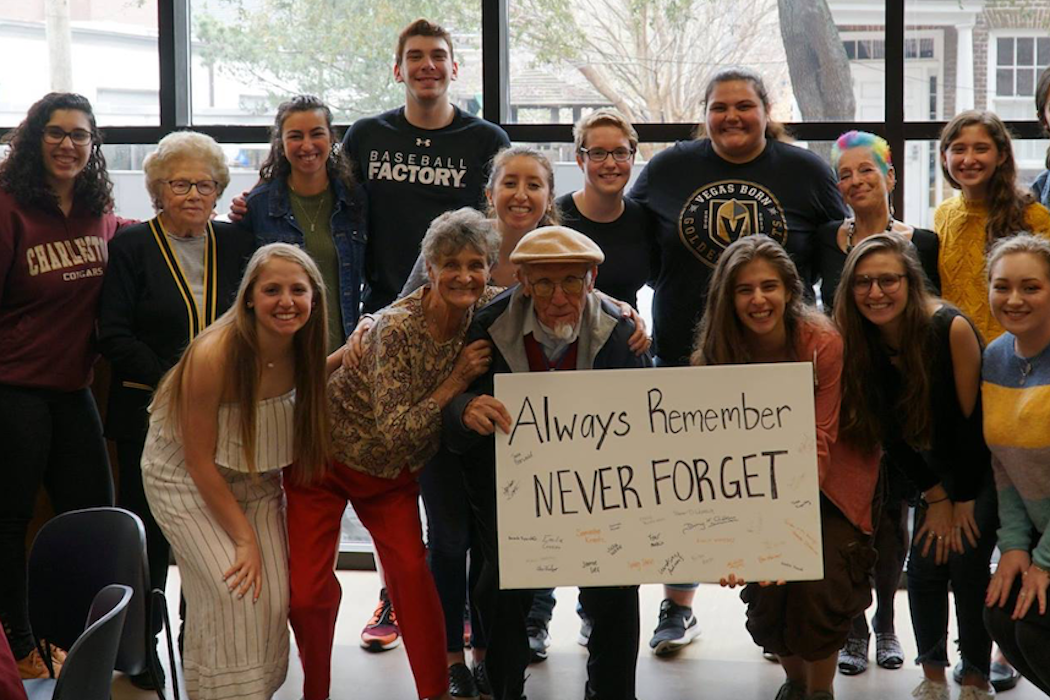
Joe Engel, joined here by fellow Holocaust survivors Rose Goldberg and Diny K. Adkins, along with College of Charleston students, dedicated his later years to speaking about his experiences during the Holocaust. Courtesy of the Zucker/Goldberg Center for Holocaust Studies

Joe Engel was and remains an icon in Charleston, South Carolina. Born in Zakroczym, Poland, he survived Auschwitz and several other concentration camps and fought with the resistance before landing on American shores as a refugee in 1949.

After retirement from his dry-cleaning business, Engel focused his later years on Holocaust education. As part of these efforts, he took to sitting on downtown park benches wearing a name tag that read “Joe Engel, Holocaust Survivor: Ask me questions” – becoming the city’s first public memorial to the victims of Nazi genocide. Knowing he would not be here to impart his message forever, Engel and his friend and fellow survivor Pincus Kolender led a drive to install the permanent memorial that now stands in Charleston’s Marion Square park.

In 2021, I moved to the city to take up my role as a professor and director of Holocaust studies at the College of Charleston. I arrived just in time to meet Engel and to teach many local students who had met him. He died the following year, at age 95.

For years, historians, educators and Jewish groups have been considering how to teach about the Holocaust after the survivors have passed on. Few of today’s college students have ever met a Holocaust survivor. Those who have likely met a child survivor, with few personal memories before 1945. American veterans of the war are almost entirely unknown to our present students; many know nothing of their own family connections to World War II.

Time marches on, distance grows, and what we call “common knowledge” changes. One alarming study from 2018 revealed that 45% of American adults could not identify a single one of the over 40,000 Nazi camps and ghettos, while 41% of younger Americans believe that Nazi Germany killed substantially less than 6 million Jews during the Holocaust.

According to a 2025 study by the Claims Conference, there are somewhat more than 200,000 survivors still alive, though their median age is 87. It is sadly expected that 7 in 10 will pass away within the next decade. With their absence near, how can educators and community members bring this history home, decreasing the perceived distance between the students of today and the lessons of the Holocaust?

Bringing history home

One method that shows promise is helping students realize the connections of their own home and their own time to a genocide that might seem far away – both on the map and in the mind.

A faded, handwritten letter in blank ink, positioned against a brown surface.
A letter dated Dec. 27, 1938, sent from Malie Landsmann to her cousin Minnie Tewel Baum of South Carolina.
Courtesy of the Jewish Heritage Collection, Addlestone Library, College of Charleston

In classes on the Holocaust, I now use a set of letters sent by a family of Polish Jews to their relatives in Camden, South Carolina. The letters themselves are powerful sources demonstrating the increasing desperation of Malie Landsmann, the main writer. In 1938, she reached out to her cousin Minnie Tewel Baum, seeking help to escape Adolf Hitler’s Germany.

Even though the two had never met, Minnie tried everything to help her cousin and her family. In the end, however, she was not successful. American immigration barriers and murderous Nazi policy took their toll, with Malie, her husband, Chaim, and their two children, Ida and Peppi, all killed at Auschwitz.

These haunting letters demonstrate the connections of the war to small-town South Carolina. They give the Holocaust a real human face and a connection to places students know.

Letter collections like these are not rare. The College of Charleston holds a second, far larger group of letters, the Helen Stern Lipton Papers, which runs to over 170 pages of correspondence between family members in South Carolina, German-occupied Europe, Russia and even Central Asia. When I was a Ph.D. student, I participated in classes using the Sara Spira postcards sent from a series of ghettos in Poland to rural Wisconsin. Further archives exist all over the United States. Most communities have connections to the Holocaust, whether via artifacts, people with direct ties or both.

The important thing is to teach in ways that can break down the mental barriers created by time and space. It is indeed the same reason that the Auschwitz-Birkenau State Museum created a traveling exhibit called “Auschwitz. Not Long Ago. Not Far Away.”

Learning from descendants

As teachers and professors attempt to bridge these divides, they often invite the descendants of Holocaust survivors to their classes to speak. Descendants can retell the stories of their parents’ or ancestors’ perseverance and survival, but what is more important is their ability to put a human face on these events and show how they remain relevant in the lives of so many.

White roses placed on a sidewalk with four inlaid, bronze memorial stones, next to four candles and a framed family photo.
The Stolpersteine memorial to the Landsmann family, installed in Berlin in 2025.
Pablo Castagnola, Anzenberger Agency. Courtesy of the Zucker/Goldberg Center for Holocaust Studies

I take these short visits a step further in a class where students train as oral history interviewers, then conduct recorded conversations with a descendant of survivors. These meetings encourage discussion of family Holocaust history, but only after the student asks the descendant about how they learned about what happened to their parent, grandparent or great-grandparent, and how this might have weighed on their own life years after the war.

This is truly the point here. The most impactful parts of these recordings are almost always the discussions of legacies; of how the families that students meet still live with the enormity of Holocaust trauma.

When a descendant tells students about the past, that is important. But when a descendant speaks of what that past means for them, their family and their community, that is so much more.

Students gain firsthand knowledge of intergenerational trauma; the difficulties of rebuilding; the prevalence of anxiety, worry and depression in survivor homes; and so much more. All of this shows students in no uncertain ways how the Holocaust still has bearing on the lives of people in our communities.

History after memory: A path forward

What’s most heartening about these methods and their successes is what they reveal about what today’s students value. In the age of AI, Big Tech and omnipresent social media, I believe it is still – and maybe even more than ever – the real human connection.

A young woman and a man in a blue suit kneel by a small memorial installed on a sidewalk of paving stones.
Chad Gibbs with student Leah Davenport, who arranged for Stolpersteine to be installed outside the Landsmann family’s home in Berlin.
Pablo Castagnola, Anzenberger Agency. Courtesy of the Zucker/Goldberg Center for Holocaust Studies

Students are drawn in by the local connections and open up to the stories of real people, brought to them in person. Often, they launch their own research to better understand the letters.

One of my students even helped turn them into classroom materials, now used well beyond our own college. Another did the painstaking work to have four new Stolpersteine, or Stumbling Stone, memorials installed in Berlin to commemorate the Landsmann family.

Never having witnessed them myself, I can only imagine the impact of Joe Engel’s conversations on those park benches in downtown Charleston.

Nothing will ever truly replace the voices of the survivors, but I believe teachers and communities can carry on his work by making history feel local and personal. As everything around us seems to show each day, little could be more important than the lessons of these people, their sources and the Holocaust.

The Conversation

Chad Gibbs does not work for, consult, own shares in or receive funding from any company or organization that would benefit from this article, and has disclosed no relevant affiliations beyond their academic appointment.

ref. Bearing witness after the witnesses are gone: How to bring Holocaust education home for a new generation – https://theconversation.com/bearing-witness-after-the-witnesses-are-gone-how-to-bring-holocaust-education-home-for-a-new-generation-272491

Ending dementia stigma could change its trajectory: Cancer’s history shows why

Source: The Conversation – Canada – By Saskia Sivananthan, Affiliate Professor, Department of Family Medicine, McGill University

At a recent party, another guest, a nurse, asked what I do for a living. I explained that as a health policy researcher, my work focuses on helping health-care systems co-ordinate care for dementia as effectively as for major conditions like cancer, diabetes or stroke. She stopped me mid-sentence.

“I don’t think you should use cancer as a comparison,” she said. “Cancer doesn’t have the stigma that dementia has. Most cancers can be treated and cured. Dementia can’t. You just can’t compare the two.”

The conversation brought to the forefront that dementia today occupies the same stigmatized, system-neglected space that cancer did half a century ago. And history shows us that stigma, not simply the absence of cures, delays progress.

Dementia taboos mirror cancer

Before the 1970s, a cancer diagnosis was widely considered a death sentence. Most physicians did not disclose the diagnosis, despite surveys showing the majority of patients wanted to know. Doctors said they concealed the truth to avoid “taking away hope” and because families preferred that patients remain unaware.

The word cancer itself was taboo. Euphemisms like “a growth” or “the Big C” were used, if the illness was discussed at all. Cancer carried the stain of shame, seen by some as a sign of personal weakness, and still does, particularly in the case of certain types of cancers like lung or liver cancer. Others viewed it as karma or divine punishment. People with cancer were quietly excluded, so much so that obituaries rarely listed cancer as the cause of death.

Sound familiar? It should.

A 2022 Canadian survey of family physicians found that 75 per cent provided care to a patient with cognitive impairment whom they had not yet informed of a diagnosis. The reasons varied: families or patients preferred not to know; clinicians felt they had no meaningful treatment to offer; or they feared “labelling” patients.

We still use dismissive expressions like “senior moment” in reference to symptoms of dementia. The word dementia itself literally translates to “out of one’s mind.” In many cultures, dementia is considered shameful and thought to be the result of witchcraft or punishment for a previous wrongdoing.

And the social exclusion is real. Dementia advocate Kate Swaffer calls it “prescribed disengagement,” the sense that society quietly ushers people with dementia out of public life.

Cancer did not change its stigma entirely because it became curable. It became curable faster because stigma was specifically being addressed and advocacy co-ordinated to push for funding and system change.

Stigma and system gaps preceded cancer breakthrough era

In fact, the first class of cancer treatments — options like surgery, chemotherapy, radiotherapy and early hormonal therapies — were introduced as far back as the 1940s, but their survival benefits were modest, much like the first generation of Alzheimer’s drugs today.

Because stigma around cancer was so entrenched, people avoided screening, delayed seeking help or refused treatment altogether, reinforcing poor outcomes and deepening the stigma.

Subsequent breakthroughs, like targeted therapies and other transformative drugs of the 1990s and 2010s, did change survival dramatically. But they landed in a landscape that had already been reshaped by something else: system co-ordination, focused, public stigma-reducing campaigns and a dramatic shift in cancer research funding.

Advocacy built the foundation for cancer system change

Starting in the 1970s, through co-ordinated advocacy led by advocates like Mary Lasker, governments began large-scale injections of research funds for cancer, built organized screening programs, launched public awareness campaigns, created standardized care pathways and invested in co-ordinating care infrastructure .

Moving cancer out of silence and into public conversations also altered clinical behaviour. Physicians increasingly disclosed diagnoses and encouraged early diagnosis, enabling earlier intervention. Survivorship became part of the narrative. Anti-discrimination frameworks strengthened. Cancer came to be understood through a public health lens rather than a moral one.

By the time highly effective therapies emerged, the system and society was far more ready for them.

Building conditions for change in dementia care

If we want the same for dementia, we need the same foundations: Co-ordinated care pathways with the infrastructure to support it, disclosure norms, national and provincial leadership bodies and ongoing public education campaigns with government backing.

I am an optimist at heart. The fact that my dinner companion now sees cancer as relatively destigmatized is, paradoxically, a sign of hope. It shows how profoundly public understanding can change within a generation.

To shift the stigma means a shift in access to care and the system itself.
Cancer shows us that stigma reduction isn’t accidental. It is created through leadership, investment and system design. Dementia deserves nothing less.

The Conversation

Saskia Sivananthan is affiliated with the Brainwell Institute, a dementia focused policy think tank

ref. Ending dementia stigma could change its trajectory: Cancer’s history shows why – https://theconversation.com/ending-dementia-stigma-could-change-its-trajectory-cancers-history-shows-why-273674

Fear at work is a hidden safety risk — and it helps explain why hazards go unreported

Source: The Conversation – Canada – By Lianne M Lefsrud, Professor and Risk, Innovation & Sustainability Chair (RISC), University of Alberta

Psychological safety — the belief that it is safe to speak up with concerns, questions or mistakes — is widely recognized as essential for organizational learning, innovation and workplace safety.

Yet its absence — interpersonal fear — is rarely examined in investigations of serious workplace incidents. My new research on workplace fatalities, conducted with several co-researchers, suggests this missing factor may help explain why hazards so often go unidentified or unreported.

We surveyed more than 4,600 workers and analyzed thousands of incident reports across five mine sites and over 100 mining and contractor companies. We asked workers: “Why aren’t hazards identified or reported?”

We found that interpersonal fear — the perception that speaking up or challenging the status quo will lead to humiliation or punishment — was one of the strongest predictors of silence. Workers who were more likely to be fearful were also more likely to withhold information.

A pattern we’ve seen before

Our recent findings echo earlier research I conducted following a fatal mining accident near Fort McMurray, Alta., in 2017, when a Suncor employee fell through ground softened by a leaking tailings pipeline and was unable to free himself.

I led a team analyzing geohazards associated with working around oilsands tailings ponds. During a safety workshop that concluded the two-year investigation, my co-researchers and I asked the attendees to answer the same question — “Why are hazards not identified or reported?”

We expected technical responses, but instead, they focused overwhelmingly on human and organizational factors: lack of training, fear, inappropriate risk tolerances, external pressures, cultural inaction and complacency.

The predominance of fear shocked us. Workers described being more afraid of the social consequences of reporting hazards than of the hazards themselves. As a result, they were putting their own lives at risk.

Our newer, larger study confirms this pattern at scale. Using machine-learning techniques, we were better able to identify where fear was most likely to flourish, its organizational causes and consequences and how it undermines companies.

We found management dismissiveness, a lack of managerial action or follow-up and a lack of training were more likely to cause fear — especially among contractors — and suppress hazard identification and reporting.

Fear isn’t limited to the frontline

Employees lower in company hierarchies tend to experience less psychological safety. But senior leaders are not immune to it either. They can encounter situations where raising concerns feels risky, particularly in executive settings where disagreement can be interpreted as “too political,” disloyal or a sign of weakness.

Leadership scholar Amy Edmondson’s research helps explain this dynamic. Her psychological safety matrix shows that fear flourishes when high performance standards are combined with low psychological safety.

In teams with high levels of psychological safety and highly challenging tasks and standards, she found employees are curious and engaged problem-solvers. However, when the same high standards exist without psychological safety (where people believe that they might be punished or humiliated for speaking up), anxiety prevails.

The goal is to have your team experience the first scenario. Because psychological safety operates at the team level, organizations can have multiple teams doing similar high-risk work with dramatically different outcomes, depending on whether people feel safe enough to speak up.

Creating safer systems starts with leadership

Since interpersonal fear is shaped by perception, it doesn’t matter whether leaders believe they are approachable; what matters is whether their teams think they are. If employees are spending more time worrying about managing impressions than operations, hazards go unreported and people are unknowingly put at risk.

Creating safer workplaces requires cultures where speaking up is not punished, dismissed or discouraged. Leaders can start by asking themselves questions: who is least likely to challenge me at work? What information might I not be hearing as a result?


Read more:
Silence speaks volumes: How mental health influences employee silence at work


Often, the employees with the most job security, such as union reps or those nearing retirement, are the most honest sources of insight. Listening to these voices is often a good place to start.

Research shows that organizations can improve psychological safety through practical leadership changes. Supervisors who listen, seek feedback, share reasoning behind decisions and are team-oriented instead of self-serving are more likely to create and maintain psychological safety.

Leaders should also pay attention to variations across teams. Useful questions to ask include:

  • Which teams are feeling fearful?

  • Which teams are feeling curious and engaged?

  • How can you create more high-performance teams?

Understanding why some teams feel safer than others can reveal opportunities for improvement.

For leaders, the greatest worry should be whether your employees are afraid to speak up. Be suspicious of “good news only” green dashboards, obsequious agreement or stony silences. Do not punish messengers — rather, embrace their candour as a gift and a sign that your organization is preventing harm.

The Conversation

Lianne M Lefsrud receives funding from the Natural Science and Engineering Research Council of Canada (NSERC), Alberta Justice, WorkSafeBC, Mitacs, Alberta Innovates, and the Lynch School of Engineering Safety and Risk Management endowed funds.

ref. Fear at work is a hidden safety risk — and it helps explain why hazards go unreported – https://theconversation.com/fear-at-work-is-a-hidden-safety-risk-and-it-helps-explain-why-hazards-go-unreported-272886

Slanguage: How the use of AI for apologies could cause the ‘Canadian Sorry’ to lose its soul

Source: The Conversation – Canada – By Joshua Gonzales, PhD Student in Management at the Lang School of Business and Economics, University of Guelph

It is a stereotype that Canadians apologize for everything. We say sorry when you bump into us. We say sorry for the weather. But as we trudge through the grey days of winter, that national instinct for politeness hits a wall of fatigue.

The temptation is obvious. With a single click, Gmail’s “Help me write” or ChatGPT can draft a polite decline to an invitation or a heartfelt thank you for a holiday sweater you’ll never wear.

It’s efficient. It’s polite. It’s grammatically perfect.

It’s also a trap.

New research suggests that when we outsource our social interactions to AI, we are trading away our reputation. Using AI to manage your social life makes you seem less warm, less moral and significantly less trustworthy.


Learning a language is hard, but even native speakers get confused by pronunciation, connotations, definitions and etymology. The lexicon is constantly evolving, especially in the social media era, where new memes, catchphrases, slang, jargon and idioms are introduced at a rapid clip.
Slanguage, The Conversation Canada’s new series, dives into how language shapes the way we see the world and what it reveals about culture, power and belonging. Welcome to the wild and wonderful world of linguistics.


The trap of efficiency

In our consumer economy, we love automation. When I order a package, I don’t need a human to type the shipping notification; I just want the box on my doorstep. We accept — even demand — efficiency from brands.

But our friends are not brands, and our relationships are not transactions.

The new study published in Computers in Human Behavior — entitled “Negative Perceptions of Outsourcing to Artificial Intelligence” by British academic Scott Claessens and other researchers — suggests that emotional dynamics follow different rules than those shaping more practical situations. The researchers found that, while we tolerate AI assistance for technical tasks like writing code or planning a daily schedule, we punish it severely in social contexts.

When you use AI to write a love letter, an apology or a wedding vow, the recipient sees a lack of effort instead of a well-written text. In relationships, effort is a strong currency of care.

Less warm, less authentic

You might think you can hack this system by being honest. Perhaps you tell your friend: “I used ChatGPT to help me find the right words, but I edited it myself.”

Unfortunately, the data doesn’t indicate this is much of a solution.

Claessens’ work investigated a “best-case” scenario, where a user treated AI as a collaborative tool, employing it for ideas and feedback rather than verbatim copying, and was fully transparent about the process.

The researchers found that the social consequences of this approach are highly task-dependent: for socio-relational tasks like writing love letters, wedding vows or apology notes, participants still rated the sender as significantly less moral, less warm and less authentic than someone who didn’t use AI.

However, for instrumental or non-social tasks like writing computer code or dinner recipes, this collaborative and honest use of AI didn’t lead to negative perceptions of moral character or warmth, even if the user was still perceived as having expended less effort.

This creates a uniquely modern anxiety for the polite Canadian. We apologize to maintain social bonds. But if we use AI to craft that apology, we sever the very bond we are trying to hold onto. An apology generated by an algorithm, no matter how polished, signals that the relationship wasn’t worth the 20 minutes it would have taken to write it yourself.

Authentic inefficiency

This friction isn’t limited to text messages.

I’ve observed a similar pattern in my own preliminary research on consumer behaviour and AI-generated art. This work was conducted with Associate Prof. Ying Zhu at the University of British Columbian, Okanagan and will be presented at the American Marketing Association’s Winter Conference.

Consumers often reject excellent AI creations in creative arts fields because they lack the moral weight of human intent.

I believe we’re entering an era where inefficiency and imperfection will become premium products. Just as a flawed hand-knit scarf means more than a mass-produced, factory-made one, a clunky, typo-ridden text message from a friend is becoming more valuable than a sonnet written by a random internet language model.

The renowned “Canadian Sorry” is only meaningful because it represents a moment of humility, a pang of guilt, the effort used to find the right words. When we outsource this type of labour, we outsource the meaning too.

So as you tackle your inbox this winter, resist the urge to let the robot take the wheel for every case. Your clients might need the perfect email, but your friends and family certainly don’t. They want to know you cared enough to find the words yourself.

The Conversation

Joshua Gonzales does not work for, consult, own shares in or receive funding from any company or organisation that would benefit from this article, and has disclosed no relevant affiliations beyond their academic appointment.

ref. Slanguage: How the use of AI for apologies could cause the ‘Canadian Sorry’ to lose its soul – https://theconversation.com/slanguage-how-the-use-of-ai-for-apologies-could-cause-the-canadian-sorry-to-lose-its-soul-273046

One venue, two speeches – how Mark Carney left Donald Trump in the dust in Davos

Source: The Conversation – UK – By Mark Shanahan, Associate Professor of Political Engagement, University of Surrey

The meeting and venue were the same, but the style and tone of the two most anticipated keynote speeches at the World Economic Forum in the Swiss town of Davos could not have been more different. On Tuesday, January 20, Canadian prime minister Mark Carney addressed the assembled political and business leaders as one of them: a national leader with deep expertise in finance.

He spoke about a “rupture” in the world order and the duty of nations to come together through appropriate coalitions for the benefit of all. It was a paean to multilateralism, but one that recognised that the US would no longer provide the glue to hold alliances together. Carney never mentioned the US by name in his speech, instead talking of “great powers” and “hegemons”.

Carney’s quiet, measured and evocative case-making demonstrated his ability to be the leader France’s Emmanuel Macron would like to be and the UK’s Keir Starmer is too cautious to be. He was clear, unequivocal and unafraid of the bully below his southern border. In standing up to the US president, Donald Trump, he appeared every inch the statesperson.

Mark Carney delivers his speech at Davos, January 21 2026.

Then, on January 21, Trump took the stage. There was none of Carney’s self-awareness and nor did he read the room recognising the strengths, talents and economic power of the audience. Trump started with humour, noting he was talking to “friends and a few enemies”.

But he quickly shifted to a riff on the greatest hits of the first year of Trump 2.0 with the usual weaving away from his script down the rabbit holes of his perceived need for vengeance. Joe Biden still takes up far too much of Trump’s head space, but the next hour could be summed up as: “Trump great: everyone else bad.”

The president is the most amazing hype man for his own greatness, but it’s a zero-sum game. For him to win, others must lose, whether that’s the UK, Macron or the unnamed female prime minister of Switzerland whom he mocked for the poverty of her tariff negotiation skills. It’s worth noting Switzerland has no prime minister and its current president is a man.

While Carney was at pains to connect with his audience of allies, Trump exists happily in his own world where support – and sovereign territory – can be bought, and fealty trumps all. As ever, Trump played fast and loose with facts, wrapping real successes, aspirations and his unique view of the truth into a paean to himself.

He actually returned to his script to make the case for taking Greenland. The case is built on a notional need for “national and international security”, underscored by pointing out the territory is “in our hemisphere”. As so many commentators have said, collective security will do the job Trump insists that only the US can – and won’t require Denmark to cede territory. But Trump is sounding ever-less the rational actor.

Contrasting visions

The coming year is one of inflection for Trump’s presidency. His Republican party may well lose control of the House and possibly the Senate in the November midterms, which would severely curtail his ability to impose his will unfettered.

Trump is focused on his legacy and demands he’s up there with former US presidents Thomas Jefferson, James Monroe, James Polk and William McKinley, expanding the American empire and its physical footprint. This may be a step too far, even for a president with such vast economic and military power.

Donald Trump’ delivers his speech at Davos, January 21 2026.

Carney’s speech played well both at home and around the world. His line, “If we’re not at the table, we’re on the menu,” clearly resonated with his fellow western leaders. His vision for how “the power of legitimacy, integrity and rules will remain strong if we choose to wield them together”, also offered a positive vision in a dark time.

Trump told the audience that he would not use “excessive strength of force” to acquire Greenland. But, ever the real estate developer, he demanded “right, title and ownership” with an ominous threat: “You can say no – we will remember.”

As Trump laid out his grand vision of protecting and cherishing the rich and aligning nations to do America’s bidding, it was in stark contrast to Carney. The hyperbole and self-aggrandising, the insults and threats, and the singular vision of seeing the world only through the personal impact it has on him mark the US president out as remarkable, even exceptional.

But is this the exceptionalism the US wants? Is America about more than the strongman politics of economic and military coercion?

The immediate reaction in the US was relief, jumping on the line that Trump won’t take Greenland by force. It will be telling to look at the commentary as the country reflects on the president’s aim of lifting America up, seemingly by dragging the rest of the world down.

One leader donned the cloak of statesmanship at Davos this week. It wasn’t Donald Trump.

The Conversation

Mark Shanahan has a new edited collection of essays, Trump Unbound, due for publication by Palgrave Macmillan in October 2026.

ref. One venue, two speeches – how Mark Carney left Donald Trump in the dust in Davos – https://theconversation.com/one-venue-two-speeches-how-mark-carney-left-donald-trump-in-the-dust-in-davos-274062

After a year of Trump, who are the winners and losers from US tariffs?

Source: The Conversation – UK – By Prachi Agarwal, Research Fellow in International Trade Policy, ODI Global

During the 2024 presidential campaign, Donald Trump promised to ease economic pressures on households and restore US economic strength. Central to that promise was the claim that tariffs would revive manufacturing and rebalance trade in America’s favour. Once in office, the second administration quickly made trade policy – especially tariffs – a central pillar of its economic agenda.

The introduction of a sweeping tariff regime on April 2, framed as “reciprocal tariffs”, became the signature economic intervention of the administration’s first year in power – and it appears we have not heard the last of it.

The tariffs were not a single event but a sequence of trade actions launched immediately after Trump’s inauguration. In January, the administration announced the “America first” trade policy. This prioritised reductions in the US trade deficit to revitalise domestic manufacturing and promised tougher economic relations with China. Sector and country-specific tariffs followed.

While Trump’s so-called “liberation day” in April set the stage as he announced a range of tariffs to levy against various countries with which the US was running a trade deficit, the implementation was delayed until August, creating prolonged uncertainty for firms and trading partners.

The tariff regime pursued three objectives: raising government revenue, reducing the US trade deficit, and compelling changes in China’s trade behaviour. But one year into Trump’s second term, has this strategy worked?

What worked

On revenue, the policy has delivered. Customs revenue rose sharply by US$287 billion (£213 billion), generating additional fiscal revenue outside the normal congressional appropriations process. In headline terms, the tariffs achieved what they were designed to do: they raised money – but mainly (96%) from American buyers.

Progress on the trade balance (exports minus imports) has been far less convincing. Despite a modest depreciation of the US dollar and stronger export growth during much of 2025, the total US trade balance (goods and services) fell by US$69 billion. While the deficit on the goods trade balance (without services) at times narrowed, there is no evidence that this will be a sustained trend.

Addressing the trade imbalance with China is at the core of the Trump’s tariff strategy. According to trade data from the US Department of Commerce, during the first ten months of 2025, US imports from China declined by 27% – the largest of all US trading partners bilateral decline observed. Tariffs on Chinese products were imposed immediately, without the transition periods granted to most other trading partners. On paper, this aligns with the administration’s objective of curbing Chinese market access.

But this contraction must be placed in context. US imports from China had already fallen by 19% between 2022 and 2024 amid rising geopolitical tensions and earlier trade restrictions. More importantly, China continues to post large global trade surpluses and has diversified both its export destinations and its product composition, reducing reliance on the US.

Rather than weakening China’s trade position, the tariff regime has accelerated supply-chain reconfiguration, as trade is now being trans-shipped through other countries before arriving in the US. Additionally, China has also increased trade with other countries that has replaced the reduction in US-China trade.


On January 20 2025, Donald Trump was sworn in as the 47th president of the United States. His first year in office has seen profound changes both in his own country and across the globe. In this series, The Conversation’s international affairs team aims to capture the mood after the first year of Trump’s second term.


As imports from China fell, US trade diversification intensified due to the uneven application of tariffs across countries. US imports from Vietnam increased by 40% and Taiwan by 61%, while imports from Mexico grew modestly by 5%. Imports from Canada declined, largely reflecting lower oil prices rather than tariff exposure. Overall, several economies increased their share of US imports, pointing to a reshuffling of suppliers rather than a reduction in US import dependence.

What did not work

The uneven rollout of the tariffs, coupled with limited data available through October 2025, complicates assessment of its impact. It is also possible that the January 2025 tariff announcements prompted US firms to bring forward imports ahead of the August implementation date, temporarily distorting trade patterns.

Nonetheless, the domestic price effects are clearer.

Evidence suggests tariff costs have largely been passed through to wholesale and retail prices, contributing to higher consumer prices of everyday goods rather than easing inflationary pressures.

Manufacturing output rose by a meagre 1% in 2025, a muted response given the scale of protection introduced. Industrial growth has also been held back by labour shortages caused by tighter immigration rules, even with strong trade protection in place.

Development impacts

Some of the significant unintended impacts of the tariff regime have been felt beyond the US. Analysis by London-based thinktank ODI Global highlights the extreme vulnerability of low- and middle-income countries caught in the crossfire with high export dependence, lack of other trade partners, and constrained fiscal space.

Combined with cuts to international aid, US higher tariffs could reduce export earnings for many of these countries by up to US$89 billion annually – about 0.7% of GDP on average. In effect, the cost of US protection has been pushed onto other countries.

Beyond this combined exposure of aid cuts and tariff increases, least developed countries (LDCs) face other economic risks. The tariffs were based on bilateral US trade deficits rather than the ability of partner countries to adapt to changes in US tariff policy. This design penalised economies that were highly dependent on the US market, and relied on labour-intensive manufacturing sectors such as clothing and footwear for employment and foreign exchange.

Women make up a large share of workforce in these sectors and have been hit harder than men by the tariff measures.
The tariff shocks transmitted quickly through reduced orders, factory closures, and unemployment, despite the absence of strategic intent to target these economies.

Looking ahead

This tariff experiment now rests in the hands of the US supreme court, with a ruling expected within days. If the reciprocal tariffs are overturned, other options remain available, including a flat 10% tariff on most countries. Under Section 122 of the 1974 Trade Act, tariffs against trade imbalances could be imposed, but only up to 15% and for a maximum of 150 days.

At the same time, the administration has signalled potential new tariffs linked to geopolitical disputes, such as Greenland. This raises the risk of widening trade conflicts.

One year on, China’s global trade position remains resilient and US trade balances show no sustained improvement. Instead, the costs of adjustment have been unevenly distributed across countries, sectors and households. In short, the tariffs may not have made America any greater, but have certainly created economic hardship for others.

The Conversation

Bernardo Arce Fernandez, ODI’s research officer, assisted with the research for this article.

Jodie Keane and Prachi Agarwal do not work for, consult, own shares in or receive funding from any company or organisation that would benefit from this article, and have disclosed no relevant affiliations beyond their academic appointment.

ref. After a year of Trump, who are the winners and losers from US tariffs? – https://theconversation.com/after-a-year-of-trump-who-are-the-winners-and-losers-from-us-tariffs-273925

I developed an app that uses drone footage to track plastic litter on beaches

Source: The Conversation – UK – By Gerard Dooly, Assistant Professor in Engineering, University of Limerick

4045/Shutterstock

Plastic pollution is one of those problems everyone can see, yet few know how to tackle it effectively. I grew up walking the beaches around Tramore in County Waterford, Ireland, where plastic debris has always been part of the coastline, including bottles, fragments of fishing gear and food packaging.

According to the UN, every year 19-23 million tonnes of plastic lands up in lakes, rivers and seas, and it has a huge impact on ecosystems, creating pollution and damaging animal habitats.

Community groups do tremendous work cleaning these beaches, but they’re essentially walking blind, guessing where plastic accumulates, missing hot spots, repeating the same stretches while problem areas may go untouched.

Years later, working in marine robotics at the University of Limerick, I began developing tools to support marine clean-up and help communities find plastic pollution along our coastline.

The question seemed straightforward: could we use drones to show people exactly where the plastic is? And could we turn finding the plastic littered on beaches and cleaning it up into something people enjoy – in other words, “gamify” it? Could we also build on other ways that drones have been used previously such as tracking wildfires or identifying shipwrecks.

Building the technology

At the University of Limerick’s Centre for Robotics and Intelligent Systems, my team combined drone-based aerial surveillance work with machine-learning algorithms (a type of artificial intelligence) to map where plastic was being littered, and this paired with a free mobile app that provides volunteers with precise GPS coordinates for targeted clean-up.

The technical challenge was more complex than it appeared. Training computer vision models to detect a bottle cap from 30 metres altitude, while distinguishing it from similar objects like seaweed, driftwood, shells and weathered rocks, required extensive field testing and checks of the accuracy of the detection system.

The development hasn’t been straightforward. Early versions of the algorithm struggled with shadows and confused driftwood for plastic bottles. We spent months refining the system through trial and error on beaches around Clare and Galway so the system can now spot plastic as small as 1cm.

We conducted hundreds of test flights across Irish coastlines under varying environmental conditions, different lighting, tidal states, weather patterns, building a robust training dataset.

How a drone finds plastic litter.

Ireland’s plastic problem

The urgency of this work becomes clear when you look at the Marine Institute’s work. Ireland’s 3,172 kilometres of coastline, the longest per capita in Europe, faces a deepening crisis.

A 2018 study found that 73% of deep-sea fish in Irish waters had ingested plastic particles. More than 250 species, including seabirds, fish, marine turtles and mammals have all been reported to ingest large items of plastics.

The costs go beyond harming wildlife, and the economic impact can be significant.

Our drone surveys revealed that some stretches of coast accumulate plastic at rates five to ten times higher than neighbouring areas, driven by ocean currents and river mouths. Without systematic monitoring, these hotspots go unaddressed.

Making the technology accessible

The plastic detection platform accepts drone imagery from any source, such as ordinary people flying their own drones.

Processing requires only standard laptop software. Users upload footage and receive GPS coordinates showing detected plastic locations. The mobile app, available free on iOS and Android, displays these locations as an interactive map.

A piece of plastic litter on a beach.
Plastic is regularly found on beaches around Europe.
Author’s own.

Community groups, schools and individuals can see nearby plastic pollution and find it, saving a lot of time.

It has already been tested with five community groups around Ireland with positive results, averaging 30 plastics spotted per ten-minute drone flight, varying by location.

Working through the EU-funded BluePoint project, which is tackling plastic pollution of coastlines around Europe, we’ve distributed over 30 drones to partners across Ireland and Europe, including county councils and environmental organisations.

The technology has been deployed in areas including Spanish Point in County Clare, where the local Tidy Towns group (litter-picking volunteers), were named joint Clean Coast Community Group of the Year 2024.

Organising a litter pick. Video by Propeller BIC (Waterford).

The wider waste story

This is part of a broader European effort to address plastic pollution. Partners such as the sports store Decathlon are exploring how to transform recovered beach plastics into new consumer products – sports equipment, textiles and components.

The challenge isn’t just collection. Beach plastics arrive contaminated with sand and salt, in mixed types and grades. Our ongoing research characterises what’s actually found on Irish coastlines, providing manufacturers with data to design appropriate sorting and recycling processes.

The open source software platforms and the drone technology have already been used in nine countries, engaging more than 2,000 people. Pilot programmes are running in France, Spain, Portugal, Brazil and the UK. What began as a question about making beach clean-ups more effective has evolved into a practical system connecting citizen action to environmental outcomes.

Community feedback from pilots has been overwhelmingly positive. Groups report that the drone-derived GPS coordinates transform clean-up work. One participating Tidy Towns group said that volunteers now head straight to flagged locations.

Groups have also reported increased participation, the gamification aspect appeals to families and participants who might not volunteer otherwise. Additionally, the data we’ve gathered so far is being used by local authorities to understand litter patterns and inform policy decisions around waste management and coastal protection.

The Conversation

Gerard Dooly works for the University of Limerick, Ireland. He receives funding under the BLUEPOINT project (EAPA_0035/2022), co-financed by the European Regional Development Fund through the Interreg Atlantic Area Programme.

ref. I developed an app that uses drone footage to track plastic litter on beaches – https://theconversation.com/i-developed-an-app-that-uses-drone-footage-to-track-plastic-litter-on-beaches-272322

Horses really can smell fear, new study claims, and it changes their behaviour

Source: The Conversation – UK – By Roberta Blake, Professor of Animal Performance Science, Anglia Ruskin University

Inna photographer/Shutterstock

Humans have long believed horses can “smell fear”. Nervous riders are often told to “relax, or the horse will feel it”. Until recently, though, there was little scientific evidence to show whether this was anything more than folklore.

A new study has found that this belief is no myth. Its results show that horses can detect chemical signals linked to human emotions, and that these signals can influence their behaviour and physiology.

Previous research has pointed to a form of emotional contagion between humans and horses. This is a phenomenon in which the emotional state of one person or animal influences the emotional state of another. But this is the first study to find evidence horses can detect human fear using their sense of smell.

Horses rely heavily on their sense of smell to understand the world around them. Their olfactory system is far more sensitive than ours, allowing them to detect subtle chemical differences in the environment.

There is scientific evidence that horses can select the most nutritious food by smelling it. A 2016 found that horses select foods based on nutrient content (such as protein), not just flavour, and that the way their body responds after eating influences future choices they make about food.

So how can horses smell our fear? Well, human emotions come with physiological changes. When people experience fear or stress, their body, face and voice changes. Their body also releases hormones such as adrenaline and cortisol, heart rate increases, and their sweat composition changes. These changes alter the chemical profile of a person’s body odour, which can carry information about their emotional state.

The scent of fear

The new study found evidence horses not only detect but also respond to human emotional odours. Horses in the study were exposed to human body odours collected via cotton pads wiped under the armpits of people.

These research participants watched either an excerpt from the 2012 horror movie Sinister (to induce fear) or clips, like the Singing in the Rain’s dance scene (to induce joy). The researchers also collected control odours with no emotional association.

The horses showed distinct behavioural and physiological changes when exposed to fear-related odours through the cotton pads, which were secured by a nylon mask on the horses’ noses. They were more alert, more reactive to sudden events and less inclined to approach humans.

And they showed increases in maximum heart rate, which indicates stress, during the exposure to the fear smell from sweat. Crucially, these responses happened without any visual or vocal cues from humans displaying fear.

Close up of dark horse's lower face, human hand reaching out to pat it.
Horses have sensitive noses.
Jaromir Chalabala/Shutterstock

This finding shows that smell alone can influence a horse’s emotional state. Horses were not reacting to tense body language, facial expressions or nervous movements – they were responding to chemical signals carried in human scent.

Previous research has shown horses seem to be sensitive to humans’ emotional states. In a May 2025 study, horses were shown videos of humans expressing fear, joy or neutral emotions in their facial expressions and voice.

Researchers measured the horses’ heart rate, behaviour and facial expressions while they watched the videos. The horses showed increased heart rates when exposed to fearful or joyful human expressions compared with neutral ones, which indicates heightened emotional arousal.

Fearful expressions depicted in the videos were associated with alert postures in the horses, like holding their head high and pointing their ears back and stress-related facial movements, like wide eyes. Joyful expressions depicted in the videos were linked to patterns associated with positive emotional states, like relaxed nostrils and ears.

Together, these findings are consistent with emotional contagion. Emotional contagion has been documented between humans and dogs, for instance, and these results suggest horses may also be affected by human emotions.

What this does – and doesn’t – mean

These studies do not suggest that horses understand fear in the same way humans do, or that they know why a person is afraid. Instead, the evidence shows horses are highly sensitive to the chemical, visual and vocal cues associated with emotional states.

Smell is probably just one part of a broader physiological system. Horses are adept at reading human posture, muscle tension, breathing patterns, heart rate and movement – all of which change when a person is anxious. These cues shape how a horse perceives and responds to a human.

Understanding how horses perceive human emotions has important implications for welfare, training and safety. Riders, handlers and therapists working with horses may unintentionally influence an animal’s emotional state through their own stress or calmness.

More broadly, the research challenges outdated assumptions about animal perception. Horses are not passive responders to human commands, as equine professionals and researchers thought until recently. They are sensitive social partners, finely tuned to the emotional signals we give off.

Horses evolved as social prey animals living in large herds on open grasslands, where survival depended on detecting danger quickly. Although humans began domesticating horses around 5,500 years ago, this is evolutionarily recent, meaning modern horses still retain highly sensitive sensory systems adapted for vigilance and social awareness.

So, when people say horses can smell fear, science now suggests they may be closer to the truth than we originally thought. And next time you are close to a horse, try to relax, and make the interaction more enjoyable for both of you.

The Conversation

Roberta Blake does not work for, consult, own shares in or receive funding from any company or organisation that would benefit from this article, and has disclosed no relevant affiliations beyond their academic appointment.

ref. Horses really can smell fear, new study claims, and it changes their behaviour – https://theconversation.com/horses-really-can-smell-fear-new-study-claims-and-it-changes-their-behaviour-273652

What’s at stake in special educational needs reform

Source: The Conversation – UK – By Paty Paliokosta, Associate Professor of Special and Inclusive Education, Kingston University

Media_Photos/Shutterstock

A campaign – backed by celebrities including actress Sally Phillips and broadcaster Chris Packham as well as MPs – is calling on the government not to scrap or reduce education, health and care plans (EHCPs).

These provide legally binding extra support for children with special educational needs. There are fears that this will be a change outlined in a forthcoming policy paper on schools.

The pressure point for the government is how much it costs. At the moment, EHCP costs come from local authority budgets, which are too low to cover them. A significant rise in EHCPs meant that councils are racking up a cumulative deficit in the billions. From 2028, these costs will be managed by the central government budget.

Mainstream schools in England currently provide what’s called “universal provision”. This is standard support for all pupils, funded by the Department for Education.

If a child needs extra help, schools must offer targeted interventions and resources to remove barriers to learning. This comes from a local authority managed notional special educational needs budget of up to £6,000 per pupil.

If progress still isn’t happening, families can request an EHCP. This unlocks additional funding from (currently) the local authority. It can be used to pay for specialist teaching, equipment, or extra staff, or for alternative provision – education in a specialist school.

Not enough money and bureaucratic delays

The system has been in real need of reform for a good while now.

Waiting times for EHCP assessments are often painfully long. Some families say they feel treated as though they are an inconvenience. Many are fighting legal battles for support: if an EHCP is denied, this can be appealed at a tribunal, where parents are usually successful.

Without the right resources in schools to meet the needs of the children they educate, teachers say they are exhausted. Sencos – teachers in mainstream schools with the overview of special educational needs, and the people holding the fragile system together – report feeling overwhelmed and undervalued. This is not sustainable, but it can be changed.

Under the current funding system, most of the increased costs come from funding special school placements, rather than on inclusive education in mainstream classrooms. The government’s December 2025 announcement of a funding investment to create 60,000 specialist placements in mainstream schools is welcome.

To make special educational needs and disabilities provision fair and effective, better management of budgets at both national and local levels, stronger leadership in schools through a properly resourced Senco role, and comprehensive training for all teachers to support inclusion is needed.

The government has recently announced £200 million to be spent on teacher training to create a “truly inclusive education system”. This very welcome investment marks a significant shift: it recognises that inclusion cannot be achieved through structural reform alone.

It requires a confident, well‑trained workforce able to meet diverse needs early and effectively. If delivered at scale and with fidelity, this could begin to rebalance the system. It would reduce dependence on EHCPs by strengthening universal and targeted provision, and easing the need for specialist placements.

EHCPs are far from perfect, but they cannot disappear overnight without reforms that place inclusion in the heart of universal education provision with statutory protection.

However, once the system is gradually robust enough, EHCPs will be needed less and less.

Without these reforms, families will continue to fight for support without knowing whether this is the best way to have their children’s needs met. Schools will feel pressured to move pupils out of mainstream settings, and costs will continue to rise.

What works

Investment in strong local provision and workforce development can reduce reliance on expensive independent placements, improve outcomes and restore trust between families and schools.

In Kirklees, Yorkshire, schools, families and communities are encouraged to engage in mutual support and shared learning to foster collective responsibility.

Some local authorities are demonstrating what reform can look like. Haringey’s Send and Inclusion Improvement Plan (2024–2025) is built on five priorities: early intervention, meeting needs locally, providing choice, working together with families, and preparing children for adulthood.

Providing early, expert support for the 800,000 UK children with lifelong speech and language challenges would transform lives and save £8 billion annually, according to the Disabled Children’s Partnership and the Speech, Language and Communication Alliance.

Universities need to be involved more than ever, equipping teachers and Sencos with neurodiversity-friendly and dyslexia-friendly research and training interweaved in mainstream, holistic instruction that can continue through in-service training and professional development opportunities.

We’ve seen that children are being placed in costly independent schools with their fees paid by the state. Many are owned by private equity firms that have turned special education into a lucrative business. This is draining public funds at an unsustainable rate, while outcomes for pupils remain stubbornly poor.

The question now is whether the government will be brave enough to overhaul a system that has become both inefficient and inequitable, and deliver sustainable reforms, beyond one-off package funds, prioritising inclusion and early support over bureaucracy and profit.

The Conversation

Paty Paliokosta does not work for, consult, own shares in or receive funding from any company or organisation that would benefit from this article, and has disclosed no relevant affiliations beyond their academic appointment.

ref. What’s at stake in special educational needs reform – https://theconversation.com/whats-at-stake-in-special-educational-needs-reform-267474